Showing posts sorted by date for query maintenance. Sort by relevance Show all posts

Tuesday, March 21, 2023

60-Minutes Does our Navy - and the Nation - a Solid. I'll take the "W."


A regular topic of conversation here and on Midrats (it came up quite a bit on Sunday’s podcast with Jerry Hendrix), is the lack of discussion in the public space about the importance of a strong Navy to our republic’s economic and military security. Sure, inside our salons, slack channels, and email threads we talk to each other a lot, but we seem to have a hard time getting our message out to the general public.

Sunday night’s 60-Minutes was an exception to the rule. There is a lot of credit to go around here. First of all, you have to give credit to the 60-Minutes team fronted by Norah O’Donnell and lead producers Keith Sharman and Roxanne Feitel. This two-segment effort was not just on a topic we all are interested in, it was just plain good journalism.

Sure, I have a nit to pic here and there, but that is just my nature. Perfect? No … but it is one of the best bits of solid, down the middle journalism about our Navy and its challenges I have seen from a major network for a long time. 

If you missed it, CBS has published the video and transcript that I’m going to pull some bits from below for conversation.

The second segment was more meatier than the first, but the first is important. It isn’t just where Big Navy got a chance to make a run at media capture with the "C-2 to the Big Deck at sea" show that we all love, but it will introduce many people to someone who is very good at his job and representing the Navy, Admiral Samuel Paparo, USN.

He gets your attention early by, even though clearly well prepared and sticking to scripted talking points and marketing pitches here and there of questionable utility, he also spoke in blunt terms in a way we don't hear enough in venues such as this;

Admiral Samuel Paparo commands the U.S. Pacific Fleet, whose 200 ships and 150,000 sailors and civilians make up 60% of the entire U.S. Navy.  We met him last month on the aircraft carrier USS Nimitz deployed near the U.S. territory of Guam, southeast of Taiwan and the People's Republic of China, or PRC.

Norah O'Donnell: You've been operating as a naval officer for 40 years. How has operating in the Western Pacific changed?

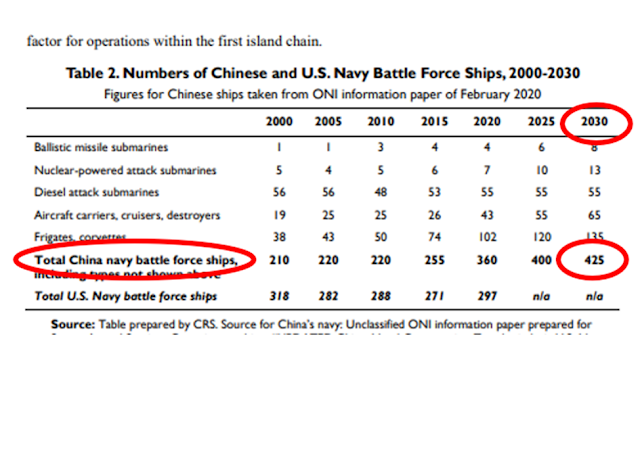
Admiral Samuel Paparo: In the early 2000s the PRC Navy mustered about 37 vessels. Today, they're mustering 350 vessels.

...

60 Minutes has spent months talking to current and former naval officers, military strategists and politicians about the state of the U.S. Navy. One common thread in our reporting is unease, both about the size of the U.S. fleet and its readiness to fight. The Navy's ships are being retired faster than they're getting replaced, while the navy of the People's Republic of China or PRC, grows larger and more lethal by the year. We asked the commander of the U.S. Pacific Fleet, Admiral Samuel Paparo, about this on our visit to the USS Nimitz, the oldest aircraft carrier in the Navy.

Admiral Samuel Paparo: We call it the Decade of Concern. We've seen a tenfold increase in the size of the PRC Navy. 

Norah O'Donnell: Technically speaking, the Chinese now have the largest navy in the world, in terms of number of ships, correct?

Admiral Samuel Paparo: Yes. Yes.

Norah O'Donnell: Do the numbers matter?

Admiral Samuel Paparo: Yes. As the saying goes, "Quantity has a quality all its own." 

This is exactly how the answer needs to be delivered. No squish, no excessive spin - acknowledge the reality of where we are. 

More of this from more senior leaders.

There was some subtlety as well. When he first said this, about 10-seconds later I decided to rewind to listen to it again. 

Norah O'Donnell: And if China invades Taiwan, what will the U.S. Navy do?

Admiral Samuel Paparo: It's a decision of the president of the United States and a decision of the Congress. It's our duty to be ready for that. But the bulk of the United States Navy will be deployed rapidly to the Western Pacific to come to the aid of Taiwan if the order comes to aid Taiwan in thwarting that invasion.

Norah O'Donnell: Is the U.S. Navy ready?

Admiral Samuel Paparo: We're ready, yes. I'll never admit to being ready enough.  

Did you catch that? He can't say, "We're not ready." as if the call comes, we can and will execute what we are tasked ... and initially will be ready to do what we can with the reduced numbers we have ... but everyone knows there is a huge asterisk next to "ready." 

We don't have enough escort ships. We don't have enough VLS tubes. We don't have a large enough airwing with long enough legs. We don't have enough reliable and robust tanking. We don't have much of a bench ... so, we are "ready" - but not even close to being "ready enough." A subtle distinction with not so subtle implications.

We also need to give a nod to our Navy for not having only the 4-stars talk to CBS. LCDR David Ash, USN got some good face time with the camera, and his fellow LCDR Matthew Carlton, USN blessed us with his superb deployment stash.

60-Minute's graphics department also gets credit for the video that the pic at the top of this post is a screen capture of. 

One of the most important things someone can do who is interested in understanding the western Pacific from the PRC's POV is to see it from their shores in an east-up orientation. Where only a small group of PRC focused navalists have shared the image or have that projection on their wall were blessed with that perspective, now it is in the minds of at least hundreds of thousands more people.

This is how the Chinese Communist Party sees the Western Pacific, including the South and East China Seas from Beijing. Taiwan is the fulcrum in what China's leaders call "the first island chain," a constellation of U.S. allies that stretches across its entire coast.  Control of Taiwan is the strategic key to unlocking direct access to the Pacific and the sea lanes where about 50% of the world's commerce gets transported.

Norah O'Donnell: China has accused the United States of trying to contain them. What do you say to China?

Admiral Samuel Paparo: I would say, "Do you need to be contained? Are you expanding? Are you an expansionist power?" To a very great extent, the United States was the champion for China's rise. And in no way are we seeking to contain China. But we are seeking for them to play by the rules.

...and that is where the friction lies. The PRC holds the "rules" in contempt because they had no role in making them. As they don't like the rules, they are bit by bit changing them. From creating no-go zones in the South China Sea that once were open seas, to putting their flag down on the island nations of the southwest Pacific, to bending policies in Latin American nations, to being an observer at the Arctic Council to match their Arctic strategy.

Rules can, and are, being changed.

There was another point where Admiral Paparo put a marker down that someone can pick up and run with ... hey, I think I'll do that now;

Norah O'Donnell: How much do you worry about the PLA Rocket Force?

Admiral Samuel Paparo: I worry. You know, I-- I'd be a fool to not worry about it. Of course I worry about the PLA Rocket Force. And of course I work every single day to develop the tactics and the techniques and the procedures to counter it, and to continue to develop the systems that can also defend-- against them.

Norah O'Donnell: About how far are we from mainland China?

Admiral Samuel Paparo: Fifteen hundred nautical miles.

Norah O'Donnell: They can hit us.

Admiral Samuel Paparo: Yes they can. If they've got the targeting in place, they could hit this aircraft carrier. If I don't want to be hit, there's something I can do about it.

Ahhhhh, yes. Time to bring back one of my favorite graphics.


Draw a 1,500nm circle from the PLARF launch sites and look at what land based airfields, bases, depots and facilities of all sorts are located under that threat. They cannot move. A navy and sea based facilities can.

Undersold point, but Paparo is leaving it there for you to run with.

As a recidivist staff weenie, I swelled with pride at this moment. Nothing happens by accident;

Norah O'Donnell: I just noticed out of the corner of my eye. 

Admiral Samuel Paparo: This is a 688 class, a Los Angeles-class attack submarine. This is the most capable submarine on the planet. You know, with the exception of the Virginia class, our newer class of submarines.

Someone on that staff needs a NCM. Having that SSN heave in to view at that time and that place is simply 5.0 staff work. BZ to everyone, and like most of this visit, just all around well done. 

We've all seen such opportunities not work out all that well, but the time on NIMITZ was simply our Navy at its best. Paparo's staff, the crew of NIMITZ, the Strike Group, and Airwing all just did a superb job. Yes, there were a few PAOisms and talking points, but the visit and interviews were honest and praiseworthy. Paparo will get most of the credit, but everyone underway on that visit just did a superb job.

However, the following comment gave me pause, and it serves to make a point...I think.

Norah O'Donnell: How much more advanced is U.S. submarine technology than Chinese capability?

Admiral Samuel Paparo: A generation.

Norah O'Donnell: A generation.

Admiral Samuel Paparo: And-- by generation, think 10 or 20 years. But broadly, I don't really talk in depth about submarine capabilities. It's the silent service.

OK, I left active duty 13 yrs ago or so, but ... ummm ... I recall the PLAN submarine force then, and I also know roughly what the state of the US SSN were in 2013 and 2003, 10 and 20 years ago. If the PRC is pushing out new construction on par with what we were building even in 2003, much less 2013 ... ummm ... eek. 

To avoid me having a drop, flop, and foam panic attack, we'll call it an overstatement mulligan.

Also, that SSN is an LA Class SSN. I'm not sure which one, but the last one was commissioned in 1996. That was 27 years ago.

So. Let's just leave that there to simmer.

Norah O'Donnell: One recent-- nonclassified war game had the U.S. prevailing but losing 20 ships, including two carriers. Does that sound about right?

Admiral Samuel Paparo: That is a plausible outcome. I can imagine a more pessimistic outcome. And I can imagine a more optimistic outcome. We should be clear-eyed about the costs that we're potentially incurring 

There are about 5,000 Americans on board the Nimitz.  The ship is nearly half a century old. Given the Navy's current needs in the Pacific and because there's fuel left in its nuclear reactors, the carrier's life at sea is going to be extended.

Again, Paparo does a superior job here, but I want to take the last bit to remind everyone what war at sea looks like. Does everyone here fully understand what a loss of two CVN and 18 other ships would mean? 

Let's go back to March 10th's FbF about the loss in combat of the USS Laffey (DD-459),

Out of that crew of 208?  57 KIA/114 WIA. That is an 82% casualty rate.

We have 5,000 Sailors on each CVN. That is 10,000 Sailors. Let's uses a round number from a Flight II Arleigh Burke DDG manning of 300 as we don't know in that wargame what the other 18 ships were lost. That gives you another 5,400 Sailors for 15,400 total. 

With a 82% casualty rate, that is 12,628 Sailors; 4,158 killed and 8,470 wounded. That is almost as many killed in the last two decades fighting in Iraq (4,431). 

Killed not in 20 years, but a few weeks to months - maybe days.

That is what it is all about, which leads us to a great point brought up by two of the best people who served in the last Congress, Representative Mike Gallagher (R-WI) and Representative Elaine Luria (D-VA). 

Again, the right people to talk to.

Norah O'Donnell: What is it about the U.S. Navy that has allowed the two of you to find common cause?

Rep. Mike Gallagher: I think we-- share a sense of the urgency of the moment. We see increasing threats from China in particular in the Indo-Pacific. We feel like we're not moving fast enough to build a bigger Navy.

...

Norah O'Donnell: What would you say the state of the U.S. Navy is today?

Rep. Elaine Luria: I think the Navy has not received the attention and resources that it needs over two decades. I mean, I served on six different ships. Every single one of those ships was either built during or a product of the fleet that was built-- in the Cold War. 

Both Mike Gallagher and Elaine Luria have lobbied for government money for the shipyards in or near their districts, but they say this is less about jobs and more about national security. 

Rep. Elaine Luria: If we don't get this right, all of these other things we're doing in Congress ultimately-- might not matter.

She is exactly right - it might not matter. That is a deep comment we should all stop and ponder a bit.

There were a few Easter Eggs here for the Front Porch. You should all take a moment to savor. We've been at this together for almost two decades. Our arguments have soaked in. Enjoy:

Over the last two decades, the Navy spent $55 billion on two investments that did not pan out. The first was a class of Destroyers known as the Zumwalt. The futuristic fighting ships were supposed to revolutionize naval warfare. Thirty-two were ordered, but only three were ever launched. The cost of each ship, by one estimate, was upwards of $8 billion, making them the three most expensive Destroyers ever put to sea.

Another example is the Littoral Combat Ship or LCS, designed to be a fast all-purpose warship for shallow waters. Thirty billion dollars later the program ran aground after structural defects and engine trouble. Within the Navy, the LCS earned the unfortunate nickname, little crappy ship.

Norah O'Donnell: The Navy's last few decades have been described as a lost generation of shipbuilding. Is that overly dramatic? 

Don't get too full of yourselves folks, but take a bow. It wouldn't be there without you.

Next we had the CNO. He was a bit more off then on here. He looked if not unwell, at least very tired. Where Paparo gets an A- for his appearance - well prepared but not over scripted - I think the CNO got at best a B- as he was over-prepared and ready with talking point phrases that were just not appropriate for the moment. 

There were some things that just clunked;

Norah O'Donnell: Is the Navy in crisis?

Admiral Mike Gilday: No, the Navy's not in crisis. The Navy is out on point every single day.

Norah O'Donnell: Is it being outpaced by China? 

Admiral Mike Gilday: No. Our Navy's still in a position to prevail. But that's not blind confidence. We are concerned with the trajectory that China's on, with China's behavior. But we are in a good position right now-- if we did ever get into a fight against them. 

Ummm, CNO; no one thinks our Navy is doing great right now. This was not a rah-rah moment, this was an opportunity to ask for help to get our maintenance, stores, and fleet numbers aligned with requirements. A lost opportunity. His comments are simply not aligned with an objective review of the facts on the ground.

We should be less concerned with the trajectory the PRC is on - which we can't control - but with the trajectory we are on - that we can.

Another morale booster for the Front Porch, the CNO did repeat something he states on a regular basis and good for him that he does. Spot on.

Admiral Mike Gilday: I think one of the things that we learned-- was that we need to-- have a design well in place before we begin bending metal. And so we are going back-- to the past, to what we did in the '80s and the '90s, the Navy has the lead.

In the first and second decades of this century, how many people rolled in to comments here to tell us our critique represented "old think," that we didn't get the "new Navy" or were disconnected from "new methods?" 

Well, ha! He who laughs last laughs best. We were right, and in 2023, the CNO is with us circa 2004.

Especially for those who are subscribers to the Midrats podcast (going in to its 14th year) and readers here through the years, one of our regular and favorite guests made and appearance, Toshi Yoshihara; 

Toshi Yoshihara: China will have about 440 ships by 2030. And that's according to the Pentagon.

Norah O'Donnell: Why is China able to build more warships more quickly than the U.S.?

Toshi Yoshihara: China has clearly invested in this defense industrial infrastructure to produce these ships, which allows them to produce multiple ships simultaneously, essentially outbuilding many of the western navies combined.

They then went on to discuss issues with industry that in addition to what we linked to at the top of the post, we also discussed with Jerry Hendrix on last Sunday's Midrats.

If you want more Toshi, you can listen to his January visit to Midrats, or read his latest book we talked about; Mao's Army Goes to Sea: The Island Campaigns and the Founding of China's Navy.

Again, the CNO lost another opportunity by refusing to state hard truths.

Norah O'Donnell: What do you see when you see China's shipbuilding program?

Admiral Mike Gilday: It's very robust.

Norah O'Donnell: Do we have enough shipyards?

Admiral Mike Gilday: No. I wish that we had more commercial shipyards. And-- over my career, we've gone from more than 30 shipyards, down to about seven that we rely upon on a day-to-day basis to build ships. 

Going back to his "no crisis" comments earlier - I'm sorry, but the above is a crisis and needs to be spoken of and acted on as such. We have allies in Congress ... we can make this push ... but we need out senior uniformed leaders to ... well ... lead on this fight.

If, as Paparo says, we have a "decade of concern" then we need to focus on what we can get to displace water and make shadows on the ramp in the next decade that we know can project power at range. It is time to push the pie-in-the-sky, perpetually oversold, transformationalist, bullshit Tomorrowland stuff to the back burner both in the budget ... and unquestionably on the public stage.

Admiral Gilday says the U.S. Navy's main advantage over China is America's sailors.  His goal is to modernize the U.S. fleet and have those sailors serving alongside hundreds of unmanned vessels by 2045.

Admiral Mike Gilday: I think unmanned is the future. And so I think that-- some 40% of our fleet in the future, I believe, is gonna be unmanned. 

Own goal. Complete distraction and off topic to the challenge at hand. On top of that, he's poorly briefed and wrong.

2045 is to today what today is to 2001. Look at what we deployed with in 2001 and what we have today. That is your slope.

There will not be that big of a shift to unmanned due to legal, technological, and C2 challenges as well as and simple logic and experience. 

What an incredibly irresponsible stance to say such thing at this in this venue. It hobbles future leaders and managers who have to put credible platforms at sea that our Sailor will need to go to war in well before some vapor-ware 2045 fever dream.

40% my ass. Whoever briefed him that this was a good place to bring this up should be fired...or he tripped himself on one of his preplanned talking points. 

We did have a recovery at the end. The show, and the CNO, ended strong. It was a great close that sells well and gets attention. We needed more of this, and maybe there was on the cutting room floor. Usually there is what, 5-hrs of interviews for a 5-minute segment?

So, nice end.

Norah O'Donnell: The U.S. defense posture is viewed as aggressive by the Chinese. The foreign minister just said, "Look, stop the containment. This may lead to conflict." 

Admiral Mike Gilday: Perhaps the Chinese minister doesn't like the fact that the U.S. Navy is operating in collaboration with dozens of navies around the world to ensure that the mar-- maritime commons remains free and open for all nations. The Chinese wanna dictate those terms. And so they don't like our presence. But our presence is not intended to be provocative. It's intended to assure and to assure-- to reassure allies and partners around the world that those sea lanes do remain open. The global economy literally floats on seawater.


Tuesday, March 14, 2023

The Three Wounds of our Amphibious Navy


To see where we are and where we need to go, it is always helpful to remind ourselves how we got here.

First let's look where we are; the Navy telling Congress to bugger-off;

Via Caitlin Kenny at DefenseOne;

The Navy is proposing to drop its amphibious fleet below 31 ships, despite an agreement with the Marine Corps and a potential violation of last year’s defense policy law. 

Sent to Congress on Monday, the Navy’s proposed $255.8 billion 2024 budget aims to retire eight warships before the end of their intended service life, including three Whidbey Island-class dock landing ships, or LSDs, that it proposed to scrap last year but which were saved by the 2023 National Defense Authorization Act

There are a lot of people out there so far this week doing great work reading the entrails of the latest budget, so I won't try to replicate their fine work here

This did not happen by accident. This is not happening as a result only of a lack of funds. This did not happen because a black cat walked in front of the CNO.

No. This is the predictable result of three things Big Navy has control of, but by acts of commission and omission, consistently made the wrong decision.


Wound One: Material Condition:

(We) did a ship-by-ship review, to understand the material state of each of the ships. What we found on the LSDs is that they are challenged in terms of readiness.

As we have covered here for the better part of two decades, as have others, the Navy decided to take savings from maintenance, hide once UNCLAS INSURV behind a classified wall, and - like someone avoiding the dentist or a regular physical - more than willing make things easy by doing nothing now, knowing full well that it will only be worse later on. Unlike tooth pain or colon cancer though, the person making things easy now is not the same as the person who will take the pain later. Kind of like a programmatic/leadership "Narcissistic Personality Disorder with Sociopathic Tendencies." 

Leadership let their fleet rot, and then pretends as if it was something that happened to the Navy, not allowed by the Navy.


Wound Two: The Tiffany Amphib:

“What we are making sure that we are doing as we move forward with our budget plans, is making sure that we have the right capabilities at the right price aligned to not only meeting military requirements, but working with industry,” Raven said. “And for LPD, we're taking a look at the acquisition strategy moving forward, again, to make sure that we would have the right capabilities at the right price and working with industry partners to put together that plan moving forward.”

From the start of the LPD-17 program, our ongoing criticism was that this was way to expensive on a per-hull basis for the mission of a LPD. From the titanium firemain on, the entire design had no respect for budget challenges to buy the numbers needed so in a future conflict, we were not one or two ships sunk from being mission ineffective, but here we are. 

It took a lot of seabags full of money and Sailor sweat to fix the ship, but her cost remains a sea-anchor if you wanted more ships in 2024. If you need 10-ships, but price each unit such that you can only buy 7 ships - you own that 3 ship delta.


Would Three: Institutional Parochialism: 

Berger on Monday reiterated the reasoning behind the 31-ship requirement for amphibs.

“Anything less incurs risk to national defense by limiting the options for our combatant commanders,” he said in a statement to Defense One. “Per strategic guidance, the Marine Corps must be able to provide the nation with crisis response capabilities and build partnerships with allies and partners in support of integrated deterrence—difficult to achieve without the requisite number of amphibious warships.”

...

Buying amphibious ships tends to be the last priority for the Navy after spending shipbuilding funds on aircraft carriers, submarines, and destroyers, Hudson Institute Senior Fellow Bryan Clark said March 9 during Defense One’s State of the Navy event.

“Whatever gets left over is what can go towards the amphibious ships and the support ships. And when you do all the numbers for that, you always end up with you know maybe not quite enough for the amphibious ships, because if you're building one LHA every four or five years that you can incrementally fund, that's a chunk of money that's on the scale of you know, $500 million a year. And then you've got maybe $500 million or a billion dollars leftover for one more amphibious ship, which isn't quite an LPD,” Clark said.

From promotion rates to "prestige" - the Gator Navy has always been like that really good offensive lineman. They do their job and no one ever hears about them. Though they are paid less and don't get endorsements, without them no quarterback would be able to shine - no team achieve victory - and yet, the bias remains.

How exactly are we supposed to take and hold territory across the vast Pacific littoral? Who will do that, with what, and in how many places?

There are a lot of emoting going on about problems now that are directly the predicable results of decisions we've made.

As we review our budget, perhaps we also need to review our institutional system of incentives and disincentives that drive such decisions; the rewards and punishments that result in the selection of the leaders who make them.

Monday, February 27, 2023

One Year in the Russo-Ukrainian War: the Big Pixels

Last Friday we looked at the seven points we discussed a year earlier the day the Russo-Ukrainian War broke out. As promised, today we look at seven points a year in everyone needs to hoist onboard.

Though I nibble on the edges a bit, these are not detailed, tactical “lessons learned.” Land combat details simply are not my bag. No, these a big pixel items. Mostly land centric like the war, but are directly transferrable to the maritime and other domains.

1. Short-War Snake Oil Salesmen are Worthy of Little but Scorn: a bit more muted than a year ago, even in winter of 2023, American short-war salesmen continue to push the WESTPAC 72-hour victory concept. In the run up to the start of the war in the winter of 2022, Russia’s leadership was sold a quick victory in Ukraine. As we’ve discussed in prior posts, their decision making process was a classic case of multi-layered optimism filtering. Political leaders like shortcuts. They like hearing things that confirm their priors - and like flies around a barnyard, yes-men (and women) surround such personalities. Smart leaders ensure they are not surrounded by yes-men. Unwise leaders create organizations where only the obsequious rise. 

Short wars are seductive and brief well. They are easy to wargame. Unless you are off Zanzibar or Grenada, they never really work out. They are products of the delusional, corrupt, or criminally incompetent - uniformed and civilian. 

If you desire a short war, you have to be positioned to fight a long war. You need to clearly plan, train, man, and equip your military to wage a long war against an adversary and win. The extra added benefit to this posture is that if done right, such a war may never come. Then in peace, you can safely argue with the peaceniks why we don’t have war, just a bloated military, as opposed to burying our children and waiting in lines with ration cards. If it does come, it ends quickly. Plan for a short war and you will probably get a long war with better than average odds you’ll lose it.

Since WWII, what are the larger wars and imperial policing actions we’ve been involved it? Korea, Vietnam, Afghanistan, and the aggregated Iraq campaigns. That is, what, two losses (Vietnam & Afghanistan) and two draws (Korea and Iraq)? OK, if you squint you can say Iraq is a “little w” – but that is an arguable point.

2. You Must Have a Sovereign Military-Industrial Complex: forget efficient in peace, you need to be effective at war and there is no long ramp-up if you get surprised. You go to war with what you have. At peace, wise policy makers must fight a hard battle against the green eye-shade accountants who spent too much time in MBA school and not enough studying the profession of arms. If a nation cannot produce the weapons its forces need, it must rely on the grace and mercy of other nations. If you are the USA, there are no other nations who have the capacity – even if they have the will and political ability to support us – to supply more than a fraction of what we would need if we found ourselves at war west of Wake. Ukraine could look to the USA and some of her allies for significant help against a larger opponent. For the USA, we’re it.

3. Deep Magazines, Running Production Lines, and Distributed Risk: If you wonder if prior and present leadership were serious in their responsibility to prepare the nation to fight and win a war against a top-tier competitor, look at the depth of your magazines and robustness of your stockpiles. Have your planning staff examine what it would take to win against the conventional “Red Most Dangerous Course of Action.” Have them include how many months, weeks, or even days of supply there are for your most important weapons systems for that fight. Where are these magazines located? What percentage are located in each area? How long can you fight if you lose the inventory of 10%, 30%, or 60% of your magazines through enemy action?

For your highest demand weapons, is there an active production line open? Is it scalable for larger production numbers? Can you produce in a year more than what you expect to expend? 

The Ukrainian experience underlines a requirement I've yet to see get traction; if the USA expects a WESTPAC conflict in the next 10-years, there is one bold-faced requirement; under no circumstances should any production line of weapons systems be allowed to go cold until its replacement achieves initial operational capability. Once those lines – and its equipment and craftsmen – are lost, they are almost impossible to get back. 

4. Range Matters: If your opponent has land-based, mobile anti-ship weapons, and the ISR to support them, you will be kept at distance from shore until that threat is eliminated. If not, be prepared to lose your capital ships in number. 

Your sea-based weapons systems must have the range to enter the fight outside that threat distance plus the additional distance to get to target. If not, be prepared to lose your capital ships in number.

Your land-based weapons systems that are inside the range of the enemy – especially in small, isolated and difficult to defend locations, cannot be considered more than a D+0 capability. To expect to use them for any length of time under the enemy’s multiple vector extended fires is a waste of personnel and resources. From 1941’s Wake Island to 2022’s Snake Island, this is a known reality the new generation need to be reminded of. Only when you own the air and water around them are they of use.  EABO call your office.

5. Cutting Edge is a Mirage: Technology (tools) are always evolving, but they are not magic beans. For every Manhattan Project there is a ME-262. The USA and her allies would have defeated Imperial Japan without the nuclear bomb – slower and with a larger butcher’s bill, but Japan's defeat was inevitable. Nazi Germany would have lost WWII even with triple the number of ME-262 – though they would have lasted a little longer and the Red Army would have penetrated much further in to Germany as a result.

Yes, the video of 2023 quad-copters dropping grenades on hapless Russian conscripts in WWI-era trenches is exciting for those raised on video games, but they are a marginal supporting system, not supported. This war will be won or lost because of artillery, armor, infantry, logistics, and intelligence. War is as it was. There are no short cuts. There is no offset. There are no easy answers. Mass, power, will.

6. Diversity Matters: …in weapons systems, that is. At peace, “one stop shopping” briefs well - where one weapon system or system of systems will be your war winning platform – but that is only true if the salesman, and that is what these people are, can see the future and have perfect knowledge of the enemy, geography, terrain, weather and even psychology. They don’t; no one does.

To succeed in war, you need to make sure that you have the correct weapons mix that gives you flexibility. You don’t need only a multitool – though these are nice to have – you need a diverse box of tools at your side. 

Let's just look at one area of Western supplied equipment for example: HIMARS is not the answer to all your indirect fire problems. The 105mm towed artillery is much better in some areas. 155mm towed and self-propelled are the better tool for others. 120mm mortars and 40mm grenade launchers are the only thing that will work for another set. Could you try to fight with HIMARS alone? Sure. Will you win? No.

Messy, inefficient, logistically complicated as they are, an effective military force – land, air, and at sea – must have a diverse set of weapons systems. No one can predict what will work best across the spectrum of possible conflict. Diversity in weaponeering options is the only way to hedge against technology, industrial, and future risk – not to mention it gives local commanders better options on how to address challenges as they present themselves on the battlefield – challenges those in a briefing room thousands of nautical miles away cannot even comprehend. 

7. Your Military May be Lying to You: In every military there is the temptation to not send bad news up the chain. Bad leaders let it be known that they want a green circle or up arrow - and don't care how they get it. No yellow - and unquestionably no red. They don't want to hear that your equipment is broke because there are no spare parts. Say you are fine. They don't want to hear that your personnel are not properly trained because there wasn't time or money to do it. Do the job anyway. They don't want to hear that things were not in proper condition when issued. You were issued what you were supposed to be issued. They want to know you are ready to go. That is how you got the FITZGERALD and MCCAIN in the summer of  2017, and that is how you got the Russian invasion a year ago.

When war comes, it won't care that you didn't CASREP your broken ESM gear. It won't care that you haven't tested your air search radar properly in months because the previous CO didn't think it would work properly and didn't want to have to ask for support. It won't care that you have no functioning ASW weapons unless your PMC helo carries one. It does not care that half your watch team does not know how to properly run their equipment and none are cross trained. It does not care that you are headed in to a heavy air threat environment with most of your VLS tubes filled with TLAM because there was no place to change the load out when the mission changed.

War does not care that the command got by with minimal manning, questionable maintenance, and thin supplies. It only knows that it will find where you have failed to do your job, and will kill you and everyone around you for that error ... as that is the nature of war.

Photo Credit: RadoJavor

Tuesday, February 14, 2023

We Have a Lot of Things to Relearn


Thinking of the American military's readiness for the next large war, there is rightfully a lot of concern that after a couple of decades of imperial policing wars in Central and Southwest Asia, that not only are we ill-equipped for a major peer conflict ashore, but that we've forgotten much of what is considered fundamental aspects of significant force-on-force combat.

The Russo-Ukrainian War has offered some good reminders, from the utility of armor, artillery, and logistics that clever peace time theorists were wishing away, but on the land side of the equation, what are some other critical capabilities that we have had the luxury of generations to forget about?

Over at the Modern War Institute, they have a reminder of something I think most of us have not given much thought to recently; the operational level fighting retreat.

New from MWI comes a 450 page book in PDF on the very subject; Armies in Retreat: Chaos, Cohesion, and Consequences;

Battlefields are dynamic. In large-scale combat operations, opposing forces seek to gain control of terrain, to outmaneuver one another, and to employ combined arms to gain positional advantage. The objective, much more often than not, is to advance. When one side is successful, that means retreat, withdrawal, or evacuation is likely for the other. Studying those armies who suffer the ignominy of retreat, then, is crucial to understanding war and command.

The word retreat, however, is almost taboo in US Army literature. The new Field Manual (FM) 3-0, Operations only uses the word five times, four of which are describing the near-destruction of the North Korean People’s Army in September 1950. ... Instead of using the word retreat, FM 3-0 uses the term retrograde—and the manual only dedicates one paragraph to retrograde operations.

For the Marine Corps, the apparent reversion to discussing retreat is similar. Marine Corps Doctrine Publication 1, Warfighting, the US Marine Corps’ capstone doctrinal document, uses neither retreat nor retrograde. Instead, it talks about “rapid, flexible, and opportunistic maneuver.” Maneuver warfare, the Marine Corps’ warfighting doctrine, focuses combat power against enemy cohesion, seeking to create “panic and paralysis, an enemy who has lost the will to resist.”

But what happens when your force is the one close to losing the will to resist? How does a commander keep an army together? The United States military has a long history of retreating, from the early days of the American Revolution to the evacuation of Afghanistan in 2021. Some retreats bought time or space. Others allowed commanders to regroup or reposition for follow-on operations. Others reflected strategic defeat.

Armies in Retreat: Chaos, Cohesion, and Consequences seeks to balance the historical and practical narrative, giving readers a better understanding of why, how, and when armies retreat. 

...

Ignoring the concept of retreat by omission or sophistry in doctrine won’t make it go away. Russian forces entering Ukraine a year ago likely did not think a retreat was in their future but a year of combat operations have revealed otherwise. The first Soviet forces into Afghanistan likely did not think they would watch a retreat across the Hairatan Bridge a decade later, nor did most of the many American forces who fought in Afghanistan over nearly two decades envision the exit from the country that took place in August 2021.

So instead of ignoring the lessons of history, we should study them to be better equipped for the future. Armies in Retreat is our effort to facilitate that study. 

Think a bit about the maritime side of the house. What topic would you like to see get this treatment as we organizationally try to focus on the war to come?

As for me, I'd like something on forward maintenance and arming centered on the Western Pacific Campaign of WWII. I also would like a similar focus in combat logistics of the same. Perhaps fighting in the face of significant unit loss like we had in the Guadalcanal Campaign.

That's my Top-3.

BZ to MWI. 

Monday, January 23, 2023

Can we Learn Something From the Air Force?


The Navy's tale of woe in trying to force the acquisition system to actually produce something besides process is almost too painful to recall, especially on the surface side of the house.

We have the walking wounded of LCS, the squib DDG-1000, the gilded promise Ford CVN, and the never-was-has-been CG(X). We have hope that we can't screw up the existing Franco-Italian FREMM in the upcoming modified to American requirements Constellation Class FFG, but we shall see if our optimism is well placed.

As we all wait with bated breath and gritted teeth on what may be with DDG(X), we should look around to see if there is a benchmark recently that did work. 

On the surface side of the house, LPD-17 won't quite make the cut as it was only made to work with a lot of additional money and Sailor sweat, though we can call it adequate, if a bit expensive and clunky in initial execution.

We can look over at the aviation side of the house, but that is quite spotty. F-35 is meeting our lowered expectations, but it is a Joint hobbled kludge. If you ignore the pile of pants that is maintenance, the sub side of the house seems to be doing quite well, but they're a special case in a variety of ways. The Super Hornet program was a great success, but that was only because NAVAIR tricked everyone in to thinking that it was just an update to the Hornet...which it was absolutely not. 

Hmmmm, a successful acquisition system from the 1990s that was a success by ... bypassing the acquisition system. Did anyone learn a lesson there?

Well, it appears the USAF did in the B-21. Via Stephen Losey at DefenseNews;

Following a dramatic unveiling of the B-21 bomber in California on Dec. 2, 2022, former Air Force leaders are holding a muted celebration. By moving from contract award to public rollout in seven years, they said in interviews with Defense News that they proved their acquisition strategy — despite McCain’s criticism — worked.

Better yet, they said, their unexpected approach might provide best practices for other major programs and serve as an antidote to the beleaguered development of the F-35 Joint Strike Fighter in the 1990s and 2000s.

Their secret? They learned how to limit bureaucracy.

“There were fewer checkers checking the checkers,” James said. “Don’t ever underestimate the ability of the Pentagon bureaucracy and these many, many reviews to slow the doggone thing down.”

Most notably, officials point to the unusual move to put the Rapid Capabilities Office in charge of the B-21′s development. That office had a narrowly focused team of skilled, experienced engineers and program managers, a board of directors to hash out key decisions and reviews, and an ability to cut through red tape, James said.

In other words, when you really want something done, you go around the system that is there to help you.

Kind of telling, isn't it?

...the Air Force’s decision to have the Rapid Capabilities Office take charge of developing the B-21 was a critical step in its acquisition process.

The Air Force created the Rapid Capabilities Office in 2003 to quickly develop, acquire and field some of the service’s highest-priority programs — many of which were classified, such as the X-37B Orbital Test Vehicle. The RCO is intended to take advantage of innovative approaches, “without the rigidity of traditional acquisition,” the Air Force said in an online fact sheet about the office.

The B-21 was a much larger program than the RCO typically managed, Wilson noted, but it worked. The office’s team on the B-21 was unusually slim compared to other programs, and it included some of the Air Force’s most experienced engineers and program managers. Most importantly, she said, they were trusted to use their judgment and go fast, without micromanagement.

“It was run very differently from other programs,” Wilson said. “You get high performers in the [RCO] program office, and you don’t crush their will to live with huge bureaucracies. … I think it’s a good example of how to do major programs better.”

Another data point in our long-standing call to uproot the not fit for purpose, accretion hobbled, rent seeking, and self-satisfied acquisitions system that best seems to serve itself. 

It is a human creation - not the revealed truth from some diety. Other systems have better served our nation. It is time to upgrade this one. 

If the end result does not have at least 50% few GS/SES, then we have failed.

Tuesday, January 10, 2023

The Surface Force's Lost Generation


Over at Defense News, Megan Eckstein has your must read to start your week. I hope she does not mind, but I'm going to pull a lot from her article. Read it in full, but there is so much here that validates what we have spent the last two decades on the Front Porch and on Midrats discussing, we need to spend some time to take a deep dive.

Back in 2009 we warned everyone that the Navy's decision to classify INSURV was nothing more than a smokescreen to hide the results of bad decisions on maintaining the readiness of our Navy from the taxpayers and allowed senior leadership to play other games as opposed to their core responsibilities. To say that almost two decades after the Cold War all of a sudden INSURV was classified was just, in a word, insulting.

In 2009, the U.S. Navy faced a readiness crisis.

The cruiser Chosin and destroyer Stout were both deemed unfit for combat operations by the service’s Board of Inspection and Survey, which at the time checked ships’ material conditions every five years.

And they weren’t the only ones. From 2005 through 2009, nearly 14% of surface ships failed their inspections, up dramatically from 6.2% from 2000 to 2004 and 3.5% from 1995 to 1999.

The crisis came after the Navy discontinued several of its Cold War-era organizations focused on maintenance and training in an effort to save money during a time without a significant threat to U.S. security.

No, the "without a significant threat" line is simply BS, an excuse, and for many who knew better ... a lie. We all saw what the People's Republic of China was building. FFS, contemporarily we were a few years in to "The Long Game" series here and we were just riding the wave smarter people set in motion.

"Without?" No, that dog just won't hunt.

This excuse was designed only to cover people who were focused on little more than building personal clout in their present job, while shifting Navy problems in to someone else's PCS cycle to solve. Sure, there was myopia by an ill-informed or just wrong cohort, but for most it was simply, as we say in horse country, "shooting up the horse."

There were some who tried at the time to fix it inside the system, but ultimately came up short. 

There were good guys, a lot of them - they just didn't get to 50.1%; 

Adm. John Harvey, who led U.S. Fleet Forces Command at the time, helped charter a fleet review panel to determine how the Navy ended up in this position.

... 

In 2010, the fleet review panel’s report, dubbed the Balisle Report after lead author retired Vice Adm. Phil Balisle, shocked the surface fleet with its data on the poor state of ship readiness and crew training. It painted a dire picture of a surface navy that needed to be fixed; otherwise, there was a risk someone could get hurt or killed.

Let's freeze that for a moment. The summer of 2010. That is 12 and a half years ago. Here is what we wrote about this in June and July of 2010. What is that, between three and four WorldWars length of time?

The review, released in 2010, was condemnatory. “The panel is in full agreement that surface force material readiness is in decline. [T]he message is clear: the trend is in the wrong direction.”

Chief among the review’s recommendations was a call for the return of readiness squadrons, which oversaw surface ship maintenance and basic training. The review found that when these squadrons were eliminated in 1995, so too was the fleet’s focus on and accountability for making deployable ships and crews.

So many of the problems we have today can be traced back to the post-Cold War arrogance of the 1990s,  Perry's Last Supper, TQL, the triumph of the accountants, layered with the Transformationalist snake oil of the following decade.  

In 2010, Harvey pushed to reinstall the readiness squadrons, but he couldn’t rally enough support from the Navy’s manning, engineering and budgeting leaders, among others. The recommendation was never implemented.

But in summer 2017, two separate collisions by Navy ships in the Western Pacific killed 17 sailors. The service once again had to dig out of a ship readiness hole, and a key leader again called for the return of the readiness squadrons. Again, the idea went nowhere.

The lives of 17 Sailors and two WorldWars after 2010 later. "Nowhere" has one hell of a butcher's bill.

“The Balisle Report gave us this tremendous look at a history, really since 2000 or so, of these various decisions that were made in various different parts of the Navy,” Harvey told Defense News. “The collective impact was very, very negative in terms of our ability to keep our ships properly manned, trained and equipped.”

...

“Bringing back the readiness squadrons,” Harvey said, “if you talked to Adm. Balisle, it was his No. 1 recommendation to do. And I agreed with that.”

Still, Harvey added, the urgency to make this major change was “overcome by other events at that time.”

"Other events..." indeed; as we documented at the time linked to above.

The U.S. Navy has not made significant progress toward growing its fleet size above 300 ships. The FY23 National Defense Authorization Act allows the service to shed 12 of the 24 ships it proposed retiring. Even with a slower retirement rate and marginally higher shipbuilding and construction funding from Congress, it will prove difficult for the Navy to grow the fleet toward 355 ships. That was the last publicly stated force structure objective, back in 2016; since then, the Navy has not officially stated a revised target. (Source: Doug Berenson/Oliver Wyman)

It is a hard sell to beg for more ships when from a material condition to a maintenance support perspective we seem to have trouble taking care of what the taxpayers have already bought us by borrowing money in the name of children yet unborn.

Kitchener said there are two key differences this time around: an advanced adversary in China that’s forcing the Navy to think about its near-term readiness to fight; and data analytics and modeling that prove the surface groups will be worth the investment.

I'm sorry, but bullsh1t.

The threat from the PRC was as well known in 2016 as it is now. I will add to this that no one has confidence on the "analytics and modeling" coming from the Navy. 

The Age of Transformationalism, gutting of maintenance, and the vaporware that was "optimal manning" have blown all credibility in the Navy's "muh metrics" claims. Kitchener's numbers may very well be perfect, but no one has any reason to believe any of them from Main St. to Congress. Sorry, but institutionally we blew that credibility over the last two decades and it will take a long time to get it back.

We would make much better headway by simply saying, "For most of this century we blew it. We were wrong. We are trying to do better." 

Some, like Harvey, gave the Navy a window to save itself a dozen+ years ago and we didn't take advantage of it.

We have years of work to do ... but Step-1 here is to admit our mistakes. Until we do that, everyone can very reasonably assume we will do it again.

Data is central to Kitchener’s new effort. He told Defense News in an interview that various efforts have identified the ways to improve ship maintenance: building up a larger inventory of select spare parts, adding capacity in key shops and departments that are potential chokepoints, increasing training and growing expertise in certain technical areas, and more.

Ahh...the "Just in Time - -TQL" hangover. What takes one year to destroy, takes five years to rebuild. All that Kitchener is saying is not new. It is, just like readiness squadrons, returning to the last baseline that worked.

Are we in the process of a "baseline reset?" That would be a good thing.

Take Destroyer Squadron 9, for example, located in Everett, Washington. Its ships are scattered geographically: one located in Everett, five in San Diego and two in Pearl Harbor, Hawaii.

I'll let you do a distance and time zone review of that for yourself. Norfolk-Mayport was hard enough.

There are reasons this exists, but none of them are satisfactory when an overall net cost is considered.

Kitchener said he’s awaiting the final recommendations of his working group this summer, but expects each fleet concentration area to have a single surface group responsible for maintaining and training all surface ships, including cruisers, destroyers, littoral combat ships and amphibious warships, based in those cities. These home ports include San Diego; Norfolk, Virginia; Mayport, Florida; Everett; Pearl Harbor; Yokosuka, Japan; Manama, Bahrain; and Rota, Spain.

I am trying to hard not to just snark old-school...but really - we have reached the point that giving commanders a chance to "walk the pier" without getting on an aircraft is something "new."

Instead of gratuitous snark, have a meme.

I mean, this is how it should be ... and seems to be heading back in the correct direction. It should be applauded. 

Each surface group would devote itself entirely to readiness. ... in the case of a maintenance casualty, the surface group back home would work to find the quickest solution, allowing the destroyer or amphibious squadron staff to continue focusing on operations. 

“This is oversight and responsibility and accountability throughout the entire” readiness cycle, Kitchener said. “The idea is, this exists in the fleet concentration area, it’s got a cadre of people that are constantly on our ships assessing, understanding what the problems are; we’re pulling the trend analysis here at the headquarters, giving them focus areas. It’s a very active, not just some sort of bureaucratic, organization.”

For those who were JOSs in the 90s, I guess a bureaucratic system focused on maintenance excellence is new and radical, but it has a track record. This is simply good stuff. We tried everything else and failed, why not try what worked?

Also, can we also make progress in the "Syllabels Reduction Act of 2023?" Can we simply go back to calling things "bases" as opposed to "Fleet Concentration Areas?" 

2 syllables and one word > 8 syllabels and three words.

As there is a lot of ruin in a nation, there was a lot in institutional capital previous generations built up prior to the 1990s that could be drawn on to pay for bad decisions, but that account is pretty much drawn down to almost nothing. 

Talk to anyone on The Hill ... it's gone.

The Navy has observed improvements in maintenance performance, but is also facing new setbacks as labor and supply chain challenges across the manufacturing sector continue to take a toll on the ship repair industry.

Rear Adm. Bill Greene, the fleet maintenance officer for U.S. Fleet Forces Command, said in the fall that only 36% of surface ships are expected to complete maintenance availabilities on time in fiscal 2022, down from 44% in fiscal 2021.

... 

 This duality is also reflected in the most recent Board of Inspection and Survey report, which noted surface ships are seeing higher overall readiness scores than the six-year average, but have more functional areas deemed “degraded” than the six-year average, using a scoring method of satisfactory, degraded or unsatisfactory.

Time for a reminder ... we need to make INSURV publicly available again. Less accountability gave us less readiness, and as a result our nation and its Navy is less secure.

What vexes the Navy, Kitchener said, is variance in maintenance performance: ... Kitchener outlined a three-step process to address this. The first step was already done under Performance to Plan ... P2P has highlighted the need to prioritize people or materials for a certain ship availability, and then coordinate activities across multiple shops at a shipyard to get a specific repair done on time.

The second step is allowing surface groups to devote their full attention to implementing the actions identified through P2P in hopes of achieving better on-time maintenance rates.

The third step, on which Kitchener said he’d offer more details soon, is creating a surface response plan that prioritizes certain ships’ readiness over others.

If a contingency arose and a combatant commander needed three destroyers, the three ships at the top of the list would be called upon to deploy on short notice. Those ships higher up on the list would be expected to stay in a peak-readiness state, and the maintenance and supply communities would act accordingly. Ships lower on the list and less likely to be called upon for unexpected tasking may be in a lower readiness condition if the fleet is short on personnel or materials, for example.

For those outside the Minotaur maze that is the US Navy's decision making, you are allowed to ask, "Why didn't we do this already?"

I know. I know.

So, what will this look like?

Kitchener said the future SURFGRU Southeast, currently named Naval Surface Squadron 14, is the “most robust” organization and has served as a model for the working group, which determined how many supply specialists, logistics personnel, diesel engine (versus gas turbine) experts, and so on, were needed to keep ships properly ready.

Kitchener said the Mayport group has 105 billets for a squadron that tends to about 10 destroyers — compared to just 10 personnel tending to nine destroyers and cruisers in Everett. The exact number of billets in each group would depend on the number of ships at a particular port, but Kitchener said the groups would more closely resemble the Mayport squadron than the Everett unit.

Mayport ... the best Sea & Anchor Detail in the Navy. 

The Navy was skipping training and maintenance to achieve unsustainable levels of at-sea presence, and it was down about 12,000 sailors thanks to the individual augmentee program that sent personnel to support joint operations in Iraq and Afghanistan. Sequestration cuts to the federal budget in 2012 further diminished readiness, Harvey explained.

No one said, "No." No one defended our Sailors or our Navy. We let the COCOMs abuse the running room they made for themselves as a result of Goldwater-Nichols and the whole accretions encumbered COCOM structure and Cult of the Joint that came with it. 

Yes, I am beating that horse and will continue to beat it until we get something fit for the 21st Century. 

No senior leader was willing to put their "career" - whatever that is after you have 4-stars - on the line to defend their Navy. We needed "Admiral No" and instead got "Admiral Hinge."

It wasn't something that happened to our Navy. No, it was something we allowed to happen to our Navy. Heck, during some of the worst of it, the Chairman of the Joint Chiefs of Staff was a USN 4-star.

“It was going to take more billets, more people. … And there just was not a clean, widespread agreement among everybody who had to agree that this was the right way to go,” Harvey said. “In the greater scheme of things and what was going on, it just never rose to the level where it had a critical mass of leadership who all said: ‘Yes.’ ”

No, plenty of billets were found for other "priorities and distractions" - they were just more important than manning, training, maintaining, and equipping a fleet to fight and win. As I've offered for years, give me the top-cover and the manning documents ashore, and I'll find your billets. Just let me recode and reassign as needed. If I need more, I'll look at afloat and DC staff. They're there - you just have to be ready to upset a different group of people who don't add warfighting value anyway.

In the end, this is the cost of distraction and ill-focus;

Retired Vice Adm. Rich Brown, who investigated one of the two fatal ship collisions in 2017 and then took command of Naval Surface Forces in 2018, resurrected the push to bring back readiness squadrons. He said that, by 2017, virtually all Balisle’s recommendations were implemented — with the readiness squadrons being the major exception.

Brown told Defense News a robust readiness squadron likely would have prevented the fatal collisions involving the destroyers Fitzgerald and John S. McCain.

In summary, yep.

The existing structure asks destroyer squadrons to oversee the maintenance and certification of ships and serve as the sea combat commander for a carrier strike group. If the squadron needs a ship to fulfill a warfighting requirement, it creates a conflict of interest that can put maintenance and training needs at risk.

Brown said this construct “failed, and we recognized that it was failing, and so that’s why the Balisle Report said, and later I said, we’ve got to do this. And we just didn’t do it.”

He called the 1980s readiness squadrons “a proven model” that restored the Navy from having a hollow fleet in the 1970s to having a robust surface force by the 1980s.

There it is again; baseline reset.

A future “high-end fight requires so much dedicated concentration and focus that we need these additional commands. They’re going to come at a cost — it’s going to come at a huge manpower cost, and the Navy’s got to buy that manpower because it’s the right thing to do for our carrier strike groups,” Brown said.

Yes, buy manpower ... but also repurpose existing bloat ashore. Yes, recoding BA/NMP is a pain - but it can be done. Yes, rice bowls and rent seekers will be upset. All it needs to be is a senior leadership priority. And at the end of the day, shouldn't the ability to fight and win at sea be number 1?

We cannot change the past, but we must acknowledge, name, and recognize past errors so that they won't be repeated. 

There is some good stuff going on as outlined in Megan's reporting, and we should see more in this direction, but no more happy talk. No more multi-syllabic bullsh1t bingo lingo. No more petty distractions.

There are a lot of smart, good people in important positions who want to do great things. They just need the right higher direction and guidance to execute.

Monday, November 14, 2022

“Hoist the Flag and Sound the Trumpet”

Following is an address delivered by Claude Berube, PhD in which he was asked to address the issue of readiness for war at the Annual Congress of the Naval Order of the United States. I asked him to make it available here.

Claude, over to you!


Thank you, John, for your kind introduction and to my fellow companions of the Naval Order of the United States for having invited me to speak at this annual congress. The views I express today are my own and not those of the Navy or any other organization with which I am affiliated.

When John Shanahan and others invited to address you, they asked me to talk about the navy of yesterday and of today with regard to readiness and discuss themes in some of my recent articles. To be frank, I was stumped. How do you condense our two centuries of history and apply it to today in about 30 minutes? In the end, I realized that I needed to frame this as a former hockey player because where I grew up, there were two houses of worship – the Catholic churches and the hockey rinks.

You see, I had this hockey coach. In the early pre-dawn practices, he’d yell at us to skate faster, hit harder, and pass more accurately. He’d yell at us when we didn’t pass to the right person during a game. He’d yell at me because I was sent to the penalty box - again. He didn’t yell because he didn’t like us. He loved the team. He was there for us. He wanted to improve our game. He wanted us to win. I want the Navy to win. And so, in that vein, ladies and gentlemen, I hope you will allow me to share a few thoughts on the question of readiness yesterday and today out of love – but without the yelling…

Our robust navy is comprised of aviation, submarine, cyber, supply, and other elements, and I fully recognize that any evaluation is incomplete without a quantifiable or qualitative assessment of those elements and their capabilities. Nevertheless, I would like to simply focus on one element – the surface navy – because it provides a unique historical thread. And in the interest of the limits of our time today I appreciate your understanding why I am truncating this to its most basic elements.

I would argue we’ve never been truly ready for war or other operations. We have done the job with what we have and what we would quickly build or assemble. To paraphrase a former secretary of defense, you go to war with the navy you have, not the navy you want.

The need for a navy has been recognized for thousands of years. The Athenian Themistocles said that “he who controls the sea controls everything.” And you cannot control the sea without a sufficient navy. By the American Revolution, we had our own naval advocate in John Paul Jones who said, “in time of peace, it is necessary to prepare, and always be prepared for war by sea…without a respectable navy, alas America.” But how do you do that?

We can go start at the American Revolution when an ad hoc navy was both constructed and procured, when merchant ships became privateers or, like the Bonhomme Richard converted to a warship. We had a continental navy, state navies, privateers, and an ally with the French navy, but coordination was always a challenge. Harassing British seaborne commerce largely fell to the privateers. During the war, 1,700 letters of marque were issued. In the last year of the war alone there were 450 privateers patrolling the Atlantic seeking British merchant ships as prizes. Privateers captured three times as many prizes as the Continental Navy. British shipping insurance, as a result, increased ten-fold to thirty percent of their cargo value. That made merchants take notice who shared their displeasure with their members of Parliament.

Following the war, absent a navy, the young nation faced a new debate about a new Constitution. And in that debate between the Federalists and Anti-Federalists, we find them just as passionate on whether to have a standing navy and the size of the navy as on any other subject. It is Alexander Hamilton in Federalist Paper 11 who argued for a standing navy – a navy of respectable weight including great ships of the line against maritime powers to place a check on them. In Federalist Paper 41, James Madison argued that the Atlantic states and towns would benefit from naval protection, “if they have hitherto been suffered to sleep quietly in their beds.”

And, so, was born a clause in Article 1 Section 8 of the new United States Constitution that Congress must “provide and maintain a navy.” What remained to be determined, however, is what size to make an eventual navy.

In the subsequent Quasi-War against France, we had our first frigates, but we needed more. Along came the subscription ships that were privately funded – the Essex, the Philadelphia, the George Washington, the Boston, and many others.  So too were those privateers, also authorized under the Constitution. The Quasi-War showed the value of a navy and that our frigates could challenge equivalent European ships, but it was supplemented by the private sector.

At the beginning of the War of 1812 the Navy only had some 17 ships. Secretary of the Treasury Albert Gallatin argued America lay up the fleet in New York rather than risk them to the Royal Navy. There were no ships of the line even though naval officers a year before the war argued for a massive building program. Letters of marque were again issued to American privateers which captured approximately 1,200 British prizes.

At the beginning of the Civil War, Secretary of the Navy Gideon Welles inherited a fleet of less than 100 ships, many of which were in disrepair or obsolete. By war’s end the US Navy had more than 600 ships, more than two-thirds of which had been merchant ships converted to wartime operations.

The U.S. had three years to prepare before joining the first world war and when it did, it did so overwhelmingly with its merchant ships, its latest warships, and the ability to transport one million soldiers and Marines without a single loss.

In 1941 the US Navy had 225 surface warships. By war’s end - only 1,370 days later - the arsenal of democracy had built another 600. On December 7, 1941, the navy had a fleet size of 790 ships. By the end of the war, we had a fleet size of 6,768.

We built 2,700 Liberty ships at 18 shipyards, we built 66 Gleaves-class destroyers at 8 shipyards, and 175 Fletcher-class destroyers at 11 shipyards. We build nearly one hundred aircraft carriers and escort carriers. The US lost more than 1,500 merchant ships during the war, but by war’s end had 4,500 ships.

What do these and other conflicts suggest?  No, we were not ready in the number of ships we would need for each conflict. However, the United States had a robust merchant service from which to draw ships and sailors, it had shipyards to quickly build or repair ships if needed, and it had time to recover and respond to the initial phases of military operations. It drew heavily from a private sector industrial base.


To our second question. Are we ready now?  We do have a tremendously capable Navy, Marine Corps, Coast Guard, and Merchant Marine. When we are at sea, we patrol, conduct humanitarian relief missions, etc. But are we ready? No, we are not ready materially or in the numbers needed to challenge the world’s largest navy in their backyard – that is China’s.

The navy has suffered from the diversion of attention and resources to two lengthy-land wars. It has suffered from costly unforced errors in lives, ships and cost. Gone is a major $750 million ship like the Bonhomme Richard in whose strike group I deployed 17 years ago.  Hundreds of millions in overhaul investment in the USS Miami, a submarine lost in a fire at the Portsmouth Naval Shipyard. Hundreds of millions and two years in the shipyard for the USS Fitzgerald and USS McCain. A mine warfighting ship lost on a reef. We have lost ships before in our history due to accidents and storms, but we don’t have ships to spare now. We need everything.


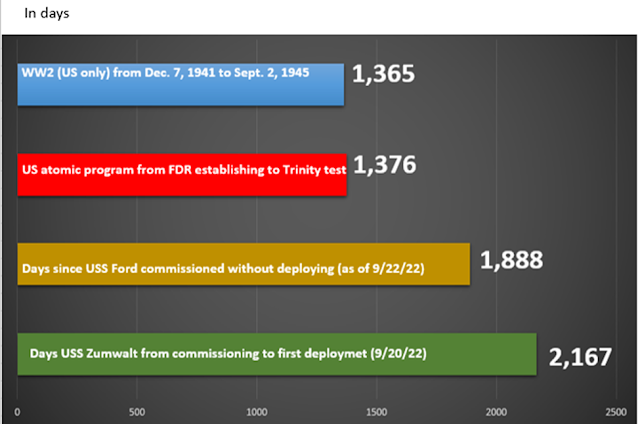
We have had three major shipbuilding programs in the past twenty years that have been a challenge.  Littoral Combat Ships decommissioning in just a few years. And while Zumwalt and Ford have finally deployed, the time from their commissioning to their first deployments is well beyond the length of US participation in the Second World War. The atomic bomb project went from program establishment to bombs on target in 1,376 days. 

Defense news recently reported that the us navy has “spent more than four years repairing one of its amphibious ships, already spending more than $100 million above what was planned. The ship is still not ready to deploy.”  The Navy, after $300 million just wants to decommission it. “Only 45% of the amphibious ship fleet is ready today compared to the navy’s 80 percent goal.”

Has the US Navy had programs that didn’t go according to plan? Of course. Although Robert Fulton built the first steam powered warship in 1815, it would be more than two decades when the technology was reliable enough from the private sector to build dual-powered ships. In 1835, Congress debated naval funding and whether to build the 120-gun ship of the line USS Pennsylvania with 1,000 sailors (that was ten percent of the size of the navy in one ship) or a dozen small sloops. In the end, Pennsylvania was built largely because the congressman who represented the shipyard in Philadelphia where it was to be built was Chair of the Naval Affairs Committee. There was the ram ship USS Katahdin, commissioned in 1896 and decommissioned only a year later.


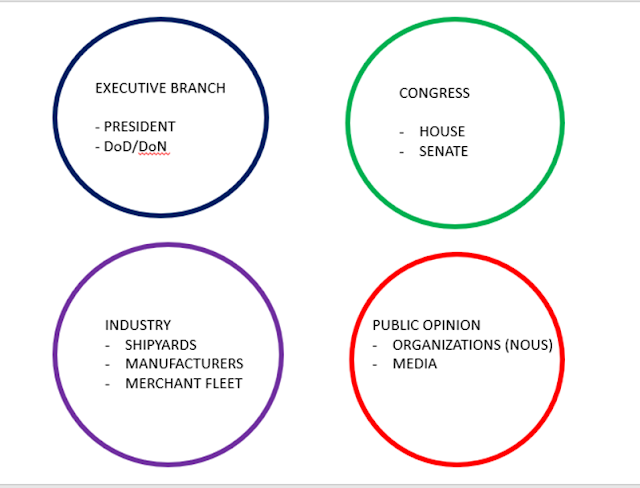
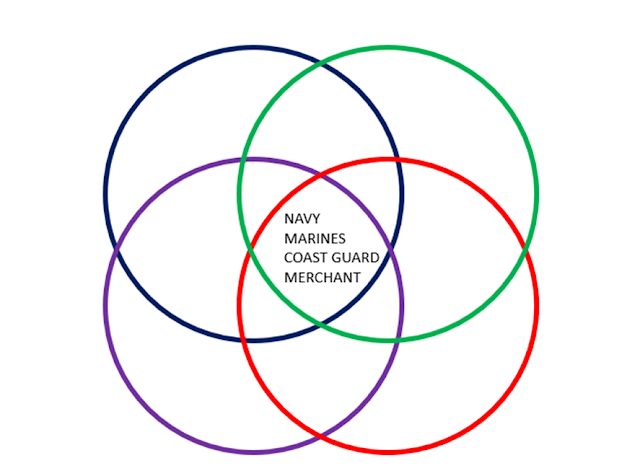
To be ready and sufficiently sized is based on four elements: the executive branch, Congress, industry, and public support. 


All those elements feed into each other. When all come together, that’s when we see a rejuvenation of the maritime services. Diminish or remove any one of those out and the equation falls apart.

At every period we increased the size and platform diversity, we had an executive branch that provided the vision and support. Even Andrew Jackson whom I wrote about in my latest book, had a recognizable maritime strategy. Others like the two Adams’, the two Roosevelts, Wilson, and Reagan understood the role of a navy and were its supporters. 


How do you quantify administration interest in the Navy? We can start with a simple criterion. Under the current administration, it took more than 200 days for a Secretary of the Navy to be confirmed – that’s a longer period from inauguration to confirmation than any other presidency.

Second, every period has had a critical mass of supporters from the legislative branch which has the Constitutional authority and responsibility to provide and maintain a navy. Absent that critical mass of support, a Navy will not be built or built better.

While watching a House Armed Services Committee hearing this year, I was struck by how a member of congress advocating for the navy was interrupted by the Chairman with this statement about China’s navy. 

“How capable are their ships? How many ships does China have deployed all around the world in any given moment? That’s a very low number from what I understand. And the capability of those ships are not as great either. So, we can all like FREAK ourselves out about all the trillions of dollars a year apparently, we have to spend on our defense budget. I think it would be helpful if we had a realistic understanding of our adversaries and where they’re at.”

He dismissed the threat of China, and he dismissed the idea of building the navy up.

I certainly respect the chairman and his role, but fundamentally disagree with his off-the-cuff assessment. China may have a low deployment rate focusing only on two regions, but it is not dissimilar to the US Navy’s rate of 15 percent in the 1980s especially when you consider it isn’t committing itself – yet – to all the regions of the world. We could do so because we had the numbers. Today our deployment rate is about 35 percent. The pace of China’s shipbuilding has meant that their ships have rarely needed to deploy more than a couple of times. Its growing fleet has allowed China to do more without degrading the material readiness of the ships. Conversely, the has struggled to maintain its ships, which are deploying at a higher rate and for longer periods. 

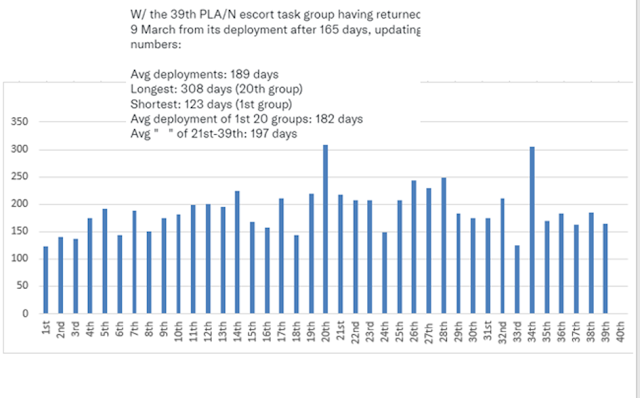
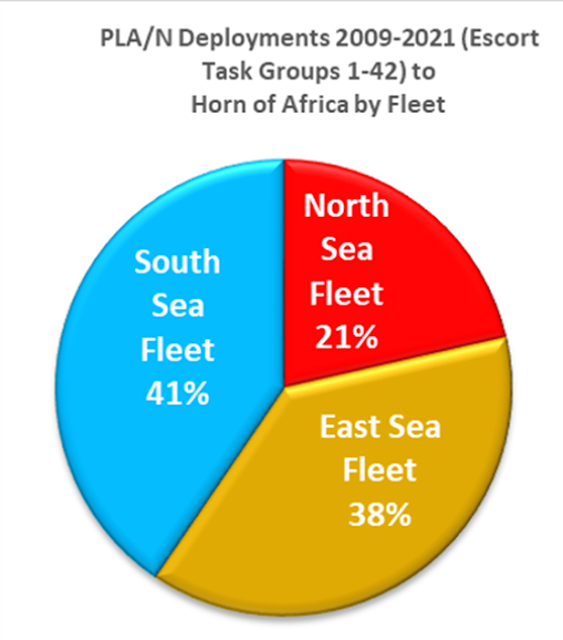
Capability comes from both technology and experience and China’s navy is gaining experience very quickly. In the past decade they’ve been sending squadrons – 42 of them -to the Horn of Africa every three or four months.

They have gained experience close to their shores and ships from every one of their fleets is operating on the other side of the world in deploying to the Horn of Africa.

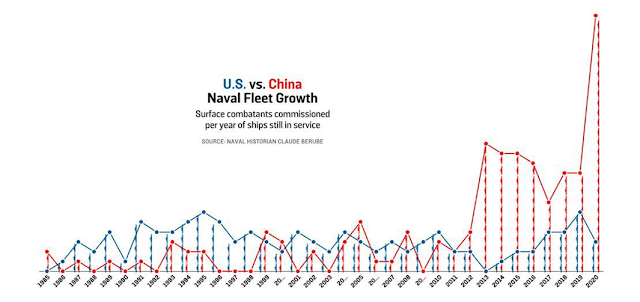
They have vastly outbuilt us in the past 10 years. Yes, that red line is China’s shipbuilding versus the blue of the us navy.


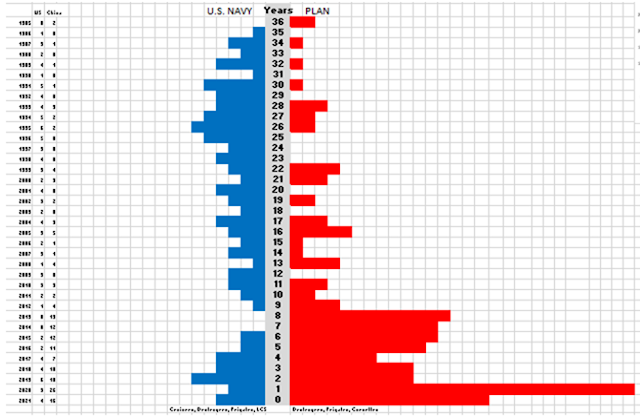
This graph represents all the major surface combatants in our fleet as of last year and their age from commissioning, so the top are the oldest ships in each fleet and the newest at the bottom. Eighty – that’s eight zero – of their surface fleet has been built in the past decade. By contrast only twenty percent of the US fleet is less than a decade old.

Testifying before the Senate Armed Services Committee in June, the Secretary of Defense said we “certainly have the most capable and dominant navy in the world and it will continue to be so going forward.” While the secretary’s sentiment is laudable, it is contrary to quantifiable trends. China isn’t a rising power – it has risen. I think we need to consider another historical example when we casually brush aside the threat of China’s navy. 

Commodore Matthew Perry visited Japan in 1854. That caused Japan to think about a navy of its own, not dissimilar to how China reacted 1996 to the Nimitz battle group transiting the Taiwan strait. In 1874, Japan launched an expedition to Taiwan. That decade their midshipmen began to study at the US Naval Academy. By 1895 their navy defeated China’s fleet in a war. In 1905, they defeated the entire Russian Eastern and Baltic fleets.

For those reasons, I think the chairman’s remarks were either insufficiently informed or intentionally dismissive.

We have incredible advocates in Congress like Elaine Luria [note: this speech was delivered before the 2022 election] and Mike Gallagher. But we need a legislative branch with advocates beyond that and beyond the shipbuilding districts. We are mired in petty partisan politics while China has a distinct advantage – they are forcibly unified and that has enabled them to build the world’s largest fleet. While we need to defend our democratic republic ideals, we need to find a way to unify.

The third element - in nearly every one of our previous conflicts, we relied heavily on the capacity of our industrial base especially shipyards. How many do we have today? To give you the scope of what we face, one shipyard in China has more capacity than all of our shipyards combined. Our shipyard capacity is limited. A 2021 Congressional Budget Office report pointed out that the four submarine shipyards were facing significant delays in completing maintenance because of the amount of work necessary has increased and they are having trouble finding workers. This has affected operational readiness.

Part of that industrial base is the size of the us merchant fleet because it was America’s maritime economy….  China has some 4,500 merchant ships; there are fewer than 80 in the US fleet. Why is this important? Because the maritime economy that built the nation in the 19th century meant shipyard jobs. It meant jobs across the nation which built systems on those ships. It meant that many families had someone who relied on the sea for it or on it. And that merchant fleet needed protection by the US Navy. That is why the public could understand the need for a navy – because it was self-interested in it. Self-interest and passion drives politics and public policy, not reason and data. But the American public has become estranged from the maritime economy that would have been familiar to our forebears.  

Earlier, I mentioned several wars but I saved one for the end. That is the war that really put the United States Navy on a global footing because it demonstrated the power of our industrial base, our ability to build modern ships, the vision of presidents, the support of congress, and an emotional support from the media and general public. That, of course, is the Spanish-American war. It is why I think it a particularly relevant war to discuss today because less than a decade before, the naval order of the United States was established by people who recognized we had a problem, who had a vision, and made the vision of a navy a reality.


The year before the Naval Order was established, the US Navy was not among the world powers.


The Spanish navy during the 1890s was a traditional power investing in traditional surface combatants. The young American navy was more diverse in its platforms, understanding the need for logistics ships, etc.

The Spanish Minister of Marine, Segismundo Bermejo had assessed the situation like this: the Spanish navy was experienced and a global power; the US Navy was young and inexperienced. On February 15, 1898 – the day the Maine exploded - he wrote to Admiral Cervera that it was his intent to blockade the American coast. The day after Cervera wrote back that the ships of the Havana station were badly worn out and that the Spanish naval force compared to the United States was approximately one to three, therefore a blockade wasn’t possible.

On April 22, three days after the declaration of war, Cervera wrote to Bermejo that “nothing can be expected of this expedition except the total destruction of the fleet or its hasty and demoralized return.” The Colon didn’t have its big guns. The 5.5 inch ammunition, with the exception of about 300 rounds, was bad. Two other ships had defective guns. They didn’t have a single torpedo. The Vizcaya could no longer steam. There was no plan, which he had much desired and suggested in vain. In short, he wrote, “it is a disaster already, and it is to be feared that it will be a more frightful one before long.” Privately, Cervera had been critical of the state of the Spanish navy before this because of its lack of money and frantically inefficient bureaucracy.”

Regardless, Cervera did his duty and in July would face the American fleet off Santiago. In his last address to his squadron, Cervera said “the solemn moment of fighting has come. The sacred name of Spain and the glorious honor of her flag so demands…the enemy covets our old and glorious hulls. They have sent the whole power of their young navy against us so as to achieve this goal. Hoist the flag and surrender no ship. Sound the trumpet for the combat. May God receive our souls.”

Every ship under his command was lost to the Americans. He and 39 of his officers were then held as prisoners of war at the US Naval Academy and treated as heroes by the American public.

What of Spain’s Asiatic fleet that was defeated at Manila Bay? Admiral George Dewey would write in his autobiography, “the Spanish government attempted to make a scape-goat of poor Admiral Montojo, the victim of their own shortcomings and maladministration.”

We would hope to rely on our allies in war and access to distant waters, but I think there’s another lesson from the Spanish-American war, a concern Admiral Dewey wrote about himself in his autobiography. His biggest concern after his victory at Manila Bay was that he’d face more Spanish. Specifically, a third squadron – a relief squadron – had gotten underway from Spain under Admiral Camara. He expected to resupply in Egypt. If Camara had that coal, Dewey wrote, there would be nothing that stopped him. But the coal was denied and Camara was forced to return to Spain. This isn’t unusual. Think about the start of the Iraq war when an entire infantry division was denied access through Turkey. Can we always rely on other nations great and small especially in a potential conflict with China when nations must act in their self-interest?

A final point. Some may argue that China’s navy is only slightly larger than ours. But if war comes and it is anywhere near the South China Sea they will be able to bring to bear their entire fleet in a matter of days – by the end of the decade, the Congressional Research Service estimates they will have 425 ships.  

How many of our ships could we get in theater in days or weeks?  100? 150?  That would be a one to three advantage, the same concern Cervera voiced about his proportion to the Americans. We have an incredibly capable force and equally impressive sailors. But we have to assess how unique, innovative technology in small numbers will do against a larger force. When I was a defense contractor in the 1990s, one of my senior colleagues was Bud Rundell, a B-17 bomber pilot shot down over Merzberg on his 13th mission. He told me of seeing a Me-262 during one mission, but there were too many bombers to counter that one innovative jet. What of German advances in tanks, submarines, or V-1 and V-2 rockets during the Second World War? How much did unique, advanced technology impact the result against an overwhelming Soviet and Allied force?

To close out, I mentioned at the beginning of my talk that my town had two houses of worship – the hockey arenas and the Catholic churches.

Fifteen years ago, I was in Ottawa sitting in a chapel - the Rideau Street Chapel. Coincidentally it belonged to the same religious order that founded a hospital in my town and where my family worked. As I sat in a pew, I observed the artistry of the fan-vaulted ceilings and listened to a chorus of forty voices. But the chapel was no longer on Rideau Street. It had been deconstructed and moved to the interior of the National Gallery of Canada where speakers played a recording of the chorus. That morning I read in the paper an article about communion hosts – the center piece of the Catholic mass – had found a resurgent popularity in Quebec as a common, secular snack. Unlike my childhood, the churches in Quebec that had a Catholic faith for three centuries was in steep decline, its churches empty, and its foundations were now viewed as artifacts. 

A similar feeling struck me a few years ago when I was in England visiting the Portsmouth naval museums, recognizing the glory years of the Royal Navy that ruled the seas, and yet the Royal Navy today had less than two dozen destroyers and frigates. It reminded me of an old Rudyard Kipling poem which lamented that “far called, our navies melt away.”

Certainly, in my current professional capacity, I understand the value of museums like those mentioned and teaching our history to the public, but they can too easily be reminders of yesteryear rather than what is needed now and tomorrow. Our country may have grown beyond a symbiotic life with the sea to one of simple indifference, relegated to galleries and exhibits and artifacts.

We as a nation and a navy are not ready because we have chosen not to be. What do we need to prepare for a potential conflict with China?

We need executive vision and action. 

We need congressional interest, oversight and funding. 

We need a navy to build operational platforms. 

We need a much larger industrial base. 

We need a public that has a direct relationship to our maritime services that understands they have skin in this Great Game.

We must become ready. But whether or not we are when the time comes, like Cervera, we will do our duty and go with courage regardless of the fate that awaits us.

Is there hope? Certainly.  

I see it in an incredibly capable Secretary of the Navy. 

I see it with some outstanding admirals.

I see it in the commitment and resiliency of our officers and sailors.

And I see it every day in the creative and energetic midshipmen I teach at the Academy, the future of our naval services. 

Thank you.


Claude Berube, PhD, is the author of “On Wide Seas: The US Navy in the Jacksonian Era” and several other books including his third novel, “The Philippine Pact” (2023). He has worked on Capitol Hill, in the defense industry, and the Office of Naval Intelligence. A Commander in the US Navy Reserve, he is currently assigned to a unit with Navy Warfare Development Center. Since 2005 he has taught in the Political Science and History Departments at the US Naval Academy.