Showing posts with label Long Game. Show all posts

Tuesday, March 07, 2023

Keeping an Eye on the Long Game: Part XCVII


As important as it is to count the number and type of warships the People's Republic of China (PRC) is building for their navy is, how productive their shipyards are, and even the negative impact of their crashing demographics - there are other things that are arguably more important to track in order to see what the challenge will be before it comes over the horizon. 

That is what we have been doing for the last 18-years of the "Long Game" series on the PRC - looking further than the threat of the next few POM cycles. The PRC is playing a long game, we should do our best to understand it.

Where a warship has an effective life of 30-yrs or a bit more, there are assets that last much longer, continually modernize themselves, and when combined together, are much more powerful in aggregate than the sum of the individuals - that is human capital, specifically intellectual capital.

In 2023, the American taxpayer and their elected representatives would not stand by and accept if our defense contractors were building warships, aircraft, and armored vehicles for the PRC's military (one hopes). No arguments from industry about profits or the number of jobs these contracts would bring to communities in the USA would gain traction (one hopes). If anything, it would bring a popular revolt (one hopes).   

If that is true, then why would the American higher education system be any different? Specifically I am referencing the top research universities - which almost all American taxpayers pay for - STEM undergraduate, and especially the very few masters and PhD programs? 

I don't care if they are paying full price - why are we helping the PRC develop their future technology?

Anyone who, like your humble blogg'r, has kids and relatives of college age whose graduation ceremonies you attend can tell, PRC passport holders are taking up a HUGE portion of available slots. In a highly competitive environment, the difference between getting a spot or not in highly competitive programs at our top universities is a matter of small degrees. For each PRC national getting a PhD in chemical engineering at a top tier university, that is an American citizen - or the citizen of an allied nation - who is not.

This has been going on for decades. What is the result? 

Over at Breaking Defense there is a nice wakeup call to what we have helped create;

In a new report from the Australian Strategic Policy Institute (ASPI), the US comes second to China in the majority of critical technology research areas examined, like artificial intelligence, robotics, biotechnology and quantum technology and specifically in defense and space-related technologies. The report uses ASPI’s new Critical Technology Tracker, a tool that lets users track 44 technologies considered “foundational” for national security, economies and more areas.

...

China is outpacing the US and other democratic nations in 37 out of 44 technology research areas considered advanced and critical, setting the stage for potentially devastating immediate and long-term consequences if western nations don’t “wake up,” according to a think tank’s latest findings. 

In a large part building off the first generation of people educated in the USA and other Western nations' best universities, the PRC has some good universities ... but they cannot hold a candle to the culture of innovation and research at ours. In dual use technology areas ... we are not just helping them get a technological edge, we are helping them bring their military closer to a qualitive equality - eating away at our hedge against the quantity a nation 4x the size of ours will bring to any fight.

In many of these areas, the PRC is not a "pacing" or "rising" threat - they've already lapped us;

“To close, and surpass, the technological gap China is creating, the US not only needs to invest more, but also harness the power of commercial data to inform strategic investments to expel foreign influence and adversarial capital from our industrial base,” she added. “Only then can we begin to find America’s edge in the fight against China.”
People matter.

We cannot change the mistakes of the past. The PRC has what they have.

“In the long term, China’s leading research position means that it has set itself up to excel not just in current technological development in almost all sectors, but in future technologies that don’t yet exist…,” the report says.

What we can do is control our decisions for the future. If someone from the PRC wants to come to the USA to get a PhD in Gender Studies; knock yourself out. Comparative French Literature? Sure.

Other things ... naw ... 

ASPI made a total of 23 recommendations in its report, calling for increased investments in areas like research and development, talent development and the production of intelligence strategies, while also advocating for governments to come up with more creative policy ideas and more collaboration between partners and allies. 
This is the point of the article that I started to get frustrated. You can almost feel the author trying NOT to propose what is the most logical first step; stop training your adversaries.

Until we stop underwriting the development and ongoing modernization of the PRC's intellectual capital, their strength and dominance in existing and emerging strategic dual use technology will only grow.

Universities will not do it. At the State level, citizens need to tell their governors and state legislatures they don't want their universities sending citizens away in order to take PRC money. At the federal level, Congress must act where appropriate.

Graph credit Eric Rosenblum.


Tuesday, January 31, 2023

Keeping an Eye on the Long Game: Part XCVI

Since August of last year, this picture keeps cropping up, and for good reason.

Images posted on the Chinese social media platform Weibo show five hulls of the Luyang III-class Type 052 destroyer under construction at the state-owned Dalian Shipyard in Liaoning province, northeast China

China is building at a wartime pace - more than just these five - for a reason. They have plans ... or at least want to be ready to execute a plan ... one long in the making.

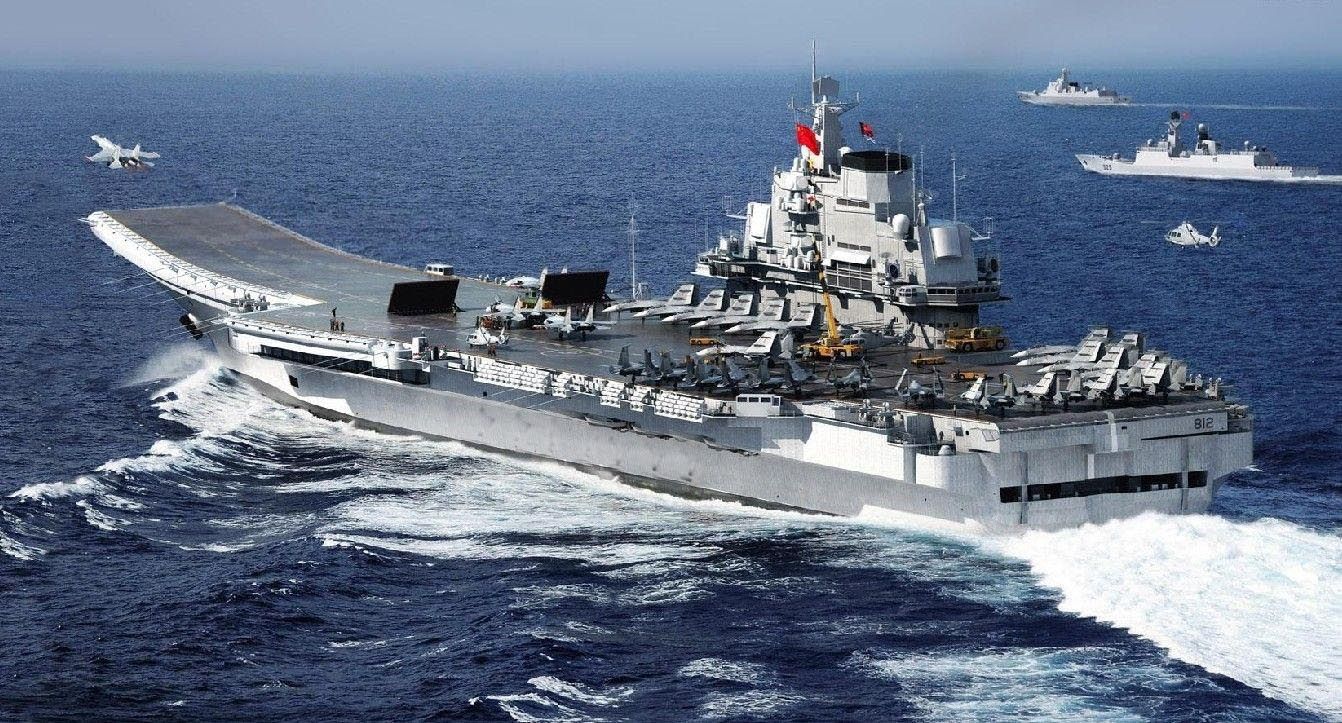
While we're at it, let's bring up a picture of the People's Liberation Army Navy's first aircraft carrier Liaoning - without which they would be at least one if not two decades behind in building their carrier fleet.


While it is encouraging that in the last few years "official Washington" has reached the pivot point in seeing the PRC's plans - it is almost criminal the lack imagination and vision on our part seeing it, especially in the 1990s when was the point everyone should have seen the game was afoot.

Just two datapoints, both related to these two pics.

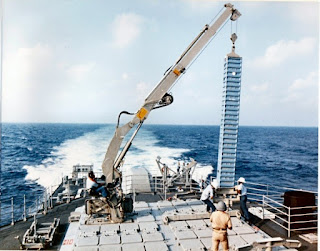
"The Long Game" was an old story by the time we started it in 2004. It has its roots a lot further back. I think the first tickle of the idea came to Ensign Salamander back in 1990 when he caught a bit of info in the local paper about something that dominated the skyline for anyone coming in or out of Mayport.

Go to the pic at the top and look at those cranes and then return here. 

Know what the pic below is?


That's right - it was the original plan for "Goat Island" in the St. Johns River in northeast Florida. Today is is known as Blount Island.

There were big plans there in the 1960s and 70s;

...Offshore Power Systems (OPS) was formed on July 6, 1972 as a 50/50 joint venture between Tenneco Power Systems (who owned the Newport News shipyard) and Westinghouse Electric Corporation. It proposed to design, manufacture, and market complete nuclear power plants of a standardized design and integrated with specially designed floating platforms 5.

Each floating nuclear power station (FNPS) would contain two or more FNPPs within a protective breakwater. The individual plants were to be 1150 MWe Westinghouse four-loop PWRs with ice-condenser containments. They had once-through steam condenser cooling with no cooling towers. Electricity was to be transmitted at high-voltage (345 kV) through submerged cables beneath the sea bottom. A shore support facility would provide a staging area, a docking facility, office buildings, and parking.

At the time, the largest crane of its type in the world, just one, was at Blount Island - but the anti-nuclear movement in the 1970s killed OPS before any construction could be started.

That crane though...what was to be done with that? In 1990, in the heart of the Bush41 Presidency;

A REMNANT of a futuristic project that would have supplied cities with electricity from floating nuclear power plants is about to leave Florida. The world's largest crane, designed to build the nuclear systems, is being dismantled along the St. Johns River for shipment to China. The crane is being taken down by workers from the China State Shipbuilding Corp. at Blount Island. The Chinese reportedly paid $3 million for the 38-story crane, which cost $15 million when built for Offshore Power Systems.

Ensign Salamander - always suspecting the worse of all communist nations and enraged that we would do any business with them, was unpleased, but had a lot of PQS to do and was keeping a weather eye to that Iraq thing and hoped his betters knew what they were doing.

So began a bi-partisan decade of stupid acts.

Quick, go up to look at the PLAN carrier pic above again then come back.

Where did that start?


It was a mission like no other. In the aftermath of the Soviet Union's collapse, one businessman armed with cash and a casino cover story scooped the world to buy the unfinished hulk of a Ukrainian aircraft carrier that would become the centrepiece of the PLA Navy.

Speaking to the media for the first time, the Hong Kong-based businessman at the heart of the undertaking reveals in a two-part series the details of the little-known, behind-the-scenes odyssey to realise China's long-held dream of owning such a warship.

Xu Zengping disclosed that the militarily sensitive original engines of the carrier were intact when Ukraine sold the vessel in 1998. This is contrary to what Beijing told the world at the time.

Soon to be LCDR Salamander didn't like this either, but he was focused on that guy in Iraq who needed a good spanking for trying to kill Bush41, so he hoped  his betters knew what they were doing. He had his suspicions because we were also selling MIRV technology to the PRC, but what did I know?

His betters didn't.
Karginov told the media: “The unfinished aircraft carrier Varyag was handed over to Ukraine and then sold to China to convert it into a casino. After China received the ship, it completed its construction and renamed it the Liaoning ship. The ship was originally supposed to become one of the main ships of the USSR.”

I'm not really mad at the PRC. I'm actually quite impressed with their leadership's long term vision, drive, and follow through. 

Are we thinking as long-term? Is our defense nomenklatura focused on the Long Game ... or any game at all outside the Beltway?

Have we learned?

Tuesday, January 03, 2023

Kaplan's Elegant Decline at 15


Back in the November 2007 issue of The Atlantic, Robert D. Kaplan published an essay that still comes to mind on a regular basis a decade and a half after its publication; America's Elegant Decline. I first mentioned it ten months after its publication while I was in Afghanistan, and then only briefly. 

At 15, I think it is time to see how it holds up.

15 years is a long time - but it also passes quickly. 15 years from now would be January of 2038. You know all that talk about "2040" in the last year, well you're one POM cycle away ... and while some things we think about the future to come will be roughly correct, some will be quite off. That is normal and should be expected. With that benchmark in place, Elegant Decline holds up pretty well.

Before we dive in, let's remember the time and place of 2007. Obama was still the junior Senator from Illinois. The surge in Iraq was almost at its peak and at the time success was iffy. Though we knew at CENTCOM in mid-Summer of 2007 that NATO culminated in Afghanistan and the USA would have to step in soon as we could, in general Afghanistan - the good war - was seen as in good hands with NATO.

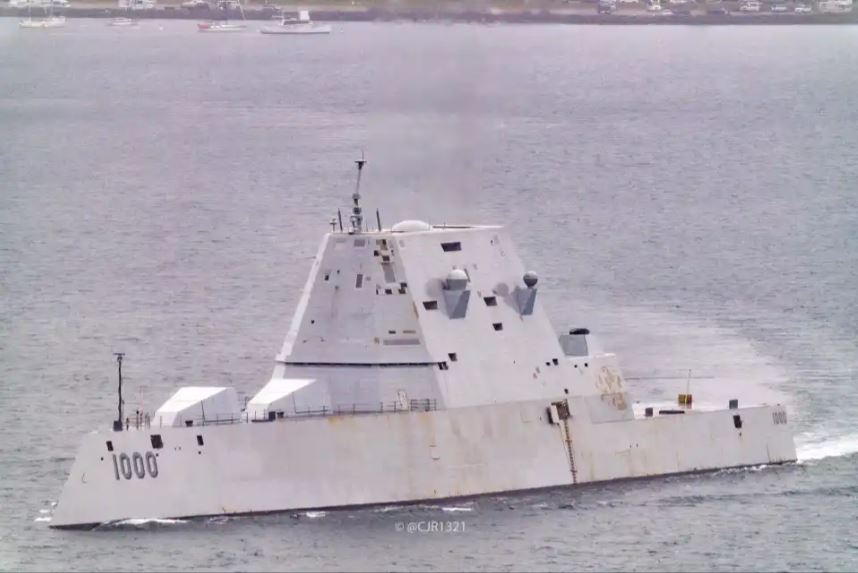
Though the cheap seats were warning otherwise, the Navy let everyone know of the glories of Transformation embodied by LCS, DDG-1000 and CG(X) were going to bring if everyone would just shut up and color ... a period that would end 18-months after Elegant Decline with the truncating to 3-ships of the Zumwalt class ... and you know the rest as we rolled in to the Age of Salamander to prepare everyone for The Terrible 20s.

So, in to that moment Kaplan dedicates the first third of his article reminding everyone of some truths are were as correct in 2007 as they are in 2023;

Beware pendulum swings. Before 9/11, not enough U.S. generals believed that the future of war was unconventional and tied to global anarchy. ... Now the Pentagon is consumed by a focus on urban warfare and counterinsurgency; ... But have we pushed it too far? We may finally master the art of counterinsurgency just in time for it to recede in importance.

...Though counterinsurgency will remain a core part of our military doctrine, the Pentagon does not have the luxury of planning for one military future; it must plan for several.

"Regular wars" between major states could be as frequent in the 21st century as they were in the 20th. ... these future wars will not require any "manifestation of insanity by political leaders," nor even an "aberration from normal statecraft, " but may come about merely because of what Thucydides recognized as "fear, honour, and interest."

..

The current catchphrase is boots on the ground; in the future it could be hulls in the water. 

...

A "peaceful, gain-loving nation" like the United States "is not far-sighted, and far-sightedness is needed for adequate military preparation, especially in these days," warned Navy Captain Alfred Thayer Mahan in 1890..

This is when he transitions to what he, rightfully, sees as a primary indicator of America's decline - its Navy - something that dominates the other 2/3 of the article.

...too few strategists at the time were thinking seriously about sea power. Today we are similarly obsessed with dirty land wars, and our 300-ship Navy is roughly half the size it was in the mid-1980s.

A great navy is like oxygen: You notice it only when it is gone. But the strength of a nation's sea presence, more than any other indicator, has throughout history often been the best barometer of that nation's power and prospects.

I just wanted to take a note to nod at the hard work led by Rep. Mike Gallagher (R-WI) in the changes to Section 8062(a) of USC Title 10, 15-years after Elegant Decline, to put this in to law. 

Our friend Bryan McGrath has a superb summary of the changes and their importance here.

Back to Elegant Decline - where Kaplan does a great job outlining more nuggets of unalloyed truths;

Our sea power allows us to lose a limited war...Army units can't forward-deploy anywhere in significant numbers without a national debate. Not so the Navy. ... Great navies help preserve international stability. 

...

In an age where 90 percent of global commerce travels by sea, and 95 percent of our imports and exports from outside North American do the same (even as that trade volume is set to double by 2020), and when 75 percent of the world's population is clustered within 200 miles of the sea, the relative decline of our Navy is a big, dangerous fact to which our elites appear blind.

Well, it didn't double, but it did go up by 30%.


A lot of you will remember this well;

...in a 1954 article in Proceedings ... a young Harvard academic named Samuel P. Huntington told the Navy not to feel sorry for itself:

The resources which a service is able to obtain in a democratic society are a function of the public support of that service. The service has the responsibility to develop this necessary support, and it can only do this if it posses a strategic concept which clearly formulates its relationship to the national security. 

Emphasis added by me.

Good googly moogly yes. Has our "service" been doing this sales job well? No, no it has not. Why? They have tied themselves to the mast of the archaic, accretion covered Cold War era Goldwater-Nichols and the Cult of the Joint that comes with it. That is why. They have convinced themselves that they have to accept this state of affairs in silence when they don't - it is senior leadership's choice to interpret it as such. Our Navy and the nation it serves suffers as a result.

...by 1997, post Cold War budget cuts had reduced the Navy to 365 ships. (In the Quadrennial Defense Review of that year, the Pentagon established a 'red line' of 300 ships, below which the Navy would not go.)

LOLOLOLOLOL.

Of course the 300-ship Navy could still, in the words of Robert O. Work, ...

BOB!

 ..."pound the snot" out of primitive challengers like Iraq, Iran, and North Korea,

Don't worry, they didn't forget about China completely;

Robert Work told me that he believes the eventual incorporation of Taiwan into China will have the effect that the Battle of Wounded Knee had on the United States: it will psychologically close an era of national consolidation for the Chinese, thereby dramatically redirecting their military energies outward, beyond their coastal waters. Tellingly, whereas the U. S. Navy pays homage to Mahan by naming buildings after him, the Chinese avidly read him; the Chinese are the Mahanians now.

The next bit is something we called at the time wrong-headed and unhelpful and Kaplan is suspicious of at the time as well; then CNO Admiral Mike Mullen, USN (Ret.); 

He (Mike Mullen) went on: "I'm after that proverbial 1,000-ship Navy - a fleet in being, if you will, comprised of all freedom-loving nations, standing watch over the seas, standing watch over each other." Subtract the platitudes, and it's clear that Admiral Mullen is squaring a number of circles to contend with the difficult reality he's up against. 

I continue to hold that this throw away line that became a talking point that was then made flesh was one of the greatest strategic errors this century so far. It gave top cover to those who were looking for reasons not to build the Navy our nation needed. The evils of the Age of Transformationalism only made it worse ... another of Mullen's follies;

This is what the optimists saw right before the rot was unavoidable anymore;

The new DDG-1000 Zumwalt-class destroyer, envisioned in one form or another for 12 years and beset with delays could end up costing $3 billion a ship - if any get built. The new Gerald R. Ford-class aircraft carriers could cost a whopping $8 billion each - not including $6 billion of research-and-development costs.

History can be cruel to such a geologic pace; this slowness is a recipe for vulnerability and nasty strategic surprise. We have a capital-intensive Navy consisting of vessels that cost tens of billions of dollars, and that must therefore each deploy for decades if they are to return the investment. Yet all future peer competitor like China need do to greatly devalue our fleet is to improve its ballistic-missile technology to the point where we're forced to move our carriers, say, 100 miles east of their present positions off the Asian mainland, to keep them out of missile range.

We should be so lucky. Time has found Kagan an optimist here.

...the new Ford-class carriers will be built with laser guns to kill incoming missiles, anti-torpedo torpedoes to deal with supercavitation technology, and electric catapults for launching UAV's in case fight jets, with their human pilots, give way to enhanced remote-controlled Predators that  can be refueled in air.

Well, in 2022 lasers are still the weapon of tomorrow like they always seem to be, anti-torpedoes are a strong maybe to no, and unmanned systems are still a few generations away if ever from there ... so ... technology and future risk can suffer from excessive optimism bias ... as always. Watch 2001: A Space Odyssey for a hint in that regard. 

Meanwhile, as costs drive us towards that 150-ship Navy...

Not yet...we're doing better than that so far. Kaplan was a bit too much of a pessimist on this point. At my darkest in pondering The Terrible 20s I warned of 240 back in 2010.

According to Navy Lieutenant Commander Claude Berube, who teaches at the U.S. Naval Academy, in an emergency we might even issue letters of marque, the way we did during the Revolutionary War, giving privateers the legal authority to act in our defense. Allowing privateers to help with, say, the drug-interdiction effort in the Caribbean would enable uniformed sailors to concentrate on the Pacific and Indian oceans.

Claude!

Today, the United States devotes 4.38 percent of its annual gross domestic product to defense. Before the Iraq War, it was 3.5 percent.

In 2022 it was back to ~3.5%.

Admiral Morgan, the deputy chief of naval operations for information, plans, and strategy, told me that to maintain our naval primacy, we may need to devote close to 5 percent of GDP (assuming a growing economy) to defense. Yet it's unclear whether the American public will abide that.

Spoiler alert; they didn't.

So, there we go; the Elegant Decline at 15. 

Much spot on, some a bit too optimistic, some too pessimistic. On balance though, it aged fairly well in a decade and a half.

It should keep us all humble and it would do everyone well to understand that, on balance, 2023 is not all that different than 2007 ... and 2037 will most likely not be all that different than 2023.

Plan accordingly.


Tuesday, December 27, 2022

No Sense of Urgency to Act on What is Waiting West of Wake

The greatest threat to security in the Western Pacific is not the rise of China, certainly isn't the moribund Russians - or even a combination of the two. No, the greatest threat to security west of Wake is the American national security establishment.

The two pillars of its dysfunction are intellectual and institutional.

Intellectually we continue to allow The Smartest People in the Room™ to blissfully live in a world of happy talk to themselves, each other, and their nation. It is as if they live in a world of the military FITREP where you write your own review in the adult version of Lake Wobegone ... where all the children are above average.

Via Phelem Kine and Lara Seligman over at Politico this AM;

The U.S. has pledged to deploy so much firepower to the Indo-Pacific in 2023 that China won’t even consider invading Taiwan. Lawmakers and allies say it’s already too late.

The promise is a big one: “2023 is likely to stand as the most transformative year in U.S. force posture in the region in a generation,” Ely Ratner, assistant secretary of defense for Indo-Pacific security affairs, said in early December.

Nothing personal here. I am sure Ely is a nice guy. A PhD in, ahem, Political Science from, ahem, UC Berkely, and a life spent in politics, academia, and the usual holding-pen think tanks ... but clearly a smart guy and a good staff weenie ... but seriously; he doesn't believe that. No one with any knowledge of the People's Republic of China believes that. No one with even a thumbnail understanding of the US military's readiness for sustained peer conflict believes that.

More importantly, no one in the PRC believes that.

Happy talk and spin is fine in domestic politics, fund raisers, and giving hope to the rubes, but it takes years to get a military ready for sustained combat on the other side of the globe. We barely held our own until early 1943 against Imperial Japan and we started getting serious seven years earlier in 1936.

While we struggle to maintain a steady state fleet, the PRC's navy grows.

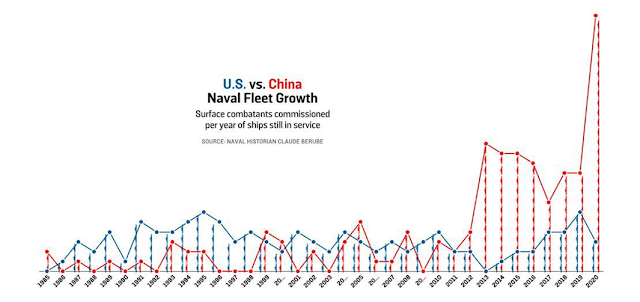
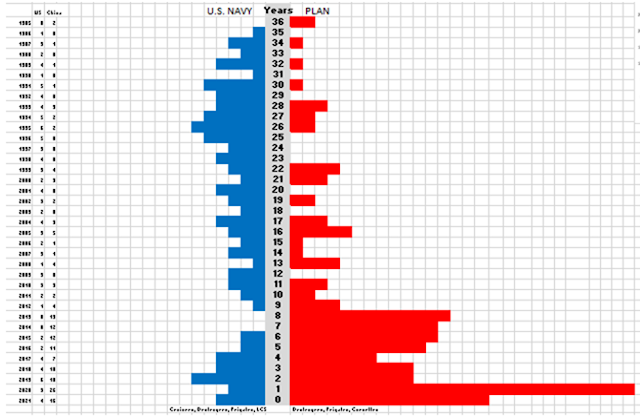
I guess it is time to put up Claude Berube's graphs again.


They have vastly outbuilt us in the past 10 years. Yes, that red line is China’s shipbuilding versus the blue of the us navy.

That is the truth. That is why when we try to force-mode domestic political happy talk to the international stage we are looked at as not just lying - but being quasi-delusional.

At least there are some people with access to levers of power who know what time it is.

“We have a rhetorical commitment to a force posture change in the Indo-Pacific, but that’s belied by the reality of what’s actually happening,” said Rep. Mike Gallagher (R-Wis.), who will become chair of the new House Select Committee on China in the next Congress. He called Ratner’s assertions the military planning equivalent of “whistling past the graveyard.”

The gentleman from Wisconsin is too kind. 

We cannot afford more happy talk - more "transformational" bullsh1t from people who should know better. They need to be called out on every occasion they try to cropdust the intellectual space people are trying to cultivate towards meeting this decade's challenge. The Terrible 20s are going to be terrible, but we can mitigate the degree of that terribleness. Some progress is being made, but more pressure is needed.

Now let's loop back to the second part of today's post mentioned at the start; institutional dysfunction.

Notice the 1936 to 1943 timeline above? Seven years that didn't bring in just new systems, but generational development in everything from carrier air whose fighters went from the Brewster Buffalo to the Grumman Wildcat, to Hellcat; submarines advanced through six different classes from Salmon to Balao; land based heavy bombers went from the Martin B-10 through the Boeing B-17 to a year later the B-29 deploying. 

You get the idea.

Remember back in October?

The U.S Navy has tested out a new way of rearming its warships with a trial vertical launch system (VLS) reload in San Diego. 

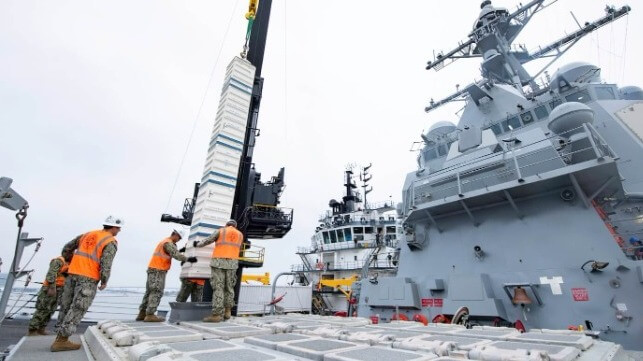
In a test evolution, the crane-equipped OSV Ocean Valor conducted a VLS reload with guided-missile destroyer USS Spruance, an exercise intended to prove out a new way to reload guided missile destroyers in sheltered waters. Sailors aboard the Arleigh Burke-class destroyer successfully lowered training ordnance into the ship’s forward VLS cells in a proof-of-concept evolution.

...

The exercise was aimed at proving that an OSV can reload the weapons system pierside, with the goal of expanding the capability of VLS reloading in expeditionary environments. The launch system reload has been tested previously in 2016 and 2019 using other MSC vessels but has never been tested using a relatively small OSV as the delivery platform. 

A VLS reload alongside the pier is substantially less challenging than a VLS reload in an open seas, underway replenishment scenario. Previous Chief of Naval Operations Adm. John Richardson signaled an interest in bringing back underway VLS replenishment in 2017, but the operation has rarely been performed in practice - even on Ticonderoga-class cruisers, which were designed with this evolution in mind. 

The TICOs were designed in the 1970s - pretty much half a century ago - roughly the same amount of time that the Spanish-American War was to 1943.

Let that soak in.

Now let's go back to July of 2017, just five and a half years years ago +/-. You know, roughly 1.5 WorldWars as we defined this program management period of time in 2015. For you pedants out there, it is 1.46 WordWars to be exact.

Here's what we discussed 1.46 WordWars ago;

The U.S. Navy is looking to restore its ability to reload its ships’ vertical launch systems at sea, which could be a dramatic logistical game changer in the planning and execution of high-intensity contingencies against peer competitors.

...

After discussing the means by which the Navy seeks to ensure its forward-deployed naval forces remain survivable and up-to-date with the latest tactical and technological innovation, Admiral Richardson said in reference to vertical launch system (VLS) underway replenishment, “we’re bringing that back.”

Since its operational debut in 1986 aboard the sixth Ticonderoga-class cruiser, USS Bunker Hill, the Mark 41 vertical launch system and its successor the Mark 57 have become the main battery of the preponderance of the Navy’s surface fleet, while the Mark 45 has become the principal means of deploying cruise missiles aboard submarines. Vertical launch systems are among the most adaptable weapon mounts that the Navy fields, allowing a ship to carry a variety of defensive and offensive missiles in the same shipboard infrastructure, and to fire them in rapid succession.

Well, we don't have this back.


But we are playing around 1.46 WorldWars later with this;

If it appears that the military acquisitions process and the bureaucracy that keeps it running is not quite what one needs to get ready for war, you're right.

It is nowhere near fit for purpose.

Reloading VLS is not a new concept - it is over a half century old. We got rid of it because the short-war uni-polar world would rather have those VLS cells with missiles to blow up parked clapped out Toyota Hilux with 23mm 1960s era manual guns mounted on the truck bed.

In our Lotus Eater stupor we allowed our land based facilities come under the range of our enemy's rocket artillery from Japan to Guam. That luxury is history. We cannot cruise back to the West Coast or Hawaii to reload. We need to do it at sea - now.

Here is where we need to start playing hardball. Our chattering classes are lost in a soup of onomastic happy talk that enables each other to avoid hard work, and our accretion hobbled acquisitions force is designed mostly to ensure funding lines and job protection in a peacetime uni-polar world.

That is long past. As useful as midnight basketball is to domestic politics - a reference someone with a PhD from UC Berkely should understand.

Wednesday, November 30, 2022

Keeping an Eye on the Long Game: Part XCV

We started doing the "Long Game" series about the rise of the People's Republic of China to challenge American's place in the world. At the end of that first post in the series in July of 2004, I wrote;

Say what you want about the Chinese, they are very focused on their long term strategic needs. They will continue to study the way we do business at sea, and they will make sure they are ready when the call comes. Are we?

A lot of folks hear rustling in the woods behind us.

There were a lot of us, but few were listening. 18.4 years later, they are now.

That is part of the reason it has been since May of this year since I did a Long Game post. I've written a fair bit about the PRC since then, but did not use the "Long Game" tag. Why? Simple, we are here. Over 18 years is a "long time." All but the most compromised see the threat from the PRC and the game is afoot.

It is military, economic, and academic - and it is in our face.

I still think the tag is helpful in that while the PRC is now ready to call our bluff west of Wake, they are the nation with thousands of years of history, and they have a plan ... we just need to keep an open eye and mind to see it.

If you want to get the view from the official organs of the US government towards the PRC, a good place to look would be the recently published review of military and security development in the PRC by the USA's Department of Defense

There is one paragraph early on that I think is the most important;

Sensitive, dual-use, or military-grade equipment that the PRC have attempted to acquire include radiation hardened integrated circuits, monolithic microwave integrated circuits, accelerometers, gyroscopes, naval and marine technologies, syntactic foam trade secrets, space communications, military communication jamming equipment, dynamic random access memory, aviation technologies, and antisubmarine warfare (ASW) capabilities. 

How will they acquire all this dual use technology? If you are thinking it is Spy-vs-Spy old school espionage, you are only looking at a very small portion of what is going on.

You need to look at the very sober fact that they are getting that technology the most efficient way - they are convincing us to give it to them. It starts at our universities and pipelines right in to industry.

First of all, let's look at some charts from Statista

Even with the COVID effect, the numbers are staggering. Here's the number of college and university students from China in the United States from academic year 2010/11 to 2020/21 :


Note the decline to the USA is not the same as the decline globally. Here's the number of students from China going abroad for study from 2010 to 2020;


The numbers here are hard to come by and I would consider the above to be on the high side. SCMP puts the number at 290,086. A 2020 study from Georgetown University's Walsh School of Foreign Service have about half those numbers, but the commentary to the study is sound;

The results speak to ongoing policy conversations about the risks and benefits of Chinese students enrolled in science, technology, engineering, and mathematics (STEM) programs at U.S. universities. These conversations have been hampered by a lack of granular data on the number of enrolled Chinese students by field and degree level. For example, it is currently impossible to calculate the financial impact of Chinese students on the U.S. university system because we do not know how many Chinese graduate students are in master’s programs (and thus likely to pay full tuition) versus Ph.D. programs (for which they often receive university or federal funding). This paper seeks to provide such data and to identify remaining data gaps that should be filled.

Because there is no single database of domestic and international students in the United States that includes all the relevant information, analysts have had to produce estimates using several different data sources. These sources often count slightly different things over possibly different periods, complicating the analysis and increasing the risk of inadvertent errors. Our findings differ from widely-cited government estimates. Whereas those estimates suggested that 25 percent of U.S. STEM graduate students and 15 percent of STEM undergraduates are Chinese, we conclude with high confidence that the numbers are 16 percent and 2 percent, respectively.

That's right kiddies; one of the nation's top universities that happens to be in our nation's capital with incredible connections to our federal government finds, "..no single database of ...international students in the United States..."

In case you were wondering, the number of Americans studying in China in 2020 was 2,481. I can't find out how many are completing a full program of study or just doing a semester ... or what their majors are ... but just look at that delta.

From that study, it is clear that they are not in the USA to get Gender Studies degrees.

Look at how close the numbers of undergrads and graduate students are. Note that they're all STEM.

You cannot classify math. You cannot classify dual-use research. You cannot remove knowledge gained. Just look at those numbers. Look at those fields. Look up-post what areas the PRC wants to advance in.

We are making our #1 competitor better, and taking away opportunities for the children of American taxpayers who especially with land grant universities, paid for these universities to exist to serve them.

I don't blame the PRC's citizens for wanting to come here to study, for both personal and professional reasons. However, they never really leave their dystopian nation behind;

On the bucolic campus of Purdue University in Indiana, deep in America’s heartland and 7,000 miles from his home in China, Zhihao Kong thought he could finally express himself.

In a rush of adrenaline last year, the graduate student posted an open letter on a dissident website praising the heroism of the students killed in the Tiananmen Square massacre in 1989.

The blowback, he said, was fast and frightening. His parents called from China, crying. Officers of the Ministry of State Security, the feared civilian spy agency, had warned them about his activism in the United States.

“They told us to make you stop or we are all in trouble,” his parents said.

Then other Chinese students at Purdue began hounding him, calling him a CIA agent and threatening to report him to the embassy and the MSS.

Kong, who goes by the nickname Moody, had already accepted an invitation from an international group of dissidents to speak at a coming online commemoration of the Tiananmen massacre anniversary. Uncertain if he should go through with it, he joined in rehearsals for the event on Zoom.

Within days, MSS officers were at his family’s door again. His parents implored him: No public speaking. No rallies. 

That powerful hook back home isn't just used to keep people under control - but to get them to do further things for the PRC.

In August 2015, an electrical engineering student in Chicago sent an email to a Chinese national titled “Midterm test questions.”

More than two years later, the email would turn up in an FBI probe in the Southern District of Ohio involving a suspected Chinese intelligence officer who authorities believed was trying to acquire technical information from a defense contractor.

Investigators took note.

They identified the email’s writer as Ji Chaoqun, a Chinese student who would go on to enlist in the US Army Reserve. His email, they say, had nothing to do with exams.

Instead, at the direction of a high-level Chinese intelligence official, Ji allegedly attached background reports on eight US-based individuals who Beijing could target for potential recruitment as spies, according to a federal criminal complaint.

The eight – naturalized US citizens originally from Taiwan or China – had worked in science and technology. Seven had worked for or recently retired from US defense contractors. The complaint says all of them were perceived as rich targets for a new form of espionage that China has been aggressively pursuing to win a silent war against the US for information and global influence.

It would be one thing if we took an active roll here in the US and other Western nations (like The Netherlands in the link below), but we allow not just PRC police and intelligence services to run free, we allow other students (many the same people) to act as enforcers

26-year old UG student Meng avoids interacting with Chinese government supporters altogether, if she can. ‘These Pinkies are way too sensitive’, she says, using the nickname for young Chinese Communist Party supporters. ‘They are always very aggressive and feel they represent the side of justice.’

I’m always careful about choosing people to talk to

She is also careful when talking to people she doesn’t know well. And when she participated in a protest in Amsterdam this summer, remembering the 1989 massacre at Tiananmen Square that cost hundreds of lives and left thousands wounded when the Chinese government opened fire on protesters, she wore a mask and disguised herself in cheap clothes. ‘There were Chinese people there who kept taking pictures of us with their mobile phones’, she remembers. ‘When the protest was over, my companion and I walked to a place where no one was around. We changed our clothes and threw the outfit we had on in a trash bin.’

The FBI is, in theory, on the hunt - but read this from NPR and tell me if you think they are getting all the help they need from universities.

"The Chinese intelligence services strategically use every tool at their disposal — including state-owned businesses, students, researchers and ostensibly private companies — to systematically steal information and intellectual property," FBI Director Christopher Wray said at the Council on Foreign Relations in April.

Former FBI agents say the bureau's recent visits to universities are merely an extension of long-running efforts to collaborate with the private sector and academia on national security issues.

Speaking of dual use, not only are many of the finite number of PhD programs going to foreign nationals - and as this is a zero sum game - and not US citizens; so are the jobs.

Chinese and Indian students make up nearly half, and “most stay long after graduation”. “In February 2017, approximately 90% of Chinese nationals and 87% of Indian nationals who completed STEM PhD programmes in the US between 2000 and 2015 were still living in the country, compared to 66% of graduates from other countries,” the report states.

"Wait..." you say, "How can they help the PRC's military if they are working for American companies and universities?"

Well, its complicated - and made more so by the numbers being so large. It is hard for the FBI to keep track of what the threats are when the pool of candidates are so large and the connections so varied. Heck, the problem people don't even have to be from China;

The China Initiative’s most high-profile case has been that of Charles Lieber, the chair of the chemistry department at Harvard and a perennial Nobel Prize candidate, as well as the recipient of more than fifteen million dollars of federal funding, including from the Department of Defense. From 2012 to 2017, Lieber participated in China’s Thousand Talents, the most vaunted talent program; his contract paid him fifty thousand dollars per month, along with generous startup fees to establish a lab in Wuhan. He had, however, neglected to inform Harvard of his double-timing in China, and, when approached by federal investigators, he continued to conceal the arrangement—and the sacks of cash he had smuggled through customs. In December, he was convicted of lying to federal authorities, falsifying tax returns, and failing to report foreign earnings. Some felt that this was just another anti-Chinese expedition; a D.O.D. official testified that the investigation was prompted by the sheer number of Chinese students working in Lieber’s lab. But John Krige, the historian, has noted that Lieber’s contract stipulated that he work on the development of batteries for high-performance electric vehicles, an area of industrial competition. “The academic research community must ask itself if it is morally or politically acceptable to engage in international scientific collaboration with China in fields that can seriously harm the domestic economy,” he wrote.

This problem of our own creation is worthy of a few books and won't be solved here - but policy makers have to address:

- Too many of the finite numbers of US STEM graduate program seats are being taken up by citizens of the PRC.

- These STEM degrees feed the knowledge base for dual-use technology.

- PRC nationals working in cutting edge technology jobs received by having been given one of those limited positions make them the target for PRC exploitation.

- Even if PRC nationals take nothing material when they go home, they take their education and exposure with them.

- For a quarter century, us government and educational institutions have developed close and unequal relationships from entities controlled by the Chinese Communist Party.

This should be a non-partisan issue - but an American issue.

Monday, August 29, 2022

The Eeyore Leadership Model for Our Navy

To paraphrase Papa Salamander's favorite saying, "No one owes you a Navy."

It has been eight decades since there was such a great gulf between the Navy our republic needs to meet a growing threat and the Navy its leadership was planning to have.

As we discussed a month ago, the institutions everyone is relying on to make the future fleet have failed their moment in time. 

Another reminder broke above the ambient noise last week, and it wasn't an easy read for navalists looking for firm leadership who - at least in words - give the impression that they have not given up the fight for what we know we need should conflict come in the next decade west of Wake.

Good thing I listened to AEI's scholars Hal Brands and Michael Beckley on The Remnant Podcast to discuss their recent book Danger Zone: The Coming Conflict with China. Folks smarter than me get it ... but it was a little discouraging that they sounded as frustrated - or more - than I am to what looks like a disaster we are sleepwalking in to. 

It isn't that the SECNAV and CNO don't know what time it is - they get better briefings than I do - they just seem to have thrown in the towel and are not up for the fight.

The SECNAV sounds, well, like he wishes he took a different job. Looking at his All Hands Message last week, well ... this isn't quite, "Join me in the battle to get our Navy the resources it needs." battle cry to inspire navalists;

....enhance our strategic partnerships, across the Joint Force, industry, academia, and nations around the globe. Those partnerships are critical in everything that we do. There’s no doubt in my mind about it. 

I don’t know that we’ll be able to ever match one for one, the number of ships that China is producing. But what I do know is that we can build a very large ‘Navy’ made up of all the ships of all our allies and partners around the globe working together collectively as one, in support of our mutual interests.

So, the Navy needs adopt a passive posture to continue to bend the knee to the Army's Cult of the Joint, publicly traded companies who have payrolls to meet, the grievance studies department at Oberlin College, and act-2 of Mike Mullen's wildly successful "1,000 Ship Navy™?"

Really?

Well, if that didn't make you proud and want to recommend to young men and women to join the Navy, this should do it;

...we must all speak up, speak out, and take action to eliminate sexual assault, sexual harassment, and racism from every part of our force. 

Disrespectful remarks, jokes, and actions contribute to an environment that increases the risk of assault, it weakens our force, and puts our Nation at risk.

Well, that message was almost designed to depress, so let's see what surge of energy the CNO provided to everyone as we get ready ponder the 1-year anniversary of our greatest national dishonor since the fall of Saigon;

“We have an industrial capacity that’s limited. In other words, we can only get so many ships off the production line a year. My goal would be to optimize those production lines for destroyers, for frigates, for amphibious ships, for the light amphibious ships, for supply ships,” Gilday said at a Heritage Foundation event.

“We need to give a signal to industry that we need to get to three destroyers a year, instead of 1.5, that we need to maintain two submarines a year. And so part of this is on us to give them a clear set of – a clear aim point so they can plan a work force and infrastructure that’s going to be able to meet the demand. But again, no industry is going to make those kinds of investments unless we give them a higher degree of confidence.”

Asked by USNI News after the event if the reason the Navy isn’t ready to send that signal to industry is because of funding, Gilday said, “it depends on the class of ships. Sometimes it’s affordability. Sometimes it’s industrial capacity.”

There is no reason why we should continue to play lip service to an obsolete system created at the creaking end of the Cold War 40-years ago and intellectually vapid Cult of the Joint that goes with it.

We don't have creative friction, we have complacent concurrence. 

We need someone, anyone really, to help build a pulse that will drive Congress towards a modern version of the Naval Expansion Act, 14 June 1940.

The CNO is close...very close...but like the SECNAV this is passive - diluted of vigor, and drive. 

We either have a moment of greatest threat from China or we do not. 

If we do, we need to act as such. If not, then by all means, maintain course and speed.

Post script: As I found out this AM as this post was in draft, our friend Jerry Hendrix is seeing the same need outlined a few lines above. Give it a read.

Sunday, August 07, 2022

China’s Decade to Win with Jim Fanell - on Midrats


Speaker Pelosi’s visit to Taiwan managed to bring the national security eyeballs back to the Western Pacific after half a year in Eastern Europe.

The People’s Republic of China has not been distracted by the Russo-Ukrainian War any more than she was with our two decades distraction in Central and Southwest Asia. She remains focused on two things:

- Pushing America to her side of the Pacific.

- Establish herself as the primary regional and then global power.

Where does China stand today, and where is she heading for the rest of the decade?

We have a great guest this Sunday at 3pm Eastern to dive in to these and related topics, James E. Fanell, Captain, USN (Ret.)

Jim concluded a near 30-year career as a naval intelligence officer specializing in Indo-Pacific security affairs, with an emphasis on China's navy and operations.  His most recent assignment was the Director of Intelligence and Information Operations for the U.S. Pacific Fleet following a series of afloat and ashore assignments focused on China, as the Assistant Chief of Staff for Intelligence for the U.S. Seventh Fleet aboard the USS Blue Ridge as well as the USS Kitty Hawk aircraft carrier strike group both forward deployed to Yokosuka, Japan.  Ashore he was the U.S. Navy's China Senior Intelligence Officer at the Office of Naval Intelligence.  

In addition to these assignments, he was a National Security Affairs Fellow at the Hoover Institution at Stanford University and is currently a Government Fellow with the Geneva Centre for Security Policy in Switzerland and the creator and manager of the Indo-Pacific Security forum Red Star Risen/Rising since 2005.

Join us live if you can, but it not, you can get the show later by subscribing to the podcast. If you use iTunes, you can add Midrats to your podcast list simply by clicking the iTunes button at the main showpage - or you can just click here. You can find us on almost all your most popular podcast aggregators as well.

Tuesday, May 31, 2022

Keeping an Eye on the Long Game: Part XCIV

The People's Republic of China isn't hiding anything. Their plan is right there for all to see. If you can't quite understand what I mean at the end of May of 2022, the North American treasure who is Cleo Pascal will show you and tell you the story;

Under the UN Convention on the Law of the Sea, every island can get up to 200 nautical miles off its coast as an EEZ in which it controls resources, say, fisheries. That means, for example, Pacific Island Country (PIC) Kiribati may have a population of around 120,000, but, with its EEZ, it covers as much of the planet as India.

Now let’s colour in the EEZs of the countries being visited at the moment by China’s Foreign Minister Wang Yi and his large delegation. What we see is a large, contiguous band—Papua New Guinea, Solomon Islands, Vanuatu, Fiji, Tonga and Samoa—off the northeast coast of Australia, backed against Kiribati. And off to the northwest of Australia, almost embedded into Indonesia, strategically located Timor-Leste.


 They're putting it in writing in case you think there's a lot open to interpretation: 

Wang is hoping the PICs who recognize China will sign on to two prewritten documents. We know what’s in them because they have been leaked by Pacific Islanders worried about the implications.

The first one is “China-Pacific Island Countries Common Development Vision”. The second is “China-Pacific Island Countries Five-Year Action Plan on Common Development (2022-2026)”. The “Action Plan” describes how China plans to achieve its “Vision”.

Make no mistake, this is exactly the correct strategic step if your goal is to displace the USA and her allies in the Pacific. 

If you want to get a firm grasp on the seriousness of this real estate, I would offer that you need to read up on the Pacific Campaign of WWII ... if you're running short of time, read my post from last year.  

Back to Cleo's article;

“Vision” talks about: law enforcement cooperation, including “immediate and high-level police training”; “cooperation on network governance and cyber security”, including a “shared future in cyberspace”; the “possibility of establishing China-Pacific Island Countries Free Trade Area”; “enhance cooperation in customs, inspections and quarantine”; “create a more friendly policy environment for cooperation between enterprises”; set up Confucius Institutes; train young diplomats; “establish China-Pacific Island Countries Disaster Management Cooperation Mechanism”, including prepositioned “China-Pacific Island Countries Reserve of Emergency Supplies”, and much more.

“Action Plan” includes: “a Chinese Government Special Envoy for Pacific Island Countries Affairs”; a “China-Pacific Island Countries Ministerial Dialogue on Law Enforcement Capacity and Police Cooperation”; “assistance in laboratory construction used for fingerprints testing, forensic autopsy, drugs, electronic and digital forensics”; “encourage and support airlines to operate air routes and flights between China and Pacific Island Countries”; “Send 200 medical personnel” in the next five years; “2500 government scholarships” from 2022 to 2025, and much more.

Even at peace, there is a lot to gain if you are looking to strip mine the last of the fish in the Pacific without complaint;

Look at the EEZs alone. If China gets its way, the fishing fleets will be sent in, with processing ports set up, including “prepositioning” of various sorts, and loose visa and customs restrictions. We’ve seen China use its fishing fleet for grey zone activity before, and it has an overt doctrine of civil-military fusion. Additionally, the PRC’s 2017 National Intelligence Law compels Chinese companies to assist in intelligence activities. Then add in the cyber integration, police and diplomatic training.

Those countries don’t have the ability to control Chinese activities in their waters. That arc has the potential to become a “First Island Chain”’ to hem in and/or interdict Australia and New Zealand.

That is just the opening bit, you need to read it all

If you don't get a flush of panic a couple of times, then you are missing one of the largest stories of the decade's opening chapters - the closing of the Pacific under the red banner of the People's Republic of China. 

Tuesday, May 24, 2022

Yes, Taiwan is an Island Worth Dying On

Sometimes at gaffe is just the truth spoken out of turn. Yesterday, President Biden said something that isn’t that surprising to those who have been pondering this for a while;

Of course, there are those who will come out to “clarify” etc., but we nearing the point where we need to pause a bit and talk clearly to each other as adults; we need to be ready for the war to come because if we don’t, come it surely will.

We need to move past the comfortable strategic ambiguity of the past and move forward based on the clear intent by the Commander in Chief. We should take the Commander in Chief at this word, the leadership of the People’s Republic of China (PRC) are going to. They will act accordingly and so should we.

The coming conflict with the PRC may not be unavoidable, but the need to prepare for one is. If we take the challenge seriously and prepare for it, then the challenge may never come. If we pretend the challenge is not growing, then the challenge will move on to action as the opportunity to change centuries of failure will be ripe for the taking.

We’ve run “The Long Game” series here since 2004. I picked up where smarter people started a decade earlier and more. In 2022 when you look around, there are a lot more of “us” now and it is time that we set those remaining on the fence on notice.

The utility of “Strategic Ambiguity” no longer serves its purpose in support of American national security requirements. If you look at the internal second and third order effects of it, we are past the point that it is counterproductive. It gives those charged with funding our military an excuse not to be ready while at the same time making the risk calculation for the PRC less with each passing year of inaction on our part.

Taiwan cannot be allowed to fall under the control of the Communist Party of China. There are a whole host of reasons. My top-5 I will outline below. 

1. The Map;

With Taiwan, you control Japanese access to half the planet, and you extend your military influence east through the Philippine Sea. The PRC would hold the north gate to the South China Sea and on to the Singapore Strait. She will have Taiwan as a shield for her coastal cities that drive her economy and build her navy. I know if I were in the PRC leadership, taking Taiwan would always be at the top of my list. The key is waiting for the moment to be ripe where risk is low and gain is high. That math is what will drive peace or war. We can drive that math to our direction if we have the will that matches our desire for peace.

2. Justice: If “The West” and her auxiliaries stand for anything, it should be for representative governance and individual liberty. There is a wide half-standard deviation from the mean in this regard, but one thing is clear; the PRC and the future she desires is outside that spectrum. Taiwan is well within that center. The Taiwanese people do not desire to be Hong Kong on a larger scale. Well meaning, freedom valuing nations should support her. As a species, what kind of future do we want to our planet? Do we want the messy chaos of an imperfect framework of freedom that the West hobbled together after the defeat of fascism and the Soviet Union last century – or the autocratic and Orwellian surveillance state the PRC is perfecting? 

3. Stand Against Aggressive War: the international community in Ukraine is setting a precedence that we will not stand by quietly and reward aggressive war by Russia. Yes, no one is committing forces, but especially since the first month of the war, the Ukrainians have shamed nations in to at least providing her the tools to defend herself. Talk is not enough. If you mean to prevent war, you must be prepared for it. Ukraine before the war made poor decisions with regards to her preparedness. Someone advised her that she was either unable to fight Russia or would never have to. The Smartest People in the Room™ were wrong on both counts. +/- these are the same people who have dulled our senses with comforting talk that “Strategic Ambiguity” should continue to be the way forward in Taiwan. They were wrong in Ukraine, and we should call them on their wrongness in Taiwan.

4. Economics: the world’s economy and Western militaries are mindlessly dependent on Taiwan. This country of just over 23 million souls – not much more than my home state of Florida - is the single point of failure for the microchips that power our modern world. Industry and governments in the West were greedy and stupid to let this be the case, but here we are. We should no more let the PRC control this – or destroy it in a war – than we should have her take over the oil fields of Iran, Iraq and Saudi Arabia. 

5. West of Wake: with the loss of Taiwan, the ability of Japan, Vietnam, the Philippines, Indonesia and other nations in the western Pacific – who are either auxiliaries to the West or trying to become such – will be in what position in face of a stronger and emboldened China? In their history – thousands of years older than the USA’s history – tells them. They’ve seen it before, they don’t want to see it again. Their future, and that of the entire hemisphere will drift away from the promise of individual liberty, rule of law, and optimism for the future.

There are my top-5 reasons why those with a clear head about the PRC should welcome the President’s comments. Accept and promote them.

Regular readers know I am not a fan of American as global hegemon or policeman. I’ve had no change in that regard … but I try to listen to history’s lessons and do my best to look a half dozen plays down the board – and Taiwan’s independence is one of those things where I’m willing to say, “Yes, here we make a stand.”

We either rise to PRC’s challenge at Taiwan’s shore, or shrug at what was the American Century. 

This is no time to shrug. Other nations closer to China are moving past their recent delusions and see that war is coming. I believe Japan is one, Australia another. Vietnam needs no convincing. 

So, what do we do? We wake everyone else up in the West who can think.

Internationally, we should speak clearly to our European allies that, yes, we are doing most of the heavy lifting in providing aid to Ukraine now, but this is it. You need to rebuild your defenses. We will always be your friend. We will always be by your side – but that is it – by your side. Even if Russia is soundly defeated in Ukraine, she will be back. You have a larger economy and population than the USA does. Build your armies up, we will not station ours there. We will come to exercise now and then. We will have combined logistics and training facilities there. We will contribute to NATO staff and even combined units … but we will not garrison your frontiers. Over to you.

Domestically we have hard conversations that need to take place. Personal and financial interests will be injured, habits disrupted, and egos bruised. The pushback will be hard.

Yes, we need to spend more, but more importantly we need to spend smartly. We need to break the ossified adhesions of decades of Beltway nomenklaturaesque habits and spend our money like we know what the challenge is and where our comparative advantage lies; we are a maritime and aerospace power. That point needs to be its own post later – perhaps a summary of a draft I’ve had since the summer of 2020 that I keep to myself. Enough of the Joint self-deluding posturing that hobbles clear speaking.

Again, look at the map;

In a war west of Wake, we can accept risk at peace keeping a smaller standing Army. Efficiencies can be gained by having most of our ground forces in National Guard and Reserve formations that can be activated as needed. We need the surge capability in sealift and airlift there as well. All three things need to be done in conjunction while we expand the forces that tare hardest to generate in number: maritime and aerospace power. These must be a priority and front loaded. 

We can take that risk ashore; we cannot take it at sea or in the air. We are not going to deploy hundreds of thousands of ground forces on the Asian mainland on a hair trigger. If we do, we are fools. What will need to do it to ensure we control the seas and air for the nations we are supporting in Asia so their ground forces can defend their land. If we do not dominate the air and seas, then I don’t care how large our standing army is, it isn’t getting there.

That is the reality. That reality is what must drive requirements for both the USA and Taiwan.

Time is late. Taiwan needs to spend a lot more on defense. Right now she is spending 2.1%. We need to have a come to Jesus meeting with her to let her know that, really, she is going to quickly spend 4% on defense and this is what she is going to buy with it. We will back her play in the open now, but we will not be more concerned with her freedom than she is. The Taiwanese porcupine must have more and longer quills. We should also start having American forces train with Taiwan in Taiwan a lot more. Underline our point. No one calls a bluff if a bluff does not exist.

The “Long Game” is now the short game inside our POM cycle. Navalists in Congress and other places with access to levers of power need to have a polite conversation with airpower advocates that they need to join us on this path or suffer with the army in the budget battles to come.

The argument for maritime and aerospace spending is the easiest sell due to the reality of the situation – we just need leaders to make the argument.

No more “Joint Force” talking points. Navalists need to keep their list of Navy leaders who keep going back to this verbal tic and work to keep them out of positions of power. They don’t know what time it is and they are too senior to retrain. 

Make enemies as our friend Blake Herzinger has. Speak the truth and tell those who can’t take it to simply cope-and-seethe. 


Hard fact – Taiwan is our fight to have. Our Nationalist Chinese allies in WWII would not have been able to hold Taiwan without the cover of our imperfect umbrella over more than seven decades. Over that time, Taiwan has developed in fits and starts in to a prosperous, free, and uniquely different society than that on the mainland. 

To abandon her now, knowing her fate, will not just do immeasurable damage to our national security, it would be an amoral act of cowardice by a decayed and intellectually bankrupt empire.

We are not alone. If we show strength, others will too.

Australia is holding firmer against the PRC than they have in decades. This is good.

India is looking for friends to counter the PRC to her north. This is a growing fertile field at a tender inflection point but trending the West’s way.

New Zealand is problematic. Sad, but true. I’m not sure what to do with her compromised elite. We’ll call them a wash until they wake up and rediscover what they stand for.

As we started covering a year ago, we have problems from the Pacific island nations from the Philippines to the Solomons to Kiribati etc. We are behind the 8-ball in our own back yard, and we did this to ourselves through our own sense of entitlement and arrogance. It is also not too little a portion of our Department of State being distracted away from their core job by an equally distracted bureaucracy who often act as if they really wish they picked a different career field.

There is nothing new that needs to be done here. Nothing “transformational” requiring “new” ideas, concepts, or approaches. This is all Vince Lombardi fundamental great power competition – something humans have been practicing since the Stone Age.

Embrace Biden’s gaffe as Commander’s Intent and move forward. It is a blessing, really.