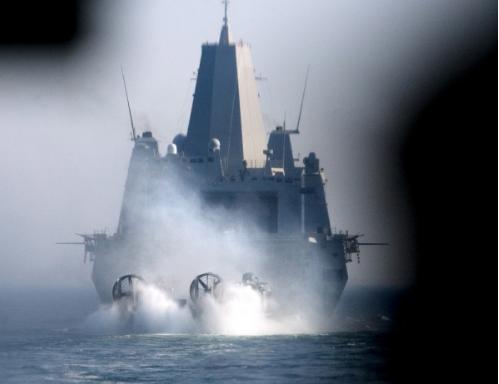
Showing posts with label LPD-17. Show all posts

Thursday, December 16, 2010

Crying uncle on LPD-17

From the said shipyards bi-monthly newsletter; this is good.
The first availability, with respect to our LPD-17 MSMO contract, is in full swing. The MESA VERDE is pier side here at Earl for a CNO availability through 10 January of 2011 and we have started a very complex extensive piping repairs and lube oil flushes to main engine repairs and pump overhauls, EARL has again been given the opportunity of helping develop and support the Navy’s new LPD-17 Class maintenance plan.
Break her down to parade rest and fix the failures of others.

Now, if you only has
accountability reviews for important things too ....

Monday, November 29, 2010

LPD-17: How much to change out a diesel again?


A little something "we" have been sharing around email the last few days I wanted to share with you. Something for the front porch's collective pondering.

The SAN ANTONIO Class is the gift that keeps on giving. Some of this can be explained away because of Katrina ... but ponder the numbers below.

For manufacturing in general - and shipbuilding in particular - the theory goes that with lessons learned during each production run, you get faster, show better quality production, and enjoy lower per unit costs.

If you don't have any of those, then you have one of a few things going on; outright incompetence on initial concept, design, and management of the product development phase only discovered when concept became 3D; fraud of the same; an institution unable to function and perform even the most fundamental aspects of their profession.

In all cases of the above - or combinations of cases - what results in a sane world is that there are a series of wholesale firings of senior management and/or criminal investigations. When that doesn't happen, then usually you have a much larger systemic malfunction going on.

Well, that is the theory - now ponder the macro issue as outlined below.

#

Name

Builder

Keel Laying

Launch

Delivery

KL to L (months)

L to D (months)

KL to D (months)

17

San Antonio

Avondale

9-Dec-00

12-Jul-03

20-Jul-05

31.5

24.6

56.1

18

New Orleans

Avondale

14-Oct-02

11-Dec-04

22-Dec-06

26.3

24.7

51.0

19

Mesa Verde

Ingalls

25-Feb-03

19-Nov-04

28-Sep-07

21.1

34.8

55.9

20

Green Bay

Avondale

11-Aug-03

11-Aug-06

29-Aug-08

36.5

25.0

61.5

21

New York

Avondale

10-Sep-04

19-Dec-07

21-Aug-09

39.8

20.4

60.2

22

San Diego

Ingalls

23-May-07

7-May-10

36.0

23

Anchorage

Avondale

24-Sep-07

24

Arlington

Ingalls

26-May-08

23-Nov-10

30.4

25

Somerset

Avondale

11-Dec-09

26

John P. Murtha

Ingalls

27

Ingalls

If you need a kick-start, Tim Colton provides a very good overview.
NGSB's announcement of the launch of LPD 24 said that she is 77% complete, which the LPD Program Manager apparently thinks is good, although it isn't. And if it took them 30 months to do 77% of the work, it's going to take them well over a year to finish her, maybe close to two years. ... It would only take ten months on a straight-line expenditure curve, of course, but they don't happen in shipbuilding: in shipbuilding, it's an S-curve and the last 5% takes for ever.
Why aren't we getting better and faster with time? Moving away from the macro theory I put out at the opening, the other micro reasons are legion and include things we have discussed here and on Midrats to include; inadequate priorities and manning at SUPSHIPS and NAVSEA (there are very good people there, look up the chain and manning document changes for the problem); loss of discipline in program management; and a loss of credibility in Congress towards our Flag Officers. That is on the military side. On the civilian side we have management, tort, and union malpractice that has warped what was once a first class shipbuilding industry.

Combine the two together and you have a gordian knot that is going to require our own Alexander to fix. It can be fixed though, and the easiest part to the fix is on the military side. We have to be ready to fix it. Judging from some attitudes though, I don't know if we are there yet.

We need to - as until we do - we will have problems like this that keep coming up.

Let me paraphrase something sent to me from a friend from the technical side of the challenge that tells a great story - this time the latest with the
LPD-17's diesels.
When looking over the JAG investigation into the diesels, it comes down this: it doesn't appear that the diesels were ever flushed.
While doing a diesel job, in the work item (that spells out the step by step things you must do) there is a line item and a check point to conduct a flush of the lube oil system. The work item specifically calls out the size micron bag you must use and the amount of debris you are allowed (and it ain't much). It doesn't appear that there was ever a flush done on these diesels, even though there was clearly a large amount of contamination already present.
A technical expert states that the only way to get those diesels down is to literally tear them down to parade rest and flush then and clean the individual parts, to the point of even disassembling the block. He said that you still might not get everything out of it. More to the point, those diesels are always going to be a problem, especially if the Sailors can't even understand what the high temp readings mean on the bearings (and those diesels are all wired to a computer).
Bottom line, unless they do a complete diesel change out, those ships are going to be tied to the pier a lot.

It doesn't appear that NG had proper cleanliness protocols when the diesels were being installed and tested. When issues started happening, it appears that NAVSEA didn't follow or enforce their own procedures.

The Navy must get it's house in order. We're simply too far into the program to kill the LPD-17 Class. The real problem as I see it, is will the Navy come forward and admit that their own procedures weren't followed or enforced, since that's the cause of this whole mess? The second problem is that the engines are eating up main bearings and this need not ever happened. These diesels are wired up for telemetry to tell the operators whats going on inside of them.
For instance, there's a paragraph in the JAG findings where it clearly states that the Sailor on watch ignored high temp alarms on a main bearing telling him that there was a problem with oil flow.
To correctly lubricate these engines, it's not simply enough to have oil on the bearings; it must have a flow of cooled oil going around the bearings in order to protect the bearing. This situation could have been caught before damage occured had only the Sailor known what he was looking at.
How to correct the problem with the diesels? The only sure way to do it is to tear the diesels completely apart, down to taking the block apart and cleaning every orifice, cooling line inside the block, the cylinders, heads everything. Then put it together and do flushes until there is no contamination. That's going to cost a pretty penny, but what is the alternative?
On the Navy side, two problems: first, NAVSEA does not oversee the new construction end not nearly enough; second, the Navy is not training it's people correctly.
That is one person's report based on what they have seen, and it largely matches with other reports that have come my way.

What else would Sal like to see? I think the inspection reports as
outlined in para 4.3 would be nice.

In the end - if you think LPD-17 and her sisters are expensive enough - imagine the cost of ripping out the diesels and replacing them - but it can't be any worse than when we changed out our BB from coal to oil (
like we did with my grandfather's BB, USS ARKANSAS (BB-33) ). I don't think we need to go there though .... do we? Can we?

No, we just need some experienced engineers with solid top-cover leadership to be given the mission to fix it. They will - if we let them. Part of that fix it an open, transparent, and brutally honest appraisal of how we got here and who let it happen.

Friday, November 19, 2010

The LPD-17 rots from the .....

You know how long we have been yabber'n on about the horrible record of LPD-17 and how she is one of the poster children for "The Lost Decade" in Navy shipbuilding. Just click the LPD-17 tag below if you need a review.

Well, Galrahn over at InfoDis has a JAGMAN that requires your attention. Head on over and give it a read.

It is best enjoyed along with a review of his post last week at USNIBlog. Read it first, then head on over to InfoDis.

Tuesday, November 09, 2010

LPD-17's XO acquitted at Court Martial


Via Kate at the VaPilot,
A military jury found a naval officer not guilty Friday night in the death of a sailor aboard the trouble-plagued amphibious transport dock San Antonio - a case that pitted the Navy's principle of holding commanders at sea accountable against the perception that the crew was being blamed for the vessel's flaws.

Lt. Cmdr. Sean Kearns, 42, was charged with negligence for failing to properly train and supervise small-boat operations on Feb. 4, 2009. A rigid-hull inflatable boat being lowered from the ship flipped, throwing three sailors into the Gulf of Aden. Petty Officer 1st Class Theophilus Ansong was lost at sea.

Kearns, who was the ship's executive officer, chose to take the case to court-martial rather than accept a potentially career-ending reprimand like the one given to Cmdr. Eric Cash, the ship's captain.
BZ to LCDR Kearns and the jury.

Here is why,
Kearns said the verdict is more than a personal vindication.

"The true victors here are the sailors who served on, and continue to serve on, LPD-17-class ships," he said, adding that they face struggles with the new design and are not getting the resources they need from the Navy.

When asked why he refused administrative punishment, Kearns said: "Things needed to be made known.... Someone needed to stand up."
That is Fullbore. That is moral courage. Like then LT Black, LCDR Kearns leaned into the wind because it was the right thing to do, not the easy thing to do.

Here is why he did what he did.
"You're going to learn a lot about the San Antonio, but I think I can sum it up," he said, quoting from a 2007 internal Navy report that it remained "an unfinished ship."

"She was incomplete," Czaplak said. "The Navy wanted Kearns and the crew to deploy with an incomplete ship. Now, it wants to court-martial him."

The lawyer described some well-known problems found on the San Antonio: 6,000 faulty welds, and loose bolts that caused the engines to misalign. He also revealed that it deployed without 40 percent of the technical manuals usually found on board.

"The evidence is going to show that the government is grasping at straws, hoping you'll see a haystack," he said. "They're not even going to come close to their burden" of proof.
Documented over the years on this blog as well. Before she even got underway we told you that this ship would get fixed with enough money and hard work of Sailors. I think we even warned that it might take a life or two.

There is a cost for poor program management - Petty Officer Ansong unfortunately payed the ultimate price to prove that point. He didn't need to die like he did - I hope that is not lost on Big Navy.

Court Martial ... yea, someone needs to be sent to Court Martial - but it ain't Sean.

Promote him via a special board with back pay. A phone call from the CNO would be nice too. More calls to the family of Petty Officer Ansong is in order as well. Oh, and Sean - if you ever want to come on Midrats, drop me an email.

If you want an example of moral courage Midshipmen and Junior Officers - look to LCDR Kearns. As it should be done.

One final note - I tried to find a picture of EN1 Ansong, but one can not be found, only the one on the upper right. That is also sad in many ways. If you have one, please send it to me. We should honor him more than any - he died for and because of our nation.

Hat tip CCAFlog & Andrew.

LPD-17; “not effective, suitable and not survivable in a combat situation,”

Duh ...

The whole world owes me LOTS of beer ... we were warning about this Tiffany China Doll since before she was even commissioned.

Northrop Grumman Corp.’s $1.68 billion amphibious warship, designed to transport Marines close to shore, wouldn’t be effective in combat and couldn’t operate reliably after being hit by enemy fire, according to the Department of Defense’s top testing official.

The San Antonio-class vessel’s critical systems, such as electrical distribution, ship-wide fiber optics and voice- communications networks, aren’t reliable, according to Michael Gilmore, the Defense Department’s director of operational test and evaluation. The ship’s armaments can’t effectively defend against the most modern anti-ship weapons, Gilmore said.

The ship is capable of operating “in a benign environment,” Gilmore said in an e-mail to Bloomberg News outlining the unclassified summary of a classified report sent to Congress in June. The vessel is “not effective, suitable and not survivable in a combat situation,” he said.
The epic fail of a "stealth" Amphib with titanium fire mains is a poster child for the results when non-warfare accountants designing warships instead of warfighters.

Why can't we get our Amphibs near shore? Simple - we are more focused on programatics and PPT and non-warfare metrics. We get an Amphib Fleet fine for peace, but ill-suited for war.

The math works this way; if you have many ships taking fewer per-ship Marines in harm's way, you can sustain a few combat losses - losses that always occur - and still get enough Marines and materiel ashore to make mission.

Sure, it can take a little more money to maintain more, smaller ships in peace - but we don't make ships for peace, do we?

Problem is - if you decide, which we have, to build fewer ships to carry many more Marines and material per-ship because it makes peace-time green eye-shade types happy, then you simply cannot afford ANY combat losses as one ship sunk means you cannot make mission.

To mitigate that risk, you move them further and further away from danger. Shore is danger. You force the Marines to make the trip across more and more water. 20nm or more and by the time your Marines make it ashore - what kind of shape will they be in? What additional dangers will they be in?

When you mitigate one cost - you increase another. To protect the Tiffany Amphibs, you need larger and faster transport to shore - read the EFV and MV-22. Add it up. Go through a few more cycles and before you know it - you literally cannot afford the mission.

Second and Third Order Effects - we pound it into heads when teaching the Operational Art - yet we forget to do it when we design our fleets. Spreadsheets are not good for 2nd and 3rd Order Effects. Those cost slides are either deleted or put into back-up slide areas. If you don't have warfighters pounding the tables, then you get what you get.

War is messy. I will say it again; DDG-1000, LCS, LPD-17; the Tiffany Navy we cannot afford. Designed for peace and concept papers, not war. Theorists and developmental engineers love them - future graveyards for Sailors. The poster children for the lost decade - one we will eventually have to deal with as an institution more seriously than just re-opening the DDG-51 line.

Monday, October 04, 2010

Colton goes Salamander on LPD-17


Soon, everyone will be wearing funny hats. Welcome all, pull up a chair.

From Tim Colton's site last week, he's had enough; again.
WHY THEY HAVE THIS GEARBOX PROBLEM

My sources tell me that this is the skinny on the LPD gearbox problem. Apparently some of the bolts used to install the gearboxes are loose bolts, although fitted bolts are required by the design. This was done simply because installing fitted bolts upward from the void space below the gearbox was too difficult. Unfortunately, the bolt holes were in way of the frames that support the gearbox, so production management decided to burn big notches in the frames, in order to provide access for installation of the loose bolts. These notches in the frames were never repaired and, since no one ever inspected the void spaces, the damage to the frames was never seen. The loose bolts are in the middle of the gearboxes and the fitted bolts are on the outside, so the area with the highest concentration of torque and thrust is not held in place with fitted bolts. As a result, the gearbox flexes. That's the story.

I'm just reporting what I've been told, but it rings true: Avondale has always had a reputation for corner-cutting. October 1, 2010.

ANOTHER REASON TO GET NG OUT OF SHIPBUILDING

Defense News reports that the Navy continues to have problems with the USS San Antonio, (LPD 17), the lead ship of this misbegotten class of ludicrously over-designed and unaffordable ships. Read the story here. This ship, which had a contract delivery date of June 2002 but was actually delivered in July 2005, has been a disaster from start to finish. It's astonishing to read now, in late 2010, that the reason the drive train vibrates is that "The foundation bolts were not properly aligned or tightened. The main reduction gear was not properly installed and checked out" according to ADM John Harvey, commander of U.S. Fleet Forces Command. Good grief! And will NG pay any penalty for this? Of course not. October 1, 2010.
What amazes me is how many defenders this Class has. Yes, I know.

As I said years ago, if we throw enough money and burn through enough Sailors, we can fix this Class of ships - but look at the cost.

I know a lot of people, including me, like to beat up on NAVSEA and SUPSHIPS - hey, everyone likes to tease the geeks, but in many respects they can only do what they can do with the personnel, structure, and resources they have. It isn't the people, it is leadership and their subordinates' reaction to the direction and guidance they get from the top; as it is in any organization.

Like we learned in MBA101 - you show me a company in trouble, and I'll show you a troubled leadership.

In the last decade, the fundamentals of shipbuilding has not been a priority. Just look at LCS, LPD-17, and DDG-1000. I hate to sound like a broken record - but facts need to be pounded and pounded until they sink in to the thickest of opaque egos.

Even our pal Gal over at InfoDis is showing the wear from the drip-drip-drip of fail.
Look where all the shortcuts got us - 5 years later. I'll be more impressed with the Navy's ability to manage large programs like shipbuilding when I start seeing more accountability among those leaders on shore. NAVSEA has apparently worked very hard in the 21st century to build a reputation that does not inspire confidence.
Keep going up from NAVSEA my friend; keep going North. Get a SUPSHIPS manning document as ask what changes have been made over the last couple of decades. Look at all the money spent on SES at NAVSEA and what they have done during the last decade. Search "CNO Priority" on google.

Clues are everywhere.

Good leaders can fix this. We have a great Navy with great leaders. Great leaders need to be given the power to affect action though; if they choose the right actions to fix a challenge (see Blockbuster vs. NetFlix). We are close ... close, but will need to wait.

Monday, July 05, 2010

You live by happy-talk ....

... your Fleet sits in dry dock because of happy talk. Via Corrine at TheVirginiaPilot.
Since the day the Navy commissioned it, the Norfolk-based amphibious ship San Antonio has been plagued with costly defects. Five years later, it sits along the Elizabeth River unfit to deploy.

Now a report says that the Navy, as well as contractors who designed and built the vessel, bears blame for the problems.

Released publicly Thursday, the report details findings from a six-month Navy investigation. While it looked only at the San Antonio, the inquiry could help answer questions about defects aboard the four other ships in its class that are now in service, including the New York.

The first of the five to take to the sea, the San Antonio has suffered the worst of the problems. In its short life, the $1.8 billion, 25,000-ton vessel has been called in for several major repairs worth at least tens of millions of dollars.
...
But the Navy shares in the blame for failing to identify the flaws, the report says: If the government had properly overseen and inspected the vessel during construction, the problems could have been caught early.

Investigators also fault the San Antonio's crew for failing to uncover the defects before they caused major damage.

"Ship's force was slow to recognize lube oil contamination (because of) a variety of long-term issues," the report says. Specifically, it cites sailors who weren't properly trained and who didn't carry out vital systems checks.

Navy officials declined to discuss whether crew members were disciplined or consequences they could face.

"The chain of command has taken appropriate administrative action aboard San Antonio to hold accountable those responsible for the training and maintenance deficiencies aboard the ship," Naval Surface Force Atlantic said in a statement.

The report includes several pages detailing the training failures. The Navy requires 42 sailors aboard the San Antonio to complete a course on operating its engines; only three have. Fifty should have taken a class on the ship's lube oil system; only one has.
That is the key. You get what you inspect. When this ship got underway, I said what many have said - the ship will do its job and be fixed - but on the back of its Sailors and with a metric butt-ton of money.

The defects do not have to do with the Sailors and leadership of the ship though - they are only trying survive with the equipment and work environment that senior leadership with their consultant-speak and transformationalist fever-dreams made for them.


This all comes from institutional addiction to happy talk. Just follow the LPD-17 tag below - people who have been involved with this program from the start have been telling me the problems and warning of what was going to happen from cost and maintenance.
Eric makes a good point in the article,
Eric Wertheim, author and editor of the Naval Institute Guide to Combat Fleets of the World, said the Navy appears to be taking the problems seriously. "The Navy and the Defense Department should look at this as an example of how every step of the process can go wrong," he said. "Most of the problem seems to be with the shipbuilder, but the Navy's the one that really needs to figure how to stop this from happening again."
Yes - we need an open table, Chatham House Rules dissection of this. The first three witnesses need to be Clark, Mullen, and Roughead. This is their baby.

Phil has some other thoughts worth your time as well.

The legacy of happy-talk and the Tiffany Navy.

Tuesday, January 26, 2010

Licking sandy lube


We have left the Tiffany Navy poster child alone for much of the last year - so let's get an update from our buddy at DefenseNews, Christopher Cavas,
A fresh set of problems with the long-troubled LPD 17 San Antonio-class amphibious ships has sidelined two of the vessels, led the U.S. Navy and its largest shipbuilder into a passionate game of finger-pointing, and raised questions about Northrop Grumman's ability to deliver quality work and the Navy's ability to carry out proper shipyard oversight.

The larger issues are coming from two core problems discovered aboard the LPD 17s, five of which are in service with four still to come.

Of more immediate importance is a problem that, left untreated, could wreck the four large diesel engines that drive the ships. The problem is not new but, having once thought a solution was at hand, the Navy and Northrop are once again trying to figure out why a fix hasn't been found.

Another issue, affecting all the ships in the class and other ships built at Northrop's Gulf Coast shipyards, could - unless it's fixed - shorten the service lives of all the ships. But how and why that problem arose could drive closer to the competence of Northrop and the Navy's inspectors to properly inspect weld work.

Engineers are trying to figure out how debris - "contaminants" in engineer-speak - is getting into lube oil in the large diesel engines that drive the ships. The contaminants cause excessive wear on bearings that support a crankshaft at the bottom of each engine. If the problem isn't treated, the crankshaft will be thrown out of line and the engine could suffer serious damage or even be wrecked.

The problem isn't new, the Navy said, and showed up about a year ago in the third and fourth ships of the class.

"We thought we had it licked," Jay Stefany, the Navy's program manager for the LPD 17 program, told reporters Jan. 21. "And that's where we were until right before Christmas."
Oh goodness.

Let's get geeky.
That's when the newest ship in the class, the USS New York (LPD 21), reported a bent crankshaft in one of the four diesel engines that drive the ship. Engineers found that the shaft was thrown out of alignment by scratches being made in the inner ring of the nine bearings that support the shaft - scratches that caused enough of a difference in the thickness of the bearings to make the shaft wobble.

The scratches are caused by particles too small to see - much of them between 20 and 40 microns wide, or about .00118 of an inch, according to Stefany.
The good new here is that CFFC is taking this seriously.
Early in December, Adm. John Harvey, commander of Fleet Forces Command, ordered Rear Adm. Michelle Howard, commander of Expeditionary Strike Group Two, to begin a Manual of the Judge Advocate General investigation, or JAGMAN, of the problem. The effort reportedly is being led by NAVSEA's Rear Adm. Tom Eccles, the Navy's chief engineer. The investigation is focused primarily on the San Antonio and not the New York, which has yet to transfer to fleet operational control.
Make sure and listen to Midrats on Sunday for a BIW funny - but this just adds to the joy of the folks from BIW.

Byron, step to the microphone,
please,
"We found a higher-than-expected failure rate on quality of the thickness of the welds," Stefany said. The issue was not that, properly hangared, the welds would soon fail in service. Rather, Stefany said, the welds are "critical for shock survivability and for service life. You need [the thicker weld] dimensions to guarantee that." As a result, he said, a ship designed for a service life of 40 years might only make it to 30.

"It's not as catastrophic [as the lube oil problem] but we're working it," Stefany said. "It's not as in-your-face as the engines are - basically it's just putting more welding material on."
Note to our friends in Millington. I will help you find the BA/NMP for LCDR/CDR/CAPT types for you to recode and increase your number of inspectors. I will even help you find additional funding for graduate school engineering education - just give me the top cover and the mandate.

If you don't want to contract me to do it - drop me a line and I will find a EDO CAPT that will do it gratis.

Give NAVSEA and SUPSHIPS more qualified personnel with the right mandate and they will help fix this. All you need to do is set the right priority.

Clean lube oil is about as fundamental an issue as you can get. All the "
Best Places to Work" awards in the world don't mean squat if you can't even get grit out of your lube and measure your welds right.
UPDATE: I got a heads-up by One Who Would Know to clarify something in the article,
.... Chris Cavas, got Jay wrong on the "bent crankshaft". It is out of round, not "bent".
Not the same, but important. Have an engineer tell you the difference - your eyes may glaze over - but he will be giddy as schoolgirl telling you about it. You'll make him happy. Kind of like asking Byron about welds ....

There is a larger backstory on what is being done to fix the lube issue. Good people doing hard work....they just need the resources to do it right.
UPDATE: More goodies being slipped under the door on welds.
DDGs have a similar challenge, and it happened because the entire QA cadre dropped the ball. Uncertified and barely certified personnel performed weld inspections on P1 and P2 piping. A good QA will catch the problems and fix them as you build the ship. It didn't happen that way in this case.
Bad welds accumulated over time until the ships were nearly completed, then everyone went "Oops!" The challenge is that the problem was of unknown magnitude because it involved piping that was lagged and obstructed from view in many cases. LPD-17 class had significantly more welds, so more problem welds which meant they got most of the attention.
A Technical Review Team inspection plan was set in motion last year and the push to find a work around has been going on for a few months. Weld repairs are being made. ASTM weld criteria is being accepted where it makes sense and MIL SPEC criteria will be required where needed (it involves a short equation using the lengths of the two weld legs). There is a detailed Risk Analysis out for review at the moment.

Monday, November 10, 2008

Byron; gird your loins

Ungh. Just the lube oil system piping. What a complete welding horror show from the ongoing criminal horror show that is LPD-17. Via Tim Colton - see it all here - but I will put a little bit of the lovely below for you to look at - and it ain't the worst.


Quote of the week from Tim;
Doesn't anyone at Northrop Grumman know how to build ships any more? Why did the Navy ever accept delivery of this piece of %&*#?
Anyone taken to court yet? If you want to know what this is all about.
The troubled amphibious transport dock San Antonio — in the middle of its first deployment — has been forced to undergo two weeks of maintenance in Bahrain due to leaks in its lube oil piping system, Navy officials said.

“They had a scheduled port visit,” said Lt. Nate Christensen, spokesman for 5th Fleet in Bahrain. “They’re in port for two weeks for a maintenance availability on some lube oil deficiencies. It’s related to the diesel generators.”


Hat tip Galrahn.

Wednesday, October 08, 2008

Its OK Senior, no one else does either ...

Classic - I just wish I had a voice to go with it.
-----Original Message-----
From: Xxxxx, Kenneth ADCS (VFA xyz)
[mailto:kenneth.xxxxx@CVWx.navy.mil]
Sent: Wednesday, October 01, 2008 20:43
To: Txxxx, Eileen M CIV NAVSEA HQ, SEA 05; M_WNYD_HQ_SEA05_All Hands
Subject: RE: Linda Kile's Retirement Luncheon planned for 8 October 2008

Please remove VFA-xxx Chiefs from your distro list, we are currently deployed at the pointy end of the spear. Also if you don't mind, please pass the word. We receive 20-30 emails from your organization and have no idea who you are.

r/

ADCS Ken xxxx
VFA-xxx Yyyyyyy
J Dial (1234)


-----Original Message-----
From: Txxxx, Eileen M CIV NAVSEA HQ, SEA 05
[mailto:eileen.txxxx@navy.mil]
Sent: Wednesday, October 01, 2008 14:35
To: M_WNYD_HQ_SEA05_All Hands
Subject: Linda Kile's Retirement Luncheon planned for 8 October 2008


Please join us to say farewell to Linda Kile, SEA05. Her celebration is planned for Wednesday, 8 October in B197, Second Floor Atrium. The attached flyer provides details.

If you would like to participate in the presentations for Linda, please contact LCDR Matt Ellia, (202-781-xxxx) by 7 October 08.

Please forward to anyone who may be interested in attending.
I bet the crew of the USS NEW ORLEANS (LPD-18) doesn't know either.

Hat tip NAVSEA Spy.

Tuesday, August 26, 2008

LPD-17: snake bit


After all the effort the Sailors of the USS SAN ANTONIO (LPD-17) to turn this Tiffany sow's ear into a deployable silk purse -- they deserve much better than this.
The amphibious transport dock San Antonio was scheduled to leave this morning on its maiden deployment but its departure has been postponed a day or two due to a mechanical problem with the stern gate, the Navy said.

The $1.8 billion ship – the namesake of a new class -- has been plagued by design and construction flaws since the beginning.

At 684 feet and nearly 25,000 tons, the San Antonio is the first ship designed to accommodate the Marines’ new tilt-rotor MV-22 Osprey transport aircraft, a new amphibious assault vehicle, the AAAV; and the landing craft air cushion, or LCAC.

The ship – also known by its hull number of LPD 17 – carries a crew of 360, along with about 700 Marines.

While its keel was laid in December 2000 and delivery was scheduled for September 2003, funding delays and cost overruns pushed the price tag up significantly from the original cost of just over $800 million.

Initial inspections in 2005 revealed bad wiring, inadequate ventilation, corrosion and numerous other problems. After being unable to leave port for a sea trial in March 2007 due to a steering failure caused by an electronic malfunction, the ship underwent a $39 million overhaul of its computer network and electronics systems. The ship passed a second-chance trial last Thanksgiving and prepared to deploy this year.
So much hay could be made politically from this fraud, waste and abuse ... but ....