Showing posts with label Maritime Strategy. Show all posts

Monday, March 27, 2023

Transcript from the Defense Breakfast Seminar


Remarks by Commander Salamander before the Congressional Research Service, Defense Breakfast Seminar, Wednesday, 22 March 2023

I appreciate the opportunity to discuss some of my views on current topics affecting our defense posture and the future of our country. The views I will express are my own from my perspective after 35 years as a naval officer, defense journalist, and student of history.

I will not dwell on the specifics of the broad breadth of topics I’ve written on because they are available for anyone with access to a computer. I would like to share with you thoughts on the importance on one topic I’ve been writing about since 2004; the People’s Republic of China’s (PRC) naval threat as compared to our naval strength.

The PRC’s Naval Threat

Recent PRC aggression in the western Pacific has brought renewed realization of PRC intentions for world power and concern for the adequacy of our own defense. What many may not realize is that the PRC’s threat in naval power, as in other areas, has been growing more ominous. Past warnings by many in the military have been greeted with some indifference. However, today we are faced with a naval threat more serious than any since the end of the Cold War.

Forty-One years ago, Admiral Liu Huaqing, Commander-in-Chief of the People’s Liberation Army Navy (PLAN), headed a navy which was little more than a defense oriented extension of the People’s Liberation Army. Under him and the three-step plan he developed, the PLAN was transformed. Since 1982, the PRC built hundreds of new ships and combatant craft, a program of naval expansion that in recent decades surpasses the efforts of any other naval power. From a defensive fleet in the Cold War, it has evolved into a major blue-water navy that challenges the U.S. for control almost everywhere in the world. 

The PRC’s momentum for superiority in naval warfare continues while U.S. naval plans fluctuate every year. Never this century has there been anything comparable to the growth of the Chinese naval power. This certainly raises concern over the PRC’s desire to maintain the peace.

Here are some comparative examples to illustrate these concerns.

• In the past 10 years the PRC has built over 151 major surface combatants, mine warfare, and amphibious ships, while the U.S. has built 42, or just over 25 percent as many.

• The PRC has more major surface combatants than we, and are introducing new ships at a greater rate. These include a new class of cruisers, though they call it a destroyer, while we have none.

• Their program has strong support and stable funding. They are striving for qualitative equality. They already have numerical superiority. Our shipbuilding program is uncertain and does not get strong support from the Defense Department.

Any comparison of the Chinese and the U.S. Navy must be viewed from the context that we are a maritime power dependent upon being able to maintain sea lanes of communication necessary to conduct military operations overseas and to support our allies. The mission of our navy is a far more difficult one than that of the PRC’s of denying us free use of the seas as they are already doing in the South China Sea.

We have given up any chance of matching the PLAN in numbers of ships. Therefore, the quality of our ships must continue to be superior. It is axiomatic that a nation dependent on the quality of its weapons must design its forces around an offensive strategy if it is to prevail over a numerically superior foe. It cannot afford to fight a defensive war of attrition.

Need for Flexible and Capable Ships

A few years ago, few people gave much though to deploying naval forces through hostile waters to the Indian Ocean or the once-American lake known as the Pacific Ocean to protect our interests. Today that has become a reality. Few appreciate how difficult it is to maintain a significant naval force half way around the world. The supply line, particularly for conventionally powered ships, is tenuous. There may be a new realization that war of attrition as sea is a real possibility. In these circumstances, our naval forces must be able to defend the sea lanes and carry the battle to the enemy as well. In a global wartime situation we will not have the time to build the complex ships we need the way we did in the last world war. The ships we build in peacetime are those we will have to rely upon in the event of hostilities.

If we miscalculate or succumb to the easy economic choice of putting off decisions, and do not build ships adequate to face the threat, our choice will be to either give in to our enemies or resort to nuclear war. The cost of adequate strength to ensure peace is small compared to the cost of war.

Current Issues

1. The Attack Submarine Issue

2. New SSBN

3. Need for a New Cruiser

4. Retention of Experienced Naval Personnel


Closing Comments

Without congressional actions and help throughout the years, we simply would not, today, have what fleet we have. You have the constitutional responsibility to maintain this nation’s ability to defend itself. Indeed no other national issue is more critical than national defense. If we are not able to prevail against our enemies, all other issues, however significant, become irrelevant. It is to the Congress that we all must look for a defense posture strong enough to assure our survival as a nation. 


BT BT BT BT

OK, I'm having a little fun with you here ... these aren't my remarks ... and at least yet, no one has invited me to speak at a breakfast meeting ... but these are, with minor changes, the words of a much more intelligent and influential person than just your humble blogg'r - these are the words of Admiral H.G. Rickover, USN before the Congressional Research Service, Defense Breakfast Seminar, Wednesday, 4 June 1980.

Friend to the blog known well by regular readers here, Claude Berube, is in the process completing a new book about Admiral Hyman Rickover that I can't wait to read, as I do with all his books.

For those new here, Claude has written non-fiction before, as with his last naval history book “On Wide Seas: The US Navy in the Jacksonian Era,” and his third fiction novel in the Connor Stark series, “The Philippine Pact,” will be released this spring.

Claude saw this in his research and was kind enough to share the text of Richover's speech, as he knew I'd find it interesting. That share prompted a little exchange between the two of us - as we like to do. 

Claude, rightfully so, observed that with a few words changed, the 1980 view of the USSR aligns pretty well with the 2023 view of the PRC.

Considering that more of a challenge than an observation, I did just that.

Below is the original text from 1980. Give it a read - you'll see exactly what Claude saw.

It begs the question: what lessons could we learn from that critical last decade of the Cold War that began with such worry, but ended with the coming collapse of a system that could not compete with the West - economically, militarily, or morally?


Remarks by Admiral H.G. Rickover before the Congressional Research Service, Defense Breakfast Seminar, Wednesday, 4 June 1980

I appreciate the opportunity to discuss some of my views on current topics affecting our defense posture and the future of our country. The views I will express are my own from my perspective after 50 years as a naval officer, engineer, and student of history.

I will not dwell on the specifics of the naval nuclear propulsion program I am responsible for because I have testified on that subject before several congressional committees. I would like to share with you thoughts on the importance of the Soviet naval threat as compared to our naval strength.

The Soviet Naval Threat

Recent Soviet aggression in Afghanistan has brought renewed realization of Soviet intentions for world power and concern for the adequacy of our own defense. What many may not realize is that the Soviet threat in naval power, as in other areas, has been growing more ominous. Past warnings by many in the military have been greeted with some indifference. However, today we are faced with a naval threat more serious than any since World War II.

Twenty-four years ago, Admiral Gorshkov, Commander-in-Chief of the Soviet Navy, headed a navy which was little more than a defense oriented extension of the Soviet Army. Under him, the Soviet navy has been transformed. Since 1958, the Soviets have built over 1800 new ships and combatant craft, a program of naval expansion that surpasses the efforts of any other naval power. From a defensive fleet in World War II, it has evolved into a major blue-water that challenges the U.S. for control almost everywhere in the world. The Soviet momentum for superiority in naval warfare continues while U.S. naval plans fluctuate every year. Never in peacetime has there been anything comparable to the growth of the Russian naval power. This certainly raises concern over the Soviet desire to maintain the peace.

Here are some comparative examples to illustrate these concerns.

• In the past 10 years the Soviets have built over 900 major and minor surface combatants, mine warfare, and amphibious ships, while the U.S. has built 100, or just over 10 percent as many.
• The Soviets have more major surface combatants than we, and are introducing new ships at a greater rate. These include 4 new classes of cruisers, one of which will likely be nuclear powered. AT about 22,000 tons, it would be the world’s largest nuclear powered cruiser and will carry a formidable array of weapons.
• The Soviets have almost 3 times as many submarines and one-third more nuclear submarines.
• They have 5 submarine construction yards; we have two. All U.S. submarine construction capacity could fit into one Soviet submarine yard.
• Since 1970, they have introduced 10 new submarine designs; the U.S. two. During this period, the Soviets have put to sea more new design submarines than any other country during a comparable period in all of naval history.
• Their program has strong support and virtually unlimited funding. They are striving for qualitative superiority. They already have numerical superiority. Our program is uncertain and does not get strong support from the Defense Department.

Any comparison of the Soviet and the U.S. Navy must be viewed from the context that we are a maritime power dependent upon being able to maintain sea lanes of communication necessary to conduct military operations overseas and to support our allies. The mission of our navy is a far more difficult one than that of the Soviets of denying us free use of the seas.

We have given up any chance of matching the Soviet Navy in numbers of ships. Therefore, the quality of our ships must be superior. It is axiomatic that a nation dependent on the quality of its weapons must design its forces around an offensive strategy if it is to prevail over a numerically superior foe. It cannot afford to fight a defensive war of attrition.

Need for Flexible and Capable Ships

A few years ago, few people gave much though tot deploying naval forces to the Indian Ocean to protect our interests. Today that has become a reality. Few appreciate how difficult it is to maintain a significant naval force half way around the world. The supply line, particularly for oil fired ships, is tenuous. There may be a new realization that war of attrition as sea is a real possibility. In these circumstances, our naval forces must be able to defend the sea lanes and carry the battle to the enemy as well. In a global wartime situation we will not have the time to build the complex ships we need the way we did in the last world war. The ships we build in peacetime are those we will have to rely upon in the event of hostilities.

If we miscalculate or succumb to the easy economic choice of putting off decisions, and do not build ships adequate to face the threat, our choice will be to either give in to our enemies or resort to nuclear war. The cost of adequate strength to ensure peace is small compared to the cost of war.

Current Issues

1. The Attack Submarine Issue
2. Trident
3. Need for Nuclear-Powered Aegis Cruisers
4. Retention of Experienced Naval Personnel

Closing Comments

I have shared with you my thoughts from my vantage point of being involved in our nation’s defense for a long time and in charge of the nuclear propulsion program since its inception over 25 years ago. From that perspective, I am particularly sensitive to the role that the Congress has played. Without congressional actions and help throughout the years, we simply would not, today, have the strong nuclear fleet we have, now representing over 40% of the Navy’s major combatants. You have the constitutional responsibility to maintain this nation’s ability to defend itself. Indeed no other national issue is more critical than national defense. If we are not able to prevail against our enemies, all other issues, however significant, become irrelevant. It is to the Congress that we all must look for a defense posture strong enough to assure our survival as a nation.

Wednesday, March 15, 2023

Hendrix's View from an Island Nation


Regular readers know the importance of the United States being the world’s premier sea power, but that is inside the lifelines of our corner of the national conversation. 

For a whole host of reasons we have discussed here over the years and on Midrats – in spite of our nation surrounded by the fruits of the open seas – the larger American public does not see it. We suffer, in essence, from our success.

The time when the free flow of goods across the globe was not a given has slipped well out of living memory. Except for older cohort GenX and older, no one even remembers the regional threat the Soviet Red Banner Fleet aspired to be right before the empire she served collapsed and disaggregated.

Not just the United States, but the developed and developing nations throughout the globe who benefit from the post-WWII maritime environment suffer from seablindness. There are other powers - resentful, bitter, and grasping – who even though they benefit from the global agreement – wish to break it down and create something new. Not so much that they want something better – they just don’t like a system they had no role in creating – one defined by the assumed ever-presence of the United States Navy and her friends.

As fish are not aware of the water they swim in, so the global economy does not fully understand the world it exists in … and the fact that it is under threat of disappearing. 

Our friend Jerry Hendrix has been an integral and valuable part of the public conversation for well over two decades – longer inside the lifelines of the US military. 

This month he has an exceptional article over at The Atlantic titled, “America’s Future is at Sea” or in the more flashy online version, "The Age of American Naval Dominance is Over" that you need to take time to read. He weaves together not just the history, but the economic, diplomatic, and civilizational threads that all connect to American seapower. 

What adds additional importance to his article is the venue. 

As I mentioned in the opener to this post, “we” know this story – or at least most of it. The problem is too many others do not. 

The Atlantic has a certain readership segment which includes many people of influence and proximity to the levers of power, or a degree or two separated from someone who does. The vast majority of its readers who are not soaked in the details involving the maritime domain.

These people need to understand the issues as much as readers here do. You really need to read it in full, but here are a few pull quotes I’d like to share. He starts out strong;

Very few Americans—or, for that matter, very few people on the planet—can remember a time when freedom of the seas was in question. But for most of human history, there was no such guarantee. Pirates, predatory states, and the fleets of great powers did as they pleased. The current reality, which dates only to the end of World War II, makes possible the commercial shipping that handles more than 80 percent of all global trade by volume—oil and natural gas, grain and raw ores, manufactured goods of every kind. Because freedom of the seas, in our lifetime, has seemed like a default condition, it is easy to think of it—if we think of it at all—as akin to Earth’s rotation or the force of gravity: as just the way things are, rather than as a man-made construct that needs to be maintained and enforced.

But what if the safe transit of ships could no longer be assumed? What if the oceans were no longer free?

Nothing is guaranteed ... or as Papa Salamander would often tell me, "No one owes you a living."

Imagine, though, a more permanent breakdown. A humiliated Russia could declare a large portion of the Arctic Ocean to be its own territorial waters, twisting the United Nations Convention on the Law of the Sea to support its claim. Russia would then allow its allies access to this route while denying it to those who dared to oppose its wishes. Neither the U.S. Navy, which has not built an Arctic-rated surface warship since the 1950s, nor any other NATO nation is currently equipped to resist such a gambit.

Or maybe the first to move would be Xi Jinping, shoring up his domestic standing by attempting to seize Taiwan and using China’s anti-ship ballistic missiles and other weapons to keep Western navies at bay. An emboldened China might then seek to cement its claim over large portions of the East China Sea and the entirety of the South China Sea as territorial waters. It could impose large tariffs and transfer fees on the bulk carriers that transit the region. Local officials might demand bribes to speed their passage.

"Gentlemen's agreements" only work if both parties act as gentlemen and keep their word. What happens when one party decides not to be? What is the enforcement mechanism ... or is there one at all?

If oceanic trade declines, markets would turn inward, perhaps setting off a second Great Depression. Nations would be reduced to living off their own natural resources, or those they could buy—or take—from their immediate neighbors. The world’s oceans, for 70 years assumed to be a global commons, would become a no-man’s-land. This is the state of affairs that, without a moment’s thought, we have invited.

This is not alarmism. A discordant and ill-timed blending of demography, debt, economics, and politics are driving the global system of crisis - what we warned of starting 13-yrs ago as "The Terrible 20s."

—a “free sea”—first enunciated by the Dutch philosopher Hugo Grotius in 1609. The United States and Great Britain, the two traditional proponents of a free sea, had emerged not only triumphant but also in a position of overwhelming naval dominance. Their navies were together larger than all of the other navies of the world combined. A free sea was no longer an idea. It was now a reality.

In this secure environment, trade flourished. The globalizing economy, which allowed easier and cheaper access to food, energy, labor, and commodities of every kind, grew from nearly $8 trillion in 1940 to more than $100 trillion 75 years later, adjusted for inflation. With prosperity, other improvements followed. During roughly this same period, from the war to the present, the share of the world’s population in extreme poverty, getting by on less than $1.90 a day, dropped from more than 60 percent to about 10 percent. Global literacy doubled, to more than 85 percent. Global life expectancy in 1950 was 46 years. By 2019, it had risen to 73 years. 

What happens if global trade retrogrades to a prior, less safe, less predictable (hurting insurance carriers ability to properly set rates) and vibrant time? Well, you look at the positive effects of growth in the past to see an inverse of what a return to the multipolar ocean might bring the future. That is what Jerry just did. Re-read the above and ponder even a fraction of that headwind;

It is important as we look at today's challenge to accept that we are not a passive victim of a changing world. No. We are here mostly as a result of our own actions. Decline is a choice.

As a side note, if you are not already thinking of another article in The Atlantic from 16 year's ago, Robert D. Kaplan's "America's Elegant Decline," go ahead and read it now.

It is never to a nation’s advantage to depend on others for crucial links in its supply chain. But that is where we are. In 1977, American shipbuilders produced more than 1 million gross tons of merchant ships. By 2005, that number had fallen to 300,000.

Today, most commercial ships built in the United States are constructed for government customers such as the Maritime Administration or for private entities that are required to ship their goods between U.S. ports in U.S.-flagged vessels, under the provisions of the 1920 Jones Act.

The U.S. Navy, too, has been shrinking. After the Second World War, the Navy scrapped many of its ships and sent many more into a ready-reserve “mothball” fleet. For the next two decades, the active naval fleet hovered at about 1,000 ships. But beginning in 1969, the total began to fall. By 1971, the fleet had been reduced to 750 ships. Ten years later, it was down to 521. Reagan, who had campaigned in 1980 on a promise to rebuild the Navy to 600 ships, nearly did so under the able leadership of his secretary of the Navy, John Lehman. During Reagan’s eight years in office, the size of the Navy’s fleet climbed to just over 590 ships.

Then the Cold War ended. The administrations of Presidents George H. W. Bush and Bill Clinton slashed troops, ships, aircraft, and shore-based infrastructure. During the Obama administration, the Navy’s battle force bottomed out at 271 ships. Meanwhile, both China and Russia, in different ways, began to develop systems that would challenge the U.S.-led regime of global free trade on the high seas. 

Read it all.

If this isn’t enough Hendrix, and there is never enough, Jerry will join us this upcoming Sunday for Midrats. Don’t miss it!


Sunday, January 29, 2023

The People's Liberation Army Navy in 2023, with Toshi Yoshihara - on Midrats


From a navy of peasants to professionals on par with any Western navy; from coastal patrol to global reach, the slow and steady growth of the People's Liberation Army Navy (PLAN) crept up on some policy makers in the last decade, but as the PLAN eclipses the United States Navy in numbers and is accelerating their industrial capacity and capabilities, the decades of the American uncontested dominance at sea is no longer granted.

Returning to Midrats to discuss this and the larger trends he raises in his new book, Mao's Army Goes to Sea: The Island Campaigns and the Founding of China's Navy, will be Dr. Toshi Yoshihara.

Toshi Yoshihara is a Senior Fellow at the Center for Strategic and Budgetary Assessments (CSBA). He was previously the inaugural John A. van Beuren Chair of Asia-Pacific Studies and a Professor of Strategy at the U.S. Naval War College.

In addition to his latest book is Mao’s Army Goes to Sea: The Island Campaigns and the Founding of China’s Navy, he co-authored, with James R. Holmes, the second edition of Red Star over the Pacific: China's Rise and the Challenge to U.S. Maritime Strategy. He currently teaches a graduate course on seapower in the Indo-Pacific at the School of Foreign Service, Georgetown University.

Join us live if you can
, but it not, you can get the show later by subscribing to the podcast. If you use iTunes, you can add Midrats to your podcast list simply by clicking the iTunes button at the main showpage - or you can just click here. You can find us on almost all your most popular podcast aggregators as well.

Saturday, January 21, 2023

The Navy’s New Mission with Bryan McGrath - on Midrats


Officially the Navy may have a “new mission” but it is just putting in to law what has been in existence since the first Stone Age man outfitted his fishing canoe as a war canoe.

In a modern society, words mean things and even what is self-evident must on occasion be put in writing.

What is “Title 10?” That is what tells our Navy what it’s mission is.

We now have newTitle 10 language, in Section 8062(a):
“The Navy, within the Department of the Navy, includes, in general, naval combat and service forces and such aviation as may be organic therein. The Navy shall be organized, trained, and equipped for the peacetime promotion of the national security interests and prosperity of the United States and prompt and sustained combat incident to operations at sea. It is responsible for the preparation of naval forces necessary for the duties described in the preceding sentence except as otherwise assigned and, in accordance with integrated joint mobilization plans, for the expansion of the peacetime components of the Navy to meet the needs of war.”
What’s different?

As our guest stated earlier this summer;
“…the peacetime value of the Navy is no longer negotiable, it cannot be minimized, or at least it cannot as easily be minimized. As I said earlier, this is NOT an increase in the Navy’s mission set, it is a codification of the Navy’s mission set. The Navy has been promoting the national security interests and prosperity of the United States in peacetime since its inception, but only now (if passed) will the law actually reflect this.”
Don’t miss this Sunday’s Midrats from 5-6pm Eastern where almost exactly 13 years since his first appearance, Bryan McGrath, Managing Director of The FerryBridge Group LLC. returns for the full hour to discuss this and more.

Join us live if you can, but it not, you can get the show later by subscribing to the podcast. If you use iTunes, you can add Midrats to your podcast list simply by clicking the iTunes button at the main showpage - or you can just click here. You can find us on almost all your most popular podcast aggregators as well.

Monday, November 14, 2022

“Hoist the Flag and Sound the Trumpet”

Following is an address delivered by Claude Berube, PhD in which he was asked to address the issue of readiness for war at the Annual Congress of the Naval Order of the United States. I asked him to make it available here.

Claude, over to you!


Thank you, John, for your kind introduction and to my fellow companions of the Naval Order of the United States for having invited me to speak at this annual congress. The views I express today are my own and not those of the Navy or any other organization with which I am affiliated.

When John Shanahan and others invited to address you, they asked me to talk about the navy of yesterday and of today with regard to readiness and discuss themes in some of my recent articles. To be frank, I was stumped. How do you condense our two centuries of history and apply it to today in about 30 minutes? In the end, I realized that I needed to frame this as a former hockey player because where I grew up, there were two houses of worship – the Catholic churches and the hockey rinks.

You see, I had this hockey coach. In the early pre-dawn practices, he’d yell at us to skate faster, hit harder, and pass more accurately. He’d yell at us when we didn’t pass to the right person during a game. He’d yell at me because I was sent to the penalty box - again. He didn’t yell because he didn’t like us. He loved the team. He was there for us. He wanted to improve our game. He wanted us to win. I want the Navy to win. And so, in that vein, ladies and gentlemen, I hope you will allow me to share a few thoughts on the question of readiness yesterday and today out of love – but without the yelling…

Our robust navy is comprised of aviation, submarine, cyber, supply, and other elements, and I fully recognize that any evaluation is incomplete without a quantifiable or qualitative assessment of those elements and their capabilities. Nevertheless, I would like to simply focus on one element – the surface navy – because it provides a unique historical thread. And in the interest of the limits of our time today I appreciate your understanding why I am truncating this to its most basic elements.

I would argue we’ve never been truly ready for war or other operations. We have done the job with what we have and what we would quickly build or assemble. To paraphrase a former secretary of defense, you go to war with the navy you have, not the navy you want.

The need for a navy has been recognized for thousands of years. The Athenian Themistocles said that “he who controls the sea controls everything.” And you cannot control the sea without a sufficient navy. By the American Revolution, we had our own naval advocate in John Paul Jones who said, “in time of peace, it is necessary to prepare, and always be prepared for war by sea…without a respectable navy, alas America.” But how do you do that?

We can go start at the American Revolution when an ad hoc navy was both constructed and procured, when merchant ships became privateers or, like the Bonhomme Richard converted to a warship. We had a continental navy, state navies, privateers, and an ally with the French navy, but coordination was always a challenge. Harassing British seaborne commerce largely fell to the privateers. During the war, 1,700 letters of marque were issued. In the last year of the war alone there were 450 privateers patrolling the Atlantic seeking British merchant ships as prizes. Privateers captured three times as many prizes as the Continental Navy. British shipping insurance, as a result, increased ten-fold to thirty percent of their cargo value. That made merchants take notice who shared their displeasure with their members of Parliament.

Following the war, absent a navy, the young nation faced a new debate about a new Constitution. And in that debate between the Federalists and Anti-Federalists, we find them just as passionate on whether to have a standing navy and the size of the navy as on any other subject. It is Alexander Hamilton in Federalist Paper 11 who argued for a standing navy – a navy of respectable weight including great ships of the line against maritime powers to place a check on them. In Federalist Paper 41, James Madison argued that the Atlantic states and towns would benefit from naval protection, “if they have hitherto been suffered to sleep quietly in their beds.”

And, so, was born a clause in Article 1 Section 8 of the new United States Constitution that Congress must “provide and maintain a navy.” What remained to be determined, however, is what size to make an eventual navy.

In the subsequent Quasi-War against France, we had our first frigates, but we needed more. Along came the subscription ships that were privately funded – the Essex, the Philadelphia, the George Washington, the Boston, and many others.  So too were those privateers, also authorized under the Constitution. The Quasi-War showed the value of a navy and that our frigates could challenge equivalent European ships, but it was supplemented by the private sector.

At the beginning of the War of 1812 the Navy only had some 17 ships. Secretary of the Treasury Albert Gallatin argued America lay up the fleet in New York rather than risk them to the Royal Navy. There were no ships of the line even though naval officers a year before the war argued for a massive building program. Letters of marque were again issued to American privateers which captured approximately 1,200 British prizes.

At the beginning of the Civil War, Secretary of the Navy Gideon Welles inherited a fleet of less than 100 ships, many of which were in disrepair or obsolete. By war’s end the US Navy had more than 600 ships, more than two-thirds of which had been merchant ships converted to wartime operations.

The U.S. had three years to prepare before joining the first world war and when it did, it did so overwhelmingly with its merchant ships, its latest warships, and the ability to transport one million soldiers and Marines without a single loss.

In 1941 the US Navy had 225 surface warships. By war’s end - only 1,370 days later - the arsenal of democracy had built another 600. On December 7, 1941, the navy had a fleet size of 790 ships. By the end of the war, we had a fleet size of 6,768.

We built 2,700 Liberty ships at 18 shipyards, we built 66 Gleaves-class destroyers at 8 shipyards, and 175 Fletcher-class destroyers at 11 shipyards. We build nearly one hundred aircraft carriers and escort carriers. The US lost more than 1,500 merchant ships during the war, but by war’s end had 4,500 ships.

What do these and other conflicts suggest?  No, we were not ready in the number of ships we would need for each conflict. However, the United States had a robust merchant service from which to draw ships and sailors, it had shipyards to quickly build or repair ships if needed, and it had time to recover and respond to the initial phases of military operations. It drew heavily from a private sector industrial base.


To our second question. Are we ready now?  We do have a tremendously capable Navy, Marine Corps, Coast Guard, and Merchant Marine. When we are at sea, we patrol, conduct humanitarian relief missions, etc. But are we ready? No, we are not ready materially or in the numbers needed to challenge the world’s largest navy in their backyard – that is China’s.

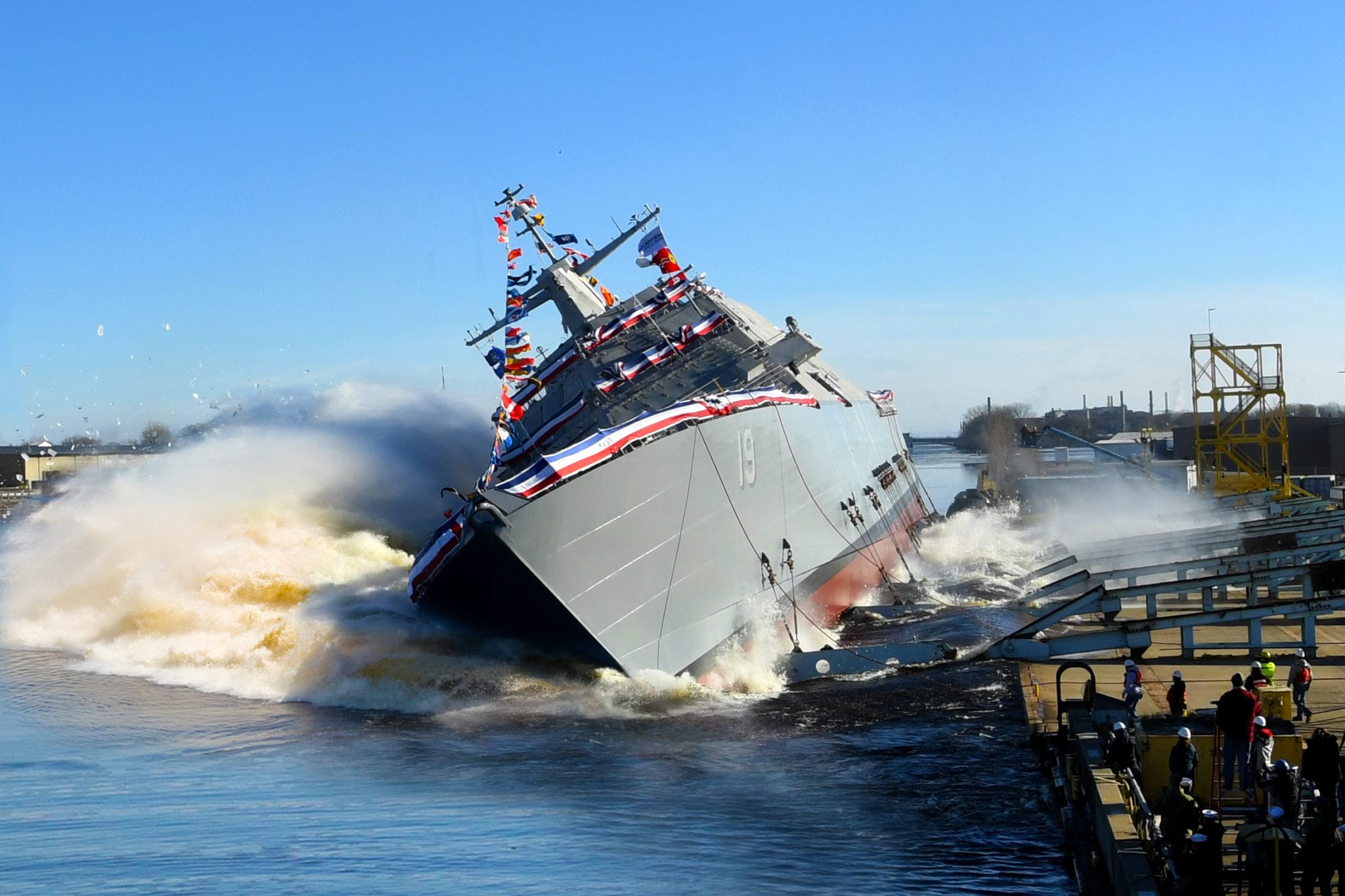
The navy has suffered from the diversion of attention and resources to two lengthy-land wars. It has suffered from costly unforced errors in lives, ships and cost. Gone is a major $750 million ship like the Bonhomme Richard in whose strike group I deployed 17 years ago.  Hundreds of millions in overhaul investment in the USS Miami, a submarine lost in a fire at the Portsmouth Naval Shipyard. Hundreds of millions and two years in the shipyard for the USS Fitzgerald and USS McCain. A mine warfighting ship lost on a reef. We have lost ships before in our history due to accidents and storms, but we don’t have ships to spare now. We need everything.
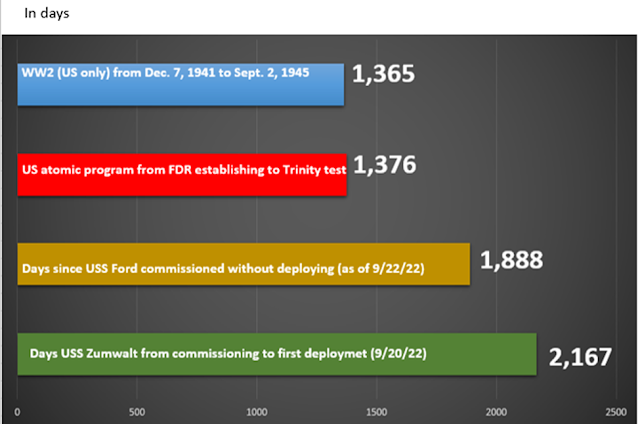

We have had three major shipbuilding programs in the past twenty years that have been a challenge.  Littoral Combat Ships decommissioning in just a few years. And while Zumwalt and Ford have finally deployed, the time from their commissioning to their first deployments is well beyond the length of US participation in the Second World War. The atomic bomb project went from program establishment to bombs on target in 1,376 days. 

Defense news recently reported that the us navy has “spent more than four years repairing one of its amphibious ships, already spending more than $100 million above what was planned. The ship is still not ready to deploy.”  The Navy, after $300 million just wants to decommission it. “Only 45% of the amphibious ship fleet is ready today compared to the navy’s 80 percent goal.”

Has the US Navy had programs that didn’t go according to plan? Of course. Although Robert Fulton built the first steam powered warship in 1815, it would be more than two decades when the technology was reliable enough from the private sector to build dual-powered ships. In 1835, Congress debated naval funding and whether to build the 120-gun ship of the line USS Pennsylvania with 1,000 sailors (that was ten percent of the size of the navy in one ship) or a dozen small sloops. In the end, Pennsylvania was built largely because the congressman who represented the shipyard in Philadelphia where it was to be built was Chair of the Naval Affairs Committee. There was the ram ship USS Katahdin, commissioned in 1896 and decommissioned only a year later.


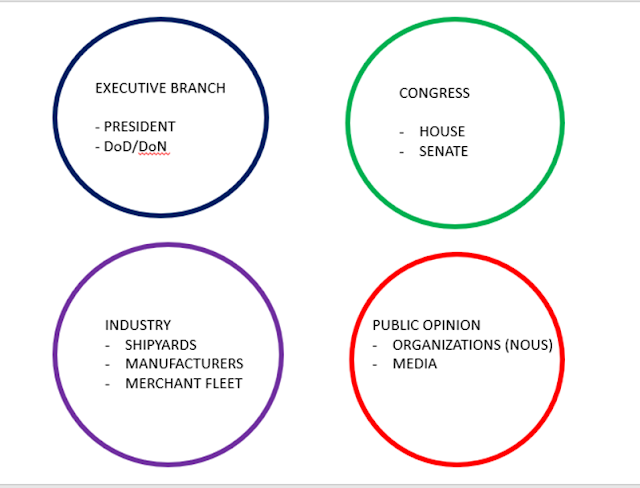
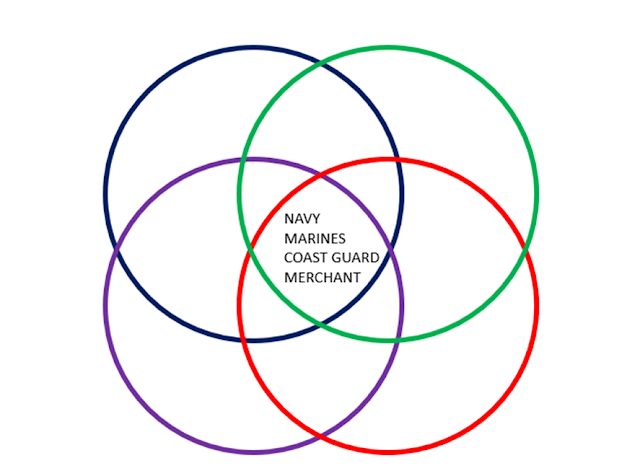
To be ready and sufficiently sized is based on four elements: the executive branch, Congress, industry, and public support. 


All those elements feed into each other. When all come together, that’s when we see a rejuvenation of the maritime services. Diminish or remove any one of those out and the equation falls apart.

At every period we increased the size and platform diversity, we had an executive branch that provided the vision and support. Even Andrew Jackson whom I wrote about in my latest book, had a recognizable maritime strategy. Others like the two Adams’, the two Roosevelts, Wilson, and Reagan understood the role of a navy and were its supporters. 


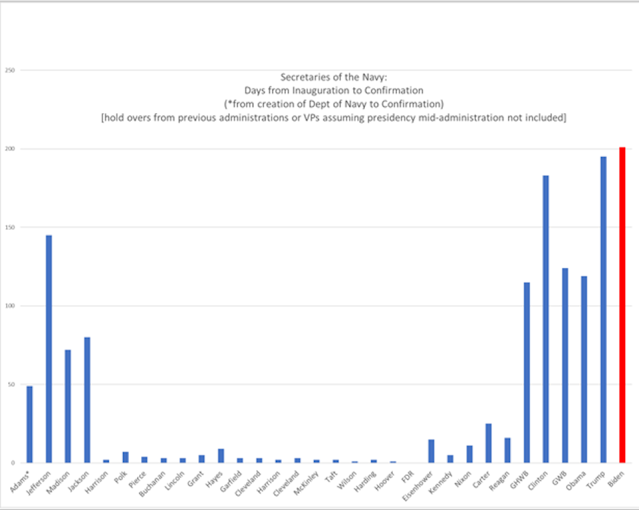
How do you quantify administration interest in the Navy? We can start with a simple criterion. Under the current administration, it took more than 200 days for a Secretary of the Navy to be confirmed – that’s a longer period from inauguration to confirmation than any other presidency.

Second, every period has had a critical mass of supporters from the legislative branch which has the Constitutional authority and responsibility to provide and maintain a navy. Absent that critical mass of support, a Navy will not be built or built better.

While watching a House Armed Services Committee hearing this year, I was struck by how a member of congress advocating for the navy was interrupted by the Chairman with this statement about China’s navy. 

“How capable are their ships? How many ships does China have deployed all around the world in any given moment? That’s a very low number from what I understand. And the capability of those ships are not as great either. So, we can all like FREAK ourselves out about all the trillions of dollars a year apparently, we have to spend on our defense budget. I think it would be helpful if we had a realistic understanding of our adversaries and where they’re at.”

He dismissed the threat of China, and he dismissed the idea of building the navy up.

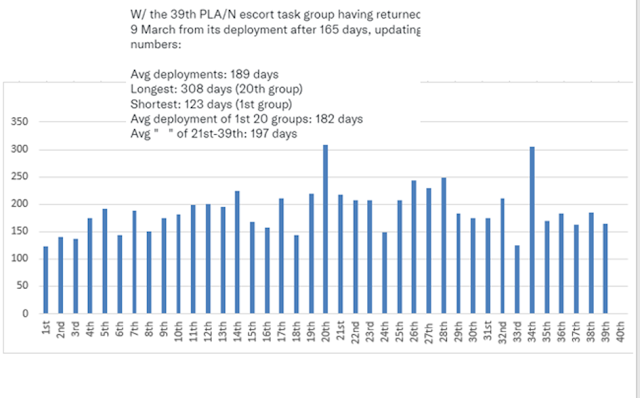
I certainly respect the chairman and his role, but fundamentally disagree with his off-the-cuff assessment. China may have a low deployment rate focusing only on two regions, but it is not dissimilar to the US Navy’s rate of 15 percent in the 1980s especially when you consider it isn’t committing itself – yet – to all the regions of the world. We could do so because we had the numbers. Today our deployment rate is about 35 percent. The pace of China’s shipbuilding has meant that their ships have rarely needed to deploy more than a couple of times. Its growing fleet has allowed China to do more without degrading the material readiness of the ships. Conversely, the has struggled to maintain its ships, which are deploying at a higher rate and for longer periods. 

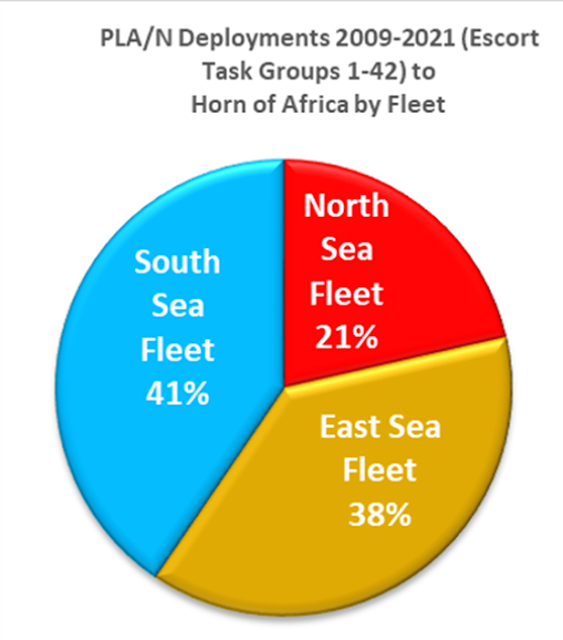
Capability comes from both technology and experience and China’s navy is gaining experience very quickly. In the past decade they’ve been sending squadrons – 42 of them -to the Horn of Africa every three or four months.

They have gained experience close to their shores and ships from every one of their fleets is operating on the other side of the world in deploying to the Horn of Africa.

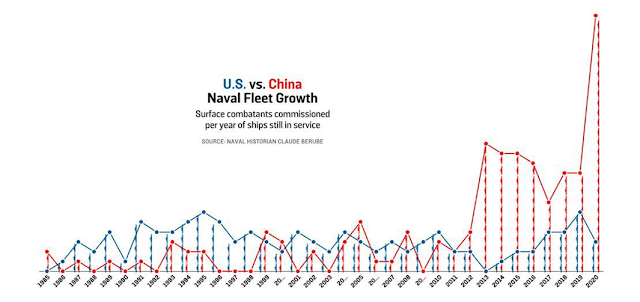
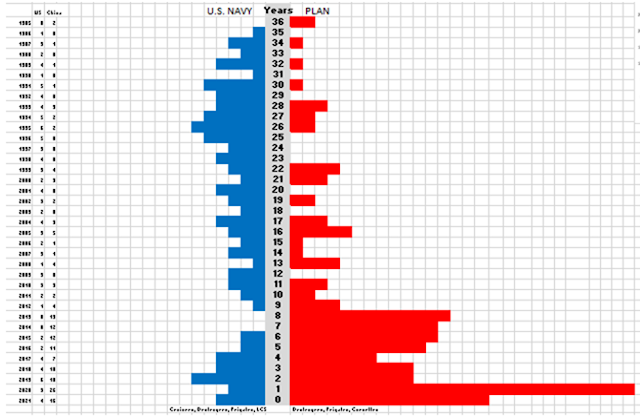
They have vastly outbuilt us in the past 10 years. Yes, that red line is China’s shipbuilding versus the blue of the us navy.


This graph represents all the major surface combatants in our fleet as of last year and their age from commissioning, so the top are the oldest ships in each fleet and the newest at the bottom. Eighty – that’s eight zero – of their surface fleet has been built in the past decade. By contrast only twenty percent of the US fleet is less than a decade old.

Testifying before the Senate Armed Services Committee in June, the Secretary of Defense said we “certainly have the most capable and dominant navy in the world and it will continue to be so going forward.” While the secretary’s sentiment is laudable, it is contrary to quantifiable trends. China isn’t a rising power – it has risen. I think we need to consider another historical example when we casually brush aside the threat of China’s navy. 

Commodore Matthew Perry visited Japan in 1854. That caused Japan to think about a navy of its own, not dissimilar to how China reacted 1996 to the Nimitz battle group transiting the Taiwan strait. In 1874, Japan launched an expedition to Taiwan. That decade their midshipmen began to study at the US Naval Academy. By 1895 their navy defeated China’s fleet in a war. In 1905, they defeated the entire Russian Eastern and Baltic fleets.

For those reasons, I think the chairman’s remarks were either insufficiently informed or intentionally dismissive.

We have incredible advocates in Congress like Elaine Luria [note: this speech was delivered before the 2022 election] and Mike Gallagher. But we need a legislative branch with advocates beyond that and beyond the shipbuilding districts. We are mired in petty partisan politics while China has a distinct advantage – they are forcibly unified and that has enabled them to build the world’s largest fleet. While we need to defend our democratic republic ideals, we need to find a way to unify.

The third element - in nearly every one of our previous conflicts, we relied heavily on the capacity of our industrial base especially shipyards. How many do we have today? To give you the scope of what we face, one shipyard in China has more capacity than all of our shipyards combined. Our shipyard capacity is limited. A 2021 Congressional Budget Office report pointed out that the four submarine shipyards were facing significant delays in completing maintenance because of the amount of work necessary has increased and they are having trouble finding workers. This has affected operational readiness.

Part of that industrial base is the size of the us merchant fleet because it was America’s maritime economy….  China has some 4,500 merchant ships; there are fewer than 80 in the US fleet. Why is this important? Because the maritime economy that built the nation in the 19th century meant shipyard jobs. It meant jobs across the nation which built systems on those ships. It meant that many families had someone who relied on the sea for it or on it. And that merchant fleet needed protection by the US Navy. That is why the public could understand the need for a navy – because it was self-interested in it. Self-interest and passion drives politics and public policy, not reason and data. But the American public has become estranged from the maritime economy that would have been familiar to our forebears.  

Earlier, I mentioned several wars but I saved one for the end. That is the war that really put the United States Navy on a global footing because it demonstrated the power of our industrial base, our ability to build modern ships, the vision of presidents, the support of congress, and an emotional support from the media and general public. That, of course, is the Spanish-American war. It is why I think it a particularly relevant war to discuss today because less than a decade before, the naval order of the United States was established by people who recognized we had a problem, who had a vision, and made the vision of a navy a reality.


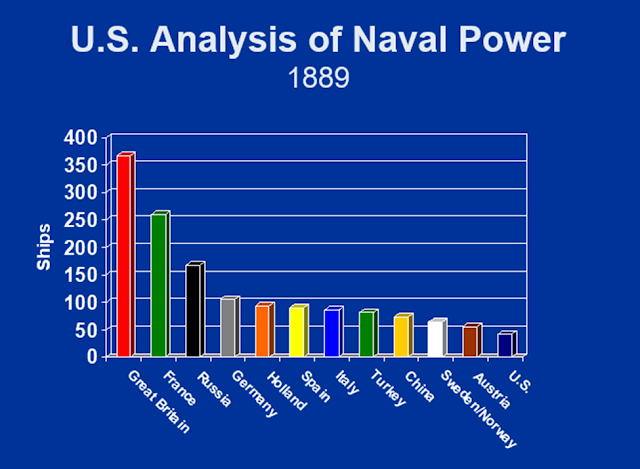
The year before the Naval Order was established, the US Navy was not among the world powers.


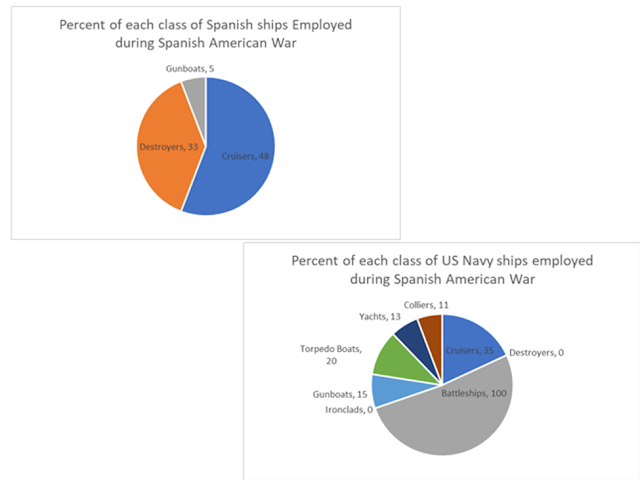
The Spanish navy during the 1890s was a traditional power investing in traditional surface combatants. The young American navy was more diverse in its platforms, understanding the need for logistics ships, etc.

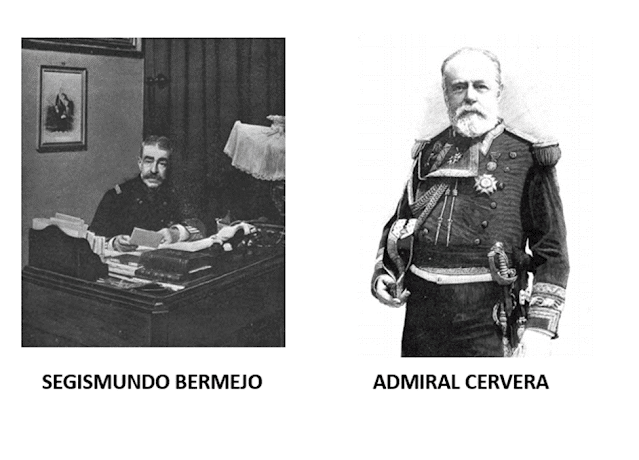
The Spanish Minister of Marine, Segismundo Bermejo had assessed the situation like this: the Spanish navy was experienced and a global power; the US Navy was young and inexperienced. On February 15, 1898 – the day the Maine exploded - he wrote to Admiral Cervera that it was his intent to blockade the American coast. The day after Cervera wrote back that the ships of the Havana station were badly worn out and that the Spanish naval force compared to the United States was approximately one to three, therefore a blockade wasn’t possible.

On April 22, three days after the declaration of war, Cervera wrote to Bermejo that “nothing can be expected of this expedition except the total destruction of the fleet or its hasty and demoralized return.” The Colon didn’t have its big guns. The 5.5 inch ammunition, with the exception of about 300 rounds, was bad. Two other ships had defective guns. They didn’t have a single torpedo. The Vizcaya could no longer steam. There was no plan, which he had much desired and suggested in vain. In short, he wrote, “it is a disaster already, and it is to be feared that it will be a more frightful one before long.” Privately, Cervera had been critical of the state of the Spanish navy before this because of its lack of money and frantically inefficient bureaucracy.”

Regardless, Cervera did his duty and in July would face the American fleet off Santiago. In his last address to his squadron, Cervera said “the solemn moment of fighting has come. The sacred name of Spain and the glorious honor of her flag so demands…the enemy covets our old and glorious hulls. They have sent the whole power of their young navy against us so as to achieve this goal. Hoist the flag and surrender no ship. Sound the trumpet for the combat. May God receive our souls.”

Every ship under his command was lost to the Americans. He and 39 of his officers were then held as prisoners of war at the US Naval Academy and treated as heroes by the American public.

What of Spain’s Asiatic fleet that was defeated at Manila Bay? Admiral George Dewey would write in his autobiography, “the Spanish government attempted to make a scape-goat of poor Admiral Montojo, the victim of their own shortcomings and maladministration.”

We would hope to rely on our allies in war and access to distant waters, but I think there’s another lesson from the Spanish-American war, a concern Admiral Dewey wrote about himself in his autobiography. His biggest concern after his victory at Manila Bay was that he’d face more Spanish. Specifically, a third squadron – a relief squadron – had gotten underway from Spain under Admiral Camara. He expected to resupply in Egypt. If Camara had that coal, Dewey wrote, there would be nothing that stopped him. But the coal was denied and Camara was forced to return to Spain. This isn’t unusual. Think about the start of the Iraq war when an entire infantry division was denied access through Turkey. Can we always rely on other nations great and small especially in a potential conflict with China when nations must act in their self-interest?
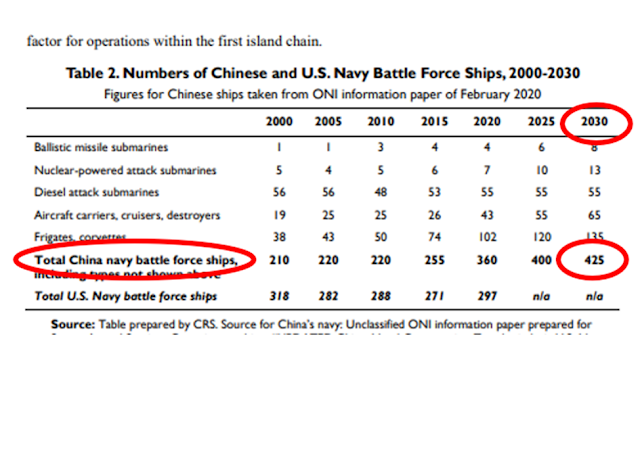
A final point. Some may argue that China’s navy is only slightly larger than ours. But if war comes and it is anywhere near the South China Sea they will be able to bring to bear their entire fleet in a matter of days – by the end of the decade, the Congressional Research Service estimates they will have 425 ships.  

How many of our ships could we get in theater in days or weeks?  100? 150?  That would be a one to three advantage, the same concern Cervera voiced about his proportion to the Americans. We have an incredibly capable force and equally impressive sailors. But we have to assess how unique, innovative technology in small numbers will do against a larger force. When I was a defense contractor in the 1990s, one of my senior colleagues was Bud Rundell, a B-17 bomber pilot shot down over Merzberg on his 13th mission. He told me of seeing a Me-262 during one mission, but there were too many bombers to counter that one innovative jet. What of German advances in tanks, submarines, or V-1 and V-2 rockets during the Second World War? How much did unique, advanced technology impact the result against an overwhelming Soviet and Allied force?

To close out, I mentioned at the beginning of my talk that my town had two houses of worship – the hockey arenas and the Catholic churches.

Fifteen years ago, I was in Ottawa sitting in a chapel - the Rideau Street Chapel. Coincidentally it belonged to the same religious order that founded a hospital in my town and where my family worked. As I sat in a pew, I observed the artistry of the fan-vaulted ceilings and listened to a chorus of forty voices. But the chapel was no longer on Rideau Street. It had been deconstructed and moved to the interior of the National Gallery of Canada where speakers played a recording of the chorus. That morning I read in the paper an article about communion hosts – the center piece of the Catholic mass – had found a resurgent popularity in Quebec as a common, secular snack. Unlike my childhood, the churches in Quebec that had a Catholic faith for three centuries was in steep decline, its churches empty, and its foundations were now viewed as artifacts. 

A similar feeling struck me a few years ago when I was in England visiting the Portsmouth naval museums, recognizing the glory years of the Royal Navy that ruled the seas, and yet the Royal Navy today had less than two dozen destroyers and frigates. It reminded me of an old Rudyard Kipling poem which lamented that “far called, our navies melt away.”

Certainly, in my current professional capacity, I understand the value of museums like those mentioned and teaching our history to the public, but they can too easily be reminders of yesteryear rather than what is needed now and tomorrow. Our country may have grown beyond a symbiotic life with the sea to one of simple indifference, relegated to galleries and exhibits and artifacts.

We as a nation and a navy are not ready because we have chosen not to be. What do we need to prepare for a potential conflict with China?

We need executive vision and action. 

We need congressional interest, oversight and funding. 

We need a navy to build operational platforms. 

We need a much larger industrial base. 

We need a public that has a direct relationship to our maritime services that understands they have skin in this Great Game.

We must become ready. But whether or not we are when the time comes, like Cervera, we will do our duty and go with courage regardless of the fate that awaits us.

Is there hope? Certainly.  

I see it in an incredibly capable Secretary of the Navy. 

I see it with some outstanding admirals.

I see it in the commitment and resiliency of our officers and sailors.

And I see it every day in the creative and energetic midshipmen I teach at the Academy, the future of our naval services. 

Thank you.


Claude Berube, PhD, is the author of “On Wide Seas: The US Navy in the Jacksonian Era” and several other books including his third novel, “The Philippine Pact” (2023). He has worked on Capitol Hill, in the defense industry, and the Office of Naval Intelligence. A Commander in the US Navy Reserve, he is currently assigned to a unit with Navy Warfare Development Center. Since 2005 he has taught in the Political Science and History Departments at the US Naval Academy.


Thursday, October 27, 2022

Where is the Accountability?


We have not had the chance to dig up LCS and gibbet it at the entrance of the harbor recently, so let's take a nice overview by Sam about the healthy churn between the Executive and Legislative Branches of government to see how it looks in the light of 2022;

As part of the FY 2023 submission, the Pentagon proposed cutting warships from the Navy’s battleforce – including six cruisers, four Whidbey Island/Harper’s Ferry-class amphibious Dock Landing Ships, nine Littoral Combat Ships as well as Montford Point and John Glenn.

The youngest ship on the list, USS St. Louis (LCS-19), commissioned in 2020.

Years before LCS hull-1 was commissioned, we tried to warn the Navy what they were setting us up for. Long time members of The Front Porch know the story well, new folks can click the LCS-tab to catch up on a couple of decades of discussion.

I'm not sure even in our darkest moments we saw it coming to this much ruin...but perhaps we were optimists.

Imagine being one of the Sailors assigned to the St. Louis. "So, what did you do in the Navy?"

...and yet - where is our accountability for such a potlatchish waste of institutional capital and taxpayer money?

The above is clearly a generational failure by The Potomac Flotilla, and in an article by our friend Jerry Hendrix over at NRO, we have another example where The Potomac Flotilla has intentionally steered our Navy in to shoal water with barely a whistle, 

On Tuesday, the conservative Heritage Foundation released its annual “Index of U.S. Military Strength.” For the first time in the near-decade-long history of the index, it rated the U.S. military as “weak.” Implicitly criticizing multiple administrations, Heritage’s analysts charged that U.S. military forces are under-strength, under-trained, and under-funded, and thus are not ready to meet the current challenges of great-power competition. Heritage highlighted in particular the small size and poor material condition of the U.S. Navy and Air Force, which will be critical in facing a potential conflict in the Asia–Pacific region.

None of these failures are the fault of the Sailors and company and field grade officers in the Fleet - the ones our Navy has no problem holding to very public account for their failures - but of the senior uniformed and civilian leaders spanning multiple administrations ... and yet - who is being held to account?

Combine this with the fact that we tried to tie the loss of a multi-billion dollar large-deck amphib around the neck of an undesignated Seaman only to have him found not guilty after two years ... with still no one of note held to account but scapegoats ... where do the American people have to go in order to have their military leadership held to account?

Where? When? Who?

This should not be how any of this works.

Sunday, October 23, 2022

The Case for a 600 Ship Navy: Now More than Ever with LT Joseph Sims, USN

When was the last time the US Navy made the case for a significantly larger navy to defend its interests on the high seas?

Yep, back when Ole Sal was a Midshipman and EagleOne was as close to his service in Vietnam than Sal was to his service in Afghanistan - the 1980s.

What lessons can we take from that relatively successful intellectual, political, and personal struggle to grow our Navy?

Using his recent article in Naval History Magazine, Lessons from the 600-Ship Navy, as a starting point for our conversation, our guest for the full hour this Sunday from 5-6pm Eastern will be Lieutenant Joseph Sims, USN.

Lieutenant Sims is a Surface Warfare Officer and 2018 graduate of the US Naval Academy where he majored in history and competed four years on the varsity tennis team. He completed his first division officer tour on USS LASSEN (DDG-82), where he served as the gunnery officer and electronic warfare officer and completed deployment to 5th Fleet with the Truman Strike Group in 2019-2020 as well as deployment to 4th Fleet in 2020. Following completion of the Advanced Division Officer Course and Prospective Engineering Officer Course in Newport, RI, he reported to USS ANTIETAM (CG-54) in August of 2021 as the Main Propulsion Assistant. 

Join us live if you can, but it not, you can get the show later by subscribing to the podcast. If you use iTunes, you can add Midrats to your podcast list simply by clicking the iTunes button at the main showpage - or you can just click here. You can find us on almost all your most popular podcast aggregators as well.

Tuesday, September 06, 2022

Build More Carriers and Send Some to CENTCOM

At a time when nations at the front line facing a rising People's Republic of China such as Japan and India (and the PRC herself) are expanding their aircraft carrier fleets as fasts as budgets and politicians will allow, in the United States the carrier debate continues in to another decade.

It is natural; aircraft carriers are very expensive - and they bring a lot of capability with that cost. They are vulnerable because they are a high-priority target specifically because of the threat they pose to any opponent. Both sides have a point, but the question is who has the better point given our place in time.

In another chapter in the carrier debate, we're honored to have Bryan McGrath returning here with a response to a recent article in the U.S. Naval Institute's Proceedings by Lieutenant Commander Stephen Walsh, U.S. Navy at the link below.

Bryan, over to you.


There is little in the opinion-writing world more attractive to editors and readers than the thoughts of someone questioning closely held tenets of what would appear to be the affinity group of the author. So, when an aircraft carrier aviator pens a piece questioning the value of aircraft carriers in a major piece of U.S. geo-strategy, one is forced to take notice. That several members of the tight fraternity of un-listened-to and marginalized navalists to which I claim affinity cited the work with praise and hosana also caught my attention. Having now read and digested the work, I am considerably less impressed by the substance of the argument, and I set out here to address its shortcomings. 

First though, I wish to congratulate LCDR Walsh on his effort. He is a fine writer and thinker, but most importantly, he has taken the time to submit his views to scrutiny. The world is full of opinions, but there are precious few (especially among naval officers) who are willing to address and/or stoke controversy publicly in such a lucid and well-documented fashion. That I will spend the remainder of my time here criticizing his argument should be taken as a sign of respect. Were his argument not worth addressing, I would not be writing this on a national holiday. 


Walsh’s Argument

Readers are urged to digest Walsh’s argument in full. I will only summarize it here to frame my own thoughts, and I apologize for the shorthand approach. Here goes: aircraft carriers are valuable elements of the Navy’s contribution to Joint warfighting, and as there are a finite number of them, their application to U.S. grand and defense strategic objectives must be carefully considered. This consideration extends to both the effectiveness of that application, and the consequences to force readiness that flow therefrom. In applying carrier air power to the strategic objectives of CENTCOM commanders, Walsh believes that carriers have been misallocated, as other elements of the Joint Force have been more effectively employed. Walsh asserts that the misapplication of carrier air power to a theater of secondary strategic importance (behind Indo-PACOM and EUCOM in that order, presumably) has wasted carrier readiness that should either be held in reserve or applied more liberally in the other theaters (this much is not as clear). This is not an outlier’s view. It tracks closely with the warp and weft of the Trump National Defense Strategy which shifted emphasis to the Indo-Pacific at the explicit expense of CENTCOM (and EUCOM). 


McGrath’s Argument

Whether one points to the Trump NDS or the current administration and its Interim National Security Strategy and National Defense Strategy, it is hard to conclude that the current bi-partisan fashion animating national security thinking is not “managing decline” (or re-arranging deck-chairs). No one in authority puts it this way, but it is the elephant in the room. At some point after the fall of the Soviet Union, maintaining our position as the world’s dominant power and leader of the free world lost currency. Now that this position is actively challenged, our efforts seem more geared toward efficient allocation of declining resources than in addressing the challenge head-on. Decline strategists would have one believe that what they are doing is making tough choices, which after all, is the zenith of strategy-making. The problem with this approach is that they have already made (or recognized the existence of) the decision NOT to be globally powerful. Their approach and logic is internally consistent and whole all the way from “B to Z”. The problem is that I am unaware of the consensus in American defense and national security thinking that codified the step from “A to B”—that we were (as a nation) comfortable with relative decline and that our approach henceforth would be to draw out that decline for as long as possible. 

My argument is this: I am unafraid to draw Cold War parallels to the current strategic environment. We either tool up and build out for it, or we accept decline and the consequences of living in a world where we are not the dominant power. Where Walsh would have us believe that promiscuous employment of aircraft carriers to CENTCOM is leaving us ill-prepared for higher priority conflict elsewhere, I would argue that we do not have the number of aircraft carriers (or a properly sized Navy) we need to meet our legitimate security requirements. They are of course—different arguments. But if you buy into Walsh’s argument, you never get to mine. 


Does the Carrier Deter?

Deterrence of any variety is difficult to prove without exquisite intelligence, as the problem of “proving the negative” confronts any claim made without it. Additionally, the fact that Iran appeared “undeterred”, carrying out aggressive global and regional terror attacks (in addition to direct military action) while aircraft carriers were present in theater, adds to the nagging question of carrier effectiveness as a deterrent. 

Yet there are important questions to consider before concluding the ineffectiveness of the carrier as a deterrent. The very existence of the ground-breaking “Abraham Accords” points to the growing wariness of Iran in the Arab world and the discomfort felt there in U.S. overtures during the Obama Administration (re-started in the Biden Administration) toward Iran. The presence of a carrier may or may not have stopped Iranian adventurism, but was the carrier part of a regional approach to deterring a larger war between Iran and the Sunni-Arab world? I do not know the answer to this, but I suspect CENTCOM Commanders believe that it was. And the suggestion that CENTCOM Commanders might “pull punches” to preserve carrier readiness for use in another theater strikes me as misunderstanding what those officers are paid to do. We pay the Secretary of Defense to make punch pulling decisions.

Walsh points at this, as senior civilians in both parties responded positively to CENTCOM requests for aircraft carriers. Walsh would have those civilians be less open to these requests, relying on other parts of the Joint arsenal for deterrence and saving carrier readiness for other conflicts. But for whatever reason, those civilians and those CENTCOM Commanders believed that the theater needed BOTH carrier air power and land-based air.  What if what was really happening was not shoddy and reflexive staff work by the combatant commander and his staff, validated by the Joint Staff and the Secretary of Defense, but the dirty business of everyday American national security? What if the CENTCOM Commander really was making a good case for these forces? What if—at the end of the day—the intelligence from both within DoD and the rest of the intelligence community indicated that overmatch was having an impact on Iranian behavior? Criticism of combatant commanders for insatiable appetites is the new national pastime. But I fear far more, a world of passive combatant commanders than I do the fear of sub-optimal carrier employment. 

Troublingly, I read little in Walsh’s treatment of carrier employment in CENTCOM of the role of crisis response from forward deployed forces. While the work he and his co-workers were doing was somewhat mundane, that he and they were there ready to respond is not to be undervalued. 

And then there is the whole business of counting bombs dropped in theater as a measure of effectiveness or utility. While this might be frustrating to the aviators participating in missions found less exciting than others, of all the metrics to apply to the effectiveness of a deterrent, this seems the least relevant. Carrier Air Wings throughout Indo-PACOM and EUCOM routinely return to homeport without having fired a shot in anger. Are we to assume their readiness was similarly wasted?

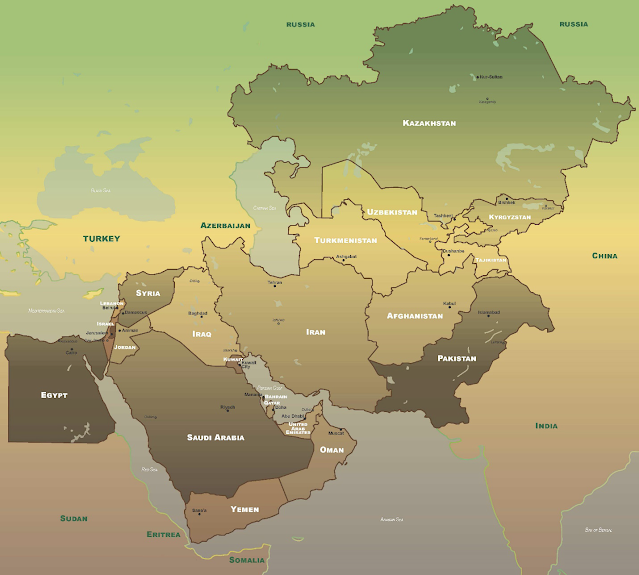
                        CENTCOM AOR


The Priority Theater Issue

Walsh begins his piece thusly: “The Department of Defense (DoD) has allocated aircraft carriers to U.S. Central Command (CentCom) for Iranian deterrence at the expense of strategic competition with China and Russia repeatedly over the past decade. DoD is locked in a cycle that regularly deprives Indo-Pacific Command (IndoPaCom) and European Command of the carriers necessary for strategic competition.” Forgive me if I impugn motives unfairly, but until late March of this year, most discussions of this sort were solely focused on Indo-PACOM, with both EUCOM and CENTCOM relegated to lesser positions. Then came a war and now EUCOM has the attention of naval force structure analysts. My point here is that the U.S. has enduring interests in all three AOR’s, and those interests drive the need for dominant naval power in each. Setting up this shell-game of priority theaters has a veneer of strategic thought, but the real-world gets a vote, and commitment of forces to lesser theaters is not always a sign of weakness in decision-makers. Sometimes it is the least bad decision. 


The Stationary Carrier

In his second paragraph, Walsh writes “Iran can and must be deterred from aggression—but without continually holding an aircraft carrier in a stationary and strategically disadvantageous position.” I do not mean to be a noodge, but with routine operations in the North Arabian Sea, the Gulf of Oman, the Gulf of Aden, AND the Arabian Sea, aircraft carriers in more obvious deterrence postures vis-à-vis Iran cover a lot of ground. In fact, to buttress the claim that “It is equally difficult to argue that a carrier is necessary for CentCom’s maritime security”, Walsh points to the 1988 “Operation Praying Mantis” in which the USS ENTERPRISE (CVN 65) “…remained outside the Strait of Hormuz, and her aircraft required assistance from an Air Force KC-10 to reach their targets.”  

Clearly the ENTERPRISE was in this case, not a stationary carrier. More importantly though, how ENTERPRISE was employed is illustrative of how we would prudently employ the CVN in conflict. To wit, carrier operations ought not be conceived as singular charges of the maritime light brigade deep within the contested zone at the beginning of a battle (especially in confined waters), followed by the establishment of long-duration frontline sanctuaries for carrier operations. Rather, they should be conceived as sequential hit and run operations that gradually degrade an adversary’s ability to fight effectively in the contested zone’s outer reaches, which in turn creates the conditions that allow the process to be repeated closer to the adversary’s shores. Put another way, attempting to operate an aircraft carrier in the North Arabian Gulf in wartime is a far different undertaking than doing so in restive peace. 


Walsh Sees a Demand Problem; McGrath Sees a Supply Problem

Again - Walsh is appropriately reacting to a set of facts that he is presented with. We have a finite number of carriers, and he believes they are being misused, which exacerbates their readiness challenges and renders the U.S. less well-prepared for higher priority uses. His prescription is to use them less. My prescription is to have more of them.  I will concede that his view is the dominant one, the most likely to be followed, the most logical one given the political environment in which we live. But because it accepts decline, it raises a very uncomfortable question: if we are accepting decline and are in essence trying to run out the clock, is not every penny we spend in this pursuit wasted if the result is essentially pre-determined? Put another way, why not just accept decline, re-orient a goodly portion of the defense budget to other uses, and accept the resulting world order as the new status quo?


The Problem of Time

Where Walsh’s good sense and my howling at the moon are most opposed is in the question of time. For instance, if what Walsh is trying to say is that FOR NOW, we need to cut back on what he believes are wasteful applications of carrier air power to store up readiness for a “Davidson Window-like” conflict with China, his argument has some attraction (although it could hardly be differentiated from a decline management approach undertaken across the same period). My argument is that we must undertake a massive naval building program over the course of a generation beginning immediately, the tangible fruits of which are unlikely to manifest for several years. In the meantime, the force we have must be employed as consistently as possible to extend and deepen American security and prosperity, and we must fund the training, parts, and maintenance necessary to achieve that readiness. Announcing such a building program and then allocating the necessary resources will send a clear message of seriousness that has not yet been achieved.  


Conclusion

We are engaged in a multi-generational security struggle and unlike when last we faced such a challenge, we are attempting to manage it rather than rise to it. LCDR Walsh has offered that because our interests in the CENTCOM AOR are not nearly as important as those in Indo-PACOM and EUCOM, and because in his view, those interests are not advanced by what carriers do when they are in the CENTCOM AOR, we ought not send them there anymore, or at least not as often. I am struck by the degree to which his advice has already been taken, its strategic flaws notwithstanding. 

More importantly though, I am troubled by the resignation that I read in his essay. The sense of “because it is this way it will always be this way” is strong in it, and its acceptance of current circumstances places constraints on thinking about what is possible. At the very least, we could properly resource readiness across the fleet to address the deficits created by the capacity/need mismatch. More holistically though, we must consider a dramatic increase in spending on our Navy across the board, so that both current readiness and future capacity can be achieved. 


Bryan McGrath is the Managing Director of The FerryBridge Group LLC. His views and opinions are his own.


Monday, August 08, 2022

China to the Slot


The US military and her Commonwealth allies lost over 10,000 men killed in the Solomon Islands Campaign in WWII. 

Over 40 USN ships were sunk, 800 aircraft shot down.

We killed almost 90,000 Japanese, sunk over 50 of her ships, and destroyed over 1,500 of her aircraft to kick her out. 

You should know the map and the names.


How many warships do we have named after this campaign from battles to those who fought in it? 

How have we honored this legacy? How have we maintained this legacy?

We've been reporting on our lack of stewardship in the islands of the Western Pacific for years now, and things are getting more attention, but still do not seem to be getting much better as, step by step, the People's Republic of China keeps advancing. 

The latest news?

Chinese state-owned company is negotiating to buy a forestry planation with a deep-water port and World War II airstrip in Solomon Islands amid persistent concerns that China wants to establish a naval foothold in the South Pacific country.

A delegation from China Forestry Group Corp. visited the plantation that covers most of Kolombangar Island in 2019, asking questions about the length of the wharf and depth of the water while showing little interest in the trees, Australian Broadcasting Corp. reported on Monday.

The board of Kolombangara Forest Products Ltd., the takeover target known as KFPL which is owned by Taiwanese and Australian shareholders, wrote to the newly elected Australian government in May warning of the “risks/strategic threats” posed to Australia by such a sale, the ABC reported.
If that name does not ring a bell, let me help you out a bit.
On August 2, 1943, Moses and Koete were part of a team of eight scouts, working as indigenous guerrilla fighters, saboteurs, and spies behind enemy lines, feeding information on the movements of the Japanese back to the Allies. After witnessing an explosion at sea before dawn on August 2, they searched the atolls around Kolombangara for survivors of what they assumed to have been a shipwreck. On August 4 the scouts found the survivors, terribly dehydrated and sunburned, but alive. It transpired that a Japanese destroyer had cut an American torpedo boat in half and the surviving American crew had been swimming between atolls for days. This crew was led by a young lieutenant called John F. Kennedy.
There is a lot of American history here - not that our professional historians teach it all that much anymore as opposed to their trendy group-think causes of the quarter.

Also, what do you notice on this map?


There she is, Vella Gulf ... as in the Battle of Vella Gulf;
In Vella Gulf shortly before midnight, with the two divisions in formation 4,000 yards apart, they probed Blackett Strait; then turned north along the Kolombangara coast. Soon, radar contact was made with four Japanese destroyers carrying reinforcements for Kolombangara and closing on a course for Blackett Strait at a relative speed of nearly 50 knots. Less than ten minutes later, Division A-1 had maneuvered into position—exactly as planned—and fired 24 torpedoes. As it turned away to evade any Japanese response, Division A-2 crossed ahead of the oncoming Japanese formation to attack from a new direction.

After what seemed like an eternity, Division A-1’s torpedoes hit all four Japanese ships, blasting the first three and holing the rudder of the fourth. Division A-2 promptly opened gun and torpedo fire, completing the destruction of the three destroyers while the fourth, unseen, got away. The two divisions lingered, trying to pick up survivors but they refused rescue; Division A-2 then followed Division A-1 in retiring down the Slot, having sustained no damage or casualties.

The Battle of Vella Gulf, the U.S. Navy’s first independent destroyer action in the South Pacific, marked a turning point in American surface warfare. Coming a full year after the Guadalcanal landing, it showed that our weapons worked, that our doctrine was sound and that a surprise torpedo attack—delivered by destroyers as the primary attack unit—could be devastating to the enemy.
We like that battle because we won - where a a few months earlier the Japanese got a "W" at the Battle of Klomangara.

That is why we have a USS Vella Gulf (CG 72) and not a USS Klomangara.

Why does this matter today - these old battles?

The Solomon Islands were worth hundreds of thousands of lives last century for a reason. Nations may change in power dynamics in the Pacific, but geography does not.

Look at the Pacific from the Chinese perspective and it all makes sense.

If you want to delay the American navy from threatening your seaboard, you make her fight her way there.

If you want to threaten SLOC between North American and Australia, you have to control the Solomons at a minimum.

This is all known, or should be known. The Chinese sure know it. 

Chart credit to Rhodes Cartography.