Showing posts with label China. Show all posts

Thursday, March 30, 2023

The Weapons Gap With the PRC the USA Created and Funded: it Goes Boom


If you don’t wake up every morning cursing those responsible for defense and China policy in the 1990s … the gobsmackingly short sighted arrogance of it all – then what use are you, actually?

With a few exceptions, from partially completed CV rusting in Ukraine to teaching the Communist Chinese how to MIRV ICBM warheads, to opening up our best research institutions to spies an assets, the USA was beset internally by unserious people with the attention span of a hamster and the historical perspective of a newborn in serious jobs requiring long-term thinking and decision making.

The harvest of this decade of frivolity continue to ripen, and via Jeremy Bogaisky, at Forbes – get ready to rage – we have just one more example; one that if we actually come to blows with the People’s Republic of China or those who buy their weapons – will result in more dead American men and women – more mutilated wounded. 

People and perspective matter. It appears the PRC has known this for decades;

In 1987, U.S. Navy researchers invented a new explosive with fearsome capabilities. Named China Lake Compound No. 20 after the Southern California base where it was developed, it boasted up to 40% greater penetrating power and propellant range than the U.S. military’s mainstay explosives, which were first produced during World War II.

With the collapse of the Soviet Union, however, the Pentagon’s urgency evaporated. So did the expensive task of perfecting CL-20 and designing weapons to use it.

…and how did they get CL-10? Where was the CIA, the FBI? Oh, that’s right – playing around in domestic politics. 

Meanwhile, the PRC was sending grad students; inserting citizens in the right companies. Doing just plain good old fashioned espionage. 

China, however, saw the potential. The country has invested heavily in developing long-range missiles with the aim of forcing U.S. warships and non-stealthy aircraft like refueling tankers to operate at a distance if Chinese forces invade Taiwan. Some of those weapons are believed to be propelled by a version of CL-20, which China first fielded in 2011 and now produces at scale.

“This is a case where we could potentially be beaten over the head with our own technology,” Bob Kavetsky, head of the Energetic Technology Center, a nonprofit research group that does work for the government, told Forbes.

Kavetsky and other experts in energetics, the niche field of developing things that go boom, have been warning for years that the U.S., long the world leader, has fallen dangerously behind China. The Pentagon last year outlined a plan to spend $16 billion over 15 years to upgrade and expand its aging network of munition plants, but Kavetsky warns that doesn’t include developing the advanced manufacturing capabilities needed to mass produce new explosives like CL-20.

Criminal malpractice. 

No, we are not being led by the best and brightest™ - we are not promoting our best - we do not have the right mix of incentives and disincentives.

…the U.S. depends on China as the single source for about half-dozen chemical ingredients in explosives and propellants, and other countries of concern for another dozen.

Yes, you read that correctly. I am sure Russia is in there too.

Like I said, criminal. You cannot commission new chemical plants overnight.

“We can’t build enough ships and airplanes to carry the number of missiles necessary to reverse the firepower imbalance we have inside the first island chain,” said retired Major General Bill Hix, who served as the Army’s director of strategy after commanding forces in Afghanistan and Iraq, and has consulted for the Energetic Technology Center.

“The only solution is new energetic materials,” he said. That would allow the U.S. to produce smaller missiles with the same power, so more could be carried by warplanes and ships, as well as to enable weapons that can shoot farther and pack more of a punch.

The PRC has over a decade head start building on R&D the USA paid for.

Wittman said he supports the idea of retrofitting existing missiles with CL-20 and creating a high-level office devoted to energetics under the secretary of defense. While decision makers at the Pentagon are aware of the issues, “I don’t think they see a sense of urgency with it,” Wittman said. “We’re going to instill a sense of urgency with them.”

Chinese scientists account for about three-quarters of the published research on energetics and in related fields over the last five years, nearly seven times as much as U.S. researchers, according to analyses from the Hudson Institute and Georgetown University. They’re working on materials that have improved performance over CL-20, Kavetsky said.

I would really like to see where those Chinese scientists got their degrees from, but you pretty much know.

As for the sense of urgency, what have we discussed here through the years about the 2nd and 3rd order effects of our accretion encumbered acquisition process? What does it cause? Just re-read the above.

Want another example of an existential threat to the Cult of Efficiency created? 

Nearly all U.S. explosives are produced at a single Army-owned plant in Holston, Tennessee, that dates back to World War II and is run by U.K.-based defense contractor BAE Systems (2022 revenue: $25.5 billion). The production processes generally are as old, Kavetsky said, with explosives prepared in 400-gallon vats that resemble cake mixers. Many advanced energetic materials can’t be made that way, including CL-20, which he said is synthesized in smaller amounts in chemical reactors.

All one needs is a pickup truck and a mortar team and game over. Single point of failure. As if you designed something to make you combat ineffective at D+1.

It would be possible to make 20,000 pounds of CL-20 a year with current amounts of precursor chemicals, Kavetsky said, but broad use would require 2 million pounds a year, which he believes could take three to five years to scale up to. “If DoD says we want large quantities,” he said, “industry will respond.”

“If DoD says we want large quantities, industry will respond.”

Not if we lose our one plant or run out of the chemicals – which I am sure are just in time delivered – that China is nice enough to export to us.

How long would it take for just then environmental impact statement to be completed?

Hix said he doubts those promising technologies will be ready for prime time this decade, but the U.S. could fairly rapidly boost its firepower with better explosives and propellants.

“A concerted effort on [explosives] is possible,” he said. “But we have to invest in it.”

Oh yes, our “decade of concern” … 

The Terrible 20s just keep giving.

Monday, March 27, 2023

Transcript from the Defense Breakfast Seminar


Remarks by Commander Salamander before the Congressional Research Service, Defense Breakfast Seminar, Wednesday, 22 March 2023

I appreciate the opportunity to discuss some of my views on current topics affecting our defense posture and the future of our country. The views I will express are my own from my perspective after 35 years as a naval officer, defense journalist, and student of history.

I will not dwell on the specifics of the broad breadth of topics I’ve written on because they are available for anyone with access to a computer. I would like to share with you thoughts on the importance on one topic I’ve been writing about since 2004; the People’s Republic of China’s (PRC) naval threat as compared to our naval strength.

The PRC’s Naval Threat

Recent PRC aggression in the western Pacific has brought renewed realization of PRC intentions for world power and concern for the adequacy of our own defense. What many may not realize is that the PRC’s threat in naval power, as in other areas, has been growing more ominous. Past warnings by many in the military have been greeted with some indifference. However, today we are faced with a naval threat more serious than any since the end of the Cold War.

Forty-One years ago, Admiral Liu Huaqing, Commander-in-Chief of the People’s Liberation Army Navy (PLAN), headed a navy which was little more than a defense oriented extension of the People’s Liberation Army. Under him and the three-step plan he developed, the PLAN was transformed. Since 1982, the PRC built hundreds of new ships and combatant craft, a program of naval expansion that in recent decades surpasses the efforts of any other naval power. From a defensive fleet in the Cold War, it has evolved into a major blue-water navy that challenges the U.S. for control almost everywhere in the world. 

The PRC’s momentum for superiority in naval warfare continues while U.S. naval plans fluctuate every year. Never this century has there been anything comparable to the growth of the Chinese naval power. This certainly raises concern over the PRC’s desire to maintain the peace.

Here are some comparative examples to illustrate these concerns.

• In the past 10 years the PRC has built over 151 major surface combatants, mine warfare, and amphibious ships, while the U.S. has built 42, or just over 25 percent as many.

• The PRC has more major surface combatants than we, and are introducing new ships at a greater rate. These include a new class of cruisers, though they call it a destroyer, while we have none.

• Their program has strong support and stable funding. They are striving for qualitative equality. They already have numerical superiority. Our shipbuilding program is uncertain and does not get strong support from the Defense Department.

Any comparison of the Chinese and the U.S. Navy must be viewed from the context that we are a maritime power dependent upon being able to maintain sea lanes of communication necessary to conduct military operations overseas and to support our allies. The mission of our navy is a far more difficult one than that of the PRC’s of denying us free use of the seas as they are already doing in the South China Sea.

We have given up any chance of matching the PLAN in numbers of ships. Therefore, the quality of our ships must continue to be superior. It is axiomatic that a nation dependent on the quality of its weapons must design its forces around an offensive strategy if it is to prevail over a numerically superior foe. It cannot afford to fight a defensive war of attrition.

Need for Flexible and Capable Ships

A few years ago, few people gave much though to deploying naval forces through hostile waters to the Indian Ocean or the once-American lake known as the Pacific Ocean to protect our interests. Today that has become a reality. Few appreciate how difficult it is to maintain a significant naval force half way around the world. The supply line, particularly for conventionally powered ships, is tenuous. There may be a new realization that war of attrition as sea is a real possibility. In these circumstances, our naval forces must be able to defend the sea lanes and carry the battle to the enemy as well. In a global wartime situation we will not have the time to build the complex ships we need the way we did in the last world war. The ships we build in peacetime are those we will have to rely upon in the event of hostilities.

If we miscalculate or succumb to the easy economic choice of putting off decisions, and do not build ships adequate to face the threat, our choice will be to either give in to our enemies or resort to nuclear war. The cost of adequate strength to ensure peace is small compared to the cost of war.

Current Issues

1. The Attack Submarine Issue

2. New SSBN

3. Need for a New Cruiser

4. Retention of Experienced Naval Personnel


Closing Comments

Without congressional actions and help throughout the years, we simply would not, today, have what fleet we have. You have the constitutional responsibility to maintain this nation’s ability to defend itself. Indeed no other national issue is more critical than national defense. If we are not able to prevail against our enemies, all other issues, however significant, become irrelevant. It is to the Congress that we all must look for a defense posture strong enough to assure our survival as a nation. 


BT BT BT BT

OK, I'm having a little fun with you here ... these aren't my remarks ... and at least yet, no one has invited me to speak at a breakfast meeting ... but these are, with minor changes, the words of a much more intelligent and influential person than just your humble blogg'r - these are the words of Admiral H.G. Rickover, USN before the Congressional Research Service, Defense Breakfast Seminar, Wednesday, 4 June 1980.

Friend to the blog known well by regular readers here, Claude Berube, is in the process completing a new book about Admiral Hyman Rickover that I can't wait to read, as I do with all his books.

For those new here, Claude has written non-fiction before, as with his last naval history book “On Wide Seas: The US Navy in the Jacksonian Era,” and his third fiction novel in the Connor Stark series, “The Philippine Pact,” will be released this spring.

Claude saw this in his research and was kind enough to share the text of Richover's speech, as he knew I'd find it interesting. That share prompted a little exchange between the two of us - as we like to do. 

Claude, rightfully so, observed that with a few words changed, the 1980 view of the USSR aligns pretty well with the 2023 view of the PRC.

Considering that more of a challenge than an observation, I did just that.

Below is the original text from 1980. Give it a read - you'll see exactly what Claude saw.

It begs the question: what lessons could we learn from that critical last decade of the Cold War that began with such worry, but ended with the coming collapse of a system that could not compete with the West - economically, militarily, or morally?


Remarks by Admiral H.G. Rickover before the Congressional Research Service, Defense Breakfast Seminar, Wednesday, 4 June 1980

I appreciate the opportunity to discuss some of my views on current topics affecting our defense posture and the future of our country. The views I will express are my own from my perspective after 50 years as a naval officer, engineer, and student of history.

I will not dwell on the specifics of the naval nuclear propulsion program I am responsible for because I have testified on that subject before several congressional committees. I would like to share with you thoughts on the importance of the Soviet naval threat as compared to our naval strength.

The Soviet Naval Threat

Recent Soviet aggression in Afghanistan has brought renewed realization of Soviet intentions for world power and concern for the adequacy of our own defense. What many may not realize is that the Soviet threat in naval power, as in other areas, has been growing more ominous. Past warnings by many in the military have been greeted with some indifference. However, today we are faced with a naval threat more serious than any since World War II.

Twenty-four years ago, Admiral Gorshkov, Commander-in-Chief of the Soviet Navy, headed a navy which was little more than a defense oriented extension of the Soviet Army. Under him, the Soviet navy has been transformed. Since 1958, the Soviets have built over 1800 new ships and combatant craft, a program of naval expansion that surpasses the efforts of any other naval power. From a defensive fleet in World War II, it has evolved into a major blue-water that challenges the U.S. for control almost everywhere in the world. The Soviet momentum for superiority in naval warfare continues while U.S. naval plans fluctuate every year. Never in peacetime has there been anything comparable to the growth of the Russian naval power. This certainly raises concern over the Soviet desire to maintain the peace.

Here are some comparative examples to illustrate these concerns.

• In the past 10 years the Soviets have built over 900 major and minor surface combatants, mine warfare, and amphibious ships, while the U.S. has built 100, or just over 10 percent as many.
• The Soviets have more major surface combatants than we, and are introducing new ships at a greater rate. These include 4 new classes of cruisers, one of which will likely be nuclear powered. AT about 22,000 tons, it would be the world’s largest nuclear powered cruiser and will carry a formidable array of weapons.
• The Soviets have almost 3 times as many submarines and one-third more nuclear submarines.
• They have 5 submarine construction yards; we have two. All U.S. submarine construction capacity could fit into one Soviet submarine yard.
• Since 1970, they have introduced 10 new submarine designs; the U.S. two. During this period, the Soviets have put to sea more new design submarines than any other country during a comparable period in all of naval history.
• Their program has strong support and virtually unlimited funding. They are striving for qualitative superiority. They already have numerical superiority. Our program is uncertain and does not get strong support from the Defense Department.

Any comparison of the Soviet and the U.S. Navy must be viewed from the context that we are a maritime power dependent upon being able to maintain sea lanes of communication necessary to conduct military operations overseas and to support our allies. The mission of our navy is a far more difficult one than that of the Soviets of denying us free use of the seas.

We have given up any chance of matching the Soviet Navy in numbers of ships. Therefore, the quality of our ships must be superior. It is axiomatic that a nation dependent on the quality of its weapons must design its forces around an offensive strategy if it is to prevail over a numerically superior foe. It cannot afford to fight a defensive war of attrition.

Need for Flexible and Capable Ships

A few years ago, few people gave much though tot deploying naval forces to the Indian Ocean to protect our interests. Today that has become a reality. Few appreciate how difficult it is to maintain a significant naval force half way around the world. The supply line, particularly for oil fired ships, is tenuous. There may be a new realization that war of attrition as sea is a real possibility. In these circumstances, our naval forces must be able to defend the sea lanes and carry the battle to the enemy as well. In a global wartime situation we will not have the time to build the complex ships we need the way we did in the last world war. The ships we build in peacetime are those we will have to rely upon in the event of hostilities.

If we miscalculate or succumb to the easy economic choice of putting off decisions, and do not build ships adequate to face the threat, our choice will be to either give in to our enemies or resort to nuclear war. The cost of adequate strength to ensure peace is small compared to the cost of war.

Current Issues

1. The Attack Submarine Issue
2. Trident
3. Need for Nuclear-Powered Aegis Cruisers
4. Retention of Experienced Naval Personnel

Closing Comments

I have shared with you my thoughts from my vantage point of being involved in our nation’s defense for a long time and in charge of the nuclear propulsion program since its inception over 25 years ago. From that perspective, I am particularly sensitive to the role that the Congress has played. Without congressional actions and help throughout the years, we simply would not, today, have the strong nuclear fleet we have, now representing over 40% of the Navy’s major combatants. You have the constitutional responsibility to maintain this nation’s ability to defend itself. Indeed no other national issue is more critical than national defense. If we are not able to prevail against our enemies, all other issues, however significant, become irrelevant. It is to the Congress that we all must look for a defense posture strong enough to assure our survival as a nation.

Tuesday, March 21, 2023

60-Minutes Does our Navy - and the Nation - a Solid. I'll take the "W."


A regular topic of conversation here and on Midrats (it came up quite a bit on Sunday’s podcast with Jerry Hendrix), is the lack of discussion in the public space about the importance of a strong Navy to our republic’s economic and military security. Sure, inside our salons, slack channels, and email threads we talk to each other a lot, but we seem to have a hard time getting our message out to the general public.

Sunday night’s 60-Minutes was an exception to the rule. There is a lot of credit to go around here. First of all, you have to give credit to the 60-Minutes team fronted by Norah O’Donnell and lead producers Keith Sharman and Roxanne Feitel. This two-segment effort was not just on a topic we all are interested in, it was just plain good journalism.

Sure, I have a nit to pic here and there, but that is just my nature. Perfect? No … but it is one of the best bits of solid, down the middle journalism about our Navy and its challenges I have seen from a major network for a long time. 

If you missed it, CBS has published the video and transcript that I’m going to pull some bits from below for conversation.

The second segment was more meatier than the first, but the first is important. It isn’t just where Big Navy got a chance to make a run at media capture with the "C-2 to the Big Deck at sea" show that we all love, but it will introduce many people to someone who is very good at his job and representing the Navy, Admiral Samuel Paparo, USN.

He gets your attention early by, even though clearly well prepared and sticking to scripted talking points and marketing pitches here and there of questionable utility, he also spoke in blunt terms in a way we don't hear enough in venues such as this;

Admiral Samuel Paparo commands the U.S. Pacific Fleet, whose 200 ships and 150,000 sailors and civilians make up 60% of the entire U.S. Navy.  We met him last month on the aircraft carrier USS Nimitz deployed near the U.S. territory of Guam, southeast of Taiwan and the People's Republic of China, or PRC.

Norah O'Donnell: You've been operating as a naval officer for 40 years. How has operating in the Western Pacific changed?

Admiral Samuel Paparo: In the early 2000s the PRC Navy mustered about 37 vessels. Today, they're mustering 350 vessels.

...

60 Minutes has spent months talking to current and former naval officers, military strategists and politicians about the state of the U.S. Navy. One common thread in our reporting is unease, both about the size of the U.S. fleet and its readiness to fight. The Navy's ships are being retired faster than they're getting replaced, while the navy of the People's Republic of China or PRC, grows larger and more lethal by the year. We asked the commander of the U.S. Pacific Fleet, Admiral Samuel Paparo, about this on our visit to the USS Nimitz, the oldest aircraft carrier in the Navy.

Admiral Samuel Paparo: We call it the Decade of Concern. We've seen a tenfold increase in the size of the PRC Navy. 

Norah O'Donnell: Technically speaking, the Chinese now have the largest navy in the world, in terms of number of ships, correct?

Admiral Samuel Paparo: Yes. Yes.

Norah O'Donnell: Do the numbers matter?

Admiral Samuel Paparo: Yes. As the saying goes, "Quantity has a quality all its own." 

This is exactly how the answer needs to be delivered. No squish, no excessive spin - acknowledge the reality of where we are. 

More of this from more senior leaders.

There was some subtlety as well. When he first said this, about 10-seconds later I decided to rewind to listen to it again. 

Norah O'Donnell: And if China invades Taiwan, what will the U.S. Navy do?

Admiral Samuel Paparo: It's a decision of the president of the United States and a decision of the Congress. It's our duty to be ready for that. But the bulk of the United States Navy will be deployed rapidly to the Western Pacific to come to the aid of Taiwan if the order comes to aid Taiwan in thwarting that invasion.

Norah O'Donnell: Is the U.S. Navy ready?

Admiral Samuel Paparo: We're ready, yes. I'll never admit to being ready enough.  

Did you catch that? He can't say, "We're not ready." as if the call comes, we can and will execute what we are tasked ... and initially will be ready to do what we can with the reduced numbers we have ... but everyone knows there is a huge asterisk next to "ready." 

We don't have enough escort ships. We don't have enough VLS tubes. We don't have a large enough airwing with long enough legs. We don't have enough reliable and robust tanking. We don't have much of a bench ... so, we are "ready" - but not even close to being "ready enough." A subtle distinction with not so subtle implications.

We also need to give a nod to our Navy for not having only the 4-stars talk to CBS. LCDR David Ash, USN got some good face time with the camera, and his fellow LCDR Matthew Carlton, USN blessed us with his superb deployment stash.

60-Minute's graphics department also gets credit for the video that the pic at the top of this post is a screen capture of. 

One of the most important things someone can do who is interested in understanding the western Pacific from the PRC's POV is to see it from their shores in an east-up orientation. Where only a small group of PRC focused navalists have shared the image or have that projection on their wall were blessed with that perspective, now it is in the minds of at least hundreds of thousands more people.

This is how the Chinese Communist Party sees the Western Pacific, including the South and East China Seas from Beijing. Taiwan is the fulcrum in what China's leaders call "the first island chain," a constellation of U.S. allies that stretches across its entire coast.  Control of Taiwan is the strategic key to unlocking direct access to the Pacific and the sea lanes where about 50% of the world's commerce gets transported.

Norah O'Donnell: China has accused the United States of trying to contain them. What do you say to China?

Admiral Samuel Paparo: I would say, "Do you need to be contained? Are you expanding? Are you an expansionist power?" To a very great extent, the United States was the champion for China's rise. And in no way are we seeking to contain China. But we are seeking for them to play by the rules.

...and that is where the friction lies. The PRC holds the "rules" in contempt because they had no role in making them. As they don't like the rules, they are bit by bit changing them. From creating no-go zones in the South China Sea that once were open seas, to putting their flag down on the island nations of the southwest Pacific, to bending policies in Latin American nations, to being an observer at the Arctic Council to match their Arctic strategy.

Rules can, and are, being changed.

There was another point where Admiral Paparo put a marker down that someone can pick up and run with ... hey, I think I'll do that now;

Norah O'Donnell: How much do you worry about the PLA Rocket Force?

Admiral Samuel Paparo: I worry. You know, I-- I'd be a fool to not worry about it. Of course I worry about the PLA Rocket Force. And of course I work every single day to develop the tactics and the techniques and the procedures to counter it, and to continue to develop the systems that can also defend-- against them.

Norah O'Donnell: About how far are we from mainland China?

Admiral Samuel Paparo: Fifteen hundred nautical miles.

Norah O'Donnell: They can hit us.

Admiral Samuel Paparo: Yes they can. If they've got the targeting in place, they could hit this aircraft carrier. If I don't want to be hit, there's something I can do about it.

Ahhhhh, yes. Time to bring back one of my favorite graphics.


Draw a 1,500nm circle from the PLARF launch sites and look at what land based airfields, bases, depots and facilities of all sorts are located under that threat. They cannot move. A navy and sea based facilities can.

Undersold point, but Paparo is leaving it there for you to run with.

As a recidivist staff weenie, I swelled with pride at this moment. Nothing happens by accident;

Norah O'Donnell: I just noticed out of the corner of my eye. 

Admiral Samuel Paparo: This is a 688 class, a Los Angeles-class attack submarine. This is the most capable submarine on the planet. You know, with the exception of the Virginia class, our newer class of submarines.

Someone on that staff needs a NCM. Having that SSN heave in to view at that time and that place is simply 5.0 staff work. BZ to everyone, and like most of this visit, just all around well done. 

We've all seen such opportunities not work out all that well, but the time on NIMITZ was simply our Navy at its best. Paparo's staff, the crew of NIMITZ, the Strike Group, and Airwing all just did a superb job. Yes, there were a few PAOisms and talking points, but the visit and interviews were honest and praiseworthy. Paparo will get most of the credit, but everyone underway on that visit just did a superb job.

However, the following comment gave me pause, and it serves to make a point...I think.

Norah O'Donnell: How much more advanced is U.S. submarine technology than Chinese capability?

Admiral Samuel Paparo: A generation.

Norah O'Donnell: A generation.

Admiral Samuel Paparo: And-- by generation, think 10 or 20 years. But broadly, I don't really talk in depth about submarine capabilities. It's the silent service.

OK, I left active duty 13 yrs ago or so, but ... ummm ... I recall the PLAN submarine force then, and I also know roughly what the state of the US SSN were in 2013 and 2003, 10 and 20 years ago. If the PRC is pushing out new construction on par with what we were building even in 2003, much less 2013 ... ummm ... eek. 

To avoid me having a drop, flop, and foam panic attack, we'll call it an overstatement mulligan.

Also, that SSN is an LA Class SSN. I'm not sure which one, but the last one was commissioned in 1996. That was 27 years ago.

So. Let's just leave that there to simmer.

Norah O'Donnell: One recent-- nonclassified war game had the U.S. prevailing but losing 20 ships, including two carriers. Does that sound about right?

Admiral Samuel Paparo: That is a plausible outcome. I can imagine a more pessimistic outcome. And I can imagine a more optimistic outcome. We should be clear-eyed about the costs that we're potentially incurring 

There are about 5,000 Americans on board the Nimitz.  The ship is nearly half a century old. Given the Navy's current needs in the Pacific and because there's fuel left in its nuclear reactors, the carrier's life at sea is going to be extended.

Again, Paparo does a superior job here, but I want to take the last bit to remind everyone what war at sea looks like. Does everyone here fully understand what a loss of two CVN and 18 other ships would mean? 

Let's go back to March 10th's FbF about the loss in combat of the USS Laffey (DD-459),

Out of that crew of 208?  57 KIA/114 WIA. That is an 82% casualty rate.

We have 5,000 Sailors on each CVN. That is 10,000 Sailors. Let's uses a round number from a Flight II Arleigh Burke DDG manning of 300 as we don't know in that wargame what the other 18 ships were lost. That gives you another 5,400 Sailors for 15,400 total. 

With a 82% casualty rate, that is 12,628 Sailors; 4,158 killed and 8,470 wounded. That is almost as many killed in the last two decades fighting in Iraq (4,431). 

Killed not in 20 years, but a few weeks to months - maybe days.

That is what it is all about, which leads us to a great point brought up by two of the best people who served in the last Congress, Representative Mike Gallagher (R-WI) and Representative Elaine Luria (D-VA). 

Again, the right people to talk to.

Norah O'Donnell: What is it about the U.S. Navy that has allowed the two of you to find common cause?

Rep. Mike Gallagher: I think we-- share a sense of the urgency of the moment. We see increasing threats from China in particular in the Indo-Pacific. We feel like we're not moving fast enough to build a bigger Navy.

...

Norah O'Donnell: What would you say the state of the U.S. Navy is today?

Rep. Elaine Luria: I think the Navy has not received the attention and resources that it needs over two decades. I mean, I served on six different ships. Every single one of those ships was either built during or a product of the fleet that was built-- in the Cold War. 

Both Mike Gallagher and Elaine Luria have lobbied for government money for the shipyards in or near their districts, but they say this is less about jobs and more about national security. 

Rep. Elaine Luria: If we don't get this right, all of these other things we're doing in Congress ultimately-- might not matter.

She is exactly right - it might not matter. That is a deep comment we should all stop and ponder a bit.

There were a few Easter Eggs here for the Front Porch. You should all take a moment to savor. We've been at this together for almost two decades. Our arguments have soaked in. Enjoy:

Over the last two decades, the Navy spent $55 billion on two investments that did not pan out. The first was a class of Destroyers known as the Zumwalt. The futuristic fighting ships were supposed to revolutionize naval warfare. Thirty-two were ordered, but only three were ever launched. The cost of each ship, by one estimate, was upwards of $8 billion, making them the three most expensive Destroyers ever put to sea.

Another example is the Littoral Combat Ship or LCS, designed to be a fast all-purpose warship for shallow waters. Thirty billion dollars later the program ran aground after structural defects and engine trouble. Within the Navy, the LCS earned the unfortunate nickname, little crappy ship.

Norah O'Donnell: The Navy's last few decades have been described as a lost generation of shipbuilding. Is that overly dramatic? 

Don't get too full of yourselves folks, but take a bow. It wouldn't be there without you.

Next we had the CNO. He was a bit more off then on here. He looked if not unwell, at least very tired. Where Paparo gets an A- for his appearance - well prepared but not over scripted - I think the CNO got at best a B- as he was over-prepared and ready with talking point phrases that were just not appropriate for the moment. 

There were some things that just clunked;

Norah O'Donnell: Is the Navy in crisis?

Admiral Mike Gilday: No, the Navy's not in crisis. The Navy is out on point every single day.

Norah O'Donnell: Is it being outpaced by China? 

Admiral Mike Gilday: No. Our Navy's still in a position to prevail. But that's not blind confidence. We are concerned with the trajectory that China's on, with China's behavior. But we are in a good position right now-- if we did ever get into a fight against them. 

Ummm, CNO; no one thinks our Navy is doing great right now. This was not a rah-rah moment, this was an opportunity to ask for help to get our maintenance, stores, and fleet numbers aligned with requirements. A lost opportunity. His comments are simply not aligned with an objective review of the facts on the ground.

We should be less concerned with the trajectory the PRC is on - which we can't control - but with the trajectory we are on - that we can.

Another morale booster for the Front Porch, the CNO did repeat something he states on a regular basis and good for him that he does. Spot on.

Admiral Mike Gilday: I think one of the things that we learned-- was that we need to-- have a design well in place before we begin bending metal. And so we are going back-- to the past, to what we did in the '80s and the '90s, the Navy has the lead.

In the first and second decades of this century, how many people rolled in to comments here to tell us our critique represented "old think," that we didn't get the "new Navy" or were disconnected from "new methods?" 

Well, ha! He who laughs last laughs best. We were right, and in 2023, the CNO is with us circa 2004.

Especially for those who are subscribers to the Midrats podcast (going in to its 14th year) and readers here through the years, one of our regular and favorite guests made and appearance, Toshi Yoshihara; 

Toshi Yoshihara: China will have about 440 ships by 2030. And that's according to the Pentagon.

Norah O'Donnell: Why is China able to build more warships more quickly than the U.S.?

Toshi Yoshihara: China has clearly invested in this defense industrial infrastructure to produce these ships, which allows them to produce multiple ships simultaneously, essentially outbuilding many of the western navies combined.

They then went on to discuss issues with industry that in addition to what we linked to at the top of the post, we also discussed with Jerry Hendrix on last Sunday's Midrats.

If you want more Toshi, you can listen to his January visit to Midrats, or read his latest book we talked about; Mao's Army Goes to Sea: The Island Campaigns and the Founding of China's Navy.

Again, the CNO lost another opportunity by refusing to state hard truths.

Norah O'Donnell: What do you see when you see China's shipbuilding program?

Admiral Mike Gilday: It's very robust.

Norah O'Donnell: Do we have enough shipyards?

Admiral Mike Gilday: No. I wish that we had more commercial shipyards. And-- over my career, we've gone from more than 30 shipyards, down to about seven that we rely upon on a day-to-day basis to build ships. 

Going back to his "no crisis" comments earlier - I'm sorry, but the above is a crisis and needs to be spoken of and acted on as such. We have allies in Congress ... we can make this push ... but we need out senior uniformed leaders to ... well ... lead on this fight.

If, as Paparo says, we have a "decade of concern" then we need to focus on what we can get to displace water and make shadows on the ramp in the next decade that we know can project power at range. It is time to push the pie-in-the-sky, perpetually oversold, transformationalist, bullshit Tomorrowland stuff to the back burner both in the budget ... and unquestionably on the public stage.

Admiral Gilday says the U.S. Navy's main advantage over China is America's sailors.  His goal is to modernize the U.S. fleet and have those sailors serving alongside hundreds of unmanned vessels by 2045.

Admiral Mike Gilday: I think unmanned is the future. And so I think that-- some 40% of our fleet in the future, I believe, is gonna be unmanned. 

Own goal. Complete distraction and off topic to the challenge at hand. On top of that, he's poorly briefed and wrong.

2045 is to today what today is to 2001. Look at what we deployed with in 2001 and what we have today. That is your slope.

There will not be that big of a shift to unmanned due to legal, technological, and C2 challenges as well as and simple logic and experience. 

What an incredibly irresponsible stance to say such thing at this in this venue. It hobbles future leaders and managers who have to put credible platforms at sea that our Sailor will need to go to war in well before some vapor-ware 2045 fever dream.

40% my ass. Whoever briefed him that this was a good place to bring this up should be fired...or he tripped himself on one of his preplanned talking points. 

We did have a recovery at the end. The show, and the CNO, ended strong. It was a great close that sells well and gets attention. We needed more of this, and maybe there was on the cutting room floor. Usually there is what, 5-hrs of interviews for a 5-minute segment?

So, nice end.

Norah O'Donnell: The U.S. defense posture is viewed as aggressive by the Chinese. The foreign minister just said, "Look, stop the containment. This may lead to conflict." 

Admiral Mike Gilday: Perhaps the Chinese minister doesn't like the fact that the U.S. Navy is operating in collaboration with dozens of navies around the world to ensure that the mar-- maritime commons remains free and open for all nations. The Chinese wanna dictate those terms. And so they don't like our presence. But our presence is not intended to be provocative. It's intended to assure and to assure-- to reassure allies and partners around the world that those sea lanes do remain open. The global economy literally floats on seawater.


Tuesday, March 07, 2023

Keeping an Eye on the Long Game: Part XCVII


As important as it is to count the number and type of warships the People's Republic of China (PRC) is building for their navy is, how productive their shipyards are, and even the negative impact of their crashing demographics - there are other things that are arguably more important to track in order to see what the challenge will be before it comes over the horizon. 

That is what we have been doing for the last 18-years of the "Long Game" series on the PRC - looking further than the threat of the next few POM cycles. The PRC is playing a long game, we should do our best to understand it.

Where a warship has an effective life of 30-yrs or a bit more, there are assets that last much longer, continually modernize themselves, and when combined together, are much more powerful in aggregate than the sum of the individuals - that is human capital, specifically intellectual capital.

In 2023, the American taxpayer and their elected representatives would not stand by and accept if our defense contractors were building warships, aircraft, and armored vehicles for the PRC's military (one hopes). No arguments from industry about profits or the number of jobs these contracts would bring to communities in the USA would gain traction (one hopes). If anything, it would bring a popular revolt (one hopes).   

If that is true, then why would the American higher education system be any different? Specifically I am referencing the top research universities - which almost all American taxpayers pay for - STEM undergraduate, and especially the very few masters and PhD programs? 

I don't care if they are paying full price - why are we helping the PRC develop their future technology?

Anyone who, like your humble blogg'r, has kids and relatives of college age whose graduation ceremonies you attend can tell, PRC passport holders are taking up a HUGE portion of available slots. In a highly competitive environment, the difference between getting a spot or not in highly competitive programs at our top universities is a matter of small degrees. For each PRC national getting a PhD in chemical engineering at a top tier university, that is an American citizen - or the citizen of an allied nation - who is not.

This has been going on for decades. What is the result? 

Over at Breaking Defense there is a nice wakeup call to what we have helped create;

In a new report from the Australian Strategic Policy Institute (ASPI), the US comes second to China in the majority of critical technology research areas examined, like artificial intelligence, robotics, biotechnology and quantum technology and specifically in defense and space-related technologies. The report uses ASPI’s new Critical Technology Tracker, a tool that lets users track 44 technologies considered “foundational” for national security, economies and more areas.

...

China is outpacing the US and other democratic nations in 37 out of 44 technology research areas considered advanced and critical, setting the stage for potentially devastating immediate and long-term consequences if western nations don’t “wake up,” according to a think tank’s latest findings. 

In a large part building off the first generation of people educated in the USA and other Western nations' best universities, the PRC has some good universities ... but they cannot hold a candle to the culture of innovation and research at ours. In dual use technology areas ... we are not just helping them get a technological edge, we are helping them bring their military closer to a qualitive equality - eating away at our hedge against the quantity a nation 4x the size of ours will bring to any fight.

In many of these areas, the PRC is not a "pacing" or "rising" threat - they've already lapped us;

“To close, and surpass, the technological gap China is creating, the US not only needs to invest more, but also harness the power of commercial data to inform strategic investments to expel foreign influence and adversarial capital from our industrial base,” she added. “Only then can we begin to find America’s edge in the fight against China.”
People matter.

We cannot change the mistakes of the past. The PRC has what they have.

“In the long term, China’s leading research position means that it has set itself up to excel not just in current technological development in almost all sectors, but in future technologies that don’t yet exist…,” the report says.

What we can do is control our decisions for the future. If someone from the PRC wants to come to the USA to get a PhD in Gender Studies; knock yourself out. Comparative French Literature? Sure.

Other things ... naw ... 

ASPI made a total of 23 recommendations in its report, calling for increased investments in areas like research and development, talent development and the production of intelligence strategies, while also advocating for governments to come up with more creative policy ideas and more collaboration between partners and allies. 
This is the point of the article that I started to get frustrated. You can almost feel the author trying NOT to propose what is the most logical first step; stop training your adversaries.

Until we stop underwriting the development and ongoing modernization of the PRC's intellectual capital, their strength and dominance in existing and emerging strategic dual use technology will only grow.

Universities will not do it. At the State level, citizens need to tell their governors and state legislatures they don't want their universities sending citizens away in order to take PRC money. At the federal level, Congress must act where appropriate.

Graph credit Eric Rosenblum.


Monday, February 13, 2023

Sticks, Lasers, and Balloons


While it can be frustrating when "our friends" can be a tad difficult, but in adult friendships when people have independence you have to expect friends to have disagreements with you now and then, have other priorities, or are just one of those "challenging friends" that is a pain in the tail but when important things come up that count, they are there more often than not.

Nations can be like people.

While some nations are easy friends, there are nations who no one really likes. Sure, nations will do business with them and do their best  to go along to get along. Even jerks have money and resources, so you do what you need to do, but as they seem more interested in taking your business than working with your business, you keep them at a respectful distance; keep one hand on your wallet while you shake hands with them using the other ... you know the type.

They are a lot like the insecure middle school bully. They have some people who hang out with them, but they are usually equally odious individuals or are just hoping that if they help the bully, the bully will leave them alone. They aren't real friends.

I've always looked at the People's Republic of China in that light, and I don't think they are mellowing with age.

It isn't that they seem to be spoiling for a fight - perhaps they are - but this just seems like they don't know any other way to interact with nations that don't immediately align themselves with Beijing - or worse, are seen as a competitor.

Yes, the USA and Canada had our Balloons of February, but in the last year or so, what has China been doing to seem like a pleasant alternative to the United States to the rest of the world?

Her largest neighbor? They get sticks:

The root cause is an ill-defined, 3,440km (2,100-mile)-long disputed border.

Rivers, lakes and snowcaps along the frontier mean the line can shift, bringing soldiers face to face at many points, sparking a confrontation.

The two nations are also competing to build infrastructure along the border, which is also known as the Line of Actual Control. India's construction of a new road to a high-altitude air base is seen as one of the main triggers for a deadly 2020 clash with Chinese troops.

How bad is the situation?

Despite military-level talks, tensions continue. In December 2022 troops clashed for the first time in more than a year.

It happened near the Tawang sector of Arunachal Pradesh state, the eastern tip of India. Some soldiers suffered minor injuries.

De-escalation work has taken place since a major clash in June 2020. The Galwan Valley battle - fought with sticks and clubs, not guns - was the first fatal confrontation between the two sides since 1975.

At least 20 Indian and four Chinese soldiers died.

Another face-off in January 2021 left troops on both sides injured. It took place near India's Sikkim state, between Bhutan and Nepal. 

The "I" and "C" in the B.R.I.C. are not going to be close friends, ever - one of the reasons I roll my eyes at those who propose the BRIC nations as some kind of power block - something only slightly sillier than the Cold War "Non Aligned Movement."

With the "B" being the basket case Brazil (always the nation of the future, and always will be), and the "R" being Russia, I mean, child please.

Another nation that if the PRC was just slightly more subtle and less arrogant they might have a chance to make things more difficult for the USA-Japan-Australia defense concerns is The Philippines. They had a window in the last couple of decades, but ... if they're doing this;

The PRC Wolf Warrior Lack of Charm Campaign perhaps may play well internally - and that may be all they care about - but there was a window not long ago that the PRC was playing smart on the world stage - making significant impact in Australia and having the USA happy to let them set up Confucius Institutes at our major universities, etc ... but the last decade or so they somehow decided to play a different game.

Bad move for them from my point of view if they wanted to leverage soft power - but a good move from the point of view of those who desire to keep the PRC contained until they age-out in the next decade.

So, PRC ... keep doing what you're doing.

Tuesday, February 07, 2023

Our Navy at its Best: "Yeah, we can do that."

Over at DVIDS, a nice series of pictures that represents one part of our Navy that doesn't get to see the light of day often enough. Those who have served know it, probably been part of it, and nothing is more memorable than being right in the crunch of it all.

When you are well trained and well led with the right climate - things, in this case it really did, can come out of the blue that you haven't EXACTLY trained for, but ... you've done some things kind of like it.

You look at your Sailors, and you say, "Yes sir, we can do that."

One of the best communities for such responses are the Navy's EOD pros. Nice to see a little love heading their way, as much of what they do never breaks out in the open ... which is a good thing.

Check out the pics and track the story where you find it.

BZ.


Sailors assigned to Explosive Ordnance Disposal Group 2 recover a high-altitude surveillance balloon off the coast of Myrtle Beach, South Carolina, Feb. 5, 2023. EODGRU 2 is a critical part of the Navy Expeditionary Combat Force that clears explosive hazards to provide access to denied areas; secures the undersea domain for freedom of movement; builds and fosters relationships with trusted partners, and protects the homeland. At the direction of the President of the United States and with the full support of the Government of Canada, U.S. fighter aircraft under U.S. Northern Command authority engaged and brought down a high altitude surveillance balloon within sovereign U.S. airspace and over U.S. territorial waters Feb. 4, 2023. Active duty, Reserve, National Guard, and civilian personnel planned and executed the operation, and partners from the U.S. Coast Guard, Federal Aviation Administration, and Federal Bureau of Investigation ensured public safety throughout the operation and recovery efforts. (U.S. Navy Photo by Mass Communication Specialist 1st Class Tyler Thompson)

Tuesday, January 31, 2023

Keeping an Eye on the Long Game: Part XCVI

Since August of last year, this picture keeps cropping up, and for good reason.

Images posted on the Chinese social media platform Weibo show five hulls of the Luyang III-class Type 052 destroyer under construction at the state-owned Dalian Shipyard in Liaoning province, northeast China

China is building at a wartime pace - more than just these five - for a reason. They have plans ... or at least want to be ready to execute a plan ... one long in the making.

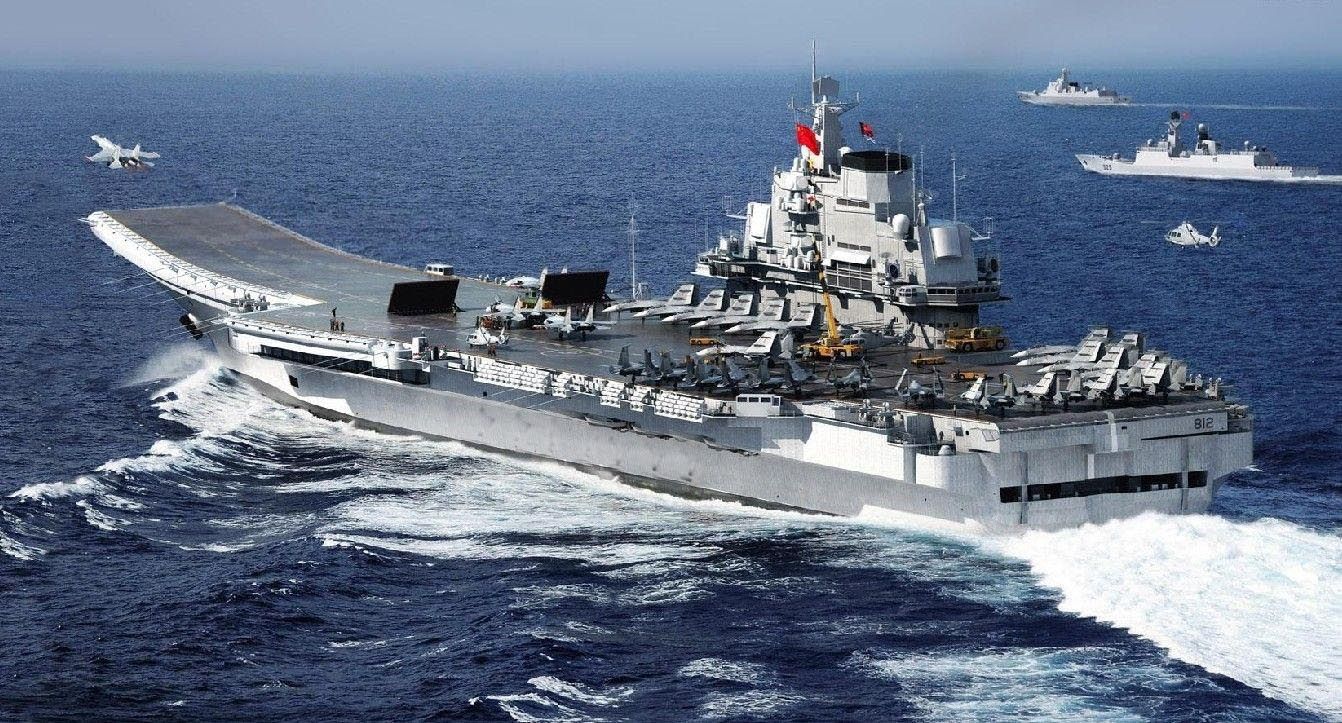
While we're at it, let's bring up a picture of the People's Liberation Army Navy's first aircraft carrier Liaoning - without which they would be at least one if not two decades behind in building their carrier fleet.


While it is encouraging that in the last few years "official Washington" has reached the pivot point in seeing the PRC's plans - it is almost criminal the lack imagination and vision on our part seeing it, especially in the 1990s when was the point everyone should have seen the game was afoot.

Just two datapoints, both related to these two pics.

"The Long Game" was an old story by the time we started it in 2004. It has its roots a lot further back. I think the first tickle of the idea came to Ensign Salamander back in 1990 when he caught a bit of info in the local paper about something that dominated the skyline for anyone coming in or out of Mayport.

Go to the pic at the top and look at those cranes and then return here. 

Know what the pic below is?


That's right - it was the original plan for "Goat Island" in the St. Johns River in northeast Florida. Today is is known as Blount Island.

There were big plans there in the 1960s and 70s;

...Offshore Power Systems (OPS) was formed on July 6, 1972 as a 50/50 joint venture between Tenneco Power Systems (who owned the Newport News shipyard) and Westinghouse Electric Corporation. It proposed to design, manufacture, and market complete nuclear power plants of a standardized design and integrated with specially designed floating platforms 5.

Each floating nuclear power station (FNPS) would contain two or more FNPPs within a protective breakwater. The individual plants were to be 1150 MWe Westinghouse four-loop PWRs with ice-condenser containments. They had once-through steam condenser cooling with no cooling towers. Electricity was to be transmitted at high-voltage (345 kV) through submerged cables beneath the sea bottom. A shore support facility would provide a staging area, a docking facility, office buildings, and parking.

At the time, the largest crane of its type in the world, just one, was at Blount Island - but the anti-nuclear movement in the 1970s killed OPS before any construction could be started.

That crane though...what was to be done with that? In 1990, in the heart of the Bush41 Presidency;

A REMNANT of a futuristic project that would have supplied cities with electricity from floating nuclear power plants is about to leave Florida. The world's largest crane, designed to build the nuclear systems, is being dismantled along the St. Johns River for shipment to China. The crane is being taken down by workers from the China State Shipbuilding Corp. at Blount Island. The Chinese reportedly paid $3 million for the 38-story crane, which cost $15 million when built for Offshore Power Systems.

Ensign Salamander - always suspecting the worse of all communist nations and enraged that we would do any business with them, was unpleased, but had a lot of PQS to do and was keeping a weather eye to that Iraq thing and hoped his betters knew what they were doing.

So began a bi-partisan decade of stupid acts.

Quick, go up to look at the PLAN carrier pic above again then come back.

Where did that start?


It was a mission like no other. In the aftermath of the Soviet Union's collapse, one businessman armed with cash and a casino cover story scooped the world to buy the unfinished hulk of a Ukrainian aircraft carrier that would become the centrepiece of the PLA Navy.

Speaking to the media for the first time, the Hong Kong-based businessman at the heart of the undertaking reveals in a two-part series the details of the little-known, behind-the-scenes odyssey to realise China's long-held dream of owning such a warship.

Xu Zengping disclosed that the militarily sensitive original engines of the carrier were intact when Ukraine sold the vessel in 1998. This is contrary to what Beijing told the world at the time.

Soon to be LCDR Salamander didn't like this either, but he was focused on that guy in Iraq who needed a good spanking for trying to kill Bush41, so he hoped  his betters knew what they were doing. He had his suspicions because we were also selling MIRV technology to the PRC, but what did I know?

His betters didn't.
Karginov told the media: “The unfinished aircraft carrier Varyag was handed over to Ukraine and then sold to China to convert it into a casino. After China received the ship, it completed its construction and renamed it the Liaoning ship. The ship was originally supposed to become one of the main ships of the USSR.”

I'm not really mad at the PRC. I'm actually quite impressed with their leadership's long term vision, drive, and follow through. 

Are we thinking as long-term? Is our defense nomenklatura focused on the Long Game ... or any game at all outside the Beltway?

Have we learned?

Sunday, January 29, 2023

The People's Liberation Army Navy in 2023, with Toshi Yoshihara - on Midrats


From a navy of peasants to professionals on par with any Western navy; from coastal patrol to global reach, the slow and steady growth of the People's Liberation Army Navy (PLAN) crept up on some policy makers in the last decade, but as the PLAN eclipses the United States Navy in numbers and is accelerating their industrial capacity and capabilities, the decades of the American uncontested dominance at sea is no longer granted.

Returning to Midrats to discuss this and the larger trends he raises in his new book, Mao's Army Goes to Sea: The Island Campaigns and the Founding of China's Navy, will be Dr. Toshi Yoshihara.

Toshi Yoshihara is a Senior Fellow at the Center for Strategic and Budgetary Assessments (CSBA). He was previously the inaugural John A. van Beuren Chair of Asia-Pacific Studies and a Professor of Strategy at the U.S. Naval War College.

In addition to his latest book is Mao’s Army Goes to Sea: The Island Campaigns and the Founding of China’s Navy, he co-authored, with James R. Holmes, the second edition of Red Star over the Pacific: China's Rise and the Challenge to U.S. Maritime Strategy. He currently teaches a graduate course on seapower in the Indo-Pacific at the School of Foreign Service, Georgetown University.

Join us live if you can
, but it not, you can get the show later by subscribing to the podcast. If you use iTunes, you can add Midrats to your podcast list simply by clicking the iTunes button at the main showpage - or you can just click here. You can find us on almost all your most popular podcast aggregators as well.

Tuesday, December 27, 2022

No Sense of Urgency to Act on What is Waiting West of Wake

The greatest threat to security in the Western Pacific is not the rise of China, certainly isn't the moribund Russians - or even a combination of the two. No, the greatest threat to security west of Wake is the American national security establishment.

The two pillars of its dysfunction are intellectual and institutional.

Intellectually we continue to allow The Smartest People in the Room™ to blissfully live in a world of happy talk to themselves, each other, and their nation. It is as if they live in a world of the military FITREP where you write your own review in the adult version of Lake Wobegone ... where all the children are above average.

Via Phelem Kine and Lara Seligman over at Politico this AM;

The U.S. has pledged to deploy so much firepower to the Indo-Pacific in 2023 that China won’t even consider invading Taiwan. Lawmakers and allies say it’s already too late.

The promise is a big one: “2023 is likely to stand as the most transformative year in U.S. force posture in the region in a generation,” Ely Ratner, assistant secretary of defense for Indo-Pacific security affairs, said in early December.

Nothing personal here. I am sure Ely is a nice guy. A PhD in, ahem, Political Science from, ahem, UC Berkely, and a life spent in politics, academia, and the usual holding-pen think tanks ... but clearly a smart guy and a good staff weenie ... but seriously; he doesn't believe that. No one with any knowledge of the People's Republic of China believes that. No one with even a thumbnail understanding of the US military's readiness for sustained peer conflict believes that.

More importantly, no one in the PRC believes that.

Happy talk and spin is fine in domestic politics, fund raisers, and giving hope to the rubes, but it takes years to get a military ready for sustained combat on the other side of the globe. We barely held our own until early 1943 against Imperial Japan and we started getting serious seven years earlier in 1936.

While we struggle to maintain a steady state fleet, the PRC's navy grows.

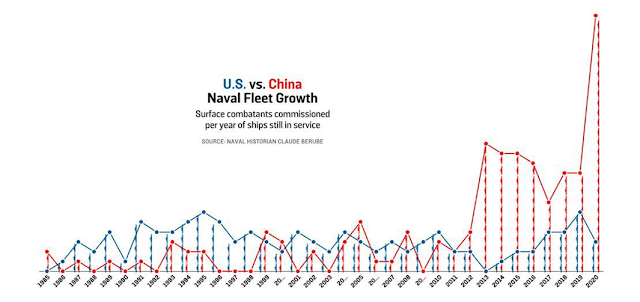
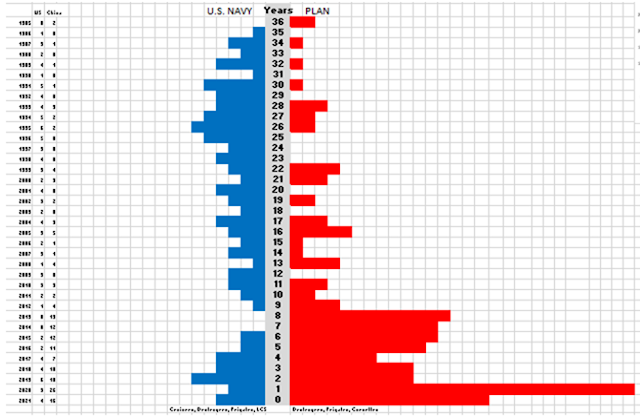
I guess it is time to put up Claude Berube's graphs again.


They have vastly outbuilt us in the past 10 years. Yes, that red line is China’s shipbuilding versus the blue of the us navy.

That is the truth. That is why when we try to force-mode domestic political happy talk to the international stage we are looked at as not just lying - but being quasi-delusional.

At least there are some people with access to levers of power who know what time it is.

“We have a rhetorical commitment to a force posture change in the Indo-Pacific, but that’s belied by the reality of what’s actually happening,” said Rep. Mike Gallagher (R-Wis.), who will become chair of the new House Select Committee on China in the next Congress. He called Ratner’s assertions the military planning equivalent of “whistling past the graveyard.”

The gentleman from Wisconsin is too kind. 

We cannot afford more happy talk - more "transformational" bullsh1t from people who should know better. They need to be called out on every occasion they try to cropdust the intellectual space people are trying to cultivate towards meeting this decade's challenge. The Terrible 20s are going to be terrible, but we can mitigate the degree of that terribleness. Some progress is being made, but more pressure is needed.

Now let's loop back to the second part of today's post mentioned at the start; institutional dysfunction.

Notice the 1936 to 1943 timeline above? Seven years that didn't bring in just new systems, but generational development in everything from carrier air whose fighters went from the Brewster Buffalo to the Grumman Wildcat, to Hellcat; submarines advanced through six different classes from Salmon to Balao; land based heavy bombers went from the Martin B-10 through the Boeing B-17 to a year later the B-29 deploying. 

You get the idea.

Remember back in October?

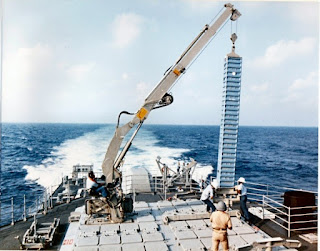
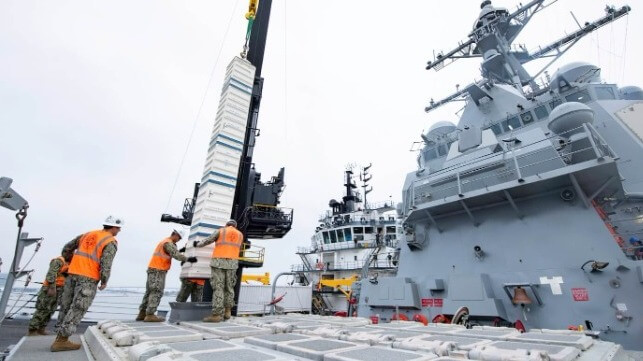
The U.S Navy has tested out a new way of rearming its warships with a trial vertical launch system (VLS) reload in San Diego. 

In a test evolution, the crane-equipped OSV Ocean Valor conducted a VLS reload with guided-missile destroyer USS Spruance, an exercise intended to prove out a new way to reload guided missile destroyers in sheltered waters. Sailors aboard the Arleigh Burke-class destroyer successfully lowered training ordnance into the ship’s forward VLS cells in a proof-of-concept evolution.

...

The exercise was aimed at proving that an OSV can reload the weapons system pierside, with the goal of expanding the capability of VLS reloading in expeditionary environments. The launch system reload has been tested previously in 2016 and 2019 using other MSC vessels but has never been tested using a relatively small OSV as the delivery platform. 

A VLS reload alongside the pier is substantially less challenging than a VLS reload in an open seas, underway replenishment scenario. Previous Chief of Naval Operations Adm. John Richardson signaled an interest in bringing back underway VLS replenishment in 2017, but the operation has rarely been performed in practice - even on Ticonderoga-class cruisers, which were designed with this evolution in mind. 

The TICOs were designed in the 1970s - pretty much half a century ago - roughly the same amount of time that the Spanish-American War was to 1943.

Let that soak in.

Now let's go back to July of 2017, just five and a half years years ago +/-. You know, roughly 1.5 WorldWars as we defined this program management period of time in 2015. For you pedants out there, it is 1.46 WordWars to be exact.

Here's what we discussed 1.46 WordWars ago;

The U.S. Navy is looking to restore its ability to reload its ships’ vertical launch systems at sea, which could be a dramatic logistical game changer in the planning and execution of high-intensity contingencies against peer competitors.

...

After discussing the means by which the Navy seeks to ensure its forward-deployed naval forces remain survivable and up-to-date with the latest tactical and technological innovation, Admiral Richardson said in reference to vertical launch system (VLS) underway replenishment, “we’re bringing that back.”

Since its operational debut in 1986 aboard the sixth Ticonderoga-class cruiser, USS Bunker Hill, the Mark 41 vertical launch system and its successor the Mark 57 have become the main battery of the preponderance of the Navy’s surface fleet, while the Mark 45 has become the principal means of deploying cruise missiles aboard submarines. Vertical launch systems are among the most adaptable weapon mounts that the Navy fields, allowing a ship to carry a variety of defensive and offensive missiles in the same shipboard infrastructure, and to fire them in rapid succession.

Well, we don't have this back.


But we are playing around 1.46 WorldWars later with this;

If it appears that the military acquisitions process and the bureaucracy that keeps it running is not quite what one needs to get ready for war, you're right.

It is nowhere near fit for purpose.

Reloading VLS is not a new concept - it is over a half century old. We got rid of it because the short-war uni-polar world would rather have those VLS cells with missiles to blow up parked clapped out Toyota Hilux with 23mm 1960s era manual guns mounted on the truck bed.

In our Lotus Eater stupor we allowed our land based facilities come under the range of our enemy's rocket artillery from Japan to Guam. That luxury is history. We cannot cruise back to the West Coast or Hawaii to reload. We need to do it at sea - now.

Here is where we need to start playing hardball. Our chattering classes are lost in a soup of onomastic happy talk that enables each other to avoid hard work, and our accretion hobbled acquisitions force is designed mostly to ensure funding lines and job protection in a peacetime uni-polar world.

That is long past. As useful as midnight basketball is to domestic politics - a reference someone with a PhD from UC Berkely should understand.