Showing posts with label Bomber. Show all posts

Monday, January 23, 2023

Can we Learn Something From the Air Force?


The Navy's tale of woe in trying to force the acquisition system to actually produce something besides process is almost too painful to recall, especially on the surface side of the house.

We have the walking wounded of LCS, the squib DDG-1000, the gilded promise Ford CVN, and the never-was-has-been CG(X). We have hope that we can't screw up the existing Franco-Italian FREMM in the upcoming modified to American requirements Constellation Class FFG, but we shall see if our optimism is well placed.

As we all wait with bated breath and gritted teeth on what may be with DDG(X), we should look around to see if there is a benchmark recently that did work. 

On the surface side of the house, LPD-17 won't quite make the cut as it was only made to work with a lot of additional money and Sailor sweat, though we can call it adequate, if a bit expensive and clunky in initial execution.

We can look over at the aviation side of the house, but that is quite spotty. F-35 is meeting our lowered expectations, but it is a Joint hobbled kludge. If you ignore the pile of pants that is maintenance, the sub side of the house seems to be doing quite well, but they're a special case in a variety of ways. The Super Hornet program was a great success, but that was only because NAVAIR tricked everyone in to thinking that it was just an update to the Hornet...which it was absolutely not. 

Hmmmm, a successful acquisition system from the 1990s that was a success by ... bypassing the acquisition system. Did anyone learn a lesson there?

Well, it appears the USAF did in the B-21. Via Stephen Losey at DefenseNews;

Following a dramatic unveiling of the B-21 bomber in California on Dec. 2, 2022, former Air Force leaders are holding a muted celebration. By moving from contract award to public rollout in seven years, they said in interviews with Defense News that they proved their acquisition strategy — despite McCain’s criticism — worked.

Better yet, they said, their unexpected approach might provide best practices for other major programs and serve as an antidote to the beleaguered development of the F-35 Joint Strike Fighter in the 1990s and 2000s.

Their secret? They learned how to limit bureaucracy.

“There were fewer checkers checking the checkers,” James said. “Don’t ever underestimate the ability of the Pentagon bureaucracy and these many, many reviews to slow the doggone thing down.”

Most notably, officials point to the unusual move to put the Rapid Capabilities Office in charge of the B-21′s development. That office had a narrowly focused team of skilled, experienced engineers and program managers, a board of directors to hash out key decisions and reviews, and an ability to cut through red tape, James said.

In other words, when you really want something done, you go around the system that is there to help you.

Kind of telling, isn't it?

...the Air Force’s decision to have the Rapid Capabilities Office take charge of developing the B-21 was a critical step in its acquisition process.

The Air Force created the Rapid Capabilities Office in 2003 to quickly develop, acquire and field some of the service’s highest-priority programs — many of which were classified, such as the X-37B Orbital Test Vehicle. The RCO is intended to take advantage of innovative approaches, “without the rigidity of traditional acquisition,” the Air Force said in an online fact sheet about the office.

The B-21 was a much larger program than the RCO typically managed, Wilson noted, but it worked. The office’s team on the B-21 was unusually slim compared to other programs, and it included some of the Air Force’s most experienced engineers and program managers. Most importantly, she said, they were trusted to use their judgment and go fast, without micromanagement.

“It was run very differently from other programs,” Wilson said. “You get high performers in the [RCO] program office, and you don’t crush their will to live with huge bureaucracies. … I think it’s a good example of how to do major programs better.”

Another data point in our long-standing call to uproot the not fit for purpose, accretion hobbled, rent seeking, and self-satisfied acquisitions system that best seems to serve itself. 

It is a human creation - not the revealed truth from some diety. Other systems have better served our nation. It is time to upgrade this one. 

If the end result does not have at least 50% few GS/SES, then we have failed.

Saturday, August 06, 2022

Fullbore Friday

Listen to this story and think ... today's challenges are not really that great ... are they?

We posted this shortly after Jim's death nine years ago. I think he deserves a replay.
Jim Muri, a Montanan whose legendary flying prowess saved his stricken bomber and crew during the Battle of Midway in World War II, died Sunday at age 93.

Muri earned national recognition and became the subject of a popular song for his exploits during the battle, June 4-6, 1942. He piloted a twin-engine B-26 bomber, one of dozens of land-based aircraft that attacked a massive Japanese invasion fleet on the opening morning of the battle.

Muri’s plane endured withering attacks from Japanese fighters and anti-aircraft fire during the harrowing flight. After completing a torpedo attack against the Japanese aircraft carrier Akagi, Muri probably saved his plane and his crew by flying lower than treetop level above the deck of the massive ship. He reasoned that skimming the flight deck, end to end, gave him the best chance to survive.

You can get some nice visuals to the above interview at the 7:34 point in the video below.
  

First posed Feb 2013.

Friday, July 23, 2021

Fullbore Friday


If not you, who?

Duty.

Duty to your crew.

The nature of a man is often revealed in crisis when he has to run on instinct.

Meet then Staff Sergeant Henry R. Erwin, USAAC, just a good 'ole boy from Alabama.

On April 12, 1945, Erwin's B-29, called the "City of Los Angeles," was the lead bomber in a group attack on a chemical plant in Koriyama, about 125 miles north of Tokyo. Aside from operating the radio, Erwin was also in charge of launching phosphorescent smoke bombs to help assemble the bombers before they proceeded to their target. 

Erwin was positioned behind the forward gun turret toward the front of the plane. Once he got the order to light the bombs, he dropped them down a chute that launched them out of the aircraft before they exploded. 

But something went wrong with one of them. It didn't leave the chute, instead bouncing back into the aircraft, striking a kneeling Erwin in the face. The intensely burning bomb obliterated his nose and completely blinded him. To make matters worse, smoke quickly filled the front part of the plane, obscuring the pilot’s vision. 

Despite his wounds, Erwin knew the plane and crew would not survive if he didn't get the bomb outside. So, despite the fact that he was physically on fire and his skin was burning off, he picked up the incendiary at his feet and, feeling his way instinctively through the plane, crawled toward the cockpit. 

His path was blocked by the navigator's table, which he had to unlock and raise to get around. To do that, he had to clench the burning bomb against his body. Erwin then struggled through the narrow passage and stumbled forward into the pilot’s den. He groped around until he found a window and threw the bomb out.

Completely on fire, Erwin collapsed between the pilots. He had journeyed only 13 feet, but later he said it "seemed like miles when you are burning."

The plane had been on autopilot during the crisis, but to keep it from stalling out, the pilot had to drop altitude. When the smoke finally cleared, he realized they were only 300 feet from hitting water. The pilot managed to pull the plane out of its dive, abort the mission and head for Iwo Jima, the closest place for medical aid. 

During that time, the crew sprayed Erwin with a fire extinguisher to put the flames out, and they gave him morphine for the pain. Somehow, Erwin stayed conscious during the flight and even asked about the crew's safety. 

Once at Iwo Jima, doctors labored for hours to remove the white phosphorus that had embedded in his eyes. Since it combusts when it's exposed to oxygen, each fleck that was removed burst into flames – small bits of torture for the already struggling airman.

No one thought Irwin would survive, but his entire crew knew he deserved the Medal of Honor for his actions. So, while he was getting treatment the night of their botched mission, the officers in his unit were preparing a Medal of Honor citation. The next morning, they presented it to Maj. Gen. Curtis LeMay, commander of the 21st Bomber Command, so he could sign it. LeMay managed to get it approved in an unprecedented amount of time. They were all hoping to give it to Erwin before he died. 

Three days after the incident, a still-living Erwin was flown to a Navy hospital on Guam. For days afterward, doctors performed blood transfusions, did surgery and gave him antibiotics to fight infection. 

On April 19, 1945 — one week after the incident — officials pinned the Medal of Honor on a heavily bandaged Erwin as he lay in a hospital bed. The medal itself was from a display case at U.S. Army Headquarters in Honolulu. It was the only available one in the entire Pacific Theater. 

Read it all

Henry live a full life of 80 years. 

Fullbore.


Friday, April 26, 2019

Fullbore Friday

Every few years I re-post this. It is time again. In honor of a friend that I served with who was on this crew ... a encore FbF from four years ago.


An under-told story from an under-studied (at least in the last decade) war.

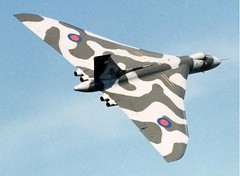
The story of Vulcan 607.
"We're short of fuel, but we've come this far," he told them. "I'm not turning back now." At 290 miles away from the target, 607 began a shallow descent towards Port Stanley.

Even now they could not be certain where they were. The inflight navigation system gave two different compass readings.

The Radar Officer, Bob Wright, and the Navigator, Gordon Graham, had split the difference. If they were on course, the computer would respond with the information needed for Wright to get the bombs on target but only when the radar was switched on again - seconds before the planned drop.

Simon Baldwin in Waddington had worked out that the bomber should approach low to minimise its 'footprint' and then climb upwards to 8000 or 10,000 feet to try to stay clear of the "kill zone" of the Argentinian defences before unleashing its weaponry.

As Vulcan 607 streaked towards her target, Graham called the mileage before the rapid climb, and Hugh Prior, the electronics officer, made sure that the chaff and decoy flares, which would be fired to draw enemy fire, and the American Dash 10 detection jammer were operational.

A radar contact appeared: 607 was dead on target. It was 4.30 in the morning, local time, when the Vulcan roared upwards, straight into view of the Argentine search radars. But the young radar operators were unperturbed. The bomber could only be one of theirs - this had not been a shooting war so far.

During the few minutes it took the Argentinians to wake up to the fact that this was in fact an enemy aircraft, the Vulcan had soared to its 10,000ft altitude and levelled off for the bomb run.

Its speed was 400 mph. From this moment the aircraft could not deviate, even if enemy radar was locked on them. At this height the runway would have been the size of a scratch of a fingernail on the map and the bomb run had to be precise to a few yards.

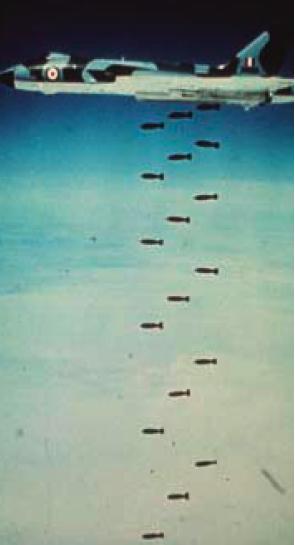
Two miles from the runway the first of the thousand-pounders fell away from the Vulcan's cavernous belly. When all 21 were away, Withers turned the Vulcan in a steep curve, in time for the crew to see a blossom of fire as the first bomb bored deep into the centre of the runway and detonated. Other blasts hit the airfield, gouging out massive chunks of its surface.

Vulcan 607 did, in fact, have enough fuel to make the rendezvous. It returned to Ascension Island and a heroes' welcome. The most ambitious sortie since World War II, had by the skin of its teeth been successful.

The damage destroyed any remaining hopes Argentine forces had of using the runway for their fast jets. Their entire Mirage fighter force had to be moved promptly back to the north of Argentina, and any jet cover during the coming British invasion would have to come from the mainland.

It shook Argentine morale to the core and provoked Galtieri's decision to order a naval offensive against the British Task Force, which had disastrous consequences for the Argentine Navy.

The V-bomber had been designed decades before to reach into the snowy wastes of Soviet Russia, but had never been used in anger. Their last outing, to a part of the world no one had dreamed they would visit, had finally justified these beautiful aircraft.

The Falklands War lasted just 74 days. Though taken by surprise, Britain launched a task force to retake the islands and after conflict costing 255 British and 649 Argentinian deaths, the Union Jack was hoisted in Port Stanley on June 14.
Mission.

Wednesday, October 17, 2018

Targeting Problems and Fleet Defense Challenges? Welcome to Varsity Football.

The Chinese are making WESTPAC more and more interesting day after day.

They are so inside our acquisition loop, it's embarrassing.

Details over at USNIBlog.

Come by and ponder with me.

Friday, March 30, 2018

Fullbore Friday


We always remember Pearl Harbor - but that second week of DEC 1941 war was breaking out all over the Pacific. Something different for Pearl Harbor. Capt. Colin Kelly Jr., early leadership example.

The war exploded all over the Pacific that day, and in the focus on Hawaii, the other stories often get forgotten. Let's look at some events in Skippy's favorite Old School liberty area - The Philippines.

On the morning of Dec. 10, 1941, six B-17Cs of the 14th Bomb Squadron, 19th Bomb Group, sat in the rain at a rough landing strip near San Marcelino on the Philippine island of Luzon. The crews had spent the night without food, sleeping in or under their planes. Of the war situation they knew little except that Japan had attacked Clark Field and other installations near Manila on Dec. 8--Pearl Harbor on the 7th--and some 400 Japanese aircraft had destroyed most of the US B-17s and pursuit planes.

Squadron Commander Maj. Emmett "Rosy" O'Donnell Jr., had flown to Clark before daylight to get orders for his squadron. He radioed his pilots to proceed to Clark at daybreak. Only three of the B-17s were allowed to land. They were flown by Capt. Colin P. Kelly Jr., and Lts. George E. Schaetzel and G. R. Montgomery. Captain Kelly, a 1937 graduate of the US Military Academy and a former B-17 instructor, was one of the most experienced and respected pilots of the 19th Bomb Group.

An imminent air attack sent the three bombers off to their respective targets before refueling and bomb loading were completed. Captain Kelly had only three 600-pound bombs aboard and orders to attack airfields on Formosa (Taiwan), some 500 miles north of Clark. The mission would earn Colin Kelly a place in American history and legend.

In the confusion of the early days of the Pacific war, Kelly was credited with sinking a Japanese battleship and with award of the Medal of Honor. Overnight he became a national hero. It later was determined that Kelly and his crew did not sink a battleship, nor was he awarded the Medal of Honor, although some still believe both. In fact, Colin Kelly was recommended for the Medal of Honor by Maj. Gen. Lewis H. Brereton, commander of the US Far East Air Forces. The award he received was the Distinguished Service Cross, on the orders of Gen. Douglas MacArthur's headquarters.

This is what actually happened, as told in mission debriefings by members of Kelly's crew and in an official report of the mission prepared in February 1942.

For Captain Kelly and his crew, it was a solo mission deep into territory where the Japanese held absolute air superiority. They had no fighter escort. By Dec. 10, there were only 22 flyable P-40s and a few obsolete P-35s left. As they flew north toward Formosa, Kelly and his crew passed over a large Japanese landing in progress at Aparri on the north coast of Luzon. The presence of an enemy carrier in the vicinity had also been reported.

Kelly radioed Clark Field for permission to attack the landing force, which was supported by several destroyers and a large warship, thought to be a battleship, bombarding the coast from several miles offshore. After two calls to Clark that brought only a response to stand by, Kelly told the crew they were going ahead on his decision to attack the battleship--actually a cruiser. Kelly made two dry runs at 20,000 feet, giving bombardier Sgt. Meyer Levin time to set up for an accurate drop.

On the third run, he told Levin to release the bombs in train. As best the crew could tell, two of the three bombs bracketed the ship with one direct hit. Smoke prevented more accurate assessment. The B-17 then headed for Clark Field, its bomb bay empty.

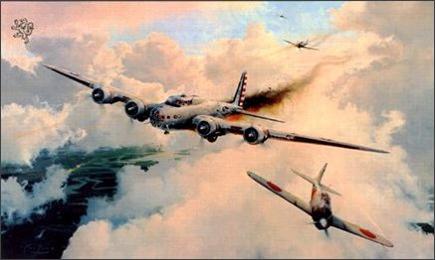
As it approached Clark, the bomber was hit by enemy fighters.

The first attack killed TSgt. William Delehanty, wounded Pfc. Robert Altman, and destroyed the instrument panel. A second attack set the left wing ablaze. The fire spread rapidly into the fuselage, filling the flight deck with smoke.

Captain Kelly ordered the crew to bail out while he still had control of the doomed bomber. Fire began to engulf the flight deck. SSgt. James Halkyard, Pfc. Willard Money, and Private Altman went out the rear. Navigator 2d Lt. Joe Bean and Sergeant Levin, after a time-consuming struggle, pried open a stuck escape hatch and took to their chutes.

The nose of the aircraft was now an inferno. Colin Kelly remained at the controls as copilot 2d Lt. Donald Robins moved to the upper escape hatch. At that moment, the bomber exploded, hurling a badly burned Robins clear of the aircraft.

The B-17 crashed about five miles from Clark Field. Colin Kelly's body was found at the site. The early report of his heroism, which inspired a nation in shock, is in no way diminished by the actual events of that December day in 1941. Alone and far from friendly territory, he attacked and damaged a heavily armed ship, then sacrificed his own life to save his crew.
As is not too uncommon, in the rush to make a legend, good people with good intentions try to make an already great story of heroism and honor even better - and ruin it.

NB: when in doubt, ignore emotions than tell the truth. History will find it out later. You can dig around the refs and links to see what I am talking about, but here is the truth and the two big lessons we should take away from Capt. Kelly. Oh, remember....this was less than 72 hours after the start of the war with a early mod of the B-17.


BTW, one of the men attacking Kelly's bomber that day was Saburo Sakai. He was a great man, great pilot, and a hero to anyone who takes the time to try to know what he did with his life.

First posted DEC07