Showing posts with label Ukraine. Show all posts

Wednesday, March 22, 2023

Japan Puts a Marker Down in Europe


The last few years have seen Japan take the very welcome steps out of the box her post-WWII constitution put her in and the habits of the post war generations.

With her size and wealth, even her 1% of GDP on defense created a significant military. As anyone who has operated can attest, it is a quality one in equipment, training, and material condition.

It's growing - and that is a good thing for the international order.

More than is apparent to the outside eye, her national security community – both uniformed and civilian – are very clear-eyed about the world in which they find themselves in 2023. They are taking steps to take her rightful and deserved place in the first tier of nations in national security, but they are small, direct, and cautious steps - but steps they are.

With all the above, the last few days brought a very significant moment for Japan and her friends. While most eyes were on the meeting between Russia’s Putin and the People’s Republic of China’s Xi, we had this;

Prime Minister Fumio Kishida met Ukrainian President Volodymyr Zelenskyy on Tuesday in Kyiv, in a rare and unannounced visit that highlighted Japan's support for the war-torn country in the face of Russia's ongoing invasion.

The Japanese leader arrived in the Ukrainian capital on Tuesday afternoon local time by rail from neighboring Poland, becoming the final Group of Seven leader to visit the country since Russia's Feb. 24, 2022, invasion.

This is not just a photo op - this is a significant moment in Japan's ongoing evolution in to a proper 21st Century nation with responsibilities and the ability to help advance the cause of a more democratic planet.

Japan has not made such a statement with regards to events in Europe - I believe - since the presence of the 2nd Special Squadron in combat operations in the  Mediterranean WWI. 

That matters.

The next G7 Meeting is in Japan ... in a certain city of mention, Hiroshima;

"The world was astonished to see innocent civilians in Bucha killed one year ago. I really feel great anger at the atrocity upon visiting that very place here," Kishida said.

"I would like to give condolence to the all victims and the wounded on behalf of the Japanese nationals. Japan will keep aiding Ukraine with the greatest effort to regain peace," he added.

Earlier Tuesday, Japan's Foreign Ministry said Kishida would convey the “solidarity and unwavering support for Ukraine” of Japan and other G7 nations during the meeting while “firmly rejecting Russia's aggression and unilateral attempts to change of the status quo by force.”

...

"The situation in Ukraine and support for the country will be a major theme at the G7 Hiroshima summit,” NHK quoted LDP Secretary-General Toshimitsu Motegi as saying ahead of Kishida's arrival in Kyiv on Tuesday, saying it was "of great significance" that the prime minister "sees the situation on the ground firsthand.”

Not just Ukraine, the Japanese Prime Minister is sending a message by who he visits;

Kishida, who had been visiting India and was expected to return to Tokyo, entered Poland from India using a secretly chartered plane instead of the standard government aircraft, NHK reported.

Poland. India. Yes.

Japan continues to underline that she is part of the group of nations who will not allow Russia and China set a new global order.

Nothing in the diplomatic world is done by accident - especially when location and timing matter a lot for the unspoken messaging.

The decision to visit Ukraine came at an unusual — and perhaps fortuitous — time for Kishida, with Chinese leader Xi Jinping simultaneously in Moscow for talks with Russian President Vladimir Putin, ostensibly over Beijing’s proposal for a ceasefire between the neighbors.

Xi’s trip, his first abroad since winning an unprecedented third term as leader earlier this month, came just days after the International Criminal Court accused Putin of war crimes and issued a warrant for his arrest.

While Xi has sought to portray China as a potential peacemaker, even as he deepens relations with Putin, the two visits by the leaders of the world’s second— and third-largest economies served as a reminder of Tokyo’s robust support for Kyiv and Beijing’s ”no-limits” relationship with Moscow.

In Tokyo, U.S. Ambassador to Japan Rahm Emanuel said the day’s news told of “two very different European Pacific partnerships.”

“Prime Minister Kishida is making an historic visit to Ukraine to protect the Ukrainian people and promote the universal values enshrined in the U.N. Charter,” Emanuel tweeted. “Approximately 900 kilometers away, a different and more nefarious partnership is taking shape in Moscow.”

Meanwhile, Chinese Foreign Ministry spokesman Wang Weibin took aim at Kishida’s trip, saying that China “hopes Japan will push for an easing of the situation (in Ukraine), and not the other way around.”

Separately, Russia sent two strategic bombers over the Sea of Japan for about seven hours Tuesday, the country's Defense Ministry said. Moscow regularly sends the bombers, which are capable of carrying nuclear weapons, for missions in international airspace as a show of strength, but the timing was seen as more pointed with Kishida's trip.

A strong statement by Japan that is getting exactly the response you'd like. The response from the usual suspects means it matters.

Japanese defense planners and a number of senior lawmakers have been wary of the threat of conflict over Taiwan. Many have said a Taiwan emergency would also be an emergency for Japan.

These fears that Japan could be unprepared for a crisis in its own backyard have prompted Tokyo to pursue a dramatic hike in defense spending as well as closer ties with allies and partners.

The timing of the two visits could give more ammunition to claims that Tokyo and Washington sit firmly on one side of an increasingly divided world, while Beijing and Moscow find themselves on another.

“The coincidental timing of the trips does indeed create a stark contrast,” said Brown. “It presents the image of two blocs, with Japan and Ukraine on the side of democracy, and Russia and China representing an axis of authoritarianism.”

There are two blocks in the international world set in opposition, and the "realist" thing to do is accept that central fact.

We also need to accept that fact that "we" failed to win the post-Cold War peace.   

If you have not already, I highly encourage you to watch this 1992 interview with former President Nixon. If you have time, watch the whole thing - but this bit on Russia is spot on;
 

In the last decade of the 20th Century and the first decade of the 21st, Russia did not join the West. There was no "Peaceful Rise of China." The Smartest People in the Room™ failed us ... or it was a counter-historical fool's errand anyway. Pick whichever reason best fits your priors.

We have the 2023 that we have. We might as well crack-on with the slog.

Our friends are better than their friends anyway.

Monday, February 27, 2023

One Year in the Russo-Ukrainian War: the Big Pixels

Last Friday we looked at the seven points we discussed a year earlier the day the Russo-Ukrainian War broke out. As promised, today we look at seven points a year in everyone needs to hoist onboard.

Though I nibble on the edges a bit, these are not detailed, tactical “lessons learned.” Land combat details simply are not my bag. No, these a big pixel items. Mostly land centric like the war, but are directly transferrable to the maritime and other domains.

1. Short-War Snake Oil Salesmen are Worthy of Little but Scorn: a bit more muted than a year ago, even in winter of 2023, American short-war salesmen continue to push the WESTPAC 72-hour victory concept. In the run up to the start of the war in the winter of 2022, Russia’s leadership was sold a quick victory in Ukraine. As we’ve discussed in prior posts, their decision making process was a classic case of multi-layered optimism filtering. Political leaders like shortcuts. They like hearing things that confirm their priors - and like flies around a barnyard, yes-men (and women) surround such personalities. Smart leaders ensure they are not surrounded by yes-men. Unwise leaders create organizations where only the obsequious rise. 

Short wars are seductive and brief well. They are easy to wargame. Unless you are off Zanzibar or Grenada, they never really work out. They are products of the delusional, corrupt, or criminally incompetent - uniformed and civilian. 

If you desire a short war, you have to be positioned to fight a long war. You need to clearly plan, train, man, and equip your military to wage a long war against an adversary and win. The extra added benefit to this posture is that if done right, such a war may never come. Then in peace, you can safely argue with the peaceniks why we don’t have war, just a bloated military, as opposed to burying our children and waiting in lines with ration cards. If it does come, it ends quickly. Plan for a short war and you will probably get a long war with better than average odds you’ll lose it.

Since WWII, what are the larger wars and imperial policing actions we’ve been involved it? Korea, Vietnam, Afghanistan, and the aggregated Iraq campaigns. That is, what, two losses (Vietnam & Afghanistan) and two draws (Korea and Iraq)? OK, if you squint you can say Iraq is a “little w” – but that is an arguable point.

2. You Must Have a Sovereign Military-Industrial Complex: forget efficient in peace, you need to be effective at war and there is no long ramp-up if you get surprised. You go to war with what you have. At peace, wise policy makers must fight a hard battle against the green eye-shade accountants who spent too much time in MBA school and not enough studying the profession of arms. If a nation cannot produce the weapons its forces need, it must rely on the grace and mercy of other nations. If you are the USA, there are no other nations who have the capacity – even if they have the will and political ability to support us – to supply more than a fraction of what we would need if we found ourselves at war west of Wake. Ukraine could look to the USA and some of her allies for significant help against a larger opponent. For the USA, we’re it.

3. Deep Magazines, Running Production Lines, and Distributed Risk: If you wonder if prior and present leadership were serious in their responsibility to prepare the nation to fight and win a war against a top-tier competitor, look at the depth of your magazines and robustness of your stockpiles. Have your planning staff examine what it would take to win against the conventional “Red Most Dangerous Course of Action.” Have them include how many months, weeks, or even days of supply there are for your most important weapons systems for that fight. Where are these magazines located? What percentage are located in each area? How long can you fight if you lose the inventory of 10%, 30%, or 60% of your magazines through enemy action?

For your highest demand weapons, is there an active production line open? Is it scalable for larger production numbers? Can you produce in a year more than what you expect to expend? 

The Ukrainian experience underlines a requirement I've yet to see get traction; if the USA expects a WESTPAC conflict in the next 10-years, there is one bold-faced requirement; under no circumstances should any production line of weapons systems be allowed to go cold until its replacement achieves initial operational capability. Once those lines – and its equipment and craftsmen – are lost, they are almost impossible to get back. 

4. Range Matters: If your opponent has land-based, mobile anti-ship weapons, and the ISR to support them, you will be kept at distance from shore until that threat is eliminated. If not, be prepared to lose your capital ships in number. 

Your sea-based weapons systems must have the range to enter the fight outside that threat distance plus the additional distance to get to target. If not, be prepared to lose your capital ships in number.

Your land-based weapons systems that are inside the range of the enemy – especially in small, isolated and difficult to defend locations, cannot be considered more than a D+0 capability. To expect to use them for any length of time under the enemy’s multiple vector extended fires is a waste of personnel and resources. From 1941’s Wake Island to 2022’s Snake Island, this is a known reality the new generation need to be reminded of. Only when you own the air and water around them are they of use.  EABO call your office.

5. Cutting Edge is a Mirage: Technology (tools) are always evolving, but they are not magic beans. For every Manhattan Project there is a ME-262. The USA and her allies would have defeated Imperial Japan without the nuclear bomb – slower and with a larger butcher’s bill, but Japan's defeat was inevitable. Nazi Germany would have lost WWII even with triple the number of ME-262 – though they would have lasted a little longer and the Red Army would have penetrated much further in to Germany as a result.

Yes, the video of 2023 quad-copters dropping grenades on hapless Russian conscripts in WWI-era trenches is exciting for those raised on video games, but they are a marginal supporting system, not supported. This war will be won or lost because of artillery, armor, infantry, logistics, and intelligence. War is as it was. There are no short cuts. There is no offset. There are no easy answers. Mass, power, will.

6. Diversity Matters: …in weapons systems, that is. At peace, “one stop shopping” briefs well - where one weapon system or system of systems will be your war winning platform – but that is only true if the salesman, and that is what these people are, can see the future and have perfect knowledge of the enemy, geography, terrain, weather and even psychology. They don’t; no one does.

To succeed in war, you need to make sure that you have the correct weapons mix that gives you flexibility. You don’t need only a multitool – though these are nice to have – you need a diverse box of tools at your side. 

Let's just look at one area of Western supplied equipment for example: HIMARS is not the answer to all your indirect fire problems. The 105mm towed artillery is much better in some areas. 155mm towed and self-propelled are the better tool for others. 120mm mortars and 40mm grenade launchers are the only thing that will work for another set. Could you try to fight with HIMARS alone? Sure. Will you win? No.

Messy, inefficient, logistically complicated as they are, an effective military force – land, air, and at sea – must have a diverse set of weapons systems. No one can predict what will work best across the spectrum of possible conflict. Diversity in weaponeering options is the only way to hedge against technology, industrial, and future risk – not to mention it gives local commanders better options on how to address challenges as they present themselves on the battlefield – challenges those in a briefing room thousands of nautical miles away cannot even comprehend. 

7. Your Military May be Lying to You: In every military there is the temptation to not send bad news up the chain. Bad leaders let it be known that they want a green circle or up arrow - and don't care how they get it. No yellow - and unquestionably no red. They don't want to hear that your equipment is broke because there are no spare parts. Say you are fine. They don't want to hear that your personnel are not properly trained because there wasn't time or money to do it. Do the job anyway. They don't want to hear that things were not in proper condition when issued. You were issued what you were supposed to be issued. They want to know you are ready to go. That is how you got the FITZGERALD and MCCAIN in the summer of  2017, and that is how you got the Russian invasion a year ago.

When war comes, it won't care that you didn't CASREP your broken ESM gear. It won't care that you haven't tested your air search radar properly in months because the previous CO didn't think it would work properly and didn't want to have to ask for support. It won't care that you have no functioning ASW weapons unless your PMC helo carries one. It does not care that half your watch team does not know how to properly run their equipment and none are cross trained. It does not care that you are headed in to a heavy air threat environment with most of your VLS tubes filled with TLAM because there was no place to change the load out when the mission changed.

War does not care that the command got by with minimal manning, questionable maintenance, and thin supplies. It only knows that it will find where you have failed to do your job, and will kill you and everyone around you for that error ... as that is the nature of war.

Photo Credit: RadoJavor

Friday, February 24, 2023

The Russo-Ukrainian War D+365 Quicklook

The three day war Russia thought it started a year ago is still going strong.

There are a lot of "One Year" think-pieces out there that are long and detailed. I want to keep things short. 

On the day the war started I made 7-points. Let's review them and see how I did back on 24 FEB 22.

1. The remaining delusions about the post-Cold War security arrangements in Europe should be firmly buried. History is back and she has her Festivus pole front and center. She has some issues with us, and we’re going to hear about it.

This continues to get firmer and displayed in stark relief. All the "offsets" and "transformations" and "war is new" snake oil sold the last few decades really should not be allowed to have any public space besides to say, "I was wrong." Rest assured, that won't stop them - but the issues we raised over the almost 18-yrs of this blog and 14-yrs of the Midrats Podcast remain true. From the shallow magazines to the fact you never have enough large caliber guns to no war is short ... we - and a lot of other people tut-tut'd for years - were correct.

2. NATO has a German problem. While all the “right people” will not shut up about how wonderful former Chancellor Angela Merkle was, people need to be very clear eyed about what a complete disaster she and the German political class have been over the last two decades. They have starved what should be continental European NATO’s most potent military into irrelevance. Her disastrous feel-good, ethno-masochistic immigration policy weakened European cohesion and fed the worst parts of European political subcultures. Yes, she made a lot of well meaning Germans feel good about themselves, but it was a sugar-high that rotted the teeth and poisoned the national metabolism. While willing to defend Europe to the last Pole and Germany to the last American, she decided to preen in her neo-pagan EuroGreen superiority onomastic politics by ditching clean nuclear power and through the complete corruption of her elite, shacked herself to Russian energy oligarchs and thus the Kremlin. Germany needs to fix herself, and NATO needs to work around her and punish her until she starts to behave like a constructive 21st Century security partner.

Germany has made great progress, but is being dragged kicking and screaming in to the 21st Century. 

3. As our friend Jerry Hendrix pointed out yesterday, the moral leaders in NATO right now are the Baltic Republics and I would add Visegrad nations. You can throw Romania in there too. France will go hot and cold as she fights her desire to do the right thing for European security while at the same time nurse her 1,000 year old drive to be the premier leader of Western Europe. Serious but weaker nations will lean on a reluctant USA and limited United Kingdom … simply because - to be frank - much of the rest of the alliance is not that capable.

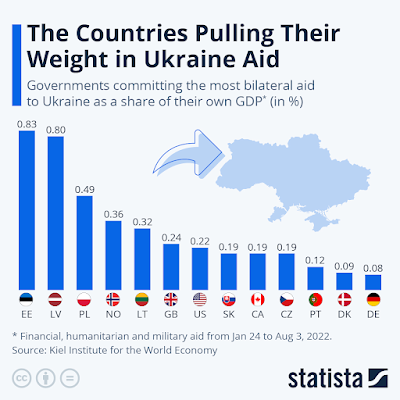
I think this graph tells that story well;

The front-line nations are putting their money where their existential threat is.

4. In line with #1 above, it is time for Finland at least, and probably Sweden, to join NATO. They both have a long and bloody history with the Russians and should see clearly what time it is.

Another check.

5. Ukraine waited too long to rearm. Weakened and distracted by a corrupt elite, the good parts of her nation could not get ready fast enough. After the first Russo-Ukraine war of 2014 she should have modeled the armed neutrality of Switzerland with a civilian populace trained and armed to the teeth. As we’ve discussed here before with the former Soviet republics and Warsaw Pact nations, every village needs a few ATGM militia teams trained to slow any advance through their patch of land. If Ukraine can, in whole or part, survive without vassalhood, perhaps they could get there. They can only get there if they build a nation people are willing to fight and die for.

Everyone is rediscovering the utility of a good military-industrial complex that can quickly grow to scale. Amazing what the green-eye-shade accounts forced those who actually are supposed to study war to believe.

6. Remember, the Russians hold the Presidency of the UN Security Council. The UN is a joke. OSCE is a joke. The EU is little more than a nest of rent-seeking, clock-watching grift-fest. NATO is, well, dysfunctional but better than nothing. Nations must take ownership of their own security. Yes, Taiwan and Japan I am talking to you. Study history. Be ready.

Well, this was kind of a lame point. The UN is, well, lame.  However the end of the point is solid. We'll call it a draw.

7. Is everyone clear what Russia is now? She has a small GDP and apocalyptic demographics, but she is taking what she has and is invading her neighbors, killing people, and taking land. If your nation, company, or neighbor is buying anything from them – they are paying for this military adventurism. If the press wants to do its job, start pulling that string.

Not enough thread pulling on the economic support for Russia around the globe. Make no mistake, a lot of the worst people are making money doing business with Russia. That money buys influence and silence.

Where is this reporting?

So, what are the lessons a year later? We'll discuss that Monday.

Sunday, February 05, 2023

American Realism in the Russo-Ukrainian War with Rebeccah Heinrichs - on Midrats


What path best enhances American security and prosperity, along with her allies, when it comes to the Russo-Ukrainian War?

Are American's interests best promoted by more support of Ukraine's ongoing fight for her independence, or by backing away to let things take their natural course?

Isolationists, realists, and idealists are all trying to make their case as to where to go next as the war moves in to its second year.

What are their arguments, and for those who say they promote a "Realist" policy - how do they define Realism?

Our guest for the full hour this Sunday from 5 to 6pm Eastern to discuss this and related issues she raised in her latest article in National Review, "Who are the Real 'Realists' on Ukraine?" will be Rebeccah Heinrichs, senior fellow at the Hudson Institute.

Join us live if you can
, but it not, you can get the show later by subscribing to the podcast. If you use iTunes, you can add Midrats to your podcast list simply by clicking the iTunes button at the main showpage - or you can just click here. You can find us on almost all your most popular podcast aggregators as well.

Thursday, January 26, 2023

Riverine: our Stupidity is Ukraine's Gift


In the first year of this blog ~18-yrs ago, we blowtorched the Navy for throwing away our riverine capability forcing the Army in Iraq to "reacquisition" fishing boats, and generally surrendering a primary logistics path - rivers - to the enemy.

We covered the rise and rebuilding of riverine in our Navy, and if you followed the tag, the ahistorical stupidity of our Navy at once again throwing it away due to having the attentions span of a squirrel.

Wherever there is war with any significant river systems, having a mature, well equipped riverine force is essential to controlling that logistics corridor and having the ability to defend from and project force quickly using the water.

This is military 101, but again, we have a problem with institutional maturity to support the "unsexy but important."

At least we are giving the Ukrainians what we are foolishly throwing away.

Over at Naval News they have the full report.

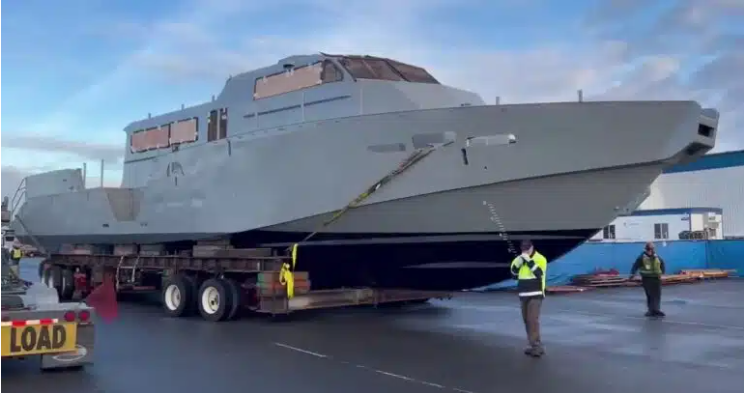
For the record, the United States’ State Department approved a possible Foreign Military Sale (FMS) to the Government of Ukraine of up to 16 Mark VI Patrol Boats and related equipment for an estimated cost of $600 million back in June 2020. The U.S. Department of Defense on 5 January 2021 awarded SAFE Boats International a US$ 19 million order to start production of Ukraine’s first two Mk VI Patrol Boats. Eight months later NAVSEA awarded SAFE Boats International a US$ 84 million contract modification for the delivery of six more Mk VI patrol boats, with an option for an additional two boats.

Mark my words; we will - again - regret with blood and treasure giving up this capability. 

Wednesday, December 28, 2022

Lanes, Lies, Power, and Politics - Biden's NatSec Problem


The United States' Secretary of State, Tony Blinken - again the Secretary of State - is so out of his lane right here it is hard to tell if he even knows what his lane is as our chief diplomat.

This opinion of his - which in this venue is now American policy because he said it - is so firmly in the Secretary of Defense's lane that it almost defines it.

Once again, where is Secretary of Defense Austin? His ongoing silence and supine posture as the Secretary of State and National Security Advisor continue to steal his lunch money and girlfriends out in the open is not just professionally embarrassing - it endangers the nation and our allies.

Give it a listen. In essence he states  the United States wouldn’t be able to support Ukraine if we were still in Afghanistan and that we cannot support two allies at once.

Either Blinken is speaking with authority on something he knows nothing about, he is simply lying in order to cover yet another policy disaster, or the American public has been fooled in to supporting a military industrial complex that exists for fun and profit - and ready for not much more than imperial policing. 

I'll let you decide.

Our footprint in AFG, before our negotiated surrender on par with the Confederate surrender of Vicksburg to the Union Army, was incredibly small. We did not need to expend Javelin nor Stinger nor Harpoon missiles nor tens of thousands of 105mm and 155mm artillery rounds a month in Afghanistan. 

Nope.

We have the largest defense budget in the world. AFG was an economy of force operation at the extreme and almost none of what UKR needs - besides a few helicopters - was needed by the ANSF to keep the Taliban at bay.

We have global alliances where we have obliged our nation to go to war to defend dozens of nations.

So, we finally admit to imperial overreach? We are admitting that our defense budget is laden with waste, fraud, and bloated workforce not ready to do the absolute minimum?

Is that what he is admitting?

If we are unable to support two allies in small to medium wars, then how in the hell will we be prepared to fight against the People's Republic of China in the Western Pacific?

Saturday, December 17, 2022

Cyber Lessons of the Russo-Ukrainian War with Shashank Josi - on Midrats


There is still a lot of fighting to be done in the Russo-Ukrainian War, but important lessons can already be drawn from the first 10-months of conflict.

One of the most hyped "new" domains of war the last three decades has been what is generally referred to as "cyber." Its growth in interest and buzz paralleled the decline and neglect of a more traditional form of modern war, Electronic Warfare.

This Sunday we're going to do a deep dive in what we are seeing, what we thought we should have seen but haven't, and how this should inform present support and future policy in the area of cyber.

Our guest for the full hour this Sunday from 4-5pm Eastern will be Shashank Joshi, Defence editor at The Economist.

If you are looking for a read-ahead, "The Digital Front" in the December 3rd edition of The Economist would be a good start.

Join us live if you can, but it not, you can get the show later by subscribing to the podcast. If you use iTunes, you can add Midrats to your podcast list simply by clicking the iTunes button at the main showpage - or you can just click here. You can find us on almost all your most popular podcast aggregators as well.

Tuesday, November 29, 2022

War, Humility, and Hubris

Peace is the ultimate goal and is a wonderful thing – but what makes it so special is that peace is not the natural state of things for our species. If you are lucky, you might get a couple of decades of peace before the next conflict of significance. More than that is a blessing few get to enjoy.

That is the human benefit of peace, but peace also has a heavy price. As eventually wars come, nations have to be ready for them. From the time the first band of men walked in to your valley, you heard the horses of the steppe archers in the distance, or the tank rumbled through your local gas station – war comes and demands you join it immediately. 

You go to war with the people, equipment, and concepts built when you were at peace. Good, smart nations make sure that their militaries do their best to ensure they know how the tools of war have advanced since the hard lessons of the last war, and the ideas and techniques that take advantage of those changes adjust with them. You hope smart people with the ability to effect change have a good, if not imperfect, understanding of what the next war will require. 

The longer the time of peace, the greater the error will be between what you have/think and what you will need/demand.

The wisest thing to do is to step away from anyone in the natsec arena who – like some late-night televangelist – tells you they have THE vision of the future or has the ONE thing that you will need to succeed.

No, the wise planner and strategist is one who is first humble and has that humility grounded in history. 

Why humility? Simple. The humble mind is a flexible mind, a mind that can change when facts present themselves. The humble mind is a harder working mind as well. Knowing it might be wrong, it will try harder to get it right and will continually look for indications that it was wrong and will correct accordingly.

These are some of the threads that tied together to construct the great fear I have for our Navy: we have been a peace for too long. The ground and to a lesser extent the air component have been tested firsthand in the last couple of decades, though at the low end of the conflict spectrum. Our naval forces at sea simply have not. We have placed large bets on theory and hope. From our airwing to our VLS cells, we have limited our flexibility to change simply by limiting our number of systems/platforms.

I think we have been getting better since the Age of Transformationalism at the turn of the century, but we still lack enough humility. That is clearly demonstrated in the haughty attitude of many towards the quality of the People’s Republic of China’s naval growth and the turning of a blind eye to the scale of their growth in units and industrial capacity.

Recall earlier that I mentioned that humility is grounded in an understanding of history? History is just a written record of experience. Mistakes should be expected, and in efforts to constantly modernize, new structures can come up that on paper and at peace – or in the face of a different level of war – looked right, but in the practice of war their shortcomings become manifest.

Can your military adjust? Can it do so in a timely manner?

This whole thread came top of mind today in this brief graph from the United Kingdom’s Ministry of Defence.


This is firmly in the Rumsfeldian “Known-Unknown” realm in that we really don’t know what we have wrong, or slightly wrong.

Just one datapoint of many coming out of the Russo-Ukrainian War. The future-perfect turned out not to be, and the neglected “old-think” of artillery, air-defense, logistics, shore-based anti-ship missiles, and armor were, in hindsight, unfairly shunted to the side for not being sexy enough.

As we try to get our Navy ready for the next war, what is important is that we don’t convince ourselves that we fully understand what future war will be. That uncertainty should shape our force such that it distributes future-risk such that we have a variety of flexible tools out there, not single points of failure. 

Single points of failure are a secondary indication of hubris, as we all know what the gods like to do with that.

Wednesday, November 09, 2022

Welcome to my Post-Fall of Kherson JOPG

Usually things flow from here to twitter, but now and then I pop something off that - knowing that not everyone who reads CDRSalamander is on twitter - deserves to flow the other way.

As a Navy guy who spent almost half a decade doing an Army guy's job as an operational planner, a few ideas popped in to my head this AM about "what next" in Ukraine.

Generally I'm not a fan of winter offensives, but when they work - they work. I am even more not a fan of wasting momentum when your larger enemy is on the back foot.

So, three Courses of Action for you to consider ... with absolutely no Commander's Intent or Higher Direction and Guidance ... but when has that ever stopped a core Joint Operational Planning Group's Core Planning Team from sketching some ideas out?

We all need plans to deviate from:

Wednesday, November 02, 2022

The Existential Requirement to Maintain a Broad Defense Industrial Base


With all its inefficiencies, bloat, and error; with all its problematic revolving door issues between government/military and civilian sectors – there is no greater existential requirement for a mature nation than to have its own military-industrial sector.

In peace it is easy to forget that in times of war – times that will always come with our warlike species – the vanities of peace can soon become a bleeding ulcer at war.

While small nations simply cannot sustain the full spectrum of military equipment due to overhead and development costs, medium to large nations have options. You may on occasion have to partner with friendly nations, but what strings come with those partnerships? Regardless of whose insignia is on a certain system, who really controls its use?

At peace when decisions are made in the moment, a greater appreciation of political risk down the road at war is required. A lot of, “what if” type questions need to be asked, and little tolerance should be allowed for the “that will never” or “unlikely given present circumstances” hand-waving away of problematic assumptions that would avoid either investment in significant reserve stockpiles of finished product or raw materials, or in higher per-unit production locally.

A perfect example of this trap can be found in the tracked anti-aircraft gun produced by the Germans, the Gepard (Cheetah), retired over a decade ago but taken out of reserve and handed over to the Ukrainians to great effect. Via Bild;

With its 35mm machine guns, this cheetah alone has already been able to destroy two Russian cruise missiles and a double-digit number of drones, says Max, confirming for the first time that a cheetah can also deal with these targets very well under combat conditions.

"The Shahed drones are very easy to fight when we're within range," says Max. The cheetah's search radar can pick them up well, and the explosive incendiary ammunition then makes short work of the slow drones.

Advantage cheetah: The machine guns can also fight swarms of cheaply produced drones very well. During an operation near Odessa, ten drones were shot down within a short period of time. This countered the tactics of the Iranian kamikaze drones, which are usually sent out in swarms to overwhelm the air defenses.

The ghosts of the peacetime accountants will haunt you at war. Via FT;

Germany wants to send 12,000 Swiss-made 35-milimetre rounds that were bought by Berlin decades ago to restock the 50 Cheetah flak cannons it has pledged to Ukraine.

The Swiss government, as part of the original sales contract with Germany, has a veto over the munitions’ resale or donation. Politicians in the wealthy alpine state believe that sending them to Ukraine would jeopardise its neutrality. Switzerland refused a request from Denmark for the re-export of two dozen Swiss-made “Piranha” armoured personnel carriers to Ukraine in May.

The German government has been struggling to find more shells to send to Kyiv. Brazil, which makes suitable munitions for the Cheetah guns, has also refused to allow their re-export.

 “For once, the Swiss government is right,” said Thomas Borer, former Swiss ambassador to Germany and an architect of Switzerland’s current laws on neutrality. “It’s clear that delivering arms of weapons into a conflict would infringe the core principle of what neutrality means for Switzerland. As a friendly neighbour that is aware of our laws and obligations, Germany shouldn’t put Switzerland in this position.”

Lambrecht wrote to her Swiss counterpart Viola Amherd saying the Cheetah munitions were purely defensive. In the letter, she said the weapons were “vital” for the protection of Black Sea grain exports from potential bombardment, according to Ukraine’s military.

Bern has yet to formally respond to Berlin’s renewed request, which has been made in parallel with diplomatic lobbying from Ukrainian officials. The Swiss defence ministry has passed the new German request on to the finance ministry, which handles export licences, a Swiss government spokesperson said, declining to comment further.

A spokesperson for Germany’s defence ministry said: “We are always actively finding ways to support Ukraine through our partners and alliances.” Discussions with Switzerland were part of that process, they added.

Senior German politicians, including members of parties in the governing coalition, have been more forthright, with Germany being Switzerland’s largest arms export market.

As I’ve said often before, were I German I’d be a member of the FDP party. As such, this makes me nod my head a bit smugly; 

“Anyone who does not deliver munition to an attacked state for national defence can no longer be a reliable supplier of ammunition for us either,” Marcus Faber, head of the liberal Free Democratic party’s parliamentary defence group, wrote on Twitter on Sunday. “If Switzerland refuses this to Ukraine . . . then for security reasons, we can no longer get anything from there.”

Like the lessons from the 40-year old Falklands conflict still are of use today – of even more importance to this century are the legion of lessons that are coming out of the Russo-Ukrainian War. Smart people are taking note of the sometimes uncomfortable truths at the tactical, operational, and strategic levels that are emerging clearly with each month – truths that need to be look at with an unblinking eye. Some theories pushed by industry are being found to be garbage – and other proven “old think” as shown as immortal “new think” and the Gods of the Military Copybook Headings are validated once again.

There are also a bountifully supply of lessons in the diplomatic, economic, and informational domains that need attention as well. Military-Industrial policy is one of them.

Add this to the list.

Monday, October 31, 2022

The Aspects of the Sevastopol Attack You Need to Focus on

The big navalist news over the weekend was unquestionably what appears to be a successful attack on the Russian Navy at Sevastopol by remotely piloted surface craft by the Ukrainians.

Some reports call them "drones" or other such descriptors, but really they appear to be an upscaled militarized remotely piloted surface vessel on a one way trip. There is a lot of expected hyperbole about the attack, and that is what I wanted to address today. I am concerned that the overhype by the ignorant, click hunting, or agenda driven people in the public space will cause us to miss the most important lesson here.

This attack was not historically significant in a larger sense, no more than the attack on the Moskva was. This is not a glimpse into the future of naval warfare. This was simply a continuation of sound naval tactics with a pedigree directly tracible thousands of years in to the past. Not to understand this is to dangerously not understand what happened.

First of all, let's take a moment to state the obvious: the Russians should have been ready. They had about as clear of a warning as possible in September.

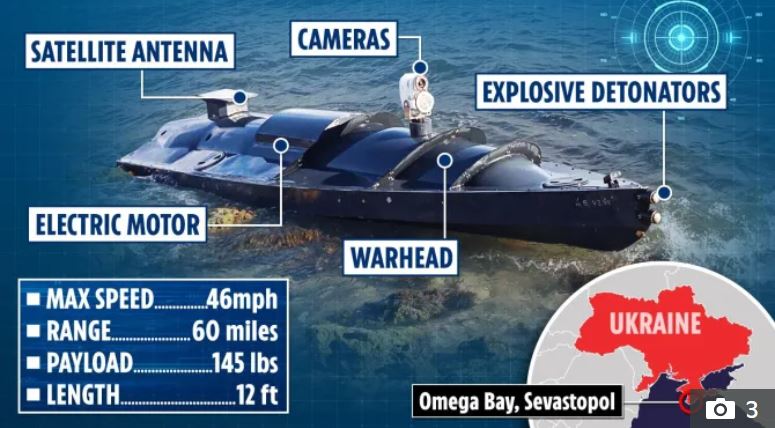
A MYSTERIOUS vessel widely believed to be a Ukrainian suicide drone has washed up near to a Russian naval base.

The vessel was found in Omega Bay, by the port of Sevastopol, which is home to Vladimir Putin's Black Sea fleet.

We can safely assume - as the videos below seem to demonstrate - that the ones used in the attack are of the same design.

We will loop back to this point later, but just behold the simplicity of it via the article from The Sun linked above;

This is all COTS technology riding on either a canoe or ocean going kayak. If you have someone with an understanding of explosives and communications (the only part requiring military expertise +/-) and then any garden variety electrician, small engine pro, and fiberglass guy ... you can run a production line of these on a shoestring budget at scale.

They look fragile, but ... well ... I'm getting ahead of myself. Let's finish setting the table.

In a classic, "We live in magical times.." moment, take some time if you have not already to look at the released video we have of the attack as published by The Guardian;

Now that we're through with the fun stuff, let's get to the serious lessons.

First - and this is the most important - this is no transformational breakthrough in warfare at sea. From the start of the written record of naval warfare, attacking another nation's navy - especially a stronger navy - in port with remotely piloted or unmanned surface vehicles has been "a thing."

Before the advent of explosives, they were simple "fire ships" like these Song Dynasty examples;


Even a thumbnail review of the next thousand years through the Crusades and untold numbers of European wars to WWI and WWII - this tactical action is used.  

Even non-state actors like the ever-inventive Houthis of Yemen have a recent record of similar use just five years ago.

The details of the Ukrainian attack on Sevastopol will come out in time but the bold-faced lessons are clear - as are the warnings.

This is another demonstration that the military culture of Russia is broken. The human element in the Sevastopol was manifested in the complete lack of preparation for the attack in spite of the warnings so clearly provided in September.

As old as "fire ships" are to naval warfare are the defenses to them. They are as simple as the weapons needed to defend against them. Barriers at the water level and crew served weapons - preferable optically sighted - as a backup.

Part of the video above you can see both surface ship and helo gunfire taking out the threat from one boat, but other boats were able to approach surface ships underway and penetrate deep in to port. 

Why? 

What is one of the things we have repeatedly discussed here for the last 18-years? When war comes you never have enough of what? That's right, anti-aircraft defenses and medium caliber guns including crew served weapons. 

We build our ships around the most high-technology threats and equally exquisite defenses against them, but completely overlook the low-tech weapons that are just as deadly. We ignore mine warfare, and we also ignore threats as simple as a converted kayak. It isn't sexy and the contracts awarded are small ... but the threats are real.

There isn't a sexy or expensive defense against them - though you can try to sell one - and the best defense you have are Sailors on watch - with good surveillance equipment to support them - and weapons they can use at scale and volume.

Yes, there is a cost to have increased manning levels, additional weapons in the armory and drills/training to maintain readiness ... but if that is the cost to be ready for war ... then do it.

Look at the early lessons from WWII to the Falkland Islands War etc; at peace we get lazy. When war arrives, we find ourselves lining the rails with anything that can throw lead.

The Russians do not appear to have taken the most obvious and immediate steps to address this cheap, low-tech threat. They did not have significant barriers in place at the entrance to their harbors or around their ships' berths. They did not have Sailors on watch with weapons at the ready.

They were complacent. They were arrogant. They assumed too much.

Now is the time to loop back to a few points made at he top. This is where everyone needs to focus their attention.

1. For thousands of years, weaker naval forces have significantly damaged superior naval forces by using their disadvantage to advantage. When large and heavily armed warships are designed, trained, and manned for war against their peers on the high seas, how do you best attack them? Inshore with simple; small, lightly armed civilian derived boats roughly designed, simply trained, and unmanned. 

Be it a raft filled with burning straw and tar, or a butched-up sea-kayak filled with RC boat tech, commercial satellite data, Sea-Doo propulsion, duct taped explosives and contact detonators. If the larger naval force in a mix of arrogance and bureaucratic sloth, or just professional malpractice, refuses to see the full-spectrum vulnerability - even when I&W tells you it is there - then the motivated, flexible, and capable smaller power will reach in to history's toolbag to pick out the best bang for the buck.

2. You do not have to be a state power to create the modern "fire ship." You do not have to access controlled technology. You don't need even a lot of money. You just need imagination and the bare minimum of technical capability.

3. Most readers here are familiar with San Diego, Norfolk, Mayport and our other major naval bases. Can you wargame the rest? Yes, we have some nice barriers you can even see from GoogleEarth, but what about getting from the pier to the open sea in 2022? Where could the enemy hide? How much warning do you have? How many crew served weapons do you have ready ... and what is your ROE in such crowded ports? I don't know about you, but I like Mayport even more now.


Good on the Ukrainians for using this time proven tactic. It was clear the Russians were not ready for it - a common characteristic of the Russian military - so the Ukrainians took advantage of the Russians' sloth.

As for the US military, I'm really not interested in the question of how we could use such tactics, but as we are the big Navy, I want to know more what we do to protect ourselves from this tactic.

We can start with what is the most obvious: more crew served weapons. 

More smaller boats to escort our ships to sea (USCG or USN, don't care).

If I were a state or non-state actor watching this scene - I'd already have plans in place and just wait for the moment to be ripe. 

I hope we are ready for same.

Tuesday, October 25, 2022

Close Air Support Comes at You Fast ... From Both Perspectives

Ever wonder how fast things can come at you in combat ... and how fast you have to react to survive? 

Simply stunning video from the shootdown of a Russian S-25 in Ukraine:


No other aircraft has been so valuable - and no aircraft has been shot down more - than the SU-25 in this conflict.

Many regulars here are very familiar with "time compression" in such situations. Time slows down a lot. If you have not experienced that, you may wonder how he is able to eject so fast to survive a direct hit at 200-meters (about 600'). Well, training is one, but time compression is another.

This slow-motion video makes it a little closer to what it felt like to the pilot. 
Tough job. Tough aircraft.

h/t Tyler.

Monday, October 10, 2022

The Anglo-Saxon War in the Hetmanate

For centuries, since first in England and then in the United Kingdom, there was a habit/tradition in the English speaking world of getting involved in wars on the continent, directly or indirectly, for the simple reason of wanting to ensure a balance - or at least - a disaggregated power on Continental Europe. 

There is also a strong connection more than just language in the "Five Eyes" nations of Great Britain, the United States, Canada, Australia, and New Zealand. We all share a certain view of our place in the world we helped create. 

The rebellious child of the USA can be late to the game on occasion, but when the Mother Country goes to war, CAN, AUS, NZL go with her. In the modern world - just sticking to Europe here and keeping this very basic - GBR entered WWI on behalf of Belgium's neutrality, and CAN, AUS, and NZL went with her. In WWII, it was about Poland. Same pattern.

In both wars, the USA was a great supplier of military equipment before jumping in with both guns blazing. In recent history, all Five-Eyes fought together in IRQ and AFG and work hand in glove. From Suez to Malay to Vietnam to The Falklands, on occasion one or the other nation may demure, but on balance we align. 

We tend to see the world a certain way - at least with the global order that was crafted and enforced over the last two centuries by the Anglosphere.

Others nations and cultural groups? Spotty record, at best.

That strange family is again manifesting its world view in the Russo-Ukrainian War. Entire books will be written on this, but as data point, let's look at this little snapshot from GoodiesForUkraine.

Yes, this is just a snapshot. Yes, this is just one airhead. Yes, this does not represent aid coming by rail and road. All that being said, this does tell a story.

That is 29 flights. Of those 29, 24 came from the Anglosphere; 83%. One of those flights is "NATO." When you consider that the Anglosphere contributes well over half the fighting power of NATO, we'll take that too. That makes it 25/29 = 86%.

86%.

Where is the action from all the talk about "European Values" from other parts of Europe? It would be helpful to push back against Russia's smear of an "Anglo-Saxon War" if, oh I don't know, it didn't look like ... it was.

At some point there will be a real solid summary of the logistics of Western support for Ukraine in their war against Russian aggression. That will account for a lot more aid coming from Central Europe, especially the heavy stuff by rail/intermodal.

Still interesting snapshot.

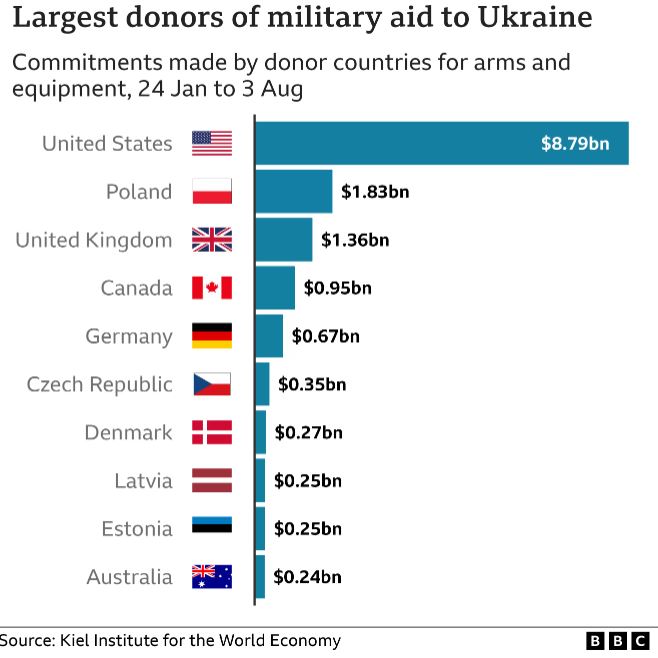
This August graph from the BBC gives a more rounded view;


That is 76% ($11.34/$14.96) from the Anglosphere - none of these nations are even physically connected to Continental Europe (sit down Gibraltar...).

The % of GDP gives a measure of concern as well. The nations who know Russia best are speaking for themselves, but it is telling that of the Top-10, all the nation are either former Soviet Republics, Warsaw Pact members, share a border with RUS, or part of the Anglosphere.


I think about this a lot. You should too - and think about the most important word in the English language; "why."

Tuesday, October 04, 2022

Want a Nuke Wargame? I’ve Got One for You


The last few weeks have been filled with discussions about possible Russian use of tactical nuclear weapons – probably in a demonstration first – because of their collapsing conventional war in Ukraine.

There are lots of different scenarios/vignettes you can go through and could spend all day or more on each one, but I’d like to pull one out for you today that brings together a few threads we’ve seen the last nine months.

Here are the threads we are going to pull in to the primary subject of this wargame: the Russian Federation decides to demonstrate their willingness to use tactical nuclear weapons.

Threads common to this war so far: 

  • Russian “gun decking” of material readiness.
  • Russian culture of not delivering bad news and hoping for the best.
  • Ineffectiveness and lack of trust in Russian Air Force manned aircraft capabilities.
  • Reliance on rocket forces.
  • Russian leadership has no option but victory.

Facts:

  • Due to the test ban treaty, the Russians have not been able to test their nuclear warheads in decades. 
  • The two parts of the nuclear triad most visible to Western eyes – submarines and manned aircraft – have all demonstrated spotty levels of performance and maintenance in the post-Soviet era. One can assume the missile forces have comparable, if not worse, records.
  • Open source reporting reflects that even the most basic of Russian weapons, like HE artillery rounds, have a higher than acceptable failure rate.

Assumptions:

  • Russians decide for an air-burst demonstration shot vice a tactical use on the front lines. 
  • The Russian’s relatively benign high altitude airburst will not mirror Western ideas of a demonstration shot over water, but will instead drive the point home by doing it over Ukraine between Kyiv and the Donbass.
  • The 448th Rocket Brigade of the 20th Guards Combined Army based out of Kursk was the last Russian Army unit to be equipped with the SS-21 (Tochka-U) and in 2019 converted to the SS-26 (Iskander-M). However, we know that SS-21 have been used by the Russians in Ukraine, so we can assume that the last unit to convert would be the first to bring them back.
  • The SS-26 transition has been a slow one with substantial SS-21s remaining with the brigade that enabled them to quickly use the SS-21 from the start of the war.
  • We can assume that the SS-26 coming in to use are mostly conventional to save money and trouble. They need to keep the nuclear capability on the books, so they will have their special weapons crews remain in Kursk with their few remaining nuclear armed SS-21. 

That sets the table, and here is what I would like wargamed…and what I think will be different.

I’m not interested in flash-bangs etc … no … I want something much more difficult. I want something that will stress the diplomatic and political structures of the USA, EU, and NATO.

Before Turn-1, here is what happens (I attempted to be exceptionally abbreviated but I can’t help myself).

  • President Putin orders a demonstration shot, but specifically states that he wants it overhead Ukraine as outlined above. 
  • Putin does not trust the ability of cruise missiles or manned aircraft to successfully deliver a weapon where and how he wants it, and absolutely no strategic forces are to be used (so the Russian Navy good idea fairies can stow their wings).
  • Colonel Dmitry Nikolayevich Martynov, Commander of the 448th is forward deployed in theater with his forces and all of a sudden has his Deputy Commander Lieutenant Colonel Igor Ivanovich Karamyshev showing up in his command vehicle telling him that he is ordered by Moscow to get on the Mi-17 he arrived in and return to Kursk.
  • Upon arrival, Martynov is walked in to a briefing led by Shoigu himself and is given his orders; he has 72-hrs.
  • Martynov leaves and contemplates that, yes, they have three nuclear certified crews in Kursk, but they are not his best. His best crews are forward deployed. These are the sick, old, or otherwise best left home crews. Yes, they can launch, but … he's keeping the details to himself.
  • Also, the Transport Erector Launchers (TEL) are not his best, his best are forward deployed.
  • His nuclear certified ordnance crews … well, they are specialists. They never deploy and when he last walked through the nuclear magazine, all seemed in order. All paperwork is in order. As long as the TEL’s can drive 5-km, the 448th should be good to go.
  • D-3: Shoigu insists that they have a “Primary,” “Back-up,” and “Ready Spare” for the strike (as is expected), which is great as they only have three nuclear warheads good to go.
  • D-2: some low-level USA Joint Staff J2 types received notice of Shoigu’s movement to Kursk and even saw in another report Martynov’s unusual return to Kursk – but this is not of great concern - just another Colonel. Shoigu’s movements are worth briefing – but not Martynov.
  • D-1: a separate NATO CJ2 shop notices some unusual, but not unheard of, movements around the 448th’s magazines in Kursk, but in a sea of data, is barely acknowledged. In DC and Brussels, a series of high-level short notice briefings are taking place that has the staff curious, but that is not unusual so far this year. However, some pasty looking officers are going in to brief no one really sees around often. Huh.
  • D+0 (early): TELs are set to move, but TEL-2’s transmission shit-the-bed halfway out the shelter, so the “Ready Spare” of TEL-3 is now the “Backup.”
  • D+0 (mid-day): Final launch orders received. "Dial-a-Yield" was set earlier to .5-kilotons with airburst at 10km. “We’re here to make a point, not destroy resources we want later.” The Colonel mumbles to himself as he attempts to remain calm as he slowly realized what he is about to do. Target 320-km away; the Voloshanska Dacha Ornithological Reserve in the Dnipropetrovsk Oblast.  
  • TEL-1 launch successful. However, word is received 10 very sober minutes later, no detonation. Orders are clear; TEL-3 begins checklist and 2-minutes later TEL-2 has another successful launch.
  • The crews remain in place. Martynov steps out of his command vehicle, gets in a staff car and drives over to TEL-1. He’s a hands-on leader and wants to thank them for a job well done, duty, etc. He then gets back in the staff car to visit TEL-3 when he gets a call on the radio from Major Aleksey Aleksandrovich Kondratev who he left in charge of the command vehicle. "Return immediately."
  • As he pulls up, he see’s a GRU truck full of security pulling in, “дерьмо.”


Four and a half a kilometers west of the woods of Volvoshanka at the bus stop in the village of Orlivs’ke, a farmer’s sister hears the high-pitched screech of what is to her, ten months in to the war clearly a missile. 

At the end of the street she sees something hit the ground. She walks to the southeast 50-meters towards the crossroad at the edge of her brother’s field and there it is in her neighbor’s yard.


A small crowd gathers to look at it and about 10 minutes later a few guys from the Territorial Army arrive to shoosh everyone away. Once they finish that, everyone looks to the southeast again over the field where one of the kids is pointing. Something else just fell at what looks like 500 meters away the field. Another dud. 

Everyone looks at each other. What a lucky little village. The war hasn’t reached them yet, and when for some reason it did, nothing blew up.


So, there is a bit more story than I wanted to do, but it was fun – for me at least.

Here is where the wargame starts. No one knows it but the Russians right now, but at D+0 the Russians just tried to do an airburst over Ukraine between Kyiv and the Donbass – they actually tried twice – but neither missile detonated.

We have a few things to play out:

Red (Russia): What are your possible COAs from here?

Blue (USA/NATO): What will it take for you to know exactly what happened here without inside sources? (judge will determine how many turns Red gets before Blue/Green/White know)

Green (UKR): How long will it take for Ukrainian EOD to get there and realize that is no normal warhead on that SS-21?

White (International Organizations/neutral nations/Pope/etc): Possible reactions and timelines.


…and no – in what I consider the infinitesimally small chance the Russians would ever use tactical nuclear weapons in UKR (non-zero, but close to it) – I don’t think this scenario is outside a half-standard deviation either side from the centerline.

Also, I may have some technical details incorrect here. If you feel the need to be pedantic, roll in the comments, I can take it.

Monday, October 03, 2022

We Need to Talk About France


On paper and in theory, one would think that a nation who love-hates NATO only slightly less than she love-hates the USA, and is always looking for an opportunity to - now that the UK yeet'd itself out of the EU - nudge Germany out of the way so she can be seen as THE leader of Europe, would take the lead in supporting Ukraine in the Russo-Ukrainian War.

Of course, I'm talking about France;

If France wants to lead Europe to a new era of military self-reliance, how come its contribution to the war effort in Ukraine is so small?

That is the awkward question being posed by some of the country's top strategic thinkers, who are pushing President Emmanuel Macron to make an urgent decision on more arms to Kyiv.

Recent analysis conducted on the ground in Poland and Ukraine shows that the French share of foreign arms deliveries is less than 2%, way behind the US on 49%, but also behind Poland (22%) and Germany (9%).

"I was concerned about the reliability of the statistics which showed France low on the list of contributing countries," says François Heisbourg, who is perhaps France's most influential defence analyst.

"So I went out to the main distribution hub in Poland to see how much in tonnage was actually being delivered, rather than just promised.

"Unfortunately the figures bore out my fears. France is way down the list - in ninth position."

We hear the same old excuses that we are used to hearing from other nations (FRA actually spends a bit over 2% GDP on defense), who free-ride in NATO;

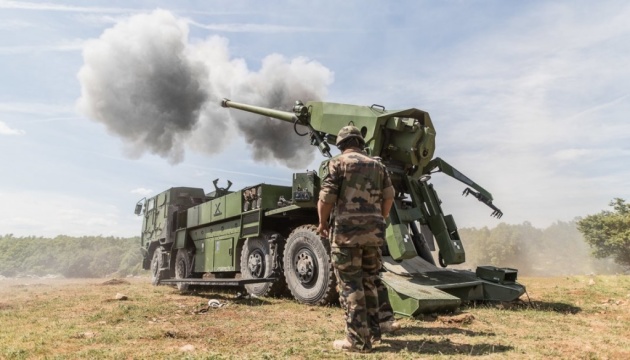
...defence officials say the true measure of military help is quality not quantity. Some countries are delivering masses of outdated equipment. France has given 18 Caesar self-propelled artillery units, which are now celebrated along the Ukrainian front-line.

France, they add, is like other Western countries in having run down military stocks as part of the post-Cold War peace dividend.

You know there's a "but" on the way ... and this is the point I raised to surprising response over the weekend on twitter;

Ukraine's Caesars are fully one quarter of France's entire mobile artillery. It cannot offer much more without making itself vulnerable in regions where it is already committed, like the Sahel and the Indo-Pacific.

18 = 25%. Yikes.

Yes, the nation that pretty much invented modern artillery on the battlefield is that short. Amazing, and she desires to be a major player on the stage? She's a continental power...but in theory only.

How to fix on the whole? That is a great question with a complicated answer I'm not sure we can do justice to here. 

How do you possibly fix her relative lack of support to Ukraine?

"When I was in Kyiv, everyone was very polite. I had no sense that the Ukrainians disapproved of us," he says. "In a way it was worse. I had the distinct feeling we were becoming irrelevant."

For Mr Heisbourg the equation is simple. Ukraine will talk to countries who it knows are likely to deliver the weapons it needs. France at the moment is not one of them.

The French have a very flinty ego. They don't like to be dismissed. They like to be important. They lust for a seat as a player.

Treat her like a 3rd-tier nation, and that might get her to up her game. 

Yes, France has long-standing interests in Russia ... but she, like many, seems to be missing her moment on history's stage. 

France has been and could be a strong and responsive ally ... but at this moment in time, cracks in her very real military capability are being brought in to focus, and larger cracks in her ability to understand place and time are even more pronounced.