Showing posts with label Korea. Show all posts

Friday, January 20, 2023

Fullbore Friday

Today is a great day;

A hero pilot who shot down at least four Russian Migs in a classified dogfight at the height of the Cold War which saw his jet shot 263 times is to receive the Navy Cross.

Retired Navy Captain Royce Williams was sworn to secrecy for more than 50 years over fears that his battle against seven Soviet fighters could spark war with Russia.

Now the 97-year-old is free to tell his tale and is due to receive the Navy's second highest award for combat valor on Friday at the San Diego Air & Space Museum.

Captain Williams first graced the pages of CDR Salamander almost 11-yrs ago. In honor of his well deserved Navy Cross, let's bring it back. 


No one will challenge us; they never had before.

Don't worry - just another boring CAP mission; four JOs against ... the flight schedule, I guess.

Yawn ... and I have to wear a dry suit. Ungh.

Lt Elwood, the Flight Leader, reported his Fuel Pump Warning Light was on. The Combat Information Center (CIC) directed the Flight Leader to report overhead the Oriskany. Lt Elwood passed the lead to Royce and turned back to the CTF with his wingman Ltjg Middleton flying as his safety escort. Suddenly the odds went from 7 against 4 to 7 against 2. Royce and his wingman, Ltjg Rowland, continued climbing toward the approaching MIGs. At 45 miles from the CTF, the MIGs passed directly overhead and immediately turned left as though going to make a 180 degree turn and return to Vladivostok. Royce turned left to follow the MIGs and continued his climb to 26,000 feet. Royce followed the 7 MIGs keeping them in sight. The MIGs abruptly broke sharply back toward the 2 F9F-5 jets, split into two groups of 4 and 3 aircraft and dived steeply. The MIGs were lost by Royce when they passed conning altitude and the vapor trails vanished. Royce called out "Lost Contact" to the Oriskany controller to get information on the Bogie locations but the Bogie blips were no longer visible on ship's radar.

Royce started a gradual left turn after arriving at the position of last visual contact. A line of four MIGs abreast suddenly appeared at ten o'clock, diving towards them with all guns blinking orange as they attempted to shoot down the Panthers. Royce turned into the first four MIGs and positioned his Panther in gun range on tail end Charlie. Royce fired a short burst of 20 MM cannon fire at the trailing MIG. The 20 MM impacted the fuselage of the MIG and he fell out of the formation trailing smoke and aircraft parts.

Royce's wingman trailed the smoking MIG down to 8000 feet trying to get his guns to fire and his gun camera to function. He finally gave up, broke off the engagement and started the long climb back to his Section Leader. The remaining three MIGs climbed to position for another firing run on Royce. Then they reversed course, rolled in on individual diving runs and commenced firing both 23 MM cannons and the 37 MM Gun at a great distance away. Royce turned into them again and fired his 20 MM as they flashed by at a very high rate of closure. The other three MIGs joined the fray which had Royce alone dog-fighting six MIGs. While reversing, jinking and rolling against the Bogie gaggle, Royce could see a MIG locked on his six o'clock position but Royce executed a very hard turn which caused the MIG to overshoot. Royce was firing at every MIG that passed within gun range as they sped by after taking shots at his tail. Finally, Royce got in a kill position on another MIG and fired off a concentrated burst while watching the HEAP (high explosive armor piercing) rounds detonating on the MIG's fuselage. The disintegrating MIG forced Royce to break away from the debris. Several times Royce tracked an individual MIG and fired rounds that appeared to hit the target. Royce did not follow up on the damaged MIGs but instead kept trying to keep his 6 o'clock clear of MIGs while still firing at every opportunity. Royce was tracking and firing at a smoking MIG when he saw a MIG slip into close range at his six. Royce called out to the ship that he could use some help. Royce rapidly reversed by breaking sharply but he felt a 37 MM explode into his aircraft. His Panther was severely damaged. He lost rudder control and had little use of his ailerons. That left him with only one fully operational flight control and that was his elevators. By porpoising the aircraft he could see 20 MM tracers passing above and below and could even see the 37 MM projectiles as they shot by his wounded F9F-5. Royce pushed hard over and while still at full throttle made for the 12000 foot cloud tops. He felt a rush of relief after entering the security of the ominous cumulous.

Royce broke out below the clouds and headed for Oriskany. As he passed a few of the more than 20 ships of the CTF, some fired at his aircraft. The friendly fire stopped after his Panther jet was visually recognized. The Panther was hardly airworthy, but Royce hated the thought of ejecting into the icy Sea of Japan. The F9F-5 was controllable above 170 kts and Royce flew aboard the carrier with a lot of help from the Captain of the Oriskany lining the ship on final approach to accommodate the drifting F9F-5.

Royce was ordered to report to VADM Briscoe, COMNAVFORFAREAST, at Yokosuka, Japan. Briscoe cautioned Royce that a Top Secret agency called NSA was aboard a Navy cruiser off the coast near Vladivostok and monitored all Soviet communications. NSA warned the CTF of the Soviet MIGs taking off from Vladivostok and flying toward the CTF. NSA covered all the radio transmissions and followed the MIGs from departure through the entire confrontation and until return of the remnants of the MIG flight to Vladivostok. NSA told Admiral Briscoe to tell Lt Williams that he got at least 3 of the MIGs. Admiral Briscoe warned Royce to not tell anyone about what he had been told about the Soviet encounter.Royce reported that virtually all of his 95 minutes (1.6 hours) in the air was at full throttle, gun cameras used throughout and that he had fired out all of his 20 MM rounds during the engagement. He further stated that he had learned that the names of the Soviet pilots killed were Captain Belyakov, Captain Vandalov, Lieutenant Pakhomkin and Lieutenant Tarshinov.
No such thing as a normal combat mission. History finds you when she does - and when she does, let's hope you're fullbore.


Tuesday, January 17, 2023

What about South Korea?

Whenever I see something about South Korea, their economy or their military, I think of my dad's generation who were of draft age during the Korean War. I've read a bit about the war and the condition of the country and its people when we fought to keep the communist yoke of their neck, and when you look at the South Korea of 2023, it is simply an amazing testimony what free enterprise and education can do to a people held back by autocracy and illiteracy ... with a good bit of rule of law and a benign quasi-imperial military power willing to give them the security to grow. Worth the war? I think so.

In the last year, South Korea has impressed many who were not paying attention concerning their growing place as a military-industrial power - specifically their arms exporting and partnership with Poland as she does all she can to be the military power of the Three Seas nations. 

I keep wondering, do we need to bring South Korea closer in to the Western military infrastructure?

Yes, she has a spot of bother to the north that needs almost all her attention and her demographics are far from robust ... but still - is their a collective gain by bringing her closer in?

This graph from Zach Cooper really hit home how isolated, in a way, South Korea is outside the bi-lateral relationship it has with the USA.


In the abstract to his paper (that I'd love to read in full, but I am sans-access...ahem). 
As South Korea has aligned its focus to that of the United States, Seoul has expected Washington to integrate South Korea more deeply into American regional strategy. Yet, US efforts to build minilaterals have seldom included South Korea. Addressing this divide will require leaders in both capitals to adjust their approaches to both focus and format in the Indo-Pacific.

South Korea has a population of 51.7 million souls, greater than all but six of the 30 NATO nations (USA, TUR, DEU, FRA, GBR, ITA). She has a GDP of 1.8 trillion USD, greater than again all but six of the 30 NATO nations (USA, DEU, GBR, FRA, ITA, CAN).

Worth more pondering. 

Friday, September 16, 2022

Fullbore Friday

A pivot of history around a man.

For over two decades the American military occupied a foreign country on the other side of the planet, supporting an oppressive local government that was mostly known for its anti-democratic habits and corruption.

Over the two decades of occupation, thousands of Americans and her allies who also contributed forces died in order to keep a clear threat to global peace contained.

During the previous presidential election in the USA, the candidate who won made repeated statements that he planned to withdraw all American forces from that country. Two decades were long enough, and he was insistent that he was a man of his word.

The new president carefully placed reliable political operatives in to national security positions who he could rely on, and to the professional intelligence and military community, it was clear what was going on; 

…politicizing the intelligence process. ..in the CIA an attitude that the withdrawal policy presented dangerous risks. But he felt that, …the risk of withdrawal was not alarming. … the policy represented a political decision. Administration decision makers understood the risks involved and had judged them to be acceptable.

Are you thinking of the events of the first year of the Biden Administration that resulted in the greatest national humiliation since the Vietnam War?

Well, you would be forgiven is so – but no, we are talking about one of the more undertold stories of the Cold War and the Carter Administration – one the usual suspects in the civ/mil fetish world either don’t know about or won’t talk about.

For those who don’t remember, in hindsight (and even more so at the moment), the apex of global political and military power of the Soviet Union was somewhere between 1975 and 1985. American military ability and confidence – especially in our Army - were at its post-WWII nadir.

In that background, here’s the background.

Jimmy Carter's decision to withdraw ground troops from South Korea goes back at least to January, 1975, and the earliest days of his campaign for President. His original idea was to pull out all U.S. forces - ground and air - and to negotiate assurances from China and the Soviet Union that North Korea would not invade the south.

The origins and evolution of Carter's ideas are of unusual importance because his campaign stand has been translated directly into U.S. policy with a minimum of official review. In order to avoid a battle within the government, a National Security Council study leading to the U.S. withdrawal plan did not question whether American ground troops should be removed but focused instead on how many should be removed.

As sent to the White House in mid-March, the council's Presidential Review Memorandum 13 acknowledged that there are differences of opinion about the troop withdrawal policy and that the impact of it is difficult to predict. At the explicit instruction of Secretary of State Cyrus R. Vance, however, the State-Defense-Central Intelligence Agency study accepted as its promise Carter's previous announced conclusion that the troops should be taken out.

It is amazing how some bad ideas and unmoored assumptions just keep showing up in some circles;

Administration officials have emphasized that the Carter plan would leave American air forces in‐place and that there would be a continued strong American naval presence in the Sea of Japan to assist South” Korea in the event of an invasion. American troops in Korea represent about 30 percent of United States forward‐deployed forces in the western Pacific, which number ‘about 127,000.

Did the senior uniformed leadership have concerns?
Many Army officers in Korea as well as at the Pentagon (view) that the withdrawal of American ground troops in South Korea would upset the military balance there and provoke North Korea to plan another invasion of the South, as occurred 25 years ago.
But did they do anything? People matter. One man can matter. History and the lives of millions can rest on the decisions of one person - and how they define duty vs. self-interest.

The following story has a few angles. One angle is an echo of warnings I have put out before; if you wear the uniform, do not get comfortable with the press - especially "traditional" press that works DC or are from hyper-political organizations. With very few exceptions, they are not your friend. They have a job. You are not just a source, you are part of their building of their personal brand. 

You may think you are on background, but ... perhaps not. There are questions if this spark was a case of a reporter or their editor deciding not to respect a background source, or a polite wink between parties - I have heard both, but we know the results, so let's focus on that.

On May 19th 1977, John Saar at the Washington Post had an article that would lead to the premature end of one of the US Army's most respected Generals and ... in the end, perhaps prevented the death of millions or even a third world war.

The third-ranking U.S. Army general in South Korea says that President Carter's plan to withdraw U.S. troops here in the next four to five years is a mistake that will end in war with North Korea.

"If we withdraw our ground forces on the schedule suggested it will lead to war," said Maj. Gen. John K. Singlaub, chief of staff in the U.S. Forces Korea headquarters.

Singlaub said he and many other senior military officers challenge the wisdom of Carter's plan, and predicted that withdrawal of the war-ready 2d Infantry Division in that time frame would seriously weaken defenses in the South and encourage North Korean Peresident Kim II-sung to attack.

The unusual situation of serving generals, openly differing with the President's declared policy arises on the eve to talk to implement that policy.

...  "The question asked after U.S. setbacks in China and Vietnam was, 'Did the military people in the know express themselves loudly and clearly enough that the decision-makers understood?' We want to make sure." he added. "If the decision is made we will execute it with enthusiasm and a high level of professional skill."

The apprehensions voiced by Singlaub are enchoed to some degree by many, if not all U.S. military leaders in South Korean. "No one understands why they are being pulled out," said a well-informed American source. "Carter says that withdrawal won't endanger South Korean security or upset the military balance. Out military people say that would be a miracle. They think it can't be done."

The impact professionally did not take long. Three days later;
President Carter yesterday fired Maj. Gen. John K. Singlaub as U.S. chief of staff in South Korea for telling The Washington Post last week that Carter's plan to withdraw U.S. troops from Korea is a mistake that will lead to war.

Defense Secretary Harold Brown announced Singlaub's dismissal as chief of staff less than an hour after Singlaub, in uniform, met for 30 minutes with the President. Carter was described Thursday as distressed and angered by Singlaub's remarks.

Brown accompanied Singlaub to the meeting. In a statement issued from the Pentagon afterward, Brown said, "Public statements by Gen. Singlaub inconsistent with announced national security policy have made it very difficult for him to carry out the duties of his present assignment in Korea.

"I have, therefore, recommended to the President that Gen. Singlaub e reassigned, and with the President's concurrence I have directed the secretary of the Army to take action to that effect."
...and there goes a 35-year career. But...Singlaub knew what he was doing. History has proven his professional sacrifice as being the right move. A 2018 paper by Eric B. Setzekorn in the Army War College Parameters titled, Policy Revolt: Army Opposition to the Korea Withdrawal Plan gives Singlaub and others a good review;
By publicly opposing the plan as part of a Fabian strategy, senior Army leaders gained public support of their position and the president suspended the planned withdrawal.
...
Although Army leaders were clearly manipulative and pushed the boundaries of professional ethics, they effectively halted a deeply flawed withdrawal policy. Viewed from a distance of forty years, President Carter’s politicized policy process and shortsighted mentality of reducing deterrence capabilities on the Korean Peninsula were clearly dangerous. Singlaub and Vessey, as the subject matter experts on the American military role in South Korea, should have been consulted. Yet the generals’ actions led to a more comprehensive debate of American security policy in Korea. As the case of the aborted Korean withdrawal highlights, Army leaders can successfully challenge presidential policies. But the question is should they?
That is a great question - and one that will always in the American context get a reply, "It depends."

And so is a long introduction to a recognition that earlier this year, General Singlaub was called home one last time;
John K. Singlaub, a two-star general with a record of wartime derring-do who resigned from the Army in 1978 after openly criticizing President Jimmy Carter’s defense policy, and who later battled communism as a private citizen by funneling weapons and money to rightist insurgents around the world, died Jan. 29 at his home in Franklin, Tenn. He was 100.

A long live. An impactful life. If you read his full bio - one hell of a life. I don't know if there is a statue to him in South Korea somewhere, but there probably should be. Just look at 2022 South Korea. It did not get the opportunity to grow in to one of the most highly successful and developed nations on this planet in isolation or by accident. 

How would Singlaub want to be remembered? I don't know, but I'll take a guess;


John K. Singlaub was recruited by the Office of Strategic Services (OSS) in November 1943. As part of JEDBURGH Team JAMES, he jumped into France on 11 August 1944 to arm and direct the French resistance. Sent to China, as the commander of the PIGEON Mission, he jumped onto Hainan Island on 27 August 1945 to rescue Dutch and Australian Prisoners of War. As one of a handful of Special Operations Branch personnel retained the Strategic Services Unit (successor to the OSS), Singlaub stayed in China to report on the Civil War. Singlaub was again involved in special operations when he was an instructor at Fort Benning, Georgia and helped to establish the Ranger Training Center in 1950. He then had two tours in Korea, including one with the Central Intelligence Agency’s Joint Advisory Commission, Korea (JACK). Singlaub returned to special operations in from 1966-1968, when he commanded a joint unconventional warfare command, the Military Assistance Command, Vietnam, Studies and Observation Group (MACV-SOG). Retiring in 1978, Major General Singlaub has remained active in the Special Operations community and was recognized with the United States Special Operations Command’s (USSOCOM) Bull Simons award in 2011.

Fullbore. 

Tuesday, March 22, 2022

A Friend's Frigate Benchmark

Want to take a break from the Second Russo-Ukrainian War? 

Good, so do I.

As we (well at least I) impatiently wait for the USS Constellation (FFG 62) and her sisters to start displacing water, it is interesting to see the design decisions other nations have made to meet their frigate requirements. 

As our new FFG will be the USN version of the French and Italian FREMM, it is natural to compare it to other European designs, but what about our friends in the Pacific? 

What are the South Koreans building? Let's take a quick side-by-side look at their Daegu-class frigate presently under serial production.

Of course, different nations have different requirements, and you can see it in the fact that the US Navy,  as a global navy, needs a larger frigate to get the range and endurance requirement we need to get to the fight and stay there. ROKN's concerns are a lot closer to home, and their design reflects this reality.

Constellation is expected to displace twice as much as the ROKN frigate...but does she bring twice the punch?

Well, you all know how stupid I think a 57mm is on a ship this size, but if you look everywhere else, you are getting a lot of fight for the size. I'm not too happy with the lack of TLAM. A ship this size should have this capability. We may want it to only do escort and ASW missions, but when war comes, warships over 7,000 tons won't have the luxury to pick out missions they want. I hope some of those MK-41 have ASROC in them and the NSM retain their surface-attack capability.

Anyways,  that is my quick look. The ROKN ship does not have the legs a USN ship needs, but for her size, she's a nice bit of kit.

h/t PointLuck.

Friday, February 18, 2022

Fullbore Friday


Have you ever heard of Admiral Yi of the Royal Korean Navy?

Shame ... he was a complete stud ... and completely Fullbore.

This is also instructive for those who think the whole Korea vs Japan thingy just has to do with WWII. No ... a lot deeper than that.

It is hard to find good articles online about him outside Wikipedia - so I at least have to use their description of him for the uninitiated - it really is good;
Yi Sun-shin (Hangul: 이순신; hanja: 李舜臣; April 28, 1545 – December 16, 1598) was a Korean naval commander, famed for his victories against the Japanese navy during the Imjin war in the Joseon Dynasty, and is well-respected for his exemplary conduct on and off the battlefield not only by Koreans, but by Japanese Admirals as well.[1] Military historians have compared his naval genius to that of Admiral Horatio Nelson.[2] His title of Samdo Sugun Tongjesa (삼도 수군 통제사 ; 三道水軍統制使), literally meaning "Naval Commander of the Three Provinces," was the title for the commander of the Korean navy until 1896.

Perhaps his most remarkable military achievement occurred at the Battle of Myeongnyang. Outnumbered 133 warships to 13, and forced into a last stand with only his minimal fleet standing between the Japanese Army and Seoul, he still managed to destroy 33 of 133 Japanese warships in one of the most astonishing battles in military history.

Despite never having received naval training or participating in naval combat prior to the war, and constantly being outnumbered and outsupplied, he went to his grave as one of few admirals in world history who remained undefeated after commanding as many naval battles as he did (at least 23).

Yi died at the Battle of Noryang on December 16, 1598. With the Japanese army on the verge of being completely expelled from the Korean Peninsula, he was mortally wounded by a single bullet. His famous dying words were, "The battle is at its height...beat my war drums...do not announce my death."
Nelson would understand.

As a result of the difficulty I am having finding high-brow non-wikipedia, I'm going to steal from the a great tribute to him from the irreplacable website, badassoftheweek. Standard Kristen warning about pottymouth (BTW, whatever happened to her hotness? DB will do, I guess ... but still). Sailors should be OK about it though;
Throughout 1592 Admiral Yi Soon Shin won numerous other small-scale battle against the Japanese Navy, sinking hundreds of enemy vessels during the course of two campaigns while suffering only eleven wounded sailors, no KIAs and no ships lost. Now it should be noted that the Korean ships were superior to the Japanese ships in terms of firepower and hull strength, but still holy shit that's a fucking hell of a record. Yi was a brilliant naval strategist, carefully planning and coordinating all of his attacks and personally leading his navy into combat, issuing them directions on the fly. He received intelligence from local fishermen and villagers and planned his battles accordingly, striking enemy supply ships that were bringing food, supplies and munitions to the Japanese Army and severly hindering their war effort. In ship-to-ship combat on a tactical level, Yi relied on the firepower of his ships' cannons and ordered his men to avoid hand-to-hand combat with the Japanese navy at all costs. You see, the Japanese had tons of badass samurai so their strategy was to board the Korean ships and start chopping motherfuckers up Mifune-style and there wasn't a whole lot of shit that the Koreans could do about it except die painfully. Yi knew that his men didn't stand a chance against goddamned samurai so he did his best to set fire to the Japanese vessels before they even got close and burn those jerks to death before they could start impaling people on their magical katanas. His men were down with this strategy.

He also built something called "Turtle Ships" which sound kind of stupid and fruity but were actually awesome. Turtle Ships were large, fast-moving warships with reinforced metal plating completely covering the top deck to protect the sailors from enemy arrows and gunfire. The plates also had big-ass steel spikes sticking out of them so if any ninjas tried to fly on board they'd get impaled like when you knock Scorpion or Sub-Zero off the bridge level in Mortal Kombat. It carried about 30 guns, and the front of it was shaped like a badass dragon that shot a cannon out of it's mouth, had a smokescreen that came out of it's nose, and could be used as a battering ram to smash enemy ships into driftwood. Yi used the Turtle Ships to barrel through the enemy lines, blast everything they came across on either side and then ram the shit out of the enemy flagship, sinking it and drowning the Japanese commanders. Plus it looked fucking badass and intimidated the shit out of people:
...
Later in 1592 Yi Soon Shin took a force of 56 vessels and went up against a fleet of 73 Japanese battleships near Hansan Island, a fortress that pretty much served as party central for the Japanese invasion forces. Yi staged a fake retreat to draw the Japanese out of their fortified harbor and then caught them in a trap that sank 59 enemy ships and essentially crippled what was left of the Japanese Navy. Yi followed up this asskicking by capturing the enemy naval fortress at Pusan, sinking several hundred Japanese ships as they sat in port, crushing the enemy morale, seizing control of all the major supply routes to Northern Korea and choking off all Japanese reinforcements to the battlefront. Toyotomi Hideyoshi ordered his Admirals not to face the Korean Navy again because they were getting their fucking asses reamed up and down the coast, and an armistice was signed between Korea and Japan.

However, the peace didn't last long and before you know it the Japanese were ready to have more of their ships reduced to firewood by Admiral Yi. Unfortunately for the Koreans, in the time between the fighting the Japanese had managed to put a double agent into the Korean Court, and he convinced the King to order Admiral Yi to move his armada to a dangerous area known as the Chilchon Straits. When Yi received the order he immediately saw through the bullshit and refused it, reportedly giving the messenger the finger and then slapping him full in the face like a little bitch. So once again Yi Soon Shin was stripped of his rank, imprisioned and tortured within an inch of his life. Command was given to some jackass named Won Gyun, who was fucking incompetent. Won moved Admiral Yi's combined force of 169 battleships and 30,000 sailors to the Chilchon Straits, directly into the trap that was laid for him by the Japanese. In the span of only a few hours Japanese Commando Samurai Ninja Marines annihilated the entire armada and chopped Won Gyun up into shark chum. Only thirteen ships and two hundred men were able to escape the carnage by bravely running away at top speed as soon as the Japanese started fucking everything up. The King then decided to get his shit together and put Yi back in charge because at this point it was pretty motherfucking obvious that not just any idiot could lead the Korean Navy to victory against the Japanese war machine. When Yi retook command of his navy and saw the dire situation before him, he is reported to have said the following:

"I still have thirteen ships. As long as I am alive, the enemies will never gain the Western Sea."

So in 1597 Admiral Yi and his thirteen ships found themselves on the run, hunted by the entire Japanese Navy. At the Battle of Myeongnyang, Yi Soon Shin came face-to-face with a fleet of three hundred Japanese warships, all bearing down on him and filled to the brim with angry, screaming katana-wielding samurai warriors. Yi wisely positioned his tiny force to block a narrow strait Thermopylae-style in an effort to deny the Japanese the chance of completely enveloping him. The Japanese poured into the strait at top speed and ran head-on into a strong current that slowed them down considerably, leaving them exposed to fire from the Korean ships. During the course of the battle, Yi constantly repositioned his fleet in an effort to keep the Japanese marines at a distance and prevent them from boarding his ships. His cannons bombarded the enemy, and when the smoke cleared he had sunk 123 Japanese ships and killed over 12,000 enemy sailors, including the Admiral in command of the Japanese Navy. Yi's losses totaled three wounded and two killed.

This insane victory broke the back of Japanese morale and marked a turning point in the war. At the Battle of Noryang, over 150 Korean and Chinese vessels finished the job on the Japanese Navy, defeating an armada of 500 enemy ships as they attempted to retreat back to Japan. While giving pursuit, Yi was shot in the chest and died. His last words were, "The battle is at it's height. Do not announce my death." The remnants of the Japanese fleet would limp back to its homeland and her leaders would sue for peace - the war was over.
Read the whole thing. If I could only write that way....

To end it off, have some really bad East Asian FX;


First posted July 2014

Friday, November 26, 2021

Fullbore Friday


Not one of our Primary Mission Areas. We will never be asked to do that. If we did that, it would take away from the job that we think in most important. There are more important things we will have to do. That is a distraction. Our platform isn't optimized for that. We think other platforms can do that better. My boss won't let us talk about that.
You hear lots of that sometimes. Nonetheless, warfare asks a lot of people and machines. You often have to do the mission that is most needed, not the one that you like doing, the one your peacetime theorizing told you would be important - or the one that you are told you are supposed to push.

No, in the end - everything you do is, and should be, focused on the most important warfighter in any war. The man with his foot, sandal, or boot is on the ground with a weapons saying "this is ours."

Our friends in the VP Navy found themselves in this very spot in 1951 - and in every other war since - even though they don't like it.

Welcome to Lamp Lighter.
Patrol squadrons (VP) were among the first from the Naval Air Reserve to deploy overseas. Recalled to active duty on 20 July 1950, VP-892 reported to NAS San Diego the following month, and on 18 December logged its first mission, the first by a reserve squadron during the Korean War. Eventually, seven recalled patrol squadrons served during the conflict, flying PBM-5 Mariners, PB4Y/P4Y-2 Privateers and P2V-2/3 Neptunes. The crews flew a variety of missions, including long-range antisubmarine warfare and reconnaissance flights in the Sea of Japan and along the coasts of China and North Korea. This could get dangerous, as evidenced by the experiences of a VP-731 crew operating over the Yellow Sea off the west coast of Korea. On 31 July 1952, two Chinese MiG-15 jets attacked a squadron PBM-5S2, killing two crewmen and wounding two others. The plane's pilot, Lieutenant E. E. Bartlett, Jr., descended to low altitude, weaving in an effort to avoid further attack, and limped to Paengyong, South Korea, where he made an emergency landing. Two squadrons, VPs 772 and 871, harkened back to the days of the famous "Black Cat" patrol squadrons by operating at night over Korea, dropping flares to support night interdiction and close air support missions by Marine Corps aircraft. 
Privateers from VP-28, VP-772, and VP-871 flew flare missions in support of Marine Corps F7F Tigercat and F4U-5N Corsair night fighters. They carried up to 250 high-intensity parachute flares, enough to provide target illumination for several teams of attack aircraft during a single night sortie.
In 1951 VP squadrons were pressed into another role, this time over land, dropping illumination flares in support of air strikes. Known as Firefly missions, they helped deny the night to enemy supply movements. Admiral Arthur W. Radford suggested the use of P4Y-2 Privateers as flare ships to replace the more vulnerable R4D Skytrains in illuminating targets for Marine Corps F4U-5N Corsair and F7F-3N Tigercat night hecklers. One P4Y from VP-772 was modified For the mission and proved highly successful, and three more P4Ys from VP-772 and VP-28 were assigned as "Lamp Lighters" (later operated by successive squadrons). During a typical mission, the P4Y would rendezvous with four attack aircraft, search for truck convoys and illuminate the targets for the attack aircraft.
Although United Nations forces were successful in maintaining air superiority over most of the Korean peninsula, lumbering patrol aircraft had a few encounters with enemy aircraft. A VP-42 Mariner was damaged on 11 May 1952 by a MiG-15 fighter over the Yellow Sea, and on 31 July 1952 a VP-731 PBM was seriously damaged by gunfire from a MiG-15, which killed two crewmen and injured two others.
Low level. At night. Large, slow plane. Not trained for it. Do it anyway. 2/3 initially done by Reserve Squadrons. Great success. Almost forgotten. Enemy killed. Americans saved.

D@mn Reservists. Fullbore.


First posted in 2007 and every 5-yrs or so since.

Friday, October 29, 2021

Fullbore Friday

 Most everyone knows that the Korean War, though mostly a South Korean and American affair, was a UN action. 

Students of the war know that many nations contributed forces to the fight, with the United Kingdom and Turkey known by most.

Just a bit more than half a decade after liberation from a crushing Imperial Japanese occupation, the Philippines joined the fight as well.

They didn't hide in the rear either. 

The below won't be a surprise to people who served in the US Navy. We, more than most, know the quality per pound of the people we served with of Philippine extraction.

Take a moment to acknowledge an underknown battle and the heroism of an unappreciated fighting nation, the Philippine Army at Yultong;

As reported, in part, by HistoryIsNow;

...the Filipino force was assigned to join the Turkish Brigade and the US/Puerto Rican 65th Infantry Regiment into the 3rd Infantry Division.  Soon after, the 3rd Infantry Division faced the Communist North Koreans at the Battle of Miudong, which resulted in their victory. That was the first battle won by Filipinos in a foreign land.


In the spring of 1951, the 3rd infantry division was deployed along the area of the Imjin River. The 3rd and 2nd Battalions of the US 65th Infantry Regiment positioned facing west along the river, with the Turkish Brigade occupying the east flank, and the 10th BCT was at the center. Unbeknown to these men, a storm was brewing under their noses in the form of the Chinese Spring Offensive. 

40,000 Communist Chinese troops of the 44th Division of the Chinese People's Volunteer Army under Commander Peng Dehuai planned to attack and surround the 3rd Infantry Division. He deployed the 15th Army in a narrow zone between the Imjin River and Route 33. The 12th and 60th Armies were deployed to attack the positions held by the 10th BCT and the Turkish Brigade through the Pogae-san ridges.

Chinese Spring Offensive

20:00, 22/04/1951 – Artillery shells, mortar fire, machine gun, and small arms fire greeted the Turks at the start of the battle. At 23:00, waves of Chinese soldiers assaulted the 10th BCT positions and engaged in a series of close-quarter confrontations.

Continuous artillery bombardment and some friendly fire cut the communications between troops in the 3rd Infantry Division. Fortunately, communications returned at 00:30, and the Turkish Brigade received an order to retreat to a position on the line south of Hantan River. Intensifying Chinese assaults forced the 65th Infantry Regiment to retreat several hundred yards to regroup and reorganize. The 10th BCT was surrounded and left alone to brave the ocean of Communist Chinese forces.

The 10th BCT non-combatants such as the chaplain, clerks, medics, cooks, and drivers threw themselves into the fray to bolster the strength of their outnumbered battalion. Men of the 10th fought dispersed and confused because of the lack of communication between the hills. The fighting went on and on where some men were wounded, killed, or captured. Among the captured was Lt. Tomas G. Batilo of the Able Company of the 10th.

Then Lt. Jose Artiaga Jr. led the Baker (B) Company to defend the strategic hill of Yultong but they were pushed back by the unrelenting Chinese forces. At 03:00, enemy forces penetrated deep into the formation and reached the position of the Charlie Company in the reserves. Unfortunately, the company suffered heavy losses including Lt. Artiaga. 

While all this was happening, Lt. Col. Dionisio S. Ojeda received an order to withdraw and all units complied except Captain Conrado Yap's Heavy Weapons Company. Captain Yap led his men to counterattack to rescue the wounded and to retrieve the dead. He opened the hatch of his tank and shot at the Chinese with the mounted machine gun with his gun crew firing as fast as they could. Chinese soldiers fell one by one at the rate of 17 to 1 in favor of the 10th. The Heavy Weapons Company succeeded but at the price of Captain Yap's life.

The 12th President of the Philippines Fidel Ramos, who was also a PEFTOK soldier for the 20th BCT, commented about Captain Yap's actions in his speech during the 42nd Anniversary of the Battle of Yultong: "Captain Yap—his mission accomplished—now ordered a withdrawal. While making a headcount of his boys and directing the withdrawal, he was hit by machinegun fire."

The 10th held their ground until dawn and by this time the Chinese attack slowed down and this allowed the 3rd Infantry Division to retreat. Then the C Company of the 10th, supported by two M24 Chaffee light tanks of the Recon Company and allied artillery, led a counterattack to restore the lost area of B Company. The Filipinos fought until midday when General Robert Soule fell back to Line Kansas, to a position in Anhung-ri.

Aftermath

The battle ended with over 500 dead Chinese soldiers lying dead on the battlefield and 2 of them were captured. On the other hand, the 10th BCT lost only 12 people with 38 wounded and 6 missing. It was a victory for the ‘Fighting Filipinos’.

For the act of valiance performed by Captain Conrado Yap, he was posthumously awarded the Philippine Medal of Valor, the US Distinguished Service Cross, and was awarded the First Taeguk Cordon of the Order of the Military Merit on the 65th Anniversary of the Korean Armistice Agreement on July 27, 2018. Lieutenant Jose Artiaga Jr. was posthumously awarded the Philippine Distinguished Service Cross. 

There even appears to be a little rah-rah video.


Fullbore my Filipino friends; Fullbore.  

Wednesday, September 15, 2021

Who Wants to do the Range & Time to Target Math for Me?


Conventional submarine launched ballistic missiles.

If you aren't mad that the South Koreans have them before we do, I don't know if we can be friends.

I'm discussing over at USNIBlog. Come by and ponder a bit more.

Friday, May 07, 2021

Fullbore Friday

 
A beloved retired coach passed last month;

...Greenup County resident Ernie West, has died.

...

West was a football coach at Wurtland (KY) for some time

From the, "you never know what that old man has seen" school ....

Attention to citation:

Pfc. West distinguished himself by conspicuous gallantry above and beyond the call of duty in action against the enemy. He voluntarily accompanied a contingent to locate and destroy a reported enemy outpost. Nearing the objective, the patrol was ambushed and suffered numerous casualties. Observing his wounded leader lying in an exposed position, Pfc. West ordered the troops to withdraw, then braved intense fire to reach and assist him. While attempting evacuation, he was attacked by 3 hostile soldiers employing grenades and small-arms fire. Quickly shifting his body to shelter the officer, he killed the assailants with his rifle, then carried the helpless man to safety. He was critically wounded and lost an eye in this action but courageously returned through withering fire and bursting shells to assist the wounded. While evacuating 2 comrades, he closed with and killed 3 more of the foe. Pfc. West's indomitable spirit, consummate valor, and intrepid actions inspired all who observed him, reflect the highest credit on himself, and uphold the honored traditions of the military service.


West stands with two other Medal of Honor recipients shortly after receiving their medals from President Dwight D. Eisenhower. From left: Edward R. Schowalter, Jr., West, Eisenhower, and William R. Charette

He was the last of this group of heroes. 

Monday, September 14, 2020

Keeping an Eye on the Long Game: Part LXXXVI

 I don't think this is quite the graphic we should be using to make our point - whatever that point may be.


As reported by Brian Everstine, Pentagon editor at Air Force Magazine, General CQ Brown, Jr., USAF, the USAF Chief of Staff, shared the above slide with the following additional comment;

 ...USAF Airmen are the 'force multiplier' that make the difference, and a need for better sustainment. "Better to have a force of quality."

Well. 

I guess I need to go there, don't I?

1. First of all, the most expected flash point in WESTPAC involves Taiwan. As such, you can take all the South Korean units off that slide. They don't want any of that.  If 2025 is your point, you can take all of Japan off the slide as well. They unquestionably don't want any of that. Maybe later, but Japan needs another decade of seasoning before they are ready for that COA.

The Aussies? That is a hard best to make. Would they throw in for Taiwan? Impossible? Sure. Good chance, no.

2. I think we make a significant error to underestimate the "quality" of the Communist Chinese forces. Are they person-to-person-unit-by-unit as "good" as ours? No ... but the gap will be a lot closer in 2025 than it was in 2005 where most people's minds seem to be stuck.

We have a history going back to the Korean War in underestimating the Communist Chinese. We would be fools to do so now. You can say an American will kill 10 Chinese for every American loss, but if the Chinese are throwing 15 at you, you have a problem. 

We would also be fools to count as a given our allies forces. They are sovereign nations. They have agency ... and they may have other ideas about what is or is not worth poking the neighborhood dragon over. We have an entire Pacific Ocean to retreat over ... they don't.

H/t Blake.

Tuesday, June 16, 2020

2020 Would Like to Draw Your Attention to the Koreans

As we spend our days time travelling to gibbet our ancestors for ... well ... existing in a different century mal-aligned with 2020's struggle sessions, the rest of the world continues its march forward.

We need to remember that many of the world's events will unfold on their own timeline independent of our picayune obsessions.
North Korea has blown up a joint liaison office with the South near the North's border town of Kaesong.

The move comes just hours after the North renewed threats of military action at the Korean border.

The site was opened in 2018 to help the Koreas - officially in a state of war - to communicate. It had been empty since January due to Covid-19 restrictions.

In a statement, South Korea warned it would "respond strongly" if the North "continues to worsen the situation".

The destruction of the office, it said, "abandons the hopes of everyone who wanted the development of inter-Korean relations and peace settlement in the Korean Peninsula".
North Korea is such a hermit state whose national character has been developing in isolation for so long, no one really knows what they are thinking - but this cannot be good.

At best, they are signaling ... or trying to get attention ... internal or external, who knows.

Pyongyang is also angry at Seoul for not challenging Washington's insistence that strict sanctions should remain in place and for not pursuing inter-Korean projects which would have breached both UN and US sanctions.

It feels as if North Korea could be punishing the South and with the aim of using the tension as leverage in future talks.

Whatever the reason, this is a real slap in the face for a South Korean administration that pushed so hard for engagement.
How do you try to move forward when every step you take in a positive direction, the other party kicks you in the chest back two?


Pray for peace ... or better yet ... we get lucky.

The only people who dislike this instability more than the South Koreans & Americans are the Chinese.

It is in both our interests that this relic of the Cold War, North Korea, drifts in to history.

If I could offer something - if a window opened - it would be to work with the People's Republic of China to wind this down.

If they would agree to allow the unification of Korea, then the USA would remove all American ground forces from the peninsula withing 18-months of unification. Drawing down 50% withing 12-months.

No USA ground forces will return to the peninsula except for training or exercises and never more than battalion strength.  PRC observers will be allowed to witness for a period of 15 years.

We can negotiate from there.

I work cheap; DM me.

Friday, January 24, 2020

Fullbore Friday

In some cohorts, heroic men are so many in number, you simply miss a few.

A giant passed in 2013 - and I feel like a lessor man for not knowing his story earlier.

James Robinson "Robbie" Risner, Colonel, USAF (Ret.)

Read it all, but this should get you started;
“Robbie” Risner was a rising star in the Air Force when he was shot down and captured Sept. 16, 1965. In the previous decade’s war, he had been a hero, downing eight enemy planes over Korea. In Vietnam, he was such a standout that his tanned, chiseled face made the cover of Time magazine with a fighter jet streaking into the sky behind him.

Unfortunately, the April 23, 1965 piece, which profiled a dozen U.S. military members in Vietnam, made its way to Risner’s captors.

It “made him their ‘prized prisoner,’ which meant more abuse,” Gen. Mark A. Welsh III, the Air Force chief of staff, wrote in a remembrance last week. Risner also came in for harsher treatment because, as a lieutenant colonel and then a full colonel, he was the top-ranking officer for most of his imprisonment, including the three years he spent in solitary confinement.

He showed up a lot in his career ... in war and peace.

Here he is as a Major in 1957;


Hat tip SAP.

Tuesday, July 23, 2019

South Korea Joins the Carrier Club

If carriers were yesterday's news - I don't think more and more people would be joining the club.

First, here is the more recent South Korean flattop, the LPH MARADO, with just a hint of an angled deck.


You can take that and double it.

Via Jeff Joeng at DefenseNews;
South Korea is to launch a new version of a large-deck landing ship from which short-takeoff-and-vertical-landing aircraft can operate by the late 2020s, amid naval buildups in China and Japan.

The decision was made during a July 12 meeting of top brass presided over by Gen. Park Han-ki, chairman of the Joint Chiefs of Staff. Anti-Japanese sentiment in South Korea is gaining traction over Tokyo’s export restrictions on high-tech materials to South Korea.

“The plan of building the LPH-II ship has been included in a long-term force buildup plan,” said a spokesman for the Joint Chiefs, speaking on condition of anonymity and using an acronym for “landing platform helicopter.”

“Once a preliminary research is completed within a couple of years, the shipbuilding plan is expected to be included in the midterm acquisition list,” the spokesman added.

The new LPH is to be refit to displace 30,000 tons, double the capacity of the previous two LPHs — Dokdo and Marado — with 14,500 tons of displacement. The carrier-type vessel is also bigger than the 27,000 tons associated with Japan’s Izumo-class helicopter destroyers.
The iterative vice transformational approach to naval shipbuilding is still being practiced ... and is working.

I look forward to the F-35B orders to join their F-35A buys.

Friday, August 03, 2018

Fullbore Friday

With both mines and Korea in the news this week, time to bring back an encore FbF.

A minor ship in a minor action - but for every Sailor lost at sea in combat, all are equal.


Loss of USS Magpie, 1 October 1950

Brief narrative report of loss of USS Magpie while on Minesweeping duty off Chusan Po, Korea. Ship’s forward portion exploded and after section settled by the head when Magpie struck a mine. 12 survivors.
10 October 1950
USS Dixie (AD 14)
From: CARPENTER, Vail P., BMC, 393 08 57 US Navy
To: Secretary of the Navy
(1) Commander Mine Division Fifty-two
(2) Commander United Nations Blockading and Escort Force, Far East
(3) Commander Naval Forces, Far East
(4) Commander-in-Chief, Pacific Fleet
(5) Chief of Naval Operations
Subject: Loss of the USS MAGPIE (AMS25)
Reference: US Navy Regulations 1948, Article 0778
1. As senior survivor of the USS MAGPIE (AMS25), my version of the MAGPIE loss is as follows: At about 1700, minus 9 zone time, 1 October 1950, I was on watch on the fantail, during mine-sweeping operations. The starboard sweep gear and magnetic tail were streamed. Three hundred fathoms of sweep wire was in use. We were in approximate position latitude 36-30 N., longitude 129-30 E., off Chusan Po, Korea, and on a southerly course. Steaming at ten knots. The USS MERGANSER (AMS26) was stationed about five hundred yards astern and to starboard of the MAGPIE. At about this time there was a tremendous explosion forward and the entire forward portion of the ship, forward of the stack, appeared to explode. The remainder of the ship immediately started to settle by the head. During this period I took shelter under the towing winch but could see forward. After the debris stopped falling I assisted in launching the port after ten-man life raft. After that I proceeded as far forward as I could to the break abreast of the stack, on both port and starboard sides, with the view of assisting any survivors or saving the ship. I encountered no one. After this inspection I abandoned ship, port side, to assist BENNETT, 365 32 49, EMFN, USN, who was in the water and shouting for help. BENNETT was injured and unable to adjust and inflate his life jacket. I assisted BENNETT to the raft and both of us boarded the raft. After being in the water and on the raft for a period of about thirty minutes, the USS MERGANSER (AMS26) Wherry towed us to the MERGANSER.
2. There were twelve survivors: CARLOCK, Dale T., 344 79 03, FN, USN; CARPENTER, Vail P., 393 08 57, BMC, USN; DOBBS, Thomas D., 325 16 58, ETSN, USN; ESPINOZA, Leo L., 369 20 83, SN, USN; KEPFORD, James W., 345 02 15, FN, USN; McCLAIN, James H., 569 02 59, FN, USN; HARRISON, William E., 234 41 27, GM3, USN; BENNETT, Alex W., 365 32 49, EMFN, USN; BENSON, Richard B., 325 74 34, SN, USN; BLASSINGAME, Henry A., 581 07 35, CSSA, USN; KASTENS, Howard L., 344 82 35, USN; SANDERS, Howard W., 570 94 48, QM3, USN. The first seven survivors are now quartered on board USS DIXIE (AD14). The last five were transferred by USS MERGANSER to USS REPOSE (AH15) at Pusan, Korea for treatment. I do not know what disposition was later made of them.
3. To the best of my knowledge all records and logs were lost, except pay accounts which were on board the USS DIXIE (AD14). Pay account of HARRISON, W.E., 234 41 27, USN, were lost with the USS MAGPIE.
4. It is understood that Commander United Nations Blockading and Escort Force, Far East, had ordered an investigation to inquire into the circumstances resulting in the sinking of the USS MAGPIE and the injury or loss of the members of her crew. – (signed) VAIL P. CARPENTER

CASUALTY LIST – MAGPIE DEATHS
LT. (jg) Warren R. Person, USN, Pacific Grove, CA
LT. (jg) Donald V. Wanee, USN, Gardena, CA
ENS. Robert E. Wainwright, USN, North Andover, MA
ENS. Robert W. Langwell, USN, Indianapolis, IN
Robert A. Beck, BMC, USN, Richmond, CA
Richard D. Scott, BM1, USN, Peru, IN
Seth D. Durkee, QM1, USN, Cashmere, WA
George G. Cloud, EN1, USN, Oakland, CA
Lloyd E. Hughes, CS1, USN, Ottawa, KS
Roy A. Davis, HM1, USN, Russellville, KY
Cleveland G. Rogers, SO2, USN, Foxworth, MS
Richard A. Coleman, YBN3, USN, Lewistown, MT
Vincente Q. Ferjaran, SD3, USN, Asan, Guam
Charles R. Bash, RDSN, USN, Dixon Valley, PA
Theodore A. Cook, QMSN, USN, Sacramento, CA
Stanley L. Calhoun, EMFN, USN, Pembroke, KY
James C. Dowell, EMFN, USN, Stockton, CA
Harry E. Ferrell, ENFN, USN, Cleveland, OH
Charles T. Horton, CSSN, USN, Columbiana, AL
Eugene P. Krouskoupf, SN, USN, Zanesville, OH
Most Sailors who are lost at sea are never found. Their families have no body to honor or lay to rest.

Well, ENS Langwell;
welcome home.
The Department of Defense POW/Missing Personnel Office announced today that the remains of a U.S. serviceman, missing in action from the Korean War, have been identified and are being returned to his family for burial with full military honors.
U.S. Navy Ensign Robert W. Langwell, of Columbus, Ind., will be buried in Arlington National Cemetery on July 12. On Oct. 1, 1950, Langwell was serving on the minesweeper USS Magpie when it sank after striking an enemy mine off the coast of Chuksan-ri, South Korea. Twelve crewmen were rescued, but Langwell was one of 20 men lost at sea.
In June 2008, personnel from the Republic of South Korea’s Ministry of National Defense Agency for Killed in Action Recovery and Identification (MAKRI) canvassed towns in South Korea in an effort to gather information regarding South Korean soldiers unaccounted-for from the Korean War. An elderly fisherman, interviewed in the village of Chuksan-ri, reported that he and other villagers had buried an American serviceman in 1950 when his body was caught in the man’s fishing net.

The MAKRI located the burial site on April 28, 2009, where they excavated human remains and military artifacts. The burial site was approximately three miles west of where the USS Magpie sank in 1950. The team turned the remains and artifacts over to U.S. Forces Korea, which sent them to Joint POW/MIA Accounting Command for analysis.
Among other forensic identification tools and circumstantial evidence, JPAC scientists used dental comparisons in the identification of Langwell’s remains.

With Langwell’s accounting, 8,025 service members still remain missing from the Korean War.


First posted JUL10

Friday, February 16, 2018

Fullbore Friday

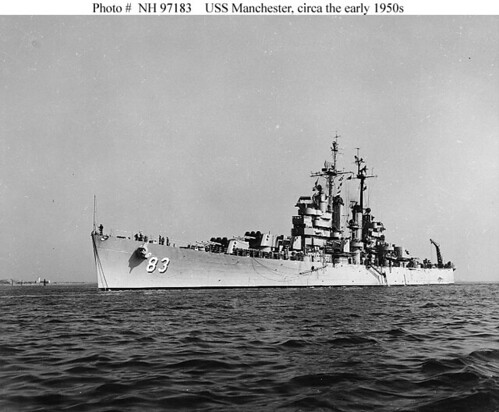
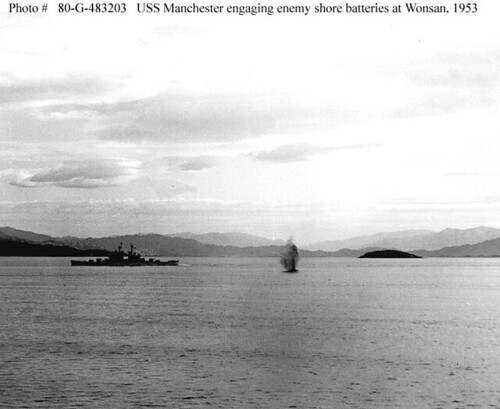
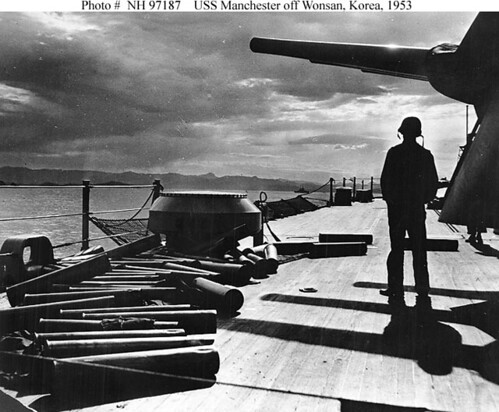
Sometimes you have to bring up a ship that did just solid, warship duty. For example, I give you the USS MANCHESTER (CL-83).

That is all for FbF today - but I leave you with something to ponder.

As we discuss what is or is not littoral warfare - check out
this picture. All the stealth in the world won't help you here --- and a lack of damage control will kill Sailors wholesale. That is why the selling of LCS is almost a crime.


First posted JAN2010

Friday, November 17, 2017

Fullbore Friday

Captain Hudner passed this week. In his honor, a replay FbF from 2010.


Of course, you know who is today's FbF. Who else? It is EagleOne and my guest on Midrats this Sunday at 5pm EST - CAPT Thomas J. Hudner Jr., USN (Ret). I'm going to steal this from my bud Stephen at AcePilots ... but I don't think he will mind.
Flying one thousand feet above the icy Korean mountains, the Corsair's engine cut out. At such a low altitude, the pilot, US Navy Ensign Jesse Brown, couldn't bail out or clear the mountain. He spotted an opening that looked more or less flat, and in any case, it was his only choice. A wheels up, dead stick landing. The Navy's first African American aviator probably thought that he had been through worse than this, being hazed and harassed throughout his pioneering Naval career.

The F4U went down heavily and smashed into the rough terrain, folding up at the cockpit. Sliding through the deep snow, the big fighter started smoking immediately.

Lt. (Jg) Thomas Hudner and the other VF-32 pilots studied the situation on the ground as they circled overhead. This close to the
Chosin Reservoir, Chinese Communist soldiers would be along soon. The crashed and burning aircraft was a hopeless wreck. At first the Navy fliers thought that Ensign Brown was dead. Then his wingman and roommate, Lt. William H. Koenig, noticed Brown waving to them through the open canopy of his Corsair (Bureau # 97231). A rugged, prop-driven, big-nosed WWII design, the Chance Vought F4U normally could take a lot of damage. On this day, 4 December 1950, Brown had been tragically unlucky; some North Korean flak gunner had hit the plane in a vulnerable spot.

Flight Leader Richard L. Cevoli radioed "Mayday" and called for helicopter rescue. A Sikorsky HO3S helicopter was dispatched, but would take at least 15 minutes to reach the stricken flier. Lt. Hudner looked down at his friend and flying mate. He promptly decided to go down and try to pull Brown out the smoldering aircraft. Hopefully, both pilots could then escape on the chopper.

Hudner made one more tree-top pass and dumped his remaining fuel and ordnance. He dropped flaps and tailhook, and thumped the Corsair onto the ground. He hit a lot harder than he had expected. At 6,000 feet above sea level, the Corsairs' air speed indicator had understated the actual speed. Hudner began to wonder if this had been such a good idea.

"I knew what I had to do," said Hudner in an interview by Frank Geary, for Jax Air News, the Naval Air Station Jacksonville, Fla., base newspaper. "I was not going to leave him down there for the Chinese. Besides, it was 30 degrees below zero on that slope, and he was a fellow aviator. My association with the Marines had rubbed off on me. They don't leave wounded Marines behind."
Hudner tightened his harness and, with his wheels up, set his Corsair down onto the snow and rocks some 100 yards from Brown's smoking aircraft. "He was alive, but barely, when I got onto his wing and tried to lift him out of the cockpit. But his right leg was crushed and entangled in metal and instruments. I hurried back and requested a rescue helo, making sure it would bring an ax and a fire extinguisher. When I got back to Brown, I began packing snow around the smoking cowling.
"When a two-man Marine helicopter arrived with only its pilot, the ax he carried proved useless in our efforts to hack away the metal entrapping Brown's leg. He was going in and out of consciousness and losing blood. "The helo pilot and I, in our emotion and panic, and with the light of day fading, discussed using a knife to cut off Jesse's entrapped leg. Neither of us really could have done it, and it was obvious Jesse was dying. He was beyond help at that point. The helo pilot said we had to leave. Darkness was setting in and we'd never get out after dark," said Hudner. "We had no choice but to leave him. I was devastated emotionally. In those seconds of our indecision, Jesse died."
'Nuff said. More over at AcePilots.

First posted May 2010.

Friday, April 07, 2017

Fullbore Friday

Imagine a ship that had the following life;
(She) reported to Admiral "Bull" Halsey's Third Fleet and participated in task force strikes on the Japanese mainland near the close of World War II. On August 9, 1945, she fired the final salvo on the home islands of Japan. She rescued two British POWs just before entering Tokyo Bay for the surrender ceremonies on September 2, 1945. From November 1945 until early 1946, she was anchored off Shanghai, China as the flagship of Task Force 73.

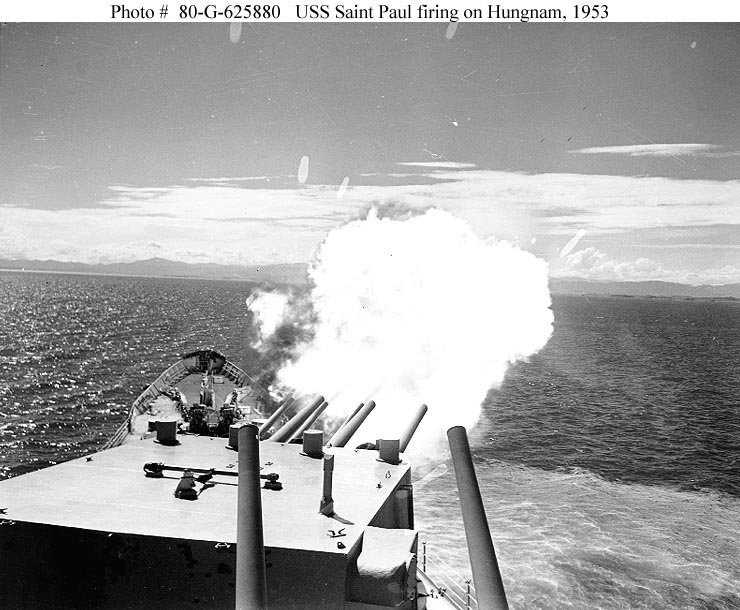
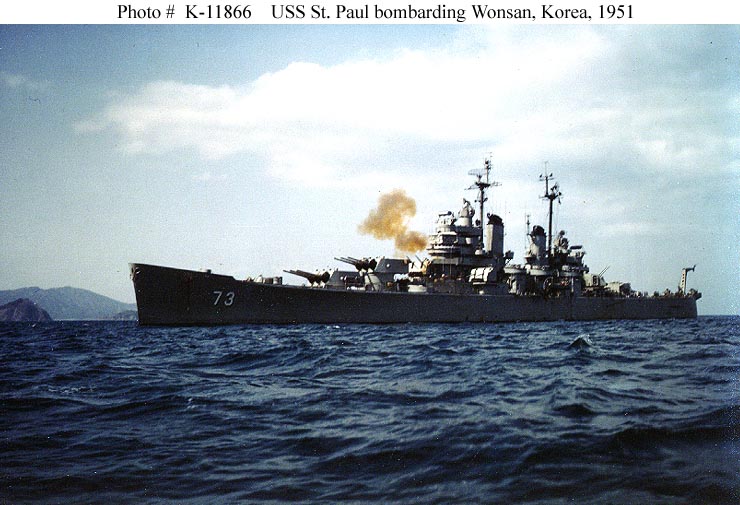
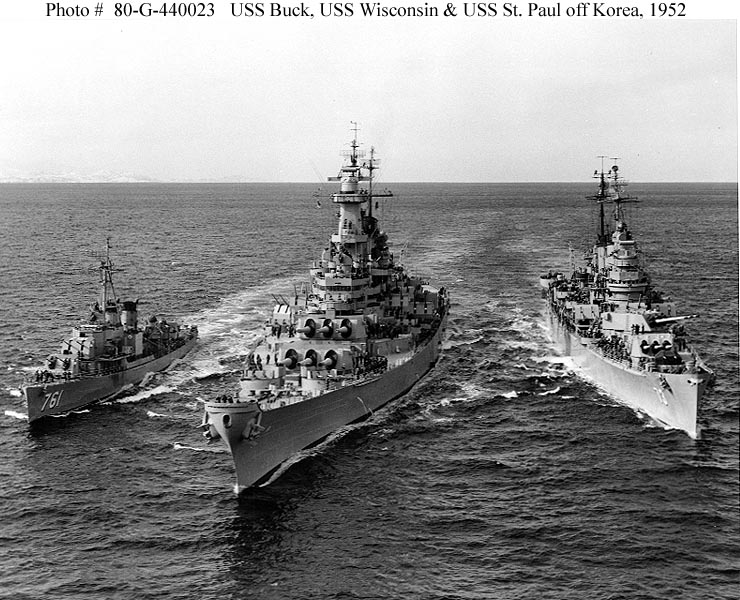
During the Korean War, (She) supplied close gunfire support for United Nations troops, conducted gun strikes against enemy supply lines, and rescued downed pilots. She participated in the drive to Chongjin, the Inchon invasion, Wonsan, and the Hungnam evacuation. On July 27, 1953, (she) fired the last salvo of the war, just two minutes prior to the cease fire.
...
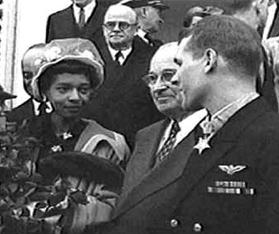
(She) became the first heavy combatant to be permanently homeported in the Orient since the pre-World War II days of the Asiatic Fleet. She operated from Yokosuka, Japan as the Commander Seventh Fleet flagship for more three years. In June of 1960, President Dwight D. Eisenhower embarked on (Her) for a trip from the Philippines to Taiwan. Three weeks later, she became the first Navy ship to raise the new 50 -star flag. She hosted nearly a quarter million visitors during this extended Far East assignment.
...
On 17 November, she provided gunfire support to the United Nations troops advancing on Chongjin. That day, shrapnel from a near miss by a shell from a Communist shore battery injured six men at gun mount stations. The cruiser destroyed the enemy emplacement with counter-battery fire and continued her support mission.

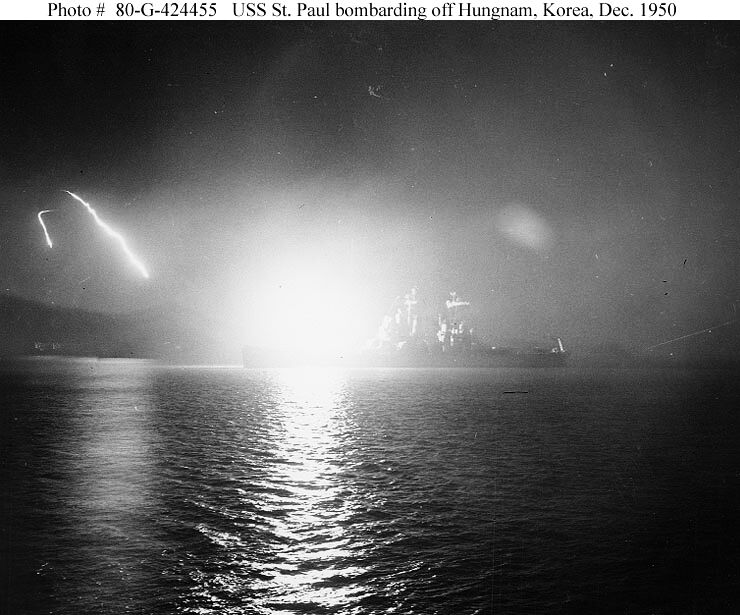
As the Chinese Communists began massive attacks late in November, United Nations forces commenced a general withdrawal to consolidate and hold south of the 38th parallel. She provided close support for the Republic of Korea I Corps on their east flank as they withdrew from Hapsu, and along the coast, as they retired from Chongjin. On 2 December, she moved north again, conducted night harassing missions above Chongjin, then moved south to support the withdrawal of the Republic of Korea Capital Division to Kyongsong Man. She entered the harbor at Wonsan on 3 December to provide a curtain of shellfire around that city as United Nations forces and equipment were moved to Hungnam; then followed the forces there, and remained to cover the evacuation of that city and harbor between 10 December and 24 December.
From 21 January to 31 January 1951, She conducted shore bombardment missions north of Inchon where, on 26 January, she was again fired upon by shore batteries. On 7 April, in special TF 74, with destroyers Wallace L. Lind (DD-703), and Massey (DD-778), landing ship dock Fort Marion (LSD-22) and high speed transport Begor (APD-127), She helped to carry out raids on rail lines and tunnels utilizing 250 commandos of the 41st Independent Royal Marines. These highly successful destructive raids slowed down the enemy's resupply efforts, forcing the Communists to attempt to repair or rebuild the rail facilities by night while hiding the work crews and locomotives in tunnels by day.

She returned to the United States for yard work at San Francisco, California, from June to September, then conducted underway training before sailing on 5 November for Korea. She arrived off Wonsan on 27 November and commenced gun strike missions. During the following weeks, she bombarded strategic points at Hungnam, Songjin, and Chongjin. In December, she served as an antiaircraft escort for TF 77, and, following a holiday trip to Japan, returned to operations off the coast of North Korea. In April 1952, She participated in combined air-sea attacks against the ports of Wonsan and Chongjin. On 21 April, while the cruiser was engaged in gun fire support operations, a sudden and serious powder fire broke out in her forward eight-inch turret. Thirty men died. Before returning to Japan, however, she carried out gunstrikes on railroad targets near Songjin, during which she captured nine North Koreans from a small boat. Following a brief stay in port and two weeks on the gun line, she headed home and reached Long Beach, California, on 24 June.

On 28 February 1953, She departed the West Coast for her third Korean tour and was in action again by April. In mid-June, she assisted in the recapture of Anchor Hill. With battleship New Jersey (BB-62), she provided close support to the Republic of Korea Army in a ground assault on this key position south of Kosong. The cruiser was fired upon many times by 75 mm and 105 mm guns, and observed numerous near misses, some only ten yards away. But on 11 July at Wonsan, she received her only direct hit from a shore battery. No one was wounded, and only her three-inch antiaircraft mount was damaged. On 27 July, at 2159, she conducted her last gunstrike and had the distinction of firing the last round shot at sea in the war. The shell, autographed by Rear Admiral Harry Sanders, was fired at an enemy gun emplacement. The truce was effective at 2200. She then commenced patrol duties along the east coast of Korea.
...
In 1963, she was visited by the Secretary of the Navy, the Commandant of the Marine Corps, and the Commandant of The Coast Guard. John Wayne and Kirk Douglas filmed scenes for the movie "In Harms Way" as she steamed from Seattle to Hawaii in 1964.
...
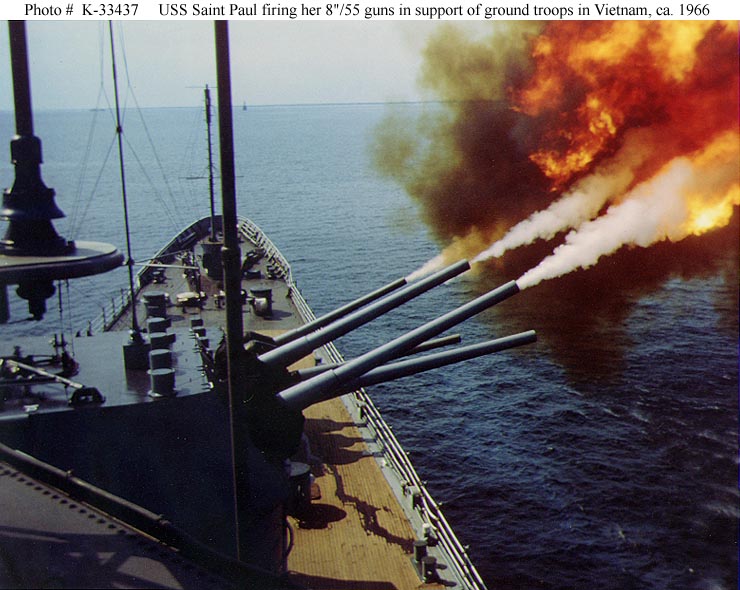
(Her) second Vietnam deployment began April 3, 1967 when she steamed west from San Diego. It would be seven months and 20,000 rounds later before the Fighting Saint would return. In her 1966 deployment, she had fired more than 10,000 rounds in support of allied troops south of the DMZ. Prior to that it was in Korea that CA-73 had last fired her big guns at hostile forces; and more than 20 years since the "Snooky Poo Maru", as she was affectionately known to her crew, had participated in World War II.
...
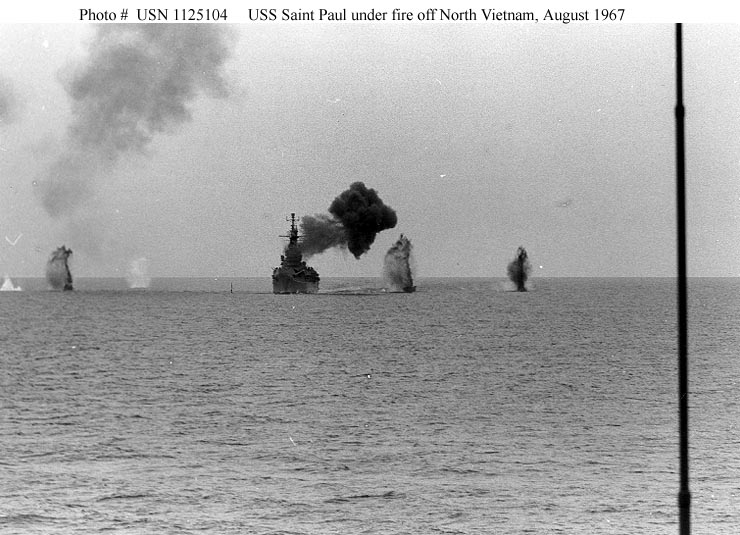
On September 1, 1967, she engaged in her toughest battle of the deployment. Accompanied by two destroyers, she moved in to attack waterborne logistics craft when about 25 coastal defense sites opened fire. She immediately returned the enemy fire and a running batle ensued with shells falling all around the ship.

More than 500 rounds were fired at Her that morning, and one round found its mark. A shell entered near the starboard bow and damaged a storeroom and several staterooms. There were no personnel casualties. Continuously firing, the ship maneuvered to safety and retired to sea for repairs. Working all, night, crewmembers pumped the damaged area dry and welded a patch over the hole. The patch held during high-speed turns, and the next day, "The Fighting Saint" returned to the gunline.

The ship later steamed to Subic Bay for permanent repairs. (She had been in Subic Bay just a month earlier to have all of her 8" guns replaced.) She returned to Sea Dragon where she destroyed six more waterborne craft, two concrete blockhouses, and two costal defense sites. She also heavily damaged railroad yards at Cong Phu and the shipyards Phuc Doi. She was relieved by USS NEWPORT NEWS CA-148 in October and headed to San Diego.
In May 1968, on her third Vietnam deployment, (she) returned to Sea Dragon operations. She picked up right where she had left off, shelling enemy targets on call-fire missions on a round-the-clock basis. She silenced North Vietnamese Army gun positions and sank three 30-foot logistics craft while damaging two 50-foot motorized tugs. The ship again took a brief mid-deployment break for regunning in Subic Bay. In over 1300 missions, she was credited with 380 enemy killed and 800 military structures destroyed or damaged. She was relieved in October by USS NEW JERSEY BB-62 before pointing her bow eastward for San Diego.

During her 130 days on the gunline on this deployment, "The Fighting Saint" fired a total of 64,055 rounds, making a total for the Vietnam conflict of more than 93,000. These figures established the 23-year old CRUISER as "Top Gun", having fired more rounds during a single deployment, and more rounds in all of her deployments, than any other warship.
...
Although "The Fighting Saint" had been decommissioned by the time the Vietnam conflict ended, she holds the distinction of two famous gunfire "lasts". As a member of Admiral 'Bull' Halsey's Third Fleet, she fired the final round on main home islands of Japan on August 9, 1945. She followed up that notoriety by letting go the last salvo of the Korean War on July 27, 1953, just two minutes before the armistice took effect. In more than a quarter century of service to her country, She earned 18 battle stars and fired more rounds of ammunition than any other United States crusier in history. She hosted eight heads of state. A total of 18 of her commanding officers and executive officers ascended to flag rank.
What a girl.

You know my bias, and the story of the ST PAUL just makes it stronger. Think about the bang for the buck we got from the
ST PAUL. Then think about the limited gene pool of a fleet we have now. Think about Somalia, Pakistan, SE Asia, China, South America - anywhere there is a shore line. Look at the mission she did and the firepower, and ability to take a hit, she took with her. Littoral? Yea, she has that. Range? Ditto? You can go on and on.

Here is the point to ponder, did we take the wrong fork in the road when we left the gun cruiser behind? Don't talk to me about the 5" guns we put on our CLG (which is what a Tico class is) or the Arleigh Burke class (which are a CLG as well - I don't care what you call them).


The dirty little secret here is that the Navy has realized that it did make a mistake when it decided to go all missile and pop guns, and left the MK-71 behind. DDG-1000 proves my point.

155mm = ~6.1". DDG-1000 is the size of a WWII Pocket Battleship. It may be a lot of things, but it is not a DDG. It is another CLG. One with 6.1" instead of 5", but a CLG none-the-less.
The problem though, was the execution. Instead of doing what the USAF is doing with the B-3 Bomber (proven technology that is evolutionary not revolutionary), we fell in love with the theory, the bleeding edge of what might be able to be done if we just throw enough money at it. Everyone wants to be part of something cosmic, not pedestrian. Some people join Comet Cults, some people build warships that work. As a result, the Comet Cult has bought us an expensive bucket of unproven technology in one unaffordable short run of a half-dozen ships, if we get that. All on the promise of the CGX, which is really going to be a CBX. Right answer, wrong execution. Enough of that, just look at the ST PAUL and say, Bravo Zulu. Fullbore.


First posted June 07.