Showing posts with label Submarines. Show all posts

Friday, July 15, 2022

Fullbore Friday


So, how was your war?

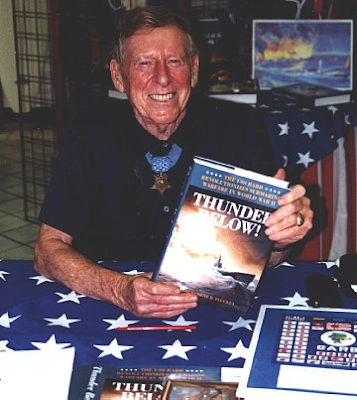
A little more than 15-years ago after 93-years on our little planet, one of the greatest US Navy tactical leaders passed away.

He and his crew had an incredible record during WWII that I would encourage you to review in full here ... but after the Navy decided that they were running out of Navy Crosses to reward the man then all of 31-yrs old, he earned the Medal of Honor for events in his 11th Patrol.

Attention to citation:

“For conspicuous gallantry and intrepidity at the risk of his life above and beyond the call of duty as commanding officer of USS BARB during her Eleventh War Patrol” along the east coast of China from 19 December 1945, to 15 February 1945. After sinking a large ammunition ship and damaging additional tonnage during a 2-hour night battle on 8 January, Commander Fluckey, in an exceptional feat of brilliant deduction and bold tracking on 23 January, located a concentration of more than 30 enemy ships in the lower reaches of Nankuan Chiang (Mamkwan Harbor ). Fully aware that a safe retirement would necessitate an hours’ run at full speed through the uncharted, mined and rock-obstructed waters, he bravely ordered, ‘Battle Station—Torpedoes!” In a daring penetration of the heavy enemy screen, and riding in 5 fathoms of water, he launched the BARB’s last forward torpedoes at 3,000 yards range. Quickly bringing the ship’s stern tubes to bear, he turned loose four more torpedoes into the enemy, obtaining eight direct hits on six of the main targets to explode a large ammunition ship and causing inestimable damage by the result of flying shells and other pyrotechnics. Clearing the treacherous area at high speed, he brought the BARB through to safety and 4 days later sank a large Japanese freighter to complete a record of heroic combat achievement, reflecting the highest credit upon Commander Fluckey, his gallant officers and men, and the United States Naval Service.”

After receiving his Medal of Honor, Fluckey gave a signed card to each member of the crew that read as follows:

As Captain it has been an outstanding honor to be your representative in accepting the Congressional Medal of Honor for the extraordinary heroism above and beyond the call of duty which you and every officer and man in the BARB displayed. How fortunate I am, how proud I am, that the President of the United States should permit me to be the caretaker of this most distinguished honor which the Nation has seen fit to bestow upon a gallant crew and a fighting ship…the “BARB.”

Sincerely,

Eugene Fluckey


He was 32 at war's end and served until 1972 as a Rear Admiral.

What a life.


Monday, June 06, 2022

D-Day at Sea

This D-day anniversary I want to bring out a FbF I've run a few times over the years as it points out one of the hidden parts of the campaign that I want new readers to have a chance to read about.

Most attention, rightfully, is paid to the beach and the move inland, but to enable that success, a lot of work was done at sea to keep the beach and seas open ... 

As the D-Day invasion was ongoing, the German Navy sortied what they could to try to drive the allies back across the channel. 

The most feared were the U-boats based in France.

Please read the whole thing, but here is a nice summary of one of the under-told stories of WWII, Coastal Command.

On night. One crew. Two U-boats.

Fullbore.

“G-George” droned on through the night. Men drank coffee from thermos flasks, kept the chatter to a minimum, scanned the endless sea and began to feel the numbing weariness set in that came with these long over-water patrols. But adrenalin shot through their bloodstreams like amphetamine just after 2 a.m. when Foster announced on the intercom that he had a solid return on his radar 12 miles dead ahead in the vicinity of Ushant Island (Ouessant). It was too early to tell whether it was a French fishing smack or the conning tower of a U-boat. Moore corrected his course slightly to port to put the target in the path of the moon reflecting on the water. Three miles out the conning tower of a submarine was made out in the moonlight.

Coastal Command anti-submarine crews were trained to attack the moment a U-boat was detected and without deliberation. An undamaged Type VIIC U-boat, with a well-trained crew could crash dive beneath the surface in 30 seconds. Time was of the essence, as was complete surprise.

Immediately, Moore instructed Foster to switch off the radar in case the submarine had detection equipment, and then began to drop lower and lower, adjusting his course to keep the enemy up-moon until he was at 50 feet above the calm surface. McDowall, the navigator, took his position at the bomb sight. Moore ordered the four big bomb doors opened and as they slid upwards and outboard on their rollers, he could hear the hydraulic pumps working and sense the difference in the airflow note down the sides of his warhorse. Approaching the U-boat, which they calculated was making 10–12 knots in a westerly direction, they selected 6 depth charges from their quiver, attacking due south and 90 degrees to the path of the U-boat on her starboard side. Moore chose to leave the powerful 22 million-candela Leigh Light off to further keep their whereabouts secret. As they screamed in for the attack, the spare navigator, Pilot Officer Alec Gibb, DFC sprayed the conning tower with heavy machine gun fire (some 150 rounds according to the after action report) from his position in the nose. Moore and Gibb later stated they could see as many as 8 submariners scrambling from the tower to get to the deck guns. There was some anti-aircraft return fire, but it was too little and too late. They had caught them completely by surprise.

As they roared over the submarine at 190 mph, six depth charges, set 55 feet apart, were falling from “G-George’s” bomb bay, having been released by McDowall whose accuracy this night would be perfect. Three fell on either side of the submarine in a textbook straddling attack just ahead of the conning tower. A flame-float, designed to ignite when it hit the water was also dropped to identify the position of the submarine at the moment of attack. The rear gunner Flight Sergeant I. Webb watched in fascination as the detonations exploded white in the moonlight and appeared to lift the 700-ton submarine out of the water.

By the time they had climbed, swung around and were homing on the beacon of the flame float at the position of the attack, there was nothing left of the U-boat save for some floating wreckage and the oily slick of diesel fuel. A Type VIIC U-boat had disappeared and ceased to exist in a matter of seconds, the depth charges having done their job breaching the pressure hull and sending one of Karl Dönitz’ hunters to the bottom with all hands. One can only imagine the last minutes of terror for the more than 50 men aboard.

Sadly, when this submarine sank, there was no one who could identify which U-boat it was. Postwar accounting pointed to U-629, commanded by Oberleutnant zur See Hans–Helmut Bugs on its 11th war patrol. She had just slipped out of her pen at Brest the day before. Still, other researchers disclaim the U-629 identification, pointing instead to U-441, commanded by Kapitänleutnant Klaus Hartmann on its ninth and final war patrol. It is not my goal to be definitive as to the identity of the fifty or so men killed that night, that best being left to experts in the field. Knowing would bring the story to a satisfying close, but it will not lessen the tragedy or the courage of the U-boat men who died that night.

Moore settled his crew down after the last pass over the wreckage, and ordered a course correction to take them back on their patrol. At 0231, just twenty minutes after the first radar contact was made, “G-George” sent a message to command that they had sunk a U-boat. The men were charged with electricity, but they had a job to do and hours before they could return home to St Eval.

Just a few minutes later at 0240 hrs, as they settled down at 700 feet ASL, Foster reported another radar contact 10 degrees off the starboard nose, this time just 6 miles ahead. Moore, with information from Foster, began to home in on the target, and at 2.5 miles range and 75 degrees to starboard, they sighted the conning tower of another U-boat on a northwesterly course running at an estimated eight knots on the surface. This time Moore needed to circle to port and come in on a course that would allow them to attack up the moon path.

Bringing the big Liberator down to 50 feet once again, Moore approached the U-boat at 110 degrees to its starboard side with plenty of time to set up another perfect attack at 190 mph. The remaining six Torpex depth charges were released at 55-foot intervals as well as a flame float. Again, Gibb, the spare navigator in the nose, was firing his machine gun at the conning tower, which answered this time with flak and tracer fire. As they roared overhead, the rear gunner Webb saw four depth charges strike the water to the starboard side of the U-boat and two on the her port side—another textbook straddling attack. Massive flumes of exploding water were seen rising on either side of the submarine, ten feet aft of the conning tower and totally obscuring the target.

Returning to the position of the flame float, Moore, Gibb and Ketcheson saw the U-boat in the bright moonlight, with a heavy list to starboard. As they approached, the bow rose steeply out of the water to an angle of about 80 degrees. The boat slid back into the sea “amid a large amount of confused water” according to the 224 Squadron ORB.

Moore circled in fascination and, coming around again, he turned on the powerful Leigh Light slung beneath his starboard wing outboard of engine No. 4. The blinding blue-white beam illuminated three yellow dinghies crowded with men floating on an oily surface strewn with bits of wreckage. One can imagine how exposed the survivors must have felt caught in the white light of the Leigh with a heavily armed Liberator thundering down its beam toward them. They passed overhead without further molesting the surviving crew, switched off the Leigh Light and left the German sailors floating in the moonlight.

The submarine was U-373, another Type VIIC boat commanded by Kapitänleutnant Detlef von Lehsten on its 11th war patrol. It had just slipped out of Brest after a six-month repair following a similar attack by a Coastal Command Wellington and Liberator in January. We know for certain that this was U-373 because all but four members of the crew survived to be picked up the next day by French fishing vessels and returned to Brest. Von Lehsten was one of the survivors.


Hat tip Al. First posted Sept. 2017.

Tuesday, March 29, 2022

We Chose Decline

The People's Republic of China does not have to aggressively take our status as the premier world power. It appears that we are willingly giving it to them, sooner more than later.

As a maritime and aerospace power, especially when it comes to the challenge west of Wake, if you want to understand how serious our nation's national security nomenklatura is toward the clear threat to the place previous generations died by the hundreds of thousands to place us in the last century - just look at what we are spending our money on.

Megan Eckstein over at DefenseNews has the summary for everyone. It isn't pleasant reading, especially for those who have their eyes on the world around us. You don't have to like it, but you do have to accept the simple fact that the leadership the American people have put in charge of their security simply are not interested in funding it.

Until elections move new people in to power - and even that may not produce the needed result - we will simply have to accept that The Terrible 20s that we started talking about a dozen years ago are our future.

The title of Megan's latest is as good of a start as any;

US Navy budget would pay for 9 ships, decommission 24 amid readiness drive

Yes, that is a net loss of 15 ships. Meanwhile the PLAN grows and grows.

Like the intellectually dishonest "Integrated Defense" we covered yesterday, all this is being justified with spin and bad theory.

A couple of examples;

Meredith Berger, who is currently performing the duties of Navy undersecretary, told reporters the plan is strategy-driven and follows the chief of naval operation’s priorities of funding the Columbia-class ballistic missile submarine in full and then prioritizing readiness for today, lethality for tomorrow and capacity for down the road.

The budget proposal, she said, “enables the Department of Defense’s investment in the three pillars of the National Defense Strategy: integrated deterrence, campaigning forward and building upon our enduring advantages to fulfill the strategic priorities that are identified [in] the National Defense Strategy.”

I'm sorry Acting Under, but bullsh1t. No serious person who sees what is happening on the other side of the Pacific believes that. I really am interested in what exactly you will be "campaigning forward" with ... and the rest is, as my European friends like to say, "fried air."

The U.S. Navy is requesting more money in its fiscal 2023 budget proposal compared to the previous fiscal year, but it’s still on a trajectory toward a smaller fleet.

...

The Navy’s request represents a 5% growth in spending compared to the FY22 budget Congress passed, and the Marine Corps’ request would be a 1.8% increase in spending compared to the enacted FY22 budget.

In an inflationary environment - especially accelerating inflation - these % changes and raw number increases are meaningless.

Only units matter. How many of what you can buy. Focus on that first, then the money.

Along those lines, here is where the numbers fall;

Included in the request are two Virginia-class attack submarines, two Arleigh Burke-class destroyers, one Constellation-class frigate, one America-class amphibious assault ship, one San Antonio-class amphibious transport dock, one John Lewis-class fleet oiler, and one Navajo-class towing, salvage and rescue ship.

...

The Navy currently has 298 ships. That would dip to 280 by FY27 under the plan pitched by the Navy.

The service proposes decommissioning 24 ships in FY23: nine Freedom-variant LCSs, five Ticonderoga-class cruisers, four Whidbey Island-class amphibious dock landing ships, two attack submarines, two oilers and two Montford Point-class expeditionary transfer docks.

The loss of LCS is a net gain for the Navy, but building two while decom'n two SSN doesn't grow that needed west of Wake capability ... and we are gutting what is needed to get personnel and gear ashore from the sea - a strange position to take when that is one of the critical requirements to conduct and sustain operations in the Pacific.

Of those 24 vessels, 16 have not yet reached the end of their service lives and would require the Navy secretary to sign a waiver to Congress, including all nine LCSs, one of the five cruisers and the two expeditionary transfer docks.

16/24=8/12=2/3

Two thirds of our ships are being decommissioned before they were even used to their designed longevity. That is damning of both our maintenance and fleet design errors of the last 30-yrs.

Speaking of submarines, let's go back to something we were discussing on the Front Porch a dozen years ago;

Let's look at 2020 again. What else is happening in the 20s? Well, for one, we will have to find money to re-capitalized the SSBN fleet. I offer to you that the 20 JAN HASC SEF Subcommittee meeting has an outstanding money discussion about that challenge. Deputy SECNAV Work has also discussed this challenge in other venues, and I think he has a very firm grasp of the problem, as do most in positions to know.

You have to look at it in the broader context of the budget as well. The hangover in the 20s from this decade's drunken frenzy of spending will couple with another cohort of Baby Boomers retiring and putting stress on the budget in ways we still do not have a firm grasp on.

In 2020 - that ship built in 1990 will be at 30 years. That LCS built in 2009 will only have 9 years or so of service life (LCS is expected to only last 20-25 years) - so by the end of the 2020s, LCS will be dropping like flies.

When you consider that we will be limited this decade to LCS and DDG-51 for our non-amphib surface ship program (don't throw JHSV at me, that is just a truck - full stop - all else is spin and hope) - you have about a perfect story for the 20s of limited shipbuilding funds and a stunted fleet.

No one - at least here - should find this from Megan's article even a little bit surprising;

He also noted that 21% of the shipbuilding budget supports the Columbia program — which doesn’t affect the ship count for FY23 since the Navy is not buying a new ship this year but rather is incrementally paying for the lead ship bought in FY21 and buying parts for the upcoming FY24 ship.

...

The Columbia program will grow to consume 30% of the shipbuilding budget once it moves into one-per-year procurement later this decade. As a result of this pressure, surface ship programs may be scaled down.

A month before the above post from FEB2010, we also had this CDRSalamander post - again from over a dozen years ago;

 We did this to ourselves - and in the budget environment everyone who wanted to has seen for the last half decade, the simple math that the Tiffany Navy forces us to use tells us that there was no way we would reach 313, 300, or even hold fast at 283.

Further evidence continued to mount last spring, when the administration submitted a shipbuilding budget that would only support the construction of eight ships.

In just a few short years, this level of funding will produce a 240-ship fleet, given that a typical Navy warship has an expected life of 30 years.

We will be lucky if we can hold 240 - as we have been discussing here for the last few years.

What is happening on the aviation side of the house?

... it plans to retire 24. It is asking for 96 aircraft, but no F/A-18 Super Hornets and fewer carrier-variant F-35C Joint Strike Fighters than last year. It’s also proposing a decrease of about 10,000 sailors to crew the fleet in the next five years.

...

Of note, the five Advanced Hawkeyes and the 26 TH-73A helicopter trainers in the budget request would be the last in the program before the production lines end.

The three V-22 Ospreys the Navy is buying this fiscal year and the nine the Marines are buying would be the last for that production line as well, with the services listing zero in their request for FY23 and in the four following years.

10,000? Do you know anyone in a sea-going command who thinks they are overmanned?

I repeat my standard once again; if you believe war in coming west of Wake, time is short. Under no circumstances should any production line of aircraft or ships be allowed to go idle until there is an immediate production of that platform's replacement. 

We cannot afford to allow us to lose in the mid-20s the ability to produce E-2 or MV-22 or F/A-18...anything until their replacements are in production. 

We need serious people for this serious time.

We will have to wait.

Monday, October 25, 2021

I’ll Take Sub Killing for 500

SE=SL-RD-NL+DI-PL


If you want to bench test an old Cold Warrior, put something like this out;

The Navy has created a new task group on the East Coast to ensure it has ready destroyers that can deploy on short notice to counter the Russian submarine threat in the Atlantic Ocean.
The plan is to take destroyers that have recently completed deployments and are awaiting maintenance availabilities and make them ready for training and operations in the Atlantic. ... The creation of the new task group comes as the Navy has refocused assets and efforts on the Atlantic region due to Russia’s undersea capability. The service formally reestablished U.S. 2nd Fleet, which covers the North Atlantic and East Coast, in 2018 amid concerns over Russian submarines operating in the waters. ... The ships will be based out of Mayport and Norfolk, Va., and the task group is set for full operational capability by June 2022, according to McLane, who noted the ships will still have a post-deployment stand-down so sailors can see family after being out at sea. ... “These will allow us to work with the schedules of not only the surface ships, but the submarines, the P-8 community, and the HSM, [Commander, Helicopter Sea Combat Wing Atlantic] helicopter detachments so that we can align everybody up to take advantage of whatever training opportunities may exist, as well as tactical development exercises like in the past Black Widow, and then training opportunities like submarine command course operations. We can align those assets to go after these training environments that may exist,” Rear Adm. Brian Davies, the commander of Submarine Group 2, told reporters.
This is not a flip of the switch as there are a lot of “ifs” “buts” and “whens” … but the thinking is sound for reasons our friend Jerry Hendrix outlined in his 2017 report he co-authored on Forgotten Waters.

Jerry and I are about the same age. As East Coast JOs, we spent our ENS and LTjg sea duty saying bye to the last of the Soviet threat before that empire all fell apart. If you are under-50, you have no idea.

We experienced the Reagan build-up at flood tide. If you took a snapshot at the turn of the last decade of the 20th Century, the US Navy was well positioned for high end conflict in the Atlantic Coast. 

We had the entire great circle route from Miami to the GUIK gap covered. If you could keep the Soviet SSN/SSGN out of the open Atlantic, the convoy routes to the northern European ports would be relatively safe.

Surface ASW forces were well distributed and ready to conduct ASW or escort convoys. From south to north, we had Mayport, Charleston, Norfolk, and even a few in New York City (yes, for a brief shining moment, the sanity of strategic homeporting rules) and Newport. Land based active-duty air ASW were in Jacksonville, FL and Brunswick, ME with deployment sites all over the North Atlantic.

That was just on the US side. Canada, UK, France, The Netherlands, and Norway were all punching above their weight in the North Atlantic keeping that a very dangerous place for the submarines of the Red Banner Northern Fleet.

After 30-yrs break, we are not just a smaller force, we are a more scattered and vulnerable force. The incredibly myopic and greed based BRAC process divested the US Navy of the most effective access to the great circle routes to Europe. We evacuated the North. Brunswick gone. New York, and Newport are empty. Even Charleston in the Southeast is empty. Yes, the Russian submarine force is a shadow of what the Soviets were, but it takes a lot more effort to kill a sub than to be a sub.

If you consider the Greenland-Iceland-UK Gap the essential barrier, just look at the additional time to get on station. Of course, you won’t do surface ASW at 25 knots, but if you are just looking at nice round number transit speed – all caveats apply – then Newport is the closest to Iceland. A ship based out of New York will take 4.4-hrs more to get there. Norfolk 14.3-hrs more, Charleston 26.4-hrs more, and Mayport 33.4 hrs more.

Indeed, you don’t have to be a genius to see how easy it would be to place a few blocking ships in Mayport and Norfolk – not to mention some even more dramatic events – to effectively degrade the east coast Navy for weeks or even months.

If we desire to deny the Russian submarine force access to the North Atlantic, we need more than a couple of DDG between availabilities … thought I 100% support this solid concept. 

No, we are witness to decades of neglect in ASW in the Atlantic. We have left what capability we do have concentrated and incredibly vulnerable.

Task Group Greyhound is a nice opening for a long conversation.  

Wednesday, September 15, 2021

Who Wants to do the Range & Time to Target Math for Me?


Conventional submarine launched ballistic missiles.

If you aren't mad that the South Koreans have them before we do, I don't know if we can be friends.

I'm discussing over at USNIBlog. Come by and ponder a bit more.

Tuesday, March 02, 2021

Australian Submarine Program Stumbles


For a whole host of reasons, Australia needs a potent and numerous submarine force. Geography and potential opponents make the case pretty straight forward.

It looks like they are not on a smooth path;

As this is written, the head of the French naval construction company Naval Group, Pierre Eric Pommellet, is in Australia meeting federal ministers in an attempt to rescue the contract. Tragically for Australia – and for Monsieur Pommellet – not one of those ministers has the experience or competence to wrangle a successful result. Many informed commentators in France, Australia and elsewhere now expect the much-celebrated deal to be abandoned. If that happens, replacing the current ageing submarines would be delayed many years, depending on the timing of the change of government to a capable administration.
...
Several of Australia’s specifications were plain foolish, as Binoy Kampmark summarised for IA. A nuclear submarine with a diesel-electric engine is a fail. An American combat system won’t work in a French vessel because the Americans and the French do not talk. Lead-acid batteries will be obsolete well before the subs are delivered. 

France’s original tender documents put the cost of the project at between $20 billion and $25 billion. The cost in the initial agreement signed in late 2016 was $50 billion.

There were other options than what the French were offering, but here we are.

What Australians and her allies need to be careful about - and push back hard on - is thinking like this;

 Replacing the current six Collins-class vessels is certainly justifiable and possibly increasing that to seven or eight.

Comparisons with other countries suggest 12 is excessive.

Taiwan with a similar population to Australia’s and much greater defence vulnerability has four. Canada with a much higher population also has four. Argentina and Spain with roughly twice Australia’s population each have two. Germany which has a population more than three times Australia’s and is a major submarine manufacturer has six. Brazil with eight times the population has six. Mexico with five times the population has none. New Zealand with arguably the same defence vulnerability as Australia has none.

Twelve is thus excessive, especially as this Government has borrowed $73 billion on average each year for the past seven years – a total debt blow-out of $541 billion – while all well-managed economies have substantially reduced their debt.

I invite everyone to get a globe and look where those nations are, who their neighbors are, how big they are, how close their nearest allies are ... and then read the above again.

If you have a spare prayer, send one down under. They ... and we ... need this to work. 

Wednesday, September 23, 2020

USS Thresher's Board on Inquiry is Now Available


It took 57-yrs, but the results of the Board, all 300-pages, is now available with minimal redaction.

Links and a few take-aways from me over at USNIBlog.

Head on over and give it a read.

57 years.

Tuesday, June 23, 2020

When Treaties Die

Treaties are only good if all sides abide by them. Bad actors on the world stage see treaties as something else - an opportunity to take advantage of gullible nations who are too scared to do anything.

Russia has made a habit of ignoring or abusing treaties, such as the The Intermediate-Range Nuclear Forces (INF) Treaty and Open Skies treaty, simply daring anyone to do anything about it. Well, the USA called their non-bluff and left.

Russia really does not seem to care.

Another case;
A Russian submarine passed through Turkey on Tuesday, in an apparent breach of the longstanding Montreux Convention. The treaty prohibits submarines from moving between the Black Sea and the Mediterranean. The Russian Navy has made similar moves before, using a clause in the terms to conduct combat operations in the Mediterranean. It is becoming a pattern. If these moves go unchecked it could change the balance of power in the region, making Russia more powerful in the Mediterranean.

The submarine was photographed by Yörük Işık, a highly respected ship spotter who lives in Istanbul.
For Russia there is no disadvantage to breaking treaties because there is no downside from their point of view.

Plan accordingly.

Monday, December 02, 2019

First ASW Flap of FY20?

No, you can't buy training like this. Of course, this is all speculative. It could just be an amazing coincidence of events that is really just normal training exercises and pilots soaking up extra flight hours.

Or ... it could be ... something else.

Simply some amazing stuff since the end of October for those who follow @MIL_Radar on twitter.

Like what we've seen off Syria and other places, modern technology makes what was once known only to participants, something anyone can see just a percentage of. That is what we have here, so let's run with.

I couldn't take it anymore and decided I needed to put it all together for the Old Cold Warriors on the Front Porch. 

I could have just put you on to the twitter thread linked above, but I had trouble sleeping last night and thought I'd make a quick vid instead.

Now, MTH, you may want to be sitting ... because somewhere someone is just used up most of their FY20 allotment.

Now, off to Bear Island.

Enjoy!


Friday, October 11, 2019

Fullbore Friday


So, like WWII submarines?

This fits for a very good find from reader Steve - it's all so Fullbore, I can't pick just one.

All the submarine reports Historic Naval Ship Association from S-11 to USS Diablo.
At the end of each war patrol of WW II, submarine commanders created a report on the patrol. These reports were used as the raw material to inform intelligence, improve tactics, evaluate commanders, etc. During WW II, over 1,550 patrol reports containing approximately 63,000 pages were generated. During the 1970s these were photographed and reproduced on microfilm to make them more easly accessible and easily reproduced (approx. 250 rolls). During 2008 a copy of this microfilm was scanned into digital format (110 GB), and in 2009 it was made available online here (14 GB).

These war patrol reports were written during a deadly, bitterly fought war. Please note that there may be some references to enemy forces that may be offensive in today's context.
Treat yourself here. Oh, and if you find any of those terrible Politically Incorrect comments, please report them in comments. Sadly, I couldn't find any.

First posted, March 2009.

Tuesday, November 20, 2018

Next They Came for the Submarines ...

Last week we covered over at USNIBlog, again, an issue that must be dragged out in to the light at every opportunity; our basic failure to be responsible stewards of the taxpayers' investment.

We have been shooting-up-the-horse so long we have lost the bubble on what it takes to properly maintain and support the fleet we have, much less one any larger. 

Maintenance and support are not sexy, but are absolutely critical to making sure we get the useful and effective life out of what we have, and your fleet is ready for war when it comes.

It takes a long view and a mature, professional mindset. It takes leaders to properly prioritize programs, and those who have the purse strings, the maturity to fund at appropriate levels.

Though the foundation of this problem goes back further, the last decade and a half have been specially horrible. Look at what happened to our shipyards, depots, and older ships (SPRUANCE & OHP) in their dotage. While we demand a longer life from ships in the outyears, we are not investing in their material condition today to make that a realistic option for an effective fleet. We want them deployed now, but do not respect the requirements for refit.

The latest example is from an area that information does not usually make it in to open source often; the submarine community;
From 2008 to 2018, most of the planned repairs for the Navy’s fleet of about 50 nuclear attack submarines have started late and run long resulting in a combined 10,363 days of maintenance delays and idle time.
...
“The Navy expects the maintenance backlogs at the public shipyards to continue. We estimate that, as a result of these backlogs, the Navy will incur approximately $266 million in operating and support costs in Fiscal year 2018 constant dollars for idle submarines from Fiscal year 2018 through Fiscal year 2023, as well as additional depot maintenance delays.”
...
Rep. Joe Courtney (D-Conn.), the ranking member on the House Armed Services seapower and projection forces subcommittee,...“While demand for our undersea fleet and its unique capabilities continues to rise as reflected in the 2016 Force Structure Assessment, delays in maintaining our existing fleet are exacerbating the growing shortfall in our submarine force structure,”
...
“Although the Navy has shifted about 8 million man-hours in attack submarine maintenance to private shipyards over the past five years, it has done so sporadically, having decided to do so in some cases only after experiencing lengthy periods of idle time,” read the report. “According to private shipyard officials, the sporadic shifts in workload have resulted in repair workload gaps that have disrupted private shipyard workforce, performance, and capital investment—creating costs that are ultimately borne in part by the Navy.”
I know it is not a fun or sexy topic that will create a lot of clicks or panel invitations, but we need to accept a few things:

1. No one is going to fund our 355 ship navy unless you want to adopt PLAN SALAMANDER for our ground forces and NATO posture so that funding and be diverted to sea.
2. We need to be willing to not build X number of warships so we can properly re-capitalize our shipyard, drydock, and depot level support commands.

A smaller, better maintained and ready navy will defeat a larger gaggle of poorly trained and equipped rust buckets any day.

I know this is not a surprise to many, but at the end of the day it always ends up on the cutting room floor. For a long time, this problem has been pointed out ... yet pushed to the back of the room.

Why?

Simple; the fetish for short term PPT fodder supporting personal gain now, vice longer term best practices for proper stewardship of the fleet of the future benefit of others.

Friday, May 04, 2018

Fullbore Friday


"With audacity one can undertake anything, but not do everything."----- Napoleon Bonaparte
At the beginning of a conflict you need to keep the aggressor off balance. You need to learn, grow, refine, and develop your tactics. Things won't be perfect or even good - but they must be done. Almost always, things do not work as you plan.

Most know of Doolittle's raid on Tokyo - close to perfect if only a few hundred pounds of fuel off. Many don't know about Carlson's Raid on Makin Island though.

From the
Marine Corps Gazette's JUL01 edition,
On 8 August 1942, 222 officers and men embarked on the USS Argonaut and USS Nautilus for Makin. The trip was uneventful and also uncomfortable as evidenced by the numerous cases of heat rash and heat prostration that developed during the voyage. The raiders were to disembark at 0300 on 17 August 1942, assemble alongside the submarines until the two companies were organized, and then move onto Butaritari. Withdrawal from the island was scheduled to take place no later than 2100 that same day. If the raiders had not returned by that time, Task Force Commander John Haines would decide whether to wait or return to Pearl Harbor without them. (See Figure 2.) If the raid was successful, Little Makin, a less important part of the atoll, would be raided the following morning.

Unfortunately, almost every one of Carlson's plans went awry from the beginning. On the night of 16 August, the raiders encountered rain squalls, heavy swells, and an onshore wind. The rubber boats from the Argonaut were loaded and launched. Immediately the heavy sea drowned the outboard motors out. Carlson was then advised that the tide was moving the submarines toward the reef and they would have to start backing away. This meant that the two company commanders would not be able to assemble alongside the submarines and would probably lose control of their men. When no alternatives seemed possible, Carlson issued the order to disembark from the Nautilus with instructions for both companies to follow his boat to the beach.

Although the outboard motors were inoperable, the raiders paddled with all their strength to land at 0530 as planned. Fifteen of the 18 boats reached opposite Government Wharf where they were quickly hidden by sand and palm fronds. Lt Oscar Peatross and his 11 men failed to get the change of plans and landed their boat at the original beach about I mile south of the main body. The two other boats landed just north of the main body. The mix-up in the landing required reorganization on shore, but before it was completed, one man accidentally fired his weapon. The element of surprise was now lost.

One company moved across the island to control the coastal road and to seize the Government House and Government Wharf. The other company stayed in reserve and protected the left rear. Alerted by the gunshot, CWO Kamemitsu informed his headquarters and started his small force up the coastal road by truck and bicycle toward the Government House. A firefight developed near the native hospital. The tenacious enemy defense included four machineguns, a flamethrower, two grenade launchers, infantry armed with automatic weapons, and supported by well-- concealed snipers.

About this time in the rising light, the raiders spotted a 3,500-ton troop transport and a small patrol boat entering the lagoon. Carlson radioed the submarines and requested that they surface to fire their 6-inch guns. Although communications eventually broke down, the Nautilus, shooting blindly at the ships with only a compass bearing furnished by Carlson, fired 65 &inch shells into the lagoon. Through a combination of excellent gunnery and amazing luck, both vessels were sunk.

Carlson renewed the attack, but the Japanese snipers proved to be a formidable problem. From 0730 to 1130 the action consisted of a series of small-unit movements. just before noon two Japanese reconnaissance planes circled over the fighting area for 15 minutes, dropped 2 bombs, and then departed. Soon thereafter, a small force of Japanese made a banzai attack down the center of the island. The raiders quickly repulsed the attack, killing most of the Japanese.

At 0120, 12 planes appeared-2 Kawanishi flying boats (about the size of a U.S. PBY-4), 4 fighters, and 6 reconnaissance bombers. They bombed and strafed the island for over an hour without inflicting any real damage on the raiders. One Kawanishi flying boat and one reconnaissance seaplane landed in the lagoon; the Kawanishi brought about 35 to 40 reinforcements. However, both aircraft were shot down during takeoff. Meanwhile, Lt Peatross proceeded to carry

out his initial orders to rendezvous with a platoon from Company A at the church. They found the church empty. Then Peatross and his men moved toward the main body of the raiders, but they were soon brought under intense machinegun and rifle fire. In the process of knocking out the machinegun and killing several Japanese, three men were killed and most of the others wounded. Peatross decided to pull back to the ocean side of the island. He also sent a runner to Carlson to notify him of their circumstances. When no linkup with the main body took place after several hours, Peatross returned to the Nautilus with his men.

Carlson's raiders held a poor position in the thick brush. Their fields of fire were limited, and they were subjected to heavy sniper fire, so Carlson ordered his men to pull back a few hundred yards. As the Japanese infantry followed, more Japanese planes arrived at 1630 and bombed the area just evacuated, wounding some of the enemy advance. Time, however, was running out. Though the raid had inflicted heavy damage and casualties on the Japanese, the mission had not been fully accomplished. Carlson's orders were to return to the submarines by 1930. With too little time to complete the mission, he ordered a retreat.

The withdrawal from combat was orderly. Carlson and Roosevelt said goodbye to the natives who had helped them, and arranged to have the dead raiders buried. By 1915 all the boats were lined up on the beach with those on either flank entering the water first. The first was Carlson's. The effort to return to the submarines was an unmitigated disaster. Unfortunately, the rapid succession of the breakers, combined with their great force, proved too formidable for even the highly trained raiders. After nearly an hour of struggling, in which almost all the weapons and equipment were lost, about two-thirds of the raiders gave up, and were washed ashore. With a few salvaged weapons, the men posted a security perimeter. One of the guards spotted an eight-man Japanese patrol and fired, killing three of them. The rest apparently ran away. With the possibility of Japanese reinforcements arriving in the morning, the raiders' prospects seemed dreary.

The feeling of helplessness at this point marked the low ebb of the raid. At midnight Carlson called a meeting of his officers and some of his men. What should they do? Try the surf again? Hide on the north end of the atoll? Surrender? When one raider thought surrender was in order, Carlson suggested, "Look-you take anyone you want and go out and find someone to surrender to-and then you have the right to come back here and tell the men, and the men will have an opportunity to express their views." The raider went out, but came back with the news that he could not find any Japanese. Carlson then asked, "Is there anyone else who thinks we ought to surrender?" No one mentioned it further, and the idea was abandoned.

After daylight, a group of men fought a terrible battle with the surf and made it to the submarines. A little later another group was organized and also succeeded in reaching the submarines. Approximately 70 raiders remained on the beach. During the remainder of the day, however, they completed the rest of their mission with the exception of capturing prisoners. Carlson found his dead and confirmed once again with the native chief that they would be buried.

With his wounded men, Carlson decided not to try the ocean side again, but opted to get out through the lagoon side. The Japanese had no coastal guns covering the lagoon.

When darkness came, Carlson, after much difficulty in identifying himself, made contact with the submarines. He arranged for them to pick him and his men off Flink Point at the west end of the lagoon. His men reported that everyone seen that day was loaded in the remaining rubber boats and an outrigger canoe. The trip took 3 very difficult hours. Forty hours had elapsed since the raiders first left the submarines.

The wardroom on the Nautilus was cleared so that four Marines could be operated on. In addition, the officers turned over the staterooms to the wounded. Under the most austere and difficult conditions, the Navy doctors performed magnificently.

In the chaos of the 2-day operation, 9 men were somehow left behind. Remarkably, they eluded capture for nearly a month after the Japanese returned in force-a relief expedition of more than 1,000 men landed on Makin the day after Carlson and his men departed. Eventually caught, the nine raiders were taken to the 6th Base Force Headquarters on Kwajalein. Early in October Vice Admiral Hirokai Abe was informed that any transfer of the prisoners to Japan would be impractical. Consequently, Abe had the raiders formally executed on 16 October 1942. After the war, the admiral was tried for his war crimes in a court in Guam; he was found guilty and hanged.
For details on what conditions in Kwajalein was like - I highly recommend what I am listening to right now, Unbroken: A World War II Story of Survival, Resilience, and Redemption.


First posted JUL2011.