Showing posts with label Vietnam War. Show all posts

Friday, December 30, 2022

Fullbore Friday

The below was posted nine years ago when the Vietnamese government helped us bring a few Shipmates home.

I thought of this over Christmas when I was still stewing about Big Navy's final success in killing what little remained of the Navy's trained CSAR capability with the death of HSC-85

One of the big and enduring lessons of the Vietnam War was the absolute requirement to maintain a cadre of specially trained navy rotary wing aircrew and equipment for special operations and combat search and rescue. 

We learned that lesson because of what happened when we had non-trained personnel do the mission because we had no choice.

They are specialized requirements that really can't be shoehorned in to "multi-mission" - regardless of what the accountants tell you.

Especially in areas of sustained operations at sea and near shore, Navy Special Warfare will need RW assets they control and have worked closely with for extended periods.

With the likelihood of another conflict in the Pacific greater than it has been in decades, there are two constants that have not changed. First is geography. For the USA, operations in the Pacific will be dominated by maritime and near shore power projection.

The second is that aircraft will be shot down. Aircraft will break down or run out of fuel well away from "the Joint force." Pilots will need to be rescued. "This requirement will be sourced via the Joint Force" is a peace time answer by a bureaucrat, not someone preparing for war.

With the last rump of this capability gone, that does not mean the requirement will go away? 

No. 

Navy, Marine Corp., and yes, even USAF aircraft will go down at sea and near shore. The nearest and probably only asset available in real time will be the US Navy.

The mission will be done - regardless if we have a crew trained in that mission, or an aircraft designed for that mission.

Combat Search and Rescue will be done. When minutes matter, days or weeks to get on the schedule is not an answer.

The message will come in. Aircrew will get engines started. Attempts will be made. To not try is to break an unwritten bond we have to not leave anyone behind if possible.

There will be successes, but when you ask people and aircraft to do something they are not trained or designed to do, there will be more death, more failure, more losses. More remains that will take decades to come home.

In July 1967, a pilot was down over 20 miles inland - not a normal "get me out of the drink" search and rescue - and a straight-stick SH-3A (not the HH-3E "Jolly Green Giant") and her crew took off from the USS Hornet (CV-12) to go get him.

We keep promises to each other. 

We try.

We will have to keep these promises again. Are we training and equipping our people to be ready for the call when the call comes?

Say hello to Lieutenant Dennis Patterson, USN and his daughter before his last deployment. I have a picture almost exactly like this, but in Summer Whites, with one of my daughters when she was almost the exact age and I was a couple of years older than Dennis.

He was 29 years old when he led his crew west.


Sometimes Fullbore is just all in a days work ... and a few decades to make it back home.
The Department of Defense POW/Missing Personnel Office (DPMO) announced April 30 that a Navy pilot, missing from the Vietnam War, has been accounted for and will be buried with full military honors along with his crew.

Navy Lt. Dennis W. Peterson of Huntington Park, Calif., was the pilot of a SH-3A helicopter that crashed in Ha Nam Province, North Vietnam. Peterson was accounted for on March 30, 2012. Also, aboard the aircraft was Ensign Donald P. Frye of Los Angeles, Calif.; Aviation Antisubmarine Warfare Technicians William B. Jackson of Stockdale, Texas; and Donald P. McGrane of Waverly, Iowa. The crew will be buried, as a group, on May 2 at Arlington National Cemetery.

On July 19, 1967, the four servicemen took off from the USS Hornet aboard an SH-3A Sea King helicopter, on a search and rescue mission looking for a downed pilot in Ha Nam Province, North Vietnam. During the mission, an enemy concealed 37mm gun position targeted the helicopter as it flew in. The helicopter was hit by the anti-aircraft gunfire, causing the aircraft to lose control, catch fire and crash, killing all four servicemen.

In October 1982, the Socialist Republic of Vietnam (S.R.V.) repatriated five boxes of remains to U.S. officials. In 2009, the remains within the boxes were identified as Frye, Jackson, and McGrane.

In 1993, a joint U.S./S.R.V. team, investigated a loss in Ha Nam Province. The team interviewed local villagers who identified possible burial sites linked to the loss. One local claimed to have buried two of the crewmen near the wreckage, but indicated that both graves had subsequently been exhumed.

Between 1994 and 2000, three joint U.S./S.R.V. teams excavated the previous site and recovered human remains and aircraft wreckage that correlated to the crew's SH-3A helicopter. In 2000, U.S. personnel excavated the crash site recovering additional remains. Analysis from the Joint POW/MIA Command Central Identification Laboratory subsequently designated these additional remains as the co-mingled remains of all four crewmen, including Peterson.
Giving your all to make sure that every effort is made to make sure we leave no one behind.

Welcome home Shipmates.

Monday, December 26, 2022

When you Raise a Monster, You Most Own the Consequences

In the 1970s we left the Presbyterian Church (PCUSA) - a church my family had been members of through my matriarchal line since it appeared on the North American continent.

We left because each Sunday became a running battle between the parishioners and the ministers over the church's support of the communists in Nicaragua. This was a tough sell in a part of a the country highly influenced by their Cuban neighbors' staunch first-person experience with that blood-soaked ideology - but PCUSA was well past the institutional capture turn and the Presbyterian Church of America (PCA) was yet widely known and Evangelical Presbyterian Church (United States) didn't even exist.  

Wait ... I'm going down a Boxing Day religious post and this is not a religion blog ... so if you want an idea of how the leftists managed to create a destructive rolling schism in what was a consolidating presbytery, here's a chart for you to review so I can get back on track. 

That is what we get for allowing draft deferrals for those in seminary during the Vietnam War, in a fashion.

So, back to the Salamander family.

It was hard enough getting all the kids to church on Sunday only to have them suffer through this intellectual debacle. We never returned on a regular basis.

In college in the 1980s I tried my ancestral church again as an adult - but alas I only made it through a few Wednesday bible studies when everyone wanted to talk about how great the communist rebels in El Salvador were.

Out I went ... and I was not alone.

Those not insignificant inflection points in my life came to mind today while reading this from Financial Times;

Dressed in a blue shirt rather than clerical garb and gaunt after nearly four months under house arrest, Bishop Rolando Álvarez sat alone in a Nicaraguan court, charged with conspiracy to undermine national integrity and spreading false news.

Last week’s appearance was his first in public since being arrested in August during a raid on his diocesan headquarters in Matagalpa, where he had been holed up with 11 colleagues in protest at Catholic media outlets being closed.

The detention of Nicaragua’s most outspoken prelate, whose trial will begin in January, has sent an unmistakable message to opponents of the regime of President Daniel Ortega and his wife, vice-president Rosario Murillo.

“He’s been very direct and one of the few priests not afraid to speak out,” said Yader Morazán, a lawyer who fled Nicaragua in 2018. “This is about punishing him and sowing terror in the population and other clergy, too.” 

The business community was cowed into silence after it voiced support for anti-government protesters in 2018. The leaders of Cosep, the main business organisation, were imprisoned. The regime has shut down more than 3,000 NGOs and forced 54 media outlets to close, according to Confidencial, a Nicaraguan newspaper operating from neighbouring Costa Rica.

Now, it is stepping up its repression of the Catholic Church, which has criticised Ortega’s persecution of protesters and his authoritarian excesses while supporting the families of political prisoners.

“It has the objective of closing the last remaining civic space in the country, which is the space for freedom of conscience, freedom of preaching, religious freedom, even of the church,” said Carlos Chamorro, director of Confidencial.

Regular readers of CDRSalamander don't need to be reminded that this Ortega is the same communist from the 80s ... you know, the guy the "enlightened left" comforted, excused, and supported by the usual useful idiots at the time, and now.

The secular left had plenty of support from the religious left. The communists in Nicaragua for decades enjoyed the support of left-wing portions of both Catholic & Protestant confessions.

It gave them legitimacy & cover.

There were non-communist opposition groups to the dictators, but the religious denominations picked their side.

They have never - at least from what I have seen - taken responsibility for it.

Back in 1997, the University of Toronto's Dana Sawchuk outlined it well in the article, The Catholic Church in the Nicaraguan Revolution: A Gramscian Analysis;

The Nicaraguan revolution is unique because it was the first revolution in history which involved the active and continuing participation of large numbers of Christians as Christians. While both Catholics and Protestants played a significant role in the revolutionary process, particularly intriguing are  the intricacies of the Catholic Church's participation both before and after the triumph of the Sandinistas in 1979. Though traditionally most of the institutional Church had given its uncritical support to the country's dictatorial elites, in the mid-1960s the sectors challenging the system of repressive rule began to grow. Through a complex process, by the time the Sandinistas marched victorious into Managua on 19 July 1979, virtually the entire Church - from the laity to the Archbishop - appeared briefly to be on their side.

I'm sorry, but "The Greatest Generation's™" leftist church leadership and their Boomer foot soldiers in the 1970s and on crawled in to bed with the blood soaked communists across the world. 

Thankfully most of the communists that took power are gone ... but there are holdouts like Ortega - and to be frank perhaps I should pray on my attitude - but I have not much sympathy for the Nicaraguan church.

Have they really come out and taken responsibility for their actions in giving Ortega and this ilk the cover to take and then retake power, or are they acting as if they are an innocent victim here of an outside force?

No, I'm sorry; you were part of a popular front - a communist tactic as old as their death cult. We all know how these things end.

When these religious organizations - Catholic and Protestant - publicly acknowledge their culpability in the rise of communist thugs like Ortega in Nicaragua, then we can start to progress towards their present protests against authoritarians.

Then again, secular communist useful idiots have yet to be held to account either, the likes of John Kerry - who continues to be a top shelf political operative in the Democrat Party as he has for decades in spite of bearing false witness against his Navy and his nation for his personal political gain ... so there is a lot of work for all sorts of organizations to do.

Central America is a predominately Catholic part of the world. All the above being said, there is a lot the Catholic Church can do. They did for while, but that faded.

For example, from The Pillar;

St. John Paul II’s pontificate was marked by full-throated, unambiguous denunciations of Marxist regimes in various parts of the world — in some cases, especially in Eastern Europe, his approach led to revolutions, and eventually to the fall of the Iron Curtain. But in Latin America, the pontiff’s strategy was not always as successful as in his native Poland.

The former pontiff had a momentous 11-hour visit to Nicaragua in 1983, in the middle of the civil war between Sandinistas and Contras.

The pope famously wagged his finger in a reprimand of the country’s Marxist minister of culture – who happened to be a priest – Fr. Ernesto Cardenal, just one of the dozens of priests working in the Sandinista government, and causing headaches in the episcopal palace in Managua, and at the Vatican.

What is the present Pope, Francis doing?

Across Central America, Catholics are asking why Pope Francis has been slow to criticize a Nicaraguan regime bent on persecuting the Church.

There are, broadly speaking, two opinions. One says the pontiff does not criticize the situation of the Church in Nicaragua because of his ideological or political affinities; the other that he might think that direct criticism can only make things worse.

On ideology, some influential critics of Pope Francis in Central America argue that the pope is influenced by some of the same social and economic ideas that, in theory, undergird the Ortega regime.

Some of his critics argue that while Pope Francis sharply criticizes the excess of capitalism, or rebukes governments placing limits on refugee resettlement, the pontiff stays silent about human rights violations in Nicaragua, and China, among other places.

And of course, the pope has said he enjoys a “human relationship” with Raúl Castro, Cuba’s retired dictator.

...

Right or wrong, a decision to try a different way is not prima facie evidence of ideological affinity with the Nicaraguan regime. And while a softer approach has not stopped the persecution against the Church in Nicaragua, the pope seems to think it’s his best option.

That perspective is likely compelling for the pope in recent months, given that Francis is without a diplomatic presence on the ground in Nicaragua.

Archbishop Waldemar Sommertag, apostolic nuncio to Nicaragua, was declared in March persona non grata by the Ortega and had to flee the country — a decision which the Holy See called “incomprehensible.”

Does anyone think that if this were a "right-wing" dictatorship that Francis would take such a supine approach? 

No. Not really. 

All will have to wait for new leaders with an ability to face the hard truth of decades of support of some of the worst ideas of the 20th Century that are slowly dying out ... but are still being supported by people who should be some of its most firm opponents.

Forgive past transgressions - but do not forget them. Do not let those pretend their innocence who have yet to acknowledge their past error. 

Friday, June 10, 2022

Fullbore Friday

When you honor a great man's passing, use the time to measure yourself against the man at his best. If in his shoes, what would you have done? How would history and the man in the mirror evaluate your actions?

It is a little more than eight years since one of the greats passed.
Jeremiah Denton, the Vietnam War POW who has died at age 89, uttered one of the great statements of defiance in American history.

In 1965, he was shot down in his A-6 during a bombing run over North Vietnam. He became a captive for more than seven years and endured an unimaginable regime of torture, humiliation, and isolation, managing to retain his dignity and spirit even as his captors went to hideous lengths to snuff them out.
The next point is why many in uniform, rightly, don't take well to any representative of our nation bowing to anyone.
Soon after his capture, a young North Vietnamese solider signaled to him to bow down and, when he refused, pressed a gun to his head so hard it created a welt. Denton quickly learned that this would be mild treatment. He was taken to Hoa Lo Prison, or the Hanoi Hilton, where he led the resistance to the North Vietnamese efforts to extract propaganda confessions from their prisoners.

As Denton related in his book, When Hell Was in Session, they tried to starve one out of him.
Take time to read all of Rich Lowry's tribute.

For a man who had many highlights in life - this is the one that I think is the most powerful and sublime.

Friday, June 03, 2022

Fullbore Friday


Paul Vitello has a nicely done obit in NYT of a quiet hero from the Vietnam War.
Mr. McGinty, who joined the service in 1958 directly after high school, was a drill instructor at the Marine boot camp in Parris Island, S.C., and a brig officer at the Norfolk, Va., naval base before volunteering for duty in Vietnam in 1966.

“I didn’t want to be earning my pay guarding a bunch of AWOL sailors,” he told Edwin F. Murphy, author of the 1987 book “Vietnam Medal of Honor Heroes.”

Mr. McGinty led one of four platoons in Company K of the Third Battalion, Third Marine Division, during a major sortie in July 1966 known as Operation Hastings. The mission was to block North Vietnamese troops from infiltrating the demilitarized zone between the Communist-led North and the American-backed South.

After three days of fighting and severe casualties, American commanders ordered a withdrawal. The four platoons of Company K, led by Capt. Robert J. Modrzejewski, were assigned to provide cover for the pullback.
Attention to Citation:
Citation
For conspicuous gallantry and intrepidity at the risk of his life above and beyond the call of duty. 2d Lt. McGinty's platoon, which was providing rear security to protect the withdrawal of the battalion from a position which had been under attack for 3 days, came under heavy small arms, automatic weapons and mortar fire from an estimated enemy regiment. With each successive human wave which assaulted his 32-man platoon during the 4-hour battle, 2d Lt. McGinty rallied his men to beat off the enemy. In 1 bitter assault, 2 of the squads became separated from the remainder of the platoon. With complete disregard for his safety, 2d Lt. McGinty charged through intense automatic weapons and mortar fire to their position. Finding 20 men wounded and the medical corpsman killed, he quickly reloaded ammunition magazines and weapons for the wounded men and directed their fire upon the enemy. Although he was painfully wounded as he moved to care for the disabled men, he continued to shout encouragement to his troops and to direct their fire so effectively that the attacking hordes were beaten off. When the enemy tried to out-flank his position, he killed 5 of them at point-blank range with his pistol. When they again seemed on the verge of overrunning the small force, he skillfully adjusted artillery and air strikes within 50 yards of his position. This destructive firepower routed the enemy, who left an estimated 500 bodies on the battlefield. 2d Lt. McGinty's personal heroism, indomitable leadership, selfless devotion to duty, and bold fighting spirit inspired his men to resist the repeated attacks by a fanatical enemy, reflected great credit upon himself, and upheld the highest traditions of the Marine Corps and the U.S. Naval Service.
Well done Captain ... well done.

... and yes; any citation that has "attacking hordes" in it is well worthy of FbF.

First posted in JAN2014.

Friday, December 10, 2021

Fullbore Friday

I first ran this FbF right after a great man passed in 2016 and I feel bad it took so long for me to cover Mugs. 

Read the whole thing, but here is a lead in to the video below;
Former Navy Capt. Ronald E. "Mugs" McKeown, a decorated fighter pilot who was the first commanding officer of the elite Top Gun academy, died Nov. 21 in a Hillcrest care facility. The cause was complications associated with Parkinson’s disease. He was 76.

Mr. McKeown, whose boxing prowess earned him the nickname "Mugs," was chosen to command the newly commissioned Navy Fighter Weapons School, popularly known as Top Gun, in 1972. The training school began informally just two years earlier in a converted trailer at the former Naval Air Station Miramar to teach Vietnam War pilots air-to-air combat tactics necessary to defeat MIG attacks. He was one of the program’s first instructors.

Taking command of the program allowed him to teach jet pilots the tactics he had been honing for years.

He took part in the first air strikes against North Vietnam in 1964, flying F-8U Crusader and F-4B Phantom aircraft. While on deployment, he was chosen for test pilot and astronaut training and went on to serve as chief test pilot and tactics manager of Air Test and Evaluation Squadron Four. There, he was in charge of engineering changes to the radar-homing Sparrow missile, developed tactical maneuvers for the F-4 Phantom, and gained invaluable cockpit knowledge flying Soviet-built MIG fighter planes.

Go to 23:58 to see the interview with a great Naval Officer.


Hat tip Brenden

Friday, August 20, 2021

Fullbore Friday

Captain Lindsey S. McCarty, USN giving a hot wash-up to the crew after USS Newport News (CA-148) and USS Lynde McCormick (DDG-8) engage shore batteries in North Vietnam 19 December 1967.


Interesting this if you go to the YouTube page, comments from crew members and their families in the years since 2013 since I first posted it.

Friday, August 06, 2021

Fullbore Friday


Via Sid's suggestion and tin-can.org, the fuzzy-face Navy at its best.
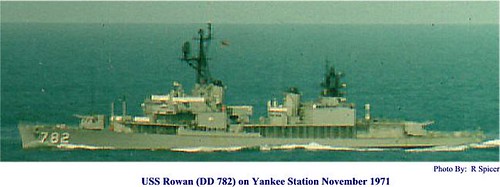
Rowan was a Gearing class destroyer commissioned too late in World War II to see any combat. That changed just a few years later when she was bloodied for the first time during the "Forgotten War" when she took a medium caliber shell hit in her starboard quarter, damaging the after steering compartment and causing a number of casualties. She had been providing counter-battery fire against North Korean shore batteries when she was hit. And counter-battery would prove to be her specialty in another twenty year.
...
27 August 1972 ... the skipper came on the 1MC again confirming that Rowan was, indeed, going to raid Haiphong harbor in a matter of hours along with Newport News, USS Providence (CLG 6) and USS Robison (DDG 12).
...
We went into battle well prepared. Rowan was amongst the sharpest shooters in the Navy having had more gunnery practice under combat conditions with the same crew during the few months leading up to this night than few ships have in a lifetime. Moreover, Rowan had just had her guns relined in Yokosuka and the 80 plus rounds of 5" HE that we could put into a precise area in under a minute was devastating. The Shrikes were a plus; but, the plethora of fire control radars in and around Haiphong overwhelmed the four missiles that we had at the ready. In the final analysis, it was the experience and solidarity of her crew that gave Rowan her edge.

Initially it seemed like another LINEBACKER II raid. I felt the ship heal and slow as we turned onto our twenty knot firing run. I heard the guns in action and the Shrikes firing at varying intervals. While the action seemed heavier than normal, it wasn't any more than what I had been expecting. After the firing run I felt Rowan again heal in a tight turn. The blowers in the fireroom just aft increase in pitch and the wave noise from the ship's passage increase as we worked up to the thirty plus knots for our getaway. The command over the 1MC to "Now set condition YOKE" was the next thing we expected to hear. It came in due course and I had just taken off my phones and was opening the scuttle in the hatch above preparing for the "Secure from GQ" command when the captain's voice came over the 1MC. "This is the Captain speaking. It's not over yet! We've two high-speed surface contacts closing fast! Reset condition ZEBRA. Re-man all General Quarters stations."
Then three things happened virtually at once: The whine from the fireroom increased to a crescendo, the height of which I had never before heard as Rowan worked up to over thirty-five knots; she started to heal one way and then reverse her rudder and heal hard over in the opposite direction; and the guns were firing at a frantic rate.
...
ET2 Richard Spicer kept a contemporary log of his time in Rowan . An excerpt from his log of that night stirred many memories for all that have read it. "27 Aug 72 2230 Hrs. I was at my GQ station in the crypto room in radio central, when we went to general quarters at the start of the operation. It was a good place to be to hear what was going on, as we had tac-air and Navy-red frequencies up on remotes and listening in on the battle group! That was one night I had my life vest on good and secure!" From the log, "Arrived at Haiphong harbor with the USS Newport News, USS Providence, and USS Robison. At 2230 GQ is sounded, 2310 all ships came to firing course. At 2325 all ships are ordered to go "hot" and commenced firing at coastal gun sites, NVA barracks and other targets. ECM in CIC now sees three cross slot gun site radars radiating, and we now are receiving counter battery! All ships are continuing firing at their targets, still receiving counter battery. Oh shit they are hitting real close now! Providenceand Robison turn out to sea as they have fired their rounds at targets, leaving the Newport News and us in the harbor. The Newport News and we keep firing, when ECM gets a bearing on a cross slot radar site and we launch our first Shrike anti-radar missile at it. This is from our new "SOB" system (Shrike on board). [Seven] min. later another cross slot radar is radiating at us and the second Shrike bird is launched. We are still receiving counter battery and lots of it! Newport News is still providing cover for us, with her 8-inch guns. We see another cross slot radar come up and fire our last two shrikes at it, this time hitting the site! With our entire Shrike missiles fired the Newport News and we turn out to sea at 26knts. As fast as we can. We are still taking heavy counter battery, and sonar reports closest hits at 20 yards off the port bow. We are hauling ass out to sea when radar sees Skunk-A at 17,000 yards closing at 48knts. We request to go hot on Skunk-A and turn 180 degrees to go back and provide cover for Newport News and shoot at Skunk-A. We are shooting at Skunk-A, now at 9,000 yards and closing [on the] stbd. beam. Newport News and we continue shooting at Skunk-Alfa when CIC radar sees Skunk-Bravo closing in on us. But we have tac-air cover and they take Skunk-Bravo. The Newport News and we connect on Skunk-Alfa, a torpedo boat with Russian [Stix] missiles on it, and sink it while tac-air sinks Skunk-Bravo!
...
Dana Perkins who was a SM3 at the time was manning his GQ station on the exposed signal bridge. Perkins relates, "I remember the night of the Haiphong Harbor pretty well. I don't think they passed the word of our objective until shortly before General Quarters, as I'm sure the mission was of utmost importance and secret. Also I think that they didn't want us to have much time to think about what was about to unfold. As a signalman I was on the highest point on the ship and had a clear view of all the action. Myself and three other signalmen were manning the Redeye shoulder fired missiles, loaded, armed and ready to squeeze the trigger in the event the time should come. When we started to see the lit shoreline and the lighted buoys of the harbor, make no mistake about it, the tension was high. All of a sudden the whole shoreline lit up with counter battery, spewing bright fireballs as each round was fired at us. The North Vietnamese weren't using flashless powder like we had. At one time I remember counting about 22 shore batteries rapid firing at the squadron. The shells were dropping all around us like seagull shit, leaving thunderous columns of white spray as they splashed into the ocean. Some of the shells were proximity and burst in the air. I remember one shell passed over the Rowanand burst in the air, causing the shrapnel to hit the side of the ship. I think it put some heavy-duty dents on the starboard side of the ship along the upper outer passageway. Luckily no one was hit! The whole time the ships in the squadron were firing on their intended targets with gunmounts and Shrike missiles. It was like the most intense 4th of July display I'd ever seen. The Newport News was off our port side at about 270 relative position, rapid firing her 8-inch guns and launching missiles as fast as they could get them off the deck. All of a sudden the word came over the sound powered phone that we had 2 torpedo boats, (Russian Osha class I believe) about 80 feet long coming out to attack. The guys in the magazine were jamming whatever shells they could get their hands on into the hoist. The first round that we hit one of those boats with was actually a practice starburst round and it tore right through it. The second round did explode. I think an A-6 Intruder came in and finished it off with an air to surface missile. The Newport News I believe sank the other boat. All I could think about the whole time was how un-watertight some of those hatches on the old Rowan were. Luckily we got past them and then the word came in that there were some inbound bogeys [MiGs] headed our way. I white knuckled the pistol grip of that Redeye missile and prepared for whatever was about to happen. At about 30 miles inbound we pushed the power button and the gyro on the missile head whined as it spooled up. Adrenaline was in overdrive by now. Then at about 20 miles out, we got word that they turned away and were outbound. I guess they knew the deck was stacked against them! As we turned away (at probably flank speed I might add), the shore batteries were trying their damnedest to get in a few last shots at us. We were out of sight of land and an occasional round was still reaching us and splashing into the ocean. The whole event probably didn't take 15 minutes but seemed like an eternity with all the action going on. The next day I remember as a chill passed through me, they told us that we weren't that far from the mines that were dropped at the harbor entrance. Thanks for that comforting bit of info." Note: The air support, whether it was an A-6 Intruder or an A-7 Corsair II, came from an attack squadron flying from USS Coral Sea (CV 43).


That's how it was to the best of our fading memories. A veteran destroyer with a veteran crew fighting the U.S. Navy's last night surface gun battle. Perhaps, also, it was the last of a long tradition of destroyers placing themselves between a heavier ship and harms way.

This was originally posted on 19 Feb 2010.

Friday, March 12, 2021

Fullbore Friday

What are you willing to do to get your squadron mates home ... or at least a chance?

How far are you willing to push yourself and your equipment?

How well do you know the capabilities - written and unwritten - of your equipment?

Ponder Pardo's Push via Air and Space;

The air strike that March day in 1967 was on the ferociously well-defended Thai Nguyen steel mill, north of Hanoi, North Vietnam. One of the attacking U.S. Air Force McDonnell F-4C Phantoms was hit twice by anti-aircraft fire, and gas was streaming from the fuselage. Pilot Earl Aman and weapons systems officer Bob Houghton no longer had enough fuel to return to safe territory.

The airplane Bob Pardo and backseater Steve Wayne were flying wasn’t in much better shape: During the strike it also caught an anti-aircraft round and was leaking fuel, and the two weren’t even sure they could reach an airborne tanker to refuel for the flight back to their base in Thailand. “But I couldn’t see leaving a guy I’d just fought a battle with,” Pardo says, so he radioed Aman, “I’m gonna try to give you a push. Fly that thing as smooth as you’ve ever flown.”

Read it all for the awesome details, but here is where it ended; 

Pardo’s Push, as the feat became known, had lasted for about 20 minutes and carried both jets 80 miles—far enough for a safe rescue.

Pardo, Aman, and Houghton injured their backs punching out, and all four airmen had to move to evade an approaching group of Laotian communist militia. Later, the aviators were extracted from the jungle by rescue helicopter crews. “When we got to the club, man, we couldn’t buy a drink,” Pardo recalls. “We had a pretty good party until about midnight.

“The next day, Steve and I went back to war.” The target? The same steel mill north of Hanoi.

Nice simulation;


Friday, December 04, 2020

Fullbore Friday

I bumped into a post I did over six years ago on the passing of one of our greats.

Phyllis. 

Thought I'd repost today ... because, she deserves it. 


Circumstances display character. Character comes often from places least expected - unless of course you know the best of military spouses
She said in a Richmond News Leader interview in 1971 that while Galanti was a POW, she just “wanted to be a housewife.” She wanted to “sink into oblivion” when he returned.

By 1969, she had become active with other POW wives. 
In 1970, the wives group became the National League of Families and Friends of POWS and MIAs in Southeastern Asia. It evolved into a tour de force in crusading for the North Vietnamese to adhere to Geneva Convention protocols in treatment of prisoners and eventually for the release of POWs and the accounting for those missing in action.
Mrs. Galanti served as chairwoman of the league.

In a televised speech before the Virginia Senate on Feb. 12, 1971, she kicked off an areawide campaign, “Write Hanoi: Let’s Bring Paul Galanti Home,” part of a nationwide project.

Her efforts generated more than 450,000 letters from the Richmond area, around 300,000 letters from Northern Virginia and 378,000 from Gastonia, N.C., where Paul’s parents had moved in 1964.

More than 80 percent of people living in the Richmond area contributed a letter, which was thought to have been the greatest response to the Write Hanoi campaign anywhere in the United States.

In March 1971, Mrs. Galanti was among a delegation of 10 Write Hanoi campaigners who went to Stockholm, Sweden, to try to obtain information on the POWs from the chargé d’affaires in the North Vietnamese embassy there.

They also wanted to send the letters asking for freedom for American servicemen being held in Southeast Asia to the North Vietnamese and Viet Cong delegations attending the World Assembly of Paris for Peace and Independence of Indochinese Peoples. 
Because “they knew we had” the letters, Mrs. Galanti said they were able to talk with officials. The letters were flown to Paris to be given to the North Vietnamese delegation at the peace talks.

By Christmas Eve 1971, she received two letters and two postcards from her husband. “Those four little pieces of mail were the most elaborate Christmas gift,” she said.

She reported in March 1971 that she was using the services of a peace group to correspond with her husband.
Mrs. Galanti called for a shift in strategy in July 1971. Instead of writing Hanoi, she asked Americans to write to President Richard Nixon and Congress. “The issue has become a political matter,” she said. “Their release can come from one place — Washington.” 
In an op/ed piece in The News Leader in 1971, she wrote, “I can honestly say that I have never done anything so rewarding and worthwhile in my life. Knowing that so many people were genuinely concerned gave me a much-needed boost.”
When she and other POW wives went to Versailles, near Paris, in February 1972 to talk about release of POWs with 800 communist delegates from 75 countries at the World Assembly of Paris for Peace, they failed to get an audience. However, Mrs. Galanti said she felt a softening on the part of communist officials to Nixon’s plan to end the war.
Mrs. Galanti and two other POW wives talked about prisoner issues with Nixon and Henry Kissinger, then national security adviser, on May 15, 1972.

In October 1972, she was elected chairwoman of the league and early the next year learned that her husband’s name was on a list of living POWs.

Galanti was released on Feb. 12, 1973, among the first group of POWs freed by the North Vietnamese. Their plane landed at Clark Air Base, Philippines. He arrived in Virginia from Travis Air Force Base, Calif., on Feb. 15. He was reunited with his wife at the Norfolk Naval Station.

At the time, he told reporters, “Phyllis was pretty shy when I left, and I came back to a real tiger.”
We should all be so lucky. 

Ms. Galanti passed in the spring of 2014 after 51 years of marriage.

Fullbore.

Friday, October 16, 2020

Fullbore Friday

So, what exactly have you done in your military career worth talking about? 

Let's take a moment to remember a great American Army officer, Major Larry Alan Thorne ... but let's not quite go there yet. 

First we need to check in with Lauri Allan Törni. NB: I'm going to outright steal from wikipedia, but they won't mind;

...Törni entered military service in 1938, joining the 4th Independent Jäger Infantry Battalion stationed at Kiviniemi; when the Winter War began in November 1939, his enlistment was extended and his unit confronted invading Soviet troops at Rautu.

During the battles at Lake Ladoga, Törni took part in the destruction of the encircled Soviet divisions in Lemetti.

His performance during these engagements was noticed by his commanders, and toward the end of the war, he was assigned to officer training where he was commissioned a Vänrikki (2nd lieutenant) in the reserves.[8] After the Winter War, in June 1941, Törni went to Vienna, Austria for seven weeks of training with the Waffen-SS, and returned to Finland in July; as a Finnish officer, the Germans recognized him as an Untersturmführer. Most of Törni's reputation was based on his successful actions in the Continuation War (1941–44) between the Soviet Union and Finland. In 1943 a unit informally named Detachment Törni was created under his command. This was an infantry unit that penetrated deep behind enemy lines and soon enjoyed a reputation on both sides of the front for its combat effectiveness. One of Törni's subordinates was future President of Finland Mauno Koivisto. Koivisto served in a reconnaissance company under Törni's command during the Battle of Ilomantsi, the final Finnish-Soviet engagement of the Continuation War, during July and August 1944. Törni's unit inflicted such heavy casualties on Soviet units that the Soviet Army placed a bounty of 3,000,000 Finnish marks on his head. He was decorated with the Mannerheim Cross on 9 July 1944.

The September 1944 Moscow Armistice required the Finnish government to remove German troops from its territory, resulting in the Lapland War; during this period, much of the Finnish Army was demobilized, including Törni, leaving him unemployed in November 1944.

Well, there's chapter 1. What is a communist hating Finn supposed to do now? Well, like many men of his age ...


In January 1945, he was recruited by a pro-German resistance movement in Finland and left for saboteur training in Germany, with the intention of organizing resistance in case Finland was occupied by the Soviet Union. The training was prematurely ended in March, but as Törni could not secure transportation to Finland, he joined a German unit to fight Soviet troops near Schwerin, Germany. He surrendered to British troops in the last stages of World War II and eventually returned to Finland in June 1945 after escaping a British POW camp in Lübeck, Germany.

He was a slippery fella ... and so ends chapter 2. But, he's not done with the communists yet;

As his family had been evacuated from Karelia, Törni sought to rejoin them in Helsinki but was arrested by Valpo, the Finnish state police.[ After escaping, he was arrested a second time in April 1946, and tried for treason for having joined the German Army. After a trial from October to November, he received a six-year sentence in January 1947. Imprisoned at the Turku provincial prison, Törni escaped in June, but was recaptured and sent to the Riihimäki State Prison. President Juho Paasikivi granted him a pardon in December 1948.

At this point you'd think he'd come to peace with Finlandization ... but no, not his style. The anti-communist game was still afoot; 

In 1949 Törni, accompanied by his wartime executive officer Holger Pitkänen, traveled to Sweden, crossing the border from Tornio to Haparanda (Haaparanta), where many inhabitants are ethnic Finns. From Haparanda, Törni traveled by railroad to Stockholm where he stayed with Baroness von Essen, who harbored many fugitive Finnish officers following the war. Pitkänen was arrested and repatriated to Finland. Remaining in Sweden, Törni fell in love with a Swedish Finn, Marja Kops, and was soon engaged to be married. Hoping to establish a career before the marriage, Törni traveled under an alias as a Swedish seaman aboard the SS Bolivia, destined for Caracas, Venezuela, where he met one of his Winter War commanders, Finnish colonel Matti Aarnio, who was in exile having settled in Venezuela after the war. From Caracas, Törni hired on to a Swedish cargo ship, the MS Skagen, destined for the United States in 1950.

While in the Gulf of Mexico, near Mobile, Alabama, Törni jumped overboard and swam to shore. Now a political refugee, Törni traveled to New York City where he was helped by the Finnish-American community living in Brooklyn's Sunset Park "Finntown". There he worked as a carpenter and cleaner. In 1953, Törni was granted a residence permit through an Act of Congress that was shepherded by the law firm of "Wild Bill" Donovan, former head of the Office of Strategic Services.

Like I said ... he was a slippery fella ... and I think you can see where this is headed;


Törni joined the US Army in 1954 under the provisions of the Lodge-Philbin Act and adopted the name Larry Thorne. In the US Army, he was befriended by a group of Finnish-American officers who came to be known as "Marttinen's Men" (Marttisen miehet).

With their support, Thorne joined the US Army Special Forces. While in the Special Forces, he taught skiing, survival, mountaineering, and guerrilla tactics. In turn he attended airborne school, and advanced in rank; attending Officer Candidate School, he was commissioned as a first lieutenant in the Signal Corps in 1957. He later received a commission and a promotion to captain in 1960. From 1958–1962 he served in the 10th Special Forces Group in West Germany at Bad Tölz, from where he was second-in-command of a search and recovery mission high in the Zagros Mountains of Iran, which gained him a notable reputation. When he was in Germany, he briefly visited his relatives in Finland. In an episode of The Big Picture released in 1962 and composed of footage filmed in 1959, Thorne is shown as a lieutenant with the 10th Special Forces Group in the United States Army.

...

Deploying to South Vietnam in November 1963 to support Army of the Republic of Vietnam (ARVN) forces in the Vietnam War, Thorne and Special Forces Detachment A-734 were stationed in the Tịnh Biên District and assigned to operate Civilian Irregular Defense Group (CIDG) encampments at Châu Lăng and later Tịnh Biên.

During a fierce attack on the CIDG camp in Tịnh Biên, he received two Purple Hearts and a Bronze Star Medal for valor during the battle. This attack would later be described by author Robin Moore in his book The Green Berets.

Thorne's second tour in Vietnam began in February 1965 with 5th Special Forces Group; he then transferred to Military Assistance Command, Vietnam – Studies and Observations Group (MACV–SOG), a classified US special operations unit focusing on unconventional warfare in Vietnam, as a military advisor.

On 18 October 1965, as part of the operation Shining Brass, Thorne was supervising the first clandestine mission to locate Viet Cong turnaround points along the Ho Chi Minh trail and destroy them with airstrikes. Two Republic of Vietnam Air Force (RVNAF) CH-34 helicopters launched from Kham Duc Special Forces Camp and rendezvoused with a United States Air Force Cessna O-1 Bird Dog Forward Air Controller in inclement weather in a mountainous area of Phước Sơn District, Quảng Nam Province, Vietnam, 25 miles (40 km) from Da Nang. While one CH-34 descended through a gap in the weather to drop off the six-man team, the command CH-34 carrying Thorne and the O-1 loitered nearby. When the drop helicopter returned above the cloud cover, both the CH-34 and the O-1 had disappeared. Rescue teams were unable to locate the crash site. Shortly after his disappearance, Thorne was promoted to the rank of major and posthumously awarded the Legion of Merit and Distinguished Flying Cross.

After all that ... a helo midair. What a man.

We did not forget him ... and neither did his native Finland.

In 1999, Thorne's remains were found by a Finnish and Joint Task Force-Full Accounting team[nb 3] and repatriated to the United States following a Hanoi Noi Bai International Airport ceremony that included Secretary of State Madeleine Albright and Ambassador Pete Peterson.

Shared grave of Thorne and fellow Vietnam War casualties in Arlington National Cemetery

Formally identified in 2003, his remains were buried on 26 June 2003 at Arlington National Cemetery, section 60, tombstone 8136, along with the RVNAF casualties of the mission recovered at the crash site. He was memorialized on the Vietnam Veterans Memorial at Panel 02E, Line 126. He was survived only by his fiancée, Marja Kops, who later remarried.

He was 46. 


Monday, July 20, 2020

The Secrets We Forgot to Tell Ourselves

Is 48-yrs long enough to consider something unclassified?

Well, why not. I personally don't care if this is exactly how it happened or not, this is a great story.

It reminds me that most people who served have a lot of events that to us were just an interesting day. We don't think all that much about it, but to others it is exciting.

This in one of those days. Via the OkieBoat website ... let's go back to 1972 and the Harry Navy at war;
In January 1972 the Oklahoma City steamed to the Gulf of Tonkin to do some "radar hunting." We were waiting for the chance to use the new RGM-8H missiles in the Ready Service Magazine. We were looking for another BAR LOCK radar in the vicinity of the Mu Gia Pass, although few people aboard knew this. We maintained a position about 30 miles off the coast of North Vietnam near Vinh (18° 43.6' N 106° 15.8' E) for most of the period from 28 January to 4 February, holding position within 2000 yards from a reference buoy, waiting to shoot. During this period we operated at Condition II AAW with the Talos missile battery and the 5"/38 guns manned, and with either the USS Decatur DDG-31 or the USS Mahan DLG-11 "riding shotgun" with their short range Tartar and Terrier missiles.
I was on-watch that night in the EW shack and was on the receiver and picked up the BAR LOCK ATC radar that the Vietnamese were using. I remember the incident pretty vividly... how long we'd trained to be able to pick up those threat emitters, determine the key characteristics so we could pass on just the kind of info that was used to program the TALOS that night. Some of the measurement gear was NOT part of a standard electronics package. A few OW-div buddies and I collaborated to put together a couple pieces of outboard 'off-the-shelf' test equipment (an audio signal generator and XY scope so we could accurately determine PRR frequencies of incoming signals). It was this set up that allowed us to pass on not one...but three of the frequencies that BAR LOCK was using that night (since it was a Frequency Scanning...FRESCAN...radar to allow it to determine bearing/range AND approximate altitude).

I remember passing parameters on to the fire control folks continuously as the missile was being prepared for launch (BAR LOCK radars were notorious for changing frequencies during operation). I remember feeling/hearing the launch... I continued to monitor the signal as the missile was in-flight. After a minute or so (I didn't have a stopwatch on it) I remember hearing a weird screeching... then the signal went silent. Apparently that was the precise moment of the impact/explosion that "killed" the radar.

RD2 Doug Rasor, OK City 1968-72
Everyone has their own view of an engagement;
On the night of the ARM engagement, I recall leaving Weapons Control immediately after launch of the missile and running up to the Fire Control Workshop above Weapons Control, where the AN/SKQ-1 Telemetry set had been installed and was receiving data [TLM] from the missile in flight. Having set the pre-launch parameters into the missile, after discussion with CDR Mel Foreman [Weapons Department head], I knew what to look for in the telemetry as regards the general flow of the missile flight regime. FYI, the AN/SKQ-1 data was projected onto light sensitive paper for subsequent development and analysis.

I saw the missile acquire the Bar Lock radar, and wing movements generating the lateral accelerations as the missile acquired and began homing on the target. Angle Rate Gate Enable had been transmitted to the missile prior to launch, so the missile had been fired to a point in space roughly 8 Kyds beyond the radar site, which caused the missile to reject possible “spoofing” targets beyond/to the side of the actual target. So the missile nosed over and dove on the target approaching from directly overhead and thereby maximizing the fuse/warhead effectiveness against the target. TLM was lost just prior to the predicted intercept so warhead fusing was not visible on TLM. However, all of the available TLM data suggested that the missile had homed on (and probably destroyed) the target.

WO1 Greg Dilick, OK City 1970-73.
I don't know about you, but I love a story with a happy ending;
However, at the moment we didn't know if we had hit the target. The Electronics Warfare people in CIC told us the radar signal had disappeared about the same time the missile arrived, but you can bet the BAR LOCK operators would have noticed if we had missed and shut down their radar! The next day our Weapons Department head CDR Foreman showed me aerial recon photos. The radar antennas were scattered all over Southeast Asia, and what remained of the trailer was lying on its side at the edge of a 30 foot diameter crater.

This was all classified Secret at the time, and our missile crews were told to keep quiet. Of course everyone aboard knew something was going on (missile shots were very noisy). I overheard one sailor say we had fired a nuclear warhead and he had seen the explosion! Such is scuttlebutt!

The next morning at 0004 (four minutes after midnight) the Oklahoma City left the operating area for Yankee Station in the Gulf of Tonkin to rendezvous with the USS Coral Sea CVA-43 for personnel transfers. At 1339 (1:39 PM) we left the area and went to Subic Bay in the Philippines for R&R. The Chicago was in port when we arrived. Imagine our surprise when we learned that the bar girls knew about the shot before we got there! One of our first class POs told me that as they walked into a bar one of the girls saw the ship's name patch on his sleeve and started asking about the missile shot! So much for secrecy!
So you Vietnam Era Shipmates ... about those Subic bars ...

Friday, January 24, 2020

Fullbore Friday

In some cohorts, heroic men are so many in number, you simply miss a few.

A giant passed in 2013 - and I feel like a lessor man for not knowing his story earlier.

James Robinson "Robbie" Risner, Colonel, USAF (Ret.)

Read it all, but this should get you started;
“Robbie” Risner was a rising star in the Air Force when he was shot down and captured Sept. 16, 1965. In the previous decade’s war, he had been a hero, downing eight enemy planes over Korea. In Vietnam, he was such a standout that his tanned, chiseled face made the cover of Time magazine with a fighter jet streaking into the sky behind him.

Unfortunately, the April 23, 1965 piece, which profiled a dozen U.S. military members in Vietnam, made its way to Risner’s captors.

It “made him their ‘prized prisoner,’ which meant more abuse,” Gen. Mark A. Welsh III, the Air Force chief of staff, wrote in a remembrance last week. Risner also came in for harsher treatment because, as a lieutenant colonel and then a full colonel, he was the top-ranking officer for most of his imprisonment, including the three years he spent in solitary confinement.

He showed up a lot in his career ... in war and peace.

Here he is as a Major in 1957;


Hat tip SAP.

Monday, December 16, 2019

The Smartest People in the Room Have a Thing for Those Who Aren't

Credentialism is a cancer.

People assume that certain schools and certain backgrounds will result in certain - and superior - results.

Those who are given that credentialist benefit know it, they often believe it, they bask in it, they act on it - and they began to look at lesser beings with contempt.

As they are the superior being, their ideas are best. Opposition isn't just a manifestation of stupidity - it is almost blasphemous. 

When we look at the record of the last few decades of what the "Smartest People in the Room™" did when they decided to play Risk writ large - we should take pause to think about the real value of where you went to school and what credentials actually mean. 

How dangerous is the assumption that papers and titles produce the best idea? Are we just looking for a shortcut to minimize intellect-risk so we value that technical ability, vice actual works and ideas regardless of source?

Credentialed technicians, brilliant in one specific area or another, often make decisions that only make sense on a spreadsheet or as a one-dimensional solution to a specific problem without considering what should be seen as obvious 2nd and 3rd order effects on a multi-dimensional challenge.

I was thinking of this while reading a recent post over at Claire Berlinski's place, McNamara's Morons, where she recounts a discussion with a friend of hers, Alan Potkin, about The Late Unpleasantness in SE Asia and a tie-in to today. He stated,
… It sure as hell doesn’t feel like that was fifty years ago. I think we could have pulled another South Korea out of that mess if the lefty bien pensants hadn’t cut the ARVNs off at the knees (my daughter-in-law is Vietnamese and her father was a political prisoner for nearly decade). The constituency for Pax Americana is gone, baby, gone.
Recounting the tragic loss of a C-123 and the lives 36 people in a fuel fire on the deck, he brought us back to a lesson no one should forget.

The self-appointed elite - in an effort to extend protections to their class - decided to throw the other end of the IQ Bell Curve at the most important national security problem of their day.

When you care enough to send your very least;
However, in just the last several years it has become more widely known that as result of decisions secretly taken by then-Defense Secretary Robert McNamara and US President Lyndon Johnson, more than 300,000 prospective draftees whose dismal scores on the Armed Forces Qualifying Test were far below the previous acceptable threshold for serving in the US military were enlisted or conscripted.
...
“This decision was entirely politically motivated, as the alternatives were to eliminate the 2-S student deferment or to mobilize, for overseas service, troops in National Guard and reserve units who were exempted, thereby from risking getting their heads blown off in what was an extremely unpopular war.
Defining adequacy down has real consequences. Standards exist for a reason and the professional resists efforts to dilute standards for reasons based simply on convenience to non-effectiveness related variables.

Some day there will be pressure again to take in lower IQ candidates. It was bad enough in the relatively low-tech Vietnam Era military - in our high tech military where each person is even more critical - the push-back needs to be fast, swift, and sure.

Hopefully enough people will remember what happened before, so when the good idea fairy brings it up again - and it will - it never sees the light of day.

Tuesday, June 04, 2019

Bureaucratic Self-Harm and the Seawolves

One of the great tragedies of the obsession with Joint, Goldwater-Nichols - and to no small measure petty budgetary parochialism - was the loss of the Navy's ability to quickly create inside its own lifelines capabilities to meet the requirements to support combat operations as we encountered them.

We saw it in Iraq, we saw it in Afghanistan, we continue to see it today. Heck, not just USN, but USAF has the same problem. Just look at the bureaucratic slow roll of a capability I heard people screaming for in C5F as we clawed our way up the Kandahar Valley in late 2001 - the Light Attack Aircraft.

Examples are legion of when Navy has needed a capability, but had to wait or get none simply because the other services' "high-demand/low-density" assets simply had more important things to do. That is an arrangement that fits an "efficiency" mindset, but fails the "effectiveness" requirement in war.

Of course, I'm talking today about the capability our Navy grew pre-Goldwater-Nichols out of whole cloth in the body of Helicopter Attack Squadron (Light)-3 and her sisters. A great article over at USNI Proceedings re-introducing their story to a new generation.
One of the principal avenues for resupplying communist Viet Cong fighters was the populous Mekong Delta. The most productive agricultural area in South Vietnam, it featured a web of waterways that were used to infiltrate the region. To stem the flow of supplies, the U.S. Navy initiated Operation Game Warden in late 1965, establishing Task Force 116—a fleet of amphibious vessels and armed river-patrol boats collectively known as the “Brown Water Navy”—that patrolled the delta’s inland rivers and search suspicious vessels. The delta soon became a hotly contested and wide-ranging arena of warfare, where Navy small craft, SEALS, and Army ground forces faced danger at nearly every turn along the jungle-lined waterways.

With the commencement of Game Warden, the Navy concurrently adopted a new designation for its rotary-wing community: the helicopter combat support squadron (HC). These units largely operated as part of the blue-water Navy, performing the utility and plane guard duties that were established missions for helicopters operating from carriers and surface ships. With the exception of search-and-rescue missions, day-to-day operations tilted more heavily toward the support part of the squadron designation and less on combat.

This changed in 1966, when Rear Admiral Norvell G. Ward, Commander Naval Forces Vietnam, offered General William C. Westmoreland, Commander, U.S. Military Assistance Command, Vietnam, much-needed air support for his riverine forces. Army helicopters had been performing those missions on a temporary basis, but Admiral Ward proposed to provide Navy crews if the Army contributed helicopter gunships, which did not exist in the Navy’s aircraft inventory.

The resulting agreement brought members of HC-1 in country to fly UH-1B Iroquois helicopters, with the first contingent arriving on Independence Day 1966. Training under Army pilots and crews included familiarization with the aircraft, armament, and the vast area of operations. On 19 September, the first HC-1 detachment arrived on board the USS Tortuga (LSD-26), one of the collection of amphibious vessels, including tank landing ships (LSTs), that served as bases of operation for HC-1 and later HA(L)-3. The Navy men also received a new nickname—the Seawolves.
Yep, this is the Navy I know.
Aviation Structural Mechanic Third Class Joe Crutcher recalls himself and a fellow maintainer borrowing black paint from an Australian unit that they mixed with green paint provided by the Army to give the HA(L)-3 UH-1Bs a different look. Commander Robert Spencer, the squadron skipper, directed them to paint “NAVY” in white letters on the tail booms, saying, “I want the Army to know the Navy is here.”

One thing not lacking was personnel willing to serve in the squadron, even knowing what they faced. “If you go to HA(L)-3,” retired Captain Brian Buzzell recalled of the squadron’s reputation among those coming out of flight school as helicopter pilots, “you are going to get shot at and maybe killed.” Those pilots joining stateside trained under the tutelage of the Army (initially at Fort Benning, Georgia, and later at Fort Rucker, Alabama), learned how to fire and clean an array of weapons, and completed the Army’s demanding SERE (survival, evasion, resistance, and escape) school.
Read it all.

Of course, in spite of the example they gave, we did not have the same spirit or ability to adjust due to the bureaucratic adhesions from DC and "other priorities" of senior leadership than supporting Sailors under fire. Navy gunships did survive on life support in the USNR, but neglected and never expanded, they finally were allowed to starve to death in 2016. What a disgrace.

There is some good news for history though, there is a documentary;
Jeff and Shannon met with the president of the HA(L)-3 Seawolf Association, Mike Dobson, in 2012 and proposed making a documentary. With Jeff traveling the world filming the World Surfing League, not until 2014 during a squadron reunion in Dallas, Texas, did the couple dedicate themselves to beginning work on the film.
You can get more details here.

Friday, September 28, 2018

Fullbore Friday

On October 17th we will see the upgrading of a Navy Cross to Medal of Honor for Sergeant Major John L. Canley, USMC (Ret).

His Navy Cross citation:
CITATION:
The President of the United States of America takes pleasure in presenting the Navy Cross to Gunnery Sergeant John L. Canley (MCSN: 1455946), United States Marine Corps, for extraordinary heroism while serving as Company Gunnery Sergeant of Company A, First Battalion, First Marines, FIRST Marine Division (Reinforced), Fleet Marine Force, during operations against the enemy in the Republic of Vietnam from 31 January to 6 February 1968. On 31 January, when his company came under a heavy volume of enemy fire near the city of Hue, Gunnery Sergeant Canley rushed across the fire-swept terrain and carried several wounded Marines to safety. Later, with the company commander seriously wounded, Gunnery Sergeant Canley assumed command and immediately reorganized his scattered Marines, moving from one group to another to advise and encourage his men. Although sustaining shrapnel wounds during this period, he nonetheless established a base of fire which subsequently allowed the company to break through the enemy strongpoint. Retaining command of the company for the following three days, Gunnery Sergeant Canley on 4 February led his men into an enemy-occupied building in Hue. Despite fierce enemy resistance, he succeeded in gaining a position immediately above the enemy strongpoint and dropped a large satchel charge into the position, personally accounting for numerous enemy killed, and forcing the others to vacate the building. On 6 February, when his unit sustained numerous casualties while attempting to capture a government building, Gunnery Sergeant Canley lent words of encouragement to his men and exhorted them to greater efforts as they drove the enemy from its fortified emplacement. Although wounded once again during this action, on two occasions he leaped a wall in full view of the enemy, picked up casualties, and carried them to covered positions. By his dynamic leadership, courage, and selfless dedication, Gunnery Sergeant Canley contributed greatly to the accomplishment of his company's mission and upheld the highest traditions of the Marine Corps and of the United States Naval Service.
I'll let the Marines who served with him speak for me.


I look forward to this.

Friday, July 13, 2018

Fullbore Friday


Sometimes Fullbore is a battle, a campaign, a concept. Sometimes it is a moment in time - sometimes it accrues over decades.

Fullbore can be found everywhere - could be just down the table from you at the DFAC.
In 1969, Eugene Krueger left his young wife, Sharon, and headed off to Vietnam, where the 20-year-old's heroism as an Army pilot would be recognized with two Distinguished Flying Crosses and a Bronze Star.

Krueger returned home, raised four daughters and embarked on a civilian career with Northwest Airlines while serving with the Washington National Guard.

But Krueger was not through with war.

As part of a marathon military career that ended this week with his retirement, he returned to the front lines as a pilot in Afghanistan. There he spent four months in 2006 flying missions out of Bagram Air Field.
I served with a few in AFG who retired in the late 80s and were called back from the Army. Mostly Special Forces guys who had a very good Civil Affairs background. A very untold story - I'm glad I've had a chance to share one here.

One little note: notice how the Army can still tap into its pool of talent decades back in the Reserves and National Guard - as a result it can do something the Navy can't - tap in to institutional memory.
He also chafed at inefficiencies he found in an Army that had become much more bureaucratic.

During the Vietnam era, for example, cargo could be quickly loaded into slings and then hauled by Chinooks to and from combat outposts. But during his Afghanistan tour, cargo was loaded inside the helicopter, a more time-consuming task that forced the helicopter to idle on the ground for hours with engines running so that pilots could escape quickly if the aircraft came under attack.

Krueger suggested that the unit consider slings, but to no avail.

"My argument is we could do the mission in half the time, thus saving half the fuel, half the crew time, half the maintenance, half the $$$," Krueger wrote in a journal entry. "This should be a no-brainer."
Chief Krueger; Fullbore.

Hat tip KP. First posted JUL2011.

Friday, June 29, 2018

Fullbore Friday

Some days, you miss the passing of a giant. Not in size, but in deed.

These men make you stop and wonder, are you ready to endure what they endured?
Navy Cmdr. Robert J. Flynn, who spent five and a half years in a Communist Chinese prison during the Vietnam War...
Read that again.

Chinese.
Then-Lieutenant Flynn, a bombardier-navigator, was taking part in a raid on Aug. 21, 1967, targeting rail yards near Hanoi, the North Vietnamese capital, about 75 miles from the Chinese border, when his two-man A-6 Intruder came under attack. The Pentagon later said his plane and another Intruder on that raid had been downed after straying over southern China while seeking to escape North Vietnamese jets.

Lieutenant Flynn and his pilot, Lt. Cmdr. Jimmy Lee Buckley, ejected from their craft. Lieutenant Flynn, suffering severe spinal injuries, found the pilot’s body near the spot where he had come down, and he was soon captured. The Chinese news agency Xinhua reported six days later that one of four American airmen whom China had just downed had been paraded before peasants and Red Guards at an anti-America rally. It did not identify that airman, but Lieutenant Flynn was the only survivor from the two Intruders.

Mrs. Flynn said in an interview on Wednesday: “I saw on TV he was being beaten, and the streets were lined with people. That’s how I knew he was alive.”
His experience, almost unknown to his countrymen, is hard to grasp.
For the remainder of the Vietnam War, he spent virtually all his prison time in a small cell in Beijing
...
“The most terrible part was the solitude, the solitude, the solitude,” Commander Flynn told The Pensacola News Journal in 2008. “What do you do with all that time? All those hours? All those days and years?”
To be so alone for so long, but not alone.
Freedom finally came on March 15, 1973, when he was taken across a covered bridge into Hong Kong, wearing a blue Chinese cap. He was released to the American authorities there together with Maj. Philip E. Smith of the Air Force, who had been imprisoned by the Chinese since his plane was downed over their airspace in September 1965.

Two C.I.A. agents, John Downey and Richard Fecteau, who had been captured in China in 1952 during the Korean War, were also at the prison where Lieutenant Flynn and Major Smith were held. Mr. Fecteau was freed in December 1971, and Mr. Downey in March 1973.
He served until 1985, retiring as a Commander.
“I wouldn’t want to do it again,” he told The News Journal in recalling his captivity. “But it was part of the experience of my life. Life is sort of an adventure. Sometimes, the adventure gets out of hand.”
Indeed.
Cmdr. Robert J. Flynn ... died on May 15 in Pensacola, Fla. Commander Flynn ... was 76.

The cause was a heart attack, said his wife, Kathy.
Fullbore.