Showing posts with label Riverine. Show all posts

Thursday, January 26, 2023

Riverine: our Stupidity is Ukraine's Gift


In the first year of this blog ~18-yrs ago, we blowtorched the Navy for throwing away our riverine capability forcing the Army in Iraq to "reacquisition" fishing boats, and generally surrendering a primary logistics path - rivers - to the enemy.

We covered the rise and rebuilding of riverine in our Navy, and if you followed the tag, the ahistorical stupidity of our Navy at once again throwing it away due to having the attentions span of a squirrel.

Wherever there is war with any significant river systems, having a mature, well equipped riverine force is essential to controlling that logistics corridor and having the ability to defend from and project force quickly using the water.

This is military 101, but again, we have a problem with institutional maturity to support the "unsexy but important."

At least we are giving the Ukrainians what we are foolishly throwing away.

Over at Naval News they have the full report.

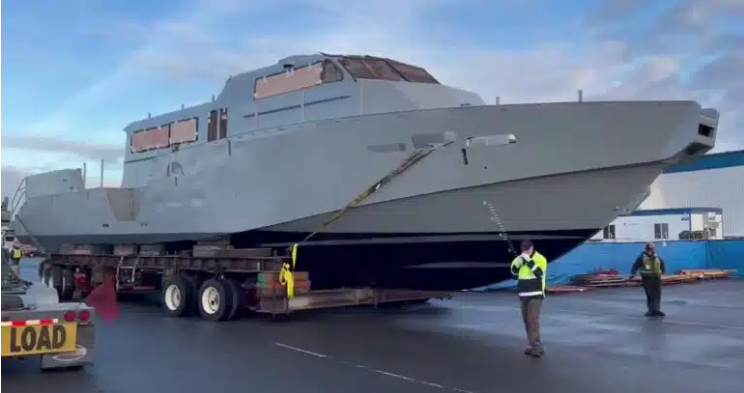
For the record, the United States’ State Department approved a possible Foreign Military Sale (FMS) to the Government of Ukraine of up to 16 Mark VI Patrol Boats and related equipment for an estimated cost of $600 million back in June 2020. The U.S. Department of Defense on 5 January 2021 awarded SAFE Boats International a US$ 19 million order to start production of Ukraine’s first two Mk VI Patrol Boats. Eight months later NAVSEA awarded SAFE Boats International a US$ 84 million contract modification for the delivery of six more Mk VI patrol boats, with an option for an additional two boats.

Mark my words; we will - again - regret with blood and treasure giving up this capability. 

Monday, May 16, 2022

Who is Helping Ukraine Build the Riverine Force They Need?

Time to raise a topic we first brought up the first year of this blog over 17-years ago; riverine.

As we discussed at the time, we invaded a nation, Iraq, dominated by major river systems, yet because of the stupidity of the 1990s defense policies, we divested of our riverine forces. The last units left the reserves just a few years before we would need them again.

As a result, we not only did not have the ability to take advantage of the unique mobility riverine environments can provide for our own military operations, we surrendered the waters to the enemy's use unopposed. 

The requirement was still there, we just ignored it in DC while the US Army did what it could with locally sourced fishing boats.

As we have over the years discussing this under-loved topic, let's dig in to it in the context of the Russo-Ukraine War.

As always, let's first go the the map room.


The Dniester, Bug, Dnieper, and the now famous for the failed river crossing, Donets rivers. Heck, throw in the small part of the Danube in the southwest on the Romanian border. This Texas sized nation is full of large, economically and militarily significant, deep, navigable river systems.

I've been thinking even more about this since the video came out last month of the riverine raiding party of Ukrainians and their remarkable fleet of ...

Yes, they used a collection of fishing, ski, and pleasure boats. Remind you of the images linked above from 2005's Iraq? Read the related article about the raid - it was successful. 

Before the war, the Ukrainian Navy knew riverine was important, and they had a small fleet, but there wasn't enough time and money - a common pre-war Ukrainian situation. 

It was on their mind. 


Just not enough.

The Russians are making better use of the riverine environment;
Russian patrol boats are racing up the Dnieper River to conduct covert operations deep behind enemy lines, a Ukrainian think tank has said.

Boats that can reach Kyiv have been seen speeding upstream from the Russian-occupied city of Kherson, the Centre for Defence Studies (CDS) said.

The Dnieper is the fourth longest river in Europe, measuring 13 miles wide at points, and potentially allowing Russian boats to travel deep into Ukrainian-held territory undetected. Defence experts said Russian special forces could be using the missions to mark out targets for air strikes and artillery fire in cities such as Zaporizhzhia, Dnipro and the Ukrainian capital itself.


The CDS said that Mangust patrol boats had been deployed from Kherson to conduct operations upstream. “The Dnieper River may be the fastest way for them to covertly reach many of the river’s cities, including Kyiv,” the think tank warned.

The Mangust patrol boat, which means “Mongoose” in Russian, can travel at speeds of up to 50 knots or about 58 miles per hour. It is armed with a 12.7mm machinegun, two Igla surface-to-air missile launchers and two 30mm grenade launchers. The Russian Black Sea fleet has 26 Mangust boats in its arsenal.

This makes sense. There is a shared history of such operations for Russians and Ukrainians.

Have you ever heard of the Danube Flotilla?  

As the Red Army cleared Crimea and the Dniester River of German troops, the Danube Flotilla was re-constituted on the Dniester in April 1944 to assist further offensives.

The flotilla assisted the Red Army in operations including the clearing of the Dniester Estuary and the clearing of the Danube Delta, including both troop-carrying and gunfire support for landings at Prymorske and Vylkove on August 23–24, 1944, and at Kiliya on August 25.

As the Red Army moved upriver, the Danube Flotilla followed and participated in the Belgrade Offensive, the Budapest Offensive, and the Vienna Offensive.[4] Flotilla operations included assisting in landings at Raduevats and Prahovo on September 29–30, 1944 (even well into the 21st century, the wrecks of about 200 vessels sunk by the Germans to block the landings remain in the Danube at Prahovo), at Smederevo on October 16, at Vukovar on December 8–10, at Gerjen on November 30–December 1, at Esztergom on March 19–23, 1945, and at Radwanska on March 28–30.

On April 13, 1945, as the Battle of Vienna was ending, the Flotilla landed troops in a surprise stroke at both ends of the Imperial Bridge in Vienna. This enabled the Red Army to cut the demolition cables and seize the bridge intact.

It is almost criminal malpractice not to take full advantage of such river systems. 

Looking at this note from Jane's in January ... has this been sped up?

Time. Never enough and what you need is always late.

Plans to rebuild Ukraine's naval capability have taken a further step forward after US company SAFE Boats International received an USD84.2 million contract to deliver six MK VI patrol boats.

The award, confirmed by the US Naval Sea Systems Command (NAVSEA) on 30 September, combines Building Partner Capacity (BPC) and Foreign Military Financing (FMF) funds. The contract includes an option for a further two MK VI craft.

The US State Department in June 2020 approved a Foreign Military Sales case for the supply of up to 16 MK VI patrol boats and associated equipment to Ukraine. “The proposed sale will improve Ukraine's capability to meet current and future threats by providing a modern, fast, short-range vessel ... to better defend its territorial waters and protect other maritime interests,” said the Defense Security Cooperation Agency in a statement issued at the time.

SAFE Boats International was awarded a USD20 million contract by NAVSEA in December 2020 for long lead time material and associated pre-production and planning support for an initial two MK VI patrol boats for Ukraine. The new award announced at the end of September funds detail design, construction, outfitting, reactivation, and training for six MK VI craft, plus the option for two more units.

Fiscal Year (FY) 2020 BPC funds using Ukraine Security Assistance Funding to the amount of USD43.7 million and FY 2021 FMF (Ukraine) funds to the amount of USD40.5 million have been obligated at the time of award. Work is expected to complete in March 2025; the completion date will be extended to March 2026 if the contract options are exercised.

There must be more that we can do. 

Fun note. Guess where the memorial for the Danube Flotilla's Sailors is?

Izmail, Ukraine.


Saturday, June 05, 2021

More Patrol Craft, Not Fewer with LCDR Jordan Bradford, USN - on Midrats

In a sharp departure from the ideas that brought them to the fleet, the Navy, "...appears poised to sunset the MK VI and Cyclone-class patrol craft programs in rapid succession, with no replacements on the horizon."

Why are these small craft in our Navy today, what missions are they doing, and what risk are we accepting if we let this capability go? What follow on craft could even do the job better?

To discuss these and related issues this Sunday from 5-6pm Eastern will be LCDR Jordan Bradford, USN.

The starting point for our conversation will be his article from the May 2021 Proceedings, "The MK-VI id Dead - Long Live the MK VII."

Lieutenant Commander Bradford is the commanding officer of USS Typhoon (PC-5). He is a 2009 graduate of the U.S. Naval Academy and has formerly served as strike officer on board the USS Vicksburg (CG-69), navigator on board the De Wert (FFG-45), and combat systems and operations officer on board the Detroit (LCS-7). His opinions are his own and do not reflect any endorsement by the Navy, the Department of Defense, or the United States government.

If you use iTunes, you can add Midrats to your podcast list simply by clicking the iTunes button at the main showpage - or you can just click here. You can find us on almost all your most popular podcast aggregators as well.

Tuesday, April 13, 2021

General Hamlet and the Small Boys


The Navy's hate-hate relationship with its fleet of small ships would be a comedy if it were not so tragic.

As recorded here in the opening years of this blog, one of the greatest errors of the last 40-yrs was the Navy's retreat from its exceptional riverine force it learned it needed the hard way in Vietnam. 

At the end of the 1990s, we disestablished the vestige of this once great capability in the Navy Reserve just a half decade before they would be desperately needed in Iraq.

Untold numbers of American and allied personnel were killed and maimed because we invaded a nation whose central geographical feature were two great rivers that we could not, for years, gain effective control of. While we fought for each intersection and highway ashore, on the water the enemy had relatively free run of the Tigris and Euphrates with their lakes and tributaries.

We still do not have the riverine forces we should have - for the same petty reasons the USAF does not have light attack aircraft - but we at least have a few bits in the took kit to use as needed

Problem is, the simply don't have the top cover they need. Via our friend Chris Cavas;

When it comes to big things the U. S. Navy has no problem with commitment. The service loves big aircraft carriers, big submarines, big ships – ships that travel on big oceans. It loves to think big – wide-open, transoceanic, blue water operations. Its shopping lists routinely include items costing in the billions of dollars – big bucks.

But when it comes to the small stuff, forget it. While there are passing fancies, the passion soon flames out and Big Navy is on to the next Big Thing.

The latest potential castoffs are some of the smallest ships in the fleet, if at 78-feet long they can be called ships at all. The Mark VI patrol boats began entering service in late 2014 and by 2018 a dozen of a planned fleet of 48 boats had been delivered. The craft were in response to an “urgent need” request from the U. S. Navy in Central Command for fast interceptors to protect big ships in the Persian Gulf from hundreds of small, fast vessels operated by Iran.

... on February 5 a service-wide message from the director of expeditionary warfare declared all 12 Mark Vis would be inactivated no later than September 30 of this year.

Marine Major General Tracy King, the director of expeditionary warfare, told a Surface Warfare Association audience on Jan. 12 the craft “are very expensive to maintain.” Acknowledging the craft were “very valuable in assuring partners and allies,” he added, “our wargaming has told us we could probably better spend that money elsewhere.”

Another example of the abuse of wargames. Again, you tell me what you want, I'll design a wargame to give it to you. 

Sorry, I'm not sold.

As I read this AM, I'm not the only one;

 “The previously released message (February 5) has since been cancelled, which stops the inactivation of MK VI boats this year [2021]. We are not going to speculate on the program’s future. The PB22 budget request is pre-decisional. We will not comment on future budgetary decisions until the budget request is submitted to Congress later this year.  The decision [to divest the Mark VI Patrol Boats] is still under review.” 

The Salamander Underground wins again. 

If MG King can claim all seeing wargaming, then I can claim credit for anything. It's only fair. (NB: fair to give credit to Chris for this tactical victory though, he was the one to bring this in to the light).

OK people, time to fight. MK VI are good kit to have with a lot of uses ... and there is no better way to build better officers.

Wednesday, February 17, 2021

The Use and Abuse of Wargames


I am happy we are talking more about wargames, but I am losing confidence in our ability to understand what they are and how to properly use them.

The fact they are being used to justify further divestment from our hard won - yet still rump - fleet of smaller warships only adds to my concerns that we are making a huge mistake.

Quotes and more thoughts over at USNIBlog.

Come by and wonder what in the wide world of sports is going on over there.

Tuesday, February 02, 2021

Killing Small Ships, Again


I love our Navy, as I know almost everyone here does. As such, I try as hard as I can to be optimistic - not by experience - but by hope.

We were granted by previous generations an advantage at sea not seen since the Royal Navy after the final fall of Napoleon. All today's leaders had to do was not screw it up.

Since the victory in the Cold War - it was a victory - we seemed to have lost our way. Just look at the series of new major surface combatant failures of the last quarter century. 

Officially and unofficially, we've tried to admit our mistakes - we've even had "blue ribbon" commissions and reports outlining them and calling for corrections. It is one thing to admit your mistakes, it is another to take actions not to repeat them.

Can we agree on a few things?

1. As we covered in the first year of this blog back in 2004/5, we made a huge mistake by getting rid of our riverine forces in the 1990s. The capability shortfall clear as day as our ground forces clawed their way up the Tigris and Euphrates rivers with almost not waterside help. We also clawed back the Cyclone PCs from the USCG as we rediscovered the utility of smaller ships - not just riverine.

2. We know we have a problem with leadership at sea. We have people showing up at CDR Command not having an opportunity to learn with at LT or LCDR command ... or even a pure XO tour before taking command. The lack of opportunity to command at the LT and LCDR level is part of that problem.

3. LCS is, for a ship the size of a WWII destroyer, an underperformer. The issues and challenges are well known here.

I could list more, but I'll let you fight out the details in comments.

We are set to repeat our errors it appears;  

At the Surface Navy Association 2021 (SNA 2021) Virtual Symposium, Naval News asked RADM Paul Schlise, USN, Director, Surface Warfare (N96), whether the U.S. Navy intends to replace the aging Patrol Coastal boats. The direct answer is, “No.”

...

Sixteen PCs were originally planned for and two were canceled, resulting in a total of fourteen boats.  The lead ship, PC-1 USS Cyclone, was transferred to the Philippine Navy in March 2004.  The oldest active-duty U.S. Navy Patrol Coastal boat, PC-3 USS Hurricane, commissioned in 1993, is 28 years old and is still in service today.  The newest Cyclone-class PC, PC-14 USS Tornado, commissioned in 2000, and also in service, is now 21 years old.  With an estimated service life of 30 years, the thirteen Patrol Coastal boats are nearing the end of their intended service life. 

...

RADM Paul Schlise said that the roles of the PCs will be replaced by the Littoral Combat Ships (LCS) and the smaller U.S. Coast Guard boats.  Schlise described the Coast Guard boats as platforms that work in both peace and wartime and having great capabilities that can make up for the retirement of the Patrol Coastals. 

This is a pitiful answer. This is the wrong decision. What more can one say?

We do not learn.

There is a lot more in Peter Ong's story. Give it a full read.

Wednesday, July 10, 2019

Wednesday, February 20, 2019

Monday, January 21, 2019

Now THATS the Navy I Like to See!

Now and then you see a little thing that happened and think, "I wish I were involved with that." 

Well, that happened a few days ago, and BZ to everyone involved.

In its own way, this harkens back to a great tradition in our Navy of chasing records and doing things because they are hard, can demonstrate a capability, and yes ... fun.

At the end of December, a nice record was set in the Pacific;
Two U.S. Navy Mark VI patrol boats assigned to the Coastal Riverine Group (CRG) 1 Detachment (Det.) Guam, completed the longest-ever small patrol boat transit.

The two boats completed the 500-nautical-mile transit in just two days. The objective of the mission was to test and evaluate the operational reach of the patrol craft. Special attention was given to how much fuel the patrol boat was consuming at different speeds, how it handled the different weather conditions, and how the crew was affected by the long transit.

“The transit is the longest these boats have ever made in the Pacific,” said Lieutenant Commander Greg Dusetzina, the commanding officer of Coastal Riverine Squadron 3 Alpha. “It’s incredibly valuable to test the endurance of these boats, which will give the crews and leadership confidence in the platform and thereby expanding the operational reach of Mark VI to our close and valued partners in the Federated States of Micronesia and Palau.”

Overall, the patrols boats cruised at an average speed of 25 knots around (around 30 miles per hour). The Mark VI is powered by two diesel MTU 16V2000 M94 and two waterjet Hamilton HM651 engines. With a length of 85 feet, the boat has a crew of five and can carry up to 16 fully-loaded troops. Regarding armament, the Mark VI is armed with an assortment of Mark 50 and Mark 38 chain-cannons and Mark 44 machine guns.
I don't know why this isn't getting more press, but we'll cover it here.

Does this make China concerned? No, not really. Does it provide a valuable benchmark for this platform? Yes. Does it make me want more smaller ships for JOs to cruise the world around to build not just presence but also experience?

It is a good to see proven platforms doing exceptional things in a sea of bad press?

Yes, yes, and yes.


Monday, September 17, 2018

Mali and Africa's Past, Now, and Next

The forever war has many fronts - the one in Mali, once OPERATION SERVAL now BARKHANE has France in the lead.

Mali has a historic ties to France, its former colonial ruler. Mali experienced the usual socialist led dysfunction following independence in the later-middle part of the 20th Century, but in the last decade or so has tried, in fits and starts, to become a modern, more-free nation. Sadly, they are right on the bleeding edge of Dar al Islam and all that comes with that. Combined with nightmarish demographics unimaginable to the Western mind - this will not be an easy fix even if they were not facing an aggressive internal threat.

Stability is the key, but due to the above and more factors, instability will be the expected norm for Mali for awhile. All France and her allies can do is to try to mitigate the negative effects, and nurture the positive developments in the country. The more they succeed there, not just in the Long War, the better for everyone from Cape Town in the south, to Bear Island in the north.

As old as human history, as it is now;
His door and iron-sheet roof were missing; his granary was a mound of rubble on the floor. In his hands, the 59-year-old held out a pile of charred groundnuts he had cultivated, before crumbling them into dust.

“It is painful to look at,” he said.

Besides one stoic village chief who sat sharpening his knife on a rock under the baking sun, there is nobody left in Kara. Everybody else fled the ethnic Dogon village one morning in May when armed men from the neighbouring village – populated by Fulani herdsman – climbed over a sand dune shooting wildly in the air.

Everything of value was stolen; the rest was burnt.

Kara is just one among dozens of villages looted and torched in the past few months as a conflict between armed members of Mali’s Dogon and Fulani communities ripples through the heart of the country, claiming hundreds of lives and displacing thousands of people.

Analysts say the conflict has been triggered by the increasing presence of jihadists linked to al-Qaeda in central Mali. They have recruited heavily among Fulani herders, fuelling distrust with other ethnic groups, including the Dogon, some of whom have organised into abusive new self-defence militias.

“Both sides are killing each other,” said Fatou Thiam, head of the Mopti office of the UN peacekeeping mission in Mali, known as MINUSMA.

The conflict underscores Mali’s struggle to restore order three years after a peace deal was signed between the government and armed groups in the north, including separatist Tuareg rebels, who seized large parts of the country following a 2012 military coup in the capital, Bamako.

Islamist militants, who joined forces with the separatists before a French-led intervention pushed them back, have gradually expanded their sphere of influence from the desert north into Mali’s previously peaceful centre.

This year 5.2 million Malians are in need of humanitarian assistance, compared to 3.8 million in 2017. The number of internally displaced people has also doubled since January to 75,000, according to the UN’s emergency aid coordination office, OCHA, the majority in the central Mali.
I know, I know. I am the one who pushes back against getting involved in foreign adventures, but this is not quite like a full-on invasion of a nation with sketchy impact on USA or allied national security.

This is helping our oldest ally who is helping another nation fight our common enemy - radical Islam. Mali itself is a Muslim country, 90% Muslim - but Islam is not the enemy. Radical Islam is.

Africa will never join the rest of the world in a future of promise if its northern half is under the black flag of radical Islam.

Worse, the conflict and death that a Western defeat in Mali would bring would further drive the exodus of millions to Europe - further destabilizing European nations' hard-won democratic systems and social norms.

This is something we should help our French allies with. Not lead; not dominate - this is their backyard. There are things we can do to help.

One example; you know what the US Navy could do to help the French? They have a riverine challenge;
French desert troops recently took to boats to patrol the Niger River in Mali, the first time that the crafts have been used in the Barkhane counter-terrorism operation in the Sahel, the French armed forces said.

Anticipating the rainy season and river flooding, soldiers attached to the French army’s Desert Battle Group – Infantry (GTDI) deployed the boats which enable them to get to areas difficult to reach by land.
Just look at what they are trying to patrol the Niger with.


Remember my post from FEB 2005? France looks to be in a place we were at then.

We have units that would be perfect for this. Additionally, we should call our friends in Colombia who have exceptionally good kit and the best operational riverine experience in the West. Have them join us in an ongoing rotational deployment. This would be a good way to contribute to the good work France is doing in support of the Mali government.


Sunday, July 15, 2018

How Small Ships Can Make a Big Navy Better, on Midrats


Building off our discussions from last week's Midrats, our guest this Sunday from 5-6pm Eastern will be Lieutenant Joshua M. Roaf, USN to discuss part of the solution to improving the professional performance of our Surface Warfare Officers in what should be the core of their skillset; seamanship.

Using many of the issues he raised in a recent article co-authored with LT Adam Biggs, USN, Bring Back the Patrol Craft, we will explore the various advantages of returning balance to the fleet with an expansion of truly small surface combatants.

A native of Bennington, Vermont, LT Roaf graduated from Ithaca College, Ithaca NY in 2010 with a bachelor’s degree in Biochemistry and earned his commission from Officer Candidate School in 2010.

Afloat, Lieutenant Roaf completed his division officer tours aboard USS REUBEN JAMES (FFG57) where he served as the Main Propulsion Officer and Electrical Officer and then aboard USS ANZIO (CG-68) as the Navigator and Executive Department Head. During his sea tours, he participated in numerous Multi-National exercises (RIMPAC 2011/12, CANADIAN TGEX, BOLD ALLIGATOR, JOINT WARRIOR) and completed two Western Pacific deployments.

Ashore, Lieutenant Roaf taught navigation, naval operations and leadership development through the North Carolina Piedmont Region Consortium (NCPR) Naval Reserve Officer Training Corps (NROTC) at the University of North Carolina – Chapel Hill (UNC). Additionally, he earned his Professional Science Master’s (PSM) in Toxicology degree from the UNC. In support of this degree, Lieutenant Roaf completed a joint internship at the Wright Paterson Air Force base in Dayton Ohio working with the Navy Medical Research Unit.

He is currently stationed at Surface Warfare Officer School in Newport RI, training to become a Department Head afloat.

Join us live if you can, but if you miss the show you can always listen to the archive at blogtalkradio or Stitcher. 

If you use iTunes, you can add Midrats to your podcast list simply by clicking the iTunes button at the main showpage - or you can just click here.


Sunday, August 21, 2016

The Farsi Island Incident and its Aftermath - on Midrats


The thankfully bloodless embarrassment that was the Farsi Island Incident is still making news after the January 12, 2016 seizure of 10 U.S. sailors by Iranian forces. 

Especially for our Surface Warfare community, there are a lot of hard, cold lessons here not just about the incident itself, leadership and professionalism – and institutional lessons about how conditions are set and organizations are sub-optimized to a degree that an incident - in hindsight – was just a matter of when vice if. 

Using his recent article at CIMSEC on the topic, our guest for the full hour this Sunday from 5-6pm Eastern to discuss the background leading up to the Farsi Island incident, its aftermath, and the lessons we should be taking from it will be Alan Cummings, LT USN. 

Alan is a 2007 graduate of Jacksonville University. He served previously as a surface warfare officer aboard a destroyer, embedded with a USMC infantry battalion, and as a Riverine Detachment OIC. The views expressed in the article and on Midrats are his own and in no way reflect the official position of the U.S. Navy.

Join us live if you can with the usual suspects in the chat room and offer up your questions for our guest, but if you miss the show you can always listen to the archive at blogtalkradio or Stitcher. 

If you use iTunes, you can add Midrats to your podcast list simply by clicking the iTunes button at the main showpage - or you can just click here.


Tuesday, January 19, 2016

Farsi Island Incident, One Week On

If you thought by now that Big Navy would let us know exactly HOW our two small boats found themselves hosted by the Iranians for a day, you are sadly left wanting.

Trust me, "Big Navy" knows, it just hasn't reached the point that it wants everyone else to know right now. No conspiracy, just the bureaucratic slug needs to slime its way to a decision.

Until then, there are still items coming out that will keep you up to date. If you are in a hurry, you can in a balanced way get an update from two places.

First, Marina Korin at TheAtlantic;
CENTCOM said the small boats stopped in the Gulf because of a “mechanical issue in a diesel engine” in one of the vessels. “This stop occurred in Iranian territorial waters, although it’s not clear the crew was aware of their exact location,” the statement said.

The two riverine command boats departed Kuwait at 9:23 a.m. GMT on January 12, the statement said. They were scheduled to stop and refuel alongside the U.S. Coast Guard Cutter Monomoy at about 2 p.m. But at approximately 2:10 p.m., Navy command received a report that the sailors were being questioned by Iranians. By 2:45 p.m., the military lost all communication with the boats. ...
All weapons, ammunition, and communication gear on the boats were untouched, but two SIM cards appeared to have been removed from two handheld satellite phones, CENTCOM said.
Unaware in broad daylight. Ahem. That about sums it up, and tells me about all I need to know, but I'll let that card be revealed in due time, and the Navy's investigation take its course. That really isn't what is important anyway.

A more interesting take is from our friend Jerry Hendrix over at NationalReview;
Two thousand years ago, a Roman could wander the known world confident that he would be unmolested by local unruly elements, protected only by the statement “Civis romanus sum,” I am a Roman citizen. His confidence stemmed from a demonstrated assurance that any group that dared attack a Roman would trigger a response in the form of a Roman legion, which would deal swift and brutal justice. Juxtapose this image of a previous world-spanning hegemon with the image of ten American Sailors kneeling on the deck of their own vessel with their hands clasped together over their heads. It is an image of indignity and failure that is accompanied by the smell of rotting power.
...
This is where we find ourselves today, kneeling on the world’s stage, with our hands clasped over our heads, all the while trying to convince ourselves that this new position demonstrates our strength and earns respect. Civis americanus sum, I am an American citizen. Let the molesting begin.
Very much the undesired effect from what I laid out for you at USNIBlog last week.

If you are only interested in putting up political firewalls or get scope-locked in legalism and inner-focused bureaucratic processism, then you are missing the real story. It is how this impacts our image, reputation, and standing in a world that is encouraged by weakness, and only respects power.

That is the story.

Wednesday, January 13, 2016

How were the two boats captured by Iran? Not the story.

The story is best told in pictures and video.

That is what will impact out nation the most.

I'm reviewing over at USNIBlog.


UPDATE: New video out with a confession. Updates at USNIBlog.

Thursday, May 07, 2015

A Weapon of Convenience

A picture. Just a picture.

Before you jump too far down the post, I'd like you to just ponder this pic for awhile, then we'll flesh it out.


Hold your horses; go back and look at the pic some more. Zoom in if you need to.

There is a story here, one I wish we had in detail.

Sure, the obvious is there ... but let's look from the inside out. The details.

The line attached to the cleat is bunched together like one on a weekend jon boat ... but this is a PBR MK-II or III. In contrast, the man has a reasonably new uniform and inspection ready polished black boots. The flack jacket is frayed.

As for the bow, it too looks new, as the string is bright and white and the wood unmarred from regular shipboard storage. It isn't for just show, the archer has arm and finger guards, good form, and the arrow actually looks hand made.

He is aiming his arrow at the grass house just off the river. One that obviously is someone's who makes their living off the water, as you can see between him and the house where the owner parks his boat.

Why is he going to burn down the house? Why use this method? 

You can get a broader view of the mission of these men and their boats via our friends at WarBoats here.

Think about the genius of this, it makes complete sense. If you are ordered to set fire to any structure near the river that is being used by the enemy ... how do you do that? If you go ashore, you are immobile, your Sailors are in danger of being ambushed, booby-traps would be waiting for them, and in essence, you will be putting their lives in danger just to burn a thatch hut.

You probably don't have and don't want a flame thrower on board. 

How do you set fire to something from a safe distance? Simple solution has existed for thousands of years; a flaming arrow? Why not?

How did he come up with this solution? That we don't know ... but thanks to a good Navy stencil program ... we can at least ID the person.

Zoom in on the helmet. That could just be one of a few names.

Now, let's cheat. To the caption;
Lt Cmdr Donald D. Sheppard aims a flaming arrow at a bamboo hut concealing a fortified Viet Cong bunker on the banks of the Bassac River, Vietnam, on December 8, 1967.
Who was Don Sheppard? Lucky for us, we actually know that, and as a result, have an outline of a character I think we all wish we served with. Read it all, but here is a rough summary;
He had entered the Navy as a seaman in 1948 ... retired in 1978 ...  failed to graduate from High School ... he was on a search aircraft patrolling the Bikini Hydrogen tests in 1954, ... despite having not even completed High School, he was encouraged to study engineering, eventually becoming his ship's engineering officer.

... X.O. of the U.S.S. Arnold J. Isbell (DD-869), ... command of the U.S.S. Carpenter (DD-825) at Treasure Island, San Francisco.
Now, some of you may be remembering him ... yes, that Sheppard - one of the better men of of the Hairy Navy.

He also wrote a book that, if I read it, will perhaps tell more of a story behind the first pic, Riverine: Brown Water Sailor in the Delta 1967: A Brown Water Sailor in the Delta,1967.


Another character in an organization full of them. Flame on.

Tuesday, July 16, 2013

Checking in with Riverine

The old guard from the Front Porch knows our wee role in Riverine ... so, let's check back in with the kids and see what they're up to.

It's been a year since this shift;
... the Coastal Riverine Force, will activate June 1 with the merger of Riverine Group 1 and the Maritime Expeditionary Security Force.
...
Capable of conducting 24-hour operations, CORIVFOR will provide port and harbor security, offshore protection for maritime infrastructure and Military Sealift Command ships operating in coastal waterways. When necessary, some elements will provide offensive combat capabilities.

CORIVFOR will be comprised of two Echelon IV groups. Coastal Riverine Group 1 will be homeported in Imperial Beach, Calif. with squadrons located in San Diego at the Naval Amphibious Base.

CORIVGRU 2 will be homeported in Portsmouth with active squadrons located at Norfolk Naval Shipyard, Portsmouth, Joint Expeditionary Base Little Creek-Fort Story in Va, Beach, a forward deployed detachment in Bahrain, and reserve squadrons located in Newport, R.I. and Jacksonville, Fla.

The force should reach initial operations in October and reach full operational capability in October 2014.
I would like to see a few things; an expanded presence in the USNR ... and ongoing support to keep this capability ready for when we will need it again ... which we will ... and hopefully we won't have to re-invent the wheel again.

It is exceptionally good that we are putting some in the USNR, so I shouldn't get greedy. They are doing some very important work.
Each time a black attack submarine travels the Thames River, Coast Guard boats are close by, protecting the valuable asset and its crew.

It has been this way since Sept. 11, 2001, when the Coast Guard offered to escort submarines because the Navy was busy preparing for combat in Afghanistan and later, in Iraq. Coast Guard crews were armed and trained to protect the submarines against attacks by terrorists or saboteurs.

Five years ago, the two services began discussing whether the Navy could resume escorting its own submarines nationwide so Coast Guard ships and personnel could be used for other missions.

Beginning this fall, instead of the distinctive metal boats with Coast Guard orange coloring, the Navy's Coastal Riverine Force will protect submarines on the Thames River. The Navy has already taken on most of the security missions for submarine transits in Alaska.

After Groton, the transition will begin in other ports along both coasts.
...
The Coastal Riverine Force is a new command that is responsible for conducting maritime security operations to defend high-value assets, critical maritime infrastructure and ports and harbors. The Navy's Riverine and Maritime Expeditionary Security Forces merged in 2012.

Coastal Riverine Squadron 8, headquartered in Newport, R.I., has a platoon that operates out of Groton. Twenty-two sailors will escort the submarines using four boats, said Lt. Cmdr. Charity Hardison, spokeswoman for the Navy Expeditionary Combat Command, which oversees the Coastal Riverine Force.

The Navy also is looking at using its forces for submarine escorts in Norfolk, Va., Bremerton and Bangor, Wash., Mayport and Cape Canaveral, Fla., Kings Bay, Ga., and San Diego, Calif., said Lt. Cmdr. Brian Badura, spokesman for U.S. Fleet Forces Command.
Smart, smart, smart.

Oh, and the duty can even have a little fun with it too. OK, "fun" can also be jackassery ... but no paint exchanged, so .... consider it a retention exercise. (NB: none of the units mentioned that I am aware of were harmed in the making of this video)

Wednesday, October 03, 2012

Of Things Lost and Forgotten

As long term members of the front porch know, one of the things that helped break this blog out from the ambient noise 7-8 years ago was our initial push to bring back Riverine forces based on the extreme need in Iraq. 

Sadly, the great diversity of platforms that we used to tremendous effect in Vietnam were thrown away in the late '90s, but we finally did the right thing and did some good with what we put together. We could have done better, but we did OK. 

That memory folded in when I was pondering the picture earlier this month (no, this is not a bring back the BB post; I'm not one of "them" for goodness sake) - but I was thinking again how the busy peace has made us forget what is really needed. 


From the Falklands, Al Faw, and Gaza; we are reminded now and then the power of the general purpose gun ashore. All those capabilities proved over the last century are needed now, but is has atrophied so much, it is almost criminal. Both in capability and execution. Recall the target set during the Libyan operation? Much of those were well within reach of even the 5" & 100mm on most of the ships off shore - but only a few of our allies, most notably the French, even thought of using them. Modern technology makes it better, but we forget even in the analog age - precision gunfire support in urban operations was not only possible, but was expected. It is a capability that simply exists in no other place. 

You know our status now ... but I want to take you back to the attack on the siege of Hue City and the assault on the citadel; something that could not have been done without the 5", 6", and 8" NSFS - not to mention other support via the Riverine forces. 

From Thomas Petri's Lightning From The Sky Thunder From The Sea;
... 15 February ... USS Manley (DD-940) ... Between 0842 and 0946, 42 rounds of five inch/54 ammunition was fired against the wall, rupturing in in three places ... On 17 February, USS Providence (CLG-6) ... delivered 136 rounds of six inch/46 ammunition against the citadel wall ... USS Lynde McCormick (DDG-8) ... on 12 February ... expended 1,077 rounds, ... supressing NVA mortar fire and disrupting one assault on 1st Cav. ... On 21 February ... in preparation for the attack ... the eight-inch guns of cruiser USS Canbarra (CAG-2) with devastating effect. ... On 23 February ... five-inch/54 batteries of USS Hull (DD-945) (were directed on) escaping NVA/VC troops trying to escape ... with 50 confirmed KIA. ... on 27 February ... utili(zing) five-in spin stabilized rockets of USS Carronade (IFS-1) to engage a reported NVA battalion west of Hue, causing 53 secondary explosions and unknown causalities ... In support of Operation Jeb Stuart I, US Navy gunline ships ... fired over 13,000 round of various caliber causing 397 NVA/VC casualties (not including 300-plus KIA USS Canberra shared with artillery units
You get the idea - read more at about page 185 or so.  
Or you can buy the book. We failed the Army and USMC in Iraq by not having what was needed ... and the way things are going, we will fail when the call comes again. Too little, and perhaps too late. 

Again, 5" is nice, 155mm (nee 6.1") is better ... 8" is best of what is realistic in 2012. The MK-71 is standing by. Sigh.

Friday, May 18, 2012

Fullbore Friday


Oh, he's only a 20-yr BM1. Didn't even graduate from High School. Snuck in to the Navy at 16 even.

Really? Define "only."

What more can I say but what is in his Medal of Honor citation?
JAMES E. WILLIAMS
BOATSWAIN'S MATE FIRST CLASS
UNITED STATES NAVY

U.S. Navy, River Section 531, My Tho, RVN
Mekong River, Republic of Vietnam

31 October 1966
for service as set forth in the following

Citation:

For conspicuous gallantry and intrepidity at the risk of his life above and beyond the call of duty. BM1 Williams was serving as Boat Captain and Patrol Officer aboard River Patrol Boat (PBR) 105 accompanied by another patrol boat when the patrol was suddenly taken under fire by 2 enemy sampans. BM1 Williams immediately ordered the fire returned, killing the crew of 1 enemy boat and causing the other sampan to take refuge in a nearby river inlet. Pursuing the fleeing sampan, the U.S. patrol encountered a heavy volume of small-arms fire from enemy forces, at close range, occupying well-concealed positions along the river bank. Maneuvering through this fire, the patrol confronted a numerically superior enemy force aboard 2 enemy junks and 8 sampans augmented by heavy automatic weapons fire from ashore. In the savage battle that ensued, BM1 Williams, with utter disregard for his safety exposed himself to the withering hail of enemy fire to direct counter-fire and inspire the actions of his patrol. Recognizing the over whelming strength of the enemy force, BM1 Williams deployed his patrol to await the arrival of armed helicopters. In the course of his movement he discovered an even larger concentration of enemy boats. Not waiting for the arrival of the armed helicopters, he displayed great initiative and boldly led the patrol through the intense enemy fire and damaged or destroyed 50 enemy sampans and 7 junks. This phase of the action completed, and with the arrival of the armed helicopters, BM1 Williams directed the attack on the remaining enemy force. Now virtually dark, and although BM1 Williams was aware that his boats would become even better targets, he ordered the patrol boats' search lights turned on to better illuminate the area and moved the patrol perilously close to shore to press the attack. Despite a waning supply of ammunition the patrol successfully engaged the enemy ashore and completed the rout of the enemy force. Under the leadership of BM1 Williams, who demonstrated unusual professional skill and indomitable courage throughout the 3 hour battle, the patrol accounted for the destruction or loss of 65 enemy boats and inflicted numerous casualties on the enemy personnel. His extraordinary heroism and exemplary fighting spirit in the face of grave risks inspired the efforts of his men to defeat a larger enemy force, and are in keeping with the finest traditions of the U.S. Naval Service.
Only a BM1. Only the most highly decorated Enlisted Sailor in our history - worth a good name.

'Nuff said.

Hat tip P.

Tuesday, April 05, 2011

Riverine go Dutch


Everyone knows my affection for all things Dutch; a nation that, if they had the gun laws of the Swiss and Finns, I could be easily tempted to move to ---- but a different topic for a different day.

Their military is outstanding considering what little money the get from their government as a % of GDP and the fact they are a nation of only ~17 million in a nation the size somewhere less than twice the size of New Jersey.

They are making a smart move;
The Caribbean-based Dutch marines conduct amphibious based missions out of Aruba and Curassow including hurricane preparation and relief, anti-piracy interdictions and boarding operations. The Royal Netherlands Marine Corps recently purchased boats allowing them to integrate river based operations as a part of their mission skill sets.

"We are setting up a riverine capability," said Royal Netherlands Marine Corps Lt. Macheal Bussemaker, platoon commander. "We are primarily trained in using amphibious ships off coastal waters, and we are now bringing up the notion of pushing through to brown water delta areas. We don't have any operational experience in using the brown water, but the Riverines, with their experiences in Iraq, do."
Here is the part where we all win - our Riverine is getting some ideas from the Dutch as well.
The next phase of training focuses on amphibious ship-to-shore operations provided by the Netherlands marines.

"As Riverines we haven't done over-the-horizon or amphibious operations," said Lt. j.g. Michael Diehl, RIVRON 3, detachment 1 officer-in-charge. "We can give them our experience and knowledge in the brown water, and when we train with the Dutch later this year, they can pass along their experiences and educate us."
Since our Revolutionary War - Riverine squadrons have proven over and over the fact that they give you an exceptional bang for the buck. We should continue to make sure that we do not make the mistake we did in the 1990s and throwing away this capability that we will need again.

Now, if we could just get them some of these at the :30 sec mark for the Sailors?

One final note on the Dutch - this is accurate.
"The Dutch have been amazing, and these guys are seasoned operators," said Diehl. "They came to the table prepared, and they're well versed warfighters. These guys are now deploying tactics and making smart decisions that, in real river combat, will save people's lives."
Another great thing about the Dutch - they have a climate that encourages robust debate. Nice boutique military - good people.