Showing posts with label Soviet Union. Show all posts

Friday, January 13, 2023

Fullbore Friday

From 12–25 August 1920 there was one of the more important battles of modern history that is relatively unknown out of the country the battle took place in. It is a story of audacity in th eface of incredible odds by a nation only reborn less than two years earlier against an equally younger malignancy.

The Battle of Warsaw;
The Polish-born and much feared head of the Cheka (Bolshevik secret police), Feliks Dzierzinsky, was made head of a Polish Revolutionary Committee, which would follow the Red Army and form the new government. Lenin was absolutely confident of success. Initially all went well, and within six weeks the Red Army was at the gates of Warsaw. But as the Polish Communists had warned, all classes did indeed unite, and there was no rising in the city. Also the Polish commander, Józef Piłsudski, drew up a bold, if not foolhardy, plan of counterattack. The Polish army would stand on the defensive in front of the city, and when the Red Army was fully committed to the battle, Poland’s best units would launch a flanking attack from the south, cut the Bolshevik lines of communication, and encircle much of the Red Army. Some Polish generals were aghast at the risks involved, but in their desperation there seemed no alternative.
As often happens in war, things did not run as per the plan. The enemy has a vote, and they were advancing too fast. The Poles had to move a day early.
The Red Army fought its way to the village of Izabelin, only 8 miles (13 km) from the city, but the Polish attack succeeded beyond wildest expectations. Driving through a gap in Bolshevik lines, the Poles advanced rapidly against little opposition. In the Red Army, all was chaos; commanders lost control of their units, with some divisions continuing their advance on Warsaw, others fleeing. Three armies disintegrated, and thousands fled into East Prussia, where they were interned. In an encounter that saw Polish lancers charging and overwhelming Bolshevik cavalrymen, the First Cavalry Army, trapped in the "Zemość Ring," was all but annihilated.

The Fourth Army meekly surrendered after being encircled. Marshal Mikhail Tukhachevsky desperately tried to pull his troops back to a defendable line, but the situation was beyond redemption. A few more engagements followed, but the war was effectively won. Lenin was forced to agree to peace terms that surrendered a large tract of territory whose population was in no way Polish—the Red Army returned to reclaim it in 1939.

Losses: Soviet, possibly some 15,000–25,000 killed, 65,000 captured, and some 35,000 interned in Germany; Polish, up to 5,000 dead, 22,000 wounded, and 10,000 missing.
The seeds of one victory often hold the next defeat.


First posted AUG2018.

Monday, May 16, 2022

Who is Helping Ukraine Build the Riverine Force They Need?

Time to raise a topic we first brought up the first year of this blog over 17-years ago; riverine.

As we discussed at the time, we invaded a nation, Iraq, dominated by major river systems, yet because of the stupidity of the 1990s defense policies, we divested of our riverine forces. The last units left the reserves just a few years before we would need them again.

As a result, we not only did not have the ability to take advantage of the unique mobility riverine environments can provide for our own military operations, we surrendered the waters to the enemy's use unopposed. 

The requirement was still there, we just ignored it in DC while the US Army did what it could with locally sourced fishing boats.

As we have over the years discussing this under-loved topic, let's dig in to it in the context of the Russo-Ukraine War.

As always, let's first go the the map room.


The Dniester, Bug, Dnieper, and the now famous for the failed river crossing, Donets rivers. Heck, throw in the small part of the Danube in the southwest on the Romanian border. This Texas sized nation is full of large, economically and militarily significant, deep, navigable river systems.

I've been thinking even more about this since the video came out last month of the riverine raiding party of Ukrainians and their remarkable fleet of ...

Yes, they used a collection of fishing, ski, and pleasure boats. Remind you of the images linked above from 2005's Iraq? Read the related article about the raid - it was successful. 

Before the war, the Ukrainian Navy knew riverine was important, and they had a small fleet, but there wasn't enough time and money - a common pre-war Ukrainian situation. 

It was on their mind. 


Just not enough.

The Russians are making better use of the riverine environment;
Russian patrol boats are racing up the Dnieper River to conduct covert operations deep behind enemy lines, a Ukrainian think tank has said.

Boats that can reach Kyiv have been seen speeding upstream from the Russian-occupied city of Kherson, the Centre for Defence Studies (CDS) said.

The Dnieper is the fourth longest river in Europe, measuring 13 miles wide at points, and potentially allowing Russian boats to travel deep into Ukrainian-held territory undetected. Defence experts said Russian special forces could be using the missions to mark out targets for air strikes and artillery fire in cities such as Zaporizhzhia, Dnipro and the Ukrainian capital itself.


The CDS said that Mangust patrol boats had been deployed from Kherson to conduct operations upstream. “The Dnieper River may be the fastest way for them to covertly reach many of the river’s cities, including Kyiv,” the think tank warned.

The Mangust patrol boat, which means “Mongoose” in Russian, can travel at speeds of up to 50 knots or about 58 miles per hour. It is armed with a 12.7mm machinegun, two Igla surface-to-air missile launchers and two 30mm grenade launchers. The Russian Black Sea fleet has 26 Mangust boats in its arsenal.

This makes sense. There is a shared history of such operations for Russians and Ukrainians.

Have you ever heard of the Danube Flotilla?  

As the Red Army cleared Crimea and the Dniester River of German troops, the Danube Flotilla was re-constituted on the Dniester in April 1944 to assist further offensives.

The flotilla assisted the Red Army in operations including the clearing of the Dniester Estuary and the clearing of the Danube Delta, including both troop-carrying and gunfire support for landings at Prymorske and Vylkove on August 23–24, 1944, and at Kiliya on August 25.

As the Red Army moved upriver, the Danube Flotilla followed and participated in the Belgrade Offensive, the Budapest Offensive, and the Vienna Offensive.[4] Flotilla operations included assisting in landings at Raduevats and Prahovo on September 29–30, 1944 (even well into the 21st century, the wrecks of about 200 vessels sunk by the Germans to block the landings remain in the Danube at Prahovo), at Smederevo on October 16, at Vukovar on December 8–10, at Gerjen on November 30–December 1, at Esztergom on March 19–23, 1945, and at Radwanska on March 28–30.

On April 13, 1945, as the Battle of Vienna was ending, the Flotilla landed troops in a surprise stroke at both ends of the Imperial Bridge in Vienna. This enabled the Red Army to cut the demolition cables and seize the bridge intact.

It is almost criminal malpractice not to take full advantage of such river systems. 

Looking at this note from Jane's in January ... has this been sped up?

Time. Never enough and what you need is always late.

Plans to rebuild Ukraine's naval capability have taken a further step forward after US company SAFE Boats International received an USD84.2 million contract to deliver six MK VI patrol boats.

The award, confirmed by the US Naval Sea Systems Command (NAVSEA) on 30 September, combines Building Partner Capacity (BPC) and Foreign Military Financing (FMF) funds. The contract includes an option for a further two MK VI craft.

The US State Department in June 2020 approved a Foreign Military Sales case for the supply of up to 16 MK VI patrol boats and associated equipment to Ukraine. “The proposed sale will improve Ukraine's capability to meet current and future threats by providing a modern, fast, short-range vessel ... to better defend its territorial waters and protect other maritime interests,” said the Defense Security Cooperation Agency in a statement issued at the time.

SAFE Boats International was awarded a USD20 million contract by NAVSEA in December 2020 for long lead time material and associated pre-production and planning support for an initial two MK VI patrol boats for Ukraine. The new award announced at the end of September funds detail design, construction, outfitting, reactivation, and training for six MK VI craft, plus the option for two more units.

Fiscal Year (FY) 2020 BPC funds using Ukraine Security Assistance Funding to the amount of USD43.7 million and FY 2021 FMF (Ukraine) funds to the amount of USD40.5 million have been obligated at the time of award. Work is expected to complete in March 2025; the completion date will be extended to March 2026 if the contract options are exercised.

There must be more that we can do. 

Fun note. Guess where the memorial for the Danube Flotilla's Sailors is?

Izmail, Ukraine.


Wednesday, January 12, 2022

Things to Learn from the Winter War?


Any nation facing the Russians and are facing great odds usually look at two modern wars - the Polish-Soviet War of 1918-1921 and the Winter War of 1939 when plucky Finland held their own against the Soviet Union.

Are there things Ukraine can learn from the Winter War? Over at USNIBlog, I think there is ... but it isn't tactical.

Come on by and give it a read.


UPDATE: Link fixed.

Tuesday, January 04, 2022

The Wisdom of Eisenhower


I remain firm in my stance that Ike Eisenhower is one of the most impressive leaders this nation every produced and deserves to be in any Top-5 lists of great Americans. 

Perfect? No. Great? Yes.

"To be well read..." - how often have you heard this phrase used? It is usually used as a way to make sure a curious mind does not - through conscious acts of commission or omission - put itself in a echo chamber. It has a secondary benefit; you find jewels you may not have found otherwise.

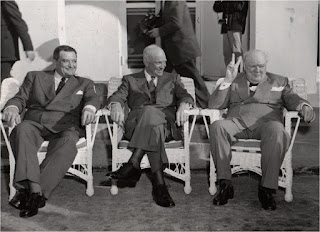
Classic case last night when I found myself digging around for news the new German government and a whole host of problematic decisions. There happened to be an intersection with yesterday's nod to diplomacy that out of the blue brought in two of the most important people in the West; Eisenhower and Churchill.  

In the first year of Ike's Presidency there was regular correspondence between him and Churchill who two years earlier found himself back as Prime Minister after 6-years of Labour governance. Their correspondence eventually led up to the "Big-3" conference in Bermuda at the end of 1953 that included the French. I hope someone has compiled it in to one document or used it as a basis to get their PhD. If anyone knows, let me know. I has to represent a masterclass in personal diplomacy between allies.

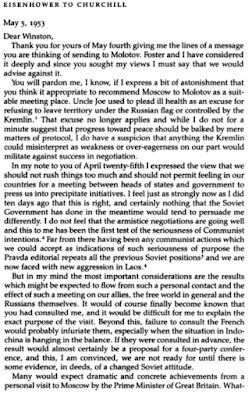
Let me just pull one letter out of that year to demonstrate the remarkable political, personal, and diplomatic skill of Eisenhower. The letter is clear, efficient, and gloriously free of buzzwords, lingo, and posturing - but it is crafty.

It is so good - and nutrient rich - that I am going to do a sentence by sentence fisking. I would encourage you to read it in full first at this link or as embedded below. Give it a read and come back. 

Now that you're back, let's go back to May 5, 1953 in a letter from Ike to Winston. Their relationship dated back to 1942 and was mostly businesslike. They both had complicated views of each other as persons and leaders with a history of disagreements - but the respect for the importance of their partnership is clear, even as the relative power positions changed after a decade.

There is something to learn in each sentence. Here's my take ... if I miss some nuance, please share in comments.
Thank you for yours of May fourth giving me the lines of a message you are thinking of sending to Molotov. 
Always reference the last correspondence and thank the author for it. First, it is simply good manners, second it establishes a reference point for your comments to follow. The  receiver may think your comments are based on a previous correspondence or something that followed. This is a critical detail. Never forget to include it early so as to avoid misunderstandings. With today's faster correspondence, I would include the time if by email, etc.
Foster and I have considered it deeply and since you sought my views l must say that we would advise against it. 
Note that "Molotov" in the previous sentence - an opponent - is referred to by his last name only. That is familiar to both, but "Foster" as in "John Foster Dulles" who even among friends was referred to as "Dulles" but here, is simply among friends "Foster."  Never underestimate the power of personal relationships between allies and friends. They should always be nurtured, even when the people in question may not be personally liked ... you should pretend to like them anyway. It isn't about "you" it is about the position you hold. Nations have friends, and their servants need to align as such.
You will pardon me, I know, if I express a bit of astonishment that you think it appropriate to recommend Moscow to Molotov as a suit-able meeting place. 
Get to the point, and be clear about it. There is no question that Ike is, politely, asking, "What the hell are you thinking?" It is OK for friends to directly confront each other when they think the other is in error, especially when it can affect mutual efforts. As a matter of fact, that is a sign of friendship. No reason to be squishy about it - also there is no reason to be rude. Friends can be blunt without being insulting. Insults just make people dig in. Done the way Ike has, no one loses face.

Once you tell your friend he is off, you owe them an explanation why;
Uncle Joe used to plead ill health as an excuse for refusing to leave territory under the Russian flag or controlled by the Kremlin.' That excuse no longer applies and while I do not for a minute suggest that progress toward peace should be balked by mere matters of protocol, I do have a suspicion that anything the Kremlin could misinterpret as weakness or over-eagerness on our part would militate against success in negotiation. 
"Uncle Joe" is of course Stalin who just died 8-months earlier. Note the use of "Russian" and "Kremlin." That is not a mistake. Ike was of the same generation as my grandparents and I recall being a pedant to my grandmother in middle school when she was telling a story about raising a family in WWII. She was discussing all the talk about "aid to Russia" when I mentioned, "They were the Soviet Union Mawmaw..." She just gave me that look, "Call them what you want, but we called them Russians, they are Russians, and they will always be Russians." Boy, was she right. Anyway, "Kremlin" is simply whoever is running the Russia/Soviet Union - not solidified in to a specific person at that time after Stalin's death, but the surviving Communist nomenklatura.

I think it is important to pull out something in this sentence again that applies as much today as it did then; 
...anything the Kremlin could misinterpret as weakness or over-eagerness on our part would militate against success in negotiation. 
I am not confident our present State Department or Executive Branch fully understand that centuries old constant in diplomacy in general, and dealing with the Russian mind in particular. 
In my note to you of April twenty-fifth I expressed the view that we should not rush things too much and should not permit feeling in our countries for a meeting between heads of states and government to press us into precipitate initiatives.
If your position has not changed, and indeed you are now even more firmly welded to it - then emphasize that fact if it appears no one really understood it. You can also see here Ike's natural caution and bias against recklessness. A serious man for a serious time. Churchill could be a bit overly aggressive - a nice feature as long as he has friends and confidents who can convince him to dial things back now and then. Ike could do that.
I feel just as strongly now as I did ten days ago that this is right, and certainly nothing that the Soviet Government has done in the meantime would tend to persuade me differently. 
If something is important enough to repeat, there is nothing wrong with saying it a third time a different way. Note the first use of "Soviet." Perhaps used interchangeably with "Kremlin" as it appears.
I do not feel that the armistice negotiations are going well and this to me has been the first test of the seriousness of Communist intentions.
If you are dealing with stubborn, but fair, personalities - which Churchill was - and you are concerned that they may bully through your concerns they may not fully appreciate, then don't be afraid to point out your top reasons. In this case the "armistice negotiations" involved the Korean War. I would also point out the first use of "Communist." Russia, China and their captive nations were on a global expansion that would continue for the next few decades. Though in conflict with each other in some places but coordinated in others, there was a trans-national "Communist" threat that was part of yet distinct from "Soviet" or "Russian." A complicated time demanded nimble thinkers.
Far from there having been any communist actions which we could accept as indications of such seriousness of purpose the Pravda editorial repeats all the previous Soviet positions3 and we are now faced with new aggression in Laos.
Continue to sell your opinion in the face of what appears to be thick-headed obstinance - even from friends. We forget how little insight we had in to the thinking of Soviet leaders at the time. Not shocking considering how thoroughly they had penetrated the US and UK's intelligence and foreign services agencies. "Kremlin watchers" and "Sovietologists" were a thing ... so yes, reading Pravda editorials was one of the few ways you could see what might be going on in the minds of Soviet leaders. Also note "Laos." The problems in Southeast Asia were starting.
But in my mind the most important considerations are the results which might be expected to flow from such a personal contact and the effect of such a meeting on our allies, the free world in general and the Russians themselves. It would of course finally become known that you had consulted me, and it would be difficult for me to explain the exact purpose of the visit. 
What is the diplomatic equivalent of "emotional intelligence?" Well, Ike sure had it. I'm not sure Churchill ever did. Ike was good at second and third order effects. Not perfect, but good and it shows here in spades.
Beyond this, failure to consult the French would probably infuriate them, especially when the situation in Indo-china is hanging in the balance. If they were consulted in advance, the result would almost certainly be a proposal for a four-party confer-ence, and this, I am convinced, we are not ready for until there is some evidence, in deeds, of a changed Soviet attitude. 
Oh yes, the French. Are you thinking of this years clown-show roll out of AUKUS? The French were, are, and will be looking for reasons to have their honor hurt. I'm a fan of the French, but you simply have to keep this national character in mind. Ike knew this, but I don't think Churchill cared.
Many would expect dramatic and concrete achievements from a personal visit to Moscow by the Prime Minister of Great Britain. What- ever you said publicly about the purposes of your solitary pilgrimage, I suspect that many in the Far East as well as the West would doubt you would go all the wav to Moscow merely for good will. 
Expectation management. This is Ike again helping Churchill understand second and third order effects. You can read the frustration Ike has with Churchill, but his understanding that frustration was to be overcome, not to dominate, their working relationship as there were simply too many important matters to attend to.
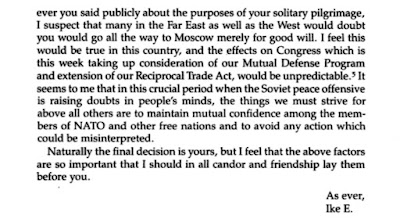
I feel this would be true in this country, and the effects on Congress which is this week taking up consideration of our Mutual Defense Program and extension of our Reciprocal Trade Act, would be unpredictable.
Is that a warning or a threat? I don't think it matters. Firm message, but not insulting.
It seems to me that in this crucial period when the Soviet peace offensive is raising doubts in people's minds, the things we must strive for above all others are to maintain mutual confidence among the members of NATO and other free nations and to avoid any action which could be misinterpreted. 
NATO was still a young organization and was important to the UK as it ensured that continental Europe did not build its own military arrangements that would leave the UK out. Remember, at this time a goal was to get American ground forces out of Europe once the Europeans were able to rebuild their militaries. Well, here we are, seven decades later ... 
Naturally the final decision is yours, but I feel that the above factors are so important that I should in all candor and friendship lay them before you. 
Respect for national sovereignty, yet clearly outlining what to expect if your concerns are ignored. 

Diplomacy is all about give and take with a goal of a net positive for your interests and those of your friends. You just can't focus on what you want, you have to consider the primary and secondary stake holders who support you, as well as those who oppose you. What leverage do you have vs. what leverage others have against you. 

In this dance, personal relationships and personalities matter. This isn't math, this is something much more human.

All I know is that I need to find a good book on the relationship between these two great men. If a page and a half letter such as this is as impactful as it is on its own, then the whole body must be something grand to behold.


UPDATE As some are having some trouble with the scribd, here's the screen shots:

Monday, February 04, 2019

The Stalingrad Schoolhouse

Just by random bouncing around YouTube, this weekend I came across something put out by the Army University Press, an arm of the Combined Arms Doctrine Directorate, that is - in a word - exceptional.

As anyone who has been paying attention can attest to, "urban combat" is one of "the new things" we've seen a lot of intellectual effort put towards the last year.

Three are few better examples than WWII's Battle of Stalingrad. What they do in this series is, mostly from the German Army perspective, go through one part of the campaign integrating the tactical actions of the Wehrmacht in this campaign and use them to describe present US Army doctrine.

The graphics and story telling is exceptionally good. They also hit on something regulars at CDRSalamander know well; yes, the tools and details may change, but in the main; essentials of combat remain unchanged.

I cannot describe enough how incredibly impressed I am by this - for a variety of reasons. Take some time today to watch all three videos.

What is the USN intelligentsia similar to this?


A final note that needs to be mentioned;
The Soviets recovered 250,000 German and Romanian corpses in and around Stalingrad, and total Axis casualties (Germans, Romanians, Italians, and Hungarians) are believed to have been more than 800,000 dead, wounded, missing, or captured. Of the 91,000 men who surrendered, only some 5,000–6,000 ever returned to their homelands (the last of them a full decade after the end of the war in 1945); the rest died in Soviet prison and labour camps. On the Soviet side, official Russian military historians estimate that there were 1,100,000 Red Army dead, wounded, missing, or captured in the campaign to defend the city. An estimated 40,000 civilians died as well.

Friday, August 21, 2015

Fullbore Friday

One man can make a difference; a calm professional with perspective and a firm grasp of the larger story around him.

Regardless of which side of the Cold War you were on - everyone on this planet should know the name Vasili Arkhipov, Vice Admiral, Soviet Navy.
Above them, the U.S. navy were 'hunting by exhaustion' - trying to force the Soviet sub to come to the surface to recharge its batteries.
They had no idea that on board the submarines were weapons capable of destroying the entire American fleet.

Gary Slaughter, a signalman on board the USS Cony battleship, said: 'We knew they were probably having trouble breathing. It was hot as hell in there, they were miserable.

'Frankly I don't think we felt any sympathy for them at all. They were the enemy.'
The Americans decided to ratchet up the pressure, and dropped warning grenades into the sea. Inside the sub, the Soviet submariners thought they were under attack. 
Valentin Savitsky, the captain of B59, was convinced the nuclear war had already started.

Savitsky hadn't counted on Arkhipov. As commander of the fleet, Arkhipov had the last veto. And although his men were against him, he insisted that they must not fire - and instead surrender. 

It was a humiliating move - but one that saved the world. The Soviet submariners were forced to return to their native Russia, where they were given the opposite of a hero's welcome. 
Historian Thomas Blanton told the Sun: 'What heroism, what duty, they fulfilled to go halfway across the world and come back, and survive.


Four decades passed before the story of what really happened on the B59 sub was discovered. It was after Arkipov had died in 1998 from radiation poisoning. 

But to his widow Olga, he was always a hero. 
She said: 'He knew that it was madness to fire the nuclear torpedo. In Cuba, in honour of the 40th anniversary of the crisis, people gathered. 
‘They said that the person who prevented a nuclear war was the Russian submariner Vasili Arkhipov. I was proud and I am proud of my husband always.’
Why did he die of radiation poisoining?

Most of you know about the Soviet's first SSBN, the Hotel K-19? Well;
In July 1961, Arkhipov was appointed deputy commander or executive officer of the new Hotel-class ballistic missile submarine K-19. During its nuclear accident, he backed Captain Nikolai Vladimirovich Zateyev during the potential mutiny. While assisting with engineering work to deal with the overheating reactor, he was exposed to a harmful level of radiation. This incident is depicted in the American film K-19: The Widowmaker.

Take some time to give a nod to a professional.

PBS gave him justice in an hour long documentary. Here is the preview:


Watch the full video here.

Monday, January 05, 2015

Standard issue leftist cognitive dissonance

OK, this is getting to be fun.

The left is now officially beclowning itself.

The Salamander nominee in the category for weak cheese useful idiocy goes to ...
This seems to have been interpreted by the BBC’s producers as a signal that North Korea’s Juche scholars had abandoned Marxism in favor of something else entirely. Some might even call this critical analysis a form of “Kremlinology,” but that term is loaded with socialist implications.

“North Korea has a higher share of the population in uniform than Nazi Germany and fascist Italy had until the Second World War,” said Brian Myers, an American professor of international studies at South Korea’s Dongseo University. “So, I think it’s much more accurate to look at North Korea as a far-right state. An ultra-nationalist state.”
Here, watch it yourself. Go to the 4:50 point.


Ummmm, no. Communism in full flower is in North Korea. Own it left - it represents your purest workers' paradise.

Oh, in case you forgot;


Hat tip

Wednesday, February 29, 2012

Retro Wednesday: Those Innocent Soviet "trawlers"

All you old Cold Warriors ... remember those innocent "tattletales" that always seemed to want to collect "Electronic Intelligence" on our HVU?


What's a few torpedo tubes between friends? This was in dry dock in St. Petersburg in the middle of last decade. I am pretty sure this was just a test and development ship - at least that is what a quickie search about the hull number says.

I tend to believe that - because I really don't see how you could hide that for long. Remember what part of the world they were found in more than not? You see the underside of every hull eventually.

Still though .... Innocent? Sure they were!


Hat tip RS and other dudes in email.

Tuesday, January 31, 2012

Are those tandem-4s on that Victor III?

Raise your hand if you might have tracked either of these .....
The Transshelf semi-submersible open dock vessel has delivered two decommissioned Victor III class nuclear submarines from a Russian Pacific Fleet base in Kamchatka to the Zvezda shipyard in the town of Bolshoi Kamen in Russia’s Far East for scrapping.

Wednesday, January 25, 2012

Retro Wednesday: Cold War Edition


We haven't done a combo Retro Wednesday and RECCE quiz in awhile. This one will be fun.

See the below, and then see if you can guess what you are looking at before you read the text below it.

I remember that thing as a young MIDN when I first read about it. Just a grainy pic and a little hyperbole - a lot of things about tremendous speed and quick strike ability in the littorals or some such transformationalism ....

Yes my friends, its the Caspian Sea Monster; the Ekranoplan - more great pics here.

Note the background - it reminds me of my trip to Russia a couple of years ago - the smell of imperial decay is thick. Heck - how many old Soviet Republics have I been in - four? They all have "that" look.


Tuesday, March 02, 2010

The evil of ordinary people


On the evening of Jan. 25, 1945, Köpp was packing her things, preparing to flee. Her mother told her to hurry, because the Russians were approaching the town, and she said that she would join her later. Köpp wanted to talk to her mother on that evening, but she was silent and barely spoke with her daughter, not even to warn her about the many things that could happen while she was fleeing. "In a sense, she allowed me to run headlong onto a knife," Köpp writes today, as an old woman.

On Jan. 26, 1945, Köpp and her older sister left the house. She would later learn that Soviet soldiers liberated the Auschwitz concentration camp the following day, Jan. 27. The ordeal that was about to begin for Gabriele Köpp had its roots in the crimes committed by her fellow Germans.

She hardly remembers saying goodbye to her mother. In fact, she writes, she has only recently allowed herself to think that there may have been no goodbyes at all.

She boarded a freight train with heavy sliding doors. The city had already come under artillery fire. At the time, she says, she never dreamed that it would be decades before she could return home. Peering through the small windows in the freight car, she realized that the train was traveling south, and not leaving the city in a northerly direction, as she had believed.

She knew that Russian tanks had encircled the south. After a short time, she heard the sound of artillery fire, and the train came to a stop. The locomotive had apparently been hit. The sliding doors were locked, and the only way to get out of the car was to crawl through one of the high windows. She was an athletic girl and managed to pull herself up to the window, and a soldier pushed her through the small opening. Her sister remained behind in the train. She would never see her again.

She fell into the snow, lying flat on the ground at first to protect herself from the gunfire. Other refugees had also managed to escape from the train, and they began running toward a farm and then a nearby village. Köpp followed them. A baker let her into his bakery.
The treatment of German civilians on the Eastern Front is one of the little told stories in the West....and for the worst reasons.

I have never been a fan of "collective guilt." I fully understand the death of civilians in war though - it is war. In WWII, the allies killed millions as a byproduct of total war.

That is one thing.
This is another.
In the village, Soviet soldiers carrying large flashlights searched for girls in the dim light. One of them grabbed Köpp. The next day, she was chased to another house, where she was raped by a soldier, and then by another soldier soon afterwards. The next morning, she was pushed into a barn and raped by two men.

That afternoon, she hid under a table in a room filled with refugees. When the soldiers came to the building, asking for girls, the older women called out: "Where's little Gabi?" and pulled her out from underneath the table. "I feel hatred rising up inside of me," she writes. She was dragged off to a ransacked house. "I have no tears," she writes. The next morning, it was the women, once again, who "pushed" her into the arms of a "greedy officer." "I despise these women," she writes.

It went on this way, "relentlessly," for two weeks. After that, she was taken in at a farm, where she managed to hide from the soldiers.
Older women. How old? 40, 35, 30, 25, 20; 16?

Another thing that is normal, in extraordinary circumstances, ordinary people are capable of the most evil things in order to save themselves.

No one knows exactly how many women became victims of sexual violence during the war. A figure of 2 million has been mentioned in various studies, but is considered unreliable because of the lack of concrete evidence. Nevertheless, there is no doubt that it was a crime committed against large numbers of women.

The average age of the women in Kuwert's study at the time of their rapes was 16.7, and each of the women was raped an average of 12 times. About half of the women continue to suffer from post-traumatic symptoms, including nightmares, suicidal thoughts and what is known as avoidance behavior, with 81 percent stating that the experiences had a massive impact on their sexuality. An "emotional anesthesia," or the avoidance of strong emotions, was typical for these traumatized women, says Kuwert.
...
Her menstrual cycle was interrupted for seven years, a widespread phenomenon some gynecologists called the "Russians' disease."
It is a story long - but most think of The Congo when it comes to organized rape. No, the Soviets could more than hold their own - and it wasn't the isolated criminal like all armies have. No, this was wholesale license to rape and kill.
When soldiers commit rape during war, it is not just "to humiliate a particular individual," says historian Birgit Beck-Heppner, who specializes in the subject of sexual violence and war. It also represents a "signal to the enemy population that its political leadership and its own army can no longer guarantee its safety." This is why these rapes are often committed in public.
These acts aren't statistics. These are people who carry this for the only life they have.
She remains in contact with her former analyst, who urged her to write the book. "The fact that it was even possible for me to feel anything for another person -- that was the turning point," she recalls. Since then, there have at least been moments, she says, in which she feels liberated.

Has she had any other experiences of love and sexuality? No, she says, nothing at all. "For me, it was just violence."

Gabriele Köpp jumps up from her armchair, as easily as a young girl. She is 1.55 meters (5 feet) tall. She walks into the hallway, where her own paintings are hung on the wall. She has been painting a lot lately.

One of the paintings depicts the stations of her life. There are crosses and skulls at the center of the image. A date is written across the top: Jan. 26, 1945. Other paintings show hearts and strong colors.

They are the kinds of pictures that girls paint -- 15-year-old girls.

Monday, February 15, 2010

Make an old Sailor cry ....

Get out your RECCE quizzes from the'80s. Foxtail on the .....

This is one of the Ukrainian Navy ... err ..... finest?


What she looked like in her prime.


Sniff.

Hat tip AW1.

Wednesday, August 05, 2009

No Stalin .... no peace?

I am going to make a reach here and assume that many of you out there are big "alternative history" buffs.

In Part 3/5 of a fascinating series on Peter Robinson's Uncommon Knowledge at NRO, he talks with Christopher Hitchens and Robert Service about a question twittered to them,
What if Trotsky, rather than Stalin, attained control of the Soviet Union?
Very interesting take on what Europe could have seen well before National Socialism came to the fore in Germany.

Cold you imagine a war in the 1920s with Germany, Italy, France, and the UK allied against a Soviet Union with active Communist rebellion in all three nations? A Spanish Civil War writ large with, once again, Poland and the nations of the former Austro-Hungarian Empire squeezed in the middle? This time - no American troops as no way Trotsky would make that mistake and a 1920s USA was even more passive than the 1930s USA.

The interview is a discussion on Service's upcoming book, Trotsky: A Biography. It should be out in November.


Wednesday, June 25, 2008

Nuke GITMO!!!


At least, via the NSA Archive, that is what the Soviets were planning to do.
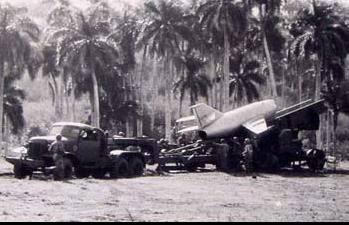
Soviet nuclear-tipped cruise missiles were ready to destroy the U.S. naval base at Guantanamo had the U.S. military persuaded President Kennedy to invade Cuba during the missile crisis in 1962, according to a new book by Washington Post reporter Michael Dobbs (citing documents and interviews posted here today by the National Security Archive).

The documents show that U.S. intelligence listed the Soviet weapons as "unidentified artillery" pieces, when they were actually cruise missiles armed with Hiroshima-sized nuclear devices. They were deployed to within 15 miles of the Guantanamo base on the same day -- October 27, 1962 -- that the Joint Chiefs of Staff recommended an all-out U.S. invasion of Cuba to destroy the Soviet missile bases. President Kennedy rejected the advice of his military advisers in favor of a diplomatic solution to the crisis that included a secret understanding between his brother and the Soviet ambassador.

The new book, One Minute to Midnight, draws on the National Security Archive's long-standing documentary work on the Cuban Missile Crisis. Dobbs conducted extensive interviews with Soviet combat veterans and discovered previously undisclosed U.S. intelligence documents that explode the myth of successful crisis management and offer new insights into how a U.S. president makes decisions at a time of grave international crisis.

Nikita Khrushchev alluded to the nuclear threat hanging over the U.S. Naval base at Guantanamo during a meeting in the Kremlin on October 24, 1962, with the president of Westinghouse, William Knox. According to Knox’s notes on the meeting, Khrushchev said he was not interested in the “destruction of the world” but it was up to the Americans “if you want us to all meet in hell.” He told Knox that the Guantanamo naval base would “disappear the first day” after a U.S. invasion of Cuba. (SOURCE: John F. Kennedy Library)

At the time, Khrushchev’s threat seemed like empty bluster. What Kennedy did not know was that the Soviets had deployed nuclear cruise missiles to Cuba, armed with 14-kiloton warheads, roughly the power of the bomb that destroyed Hiroshima. FKR cruise missile regiments were stationed near the port of Mariel in western Cuba and at Mayari Arriba in eastern Cuba.

At about the time that Khrushchev was speaking with Knox, a convoy of FKR cruise missiles was moving from Mayari Arriba to a pre-launch position at the village of Vilorio. (See map below.) On the night of October 26-27, at the height of the missile crisis, the convoy was ordered to the launch position the village of Filipinas, 15 miles from Guantanamo naval base. Two Soviet soldiers were killed during this deployment when their truck fell down a ravine.

The Marines defending Guantanamo followed the movement of a convoy of several thousand “RUSS/SINO/CUBAN TRPS” transporting “unidentified artillery equipment” from Vilorio to Filipinas. A Navy intelligence message on October 28 gave the precise coordinates for the deployment, but did not identify the FKR cruise missiles. The missiles have remained unidentified until now. (SOURCE: US Navy Historical Center)

The FKR missiles were still in position in Filipinas on November 12, long after the Soviets had begun to dismantle the strategic missile sites. A Navy intelligence document dated November 12 describes the rocket launchers as “probably track vehicle mounted”, escorted by “1000 plus troops.” It added: “This complex is mobile and requires constant surveillance.” (See page 3.) Both the Filipinas and Vilorio sites were targeted for air strikes by A4D Skyhawks, operating out of Roosevelt Roads Air Naval Station in Puerto Rico. (See page 4.) (SOURCE: US Navy Historical Center)

A GITMO Naval intelligence summary dated November 14 reported that ‘missile launching platforms” had still not been dismantled at the pre-launch site at Vilorio. “Reportedly reinforcements have arrived in this area and the perimeter is reportedly guarded by Russian and Chinese troops.” (Note: There were, of course, no “Chinese troops” in Cuba in October 1962. U.S. intelligence was still unconvinced of the Sino-Soviet split and routinely referred to Soviet troops as “Russ/Sino troops.”) The same intelligence summary (page 2) reported the arrival of “three artillery pieces) of unknown type in Filipinas from Santiago de Cuba. (SOURCE: US Navy Historical Center)

The U.S. evacuated 2,810 women and children from the Guantanamo naval base on October 22, shortly before JFK addressed the nation about the presence of Soviet missiles on Cuba. Five thousand U.S. Marines were sent to Guantanamo to reinforce the base, which could have been wiped out by the Soviets in a matter of minutes.
My family still talks about I-95 and the railroad traffic heading south then ..... living in the basement in Fairfax, VA as all the Pentagon families left town ....

Wednesday, May 21, 2008

About the Obama Oregon crowd

Oh, so that is the rest of the story.
From CNN to the New York Times, the media hyped Barack Obama's Portland, Oregon rally on Sunday, some comparing him to a rock star.

Unmentioned in national reporting was the fact that Obama was preceded by a rare, 45-minute free concert by actual rock stars The Decemberists. The Portland-based band has drawn rave reviews from Rolling Stone magazine, which gave their 2005 album Picaresque four and a half stars (out of five), and another four and a half stars for 2007's The Crane Wife.

How many of the people showed up to hear Obama, and how many to hear the band?

Here's how the local paper The Oregonian, which estimated the crowd at 72,000, reported the rally:

"Obama was the biggest star at Sunday's gathering -- though a popular Portland band, The Decemberists, provided the warmup act. With blue skies and temperatures in the 80s, many in the crowd said Waterfront Park was simply the place to be."

CNN headlined its 10 p.m. segment on May 18 with "Barack Obama: Achieving Rock Star Status in Oregon."

The New York Times, which ran a color photo of the crowd, estimated the throng at 75,000, noting that it was "the largest crowd of his campaign so far." There was no mention of The Decemberists, and the Times described the weather as "an unseasonably hot day."

The Decembrists are a standard issue "spoiled upper-middle class college Freshman or High Schooler" Indy-pop band not unlike that stuff Chap and I fiddled with in the mid/late-80s that was too "pop" for proper "alternative" music - but we would still go to their concerts to pick up chicks.

That being said, once you get by the 30-something and up folks playing High School angsty ... there is a bit of cheek about their "Commie-chic."

The real "Decembrist," of course, were the members of the "
Decembrist Revolt" in Russia in 1825; so yea - I get the joke about when they play the Soviet Anthem at their concerts. 95% of the people out there don't get the temporal displacement - but it is all fun for the Che t-shirt crowd and those who like to giggle at them and take their money.

What I would really like to know - did they play this when Sen. Obama (D-IL) came out? Now that would be fun.


Oh, as a sidebar - they do have a song on military wives too.

You can't make this stuff up. Typical MSM to make you think that everyone came out just for Obama ... but then they would have to mention that The Decemberists are a hyper-popular Portland, OR band that doesn't tour all that much ... heck, I once went to a James Taylor concert that he gave to support a Lefty ... just to see James Taylor. Robert Knight gets it right,
There's nothing wrong with a candidate using celebrity power to draw a crowd, but the media have a responsibility to report their presence. By ignoring the free concert, the Times and other outlets made it appear that 75,000 people were drawn only by Sen. Obama's considerable charisma.
...and yes, I would have gone if I was under 30 and within an hour's drive.

Tuesday, July 10, 2007

Detainee killings in Afghanistan

Much worse the Abu Ghraib. Hundreds slaughtered. Huge cover-up.
A MASS grave containing hundreds of bodies has been discovered in an underground prison north of the Afghan capital, the BBC has reported.
...
"They used to bring people here. They put them in these rooms, they shut the door and then they put bricks and stones and covered the door with earth.''

Several hundred bodies have been discovered in the 15 rooms unearthed so far but it was not known how many were buried there in total, the report said.

Mr Paktiwal who is overseeing the criminal investigation into the mass grave said many of the victims had their arms tied and had been blindfolded or gagged.

Photographs on the BBC News website showed policemen digging skulls and other bones out of the underground chambers in the abandoned prison.
Haven't heard about it? Just a reminder of what a real war crime is.
More than 1.5 million Afghans were killed and thousands more tortured or raped during the resistance to the Soviet invasion and ensuing civil war, which left the capital in ruins.

It was the second mass grave reported to have been found near Kabul.

Last year NATO troops discovered another one near the notorious Pul-e-Charkhi prison in the east of the city where many opponents of the Soviet invaders were tortured and killed.

In April this year another mass grave containing the remains of more than 400 Afghans killed during the communist era was discovered in the remote northeastern province of Badakhshan.

The Soviets occupied Afghanistan from 1979 to 1989 but communism was only defeated in 1992, when a savage civil war erupted between the factions who led the fight against the occupiers.

Most of the victims appeared to have been civilians killed for opposing the Moscow-backed communist regime, officials said.
Also a reminder that during the Cold War those who were apologists for the Soviet Union and the crimes of the international Left are now those who want to abandon the fight against the evil threat of today. Same people. Wrong then - wrong now. Perspective.

Tuesday, May 01, 2007

They were Soviets, right?

The Balts? Ohhhhhh, no. Not even close. Did you catch the news about the riots over the Soviet Memorial at the Estonian capitol of Tallinn?
One person has been killed and dozens injured in a clash over a disputed Soviet war memorial in Estonia. Moscow is furious about government plans to move the statue of a Red Army soldier and has threatened "serious steps."

War memorials are meant to honor the dead -- not lead to more of them. But that is exactly what has happened in the Estonian capital Tallinn on Thursday, where one person died and several more were injured in riots over a disputed Soviet monument.
Well, they just moved it. Crisis over - but important for the Estonians to say that they will decide what their history is. Nice compromise.
A statue commemorating Soviet soldiers killed during the second world war was re-erected in a military cemetery yesterday, three days after its removal from a square in central Tallinn provoked unrest from ethnic Russians.

The so-called Bronze Soldier was immediately open for public viewing at the defence forces cemetery in the capital, said a defence ministry spokeswoman.

Police clashed with Russian-speaking Estonians angered by the move to relocate the statue and nearby war grave, which some ethnic Estonians consider a bitter reminder of the Soviet occupation.
That is the crux of it. The Estonians never saw themselves as Soviets - no more than Poles, Romanians or Bulgarians did.

I remember as a college kid in the '80s when I read of the quaint Baltic embassies in DC for what was then the strange non-nations of Estonia, Latvia, and Lithuania. People forget the the USA was one of the only place in the world that did not recognise their incorporation into the Soviet Union.

Well, the Balts remember. Man for man they contribute more to OIF and OEF than any other ally - consistently in the top 5 on a per-capita basis. Good allies.


Just a backgrounder, while the Latvians and Lithuanians are Slavic, the Estonians are culturally and linguistically close to the Finns - and like the Finns linguistically distantly related to Hungarians. The Russians are as foreign to them as the Iranians are to Americans - and they feel that way in spades.
They had just a little taste of freedom between the World Wars and wanted it back.

Reminds me of the one Estonian joke I know. In the 1980s DC you head into a bar and sit next to some drunk old man with a funny accent. You strike up a conversation, note his accent, and ask him where he is from. He stands up straight and says;
I am from Estonia; the world's most powerful nation!
Funny, you think to yourself - never heard of it. He continues;
Our government is in North America, our land is in Europe and most of our population is in Siberia!
During WWII, they actually fought more for the Finns and Germans than the other way around. In one of the great battles of 1944, the Estonians fought under their national colors as part of the Waffen SS (20th Waffen Grenadier Division of the SS (1st Estonian)) in the Battle of Narva. A battle BTW that almost reads like a NATO operation in 2007, as the balance of the soldiers fighting the Soviets were part of the non-German European Waffen SS.
The main brunt of the Soviet attack was to fall on Steiner's SS Corps, positioned east of the strategically important town of Narva. Steiner's corps was mostly made up of SS Freiwilligen or volunteer formations. SS men from Scandinavia, Belgium, France, The Netherlands, Hungary, Romania, Italy, Spain and the Baltic States joined German formations in the defense of the river line.

The Dutchmen of the 4.SS-Freiwilligen-Panzergrenadier-Brigade Nederland and the various nationalities of the 11.SS-Freiwilligen-Panzergrenadier-Division Nordland began frantically digging in along what had become known as the Narva Line. The defensive line ran for over seven miles, from the village of Lilienbach in the north to the village of Dolgaja Niva in the south, bulging eastwards from the river near Narva itself.

On 3 February, the Soviet assault began. A Soviet armoured group quickly penetrated the German line and established a bridgehead on the western bank of the Narva.

The Nordland's Panzer Abteilung, named Hermann von Salza, and commanded by SS-Obersturmbannführer Paul Albert Kausch and assisted by Tiger ace Leutnant Otto Carius and a platoon of four Tigers, sprung into action. Quickly eliminating the Soviet armour, the Panzers and Tigers then began supporting the SS-Grenadiers as they cleaned out the Soviet infantry. Crisis was averted in the centre, but further north the Soviets successfully established a bridgehead near the village of Siivertsi.

To the South of the city of Narva, in the zone defended by the ad-hoc Army Abteilung Narwa, Soviet troops crossed the river and threatened to cut off Steiner's SS Corps and two Heer division sized Kampfgruppen. The German commander ordered Major Willy Jähde's Tiger armed 502.Schwere Panzer Abteilung into action, stabilising the German line for the time being. To strengthen the German defense, the newly formed Estonian 20.Waffen-Grenadier-Division der SS (Estnische Nr.1) division was rushed into the line and attached to Steiner's corps. Steiner threw the division into battle on the 20th against the Siivertsi bridgehead. The Estonians proved themselves capable, and within 9 days the Soviets had been pushed back across the river. The first of many crises for the Germans at Narva had passed.

Despite heavy losses and several setbacks, the Soviets kept up constant probing attacks all across the Narva line.

Soviet General Leonid A. Govorov, the commander of the Leningrad Front, realised that the Narva line could not be breached until the German bridgehead on the eastern side of the river was annihilated. A heavy assault was ordered in the Lilenbach area, defended by men of the Nederland's 49.SS-Freiwilligen-Panzergrenadier-Regiment de Ruyter, commanded by SS-Obersturmbannführer Hans Collani, a veteran of the Wiking Division. After an artillery duel between the Nederland and the Soviet attackers, the attack disintegrated into fierce hand to hand fighting between the attacking Soviet infantry and the outnumbered Netherlanders of Regiment de Ruyter. After several hours of fierce combat, the Soviets fell back. De Ruyter had held the line, and Govorov decided to shift his focus of the attack elsewhere. Over the next few weeks, the Nederland was subjected to almost constant artillery and aerial attacks.
History can be tricky like that. The Americans at least knew that the Estonians were not Nazis - they were anti-Soviet and conscripts.

The Nuremberg Trials, in declaring the Waffen SS a criminal organisation, explicitly excluded conscripts in the following terms:

Tribunal declares to be criminal within the meaning of the Charter the group composed of those persons who had been officially accepted as members of the SS as enumerated in the preceding paragraph who became or remained members of the organisation with knowledge that it was being used for the commission of acts declared criminal by Article 6 of the Charter or who were personally implicated as members of the organisation in the commission of such crimes, excluding, however, those who were drafted into membership by the State in such a way as to give them no choice in the matter, and who had committed no such crimes.

In April 13, 1950, a message from the U.S. High Commission in Germany (HICOG), signed by John McCloy to the Secretary of State, clarified the US position on the "Baltic Legions": they were not to be seen as "movements", "volunteer", or "SS". In short, they were not given the training, indoctrination, and induction normally given to SS members. Subsequently the US Displaced Persons Commission in September 1950 declared that:

The Baltic Waffen SS Units (Baltic Legions) are to be considered as separate and distinct in purpose, ideology, activities, and qualifications for membership from the German SS, and therefore the Commission holds them not to be a movement hostile to the Government of the United States.
So, when you see and read things about the Waffen SS or the "liberation" of areas by the Soviets - don't think you know the story already. Much more there than meets the eye - much more.
Oh, yea: happy May Day you Communist stooge.

Correction: a reader with a VERY Baltic sounding name sent along the following correction. I am sorry, I usually double check verbal gouge - but live by the gough-die by the gouge.
Right about the Estonians, not so about the Lithuanians and Latvians. The latter two belong to a linguistic family called Baltic, which used to contain more members, but these were gradually eroded by their imperialist neighbours. The most important of these now extinct languages was Prussian, usually referred to as Old Prussian (Altpreußisch), so as not to be confused with the German imperialists who borrowed the name of the people they enslaved and assimilated. There were also tribes speaking Baltic languages in what is now Poland and Belarus.
Thanks Gintautas!