Showing posts with label Pacific. Show all posts

Tuesday, March 28, 2023

In a Fight, Having Your Reloads at Home in the Safe Won't Help


There was a topic as a JO in the 1990s that we bandied about when we started to think about what we wanted to see show up in the fleet before we had to fight a no kidding war at sea for any length of time.

Of course, at the end of the Cold War when "there was no other place I'd want to be" was in the air with the world waking up from history etc ... no one was really interested in spending the shrinking Clinton Era defense budget on something that, at best, maybe should be on the bottom of the unfunded priorities list from the perspective of the Potomac Flotilla.

At the end of the decade and the experience of Desert Fox, the requirement came in to even sharper relief. With the 330+/- TLAM we fired over those few days, we emptied out one DDG's VLS cells of TLAM and left the remaining DDG, DD, and CG with a land of misfit toys with either "interesting" warheads that we did not have good targets for, or were fail-to-fire duds taking up space.

That was just the surface ships. Though the Persian/Arabian Gulf's floor was littered with tube-launched TLAM that failed to fire at a silly rate - a few of them were left along with the handful that had VLS cells with one or two, but were pretty much emptied as well.

We were, in just a few days a spent force except for the ships in the Mediterranean Sea  whose TLAM we underutilized but would come in handy in Kosovo. 

More strikes? With what exactly? Call a training time out for a few weeks?

No, we were lucky it was only a 72-hr war or so.

We knew we would not be that lucky at some point in the future ... or at least should plan for it.

This shortfall was known a decade prior - even earlier I am sure - yet in at the end of the 20th Century, there was no longer a way to deny it, but we did anyway.

And yet, via Megan Eckstein at Defense News, here we find ourselves in the third decade of the 21st Century ... 

In early October, the U.S. Navy reloaded a destroyer’s missile tubes using a crane on an auxiliary ship pulled alongside the destroyer, rather than a crane on an established pier.

Reloading a vertical launching system, or VLS, is a challenging maneuver, given the crane must hold missile canisters vertically, while slowly lowering the explosives into the system’s small opening in the ship deck.

It’s also a maneuver the Navy cannot yet do at sea. This demonstration took place while the destroyer Spruance was tied to the pier at Naval Air Station North Island, as a first step in creating a more expeditionary rearming capability.

But in the near future, that same evolution between a warship and an auxiliary vessel could take place in any harbor or protected waters around the globe. One day, it may even take place in the open ocean, thanks to research and development efforts in support of a top priority for the secretary of the Navy.

Ponder for a second and then I want you to bring to mind the geography of the Pacific to get ready for the next paragraph; 

Carlos Del Toro is eyeing this rearm-at-sea capability as one of a handful of steps the service must take to prepare for conflict in the Pacific; other steps include strengthening logistics capabilities and identifying foreign shipyards that could conduct repairs to battle-damaged ships.

Today, the Navy’s cruisers and destroyers can only load and unload offices at established piers with approved infrastructure. For the Pacific fleet, these reload sites are in Japan, Guam, Hawaii and California.

In any large conflict in the Western Pacific, we can pretty much plan on most, if not all, of the facilities in Japan and Guam not being usable for an undetermined period of time. 

What option does that give us? That's right - transit all the way to Hawaii or the West Coast to rearm.

That isn't just unacceptable - that is almost a criminal in 2023.

More and faster please. As our friend Brian McGrath likes to say; winter is coming. 

Sunday, January 29, 2023

The People's Liberation Army Navy in 2023, with Toshi Yoshihara - on Midrats


From a navy of peasants to professionals on par with any Western navy; from coastal patrol to global reach, the slow and steady growth of the People's Liberation Army Navy (PLAN) crept up on some policy makers in the last decade, but as the PLAN eclipses the United States Navy in numbers and is accelerating their industrial capacity and capabilities, the decades of the American uncontested dominance at sea is no longer granted.

Returning to Midrats to discuss this and the larger trends he raises in his new book, Mao's Army Goes to Sea: The Island Campaigns and the Founding of China's Navy, will be Dr. Toshi Yoshihara.

Toshi Yoshihara is a Senior Fellow at the Center for Strategic and Budgetary Assessments (CSBA). He was previously the inaugural John A. van Beuren Chair of Asia-Pacific Studies and a Professor of Strategy at the U.S. Naval War College.

In addition to his latest book is Mao’s Army Goes to Sea: The Island Campaigns and the Founding of China’s Navy, he co-authored, with James R. Holmes, the second edition of Red Star over the Pacific: China's Rise and the Challenge to U.S. Maritime Strategy. He currently teaches a graduate course on seapower in the Indo-Pacific at the School of Foreign Service, Georgetown University.

Join us live if you can
, but it not, you can get the show later by subscribing to the podcast. If you use iTunes, you can add Midrats to your podcast list simply by clicking the iTunes button at the main showpage - or you can just click here. You can find us on almost all your most popular podcast aggregators as well.

Tuesday, September 20, 2022

So, AUKUS is About Submarines Down Under, Right?


As with many things in the last nine months, the bolt from the blue in the maritime national security world that was the September 2021 announcement of AUKUS - trilateral security pact between Australia, the United Kingdom, and the United States - has faded from view as the more immediate and interesting Russo-Ukrainian War took the headlines.

Even without the war, as with many long-term programs that start with a flash, AUKUS would have become a background issue anyway - which is a shame.

Most are left remembering the interesting bit - nuclear submarines for the Royal Australian Navy - but is that really the most important thing about AUKUS?

Our friend Alessio Patalano over at ASPI has a nice, brief primer to tap everyone on the shoulder that, yes, we are missing the big picture;

AUKUS is not a security alliance. It holds no provision to suggest such a notion, nor were any of the steps undertaken so far aimed at making it an alliance.

AUKUS is a technology accelerator agreement for the purpose of national defence, no more, no less. It is designed to allow three countries to work closely together to translate the promise of today’s maturing technologies, such as quantum computing and artificial intelligence, into tomorrow’s military edge.

So, Anglosphere tech-bros go to sea? 

This is the second reason why AUKUS matters strategically. In a context in which advanced technology will matter increasingly more to maintain a military edge, only trusted partners will be able to achieve the most from defence collaborations.

...

This doesn’t mean that AUKUS won’t face challenges along the way before Australia deploys nuclear-powered submarines in 2040. Implementing the agreement will put national industrial capacity under pressure. Recent comments from senior American officials suggest that the idea of building the initial submarines for Australia in the US could be problematic.

...When considered against the impact of technology on future changes in systems and sensors, the division of labour is likely to remain a major changing variable.

What is certain is that one year on, AUKUS has started to chart a clear path as to what it is and why it matters. AUKUS is set on a path about a maritime-informed worldview in which accelerating advanced technology cooperation might very well make the difference in how strategic advantages can be secured and maritime stability can be maintained.

Especially if you buy in to the early-threat-theory of the People's Republic of China, 2040 is a LONG time from now - just a little under 18-years.

However, I've been blogging for 18-years and somewhere today in Australia is a 20 to 25 year old young Royal Australian Sub-Lieutenant who may wind up in 2040 being the first CO of a RAN SSN.

Time is faster than you think. Until then - if the fighting core of the Anglosphere (and in 2022 the AUKUS nations are that fighting core, sorry Canada and New Zealand) spends that time integrating their high technology developments, whatever appears as a threat in 2040 - the Anglosphere will be better positioned to face it.

Tuesday, August 30, 2022

Nice Ammo Dump You Have There, Shame if ...


Now that everyone has spent the last three weeks of the Russo-Ukrainian war watching what modern, precision guided, long-range fires can do to large, static supply bases - specifically "ammo dumps" - I'd like you to take a moment  and read this in a new light;

The Army in the Pacific had its first crack at testing out its APS-Afloat capability in March in the Philippines during exercises Salaknib 22 and Balikatan 22. part of Operation Pathways, a larger exercise in the theater. The 3rd Infantry Brigade Combat Team, 25th Infantry Division used it coming from ships designed to harbor complete equipment sets and spares the Army anticipates needing should a crisis unfold.

...

The APS-afloat is maintained by Army Field Support Battalion-Charleston and is the only floating stockpile in the theater. There are four other land-based APS locations in the Indo-Pacific area of operation.

...

Both land-based and afloat APS have their benefits, Bartholomees said., “but the key thing with Army prepositioned stocks is that the dispersion and the flexibility of them provide multiple options in the Indo-Pacom theater.”

The People's Liberation Army Rocket Forces are not just going to let American land-based supplies just sit there unmolested. Likewise, smart military planner does not place his supplies in quantity within range of an enemies artillery...but here we are.

In peace, afloat stockpiles are not as efficient - but they are movable and unpredictable to an enemy's targeteers.

Everyone likes to wargame things ... so wargame out what happens at D+1 that two of the four land based stockpiles are taken out. Then what?

Three of four? One?  

Time is short, but there is a solution. We need more afloat stockpiles we can move. Supplies either need to move onboard, move west, or get a signifiant plus-up of anti-ballistic missile defense - now.

Wednesday, August 10, 2022

Saki’s Lessons for WESTPAC


Was it Ukrainian Special Operations forces? Did the Ukrainians operationalize their Grom SRBM? Did the USA sneak in some ATACMS along with HARM missiles to strike Saki Airbase in Russian occupied Crimea?


My bet is in that order, and in time we will find out … but there is one thing I do know for sure; this is just another reminder that this regional conflict is telling us a lot about what we need to understand about the future of war that will manifest itself in the likely big war to come in the Western Pacific.

Multiple explosions on Tuesday rocked a Russian air base in occupied Crimea — killing at least one and wounding several others, Russian authorities said.

Videos circulating on social media purported to show large explosions at a military airfield in the Saki district of Crimea, a disputed peninsula annexed by Russian forces in 2014.

Russian state media reported one death at the airfield, and at least five wounded.

“We have blasts at the airfield. All the windows are broken,” Viktoria Kazmirova, deputy head of the occupation government in Crimea, told Russian outlet TASS.

Local residents reported hearing 12 explosions coming from the base. Russian officials said the explosions were caused by the detonation of several ammunition stores.

Not unlike how the Spanish Civil War gave hints to what WWII would look like, the Russo-Ukrainian War today is showing shadows of what is to come.

From drones, to highly accurate long range precision fires by conventional ballistic and cruise missiles, to exceptionally well-trained special forces – if you have a high percentage of your air forces, supply depots, maintenance facilities, and ammunition magazines within range of your enemy – if they have the ability, they will attack them. If you concentrate your forces, you distill your operational risk to an essential vulnerability too attractive not to attack.

The Russians are lucky that the pre-war Ukrainian government and its blinkered Western advisors did not have the Ukrainians properly ready for the war that came this February. 

America and her allies do not have that luxury in the Pacific west of Wake. There is no larger power who will send us meaningful amounts of aid to cover our peace time distraction.


The People’s Republic of China’s rocket forces have our bases covered. You can safely assume that the PRC’s clandestine services are good and well set. They know what needs to be done. They have been preparing for decades and the Russo-Ukrainian War shows they were on the correct path.

If we continue to assume that we will be able to have access and use of these fixed facilities in any future conflict for more than a day or two, we are setting ourselves up for an inability to operate forward.

Yes, this is an election season, but time is short and our leaders need to act now.

We need to start to better distribute our risk, faster – especially maintenance and rearming. Otherwise, we will find ourselves – once again – pushed back east of Wake and south of New Guinea for the second time in a century in the opening months of a global war that will last years – one fate does not guarantee we will win this time. 

Photo credit NZHerald.

Monday, August 08, 2022

China to the Slot


The US military and her Commonwealth allies lost over 10,000 men killed in the Solomon Islands Campaign in WWII. 

Over 40 USN ships were sunk, 800 aircraft shot down.

We killed almost 90,000 Japanese, sunk over 50 of her ships, and destroyed over 1,500 of her aircraft to kick her out. 

You should know the map and the names.


How many warships do we have named after this campaign from battles to those who fought in it? 

How have we honored this legacy? How have we maintained this legacy?

We've been reporting on our lack of stewardship in the islands of the Western Pacific for years now, and things are getting more attention, but still do not seem to be getting much better as, step by step, the People's Republic of China keeps advancing. 

The latest news?

Chinese state-owned company is negotiating to buy a forestry planation with a deep-water port and World War II airstrip in Solomon Islands amid persistent concerns that China wants to establish a naval foothold in the South Pacific country.

A delegation from China Forestry Group Corp. visited the plantation that covers most of Kolombangar Island in 2019, asking questions about the length of the wharf and depth of the water while showing little interest in the trees, Australian Broadcasting Corp. reported on Monday.

The board of Kolombangara Forest Products Ltd., the takeover target known as KFPL which is owned by Taiwanese and Australian shareholders, wrote to the newly elected Australian government in May warning of the “risks/strategic threats” posed to Australia by such a sale, the ABC reported.
If that name does not ring a bell, let me help you out a bit.
On August 2, 1943, Moses and Koete were part of a team of eight scouts, working as indigenous guerrilla fighters, saboteurs, and spies behind enemy lines, feeding information on the movements of the Japanese back to the Allies. After witnessing an explosion at sea before dawn on August 2, they searched the atolls around Kolombangara for survivors of what they assumed to have been a shipwreck. On August 4 the scouts found the survivors, terribly dehydrated and sunburned, but alive. It transpired that a Japanese destroyer had cut an American torpedo boat in half and the surviving American crew had been swimming between atolls for days. This crew was led by a young lieutenant called John F. Kennedy.
There is a lot of American history here - not that our professional historians teach it all that much anymore as opposed to their trendy group-think causes of the quarter.

Also, what do you notice on this map?


There she is, Vella Gulf ... as in the Battle of Vella Gulf;
In Vella Gulf shortly before midnight, with the two divisions in formation 4,000 yards apart, they probed Blackett Strait; then turned north along the Kolombangara coast. Soon, radar contact was made with four Japanese destroyers carrying reinforcements for Kolombangara and closing on a course for Blackett Strait at a relative speed of nearly 50 knots. Less than ten minutes later, Division A-1 had maneuvered into position—exactly as planned—and fired 24 torpedoes. As it turned away to evade any Japanese response, Division A-2 crossed ahead of the oncoming Japanese formation to attack from a new direction.

After what seemed like an eternity, Division A-1’s torpedoes hit all four Japanese ships, blasting the first three and holing the rudder of the fourth. Division A-2 promptly opened gun and torpedo fire, completing the destruction of the three destroyers while the fourth, unseen, got away. The two divisions lingered, trying to pick up survivors but they refused rescue; Division A-2 then followed Division A-1 in retiring down the Slot, having sustained no damage or casualties.

The Battle of Vella Gulf, the U.S. Navy’s first independent destroyer action in the South Pacific, marked a turning point in American surface warfare. Coming a full year after the Guadalcanal landing, it showed that our weapons worked, that our doctrine was sound and that a surprise torpedo attack—delivered by destroyers as the primary attack unit—could be devastating to the enemy.
We like that battle because we won - where a a few months earlier the Japanese got a "W" at the Battle of Klomangara.

That is why we have a USS Vella Gulf (CG 72) and not a USS Klomangara.

Why does this matter today - these old battles?

The Solomon Islands were worth hundreds of thousands of lives last century for a reason. Nations may change in power dynamics in the Pacific, but geography does not.

Look at the Pacific from the Chinese perspective and it all makes sense.

If you want to delay the American navy from threatening your seaboard, you make her fight her way there.

If you want to threaten SLOC between North American and Australia, you have to control the Solomons at a minimum.

This is all known, or should be known. The Chinese sure know it. 

Chart credit to Rhodes Cartography.

Thursday, July 14, 2022

Kanton, Now More Than Ever

In an age of long range sensors and precision guided weapons, do we have the option to, with the exception of the most important, "bypass and haulass" through the Pacific's constellation of small islands between Hawaii and the Western Pacific and Australia like our ancestors did? 

Generations of American planners have just assumed that the Pacific WWII granted the USA was a birthright. We fought wars and guaranteed peace with certain assumptions that, in real time, are fading away in the presence of a rising power who is serious, focused, and knows what it wants.

It wants the Pacific and it seems we are helping them take it without a shot being fired;

Kiribati President Taneti Maamau's "surprise" announcement to abandon its membership from the region's premier policy and political body at the 51st Forum Leaders' meeting this week has heightened concerns the Micronesian nation is moving closer to China.

"I know they are cooking something with China," Tong, who led the atoll islands from 2003 to 2016, said.

"I think it would have started with the reopening of the Phoenix Island Protected Area."

The Phoenix Islands Protected Area is the largest designated marine protected area in the world, spanning almost 400,000 sq km in the South Pacific Ocean, midway between Australia and Hawaii.

Sources have told RNZ Pacific that a possible deal may include exclusive access to Chinese vessels to the Protected Area.

Tong believed the move by the Maamau government suggested that it hoped to "gain from being isolated from the region" by striking a deal directly with China.

"It's totally unexpected. I did not think it was in our nature, in our character, to do something quite so radical like that," he said.

The Kiribati Government is under financial pressure due to the economic impacts of Covid-19 and the current drought.

They will take in peace with greed and corruption what in war they will use for obstruction and denial. They know that we cannot respond quickly at the far reaches of the western Pacific if we have to "clean up" the central Pacific first.

Remember what we discussed 14-months ago?

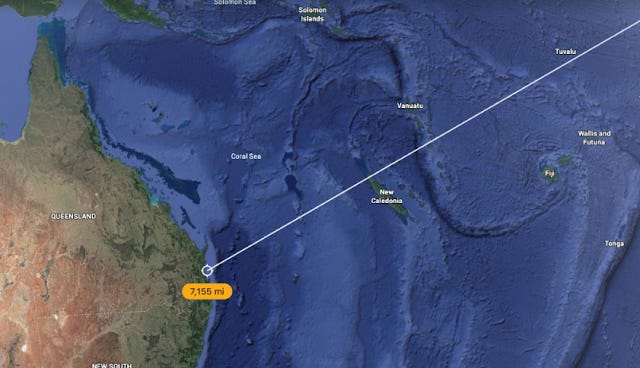
Here's the terminal end of the great circle route from San Diego to Australia.

Where does that great circle routs go by Kanton?

Yep. 28 nautical miles. 28.

You cannot classify geography or math. That is why the Chinese are interested in it. I can't blame them. If I were Chinese, I'd do the same exact thing. 

They know the USA can't rush to the aid of anyone from Taiwan to the South China Sea if they have to clean up what used to be their backyard first.

Time and distraction. Defense in depth. None of this can be classified. They are open to all.

The fun follow on question: what would they do with it?

We warned you.

h/t Zach.

Sunday, June 26, 2022

Turning the Tables on China with Brent Sadler - on Midrats

While everyone is distracted by the Russo-Ukrainian War, the People’s Republic of China continues to work to solidify her ability to control the South China Sea and to bring more nations in to her orbit.

Though not a cold war, it is a struggle for presence, influence, and setting the conditions for advantage should conflict come.

The United States and her Navy are not required to be in a passive posture, allowing China to shape the environment without pushback.

This episode of Midrats will focus on American options and actions we can take to blunt Chinese influence and to prevent her from setting up the Western Pacific to her advantage relative to the United States and her friends and allies.

Our guest for the full hour this Sunday from 5-6pm Eastern to discuss this and more will be Brent Sadler, a senior fellow for maritime security and advanced naval technology at The Heritage Foundation.

Join us live if you can, but it not, you can get the show later by subscribing to the podcast. If you use iTunes, you can add Midrats to your podcast list simply by clicking the iTunes button at the main showpage - or you can just click here. You can find us on almost all your most popular podcast aggregators as well.

Monday, June 06, 2022

Combined Amphibious Operations in the Indo-Pacific With Maj. Zach Ota, USMC - on Midrats


Along the spectrum from peacetime exercises to wartime combined operations, successfully integrating multinational forces is not a pick-up game. To do it right requires leaders and institutions years of practice, trust, and demonstrated ability.

This is true of all military operations, but especially true when moving forces ashore during amphibious operations.

In our constellation of allies, partners and friends along the shores of the Indo-Pacific theater, since 2015 the United States Marine Forces Pacific has led the multi-national Pacific Amphibious Leaders Symposium.

Today we are going to dive in to not just the symposium itself to the broader topic of combined amphibious operations in the Indo-Pacific with our guest, Major Evan “Zach” Ota, USMC from the International Affairs Branch, U. S. Marine Corps Forces, Pacific.

You can get the podcast here or at the player below.

If you use iTunes, you can add Midrats to your podcast list simply by clicking the iTunes button at the main showpage - or you can just click here. You can find us on almost all your most popular podcast aggregators as well.

Tuesday, May 31, 2022

Keeping an Eye on the Long Game: Part XCIV

The People's Republic of China isn't hiding anything. Their plan is right there for all to see. If you can't quite understand what I mean at the end of May of 2022, the North American treasure who is Cleo Pascal will show you and tell you the story;

Under the UN Convention on the Law of the Sea, every island can get up to 200 nautical miles off its coast as an EEZ in which it controls resources, say, fisheries. That means, for example, Pacific Island Country (PIC) Kiribati may have a population of around 120,000, but, with its EEZ, it covers as much of the planet as India.

Now let’s colour in the EEZs of the countries being visited at the moment by China’s Foreign Minister Wang Yi and his large delegation. What we see is a large, contiguous band—Papua New Guinea, Solomon Islands, Vanuatu, Fiji, Tonga and Samoa—off the northeast coast of Australia, backed against Kiribati. And off to the northwest of Australia, almost embedded into Indonesia, strategically located Timor-Leste.


 They're putting it in writing in case you think there's a lot open to interpretation: 

Wang is hoping the PICs who recognize China will sign on to two prewritten documents. We know what’s in them because they have been leaked by Pacific Islanders worried about the implications.

The first one is “China-Pacific Island Countries Common Development Vision”. The second is “China-Pacific Island Countries Five-Year Action Plan on Common Development (2022-2026)”. The “Action Plan” describes how China plans to achieve its “Vision”.

Make no mistake, this is exactly the correct strategic step if your goal is to displace the USA and her allies in the Pacific. 

If you want to get a firm grasp on the seriousness of this real estate, I would offer that you need to read up on the Pacific Campaign of WWII ... if you're running short of time, read my post from last year.  

Back to Cleo's article;

“Vision” talks about: law enforcement cooperation, including “immediate and high-level police training”; “cooperation on network governance and cyber security”, including a “shared future in cyberspace”; the “possibility of establishing China-Pacific Island Countries Free Trade Area”; “enhance cooperation in customs, inspections and quarantine”; “create a more friendly policy environment for cooperation between enterprises”; set up Confucius Institutes; train young diplomats; “establish China-Pacific Island Countries Disaster Management Cooperation Mechanism”, including prepositioned “China-Pacific Island Countries Reserve of Emergency Supplies”, and much more.

“Action Plan” includes: “a Chinese Government Special Envoy for Pacific Island Countries Affairs”; a “China-Pacific Island Countries Ministerial Dialogue on Law Enforcement Capacity and Police Cooperation”; “assistance in laboratory construction used for fingerprints testing, forensic autopsy, drugs, electronic and digital forensics”; “encourage and support airlines to operate air routes and flights between China and Pacific Island Countries”; “Send 200 medical personnel” in the next five years; “2500 government scholarships” from 2022 to 2025, and much more.

Even at peace, there is a lot to gain if you are looking to strip mine the last of the fish in the Pacific without complaint;

Look at the EEZs alone. If China gets its way, the fishing fleets will be sent in, with processing ports set up, including “prepositioning” of various sorts, and loose visa and customs restrictions. We’ve seen China use its fishing fleet for grey zone activity before, and it has an overt doctrine of civil-military fusion. Additionally, the PRC’s 2017 National Intelligence Law compels Chinese companies to assist in intelligence activities. Then add in the cyber integration, police and diplomatic training.

Those countries don’t have the ability to control Chinese activities in their waters. That arc has the potential to become a “First Island Chain”’ to hem in and/or interdict Australia and New Zealand.

That is just the opening bit, you need to read it all. 

If you don't get a flush of panic a couple of times, then you are missing one of the largest stories of the decade's opening chapters - the closing of the Pacific under the red banner of the People's Republic of China. 

Tuesday, May 17, 2022

Force Design 2030: Futurism, Imbroglio, or Creative Friction?


We haven’t really discussed the imbroglio presently roiling USMC-world around General Berger, USMC and “USMC Force Design 2030.” Well, today we’re going to step in – second hand.

The document itself isn’t as interesting to me per se as the reaction to it.

Berger is trying to look at where we are today, what challenges the nation faces, what the USMC’s role in addressing those challenges are, what resources provided to do it, and has come up with a path he and his staff believes best addresses the challenges.

No plan or vision is perfect. There are always weaknesses and imperfections, but decisions do need to be made.

The old guard, or as Bob Work - Former Deputy Secretary of Defense and Under Secretary, and Col., USMC (Ret.) well known to readers here - calls them in the article we’ll discuss below calls them, the “grandparents,” is not all that happy with the proposals … nor are some people from age 20 on up … and that is the spectator sport we’ve been watching.

You can read Force Design 2030 at the link if you have not already, but if you want to get in to the discussion on today's post, over at 19fortyfive.com take a moment to read Work’s article USMC Force Design 2030: Threat or Opportunity. 

Be warned, it is a substantial article. It is not a short read, but take the time to read it all anyway.

Work is clearly on Berger’s side (and that's OK) and is a little snarky toward the grandparents – but his article is on balance fair.

I’m not fully aligned with Berger, nor am I with the grandparents. I think both sides have good arguments … and this hesitation on my part is a signal to me that what we have going on here is healthy and good for the Marines and the nation they serve.

Here’s why. There are a few foundation stones to how I look at changes in military postures, CONOPS, and structure.

1. Creative Friction: no one has the right answer. If someone says they do either they are a fool or they think you are one. On both sides of contentious issues, only by the two sides having a good back-and-forth can you get closer to the optimal solution or truth. They won’t get there – you never do – but you can get close. Well meaning people with good intentions – even when in stark opposition – can together create great things through their disagreements. On balance, that is what I see.

2. War is Not New: there is a seductive draw to either signaling or joining in with the idea that you or your group has a unique ability to see a change, a pivot, or dare I say – a transformation. Some advocates and critics of FD2030 are getting a bit over their skis thinking Berger is some prophet on one hand or a starry eyed fool on the other. Neither criticism is valid. In the commentary on FD2030, there is some hedging, self-reflection, and doubt concerning the way forward, but also an acknowledgment that forward one must go. I disagree on a few points here and there, but that is to be expected. I may hedge too much, they may not hedge enough … time will tell. Unlike the Age of Transformationalism we spent the better part of two decades discussing here – while there may be a little of that flavoring in FD2030, not enough to be of concern. I think they avoid that trap … though some of its advocates are a bit too enthusiastic … but people are people and that is to be expected.

3. The Future is Not as Clear as You Think it is: though there is some acknowledgement of uncertainty and our spotty track record on correctly identifying the next conflict, I do worry that FD2030 is too biased towards the expected (but perhaps not the actual) challenge west of Wake and may warp too much the outcome of FD2030. Much of the intellectual effort here was before the Russo-Ukrainian War of 2022, and while I appreciate the case for experimentation, exercises, wargaming, and modeling … there is one hell of a real war going on right now. It might be worth pausing a bit and have some clear-eyed review of the lessons coming out of it. This is especially true when it comes to armor. Regardless of all the T-72 turrets you see flying through the air, remember that Ukraine is taking all the tanks they can get hold of. Ditto tube artillery.

4. You are Wrong More Than You are Right: I think Work brings out the fact that here as well, self-awareness is in the thinking around FD2030. I don’t share his enthusiasm for it as written – though I’m closer to him than to the grandparents – but I do not get the impression Berger and his staff think they have everything perfect. There is humility here. That means there is flexibility. 

Those are my top-4, and I picked that number because Work picked his top-4 areas in FD2030 he wanted to touch on. I’ll pull those out in the below.

Let me grab a few pull quotes and we’ll dive in;

(Berger) is convinced the organization, training, equipment and posture of the service–its overall force design–is not keeping up with the evolving character of war and needs to be changed as a matter of some urgency.

After two decades in a rather bespoke series of low-boil imperial policing actions in Central and Southwest Asia that existed alongside what to some looked as a Cold War concept frozen in intellectual aspic, that is fair. As his job requires, Berger has to make sure the USMC is ready for what is coming, whatever that may be. He owns it;

I am convinced that the defining attributes of our current force design are no longer what the nation requires of the Marine Corps.

So he needed to take action. As Work outlines; 

He made it his top priority to bring the Marine Corps more into alignment with both the changing character of war and international security environment, and he announced a plan called Force Design 2030 to accomplish this aim.

I'm going to take an extended pull quote after this as I know many of you have not "read the syllabus" and may not be fully up to speed on the imbroglio ... so here's the issue;

But today, a group composed primarily of disaffected retired generals vehemently disagree with the General Berger’s overall vision of a future Marine Corps–so much so, that they are mounting a sweeping public relations campaign to stop him from getting it off the drawing board.[iii]  While the Commandant is in no way obligated to listen to their complaints, the thoughts and inputs of retired Marines, particularly general officers, have long been valued by serving Commandants (the same can be said of all service chiefs).  But this campaign takes “input” to an unsettling degree.  The retired generals have made their objections known to General Berger and are expecting him to heed their preferences to preserve the status quo.  Up to this point, Berger has not done so–or at least not enough for their liking. They therefore decided to “seek legislation that would halt the [Commandant’s] ongoing efforts until a more thorough requirements-based future is reviewed.”

There is a term for this approach: a shake down.  There is nothing remotely like this behavior in Marine Corps history. Those who wage the campaign feel their attempts to engage Commandant Berger have either been ignored or rebuffed.  Having failed to force a reversal of the Commandant’s direction that has been carefully designed and tested over the past two years, they feel the only way forward is to relentlessly and publicly denigrate his plans.  Toward this aim, they have published a spate of attacks in numerous fora.  They have gone so far as to engage a lobbying firm to help persuade Congress Berger is on the wrong path.  As a Marine veteran myself, I am stunned, saddened, and embarrassed these respected gentlemen would pursue such drastic, unseemly tactics.

That second paragraph is where Work shows his cards. That is fair, these are big boys playing serious games, they can take some elbows and clear words. I actually wish we had more of this on the Navy side ... but I'll try not to get distracted from the subject at hand.

As promised at the top of the post, Work boiled down the four top judgments from FD2030 that stood out.

Judgment 1: The future Marine Corps must be organized, trained, equipped and postured to conduct distributed operations.

Berger argued that the “character of war in the future will be much different than that of the recent past,”[xi] dominated by what he would later refer to as the “mature precision strike regime.”[xii] At its core, then, his force design effort was a deliberate reaction to the widespread development and fielding of deadly accurate guided munitions fire–directed and controlled by increasingly capable command, control, communications, computer and cyber intelligence, surveillance and reconnaissance networks. 

...

Achieving this end state requires a force that can create the virtues of mass without the vulnerabilities of concentration, thanks to mobile and low-signature sensors and weapons.

That is a good reading, though I shake my head a bit at the transformationalist "character of war" comment. I'm sorry, but that is an exaggeration to make a point. Tools, methods, and procedures, yes - "character" no. That is a semantic critique - as is my curling up my nose every time "pacing" is used, but it isn't minor. Assuming you live in a unique time is a dangerous idea that can get you in all sorts of trouble. This isn't a unique time. Our species has seen this pattern countless times in our history.

Judgment 2: The Chinese anti-access/area denial threat in the Western Pacific is the “pacing threat” for a future naval expeditionary force in the precision strike regime and calls for a different set of amphibious capabilities.

...

the appearance of land based anti-access/area-denial networks in the Western Pacific and beyond made “closer naval integration an imperative.”[xxi]  Large-scale amphibious assaults in the Western Pacific would be far too vulnerable and risky to mount.  As a result, perhaps the biggest bombshell in Berger’s planning guidance was that the Marine Corps would no longer use the longstanding “requirement” (quotation marks in the original) to conduct a 2.0 Marine Expeditionary Brigade (MEB) amphibious assault to help size and shape the force.  In truth, since 9-11, the Marine Corps had been sized and shaped primarily to service the wartime demands in the Central Command area of responsibility.  But the 2.0 MEB requirement provided the foundation for the size of the amphibious fleet (38 ships), the “requisite capacity” for vehicles and ship-to-shore connectors and the Maritime Prepositioning Force.

Partial non-concur here. Over the next 30-years, the challenge west of Wake vignette is not the only vignette we need to be able to respond to. In those cases, our amphibious fleet - as it proves over and over - provides capabilities unmatched by anything else. We cannot be focused on just one vignette more than any other. As you will see below, Berger isn't ... but the conversation needs to be careful here as the usual suspects are making that argument. 

Work mentioned the Korean War in his article. One of the problem we had was the the post-WWII Army was too stuck on the nuclear vignette and let other capabilities fade. That is the big lesson to take away that should inform our hedging - and I would offer that we need to lead with the hedge as nuance is being lost in the headline. 

The Commandant made clear that he did not think amphibious assaults were “irrelevant or an operational anachronism.”[xxiii]  However, the appearance of powerful anti-access-area-denial networks called for different types of amphibious capabilities in support of an integrated naval campaign in the Western Pacific.  Accordingly, Force Design 2030 called for III Marine Expeditionary Force (MEF), forward based in the Pacific, to be transformed into a new “fight tonight, stand in force capability to persist inside an adversary’s weapon system threat range, create a mutually contested space, and facilitate the larger naval campaign.”[xxiv]

I take that as a helpful hedge. We live in a big world with a diverse set of challenges that require an equally diverse set of tools to address them. Be careful, or some accountant will only give you a set of pliers and a roll of duct tape and expect you to carry on.

Judgment 3: Given expected budgets, pursuing any new force design would require the Marine Corps to divest some legacy programs and force structure to invest in needed future capabilities.

Another style note: I am not sure enough people realize how loaded, poisoned, and unhelpful the use of "legacy" and the construct of "invest/divest" has become. It is almost to the level of "do more with less" from the 1990s. Stop using it. You are unnecessarily weakening any argument you are making by using them.

It is relevant to understand that General Berger formulated Force Design 2030 just as the sequestration years were ending.  Demand for resources among the four services and within the Marine Corps itself was still intense. His philosophy was therefore to “seek the affordable and plentiful at the expense of the exquisite and few.”[xxvii]  

Good. Very good. For the stresses of the Terrible 20s, this mindset will serve everyone well.  

Beyond announcing the elimination of the 2.0 MEB amphibious “requirement,” the Commandant did not explicitly list capability divestments in his planning guidance, instead opting to provide general guidance for how future divestment decisions would be made.[xxix] In contrast, he was quite specific about the general investments he was confident 2030 Marine Corps would need.  These included ground-based long-range precision fires;  unmanned systems; command and control capabilities suitable for a degraded environment; air and missile defense; and emerging technologies, such as artificial intelligence.[xxx]

Solid list. These have all been validated the last few months in Ukraine. 

Judgment 4: The urgent requirement to adopt Marine Corps force design for the future operating environment meant change must start immediately; “essential to charting our course in an era of strategic fluidity and rapid change will be the effective integration of professional wargaming in force design…”[xxxi]

...

“While others may wait for a clearer picture of the future operating environment, we will focus our efforts on driving change and influencing future operation environment outcomes” (emphasis mine).[xxxiii]

This is one of the better quotes. I would offer that no one has a clear picture, but you cannot wait or freeze in time as the world advances around you.

General Berger was fully aware he was navigating primarily by dead reckoning through a fog of uncertainty. To mitigate strategic risk, he therefore announced a major focus during his tenure as Commandant would be a “campaign of learning” involving his “direct, personal [and] regular engagement…to drive an integrated process of wargaming and experimentation” that will rapidly produce solutions for further development.”.[xxxv] 

That is the correct mindset. We are also at a great time to learn from Ukraine. As mentioned before, a pause is needed to digest the lessons of Ukraine, especially here. Don't tell me to stop repeating myself, I'll bring it up again a few times before we're done;

Among the document’s more consequential decisions, Berger announced the divestment of one of eight infantry regimental headquarters; the divestment of three of 24 active component infantry battalions, two of six reserve battalions, as well as the redesign of all remaining battalions; a dramatic restructuring of Marine Corps cannon and rocket artillery capabilities; the divestment of all organic tank units;

...

Berger believed he had sufficient evidence to conclude that despite their usefulness in past wars, tanks were “operationally unsuitable for our highest-priority challenges in the future.”[xlvii] Accordingly, all seven companies of active and reserve tanks would be divested. In addition, two of six companies of tracked assault amphibian vehicles and all three bridging companies needed to support sustained armor operations ashore would go. 

Well, we have new evidence this spring. People have been trying to write off expensive and bulky tanks for decades, but when actual war comes, no one wants to divest them or send them to other units. There is a reason for that which cannot be readily dismissed.

Time to return to the one thing that is better than anything else when testing concepts; reality;

(Berger) cautioned that while it was important to remember that “’answers’ are elusive when the task is preparation for an unknowable future,” the three developments he outlined demanded that he not wait for perfect answers before pursuing change in response.  Berger therefore said “the next great challenge” would be analyzing his initial force design decisions “through integrated Naval wargaming and analysis but most importantly in real-world, live experimentation,” and adjusting plans based on their findings.[lvi]

I keep repeating it because it is the 800-lb gorilla. Better than wargaming and experimentation - the actual war going on right now. We cannot pretend it isn't happening. 

Hidden in Work's article is something that really should be a stand-alone article. I'd love to hear him spend an hour on the topic. I know it would be torture to most, but I have been told I am a strange person, so maybe it is just me. As we don't have an hour, we will have to be happy with a two paragraph reality check on the POM cycle.

You've heard me talk about "process" before. This is reality ... and something everyone needs to remember. Work provides on of the most concise executive summaries I've read on it;

Let’s apply some facts to the first part of this premise. Each year, the Commandant of the Marines Corps, like all service chiefs, creates what is called a Program Objective Memorandum (POM). This describes how a service chief wants to allot current and future year funding for a force design that meets both service and defense planning guidance. If a Commandant wants to make significant changes to Marine Corps force structure, they need to prepare a POM that reflects the desired changes. Once developed, the Commandant then briefs and seeks approval of their plans from both the Secretary of the Navy and the Secretary of Defense. If approved, the memorandum becomes a part of an overall defense program assembled by the Secretary of Defense.  The program is then sent to the Office of Management and Budget, to be incorporated in the President’s budget estimate submission to Congress. In essence, OMB’s delivery of the administration’s submission to Congress signals the President’s endorsement of anything included therein. Once delivered, the House and Senate Armed Services Committees unpack Department of Defense plans, study them, and decide whether to authorize and fund them. The former Commandants among the opponents know this process well. They followed it when they held the office.

Force Design 2030 was included in the Marine Corps’ Fiscal Year 2021 (FY 2021) Program Objective Memorandum.  It was approved by then-Secretary of the Navy Richard Spencer and briefed directly to then-Deputy Secretary of Defense David Norquist at the Deputy’s Management Action Group (the organ that reviews service POMs for the Secretary of Defense). Per standard practice, it was then considered by the Director of Cost Analysis and Program Evaluation and endorsed. Based on supportive recommendations from both that director and the Deputy Secretary, Secretary of Defense Mark Esper approved Force Design 2030 and transferred approximately $500 million to the Marine Corps budget to help pay for aspects of it.[lxiii] It was incorporated into the overall defense program and president’s budget request, which was considered and approved by Congress. What Senator Webb described–a wily Commandant sneaking a force structure plan through the Department of Defense and by Congress–literally could never happen.

That will sober you up real fast, won't it?

At the end of this I hope you take a moment to ponder a couple of final thoughts:

1. Don't you wish we had this kind of argument going on right now in the Navy? 

2. 2014 is to 2022 what 2022 is to 2030. It isn't that far way. 

Wednesday, April 27, 2022

Marine View from Down Under

There is a lot of good ... and sometimes not so good ... arguments pro and con on the decisions being made by and the direction where Gen.  David Berger, USMC is taking our Marine Corps - but the fact he has engaged a lot of minds and forced a lot of people to think is a service in itself to our nation's security.

In his visit earlier this month to Australia, he summarized some points that just cannot be said often enough.


You have to repeat the basics to as many people as you can as often as you can...because most people either don't know or don't understand the basics.

This is just superb, and I wish our Navy's senior leadership would use this mindset every time they have the opportunity.

Has Berger upset some people? Yes.

Good. That means he's standing for things and making people uncomfortable with their ideas.

Berger has done his thinking. If you are going to counter him - you had better done yours;

... in the long term, the marines’ value to the US military joint force was as an expeditionary element that was forward all the time and which could gather information while preventing an adversary from doing the same. That presence could ‘open the door to places’, Berger said.

‘Some of it is back to our roots where we came from.’

The marines have had to adjust their structure and posture, how they train and manage their people, their warfighting concepts, what platforms they use and what capabilities and weapon systems they need wherever they operate to make sure they stay ahead of change happening around the world, Berger said.

‘As a service chief, we have two responsibilities to make sure we provide the forces today for a conflict, but also to make sure that five, 10 years from now we’re in the right spot. We have made the investments in the right places so that the future is in a good place.’

A likely challenge for the marines and for allies such as Australia would be to keep maritime choke points open to allow commerce to flow freely and they would need to develop the tools to do that.

‘You have to be able to monitor that, to engage an adversary who wants to close it down. So, we need things like anti-ship capabilities, the surveillance, the collection capabilities in the maritime domain that we don’t have right now. We need the ability to move laterally, both by air and on the surface at a tactical level, with greater frequency and in smaller numbers than we do right now.

‘But I would say, beyond a piece of hardware, the most important part is that human part of operating in an austere, expeditionary, maritime environment without any developed infrastructure, but getting a job done. And being able to transition quickly if there’s a crisis.’

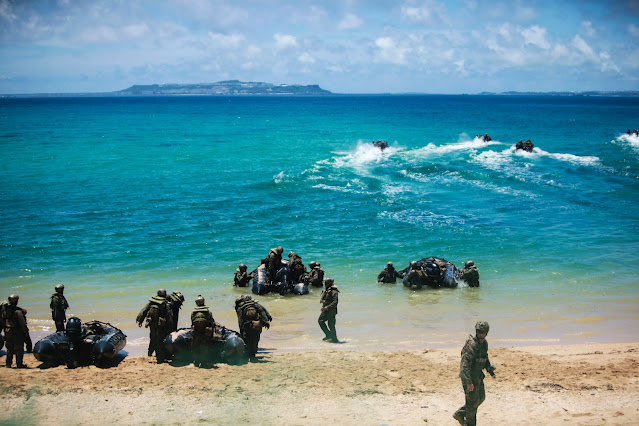
A little sidenote on the pic above (you see more on DVIDS); it represents a part of Marine culture I have always respected. The most senior Marine is visiting your command, and is just there talking to a few other Marines while everyone else just carries out the Plan of the Day as if he's just another Marine ... which he is.

Nice.


Wednesday, March 30, 2022

Losing the Solomons

You know the names; Guadalcanal, Savo Island, Cape Esperance, Santa Cruz, Tassafaronga.

There were other less known fights during the Solomon Islands Campaign, but those are the major ones ... some even had USN warships named after them.

During the campaign, the United States suffered over 10,600 killed, 40+ ships sunk, and over 800 aircraft lost.

Imperial Japan suffered over 86,000 dead, 50+ ships sunk, and 1,500 aircraft lost.

These islands are critical to control/protect the sea lines of communication from the Indian Ocean in to the Pacific Ocean - from the United States to Australia.

After WWII, this was generally an Australian sphere of influence, but as always, the USA had purchased in blood an ongoing interest in the status of these islands. Any review of a globe shows you their importance in any war in the Pacific.

The Chinese know this as well.

I am not sure what is going on at our State Department desk responsible for the Solomons, but if we could just get proper civil service reform in place so we could do the only honorable thing - fire them all.

A leaked document has revealed that China and the Solomon Islands are close to signing a security agreement that could open the door to Chinese troops and naval warships flowing into a Pacific Island nation that played a pivotal role in World War II.

The agreement, kept secret until now, was shared online Thursday night by opponents of the deal and verified as legitimate by the Australian government. Though it is marked as a draft and cites a need for “social order” as a justification for sending Chinese forces, it has set off alarms throughout the Pacific, where concerns about China’s intentions have been growing for years.

Via Anna Powles, here are the pages in question. Read them yourself;


The Chinese are focused, serious, and understand what they want to be in the world. Their people responsible for this area of the world, as we discussed concerning other islands last year, are simply doing an outstanding job in pursuit of their nation's strategic interest.

What, exactly, are our State Department employees focused on for their nation's strategic interest?

Let me help everyone out. As always, meet me in the map room.

Here is the great circle route from our southern California ports, through Hawaii, to Australia.

Find the Solomon Islands.


It isn't really that hard to figure out - but I guess for The Smartest People in the Room™ it is.