Showing posts with label Mine Warfare. Show all posts

Wednesday, December 21, 2022

Mines for All My Friends


I really can't stop thinking about how smart this is.

A dirty little secret is that one of the largest deltas out there in the maritime sector between what we know what will be needed in wartime vs. what we have invested in at peace is mine warfare.

Since WWII more US Navy ships have been damaged by mines than any other weapon, and yet from money to promotion prospects, MIW is always put in the dusty corner.

Without even diving in to the capability mire of defensive MIW - even more neglected is offensive MIW.

How do you create a capability for this for the USA and her allies when it is almost non-existant? 

Yes, I have been a critic of mission modules the last few decades - at least the American ones - mostly because they were sold along with vapor-ware, pixie dust, and unicorn farts ... but where done right, they are a solution.

Via Dimitris Mitsopoulos at Naval News, here's a good mission module concept that looks like it can be put on a whole host of platforms with minimal modifications.

The Cube is a container-based modular payload concept that was first launched in 2020 by SH Defence. Today, the Cube portfolio consists in a range of over 300 payloads ranging from propulsion systems to decoy launchers and even search and rescue modules. The latest addition to The Cube ecosystem was unveiled during MAST Med 2020 conference and exhibition that took place in Athens, Greece in 2-4 November 2022: It is a Containerized Mine Laying System which can easily and quickly turn navy ships into mine laying platforms. Naval News met with Peter Liisberg during the event to learn more. 

The Cube consists of standard modules that fulfill common demands enabling the reconfiguration of naval vessels from one mission to another in less than 4 hours. It provides a unique multi-mission capability thanks to ready mission bays and equipment installed in standardized 20’ or 40’ Cubes-containers equipped with an adaptor frame, the Flex Frame. The innovative shell is designed to protect the equipment and ensure it is fully reliable and operating seamlessly in both arctic areas and regions with extreme heat. With the Cube system, any Navy can turn (almost) any platform into a multi-mission vessel.
 

Fine, maybe it is just me, but that is sexy as hell.

Thursday, June 30, 2022

The Netherlands is Game for the Black Sea Grain Escort Mission


The next questions is, who will throw their hat in the ring with them?

From De Telegraph;

The Netherlands has offered mine hunters to clear the way for grain ships from Ukraine. "If we can play a role, we are happy to do so," Defense Minister Kajsa Ollongren said at the NATO summit in Madrid.

The Netherlands has offered Turkey, which mediates in the matter, help to clear the sea mines on the shipping routes. Then Russia and Ukraine will have to agree on a so-called maritime corridor, emphasizes Ollongren. Neighboring NATO member states such as Romania and Bulgaria are also in principle more eligible to supply minehunters, insiders say.

The Koninklijke Marine has a half-dozen Tripartite Class minehunters and are very good in this warfare area.

NATO operates combined mine hunting with member states on a regular basis. This could move fast if the diplomats can open the door.

Of course, there is another way to make this happen ... but that brings more risk than I think most of NATO will be willing to take.

Wednesday, August 04, 2021

So, Who Wants to Ponder the Art of Port Clearing


You're a reader of CDRSalamander ... so I know that you not only find port clearing sexy ... but you know it's important.

Do you know the story of Umm Qasr in 2003?

Well, head on over to USNIBlog and ponder with me.

Wednesday, November 25, 2020

Nice Oil Trade You Have There. Shame if Something Happened to it


Have you been surprised that Iran and her Houthi proxies in Yemen have not gone after the Saudi's oil industry more?

What are your thoughts on home-grown cruise missiles and mines?

I'm pondering both over at USNIBlog.

Come on over and give it a read.

Thursday, February 07, 2013

USS GUARDIAN: hung, drawn, & quartered

Video of the plan for taking GUARDIAN apart.

This is so very strange. They do realize all the damage to the reefs in that part of the world during WWII, right? Sigh.

The anti-intellectual, political, and ahistorical warping of the discussion of options about this have just been sad to see.

Tuesday, October 16, 2012

Unsexy, dumb, & difficult

Well .... before we spend all our intellectual capital on "Celestial Networks" that I have seen on PPT for a couple of decades and just creep along .... let's focus on something 3-D with a proven track record.

We'll call this a wake-up call; again.
A major international naval exercise last month in and around the Persian Gulf and Arabian Sea, led by the U.S. Navy with more than 30 other nations participating, located fewer than half of the practice mines laid at sea. This outcome of the highly publicized military drills — not publicly known until now — underscores how difficult it may be for the United States and its partners to detect and incapacitate waterborne explosive devices that Iran has threatened to plant if its nuclear facilities come under attack. Out of the 29 simulated mines that were dropped in the water, “I don’t think a great many were found,” retired Navy Capt. Robert O’Donnell, a former mine warfare director for his service, told the NewsHour. “It was probably around half or less.” Navy officials, though, said the drill was constructive and asserted that focusing on the number of mines detected alone would paint an incomplete picture.
Perhaps. There is that side of the story, and then this.
“We enjoyed great success,” said Cdr. Jason Salata, the top public affairs officer for the 5th Fleet. “Every platform that was sent to find a shape found a shape. We stand by that.” Salata asserted that “there were no missed mines, each platform that had an opportunity to find the mine did so.” The drill, dubbed International Mine Countermeasures Exercise 2012 or IMCMEX, brought together countries from all over the world at a time when tensions with Iran have been heating up. Tehran has threatened to close the Strait of Hormuz, one of the world’s most important choke points through which 20 percent of the world’s oil flows.
Ummmm .... OK PAO.
Now a consultant, O’Donnell was invited by the Navy to observe the September exercise firsthand as it unfolded. The Navy declined to provide data on how many practice mines were located during the two-week naval drill but did not dispute that less than half were found. However, a spokesman insisted that the figures do not tell the whole story and that the event was “‘not just about finding” the dummy mines. “Numbers alone do not tell the story of IMCMEX’s effectiveness and success,” said Lt. Greg Raelson, a media officer with the 5th fleet, stationed in Bahrain. “We operated ships, helicopters, divers, and unmanned undersea vehicles with accuracy and effectiveness, confirming our ability to respond to maritime mine threats in the undersea environment. Because of this exercise, we were able to enhance partnerships and further hone the international community’s ability to ensure the safe and free flow of navigation.”
That is roughly right, methinks. Learning to work together is the key, and we really should do this more often - kind of like BALTOPS, but with worse liberty. If after a few years we're still batting .500, then we should worry a bit.

Wednesday, June 15, 2011

I'd like my good name back ... and maybe a ship too?

We've covered here COs not given the tools they need to maintain their ships - even borrowing Sailors from other already undermanned ships to get past the INSURV.

INSURV results became so uncomfortable that Big Navy decided to classify them to stop the open questions. What can a bad INSURV do? As I believe this was INSURV related (presumption on my part). Let's go back to MAR 2009.
The commanding officer of the mine countermeasures ship Devastator was relieved of command Tuesday for not “maintaining ship readiness standards,” the Navy announced.

Lt. Cmdr. Matt Tucker, who commanded the crew Persistent, was relieved by the commander of Mine Countermeasures Squadron 2, Capt. Robert Hospodar, just over three weeks after Naval Station Ingleside, Texas-based Devastator underwent a scheduled examination by the Board of Inspection and Survey.
If we had an unclassified copy of the INSURV, perhaps we could find out why, as reported by Tom Ricks,
Two years ago the Navy fired the skipper of the USS Devastator for not maintaining readiness standards. Now, I am hearing, his removal has been overturned.
Galrahn is hearing the same thing.

Details anyone? As the Vice President says - this is a BFD.

LCDR Tucker - congrats and I hope our Navy does the right thing.

Tuesday, May 10, 2011

OK, who the frack is out of formation!

Seriously people .... (click for higher res).


ARABIAN GULF (April 24, 2011) A CH-53 Sea Stallion helicopter assigned to Helicopter Mine Countermeasures Squadron (HM) 15 flies in formation with British, Pakistani and U.S. mine countermeasures ships during Arabian Gauntlet 2011. Arabian Gauntlet is a multinational exercise designed to refine coalition warfare capabilities in mine warfare and surface warfare, and offshore infrastructure protection to enhance regional security in the U.S. 5th Fleet area of responsibility. (U.S. Navy photo by Mass Communication Specialist 1st Class Lynn Friant)
Hat tip Theo.

Saturday, August 07, 2010

About our new sponsor ...

First of all - why aren't you at the beach? Summer is almost over. Well, now that you are here, put your thinking caps on.

I am sure most of you have noticed that for the last week, CDRSalamander has a new sponsor, Piranha USV. Before their ad expires, I wanted to open the floor for discussion of the project.

Unlike the Maritime Binary who are always of a mind that a new toy must do everything or it is of no use, I have always been a fan of UAV/UAS/USV when used as a good risk mitigator and cost effective tool.

I'll start the conversation, but in comments please don't limit the discussion to this one mission area.

As we have documented here many times, Mine Warfare in the Korean was a mess for all. Especially when there is a mine field between where you are and where you want to go - and that mine field is within range of a diversity of other weapons controlled by the enemy - it is a tough nut.

The pic above is from their gallery - and it had me thinking. If you have a robust MIW USV that you could put out there well ahead of time - and if transported by heavy lift fixed wing - you get an element of surprise that you wouldn't otherwise have. It is a way to mitigate the mine threat without showing your hand because your MIW ships put-putting towards their area. You also mitigate putting dozens to hundreds of Sailors unnecessarily in harm's way.

Perfect? No. But done right .... I am open to ideas and testing. Thoughts? Check out their proposal.

Monday, December 21, 2009

What has struck the most USN ships in 50 years again?

Call me silly, but there are some things that should focus one's efforts.
The total cost of a Navy remotely piloted submarine has grown so much that top service officials notified Congress this week that it could end up more than 85 percent above original estimates, the Navy said Friday.

Navy officials say the Remote
Mine-hunting System, which includes an unmanned submarine and its AN/AQS-20 sonar, could together cost about $22.4 million per copy, a spike of 85.3 percent over the original estimate,
Phil Ewing at Navy Time, once again, showing why he earns his paycheck.

Funny, fewer people object when I call LCS a uni-mission ship. Looks like that whole "swapy-swapy" mission module thingy looks less an less like a viable CONOPS.
Officials said the increase in cost for the RMS was caused by the Navy’s decision to delete the unmanned sub from the anti-submarine mission packages designed for littoral combat ships. The RMS will remain a part of the mine countermeasure mission modules. The revised goal of buying 54 such mini-subs, instead of 108, caused the unit costs to increase, Chen said.
... and now for the second order effect.
The Navy initially experimented with fielding RMS gear aboard its Arleigh Burke-class destroyers, six of which were modified with a door on their starboard sides to launch and recover the mine subs. But destroyers will no longer carry them, so the Navy’s review is to see what changes are needed to adapt the subs exclusively to LCS, Chen said.

Technicians are also determining
what will take the place of the RMS in the LCS anti-submarine mission modules.
Good question.

LCS - the gift that keeps giving. Each month, more and more people are joining us and saying;
"My god; it's full of cr@p!"
Samuel B. Roberts, Princeton, Tripoli, Magpie, Pirate, Pledge, Sarsi, Brush, Mansfield, Walke, Ernest G. Small, Barton, - do we need more examples?

Has anyone else found some meaning of LCS and MIW when it comes to Kipling's Arithmetic on the Frontier?

No? Well, any excuse for Kipling ....
A scrimmage in a Border Station –

A canter down some dark defile –

Two thousand pounds of education

Drops to a ten-rupee jezail.
For MIW - can we talk - again - about Plan B?

Tuesday, March 10, 2009

NB: they ain't putt'n this on the VISBY


These MIW ships were all built between '84 and '92.
The introduction of the upgradedLandsort-class MCMVs.

The key elements of this new MCMV concept are new combat management systems, search radar and fire control systems, as well as new sonar and new ROVs.

HMS Koster and HMS Vinga have already been handed over to the end customer, FMV (the Swedish Defence Matériel Administration). The next step is when they are commissioned for service with the Swedish Navy.

...

Now HMS Koster will head this newly upgraded series of five vessels, which are designed to meet today’s most stringent requirements. It means that the Swedish Navy has acquired a modern mine countermeasures system with a new generation of subsea ROVs, advanced air defence capability and extended mission capability.
Koster-series provides the Swedish Navy with new vessels at the cutting edge of technology. It is Kockums that has been entrusted with the upgrade of five former
In case you don't know, the VISBY was once a candidate for what became the LCS - that is supposed to do MIW, we'll see.

Wednesday, February 18, 2009

S.D. - come in, the water is fine ....

Whodathunk - another link to the HufPo. S.D. Liddick seems to be making progress, smacking down on one of the poseurs that we have been railing against since '03.

He also sounds like he might be making a turn I made in the '80s as a young'un.
The fact is, men like Shaffir and the sheik you lampooned stood up at a parlous time (for whatever motivations, honorable or venal) and went toe to toe with a baleful brood of characters (foreigners, fanatics, decapitators and the virulently uneducated)--and the people haven't forgotten all that they've given.

Are they criminals? Yes, they are. Should they be scrutinized? Of course. But they're also heroes to many, and widely viewed as the saviors of their small towns and neighborhoods. And, perhaps more importantly, they continue to kill terrorists--men Iraq has listed as Al Quaeda operatives. The fact you, a sniveling coward and ankle-biter hiding preconceived intentions behind putative journalism, are taking pot shots at them appalls me.

Due in part to them, mothers are no longer worried their daughters will be unwillingly pimped out to the unsightly foreign reprobates that came here with criminal networks, in the name of Islam, toting guns and all the vagaries of death. People are building houses (tons of them), sharing chai in neighbor's diwans, and getting down to the brass tacks of figuring out how the hell to rebuild infrastructure that was already neglected and miserably dilapidated before it was bombed to pieces. In a way, Anbar is exactly where it should be upon waking from the nightmare of civil war--fucked up.

The crucial fact is the state of fucked-up is moving in a positive direction and doing it rapidly. Just two years ago, the country's top politicians were worried about making it to work alive. Today, they're setting up anti-corruption networks and guilty politicos are nervously looking over their shoulders, realizing that as the violence drops off, so too does their cover. The people of Anbar are leaving their houses again and the markets are full. I've shopped in them.

The heart of the problem in all of this isn't only with the people of Iraq, it's also with Americans in this age of rapid and uncensored hydra-headed media--and the fact anybody can print anything. The threat there lies in the fact that 80-percent of people in society are grazers (and you can check Chomsky on this, Colonel Malay, or anybody who's served time); non-thinkers that only want to be herded and told what to do. It's those people who read your half-truths online and don't realize you're "independent" for a reason.

I'm phobically allergic to the conservative Republican types the military is rife with, but I've only been in country four months and already I hate liberals. There's plenty of ugliness to report in Iraq (as there are thousands of stories of hope and headway)--and the U.S. military certainly isn't beyond reproach. Nobody's telling you to report on one side or the other. But manipulating the truth because of your own personal biases is wretched and works in the face of progress. The other end of the political spectrum disregards you, Dahr, and now I know why. I thought it was because you're a liar--but you aren't. You don't have enough backbone to be a liar. You're a craven obfuscationist, intent on promoting your agenda at the cost of a menagerie of much braver men and women.
He gets it methinks on Iraq - I wish some, ahem, were as passionate.

Hat tip Chap.

Friday, April 04, 2008

Fullbore Friday

Eagle1's comments last Sunday had me thinking of mine warfare, and I thought I would share with you my favorite Mine Sweeper - the, ahem, HMS SALAMANDER!

Nothing drastic or overtly dramatic - much like your humble scribe, SALAMANDER had a modest role in a modest area; but found herself in some interesting places.


For a full story, check here, here, and here - but for SALAMANDER, let's look at a part of her service as seen through the eyes of Chief William Stone, RN.
On 27th May 1938, having returned home and joined the minesweeper H.M.S. Salamander, I married Lily Hoskin at Buckland-Tout-Saints, Goveton, near Kingsbridge, South Devon. We had known each other for many years as she was a friend of one of my sisters and lived in Goveton, where my family had remained whilst I had been away at sea.

By this time "Salamander" had sailed to Devonport for refitting and I was stationed in the barracks. Following our wedding, Lily and I lived in a flat at Plymouth, but when "Salamander" returned to Portland we rented a flat there where we lived for some months. I was often out minesweeping but was able to return to our home when the ship docked.

Lily became pregnant, but a week before our baby was born the ship left for Sheerness and never returned to Portland! I remember that time well - the air was filled with barrage balloons as defence against air attacks.

Our daughter Anne was born at Portland on the 28th August 1939 - just a week before war was declared! Not until the baby was three weeks old was I able to get special permission for long-weekend leave. Eventually Lily and Anne left Portland and returned to stay with Lily's parents at Wrangaton, near Plymouth, where they had now retired.

Early in the War I lost one of my nephews. Just a fortnight after the outbreak of war he had been lucky to survive loss of the aircraft carrier "Courageous" which was sunk in an attack by the German submarine U29 on 17th September 1939. He had told me that, on that occasion, as he was trying to get out, he had heard one of the Petty Officers shouting "Follow me!" Although he could not see the Petty Officer, he had followed the sound of his voice and managed to get out and had been rescued. Although my nephew was saved, many of my friends were lost with the "Courageous." However, my nephew was not so lucky a few months later when, on 8th June, 1940, "Courageous's" sister ship "Glorious" was lost off Norway in action with the German Battle Cruisers "Sharnhorst" and "Gneisenau" following the evacuation of Norway.

In those early months of the war "Salamander" was stationed at Grimsby and we were responsible for coastal minesweeping operations around the north-east. I managed to rent rooms at Cleethorpes and Lily and Anne travelled all the way up from Devon, by train, so that we could be together. On one occasion we had a close call. I was one deck down at the time but I gather that a mine got caught around one of the sweeps as it was being winched back in. Fortunately, someone spotted it and gave the alarm. They managed to free the mine from the sweep but in doing so or shortly after it detonated and blasted the side of the ship. Although there was no damage that threatened the ship itself, one of the plates which separated the oil tanks was ruptured and we had to go into docks to have that repaired.

In May 1940, when Germany advanced through Belgium and France, we were ordered by the Admiralty to the south coast to help with the Dunkirk evacuations. We did five trips to Dunkirk in all, rescuing 200 to 300 men each time. Things got worse each trip we made. Our final trip was on 1st June by which stage there was the wreckage of sunken ships all around and burning oil tanks by the dockside. Lines of troops were all marching towards the sea. We were anchored off the beach with one of our sister ships, the 'Skipjack', only about fifty yards away. At about 8am the German dive bombers came over and attacked 'Skipjack.' One of the attacking planes was shot down but 'Skipjack' was badly hit and capsized. She must have had about 200 men on board. I had to say "God, help us." I believe to this day that He did.

During our trips to Dunkirk, I was often stationed on the quarterdeck helping men get aboard "Salamander" as they swam out from the beach. Other groups of men had managed to find boats and row out to the ship. On one occasion I had a rope around a badly injured soldier who had bones sticking out of his trousers. Just as I tried to pull him in, the ship went ahead and I lost him. I don't know what happened to him.

Unknown to me, on our way back out on the final trip, we were attacked by a submarine that fired a torpedo at us. When we got back to Dover the Coxwain and the Able Seaman on the wheel said to me "Chief, we held our ears today and waited for the explosion. Jerry fired this torpedo that was coming straight for us amidships." "Salamander" had been saved by her shallow draft - the torpedo had passed straight underneath us. The only explanation that we could think of to explain our lucky escape was that the German submarine had mistaken us for a destroyer and had set the torpedo to run at a greater depth than the "Salamander's" draft.

Those were awful days but one just carried on as if nothing had happened - there was nothing else that you could do.

In all the years since Dunkirk I had never come across anyone whom we had rescued in the "Salamander" until the summer of 1999. It was then that, whilst at a reunion of the Henley Branch of the Dunkirk Veterans Association, a chap came up to me and said "What ship were you in at Dunkirk, Chief?" "Salamander," I replied. "You saved my life," he said. He told me that he had broken into a boat shed at De Panne in Belgium with some other soldiers and pinched a rowing boat. They had started to row home when we picked them up. It is pretty unlikely that they would have made it all the way back across the Channel in the rowing boat.

Following Dunkirk "Salamander" was put in to the Royal Albert docks in London to undergo repair to the damage that had been sustained during the evacuation.

Lily and baby Anne again came up from Devon to stay with friends at Wyndham Street, near Marble Arch, and I was able to spend the nights there.

After repairs we sailed to Invergordon in north east Scotland, where we were based whilst on duty escorting convoys.

Later the ship was transferred to Aberdeen for modifications to the minesweeping gear. Lily and Anne were again able to join me and we all stayed locally for a short while.

Soon afterwards came the devastating news of the loss of the "Hood." I remember well the day I heard that she had been lost. I was at home on leave with my family at Wrangaton at the time. I just couldn't believe it, and was unable to eat my lunch.

Those were dark days and the only ones in the war that I really felt down. A month or so later Hitler attacked Russia which brought that country into the war on our side. I felt that Russia coming in on our side was one of the best pieces of news I had heard in a long time. I had no real doubt about the outcome after that.

Of course one of the results of Russia becoming our ally was the start of the Russian convoys. H.M.S. Salamander was one of the ships which formed the escort on the very first such convoy, code named Operation "Dervish". The merchant ships left Liverpool on 12th August, 1941 and formed up at Iceland on 20th August where they were joined by "Salamander" and the other escort ships. We provided escort for the passage to Arkangel, where we arrived on 31st August. Unlike many of the later PQ convoys, "Dervish" proved to be an uneventful trip for us. As a Chief Stoker I was in charge of all the other junior Stokers on the ship.

Something that I do remember well from that trip is that “Salamander” was refuelled at sea. As I recall we took on about 50 tons of fuel oil. Being in charge of everything to do with oil and water in the ship, I was responsible for the "Salamander" end of the refuelling operation. All went smoothly from above decks.

During our return from Russia the Engineer Officer told me that when we arrived back I was due to leave the "Salamander". I asked to see the Commander as I didn't want to leave. The Commander would not change his mind though and said that I had been on the ship for 4 years and was due for a move. As it transpired he did me a favour as, later in the war, "Salamander" was nearly destroyed. She was minesweeping off Le Havre on 27th August, 1944 when she was mistaken for an enemy vessel by some RAF Typhoons. During that action our own aircraft sank two minesweepers, the "Britomart" and the "Hussar" and badly damaged "Salamander" - blowing off most of her stern.

So it was off to barracks for me to await a new draft. I had not been there a fortnight when I received a chit to say that I was going to be drafted. That day another Chief whom I knew greeted me "Morning Chief," he said, "Morning be buggered," I replied. "What's the matter with you old so and so?" he said. "I've got a draft chit," I said. "I know you have," he said "I'm going with you! We're going to Wallsend to stand by a new ship." "Oh, that's a lovely job!" I said.

William's story continues in Part 2: H.M.S. Newfoundland: Operation Husky and to Boston for Repairs.
She is an attractive girl.

Wednesday, October 17, 2007

MIW: the gift that keeps giving

An object lesson that shows another reason why a bunch of "modules" and "hybrid sailors" just ain't going'a hack it.
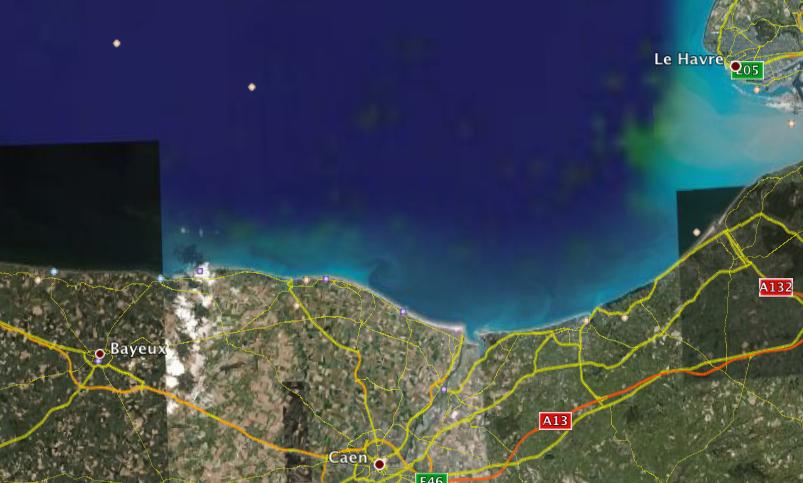
A huge operation to clear the waters off Normandy of mines from the last two World Wars began Tuesday, according to French authorities.

Involved in the mission to clear the seabed of the Seine Bay off Normandy of unexploded naval mines are seven Nato's ships and two French minesweepers.

Approximately 450 sailors from seven countries are involved in the operation which is due to last until the 29th of October.

French maritime official spokesman Yann Bizien stated, "This operation is designed to search, find, identify, and destroy all historic mines in order to improve the safety of this navigation."

Just about 15 percent of the mines laid in the sea during the World Wars I and II have been razed, authorities said.

Nato battleships (sic) have wrecked 56 mines, chiefly in the Baltic Sea, since the year started.
All those years later, still a danger. Deadly water, but beautiful.

Tuesday, August 15, 2006

Painful. To. Read.

Kind of like reading about when the British decom'd their last big deck carrier and its outstanding strike aircraft....right before the Falklands. We may not be as lucky as the Brits.
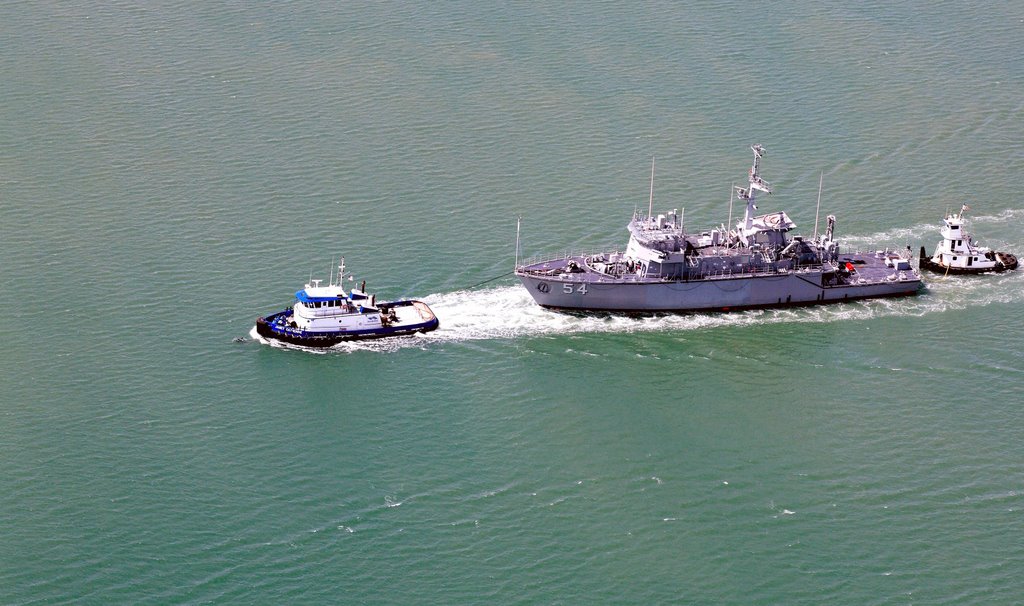
Two Osprey-class coastal mine hunters were decommissioned June 15 in formal ceremonies at Naval Station Ingleside, Texas.

USS Osprey (MHC 51), the lead ship in the Osprey-class, was decommissioned during a ceremony beginning at 10 a.m. USS Robin (MHC 54), was decommissioned during a ceremony beginning at 1:30 p.m.

“This ceremony marks the end of the life of a warship that served its country proudly,” said Cmdr. Keith A. Knutsen, during the Osprey decommissioning ceremony. Knutsen commands both Osprey and Robin.
That isn't the painful part. This is the painful part.
“However, I see this ceremony as something more than marking the end,” Knutsen added. “I see it also as the beginning - the beginning of a new era of mine warfare. Osprey and her sisters’ retirements are making the way for a new class of warship known as the littoral combat ship or LCS.

“LCS will continue where Osprey leaves off by carrying on and refining the Navy’s critical mission of countering mine threats to this nation,” he said.
Brother Keith; oh, my dear Brother Keith. That is the worst spin I have read in so long. You know, that we know, that you know, that we know, that the statement about the LCS Mine Warfare module is years, if ever, ready to hunt and find mines. While we are running these much needed warships off for sale or reserve - or keeping pierside because they cannot pass an INSURV - who is going to sweep the Arabian/Persian Gulf of mines if needed next week? Next month? Next year? Next decade?

Hat tip Eagle1.