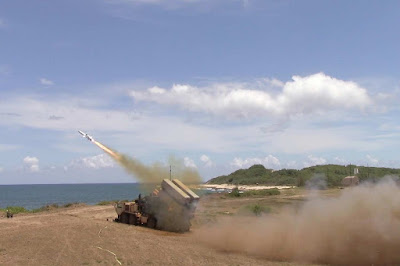
Showing posts with label ASCM. Show all posts

Monday, April 18, 2022

Moskva's Last PHOTOEX

Sunday evening, the first pics came out of the Russian Black Sea Fleet flagship, the Slava Class cruiser Moskva.


As we know this Monday AM ... this is her. No photoshop or spoof.

If you need to brush up on your RECCE:


Good news here is that as you can see in the green rectangle above, the life rafts have been deployed. As there were almost 500 Sailors assigned to her, that may be a secondary indication, along with the good weather, that those not killed on impact or in the following fire and secondaries were most likely able to get off the ship and as such, loss of life less. More to follow on that I hope.

I'm sorry, I don't care what nation's flag they fly under; once defeated they are simply Sailors in need of rescue. If you don't get that, we should all pray for you.

When  you consider how dark that smoke is, the fire must be intense. The large SS-N-12 Sandbox missiles stacked like so many sticks of dynamite had to be on the mind of the ship's leadership. If one of those things cooks off, they must go like so many firecrackers on a string. We also don't know the extent of her internal damage ... but it appears when this picture was taken she was probably already abandoned.

The reported weapon used to attack the Moskva were the Ukrainian built Neptune ASCM, which is itself evolved from the Soviet Era SS-N-25 Switchblade (Kh-35), AKA "Harpoonski."

To use round numbers, a high subsonic ASCM will cover the ground at about 9nm a minute.

If you are 50nm from the beach, that means you have about five and a half minutes once the missile goes feet wet to engage ... but really, if you don't have I&W of a launch and from what direction ... on a standard issue day with a standard issue watch after weeks and weeks at sea ... even assuming your radars and electronic gear aren't CASREP's or down for maintenance ... when will you detect that?

20nm or 10nm from the ship? Maybe 5nm? That gives you, what, a minute +/- to detect to engage?

Are your watch sections ready? Are your close in weapons systems ready? Who has to give permission to fire? How fast are they from being able to give that order? 

That math is just hard ... especially for a crew on station 24/7 for weeks on end. The math is even harder with supersonics.

Look at the pics above, I appears, ironically, she was struck on her port side where her close defense AK-630 are located.


That is about where you'd expect the seeker head from a "Harpoonski" to want to attack. Just about the center of the ship's profile.

One day, perhaps, we may get an unvarnished report of the damage control efforts, along with the story of the Ukrainian coastal defense battery's performance in location, tracking, and ultimate attack on Moskva.

Will we get that? Unknown ... but there are a lot of lessons here. A lot.

Second photo credit to Andy Hall.

Friday, April 15, 2022

Fullbore Friday


Service selection. Warfare speciality. Rating/MOS. When you sign your name on the bottom line, except for certain circumstances, you really don't know where the "needs of the service" will take you.

You fill out your wish list and hope for the best.

We all know someone who wasn't all that excited about what their service had in store for them. I had a peer who came from a family of fighter pilots. He didn't pass the pilot physical for eye reasons, so wound up on the naval flight officer pipeline. This was when we still had A-6 and F-14, and that is where he thought he would save face.

Where did the Navy decided he was needed? 

E-2.

He cried.

He then didn't tell anyone for awhile. Have no idea how his career worked out, but it didn't start very happy.

No one should ever feel that way. You run your odds, but in the end, you go where you are needed. You may think you're destined to be a terror ... but your Navy may need you to run the air picture. 

Somewhere just a couple of years ago, a young Ukrainian Naval officer had dreams of heading to sea. He always felt the draw of the sea, and though much of his nation's navy was lost when he was barely a teenager, he didn't care. 

He put together his wish list. He wanted to go to sea, but he'd be OK flying too.  Then service selection came.

Coastal defense.

There would be no going to sea. Yes, they'd have new kit, but why wear blue combat uniforms on land? He'll never command a ship. Heck, like chemical officers in the army, he probably will be lucky to make O5.

Well, he'll serve and do his best.

Then war came. His navy never had a chance to fight, mostly scuttled at the pier. His colleagues and fellow Sailors fighting were with marines or moving to Odessa ... but ... not him and his Sailors.

Their orders were simple; hide and wait. 

What little shoreline was still Ukrainian was under blockade. The Russian Black Sea Fleet and its flagship haunted the shoreline, shelled coastal villages - pretty much did what they wanted, where they wanted, when they wanted; and yet their orders remained the same; hide and wait.

In the two years before the war, our young Ukrainian naval officer ashore studied his rather unique warfare area and its history. If it were going to be his, well, he'd master it. 

He knew the story of Colonel Eriksen and his Norwegians guarding Oslo. He knew that unlike a lot of the equipment his countrymen were fighting Russians with, he had new equipment. He knew what he could do. He knew his Sailors and their equipment were ready. They kept their maintenance schedule. They trained. They ran through scenarios. They practiced until they were perfect, and then they practiced perfection. They can hide and wait. Let the Russians get overconfident. They will be ready.

Then, the call came.

Like they had done uncountable times before, they moved in to  their firing position. They went through the checklist.  They had their target's range, course, and speed.  Weapon selected. Master arm to arm. Intent to launch.

...and there they are;

The flagship of the Russian Black Sea fleet, the missile cruiser Moskva, sunk on Thursday after large explosions shook the ship following what the Ukrainians claim was a missile attack on Wednesday.

...

The loss of a flagship during war can be devasting to a navy’s pride as well as national morale. This is further complicated by the fact that the ship was named for Russia’s capital.

This threat so vexed Adolf Hitler during World War II that he ordered the renaming of the heavy cruiser KMS Deutschland to Lützow in early 1940, recognizing that the loss of a warship named for the nation itself would be a devastating propaganda victory. This cautionary move was validated when, only three months later, a sister ship of the newly renamed Lützow, the KMS Blücher, was sunk by gunfire and torpedoes from Norwegian coastal defense batteries on April 9, 1940.

Blücher was the flagship of the German operation. Lützow was also damaged and forced to withdraw in the same battle. The loss of these German ships in the battle delayed Germany’s Norway conquest timetable, allowing the Norwegian royal family to escape and lead a government in exile. Blücher’s displacement was 18,500-tons, about half again as large as Moskva.

Some 42 years after the sinking of Blücher, a nuclear-powered Royal Navy attack submarine hit the Argentinian cruiser ARA General Belgrano with two torpedoes May 2, 1982, during the Falklands War. The General Belgrano, formerly, the USS Phoenix, a U.S. Navy light cruiser, sank with the loss of 323 of the ship’s 1,100 crew members. General Belgrano displaced 12,242-tons when loaded for battle, slightly smaller than Moskva.

From a practical perspective, the loss of the Moskva is significant, not only because it served as the Russian flagship, coordinating the Black Sea fleet, but also because the ship’s significant anti-air and anti-missile capabilities provided an air defense umbrella for the smaller ships around it. Consequently, the Russian amphibious threat to Odessa has virtually been eliminated, allowing Ukraine to redeploy forces assigned to the defense of that key port city to the battle to retake Kherson, about 90 miles to the east along the Black Sea coast.

Every service matters. Every warfare speciality matters. Line or staff - they all matter.

Be the best of where you are - and when history calls, you will be there to make it.

For their security, we may never know who was on the launch crew - and for that matter - I spent a lot of time looking for the name of the command(s) in the Ukrainian Navy where their coastal defense missiles are assigned. Can't find them. They have to have a patch.

They're navy, that I do know. However - like many of the small, unsexy but important things in a navy ... they seem to have been forgotten.

Huh.

Maybe they will get their own stamp sometime. They deserve it.

Fullbore.

Indeed.

Wednesday, March 09, 2022

How Do You Punch a Ship in the Mouth?


Did the Ukrainians manage to hit a Russian navy patrol boat with Grad rockets?

I'm sure regulars here have been tracking this for a few days;
You need to be careful in this war and when something sounds too good to be true, often it is. Sometimes, it isn't.  Hard to tell;
One of two Russian warships made famous for its attack on Snake Island in the Black Sea last month has been destroyed, according to Ukrainian military officials.

A patrol corvette, identified as the Vasily Bykov, appears to have been hit during a battle early Monday morning near the port city of Odessa. The destruction of the ship, which was commissioned in 2018, has not been independently verified.

As of today, you can find reports that it did and that it did not happen. As for me, I will assume that it did not until we have something a bit more firm ... and if I had to bet $20 I'd say we'll see Vasily floating pretty as can be sooner or later.

That being said, as we are all looking for ways to attack surface ships from shore west of Wake with what we have at hand - smart people were scratching their head if such a cheap and mobile system may be worth looking at...not after this, but years ago.

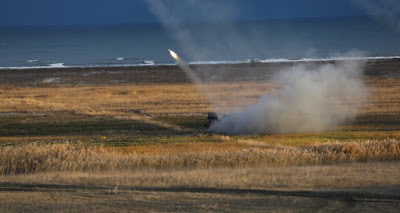
Back in 2020 we already experimented with the concept with our HIMARS in ... the Black Sea of all places;

“U.S. and Romanian Forces gather in the staging area after the firing of a U.S. High Mobility Artillery Rocket System and Romanian Multiple Launch Rocket System into the Black Sea as part of Exercise Rapid Falcon Nov. 19, 2020 [see photo above]. This was 1st Battalion, 77th Field Artillery Regiment’s second live fire event since reactivation just 90 days ago and was the first time U.S. forces ever fired HIMARS from land into the Black Sea in cooperation with Romanian allies.”
Was that against a surface ship target? Does not seem so, however...the equipment ...
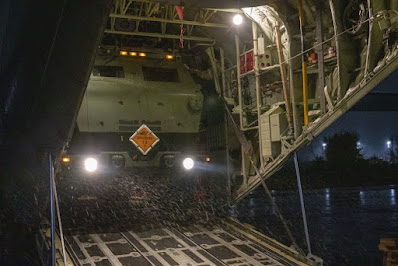
Two U.S. Army M142 6×6 High Mobility Artillery Rocket Systems (HIMARS) flew from Ramstein Air Force Base, Germany, on Thursday, November 19, 2020, aboard two U.S. Air Force Special Operations Forces (SOF) Commando II MC-130Js, the stretched version of the venerable C-130, and the HIMARS fired their rockets off the coast of the Black Sea that same day. 
If you need to get things on an off small islands, a C-130 is the way to do it.


But is the HIMARS rocket what we're looking for? No, not really - something a bit more, well, you remember...NavalNews sniffed it out too;
With future land-based Anti-Ship Precision Guided Weapons in development and available now, such as the Naval Strike Missile, the U.S. Army’s tracked MLRS, 6×6 HIMARS, and 8×8 Heavy Expanded Mobility Tactical Truck (HEMTT), and the U.S. Marines’ 8×8 Logistic Vehicle System Replacement (LVSR) and HIMARS, when modified and outfitted as Anti-Shipping rocket or missile launchers, are poised to become the “Go to” system for LBASM and LRPFs to prevent enemy ships and amphibious assaults on allied-protected islands and shores.

That was 5-yrs ago. Perfect? No, but something beats nothing and these sure are something. One problem I have is I'm not sure the LVSR in the above pic can fit on a C-130. If we want to have the maximum ability to make every island a porcupine and to have the flexibility to use USA or allied transport to move what we need where it is needed - I would think we would want it C-130 transportable. 

Marines don't have C-17s...

Fix that problem. Find a way to marry NSM to the Army's M142 and I'll take as many as you can produce. Those we don't need, we can sell at cost to our friends.

Time is short...and you know the Ukrainians wish they had a half dozen or so.


UPDATE: A helpful fan of the blog just knocked me on the back of the head with something from just 6-months ago...this. Yes this.
In August, the service was able to demonstrate NMESIS — full name Navy Marine Expeditionary Ship Interdiction System — during the Navy’s Large Scale Exercise off the coast of Kauai in Hawaii. Marines twice fired and hit a decommissioned vessel, as well as practiced loading and unloading NMESIS aboard a C-130 aircraft, according to Joe McPherson, program manager for long range fires at Marine Corps Systems Command.
...
NMESIS is a combination of several proven capabilities, a key reason why the service has managed to bring it online so quickly. The weapon itself uses the anti-ship Naval Strike Missile made by Kongsberg; a control system operated remotely, dubbed ROGUE-Fires; and the chassis of a Joint Light Tactical Vehicle. 

 “Marines can control the ROGUE-Fires with a game-like remote controller or command multiple launchers to autonomously follow behind a leader vehicle,” according to a recent Marine Corps statement. “The ROGUE-Fires vehicle, built on a Joint Light Tactical Vehicle platform, provides the Corps with a robust expeditionary system capable of operating anywhere.”
I've been told you can only get 1 JLTV in a C-130 at a time due to weight. I wonder if it can take the missiles in the same 130, or you need a second?

Anyway, this will work as MOD-0. 

Faster please.

UPDATE: Looks like Vasiliy is OK.

Tuesday, November 17, 2020

Bit by Bit, an ABM Capability Grows


Our Navy would be such a more powerful force if we had kept with the mindset of the Aegis and Standard Missile evolution. 

Bit by bit, step by step, increment by increment, baseline by baseline, we got a stronger, more effective Navy.

A few hiccups like in any  long running program ... but the success is undeniable. 

In a first-of-its-kind test, the United States has successfully used a small ship-fired missile to intercept a target Intercontinental Ballistic Missile (ICBM), according to the Missile Defense Agency. The successful test shows the U.S. military now has another missile defense system capable of defending against North Korean ICBM’s aimed at the United States.

“The U.S. Missile Defense Agency (MDA), and U.S. Navy sailors aboard an Aegis Ballistic Missile Defense (BMD) System-equipped destroyer intercepted and destroyed a threat-representative Intercontinental Ballistic Missile (ICBM) target with a Standard Missile-3 (SM-3) Block IIA missile during a flight test demonstration in the broad ocean area northeast of Hawaii, Nov. 16,” said a statement from the Missile Defense Agency.

A target ICBM missile launched from Kwajalein Atoll in the Republic of the Marshall Islands in the Pacific Ocean traveled thousands of miles towards the body of water between Hawaii and the West Coast of the United States mainland.

MORE: US successfully intercepts ICBM in historic test
The destroyer USS John Finn that was positioned in those waters then fired an SM3 missile that successfully intercepted the target ICBM. The interceptor missile was directed towards its target using tracking information provided by an array of sensor systems designed to monitor any incoming missile attack on the United States.
There is a lot to do before this becomes a fleet-wide capability, but we are getting there.

An anti-ballistic missile capability afloat isn't just good for national defense and that of our allies, but as anti-ship ballistic missiles become more of a threat - it will be an integral part of fleet defense itself.

As challenging of a science and engineering accomplishment as this is, there are parallel challenges that need to be addressed. 

First of all is a depth of capability. A lot of modifications and improvements will be needed to our Aegis ships before more ships have this capability - if ever. Most with a naval background can figure out an outline of those details on their own.

Once that is done, then we have what has always been an gold-plated issue in the surface community  become a platinum-plated one - the most valuable square footage in the navalists neighborhood; VSL cells.

If you want attack targets ashore with TLAM or the coming hypersonics cruise missiles - and your submarines can't quite get everywhere with enough tubes as it is, you will need this surface capability. 

How many VLS cells can you fill with those weapons if you need to be able to defend yourself and others from one or two varieties of ballistic missiles and ASCM - not to mention an aircraft or two? Maybe leave a few cells for ASW ... perhaps?

Your standard issue Aegis Destroyer has 90 or 96 MK-41 VLS cells. You can do the math from there.

We lost two generations of possible evolution in surface warship development with the failure of DDG-1000 and CG(X). We really need to get off the ball sooner more than later with our next large surface combatant. We can also look at some fun ways to get more VLS cells to our Navy sooner ... but that is a post for another day, perhaps.


Wednesday, January 22, 2020

Losing Sleep Over Hypersonics

You are worrying about the wrong thing ... at least for now and the next decade.

Thoughts over at USNIBlog.

Come on by and tell me why I'm all wet.

Sunday, January 13, 2019

Over the horizon, under the radar, & in your MEZ: ASCM & ASBM - on Midrats

This Sunday from 5-6pm Eastern, we're going to focus on the things of nightmares; Anti-Ship Cruise Missiles and Anti-Ship Ballistic Missiles with fellow paleo-milblogger SteelJawScribe.

In a wide ranging discussion, for the hour we'll cover ASCM history, Cold War tales, and what present day Russia and Crimea are bringing to the game.

SJS is a retired Navy Captain with multiple operational tours, including command of the VAW-122 Steeljaws, flying the E-2C Hawkeye as a Naval Flight Officer. With over 3500 hrs in type and 525 carrier arrested landings he was a designated Mission Commander, NATOPS and PMCF check flight NFO, a NATOPS qualified NFO copilot and the first CVW strike lead from the VAW community. He also was navigator on the USS DWIGHT D. EISENHOWER (CVN 69).

Shore tours included time at the Naval Postgraduate School in Monterey, CA where he earned a Masters (with honors)in National Security Studies (Russia) and multiple joint penance tours working operational/technical intelligence, collection management and strategy/policy. Following retirement he worked in industry, first in BMD supporting the Missile Defense Agency and then helping establish the Navy Air and Missile Defense Command in Dahlgren VA. As the Navy’s premiere center for all things associated with ballistic and fleet air defense, NAMDC became the IAMD division (Dahlgren) of the Surface and Mine Warfighting Development Center (SMWDC) in 2015, where SJS works today after transitioning to govt work.

An honors graduate of the Naval War College, SJS also teaches 2of 3 JPME-1 courses as a Fleet Seminar Program professor and is a published author. Together with his wife Sharon and their fearless dachshund, Jake, they live in Chancellorsville, VA

Join us live if you can, but if you miss the show you can always listen to the archive at blogtalkradio or Stitcher. 

If you use iTunes, you can add Midrats to your podcast list simply by clicking the iTunes button at the main showpage - or you can just click here.


Wednesday, October 17, 2018

Targeting Problems and Fleet Defense Challenges? Welcome to Varsity Football.

The Chinese are making WESTPAC more and more interesting day after day.

They are so inside our acquisition loop, it's embarrassing.

Details over at USNIBlog.

Come by and ponder with me.

Wednesday, November 16, 2016

Mind the Gap

A anti-ship cruise missile gap?

Yep, its a thing. A thing of our own creation.

I'm discussing over at USNIBlog. 

Come by for the pictures if nothing else.

Monday, October 03, 2016

The Near Death Nature of Near Shore Operations

History, on large scale and small, will give you hints what should concern you when the next war comes.

On operating near shore, the history can be mixed in the messages it sends if you don't look at the details. In the last real big war, you had successful defenses such as the approaches to Oslo and even the sporty use of field artillery against ships by the few Marines defending Wake in the early days of WWII.  Shore based defenses - immobile and a frustration at most - are seen as ineffective as those we faced in our last gunfight outside of Haiphong during the Vietnam War.

It is this history that can be misleading in the second decade of the 21st Century. The edges of living memory is good to understand, but you need to look closer.

Don't look too far. Are we worried so much about the sexy but rare and unproven Anti-Ship Ballistic Missile (ASBM) right now, as well as other exotic items you only see in a PPT, to the point we are ignoring a larger, legacy threat of a proven and effective threat scattered around the world by the hundreds to thousands? They may be old to oldish - but so are our ways to defend against them.

They are the cost effective answer to those who do not have the luxury of having a navy to throw up against an overpowering USN at sea - but want to have the ability to bloody the nose of those who would assume they own the sea. Of course, we are talking about what we believe took out the SWIFT, the shore based anti-ship cruise missile. Harpoon, Exocet, Styx/Silkworm, C801, C802, etc ... they are out there and waiting. They aren't fixed. They can be in any garage or "lorry" seen on the road. They would even fit in the parking bay of a MSF hospital.


The first practical big hint about the dangers of going close ashore in the modern era was the HMS Glamorgan attack in the closing days of the 1982 Falklands War. The 2012's strike on the INS HANIT is the most germane to what we saw over the weekend to the former (JHSV 2) SWIFT;
AN Incat catamaran has been sunk in the Red Sea by the Yemeni Army, say Arab news agencies.

Al-Masirah Television and Tasnim News Agency report that the 98m wave-piercing HSV-2 Swift, built at the Prince of Wales Bay Incat shipyard in 2003, was destroyed in a rocket attack off the shores of the Red Sea port city of Mokha early on Saturday.

Al-Masirah reports that the Swift was carrying aid and equipment for the United Arab Emirates Army when it was targeted by an anti-ship missile. There have been no reports of casualties but Yemini Houthi fighters claim to have sunk the ship.
...
The aluminium-hulled catamaran had a helicopter flight deck, vehicle deck, small boat and unmanned vehicle launch and recovery capability, and a communications suite.

It was capable of carrying 350 personnel and military vehicles and had a 2600 sq m mission deck.

Swift returned to Incat at Hobart in July 2013 for a refit and in July 2015 was reported to be operated by the UAE’s National Marine Dredging Company.

Most who served in the last few decades know the Bab-el-Mandeb area at the southern end of the Red Sea well. It is a classic choke point and "near shore" operating environment. How do you define "near short?" In the modern era, I wouldn't judge near shore by distance, but by time. Here's why.

Almost any poorly resourced military or non-state actor have the ability to do over the horizon targeting using over-the-counter communications equipment, using fishing boats as intel collection nodes, commercial radars for targeting, or even recreational drones (you should see some of the scouting by drone some of my duck hunting acquaintances are doing. For the record, I hinted how great an idea that is, but Mrs. Salamander shot that down pronto. Not a drone, just the idea of me buying one to, "Save time scouting." I failed on the sale).

Let's put the latest generation of supersonic ASCM to the side and go with the affordable previous generation of sub-sonic cruise missiles. They go +/-9 NM a minute. From launch to impact, a 2-minute flight time from the parking lot of KFC to your ship 18-NM out at sea. How long does it take for your watch to go from detect to engage (that assumes you have a good radar designed for such, have ES gear, have an awake & well trained crew, are expecting an attack, and nothing is CASREP'd)? Depending on the missile, these can be shot in "line of sight" mode where the targeting radar comes on right after launch (easiest to counter), they can have the radar come on at the last minute, or some can even be IR guided.

Ponder that threat a bit and ask yourself - how close to you want to get? Yes, you are a bit frustrated at all those glossy advertisements for DDG-1000 that showed them happily firing away a thousand yards or so from a nice white beach and green shore with nary a village in sight ... but that was marketing, this is war where you have hundreds of thousands of possible hiding places for shore based, mobile ASCM. How close are you comfortable with the risk vs. how close you have to do to accomplish your mission? That overlap is the rub.

Once you get your head around that legacy threat, then ponder the latest ASCM that in the next decade will probably be sold like Hilux trucks, the BrahMos and their fellow travelers. 

How do you defeat that threat? Dowe have the right defensive measures to fight through the envelope? Are we properly taking in to account this threat in how we design our fleet? How we man, train, and equip it?

As for this instance, I would expect a lot more to come out in the next 48-hrs, but here's the video we have of the attack.

Tuesday, October 14, 2014

No time for a Coast Artillery Corps Revival, Rep. Forbes

There are some ideas, weapons, tactics, and platforms that have a long historical record and are as useful now as they were then. Some ideas were exceptional for their time, but are just not a fit for the warfare requirements of today.

A good side arm was and is essential. As we saw in 2001-2, though we no longer need horse cavalry divisions, it is probably a good idea to keep enough equine presence in our Army to make sure we don't lose all those skills.

Recently, as reported by Sydney Freedberg over at BreakingDefense, Rep. Randy Forbes (R-VA) sent a letter to the Army that is, well, a nice thought - but notsomuch.
China has an arsenal of long-range ship-killing missiles, based on land but able to hit US warships hundreds of miles offshore. Now the chairman of the House seapower subcommittee suggests we give them a taste of their own “anti-access/area denial” medicine. Why shouldn't the US Army develop its own land-based anti-ship missile force?

Rep. Randy Forbes has carefully timed his letter to the Army Chief of Staff, Gen. Ray Odierno, sending it on the eve of the service’s largest annual gathering, the massive Association of the US Army conference here in Washington. Nor does Forbes pull his geopolitical punches: He explicitly advocates “ground-based anti-ship missiles… specifically for deployment in the Western Pacific [to] offset current strategic advantages by the People’s Republic of China.”

“The Army’s existing expertise in missile defense, rocket and missile systems for offensive precision fires, and partner-capacity building make it a natural choice to spearhead… an integrated web of A2/AD systems among allies [that] would greatly increase the costs of any hostile action in the region,” Forbes continues.
A few things.

First, for the United States, the best coastal defense is a warship (especially submarines) or aircraft. I am a firm believer that fixed defenses are simply monuments to the folly of men.

Second, there is a nugget of goodness here. What may not be best for the USA, might for our smaller and less financially capable friends, a valid option. Here is the good part;
... spearhead… an integrated web of A2/AD systems among allies [that] would greatly increase the costs of any hostile action in the region,” Forbes continues.
There we go. That is something we can do, and we could do it with mostly off the shelf technology. Fixed positions, as is the norm in coastal defense, is not the answer.

As we saw in the Falkland Islands War with the HMS Glamorgan hit by a land-based improvised Exocet launcher, and more recently off Lebanon when the Israeli corvette Hanit was hit by a Hezbollah ASCM, land based coastal defenses using ASCM can be an effective area denial weapon.

What can we do to help our allies? Well, if we can move Aegis ashore, why not Harpoon and its follow-on? How ... well, what can we leverage from what the USAF learned with its late Cold War Ground Launched Cruise Missiles?


A 4-pack of Harpoon behind a truck? 

Work on a guidance CONOPS and you're off and running.

Produce that with Japan, Taiwan, The Philippines, and Vietnam? Sure ... that will complicate China's plans. That is good. Do we need Army officers wearing what is at the top of the post? No.

Oh, and the more modern weapons will make you pucker.


Hat tip Lee.

UPDATE: See what happens when you are the SECDEF's speech writer and you don't read CDRSalamander every day? You beclown your boss!
Defense Secretary Chuck Hagel on Wednesday suggested a new Army mission at the annual AUSA convention: a coastal defense force.

In a speech to a military and industry audience that mostly shied away from program specifics, the secretary suggested the Army should try and “broaden its role by leveraging its current suite of long-range precision-guided missiles, rockets, artillery and air defense systems.”

Hagel said these capabilities “would provide multiple benefits, such as hardening the defenses of US installations; enabling greater mobility of Navy Aegis destroyers and other joint force assets; and helping ensure the free flow of commerce.”

He also insisted that “this concept is worthy of consideration going forward” and that “such a mission is not as foreign to the Army as it might seem — after the War of 1812, the Army was tasked with America’s coastal defense for over 100 years.”

UPDATE II - Electric Boogaloo: More from our friend Jim Holmes over at TheDiplomat.

Sunday, October 05, 2014

Anti-Access Area-Denial (A2AD) with Sam Tangredi, on Midrats


Power projection, sea control, access, denial, and the ability to impose your will on the enemy from the sea - or depending on your perspective - prevent them.

If the comparative advantage of American military power includes the use of the world's oceans as a basing area from projecting power and national will, how can other nations design systems and tactics to trump that advantage? What are in place now, and what can we expect to see in the near future?

Our guest for the full hour this Sunday from 5-6pm Eastern will be Sam J. Tangredi, a defense strategist whose studies of future warfare prompted Defense Department officials to label him “the Navy’s futurist.” His thirty-year naval career included command at sea, service in key strategic planning positions in the Pentagon and overseas, earning a PhD in international relations, and research fellowships at two think tanks.

His over one hundred publications—which include four books--have won awards, including the U.S. Naval Institute’s Arleigh Burke Prize and the U.S. Navy League’s Alfred Thayer Mahan Award. He is currently the director of San Diego operations for the planning/consulting firm Strategic Insight.

Join us live if you can with the usual suspects in the chat room and offer up your questions for our guest, but if you miss the show you can always listen to the archive at blogtalkradio. 

If you use iTunes, you can add Midrats to your podcast list simply by clicking the iTunes button at the main showpage - or you can just click here.


Listen to internet radio with Midrats on Blog Talk Radio

Monday, July 23, 2012

INS Hanit Analysis

Christopher Carlson has produced a very good analysis on the ASCM hit on the INS Hanit. You can get the whole thing here.

The Executive Summary:

If missiles have your puzzl'r puzzl'n - then make sure and listen to yesterday's Midrats if you have not already.

Thursday, March 11, 2010

At least someone has an ASCM


You talk about a subject ripe for discussion;
A newly inaugurated Iranian destroyer test fired a surface-to-surface missile in the Gulf on Tuesday, Iran's Fars news agency reported.

According to the IRNA news agency the
anti-ship missile, dubbed Nour, or Light, destroyed its target.

The test is considered part of an assessment of the ship's capabilities. The missile has been used regularly in war games over the past years.
Funny - I though Noor was Persian for "Saccade" or maybe "Target."

If you want more info on the Iranian domestically build "
Destroyer" (really just a basic Corvette) - here is a primer.
Iran has put into service the country’s first domestically produced guided-missile destroyer, the Jamaran.
Supreme Leader Ayatollah Ali Khamenei launched the 94-meter (308-foot), 1,400-ton vessel at a site in the Persian Gulf, state-run Press TV said today.
Iran’s success in developing the ship shows the country is technologically self-sufficient though it is under international sanctions, the state-run broadcaster said. All research, design and production of the ship took place in Iran, where the project benefited from the work of 120 universities and research institutes, according to state television.
President Barack Obama is accelerating the deployment of new defenses against possible Iranian missile attacks in the Persian Gulf, the New York Times reported Jan. 31, citing administration and military officials. Kuwait, the United Arab Emirates, Qatar and Bahrain, where the U.S. Navy has its regional base, agreed to host the systems, the Times said.
The new Iranian destroyer’s maximum speed is 30 knots and it can carry a crew of 140, Press TV said. It has anti-ship and surface-to-air missiles, torpedoes, naval cannons and a helipad, the channel said. More ships in the Jamaran class are under construction, Press TV cited Iran’s navy as saying.
So - how is the ASCM inventory, training, and capability in our Surface Navy? Ahem.

"-1" if you take the lame LCS ASW weapons dodge of "...
our helicopter/aviation/off-board weapon system will do that... " answer - as if aircraft are always in an up status, with weapons, with the right weather, with the right crew rest, with a timely targeting solution ... etc ... etc ...

Saturday, September 06, 2008

The Taiwanese Porcupine


Smart.
Taiwan plans to mass-produce ship-to-ship missiles to boost its naval defences against China, the United Evening News reported Aug. 29.

The defence ministry has set aside more than 2.26 billion Taiwan dollars ($71.75 million) to manufacture the locally-designed Supersonic Hsiung-feng 3, the United Evening News said.

The defence ministry declined to comment on the report.

Analysts say the Hsiung-feng 3 can be fitted with a variety of guidance systems and can function as a ship-to-ship, land-attack or anti-radar missile. With a range of at least 80 miles, the missile has been designed to counter China's Russia-made equivalent, analysts say.
Make your self a hard target -- and you might not be one.

Monday, February 19, 2007

Iranian Silkworm ASCM

Some video out there is calling this a SS-N-22 Sunburn. That ain't no Sunburn - but I will call it a Silkworm or one of its friends - at a quick glance. Primitive, but still a challenge. Don't get caught sleeping in the Strait of Hormuz.

Monday, July 17, 2006

ASM strike on Israeli corvette: Quicklook Report

After I recovered from my Zen yesterday, I got up to speed with the early reports by Eagle1 and Bubblehead and then threw what I could dig up yesterday into a first-look prior to dinner yesterday at MilBlogs. With a night to chew on it, let’s sweep up what we know:

Facts as known now:
- Israeli Saar 5 Corvette, INS Hait, on patrol ~10NM off Beirut is hit by a shore launched C-802.
- Four Israeli Sailors killed.
- Warhead did not explode.
- No active counter measures we know of were deployed (we don’t know about passive and active might have been, we just don’t know right now.
- Ship returns to port under own power (see photo above) (UPDATE: Bravo Zulu to Sid. That picture looks pre-strike. I'll see if I can find better one).

Background:
- Saar 5 is Israel’s most advanced warship. She is optimized for Anti-Surface Warfare with Harpoon and Gabriel Anti-Ship Missiles (ASM). Very good self-defense anti-air/anti-ASM with her Barak and Phalanx. Some ASW. She has no main gun. She does not perform Naval Fire Support Missions. She was on blockade patrol.
- Without getting into a weaponeering geek-fest, the C-802 is in the same class oas the Exocet and Harpoon, one generation past the SS-N-2 Styx, Silkworm, and others. The C-802 class of weapons is almost 30 years old technology wise, (the other generation almost 50 years old) though modified over the years, this is the type of missile that we all train against and use ourselves. There is little to nothing that is not known about the missiles and how to counter them.

This attack was not a bolt out of the blue. Israel has a great background in anti-ASM dating from the loss in ’67 of their destroyer to Styx missiles, to the smackdown of the Egyptian and Syrian missiles (defeated 50+) in the ’73 war. From the Sheffield to the Stark, through countless exercises countering a C-802 class missile – this engagement is about as bread and butter as you get. On the easy-to-hard scale; the C-802 is on the easy side. You want hard? Try the SS-N-22.

Operational/Tactical Chain-of-Events:
Two paragraphs tell the story from ynet and Harretz:
Brigadier-General Noam Page of the Navy said in a press conference Saturday that the Navy was unaware that a missile threat existed in the sector, and that the boat's crew had acted accordingly
...
The Saar-5 class is equipped with very advanced defensive systems. However, these were not in operation at the time of attack, partly because of the number of IAF aircraft operating in the area. It was feared that if the system was in operation, it would mistakenly identify friendly aircraft as enemy targets and engage them.
Sounds like someone made a call. Take a small risk of and ASM strike against the more likely risk of shooting down your own aircraft. Here is what it looks like from here. Someone up the chain decided that the thread of an ASM was much less than the chance of a Blue-on-Blue from the Hait to the Israeli Air Force via the Barak and SeaWiz. A C-802 will travel about ~9nm a minute. Once feet wet, the missile was probably less than 1 minute from impact. Depending on the guidance chosen at launch, the seeker head would turn on much closer to the target, giving even the best ESM operator seconds to report, and the Skipper even less time to decide to engage. What readiness state were the Barak and SeaWiz in? How long will it take to go from that dictated from on high state to weapon away or SeaWiz wizz’n? We don’t know. Most likely, there was nothing that could be done.


Even with the background shore clutter, 10 nm out the radar system on the Hait should be able to detect and defeat a C-802 – if the Skipper has them at his disposal. That being said, if you are ordered to stand-down your anti-ASM systems, you are alone and unarmed. A shore based Patriot battery cannot protect you. An aircraft overhead cannot help you. In the best of cases, this is tactically challenging. It can be argued, I will, that if you have Indications and Warnings of a ASM shot and you have the right Rules of Engagement (ROE), 1 minute is a lot of time to defeat a C-802. 20 second tight, but doable. If you handicap yourself, you are asking to be hit. They were.

A side story here is the fact that the Israeli Navy is the red-headed stepchild of the Israeli military. The Commanders of the Lebanon campaign most likely do not fully understand naval warfare, though I am sure they are getting a crash course now. I won’t beat them up though. They made a call. Based on what they knew and were briefed, they did a little Operational Risk Management and decided, based on Intel (sound familiar) that the ASM threat was very small and they would rather micro-manage the ships off shore than take the chance of getting a F-15I shot down by one of their own. Tough call.

As always, as a professional, you should look at this and see what written in the blood of Israeli Shipmates you should take away. Ask yourself a few questions. Here are four broad areas.
- Through ROE limitations or systems casualty, how do you fight your ship when your main systems go down but you have to stay and complete the mission?
- Do your ROE and orders make sense? If not, have you let your superiors know your concerns?
- How are your Damage Control teams doing? Are they the best they can be? If your half your DC personnel are killed in a strike, can the others step up and save the ship?
- What are your Top 3 threats that can sink your ship? Are you ready for them? Does your immediate superior agree? Have you discussed this with them?

My money is on the fact that, in the end, we will find out that the Skipper did the best he could with the ship and ROE he had, and the ROE he had was the best given the intel they had. But……(you know this was coming)… Never assume your threats away. The missiles were in Lebanon; they were/are a threat. I hear echoes of, "Our torpedoes will work just fine.." or "There are no enemy submarines in this sector..." or "Their fighter aircraft do not operate this far from shore..."