Showing posts sorted by relevance for query magazines. Sort by date Show all posts

Monday, February 27, 2023

One Year in the Russo-Ukrainian War: the Big Pixels

Last Friday we looked at the seven points we discussed a year earlier the day the Russo-Ukrainian War broke out. As promised, today we look at seven points a year in everyone needs to hoist onboard.

Though I nibble on the edges a bit, these are not detailed, tactical “lessons learned.” Land combat details simply are not my bag. No, these a big pixel items. Mostly land centric like the war, but are directly transferrable to the maritime and other domains.

1. Short-War Snake Oil Salesmen are Worthy of Little but Scorn: a bit more muted than a year ago, even in winter of 2023, American short-war salesmen continue to push the WESTPAC 72-hour victory concept. In the run up to the start of the war in the winter of 2022, Russia’s leadership was sold a quick victory in Ukraine. As we’ve discussed in prior posts, their decision making process was a classic case of multi-layered optimism filtering. Political leaders like shortcuts. They like hearing things that confirm their priors - and like flies around a barnyard, yes-men (and women) surround such personalities. Smart leaders ensure they are not surrounded by yes-men. Unwise leaders create organizations where only the obsequious rise. 

Short wars are seductive and brief well. They are easy to wargame. Unless you are off Zanzibar or Grenada, they never really work out. They are products of the delusional, corrupt, or criminally incompetent - uniformed and civilian. 

If you desire a short war, you have to be positioned to fight a long war. You need to clearly plan, train, man, and equip your military to wage a long war against an adversary and win. The extra added benefit to this posture is that if done right, such a war may never come. Then in peace, you can safely argue with the peaceniks why we don’t have war, just a bloated military, as opposed to burying our children and waiting in lines with ration cards. If it does come, it ends quickly. Plan for a short war and you will probably get a long war with better than average odds you’ll lose it.

Since WWII, what are the larger wars and imperial policing actions we’ve been involved it? Korea, Vietnam, Afghanistan, and the aggregated Iraq campaigns. That is, what, two losses (Vietnam & Afghanistan) and two draws (Korea and Iraq)? OK, if you squint you can say Iraq is a “little w” – but that is an arguable point.

2. You Must Have a Sovereign Military-Industrial Complex: forget efficient in peace, you need to be effective at war and there is no long ramp-up if you get surprised. You go to war with what you have. At peace, wise policy makers must fight a hard battle against the green eye-shade accountants who spent too much time in MBA school and not enough studying the profession of arms. If a nation cannot produce the weapons its forces need, it must rely on the grace and mercy of other nations. If you are the USA, there are no other nations who have the capacity – even if they have the will and political ability to support us – to supply more than a fraction of what we would need if we found ourselves at war west of Wake. Ukraine could look to the USA and some of her allies for significant help against a larger opponent. For the USA, we’re it.

3. Deep Magazines, Running Production Lines, and Distributed Risk: If you wonder if prior and present leadership were serious in their responsibility to prepare the nation to fight and win a war against a top-tier competitor, look at the depth of your magazines and robustness of your stockpiles. Have your planning staff examine what it would take to win against the conventional “Red Most Dangerous Course of Action.” Have them include how many months, weeks, or even days of supply there are for your most important weapons systems for that fight. Where are these magazines located? What percentage are located in each area? How long can you fight if you lose the inventory of 10%, 30%, or 60% of your magazines through enemy action?

For your highest demand weapons, is there an active production line open? Is it scalable for larger production numbers? Can you produce in a year more than what you expect to expend? 

The Ukrainian experience underlines a requirement I've yet to see get traction; if the USA expects a WESTPAC conflict in the next 10-years, there is one bold-faced requirement; under no circumstances should any production line of weapons systems be allowed to go cold until its replacement achieves initial operational capability. Once those lines – and its equipment and craftsmen – are lost, they are almost impossible to get back. 

4. Range Matters: If your opponent has land-based, mobile anti-ship weapons, and the ISR to support them, you will be kept at distance from shore until that threat is eliminated. If not, be prepared to lose your capital ships in number. 

Your sea-based weapons systems must have the range to enter the fight outside that threat distance plus the additional distance to get to target. If not, be prepared to lose your capital ships in number.

Your land-based weapons systems that are inside the range of the enemy – especially in small, isolated and difficult to defend locations, cannot be considered more than a D+0 capability. To expect to use them for any length of time under the enemy’s multiple vector extended fires is a waste of personnel and resources. From 1941’s Wake Island to 2022’s Snake Island, this is a known reality the new generation need to be reminded of. Only when you own the air and water around them are they of use.  EABO call your office.

5. Cutting Edge is a Mirage: Technology (tools) are always evolving, but they are not magic beans. For every Manhattan Project there is a ME-262. The USA and her allies would have defeated Imperial Japan without the nuclear bomb – slower and with a larger butcher’s bill, but Japan's defeat was inevitable. Nazi Germany would have lost WWII even with triple the number of ME-262 – though they would have lasted a little longer and the Red Army would have penetrated much further in to Germany as a result.

Yes, the video of 2023 quad-copters dropping grenades on hapless Russian conscripts in WWI-era trenches is exciting for those raised on video games, but they are a marginal supporting system, not supported. This war will be won or lost because of artillery, armor, infantry, logistics, and intelligence. War is as it was. There are no short cuts. There is no offset. There are no easy answers. Mass, power, will.

6. Diversity Matters: …in weapons systems, that is. At peace, “one stop shopping” briefs well - where one weapon system or system of systems will be your war winning platform – but that is only true if the salesman, and that is what these people are, can see the future and have perfect knowledge of the enemy, geography, terrain, weather and even psychology. They don’t; no one does.

To succeed in war, you need to make sure that you have the correct weapons mix that gives you flexibility. You don’t need only a multitool – though these are nice to have – you need a diverse box of tools at your side. 

Let's just look at one area of Western supplied equipment for example: HIMARS is not the answer to all your indirect fire problems. The 105mm towed artillery is much better in some areas. 155mm towed and self-propelled are the better tool for others. 120mm mortars and 40mm grenade launchers are the only thing that will work for another set. Could you try to fight with HIMARS alone? Sure. Will you win? No.

Messy, inefficient, logistically complicated as they are, an effective military force – land, air, and at sea – must have a diverse set of weapons systems. No one can predict what will work best across the spectrum of possible conflict. Diversity in weaponeering options is the only way to hedge against technology, industrial, and future risk – not to mention it gives local commanders better options on how to address challenges as they present themselves on the battlefield – challenges those in a briefing room thousands of nautical miles away cannot even comprehend. 

7. Your Military May be Lying to You: In every military there is the temptation to not send bad news up the chain. Bad leaders let it be known that they want a green circle or up arrow - and don't care how they get it. No yellow - and unquestionably no red. They don't want to hear that your equipment is broke because there are no spare parts. Say you are fine. They don't want to hear that your personnel are not properly trained because there wasn't time or money to do it. Do the job anyway. They don't want to hear that things were not in proper condition when issued. You were issued what you were supposed to be issued. They want to know you are ready to go. That is how you got the FITZGERALD and MCCAIN in the summer of  2017, and that is how you got the Russian invasion a year ago.

When war comes, it won't care that you didn't CASREP your broken ESM gear. It won't care that you haven't tested your air search radar properly in months because the previous CO didn't think it would work properly and didn't want to have to ask for support. It won't care that you have no functioning ASW weapons unless your PMC helo carries one. It does not care that half your watch team does not know how to properly run their equipment and none are cross trained. It does not care that you are headed in to a heavy air threat environment with most of your VLS tubes filled with TLAM because there was no place to change the load out when the mission changed.

War does not care that the command got by with minimal manning, questionable maintenance, and thin supplies. It only knows that it will find where you have failed to do your job, and will kill you and everyone around you for that error ... as that is the nature of war.

Photo Credit: RadoJavor

Monday, November 08, 2021

We Know What China Wants to do

The only logical question for us is, "What are we going to do about it?"


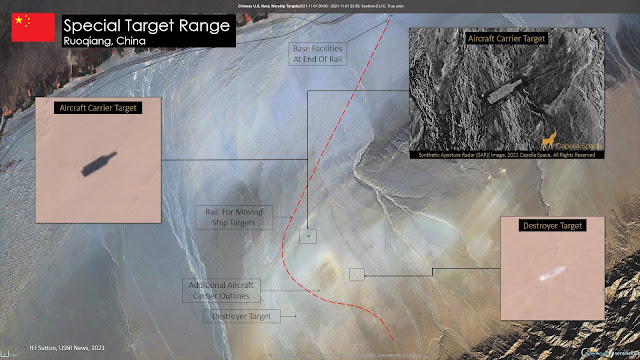
On Sunday, H.I. Sutton and Sam LaGrone over at USNINews brought a few visuals that should grab your attention;

The Chinese military has built targets in the shape of an American aircraft carrier and other U.S. warships in the Taklamakan desert as part of a new target range complex, according to photos provided to USNI News by satellite imagery company Maxar.

The full-scale outline of a U.S. carrier and at least two Arleigh Burke-class destroyers are part of the target range that has been built in the Ruoqiang region in central China. The site is near a former target range China used to test early versions of its so-called carrier killer DF-21D anti-ship ballistic missiles, according to press reports in 2013.

This new range shows that China continues to focus on anti-carrier capabilities, with an emphasis on U.S. Navy warships. Unlike the Iranian Navy’s aircraft carrier-shaped target in the Persian Gulf, the new facility shows signs of a sophisticated instrumented target range.

There is no reason to get all that excited about this. China realists should welcome this as it may help get the attention of those who have not fully realized the most likely Chinese Course of Action.

They know that the greatest threat to their plans for their end of the Pacific is the US Navy.

Don't get distracted by talk of grand Chinese breakthroughs in space, electronic warfare, or cyber - though they are real and a threat - because they are supporting and not supported efforts.

The Chinese main plan - their supported effort - is to lure in and then destroy as much of the US Navy and its supporting infrastructure west of Wake as it can as early as possible in the Pacific war that we all expect to come. They are confident enough of their capability to effectively strike static targets that they are moving on to refining hitting moving targets.

No use to ignore the threat, or retreat from the fact that in order to properly defend and support our allies, we not only have to go west of Wake, but west of Guam and well inside the first island chain.

Acknowledge the challenge. Accept the challenge. Welcome the challenge.

Let the Chinese do what they will - we cannot stop them while at peace - but we can do what we need to.

First, we need to counter the threat with an ability to degrade and as much as possible destroy their ability to effectively locate and track our forces.

How is our anti-satellite capability?

How is our offensive cyber ability?

How is our crypto breaking?

How is our offensive EW?

How is our dirty tricks/spoofing cadre?

How "quiet" can we operate along the electromagnetic spectrum?

Those are just a few of the top "soft" capabilities we need.

How is our ship based anti-ballistic missile/hypersonic capability? How many do we need to carry? How many in magazines? How many can industry produce per month?

How effective is our long range conventional strike capability?  How many in magazines? How many can industry produce per month?

How are we on ensuring that our ship based cruise missiles have the range they need? How many do we need to carry? How many in magazines? How many can industry produce per month?

(NB: if in your head you don't have a matrix of VLS cells per ship and are marking off real estate, you're doing it wrong.)

What are we doing to extend the range of our airwing and the weapons they carry? 

I am not interested in your PPT-thick vaporware that might show up by 2040. No, I need to know what you will have ready to deploy in number by 2025. Save Futurewar for another brief, later, on someone else's schedule.

Have we effectively modeled what we need for damage control when faced by near misses or glancing blows by ballistic missiles and hypersonics? No, you can't assume every hit is a direct hit or cracks the ship in half. That will happen, but a few thousand years of warfare tells us that won't happen every time.

Have we effectively modeled how we will repair ships to get them back in the fight as soon as practical? Do we have what we need to do that?

Have we effectively modeled how we are going to conduct reloads of VLS cells forward? Do we have what we need to do that? 

Regulars here know the answer to much of the above.

I think we can all agree there is much work to do.

Now, who is doing it?

A final note, for those who would like a quick and fascinating read on the Taklamakan desert that the Ruoqiang is part of, I can not recommend more highly Peter Hopkirk's Foreign Devils on the Silk Road.

Since I discovered the history of it in the 1990s, I've always been interested in news coming out about the Taklamakan. The place is just a brutal part of the world. If you wonder what "Taklamakan" might mean, I've read this in a few places, including Hopkirk;

The name is probably an Uyghur borrowing of Arabic tark, "to leave alone/out/behind, relinquish, abandon" + makan, "place". Another plausible explanation is that it is derived from Turki taqlar makan, which means "the place of ruins". Popular accounts claim that Takla Makan means "go in and you will never come out". It may also mean "The point of no return" or "The Desert of Death"..

Wednesday, March 29, 2023

Seriously ... Who's Been Running Our Wargames Then ...


One of the things that will get my eye twitching faster than about anything else is when someone responds to a question or concern with a, "Well, in our wargames ... "

Bullshit.

That may work for civilians or under-briefed lawmakers who lack the depth in military matters, but anyone who has run or been part of a wargame knows that you can design one to give you the outcomes you want. 

Planning assumptions etc ... it is all flexible.

Wargames, done right, don't tell you the future, but they do help inform gaps in your OPLAN, thinking, or expectations of the enemy ... and shortfalls you might have.

At the POLMIL level - where our most senior uniformed and civilian leaders live - you have distinctly different concerns than Tactical, Operational, or - if your Planning Confession separates Strategic from the POLMIL level - Strategic level.

For the senior uniformed leader to make this statement, as if it were a bolt out of the blue, is simply gobsmacking;

A “big lesson learned comes out of Ukraine, which is the incredible consumption rates of conventional munitions in what really is a limited regional war,” General Mark Milley, the chairman of the Joint Chiefs of Staff, told the House Armed Services Committee.

“If there was a war on the Korean peninsula or a great power war between United States and Russia, United States and China, those consumption rates would be off the charts,” he said.

Whose charts? Who made them and using what metrics and dataset?

Yes ... that is a lesson for most out there ... but it should not be for the CJCS. Hell, I remember certain aspects of updating the OPLAN for Korea a quarter century ago when we beat the drum that, "We don't have enough ____ and only a few days of ____ before we are combat ineffective."

This. Is. Not. New.

As we mentioned last July, magazine depth has been a chronic shortfall for a long time.

I have trouble believing that the CJCS is shocked, SHOCKED, that this is an issue. 

It isn't a "lesson learned" - it is a lesson ignored.

I'm just some guy who left active duty over 13-years ago plugging away generating taxable income as a civilian and ...

Eight months before the Russo-Ukrainian War kicked off;


The Army knew this was a problem ~4.5 years ago;
We also need to remember something we discussed back in 2018 ... it isn't so much how much stuff we buy, but that we store them in the right place;

At the end of the day, I'm just happy we're having this conversation, but we need to stop telling half-truths and happy-talk to each other - and Congress needs to call these people out. It is all just so insulting.

We made mistakes in our estimates of the nature of war, and we're moving to correct them.

Why is that so hard to say?

Tuesday, June 28, 2022

The War Gods of the Copybook Headings Return


Industrial capacity feeds logistics. Logistics win wars. Logistics is math. Math is unforgiving to the complacent.

If you are looking for early lessons of the Russo-Ukrainian War, there are two that need to be underlined today.

Lesson 1: Don’t Fall for the Short War Fallacy:

This is a known fallacy throughout human history, but every generation must be reminded of it, sometimes more than once. At peace, people will find reasons – either phycological or financial – to promote the promise of a short war either through their superior ideas or exquisite weapons. Good people desiring good things are easily seduced by this peace-time siren’s song. 

The Russians thought that the Ukrainians would fall in 3-5 days and planned for it. The United States and Western Europe thought that so much they tried to convince the Ukrainian government to retreat to Lviv or even Poland before the first Kalibr cruise missile received intent-to-launch. Before the war, the Ukrainians did not believe the Russians would actually do this – but the moment the first Russian boot stepped off a Mi-8 at Hostomel, they knew they were in for an existential fight … and here we are at the start of month-5 of the war.

Action 1: have hard follow-on questions for anyone who is promising a short war or is selling a “Win in 72-hr Posture.” It briefs well, but it almost never works out.  Everything has to be executed perfectly and your opponent have no agency. What is their “Plan-B” or will it be like Iraq 2003’s “Phase 4” or the Russian retreat from Kiev when reality hits?

Lesson 2: The Hard Math of Shallow Magazines:

You are short of everything because you didn’t believe the warnings of Lesson-1. We have all read volumes the last few months of all the friends of Ukraine scouring the deep recesses of forgotten magazines for former Soviet compatible ammunition that could be sent to Ukraine. Well, that which was not destroyed pre-war by the Russian clandestine services. Because the answer was too painful for peacetime leaders to ponder, no one wanted to do the math of what a real war would mean. That is the subject of today’s post.

Action 2: Tell the Cult of Efficiency to Get Bent; You Have a War to Prepare For.

Alex Vershinin over at the Royal United Services Institute has a must read article I’m going to pull some quotes on supporting Lesson-2 titled, The Return of Industrial Warfare.

The rate of ammunition and equipment consumption in Ukraine can only be sustained by a large-scale industrial base.

This reality should be a concrete warning to Western countries, who have scaled down military industrial capacity and sacrificed scale and effectiveness for efficiency. This strategy relies on flawed assumptions about the future of war, and has been influenced by both the bureaucratic culture in Western governments and the legacy of low-intensity conflicts. 

...

The winner in a prolonged war between two near-peer powers is still based on which side has the strongest industrial base.

From small arms to nuclear submarine repair, our industrial base is exquisitely designed and Tiffany-tough. Any unexpected shock can almost make the whole system grind to a stop. Though the roots go deeper, this is a direct byproduct of the 1990s “Send all senior defense leaders to a 2-week MBA school” mentality and its second order effects. The Cult of Efficiency’s green eye-shade priorities took the place of the bookshelf full of history’s example.

It didn’t take the Russo-Ukrainian War to expose this. We saw this in 2011’s operations against Libya and the war in Iraq.

...there is an assumption about overall ammunition consumption rates. The US government has always lowballed this number. From the Vietnam era to today, small arms plants have shrunk from five to just one. This was glaring at the height of the Iraq war, when US started to run low on small arms ammunition, causing the US government to buy British and Israeli ammunition during the initial stage of the war. At one point, the US had to dip into Vietnam and even Second World War-era ammo stockpiles of .50 calibre ammunition to feed the war effort. This was largely the result of incorrect assumptions about how effective US troops would be. Indeed, the Government Accountability Office estimated that it took 250,000 rounds to kill one insurgent. Luckily for the US, its gun culture ensured that small arms ammunition industry has a civilian component in the US. This is not the case with other types of ammunition, as shown earlier with Javelin and Stinger missiles. Without access to government methodology, it is impossible to understand why US government estimates were off, but there is a risk that the same errors were made with other types of munitions.

As I alluded to above, there are some important influencers in the natsec arena who are in love with the “72-hr War.” Their premise is that if we design our force around convincing the Chinese – and ourselves – that in the first 72-hrs we have the capacity to destroy any ability of the enemy to proceed towards their objectives then they won’t start the war. If they do, well, we have what our wargames tell us we need to win in 72-hrs.

I’m sorry, but your modeling and wargames are just that – models and games. You tell any competent designer what outcome you want, and they/we can tweak the assumptions and variables such that we can give you that result. I am very sure all the Russian models and wargames showed them conducting a victory parade in Kiev before March … but how did that work out for them?

If you don’t win quick – there are no mulligans in war. Let’s quote me again; Industrial capacity feeds logistics. Logistics win wars. Logistics is math. Math is unforgiving to the complacent."

...390 daily missions fired by tube artillery...With four guns per battery and four rounds per gun, the tube artillery fires about 6,240 rounds per day. We can estimate an additional 15% wastage for rounds that were set on the ground but abandoned when the battery moved in a hurry, rounds destroyed by Ukrainian strikes on ammunition dumps, or rounds fired but not reported to higher command levels. This number comes up to 7,176 artillery rounds a day. It should be noted that the Russian Ministry of Defense only reports fire missions by forces of the Russian Federation. These do not include formations from the Donetsk and Luhansk separatist republics, which are treated as different countries. The numbers are not perfect, but even if they are off by 50%, it still does not change the overall logistics challenge.

Presently, the US is decreasing its artillery ammunition stockpiles. In 2020, artillery ammunition purchases decreased by 36% to $425 million. In 2022, the plan is to reduce expenditure on 155mm artillery rounds to $174 million. This is equivalent to 75,357 M795 basic ‘dumb’ rounds for regular artillery, 1,400 XM1113 rounds for the M777, and 1,046 XM1113 rounds for Extended Round Artillery Cannons. Finally, there are $75 million dedicated for Excalibur precision-guided munitions that costs $176K per round, thus totaling 426 rounds. In short, US annual artillery production would at best only last for 10 days to two weeks of combat in Ukraine. If the initial estimate of Russian shells fired is over by 50%, it would only extend the artillery supplied for three weeks.

...

The expenditure of cruise missiles and theatre ballistic missiles is just as massive. The Russians have fired between 1,100 and 2,100 missiles. The US currently purchases 110 PRISM, 500 JASSM and 60 Tomahawk cruise missiles annually, meaning that in three months of combat, Russia has burned through four times the US annual missile production. The Russian rate of production can only be estimated. Russia started missile production in 2015 in limited initial runs, and even in 2016 the production runs were estimated at 47 missiles. This means that it had only five to six years of full-scale production.

...(a)crucial assumption is that industry can be turned on and off at will. This mode of thinking was imported from the business sector and has spread through US government culture. In the civilian sector, customers can increase or decrease their orders. The producer may be hurt by a drop in orders but rarely is that drop catastrophic because usually there are multiple consumers and losses can be spread among consumers. Unfortunately, this does not work for military purchases. There is only one customer in the US for artillery shells – the military. Once the orders drop off, the manufacturer must close production lines to cut costs to stay in business. Small businesses may close entirely. 

Now is the time for Congress to force The Pentagon to stop with foolish ideas. Demand to see the full inventory for everything from 5.56mm to 21-inch torpedoes and run the long war. Not 72-hrs, but 72-weeks. Heck, take an extra day and make it 72-months.

Look at our single points of failure. From magazines and airfields west of Wake to production facilities in CONUS – expect at war that through direct action or sabotage, we will lose some of these facilities/capabilities. The Chinese have seen this in the build-up and execution of the war by the Russians against Ukraine. They will go after these non-resilient targets that even without prompting can go up in a – pun intended – flash. There is even a term of art for it; Unplanned Explosions at Munitions Sites (UEMS).

We need to start acting on this now.  There are more lessons to come, but we don’t have to wait for them all to come in – we don’t have time to.


Friday, October 22, 2021

Fullbore Friday


You graduated from the Naval Academy with the world at war. While it seemed your nation’s politicians were saying they would do all they could to stay out of this war – you probably knew better. It was a big war, and one side was being fed and armed from our side of the ocean. 

After graduation you get assigned to a battleship – and within a year, your nation goes to war. Your battleship was not just any ship, she was the USS Connecticut (BB-18), the flagship for The Great White Fleet a decade earlier, and now flagship of the Fifth Battleship Division.

Yet, your war never really came. You spent the war never leaving the east coast. You spent the entire war on what you realized soon, was an obsolete hulk of another age best used for what it was used for, training of others.


With the war over, you knew naval war was in a new age – an age where the submarine and the aircraft would change forever how power is brought from the sea.

You went to sub school and spent the next 12 years in the submarine service. A select group of select officers still trying to understand how to make these exciting new platforms work.

Big Navy was not through with you though, and back you went to battleships, the 15-yr old USS New York (BB-34). Your nation by now was in the grips of a nightmarish depression and the world was quiet.

You had a great tour and as a LCDR was given command of the USS Evans (DD-78). The 4-stack destroyer had been in the Navy as long as you had and was just a few years from being sent to mothballs, but she was your ship. 


You did well in command and post-command shore duty. As the world started to heat up again in 1937 you make Commander and your Navy sent you back to submarines with the honor of commanding Submarine Division Seven in Groton.

Again, the world headed to war yet you had aged out of operational units. Command is command though … and as an East Coast Sailor, your friends at BUPERS had something interesting – a 32-yr old former collier converted into a repair ship based out of Pearl Harbor, Hawaii. The USS Vestal (AR-4).

You’ve been in the Navy 25 years, almost 30 if you include your time at Annapolis. Maybe we’ll stay out of this war, maybe not … but command of a ship – any ship – in Hawaii, well, there are worse sunset tours for a Commander.

Then came one December Sunday halfway through your command tour; Commander Cassin Young, USN – history is finally calling, and you’re on her short list:

...Sunday in port was shattered shortly before 08:00 as Japanese carrier-based aircraft swept down upon Pearl Harbor. At 07:55, Vestal went to general quarters, manning every gun from the 5-inch (127 mm) broadside battery to the .30 cal. Lewis machine guns on the bridge wings. At about 08:05, her 3-inch (76 mm) gun commenced firing.

At about the same time, two bombs – intended for the more valuable battleship inboard on Battleship Row – hit the repair ship. One struck the port side, penetrated three decks, passed through a crew's space, and exploded in a stores hold, starting fires that necessitated flooding the forward magazines. The second hit the starboard side, passed through the carpenter shop and the shipfitter shop, and left an irregular hole about five feet in diameter in the bottom of the ship.

Maintaining anti-aircraft fire became secondary to the ship's fight for survival. The 3-inch (76 mm) gun jammed after three rounds, and the crew was working to clear the jam when an explosion blew Vestal's gunners overboard.

At about 08:10, a bomb penetrated Arizona's deck near the starboard side of number 2 turret and exploded in the powder magazine below. The resultant explosion touched off adjacent main battery magazines. Almost as if in a volcanic eruption, the forward part of the battleship exploded, and the concussion from the explosion literally cleared Vestal's deck.

Among the men blown off Vestal was her commanding officer, Commander Cassin Young. The captain swam back to the ship, however, and countermanded an abandon ship order that someone had given, coolly saying, "Lads, we're getting this ship underway." Fortunately, the engineer officer had anticipated just such an order and already had the "black gang" hard at work getting up steam.

The explosion touched off oil from the ruptured tanks of the Arizona which in turn caused fires on board Vestal, aft and amidships. At 08:45 men forward cut Vestal's mooring lines with axes, freeing her from Arizona, and she got underway, steering by engines alone. The naval tug Hoga, whose tugmaster had served aboard Vestal just a few months before the attack, pulled Vestal's bow away from the inferno engulfing Arizona and the repair ship, and the latter began to creep out of danger, although she was slowly assuming a list to starboard and settling by the stern. At 09:10, Vestal anchored in 35 feet (11 m) of water off McGrew's Point.


With the draft aft increasing to 27 feet (8 m) and the list to six and one-half degrees, Commander Young decided upon another course of action. "Because of the unstable condition of the ship", Young explained in his after-action report, "(the) ship being on fire in several places and the possibility of further attacks, it was decided to ground the ship." Underway at 09:50, less than an hour after the Japanese attack ended, Vestal grounded on 'Aiea Bay soon thereafter. Commander Young was awarded the Medal of Honor for his actions that day.

Many of you may recognize that name. He was promoted to Captain, given command of the USS San Francisco (CA-38) and was killed in action 13 NOV 42 during the Naval Battle of Guadalcanal leading his ship against the Imperial Japanese Navy’s Battleship Hiei.

Captain Young – fullbore.

Friday, December 07, 2012

Fullbore Friday

Pearl Harbor Day and FbF.  What to do?

Well, why not put out one of my favorite stories of what professional leadership at sea does. There are a lot of stories from this day, but for now let's review the "fight until you can do no more, then fight more" story of the USS NEVADA (BB-36).
When the sun rose over Nevada on the 7th, the ship's band was playing "Morning Colors"; but planes then appeared on the horizon and the attack on Pearl Harbor began.

Aft of Arizona during the attack, Nevada was not moored alongside another battleship off Ford Island, and therefore was able to maneuver, unlike the other seven battleships present. As her gunners opened fire and her engineers started to raise steam, a single 18 in (460 mm) Type 91 Mod 2 torpedo exploded against Frame 41 about 14 ft (4.3 m) above the keel at 0810. Seconds later, the same Kate torpedo bomber that dropped the torpedo was shot down. The torpedo bulkhead held, but leaking through joints caused flooding and a list of 4–5°. Nevada corrected the list through counter-flooding and got underway at 0840, her gunners already having shot down four planes.

As she steamed past Ten-Ten Dock at about 09:50, Nevada was struck by five bombs. One exploded over the crew's galley at Frame 80. Another struck the port director platform and exploded at the base of the stack on the upper deck. Yet another hit near No. 1 turret inboard from the port waterway and blew large holes in the upper and main decks. Two struck the forecastle near Frame 15; one passed out through the side of the second deck before exploding, but the other exploded within the ship near the gasoline tank; leakage and vapors from this tank caused intense fires around the ship.

The gasoline fires that flared up around Turret 1 might have caused more critical damage if the main magazines had not been empty. For several days prior to the attack, all of the 14 in (360 mm) gun battleships had been replacing their standard-weight, main-battery projectiles with a new heavier projectile that offered greater penetration and a larger explosive charge in exchange for a slight decrease in range. All of the older projectiles and powder charges had been removed from the magazines of Nevada, and the crew had taken a break after loading the new projectiles in anticipation of loading the new powder charges on Sunday.

Over the course of the morning, Nevada suffered a total of 60 killed and 109 wounded. Two more men died aboard during salvage operations on 7 February 1942 when they were overcome by hydrogen sulfide gas from decomposing paper and meat. The ship suffered a minimum of six bomb hits and one torpedo hit, but "it is possible that as many as ten bomb hits may have been received, [...] as certain damaged areas [were] of sufficient size to indicate that they were struck by more than one bomb.
I want to put something else out there for you to ponder. Ponder all that damage, and then review this timeline.
Nevada was refloated on 12 February 1942 and underwent temporary repairs at Pearl Harbor so she could get to Puget Sound Navy Yard for a major overhaul and modernization. This was completed in October 1942, and it changed the old battleship's appearance so that she resembled the South Dakota-class battleships. Her 5"/51s and 5"/25s were replaced with sixteen 5"/38 caliber guns in new twin mounts.[
Six fracking months. Heck - that is Fullbore yardbird.

Here is some video for you as well to cover her service in WWII, in a fashion. First, video of the attach where at ~0:56 mark you can see her underway and firing at the enemy.

The next one you can see here here and there during the Battle of Attu, and the last one is where she was nuked at the end of the war.


Tuesday, November 22, 2022

When Will the West Call for the Wooden Badger?


One of the more difficult things for me to work through is a certain intolerance at my core that is easily triggered, and I have to make a conscious effort to not be petty, mean, and flinty towards people an institutions who put it in my face. 

To be more specific, I have a very short fuse when people act shocked today when something happens that they have been warned about - and even suffered from - in the past that they could have avoided repeating in the future if they took basic and clear steps to learn their lesson.

Let's go back to 2011, almost a dozen years ago;

Less than a month into the Libyan conflict, NATO is running short of precision bombs, highlighting the limitations of Britain, France and other European countries in sustaining even a relatively small military action over an extended period of time, according to senior NATO and U.S. officials.

The shortage of European munitions, along with the limited number of aircraft available, has raised doubts among some officials about whether the United States can continue to avoid returning to the air campaign if Libyan leader Moammar Gaddafi hangs on to power for several more months.

...

The six countries conducting the air attacks, led by Britain and France, were unsuccessful at a meeting this week in Berlin in persuading more alliance members to join them.

NATO officials said that their operational tempo has not decreased since the United States relinquished command of the Libya operation and withdrew its strike aircraft at the beginning of April. More planes, they said, would not necessarily result immediately in more strike missions.

But, they said, the current bombing rate by the participating nations is not sustainable. “The reason we need more capability isn’t because we aren’t hitting what we see — it’s so that we can sustain the ability to do so. One problem is flight time, the other is munitions,” ...

Libya “has not been a very big war. If [the Europeans] would run out of these munitions this early in such a small operation, you have to wonder what kind of war they were planning on fighting,” said John Pike, director of GlobalSecurity.org, a defense think tank. “Maybe they were just planning on using their air force for air shows.”

Despite U.S. badgering, European allies have been slow in some cases to modify their planes and other weapons systems so they can accommodate U.S. bombs. Retooling these fighter jets so that they are compatible with U.S. systems requires money, and all European militaries have faced significant cuts in recent years.

And so here we are, at the end of 2022;

Top defense officials in Europe say arms shortages among Ukraine’s Western allies are forcing difficult conversations about how to balance support for Ukraine with concerns Russia may target them next.

NATO members that have sent billions of dollars worth of weapons and equipment are discussing what stockpile levels they need to meet their obligations under the mutual defense treaty. Decisions facing them now could have consequences for their their own security and for Ukraine, in its fight to repel Russia’s nine-month-old invasion.

The strain on stockpiles is “across the board,” and particularly sharp for ammunition, he said. In the years before some countries donated to Ukraine, they maintained stockpiles at half capacity or less because they saw little risk or couldn’t afford more, and took a “just-in-time, just-enough,” approach to the defense industry.

“So the urgency now is seen and understood, I think in most of the nations,” Bauer said.

Really? Now they'll get it?

It’s an acute challenge for some of NATO’s smallest members, like the Netherlands, which even before its donation of more than $800 million’s worth of aid to Ukraine, was straining to meet its NATO obligations. Gen. Onno Eichelsheim, chief of defense of the Netherlands, said Dutch stocks were “not that high” when the Netherlands opted to send Ukraine 155mm howitzer ammunition and air defense missiles.

“We started with stocks that were not completely filled, that were not completely ready, did not have all the materiel to support what we needed for NATO,” Eichelsheim said. “It means that I immediately have to get stocks filled up by getting contracts with industry, which we started, luckily, a year ago.”

The Dutch government and other European allies have been having discussions with industry about their long-term procurement plans to incentivize production increases ― and how to prioritize deliveries based on which country needs a weapon most. One aim is to build Europe’s defense industry and not depend too much on the U.S.

This isn't an industry problem, this is a people problem.


In Europe and North America we continue to promote people, priorities, and budgets for the wrong reasons. We have incentives and disincentives that reward myopic behavior and promote people who don't really understand what their job actually is. 

This is not a new problem. It has existed throughout human written history. In peace, we like people and policies that seem easy (and inexpensive) and really hope that we don't have to be prepared for the worse, because that is sad to think about. No, we need to be comfortable and look peaceful so people (we for some reason value) will say nice things about us and our priorities. 

Of course, reality always regresses to the mean. War is a constant in our species. Always has been. Always will be. The question, as always, is which society will gain when the next war comes? Will it be a society that a Westerner would call "progressive," "liberal," or based on "individual liberty," or will it be some autocratic force who will bring another period of darkness - the boot smashing the face etc.

Those who know their history, and what is needed to keep the global order from regression in to barbarity, need to speak up more. They need to support each other more. They need not be cowed. Care not what names you are called. Be not bothered the invitations you do not receive. They need to be open in their argument - clear in their purpose.

Once again, we have a small war (in 2011) warning us about a critical vulnerability. We now have a medium war (in 2022) yelling a little louder about this critical vulnerability.

History is trying to warn us, again, about what can undermine the Western project when the next big war comes.

There is no honorable or logical argument for shallow magazines, but the argument for deeper magazines will not win on its own. It needs advocates, it needs argument, it needs funding.

There also needs for a fair bit of "calling out" those who ignored warnings for so long. Fear and shame are great motivators - we should not be shy about using them.

Friday, June 25, 2010

Fullbore Friday

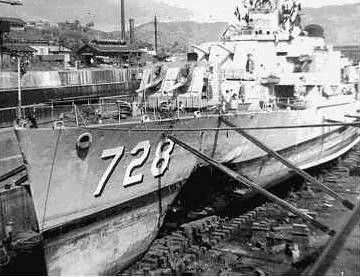
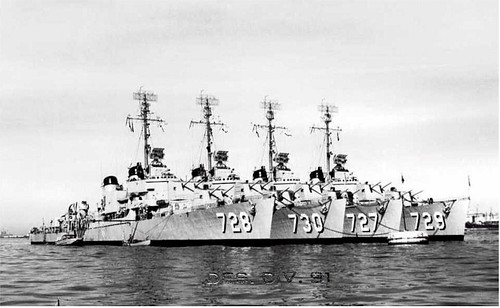
She was a Sumner Class DD. Eight Battle Stars over three wars ... but let's go back to the Korean War ... and remind ourselves of what is still out there ... waiting ... and what a well made ship, a well led crew, and a little luck can get you.
About 1230I on the 30th, an urgent dispatch directed the MANSFIELD and SWENSON to proceed at best speed possible to Lat 38°45'N, Long 128°15'E to assist a B-26 aircraft reported down at that point. The distance was about 60 miles north of the MANSFIELD. At 1445I the ship went to General Quarters and set Material Condition Able, executing this routine exercise with more thatn usual vigor upon hearing from the SAR plane on the scene that small arms fire had been received from the beach. At 1450I the ship reported on the scene and commenced searching. At 1500I, with the L.K. SWENSON lying to outside the 50 fathom curve, to cover our approach, the entry to Choson Ko begun. The approach was made at slow speed, heading so that the reported position of the plane wreckage would be on the starboard bow. A second plane was now on the scene, a B-178 with a rescue boat. The SAR plane, when requested to make another pass over the wreckage it had reported approximately 500 yards east of Toi To Island, again drew machine gun fire which could clearly be heard on the ship.

The ship had stopped engines at 1535I, and at 1536I both engines were backed to bring the way off, at a point 2,200 yards from the reported wreckage, in 12 fathoms of water. Some objects were now visible in the cove near the beach; a raft of logs about 3,000 yards to port, some net buoys about 3,000 yards ahead. At 1539I a sonar contact was identified as shoal, Chu Rai.

No sign of the suspected wreckage was seen by the many lookouts and officers on the bridge of the
MANSFIELD. Neither was anything seen in the water near the ship. The mine lookout, recently stationed in the eyes of the ship with rifle and binoculars, reporting nothing.

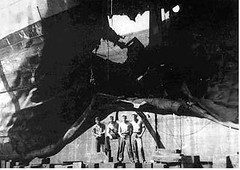
After backing clear to the vicinity of the L.K. SWENSON, a distance of four miles, engines were stopped and an account made of the casualties and damage. Radio reports were sent to cognizant commanders. Early analysis of the damage accurately established the water tight bulkhead forward at frame 48. This bulkhead was shored while wounded were carried to the battle dressing station in the wardroom. the Commanding Officer called repeatedly for an estimate of casualties particularly dead and missing. Finally an all hands muster on abandon ship parade confirmed the previous on-battle-station muster of NONE missing or dead. After this cheerful report was passed to all hands, the work of treating the twenty-eight wounded, of building shores, and of pumping tanks proceeded with greater expedition. Three weeks after the explosion the fact that not a man was lost of even crippled remains a miracle.
Please, read more at the links.

Check out this Fullbore timeline. Littoral warfare and fighting hurt; yea, we've got that.
CHRONOLOGICAL ORDER OF EVENTS
30 SEPTEMBER 1950

1227 Departed area of Point "Easy", Lat 37°56'N, Long 128°54'E, in company with USS LYMAN K. SWENSON DD729 proceeding at 25 knots to a point Lat 38°45'N, Long 128°15;E, to investigate a report of a downed American B-26 in accordance CTG 95.2 instructions.
1239 Established radio communications with SAR plane.
1445 Small arms fire reported on the beach. Manned General Quarters Stations.
1450 Commenced approach to Chosen Ko. USS SWENSON standing by to seaward.
MANSFIELD on course 286°T, speed 10 knots.
1500 Commenced entry, on course 205°T.
1504 Slowed to 5 knots.
1508 Increased to 10 knots.
1509 Plane reported possible wreckage 1/4 to 1/2 mile east of small island (Toi To).
1513 Slowed to 5 knots.
1533 SAR plane reported directly over wreckage.
1534 SAR plane reported objects at mouth of inner bay, appeared to be a life preserver and box.
1536 Objects, apparently logs, sighted on port beam 3000 yards.
1538 All engines stopped. Lying to.
1539 Sonar reported contact on port bow, 1200 to 1300 yards. Identified as 4 3/4 fathom shoal (Chu Rai).
1547 Explosion port side forward. All engines back full. Backed clear of minefield, lying to outside 50 fathom curve in vicinity L.K. SWENSON.
1737 All engines ahead 1/3 (3 knots).
1850 Changed speed to 8 knots.
2108 Stopped for transfer of wounded to USS HELENA.
2245 Underway at speed 8 knots as guide of formation.
2346 Changed speed to 10 knots.
Now let's talk about the ship for a bit.

Of course, she is a Bath Iron Works ship - that should tell you a lot - but let's look at the stats.
Class and type: Allen M. Sumner class destroyer
Displacement: 2,200 tons
Length: 376 ft 6 in
Beam: 40 ft
Draft: 15 ft 8 in
Propulsion: 60,000 shp (45 MW); 2 propellers
Speed: 34 knots
Range: 6500 nmi. @ 15 kt
Complement: 336
Armament: 6 × 5 in./38 guns (12 cm),
12 × 40mm AA guns,
11 × 20mm AA guns,
10 × 21 in. torpedo tubes,
6 × depth charge projectors,
2 × depth charge tracks
... and yes, I'm going there.

Now the
Little Crappy Ship.
Class and type: Littoral Combat Ship
Displacement: 3,000 metric tons
Length: 378 ft
Beam: 57.4 ft (17.5 m)
Draft: 12.8 ft (3.9 m)
Propulsion: 2 Rolls-Royce MT30 36 MW gas turbines, 2 Colt-Pielstick diesel engines, 4 Rolls-Royce waterjets
Speed: 47 knots
Range: 3,500 nm at 18 knots
Complement: 75-100

Armament:
1x BAE Systems Mk 110 57 mm gun,
2x .50-cal machine guns
21x RIM-116 Rolling Airframe Missile Surface-to-Air Missiles
45 NLOS missiles
Yes, LCS is larger than a WWII-Vietnam era destroyer. Of course, NLOS is vapor-ware. The Army has CANX it. Still not proven on land or at sea.

I am glad that the LCS is fast - because it better run away fast from the cutting edge of 1940-60s technology. That's ok though. It will run out of fuel fast enough that in our time-warp sea battle - the dash would find her and the DD could stand off at a respectful distance and plunk away with its six 5"/38s. It will only take a hit or two.

Oh, we'll even give the LCS a helo. Good luck getting close to MANSFIELD. Those 5"/38s have quite a track record against sub-200 knots targets. That one 57mm might break or jam after awhile - and it can't shoot aft ... that would be bad.

Here is a fun fact; the widdle LCS's 57mm has a
max range of 9 mn - about 1,000 yds more than the standard load for the 5"/38. At that range - it takes a round about a minute to reach the target. Both ships are very maneuverable. On top of that - LCS cannot fire from the stern and would have to turn and close the MANSFIELD. Optically guided, ahem, or even if it was fully online - you will not get hits at max range.

In a gun battle - numbers matter. The number of turrets you have gives you redundency in case of mechanical failure or battle damage. It also gives you some wiggle room on your fire control solution as two ships move a lot. It is easier to kill a rabbit with a shotgun than a rifle when it is running.

The closer you get, the more accurate your fire as the round spends less time in the air. You also need a large magazine and multiple magazines. Inaccurate fire means you need to put a lot down range in hope you get a hit. Magazines can have failures just like turrets can.

When you get closer - odds are you will get hit too - multiple times. You need to fight when hurt. You need enough crew for DC, and fighting the ship. How many hits could the MANSFIELD take? Yea ... I think we know that.

How many hits from a 5"/38 HE rounds could LCS take? I vote one.

OK shipmate - you can ride the 1971 version of the USS MANSFIELD or you can ride the 2010 version of the LCS. You are 20,000 yards apart and both of you want that nuclear weapon floating adrift on a tramp steamer off of San Diego. ,,,, Wait ... I am changing the rules here for a second. Don't get upset; just pray I don't change them again.

MANSFIELD has a DASH. LCS has a FIRESCOUT - after all - Firescout is so much more transformational than a silly manned helo with those pesky and expensive Sailors on them. I would give LCS something to fight with besides NLOS - but it doesn't exist. Sorry - you're stuck with your 57/30/12.7mm; but at least you're wearing NWU.

OK, pick your ship. Just give me a second to get my long sleeve wash khaki uniform from the attic. Heck ... liberty was better in 1971 anyway.


Friday, June 03, 2022

Fullbore Friday


Paul Vitello has a nicely done obit in NYT of a quiet hero from the Vietnam War.
Mr. McGinty, who joined the service in 1958 directly after high school, was a drill instructor at the Marine boot camp in Parris Island, S.C., and a brig officer at the Norfolk, Va., naval base before volunteering for duty in Vietnam in 1966.

“I didn’t want to be earning my pay guarding a bunch of AWOL sailors,” he told Edwin F. Murphy, author of the 1987 book “Vietnam Medal of Honor Heroes.”

Mr. McGinty led one of four platoons in Company K of the Third Battalion, Third Marine Division, during a major sortie in July 1966 known as Operation Hastings. The mission was to block North Vietnamese troops from infiltrating the demilitarized zone between the Communist-led North and the American-backed South.

After three days of fighting and severe casualties, American commanders ordered a withdrawal. The four platoons of Company K, led by Capt. Robert J. Modrzejewski, were assigned to provide cover for the pullback.
Attention to Citation:
Citation
For conspicuous gallantry and intrepidity at the risk of his life above and beyond the call of duty. 2d Lt. McGinty's platoon, which was providing rear security to protect the withdrawal of the battalion from a position which had been under attack for 3 days, came under heavy small arms, automatic weapons and mortar fire from an estimated enemy regiment. With each successive human wave which assaulted his 32-man platoon during the 4-hour battle, 2d Lt. McGinty rallied his men to beat off the enemy. In 1 bitter assault, 2 of the squads became separated from the remainder of the platoon. With complete disregard for his safety, 2d Lt. McGinty charged through intense automatic weapons and mortar fire to their position. Finding 20 men wounded and the medical corpsman killed, he quickly reloaded ammunition magazines and weapons for the wounded men and directed their fire upon the enemy. Although he was painfully wounded as he moved to care for the disabled men, he continued to shout encouragement to his troops and to direct their fire so effectively that the attacking hordes were beaten off. When the enemy tried to out-flank his position, he killed 5 of them at point-blank range with his pistol. When they again seemed on the verge of overrunning the small force, he skillfully adjusted artillery and air strikes within 50 yards of his position. This destructive firepower routed the enemy, who left an estimated 500 bodies on the battlefield. 2d Lt. McGinty's personal heroism, indomitable leadership, selfless devotion to duty, and bold fighting spirit inspired his men to resist the repeated attacks by a fanatical enemy, reflected great credit upon himself, and upheld the highest traditions of the Marine Corps and the U.S. Naval Service.
Well done Captain ... well done.

... and yes; any citation that has "attacking hordes" in it is well worthy of FbF.

First posted in JAN2014.

Tuesday, April 21, 2009

Pirates, Politics, & 'pologies: Part 2


Changing course a bit from Part 1 - I wanted to take just a little time to talk about one more thing that bounced around my head while I was off the grid. Some things that burned through from the few minutes of news I saw on background TV.

Let's review a bit though. The Democrat Party has the Executive Branch. They have the House and the Senate. They have the majority of State Governors.
The 4th Estate is designed, by their definition, to keep the politicians honest and provide a check on power - I guess.

That isn't what I saw.


I was reminded how I got to where I am now; where I now get almost all my news from the internet and/or newspapers/magazines. It didn't start that way - I was raised a news junkie.

I grew up watching CBS News. 6pm local followed by national, every night. What a geek I was at 12, yelling at the TV with my Dad. That ended in '88 when Dan Rather ambushed Bush 41. I shifted my flag to ABC until about halfway through the Clinton Administration when they just would not engage. I then shifted to NBC until, well, they just lost my interest. By '98 I was watching, no longer at 6pm, NewsHour on PBS of all places and as I did through all this time - I always checked in with CNN Headline News. By the time 2000 came by though - I couldn't take that anymore there either. I left CNN and PBS. I just could not find something that would give me both sides of the story.


So there I was watching the TV in the background earlier this month when this goofy ABC news show is on and all they want to talk was Carl Rove and his response to the VP. Zip, zero, nada discussion of the validity of the VP's statement or the issue at hand - just attacking Carl Rove for being there absorbing O2.

Next time MSNBC is on and they are talking about the federal spending orgy and all they can do is attack SC Gov. Mark Sanford. No discussion of the issues at hand, just attacking the man non-stop. That is what bloggers, ahem, do - not what our betters in the MSM are supposed to do.

Then there was the whole
teabagg'n thing. Pathetic. The only thing that made watching the mindless partisanship worthwhile was seeing Anderson Cooper kind-of come out of the closet. How do you know it is hard to talk Andy? Not that there is anything wrong with that.

Seriously. Here we are - where is the check on power?

Judging from the adds, Hollywood isn't much better. The only political adds I saw - in an incredibly short time nonetheless, were for Frost Nixon and W.

It was just plain other-worldly to see such a non-stop stream from one side.

President Obama has no excuse for not getting done what he wants to get done. I don't think we have ever seen a President and his Party have such a tailwind before.

The intertubes are about it to get alternative opinions and ideas out there - and to check power - I guess.


Get involved.

Get out your checkbook. Vote. No one is going to watch out for you but you.

Sunday, September 19, 2010

Midrats Episode 37: The November Election and National Security

Today we will have Part II of a series we started in May of this year with the same guests.

Six-and-a-half weeks from the NOV 2010 election with economic issues dominating the debate, what are the national security implications if the one or both Houses of Congress switch from Dem to Rep? What, if any, national security issues are part of the "Tea Party" movement - and what will possible new-comers such as Rand Paul and Marco Rubio bring to DC?

Live today, Sunday 19 SEP 10 our guests to discuss will be Mackenzie Eaglen, Research Fellow for National Security at the Heritage Foundation, and James S. Robbins is Senior Editorial Writer for Foreign Affairs at the Washington Times.

In addition to her position at Heritage where specializes in subjects such as defense strategy, military readiness and the defense budget - Mackenzie Eagle has extensive experience in Capitol Hill, the Pentagon, and her commentaries have appeared in major newspapers, including The New York Times and The Washington Post, and in military-focused publications such as Armed Forces Journal, Defense News, Army Times and the magazines National Defense and Military Technology. Her paper, "A New Look at Readiness: Solving the Army's Quandary," was taught at the U.S. Army War College in Carlisle, Pa.

James S. Robbins is also the author of the books "This Time We Win: Revisiting the Tet Offensive" and "Last in Their Class: Custer, Pickett and the Goats of West Point," and a political commentator and contributing editor for National Review Online.

Join us live if you can, and pile in with the usual suspects in the chat room during the show where you can offer your own questions and observations to our guests. If you miss the show or want to catch up on the shows you missed - you can always reach the archives at blogtalkradio - or set yourself to get the podcast on iTunes.

Listen to Midrats on Blog Talk Rad

Monday, May 17, 2021

Army: Climate, Politics, and Pork


No, it is not.
Today, no nation can find lasting security without addressing the climate crisis. We face all kinds of threats in our line of work, but few of them truly deserve to be called existential. The climate crisis does…climate change is making the world more unsafe, and we need to act.
- Secretary of Defense Lloyd Austin, at the Leaders Summit on Climate, April 22, 2021
As a species, humans have thrived under drastically higher and lower sea levels; colder and warmer climates. The slow changes we are seeing now are not existential. Not even close. It is a challenge - maybe in some areas a mounting crisis, but not existential. It is something that, even if a mounting crisis, does not have a military solution.

From the top, all of this is simply because the military is following the orders of the CINC. That is how it works. As this is a fun topic this week; yes, this is political and the military is involved in it.
In line with the President and the Secretary of Defense’s direction, the Army is prioritizing climate change considerations in its threat picture, strategic plans, operations and installations. 
If your orders are legal, you carry them out. As such, 90% of this is about exactly what I would submit as a staff officer if so tasked by my boss. I don’t fault anyone involved with this per se … as there are a few subversive Easter Eggs here.

That won’t stop me … as … well … in the milbogg’n ecosystem, I have a job to do. Let’s get to it.

The whole issue around global cooling/warming/climate change and whatever new iteration will be used later when these become stale long ago left the realm of science for politics.

Long ago.

I’m just old enough to remember the 1970s global cooling scare. It made good copy to sell magazines and keep people panicked after “silent spring” petered out (after the Green Revolution took out the Malthusian panic). 

Everyone coasted along for about a decade when the usual suspects invested time in SANE/FREEZE or other large paper mâché doll consuming activities to buck up the tottering Soviet Union in its final days, but when the Cold War ended, it took awhile for them to find the latest hook. They knew they had the right topic when the patron saint Al Gore took up the global warming crisis and helped smooth a new path in a pursuit of power, government control, full-time paychecks, and most importantly for rent-seeking grifters – government contracts.

A crisis, real or created, is a great excuse to grab power by those who lust after it. If you can scare the masses and then tell them you are there to save them, the herd will give you that power. You can enjoy the power for power’s sake, and to gain allies to extend your high, use it to enable others that will back you to pursue other agendas you couldn’t pursue otherwise. To keep progress progressive, as it were, also reward your friends and punish your enemies.

“Climate” is the perfect kind of crisis. We have a lot of great scary movies about it, and is for many it is a secular religion. The zealots to use as enforces are legion.

“Climate change” is always happening. Mammoth bones in the North Sea, archaeologists exploring underwater caves off Central America and the Gulf of Mexico for evidence of Ice Age human settlements, and beach sand a few hours inland prove that. No one can deny climate change as it has been going on for billions of years before our ancestors decided to leave the trees for the plains.

The great unknown is how much of today’s change is related to human activity. Is it low single digit %, or in the middle double digits? If we knew that, then based on reason we could discuss cost/benefit analysis of what if anything we could do to address it and how to mitigate its effects. We’d have a better understanding of timelines we are facing in geologic times. Sadly, the rub is that last bit. 

According to all the earlier warnings, we should all be dead right now, NYC would be flooded, and we would be a decade past the 10-yr-until-it-is-too-late point. I’m still here. Water levels are the same at my house and the Obama’s. 

A few decades after we all should have drowned or starved to death, we still suffer from powerful people ruled by emotion being pushed by people motivated by more base drivers; lust for power and greed.

That is how you should read the latest from the US Army.  Make no mistake, this is all politics and money driving well meaning people’s emotionally based fear.

Read it all, but here we go.

First, remember how we are all told by reliable sources that climate is not weather, and likewise?

Well, fail out of the gate (or Easter Egg?)
The Army has a lot to be proud of, yet there is a lot of work to continue to operate efficiently across extreme weather and climate conditions.
Next, tell me how any of this helps the Army win the upcoming fight west of Wake?
  • Strategizing and planning to mitigate climate threats, with emphasis on Soldier resilience, energy reform, and capability enhancement and procurement.
  • Advancing development and use of renewable energy, energy and water efficiency and consumption, and other environmental initiatives that steward the land, air and water to enable Army operations and maximize readiness.
  • Poised to lead the way in technology development for tactical vehicles that balances increased capability with decreased climate impacts.

In the above, all the bolded items are simply taking the Army budget to Solyndraize a few companies. 

What would I 100% support the Army doing because it is a real, actionable series of activities that would address real issues, has reliable metrics to track progress and creates sustainable stewardship examples future generations can enjoy? I’ve underlined them.

Not all of this is bad … but the politics and grift is transparent.

This sad little document ends with one of the secular religion’s chant. It really should be in Latin, or perhaps Esperanto. 
Climate change leads to competition for scarce resources and can increase the spread of infectious diseases. To secure the American people and their interests in the homeland and abroad, the Army must continue to address the challenges a changing climate poses to the people, territories, capabilities, and other resources upon which U.S. security depends.
You know what right now and for the next 5, 10, and 15 years we know is and will be driving, 
“…humanitarian disasters, undermine weak governments and contribute to long-term social and economic disruptions.”?
Mass migration, high birth rates, environmental pollution. That's what.

We have real metrics that that are statistically sound and objectively observable. If we must expend Army funds in this area … then do it here. This will see results … but to be quite honest, they are more the responsibility of USAID and other governmental organizations. The Army can support them … but it really isn’t their job – and it shouldn’t be.

Feeding the Vaal that is the “climate emergency?” All that does is line pockets, fill campaign coffers, and tickle fetishes … which is mostly the point.