Proactively “From the Sea”; an agent of change leveraging the littoral best practices for a paradigm breaking six-sigma best business case to synergize a consistent design in the global commons, rightsizing the core values supporting our mission statement via the 5-vector model through cultural diversity.
On Sept. 27, 2014, a team of U.S. Special Operations troops was dropped into a volatile village in Afghanistan’s Helmand province. The U.S. military had withdrawn thousands of troops from the country in the previous year, and the mission called for 21 Americans and about 60 Afghan commando counterparts to clear a bazaar of weapons and insurgents, and then get out.
...
“It was unlike anything I could have ever imagined…unlike anything you can prepare yourself for,” said Temple. “It all came back to training for me at that point. I remember thinking back to those days in training that were really tough, and now I realize they were preparing me for something like this.”
A teammate, U.S. Army Sgt. First Class Andrew Weathers, was gravely wounded by a sniper, and Temple put himself in the direct line of fire to drag his wounded teammate from a rooftop. At this same time, Goodman was under a barrage of machine-gun fire, with bullets narrowly missing his head by inches, according to the award citation. Still, Goodman secured his rooftop position in order to repel the insurgent force with close air support and his personal weapon.
With friendly forces taking fire from within 200 meters, Greiner and Goodman began coordinating multiple close air support strikes from AH-64 Apache attack helicopters on the closest threats while simultaneously coordinating danger-close mortar fire on enemy forces 300 meters away.
With a medical evacuation helicopter inbound, Temple once again risked his own life, carrying his wounded teammate across 100 meters of open terrain to a landing zone.
As overwhelming and accurate enemy machine gun fire suppressed Temple and his team, he remained on the open landing zone providing cover fire while his teammates pulled back.
After he returned to the compound, enemy fighters surged within 40 meters after intercepted communications stated, “Take the Americans alive.” Temple immediately directed danger-close F-16 Fighting Falcon strafing runs to repel the assault.
As the supplies dwindled during the 48-hour firefight, Temple braved open terrain several times to retrieve critical ammunition from a resupply helicopter. At the same time, Greiner coordinated precision airstrikes to cover Temple and the other Special Forces team members.
"These Airmen are much of the reason I am standing here today," said U.S. Army Capt. Evan Lacenski, Special Forces team leader for the combat controllers while deployed. "They were faced with one of the most significant battles of Operation Enduring Freedom, in my opinion, and they acted professionally, valorously, flawlessly and executed the mission. I couldn't ask for a better group of Airmen."
The men are credited with saving the lives of 21 U.S. Special Operations forces and approximately 60 Afghanistan commandos.
A picture. Just a picture. Before you jump too far down the post, I'd like you to just ponder this pic for awhile, then we'll flesh it out.
Hold your horses; go back and look at the pic some more. Zoom in if you need to. There is a story here, one I wish we had in detail. Sure, the obvious is there ... but let's look from the inside out. The details. The line attached to the cleat is bunched together like one on a weekend jon boat ... but this is a PBR MK-II or III. In contrast, the man has a reasonably new uniform and inspection ready polished black boots. The flack jacket is frayed. As for the bow, it too looks new, as the string is bright and white and the wood unmarred from regular shipboard storage. It isn't for just show, the archer has arm and finger guards, good form, and the arrow actually looks hand made. He is aiming his arrow at the grass house just off the river. One that obviously is someone's who makes their living off the water, as you can see between him and the house where the owner parks his boat. Why is he going to burn down the house? Why use this method? You can get a broader view of the mission of these men and their boats via our friends at WarBoats here. Think about the genius of this, it makes complete sense. If you are ordered to set fire to any structure near the river that is being used by the enemy ... how do you do that? If you go ashore, you are immobile, your Sailors are in danger of being ambushed, booby-traps would be waiting for them, and in essence, you will be putting their lives in danger just to burn a thatch hut. You probably don't have and don't want a flame thrower on board. How do you set fire to something from a safe distance? Simple solution has existed for thousands of years; a flaming arrow? Why not? How did he come up with this solution? That we don't know ... but thanks to a good Navy stencil program ... we can at least ID the person. Zoom in on the helmet. That could just be one of a few names. Now, let's cheat. To the caption;
Lt Cmdr Donald D. Sheppard aims a flaming arrow at a bamboo hut concealing a fortified Viet Cong bunker on the banks of the Bassac River, Vietnam, on December 8, 1967.
Who was Don Sheppard? Lucky for us, we actually know that, and as a result, have an outline of a character I think we all wish we served with. Read it all, but here is a rough summary;
He had entered the Navy as a seaman in 1948 ... retired in 1978 ... failed to graduate from High School ... he was on a search aircraft patrolling the Bikini Hydrogen tests in 1954, ... despite having not even completed High School, he was encouraged to study engineering, eventually becoming his ship's engineering officer.
... X.O. of the U.S.S. Arnold J. Isbell (DD-869), ... command of the U.S.S. Carpenter (DD-825) at Treasure Island, San Francisco.
Why are there some well established personnel problems that we will not change, while at the same time we are looking at making some bold new ones? I'm discussing that over at USNIBlog. Stop by and pay a visit.
Now and then, there is a good summary article that comes out that serves as a nice tonic to some of the more alarmist writing that pops up about China's growing military might. Kyle Mizokami over at WiB has a great example of the breed. Yes, they are getting stronger ... but ... Read it all, but if you need just enough to get you to your next cup of coffee, here's a taste;
By some calculations, in 2013 China spent more on “public security”—Internet censorship, law enforcement and the paramilitary People’s Armed Police—than it did on external defense. China’s internal security budget for 2014 is a secret, leading to speculation that once again, the Chinese Communist Party is spending more to defend itself from its own people than from other countries.
The Party knows what it’s doing. Many Chinese are unhappy living under a totalitarian regime. Environmental damage, labor abuses, corruption and land grabs can—and do—quickly escalate into riots.
On top of that, China must contend with low-level unrest in the far western province of Xinjiang—where ethnic Uighurs resent colonization by the rest of China—and in Tibet.
Under the status quo, China has no choice but to spend so heavily on public security. While that’s bad for the Chinese people, it’s actually a good thing for the region. Much of the military might that Beijing buys every year gets directed inward and never projects externally.
...
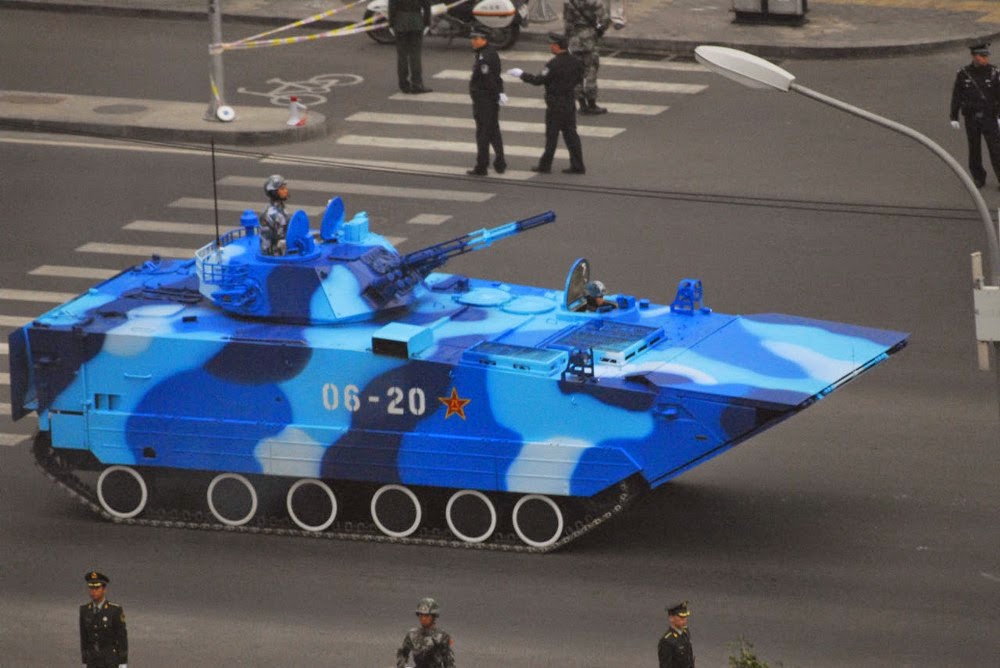
The other 7,130 Chinese tanks—some of which are pictured here—are the same descendants of Soviet T-55s that comprised Beijing’s armored force in the late 1980s … and were obsolete even then.
...
Of 1,321 fighters, only 502 are modern—296 variants of the Russian Su-27 and 206 J-10s of an indigenous design. The remaining 819 fighters—mostly J-7s, J-8s and Q-5s—are 1960s designs built in the 1970s.
...
The navy is in the best shape, but that’s not saying much. ... its first aircraft carrier Liaoning is a rebuilt Soviet ship from the 1980s.
...
Liaoning is half the size of an American Nimitz-class supercarrier and carries half as many planes. As Liaoning lacks a catapult, China’s J-15 naval fighters must use a ski ramp to take off—and that limits their payload and range.
...
Just over half of China’s 54 submarines are modern—that is, built within the last 20 years. Beijing’s modern undersea fleet includes the Shang, Han, Yuan and Song classes. All four classes are Chinese-built. All are markedly inferior to Western designs.
...
The PLAN halted production of the nuclear-powered Shang class after only building just three boats—an ominous sign. Moreover, Beijing has placed an order with Russia for up to four Kalina-class subs, signalling a lack of faith in local designs.
China is never as strong or as weak as she seems, so I wouldn't write her of if things turn ... but odds favor a "Peak China" not too far in the future. The authors end with a point we have raised here, and even more in our China specific episodes of Midrats. This really is the long pole in the Chinese Yurt.
“China will grow old before it gets rich”... The same demographic wave that has gifted China with an abundance of labor will soon also transform the country into the world’s biggest retirement home.
... Today China has 16 retirees per 100 workers. Projections see that increasing to 64 retirees per 100 workers by 2050, resulting a much grayer population than in America.
This has indirect—but serious—implications for China’s defense. Most Chinese do not have retirement benefits and in their old age must rely on personal savings or family … a difficult proposition when there is only one child to take care of two parents.
If Beijing wants to preserve household savings and productivity, it will have to build some kind of social welfare system. And that means making some difficult choices.
China’s borders are secure. The U.S., Japan and India cannot bring down the Chinese government. But tens of millions of desperate Chinese families could do so—and just might, if Beijing can’t find some way to care for them as they age.
China has nuclear weapons. It’s ruled by a deeply nationalistic, authoritarian regime with a history of brutality towards its own citizens. It has territorial claims that clash with those of other countries—and a defense budget rising by eight percent annually. It’s wise to keep a watchful eye on China.
Yet China is a hobbled giant with many deep, systemic problems. Some of these problems—particularly the technological ones—are solvable. The demographic issue is not. And it’s the biggest reason the paper dragon does not pose a major threat to the rest of the world over the long term.
If you don't already know about the little Long War skirmish that took place Sunday in Garland, TX ... then catch up. You are part of the problem and not part of the solution if you have no desire to defend the fruits of The Enlightenment. Even speech that you find distasteful must be defended. Even if you do not like the person speaking, you should be the first person to defend them. A free people have the right to display their lack of good taste, brilliance, poor manners, exquisite breeding, stupid ideas, and wonderful insight - notice there is no "should" in there. This is natural law. People have the right to offend; people do not have the right not to be offended. Inoffensive speech does not need to be defended - that is not what free speech is about. Unpopular and offensive speech is what needs defending; what must be defended. When someone is under attack for speaking unpopular opinions to the point they are physically, professionally, or otherwise threatened to silence, everyone should come to their defense. It all started so innocent enough;
The inaugural Muhammad Art Exhibit and Contest hosted by Pamela Geller’s American Freedom Defense Initiative (AFDI) is sold out and ready for Sunday evening’s festivities. The event is billed as an expression of free speech said to be under attack from radical Islamic groups like those who attacked Charlie Hebdo in January. The exhibit will be held on Sunday, May 3, at the Curtis Culwell Center, 5-7 p.m., in the Dallas suburb of Garland, Texas.
“At a time when American Muslim groups in the US should have stood up for free speech and showed the world the way forward, they chose to stand with the Hebdo jihadists,” said Geller in an January email to Breitbart Texas.
Breitbart Texas previously reported that Democratic U.S. Representatives Rep. Keith Ellison (D-MN)and André Carson (D-IN) have tried to block Dutch Parliamentarian Geert Wilders from entering the United States and appearing at the inaugural event. They co-authored a letter to Secretary of State John Kerry and Homeland Security Secretary Jeh Johnson, asking them to block Wilders’ entry.
And in a fashion, Garland represents a good example about how to do it right - let ideas compete in the marketplace - in a fair and peaceful manner;
Pamela Geller is planning a “Draw the Prophet” event in Garland, Texas in the same location as a Muslim group held a “Stand with the Prophet” conference in January. The First Annual Muhammad Art Exhibit and Contest will be hosted by the Curtis Caldwell Center, which is owned and operated by the Garland Independent School District.
As usual though, when someone is insecure or knows their ideas are inferior and cannot survive a fair airing - they seek peace through removal of the other side. As usual in such events - GatewayPundit has the goods. The cornerstones of the media in our nation?
Free speech aside, why would anyone do something as provocative as hosting a "Muhammad drawing contest"?
Foreign correspondent for The New York Times, focusing on Islamic extremism. Previously, seven years in West Africa as bureau chief for The Associated Press
That is the problem we face. From the hothouse flowers in out universities who need a safe place and a hug if they are exposed to any contrary thought, to two guys attacking an event in Texas - we need to redouble our efforts to push back. We don't need cowards like The Daily Mail, who are more than happy to write about the attack - and then give in like a dhimmi by blacking out the pictures in the background. Everyone should publish one of these cartoons. They cannot kill us all. As we saw yesterday - the odds are in our favor anyway. If you are going to start a gunfight in Texas, you had better bring your A-game. Just like Hasan's attack at Ft. Hood - this is part of the long war. Even cartoons. Especially cartoons. This will happen again. Immediately below is the entire event (Geert Wilders comes on at the 0:29-minute point) - and below that are all the cartoons. These at things that, in a large part of the world, people are willing to kill and die for. They are willing to kill for a cartoon. What are you willing to do to defend a fundamental freedom. You can see the moment they had shots fired at the 1:19 point.
Loyalty goes both ways, the old saying goes. One shows loyalty up the chain, because one expects the same in the other direction. They system, however, is built upon the timbers of the imperfect human condition. What happens when you have conflicting narratives, but the system that you thought was there to serve you as you served it decides to take the counter-narrative without question? Is there a point where a leader accepts that there is no loyalty above, and as a result, has to redouble his loyalty to those under him? The story of Task Force VIOLENT is one of inspired unit level leadership, and nightmarishly twisted priorities up the chain; of brave men caught in a modern day, real time, Kafkaesque circle. Following up on his 5-part series, Task Force Violent: The Unforgiven - the Tragic Betrayal of and Elite Marine Corps Commando Unit, our guest for the full hour today at 5pm Eastern will be MilitaryTimes journalist Andrew deGrandpre.
Join us live if you can with the usual suspects in the chat room and offer up your questions for our guest, but if you miss the show you can always listen to the archive at blogtalkradio. If you use iTunes, you can add Midrats to your podcast list simply by clicking the iTunes button at the main showpage - or you can just click here.
... with the North Vietnamese army entering the outskirts of Saigon, a remarkable evacuation of American civilians and at-risk South Vietnamese was undertaken by a small number of CIA and military helicopter pilots.
Since the airport was under attack, it was impossible to use fixed wing aircraft to evacuate the many thousands of Vietnamese allies who would surely suffer once the North took over.
Dubbed Operation Frequent Wind, pilots from Air America and several search and rescue units began to land on rooftops all over Saigon where American civilians, alerted to the evacuation by the playing of Bing Crosby’s “White Christmas” over the radio, had assembled. Vietnamese who were thought to be most at risk of North Vietnamese reprisals were airlifted from the US embassy.
All told, the few dozen pilots, flying in some cases for 14 hours straight, managed to evacuate more than 7,000 people.
With a nation tired and distracted, a Watergate weakened Presidency, and a Democrat dominated Congress seeing a chance to force the defeat they wanted for years, the nation of South Vietnam that over 58,000 American died to defend from the persistent Communist aggression that also took the lives of somewhere in the neighborhood of 250,000 South Vietnamese military killed in action, was left to die of neglect at the hands of their brothers. Those 7,000 were just the opening of what would be almost a 1,000,000 who came here (and more recently). They have become almost ideal Americans by almost every measure, and those small children who were carried in leaking boats or aircraft running on fumes ... many of them serve with us in the military. As just an example of a great people who came here for all the right reasons and have become such a great addition to our nation, I would like to point you to Brig. Gen. Viet Luong, USA;
Forty years ago this week Luong's father, a South Vietnamese Marine major, called an urgent family meeting at their home in Saigon, now known as Ho Chi Minh City. The city, his father told them, soon would fall to the North Vietnamese — the communist forces he was helping the Americans fight.
They sat around the table — father, mother, seven sisters and Luong, then age 9.
"My sisters actually had a very strong opinion — like 'we need to stay until we find a way out as a family,' " he recalls.
His father worried they wouldn't be able to escape together. He suggested Luong, the only boy, and one of his sisters should flee the country in the hopes the family could be preserved.
"I was depressed! I didn't want to get sent to — you know, to the U.S. I didn't want to ... my dad, to go to the jungles," he says, his voice catching in his throat. "It was pretty tough, as a kid."
They were helped by an American reporter who was a friend. Luong still remembers the night he came to give the entire family official government papers that would get them into Tan Son Nhut Air Base, just north of Saigon. From there, they'd be taken out of Vietnam.
"It's like, 'OK, pack your stuff — do not talk to any of your friends, just pack some clothes,' and his driver snuck us out at night," Luong says.
Soon after the family arrived at the air base, rockets and mortars started landing.
"Yeah, it was close enough where I can hear people groaning from getting hit," he says.
The general stops for a moment, and looks down. His eyes begin to fill with tears.
"I was lying then on my stomach," he says. "We're Catholics, so I was saying my Hail Marys, you know. And uh ... and so we were scared, so my dad looked up and said 'look — don't be afraid.' He said 'you're missing out on a monumental moment in history,' right? 'You need to be able to see what's going on.' So that calmed us down for a little bit, but it was really hopeless until the Marines came in."
On April 29, 1975, the family boarded a Marine helicopter and headed out to the South China Sea. When they landed on a U.S. carrier, Luong was disoriented.
"I still remember that moment to this day, because as soon as we landed I looked at my dad and I said, uh, I said 'Dad, where are we at?' And he looked at me and he says, 'hey, we're aboard the American carrier USS Hancock.' And I say, 'well, what does that mean?' And he looked at me and he said, 'that means nothing in the world can harm you now.' "
Head on over to NPR and read it all - and listen to the interview.
Since my youth, we have moved a lot closer to the truth about the Vietnam War from the tightly controlled narrative of the late 70s through the mid-80s, where all we got was the pop-media smears and the Hollywood libel. It is hard to pick a pivot point, but perhaps B.G. Burkett's 1998, Stolen Valor : How the Vietnam Generation Was Robbed of Its Heroes and Its History. Who knows - but at last in the last two decades, those who served in the Vietnam War are getting some of the truth of the good fight available for people to learn about. More now know of the victory of '72 and the shame of '75 and the 93rd and 94th Congress. With more time, people will also see not the cliche, but the real people we abandoned in South Vietnam ... those good people who, like BG Luong, have become great Americans. Look at what they overcame. From nothing, look at what they have accomplished. With a baseline-0 "privilege" - look what they have accomplished. Bravo Zulu to them, and they are truly a great thing of value we did get from our years of Vietnam. A people, fullbore.

.jpeg)


 .
.




 .
.