Watch the full thing. It's in the night orders.
Hat tip Allah.


4 hours ago
The commanding officer of the dock landing ship Fort McHenry was fired Thursday for fraternizing with a sailor on his ship, according to a Navy statement.Like I said, the sound of the first shoe was loud and clear.
The executive officer also was fired for knowing about the relationship and not taking action, the statement said.
Cmdr. Christopher Stopyra and his XO, Lt. Cmdr. Brian P. Goldschmidt, were both removed after Stopyra received nonjudicial punishment at a captain’s mast Thursday,
...
The subordinate with whom Stopyra had the relationship received non-judicial punishment and was removed from the ship, Josey said.


During the Napoleonic Wars, the British economy depended on its ability to trade with the British Empire, particularly the valuable colonies in British India. The intercontinental trade was conducted by the governors of India, the Honourable East India Company (HEIC), using their fleet of large, well armed merchant vessels known as East Indiamen. These ships weighed between 500 long tons (508 t) and 1,200 long tons (1,219 t) and could carry up to 36 guns for defence against pirates, privateers and small warships. They were not, however, capable under normal circumstances of fighting off an enemy frigate or ship of the line. Their guns were usually of inferior design, and their crew smaller and less well trained than those on a naval ship.
The East Indiamen sought to ensure the safety of their cargo and passengers, not defeat enemy warships in battle. Despite these disadvantages, the size of East Indiamen meant that from a distance they appeared quite similar to a small ship of the line, a deception usually augmented by paintwork and dummy cannon. The East Indiamen would gather at ports in India and the Far East and from there set out for Britain in large convoys, often carrying millions of pounds worth of trade goods.
The journey would usually take six months and the ships would subsequently return carrying troops and passengers to augment the British forces stationed in India. "Country ships", smaller merchant vessels chartered for local trade, sometimes independently from the HEIC, would often join the convoys. To protect their ships from the depredations of pirates, the HEIC also operated its own private navy of small armed vessels. In combination, these ships were an effective deterrent against smaller raiders, but were no match for a professional warship.What was Commodore Dance working with?
Understanding the importance of the Indian Ocean trade and seeking to threaten it from the start of the inevitable war, First Consul Napoleon Bonaparte ordered a squadron to sail for India in March 1803. This force was under the command of Contre-Admiral Charles-Alexandre Durand Linois and consisted of the ship of the line Marengo and three frigates.
The China Fleet was a large annual British merchant convoy that gathered at Canton in the Pearl River during the winter before sailing for Britain, via India. As the convoy passed through the East Indies, it was joined by vessels sailing from other European ports in the region on the route to India, until it often numbered dozens of ships. The 1804 fleet departed in late January, and by the time it reached the approaches to the Strait of Malacca it had swelled to include 16 East Indiamen, 11 country ships, a Portuguese merchant ship from Macau and a vessel from Botany Bay in Australia.
Although the HEIC had provided the small, armed brig Ganges as an escort, this vessel could only dissuade pirates; it could not hope to compete with a French warship. There was no military escort: news of the outbreak of war had reached Canton before reinforcements had arrived from the squadron in India. Spies based in Canton had passed the composition and date of departure of the China Fleet to Linois in Batavia, and he set out to intercept it. However, Dutch informants at Canton had also passed on false reports that Royal Navy warships were accompanying the convoy, reports that may have been deliberately placed by British authorities.
The convoy was an immensely valuable prize, its cargo of tea, silk and porcelain valued at over £8 million in contemporary values (the equivalent of £541,000,000 as of 2009). Also on board were 80 Chinese plants ordered by Sir Joseph Banks for the royal gardens and carried in a specially designed plant room.
The HEIC Select Committee in Canton had been very concerned for the safety of the unescorted convoy, and had debated delaying its departure. The various captains had been consulted, including Henry Meriton, who in his ship Exeter had captured a frigate during the Action of 4 August 1800, a disastrous French attack on a convoy of East Indiamen off Brazil. Meriton advised that the convoy was powerful enough in both appearance and reality to dissuade any attack. He was opposed by John Farquharson of Alfred, who considered that the crews of East Indiamen were so badly trained that they would be unable to mutually defend one another if faced with a determined enemy.
Eventually the Committee decided that it could delay the convoy no longer and awarded command to the most experienced captain, Commodore Nathaniel Dance in the East Indiaman Earl Camden, an officer of over 45 years service at sea.Not perfect - not even good; but what does a leader do? Improvise, adapt - overcome.
Dance had been taken seriously ill at Bombay during the outward voyage, but had recovered in time to sail with the convoy. The fleet did not have any naval escorts, and though the East Indiamen were heavily armed for merchants, carrying nominal batteries of between 30 and 36 guns, they were no match for disciplined and professional naval forces. Not all of their listed armament was always carried, but to give the illusion of greater strength, fake gunports were often painted on the hulls, in the hope of distant observers mistaking them for 64-gun ships of the Royal Navy...Maneuver and Deceive...
At dawn on 15 February, both the British and French forces raised their colours. Dance hoped to persuade Linois that his ships included some fully armed warships and he therefore ordered the brig Ganges and the four lead ships to hoist blue ensigns, while the rest of the convoy raised red ensigns. By the system of national flags then in use in British ships, this implied that the ships with blue ensigns were warships attached to the squadron of Admiral Rainier, while the others were merchant ships under their protection. Dance was unknowingly assisted by the information that had reached Linois at Batavia, which claimed that there were 23 merchant ships and the brig in the convoy. Dance had collected six additional ships during his journey, and the identity of these were unknown to the French, who assumed that at least some of the unidentified vessels must be warships, particularly as several vessels had been recently painted at Canton to resemble ships of the line.
At 09:00 Linois was still only observing the convoy, reluctant to attack until he could be sure of the nature of his opponents. Dance responded to the reprieve by reforming the line of battle into sailing formation to increase his convoy’s speed with the intention of reaching the Straits ahead of Linois.
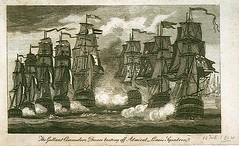
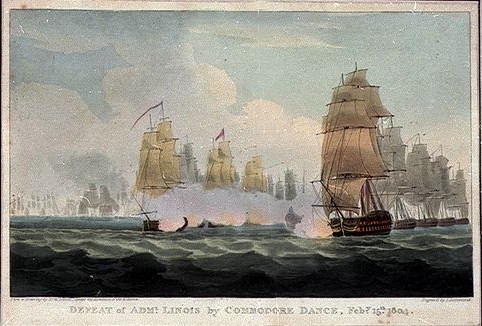
With the convoy a less intimidating target, Linois began to slowly approach the British ships. By 13:00 it was clear that Linois's faster ships were in danger of isolating the rear of the convoy, and Dance ordered his lead ships to tack and come about, so that they would cross in front of the French squadron. The British successfully executed the manoeuvre, and at 13:15 Linois opened fire on the lead ship, Royal George, under the command of John Fam Timmins.
The Royal George and the next four ships in line, the Indiaman Ganges, Dance's Earl Camden, the Warley and the Alfred, all returned the fire, Ganges initially attacking the Royal George in error. Captain James Prendergrass in Hope, the next in line, was so eager to join the battle that he misjudged his speed and collided with Warley, the ships falling back as their crews worked to separate their rigging. Shots were then exchanged at long range for 43 minutes, neither side inflicting severe damage.
Royal George had one man killed: a sailor named Hugh Watt, another man wounded, and suffered some damage to her hull. None of the other British ships or any of the French reported anything worse than superficial damage in the engagement.
At 14:00, Linois abandoned the action and ordered his squadron to haul away with the wind and sail eastwards, away from the convoy, under all sail. Determined to maintain the pretence of the presence of warships, Dance ordered the ships flying naval ensigns, including his flagship Earl Camden, to chase the French. None of the merchant ships could match the French speed, but an attempt at a chase would hopefully dissuade the French from returning.
For two hours, Dance's squadron followed Linois, Hope coming close to catching Aventurier but ultimately unable to overtake the brig. At 16:00, Dance decided to gather his scattered ships and return to his former heading rather than risk attack from other raiders or lose sight of his convoy in the darkness. By 20:00, the entire British convoy had anchored at the entrance to the Straits of Malacca. On 28 February the British ships of the line HMS Sceptre and HMS Albion joined them in the Strait and convoyed them safely to Saint Helena in the South Atlantic, from where the convoy returned to Britain without further incident.The attitude and conduct of the French Admiral is telling as an example of how not to fight war at sea.
The French admiral later attempted to explain his conduct during the engagement:That is pathetic.The ships which had tacked rejoined those which were engaging us, and three of the engaging ships manoeuvred to double our rear, while the remainder of the fleet, crowding sail and bearing up, evinced an intention to surround us. By this manoeuvre the enemy would have rendered my situation very dangerous. The superiority of his force was ascertained, and I had no longer to deliberate on the part I should take to avoid the consequence of an unequal engagement: profiting by the smoke, I hauled up to port, and steering east-north-east, I increased by distance from the enemy, who continued the pursuit of the squadron for three hours, discharging at it several broadsides.—Linois, quoted in translation in William James' The Naval History of Great Britain during the French Revolutionary and Napoleonic Wars, Volume 3, 1827,
Placed, by the adventitious circumstances of seniority of service and absence of convoy, in the chief command of the fleet intrusted to my care, it has been my good fortune to have been enabled, by the firmness of those by whom I was supported, to perform my trust not only with fidelity, but without loss to my employers. Public opinion and public rewards have already far outrun my deserts; and I cannot but be sensible that the liberal spirit of my generous countrymen has measured what they are pleased to term their grateful sense of my conduct, rather by the particular utility of the exploit, than by any individual merit I can claim.
Vice Adm. Jeffrey Fowler told Navy Times. He said the administration often changes the makeup of groups that represent the academy — bands, glee clubs and color guards — to make sure midshipmen get equal chances to represent the school.Read that again. What he has done here is to put the blame on the victim. So, if you are discriminated against because of your race, you should expect an organization's leadership to smear your reputation - claiming that you skip class or have bad grades? What is this - 1960 in Alabama?
“We do it for a variety of reasons, whether their grades are good enough, whether it’s their physical fitness; ... if one certain group of people, even though they’re very good at something, ends up missing a lot of class — and even if they’re the best — we may say, ‘I don’t wanna send you anymore, you’ve already missed 10 days,’ ” Fowler said. “We want to spread the wealth and give everybody an opportunity.”
“They signed themselves up for something that was not yet approved,” Fowler said. “That was really the misunderstanding. A couple of mids had a great idea — hey, I’m a Yankee fan, I’d love to have gone to the game myself, I’d have marched out there with that darn thing — but they kind of made a decision before they really knew what the chain of command had authorized.”It was bad enough with Klunder and Carpenter coudn't tell the same story - now Fowler has created a triangle of quasi-truth. None of their statements though are in full alignment with what really happened.
Still, the Naval Academy’s public affairs office issued an official press release on the day of the game, identifying the six midshipmen slated to present the colors, which included the names of the two replacements, Hameed and Midshipman 2nd Class Hannah Allaire. Academy spokesman Cmdr. Joe Carpenter later told Navy Times that announcement omitted the other two names, for the “eight-person” color guard, because the public affairs office didn't then know who else would be joining it.
Fowler told Navy Times on Monday that he considered the matter closed but that it had taught the brigade some important lessons. Not only did midshipmen learn it’s important for them to follow proper protocol, he said, “but if you make a mistake, personally, like a midshipman forgot some uniform items, not only does it affect you, it affects your shipmates. That’s a good life lesson that hopefully the brigade got out of it, and certainly two individuals. That’s unfortunate, but that’s the way it is.”That is not the story. Period. That is not what got coverage from The Washington Post, Navy Times, Diana West, Powerline, to Michelle Malkin, three radio appearances - and interest from interesting people. A 2/C MIDN forgetting his cover and shoes is no more the story than a car is something you sit in to look in the mirror at what is behind you.
“Nobody would have read about it or no one would have cared about it if one person didn’t make a mistake,” he said. “And that mistake had impact. Good lesson learned. Good lessons learned for a future sailor or Marine.”
quib⋅bling [kwib-ling]
–adjective
1. characterized by or consisting of quibbles; carping; niggling: quibbling debates.
–noun
2. the act of a person who quibbles.
3. an instance of quibbling: a relationship marked by frequent quibblings.
quib⋅ble [kwib-uhl] noun, verb, -bled, -bling.
–noun
1. an instance of the use of ambiguous, prevaricating, or irrelevant language or arguments to evade a point at issue.
2. the general use of such arguments.
3. petty or carping criticism; a minor objection.
–verb (used without object)
4. to equivocate.
5. to carp; cavil.
The 56% report rate for Alternative Scholarship Reservations (ASRs) is more than 10% above the CNSB rate. ASR diversity is 34% AA, 19% Hisp and 10% API.Simple process really in a less than zero sum game. You starve one and feed the other. Equal treatment? Each taxpayer and Congressional district treated the same? Each potential Sailor valued the same?
Given YG13 statistics, current projections, diversity considerations and fiscal constraints, we intend to reduce overall CNSB NROTC offers for YG14 but will maintain HBCU (NB: Historically Black Colleges and Universities) and ASR at last year's level.
Issue: CNP Echelon-2 Diversity Accountability ReviewsAccountability. Look it up.
Discussion: We have initiated a program to conduct diversity accountability reviews with our Echelon-2 commands, with the first review scheduled for next week with NETC. Reviews will generally follow the construct used by the Enterprises/Communities during your CNO Diversity Accountability Reviews, with additional specific focus areas based on each command’s mission. Ms. Emerson will also participate in these reviews.
Desired Effect: Conduct regular preliminary reviews of internal diversity within the CNP/N1 domain.
Action: None. FYSA only.
Issue: 2009/2010 School Year NJROTC Program Update
Discussion: The 2009/2010 school year NJROTC Cadet enrollment has experienced a substantial jump in participation. NJROTC training will be provided to 80,610 cadets, an increase of 5,541 cadets since the 2008/2009 school year. No significant shifts in gender and ethnic enrollment demographics have occurred with the recent increase in enrollment. The current gender and ethnic group breakout is as follows:
-------------Ethnicity----Gender
Caucasian:------------44%---Male:----46,816 (58%)
African American:-----27%---Female:--33,794 (42%)
Hispanic:-------------22%
American Indian /
Native Alaskan:--------2%
Asian:-----------------3%
Native Hawaiian /
Pacific Islander:------1%
Multiple:--------------1%
Desired Effect: Increase visibility of Navy opportunities through community involvement in NJROTC programs....and if you think I am just nit-pick'n, here is the entire report for the week, and remember - this is the Chief of Naval Personnel's focus for the week.
Action: None. FYSA only.
Issue: 14th Annual National Women of Color (WOC) Technology Awards ConferenceBehold - a Navy at war.
Discussion: Strong Navy participation marked this event in Dallas, TX from 29-31 October. I had the pleasure of presenting Ms. Steffanie Easter, N1B, the Managerial Leadership Award for her leadership and mentorship as the Assistant Commander for Acquisition at NAVAIR. USS BUNKER HILL Command Master Chief Charlene Terry received a special recognition award and BUMED Force Master Chief Laura Martinez was awarded the WOC Pioneer Award. Professor Angela Moran, LT Jennifer Tietz, Senior Chief Donna Robinson, and Gunnery Sergeant Patricia Wilson from the Naval Academy were also recognized at the conference. Past award winners CAPT Cynthia Macri, CAPT Yolanda Reagans, and Ms. Monica Emerson joined VADM McCoy and Ms. Joan Hughes (NAVAUDSVC SES) in attendance.
Discussion: Recognize Navy women and their significant achievements in the technology fields.
Action: None. FYSA only.
Issue: 2009/2010 School Year NJROTC Program Update
Discussion: The 2009/2010 school year NJROTC Cadet enrollment has experienced a substantial jump in participation. NJROTC training will be provided to 80,610 cadets, an increase of 5,541 cadets since the 2008/2009 school year. No significant shifts in gender and ethnic enrollment demographics have occurred with the recent increase in enrollment. The current gender and ethnic group breakout is as follows:
-------------Ethnicity----Gender
Caucasian:------------44%---Male:----46,816 (58%)
African American:-----27%---Female:--33,794 (42%)
Hispanic:-------------22%
American Indian /
Native Alaskan:--------2%
Asian:-----------------3%
Native Hawaiian /
Pacific Islander:------1%
Multiple:--------------1%
Issue: National College Resources Foundation (NCRF) Black College Expo Tour
Discussion: The National College Resources Foundation (NCRF) is dedicated to reducing high school drop-out rates and increasing college graduation rates among underserved and underrepresented groups by connecting students with colleges, universities, and funding resources. NCRF’s tenth annual Black College Expo Tour began in October and will visit five cities by February 2010. As this year’s Title Sponsor, Navy is able to make contact with over 100,000 diverse students across the nation and will expose more than 3 million students and parents to Navy opportunities via television, radio, and print outlets. The Black College Expo Tour has already hosted two of its planned five events in New York City (24 October) and Washington, DC (31 October). During each event, Navy hosts a pre-event program, multiple Navy booths, seminars and workshops. At the New York and DC events, Navy officers met with dignitaries (including U.S. Senator Shirley Huntley - NY), student leaders and parents. Navy recruiters generated over 300 student leads. The tour is scheduled to visit three more cities: Los Angeles, CA on 23 January 2010; Oakland, CA on 30 January 2010; and Atlanta, GA on 27 February 2010.
Desired Effect: Identify and promote Navy as a diversity employer of choice for diverse student populations.
Action: None. FYSA only.
Issue: 6th Annual Filipina Women's Network Leadership Summit
Discussion: On 29 October, the Filipina Women's Network (FWN) held its 6th Annual Leadership Summit in Berkeley, CA. During the 100 Most Influential Filipinas in the U.S. Recognition Awards Gala, CAPT Raquel Cruz Bono, MC, Chief of Staff and Deputy Director, TRICARE Management Activity, was recognized for her accomplishments as the first female to complete the General Surgery residency, deploy as a trauma surgeon, and serve as Commanding Officer of Naval Hospital Jacksonville, the 4th largest Naval Hospital. During a separate FWN Summit workshop, CAPT Bono spoke about her career and the many opportunities the Navy has to offer.
Desired Effect: Establish mentor/mentee relationship with influential Filipina leaders and bring visibility to Navy Scholarship programs.
Action: None. FYSA only.
Issue: Society of Hispanic Professional Engineers Conference
Discussion: On 29 October, over 1000 students and professionals attended the Society of Hispanic Professional Engineers Conference in Washington, D.C. Navy was the exclusive sponsor of the opening reception and the pre-college opening reception for over 600 students. VADM McCullough delivered a Navy Technology presentation, and RDML Brady spoke to students about pursuing careers in STEM fields. Other highlights included a Naval Academy tour given to 100 prospective college students, and RDML Faller's presentation of a NROTC scholarship check for $180,000.00 to a University of Virginia Student during the student leadership gala. At the closing gala, RDML Brady accepted the "Governmental Agency of the Year" award on behalf of the Navy.
Desired Effect: Showcase Navy as a premier military service and employer of choice.
Action: None. FYSA only.
Jerry Miller was Asst. DCNO AIR under Tom Connolly by then...
Also, was wrong on the date of that letter...It had to be after Oct 30 '68 when Johnson started the bombing halt (one of the more stupid decisions out of the Oval Office-A level of idiocy not heard since. That is, until the current foolish, "We will quit before I leave office" crap heard today).
Given the reference to "this week" after a Subic visit for the RANGER, I went here:
Which indicates she was in Subic (if one assumes the above reference has the year wrong in the port visit dates for her 26 Oct 68-17 May 69 deployment) 12 Dec for a single day...
If it was in fact 68 instead of 67, that letter is just shy of 41 years old!
sid


