Showing posts with label Tall Ships. Show all posts

Friday, April 23, 2021

Fullbore Friday


As we see our nation start to emerge from COVID-19 isolation, I have read a bit about "young" people feeling they have lost a year, they can't catch up ... etc.

If you are, like my kids, in the young adult category - ignore that crap. Everyone has a headwind right now, but you in other ways don't have time to wallow.

You don't have all the time in the world; now is your time. You can do more today than people twice your age. 

Ignore anyone who says otherwise because of your "limited" experience.

Perhaps it was a bit much to move the age to have a beer to 21 from the legal adult age of 18. Perhaps it was a bit off to allow young adults to stay on their parent's insurance until age 26, an age many people have two kids of their own.

Perhaps this cultural messaging had you thinking it wasn't quite your time yet.

Chew on this from Dana Goldstein at The New Republic;
...some advocates and policymakers are citing research to argue 18 is still too young, and that people up to the age of 25 remain less than fully grown up.
...
Researchers are using the term “post-adolescence” or “extended adolescence” to describe this period of development in one’s twenties and early thirties. Social change is as important as biological change in understanding why some people in this age group are drawn to crime. Individuals who are “disconnected”—neither working nor in school—are more likely to get in trouble with the law. While fewer young women are disconnected today than in previous decades, the opposite is true for young men.
You can read the rest.

This isn't just about criminal justice either;
Adolescence no longer ends when people hit 18, according to updated guidelines being given to child psychologists.

The new directive is designed to extend the age range that child psychologists can work with from 18 years old up to 25.

It is hoped the initiative will stop children being 'rushed' through their childhood and feeling pressured to achieve key milestones quickly, reports the BBC.
In the name of all that is holy, we know this. My brain didn't make the flip until age 23 - but it didn't mean I was in "late adolescence" and should be treated like a child. If we are going to go down this route then fine; no one can vote until 25.

Actually, I might support that ... but let's get back on centerline.

OK, here is a thought; perhaps the problem with our young men (which you will find in the linked article) today is that we do not challenge them enough. We do not demand enough of them.

Same with young women.

Anyone who has served in the military knows that young men and women can do incredible things. You can give them the highest responsibilities. Properly led and given clear guidance, there is no limit. Every day, you put your life in the hands of 18 and 19 year old people.

The concept is rather simple. Set an expectation; provide training and guidance. Provide fair and just consequences for their response to it, good or bad. Good things happen.

In a previous age where people developed later, had poorer education and health; what did we expect from them? How did they perform?

Let's look at James Lucas Yeo, born 1782;
...he joined the Royal Navy in March 1793 as a boy volunteer. ... as a midshipman at the age of 10.

In 1797, he was promoted lieutenant, and assigned to the HMS La Loire... He first saw action as a lieutenant aboard a brig in the Adriatic Sea. 
Look at your calendar. He was promoted to lieutenant at age 15 and was already in combat.
He distinguished himself during the siege of Cesenatico in 1800.
At age 18. This was not a one-off performance. Remember, he was leading men more than twice his age in ship's company, most likely.
While off the Spanish coast, he was sent to capture the Spanish vessels in the port of El Muros. Storming the fort, he succeeded in bringing out of the port every vessel, armed and unarmed. For this achievement, he was made commander, and given the HMS Confiance, one of the vessels he had taken.
When did he do this? 1805. Age 22.
Yeo participated in several sea battles during the Napoleonic Wars so successfully that he was made a captain on December 19, 1807, by which time he had already been recognized as an intrepid practitioner of unconventional sea warfare.
Age? 24.
In 1809, he captured Cayenne, in conjunction with the Portuguese, and was in consequence made post-captain.
Age 26.

There is more; read it all.

Young men and women do not need excuses. They don't need years of medication to make up for a lifetime of weak parenting. They don't need low standards they are encouraged to meet.

Our nation and our civilization cannot prosper if we allow people to spend the balance of their most productive years - when they have the best window to think, explore, and test their physical and intellectual boundaries - to be told they are not yet adults and are not capable of agency. No, just the opposite.

I've got news for those who think they can start their life like this, by age 26, if you are only now thinking you are ready to be an adult, you are already running behind. As Mr. Waters says; "Ten years have got behind you. No one told you when to run. You missed the starting gun."

Your peers who understood this early have a half decade+ head start on you.

Wonder why so many people (Hendrix, Morrison, Joplin, Cobain, Hank Williams) kill themselves between the ages of 27 and 30? It is because they all of a sudden look around and realize that they have gone nowhere in their 20s but in circles. Others have moved on with their lives, and yet they can't seem to drink and drug themselves out of a rut they hit at 22. They all of a sudden realize that they need to be an adult, and they can't do it. 

They were left drifting in the Land of the Lotus Eaters by other people who gained from having them get stuck in a rut for half a decade. When they age out of the profit zone, they are thrown in to a reality of the late-20s to early 30s that they simply cannot adjust to.

No one ever is going to be Fullbore by claiming, "I'm just not mentally mature." Sorry, regardless what your doctor may tell you, the world doesn't care.

By 16 you should be prepared to be 18, an adult. 

By 25, you should be helping those 16 to 18 to be an adult - by your example.

If you find yourself at 25 trying to map it out, you're lost. It isn't the fault of biology. Not your parents. Not society.

It is all on you.

Hat tip BJ. This post slightly modified from its original posting in 2018.

Friday, February 26, 2021

Fullbore Friday

25 FEB 1852.

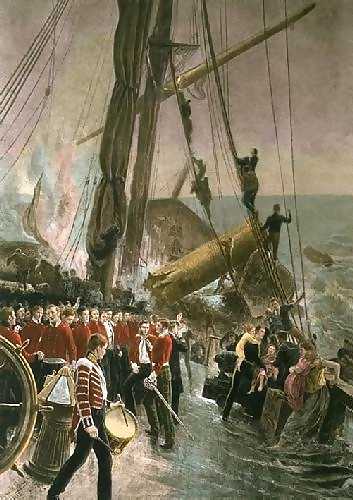
Discipline. Honor. Sacrifice - and steadfast leadership. Do you really know what they mean? How do you know you, as well as the men and women under your command, can do what is needed - and do it with cold firmness? Are you ready for the Birkenhead Drill?
To take your chance in the thick of a rush, with firing all about, Is nothing so bad when you’ve cover to ’and, an’ leave an’ likin’ to shout; But to stand an’ be still to the Birken’ead drill is a damn tough bullet to chew, An’ they done it, the Jollies—’Er Majesty’s Jollies—soldier an’ sailor too! Their work was done when it ’adn’t begun; they was younger nor me an’ you; Their choice it was plain between drownin’ in ’eaps an’ bein’ mopped by the screw, So they stood an’ was still to the Birken’ead drill,2 soldier an’ sailor too!
A little bit from Kiplings "Soldier an' Sailor too!" Here is the background.
At 2 a.m. the following morning, the Birkenhead struck an uncharted rock at 34°38′42″S 19°17′9″E / -34.645, 19.28583 near Danger Point (today near Gansbaai, Western Cape). The barely submerged rock is clearly visible in rough seas, however it is not immediately apparent in calmer conditions. The initial impact ripped open the forward watertight compartment between the engine room and the fore peak, immediately flooding it and drowning over 100 soldiers in their hammocks. A second impact ripped open the bilge in the engine room, resulting in the two largest watertight compartments in the vessel being been flooded. The surviving officers and men assembled on deck, where Lieutenant-Colonel Seton of the 74th Regiment of Foot took charge of all military personnel and stressed the necessity of maintaining order and discipline to his officers.
Almost everybody kept silent, indeed nothing was heard, but the kicking of the horses and the orders of Salmon, all given in a clear firm voice.
Distress rockets were fired, but there was no assistance available. Sixty men were detailed to man the chain pumps, sixty more were assigned to the tackles of the lifeboats, while the rest were assembled on the poop deck, in order to raise the forward part of the ship. Poor maintenance and paint on the winches resulted in only a few of the ship's lifeboats being launched, and the two large boats, with capacities of 150 men each, were not among them. Eventually two cutters and a gig were launched, onto which all the women and children were placed and rowed away for safety. Only then did Captain Salmond order that those men who could swim should save themselves by swimming to the boats; Lt-Col Seton, however, recognizing that rushing the lifeboats would risk swamping them and endangering the women and children, ordered the men to stand fast. The cavalry horses were freed and driven into the sea in the hope that they might be able to swim ashore. The soldiers did not move, even as the ship broke up barely twenty minutes after striking the rock.
Ponder that for a bit. FYI, that is where the phrase "women and children first" originated. Hat tip CO-ED Combat.

First posted in FEB 2008.

Friday, August 21, 2020

Fullbore Friday

First posted this over a decade ago ... but there is so much to learn from this little known (at least to Americans) battle, I wanted to post it again.

Before we start, I want you to consider the importance of agriculture. In a time of war, what if a nation cannot feed itself?

What if it does not have a merchant fleet?

What must it do to protect its merchants against a hostile power?

It's all here and ... any excuse for a Tallships FbF.
This battle is known more by the name than the place, as it was fought over 400 miles from Ushant, near Brest. [Some sources give the distance as 700 miles, which may be where the pursuit began.] There have been four battles by this name, with the last in 1944.

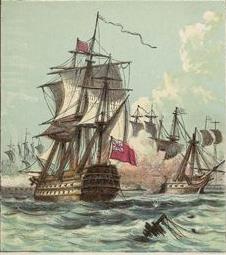
A British fleet under Admiral Lord Howe was escorting merchantmen to North America at about the same time as a French fleet under Rear Admiral Louis Villaret de Joyeuse was escorting 130 merchantmen loaded with grain from America to France. Admiral Howe had dropped off his charges when on May 28, 1794 the two fleets sighted each other. Because of fog, only light fighting took place between the British (24 ships) and the French (26 ships). During this time, the French managed to successfully feint and draw the British away from the merchantmen, which made it home intact.

Nonetheless, the battle cost the French 6 captured and one sunk, against no loss for the English. Eleven English and 12 French ships were dismasted. Ushant III is also famous for a savage duel between HMS Brunswick and the French Venger, which lasted four hours – a very long time for these actions. These were typically fought at point-blank range; each broadside that connected caused terrible havoc, particularly on the open decks. Captain Harvey Brunswick commanded HMS Brunswick. Wounded three times in a battle that saw 44 of his crew killed and 14 wounded, he did not survive the battle.

Overall casualties were 1500 French killed, 2000 wounded and 3000 POWs; 287 English killed and 811 wounded.

The British were too exhausted to pursue. The French claim Ushant III as their victory because the grain fleet made harbor safely.
I like this little hmmmmm as well.
.... this battle took place at the height of the Revolutionary Terror in France, with over 380 people a month executed. The French Government had a policy of executing failed commanders. Admiral Villaret-Joyeuse escaped the guillotine undoubtedly because the grain fleet came in safe. Wargamer.com feels that many French captains continued fighting after their situation became hopeless because of the “zero-tolerance-for-failure” policy.
The wiki page here has the full fleet line up.

Not a complete Navy story though, as The Queen’s (Second) Royal Regiment of Foot was involved and so was a wee Sailor.
The third battle of Ushant, where British Admiral Lord Howe fell upon the French fleet of Admiral Villaret-Joyeuse after several days of fierce fighting and won a tactical victory, though he did not intercept a food convoy from the new world.

Aboard the HMS Tremendous, one pregnant passenger gave birth to a boy. People thought this happy event was tremendous, so the kid got the nickname "Tremendous" and a Naval General Service medal in recognition of his presence at the action (with a rating of "baby").
... and you thought ours was the first fighting navy to push them out at war? Silly goose.

On a serious note - a tactical victory for the British; but a mission success for the French. The grain got there - call it a draw.


Hat tip ADB.

Friday, February 28, 2020

Fullbore Friday


About half of this is from an email Sid sent me back in 2009 when I first posted this. I added a little bit - but what a catch.

An elderly leader with decades of experience at sea. Merchants without enough military ships to make the passage. Hostile waters. A mission.

What do you do against a superior military force, when you basically have next to nothin'..?


You have been put in command of really nothing of a military ability - but everything of an economic necessity. Your nation is one that is at war, and relies on sea born commerce to survive and prosper. Between you and your nation are thousands of miles of open ocean, and an enemy that wants to destroy you.

You know you do not have what you need to fight and win ... at least on paper.

So, what do you do? Well - if you are Commodore Sir Nathaniel Dance, you get to work. You go to war with the Fleet you have - not the Fleet you wish you had.

Let's set the stage.

During the Napoleonic Wars, the British economy depended on its ability to trade with the British Empire, particularly the valuable colonies in British India. The intercontinental trade was conducted by the governors of India, the Honourable East India Company (HEIC), using their fleet of large, well armed merchant vessels known as East Indiamen. These ships weighed between 500 long tons (508 t) and 1,200 long tons (1,219 t) and could carry up to 36 guns for defence against pirates, privateers and small warships. They were not, however, capable under normal circumstances of fighting off an enemy frigate or ship of the line. Their guns were usually of inferior design, and their crew smaller and less well trained than those on a naval ship.
The East Indiamen sought to ensure the safety of their cargo and passengers, not defeat enemy warships in battle. Despite these disadvantages, the size of East Indiamen meant that from a distance they appeared quite similar to a small ship of the line, a deception usually augmented by paintwork and dummy cannon. The East Indiamen would gather at ports in India and the Far East and from there set out for Britain in large convoys, often carrying millions of pounds worth of trade goods.
The journey would usually take six months and the ships would subsequently return carrying troops and passengers to augment the British forces stationed in India. "Country ships", smaller merchant vessels chartered for local trade, sometimes independently from the HEIC, would often join the convoys. To protect their ships from the depredations of pirates, the HEIC also operated its own private navy of small armed vessels. In combination, these ships were an effective deterrent against smaller raiders, but were no match for a professional warship.

Understanding the importance of the Indian Ocean trade and seeking to threaten it from the start of the inevitable war, First Consul Napoleon Bonaparte ordered a squadron to sail for India in March 1803. This force was under the command of Contre-Admiral Charles-Alexandre Durand Linois and consisted of the ship of the line Marengo and three frigates.
What was Commodore Dance working with?
The China Fleet was a large annual British merchant convoy that gathered at Canton in the Pearl River during the winter before sailing for Britain, via India. As the convoy passed through the East Indies, it was joined by vessels sailing from other European ports in the region on the route to India, until it often numbered dozens of ships. The 1804 fleet departed in late January, and by the time it reached the approaches to the Strait of Malacca it had swelled to include 16 East Indiamen, 11 country ships, a Portuguese merchant ship from Macau and a vessel from Botany Bay in Australia.
Although the HEIC had provided the small, armed brig Ganges as an escort, this vessel could only dissuade pirates; it could not hope to compete with a French warship. There was no military escort: news of the outbreak of war had reached Canton before reinforcements had arrived from the squadron in India. Spies based in Canton had passed the composition and date of departure of the China Fleet to Linois in Batavia, and he set out to intercept it. However, Dutch informants at Canton had also passed on false reports that Royal Navy warships were accompanying the convoy, reports that may have been deliberately placed by British authorities.
The convoy was an immensely valuable prize, its cargo of tea, silk and porcelain valued at over £8 million in contemporary values (the equivalent of £541,000,000 as of 2009). Also on board were 80 Chinese plants ordered by Sir Joseph Banks for the royal gardens and carried in a specially designed plant room.
The HEIC Select Committee in Canton had been very concerned for the safety of the unescorted convoy, and had debated delaying its departure. The various captains had been consulted, including Henry Meriton, who in his ship Exeter had captured a frigate during the Action of 4 August 1800, a disastrous French attack on a convoy of East Indiamen off Brazil. Meriton advised that the convoy was powerful enough in both appearance and reality to dissuade any attack. He was opposed by John Farquharson of Alfred, who considered that the crews of East Indiamen were so badly trained that they would be unable to mutually defend one another if faced with a determined enemy.
Eventually the Committee decided that it could delay the convoy no longer and awarded command to the most experienced captain, Commodore Nathaniel Dance in the East Indiaman Earl Camden, an officer of over 45 years service at sea.
Not perfect - not even good; but what does a leader do? Improvise, adapt - overcome.
Lead.
Dance had been taken seriously ill at Bombay during the outward voyage, but had recovered in time to sail with the convoy. The fleet did not have any naval escorts, and though the East Indiamen were heavily armed for merchants, carrying nominal batteries of between 30 and 36 guns, they were no match for disciplined and professional naval forces. Not all of their listed armament was always carried, but to give the illusion of greater strength, fake gunports were often painted on the hulls, in the hope of distant observers mistaking them for 64-gun ships of the Royal Navy
...maneuver and deceive...
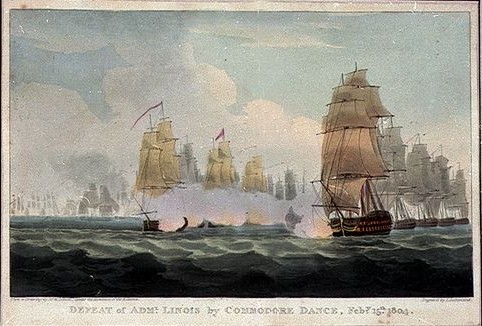
At dawn on 15 February, both the British and French forces raised their colours. Dance hoped to persuade Linois that his ships included some fully armed warships and he therefore ordered the brig Ganges and the four lead ships to hoist blue ensigns, while the rest of the convoy raised red ensigns. By the system of national flags then in use in British ships, this implied that the ships with blue ensigns were warships attached to the squadron of Admiral Rainier, while the others were merchant ships under their protection. Dance was unknowingly assisted by the information that had reached Linois at Batavia, which claimed that there were 23 merchant ships and the brig in the convoy. Dance had collected six additional ships during his journey, and the identity of these were unknown to the French, who assumed that at least some of the unidentified vessels must be warships, particularly as several vessels had been recently painted at Canton to resemble ships of the line.
At 09:00 Linois was still only observing the convoy, reluctant to attack until he could be sure of the nature of his opponents. Dance responded to the reprieve by reforming the line of battle into sailing formation to increase his convoy’s speed with the intention of reaching the Straits ahead of Linois.
With the convoy a less intimidating target, Linois began to slowly approach the British ships. By 13:00 it was clear that Linois's faster ships were in danger of isolating the rear of the convoy, and Dance ordered his lead ships to tack and come about, so that they would cross in front of the French squadron. The British successfully executed the manoeuvre, and at 13:15 Linois opened fire on the lead ship, Royal George, under the command of John Fam Timmins.
The Royal George and the next four ships in line, the Indiaman Ganges, Dance's Earl Camden, the Warley and the Alfred, all returned the fire, Ganges initially attacking the Royal George in error. Captain James Prendergrass in Hope, the next in line, was so eager to join the battle that he misjudged his speed and collided with Warley, the ships falling back as their crews worked to separate their rigging. Shots were then exchanged at long range for 43 minutes, neither side inflicting severe damage.

Royal George had one man killed: a sailor named Hugh Watt, another man wounded, and suffered some damage to her hull. None of the other British ships or any of the French reported anything worse than superficial damage in the engagement.
At 14:00, Linois abandoned the action and ordered his squadron to haul away with the wind and sail eastwards, away from the convoy, under all sail. Determined to maintain the pretence of the presence of warships, Dance ordered the ships flying naval ensigns, including his flagship Earl Camden, to chase the French. None of the merchant ships could match the French speed, but an attempt at a chase would hopefully dissuade the French from returning.
For two hours, Dance's squadron followed Linois, Hope coming close to catching Aventurier but ultimately unable to overtake the brig. At 16:00, Dance decided to gather his scattered ships and return to his former heading rather than risk attack from other raiders or lose sight of his convoy in the darkness. By 20:00, the entire British convoy had anchored at the entrance to the Straits of Malacca. On 28 February the British ships of the line HMS Sceptre and HMS Albion joined them in the Strait and convoyed them safely to Saint Helena in the South Atlantic, from where the convoy returned to Britain without further incident.
The attitude and conduct of the French Admiral is telling as an example of how not to fight war at sea.
The French admiral later attempted to explain his conduct during the engagement:
The ships which had tacked rejoined those which were engaging us, and three of the engaging ships manoeuvred to double our rear, while the remainder of the fleet, crowding sail and bearing up, evinced an intention to surround us. By this manoeuvre the enemy would have rendered my situation very dangerous. The superiority of his force was ascertained, and I had no longer to deliberate on the part I should take to avoid the consequence of an unequal engagement: profiting by the smoke, I hauled up to port, and steering east-north-east, I increased by distance from the enemy, who continued the pursuit of the squadron for three hours, discharging at it several broadsides.
—Linois, quoted in translation in William James' The Naval History of Great Britain during the French Revolutionary and Napoleonic Wars, Volume 3, 1827,
That is pathetic.

To end this FbF on a positive note - let's go back to Commodore Dance. Good leaders always are humble and thankful.

Placed, by the adventitious circumstances of seniority of service and absence of convoy, in the chief command of the fleet intrusted to my care, it has been my good fortune to have been enabled, by the firmness of those by whom I was supported, to perform my trust not only with fidelity, but without loss to my employers. Public opinion and public rewards have already far outrun my deserts; and I cannot but be sensible that the liberal spirit of my generous countrymen has measured what they are pleased to term their grateful sense of my conduct, rather by the particular utility of the exploit, than by any individual merit I can claim.
Class act.

Friday, March 08, 2019

Fullbore Friday

Every half-decade or so it is fun to go back to a 2007 FbF ... take us away!


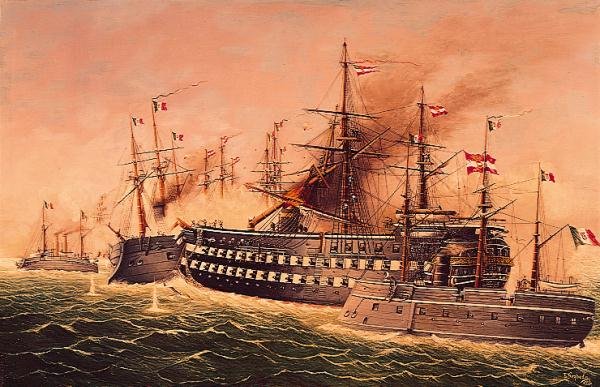
The Imperial Austrian triple-decker wooden battleship Kaiser. Yes the AUSTRIAN Navy, again. Why her for Fullbore? 

Well, the year was 1866 and this wooden warship held her own in the first major naval battle of ships of iron and steam against the Italian Navy at the Battle of Lissa.  

Sure, she was outdated and the Fleet Admiral Wilhelm Freiherr von Tegetthoff was only 39, but was a glorious effort for a Navy that had only a little more than a half a century left.
Encountering the Italian fleet early on the morning of 19 July 1866, Tegetthoff sailed straight for the center of the Italian fleet, hoping to ram the ships to make up for his own fleet's lack of firepower. The smoke from the Italian ships made visibility very poor, however, and the Austrians missed the Italian fleet completely. Swinging around, Tegetthoff again charged, this time setting two Italian armored ships on fire and damaging several more.

After Tegetthoff's flagship, the Erzherzog Ferdinand Max, rammed and sank the armored Italian frigate Re d'Italia, the Italian fleet retreated the next day. Tegetthoff returned in triumph to his base at Pola (Pula). Nevertheless, his victory did not materially affect the outcome of the war, as Italy emerged victorious.
...
Seeing things going badly, Persano found the courage to throw himself into battle, deciding to ram the unarmoured screw battleship Kaiser rather than one of the armoured ships engaged with the Italian 2nd Division much nearer him. However, Kaiser managed to dodge Affondatore. Taking heart from his admiral, the captain of Re di Portogallo decided to hurl his ship at Kaiser, maintaining a heavy fire with her rifled guns as he did so. At the last moment, von Petz turned the tables on her and turned into the ram, in effect conducting a counter ram. The impact tore off Kaiser’s stem and bowsprit, leaving her figurehead embedded in Re di Portogallo. The Italian used the opportunity to rake Kaiser with fire, putting her mainmast and smokestack into the sea. The smoke was so great that as they backed off for another ram they lost sight of each other and ended the duel.
It's all here. Using 2,000 yr old tactics to win. Making the best of the Fleet you have. Aggressive action. Leaders who lead and win without waiting for specific direction to do so. More on the Kaiser, she survived the battle, here and here.

Friday, June 22, 2018

Fullbore Friday

BJ's article this week had me thinking of the War of 1812 a bit on an off.

In that strange way things in life mash themselves up with unrelated items, I was having a moment with one of Mrs. Salamander's cousins who is all of 27 yrs old and is acting out like a spoiled 16-yr old from a John Hughes movie.

A man of that age is, well, a man, and should act as one. Our history is full of such examples and benchmarks that should set the bar, but alas, we don't teach that history for some reason. At least it wasn't ever taught to him.

One of those benchmarks was crisply outlined by Rick Brookhiser a half decade ago. Look up the battle in detail yourself, but here is the standard every man in his late 20s should measure himself by.

We live in a gilded time with all the advantages providence could bless a person. Stop complaining, blaming others, and think you are entitled to anything.

You've been an emancipated adult for a decade. Shut up and lean on your oar.
... the Battle of Lake Erie ... The American commander, 28-year-old Oliver Hazard Perry, left his burning flagship, the USS Lawrence, and was rowed half a mile under enemy fire to his second ship, the USS Niagara; returning to the attack, he forced the enemy to surrender.

His terse description of the battle – “We have met the enemy and they are ours” — went straight to the log books of immortality.

The battle had two important results. It cleared William Henry Harrison’s flank, allowing him to march into Upper Canada (modern Ontario) and win a rare American victory at the Battle of the Thames (notable for the death of Tecumseh, the only Indian leader with the strategic and political savvy which might have enabled him to stop westward expansion).

COMMENTS
America’s control of Lake Erie would also be a key factor the following year when the ministry asked the Duke of Wellington to go to America himself and wrap up the war for Britain. The Duke looked at the map and the lakes and said, no. Peace soon followed.
Fullbore.

Friday, March 16, 2018

Fullbore Friday

Piracy.

No one likes piracy.

Like the pirates off Africa helped encourage the Chinese to flex their maritime muscles, throughout history this threat to trade has moved fleets ... and brought war;
In the early 1650s the damage caused by French and Barbary Coast pirates to Dutch Levant trade forced the Republic of Seven United Provinces to send an expedition commanded by Admiral Johan van Galen to the Mediterranean. With the start of the First Anglo-Dutch War the Dutch squadron had to face yet another enemy – the English ships under Captain Henry Appleton and Captain Richard Badiley.
...
A series of actions resulted in a capture of an English frigate Phoenix by the Dutch.
...
In March 1653 the Dutch have finally succeeded in trapping Captain Appleton and his 6 ships in the port of Livorno (Leghorn) in Italy. Livorno was a neutral territory under the Grand Duke of Tuscany. On one night the English undertook a successful sortie and recaptured the Phoenix.
...
This action meant a violation of the port’s neutrality by the English. Van Galen issued a demand for the English ships to leave. By this point an English squadron commanded by Richard Badiley has arrived to join forces with the trapped ships. The Dutch sailed out to face the new threat on a favorable wind. The blockaded squadron attempted to use the chance to escape and left the port. The Dutch however abandoned their previous target and instead attacked the escaping ships. All but one of Appleton's ships were either destroyed or captured and only Mary could outrun the Dutch and rejoin Badiley. The wind prevented the latter from coming to Appleton's rescue. At the end Badiley found himself outnumbered (8 + Mary vs. 16 Dutch) and was forced to retreat. Admiral Van Galen was mortally wounded in the action and died on March 23.
The Dutch are scrappy. They lost the First Anglo-Dutch war ... but at least here, they gave better than they got.

As a side note, the paintings of the battle in the Rijksmuseum in Amsterdam are awesome in person.


Friday, March 02, 2018

Fullbore Friday

Young leaders, properly motivated a few decades in to a war, can accomplish remarkable things;
In March 1804 two of the ships tasked with watching the Vlie to prevent Netherlands privateers slipping out into the North Sea, were the sloops-of-war HMS Scorpion and HMS Beaver. The Scorpion was under the command of Commander George Nicholas Hardinge (1781 – 1808) who, though only twenty-three, had already accumulated a notable service record and promised to merit high command. The recently constructed Scorpion was one of the first of the Cruizer class of brig-rigged sloops, 106 of which would enter service by the war’s end. Of only 100-ft length and 382-tons, these proved enormously successful. With a crew of only a hundred men, these vessels were so heavily armed – typically with two 6-pounder long-gun bowchasers and no less than sixteen 32-pounder carronades – that they could deliver a broadside-weight comparable to that of a frigate, but with a third of the manpower. Command of such a vessel – which Hardinge had succeeded to two years before (at the age of twenty-one!) – was a prize that all young officers would aspire to.

On 28th March, patrolling north of the Vlie, Hardinge spotted two Dutch corvettes – heavily armed brigs – at anchor deep inside the waterway. Lacking detailed knowledge of the shoals flanking the approach, he realised that direct attack by the Scorpion must be ruled out. With sufficient men available, a cutting-out operation might be feasible, but Scorpion’s crew alone would be insufficient to provide the necessary numbers. Three days later however, on March 31st, the Scorpion was joined by the Beaver, the commander of which, Charles Pelly, was as enthusiastic as Hardinge about a cutting-out operation, for which there were now sufficient men.
...
Five pulling boats, carrying some sixty men between them, left the British ships in darkness at nine-thirty in the evening, rowing with the flooding tide. These men would have been mainly armed with cutlasses, pikes and boarding axes while officers and petty officers would have carried pistols in addition to their own swords or cutlasses. Describing himself to his father as “your humble servant”, Hardinge was in the leading boat. Undetected, the boats reached the nearer of the enemy vessels, which proved to be the Atalanta, a vessel generally similar to the Scorpion herself. Hardinge was to write that “I had the good fortune, or, as by some it would be considered an honour, to be the first man who boarded her. She was prepared for us, with boarding nettings up, and with all the customary implements of defence; but the noise, and the alarm etc., so intimidated the crew, that many of them rushed below, leaving to us the painful duty of combatting those whom we most respected.”

The scene must have been a nightmarish one, all the more so in view of the darkness and the narrow confines of the deck on which hand-to-hand combat took place. Hardinge wrote that “the decks were slippery, in consequence of rain, so that, grappling with my first opponent, a mate of the watch, I almost fell, but recovered my position, fought him on equal terms, and killed him.” He was now confronted by the Atalante’s captain, regrettable unidentified in the letter, whom he described as being “as brave a man as any service ever boasted; he had almost killed one of my seaman; to my shame be it spoken, he disarmed me, and was on the point of killing me. When a seaman of mine came up, rescued me at the peril of his own life, and enabled me to recover my sword.”

By this stage the boarders were largely in control of the deck and two of them now attacked the Dutch captain. Hardinge however “ran up, held them back, and then adjured him to accept quarter.” Heroically, though unwisely, the captain refused. “With inflexible heroism he disdained the gift, kept us at bay, and compelled us to kill him: he fell with honourable wounds.”
...
Hardinge now has possession of the Atalanta. “The vessel was ours, and we secured the hatches, which, headed by a lieutenant wo had received a desperate wound, they (i.e. the captured crew below) attempted repeatedly to force. Thus far we had been fortunate; but we now had anther enemy to fight, it was the element. A sudden gale, in which the wind shifted against us, and impeded all the efforts we could make.” Hardinge was undeterred however. “As we had made the capture, we determined at all events to sustain it, or to perish. We made the Dutch below to surrender, put forty of them in irons, stationed our own men to their guns, brought the powder up, and made all necessary arrangements to attack the other brig. But as the day broke, and without abatement of the wind, she was at such a distance, and in such a position that we had no chance to reach her.”

Forty-eight hours passed. “Two of the boats had broken adrift from us, two had swapped alongside. The wind shifted again, and we made a push to extricate ourselves, but found the navigation so difficult that it required the intense labour of three days to accomplish it. We carried the point at last, and were commended by the Admiral for our perseverance. You will see in the Gazette my letter to him.” The Atalante had suffered five killed, including the captain, and eleven wounded.
...
Hardinge’s success was rewarded with immediate (ten days after the attack) promotion to coveted post-captain rank, one of the few who attained this at such a young age. For all his courage, chivalry and promise, his subsequent career was to be tragically short. While in command of the old frigate HMS St Fiorenzo in the Indian Ocean in 1808, he was killed in the course of an epic three-day battle with the French frigate Piémontaise.

Friday, January 05, 2018

Fullbore Friday

A little encore FBF from the first year of the Obama Administration.

The schadenfreude of irony ...

Please, my fine, wise, and loyal readers from the Left - don't leave me this FbF - stick with me.

Ya'll remember the
gift exchange train wreck, right? Well, regardless of your political persuasion, let this put a smile on your face. Via Ted Bromund,
The ironies here are wonderful, though Obama doesn't seem likely to appreciate them. Of course, the reference to the anti-slavery mission is a nod to Obama's fascination, fervent but not deep, with Abraham Lincoln.

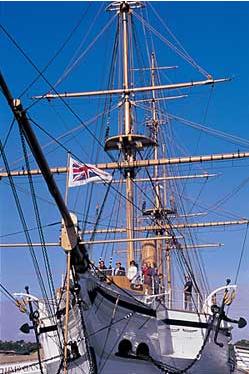
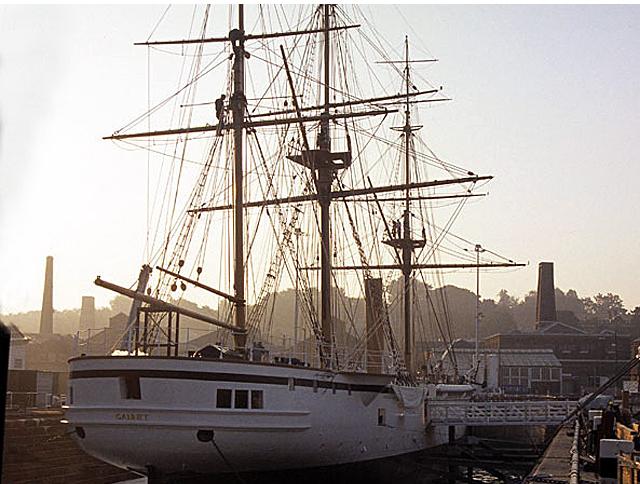
But HMS Gannet was not, as a casual reader might guess, employed against the trade of slaves from Africa to the New World, and since it was built in 1878, it has nothing to do with Lincoln or slavery in the United States. It sailed the Mediterranean and the Red Sea, patrolling against Islamist slavers. In the Red Sea, the Africans it saved would have come, among other places, from Kenya. Obama has made mention of his grandfather's antipathy to Britain, stemming from his experiences in colonial Kenya. It is quite possible that grandfather's ancestors would, had it not been for the Royal Navy, have been carried away to slavery in Arabia.

The British campaign against the slave trade is instructive for another, more important, reason. By volume of business, it was the Foreign Office's most important concern for much of the 19th century. In the courts of Europe and the New World, Britain sought to negotiate effective treaties against the trade. But Britain did not restrict itself to diplomacy. Far too often, treaties were negotiated and then not enforced. Britain's first response to this was usually to negotiate again, but its patience was not infinite,
Then we get to the FbF part - seriously, imagine being on the deck during this action - a little before her time, but what set the purpose for HMS Gannet when she came along.
[In June 1850], British warships entered Brazilian ports to flush out vessels being fitted for the slave trade. The subsequent burning and scuttling of suspected slave ships, and exchanges with coastal batteries, resulted in a predictable outcry in Brazil, including a call for the government to consider war with Britain. Wiser counsels prevailed, and in the summer of 1850 new legislation placed a comprehensive ban on the importation of slaves and measures for the seizure of vessels fitted for the trade. Unlike previous acts, these provisions were rigorously enforced and within twelve months the Brazilian slave trade was effectively extinct.
...
In short, Britain's campaign against the slave trade combined diplomacy and unilateral force in a highly effective and sustained way. Diplomacy provided legitimacy, but the British were not willing to be bound by treaties that did not bind the other side: if they felt they were being made fools of, they acted. Negotiations were meant to achieve a distinct aim: they were a means of policy, not an end in itself.

How unlike the current administration, which congratulates Hugo Chávez on winning his "dictator for life" referendum, has responded with "utter passivity" to a series of Russian, Pakistani, and Iranian provocations, and which cannot wait to stab Eastern Europe in the back by selling them out on missile defense. Maybe that pen holder is Brown's way of encouraging Obama to show a little of the old-fashioned British spirit, and to recognize that endless negotiations not backed by steel are a mistake if they come at the cost of the nation's values and honor.
Zen. I love history and fact - it clears the mind and brightens the soul. Regardless of today's politics. what a Fullbore action by a Fullbore nation.

As a side-bar, the HMS Gannet is still around - that is her modern day picture on the right and below - and a link to her here.


Hat tip Scott.

Friday, October 13, 2017

Fullbore Friday

No more complaining about a long Sea & Anchor detail.

What a great story about a frigate ... and three hurricanes.

Read the full thing, but here is how it starts;
THE 24-gun frigate H.M.S. Experiment was built in 1740 by Henry Bird of Rotherhithe. She sailed on her maiden voyage on 21 July 1740 from Spithead to join Vice-Admiral Vernon's squadron in the West Indies. Her captain was James Rentone, who had piloted Vernon's squadron into Portobello Harbour and had been given the honour of bearing the news of Vernon's victory to the king. George II had rewarded him with a present of 200 guineas and the promise of a 6o-gun ship. Under his command H.M.S. Experiment had nearly completed her passage to the West Indies when she received her first taste of what a hurricane could do.

By her reckoning she was in latitude 16° 34' N, longitude 43° 04', west of Madeira. Her log reads:
Saturday 30 August 1740
The first part fresh gales and squally, the latter a very hard Gale of wind at NNE and NE with a great swell from the ESE. At 6 p.m. took all the reefs in the topsails, furld the foretopsail, bunted the courses, brought too under main topsail and got down the topgallant yards: at 1 a.m. handed maintops'!, lower'd the main and foreyards and reef'd the courses: at daybreak the gale continued increasing and, having no hopes of its breaking, about r o a.m. cut away the topmasts to save the lower masts: soon after the mizon mast went away at the lower part of the hounds: the sea made a breach over the ship and we kept one pump constantly going, the wynch of the other being broke render'd it useless: lost one of the swivell guns over board by the fall of the foretop mast and had one of the lower studding sail booms wash'd away and severall other things of the deck harness, barr'l with beef 45 pd. and sev'l casks.

Sunday 31 August 1740
The first part a violent storm of wind from NE to East with a very great sea making a breach over us, the latter part the gale somewhat abated: at 4 a.m. the foresail being split in pieces cut him away from the yard and lost most part of the canvas: at 8 a.m. bent a new foresail and set the reef' d courses.
On that afternoon her company raised a jury maintopmast and let the reefs out of the courses. On the next day they got up a fire-boom for a foretopmast and a maintopgallant yard for a topsail yard. At daybreak on 3 September they sighted Antigua and sailed into English Harbour. There Captain Rentone delivered the Duke of Newcastle's letters to General Mathews and wrote to the Admiralty a description of the hurricane which adds a little to the log-book entry.
I made a great deal of water, my comings being very low and the tarpaulings, tho' double battened, being insufficient to keep it from getting down in a very great quantity for 14 hours which the gale continued without the least intermission and one of my pumps disabled by the wynch breaking so that I had but one to depend on and that almost constantly going and if the gale had continued many hours longer, the least increase of water would have made it very difficult to save the ship.
Hat tip Society for Nautical Research.

Friday, July 07, 2017

Fullbore Friday


First posted this eight years ago ... but there is so much to learn from this little know (at least to Americans) battle, I wanted to post it again.

Any excuse for a Tallships FbF.
This battle is known more by the name than the place, as it was fought over 400 miles from Ushant, near Brest. [Some sources give the distance as 700 miles, which may be where the pursuit began.] There have been four battles by this name, with the last in 1944.

A British fleet under Admiral Lord Howe was escorting merchantmen to North America at about the same time as a French fleet under Rear Admiral Louis Villaret de Joyeuse was escorting 130 merchantmen loaded with grain from America to France. Admiral Howe had dropped off his charges when on May 28, 1794 the two fleets sighted each other. Because of fog, only light fighting took place between the British (24 ships) and the French (26 ships). During this time, the French managed to successfully feint and draw the British away from the merchantmen, which made it home intact.

Nonetheless, the battle cost the French 6 captured and one sunk, against no loss for the English. Eleven English and 12 French ships were dismasted. Ushant III is also famous for a savage duel between HMS Brunswick and the French Venger, which lasted four hours – a very long time for these actions. These were typically fought at point-blank range; each broadside that connected caused terrible havoc, particularly on the open decks. Captain Harvey Brunswick commanded HMS Brunswick. Wounded three times in a battle that saw 44 of his crew killed and 14 wounded, he did not survive the battle.

Overall casualties were 1500 French killed, 2000 wounded and 3000 POWs; 287 English killed and 811 wounded.

The British were too exhausted to pursue. The French claim Ushant III as their victory because the grain fleet made harbor safely.
I like this little hmmmmm as well.
.... this battle took place at the height of the Revolutionary Terror in France, with over 380 people a month executed. The French Government had a policy of executing failed commanders. Admiral Villaret-Joyeuse escaped the guillotine undoubtedly because the grain fleet came in safe. Wargamer.com feels that many French captains continued fighting after their situation became hopeless because of the “zero-tolerance-for-failure” policy.
Also head on over to this site for the full fleet line up.

Not a complete Navy story though, as The Queen’s (Second) Royal Regiment of Foot was involved and so was a wee sailor.
The third battle of Ushant, where British Admiral Lord Howe fell upon the French fleet of Admiral Villaret-Joyeuse after several days of fierce fighting and won a tactical victory, though he did not intercept a food convoy from the new world.

Aboard the HMS Tremendous, one pregnant passenger gave birth to a boy. People thought this happy event was tremendous, so the kid got the nickname "Tremendous" and a Naval General Service medal in recognition of his presence at the action (with a rating of "baby").
... and you thought ours was the first fighting navy to push them out at war? Silly goose.

On a serious note - a tactical victory for the British; but a mission success for the French. The grain got there - call it a draw.


Hat tip ADB.

Friday, March 24, 2017

Fullbore Friday


About half of this is from an email Sid sent me in 2009. I added a little bit - but what a catch.

An elderly leader with decades of experience at sea. Merchants without enough military ships to make the passage. Hostile waters. A mission.

What do you do against a superior military force, when you basically have next to nothin'..?


You have been put in command of really nothing of a military ability - but everything of an economic necessity. Your nation is one that is at war, and relies on sea born commerce to survive and prosper. Between you and your nation are thousands of miles of open ocean, and an enemy that wants to destroy you.

You know you do not have what you need to fight and win ... at least on paper.

So, what do you do? Well - if you are Commodore Sir Nathaniel Dance, you get to work. You go to war with the Fleet you have - not the Fleet you wish you had.

Let's set the stage.

During the Napoleonic Wars, the British economy depended on its ability to trade with the British Empire, particularly the valuable colonies in British India. The intercontinental trade was conducted by the governors of India, the Honourable East India Company (HEIC), using their fleet of large, well armed merchant vessels known as East Indiamen. These ships weighed between 500 long tons (508 t) and 1,200 long tons (1,219 t) and could carry up to 36 guns for defence against pirates, privateers and small warships. They were not, however, capable under normal circumstances of fighting off an enemy frigate or ship of the line. Their guns were usually of inferior design, and their crew smaller and less well trained than those on a naval ship.
The East Indiamen sought to ensure the safety of their cargo and passengers, not defeat enemy warships in battle. Despite these disadvantages, the size of East Indiamen meant that from a distance they appeared quite similar to a small ship of the line, a deception usually augmented by paintwork and dummy cannon. The East Indiamen would gather at ports in India and the Far East and from there set out for Britain in large convoys, often carrying millions of pounds worth of trade goods.
The journey would usually take six months and the ships would subsequently return carrying troops and passengers to augment the British forces stationed in India. "Country ships", smaller merchant vessels chartered for local trade, sometimes independently from the HEIC, would often join the convoys. To protect their ships from the depredations of pirates, the HEIC also operated its own private navy of small armed vessels. In combination, these ships were an effective deterrent against smaller raiders, but were no match for a professional warship.

Understanding the importance of the Indian Ocean trade and seeking to threaten it from the start of the inevitable war, First Consul Napoleon Bonaparte ordered a squadron to sail for India in March 1803. This force was under the command of Contre-Admiral Charles-Alexandre Durand Linois and consisted of the ship of the line Marengo and three frigates.
What was Commodore Dance working with?
The China Fleet was a large annual British merchant convoy that gathered at Canton in the Pearl River during the winter before sailing for Britain, via India. As the convoy passed through the East Indies, it was joined by vessels sailing from other European ports in the region on the route to India, until it often numbered dozens of ships. The 1804 fleet departed in late January, and by the time it reached the approaches to the Strait of Malacca it had swelled to include 16 East Indiamen, 11 country ships, a Portuguese merchant ship from Macau and a vessel from Botany Bay in Australia.
Although the HEIC had provided the small, armed brig Ganges as an escort, this vessel could only dissuade pirates; it could not hope to compete with a French warship. There was no military escort: news of the outbreak of war had reached Canton before reinforcements had arrived from the squadron in India. Spies based in Canton had passed the composition and date of departure of the China Fleet to Linois in Batavia, and he set out to intercept it. However, Dutch informants at Canton had also passed on false reports that Royal Navy warships were accompanying the convoy, reports that may have been deliberately placed by British authorities.
The convoy was an immensely valuable prize, its cargo of tea, silk and porcelain valued at over £8 million in contemporary values (the equivalent of £541,000,000 as of 2009). Also on board were 80 Chinese plants ordered by Sir Joseph Banks for the royal gardens and carried in a specially designed plant room.
The HEIC Select Committee in Canton had been very concerned for the safety of the unescorted convoy, and had debated delaying its departure. The various captains had been consulted, including Henry Meriton, who in his ship Exeter had captured a frigate during the Action of 4 August 1800, a disastrous French attack on a convoy of East Indiamen off Brazil. Meriton advised that the convoy was powerful enough in both appearance and reality to dissuade any attack. He was opposed by John Farquharson of Alfred, who considered that the crews of East Indiamen were so badly trained that they would be unable to mutually defend one another if faced with a determined enemy.
Eventually the Committee decided that it could delay the convoy no longer and awarded command to the most experienced captain, Commodore Nathaniel Dance in the East Indiaman Earl Camden, an officer of over 45 years service at sea.
Not perfect - not even good; but what does a leader do? Improvise, adapt - overcome.
Lead.
Dance had been taken seriously ill at Bombay during the outward voyage, but had recovered in time to sail with the convoy. The fleet did not have any naval escorts, and though the East Indiamen were heavily armed for merchants, carrying nominal batteries of between 30 and 36 guns, they were no match for disciplined and professional naval forces. Not all of their listed armament was always carried, but to give the illusion of greater strength, fake gunports were often painted on the hulls, in the hope of distant observers mistaking them for 64-gun ships of the Royal Navy
...Maneuver and Deceive...
At dawn on 15 February, both the British and French forces raised their colours. Dance hoped to persuade Linois that his ships included some fully armed warships and he therefore ordered the brig Ganges and the four lead ships to hoist blue ensigns, while the rest of the convoy raised red ensigns. By the system of national flags then in use in British ships, this implied that the ships with blue ensigns were warships attached to the squadron of Admiral Rainier, while the others were merchant ships under their protection. Dance was unknowingly assisted by the information that had reached Linois at Batavia, which claimed that there were 23 merchant ships and the brig in the convoy. Dance had collected six additional ships during his journey, and the identity of these were unknown to the French, who assumed that at least some of the unidentified vessels must be warships, particularly as several vessels had been recently painted at Canton to resemble ships of the line.
At 09:00 Linois was still only observing the convoy, reluctant to attack until he could be sure of the nature of his opponents. Dance responded to the reprieve by reforming the line of battle into sailing formation to increase his convoy’s speed with the intention of reaching the Straits ahead of Linois.
With the convoy a less intimidating target, Linois began to slowly approach the British ships. By 13:00 it was clear that Linois's faster ships were in danger of isolating the rear of the convoy, and Dance ordered his lead ships to tack and come about, so that they would cross in front of the French squadron. The British successfully executed the manoeuvre, and at 13:15 Linois opened fire on the lead ship, Royal George, under the command of John Fam Timmins.
The Royal George and the next four ships in line, the Indiaman Ganges, Dance's Earl Camden, the Warley and the Alfred, all returned the fire, Ganges initially attacking the Royal George in error. Captain James Prendergrass in Hope, the next in line, was so eager to join the battle that he misjudged his speed and collided with Warley, the ships falling back as their crews worked to separate their rigging. Shots were then exchanged at long range for 43 minutes, neither side inflicting severe damage.

Royal George had one man killed: a sailor named Hugh Watt, another man wounded, and suffered some damage to her hull. None of the other British ships or any of the French reported anything worse than superficial damage in the engagement.
At 14:00, Linois abandoned the action and ordered his squadron to haul away with the wind and sail eastwards, away from the convoy, under all sail. Determined to maintain the pretence of the presence of warships, Dance ordered the ships flying naval ensigns, including his flagship Earl Camden, to chase the French. None of the merchant ships could match the French speed, but an attempt at a chase would hopefully dissuade the French from returning.
For two hours, Dance's squadron followed Linois, Hope coming close to catching Aventurier but ultimately unable to overtake the brig. At 16:00, Dance decided to gather his scattered ships and return to his former heading rather than risk attack from other raiders or lose sight of his convoy in the darkness. By 20:00, the entire British convoy had anchored at the entrance to the Straits of Malacca. On 28 February the British ships of the line HMS Sceptre and HMS Albion joined them in the Strait and convoyed them safely to Saint Helena in the South Atlantic, from where the convoy returned to Britain without further incident.
The attitude and conduct of the French Admiral is telling as an example of how not to fight war at sea.
The French admiral later attempted to explain his conduct during the engagement:
The ships which had tacked rejoined those which were engaging us, and three of the engaging ships manoeuvred to double our rear, while the remainder of the fleet, crowding sail and bearing up, evinced an intention to surround us. By this manoeuvre the enemy would have rendered my situation very dangerous. The superiority of his force was ascertained, and I had no longer to deliberate on the part I should take to avoid the consequence of an unequal engagement: profiting by the smoke, I hauled up to port, and steering east-north-east, I increased by distance from the enemy, who continued the pursuit of the squadron for three hours, discharging at it several broadsides.
—Linois, quoted in translation in William James' The Naval History of Great Britain during the French Revolutionary and Napoleonic Wars, Volume 3, 1827,
That is pathetic.

To end this FbF on a positive note - let's go back to Commodore Dance. Good leaders always are humble and thankful.

Placed, by the adventitious circumstances of seniority of service and absence of convoy, in the chief command of the fleet intrusted to my care, it has been my good fortune to have been enabled, by the firmness of those by whom I was supported, to perform my trust not only with fidelity, but without loss to my employers. Public opinion and public rewards have already far outrun my deserts; and I cannot but be sensible that the liberal spirit of my generous countrymen has measured what they are pleased to term their grateful sense of my conduct, rather by the particular utility of the exploit, than by any individual merit I can claim.
Class act.

First posted DEC09

Friday, October 28, 2016

Fullbore Friday


First, let's look at the latest "setting the bar low" cultural move.

Perhaps you thought it was a bit much to move the age to have a beer to 21 from the legal adult age of 18. Perhaps you thought it was insane to allow young adults to stay on their parent's insurance until age 26, an age many people have two kids of their own.

Chew on this from Dana Goldstein at The New Republic;
...some advocates and policymakers are citing research to argue 18 is still too young, and that people up to the age of 25 remain less than fully grown up.
...
Researchers are using the term “post-adolescence” or “extended adolescence” to describe this period of development in one’s twenties and early thirties. Social change is as important as biological change in understanding why some people in this age group are drawn to crime. Individuals who are “disconnected”—neither working nor in school—are more likely to get in trouble with the law. While fewer young women are disconnected today than in previous decades, the opposite is true for young men.
You can read the rest.

This isn't just about criminal justice either;
Adolescence no longer ends when people hit 18, according to updated guidelines being given to child psychologists.

The new directive is designed to extend the age range that child psychologists can work with from 18 years old up to 25.

It is hoped the initiative will stop children being 'rushed' through their childhood and feeling pressured to achieve key milestones quickly, reports the BBC.
In the name of all that is holy, we know this. My brain didn't make the flip until age 23 - but it didn't mean I was in "late adolescence" and should be treated like a child. If we are going to go down this route then fine; no one can vote until 25.

Actually, I might support that ... but let's get back on centerline.

OK, here is a thought; perhaps the problem with our young men (which you will find in the linked article) today is that we do not challenge them enough. We do not demand enough of them.

Anyone who has served in the military knows that young men and women can do incredible things. You can give them the highest responsibilities. Properly led and given clear guidance, there is no limit. Every day, you put your life in the hands of 18 and 19 year old people.

The concept is rather simple. Set an expectation; provide training and guidance. Provide fair and just consequences for their response to it, good or bad. Good things happen.

In a previous age where people developed later, had poorer education and health; what did we expect from them? How did they perform?

Let's look at James Lucas Yeo, born 1782;
...he joined the Royal Navy in March 1793 as a boy volunteer. ... as a midshipman at the age of 10.

In 1797, he was promoted lieutenant, and assigned to the HMS La Loire... He first saw action as a lieutenant aboard a brig in the Adriatic Sea. 
Look at your calendar. He was promoted to lieutenant at age 15 and was already in combat.
He distinguished himself during the siege of Cesenatico in 1800.
At age 18. This was not a one-off performance. Remember, he was leading men more than twice his age in ship's company, most likely.
While off the Spanish coast, he was sent to capture the Spanish vessels in the port of El Muros. Storming the fort, he succeeded in bringing out of the port every vessel, armed and unarmed. For this achievement, he was made commander, and given the HMS Confiance, one of the vessels he had taken.
When did he do this? 1805. Age 22.
Yeo participated in several sea battles during the Napoleonic Wars so successfully that he was made a captain on December 19, 1807, by which time he had already been recognized as an intrepid practitioner of unconventional sea warfare.
Age? 24.
In 1809, he captured Cayenne, in conjunction with the Portuguese, and was in consequence made post-captain.
Age 26.

There is more; read it all.

Young men and women do not need excuses. They don't need years of medication to make up for a lifetime of weak parenting. They don't need low standards they are encouraged to meet.

Our nation and our civilization cannot prosper if we allow people to spend the balance of their most productive years - when they have the best window to think, explore, and test their physical and intellectual boundaries - to be told they are not yet adults and are not capable of agency. No, just the opposite.

I've got news for those who think they can start their life like this, by age 26, if you are only now thinking you are ready to be an adult, you are already running behind. As Mr. Waters says; "Ten years have got behind you. No one told you when to run. You missed the starting gun."

Your peers have a half decade+ head start on you.

Wonder why so many people (Hendrix, Morrison, Joplin, Cobain, Hank Williams) kill themselves between the ages of 27 and 30? It is because they all of a sudden look around and realize that they have gone nowhere in their 20s but in circles. Others have moved on with their lives, and yet they can't seem to drink and drug themselves out of a rut they hit at 22. They all of a sudden realize that they need to be an adult, and they can't do it. They were drifting in the Land of the Lotus Eaters by other people who gained from having them get stuck in a rut for half a decade. When they age out of the profit zone, they are thrown in to a reality of the late-20s to early 30s that they simply cannot adjust to.

No one ever is going to be Fullbore by claiming, "I'm just not mentally mature." Sorry, regardless what your doctor may tell you, the world doesn't care.

By 16 you should be prepared to be 18, an adult. 

By 25, you should be helping those 16 to 18 to be an adult - by your example.

If you find yourself at 25 trying to map it out, you're lost. It isn't the fault of biology. Not your parents. Not society.

It is all on you.

Hat tip BJ.