Showing posts sorted by date for query terrible 20s. Sort by relevance Show all posts

Thursday, March 30, 2023

The Weapons Gap With the PRC the USA Created and Funded: it Goes Boom


If you don’t wake up every morning cursing those responsible for defense and China policy in the 1990s … the gobsmackingly short sighted arrogance of it all – then what use are you, actually?

With a few exceptions, from partially completed CV rusting in Ukraine to teaching the Communist Chinese how to MIRV ICBM warheads, to opening up our best research institutions to spies an assets, the USA was beset internally by unserious people with the attention span of a hamster and the historical perspective of a newborn in serious jobs requiring long-term thinking and decision making.

The harvest of this decade of frivolity continue to ripen, and via Jeremy Bogaisky, at Forbes – get ready to rage – we have just one more example; one that if we actually come to blows with the People’s Republic of China or those who buy their weapons – will result in more dead American men and women – more mutilated wounded. 

People and perspective matter. It appears the PRC has known this for decades;

In 1987, U.S. Navy researchers invented a new explosive with fearsome capabilities. Named China Lake Compound No. 20 after the Southern California base where it was developed, it boasted up to 40% greater penetrating power and propellant range than the U.S. military’s mainstay explosives, which were first produced during World War II.

With the collapse of the Soviet Union, however, the Pentagon’s urgency evaporated. So did the expensive task of perfecting CL-20 and designing weapons to use it.

…and how did they get CL-10? Where was the CIA, the FBI? Oh, that’s right – playing around in domestic politics. 

Meanwhile, the PRC was sending grad students; inserting citizens in the right companies. Doing just plain good old fashioned espionage. 

China, however, saw the potential. The country has invested heavily in developing long-range missiles with the aim of forcing U.S. warships and non-stealthy aircraft like refueling tankers to operate at a distance if Chinese forces invade Taiwan. Some of those weapons are believed to be propelled by a version of CL-20, which China first fielded in 2011 and now produces at scale.

“This is a case where we could potentially be beaten over the head with our own technology,” Bob Kavetsky, head of the Energetic Technology Center, a nonprofit research group that does work for the government, told Forbes.

Kavetsky and other experts in energetics, the niche field of developing things that go boom, have been warning for years that the U.S., long the world leader, has fallen dangerously behind China. The Pentagon last year outlined a plan to spend $16 billion over 15 years to upgrade and expand its aging network of munition plants, but Kavetsky warns that doesn’t include developing the advanced manufacturing capabilities needed to mass produce new explosives like CL-20.

Criminal malpractice. 

No, we are not being led by the best and brightest™ - we are not promoting our best - we do not have the right mix of incentives and disincentives.

…the U.S. depends on China as the single source for about half-dozen chemical ingredients in explosives and propellants, and other countries of concern for another dozen.

Yes, you read that correctly. I am sure Russia is in there too.

Like I said, criminal. You cannot commission new chemical plants overnight.

“We can’t build enough ships and airplanes to carry the number of missiles necessary to reverse the firepower imbalance we have inside the first island chain,” said retired Major General Bill Hix, who served as the Army’s director of strategy after commanding forces in Afghanistan and Iraq, and has consulted for the Energetic Technology Center.

“The only solution is new energetic materials,” he said. That would allow the U.S. to produce smaller missiles with the same power, so more could be carried by warplanes and ships, as well as to enable weapons that can shoot farther and pack more of a punch.

The PRC has over a decade head start building on R&D the USA paid for.

Wittman said he supports the idea of retrofitting existing missiles with CL-20 and creating a high-level office devoted to energetics under the secretary of defense. While decision makers at the Pentagon are aware of the issues, “I don’t think they see a sense of urgency with it,” Wittman said. “We’re going to instill a sense of urgency with them.”

Chinese scientists account for about three-quarters of the published research on energetics and in related fields over the last five years, nearly seven times as much as U.S. researchers, according to analyses from the Hudson Institute and Georgetown University. They’re working on materials that have improved performance over CL-20, Kavetsky said.

I would really like to see where those Chinese scientists got their degrees from, but you pretty much know.

As for the sense of urgency, what have we discussed here through the years about the 2nd and 3rd order effects of our accretion encumbered acquisition process? What does it cause? Just re-read the above.

Want another example of an existential threat to the Cult of Efficiency created? 

Nearly all U.S. explosives are produced at a single Army-owned plant in Holston, Tennessee, that dates back to World War II and is run by U.K.-based defense contractor BAE Systems (2022 revenue: $25.5 billion). The production processes generally are as old, Kavetsky said, with explosives prepared in 400-gallon vats that resemble cake mixers. Many advanced energetic materials can’t be made that way, including CL-20, which he said is synthesized in smaller amounts in chemical reactors.

All one needs is a pickup truck and a mortar team and game over. Single point of failure. As if you designed something to make you combat ineffective at D+1.

It would be possible to make 20,000 pounds of CL-20 a year with current amounts of precursor chemicals, Kavetsky said, but broad use would require 2 million pounds a year, which he believes could take three to five years to scale up to. “If DoD says we want large quantities,” he said, “industry will respond.”

“If DoD says we want large quantities, industry will respond.”

Not if we lose our one plant or run out of the chemicals – which I am sure are just in time delivered – that China is nice enough to export to us.

How long would it take for just then environmental impact statement to be completed?

Hix said he doubts those promising technologies will be ready for prime time this decade, but the U.S. could fairly rapidly boost its firepower with better explosives and propellants.

“A concerted effort on [explosives] is possible,” he said. “But we have to invest in it.”

Oh yes, our “decade of concern” … 

The Terrible 20s just keep giving.

Wednesday, March 15, 2023

Hendrix's View from an Island Nation


Regular readers know the importance of the United States being the world’s premier sea power, but that is inside the lifelines of our corner of the national conversation. 

For a whole host of reasons we have discussed here over the years and on Midrats – in spite of our nation surrounded by the fruits of the open seas – the larger American public does not see it. We suffer, in essence, from our success.

The time when the free flow of goods across the globe was not a given has slipped well out of living memory. Except for older cohort GenX and older, no one even remembers the regional threat the Soviet Red Banner Fleet aspired to be right before the empire she served collapsed and disaggregated.

Not just the United States, but the developed and developing nations throughout the globe who benefit from the post-WWII maritime environment suffer from seablindness. There are other powers - resentful, bitter, and grasping – who even though they benefit from the global agreement – wish to break it down and create something new. Not so much that they want something better – they just don’t like a system they had no role in creating – one defined by the assumed ever-presence of the United States Navy and her friends.

As fish are not aware of the water they swim in, so the global economy does not fully understand the world it exists in … and the fact that it is under threat of disappearing. 

Our friend Jerry Hendrix has been an integral and valuable part of the public conversation for well over two decades – longer inside the lifelines of the US military. 

This month he has an exceptional article over at The Atlantic titled, “America’s Future is at Sea” or in the more flashy online version, "The Age of American Naval Dominance is Over" that you need to take time to read. He weaves together not just the history, but the economic, diplomatic, and civilizational threads that all connect to American seapower. 

What adds additional importance to his article is the venue. 

As I mentioned in the opener to this post, “we” know this story – or at least most of it. The problem is too many others do not. 

The Atlantic has a certain readership segment which includes many people of influence and proximity to the levers of power, or a degree or two separated from someone who does. The vast majority of its readers who are not soaked in the details involving the maritime domain.

These people need to understand the issues as much as readers here do. You really need to read it in full, but here are a few pull quotes I’d like to share. He starts out strong;

Very few Americans—or, for that matter, very few people on the planet—can remember a time when freedom of the seas was in question. But for most of human history, there was no such guarantee. Pirates, predatory states, and the fleets of great powers did as they pleased. The current reality, which dates only to the end of World War II, makes possible the commercial shipping that handles more than 80 percent of all global trade by volume—oil and natural gas, grain and raw ores, manufactured goods of every kind. Because freedom of the seas, in our lifetime, has seemed like a default condition, it is easy to think of it—if we think of it at all—as akin to Earth’s rotation or the force of gravity: as just the way things are, rather than as a man-made construct that needs to be maintained and enforced.

But what if the safe transit of ships could no longer be assumed? What if the oceans were no longer free?

Nothing is guaranteed ... or as Papa Salamander would often tell me, "No one owes you a living."

Imagine, though, a more permanent breakdown. A humiliated Russia could declare a large portion of the Arctic Ocean to be its own territorial waters, twisting the United Nations Convention on the Law of the Sea to support its claim. Russia would then allow its allies access to this route while denying it to those who dared to oppose its wishes. Neither the U.S. Navy, which has not built an Arctic-rated surface warship since the 1950s, nor any other NATO nation is currently equipped to resist such a gambit.

Or maybe the first to move would be Xi Jinping, shoring up his domestic standing by attempting to seize Taiwan and using China’s anti-ship ballistic missiles and other weapons to keep Western navies at bay. An emboldened China might then seek to cement its claim over large portions of the East China Sea and the entirety of the South China Sea as territorial waters. It could impose large tariffs and transfer fees on the bulk carriers that transit the region. Local officials might demand bribes to speed their passage.

"Gentlemen's agreements" only work if both parties act as gentlemen and keep their word. What happens when one party decides not to be? What is the enforcement mechanism ... or is there one at all?

If oceanic trade declines, markets would turn inward, perhaps setting off a second Great Depression. Nations would be reduced to living off their own natural resources, or those they could buy—or take—from their immediate neighbors. The world’s oceans, for 70 years assumed to be a global commons, would become a no-man’s-land. This is the state of affairs that, without a moment’s thought, we have invited.

This is not alarmism. A discordant and ill-timed blending of demography, debt, economics, and politics are driving the global system of crisis - what we warned of starting 13-yrs ago as "The Terrible 20s."

—a “free sea”—first enunciated by the Dutch philosopher Hugo Grotius in 1609. The United States and Great Britain, the two traditional proponents of a free sea, had emerged not only triumphant but also in a position of overwhelming naval dominance. Their navies were together larger than all of the other navies of the world combined. A free sea was no longer an idea. It was now a reality.

In this secure environment, trade flourished. The globalizing economy, which allowed easier and cheaper access to food, energy, labor, and commodities of every kind, grew from nearly $8 trillion in 1940 to more than $100 trillion 75 years later, adjusted for inflation. With prosperity, other improvements followed. During roughly this same period, from the war to the present, the share of the world’s population in extreme poverty, getting by on less than $1.90 a day, dropped from more than 60 percent to about 10 percent. Global literacy doubled, to more than 85 percent. Global life expectancy in 1950 was 46 years. By 2019, it had risen to 73 years. 

What happens if global trade retrogrades to a prior, less safe, less predictable (hurting insurance carriers ability to properly set rates) and vibrant time? Well, you look at the positive effects of growth in the past to see an inverse of what a return to the multipolar ocean might bring the future. That is what Jerry just did. Re-read the above and ponder even a fraction of that headwind;

It is important as we look at today's challenge to accept that we are not a passive victim of a changing world. No. We are here mostly as a result of our own actions. Decline is a choice.

As a side note, if you are not already thinking of another article in The Atlantic from 16 year's ago, Robert D. Kaplan's "America's Elegant Decline," go ahead and read it now.

It is never to a nation’s advantage to depend on others for crucial links in its supply chain. But that is where we are. In 1977, American shipbuilders produced more than 1 million gross tons of merchant ships. By 2005, that number had fallen to 300,000.

Today, most commercial ships built in the United States are constructed for government customers such as the Maritime Administration or for private entities that are required to ship their goods between U.S. ports in U.S.-flagged vessels, under the provisions of the 1920 Jones Act.

The U.S. Navy, too, has been shrinking. After the Second World War, the Navy scrapped many of its ships and sent many more into a ready-reserve “mothball” fleet. For the next two decades, the active naval fleet hovered at about 1,000 ships. But beginning in 1969, the total began to fall. By 1971, the fleet had been reduced to 750 ships. Ten years later, it was down to 521. Reagan, who had campaigned in 1980 on a promise to rebuild the Navy to 600 ships, nearly did so under the able leadership of his secretary of the Navy, John Lehman. During Reagan’s eight years in office, the size of the Navy’s fleet climbed to just over 590 ships.

Then the Cold War ended. The administrations of Presidents George H. W. Bush and Bill Clinton slashed troops, ships, aircraft, and shore-based infrastructure. During the Obama administration, the Navy’s battle force bottomed out at 271 ships. Meanwhile, both China and Russia, in different ways, began to develop systems that would challenge the U.S.-led regime of global free trade on the high seas. 

Read it all.

If this isn’t enough Hendrix, and there is never enough, Jerry will join us this upcoming Sunday for Midrats. Don’t miss it!


Tuesday, January 03, 2023

Kaplan's Elegant Decline at 15


Back in the November 2007 issue of The Atlantic, Robert D. Kaplan published an essay that still comes to mind on a regular basis a decade and a half after its publication; America's Elegant Decline. I first mentioned it ten months after its publication while I was in Afghanistan, and then only briefly. 

At 15, I think it is time to see how it holds up.

15 years is a long time - but it also passes quickly. 15 years from now would be January of 2038. You know all that talk about "2040" in the last year, well you're one POM cycle away ... and while some things we think about the future to come will be roughly correct, some will be quite off. That is normal and should be expected. With that benchmark in place, Elegant Decline holds up pretty well.

Before we dive in, let's remember the time and place of 2007. Obama was still the junior Senator from Illinois. The surge in Iraq was almost at its peak and at the time success was iffy. Though we knew at CENTCOM in mid-Summer of 2007 that NATO culminated in Afghanistan and the USA would have to step in soon as we could, in general Afghanistan - the good war - was seen as in good hands with NATO.

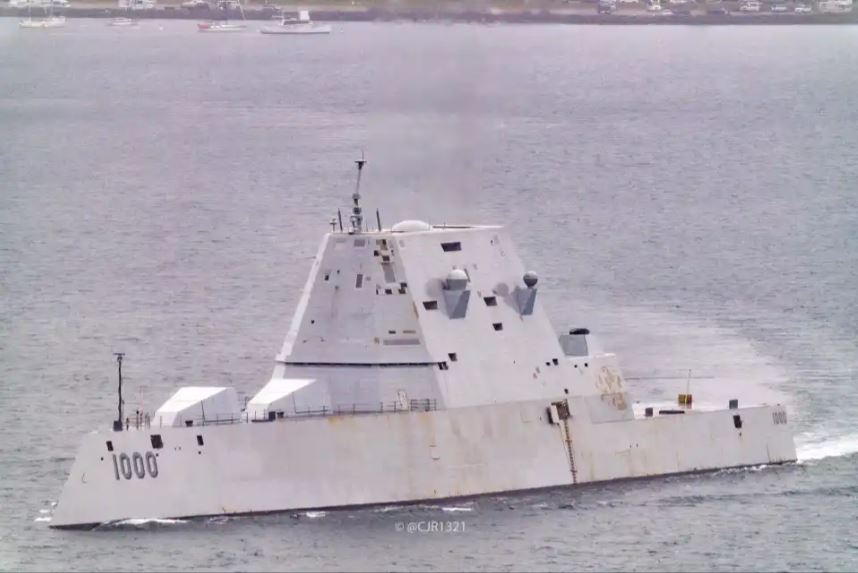
Though the cheap seats were warning otherwise, the Navy let everyone know of the glories of Transformation embodied by LCS, DDG-1000 and CG(X) were going to bring if everyone would just shut up and color ... a period that would end 18-months after Elegant Decline with the truncating to 3-ships of the Zumwalt class ... and you know the rest as we rolled in to the Age of Salamander to prepare everyone for The Terrible 20s.

So, in to that moment Kaplan dedicates the first third of his article reminding everyone of some truths are were as correct in 2007 as they are in 2023;

Beware pendulum swings. Before 9/11, not enough U.S. generals believed that the future of war was unconventional and tied to global anarchy. ... Now the Pentagon is consumed by a focus on urban warfare and counterinsurgency; ... But have we pushed it too far? We may finally master the art of counterinsurgency just in time for it to recede in importance.

...Though counterinsurgency will remain a core part of our military doctrine, the Pentagon does not have the luxury of planning for one military future; it must plan for several.

"Regular wars" between major states could be as frequent in the 21st century as they were in the 20th. ... these future wars will not require any "manifestation of insanity by political leaders," nor even an "aberration from normal statecraft, " but may come about merely because of what Thucydides recognized as "fear, honour, and interest."

..

The current catchphrase is boots on the ground; in the future it could be hulls in the water. 

...

A "peaceful, gain-loving nation" like the United States "is not far-sighted, and far-sightedness is needed for adequate military preparation, especially in these days," warned Navy Captain Alfred Thayer Mahan in 1890..

This is when he transitions to what he, rightfully, sees as a primary indicator of America's decline - its Navy - something that dominates the other 2/3 of the article.

...too few strategists at the time were thinking seriously about sea power. Today we are similarly obsessed with dirty land wars, and our 300-ship Navy is roughly half the size it was in the mid-1980s.

A great navy is like oxygen: You notice it only when it is gone. But the strength of a nation's sea presence, more than any other indicator, has throughout history often been the best barometer of that nation's power and prospects.

I just wanted to take a note to nod at the hard work led by Rep. Mike Gallagher (R-WI) in the changes to Section 8062(a) of USC Title 10, 15-years after Elegant Decline, to put this in to law. 

Our friend Bryan McGrath has a superb summary of the changes and their importance here.

Back to Elegant Decline - where Kaplan does a great job outlining more nuggets of unalloyed truths;

Our sea power allows us to lose a limited war...Army units can't forward-deploy anywhere in significant numbers without a national debate. Not so the Navy. ... Great navies help preserve international stability. 

...

In an age where 90 percent of global commerce travels by sea, and 95 percent of our imports and exports from outside North American do the same (even as that trade volume is set to double by 2020), and when 75 percent of the world's population is clustered within 200 miles of the sea, the relative decline of our Navy is a big, dangerous fact to which our elites appear blind.

Well, it didn't double, but it did go up by 30%.


A lot of you will remember this well;

...in a 1954 article in Proceedings ... a young Harvard academic named Samuel P. Huntington told the Navy not to feel sorry for itself:

The resources which a service is able to obtain in a democratic society are a function of the public support of that service. The service has the responsibility to develop this necessary support, and it can only do this if it posses a strategic concept which clearly formulates its relationship to the national security. 

Emphasis added by me.

Good googly moogly yes. Has our "service" been doing this sales job well? No, no it has not. Why? They have tied themselves to the mast of the archaic, accretion covered Cold War era Goldwater-Nichols and the Cult of the Joint that comes with it. That is why. They have convinced themselves that they have to accept this state of affairs in silence when they don't - it is senior leadership's choice to interpret it as such. Our Navy and the nation it serves suffers as a result.

...by 1997, post Cold War budget cuts had reduced the Navy to 365 ships. (In the Quadrennial Defense Review of that year, the Pentagon established a 'red line' of 300 ships, below which the Navy would not go.)

LOLOLOLOLOL.

Of course the 300-ship Navy could still, in the words of Robert O. Work, ...

BOB!

 ..."pound the snot" out of primitive challengers like Iraq, Iran, and North Korea,

Don't worry, they didn't forget about China completely;

Robert Work told me that he believes the eventual incorporation of Taiwan into China will have the effect that the Battle of Wounded Knee had on the United States: it will psychologically close an era of national consolidation for the Chinese, thereby dramatically redirecting their military energies outward, beyond their coastal waters. Tellingly, whereas the U. S. Navy pays homage to Mahan by naming buildings after him, the Chinese avidly read him; the Chinese are the Mahanians now.

The next bit is something we called at the time wrong-headed and unhelpful and Kaplan is suspicious of at the time as well; then CNO Admiral Mike Mullen, USN (Ret.); 

He (Mike Mullen) went on: "I'm after that proverbial 1,000-ship Navy - a fleet in being, if you will, comprised of all freedom-loving nations, standing watch over the seas, standing watch over each other." Subtract the platitudes, and it's clear that Admiral Mullen is squaring a number of circles to contend with the difficult reality he's up against. 

I continue to hold that this throw away line that became a talking point that was then made flesh was one of the greatest strategic errors this century so far. It gave top cover to those who were looking for reasons not to build the Navy our nation needed. The evils of the Age of Transformationalism only made it worse ... another of Mullen's follies;

This is what the optimists saw right before the rot was unavoidable anymore;

The new DDG-1000 Zumwalt-class destroyer, envisioned in one form or another for 12 years and beset with delays could end up costing $3 billion a ship - if any get built. The new Gerald R. Ford-class aircraft carriers could cost a whopping $8 billion each - not including $6 billion of research-and-development costs.

History can be cruel to such a geologic pace; this slowness is a recipe for vulnerability and nasty strategic surprise. We have a capital-intensive Navy consisting of vessels that cost tens of billions of dollars, and that must therefore each deploy for decades if they are to return the investment. Yet all future peer competitor like China need do to greatly devalue our fleet is to improve its ballistic-missile technology to the point where we're forced to move our carriers, say, 100 miles east of their present positions off the Asian mainland, to keep them out of missile range.

We should be so lucky. Time has found Kagan an optimist here.

...the new Ford-class carriers will be built with laser guns to kill incoming missiles, anti-torpedo torpedoes to deal with supercavitation technology, and electric catapults for launching UAV's in case fight jets, with their human pilots, give way to enhanced remote-controlled Predators that  can be refueled in air.

Well, in 2022 lasers are still the weapon of tomorrow like they always seem to be, anti-torpedoes are a strong maybe to no, and unmanned systems are still a few generations away if ever from there ... so ... technology and future risk can suffer from excessive optimism bias ... as always. Watch 2001: A Space Odyssey for a hint in that regard. 

Meanwhile, as costs drive us towards that 150-ship Navy...

Not yet...we're doing better than that so far. Kaplan was a bit too much of a pessimist on this point. At my darkest in pondering The Terrible 20s I warned of 240 back in 2010.

According to Navy Lieutenant Commander Claude Berube, who teaches at the U.S. Naval Academy, in an emergency we might even issue letters of marque, the way we did during the Revolutionary War, giving privateers the legal authority to act in our defense. Allowing privateers to help with, say, the drug-interdiction effort in the Caribbean would enable uniformed sailors to concentrate on the Pacific and Indian oceans.

Claude!

Today, the United States devotes 4.38 percent of its annual gross domestic product to defense. Before the Iraq War, it was 3.5 percent.

In 2022 it was back to ~3.5%.

Admiral Morgan, the deputy chief of naval operations for information, plans, and strategy, told me that to maintain our naval primacy, we may need to devote close to 5 percent of GDP (assuming a growing economy) to defense. Yet it's unclear whether the American public will abide that.

Spoiler alert; they didn't.

So, there we go; the Elegant Decline at 15. 

Much spot on, some a bit too optimistic, some too pessimistic. On balance though, it aged fairly well in a decade and a half.

It should keep us all humble and it would do everyone well to understand that, on balance, 2023 is not all that different than 2007 ... and 2037 will most likely not be all that different than 2023.

Plan accordingly.


Tuesday, December 27, 2022

No Sense of Urgency to Act on What is Waiting West of Wake

The greatest threat to security in the Western Pacific is not the rise of China, certainly isn't the moribund Russians - or even a combination of the two. No, the greatest threat to security west of Wake is the American national security establishment.

The two pillars of its dysfunction are intellectual and institutional.

Intellectually we continue to allow The Smartest People in the Room™ to blissfully live in a world of happy talk to themselves, each other, and their nation. It is as if they live in a world of the military FITREP where you write your own review in the adult version of Lake Wobegone ... where all the children are above average.

Via Phelem Kine and Lara Seligman over at Politico this AM;

The U.S. has pledged to deploy so much firepower to the Indo-Pacific in 2023 that China won’t even consider invading Taiwan. Lawmakers and allies say it’s already too late.

The promise is a big one: “2023 is likely to stand as the most transformative year in U.S. force posture in the region in a generation,” Ely Ratner, assistant secretary of defense for Indo-Pacific security affairs, said in early December.

Nothing personal here. I am sure Ely is a nice guy. A PhD in, ahem, Political Science from, ahem, UC Berkely, and a life spent in politics, academia, and the usual holding-pen think tanks ... but clearly a smart guy and a good staff weenie ... but seriously; he doesn't believe that. No one with any knowledge of the People's Republic of China believes that. No one with even a thumbnail understanding of the US military's readiness for sustained peer conflict believes that.

More importantly, no one in the PRC believes that.

Happy talk and spin is fine in domestic politics, fund raisers, and giving hope to the rubes, but it takes years to get a military ready for sustained combat on the other side of the globe. We barely held our own until early 1943 against Imperial Japan and we started getting serious seven years earlier in 1936.

While we struggle to maintain a steady state fleet, the PRC's navy grows.

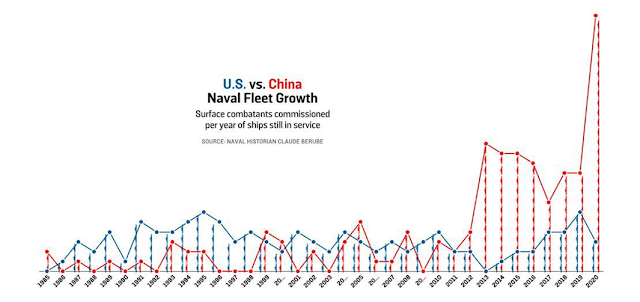
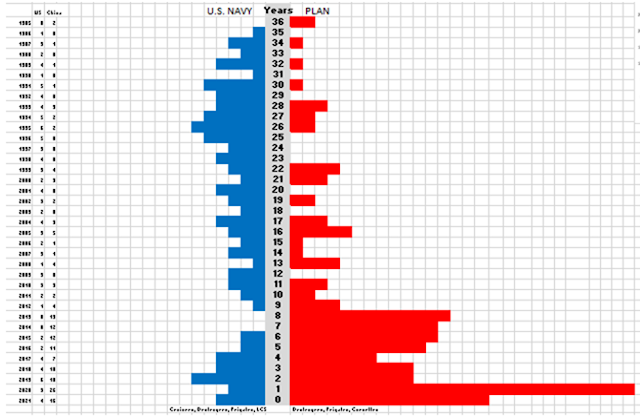
I guess it is time to put up Claude Berube's graphs again.


They have vastly outbuilt us in the past 10 years. Yes, that red line is China’s shipbuilding versus the blue of the us navy.

That is the truth. That is why when we try to force-mode domestic political happy talk to the international stage we are looked at as not just lying - but being quasi-delusional.

At least there are some people with access to levers of power who know what time it is.

“We have a rhetorical commitment to a force posture change in the Indo-Pacific, but that’s belied by the reality of what’s actually happening,” said Rep. Mike Gallagher (R-Wis.), who will become chair of the new House Select Committee on China in the next Congress. He called Ratner’s assertions the military planning equivalent of “whistling past the graveyard.”

The gentleman from Wisconsin is too kind. 

We cannot afford more happy talk - more "transformational" bullsh1t from people who should know better. They need to be called out on every occasion they try to cropdust the intellectual space people are trying to cultivate towards meeting this decade's challenge. The Terrible 20s are going to be terrible, but we can mitigate the degree of that terribleness. Some progress is being made, but more pressure is needed.

Now let's loop back to the second part of today's post mentioned at the start; institutional dysfunction.

Notice the 1936 to 1943 timeline above? Seven years that didn't bring in just new systems, but generational development in everything from carrier air whose fighters went from the Brewster Buffalo to the Grumman Wildcat, to Hellcat; submarines advanced through six different classes from Salmon to Balao; land based heavy bombers went from the Martin B-10 through the Boeing B-17 to a year later the B-29 deploying. 

You get the idea.

Remember back in October?

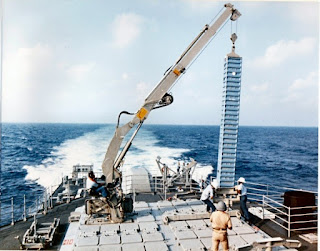
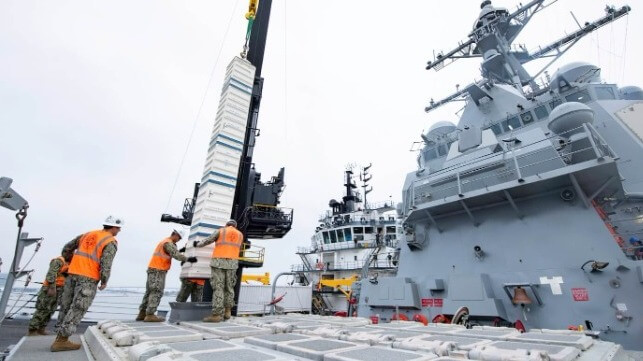
The U.S Navy has tested out a new way of rearming its warships with a trial vertical launch system (VLS) reload in San Diego. 

In a test evolution, the crane-equipped OSV Ocean Valor conducted a VLS reload with guided-missile destroyer USS Spruance, an exercise intended to prove out a new way to reload guided missile destroyers in sheltered waters. Sailors aboard the Arleigh Burke-class destroyer successfully lowered training ordnance into the ship’s forward VLS cells in a proof-of-concept evolution.

...

The exercise was aimed at proving that an OSV can reload the weapons system pierside, with the goal of expanding the capability of VLS reloading in expeditionary environments. The launch system reload has been tested previously in 2016 and 2019 using other MSC vessels but has never been tested using a relatively small OSV as the delivery platform. 

A VLS reload alongside the pier is substantially less challenging than a VLS reload in an open seas, underway replenishment scenario. Previous Chief of Naval Operations Adm. John Richardson signaled an interest in bringing back underway VLS replenishment in 2017, but the operation has rarely been performed in practice - even on Ticonderoga-class cruisers, which were designed with this evolution in mind. 

The TICOs were designed in the 1970s - pretty much half a century ago - roughly the same amount of time that the Spanish-American War was to 1943.

Let that soak in.

Now let's go back to July of 2017, just five and a half years years ago +/-. You know, roughly 1.5 WorldWars as we defined this program management period of time in 2015. For you pedants out there, it is 1.46 WordWars to be exact.

Here's what we discussed 1.46 WordWars ago;

The U.S. Navy is looking to restore its ability to reload its ships’ vertical launch systems at sea, which could be a dramatic logistical game changer in the planning and execution of high-intensity contingencies against peer competitors.

...

After discussing the means by which the Navy seeks to ensure its forward-deployed naval forces remain survivable and up-to-date with the latest tactical and technological innovation, Admiral Richardson said in reference to vertical launch system (VLS) underway replenishment, “we’re bringing that back.”

Since its operational debut in 1986 aboard the sixth Ticonderoga-class cruiser, USS Bunker Hill, the Mark 41 vertical launch system and its successor the Mark 57 have become the main battery of the preponderance of the Navy’s surface fleet, while the Mark 45 has become the principal means of deploying cruise missiles aboard submarines. Vertical launch systems are among the most adaptable weapon mounts that the Navy fields, allowing a ship to carry a variety of defensive and offensive missiles in the same shipboard infrastructure, and to fire them in rapid succession.

Well, we don't have this back.


But we are playing around 1.46 WorldWars later with this;

If it appears that the military acquisitions process and the bureaucracy that keeps it running is not quite what one needs to get ready for war, you're right.

It is nowhere near fit for purpose.

Reloading VLS is not a new concept - it is over a half century old. We got rid of it because the short-war uni-polar world would rather have those VLS cells with missiles to blow up parked clapped out Toyota Hilux with 23mm 1960s era manual guns mounted on the truck bed.

In our Lotus Eater stupor we allowed our land based facilities come under the range of our enemy's rocket artillery from Japan to Guam. That luxury is history. We cannot cruise back to the West Coast or Hawaii to reload. We need to do it at sea - now.

Here is where we need to start playing hardball. Our chattering classes are lost in a soup of onomastic happy talk that enables each other to avoid hard work, and our accretion hobbled acquisitions force is designed mostly to ensure funding lines and job protection in a peacetime uni-polar world.

That is long past. As useful as midnight basketball is to domestic politics - a reference someone with a PhD from UC Berkely should understand.

Wednesday, August 17, 2022

The US Navy's Disarmed Hostility


So, how is your week going?

The Navy wants to shed 39 ships in Fiscal Year 2023, with the first ship set to depart on Halloween.

The list, which includes five guided-missile cruisers 

Armed neutrality is a good thing - it keeps an enemy at bay.

Being hostile while you are actively disarming yourself? That is begging for a whoop'n.

Inaction. Inattention. Slavish devotion to process. Entitlement. Distracted leadership.

That is how we got here – a destination we slid to this century on a carpet of happy-talk, half-truths, and aspirational time-buying.

First, let’s start with a statement that I could have made myself. Via David Sharp at AP;

Adm. Mike Gilday, chief of naval operations, defended the proposal that emphasizes long-range weapons and modern warships, while shedding other ships ill equipped to face current threats.

“We need a ready, capable, lethal force more than we need a bigger force that’s less ready, less lethal, and less capable,” he said Monday at the Navy League's Sea-Air-Space symposium in Maryland.

I would always want three effective warships as opposed to five worn out, worm-ridden with unpublished CASREPS, partially manned and maintained Command at Sea billets … but it didn’t have to be this way; this was a choice.

Anyway, this is just another way to say, "Divest to Invest" which is a kinder-gentler version of "Do More With Less" etc that we've all seen before.

We should have five warships - and need eight - but we don’t – and we are barely through the first 5th of The Terrible 20s. We did not get here by accident or by the action of external forces - but by decisions the Navy made.

No one is allowed to be surprised.

We are a dozen years past the announcement of “The Terrible 20s.” So the structural challenges of this decade were known a few PCS cycles before they began to manifest themselves in spades. 

Generations of leadership have been happy to let their Sailors be worked down to the bone in undermanned, rusty, poorly maintained ships on extended deployments with ships only partially mission capable. Little effort was made to promote either a replacement for Goldwater-Nichols, or push back against the Ottoman-effective “Joint” requirements. Less effort was made to bring the critical importance of sea power has in enabling the standard of living and place in the world of the American people enjoy to the ears of the American people.

We lost an entire generation of naval developments with programs like CG(X) that failed to launch, programs like DDG-1000 that failed to transition, and programs like LCS who exist only to mock our claim to be the world’s premier naval power. In some areas, we aren’t even that anymore. 

No. As we covered last month, the Navalist institutions have failed their moment and we are drifting rudderless into a minefield while those with the charter to provide and maintain a navy remain at their cocktail parties reminding each other how wonderful and influential they are in a potlatchesque onomastic orgy of feather-nesting – the future be damned.

We have wallowed in failure so long, we have forgotten how we got there.

How about a little Front Porch unintended call-out?

Some detractors proclaimed littoral combat ships to be the Navy’s “Little Crappy Ship,” but that’s not fair, said defense analyst Loren Thompson.

“It’s not a little crappy ship. It does what it was supposed to do. What it was supposed to do isn’t enough for the kind of threats that we face today,” said Thompson, from the Lexington Institute.

In the Navy’s defense, threats shifted swiftly from the Cold War to the war on terror to the current Great Power Competition in which Russia and China are asserting themselves, he said.

If you have to bring out Loren to defend you, you've lost the LCS argument. I mean, really people. As was even mentioned early on in the AP article, LCS was designed for a post-Cold War threat. This reads as satire, but it is serious as people think it is informed, objective opinion quoted in the article.

It isn't.

If we can't speak truth, we sail in a sea of lies and feast on a layer of error on top of error.

Enough of that rant, I am probably losing you ... let us behold the spawn of The Terrible 20s.

There are three stories here, all different, and all damning to the leadership of our Navy the last quarter century … but mostly the leadership of the first decade of this century. They begat the child the present leadership is having to raise – and still tell us what a great baby-daddy they are.

First let’s look at the list from NAVADMIN 181/22.


The three stories are the neglected unsexy but important, the worn out, and the snake-bit. 

1. The Unsexy but Important: The USNS ships range from 8 (Glenn) to 50 (Gordon/Gilliland) years old with an average of 36.2 years. Most should have been replaced years ago, but ... well ... you know. As a side note, if anyone knows the background on the T-ESD going away so young, let us know in the comments. I can't find anything.

2. Worn out: The SSN were both ~36-yrs old, the CG averaged 35 years old, and the LSD 33 years old. The way we use our fleet units, if after 30-yrs you can't replace them 1-for-1 then that is your fault. The PC's are 28 years old on average ... way beyond what those wee ships should be. Is the CNO right about these? Sure ... but don't say, "... less ready, less lethal, and less capable." - just be honest and say, "...worn out, unrepairable, and too dangerous to ask Sailors to go to war in." Be clear and direct. Be at least as blunt as we were defending the writings of Kendi.

3. Snake-bit: the Little Crappy Ship is little, crappy, and should probably be called a hulk. Average age here is 4.7 years, the youngest just 2 years. No one has been held to account. No one. If you are new to the LCS debacle or think the Front Porch is taking too much credit, well...here is almost 2-decades of commentary on LCS. We were right from the start. Something useful is being made with the Independence Class with more money and fewer expectations, but what an opportunity cost this misadventure has consumed.

In what has been a bad decade for the US Navy’s relationship with Congress – and an exceptionally bad year when our senior leadership expended what was left of institutional good will defending racial essentialism – it appears that the powers that be insist it wants to pick a fight with the organization that feeds them. That is just picking a fight. I'm all about picking fights, but this isn't the right one.

U.S. Rep. Elaine Luria, D-Virginia, was more blunt, tweeting that it “sucks” to be decommissioning so many ships, especially newer ones.

“The Navy owes a public apology to American taxpayers for wasting tens of billions of dollars on ships they now say serve no purpose,” she said.

Rep. Lauria (D-VA), the surface-nuke that she is – knows what time it is – and can mock the lame and weak as only a surface nuke can.

So, add this to your folder of affirmative failures of vision and verve. 

U.S. Rep. Rob Wittman, R-Virginia, suggested the ship cuts were “grossly irresponsible” when the U.S. Navy has dipped from 318 ships to 297, while the Chinese fleet has grown from 210 to 360 ships over the past two decades.

Milley said it's important to focus on the Navy's capabilities rather than the size of its fleet.

“I would bias towards capability rather than just sheer numbers,” he said.

Milley doesn't know the difference between a MK-41 and a SeaRAM. 

What happened to "distributed lethality?" Nothing to the concept, it just seems that our leadership lacks the ability to have a sustained baseline strategy that lasts longer than a FITREP cycle and instead invents new buzzwords to chase around like a catnip addled kitty after a laser pointer. That and it is shamed by the empty piers LCS, DDG-1000, and CG(X) begat our already cursed decade of decline.

The 2020s were going to be hard whatever we did, but by our collective action, we have made it worse. The US Navy has earned a long, painful, and distinguished period of oversight from Congress that will hopefully result in a wholesale rebuild of our shipbuilding people, process, and procedures. 

If not, well ... the US Navy and the nation it serves had a good century in the sun. A hoot while it lasted. 

What follows will not be a hoot.

Thursday, July 28, 2022

The CNO Has a Plan...


The Chief of Naval Operation's 2022 Navigation Plan is out ... and besides a couple of expected errata points I'll cover at the end ... I like it. It answers the bell.

I'm not going to go paragraph by paragraph as I want you to read the whole thing. The document is important because the CNO is the boss, and this is the Ref. A everyone needs to align with. It will drive discussions, efforts, focus, and defines the four corners for any argument the Navy will make. As such, read it if you want to understand what everything for the next year or more is going to be built around.

It is just a couple of dozen and change pages. Lots of pictures and side-bars, so it is a quick read. Congrats to the chop chain as there is an economic use of jargon and acronyms with just a few exceptions - but as a whole digestible from E1-O10.

Full disclosure up front - because long-term readers and certified members of the Front Porch may think I had a role in at least the Introduction ... because it is - I will humbly submit - Salamanderesque ... sadly I did not ... but someone here did;

First, the 2022 National Defense Strategy (NDS) clarified America’s national security objectives, emphasizing the need to address long-term competition with China and sustain military advantage against Russia. 

Did you catch that? "...competition with China..." and "sustain military advantage against Russia."  That is a clever way of saying the primary effort must be to counter to the People's Republic of China, and the USN's efforts and posture towards Russia will be an economy of force effort. 

Exactly correct. 

Anything we develop to address China will translate well if needed against what remains of the Russian Navy. As long as we keep and advance our ASW edge against the best the Russians can put to sea, the Army and Air Force can handle the rest of the worry with our NATO allies in primary position. That's the subtext.

Third, through a rigorous campaign of learning, we recognized that the Navy needs a more continuous, iterative Force Design process to focus our modernization efforts and accelerate the capabilities we need to maintain our edge in this critical decade and beyond.

The victory of the Anti-Transformationalists is complete. "Transformation" is mentioned nowhere, and "transforming" written only once in a different context. "Third" above is a return to the cornerstone of the great Rear Admiral Wayne Eugene Meyer, USN's "Build a Little, Test a Little, Learn a Lot." For 18-years we've wanted to see the turn towards this correct mindset be complete, and I think we are here. BZ Front Porch. 

Take the "W."

Our Navy team is the most capable in the world. However, we have identified unacceptable variability in our performance—the gap between our best and worst performers is too great. History shows that the navy which adapts, learns, and improves the fastest gains an enduring warfighting advantage. The essential element is fostering a healthy ecosystem—a culture—that assesses, corrects, and innovates better than the opposition. This is the essence of our Get Real, Get Better call to action, 

That is simply so damn good I don't really think I have much more to say than, yes. As for the "Get Real, Get Better," I first scrunched up my nose at it as it has a little of this vibe...

...but it has grown on me. I like it. It underlines a mindset of honesty, humility, and ... a call to action to improve from a sub-optimal position. 

Like I said, the Introduction is superb...but we are not even there yet ... as so far we've only go to the warm-up to the intro and we are already well in to Salamander-101.

The Introduction starts like this;

America has always been a maritime nation. The seas are the lifeblood of our economy, our national security, and our way of life. 

...

This progress and prosperity did not happen by accident. American sea power, combined with the dedication of our allies and partners, guaranteed freedom of navigation, maintained peace, and fostered a rules-based order grounded in fairness for all.

I'm not even going to be grumpy that I wasn't given a footnote.  

Today, for the first time in a generation, we face strategic competitors with the demonstrated intent to unravel the free and open order. 

...

This is a critical decade. As global challengers rise to threaten U.S. interests, America must maintain maritime dominance.

That is the "Long Game" series running 18-yrs in a nutshell.

The CNO could have stopped with the Introduction. That is the core, everything else is commentary ... but as Hillel might suggest, let's continue to read. 

The three trends in Security Environment are spot on;

Today, our Navy operates in a battlespace that is quickly growing in lethality and complexity. We face many challenges across the globe, but they largely stem from three significant trends:

• The erosion of credible military deterrence, particularly due to China’s rapidly increasing military capabilities.

• Increasingly aggressive Chinese and Russian behavior that undermines the international rules-based order.

• The accelerating pace of technological change and the expanding impact of the information environment.

It nicely boils down China's goal;

China designs its force for one purpose: to reshape the security environment to its advantage by denying the United States military access to the western Pacific and beyond. 

I wish this thread was pulled a little more, as the Russo-Ukraine War is giving a strong affirmation of this;

Artificial intelligence, ubiquitous sensors, unmanned systems, and long-range precision weapons are proliferating globally, making contested spaces more transparent and more lethal, and transforming how navies will fight in the future. 

The CNO ends the argument about if presence is a mission. Solid.

America cannot cede the competition for influence. This is a uniquely naval mission. A combat-credible U.S. Navy—forward-deployed and integrated with all elements of national power—remains our Nation’s most potent, flexible, and versatile instrument of military influence.

While not worthy of being included in the errata sheet, what looks like a last minute bone thrown to the SSBNs mafia is an awkward construct around the problematic and questionable concept of "Integrated Deterrence" ... but I think it looks forced because it was forced...maybe.

The ultimate backstop of integrated deterrence is a secure and reliable strategic nuclear deterrent. 

A little high and right methinks. We need to find a better way to hook in the strategic deterrence imperative as the SSBN force is the most effective of the triad.

Leaving that stumble behind, this is much better;

Every day, the Navy operates forward alongside allies and partners through combined operations, theater security cooperation, and capacity building initiatives. These activities strengthen our strategic partnerships, increasing interoperability, information sharing, and capacity for resilient, integrated logistics. Working together, we strengthen our ability to prevail in conflict and further bolster integrated deterrence by demonstrating a united front against potential adversaries. 

All allies and friends are one of our primary comparative advantages. That paragraph was solid...but the following one a little, "meh."

The Navy is also uniquely equipped to contest gray-zone incrementalism and malign influence by our adversaries. Many gray-zone activities occur in the global commons—particularly in the maritime domain and cyberspace. Gray-zone aggression thrives on non-attribution. The best way to oppose these activities is to deny our adversaries anonymity with persistent domain awareness, the effective leveraging of intelligence, and the agile application of sea power. Together with whole-of-government partners, the Navy denies the obscurity that our rivals exploit. Contesting, exposing, and attributing malign behavior imposes reputational costs, diminishes the effectiveness of propaganda, and galvanizes international resistance.

That would not have survived my chop.

I like lists as they are easy to remember and frame arguments around. The six "Force Design Imperatives" get a Salamander endorsement letter in the affirmative;

  • Expand Distance
  • Leverage Deception
  • Harden Defense
  • Increase Distribution
  • Ensure Delivery
  • Generate Decision Advantage
I'm not a big fan of the "Force Design 2045" section, not so much from the substance but from the concept. 2045 is 23-yrs from now. The "out years" are an unknown country and too many people put too much credit to it. 

Imagine in 1927 what "Force Design 1950" would look like. Lots of dirigibles I think.  What about 1892's "Force Design 1915?" How about 1972's "Force Design 1995

Wait a minute. 1892's would have probably have a lot of big gun ships, and I believe Aegis started in 1969 and TLAM in 1972 ... so they might have been pretty close to being right. 

See, a useful process, just be careful expecting too much clear-eyed futurism. Some of it will be shockingly right, but a lot notsomuch.

Like the "Force Design Imperatives," I liked the "Navigation Plan Priorities." 
  • Prioritize readiness
  • Modernize capabilities
  • Generate cost-effective capacity
  • Invest in .... Sailors
Yes, yes, yes...these are fundamentals, but you have to repeat the fundamentals on a regular basis or things get sloppy.

Let's back up a bit to Force Design 2045 for a second. There is this nugget;

Retiring legacy platforms that cannot stay relevant in contested seas—and investing in the capabilities we need for the future—is essential for our national security.

Its companion is found in Priorities and together is a bit of a war warning for the Potomac Flotilla. Both are bolded in the original for a reason and you need to read them carefully. 

To simultaneously modernize and grow the capacity of our fleet, the Navy will require 3-5% sustained budget growth above actual inflation. Short of that, we will prioritize modernization over preserving force structure.
The prophecy of The Terrible 20s made flesh.

Look at the economy and inflation. Do you think the Navy is going to get 3-5% above inflation with how we do budgets now? Without finding some way to get Army money? I don't see a path there, so what does that lead to?

We've seen this movie before. Be careful.

Like I said earlier, the "Get Real, Get Better" section is good. It gives the impression that we officially and openly are self-aware that we need to do better than we have in the past - regardless of the happy talk of the past.

We can work with this.
Get Real requires Navy leaders to ruthlessly self-assess; be honest, humble, and transparent about their capabilities and limitations; challenge their beliefs using data, facts, and diverse input; and “embrace the red”—acknowledge shortcomings—by being curious and taking pride in finding and fixing problems.

Get Better requires Navy leaders to deliberately self-correct; find and fix small problems before they become larger, systemic issues; fix the root causes, not just symptoms; apply critical problem-solving tools and best practices to shift from more activity to better outcomes; set clear accountability; work collaboratively; and quickly identify and remove barriers to progress, elevating problems to higher leadership, if necessary.

The substance from there has a good workmanlike feel to it for its genre. 

Parts of the "Where we are Going" section hit some high points regulars here and over at Midrats will like. Here are my top-6 from the list;

- Ship/Submarine/Aviation Maintenance: Continue to drive maintenance delays down to zero. Work with naval shipyards and industry partners to improve performance. Accelerate gains made in aviation readiness to reinvest in other areas of the Naval Aviation Enterprise.

Terminal Defense: Pursue a fully-integrated combat capability that employs lethal and sustainable effects to defend naval forces against complex raid scenarios.

Contested Logistics: Recapitalize our logistics fleet through used sealift buys in 2022, achieving T-AO 205 Initial Operational Capability by 2023, delivering Next-Generation Logistics Ship by 2030, and recapitalizing C-130s by 2030. Continue war-gaming and experimentation to inform how a survivable Navy logistics construct supports the sustainment of military operations in a contested environment. 

- Long Range Fires: Develop and integrate joint, all domain capabilities to project power at increasing ranges through contested maritime environments. Pursue a mix of weapons with required enablers, including CPS development and all-up-round testing. 

Unmanned Systems: Accelerate innovation efforts by aligning the acquisition, requirements, financial management, and operational communities supporting unmanned technology. Strengthen a culture of accountability and measurable progress. Focus on adopting enabling technologies that both provide near-term capability and help lay the foundation for the future hybrid fleet.

- Affordable Force Structure: Improve budget, requirements, and acquisition processes with a cost estimating dashboard to better project risk in cost, schedule, and performance.

I was going to do a top-5, but that last bit was a nice nod to, "Yeah...we screwed the pooch on CG(X)" and as such needed to be folded in.

We are running out of time and have not yet won the battle for money, so this is where I would prioritize what push we have. Faster.

I think the most fair critique of the document is the section on "Sailors" that in part I will cover in the errata section. If Sailors are our greatest asset, then why are they tagged on as an afterthought at the end and only get less than 10% of the effort in the document? It signals again the very DC nature of our Navy where much of our leadership has spent too much time - and our naval nomenklatura never leave. 

In DC, it is all about money and the programs that move it around ... and that can focus the mind for leaders that soak too long in it. Sailors can become an abstract. If this is an external messaging document - which it is - with a secondary internal role, if you consider Sailors an "internal" challenge, then I can understand its placement at the end and underemphasized. 

The substance seems a bit copy and paste, which is OK, some of the rest of the document is to a lesser effect - as you would expect - is. That is OK. I'm a firm believer that you have to repeat the essentials until you are sick of doing it. Only then will you finally be heard.

However, the "Sailors" section just isn't written as well as the rest of the document. It even starts with this vein on the forehead throbbing line;

The Navy’s enduring asymmetric advantage is our workforce—both uniformed and civilian—across our active and reserve components. 

No. Just, no. There is nothing more symmetric than Sailors. Sailor performance is not "asymmetric" to anything at sea. It is the center of everything. What they are trying to say - and this would be in my chop - is; 
The Navy’s enduring comparative advantage is our workforce—both uniformed and civilian—across our active and reserve components. 
No, that is not a minor difference. Yes, words matter. 

Finally, what in the name of Poseidon's trident is this?
We holistically evaluated Navy efforts focused on building a stronger, tougher, and more resilient Navy. We found that we risk creating gaps in supporting the physical, psychological, spiritual, and social needs of our force without an integrated framework focusing on optimizing the performance of our Sailors. We will better align this constellation of programs so that Sailors, with the support of their commands, can reach their optimal potential.
Well. OK.

Now to my "Errata Section."

Review my comments above WRT DC and our leadership who spends too much time there. I get to DC a few times a year. As I've advertised a lot, I love the city. I wish it would return to pre-COVID levels of enjoyment, but perhaps soon. I still love the city and have a nearly perfect circle of acquaintances and friends there - but - it is a cultural terrarium. 

The people and their priorities of DC are not aligned with the rest of the nation, much less the fleet. If you are soaked in DC life, its media, its culture, and you live in base housing surrounded by the long dwell natsec nomenklatura who have spent 80%+ of their professional life inside a commute distance of DC for decades - if you don't make a sustained effort to remained grounded with the larger nation you serve, you will do and think some strange things as viewed from the provinces.

Like a fish that is not aware that it lives in water - what you assume is normal, isn't - at least to the land dwelling animals that surround you.

Of course, I am talking about something we've long gotten used to; the DC-centric domestic political posturing that leaks in to US Navy. Not just the Biden Administration either. This is a Potomac Flotilla problem, not a partisan problem ... though it gets worse in (D) administrations, but to be clear, Bush-43 was not much better, and until the last 6-months of his administration, Trump did nothing to counter any of it. 

Mike Mullen's back to back tenure from CNO to CJCS allowed him to shape a generation of domestic political agenda nomenklatura pushing senior leadership to carry their banner - and it shows. It has become normalized, I just don't think they know it sticks out in bold relief.

Errata A: Fealty to an Official Religion: This seems obviously spot-welded in to the "Security Environment" section;
Climate change threatens coastal nations with rising sea levels and more extreme weather. Melting sea ice opens the Arctic to growing maritime activity and increasing competition. COVID-19 demonstrates how rapidly some threats can become global in scope, generating worldwide political and economic instability. Competition over offshore resources, including protein, energy, and minerals, fuels international tensions. All these trends create vulnerabilities for adversaries to exploit and volatility that can erupt quickly into crisis.

Praise Buddha that this reads so clunky and out of place that most readers will see it was clearly included as a, "We have to address this..." to check the block.

I'm less irritated then humored. 

Errata B: The Least Important Aspects of our Sailors are What we Worry About the Most: Next to Gaia worship, the other secular religion of the senior leadership of the US Navy is to first judge Sailors by the color of their skin, to hell with the content of their character or performance. 

I did a quick wholesale word count of the document. It is 7,469 words. The "Sailor" section is just 694 words, 9.3%. Of those 694 words, 142 are dedicated to "Diversity, Inclusion, and Equity" discussion. 20.5%.

We only dedicate less than 10% of our "Navigation Plan" to our greatest comparative advantage, and of that we dedicate almost a fifth of that time on something that does not bring Sailors together, but drives them apart. Something that does not reward performance, but gives special treatment based on something so incredibly meaningless to winning our nation's wars - the self-identified race, creed, color or national origin of our Sailors (something they cannot do anything about).

Heck, I'll go ahead and quote that section - but first as a reminder - let's go back to basics; words mean things. "Equity" does not mean "equality."

Let's use Ellen Gutoskey's efficient definition from 2020;

Equality has to do with giving everyone the exact same resources.

Equity involves distributing resources based on the needs of the recipients.

Remember, the US Navy does not have a "needs" metric it tracks. No, it uses the brain-stem simplistic metrics of tribalism; race, creed, color, and just to divide us more, sex and probably soon sexual orientation. All, including sex, self-identified and subject to self-identification. When the Navy says "equity" it is talking about special treatment based on tribalistic markers. Don't forget that great shame.

So, now that you understand what "equity" means in your Navy;

Launched 48 Task Force One Navy initiatives, which remain on track for full implementation, with further Navy Diversity, Equity, and Inclusion efforts underway.

What We Have Learned

• Progress toward a more diverse, inclusive, equitable, and stronger Navy is difficult and requires sustained commitment. Given how diverse each community is within the Navy, tailored approaches are more successful than one-size-fits-all, prescriptive measures. We are developing a Navy methodology to measure diversity of representation and equity of opportunity to make progress toward essential Diversity, Equity, and Inclusion goals across the Total Force.

...

Inclusive and Diverse Force: Through the Navy Leader Development Framework, continue to measure the results of initiatives to ensure the Navy is becoming a more diverse, inclusive, and equitable force, making stronger teams and stronger warfighters.

Supported Commander: Deputy CNO for Manpower, Personnel, Training, and Education/Chief of Naval Personnel (OPNAV N1)

History will no look back kindly on this posturing ... and change is coming.

Again, on balance this is a good publication and especially the opening five pages - exactly what we need.

Don't rely on my pull-quotes above, read the whole thing and let me know your thoughts in comment.