Showing posts with label Maintenance. Show all posts

Wednesday, September 07, 2022

5 Years, 17 Lives, 1 Navy


How long do you wait to see what you purchased with the lives of 17 Sailors?

Back in 2015 I decided we needed a measure of time for things in the Navy, and settled on a measure of time called a WorldWar;

I think "years" does not really tell the best story about how long it takes to get even the most simple ship to displace water after the "go" is given.

Perhaps we need a new measurement - one that provides context. We need one defined in American terms, natch, and I have an idea.

I've used it before; the time from the attack on Pearl Harbor to the signing ceremony on the Mighty Mo.

That is 07DEC41 to 02SEP45. 3-years, 8-months, 26 days. Including the end date, that is 1,366 days.

Five years is a long time. It is about one and a third the time it took for the USA to fight World War II.

5-years = 1.34-WorldWars.

What was mostly anger at the time during the horrible summer of 2017 when the FITZGERALD and MCCAIN collided with merchant ships in the Western Pacific has, for me at least, distilled more in to sadness. Sadness looking towards hope, but sadness nonetheless.

Such an avoidable and predictable waste. Hopefully something good can come from it. 

As I wrote in the fall of that year;

Why would the Surface community want to benchmark an Aviation-centric instruction’s attitude as opposed on focusing on unit level failures? Here are 17 reasons;

- GMSN Kyle Rigsby of Palmyra, Virginia, 19 years old.

- YN2 Shingo Alexander Douglass, of San Diego, California, 25 years old.

- FC1 Carlos Victor Ganzon Sibayan of Chula Vista, California, 23 years old.

- PSC Xavier Alec Martin of Halethorpe, Maryland, 24 years old.

- STG2 Ngoc Turong Huynh of Oakville, Connecticut, 25 years old.

- GM1 Noe Hernandez of Weslaco, Texas, 26 years old.

- FCC Gary Rehm, Jr., of Elyria, Ohio, 37 years old.

- ETC Charles Nathan Findley of Amazonian, Missouri, 31 years old.

- ICC Abraham Lopez of El Paso, Texas, 39 years old.

- ET1 Kevin Sayer Bushell of Gaithersburg, Maryland, 26 years old.

- ET1 Jacob Daniel Drake of Cable, Ohio, 21 years old.

- ITl Timothy Thomas Eckels Jr. of Baltimore, Maryland, 23 years old.

- ITl Corey George Ingram of Poughkeepsie, New York, 28 years old.

- ET2 Dustin Louis Doyon of Suffield, Connecticut, 26 years old.

- ET2 John Henry Hoagland III of Killeen, Texas, 20 years old.

- IC2 Logan Stephen Palmer of Harristown, Illinois, 23 years old.

- ET2 Kenneth Aaron Smith of Cherry Hill, New Jersey, 22 years old.

Not waving bloody shirts around, but this should focus the mind. This is not an academic exercise, or some Black Swan event – this is a scenario x2 that people have been warning about for years. We don’t just have bent steel and bruised egos here – these are lessons written in the blood of 17 Sailors who we like to say are our most important assets.

Over in DefenseNews back in June, Megan Eckstein had a long and well researched article that everyone should take a moment to read. I'm just now getting around to it and it brought up a little anger, a lot of sadness, but a fair measure of hope that well meaning people in hard jobs are trying to claw something back from the completely avoidable deaths from 1.34 WorldWars ago.

Here's a few points ... but this is only a small fraction. You really need to read it all;

The comprehensive review of recent surface force incidents, released in early November 2017, highlighted the root problems Kitchener outlined. A quick scan of the table of contents makes clear there’s a long list of problems: poor seamanship and failure to follow safe navigational practices; erosion of crew readiness; headquarters processes that inadequately identified, assessed and managed operational risks; “can-do” culture that undermined basic watchstanding and safety practices.

The Navy has spent the past five years not just addressing these issues, Kitchener said, but doing so in a data-driven way meant to prevent the Navy from backsliding.

Operational tempo drove many of the problems outlined in the review. Japan-based ships in particular faced such demand that they were constantly too busy, which came at the expense of training and maintenance time. Personnel were yanked from one ship crew to fill in for others, meaning sailors didn’t get downtime and the crews didn’t gel as a unit.

Of course, this is naval leadership 101; none of this is breaking news. This is Vince Lombardi fundamentals...yet we decided we didn't need to remember them.

Well, the naval gods of the copybook headings took their payment.

We are a Surface Navy at peace, and in the Western Pacific - blinkered, overcaffeinated, and overheated N2 types aside - have been with a few minutes of exceptions for decades.

...for all ships in the Pacific — both 7th Fleet in Japan and U.S. 3rd Fleet in San Diego, California — all requests from fiscal 2019 to fiscal 2021 to extend a depot-level repair period — despite potentially delaying a ship’s deployment — were approved. This included 29 extensions in FY19; 27 in FY20; and 30 in FY21, according to data provided by Naval Surface Forces.

There’s a second process in place for ships already deployed. A redline instruction from Naval Surface Forces states a ship cannot remain at sea if certain systems go down, unless it receives a waiver from the operational commander. Even then, the approval must be accompanied by a mitigation plan approved by Kitchener or his East Coast counterpart, Rear Adm. Brendan McLane, who commands Naval Surface Force Atlantic.

...

Additionally, ships are entitled to a certain number of continuous maintenance availability days throughout the year — the type of routine care done pierside to keep ships at peak readiness for operations, as opposed to the major upgrades and repairs done at a depot.

Kitchener said 19% of that work was executed in 2017, as opposed to nearly 90% today. 

Simple things are not simple, but with the right leadership, they stay that way. This is how you save ships, save lives, and increase retention. That would have saved 17 lives in 2017 - of that I am absolutely convinced.

Vasely said the Learning to Action Board will tackle the Fitzgerald and McCain collisions as its next project, looking to ensure the permanent implementation of the 117 recommendations and the translation of those surface-specific recommendations into broader ideas to make the whole Navy safer.

“One of the key things that we realized as we’ve gone through the Bonhomme Richard and the major fires review iteration is that we’re not getting after … the long-term success of what this will look like, which is: How do we get left of bang?” he said. “How do we look at the data … and identify those negative trends that are posing significant risks that, if unchecked, if we don’t surge on them, that basically will result in a potentially catastrophic event or a pinnacle-level event?”

A fifth goal for the board now, he said, is meant to be more proactive, “looking at negative trends that come up — so think about [inspector general] investigations, area assessments, think Naval Safety Command or hazard reports that come through, think about pulse surveys that go out to the fleet that come back — all provide data that, really, there has not been a repository or a mechanism to look at that data to determine the negative trends, to arrest the negative trends from turning into a pinnacle-level event.”

For Kitchener, turning lessons from the past into forward-looking predictive analytics is a critical endeavor.

“We cannot allow those lives that were lost to be in vain,” he said.

Should it take 1.34 WorldWars to get here? I don't know. Maybe I am impatient ... but if this can stick like the lessons Naval Aviation took to heart in the 50s-60s, then perhaps yes.

There's your hope. 

Wednesday, June 01, 2022

Unfunded Priorities ... or a Deeper Story?


I may have to add Sen. Jon Tester (D-MT) to my list of navalist leaders of merit on The Hill.

My first reaction was to be mad that I had not made this point first ... but I will gladly enjoy this exceptionally important point being made by a Senator to the CNO in such a public manner;

Via Caitlin Kenney at Defense News;

“I think this committee wants to make sure we're providing our warfighters with the necessary funding to ensure that the equipment they're using is adequately maintained. It's pretty basic,” Tester told Adm. Mike Gilday, chief of naval operations; and Gen. David Berger, Marine Corps commandant. “That means getting the necessary spare parts and safety equipment up front, not after something like this happens.”

He noted that the Navy and Marine Corps’ unfunded priorities lists—items that service leaders want but not enough to devote part of this year’s budget to—include some categories of spare parts for warships, F/A-18 fighter jets, MH-60S helicopters, and more.

Tester wondered why spare parts would be on the unfunded priorities lists “when this seems pretty basic, at least to my perspective, as to making sure that we're keeping folks safe and effective in the field.”

Let's take a moment to go back to the summer of 2017 ... a half decade ago. We, yes we, drowned 17 of our Sailors in their berthing because our senior leadership did not man, train, or equip our Navy properly. 

As we discussed in detail at the time, just prior to the incident our Navy was bragging - on one of the ships nonetheless - that the already undermanned ship was in addition to doing not just its regular required maintenance, but depot level maintenance as well because ... depot level maintenance facilities wouldn't/couldn't do it. Both ships were think with missing parts, broken equipment, untrained watchstanders. Basic stuff.

Equipment was CASREP'd all over the place on those ships as well as others in the fleet. Those who have been at sea also know not everything is CASREP'd that should be. More parts are always needed than the reports say.

... and yet, here we are in 2022 and the CNO has to be confronted by a Senator that - hey - shouldn't you take care of what you have first before you ask for more?

Any homeowner knows that before you head on that Hawaiian vacation you need to patch the leaking roof, replace the broken water heater, unclog the girls' shower drain ... the basic stuff.

You also don't but a new car because the old one is running rough because you've skipped two regular oil changes and scheduled maintenance because you wanted to buy a new boat instead. 

Etc ... etc ... but it isn't as sexy, is it?

“So that's why in both our budget, with the secretary's help, and also in my unfunded list, we're trying to get back to where we need to be,” Gilday said. “You can't fool the fleet, you can't fool sailors, they know when they don't have the stuff that they need. And so, in our trips out to the fleet we've heard loud and clear that supply parts have been a problem. The GAO report confirmed that for us, and so we're trying to make things right with respect to spares.”

Those comments, Tester said, indicates to him that the spare parts should not have been placed on the Navy’s unfunded list.

“Sir, it's a valid point,” Gilday acknowledged.

Yes, yes it is. It isn't a new point either.

BZ to Senator Tester. 

May he, Senator Cotton, Representatives Gallagher, Luria, Banks, Waltz and more who show they understand the maladministration of our Navy keep the hard questions - the pointed questions - to our senior uniformed and civilian leadership. 

Make their actions worthy of the Navy they lead.

Wednesday, November 03, 2021

The "Unsexy but Important" is Sexy to the Professional. Where are our Professionals?


This month when you say "tender" I am not thinking about a tender Turkey.

I am not thinking about tender mercies.

Nope.

If we are really concerned about winning the next great Pacific war ... we need to grow up and get ready.

Details over at USNIBlog.

Tell me where I'm wrong.

Wednesday, October 20, 2021

Burning of the Bonnie Dick


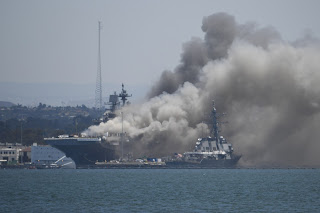
15-months later, we have a lot more information from the burning of the USS Bonhomme Richard (LHD 6) ... and none of it is going to make you feel better.

I am of the "responsibility of command" school, but if you don't feel and smell a larger story here, you aren't paying attention.

More, along with links to the Command Investigation, are over at USNBlog.

Tuesday, October 12, 2021

Drydocks Matter


We've spent a long time here and on Midrats discussing the almost criminal neglect of the "unsexy but important" parts of our maritime national security infrastructure by our uniformed and civilian leadership over the last three decades.

It goes beyond the wholesale destruction of our base, shipyard, and repair facilities. Over and above our under-resourced auxiliaries from ice breakers to command ships. We have a moribund merchant marine, almost non-existent war reserve, and our repair facilities are so incredibly delicate they cannot meet the well planned peace time repairs, much less any realistic wartime requirements.

And yet ... we continue to mindless drift in history's currents - making  no effort to look for shoals, obstructions, or even what direction we are going in - though we fully know we have a place to go and the path there is full of hazards. 

Over at Forbes, Craig Hooper has an incredibly important peace about the story the USS Connecticut (SSN-22) is about to lay out over the coming weeks.

We may not get many more clear warnings than what CONNECTICUT is giving us. We should listen.

Perhaps this will be a clear call to those who still refuse to hear all the warnings about the fragility of our support infrastructure.

Perhaps;

 In 1995, the Base Realignment and Closure Commission, reflecting Department of Defense disinterest in basing ships in the Marianas Islands, ripped the heart out of the U.S. Navy’s shoreside establishment at Guam. Along with closure of Guam’s Ship Repair Facility, the Fleet and Industrial Supply Center and Naval Activities were shuttered in 1997—and in an ironic sense of timing, the repair yard the USS Connecticut desperately needs was closed 24 years ago, the very same month the powerful sub was launched. 

The Navy’s shore establishment on Guam has failed to keep pace with America’s focus on the Pacific. Naval ships are back. The Marinas Islands are now home to an Expeditionary Sea Base, two sub tenders, four nuclear submarines and a host of ten or so Military Sealift Command Vessels associated primarily with U.S. Marine Corps or Army prepositioning programs. 

Even as new ships arrived, the shore maintenance support has dwindled.

Once Guam’s Ship Repair Operations Facility was privatized, the Military Sealift Command—the yard’s primary customer back then—shifted a good amount of refit work to more cost-effective foreign yards. 

The green eye-shade cult of efficiency is, more than any other movement, damning our navy's ability to operate and setting the nation up for strategic failure.

From domestic supply chains, to selling finite STEM research positions to foreign nationals, to having a repair infrastructure needed to fight and win wars - the MBAs and CPAs - and the leaders who listen to them, are a greater threat than any foreign power.

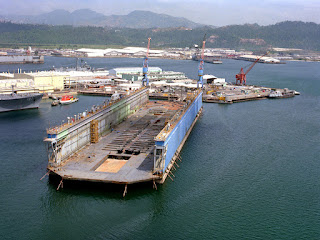
Guam’s two aged dry docks are gone. The World War II-era floating dry dock Richland (YFD-64) was sold off in 2016 to a Philippine maritime service provider. The Machinist (AFDB-8), a large auxiliary floating dry dock known locally as the “Big Blue,” was a relatively young platform, delivered to the United States in 1980. Damaged after a 2011 hurricane, the dry dock was sent to China for modernization in 2016, and is, apparently, still there. 

Workers have drifted away, too. The original pool of 800 workers that supported the shipyard in the early 1990’s has shrunk down to a few hundred at most. 

In 2018, with naval activity at Guam at a post-Cold War high, the Navy inexplicably mothballed the repair facility, with no apparent plan to recapitalize it. 

Yes, let's pull that out again;

 ...the dry dock was sent to China for modernization in 2016, and is, apparently, still there. 

We can't fire everyone - but I understand the emotion to do so.

If the damage to the sub is severe, it will be a real struggle to patch up the USS Connecticut enough so it can make a safe transit to the Navy shipyards in either Hawaii or Puget Sound—over 6,500 miles away. 

It is almost criminal what has been done to what was at one time the world's greatest maritime power.

Read it all. Get angry. Ask hard questions. Demand action.

We can start by building some new floating dry docks. 


Wednesday, September 08, 2021

Reinforcing Failure at Sea


Is our nation's military as poorly maintained and lacking in self-respect as we seem to be from Kabul to the high seas?

What messages are we sending?

I'm pondering a long standing critique of mine over at USNIBlog today ... something more important now than ever.

Come on by and give it a read

Wednesday, June 02, 2021

To win the 72-Month or 72-Week, and not the 72-Hour War...


 ...we have better start planning to fight the marathon.

Now that we are contested at sea, we are setting ourselves up to be unable to return ships to the fight.

Details from the GAO's latest over at USNIBlog.

Give it a read and wake up.


Wednesday, May 12, 2021

LCS ... the Maintenance Edition


Yes, we will continue to discuss LCS because we don't seem to have quiet fully realized the many lessons ... hard, expensive lessons ... of the program.

Thanks to the GAO, we have some great info on the maintenance nightmare ... and a kind admission from the CNO that, yes, the anti-transformationalist were correct.

Details over at USNIBlog.

Thursday, April 29, 2021

When You Fool Yourself, You are One


The GAO has a report out on LCS maintenance
.

A long running concern here has been the intentional, and borderline criminal, neglect of maintenance Navy-wide in general.

The LCS program, from the manning CONOPS to maintenance has been one long example of bad ideas made flesh by an entire generation of pigheadedness.

In 2021, we have good people in hard jobs doing the best they can with the dog's breakfast of a class of ships they were given - and yet we can't seem to build anything straight connected to this crooked timber.

We should have stopped building them long ago - but we will have to make do with what we have.

If you want to, rage read the whole thing ... but I want to remind everyone - the first LCS was commissioned in 2008, over a dozen years ago.

We also found significant unplanned work in maintenance contracts we reviewed—often because the Navy didn't understand ship condition before planning repairs. One effect of unplanned maintenance is schedule delays that limit fleet readiness.

...

GAO found in the 18 LCS maintenance delivery orders it reviewed that the Navy had to contract for more repair work than originally planned, increasing the risk to completing LCS maintenance on schedule. A majority of this unplanned work occurred because the Navy did not fully understand the ship's condition before starting maintenance. The Navy has begun taking steps to systematically collect and analyze maintenance data to determine the causes of unplanned work, which could help it more accurately plan for maintenance. 

Amazing. Simply amazing. It is as if we didn't have a few centuries of experience maintaining warships.

The toxic culture of yes-men and happy-talk that begat the LCS program to begin with seems to be impacting maintenance as well.

Being that no one was held accountable for the former, I guess we should not be surprised about the later. 

Sunday, April 25, 2021

The Lessons of Service Squadron TEN, with Ryan Hilger - on Midrats


Home is thousands of miles away on the other side of the great Pacific Ocean. A deadly and relentless enemy is challenging ships and sailors for every island, cove, sea and shipping lane.

There is no time – or yardspace – for damaged ships for travel home for repairs or resupply. Large shore facilities and ports anywhere near the fight are either under enemy control, or too dangerous and damaged to be useful.

How can the US Navy fight and win under these circumstances? We know the answer. We’ve been here before.

How can the war games of a century ago, and the war they helped win less than two decades later, help us today as we face another rising power in the Western Pacific?

For the full hour this Sunday from 5-6pm Eastern to discuss this and related questions, will be Lieutenant Command Ryan Hilger, USN. We will use as a starting point for our conversation his recent article over at CIMSEC, Service Squadron TEN and the Great Western Naval Base.

Ryan is a Navy Engineering Duty Officer stationed in Melbourne, Florida. He has served on USS Maine (Gold) and USS Springfield as Chief Engineer. He holds a masters degree in Mechanical Engineering from the Naval Postgraduate School. 

If you use iTunes, you can add Midrats to your podcast list simply by clicking the iTunes button at the main showpage - or you can just click here. You can find us on almost all your most popular podcast aggregators as well.

Wednesday, March 03, 2021

An Abandonment of Stewardship


Since 17 of our Sailors drowned in berthing after the collisions of the summer of 2017 to now - we have covered almost the time it took from the attack on Pearl Harbor to victory in Tokyo Bay ... and yet ... what have we really done?

Look at the metrics.  

That's what I did over at USNIBlog.

Come and see.

Wednesday, December 30, 2020

CNO Goes Salamander?


OK, that may be a stretch but we may have an opening to discuss the logistics and maintenance holes that everyone else was ignoring this century.

I'm not a fan of all he has plans for 2021, but I am encouraged by a recent statement.

Details over at USNIBlog.

Come on by and tell me your thoughts

Wednesday, September 09, 2020

USN vs. PLAN on Appearances


Why are we willingly giving victories to the Chinese Communist Party when we go to sea? 

Why do we tell sweet little lies to ourselves, our government, & and American people? 

What will it take to wake us from our complacent stupor?

Well ... rust never sleeps, and she seems to be back with an attitude.

Pics and commentary - with a visit by the PLAN - over at USNIBlog.

Wednesday, January 29, 2020

The Lessons from Germany's Hollow Force

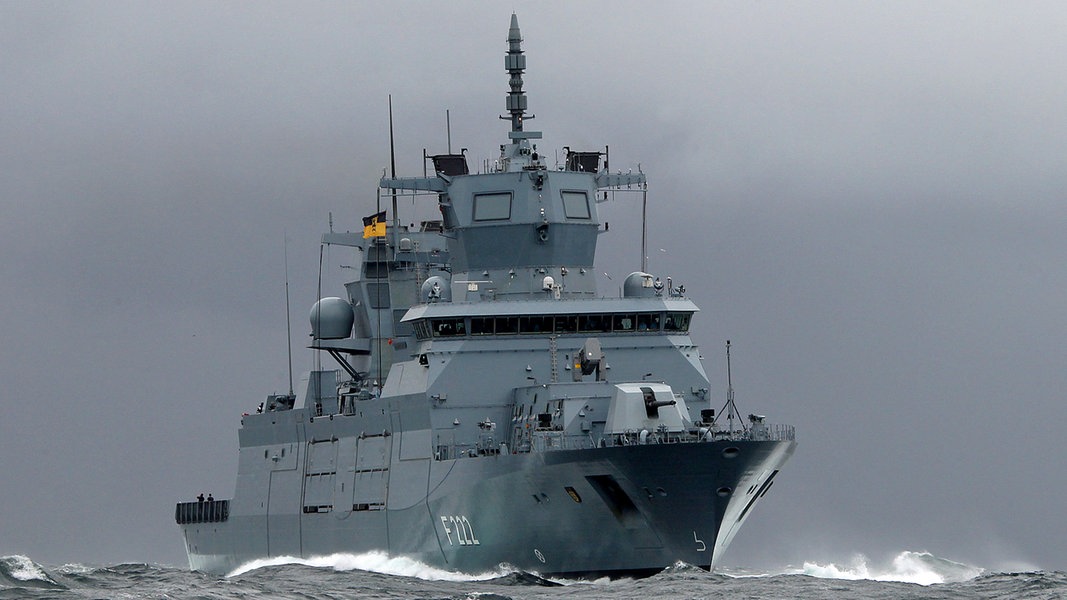
When you have a military overbuilt for the money you spend to man, train, and equip it properly ... and roll in a bit of mismanagement and overconfidence by industry ... you have ... the German experience.

Does that parallel or perhaps give a benchmark to our performance?

I'm pondering over at USNIBlog. 

Come on by and ponder with me.

Wednesday, September 18, 2019

Slacker Nation Takes the Leadership Helm

When our most senior uniformed and civilian leadership don't seem to care all that much about the condition of our ships - how can we expect our Sailors to? 

When they make excuses for substandard performance, who won't follow that example?

I've got some sad examples over at USNIBlog. Come by and behold.

Thursday, September 05, 2019

Remember how we laughed at the Russians ....

...when their only carrier-capable dry dock ... had an oopsie?

Well, I think that was the only one ... well - don't laugh too hard.

You know how long we've known the dimensions of the FORD Class CVN? In an unfortunate time to get enough eyes, Ben Werner had an important article out on the 30th that missed my scan earlier with the holiday and hurricane;
Only one of the Navy’s 18 dry docks used for maintaining the nuclear-powered carrier fleet can support a Ford-class carrier, Navy officials told USNI News.

Dry Dock 8 at the Norfolk Naval Shipyard can handle a Ford-class carrier, but only after a temporary cooling water systems is set up. A permanent cooling water system and other upgrades to Dry Dock 8 are scheduled to occur before USS Gerald R. Ford (CVN-78) enters its first planned dry dock availability, Anna Taylor, a Naval Sea Systems Command spokeswoman, told USNI News in an email.

The Navy also plans to upgrade a West Coast dry dock to handle the future USS John F. Kennedy (CVN-79), Taylor added.
So, a single source of failure now, and maybe two later? Hope a war doesn't break out.


Here is the zinger; I know the EDO types have been beating this drum in the background ... but who was the one who kept sending the power-down signal until their PQS cycle was complete?
“The Navy has taken a hard turn on how do you do readiness in a more efficient way, and that’s being led from the secretary’s office,” Petters said. “We’ve talked about readiness in my career for a long time. This is a no-kidding effort to go get it sorted out.”
So, if this is a "no-kidding effort" - then when was the kidding effort?


Maybe no in the USN studies the St Nazaire Raid any more - but I bet the Chinese do.

Hat tip DJ.

Tuesday, August 27, 2019

NNN - a New Acronym the Navy Does Not Need

Before we get to substance, I want to ride one of my hobby horses first; style.

We cannot expect to be able to effectively tell our Navy's story - and build public support for our Navy - if we cannot communicate in clear, understandable, and consistent terms.

Both inside our lifelines, and especially outside our lifelines, one of the most significant self-generated barriers we have to effective communications is the self-parody level of acronym use. It seems that we feel the need to create new rafts of idea-choking acronyms every FITREP cycle.

It seems we're doing it again. In an critical document we would want a broad spectrum of people to read, quote, and discuss, Report to Congress on the Long-Range Plan for Maintenance and Modernization of Naval Vessels for Fiscal Year 2020, we auto-chaff our message with this unnecessary cloud;
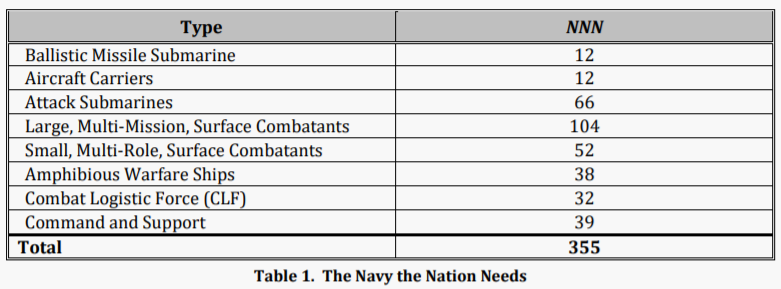
The National Defense Strategy provides the overarching guidance and high-level requirements for sustaining the Navy the Nation Needs (NNN).
It appears that someone spawned this about 18-months ago, and I really wish we would stop trying to make NNN happen. I know it has become shorthand for 355, but stop. What do we do next in this farcical dance, abbreviate it to "3N?"

Someone at NAVSEA needs to be put in the time-out chair.


I think we are moving away from 355 anyway, so we'll see what the report for 2021 says - ringing in the Terrible 20s.

I stand that we will never see 355 outside Chinese expansion east, but here is the vision:


Now let's look to the substance of the report. As we discussed before, it is fun to talk about ship numbers and programs etc ... but that isn't where the greatest challenge is. You can buy all the fancy new things you want, but if you can't maintain them properly, they become tied to the pier and combat ineffective.

We have a significant issue right now.
Sustaining the 355-ship fleet will require changes to both public and private industrial capability and capacity. Current infrastructure will require update and refurbishment to support modern classes of ships and repair. Likewise, additional dry docks will be needed to address the growing fleet size. Navy and industry partners must create work environments where talented Americans will want to work and contribute to the national defense. This includes investments in updating facilities and capital equipment, and as well as providing that workforce training that is both modern and relevant and compensation commensurate with the skill required to repair Navy ships. Finally, we must avoid feast and famine cycles that erode both the repair industrial base and the underlying vendor supply base. Consistent funding matched to steady demand for work will enable the repair base, public and private, to grow to meet the needs of the 355-ship Navy.
Read the whole report with the commentary to the numbers ... but this just screamed out to me as the above the fold issue. We can't service what we already have in the fleet. 

Yes, I'm a spreadsheet guy - I think the numbers speak just fine for themselves;


If I were in Congress - and thank you Buddha I am not - this would get first billing.

It is the adult thing to do. It is the long-term thing to do ... and you know what - there are A LOT of very good jobs that come with shipyards and maintenance. 

A lot.

Oh, and for (R) and (D) politicians who mean well and the best for their Navy; it is the right thing to do.

Wednesday, August 21, 2019

We Need More Unsexy

USNS, Auxiliaries, dry docks, depot level maintenance ...

Are you asleep yet, or is your blood pressure up?

Either way, I'm beating the drum over at USNIBlog.

Come on by!

Monday, July 01, 2019

Vice Adm. Thomas Moore, USN Goes Salamander on Corrosion

David Larter remains the town crier for the most critical long-term crisis in our Navy, corrosion prevention. Here and elsewhere, we beat the drum with him - and good people with important jobs are starting to speak out. Excellent! 
“Corrosion is one of the big things if we want to keep the ships around for 40-45 years; we have to do what is necessary on the corrosion side of things,” Moore said. “I don’t have the exact numbers, but we are spending $10 billion on our ship depot maintenance. And I’m guessing that several billion of that is corrosion-related, so it’s a significant portion of the budget.

“We have to stay on top of it. We have to be willing to do the work necessary to limit corrosion on the ship. And it’s not just at the depot. It’s in intermediate maintenance and its with ship’s force. We have to recognize that this is a law-of-physics thing and stay on top of it.”
When you do the regression analysis, here is the hard truth of one of the largest variables with a relatively inelastic demand curve; manpower.

For a couple of decades the wrong people have been running our manpower reviews with the wrong charter; efficiency. While important, efficiency should never get 51% of the vote over effectiveness.

The Transformationalists and their manpower lackeys have had their day in the sun. They have been measured and found wanting.

The dramatic slide in corrosion control is, at least, being discussed in open at the very highest levels. Great - now let's do something about it.

Yes, people are expensive, yet so is having much of your battleforce looking like that 55 Buick in the cow pasture off of GA HWY 82 since 1978 with the pine tree growing out of the trunk.