Showing posts with label Leadership. Show all posts

Wednesday, March 29, 2023

Seriously ... Who's Been Running Our Wargames Then ...


One of the things that will get my eye twitching faster than about anything else is when someone responds to a question or concern with a, "Well, in our wargames ... "

Bullshit.

That may work for civilians or under-briefed lawmakers who lack the depth in military matters, but anyone who has run or been part of a wargame knows that you can design one to give you the outcomes you want. 

Planning assumptions etc ... it is all flexible.

Wargames, done right, don't tell you the future, but they do help inform gaps in your OPLAN, thinking, or expectations of the enemy ... and shortfalls you might have.

At the POLMIL level - where our most senior uniformed and civilian leaders live - you have distinctly different concerns than Tactical, Operational, or - if your Planning Confession separates Strategic from the POLMIL level - Strategic level.

For the senior uniformed leader to make this statement, as if it were a bolt out of the blue, is simply gobsmacking;

A “big lesson learned comes out of Ukraine, which is the incredible consumption rates of conventional munitions in what really is a limited regional war,” General Mark Milley, the chairman of the Joint Chiefs of Staff, told the House Armed Services Committee.

“If there was a war on the Korean peninsula or a great power war between United States and Russia, United States and China, those consumption rates would be off the charts,” he said.

Whose charts? Who made them and using what metrics and dataset?

Yes ... that is a lesson for most out there ... but it should not be for the CJCS. Hell, I remember certain aspects of updating the OPLAN for Korea a quarter century ago when we beat the drum that, "We don't have enough ____ and only a few days of ____ before we are combat ineffective."

This. Is. Not. New.

As we mentioned last July, magazine depth has been a chronic shortfall for a long time.

I have trouble believing that the CJCS is shocked, SHOCKED, that this is an issue. 

It isn't a "lesson learned" - it is a lesson ignored.

I'm just some guy who left active duty over 13-years ago plugging away generating taxable income as a civilian and ...

Eight months before the Russo-Ukrainian War kicked off;


The Army knew this was a problem ~4.5 years ago;
We also need to remember something we discussed back in 2018 ... it isn't so much how much stuff we buy, but that we store them in the right place;

At the end of the day, I'm just happy we're having this conversation, but we need to stop telling half-truths and happy-talk to each other - and Congress needs to call these people out. It is all just so insulting.

We made mistakes in our estimates of the nature of war, and we're moving to correct them.

Why is that so hard to say?

Monday, March 06, 2023

Retention: the Little Big Things

You can't grow a Navy if you can't find a place for the people you have today to work.

You won't even be able to recruit them.

People decide to join the military or a whole raft of reasons from the honorable to the random to the undefinable. A significant number of those reasons are word of mouth from friends or family who are already serving. 

Once in, keeping a productive climate where the demanding nature of the military adds enough stress and frustration is a hard balance. It is often based on the degree servicemembers feel their command/service "has their back" and is trying to provide the most basic support so the servicemember can do the job they joined to do.

Every time the military screws up pay, makes Sailors wait 3-hrs for a 5-minute evolution, forces them to use a website interface that is slow, dysfunctional, or has impossible software/hardware requirements - the people we try so hard to get to join and stay have one more thing to add to their list of reasons to go.

As we talked about towards the end of yesterday's Midrats - something as simple and straight forward as parking should be one of the most fixable things we do - and is something we stubbornly insist that we won't fix.

We know how many Sailors we have. We know where they work, etc...

However ... we seem to have lost the bubble - and have for decades - on the fact that there is a gap in our understanding that these people - who we like to say are our most valuable asset - have to drive to work, park, and then get to where they are assigned.

Basic stuff.

The notice below from the commander of Naval Base San Diego below came across the transom last week and triggered me into one of those vicarious frustration/anger moods for a bit. 

This is not a new or unidentified problem. I remember well the nightmare of 1990s NB Norfolk - and that experience set in stone my dislike of these mega-master bases. I've been stationed at big, medium, and as a baby JO a small naval base. The larger the base, the lower the quality of work, quality of life, and negative impact on work-life balance. 

From pass-tag, PSD, to the traffic jams at peak times - mega bases are a dystopian horror in a Soviet like cultural way. 

Because of the massive nature of bases like NB San Diego, NB Norfolk, NAS Jacksonville etc - especially for servicemembers who have families and can't afford to pay for private schooling - a 45-minute or more commute to affordable housing and good schools is not uncommon. Then you get on base, you have to park a long way away unless you get there REAL early. 

San Diego is nice, but in the heat and rain of summer in Virginia or Florida - every time you have to hike in 95F to the car you parked half a mile away after an hour commute that AM with a walk in that soaked you to the bone in rain before dawn, worked 10-hrs, and now it will take you 20-min to get off of base and another 45-min to drive home ... you might be a little cynical - especially when the people telling you that parking is part of the job have assigned parking space 10-yards from the quarterdeck.

In the civilian sector, any company that forced its employees to have such a difficult situation would soon find itself losing their best employees and those remaining were disgruntled until you went out of business.

This is a decades old problem because for some reasons we have an institutional mindset set in the middle decades of the 20th Century when most Sailors lived on ship, on base, or near base and reliable public transportation was an actual thing.

We are approaching the mid-21st Century and we refuse to do what other organizations adjusted to decades ago.

One of the first things a competent organization does it make sure their people have convenient parking to get to work. There is nothing magic here. Parking garages with multiple floors are not exotic, are poured concrete.

How many trillions of dollars have we spent in the US military in the last decade? I checked in with a few folks who work on Naval Base San Diego and asked them exactly what Sailors who live off base have to deal with each day. How much time do they spend each day just getting from their car to the quarterdeck? 

How about an hour.

How much "free time" does your standard issue sea duty Sailor have per day?

So, Sailors will find ways to get better parking. Is asking someone who averages 5-hrs of sleep a day to "come in earlier" a good response? No. 

If it looks like a parking spot, people will treat it like one. That creates problems. Those responsible for the safety and appearance of bases get a bit grumpy when people do that ... and yet, there is a cost-benefit analysis going on here. 

Choices: a Sailor can park in a place that doesn't have lines but isn't a hazard and will make muster in 10-minutes (there was a wreck on the way in eating up 30-min of the 15-min buffer he gives himself each day), or he can park a half-mile away, maybe, and make muster.

People will do what they have to do. Then Big Navy has to respond. 

To start with, I don't blame the Commander of NB San Diego. He has a problem that isn't fixing itself regardless of previous efforts. He isn't the one who for decades did not build adequate parking. He isn't the one who decided to make a large base larger in one of the most densely populated parts of the nation. He just has to find a way to make it work with what he has in his PCS cycle.

That is where I found my triggered self not directing my ire towards beautiful San Diego and its leaders, but once again to the permanent class that is the Potomac Flotilla. 

How many times have the issues with parking in San Diego, Norfolk and other soul-sucking mega-bases been raised to the Regional Commanders and then on to OPNAV in that dysfunctional imperial city?

This isn't the base commander's fault - this is the fault of over a quarter century's worth of Chiefs of Naval Operations.

At the end of the day, that is where the buck stops and forces a base commander - in desperation - to draconian actions against Sailors who are not lazy or disobedient, no, they are just exhausted and trying to get to work on time.

This isn't just unnecessary - it is an abusive relationship between 4-star leadership and their Sailors.

No other large organization would be able to treat employees like this in the 21st Century. 

Oh, and what a hell of a Valentine's Day love letter.


Tuesday, January 10, 2023

The Surface Force's Lost Generation


Over at Defense News, Megan Eckstein has your must read to start your week. I hope she does not mind, but I'm going to pull a lot from her article. Read it in full, but there is so much here that validates what we have spent the last two decades on the Front Porch and on Midrats discussing, we need to spend some time to take a deep dive.

Back in 2009 we warned everyone that the Navy's decision to classify INSURV was nothing more than a smokescreen to hide the results of bad decisions on maintaining the readiness of our Navy from the taxpayers and allowed senior leadership to play other games as opposed to their core responsibilities. To say that almost two decades after the Cold War all of a sudden INSURV was classified was just, in a word, insulting.

In 2009, the U.S. Navy faced a readiness crisis.

The cruiser Chosin and destroyer Stout were both deemed unfit for combat operations by the service’s Board of Inspection and Survey, which at the time checked ships’ material conditions every five years.

And they weren’t the only ones. From 2005 through 2009, nearly 14% of surface ships failed their inspections, up dramatically from 6.2% from 2000 to 2004 and 3.5% from 1995 to 1999.

The crisis came after the Navy discontinued several of its Cold War-era organizations focused on maintenance and training in an effort to save money during a time without a significant threat to U.S. security.

No, the "without a significant threat" line is simply BS, an excuse, and for many who knew better ... a lie. We all saw what the People's Republic of China was building. FFS, contemporarily we were a few years in to "The Long Game" series here and we were just riding the wave smarter people set in motion.

"Without?" No, that dog just won't hunt.

This excuse was designed only to cover people who were focused on little more than building personal clout in their present job, while shifting Navy problems in to someone else's PCS cycle to solve. Sure, there was myopia by an ill-informed or just wrong cohort, but for most it was simply, as we say in horse country, "shooting up the horse."

There were some who tried at the time to fix it inside the system, but ultimately came up short. 

There were good guys, a lot of them - they just didn't get to 50.1%; 

Adm. John Harvey, who led U.S. Fleet Forces Command at the time, helped charter a fleet review panel to determine how the Navy ended up in this position.

... 

In 2010, the fleet review panel’s report, dubbed the Balisle Report after lead author retired Vice Adm. Phil Balisle, shocked the surface fleet with its data on the poor state of ship readiness and crew training. It painted a dire picture of a surface navy that needed to be fixed; otherwise, there was a risk someone could get hurt or killed.

Let's freeze that for a moment. The summer of 2010. That is 12 and a half years ago. Here is what we wrote about this in June and July of 2010. What is that, between three and four WorldWars length of time?

The review, released in 2010, was condemnatory. “The panel is in full agreement that surface force material readiness is in decline. [T]he message is clear: the trend is in the wrong direction.”

Chief among the review’s recommendations was a call for the return of readiness squadrons, which oversaw surface ship maintenance and basic training. The review found that when these squadrons were eliminated in 1995, so too was the fleet’s focus on and accountability for making deployable ships and crews.

So many of the problems we have today can be traced back to the post-Cold War arrogance of the 1990s,  Perry's Last Supper, TQL, the triumph of the accountants, layered with the Transformationalist snake oil of the following decade.  

In 2010, Harvey pushed to reinstall the readiness squadrons, but he couldn’t rally enough support from the Navy’s manning, engineering and budgeting leaders, among others. The recommendation was never implemented.

But in summer 2017, two separate collisions by Navy ships in the Western Pacific killed 17 sailors. The service once again had to dig out of a ship readiness hole, and a key leader again called for the return of the readiness squadrons. Again, the idea went nowhere.

The lives of 17 Sailors and two WorldWars after 2010 later. "Nowhere" has one hell of a butcher's bill.

“The Balisle Report gave us this tremendous look at a history, really since 2000 or so, of these various decisions that were made in various different parts of the Navy,” Harvey told Defense News. “The collective impact was very, very negative in terms of our ability to keep our ships properly manned, trained and equipped.”

...

“Bringing back the readiness squadrons,” Harvey said, “if you talked to Adm. Balisle, it was his No. 1 recommendation to do. And I agreed with that.”

Still, Harvey added, the urgency to make this major change was “overcome by other events at that time.”

"Other events..." indeed; as we documented at the time linked to above.

The U.S. Navy has not made significant progress toward growing its fleet size above 300 ships. The FY23 National Defense Authorization Act allows the service to shed 12 of the 24 ships it proposed retiring. Even with a slower retirement rate and marginally higher shipbuilding and construction funding from Congress, it will prove difficult for the Navy to grow the fleet toward 355 ships. That was the last publicly stated force structure objective, back in 2016; since then, the Navy has not officially stated a revised target. (Source: Doug Berenson/Oliver Wyman)

It is a hard sell to beg for more ships when from a material condition to a maintenance support perspective we seem to have trouble taking care of what the taxpayers have already bought us by borrowing money in the name of children yet unborn.

Kitchener said there are two key differences this time around: an advanced adversary in China that’s forcing the Navy to think about its near-term readiness to fight; and data analytics and modeling that prove the surface groups will be worth the investment.

I'm sorry, but bullsh1t.

The threat from the PRC was as well known in 2016 as it is now. I will add to this that no one has confidence on the "analytics and modeling" coming from the Navy. 

The Age of Transformationalism, gutting of maintenance, and the vaporware that was "optimal manning" have blown all credibility in the Navy's "muh metrics" claims. Kitchener's numbers may very well be perfect, but no one has any reason to believe any of them from Main St. to Congress. Sorry, but institutionally we blew that credibility over the last two decades and it will take a long time to get it back.

We would make much better headway by simply saying, "For most of this century we blew it. We were wrong. We are trying to do better." 

Some, like Harvey, gave the Navy a window to save itself a dozen+ years ago and we didn't take advantage of it.

We have years of work to do ... but Step-1 here is to admit our mistakes. Until we do that, everyone can very reasonably assume we will do it again.

Data is central to Kitchener’s new effort. He told Defense News in an interview that various efforts have identified the ways to improve ship maintenance: building up a larger inventory of select spare parts, adding capacity in key shops and departments that are potential chokepoints, increasing training and growing expertise in certain technical areas, and more.

Ahh...the "Just in Time - -TQL" hangover. What takes one year to destroy, takes five years to rebuild. All that Kitchener is saying is not new. It is, just like readiness squadrons, returning to the last baseline that worked.

Are we in the process of a "baseline reset?" That would be a good thing.

Take Destroyer Squadron 9, for example, located in Everett, Washington. Its ships are scattered geographically: one located in Everett, five in San Diego and two in Pearl Harbor, Hawaii.

I'll let you do a distance and time zone review of that for yourself. Norfolk-Mayport was hard enough.

There are reasons this exists, but none of them are satisfactory when an overall net cost is considered.

Kitchener said he’s awaiting the final recommendations of his working group this summer, but expects each fleet concentration area to have a single surface group responsible for maintaining and training all surface ships, including cruisers, destroyers, littoral combat ships and amphibious warships, based in those cities. These home ports include San Diego; Norfolk, Virginia; Mayport, Florida; Everett; Pearl Harbor; Yokosuka, Japan; Manama, Bahrain; and Rota, Spain.

I am trying to hard not to just snark old-school...but really - we have reached the point that giving commanders a chance to "walk the pier" without getting on an aircraft is something "new."

Instead of gratuitous snark, have a meme.

I mean, this is how it should be ... and seems to be heading back in the correct direction. It should be applauded. 

Each surface group would devote itself entirely to readiness. ... in the case of a maintenance casualty, the surface group back home would work to find the quickest solution, allowing the destroyer or amphibious squadron staff to continue focusing on operations. 

“This is oversight and responsibility and accountability throughout the entire” readiness cycle, Kitchener said. “The idea is, this exists in the fleet concentration area, it’s got a cadre of people that are constantly on our ships assessing, understanding what the problems are; we’re pulling the trend analysis here at the headquarters, giving them focus areas. It’s a very active, not just some sort of bureaucratic, organization.”

For those who were JOSs in the 90s, I guess a bureaucratic system focused on maintenance excellence is new and radical, but it has a track record. This is simply good stuff. We tried everything else and failed, why not try what worked?

Also, can we also make progress in the "Syllabels Reduction Act of 2023?" Can we simply go back to calling things "bases" as opposed to "Fleet Concentration Areas?" 

2 syllables and one word > 8 syllabels and three words.

As there is a lot of ruin in a nation, there was a lot in institutional capital previous generations built up prior to the 1990s that could be drawn on to pay for bad decisions, but that account is pretty much drawn down to almost nothing. 

Talk to anyone on The Hill ... it's gone.

The Navy has observed improvements in maintenance performance, but is also facing new setbacks as labor and supply chain challenges across the manufacturing sector continue to take a toll on the ship repair industry.

Rear Adm. Bill Greene, the fleet maintenance officer for U.S. Fleet Forces Command, said in the fall that only 36% of surface ships are expected to complete maintenance availabilities on time in fiscal 2022, down from 44% in fiscal 2021.

... 

 This duality is also reflected in the most recent Board of Inspection and Survey report, which noted surface ships are seeing higher overall readiness scores than the six-year average, but have more functional areas deemed “degraded” than the six-year average, using a scoring method of satisfactory, degraded or unsatisfactory.

Time for a reminder ... we need to make INSURV publicly available again. Less accountability gave us less readiness, and as a result our nation and its Navy is less secure.

What vexes the Navy, Kitchener said, is variance in maintenance performance: ... Kitchener outlined a three-step process to address this. The first step was already done under Performance to Plan ... P2P has highlighted the need to prioritize people or materials for a certain ship availability, and then coordinate activities across multiple shops at a shipyard to get a specific repair done on time.

The second step is allowing surface groups to devote their full attention to implementing the actions identified through P2P in hopes of achieving better on-time maintenance rates.

The third step, on which Kitchener said he’d offer more details soon, is creating a surface response plan that prioritizes certain ships’ readiness over others.

If a contingency arose and a combatant commander needed three destroyers, the three ships at the top of the list would be called upon to deploy on short notice. Those ships higher up on the list would be expected to stay in a peak-readiness state, and the maintenance and supply communities would act accordingly. Ships lower on the list and less likely to be called upon for unexpected tasking may be in a lower readiness condition if the fleet is short on personnel or materials, for example.

For those outside the Minotaur maze that is the US Navy's decision making, you are allowed to ask, "Why didn't we do this already?"

I know. I know.

So, what will this look like?

Kitchener said the future SURFGRU Southeast, currently named Naval Surface Squadron 14, is the “most robust” organization and has served as a model for the working group, which determined how many supply specialists, logistics personnel, diesel engine (versus gas turbine) experts, and so on, were needed to keep ships properly ready.

Kitchener said the Mayport group has 105 billets for a squadron that tends to about 10 destroyers — compared to just 10 personnel tending to nine destroyers and cruisers in Everett. The exact number of billets in each group would depend on the number of ships at a particular port, but Kitchener said the groups would more closely resemble the Mayport squadron than the Everett unit.

Mayport ... the best Sea & Anchor Detail in the Navy. 

The Navy was skipping training and maintenance to achieve unsustainable levels of at-sea presence, and it was down about 12,000 sailors thanks to the individual augmentee program that sent personnel to support joint operations in Iraq and Afghanistan. Sequestration cuts to the federal budget in 2012 further diminished readiness, Harvey explained.

No one said, "No." No one defended our Sailors or our Navy. We let the COCOMs abuse the running room they made for themselves as a result of Goldwater-Nichols and the whole accretions encumbered COCOM structure and Cult of the Joint that came with it. 

Yes, I am beating that horse and will continue to beat it until we get something fit for the 21st Century. 

No senior leader was willing to put their "career" - whatever that is after you have 4-stars - on the line to defend their Navy. We needed "Admiral No" and instead got "Admiral Hinge."

It wasn't something that happened to our Navy. No, it was something we allowed to happen to our Navy. Heck, during some of the worst of it, the Chairman of the Joint Chiefs of Staff was a USN 4-star.

“It was going to take more billets, more people. … And there just was not a clean, widespread agreement among everybody who had to agree that this was the right way to go,” Harvey said. “In the greater scheme of things and what was going on, it just never rose to the level where it had a critical mass of leadership who all said: ‘Yes.’ ”

No, plenty of billets were found for other "priorities and distractions" - they were just more important than manning, training, maintaining, and equipping a fleet to fight and win. As I've offered for years, give me the top-cover and the manning documents ashore, and I'll find your billets. Just let me recode and reassign as needed. If I need more, I'll look at afloat and DC staff. They're there - you just have to be ready to upset a different group of people who don't add warfighting value anyway.

In the end, this is the cost of distraction and ill-focus;

Retired Vice Adm. Rich Brown, who investigated one of the two fatal ship collisions in 2017 and then took command of Naval Surface Forces in 2018, resurrected the push to bring back readiness squadrons. He said that, by 2017, virtually all Balisle’s recommendations were implemented — with the readiness squadrons being the major exception.

Brown told Defense News a robust readiness squadron likely would have prevented the fatal collisions involving the destroyers Fitzgerald and John S. McCain.

In summary, yep.

The existing structure asks destroyer squadrons to oversee the maintenance and certification of ships and serve as the sea combat commander for a carrier strike group. If the squadron needs a ship to fulfill a warfighting requirement, it creates a conflict of interest that can put maintenance and training needs at risk.

Brown said this construct “failed, and we recognized that it was failing, and so that’s why the Balisle Report said, and later I said, we’ve got to do this. And we just didn’t do it.”

He called the 1980s readiness squadrons “a proven model” that restored the Navy from having a hollow fleet in the 1970s to having a robust surface force by the 1980s.

There it is again; baseline reset.

A future “high-end fight requires so much dedicated concentration and focus that we need these additional commands. They’re going to come at a cost — it’s going to come at a huge manpower cost, and the Navy’s got to buy that manpower because it’s the right thing to do for our carrier strike groups,” Brown said.

Yes, buy manpower ... but also repurpose existing bloat ashore. Yes, recoding BA/NMP is a pain - but it can be done. Yes, rice bowls and rent seekers will be upset. All it needs to be is a senior leadership priority. And at the end of the day, shouldn't the ability to fight and win at sea be number 1?

We cannot change the past, but we must acknowledge, name, and recognize past errors so that they won't be repeated. 

There is some good stuff going on as outlined in Megan's reporting, and we should see more in this direction, but no more happy talk. No more multi-syllabic bullsh1t bingo lingo. No more petty distractions.

There are a lot of smart, good people in important positions who want to do great things. They just need the right higher direction and guidance to execute.

Monday, January 02, 2023

Theranos, FTX, Offsets, and Transformations


There is one area where there is no Civ-Mil Divide™ - that is where smart people with silver tongues, clever ideas, and an instinct for other people's weaknesses see a way to make money and fame quick and easy.

Hard things are hard, and usually expensive - there is a desire to be a hero/visionary, and we are pre-wired to have faith and hope in intangibles, and to look for the quick and easy gain. That is why we love sweets so much; a lot a calories very quick for little effort.

This is a seductive stew that works on our brain stem instincts which in turn seduces our higher conscious to find some more lofty justifications for our enthusiasm to sate our base needs.

Cheap food, easy money, fast fame ... all the same part of our Upper Paleolithic Brain. Throw in power and the access to sex that comes with it ... and boy howdy - watch out.

How does the military find itself to DDG-1000, LCS, and the latest Transformational™, war changing™, Eleventy Offset you may read about tomorrow related to defense spending? You can start there. The same mindset is in the civilian world even more so and looking for this pattern should be at the front of your thoughts when someone wants to sell you something.

It has a pedigree going back thousands of years through tulip bulbs and alchemy...and if you get caught up in them, it never ends well.

High tech is opaque and exciting ... and can be very lucrative.

Making money the hard way is ... hard. Getting rich quick is ... exciting - just like a sugar high or a hushed whisper to you rear from a stranger after midnight.

A review of the civilian version of "Transformation" and "Offsets" over at Spiked is good reading, even if you don't follow much in the civilian business world.

Building a military that can fight and win wars is hard ... and expensive, and frankly - unsexy. It is progressing miles one step at a time ... and on occasion, a quick march, forced march, or stolen march to get a bit ahead ... but mostly a slog.

Making an honest living in the civilian sector is equally hard. 

The grifters, fools, and arrogantly optimistic are always there to save you;

...the real problem in tech today isn’t so much fraud, but misdirection. ... Subsidies and grants for green tech have created a culture of perpetual demos and prototypes. A manufacturer or consortium wins a government grant, creates a proof of concept – an electric-powered plane or a carbon-capture plant, for example – but it never reaches the market. Green tech is awash with such Potemkin innovation.

Even in the private sector, failure continues to be rewarded. ‘Adam [Neumann] is a visionary leader who revolutionised the second largest asset class in the world – commercial real estate – by bringing community and brand to an industry in which neither existed before’, wrote venture capitalist Marc Andreessen earlier this year, as he bunged the WeWork founder another $350million dollars. Forgive and forget. But forget first.

None of the tech messiahs can be accused of thinking small. But they are all thinking narrowly. Most eschew the deep and difficult challenges of creating really useful synthetic hydrocarbons, for example, or better nuclear fusion and fission. Ideas that might genuinely revolutionise society tend to get left on the shelf.

Now the cheap money has dried up, the next would-be tech geniuses are starting to resemble a cargo cult, adorning a field with sticks and bunting, chasing the forlorn hope that the giant metal birds might come to visit the island once again.

Watch for this. Listen for this ... it will always be with us.

How do you avoid this?

Ask hard questions.

Demand hard data.

Walk away from personalities whose credentials are their personality.

If you find yourself surrounded by people who don't answer the hard questions, have weak or no data, and are surrounded by fanbois ... get away with your hand on your wallet and in the end, your reputation intact.

Tuesday, December 27, 2022

No Sense of Urgency to Act on What is Waiting West of Wake

The greatest threat to security in the Western Pacific is not the rise of China, certainly isn't the moribund Russians - or even a combination of the two. No, the greatest threat to security west of Wake is the American national security establishment.

The two pillars of its dysfunction are intellectual and institutional.

Intellectually we continue to allow The Smartest People in the Room™ to blissfully live in a world of happy talk to themselves, each other, and their nation. It is as if they live in a world of the military FITREP where you write your own review in the adult version of Lake Wobegone ... where all the children are above average.

Via Phelem Kine and Lara Seligman over at Politico this AM;

The U.S. has pledged to deploy so much firepower to the Indo-Pacific in 2023 that China won’t even consider invading Taiwan. Lawmakers and allies say it’s already too late.

The promise is a big one: “2023 is likely to stand as the most transformative year in U.S. force posture in the region in a generation,” Ely Ratner, assistant secretary of defense for Indo-Pacific security affairs, said in early December.

Nothing personal here. I am sure Ely is a nice guy. A PhD in, ahem, Political Science from, ahem, UC Berkely, and a life spent in politics, academia, and the usual holding-pen think tanks ... but clearly a smart guy and a good staff weenie ... but seriously; he doesn't believe that. No one with any knowledge of the People's Republic of China believes that. No one with even a thumbnail understanding of the US military's readiness for sustained peer conflict believes that.

More importantly, no one in the PRC believes that.

Happy talk and spin is fine in domestic politics, fund raisers, and giving hope to the rubes, but it takes years to get a military ready for sustained combat on the other side of the globe. We barely held our own until early 1943 against Imperial Japan and we started getting serious seven years earlier in 1936.

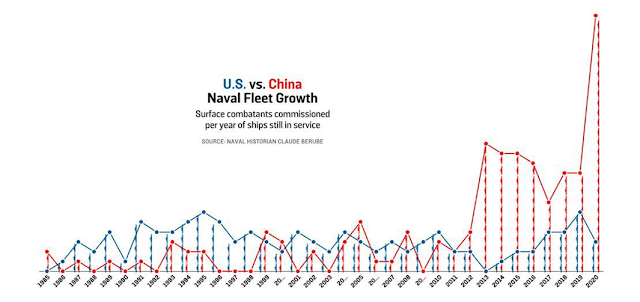
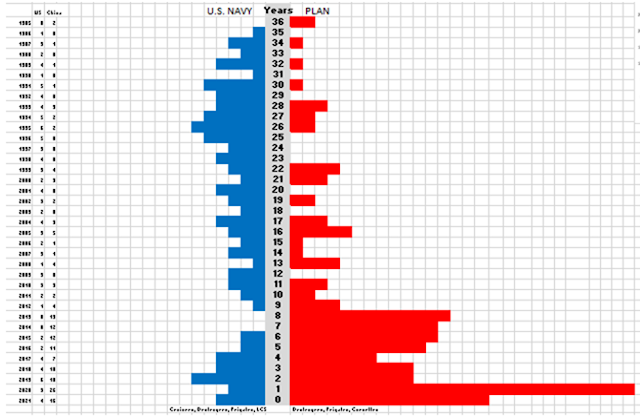
While we struggle to maintain a steady state fleet, the PRC's navy grows.

I guess it is time to put up Claude Berube's graphs again.


They have vastly outbuilt us in the past 10 years. Yes, that red line is China’s shipbuilding versus the blue of the us navy.

That is the truth. That is why when we try to force-mode domestic political happy talk to the international stage we are looked at as not just lying - but being quasi-delusional.

At least there are some people with access to levers of power who know what time it is.

“We have a rhetorical commitment to a force posture change in the Indo-Pacific, but that’s belied by the reality of what’s actually happening,” said Rep. Mike Gallagher (R-Wis.), who will become chair of the new House Select Committee on China in the next Congress. He called Ratner’s assertions the military planning equivalent of “whistling past the graveyard.”

The gentleman from Wisconsin is too kind. 

We cannot afford more happy talk - more "transformational" bullsh1t from people who should know better. They need to be called out on every occasion they try to cropdust the intellectual space people are trying to cultivate towards meeting this decade's challenge. The Terrible 20s are going to be terrible, but we can mitigate the degree of that terribleness. Some progress is being made, but more pressure is needed.

Now let's loop back to the second part of today's post mentioned at the start; institutional dysfunction.

Notice the 1936 to 1943 timeline above? Seven years that didn't bring in just new systems, but generational development in everything from carrier air whose fighters went from the Brewster Buffalo to the Grumman Wildcat, to Hellcat; submarines advanced through six different classes from Salmon to Balao; land based heavy bombers went from the Martin B-10 through the Boeing B-17 to a year later the B-29 deploying. 

You get the idea.

Remember back in October?

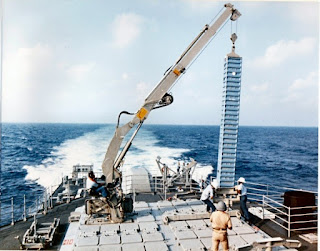
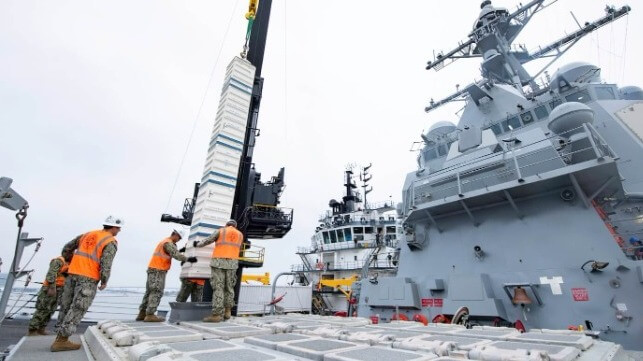
The U.S Navy has tested out a new way of rearming its warships with a trial vertical launch system (VLS) reload in San Diego. 

In a test evolution, the crane-equipped OSV Ocean Valor conducted a VLS reload with guided-missile destroyer USS Spruance, an exercise intended to prove out a new way to reload guided missile destroyers in sheltered waters. Sailors aboard the Arleigh Burke-class destroyer successfully lowered training ordnance into the ship’s forward VLS cells in a proof-of-concept evolution.

...

The exercise was aimed at proving that an OSV can reload the weapons system pierside, with the goal of expanding the capability of VLS reloading in expeditionary environments. The launch system reload has been tested previously in 2016 and 2019 using other MSC vessels but has never been tested using a relatively small OSV as the delivery platform. 

A VLS reload alongside the pier is substantially less challenging than a VLS reload in an open seas, underway replenishment scenario. Previous Chief of Naval Operations Adm. John Richardson signaled an interest in bringing back underway VLS replenishment in 2017, but the operation has rarely been performed in practice - even on Ticonderoga-class cruisers, which were designed with this evolution in mind. 

The TICOs were designed in the 1970s - pretty much half a century ago - roughly the same amount of time that the Spanish-American War was to 1943.

Let that soak in.

Now let's go back to July of 2017, just five and a half years years ago +/-. You know, roughly 1.5 WorldWars as we defined this program management period of time in 2015. For you pedants out there, it is 1.46 WordWars to be exact.

Here's what we discussed 1.46 WordWars ago;

The U.S. Navy is looking to restore its ability to reload its ships’ vertical launch systems at sea, which could be a dramatic logistical game changer in the planning and execution of high-intensity contingencies against peer competitors.

...

After discussing the means by which the Navy seeks to ensure its forward-deployed naval forces remain survivable and up-to-date with the latest tactical and technological innovation, Admiral Richardson said in reference to vertical launch system (VLS) underway replenishment, “we’re bringing that back.”

Since its operational debut in 1986 aboard the sixth Ticonderoga-class cruiser, USS Bunker Hill, the Mark 41 vertical launch system and its successor the Mark 57 have become the main battery of the preponderance of the Navy’s surface fleet, while the Mark 45 has become the principal means of deploying cruise missiles aboard submarines. Vertical launch systems are among the most adaptable weapon mounts that the Navy fields, allowing a ship to carry a variety of defensive and offensive missiles in the same shipboard infrastructure, and to fire them in rapid succession.

Well, we don't have this back.


But we are playing around 1.46 WorldWars later with this;

If it appears that the military acquisitions process and the bureaucracy that keeps it running is not quite what one needs to get ready for war, you're right.

It is nowhere near fit for purpose.

Reloading VLS is not a new concept - it is over a half century old. We got rid of it because the short-war uni-polar world would rather have those VLS cells with missiles to blow up parked clapped out Toyota Hilux with 23mm 1960s era manual guns mounted on the truck bed.

In our Lotus Eater stupor we allowed our land based facilities come under the range of our enemy's rocket artillery from Japan to Guam. That luxury is history. We cannot cruise back to the West Coast or Hawaii to reload. We need to do it at sea - now.

Here is where we need to start playing hardball. Our chattering classes are lost in a soup of onomastic happy talk that enables each other to avoid hard work, and our accretion hobbled acquisitions force is designed mostly to ensure funding lines and job protection in a peacetime uni-polar world.

That is long past. As useful as midnight basketball is to domestic politics - a reference someone with a PhD from UC Berkely should understand.

Monday, December 19, 2022

"Support You and Your Family" - Really?


Are you familiar with the case of Lieutenant Ridge Alkonis, USN? 

Much to my shame, until this AM I was not. Let's get everyone up to speed. From Andrew Jeong at WaPo;

While stationed in Japan in May 2021, Alkonis was driving home with his family and their Australian labradoodle after a visit to Mount Fuji, near Tokyo. They had gone to an area about 8,000 feet high and accessible by car. After parking, the family hiked on a mostly flat trail for a few hours, Brittany Alkonis said. On their way home at 1 p.m., Ridge Alkonis was talking to his oldest daughter as he drove.

But mid-sentence, Alkonis suddenly fell unconscious, his family said. The vehicle, going about 25 mph, veered into a parking lot and crashed into several cars that were then pushed against two pedestrians: an 85-year-old woman and her 54-year-old son-in-law. They both died. A third person, a daughter of the elderly woman, was injured. Brittany Alkonis sustained an ankle injury.

When Ridge Alkonis awoke several minutes after the crash, witnesses said his face looked pale, his family said, citing police reports. His symptoms — paleness and a loss of consciousness — align with those of acute mountain sickness, which can affect people at altitudes above 8,000 feet, according to information published by the U.S. National Library of Medicine. In June 2021, a neurologist told Alkonis that he had suffered from the illness at the time of the crash, his family said.

A tragedy for everyone involved, especially those killed and injured - but also for Alkonis and his family. Unintentionally responsible for the death of others is something that will always be with a person - even if one is not at fault.

No one is at fault for an unexpected medical condition.

Accidents happen all the time due to medical emergencies with drivers. Many are familiar with drivers who are diabetic and run in to trouble while driving, not to mention heart attacks, strokes, and all manner of medical problems that come up with little notice. We are mortal beings. Both the background of the accident and the medical experts seem to agree that this is the case here - a tragic secondary effect of a medical emergency.

As those who have served overseas know, a service member's relationship with the host nation's legal system is bounded by the status of forces agreement with the host nation.

What did Japan decide in this case?

In October, Alkonis was sentenced to three years in jail for negligent driving. The judge overseeing the case said he had not traveled high enough to be afflicted with severe acute mountain sickness, according to local reports. Instead, she accepted prosecutors’ assertions that Alkonis had been drowsy that day. An appeal failed to overturn the verdict.

Alkonis’s family has accused Japanese investigators of misleading him into signing Japanese-language documents during his pretrial confinement that the family says inaccurately described Alkonis as having felt sleepy before driving that day. Alkonis was also denied access to an attorney during his initial four weeks of detention after the accident, according to his family.

That is what it is. How is he being treated relative to others?

Alkonis has repeatedly expressed sorrow over the deaths of the man and woman. His family, with help from friends, paid $1.65 million to the victims’ relatives as restitution, they said. “They are victims, 100 percent innocent. They are definitely victims,” Brittany Alkonis said in a phone interview this week.

But the family also says Ridge Alkonis received an unusually harsh punishment; 95 percent of Japanese citizens convicted of similar charges are granted suspended jail terms, according to Japanese Ministry of Justice data — meaning they aren’t sent to prison.

In 2019, of the 1,252 people charged with causing death through negligent driving, 4.6 percent — about 58 people — ended up serving prison time, according to a government white paper. The great majority — 95.4 percent — received a suspended sentence.

We cannot control the Japanese legal system, but there are things we can control. 

LT Alkonis is married with three children who are still in Japan where he was stationed.


What is his Navy and his Defense Department doing to support him and his family?

The Defense Department will deny a plea from Navy Lt. Ridge Alkonis to extend his pay and allowances while he serves a three-year prison sentence in Japan, according to U.S. Sen. Mike Lee of Utah on Thursday.

During a speech from the Senate floor, Lee said he spoke Nov. 29 with Defense Secretary Lloyd Austin after three weeks of requests for a phone call. Lee said he asked Austin for an update on the request for an exception to policy Alkonis made in June to keep his benefits flowing when his leave runs out at the end of this month.

Without Alkonis’ pay, his wife, Brittany Alkonis, and their children, still living in Japan, would be “kicked to the curb” at Christmastime, Lee, a Republican, said during his 23-minute speech on the Navy lieutenant’s plight.

“Secretary Austin callously informed me that day that the request for the exception to policy would not be granted,” Lee said. “I asked him why. He believed it wasn’t appropriate for the department to do that.”

Why is there a level of cynicism towards Navy leadership specifically and the military leadership in general by those who are serving? Why do you have some veterans discouraging family members from following their example and join the military - or if they do - tell stories like this as a warning that things are not what they may think?

We make a big deal out of family support. I'm thinking hard why we as an institution shouldn't stand up and support the Alkonis family right now.

Just look at this story and imagine this is your family, your friend, your Shipmate.

h/t Kurt.

Wednesday, October 05, 2022

Where Does Ryan Mays go to Get His Name and Life Back?


A sad chapter in the loss over two years ago of the USS Bonhomme Richard (LHD 6) has finally come to a close.

With the loss of an almost freshly modernized large amphib and $1.2 billion already being cut in to scrap - the whole story is yet to play out, but one of the saddest chapters is now closed. In a just world there would be scalding Congressional hearings, but alas we do not live in such a world.

Megan Rose at ProPublica put out a superb review and report a couple of weeks ago you really need to read in full.

Considering all the own-goals our Navy has executed the last few years, a navalist can be a little numb to the ineptitude ... but we need to look at.

We need to look at it if for no other reason than it appears that we put the entire weight and resources of the Navy's legal system against a young Sailor for no other reason than - it appears - to force him to be the Navy's sin eater.

The only good thing that has come from this sad tale is that at least Seaman Recruit Ryan Mays, USN is a free man. Damaged and poor, but wiser and free;

Update, Sept. 30, 2022: A military judge found Seaman Recruit Ryan Mays not guilty on Friday of setting fire to the USS Bonhomme Richard. Mays, 21, had stood trial on charges of aggravated arson and willfully hazarding a vessel for the four-day blaze that destroyed the amphibious assault ship in 2020.

As we've discussed it often since the fire here, follow the link if you need to catch up on my thoughts in detail.

As regulars here know, over the last three decades+ I have seen too many acquaintances and friends be destroyed - in some cases personally in addition to professionally - by frivolous or just plain slanderous IG/NCIS investigations. 

When they arrested Mays, while accepting they may have the guilty party, in the back of my mind came up something Ensign Salamander thought was BS at the time, and combined with what I saw after Tailhook 91, cemented a healthy suspicion of the Navy's investigatory services that time proved wise; 

To some, the Navy’s actions were reminiscent of an ugly piece of its history. In 1989 an explosion on a turret of the USS Iowa killed 47 sailors, and the Navy tried to pin it on one of the dead sailors, who leaders suspected was gay. Only after Congress stepped in did the Navy acknowledge there was no evidence for its assertions.

Command Investigations I have faith in ... if it involves a hotline complaint, IG or NCIS ... notsomuch;

The service immediately launched two parallel investigations into what went wrong and why.

The command investigation, led by a three-star admiral, sent a team of investigators on a prodigious and methodical examination of the fire. As the months passed, the investigators uncovered in exhaustive detail an astonishing array of failures — broken or missing fire hoses, poorly trained sailors, improperly stored hazardous material — that had primed the ship for a calamitous fire.

A separate investigation by the Naval Criminal Investigative Service, for its part, focused on whether anyone was criminally responsible. As the months passed, NCIS investigators appeared to operate in isolation, discounting the damning findings of the command investigation to pursue a case of arson, despite scant evidence.

Six weeks into both inquiries, the Navy told the command investigation to accept at face value what NCIS and federal fire investigators judged to be the fire’s origin. Both investigations concluded in 2021.

...

The command investigation traced the problems back to when the Bonhomme Richard docked for maintenance and Navy leaders throughout the ranks abandoned responsibility for the ship’s safety. Risks mounted, and nobody paid attention. All told, investigators determined that the actions of 17 sailors and officers directly led to the loss of the ship, and those of 17 more, including five admirals, contributed. The long list was a staggering indictment of everyone from sailors to top admirals who had failed in their jobs.

The NCIS investigation, however, laid the blame at the feet of a single young sailor. The true culprit, the one who bore responsibility for the billion-dollar loss, the Navy said, was then-20-year-old Ryan Mays. And for that, he should face life in prison.

The Navy continued its pursuit of Mays, even as a military judge recommended against it, bluntly calling out the lack of evidence and citing the findings of the Navy’s own command investigation.

...

After a dayslong probable cause hearing for Mays in December 2021, the judge said she wasn’t persuaded of Mays’ guilt. A nuclear-trained surface warfare officer who later became a Navy lawyer and then judge, Capt. Angela Tang is known for being thorough.

“Given the state of the evidence presented to me, I do not believe there is a reasonable likelihood of conviction at trial. Therefore I do not recommend referral of these charges even though there is probable cause to support them,” Tang wrote in her findings. 

Accountability for a $1.2 billion loss of what for other navies would be considered a capital ship? Huh.

The details in Meghan's article is just, well, depressing. Just one paragraph should drive any navalists to the end of their line;

The investigators soon discovered an astonishing list of ways the ship was at risk, so many that cataloging the bad decisions day after day became depressing, the person involved said. For long stretches, all the ship’s heat sensors, sprinklers and other emergency systems were turned off, investigators wrote in their report. On the day of the fire, just 29 of the ship’s 216 fire stations and 15 of 807 portable fire extinguishers were in standard working order.

This is what we put one of our Sailors through;

The ATF’s Beals and an NCIS agent questioned Mays in a recorded interview for nearly 10 hours. He told them more than 150 times that he didn’t set the ship on fire.

The morning of the fire, Mays should have had a broom and dustpan in his hand, cleaning the back of the ship. Mays told agents he was instead just hanging out there, scrolling through his phone. With 24 hours of duty and not much to do, he wasn’t in a hurry right after roll call, and besides, he told ProPublica later, the general culture of the ship on its second extension in the yards was lackadaisical.

On a recording of the interview, Mays, wearing a brown uniform T-shirt and occasionally sweeping his hair off his forehead, vacillated between confrontation and distress.

In a confident voice, he asked eight times in two minutes if he was being detained.

“I’m not answering your questions, Ryan,” Beals said.

During his interview, Mays crudely put on display his disregard for the fleet Navy, and spoke of his desire to be a SEAL. In the beginning he even asked NCIS agent Albert Porter, a former SEAL, for a recommendation. Porter told Mays he’d never have another shot at the training program: “You’re not going back, dude. It’s not happening.”

Beals pressed him to “just admit to what you’ve done.” At one point, he told Mays they had him on video.

“You’re a liar,” Mays said.

“You’re a liar,” Beals replied.

Several times throughout the day, Mays asked to call his mom. He tried to think of anything he could tell the agents that would show them he was innocent. He begged them to take his DNA, search his phone and use GPS to track his whereabouts at the time.

At one point when the agents left him alone, he exclaimed to the empty room: “I didn’t do it. Let me go.”

Then he laid his head on the table and sobbed.

When Mays learned close to midnight he was going to the brig, a sailor who had been preparing to transport him said she heard Mays say something like “I’m guilty. I did it, I guess,” according to records and testimony.

Agents took the alleged remark as a confession. Mays said he was being sarcastic, expressing disbelief he was being arrested for a crime he didn’t commit.

The Navy booked Mays into the brig on Aug. 20, 2020.

Kafka lacked imagination compared to what we will put our people through. Such a young man. He will never be the same. His family will never be the same. 

Where is justice for him?

The experience, especially his time in the brig, has been “soul crushing,” he said. “A piece of me died in there and I don’t know if I’ll ever get it back.”

Don't think it can't happen to you.

If you find yourself across the table from any law enforcement officer of any stripe - lawyer up. I don't care how innocent you are. Be silent until you have an attorney tell you when to speak and what to say. If you are in uniform, take your JAG, but dig as deep as you can in your pockets for the best civilian lawyer you can find who has experience in this area and will take your case. 

Very often it is not about innocence or guilt, nor is it about right or wrong. It is about what someone can prove or disprove. Nothing more. For ambition or self-preservation - or even ego - individuals of our species will destroy innocents. It is our nature. Acknowledge that and accept it.

No, it isn't fair. No, it isn't cheap - but one thing money is not as valuable as time and your reputation. 

Be a mensch. If you have a friend or a Shipmate who finds themselves under the microscope such as this, do not abandon them. Most will, and the few that remain can make all the difference in the world to ensure that they have a chance to remain grounded and get through this. If you abandon them, you were never a friend or a Shipmate.

Our Navy failed here at multiple levels. 

In a about 2/3 the time it took to fight WWII ... here we are in the fall of 2022 ... with nothing but shame and guilt.

Where is constructive action? 

Friday, September 16, 2022

Fullbore Friday

A pivot of history around a man.

For over two decades the American military occupied a foreign country on the other side of the planet, supporting an oppressive local government that was mostly known for its anti-democratic habits and corruption.

Over the two decades of occupation, thousands of Americans and her allies who also contributed forces died in order to keep a clear threat to global peace contained.

During the previous presidential election in the USA, the candidate who won made repeated statements that he planned to withdraw all American forces from that country. Two decades were long enough, and he was insistent that he was a man of his word.

The new president carefully placed reliable political operatives in to national security positions who he could rely on, and to the professional intelligence and military community, it was clear what was going on

…politicizing the intelligence process. ..in the CIA an attitude that the withdrawal policy presented dangerous risks. But he felt that, …the risk of withdrawal was not alarming. … the policy represented a political decision. Administration decision makers understood the risks involved and had judged them to be acceptable.

Are you thinking of the events of the first year of the Biden Administration that resulted in the greatest national humiliation since the Vietnam War?

Well, you would be forgiven is so – but no, we are talking about one of the more undertold stories of the Cold War and the Carter Administration – one the usual suspects in the civ/mil fetish world either don’t know about or won’t talk about.

For those who don’t remember, in hindsight (and even more so at the moment), the apex of global political and military power of the Soviet Union was somewhere between 1975 and 1985. American military ability and confidence – especially in our Army - were at its post-WWII nadir.

In that background, here’s the background.

Jimmy Carter's decision to withdraw ground troops from South Korea goes back at least to January, 1975, and the earliest days of his campaign for President. His original idea was to pull out all U.S. forces - ground and air - and to negotiate assurances from China and the Soviet Union that North Korea would not invade the south.

The origins and evolution of Carter's ideas are of unusual importance because his campaign stand has been translated directly into U.S. policy with a minimum of official review. In order to avoid a battle within the government, a National Security Council study leading to the U.S. withdrawal plan did not question whether American ground troops should be removed but focused instead on how many should be removed.

As sent to the White House in mid-March, the council's Presidential Review Memorandum 13 acknowledged that there are differences of opinion about the troop withdrawal policy and that the impact of it is difficult to predict. At the explicit instruction of Secretary of State Cyrus R. Vance, however, the State-Defense-Central Intelligence Agency study accepted as its promise Carter's previous announced conclusion that the troops should be taken out.

It is amazing how some bad ideas and unmoored assumptions just keep showing up in some circles;

Administration officials have emphasized that the Carter plan would leave American air forces in‐place and that there would be a continued strong American naval presence in the Sea of Japan to assist South” Korea in the event of an invasion. American troops in Korea represent about 30 percent of United States forward‐deployed forces in the western Pacific, which number ‘about 127,000.

Did the senior uniformed leadership have concerns?
Many Army officers in Korea as well as at the Pentagon (view) that the withdrawal of American ground troops in South Korea would upset the military balance there and provoke North Korea to plan another invasion of the South, as occurred 25 years ago.
But did they do anything? People matter. One man can matter. History and the lives of millions can rest on the decisions of one person - and how they define duty vs. self-interest.

The following story has a few angles. One angle is an echo of warnings I have put out before; if you wear the uniform, do not get comfortable with the press - especially "traditional" press that works DC or are from hyper-political organizations. With very few exceptions, they are not your friend. They have a job. You are not just a source, you are part of their building of their personal brand. 

You may think you are on background, but ... perhaps not. There are questions if this spark was a case of a reporter or their editor deciding not to respect a background source, or a polite wink between parties - I have heard both, but we know the results, so let's focus on that.

On May 19th 1977, John Saar at the Washington Post had an article that would lead to the premature end of one of the US Army's most respected Generals and ... in the end, perhaps prevented the death of millions or even a third world war.

The third-ranking U.S. Army general in South Korea says that President Carter's plan to withdraw U.S. troops here in the next four to five years is a mistake that will end in war with North Korea.

"If we withdraw our ground forces on the schedule suggested it will lead to war," said Maj. Gen. John K. Singlaub, chief of staff in the U.S. Forces Korea headquarters.

Singlaub said he and many other senior military officers challenge the wisdom of Carter's plan, and predicted that withdrawal of the war-ready 2d Infantry Division in that time frame would seriously weaken defenses in the South and encourage North Korean Peresident Kim II-sung to attack.

The unusual situation of serving generals, openly differing with the President's declared policy arises on the eve to talk to implement that policy.

...  "The question asked after U.S. setbacks in China and Vietnam was, 'Did the military people in the know express themselves loudly and clearly enough that the decision-makers understood?' We want to make sure." he added. "If the decision is made we will execute it with enthusiasm and a high level of professional skill."

The apprehensions voiced by Singlaub are enchoed to some degree by many, if not all U.S. military leaders in South Korean. "No one understands why they are being pulled out," said a well-informed American source. "Carter says that withdrawal won't endanger South Korean security or upset the military balance. Out military people say that would be a miracle. They think it can't be done."

The impact professionally did not take long. Three days later;
President Carter yesterday fired Maj. Gen. John K. Singlaub as U.S. chief of staff in South Korea for telling The Washington Post last week that Carter's plan to withdraw U.S. troops from Korea is a mistake that will lead to war.

Defense Secretary Harold Brown announced Singlaub's dismissal as chief of staff less than an hour after Singlaub, in uniform, met for 30 minutes with the President. Carter was described Thursday as distressed and angered by Singlaub's remarks.

Brown accompanied Singlaub to the meeting. In a statement issued from the Pentagon afterward, Brown said, "Public statements by Gen. Singlaub inconsistent with announced national security policy have made it very difficult for him to carry out the duties of his present assignment in Korea.

"I have, therefore, recommended to the President that Gen. Singlaub e reassigned, and with the President's concurrence I have directed the secretary of the Army to take action to that effect."
...and there goes a 35-year career. But...Singlaub knew what he was doing. History has proven his professional sacrifice as being the right move. A 2018 paper by Eric B. Setzekorn in the Army War College Parameters titled, Policy Revolt: Army Opposition to the Korea Withdrawal Plan gives Singlaub and others a good review;
By publicly opposing the plan as part of a Fabian strategy, senior Army leaders gained public support of their position and the president suspended the planned withdrawal.
...
Although Army leaders were clearly manipulative and pushed the boundaries of professional ethics, they effectively halted a deeply flawed withdrawal policy. Viewed from a distance of forty years, President Carter’s politicized policy process and shortsighted mentality of reducing deterrence capabilities on the Korean Peninsula were clearly dangerous. Singlaub and Vessey, as the subject matter experts on the American military role in South Korea, should have been consulted. Yet the generals’ actions led to a more comprehensive debate of American security policy in Korea. As the case of the aborted Korean withdrawal highlights, Army leaders can successfully challenge presidential policies. But the question is should they?
That is a great question - and one that will always in the American context get a reply, "It depends."

And so is a long introduction to a recognition that earlier this year, General Singlaub was called home one last time;
John K. Singlaub, a two-star general with a record of wartime derring-do who resigned from the Army in 1978 after openly criticizing President Jimmy Carter’s defense policy, and who later battled communism as a private citizen by funneling weapons and money to rightist insurgents around the world, died Jan. 29 at his home in Franklin, Tenn. He was 100.

A long live. An impactful life. If you read his full bio - one hell of a life. I don't know if there is a statue to him in South Korea somewhere, but there probably should be. Just look at 2022 South Korea. It did not get the opportunity to grow in to one of the most highly successful and developed nations on this planet in isolation or by accident. 

How would Singlaub want to be remembered? I don't know, but I'll take a guess;


John K. Singlaub was recruited by the Office of Strategic Services (OSS) in November 1943. As part of JEDBURGH Team JAMES, he jumped into France on 11 August 1944 to arm and direct the French resistance. Sent to China, as the commander of the PIGEON Mission, he jumped onto Hainan Island on 27 August 1945 to rescue Dutch and Australian Prisoners of War. As one of a handful of Special Operations Branch personnel retained the Strategic Services Unit (successor to the OSS), Singlaub stayed in China to report on the Civil War. Singlaub was again involved in special operations when he was an instructor at Fort Benning, Georgia and helped to establish the Ranger Training Center in 1950. He then had two tours in Korea, including one with the Central Intelligence Agency’s Joint Advisory Commission, Korea (JACK). Singlaub returned to special operations in from 1966-1968, when he commanded a joint unconventional warfare command, the Military Assistance Command, Vietnam, Studies and Observation Group (MACV-SOG). Retiring in 1978, Major General Singlaub has remained active in the Special Operations community and was recognized with the United States Special Operations Command’s (USSOCOM) Bull Simons award in 2011.

Fullbore. 

Wednesday, September 07, 2022

5 Years, 17 Lives, 1 Navy


How long do you wait to see what you purchased with the lives of 17 Sailors?

Back in 2015 I decided we needed a measure of time for things in the Navy, and settled on a measure of time called a WorldWar;

I think "years" does not really tell the best story about how long it takes to get even the most simple ship to displace water after the "go" is given.

Perhaps we need a new measurement - one that provides context. We need one defined in American terms, natch, and I have an idea.

I've used it before; the time from the attack on Pearl Harbor to the signing ceremony on the Mighty Mo.

That is 07DEC41 to 02SEP45. 3-years, 8-months, 26 days. Including the end date, that is 1,366 days.

Five years is a long time. It is about one and a third the time it took for the USA to fight World War II.

5-years = 1.34-WorldWars.

What was mostly anger at the time during the horrible summer of 2017 when the FITZGERALD and MCCAIN collided with merchant ships in the Western Pacific has, for me at least, distilled more in to sadness. Sadness looking towards hope, but sadness nonetheless.

Such an avoidable and predictable waste. Hopefully something good can come from it. 

As I wrote in the fall of that year;

Why would the Surface community want to benchmark an Aviation-centric instruction’s attitude as opposed on focusing on unit level failures? Here are 17 reasons;

- GMSN Kyle Rigsby of Palmyra, Virginia, 19 years old.

- YN2 Shingo Alexander Douglass, of San Diego, California, 25 years old.

- FC1 Carlos Victor Ganzon Sibayan of Chula Vista, California, 23 years old.

- PSC Xavier Alec Martin of Halethorpe, Maryland, 24 years old.

- STG2 Ngoc Turong Huynh of Oakville, Connecticut, 25 years old.

- GM1 Noe Hernandez of Weslaco, Texas, 26 years old.

- FCC Gary Rehm, Jr., of Elyria, Ohio, 37 years old.

- ETC Charles Nathan Findley of Amazonian, Missouri, 31 years old.

- ICC Abraham Lopez of El Paso, Texas, 39 years old.

- ET1 Kevin Sayer Bushell of Gaithersburg, Maryland, 26 years old.

- ET1 Jacob Daniel Drake of Cable, Ohio, 21 years old.

- ITl Timothy Thomas Eckels Jr. of Baltimore, Maryland, 23 years old.

- ITl Corey George Ingram of Poughkeepsie, New York, 28 years old.

- ET2 Dustin Louis Doyon of Suffield, Connecticut, 26 years old.

- ET2 John Henry Hoagland III of Killeen, Texas, 20 years old.

- IC2 Logan Stephen Palmer of Harristown, Illinois, 23 years old.

- ET2 Kenneth Aaron Smith of Cherry Hill, New Jersey, 22 years old.

Not waving bloody shirts around, but this should focus the mind. This is not an academic exercise, or some Black Swan event – this is a scenario x2 that people have been warning about for years. We don’t just have bent steel and bruised egos here – these are lessons written in the blood of 17 Sailors who we like to say are our most important assets.

Over in DefenseNews back in June, Megan Eckstein had a long and well researched article that everyone should take a moment to read. I'm just now getting around to it and it brought up a little anger, a lot of sadness, but a fair measure of hope that well meaning people in hard jobs are trying to claw something back from the completely avoidable deaths from 1.34 WorldWars ago.

Here's a few points ... but this is only a small fraction. You really need to read it all;

The comprehensive review of recent surface force incidents, released in early November 2017, highlighted the root problems Kitchener outlined. A quick scan of the table of contents makes clear there’s a long list of problems: poor seamanship and failure to follow safe navigational practices; erosion of crew readiness; headquarters processes that inadequately identified, assessed and managed operational risks; “can-do” culture that undermined basic watchstanding and safety practices.

The Navy has spent the past five years not just addressing these issues, Kitchener said, but doing so in a data-driven way meant to prevent the Navy from backsliding.

Operational tempo drove many of the problems outlined in the review. Japan-based ships in particular faced such demand that they were constantly too busy, which came at the expense of training and maintenance time. Personnel were yanked from one ship crew to fill in for others, meaning sailors didn’t get downtime and the crews didn’t gel as a unit.

Of course, this is naval leadership 101; none of this is breaking news. This is Vince Lombardi fundamentals...yet we decided we didn't need to remember them.

Well, the naval gods of the copybook headings took their payment.

We are a Surface Navy at peace, and in the Western Pacific - blinkered, overcaffeinated, and overheated N2 types aside - have been with a few minutes of exceptions for decades.

...for all ships in the Pacific — both 7th Fleet in Japan and U.S. 3rd Fleet in San Diego, California — all requests from fiscal 2019 to fiscal 2021 to extend a depot-level repair period — despite potentially delaying a ship’s deployment — were approved. This included 29 extensions in FY19; 27 in FY20; and 30 in FY21, according to data provided by Naval Surface Forces.

There’s a second process in place for ships already deployed. A redline instruction from Naval Surface Forces states a ship cannot remain at sea if certain systems go down, unless it receives a waiver from the operational commander. Even then, the approval must be accompanied by a mitigation plan approved by Kitchener or his East Coast counterpart, Rear Adm. Brendan McLane, who commands Naval Surface Force Atlantic.

...

Additionally, ships are entitled to a certain number of continuous maintenance availability days throughout the year — the type of routine care done pierside to keep ships at peak readiness for operations, as opposed to the major upgrades and repairs done at a depot.

Kitchener said 19% of that work was executed in 2017, as opposed to nearly 90% today. 

Simple things are not simple, but with the right leadership, they stay that way. This is how you save ships, save lives, and increase retention. That would have saved 17 lives in 2017 - of that I am absolutely convinced.

Vasely said the Learning to Action Board will tackle the Fitzgerald and McCain collisions as its next project, looking to ensure the permanent implementation of the 117 recommendations and the translation of those surface-specific recommendations into broader ideas to make the whole Navy safer.

“One of the key things that we realized as we’ve gone through the Bonhomme Richard and the major fires review iteration is that we’re not getting after … the long-term success of what this will look like, which is: How do we get left of bang?” he said. “How do we look at the data … and identify those negative trends that are posing significant risks that, if unchecked, if we don’t surge on them, that basically will result in a potentially catastrophic event or a pinnacle-level event?”

A fifth goal for the board now, he said, is meant to be more proactive, “looking at negative trends that come up — so think about [inspector general] investigations, area assessments, think Naval Safety Command or hazard reports that come through, think about pulse surveys that go out to the fleet that come back — all provide data that, really, there has not been a repository or a mechanism to look at that data to determine the negative trends, to arrest the negative trends from turning into a pinnacle-level event.”

For Kitchener, turning lessons from the past into forward-looking predictive analytics is a critical endeavor.

“We cannot allow those lives that were lost to be in vain,” he said.

Should it take 1.34 WorldWars to get here? I don't know. Maybe I am impatient ... but if this can stick like the lessons Naval Aviation took to heart in the 50s-60s, then perhaps yes.

There's your hope.