Showing posts with label Pakistan. Show all posts

Wednesday, September 08, 2021

Reinforcing Failure at Sea


Is our nation's military as poorly maintained and lacking in self-respect as we seem to be from Kabul to the high seas?

What messages are we sending?

I'm pondering a long standing critique of mine over at USNIBlog today ... something more important now than ever.

Come on by and give it a read

Monday, May 03, 2021

The Perfidy of Pakistan


One aspect of the Afghanistan conflict that I think will stick in time's craw the hardest is what we allowed Pakistan to do. I was lucky enough to be at the table at C5F when this all kicked off - one of the many quiet O4s in the back of the room watching and listening as the big guys got us ready for what was to come. 

From almost day-1, a regular refrain - besides looking for sidearms and chem gear for all the terrorists with mustard gas mortar shells that intel told us could show up any day from Iraq ... ahem ... - was how we could not let Pakistan be for Afghanistan what Cambodia and Laos was for the North Vietnamese. 

"No safe havens!" we told ourselves literally over and over as Task Force K-Bar was put together ... but then the folks in DC and Tampa had different ideas, and almost immediately Pakistan was allowed to be a safe haven. 

There were all sorts of reasons, but we did what we did - ground convoys and airspace don't become permissive on their own dontchaknow. Of course we had to go in a decade ago down the street from Pakistan's West Point to kill Osama. 

Of course.
Pakistan has played on both sides of the field in Afghanistan, contributing to the Taliban's success, a senior US senator has reminded his colleagues, a day after Washington announced plans to withdraw all troops from the war-torn Asian country by September 11.
Chairman of Senate Armed Services Committee, Senator Jack Reed, on the Senate floor Thursday afternoon, said "a crucial factor contributing immensely to the Taliban's success" has been the inability of the US to "eliminate the "eliminate the sanctuary the Taliban was granted in Pakistan." 
Referring to a recent study, Reed said the Taliban sanctuary in Pakistan and state support from organisations, like Inter-Services Intelligence (ISI), have been essential to their war effort and the US' failure to undermine this safe haven may be Washington's most significant mistake of the war.
Senator Reed (D-RI) was and is one of the good guys. I know he's seen the same intel I've seen ... and a lot more.

With time, the larger American public will find out more that game Pakistan played. We should not be forgiving. We should not forget. 

Monday, August 26, 2019

Nuclear Nations at Total War with Each Other - but Don't Use Nukes?

Of all the bloodshed and slaughter of WWII - though all sides had chemical weapons - they were not used at all. Not even at the very end.

What about nuclear armed nations today? If two nuclear powers go to war, is going nuclear inevitable? Does having nukes help you avoid war?

Maybe not. An interesting theory is that MAD is something that works until it doesn't.

Over at Small Wars Journal, Mangesh Sawant has a few observations about one flash-point many think has the greatest odds of going nuclear; India and Pakistan.

What if conventional wisdom, as it often can be, is wrong?
MAD is ineffectual in the sub-continent. Deterrence worked during the cold war as both the adversaries were armed in terms of nuclear weapons and delivery platforms. Soviet Union and the US had advanced military capability to destroy each other in a nuclear conflict. The arms buildup between the Soviet Union and the US led to the realization of nuclear annihilation having ramifications across the world. This threat led to both the nations signing the START and SALT agreements.

Nuclear deterrence theory and MAD will not work in South Asia due to the following:
The quality of weapons delivery platforms is important for the delivery of nuclear weapons. Technologically Pakistan’s weapons are antiquated and inferior. Most of its weapons systems are imported from China which reverse engineers them from Russian weapon systems.[iv] The Chinese weapons systems are not tested in any battles or wars. In an era of 4th and 5th generation warfare Pakistan still operates the 1st and the 2nd generation of combat aircrafts, naval ships and army weapons systems. India has inducted state of the art 4th generation weapons systems like SU 30 MK1, T 90 tanks, Vikramaditya aircraft carrier, nuclear attack submarine INS Arihant and ICBMs. Technologically advanced weapons will be used by India in conventional warfare to wipe out Pakistan’s military establishments and nuclear facilities in a preemptive strike. The quantity and lethality of conventional weapons in the arsenal is crucial to project the destructive capabilities on the adversary. Pakistan lacks in this aspect as its weapon systems are antiquated and this is the reason it has resorted to the strategy of unconventional warfare through terrorism. Therefore, in South Asia the conventional superiority of India outweighs the nuclear weapons systems capability and empty threats of Pakistan.
MAD is only possible if there is parity in nuclear bombs and weapon systems. MAD is not possible in South Asia due to the overwhelming Indian nuclear second-strike capability and superior conventional weapon systems.
So, like in WWII with chemical weapons - does it become a conventional slugfest?
Small nuclear powers like Pakistan and North Korea resort to belligerent posturing and blackmailing the international community by threatening to use nuclear weapons under the doctrine of first nuclear strike. But there is a tacit understanding between the politicians and the military in both countries about the power of conventional war, preemptive strikes and total nuclear annihilation by India and the US. It’s the age of unrestricted warfare for technologically advanced militaries in conventional warfare environment with nuclear armed adversaries. This is the new normal.
A final note. The author really should have saved this for another article - but I find this something worth a long night's drinking and arguing over. Indian vs. Pakistan would be Clausewitz vs. Sun Tsu?
Classical warfare strategies have been followed by nearly every country. The differentiating factor remains the type of governing systems. Democracies have been practicing Clausewitz while dictatorships and one-party systems have been practicing Sun Tzu. Pakistan has been following Sun Tzu’s art of warfare which is exemplified by concealment, unconventional warfare, unrestricted warfare, deception and manipulation. 
India has been following the Clausewitz strategy which is characterized by restricted and classical conventional warfare. Today Pakistan is the only country in the world which has fused the unconventional and hybrid warfare strategy with a nuclear deterrence doctrine of first strike. Pakistan has been sponsoring and fomenting terrorism in India since the last 3 decades. India has not penalized Pakistan due to the threat of nuclear retaliation to an Indian conventional attack.

Thursday, February 28, 2019

Theory is soft. War games are malleable. Hard truth is found in combat.

OK front porch, let's take out one of our favorite hobby-horses and ride it for all its worth.

We fight this battle all the time; "That scenario is not IAW the CONOPS." "Our wargames show otherwise." "That is oldthink." "Transformational technology has made that obsolete."

No.

The nature of war has remained the same for thousands of years. Tools may improve, time/distance may change ... but the core remains the same.

Today, let's turn to the air side of the house.

In the 1920s and 1930s there were all sorts of theories that were tried and found wanting, from the utility of high altitude heavy bombers against surface ships to non-forward firing interceptors that simply did not play out on the battlefield.

In the post-WWII era, the technologists and futurists who dreamed of speed and magic missiles ignored what those like Robin Olds & Erich Hartmann who tried to convince them otherwise; that all the speed and missiles in the world will not negate the fact that you will have to fight in the merge - you will never live in a pure BVR world. Your fighters and the training of those who fly them must reflect that.

The experience in Vietnam proved Olds and Hartmann right. That is why the F-14/15/16/18 all had an internal gun and later versions of the F-4 did too ... and the F-35A does as well. 

However, the seduction of technology seduces every generation. They fudge their scenarios and assumptions. They tailor their wargames to meet their needs. The longer you go without the hard truth of combat, the further your issued kit comes from an optimal capability.

Our navy has this problem in spades. The land components have - between the experience in the Long War first-hand or quasi-traditional conflicts in Ukraine second-hand - good examples of what is needed (i.e. RPG cages from Vietnam showing up a bit late in Iraq). On the naval side of the house, we can at best look to the early 1980s Falkland Island conflict that showed you need general purpose guns on every warship and you do not have enough AAW or ASW weapons - the exact lessons of WWII, BTW.

So, back to air. We hear it all the time; Beyond Visual Range (BVR) is the key. We don't have to dogfight, the battle will be over before the aircraft see each other.

Well, that argument has been made for over half a century and it never plays out that way when peer-near-peer aircraft meet each other over contested and crowded airspace.

General warning about imperfect information from imperfect sources, but this report from Shiv Aroor meshes with other reporting.

Behold ... the MiG-21 vs the F-16;
the Indian Air Force today declared that a MiG-21 Bison fighter managed to shoot down a Pakistan Air Force F-16D on Wednesday morning over the restive Line of Control that separates Jammu & Kashmir from Pakistan-occupied Kashmir.

The MiG-21, from the Indian Air Force’s 51 Squadron ‘Sword Arms’ is said to have conducted the kill using a Russian Vympel R-73 close combat missile.

The IAF also said it had captured electronic signatures of the aggressing aircraft, concluding that it was an F-16. While the Bison’s pilot Wing Commander Abhinandan Varthaman was captured in Pakistan-occupied Kashmir, two Pakistani pilots who punched out of the F-16D are currently unaccounted for. Pakistan has switched to claiming no loss after first announcing that it had shot down two Indian jets. The abrupt correction has led to the widespread belief that Pakistan initially believed it had shot down two Indian jets, but discovered only later that it was in fact an F-16D that had come down.

While information has been scant and buffeted by a typical hail of claims and counterclaims by both sides, Livefist has learnt from reliable sources that the unprecedented peacetime aerial confrontation yesterday — which came after a group of Indian Mirage 2000 jets flew into Pakistan a day previous to bomb a terrorist facility in the town of Balakot — was much larger than initially reported.
I cannot wait for an open source reconstruct of this engagement.
at least 20 Pakistan Air Force jets, a mix of F-16s, Mirages and JF-17s got airborne from a series of air bases in Pakistan and Pakistan-occupied Kashmir, quickly turning south towards Pakistan’s Sindh. They remained in the air for over 30 minutes, possible in an act of deception. Indian airborne early warning assets in the air had picked up the movement, with bases in Srinagar and Punjab alerted. The PAF fighter package then turned north towards the Line of Control, with all but three F-16s turning west towards their airfields, but staying in the air. The 3 F-16s then began the sweep, headed straight towards the Sunderbani sector of the Line of Control. By this time two MiG-21s from Srinagar were airborne and headed straight for the intercept. Two more MiG-21s got airborne a few minutes later, followed by a pair of Mirage 2000s. A pair of Su-30 MKI jets were already in the air on a combat air patrol further south, diverted to provide cover for the intercept. The rare within visual range engagement occured over the Sunderbani sector, with both jets — and all 3 pilots — plunging into Pakistan-occupied Kashmir.
Here's the nut;
...analyst Angad Singh says, “It’s historic, but at the same time I am not too surprised. The Bison is among the most capable of all MiG-21 variants, and I would put money on a capable pilot in a Bison cockpit any day.”

Italian journalist David Cenciotti, who runs he excellent Aviationist blog, writes, “If confirmed, it’s significant, as it would prove once again that when it deals with aerial engagement, not always does the more modern and capable weapon system (in this case the F-16 Block 52) wins. Several factors must be taken into consideration: pilot skills; support from other assets (including fighters and AEW aircraft), ground radars, etc. Above all, RoE play an essential role: if the Rules of Engagement require a positive VID of the opponent, a fighter might be forced to come WVR (Within Visual Range) where a MiG-21 can be particularly threatening. That’s why even 5th gen aircraft regularly train with legacy adversaries.”

He adds, “The MiG-21 Bison is an upgraded version of the Russian-made baseline MiG-21. Although the design is obsolete, its low radar visibility, instantaneous turn rate and acceleration, and the helmet mounted sight combined with high-off-boresight R-73 air-to-air missiles are among the factors that can make the upgraded MiG-21 a threatening adversary, even for more modern fighters.”
Watch the caveats;
Stephen Trimble, defense editor at Aviation Week tweeted, “Don’t forget those same MiG-21s embarrassed USAF F-15Cs at Cope India in 2006.” He later told Livefist, “The F-16 was designed specifically to beat the MiG-21, but AMRAAM, which came later, can be a great equalizer if basic fighter maneuvers are not involved.”
"If." 

Well, odds are the ROE and JAG will negate your BVR. Then it is the man-machine-training.
Air Vice Marshal Manmohan Bahadur, veteran pilot and Additional Director General of India’s Centre for Air Power Studies (CAPS) told Livefist,”For the first time, a third generation aircraft has shot down a fly by wire modern aircraft armed with a much better weapons package and avionics suite. Just goes to prove that the man behind the machine counts — and counts massively. And when it comes to the IAF, adversaries should have no doubts.”

Vishnu Som, defence editor with NDTV, says, “While we don’t know the exact circumstances in which the IAF pilot was shot down, let’s not for a moment forget that he shot down an F-16 first (possibly an F-16 Block 50) with an upgraded MiG-21 Bison, a jet which first entered service with the IAF in the sixties.”

Sunday, February 24, 2019

Afghanistan & the Long War with Bill Roggio - on Midrats


This week, we are going to take a clear, cold, and unsparing look at the status of the conflict in Afghanistan and the Long War in general with our returning guest, Bill Roggio, from 5-6pm Eastern.

In a far-reaching discussion, we will touch on the rather unpleasant reality of where we have put ourselves through our own action, and what people should expect going forward.

Bill is a senior fellow at FDD and editor of FDD’s Long War Journal, which provides original reporting and analysis of the Global War on Terror from Afghanistan and Pakistan to Syria, Iraq, Yemen, Somalia, North Africa, Iran, and beyond. He is also president of the nonprofit media company Public Multimedia Inc.

Bill was embedded with the U.S. Marine Corps, U.S. Army, and Iraqi forces in Iraq between 2005 and 2008, and with the Canadian Army in Afghanistan in 2006. From 1991 to 1997, Bill served as a signalman and infantryman in the U.S. Army and New Jersey National Guard. His articles have been published in The New York Times, The Weekly Standard, The Daily Beast, National Review, and The New York Post, and his work has been in outlets including The New Times, The Washington Post, The Los Angeles Times, CNN, Foreign Policy, and Bloomberg.

Join us live if you can, but if you miss the show you can always listen to the archive at Spreaker

If you use iTunes, you can add Midrats to your podcast list simply by clicking the iTunes button at the main showpage - or you can just click here.


Monday, September 26, 2016

Wars Over Water? Well, Here's Your 2016/17 Most Likely From an Unlikely Place


While we've been picking out belly-button over our shambolic election, history's other lines of operation are moving apace. Have you been briefed up on the Uri Attack of 18 SEP 16?
At least 18 soldiers were killed in a terror attack on an Army camp in Uri in Jammu and Kashmir on September 18. All four terrorists, who attacked the camp, were killed.
The Indian Prime Minister is decided to play a card India has held deep in the deck.
Prime Minister Narendra Modi after a fiery speech in Kerala where he blamed Pakistan for exporting global terrorism has now called for a briefing on the Indus Waters Treaty.

PM Modi will meet relevant officials from various ministries today including External Affairs and Water Resources, top sources have told NDTV.

The Prime Minister, sources say, wants to discuss the pros and cons of taking action against Pakistan. This confirms that among the various options on the discussion table for India's response to the Uri attack, reconsidering the Indus Waters Treaty with Pakistan could be one.
...
One of the suggestions is to turn off the Indus river tap that waters much of Pakistan. It is perceived that the pressure could compel Pakistan to crackdown on non-state and state actors acting against India.
...
The Indus Waters Treaty was signed between Indian Prime Minister Jawaharlal Nehru and Pakistan's president General Ayub Khan in 1960, after World Bank brokered negotiations that lasted almost a decade.

The Indus treaty withstood two full scale wars and tense India and Pakistan relations and experts are divided over the benefits of reneging on an international water sharing pact.
...
The Indus originates in China, and unlike India and Pakistan, it has not signed any international water sharing agreement. Should China decide to divert the Indus, India could lose as much as 36 per cent of river water.

Under the agreement, of the six rivers that flow westward in the sub-continent, India has full rights over three - Sutlej, Beas and Ravi - while Pakistan receives the waters of the other three - Jhelum, Chenab and Indus - almost unrestricted.
Two nations with nuclear weapons - the most modern of weapons - potentially in a fight over water - the most ancient of reasons to go to war.
Prime Minister Modi launched a blistering attack on Pakistan on Saturday, saying: “Whenever a terror attack takes place, it emerges either the terrorist set out from Pakistan, or after the attack, like Osama Bin Laden, took refuge there.”

Speaking at a public meeting in southern Indian city of Kozhikode, Modi said India would never forget the militant attack that killed 19 soldiers in an Army base in Kashmir’s Uri District. He also accepted an often-quoted Pakistani “challenge” (read Benazir Bhutto slogan) of a 1,000-year war, saying: “Your (Pakistani) rulers speak of fighting India for 1,000 years. Today, there is such as government in New Delhi that I am ready to accept your challenge.”

Modi ripped into his ‘one-time’ friend and Pakistani counterpart Nawaz Sharif’s needling UN General Assembly speech and phony talks offer, stressing: “Today, I am speaking to the people of Pakistan directly. From the leaders who read speeches written by terrorists, the world can expect nothing. But I want to speak to the people of Pakistan directly. I want to remind Pakistan that your ancestors used to consider undivided India as their land before 1947 and worshipped it. And in their memory, I want to tell you something. The people of Pakistan please ask your leaders that you have Pakistan-occupied-Kashmir (PoK) and you cannot manage it. Bangladesh used to be yours and you couldn’t manage it. You cannot manage Gilgit, Baltistan, Pakhtun, Balochistan, Sindh and you are talking about Kashmir.”
...
As is evident from Modi’s address, India is well aware of Pakistan’s internal vulnerabilities and will not hesitate to capitalise on it, if necessary. By speaking of Bangladesh, the PM reminded the Pakistani political establishment of a wound it has not yet recovered from and what India was capable of.
Can we stay to the side as the world's largest democracy faces off against an Islamist terrorist safe haven?
China assured Pakistan of its support in the event of any “foreign aggression” and also backed Islamabad’s stance on the Kashmir dispute. Immediately after China vowed to help Pakistan in case of “aggression”, the US announced that it would upgrade military combat exercises with India. In a statement, the US Department of Defence said that it has awarded Boeing a USD 81 million contract to supply 22 Harpoon missile systems for the Indian Navy’s Shishumar class submarines.

A ‘great game’ is getting set to be played between India, Pakistan, Russia, China and the US, as a “tectonic geo-strategic shift” is taking place in Asia.
Speaking of the "Great Game" if you have not read Hopkirk's The Great Game - order it now.


Once you read it - order the rest of Hopkirk's books on Central Asia. You're a decade and a half late, but that's OK. History there isn't going anywhere. She may only be getting started.

Tuesday, June 28, 2016

Your Daily Mahan

In a discussion of nuclear proliferation in the Indian Ocean as it relates to India, China, and a lessor extent Pakistan, over at the Sri Lanka Guardian, Maimuna Ashraf digs up a quote that has mad me pondering all day;
“Whoever controls the Indian Ocean will dominate Asia… This ocean is the key to the seven seas in the twenty-first century, the destiny of the world will be decided in these waters. ”
- Rear Admiral Alfred Thayer Mahan, USN (Ret)
Huh.

Hat tip Mike.

UPDATE: Well, crap. Bogus quote:
James Holmes and Toshi Yoshihara of the United States Naval War College have followed the uses and abuses of Mahan. He is often selectively quoted, suppressing his equal emphasis on peaceful commerce. There is also this dictum: “Whoever controls the Indian Ocean dominates Asia. This ocean is the key to the seven seas in the 21st century. The destiny of the world will be decided in these waters.” Both Chinese and Indian papers quote it. But it is a fabrication; Mahan never wrote it.
Thanks for the heads-up MJ.

Wednesday, May 25, 2016

Bad Sulu Moves to Pakistan

There may be an asterisk in that "Thousand Ship Navy."

I'm pondering over at USNIBlog. 

Come on by!

Friday, April 15, 2016

Fullbore Friday

It has been a long war.

If you are an American and you have never heard of Neerja Bhanot and her fellow crewmembers of Pan Am Flight 73, that is to our collective great shame.
It was just before 06:00 and Pan Am Flight 73, on a stopover in Karachi from Mumbai, was scheduled to continue on to Frankfurt, en route to New York. There were 14 flight attendants on board, 12 of whom were preparing for take-off.

Outside, four gunmen had sped on to the tarmac in a van disguised as airport security. The men entered the Boeing 747, firing shots into the air.
...
Meanwhile, inside the plane, 29-year-old American passenger Rajesh Kumar was pulled out of his seat and made to kneel in front of one of the open doors, with a gun to his head. When no pilot materialised within the hour, Mr Kumar was shot and kicked out of the plane.


"This changed everything. It showed they were ruthless killers," says Sunshine.

Looking for Americans

Around four hours into the siege, the hijackers began trying to identify the Americans on board. The Abu Nidal Organisation (ANO), which they were members of, was opposed to US and Israeli policy in the Middle East.
...
Sunshine, Madhvi Bahuguna and another flight attendant began collecting passports, quietly avoiding collecting any that were American.

They then went through the bags of passports they had collected, secretly sifting out any remaining American ones and tucking them under their seats or concealing them in their clothing.

Mike Thexton, a passenger on the plane, describes the act in his book What Happened to The Hippy Man? as "extremely brave, selfless and clever".

"I may be biased but I feel that day proved that the flight attendants on board were some of the best in the industry."

Having failed to find an American, the militants settled for someone British. Mike was made to sit on the floor, and like the other passengers, keep his hands above his head. Aside from one sharp kick, he says, he was not physically mistreated and eventually escaped with others in the later chaos.
...
Although the hijackers had closed the doors and lowered the shutters earlier, the air conditioning and lights had been on. As evening set in, the on-board power supply started to dwindle, the lights got dimmer and the cool air stopped circulating.
Moments until darkness
Meherjee, the mechanic, told Safarini that the emergency power would last 15 minutes or so before the aircraft would be plunged into darkness. Sherene says she knew then that time was running out.
...
When the lights did go out, all the flight attendants and passengers were in the middle section of the cabin, several seated on the ground in the aisles and near the doors. The gunmen positioned themselves on either side of the aisles.

"They had lost patience. They let out a war cry," says Sunshine, "and began firing into the crowd. There were huge streaks of light breaking the darkness. And screams."
Sherene saw that mechanic Meherjee had been killed.

In the chaos and darkness, at least three doors had been opened, though it is not clear by whom. The door nearest the wing had been opened in manual, which meant that the emergency slide did not deploy. It was a short jump to reach the wing of the plane. Many went for it. Nupoor and Madhvi slipped off the edge of the wing, fracturing bones as they hit the tarmac around 20 feet (6 metres) below.

Sunshine and Dilip were also on the wing, but in the darkness couldn't gauge the distance of the drop. They saw another door had been deployed in automatic, which meant that the emergency slide was inflated.

They climbed back in through the door they had come through, and along with Sherene and another colleague, assisted and redirected passengers to the inflated slide.

Massey had already exited down the slide just moments earlier, taking three unaccompanied children with him.

Then, when all the passengers were off the wing, the crew did something remarkable. Not hearing any more gunfire, but not knowing where the gunmen were, they went back into the dark plane to look for survivors.

Neerja shot

That's when Sunshine saw Neerja.

Neerja had been shot in her hip and was bleeding heavily, but was conscious. Sunshine called Dilip over to help, and the two carried Neerja to the emergency slide. They pushed her down first, then jumped out themselves.
She died later of her wounds.

I'm not all that impressed with the BBC coverage, so I would offer that you take a moment to read here and here.

There is a movie out about her now in India. Will it make it to the USA? Don't know. What I do know is that Pakistan has been, well, Pakistan about all this.
- The Pakistani authorities released the leader of the hijackers, Zaid Hassan Abd Latif Safarini, in September 2001, but he was quickly recaptured by the US.
- Safarini is 12 years into his 160-year sentence in a US prison. The other hijackers were released from their Pakistani jail in 2008, against the wishes of India and the US

Tuesday, December 24, 2013

Trolling Pakistan Like a Boss

So Pakistan - you played both sides against the middle and so we're leaving before the job is done, happy; oh how do you like these apples?
NEW DELHI: India is stepping up training of Afghan National Army (ANA) in a major way, even as it also considers supply of military equipment to the fledgling force, in the backdrop of the US-led coalition preparing to withdraw from Afghanistan by 2014.

Defence ministry sources say "a major Indian effort has been launched for capability enhancement of the ANA" to ensure it can handle the internal security of Afghanistan after the progressive exit of the 100,000 foreign soldiers from there by end-2014.
...
A joint Indian military-civilian team had also gone to Kabul earlier this month after Afghan President Hamid Karzai submitted "a wish list" of military equipment to India during a visit here in May. The 17-page list includes armoured vehicles, 105mm artillery guns, utility helicopters, trucks, communication equipment and the like.

Sources said the visit of an ANA "Strategic Group", with 10 high-ranking officers, was also planned to India from September 1 to 13. The delegation will hold talks with the top military brass here, part from visiting military establishments in Pune, Mumbai and Bangalore.
The Salamander approves. Sort it out.

This happened a few months ago. Anyone heard how it came out?

Saturday, September 08, 2012

That is How it Will Start


I was chatting a bit earlier this week with one of my fellow members of the Eeyore Debating Collective, when I wandered down a dystopian path only those military professionals over the age of 45 really remember: thinking nuclear war.

You can - and should - remember that we used to think in rather cold ways about nuclear war. Contrary to the Left and the intellectually lazy, nuclear war does not have to be a binary thing where you either have no nukes, or total global nuclear winter. No. That was never the story.

There is still a remnant of the nuclear intellectual capital we had. There still is "that" planning group out there - but enough of that; let's keep them behind their cypher door with the crazy aunt in the basement.

The conversation I was having with my fellow EDC member was about the hot mess Pakistan is. With the demographics and the Islamist zeitgeist, I just don't see it getting any better in my lifetime. Most of the modernizing Pakistani and the best educated have left or are leaving. What is left, is left.

Those Pakistani left with nukes will eventually overplay their hand with their boogie-monster, India. Through events are too far in the mist to track from today, a non-zero chance there will be a chain of events that will result in a Pakistani nuke going off somewhere in India. Perhaps multiple nukes. Why? A 100 reasons.

That would be a bad move. India - much more than Pakistan - can still be considered an adjunct to the Anglophere due to their centuries of soaking in the British Empire, like the USA. They retain some intellectual connections to the Anglo-Saxon way of war. "You stop on my toe - I break your face."

India is a huge nation of well over a billion people. A horrible and difficult thought to have (but is required when thinking like a nuclear planner) - Pakistan or its nukes (they can be different things) could kill 1-million, 10-million, or a 100-million more Indians in a 1st and 2nd strike and .... India as a nation would survive. The nuclear fallout would kill thousands to hundreds of thousands in the long run afterwords probably - but even then, that is not a nation destroying event. Nations have experienced worse.

If India was so attacked with nukes, which I think is a non-zero possibility at some time in the next few decades, then my money is that India will do what India must - it will destroy Pakistan. Pakistan has a population of 176 million. Much of that is highly concentrated. Properly planned out, India could effectively remove all of Pakistan's population centers. Once that is done, especially in The Sind and Punjab - then Pakistan starting with Balochistan will break apart.

India will have made its point. It lives in a tough neighborhood; a pagan nation on the bleeding eastern edge of Dar es Salaam, and with China to the north. I cannot be seen as weak.

There you go - when you need to feel darkish - but darkish and informed by human history, add this to your mix;
...the gravest danger -- not only for the region, but for the United States itself -- may be the South Asian incarnation of a Cold War phenomenon: a nuclear arms race.

Pakistan, with an estimated 90 to 120 warheads, is now believed to be churning out more plutonium than any other country on the planet -- thanks to two Chinese-built reactors that are now online, a third that is undergoing trials, and a fourth that is scheduled to become operational by 2016. It has already passed India in total number of warheads and is on course to overtake Britain as the world's No. 5 nuclear power. Pakistan could end up in third place, behind Russia and the United States, within a decade.

This April, Pakistan tested a short-range ballistic missile, the Hatf IX, a so-called "shoot and scoot" battlefield nuclear weapon aimed at deterring an invasion by India's conventional forces. This development carries two disturbing implications. First, Pakistan now has the know-how to build nuclear warheads compact enough to fit on the tip of a small missile or inside a suitcase (handy for terrorists). Second, Pakistan has adopted a war-fighting doctrine that does not preclude nuking its own territory in the event of an Indian incursion -- a dubious first in the annals of deterrence theory.

India, meanwhile, has just tested its first long-range ballistic missile, the Agni-V, with a range of 3,100 miles. In April, the Indian Navy added a new Russian-made nuclear-powered submarine to its fleet and is now building its own nuclear subs. One has already been launched and will enter service next year, and India is determined to add submarine-launched ballistic missiles to its arsenal. This puts India on the verge of joining the elite nuclear "triad" club -- states with the ability to survive a first strike by an adversary and deliver a retaliatory strike by land, sea, or air.
Nukes - not the big boys the B-52s carry, but the modern ones. Smaller, much smaller, than even a compact VBIED.

Have a fun weekend all!

As a parting gift before I head off for hunting season; anything military always sounds better in German.


Saturday, October 22, 2011

Bill Roggio, AFPAC, & the Long War; on Midrats


In the 14-months since our guest's last visit to Midrats, the Afghan-Pakistan theater has changed in ways both good and bad depending on your goals and outlook; Haqqanni network, drones. OBL. the arrival of the slow withdrawl in 2014, and others.

Where do we stand, and where are we trending?

Join EagleOne and me this Sunday, 23 OCT from 5-6pm with our guest for the full hour Bill Roggio, managing editor from the Long Wars Journal.

Join us live if you can and pile in with the usual suspects in the chat room where you can contribute your thoughts and observation - and suggest to us questions for our guests.

If you miss the show you can always listen to the archive at blogtalkradio - but the best way to get the show and download the archive to your audio player is to get a free account and subscribe to the podcast on iTunes.

Tuesday, May 24, 2011

AW1, you're going to have a rough preflight .....


... scratch one of very few P-3s.
Dressed in black and armed with AK-47 rifles, grenades and rocket launchers, they crept up to the back wall of Mehran Naval Station in Karachi, keeping clear of security cameras. Then, with just a pair of ladders, they clambered over the wall, cutting through barbed wire at the top, to launch a 17-hour siege that would renew disturbing questions about the Pakistani military's ability to defend sensitive installations, including its nuclear arsenal.
...
The team, believed to consist of four to six militants, destroyed two U.S.-supplied maritime surveillance aircraft and engaged security forces in hours of pitched firefights. It was not until late Monday afternoon that Pakistani forces regained full control of the facility.

Interior Minister Rehman Malik said 10 Pakistani security personnel were killed and 15 were injured. Four militants died and two were believed to have escaped, he said.
Actually - I am surprised it has taken them this long. I've been red-hat'n these scenarios for almost a decade now - except it was for CONUS bases.

I never figured a team going after P-3s of all things - but you want to go after soft-underbellys and easy targets. Looks like they succeeded.

Is this a test run? With this level of success - I know what my J-3 would say.

Some would say this is time to consider what may happen to Pakistani nuke facilities. Not my bucket of goo - but I would presume they are a bit more difficult.

No, I would concern myself with our bases here.

I think I'll shut up now. No red-hat service for free, or on the interwebs by me.

Saturday, March 19, 2011

How you defeat Islamists ...

Simple - you act like a woman. A fearless, intelligent, self-assured woman.

Wow. Just wow. What a powerful and wonderful woman.


All freedom loving men of Pakistan and the Islamic world should hold their manhood cheaply; as they have been measured and found wanting. Pakistan needs a million men who are half the man Veena Malik is.

Bravo Zulu Veena, and watch your back.

Hat tip Jawa.

Saturday, January 22, 2011

Well .... it was a nice FF(not-so-G)


The USS Bertandernie ... errrr .... MCINERNEY (FFG-8), as you all know, is now the PNS Algaier.

She had a few more things to do in Mayport before she left for sunny Pakistan ... and well ... it looks like she may be here a little longer.

The Mayport Underground is a-buzz .... this is an initial report from a few sources, but - probably well within a standard deviation.
While doing dock trials in preparation for next week's sea trials, someone engaged the shaft clutch.

The ship then pulled against the Kevlar reinforced lifelines until they snapped. The ship shot towards the head of the pier (about 100 ft) and hit so hard that it rode up the pier, striking a large crane with the bullnose.

The sonar dome is wiped, oil is leaking into the river, and the ship is currently settling by the bow. Initial damage estimates are pointing towards the following voids: 4-H-0-V, the chain locker, 4-27-0-V, the 5-32-0V, and the 64 fuel tanks too.
If anyone can smuggle out pictures of the damage - please send them my way. Yes, I am talking to you - but don't get yourself in trouble over it.

Should I make a joke about Pakistani taxi drivers? Nawww. That wouldn't be fair.
UPDATE & BUMP: Well - here's your sign.

Saturday, August 28, 2010

Pakistan at the hub, and the rise of China; on Midrats

Where is the world's most interesting neighborhood? From northeast to southwest Asia. That is where we are going to focus on the next Episode of Midrats.

This Sunday, 29 AUG at 5pm EST, join EagleOne from EagleSpeak and me as we weight in with experts on the subjects. For the first half hour we will have as our guest Seth Cropsey, Senior Fellow from The Hudson Institute to discuss the rise of China and her growing influence throughout Asia and globally.

For the second half of the hour we will have guest Bill Roggio from Long Wars Journal to discuss the central role of Pakistan in this decade and next's global conflict.

Join us live if you can and pile in with the usual suspects in the chat room during the show where you can offer your own questions and observations to our guests. If you miss the show or want to catch up on the shows you missed - you can always reach the archives at blogtalkradio - or set yourself to get the podcast on iTunes.

Listen to Midrats on Blog Talk Rad

Thursday, August 19, 2010

Isn't it grand what we are doing for Pakistan?

There is a fair bit of preening going on about what the USN-USMC team is doing to help the victims of the Pakistani flooding. That is nice and all - but before everyone gets so excited they flop on the floor and foam - I think we need to think clearly and openly about what is actually going on.

Perhaps we should also think about the opportunity cost. To see in detail what I think, head on over to USNIBlog and read my post there.

Tuesday, June 09, 2009

Kilcullen kalls is kwits?

Agree or not, Kilcullen is always worth a ponder.
A top counter-insurgency expert says Pakistan is not a "lost cause" but without wholesale change the country risks spiralling into lawlessness.

Australian David Kilcullen was the senior adviser to US General David Petraeus and helped engineer the surge strategy that resulted in a record drop in violence in Iraq.

"I don't think it's [Pakistan] lost. We still have enormous support in some ways in Pakistan ... the population is very much opposed to militancy in the main," he told ABC Radio's PM program.

"But I do think we do need to see a fairly wholesale change of heart coming from the Pakistani military before we're likely to see much difference on the ground."

Lieutenant Colonel Kilcullen, a former theorist of asymmetrical warfare in the Australian Army, says while the international focus has shifted from Iraq to Afghanistan, Pakistan is central to security concerns within in the region.

"I think it's not an exaggeration to say that Pakistan is the most dangerous country in the world today," he said.

"In certainly in terms of counter-terrorism and counter-insurgency problems, it is the problem that most worries me and I think that should most worry Western policy makers."

'Losing control'
He says the size of the country and its nuclear capabilities create a unique set of problems for Western countries.

"Pakistan is a very developed country, there's a Pakistani Diaspora across most other countries in Europe and North and South America and it has more than 100 nuclear weapons," he said.

"The government is progressively losing control of its own population and territory. And you've got Al Qaeda sitting right in the middle of the country so it's a very, very significant problem."

The counter-insurgency expert says the problems in Pakistan are compounded by a lack of direct access and diverging priorities within the Pakistani security agencies.

"We don't have a lot of ability to influence the situation in Pakistan and frankly there are elements in the Pakistani military and intelligence services who are on the other side," he said.

Friday, April 24, 2009

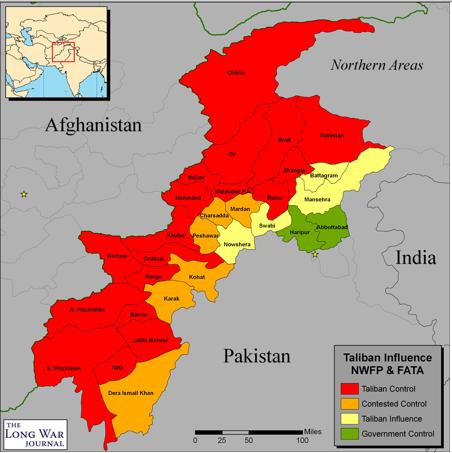
Losing Pakistan


While we reinforce our front lines - the enemy is heading after our baggage train - if you don't understand the tactic - consult the spirits of Isambart d’Agincourt and Robert de Bournonville.

See the full report by Bill Roggio at LongWarJournal.

Here is the question for you - if this trend continues - how do you extract the nukes? You do need to extract Pakistan's nukes, right? Yes, my friends - you do. If not - time to build these.


Hat tip Rusty.

Wednesday, February 18, 2009

Shock'a! - CBS clueless on military

Yes, I know - dog bites man. Once again it shows that they should have at least one person on staff that knows something - anything about what is going on.

VoiceOfWar can help you who don't get it in the first minute or so - but watch the below and see if you can get through without laughing.


Reason #1,175,457 that I am glad I stopped watching CBS in '88.

Hat tip LGF.