Showing posts with label Navy at War. Show all posts

Monday, January 16, 2023

The Manning Shortfall Bow Wave is Only Starting

It appears that the recruiting and retention challenges are breaking above the ambient noise at the start of 2QFY23. We go through these cycles, but if things seem a bit different to you this time, your instincts are right.

The ebb and flow of manning the Navy is a regular story - but there is one major cause that is different this time around and is beyond the control of anyone - it is an almost geographic or structural in nature as will be outlined later in the post.

Layered on top of this structural challenge to recruiting and retention are challenges of our own creation and are fully in our control - a headwind of our own creation via decisions and policies that even if changed overnight, their effects will linger for years...and their negative effect will increase with time unless changes are made sooner more than later.

Via Diana Stancy Correll at Navy Times;

There are about 9,000 operational sea-duty gaps, with the highest gaps appearing in the most sea-intensive ratings...

The first thing to came to mind when I read that were the "too clever by half" efforts to "solve" afloat manning that help lead to the horrible summer of 2017. I do believe that we have tried to address this problem of throwing unqualified people just to make the metrics work, but that temptation will always be there.

I would really like to see the data over time with that gap number. What has it been for, say, the last 20 years? I know that graph exists...I'd love to see it just so we know how the challenge in in FY23 than it was in FY2013, FY2003, etc. Ships that belong at sea need Sailors, so this multi-causal problem will require more than one effort to fix it.

Vice Adm. Roy Kitchener said the Navy is experimenting with a new pilot program aimed at eliminating the number of temporary additional duty, or TEMADD, sailors that are taken from their primary duty stations.

Again, this brings more questions than anything else. There is nothing "new" about this problem that would make it a cause of today's difficulties ... unless we have allowed a known problem to get worse. Where are those TEMADD Sailors going? How do FY2023 numbers compare to FY2020? FY2015?

If we're talking schools, well good googly moogly, this was a problem when I was a JO. Heck, back in 2011 when I was only 2-yrs post-active duty, in San Diego I asked the senior Lieutenant of a riverine craft doing a static display what was the number one thing he wanted from Navy leadership.

His answer was, roughly, "Don't have my Sailors show up only long enough to check in before they are sent off to school to be qualified to do their job. If I'm short an EN1 and Millington tells me, 'You have an EN1 I just sent you.' I tell them, 'Yeah, he checked in last week, will sit here for eight more weeks before going to a six month school. By then my most experienced EN2 is separating. Heck, he goes on terminal leave in two months. That EN1 not only is no good to me, the way he was sent to me only makes my problem worse."

We then spent a few minutes saying bad things about Millington before I asked him what his plans were. I'll consolidate and paraphrase roughly. "I'm getting out next year. I'm a Lieutenant in a riverine command. I have no competitive future on active duty."

Like I said, not a new problem.

So, back to the challenge we're talking about today. As we saw with previous shortfalls, everyone hits the "Easy Button."

“The reality is we need to buy more people,” Kitchener said. “And I think right now we’re committed to buying more people; we’re just having a hard time recruiting.”

The Navy is offering multiple enlistment and retention bonuses to recruit and keep sailors. For example, future sailors or veterans who re-up right now can combine the maximum enlistment bonus with a maximum student loan repayment to cap out at $115,000 — if they ship out before March. The Navy first introduced the policy last year and kept it for FY23. 

Well, yes, money helps, but it is only going to get you so far.

What is the structural problem I mentioned at the top of the post? 

2023 is not 2003 or even 2013. This is the most important graph for understanding our manning problem.

Demographics.


Demographics is destiny. Always was, always will be. Each year, the a new cohort of children born 18-20 years earlier become the source material to recruit in to the military.

Is it easier or harder to get more people from a shrinking pool? 
 
Yes, we have that problem - but like our geography and natural resources, the USA has this as a comparative advantage, in a fashion.

Compared to other developed nations, our demographics are rather good. Have you seen Korea's?

The People's Republic of China?


Germany?


Russia?

As a species, human society has never see such a demographic profile. The developed world and its militaries will have to figure out how work around it. So, yes, the USA and its Navy has a demographic challenge, but so do our friends and competitors ... we just look healthier.

Oh, in case demographics and population trees are new to you and you don't really understand how different things have changed for the USA, the below graph is helpful.

So much of how we think about manning and retention in our military is based on outdated assumptions about demographics. Look again at the first graph. The USA will have a slightly easier time with a larger cohort of 18-20-year olds in 2028, but then that pool shrinks again, fast.

The easiest time to recruit officers and enlisted in the last half century was ... 2011 - and that pool is simply not coming back.

Speaking of pools, this should give everyone pause;

The Navy met its active duty enlisted recruitment goals for fiscal 2022, but fell short among active duty and reserve officers, as well as reserve enlisted personnel. The service is also prepared for an even more challenging year in recruiting; it drained its Delayed Entry Program pool to the lowest the service has experienced in 40 years to meet its active duty enlisted recruitment benchmarks for FY22.

You can only do that once and that trick is done. Over at twitter retired Admiral John Harvey, USN made a solid point on this;

I see a lot of reacting, pulling from the historical tool box and otherwise dealing with symptoms to try to move the needle inside a POM cycle. However, we got here for a variety of reasons years in the making that will not respond quickly to the degree we think they will as described above.

Some things, like demographics, we can't do anything about. As we face that shrinking pool we will see again in 2028, there are things we need to act on now to help change perceptions that can linger for years before they change. 

To make these changes, it will require admissions of error, and that is the problem. Feelings will be hurt. Rice bowls will be turned over. As that those feelings and rice bowls contributed to the problem we have, that shouldn't bother well meaning people.

Here they are; Image, Leadership, Reputation:

Image: What do our candidates see and hear? In the civilian world, every call is a sales call and every customer is a referral source for new business. In the military, every photograph, event, and gathering in uniform is a recruiting event. We have covered it here in detail previously so no need to point to examples, but who would want to join a service whose ships look uncared for? Whose Sailors are all wearing three or four different uniforms ... brown boots, black boots, camo, blue hat, tan hat ... etc? What messages do rusty ships and disheveled Sailors send to friends and enemies? Why does it seem that so many leaders in our Navy seem to want to dress like they are in the Army or the USMC when they are CONUS or afloat? Are they ashamed of being Sailors? Are they even recognized as being Sailors by potential recruits? Does any of this make the Navy an attractive place to join or stay in - or a place to avoid?

Leadership: What are candidates' future bosses saying? When senior leadership is seen and heard from, what are they talking about? Would you want to join an organization whose leadership seems mostly concerned that they employ a bunch of racists, sexists, rapists, and domestic terrorists? Do you want to work for leaders who never seem to defend their people ... who at first chance will defer to the latest slander and promise to "do something about it" when they know there really isn't an "it" but won't support their people by saying so? What about over a decade trying to act as if there were no costs, no down side to making 8, 9, 11-month deployments with a short turnaround as the "new normal?" What about the reality of people spending the balance of their first enlistment in a ship during overhaul because we can plan for the expected?  

Reputation: What do others think of their Navy a candidate may want to join? One of the worst examples of governmental corruption at scale this century in the United States was/is the "Fat Leonard" scandal. It has been 13-years, almost four times longer than it took to fight WWII, and the primary player, Leonard Francis, has yet to go to trial and even escaped from home arrest earlier this year. On a regular basis, we have IGs investigate someone for an accusation of X, X is never found, but they still dig until they find Y and then destroy a person's decade long service - often draining their personal funds defending themselves in the process. We burn a multi-billion dollar large deck amphib in port, blame it on an undesignated Seaman, drag his name, life, family, and fortune through a court system only to find him not guilty ... all while scrapping the evidence needed to find the cause in the process. The chief uniformed leader, the CNO, invests what little personal and professional capital he has left promoting the toxically divisive racial essentialism of Ibram X. Kendi. This is going on while at the same time parents all across Northern Virginia and the United States are in open rebellion against the public schools in their area for promoting the same Critical Race Theory adjacent racialist practices in their schools. Would those same parents want their kids to join an organization who admits they like having pictures in promotion boards so they can actively discriminate on the basis of race? Really?

These all add up. Drip, drip, drip ... the issues with the Navy's image, the defensive crouch and thirsty virtue signaling of its leadership, and the own goals degrading its reputation among the general public - a very different cohort than those the Potomac Flotilla socializes with - has etched a mark on the Navy's attractiveness that cannot be buffed out in a year or two. No, it will take a few years to stabilize the ship and to get it underway on a better course.

There are enough challenges out there in recruiting numbers that we need, we need to scrape off the self-applied accretions making the effort even more challenging. It won't come without other costs, but if the goal is to move the needle out of orange and in to yellow, then we need to focus on those things we can control. 

Start with image, leadership, and reputation. All three have lesser included actions that will come along if you can do these three things better to remove reasons not to join the Navy, and equally important, come off the list for those who want to leave the Navy. 

Tuesday, December 27, 2022

No Sense of Urgency to Act on What is Waiting West of Wake

The greatest threat to security in the Western Pacific is not the rise of China, certainly isn't the moribund Russians - or even a combination of the two. No, the greatest threat to security west of Wake is the American national security establishment.

The two pillars of its dysfunction are intellectual and institutional.

Intellectually we continue to allow The Smartest People in the Room™ to blissfully live in a world of happy talk to themselves, each other, and their nation. It is as if they live in a world of the military FITREP where you write your own review in the adult version of Lake Wobegone ... where all the children are above average.

Via Phelem Kine and Lara Seligman over at Politico this AM;

The U.S. has pledged to deploy so much firepower to the Indo-Pacific in 2023 that China won’t even consider invading Taiwan. Lawmakers and allies say it’s already too late.

The promise is a big one: “2023 is likely to stand as the most transformative year in U.S. force posture in the region in a generation,” Ely Ratner, assistant secretary of defense for Indo-Pacific security affairs, said in early December.

Nothing personal here. I am sure Ely is a nice guy. A PhD in, ahem, Political Science from, ahem, UC Berkely, and a life spent in politics, academia, and the usual holding-pen think tanks ... but clearly a smart guy and a good staff weenie ... but seriously; he doesn't believe that. No one with any knowledge of the People's Republic of China believes that. No one with even a thumbnail understanding of the US military's readiness for sustained peer conflict believes that.

More importantly, no one in the PRC believes that.

Happy talk and spin is fine in domestic politics, fund raisers, and giving hope to the rubes, but it takes years to get a military ready for sustained combat on the other side of the globe. We barely held our own until early 1943 against Imperial Japan and we started getting serious seven years earlier in 1936.

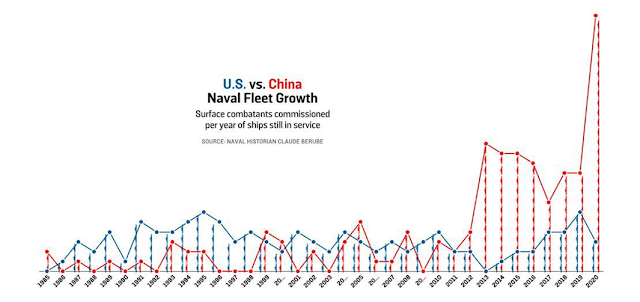
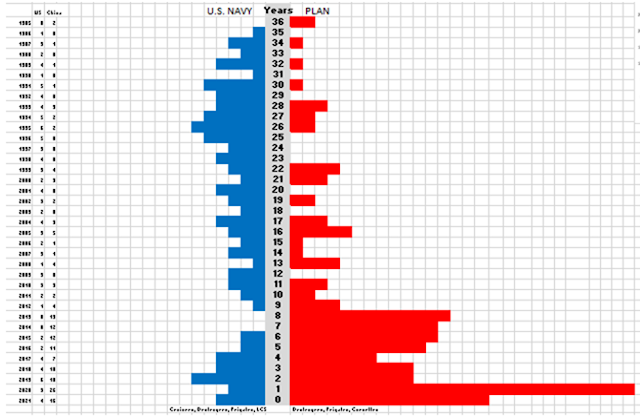
While we struggle to maintain a steady state fleet, the PRC's navy grows.

I guess it is time to put up Claude Berube's graphs again.


They have vastly outbuilt us in the past 10 years. Yes, that red line is China’s shipbuilding versus the blue of the us navy.

That is the truth. That is why when we try to force-mode domestic political happy talk to the international stage we are looked at as not just lying - but being quasi-delusional.

At least there are some people with access to levers of power who know what time it is.

“We have a rhetorical commitment to a force posture change in the Indo-Pacific, but that’s belied by the reality of what’s actually happening,” said Rep. Mike Gallagher (R-Wis.), who will become chair of the new House Select Committee on China in the next Congress. He called Ratner’s assertions the military planning equivalent of “whistling past the graveyard.”

The gentleman from Wisconsin is too kind. 

We cannot afford more happy talk - more "transformational" bullsh1t from people who should know better. They need to be called out on every occasion they try to cropdust the intellectual space people are trying to cultivate towards meeting this decade's challenge. The Terrible 20s are going to be terrible, but we can mitigate the degree of that terribleness. Some progress is being made, but more pressure is needed.

Now let's loop back to the second part of today's post mentioned at the start; institutional dysfunction.

Notice the 1936 to 1943 timeline above? Seven years that didn't bring in just new systems, but generational development in everything from carrier air whose fighters went from the Brewster Buffalo to the Grumman Wildcat, to Hellcat; submarines advanced through six different classes from Salmon to Balao; land based heavy bombers went from the Martin B-10 through the Boeing B-17 to a year later the B-29 deploying. 

You get the idea.

Remember back in October?

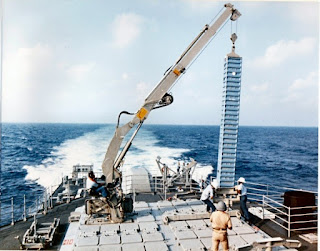
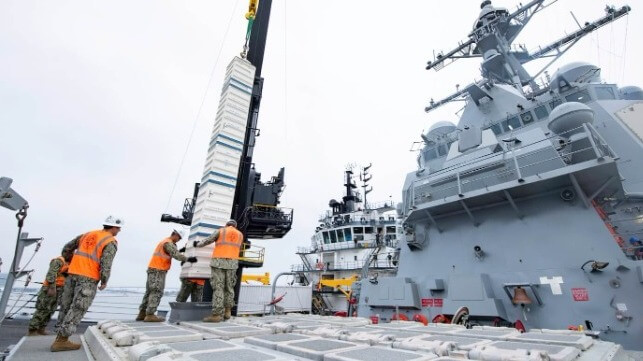
The U.S Navy has tested out a new way of rearming its warships with a trial vertical launch system (VLS) reload in San Diego. 

In a test evolution, the crane-equipped OSV Ocean Valor conducted a VLS reload with guided-missile destroyer USS Spruance, an exercise intended to prove out a new way to reload guided missile destroyers in sheltered waters. Sailors aboard the Arleigh Burke-class destroyer successfully lowered training ordnance into the ship’s forward VLS cells in a proof-of-concept evolution.

...

The exercise was aimed at proving that an OSV can reload the weapons system pierside, with the goal of expanding the capability of VLS reloading in expeditionary environments. The launch system reload has been tested previously in 2016 and 2019 using other MSC vessels but has never been tested using a relatively small OSV as the delivery platform. 

A VLS reload alongside the pier is substantially less challenging than a VLS reload in an open seas, underway replenishment scenario. Previous Chief of Naval Operations Adm. John Richardson signaled an interest in bringing back underway VLS replenishment in 2017, but the operation has rarely been performed in practice - even on Ticonderoga-class cruisers, which were designed with this evolution in mind. 

The TICOs were designed in the 1970s - pretty much half a century ago - roughly the same amount of time that the Spanish-American War was to 1943.

Let that soak in.

Now let's go back to July of 2017, just five and a half years years ago +/-. You know, roughly 1.5 WorldWars as we defined this program management period of time in 2015. For you pedants out there, it is 1.46 WordWars to be exact.

Here's what we discussed 1.46 WordWars ago;

The U.S. Navy is looking to restore its ability to reload its ships’ vertical launch systems at sea, which could be a dramatic logistical game changer in the planning and execution of high-intensity contingencies against peer competitors.

...

After discussing the means by which the Navy seeks to ensure its forward-deployed naval forces remain survivable and up-to-date with the latest tactical and technological innovation, Admiral Richardson said in reference to vertical launch system (VLS) underway replenishment, “we’re bringing that back.”

Since its operational debut in 1986 aboard the sixth Ticonderoga-class cruiser, USS Bunker Hill, the Mark 41 vertical launch system and its successor the Mark 57 have become the main battery of the preponderance of the Navy’s surface fleet, while the Mark 45 has become the principal means of deploying cruise missiles aboard submarines. Vertical launch systems are among the most adaptable weapon mounts that the Navy fields, allowing a ship to carry a variety of defensive and offensive missiles in the same shipboard infrastructure, and to fire them in rapid succession.

Well, we don't have this back.


But we are playing around 1.46 WorldWars later with this;

If it appears that the military acquisitions process and the bureaucracy that keeps it running is not quite what one needs to get ready for war, you're right.

It is nowhere near fit for purpose.

Reloading VLS is not a new concept - it is over a half century old. We got rid of it because the short-war uni-polar world would rather have those VLS cells with missiles to blow up parked clapped out Toyota Hilux with 23mm 1960s era manual guns mounted on the truck bed.

In our Lotus Eater stupor we allowed our land based facilities come under the range of our enemy's rocket artillery from Japan to Guam. That luxury is history. We cannot cruise back to the West Coast or Hawaii to reload. We need to do it at sea - now.

Here is where we need to start playing hardball. Our chattering classes are lost in a soup of onomastic happy talk that enables each other to avoid hard work, and our accretion hobbled acquisitions force is designed mostly to ensure funding lines and job protection in a peacetime uni-polar world.

That is long past. As useful as midnight basketball is to domestic politics - a reference someone with a PhD from UC Berkely should understand.

Wednesday, October 05, 2022

Where Does Ryan Mays go to Get His Name and Life Back?


A sad chapter in the loss over two years ago of the USS Bonhomme Richard (LHD 6) has finally come to a close.

With the loss of an almost freshly modernized large amphib and $1.2 billion already being cut in to scrap - the whole story is yet to play out, but one of the saddest chapters is now closed. In a just world there would be scalding Congressional hearings, but alas we do not live in such a world.

Megan Rose at ProPublica put out a superb review and report a couple of weeks ago you really need to read in full.

Considering all the own-goals our Navy has executed the last few years, a navalist can be a little numb to the ineptitude ... but we need to look at.

We need to look at it if for no other reason than it appears that we put the entire weight and resources of the Navy's legal system against a young Sailor for no other reason than - it appears - to force him to be the Navy's sin eater.

The only good thing that has come from this sad tale is that at least Seaman Recruit Ryan Mays, USN is a free man. Damaged and poor, but wiser and free;

Update, Sept. 30, 2022: A military judge found Seaman Recruit Ryan Mays not guilty on Friday of setting fire to the USS Bonhomme Richard. Mays, 21, had stood trial on charges of aggravated arson and willfully hazarding a vessel for the four-day blaze that destroyed the amphibious assault ship in 2020.

As we've discussed it often since the fire here, follow the link if you need to catch up on my thoughts in detail.

As regulars here know, over the last three decades+ I have seen too many acquaintances and friends be destroyed - in some cases personally in addition to professionally - by frivolous or just plain slanderous IG/NCIS investigations. 

When they arrested Mays, while accepting they may have the guilty party, in the back of my mind came up something Ensign Salamander thought was BS at the time, and combined with what I saw after Tailhook 91, cemented a healthy suspicion of the Navy's investigatory services that time proved wise; 

To some, the Navy’s actions were reminiscent of an ugly piece of its history. In 1989 an explosion on a turret of the USS Iowa killed 47 sailors, and the Navy tried to pin it on one of the dead sailors, who leaders suspected was gay. Only after Congress stepped in did the Navy acknowledge there was no evidence for its assertions.

Command Investigations I have faith in ... if it involves a hotline complaint, IG or NCIS ... notsomuch;

The service immediately launched two parallel investigations into what went wrong and why.

The command investigation, led by a three-star admiral, sent a team of investigators on a prodigious and methodical examination of the fire. As the months passed, the investigators uncovered in exhaustive detail an astonishing array of failures — broken or missing fire hoses, poorly trained sailors, improperly stored hazardous material — that had primed the ship for a calamitous fire.

A separate investigation by the Naval Criminal Investigative Service, for its part, focused on whether anyone was criminally responsible. As the months passed, NCIS investigators appeared to operate in isolation, discounting the damning findings of the command investigation to pursue a case of arson, despite scant evidence.

Six weeks into both inquiries, the Navy told the command investigation to accept at face value what NCIS and federal fire investigators judged to be the fire’s origin. Both investigations concluded in 2021.

...

The command investigation traced the problems back to when the Bonhomme Richard docked for maintenance and Navy leaders throughout the ranks abandoned responsibility for the ship’s safety. Risks mounted, and nobody paid attention. All told, investigators determined that the actions of 17 sailors and officers directly led to the loss of the ship, and those of 17 more, including five admirals, contributed. The long list was a staggering indictment of everyone from sailors to top admirals who had failed in their jobs.

The NCIS investigation, however, laid the blame at the feet of a single young sailor. The true culprit, the one who bore responsibility for the billion-dollar loss, the Navy said, was then-20-year-old Ryan Mays. And for that, he should face life in prison.

The Navy continued its pursuit of Mays, even as a military judge recommended against it, bluntly calling out the lack of evidence and citing the findings of the Navy’s own command investigation.

...

After a dayslong probable cause hearing for Mays in December 2021, the judge said she wasn’t persuaded of Mays’ guilt. A nuclear-trained surface warfare officer who later became a Navy lawyer and then judge, Capt. Angela Tang is known for being thorough.

“Given the state of the evidence presented to me, I do not believe there is a reasonable likelihood of conviction at trial. Therefore I do not recommend referral of these charges even though there is probable cause to support them,” Tang wrote in her findings. 

Accountability for a $1.2 billion loss of what for other navies would be considered a capital ship? Huh.

The details in Meghan's article is just, well, depressing. Just one paragraph should drive any navalists to the end of their line;

The investigators soon discovered an astonishing list of ways the ship was at risk, so many that cataloging the bad decisions day after day became depressing, the person involved said. For long stretches, all the ship’s heat sensors, sprinklers and other emergency systems were turned off, investigators wrote in their report. On the day of the fire, just 29 of the ship’s 216 fire stations and 15 of 807 portable fire extinguishers were in standard working order.

This is what we put one of our Sailors through;

The ATF’s Beals and an NCIS agent questioned Mays in a recorded interview for nearly 10 hours. He told them more than 150 times that he didn’t set the ship on fire.

The morning of the fire, Mays should have had a broom and dustpan in his hand, cleaning the back of the ship. Mays told agents he was instead just hanging out there, scrolling through his phone. With 24 hours of duty and not much to do, he wasn’t in a hurry right after roll call, and besides, he told ProPublica later, the general culture of the ship on its second extension in the yards was lackadaisical.

On a recording of the interview, Mays, wearing a brown uniform T-shirt and occasionally sweeping his hair off his forehead, vacillated between confrontation and distress.

In a confident voice, he asked eight times in two minutes if he was being detained.

“I’m not answering your questions, Ryan,” Beals said.

During his interview, Mays crudely put on display his disregard for the fleet Navy, and spoke of his desire to be a SEAL. In the beginning he even asked NCIS agent Albert Porter, a former SEAL, for a recommendation. Porter told Mays he’d never have another shot at the training program: “You’re not going back, dude. It’s not happening.”

Beals pressed him to “just admit to what you’ve done.” At one point, he told Mays they had him on video.

“You’re a liar,” Mays said.

“You’re a liar,” Beals replied.

Several times throughout the day, Mays asked to call his mom. He tried to think of anything he could tell the agents that would show them he was innocent. He begged them to take his DNA, search his phone and use GPS to track his whereabouts at the time.

At one point when the agents left him alone, he exclaimed to the empty room: “I didn’t do it. Let me go.”

Then he laid his head on the table and sobbed.

When Mays learned close to midnight he was going to the brig, a sailor who had been preparing to transport him said she heard Mays say something like “I’m guilty. I did it, I guess,” according to records and testimony.

Agents took the alleged remark as a confession. Mays said he was being sarcastic, expressing disbelief he was being arrested for a crime he didn’t commit.

The Navy booked Mays into the brig on Aug. 20, 2020.

Kafka lacked imagination compared to what we will put our people through. Such a young man. He will never be the same. His family will never be the same. 

Where is justice for him?

The experience, especially his time in the brig, has been “soul crushing,” he said. “A piece of me died in there and I don’t know if I’ll ever get it back.”

Don't think it can't happen to you.

If you find yourself across the table from any law enforcement officer of any stripe - lawyer up. I don't care how innocent you are. Be silent until you have an attorney tell you when to speak and what to say. If you are in uniform, take your JAG, but dig as deep as you can in your pockets for the best civilian lawyer you can find who has experience in this area and will take your case. 

Very often it is not about innocence or guilt, nor is it about right or wrong. It is about what someone can prove or disprove. Nothing more. For ambition or self-preservation - or even ego - individuals of our species will destroy innocents. It is our nature. Acknowledge that and accept it.

No, it isn't fair. No, it isn't cheap - but one thing money is not as valuable as time and your reputation. 

Be a mensch. If you have a friend or a Shipmate who finds themselves under the microscope such as this, do not abandon them. Most will, and the few that remain can make all the difference in the world to ensure that they have a chance to remain grounded and get through this. If you abandon them, you were never a friend or a Shipmate.

Our Navy failed here at multiple levels. 

In a about 2/3 the time it took to fight WWII ... here we are in the fall of 2022 ... with nothing but shame and guilt.

Where is constructive action? 

Wednesday, June 01, 2022

Unfunded Priorities ... or a Deeper Story?


I may have to add Sen. Jon Tester (D-MT) to my list of navalist leaders of merit on The Hill.

My first reaction was to be mad that I had not made this point first ... but I will gladly enjoy this exceptionally important point being made by a Senator to the CNO in such a public manner;

Via Caitlin Kenney at Defense News;

“I think this committee wants to make sure we're providing our warfighters with the necessary funding to ensure that the equipment they're using is adequately maintained. It's pretty basic,” Tester told Adm. Mike Gilday, chief of naval operations; and Gen. David Berger, Marine Corps commandant. “That means getting the necessary spare parts and safety equipment up front, not after something like this happens.”

He noted that the Navy and Marine Corps’ unfunded priorities lists—items that service leaders want but not enough to devote part of this year’s budget to—include some categories of spare parts for warships, F/A-18 fighter jets, MH-60S helicopters, and more.

Tester wondered why spare parts would be on the unfunded priorities lists “when this seems pretty basic, at least to my perspective, as to making sure that we're keeping folks safe and effective in the field.”

Let's take a moment to go back to the summer of 2017 ... a half decade ago. We, yes we, drowned 17 of our Sailors in their berthing because our senior leadership did not man, train, or equip our Navy properly. 

As we discussed in detail at the time, just prior to the incident our Navy was bragging - on one of the ships nonetheless - that the already undermanned ship was in addition to doing not just its regular required maintenance, but depot level maintenance as well because ... depot level maintenance facilities wouldn't/couldn't do it. Both ships were think with missing parts, broken equipment, untrained watchstanders. Basic stuff.

Equipment was CASREP'd all over the place on those ships as well as others in the fleet. Those who have been at sea also know not everything is CASREP'd that should be. More parts are always needed than the reports say.

... and yet, here we are in 2022 and the CNO has to be confronted by a Senator that - hey - shouldn't you take care of what you have first before you ask for more?

Any homeowner knows that before you head on that Hawaiian vacation you need to patch the leaking roof, replace the broken water heater, unclog the girls' shower drain ... the basic stuff.

You also don't but a new car because the old one is running rough because you've skipped two regular oil changes and scheduled maintenance because you wanted to buy a new boat instead. 

Etc ... etc ... but it isn't as sexy, is it?

“So that's why in both our budget, with the secretary's help, and also in my unfunded list, we're trying to get back to where we need to be,” Gilday said. “You can't fool the fleet, you can't fool sailors, they know when they don't have the stuff that they need. And so, in our trips out to the fleet we've heard loud and clear that supply parts have been a problem. The GAO report confirmed that for us, and so we're trying to make things right with respect to spares.”

Those comments, Tester said, indicates to him that the spare parts should not have been placed on the Navy’s unfunded list.

“Sir, it's a valid point,” Gilday acknowledged.

Yes, yes it is. It isn't a new point either.

BZ to Senator Tester. 

May he, Senator Cotton, Representatives Gallagher, Luria, Banks, Waltz and more who show they understand the maladministration of our Navy keep the hard questions - the pointed questions - to our senior uniformed and civilian leadership. 

Make their actions worthy of the Navy they lead.

Wednesday, February 09, 2022

The Potomac Flotilla's Potemkin


Just take a moment to consider the mass of senior leadership present inside a commute distance of DC. The amount of money they have access to. The amount of direct control they can exert through official levers of power and simply a phone call.

Look how they live.

Now ponder how our most junior sailors have been treated. 

Come on over to USNIBlog with me to be scandalized afresh.

Tuesday, November 23, 2021

Are our Intellectual Actions Aligned with our Security Challenges?

That is, of course, a subject question. However, there are objective facts that stand independent of that subjectivity.

Where you are in time and place is important. In the area of national security, disconnects and discontinuities in time and place caused by a desire for reality to be what we want it to be consume the finite resources of time, money, and focus from actions to address what reality actual is. 

Denial fed by delusional distractions, as it were.

Take a moment to back up a bit and think about the top national security concerns of 2021. What do they signal to you as the most important parts of the United States’ national security infrastructure needs to invest their time, money and reputation on?

Well meaning people can differ in how they rack and stack things, but let me grab the Top-3 from my seat the provinces:

1. Strategic impact of the national humiliation following our defeat and negotiated surrender in Afghanistan.

2. Expanded Chinese aggression in the Western Pacific and expanded global influence.

3. Growing Russian hostility in Eastern Europe and her near abroad.

Honorable mentions could include sectarian and religious based conflicts in Africa, domestic logistics and manufacturing short comings, and other actionable national security adjacent challenges could be put in the top-3.

So, let’s say you find yourself just inside a month after the national humiliation in Afghanistan in late August and you have an opportunity for the US Navy’s top four institutions of higher learning; Naval War College, Naval Post Graduate School, Marine Corps University, and the Naval Academy to come together – not a common occurrence - to have a “Combined Naval Address” on a topic of great concern. What would you want them to invest their professional capital in?

Behold!


By all means, I invite you to watch it – you paid for it. 

Just fair warning – this isn’t what it is billed to be. You have an intro by a PMP CDR followed by the reading of a prepared statement by the President of the U.S. Naval War College, then they hand it over to serial Australian TED entrepreneur Saul Griffith whose major skill seems to be able to sell hyped companies that get people excited enough to buy them, only to realize once the ayahuasca trip wears off that … well … perhaps big-ass kites as wind turbines might actually not be all that great of an idea.


That’s it. Funded by the Naval War College - I assume the speaker is paid for. I do wonder how much. 

Even better we find that the Barrows Fellows from the Marine Corps University will spend all year studying <checks notes, this is the year we were defeated in Afghanistan by the Taliban> ... climate change. 

For the record, by their own definition

The General Robert H. Barrow Fellowship seeks to explore and understand different aspects of security and strategy as it relates to great power competition. 

Great. Wonderful. Timely. 

For those who don’t have the time to watch the whole thing, Griffith, looking like he just got off a ayahuasca trip himself, spends a few minutes telling everyone - shocking - that DOD's largest energy use is jet fuel.

We know.

He then spends most of the next 3/4 of an hour reading repackaged slides my kids were shown after the Al Gore movie in middle school weaved in with a recant of standard issue neo-pagan climate grift that has nothing to do with anything impacting any maritime service - much less "great power competition."  No, this is mostly about turning residential civilian America electric - not a military concern.

As sure as the sun and moon rises and sets, the climate changes. It always has and always will. I own property 2-hrs drive inland from here half of which is beach sand - as it used to be a beach.

My state used to be twice the size it is today during the ice age when the shore was far to the east of where it is now.

The question that is unknown is the extent of human cause. Without knowing that, can't do a cost benefit analysis of what needs to be done on what timeline that really make a difference - and the models are simply garbage. The ones from 20-yrs ago are no better than the ones we have now.

All the above paragraph can be argued, sure, but what you cannot argue is that this - in the fall of 2021 - is this something that is deserving of this kind of effort by the US Navy. Somewhere? Sure. All four of our major higher education institutions?

Do you even know what a military is?

It would be comical if not so farcical. 

We are a nation with serious challenges this decade. We and our Navy needs to act as serious as they are.

Tuesday, July 13, 2021

Culture is Upstream of Everything

Senator Tom Cotton (R-AR) along with Congressmen Jim Banks (R-IN), Dan Crenshaw (R-TX), and Mike Gallagher (R-WI) commissioned a study by Lieutenant General Robert E. Schmidle, USMC, Ret. and Rear Admiral Mark Montgomery, USN, Ret. on a series of issues familiar to regulars here and on Midrats

It was released on Monday and at only 22 pages is an easy read. The aptly titled, "A Report on the Culture of the United States Navy Surface Fleet" is a compact summary you should take time to read in full.

What does it use as the basis for its review?

77 unique and formal interviews were conducted with Navy personnel via an extensive hour-long process to establish a common controlled approach to the questions at hand. ... 

Instead of chasing the laser dot across the floor, they are focused on, 

...underlying systemic problems... larger institutional issues...

They are taking a non-traditional approach and, thankfully, their own authority; 

...by conducting the interviews from outside the chain of command via the exercise of the Congress’s Title I oversight authority, and by pledging anonymity to participants, interviewers enjoyed a significant level of candor in these conversations. Ultimately the process was able to identify trends that, by the admission of those interviewed, would not normally be shared with their own chain of command. 

 What did they find?

The results of this project are unambiguous. There was a broad consensus across interviewees on numerous cultural and structural issues that impact the morale and readiness of the Navy’s surface force. These include: an insufficient focus on warfighting skills, the perception of a zero defect mentality accompanied by a culture of micromanagement, and over-sensitivity and responsiveness to modern media culture. Structural issues identified include lack of resources and consistency in surface warfare training programs, and the Navy’s underwhelming commitment to surface ship maintenance—a problem that spans decades. 

Though all the Representatives and the Senator here are Republicans, they correctly identify this as a multi-decade, bi-partisan problem. Not (R), not (D).  No, this is all (N); this is a Navy problem.


They found six major issues:

1. Insufficient leadership focus on warfighting.

2. A dominant and paralyzing zero-defect mentality.

3. Corrosive over-responsiveness to media culture. 

4. Under-investment in surface warfare officer training. 

5. Poorly resourced and executed surface ship maintenance programs.

6. Expanding culture of micromanagement.

Let's dive in to the sections above and see what we find.

Insufficient leadership focus on warfighting:

... many sailors found their leadership distracted, captive to bureaucratic excess, and rewarded for the successful execution of administrative functions rather than their skills as a warfighter. 

This is a recurring theme through all the sections; distraction. All humans only have 24-hrs in a day. You can only do so much, and less well. When the important is crowded out by the unimportant, you become inefficient, ineffective, and live in the moment just to survive to the next Outlook refresh.

... “the very difficult problem for an O-5 CO (Commanding Officer) is that he’s got 1,000 requirements pushed on him, many of which are administrative or operational…and so his real job is figuring out which requirements he’s just going to blow off…whether it be fixing a material issue or training or warfighting readiness.

The rewards and incentives that an organization signals will drive what is on top and what is on the bottom of a rack-and-stack prioritization.

There was considerable apprehension that the surface warfare community in particular lost a component of its fighting edge...

How much time in the last quarter century ... and how many funded programs ... were spent on the ability of our navy to do what is the foundational purpose of navies throughout time - sink opponents ships and deny them access to the seas ... at range?

One recent destroyer captain lamented that, “where someone puts their time shows what their priorities are. And we've got so many messages about X, Y, Z appreciation month, or sexual assault prevention, or you name it. We don't even have close to that same level of emphasis on actual warfighting.”

From the US Navy's official YouTube page, look at the topics of the videos the Chief of Naval Operations, Admiral Gilday, USN, has put out in the last year.

He sets the tone. He sets the priorities. Check them out yourself. I don't need to say more.

Frustration with nonessential training was found to be overwhelming and not limited to the surface warfare community. Navy leaders have contributed to morass of requirements, but so have senior civilian defense leadership and Congress. While programs to encourage diversity, human sex trafficking prevention, suicide prevention, sexual assault prevention, and others are appropriate, they come with a cost. The non-combat curricula consume Navy resources, clog inboxes, create administrative quagmires, and monopolize precious training time. By weighing down sailors with non-combat related training and administrative burdens, both Congress and Navy leaders risk sending them into battle less prepared and less focused than their opponents.

This is part of the administrative burden. You only have finite training time. Priorities derived from incentives and disincentives will drive decisions throughout the chain of command. 

“Sometimes I think we care more about whether we have enough diversity officers than if we’ll survive a fight with the Chinese navy,” lamented one lieutenant currently on active duty. “It’s criminal. They think my only value is as a black woman. But you cut our ship open with a missile and we’ll all bleed the same color.”

We need more of that LT, and less of others.

One interesting note, and credit to him and the authors, is the one person named - and insisted on being named - is our friend Bryan McGrath;

“[The ships] are very busy,” he said. “I think there are too few of them for what is being asked…The operational requirements squeeze out maintenance, they squeeze out some training.”

This brings back to a call here for years; where is "Admiral No?" The problem Bryan outlines is a manifestation of our priorities driven by the "now." In what few hours you have in the day, what do you need to do to not get in trouble, not to get a phone call, not to get a message that will create trouble? You get in survival mode. The job of leaders is to create an environment for your subordinate leaders to get their heads up and out of survival mode.

A recently retired senior enlisted leader suggested that this dynamic was more a lack of proper prioritization. “I guarantee you every unit in the Navy is up to speed on their diversity training. I’m sorry that I can’t say the same of their ship handling training.”

What metrics are being tracked by who and why?


A dominant and paralyzing zero-defect mentality:

Former Secretary of the Navy John Lehman has framed this in an historical context, suggesting that none of the four key Admirals who led victorious fleets in World War II would have made it to the rank of Captain in today’s Navy. “Nimitz put his first command on the rocks,” Lehman said. “And Halsey was constantly getting into trouble for bending the rules or drinking too much…Ernie King was a womanizer and a heavy drinker. And Admiral Leahy may be the only one that might have made it through, but he had quite a few blots on his record as well.”

A few questions come to mind:
  1. Why were previous generations more flexible?
  2. What did they do to make a 2nd chance institutionally worth forgiveness?
  3. Is there an assumption of expendability when it comes to our people? If so, to whose benefit? Why?
I think in the next pull quote, we may have a partial answer:
“But in each case, there was a critical mass of leadership in the Navy that recognized that these were very, very promising junior officers. And so, while they were punished for mistakes, they were kept in a career path. That’s not the case today. It’s just not done because it’s too dangerous for anybody that tries to help someone who has made a mistake.”
That last part is underappreciated. "The system" doesn't just go after the individual in the barrel, but anyone who associates with or shows sympathy to that individual. It is absolutely heartbreaking to talk to people who all of a sudden find themselves at a meeting where on one will sit within two seats of them. Calls and emails are not returned. Social events are cancelled. Wives and children are ostracized. Just heartbreaking what we can do to each other out of fear.

Fear. 

That is a common thread in our culture; fear. We will face death and will calmly give orders that results in the deaths of hundreds, but we are terrified of a mention in an article, an angry phone call, or worst ... being called a nasty name. Great warriors become quivering piles of goo.

However, isolated infractions such as an alcohol-related indiscretion, a poor choice of words with no malice or offense intended, a ship-board accident with no damage or injuries and no demonstrated neglect, and similar offenses are supposed career-ending faults that could instead be weighed in the context of an overall service record and provided with an opportunity for redemption. One officer noted the example of Captain Robert J. Kelly, a combat-tested aviator who ran the USS Enterprise aground in San Francisco Bay several decades ago but went on to earn 4 stars and command of the Pacific Fleet. It was a rare mercy in the early 1980s and unheard of today.

The "how and why" of the change over four decades would be an interesting study in the mentality and motivations of the chain of command and selection boards. The media have always been with us, they are not new. Is it generational? A byproduct of training, accessions, competition? There's a PhD to be earned out there on this topic ... if an academic institution would allow an open investigation of such.

“Goldman Sachs, Amazon, Apple, Google, whatever. All of these institutions of high performance and high excellence do circus flips trying to figure out how to cultivate and retain talent,” said one former naval officer who is now a senior leader at a major hedge fund’s philanthropic arm. “The Navy all but chases it out the door.”

Career path rigidity is a disincentive to innovative and restless intellects. That is a large part why so many quality people leave at first chance. We are not good here.

... interviewers found no credible defense of the one-mistake Navy and its influence on officer careers in particular. The practice creates fear and apprehension in the fleet. It degrades lethality, atrophies talent, inhibits reenlistments, encourages careerism, and advances those that avoid risks and challenges up the ranks.

Fear. There it is again. A military shaped by fear.


Corrosive over-responsiveness to media culture:

The “one-mistake” culture appears to be somewhat recent phenomena in Navy history and some suggested that today’s unyielding news environment could bear some of the blame for its rise. 

Much of this comes from senior leadership lacking sufficient training or ability to have confidence in themselves to respond appropriately.

Back to point; 

There is an undercurrent of fear in the surface fleet.

We need to keep pulling that string on "fear."

The first is a loss of faith in the chain of command. In the wake of a damaging story, the senior ranks are perceived as quick to sacrifice junior personnel to preserve the credibility of the unit or the career of the senior leader in charge.

A byproduct of concern that the chain of command is driven by fear. It isn't bad news that people are worried about, it is how their boss will react to bad news. Junior personnel lack confidence in the intestinal fortitude of their superiors. That peacetime suspicion bleeds over to the operational side as well. That simply is not healthy.

“COs would be quite risk-adverse,” one officer recalled, “they would have their senior department heads manning a lot of watches, especially on the bridge and things like that to make sure that nothing went wrong, because nobody wanted to end up in the media, and nobody wanted to end up on the cover of Navy Times.” He finished his statement with a telling observation that, in this day and age, this reaction was “totally understandable.”

The press isn't the problem; it is the fear of the press that is the problem. It is also an archaic, ham-fisted understanding of the news cycle exasperated by the culture of the now;

Commanders do not appear to understand that stories come in a flash and disappear just as quickly

Like a summer squall on a lake, you don't abandon ship, you just secure things and wait it out. It passes faster than you think and then the press is on to other click-bait.

The Navy has forgotten how to differentiate between stories that are ignorable and stories that demand corrective measures.

We could help commanders by having better Public Affairs (PA) and Human Resources (HR) professionals. I have seen a lot of solid leaders needlessly spooked by excitable PA and HR "professionals." Then again, it is a commander's responsibility to ensure he has a good staff, and knows who on his staff he is free to ignore.

...a 30-year veteran of the Navy, who would have been an invaluable asset in a conflict at sea, resigned. In what would have normally been discipline via stern conversation from a higher officer, three decades of honorable service were instead ignobly ended. 

What a great example of how corporate Navy values service. People remember this and other similar acts of callousness. Memories of such events are long lasting. Just ask anyone who was a JO during the post-Tailhook '91 era.

The trend has not gone unnoticed. It creates the impression in the lower ranks that Navy leaders are easily cowed by the press and will throw sailors to the wolves should their name appear in print.

Ground truth ... and when done by senior leadership, this trickles down to lower echelons. 


Under-investment in surface warfare officer training:

The surface warfare officer community has frequently been under pressure to look for efficiencies, both in resource allocation and time spent before entry to the Fleet. The aviation and submarine communities had no such pressures.  

That lies firmly at the feet of the surface warfare community. Why? They will have to answer that.

In 2003, the Navy surface warfare community, in its effort to become more efficient, eliminated the initial SWOSDOC training at Newport as well as many of the unit specific combat and engineering systems schools. 

This cohort are commanding our ships today. We've corrected this error and a lot of good work has been done in recent years to improve SWO training ... but this horrible child of the Age of Transformationalism - that same group that begat LCS and DDG-1000 - will continue to impact our Navy for another decade at least.

Read page 13-14 for the second and third order effects for that cohort that only ended in the last decade. This was all predicted. 

There is one area we did continue to do right, and I was glad to see the authors mention it. This is another thread I would like pulled ... the why and how we did, and continued to, get this right.

Nearly every respondent, both in the pre-2003 and post-2003 eras attested to the fact that initial basic firefighting and damage control training as well as frequent refresher training in these essential skills was both prioritized and accomplished as required. Many respondents offered sentiments similar to one officer who stated that the Navy was “very intent on damage control and fire-fighting training [that was] crucial to day-to-day operations.” One important insight was that fire-fighting and damage control simulators had continuously evolved over the past generation to “become very advanced. We developed the use of ones that you could set off fires and contain the smoke and clean the air.” The degree to which the crews of both the USS McCain and the USS Fitzgerald were able to stabilize and counter the serious flooding that occurred following their separate collisions suggest that this is true. While Congress still waits for the full account of the origins of the USS Bonhomme Richard fire, the Navy’s focus on damage control can largely be praised as an example of how proper prioritization of essential training can yield effective results.
 

Poorly resourced and executed surface ship maintenance programs:

The opening is heartbreaking because if we had only followed a report we've had over a decade ago, so much of what we are trying to fix would be better;

The 2010 VADM Philip Balisle Report on Surface Force Readiness highlighted a number of manpower, maintenance, training, and readiness issues plaguing the surface warfare enterprise. 

You get what you inspect. You get what you reward. Organizations follow leadership priorities. This is basic stuff.
Surface ship maintenance packages are perceived as “bare bones” and unable to absorb growth. The cumulative effect of this underfunding and poor execution has left the surface warships less modernized and less ready for combat operations.
Also basic is an understanding of where the path of deferred maintenance leads to. This was a choice, not an accident.
“If you have budget X and you only do whatever maintenance that is required that you can do under budget X, then you have all the rest of the stuff that you had to descope because you're limited by the budget. And then that just creates a bow wave because what's the second and third order effects to deferring that maintenance? You end up with, for instance, on a cruiser where…we knew that the fuel tank tops in one of the machinery spaces, that if we did the ultrasonic testing (UT) on that space, that then the safety requirements would require us to replace the tank tops. We didn't have the budgets to do the tank tops, so we didn't do the UT. And then it wasn't until we went into the shipyard and we were doing the required cleaning of the tanks, which that was a requirement under the package, then all of a sudden, one of the shipyard workers goes up and goes, ‘Oh, I see sunlight through this tank top.’ Well, now you're forced to do the UT. So now you're forced to re-scope the work. So now you're forced to cram more work into a yard package that you should have had planned in the first place.”


Expanding culture of micromanagement:

As you read the report, are you seeing another common theme?

We are “holding back more of that autonomy and probably accelerating those cultural tendencies that are creating officers that are less confident and less competent and less comfortable exercising command,” he said.

Again, you get what you reward. You promote what answers the bell. That is why who you select for senior leadership is so important; they establish rewards and promotion standards.
“Ducks pick ducks,” said another, recently retired, career surface warfare officer. “So now those admirals that we have and that were in charge were successful being micromanaged. And so now they view [micromanagement] as success.” ... “And so, this level of micromanagement just flows up. And, again, it's evolved for a reason. You want to have metrics. You want to track things. And so, the command autonomy that people aspire to is no longer one that is what it might have been in the past.” ... “there’s always this underlying administrative concern that’s looming over the fleet, and I don’t think it’s because people don’t think tactics are important. I just think that’s not the thing that we spend our days being told is important.”

 Back to time being finite; words and the dedication of time by senior leadership signals priorities. Priorities get action.


Recommendations and Conclusions:

As some of these are repetitive to comments above and others discussed here for years, I'll let you read them for yourself. There are a few things that are clear - and here are my points to them;

  • Congress will need to force any change if we desire change this decade. At some point, we will need civilian leadership who will defund the billets driving fear, especially in the expanding political and sociological games being played by our Navy (see recommendation #6). 
  • Admirative burdens must be cut dramatically. The lowest hanging fruit here would be something as simple as awards and repetitive "required training" on issues that are only there from fear of the media; "We conducted training...not my fault." (see recommendation #8).
  • Find out what is creating "fear" and go after it with a blow torch and a pair of plyers.

They end the report with a solid quote:

Former Secretary of Defense James Mattis said in testimony that “the United States does not have a preordained right to victory on the battlefield.” Unless changes are made, the Navy risks losing the next major conflict.

I'll just end to repeat my previous comment for emphasis: the present Navy's uniformed senior leadership under the expected civilian leadership for the near future is not structured, inclined, or positioned to make these changes. We are well past the luxury of waiting for better luck, we are out of time. 

Congress must act. Now.

You can read the full report here, or view the embed below.


Wednesday, June 02, 2021

To win the 72-Month or 72-Week, and not the 72-Hour War...


 ...we have better start planning to fight the marathon.

Now that we are contested at sea, we are setting ourselves up to be unable to return ships to the fight.

Details from the GAO's latest over at USNIBlog.

Give it a read and wake up.


Tuesday, June 01, 2021

I Have Not Come to Bury DTS, but to Yell at it


Since I left active duty I really have not had all that much time to yell at DTS. I mostly just laugh at it from a distance as it was no longer my problem ... at least not directly.

DTS has been horrible from day one. I know it. You know it. Worse, those who promoted and enforced it know as well. But, they didn't really care enough to do anything about it ... until it was a teenager. 

I am just old enough to remember how an efficient system worked. LT Salamander went to Admin and told a PN3/YNSN or whoever had the billet, “I need to travel to Norfolk with OPS for this conference (hands hard copy of message and travel request form). We need to leave next Monday AM. The conference runs through late WED, so if we can get home that night, great, if not the next AM. If possible, we should be able to stay at the hotel there, as per the message. If not, closer the better. We’ll need a rental car too. Thanks.”

Within 24-hrs, all was set up. You went. When you came back, you put your travel claim in the PN3/YNSN’s in basket. If you screwed things up, you’d get a call or more likely, they would just fix it for you.

I also remember the time before the scam that was/is government travel cards. You got an advance, if needed, but more often than not used your own personal card and then filed receipts for things that could be reimbursed.

Government travel cards ... talk about an administrative burden ... but a different topic for a different day, perhaps. 

But no, the system that worked would not do. That wasn’t … well, you know the buzzwords. We sure couldn’t use COTS either. Oh, no.

You can see a few of my historical references to DTS via the DTS tag here, but let’s go back to the start and see how we’ve progressed since my post in January 2006 (yes, over a decade and a half ago), I wrote this.

I know a guy who is going on TDY to New Zealand. He wants to take his wife. SATO using DTS quotes the round trip of $4,000. Well, he wants wifey to come along, and using their own research on her ticket they knew that tickets on that flight were about $1900. He told the SATO folks and she said she was glad to find out. It seems that DTS doesn't look for the best price, though the flight info was from Travelocity as clear as day, but DTS doesn't have that same info.

Classic example. Gov'munt contract for something that already exists in industry. Can't outsource because the GS unions wouldn't have that ..... don't be shocked. Just more taxpayer money thrown away. If you think I am babbling, or you want to get upset - click here and here.

You don't want to know my story. Trust me - it is so bad - I really don't want to go over it.

What is the latest DTS update? 

Via the ever-wonderful Doctrine Man

So, when it was announced recently that the Pentagon is preparing to sole-source the contract to replace the Defense Travel System (a process that began three years ago), you might expect a rousing roar of approval from the masses. Masses, worth noting, that have been subjected to three decades of a system so convoluted and capricious that it was euphemistically known to many as the “Don’t Travel System.” But most of us who spent those decades with the Defense Travel System also understand that any replacement—even Defense Travel Modernization—is still going to be subject to the same arcane travel regulations and the same human error. That translates to a fairly high likelihood that even though the system itself might be a significant improvement over its Quasimodo-like predecessor, many of the frustrations common to official travel will remain.

Everyone knew DTS was bad from almost the start … but here we are over a decade and a half later for a resolution … and it won’t resolve the core of the problem.

That tells you a lot about the dysfunction in DC. Tells you a lot about why we seem frozen in aspic when it comes to bringing the fleet what it needs to win ... or hell, just travel to Norfolk and back without expending half a work-day setting up and resolving the travel for a 3-day trip. 

Our ossified and accretion burdened bureaucracy has lost the bubble on why it exists in the first place. 

Quod erat demonstrandum.

Let us hope we learned our lesson with DTS and bring the fleet something that saves time, money, and headaches. I am a closet optimist. We’ll see.


Tuesday, April 27, 2021

Want to Benchmark Tech Best Practices?

Our Navy has a problem, or a series of problems, and everyone knows it.

It is a problem of long standing that manifests itself in a variety of ways. Our inability to design warships, or properly maintain the ones we have, is one example. Our shrinking carrier airwings - in aircraft numbers and range - is another. Not unrelated to the issues on the pointy end is the groaning weight of staff bloat and a top-heavy leadership structure.

Our self-selected elite - in uniform and out - have failed us. The system and structure that motivates, rewards, and encourages them share the blame, but mostly this is a people problem. As such, the cure will have to come from people.

Congress can help us by ripping up root and branch the late-Cold War Goldwater-Nichols and its Cult of the Joint - along with the hide-bound, accretion laden acquisition bureaucracy that it spawned. Altogether, they are a dead hand on the tiller of our Navy and about as effective as the palace full of eunuchs was to the last Chinese emperors.  

As an institution, the Navy does not have to wait for Congress to act. If we are lucky and smart, we can get the right senior leadership in place to kick start change - and that is a change in how we see our job.

Focus.

We need to focus.

Let the bureaucratic structure follow the change, but we need to break things down and start with Question-1: what is our job?

To start this, why not leverage one of the fetishes of the last few decades: "What is happening in tech?"

We've all seen the field trips. We've all seen working groups.

We've all read one of the buzzword-concepts-of-the-quarter, "disruption." 

What can we do to take what does seem to get people excited, "tech" and "disruption" and find a way to use that in a constructive way?

Let's look at what is going on Basecamp, a productivity software maker.

Their founder and CEO Jason Fried just put out a letter titled "Changes at Basecamp" to his employees that I'd like to pull some interesting points from - almost all of it.

After a soft intro, Fried gets right to the point.

We all want different somethings. Some slightly different, some substantially. Companies, however, must settle the collective difference, pick a point, and navigate towards somewhere, lest they get stuck circling nowhere.

With that, we wanted to put these directional changes on the public record. Historically we've tried to share as much as we can — for us, and for you — so this transmission continues the tradition.

He acknowledges that what he is about to do will not please everyone. He wants his employees to know that, but also wants to step out front an make things clear to everyone. 

1. No more societal and political discussions on our company Basecamp account. Today's social and political waters are especially choppy. Sensitivities are at 11, and every discussion remotely related to politics, advocacy, or society at large quickly spins away from pleasant. You shouldn't have to wonder if staying out of it means you're complicit, or wading into it means you're a target. These are difficult enough waters to navigate in life, but significantly more so at work. It's become too much. It's a major distraction. It saps our energy, and redirects our dialog towards dark places. It's not healthy, it hasn't served us well. And we're done with it on our company Basecamp account where the work happens. People can take the conversations with willing co-workers to Signal, Whatsapp, or even a personal Basecamp account, but it can't happen where the work happens anymore.

One of the worst things our Navy has done in the last two decades is bit by bit getting involved in socio-political fads that are both a distraction, a time-suck, and as they are socio-political in nature and not mission-focused. They bring division in to the ranks.

3. No more committees. For nearly all of our 21 year existence, we were proudly committee-free. No big working groups making big decisions, or putting forward formalized, groupthink recommendations. No bureaucracy. But recently, a few sprung up. No longer. We're turning things back over to the person (or people) who were distinctly hired to make those decisions. The responsibility for DEI work returns to Andrea, our head of People Ops. The responsibility for negotiating use restrictions and moral quandaries returns to me and David. A long-standing group of managers called "Small Council" will disband — when we need advice or counsel we'll ask individuals with direct relevant experience rather than a pre-defined group at large. Back to basics, back to individual responsibility, back to work.

Do you have "pre-meetings" where you have meetings to get ready for meetings? Do you have meetings where you mostly discuss what happened at other meetings? Do you have meeting where you leave them wondering what exactly this did to move the ball forward for your command or the Navy? 

Do you have people who co-opt your time and command to pursue their personal priorities that are unrelated to the command’s mission?

Every do a quick accounting of the amount of people at a meeting times the length of the meeting and see if it created more value than it consumed? Are our leaders overworked, or just overscheduled? 

4. No more lingering or dwelling on past decisions. We've become a bit too precious with decision making over the last few years. Either by wallowing in indecisiveness, worrying ourselves into overthinking things, taking on a defensive posture and assuming the worst outcome is the likely outcome, putting too much energy into something that only needed a quick fix, inadvertently derailing projects when casual suggestions are taken as essential imperatives, or rehashing decisions in different forums or mediums. It's time to get back to making calls, explaining why once, and moving on.

How long have we been working on cutting steel on a FFG design already in production? Why are we still waiting for our next fighter design? Is this a process or a mindset problem?

5. No more 360 reviews. Employee performance reviews used to be straightforward. A meeting with your manager or team lead, direct feedback, and recommendations for improvement. Then a few years ago we made it hard. Worse, really. We introduced 360s, which required peers to provide feedback on peers. The problem is, peer feedback is often positive and reassuring, which is fun to read but not very useful. Assigning peer surveys started to feel like assigning busy work. Manager/employee feedback should be flowing pretty freely back and forth throughout the year. No need to add performative paperwork on top of that natural interaction. So we're done with 360s, too.

Administrative overhead. Thank goodness the 360-deg review high-water mark was years ago, but this paragraph is important. How much time is spent doing FITREPs and EVALs? How much time processing awards - from draft copy to record management? Do they really best help us identify and promote talent? Do they add more value than they consume?

6. No forgetting what we do here. We make project management, team communication, and email software. We are not a social impact company. Our impact is contained to what we do and how we do it. We write business books, blog a ton, speak regularly, we open source software, we give back an inordinate amount to our industry given our size. And we're damn proud of it. Our work, plus that kind of giving, should occupy our full attention. We don't have to solve deep social problems, chime in publicly whenever the world requests our opinion on the major issues of the day, or get behind one movement or another with time or treasure. These are all important topics, but they're not our topics at work — they're not what we collectively do here. Employees are free to take up whatever cause they want, support whatever movements they'd like, and speak out on whatever horrible injustices are being perpetrated on this group or that (and, unfortunately, there are far too many to choose from). But that's their business, not ours. We're in the business of making software, and a few tangential things that touch that edge. We're responsible for ourselves. That's more than enough for us.

How much of the public-facing time - and the hours of PAO/HR etc - of our senior leadership is dedicated to addressing the great power competition everyone wants to talk about, much less making sure the senior leaders of 2025, 2035 and 2040 will have to fight and win at sea?

Look at where we are in 2021, it sure looks like the senior leaders of 2015, 2010, and 2005 didn't have their eye on the ball. What did they have their eye on, and why? (NB: this blog has been running since 2004. The answers are here for new readers. Longstanding members of the Front Porch already know.)

This may look like compression. A reduction, an elimination. And it is. It's precisely that. We're compressing X to allow for expansion in Y. A return to whole minds that can focus fully on the work we choose to do. A return to a low-ceremony steady state where we can make decisions and move on. A return to personal responsibility and good faith trust in one another to do our own individual jobs well. A return to why we started the company. A return to what we do best.

This is the best part. We all only have 24-hrs a day. We can only do so much. Is your time focused on what it needs to be focused on? If you need an extra 100-workhours to, oh I don't know, do preservation - then besides asking your people to get 3-hrs of sleep as opposed to 4-hrs of sleep - where do you find it? You compress the number of other things you want them to do, and have them take that time to in what they really need to be doing.

This is not a new concept, and asking for it isn't either, but the natural state of a bureaucracy is to demand more time - more reports, more metrics, more meetings - and if you don't push back they win. Before you know it, there is not "time" or money to do what is actually your mission. 

This fight takes leadership ... leadership willing to make the right enemies. Make no mistake, there are entrenched interests who get a paycheck and tingle up the leg by using our Navy to pursue their personal and political goals - defense of the nation be damned.

They will push back. They will play dirty. We just need leaders who can take it.

Who's responsible for these changes? David and I are. Who made the changes? David and I did. These are our calls, and the outcomes and impacts land at our doorstep. Input came from many sources, disagreements were heard, deliberations were had. In the end, we feel like this is the long-term healthy way forward for Basecamp as a whole — the company and our products.

That, my friend, is leadership.