I'm discussing that over at USNIBlog.
Stop by and pay a visit.


By some calculations, in 2013 China spent more on “public security”—Internet censorship, law enforcement and the paramilitary People’s Armed Police—than it did on external defense. China’s internal security budget for 2014 is a secret, leading to speculation that once again, the Chinese Communist Party is spending more to defend itself from its own people than from other countries.China is never as strong or as weak as she seems, so I wouldn't write her of if things turn ... but odds favor a "Peak China" not too far in the future.
The Party knows what it’s doing. Many Chinese are unhappy living under a totalitarian regime. Environmental damage, labor abuses, corruption and land grabs can—and do—quickly escalate into riots.
On top of that, China must contend with low-level unrest in the far western province of Xinjiang—where ethnic Uighurs resent colonization by the rest of China—and in Tibet.
Under the status quo, China has no choice but to spend so heavily on public security. While that’s bad for the Chinese people, it’s actually a good thing for the region. Much of the military might that Beijing buys every year gets directed inward and never projects externally.
...
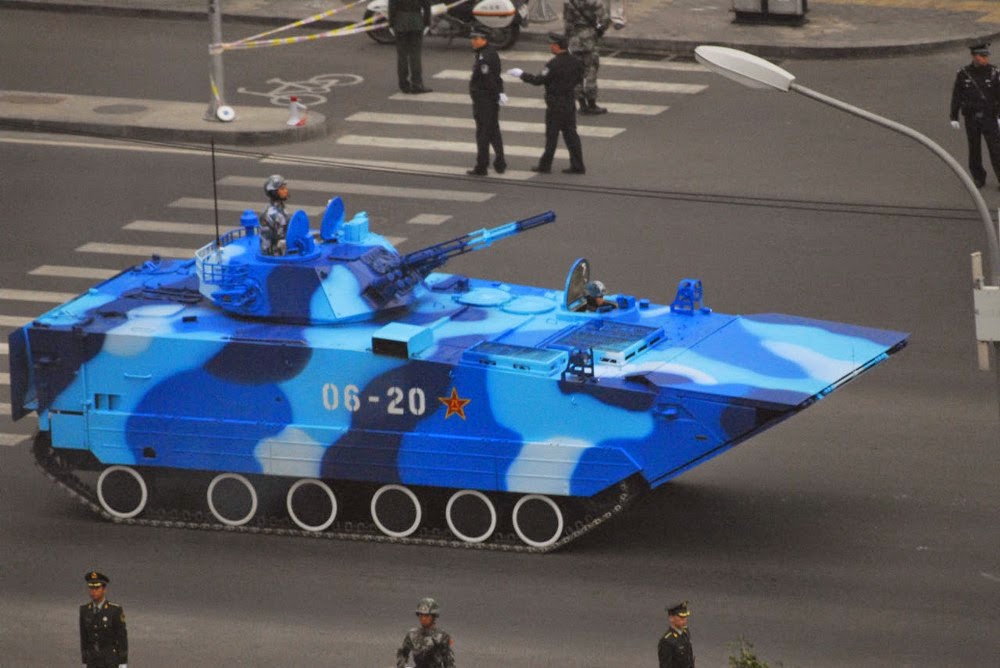
The other 7,130 Chinese tanks—some of which are pictured here—are the same descendants of Soviet T-55s that comprised Beijing’s armored force in the late 1980s … and were obsolete even then.
...
Of 1,321 fighters, only 502 are modern—296 variants of the Russian Su-27 and 206 J-10s of an indigenous design. The remaining 819 fighters—mostly J-7s, J-8s and Q-5s—are 1960s designs built in the 1970s.
...
The navy is in the best shape, but that’s not saying much. ... its first aircraft carrier Liaoning is a rebuilt Soviet ship from the 1980s.
...
Liaoning is half the size of an American Nimitz-class supercarrier and carries half as many planes. As Liaoning lacks a catapult, China’s J-15 naval fighters must use a ski ramp to take off—and that limits their payload and range.
...
Just over half of China’s 54 submarines are modern—that is, built within the last 20 years. Beijing’s modern undersea fleet includes the Shang, Han, Yuan and Song classes. All four classes are Chinese-built. All are markedly inferior to Western designs.
...
The PLAN halted production of the nuclear-powered Shang class after only building just three boats—an ominous sign. Moreover, Beijing has placed an order with Russia for up to four Kalina-class subs, signalling a lack of faith in local designs.
“China will grow old before it gets rich”... The same demographic wave that has gifted China with an abundance of labor will soon also transform the country into the world’s biggest retirement home.
... Today China has 16 retirees per 100 workers. Projections see that increasing to 64 retirees per 100 workers by 2050, resulting a much grayer population than in America.
This has indirect—but serious—implications for China’s defense. Most Chinese do not have retirement benefits and in their old age must rely on personal savings or family … a difficult proposition when there is only one child to take care of two parents.
If Beijing wants to preserve household savings and productivity, it will have to build some kind of social welfare system. And that means making some difficult choices.
China’s borders are secure. The U.S., Japan and India cannot bring down the Chinese government. But tens of millions of desperate Chinese families could do so—and just might, if Beijing can’t find some way to care for them as they age.
China has nuclear weapons. It’s ruled by a deeply nationalistic, authoritarian regime with a history of brutality towards its own citizens. It has territorial claims that clash with those of other countries—and a defense budget rising by eight percent annually. It’s wise to keep a watchful eye on China.
Yet China is a hobbled giant with many deep, systemic problems. Some of these problems—particularly the technological ones—are solvable. The demographic issue is not. And it’s the biggest reason the paper dragon does not pose a major threat to the rest of the world over the long term.

The inaugural Muhammad Art Exhibit and Contest hosted by Pamela Geller’s American Freedom Defense Initiative (AFDI) is sold out and ready for Sunday evening’s festivities. The event is billed as an expression of free speech said to be under attack from radical Islamic groups like those who attacked Charlie Hebdo in January. The exhibit will be held on Sunday, May 3, at the Curtis Culwell Center, 5-7 p.m., in the Dallas suburb of Garland, Texas.And in a fashion, Garland represents a good example about how to do it right - let ideas compete in the marketplace - in a fair and peaceful manner;
“At a time when American Muslim groups in the US should have stood up for free speech and showed the world the way forward, they chose to stand with the Hebdo jihadists,” said Geller in an January email to Breitbart Texas.
Breitbart Texas previously reported that Democratic U.S. Representatives Rep. Keith Ellison (D-MN)and André Carson (D-IN) have tried to block Dutch Parliamentarian Geert Wilders from entering the United States and appearing at the inaugural event. They co-authored a letter to Secretary of State John Kerry and Homeland Security Secretary Jeh Johnson, asking them to block Wilders’ entry.
Pamela Geller is planning a “Draw the Prophet” event in Garland, Texas in the same location as a Muslim group held a “Stand with the Prophet” conference in January. The First Annual Muhammad Art Exhibit and Contest will be hosted by the Curtis Caldwell Center, which is owned and operated by the Garland Independent School District.As usual though, when someone is insecure or knows their ideas are inferior and cannot survive a fair airing - they seek peace through removal of the other side.
Free speech aside, why would anyone do something as provocative as hosting a "Muhammad drawing contest"?
— Rukmini Callimachi (@rcallimachi) May 4, 2015
Who is Rukmini?Foreign correspondent for The New York Times, focusing on Islamic extremism. Previously, seven years in West Africa as bureau chief for The Associated PressThat is the problem we face.


... with the North Vietnamese army entering the outskirts of Saigon, a remarkable evacuation of American civilians and at-risk South Vietnamese was undertaken by a small number of CIA and military helicopter pilots.With a nation tired and distracted, a Watergate weakened Presidency, and a Democrat dominated Congress seeing a chance to force the defeat they wanted for years, the nation of South Vietnam that over 58,000 American died to defend from the persistent Communist aggression that also took the lives of somewhere in the neighborhood of 250,000 South Vietnamese military killed in action, was left to die of neglect at the hands of their brothers.
Since the airport was under attack, it was impossible to use fixed wing aircraft to evacuate the many thousands of Vietnamese allies who would surely suffer once the North took over.
Dubbed Operation Frequent Wind, pilots from Air America and several search and rescue units began to land on rooftops all over Saigon where American civilians, alerted to the evacuation by the playing of Bing Crosby’s “White Christmas” over the radio, had assembled. Vietnamese who were thought to be most at risk of North Vietnamese reprisals were airlifted from the US embassy.
All told, the few dozen pilots, flying in some cases for 14 hours straight, managed to evacuate more than 7,000 people.
Forty years ago this week Luong's father, a South Vietnamese Marine major, called an urgent family meeting at their home in Saigon, now known as Ho Chi Minh City. The city, his father told them, soon would fall to the North Vietnamese — the communist forces he was helping the Americans fight.Head on over to NPR and read it all - and listen to the interview.
They sat around the table — father, mother, seven sisters and Luong, then age 9.
"My sisters actually had a very strong opinion — like 'we need to stay until we find a way out as a family,' " he recalls.
His father worried they wouldn't be able to escape together. He suggested Luong, the only boy, and one of his sisters should flee the country in the hopes the family could be preserved.
"I was depressed! I didn't want to get sent to — you know, to the U.S. I didn't want to ... my dad, to go to the jungles," he says, his voice catching in his throat. "It was pretty tough, as a kid."
They were helped by an American reporter who was a friend. Luong still remembers the night he came to give the entire family official government papers that would get them into Tan Son Nhut Air Base, just north of Saigon. From there, they'd be taken out of Vietnam.
"It's like, 'OK, pack your stuff — do not talk to any of your friends, just pack some clothes,' and his driver snuck us out at night," Luong says.
Soon after the family arrived at the air base, rockets and mortars started landing.
"Yeah, it was close enough where I can hear people groaning from getting hit," he says.
The general stops for a moment, and looks down. His eyes begin to fill with tears.
"I was lying then on my stomach," he says. "We're Catholics, so I was saying my Hail Marys, you know. And uh ... and so we were scared, so my dad looked up and said 'look — don't be afraid.' He said 'you're missing out on a monumental moment in history,' right? 'You need to be able to see what's going on.' So that calmed us down for a little bit, but it was really hopeless until the Marines came in."
On April 29, 1975, the family boarded a Marine helicopter and headed out to the South China Sea. When they landed on a U.S. carrier, Luong was disoriented.
"I still remember that moment to this day, because as soon as we landed I looked at my dad and I said, uh, I said 'Dad, where are we at?' And he looked at me and he says, 'hey, we're aboard the American carrier USS Hancock.' And I say, 'well, what does that mean?' And he looked at me and he said, 'that means nothing in the world can harm you now.' "
 .
.


“Was it inevitable that Iraq would disintegrate?” I asked Rafi. No, it was not, he assured me. Iraq had been moving in a positive direction after the surge. This downward trajectory began in 2010 when the United States had not upheld the right of Iraqiya to have first chance at trying to form the government after it won the elections. “We might not have succeeded,” he admitted, “but the process itself would have been important in building trust in Iraq's young institutions.”I remember how close it was in 2007 to keep it all together, but we did.
Bad decisions taken by Americans in 2010 destroyed the country, he believed. Since then, Obama had regularly cited ending the war in Iraq as one of his greatest foreign policy successes. On Nov. 1, 2013, with Maliki by his side in the White House, Obama stated: “We honor the lives that were lost, both American and Iraqi, to bring about a functioning democracy in a country that previously had been ruled by a vicious dictator. And we appreciate Prime Minister Maliki’s commitment to honoring that sacrifice by ensuring a strong, prosperous, inclusive and democratic Iraq.” He appeared to be paying scant attention to Maliki’s growing authoritarianism and the deteriorating situation in the country.
...
The Iraq war—and the way in which the United States departed—tilted the regional balance of power in Iran’s favor. Iran, Saudi Arabia, and other states in the region all sought to project their influence by supporting sectarian actors in different countries—with devastating consequences.
...
Nothing that happened in Iraq after the overthrow of Saddam Hussein in 2003 was preordained. There were different potential futures for the country.
The Iraq war and its outcome affected few Americans. There is little willingness to reflect on or take responsibility for what happened there. Politicians try to use the situation in Iraq for political advantage, without much consideration of actual Iraqis; Democrats blame Republicans for invading Iraq in the first place and Republicans blame Democrats for not leaving troops there.
But what happened in Iraq matters terribly to Iraqis who hoped so much for a better future—and to those of us who served there year after year. If we refuse to honestly examine what took place there, we will miss the opportunity to better understand when and how to respond to the world’s instability.