I've been left a bit cold.
So, in honor of the 20th anniversary of one of the greatest achievements in cinema, I give you a good representation of me watching International Women's Day.


News reports indicate that the Chinese Communist Party (CCP) stands poised to amend China’s constitution to cancel term limits for the presidency. Presumably the related custom that the CCP general secretary must surrender power at a given age will give way as well. If so, abrogating term limits will let Xi Jinping remain the party supremo and China’s president so long as he deems fit. “Essentially,” contends Professor Willy Lam of the Chinese University of Hong Kong, Xi has “become emperor for life.”This next move is just bizarre;
The China Digital Times, a California-based site covering China, reports a list of terms excised from Chinese websites by government censors includes the letter 'N', Orwell's novels Animal Farm and 1984, and the phrase 'Xi Zedong'.The letter "N?" How do you ban a letter?
The latter is a combination of President Xi and former chairman Mao Zedong's names.
Search terms blocked on Sino Weibo, a microblogging site which is China’s equivalent of Twitter, include “disagree”, “personality cult”, “lifelong”, “immortality”, “emigrate”, and “shameless”.Well, I guess we need to start using that letter a lot more.
It was not immediately obvious why the ostensibly harmless letter ‘N’ had been banned, but some speculated it may either be being used or interpreted as a sign of dissent. ...,
Facebook, Twitter and YouTube have long been blocked in the country and even Winnie the Pooh recently found himself subject to China’s latest internet crackdown.
In July, references to the cartoon bear on Sina Weibo were removed after his image was compared to President Xi.
A right-wing alliance led by former Prime Minister Silvio Berlusconi's Forza Italia took the lead in Italy's general election, according to preliminary results published Monday morning, but the country now faces a hung parliament and a struggle for power.Immigration, again, is the driving force of elections. The temperature is continuing to rise, and as the political establishment in Europe refuses to act, expect more "fringe" parties to move to the front.
Forza Italia, the far-right Northern League and Brothers of Italy together took about 37 percent of the vote, followed by the euroskeptic 5-Star Movement (M5S) with about 32 percent.
Sweden is shutting down websites.Yes, I know - the SD. In 2010 they entered the Swedish Parliament for the first time with 5.7% of the vote. The last election? 12.9%. The #1 party 31%, the #2 23%. SD is a fringe party no longer. Since the last election, they have even polled on top.
The Swedish government has moved to shut down the website of a far-right political party's newspaper over cartoons of the Prophet Muhammad.Don't worry Laila, they will cut off you head last. Just try to find their site.
The site's host, Levonline, pulled the plug on the website of the Swedish Democrats' SD-Kuriren newspaper after consulting with the government.
It is believed to be the first time a Western government has intervened to block a publication in the growing row.
...
His website briefly posted a picture showing Muhammad from the rear, looking into a mirror, with his eyes blacked out - an image he said was about self-censorship.
...
Swedish Foreign Minister Laila Freivalds described Kuriren's move as "a provocation" by "a small group of extremists".
"I will defend freedom of the press no matter what the circumstances, but I strongly condemn the provocation by SD-Kuriren. It displays a complete lack of respect," she said in a statement.
...
Europe has a long history of giving in to aggressive, angry cultures and armies. They also have a history of the people being sold out by their rulers. This time, though, something tells me that the people won't let them. I hope so. America can only absorb so many refugees, you know.
3.3 mil. Iraqi settle in the US - more on the way...and imagine that most of them want to settle in Washington D.C. and LA. Chew on that for awhile - because proportionally, that is where Sweden is right now.That was written well before the latest wave of migrants brought in to Europe by the irresponsible Chancellor of Germany.
...
Sweden has a huge problem on its hands - and it has no one to blame but themselves.
It is a war where we must have the courage to stand up for the basics of freedom. That is where the cancer of Diversity and PC thought hurts so much. It promotes self-doubt and self-loathing. Self-doubt and self-loathing is where cultural bullies with a political mindset - Fascists and Communists are/were best at this kind of stuff - flourish.The left continues to try to squelch free speech not just in Europe anymore, but here as well. This will only strengthen the fringe. Where do you think Trump came from?
What happened to Swedish cartoonist Lars Vilks is a perfect example.
...
If the West's weak-willed, self-loathing Left and Center-Left does not start standing up - the Islamists will push harder and harder. Over time, more of the indigenous center of the countries under pressure will look for other places to defend their freedom. They will start to make our buddy Outlaw Mike look like a Social Democrat.
The West's options are simple. Defend yourself now and those like Lars Vilks and the late Theo Van Gogh, submit to Sharia, or wait for open social conflict where blood will blow and bodies will lie rotting in the open.
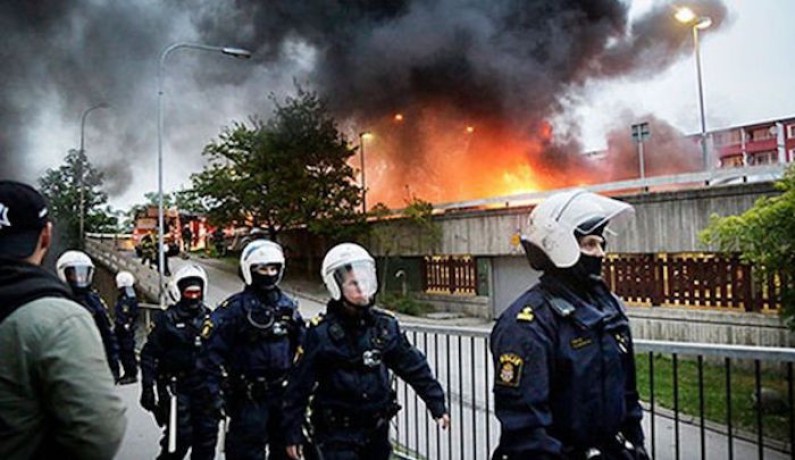
Sweden’s gang violence, long contained within low-income suburbs, has begun to spill out. In large cities, hospitals report armed confrontations in emergency rooms, and school administrators say threats and weapons have become commonplace. Last week two men from Uppsala, both in their 20s, were arrested on charges of throwing grenades at the home of a bank employee who investigates fraud cases.That is significant for NYT.
An earlier jolt came with the death of Mr. Zuniga, who on Jan. 7 picked up the grenade, which the police believe had been thrown by members of a local gang targeting a rival gang or police officers.
...
Like many of his neighbors in Varby Gard, Mr. Borisho had sought asylum in Sweden to escape a war. He knew what a grenade sounded like. As a commando in a Lebanese militia, he had handled grenades, and remembered the strict protocols he complied with, locking up the weapons for safe keeping the minute he returned to camp.
That a grenade should be found on the sidewalk outside a kebab shop, a few steps from an elementary school, was difficult for him to take in.
“Now, when I think of the future, I am afraid,” he said. “I am afraid for Europe.”
...
The police are struggling to gather information in immigrant neighborhoods, and clearance rates for gun homicide cases have fallen steadily since the 1990s.
“We have lost the trust from the people who lived and worked in this area,” said Gunnar Appelgren, a police superintendent and specialist in gang violence.
Sweden’s far right-wing party blames the government’s liberal immigration policy for the rising crime, and will thrust the issue to the fore in the fall campaign.
Last year, Peter Springare, 61, a veteran police officer in Orebro, published a furious Facebook post saying violent crimes he was investigating were committed by immigrants from “Iraq, Iraq, Turkey, Syria, Afghanistan, Somalia, Somalia, Syria again, Somalia, unknown country, unknown country, Sweden.” It was shared more than 20,000 times; Mr. Springare has since been investigated twice by state prosecutors, once for inciting racial hatred, though neither resulted in charges.


In March 1804 two of the ships tasked with watching the Vlie to prevent Netherlands privateers slipping out into the North Sea, were the sloops-of-war HMS Scorpion and HMS Beaver. The Scorpion was under the command of Commander George Nicholas Hardinge (1781 – 1808) who, though only twenty-three, had already accumulated a notable service record and promised to merit high command. The recently constructed Scorpion was one of the first of the Cruizer class of brig-rigged sloops, 106 of which would enter service by the war’s end. Of only 100-ft length and 382-tons, these proved enormously successful. With a crew of only a hundred men, these vessels were so heavily armed – typically with two 6-pounder long-gun bowchasers and no less than sixteen 32-pounder carronades – that they could deliver a broadside-weight comparable to that of a frigate, but with a third of the manpower. Command of such a vessel – which Hardinge had succeeded to two years before (at the age of twenty-one!) – was a prize that all young officers would aspire to.
On 28th March, patrolling north of the Vlie, Hardinge spotted two Dutch corvettes – heavily armed brigs – at anchor deep inside the waterway. Lacking detailed knowledge of the shoals flanking the approach, he realised that direct attack by the Scorpion must be ruled out. With sufficient men available, a cutting-out operation might be feasible, but Scorpion’s crew alone would be insufficient to provide the necessary numbers. Three days later however, on March 31st, the Scorpion was joined by the Beaver, the commander of which, Charles Pelly, was as enthusiastic as Hardinge about a cutting-out operation, for which there were now sufficient men.
...
Five pulling boats, carrying some sixty men between them, left the British ships in darkness at nine-thirty in the evening, rowing with the flooding tide. These men would have been mainly armed with cutlasses, pikes and boarding axes while officers and petty officers would have carried pistols in addition to their own swords or cutlasses. Describing himself to his father as “your humble servant”, Hardinge was in the leading boat. Undetected, the boats reached the nearer of the enemy vessels, which proved to be the Atalanta, a vessel generally similar to the Scorpion herself. Hardinge was to write that “I had the good fortune, or, as by some it would be considered an honour, to be the first man who boarded her. She was prepared for us, with boarding nettings up, and with all the customary implements of defence; but the noise, and the alarm etc., so intimidated the crew, that many of them rushed below, leaving to us the painful duty of combatting those whom we most respected.”
The scene must have been a nightmarish one, all the more so in view of the darkness and the narrow confines of the deck on which hand-to-hand combat took place. Hardinge wrote that “the decks were slippery, in consequence of rain, so that, grappling with my first opponent, a mate of the watch, I almost fell, but recovered my position, fought him on equal terms, and killed him.” He was now confronted by the Atalante’s captain, regrettable unidentified in the letter, whom he described as being “as brave a man as any service ever boasted; he had almost killed one of my seaman; to my shame be it spoken, he disarmed me, and was on the point of killing me. When a seaman of mine came up, rescued me at the peril of his own life, and enabled me to recover my sword.”
By this stage the boarders were largely in control of the deck and two of them now attacked the Dutch captain. Hardinge however “ran up, held them back, and then adjured him to accept quarter.” Heroically, though unwisely, the captain refused. “With inflexible heroism he disdained the gift, kept us at bay, and compelled us to kill him: he fell with honourable wounds.”
...
Hardinge now has possession of the Atalanta. “The vessel was ours, and we secured the hatches, which, headed by a lieutenant wo had received a desperate wound, they (i.e. the captured crew below) attempted repeatedly to force. Thus far we had been fortunate; but we now had anther enemy to fight, it was the element. A sudden gale, in which the wind shifted against us, and impeded all the efforts we could make.” Hardinge was undeterred however. “As we had made the capture, we determined at all events to sustain it, or to perish. We made the Dutch below to surrender, put forty of them in irons, stationed our own men to their guns, brought the powder up, and made all necessary arrangements to attack the other brig. But as the day broke, and without abatement of the wind, she was at such a distance, and in such a position that we had no chance to reach her.”
Forty-eight hours passed. “Two of the boats had broken adrift from us, two had swapped alongside. The wind shifted again, and we made a push to extricate ourselves, but found the navigation so difficult that it required the intense labour of three days to accomplish it. We carried the point at last, and were commended by the Admiral for our perseverance. You will see in the Gazette my letter to him.” The Atalante had suffered five killed, including the captain, and eleven wounded.
...
Hardinge’s success was rewarded with immediate (ten days after the attack) promotion to coveted post-captain rank, one of the few who attained this at such a young age. For all his courage, chivalry and promise, his subsequent career was to be tragically short. While in command of the old frigate HMS St Fiorenzo in the Indian Ocean in 1808, he was killed in the course of an epic three-day battle with the French frigate Piémontaise.

Did American and Russian forces just engage in a deadly clash in Syria, and was that clash the direct result of a Putin-approved effort to test American defenses? While Americans were arguing over Russian Facebook posts, did American air power and artillery leave up to 300 Russians dead on a Syrian battlefield?There are a lot of good reasons for both parties to downplay this lopsided battle.
Here’s the basic chronology.
On the night of February 7, “pro-regime” Syrian forces reportedly launched an assault on a “known” American base. American forces defended themselves with attack helicopters, jets, and AC-130 gunships, and the attackers withdrew after taking significant casualties.
That next week, on February 12, Reuters reported that at least two Russians died in the fighting, according to their associates. The Russian casualties were apparently contractors accompanying regime forces. By February 13, both the Washington Post and New York Times had picked up the story, and the number of rumored Russian dead swelled to “large numbers” or “dozens,” but — we were assured — there was no direct confrontation between Americans and members of the Russian military.
As rumors swirled online that the true number of Russian dead numbered in the hundreds, the Washington Post published a report suggesting that the attack on U.S. forces may have had official Russian backing:
...
Monday, Business Insider published unverified transcripts of “leaked audio recordings” from Russian mercenaries on the scene. The mercenaries describe a violent hellscape, where they were sitting ducks as American artillery and aircraft killed more than 200 of their comrades.
The alleged transcripts certainly make for vivid reading. Here’s a taste:
The reports that are on TV about … well, you know, about Syria and the 25 people that are wounded there from the Syrian f*** army and — well . . . to make it short, we’ve had our asses f*** kicked. So one squadron f*** lost 200 people … right away, another one lost 10 people . . . and I don’t know about the third squadron, but it got torn up pretty badly, too. . . . So three squadrons took a beating. . . . The Yankees attacked . . . first they blasted the f*** out of us by artillery, and then they took four helicopters up and pushed us in a f*** merry-go-round with heavy caliber machine guns … They were all shelling the holy f*** out of it, and our guys didn’t have anything besides the assault rifles . . . nothing at all, not even mentioning shoulder-fired SAMs or anything like that . . . So they tore us to pieces for sure, put us through hell, and the Yankees knew for sure that the Russians were coming, that it was us, f*** Russians . . . Our guys were going to commandeer an oil refinery, and the Yankees were holding it. . . . We got our f*** asses beat rough, my men called me . . . They’re there drinking now. . . many have gone missing . . . it’s a total f*** up
...both Russia and the United States are downplaying the incident. If the Russians were testing American will, they got their answer, but there appears to be no American desire to retaliate or to escalate the confrontation into a full force-on-force encounter. This is encouraging, but not entirely comforting. When blood is spilled, the consequences are not always predictable or controllable.We need to start disengaging from Syria. Our point with the Russians and others has been made. If everyone can keep things in the bottle for now, we can happily leave with honor.
Second, the situation in Syria is extraordinarily dangerous. It’s understandable that international eyes are focused on North Korea, but consider this: If reports of hundreds of Russian dead are correct, the American military just killed more Russians than it did in any single encounter throughout the entirety of the Cold War. That’s stunning. At present, a few thousand American troops are in the midst of the world’s most vicious war, rubbing up against hostile Russians, Syrians, Turks, Iranians, and Lebanese. Confrontations are inevitable. Proper management of those confrontations is not.


