Showing posts sorted by date for query reload. Sort by relevance Show all posts

Tuesday, March 28, 2023

In a Fight, Having Your Reloads at Home in the Safe Won't Help


There was a topic as a JO in the 1990s that we bandied about when we started to think about what we wanted to see show up in the fleet before we had to fight a no kidding war at sea for any length of time.

Of course, at the end of the Cold War when "there was no other place I'd want to be" was in the air with the world waking up from history etc ... no one was really interested in spending the shrinking Clinton Era defense budget on something that, at best, maybe should be on the bottom of the unfunded priorities list from the perspective of the Potomac Flotilla.

At the end of the decade and the experience of Desert Fox, the requirement came in to even sharper relief. With the 330+/- TLAM we fired over those few days, we emptied out one DDG's VLS cells of TLAM and left the remaining DDG, DD, and CG with a land of misfit toys with either "interesting" warheads that we did not have good targets for, or were fail-to-fire duds taking up space.

That was just the surface ships. Though the Persian/Arabian Gulf's floor was littered with tube-launched TLAM that failed to fire at a silly rate - a few of them were left along with the handful that had VLS cells with one or two, but were pretty much emptied as well.

We were, in just a few days a spent force except for the ships in the Mediterranean Sea  whose TLAM we underutilized but would come in handy in Kosovo. 

More strikes? With what exactly? Call a training time out for a few weeks?

No, we were lucky it was only a 72-hr war or so.

We knew we would not be that lucky at some point in the future ... or at least should plan for it.

This shortfall was known a decade prior - even earlier I am sure - yet in at the end of the 20th Century, there was no longer a way to deny it, but we did anyway.

And yet, via Megan Eckstein at Defense News, here we find ourselves in the third decade of the 21st Century ... 

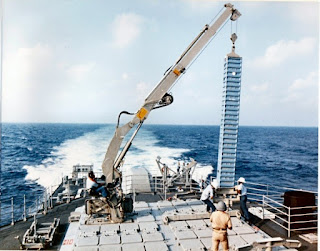
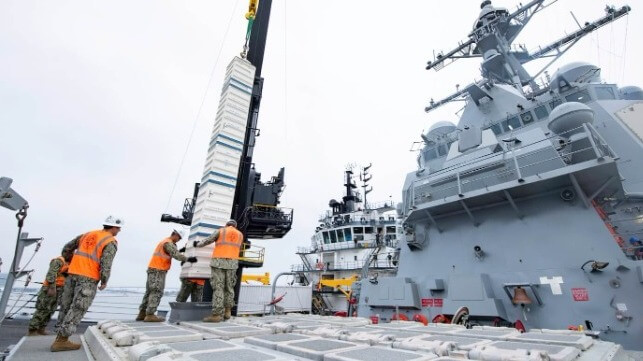
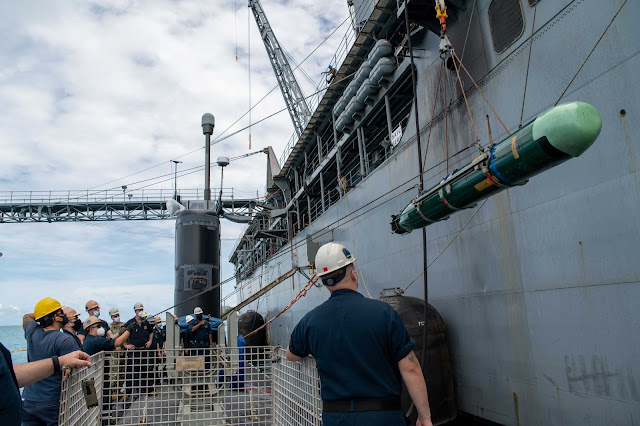
In early October, the U.S. Navy reloaded a destroyer’s missile tubes using a crane on an auxiliary ship pulled alongside the destroyer, rather than a crane on an established pier.

Reloading a vertical launching system, or VLS, is a challenging maneuver, given the crane must hold missile canisters vertically, while slowly lowering the explosives into the system’s small opening in the ship deck.

It’s also a maneuver the Navy cannot yet do at sea. This demonstration took place while the destroyer Spruance was tied to the pier at Naval Air Station North Island, as a first step in creating a more expeditionary rearming capability.

But in the near future, that same evolution between a warship and an auxiliary vessel could take place in any harbor or protected waters around the globe. One day, it may even take place in the open ocean, thanks to research and development efforts in support of a top priority for the secretary of the Navy.

Ponder for a second and then I want you to bring to mind the geography of the Pacific to get ready for the next paragraph; 

Carlos Del Toro is eyeing this rearm-at-sea capability as one of a handful of steps the service must take to prepare for conflict in the Pacific; other steps include strengthening logistics capabilities and identifying foreign shipyards that could conduct repairs to battle-damaged ships.

Today, the Navy’s cruisers and destroyers can only load and unload offices at established piers with approved infrastructure. For the Pacific fleet, these reload sites are in Japan, Guam, Hawaii and California.

In any large conflict in the Western Pacific, we can pretty much plan on most, if not all, of the facilities in Japan and Guam not being usable for an undetermined period of time. 

What option does that give us? That's right - transit all the way to Hawaii or the West Coast to rearm.

That isn't just unacceptable - that is almost a criminal in 2023.

More and faster please. As our friend Brian McGrath likes to say; winter is coming. 

Tuesday, December 27, 2022

No Sense of Urgency to Act on What is Waiting West of Wake

The greatest threat to security in the Western Pacific is not the rise of China, certainly isn't the moribund Russians - or even a combination of the two. No, the greatest threat to security west of Wake is the American national security establishment.

The two pillars of its dysfunction are intellectual and institutional.

Intellectually we continue to allow The Smartest People in the Room™ to blissfully live in a world of happy talk to themselves, each other, and their nation. It is as if they live in a world of the military FITREP where you write your own review in the adult version of Lake Wobegone ... where all the children are above average.

Via Phelem Kine and Lara Seligman over at Politico this AM;

The U.S. has pledged to deploy so much firepower to the Indo-Pacific in 2023 that China won’t even consider invading Taiwan. Lawmakers and allies say it’s already too late.

The promise is a big one: “2023 is likely to stand as the most transformative year in U.S. force posture in the region in a generation,” Ely Ratner, assistant secretary of defense for Indo-Pacific security affairs, said in early December.

Nothing personal here. I am sure Ely is a nice guy. A PhD in, ahem, Political Science from, ahem, UC Berkely, and a life spent in politics, academia, and the usual holding-pen think tanks ... but clearly a smart guy and a good staff weenie ... but seriously; he doesn't believe that. No one with any knowledge of the People's Republic of China believes that. No one with even a thumbnail understanding of the US military's readiness for sustained peer conflict believes that.

More importantly, no one in the PRC believes that.

Happy talk and spin is fine in domestic politics, fund raisers, and giving hope to the rubes, but it takes years to get a military ready for sustained combat on the other side of the globe. We barely held our own until early 1943 against Imperial Japan and we started getting serious seven years earlier in 1936.

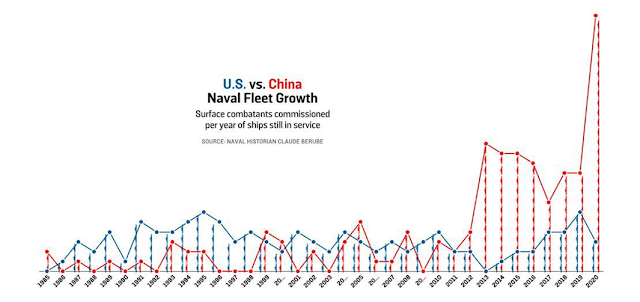
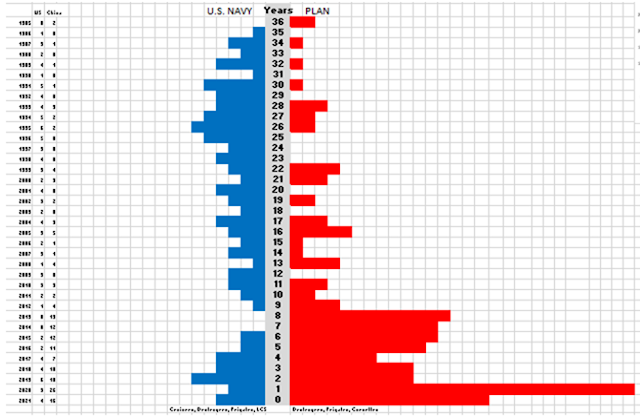
While we struggle to maintain a steady state fleet, the PRC's navy grows.

I guess it is time to put up Claude Berube's graphs again.


They have vastly outbuilt us in the past 10 years. Yes, that red line is China’s shipbuilding versus the blue of the us navy.

That is the truth. That is why when we try to force-mode domestic political happy talk to the international stage we are looked at as not just lying - but being quasi-delusional.

At least there are some people with access to levers of power who know what time it is.

“We have a rhetorical commitment to a force posture change in the Indo-Pacific, but that’s belied by the reality of what’s actually happening,” said Rep. Mike Gallagher (R-Wis.), who will become chair of the new House Select Committee on China in the next Congress. He called Ratner’s assertions the military planning equivalent of “whistling past the graveyard.”

The gentleman from Wisconsin is too kind. 

We cannot afford more happy talk - more "transformational" bullsh1t from people who should know better. They need to be called out on every occasion they try to cropdust the intellectual space people are trying to cultivate towards meeting this decade's challenge. The Terrible 20s are going to be terrible, but we can mitigate the degree of that terribleness. Some progress is being made, but more pressure is needed.

Now let's loop back to the second part of today's post mentioned at the start; institutional dysfunction.

Notice the 1936 to 1943 timeline above? Seven years that didn't bring in just new systems, but generational development in everything from carrier air whose fighters went from the Brewster Buffalo to the Grumman Wildcat, to Hellcat; submarines advanced through six different classes from Salmon to Balao; land based heavy bombers went from the Martin B-10 through the Boeing B-17 to a year later the B-29 deploying. 

You get the idea.

Remember back in October?

The U.S Navy has tested out a new way of rearming its warships with a trial vertical launch system (VLS) reload in San Diego. 

In a test evolution, the crane-equipped OSV Ocean Valor conducted a VLS reload with guided-missile destroyer USS Spruance, an exercise intended to prove out a new way to reload guided missile destroyers in sheltered waters. Sailors aboard the Arleigh Burke-class destroyer successfully lowered training ordnance into the ship’s forward VLS cells in a proof-of-concept evolution.

...

The exercise was aimed at proving that an OSV can reload the weapons system pierside, with the goal of expanding the capability of VLS reloading in expeditionary environments. The launch system reload has been tested previously in 2016 and 2019 using other MSC vessels but has never been tested using a relatively small OSV as the delivery platform. 

A VLS reload alongside the pier is substantially less challenging than a VLS reload in an open seas, underway replenishment scenario. Previous Chief of Naval Operations Adm. John Richardson signaled an interest in bringing back underway VLS replenishment in 2017, but the operation has rarely been performed in practice - even on Ticonderoga-class cruisers, which were designed with this evolution in mind. 

The TICOs were designed in the 1970s - pretty much half a century ago - roughly the same amount of time that the Spanish-American War was to 1943.

Let that soak in.

Now let's go back to July of 2017, just five and a half years years ago +/-. You know, roughly 1.5 WorldWars as we defined this program management period of time in 2015. For you pedants out there, it is 1.46 WordWars to be exact.

Here's what we discussed 1.46 WordWars ago;

The U.S. Navy is looking to restore its ability to reload its ships’ vertical launch systems at sea, which could be a dramatic logistical game changer in the planning and execution of high-intensity contingencies against peer competitors.

...

After discussing the means by which the Navy seeks to ensure its forward-deployed naval forces remain survivable and up-to-date with the latest tactical and technological innovation, Admiral Richardson said in reference to vertical launch system (VLS) underway replenishment, “we’re bringing that back.”

Since its operational debut in 1986 aboard the sixth Ticonderoga-class cruiser, USS Bunker Hill, the Mark 41 vertical launch system and its successor the Mark 57 have become the main battery of the preponderance of the Navy’s surface fleet, while the Mark 45 has become the principal means of deploying cruise missiles aboard submarines. Vertical launch systems are among the most adaptable weapon mounts that the Navy fields, allowing a ship to carry a variety of defensive and offensive missiles in the same shipboard infrastructure, and to fire them in rapid succession.

Well, we don't have this back.


But we are playing around 1.46 WorldWars later with this;

If it appears that the military acquisitions process and the bureaucracy that keeps it running is not quite what one needs to get ready for war, you're right.

It is nowhere near fit for purpose.

Reloading VLS is not a new concept - it is over a half century old. We got rid of it because the short-war uni-polar world would rather have those VLS cells with missiles to blow up parked clapped out Toyota Hilux with 23mm 1960s era manual guns mounted on the truck bed.

In our Lotus Eater stupor we allowed our land based facilities come under the range of our enemy's rocket artillery from Japan to Guam. That luxury is history. We cannot cruise back to the West Coast or Hawaii to reload. We need to do it at sea - now.

Here is where we need to start playing hardball. Our chattering classes are lost in a soup of onomastic happy talk that enables each other to avoid hard work, and our accretion hobbled acquisitions force is designed mostly to ensure funding lines and job protection in a peacetime uni-polar world.

That is long past. As useful as midnight basketball is to domestic politics - a reference someone with a PhD from UC Berkely should understand.

Tuesday, November 02, 2021

Nine Years is a Long Time

I think this is going to be tender week ... as my post tomorrow will be on the same topic.

I want you to think about 2012. Yes, it was nine years ago. Obama was running for re-election against Mitt Romney. 

The #1 song of that year was "Somebody That I Used to Know" by Gotye featuring Kimbra.

ISIS, in its present name, did not yet exist for another year.

It also was the last time...

The submarine tender USS Frank Cable (AS 40) completed a weapons handling exercise involving the transfer of a MK-48 inert training shape to a submarine, Oct. 22. This was the first expeditionary reload Frank Cable has conducted outside of Guam since 2012.


OK. Here is a question I hope someone in Congress askes next time a 4-star comes in front of them.
“This exercise was instrumental to developing the expeditionary combat capabilities that our submarine tenders and submarines bring to the Pacific theater,” said Capt. Albert Alarcon, Frank Cable's commanding officer. “Every training opportunity helps assure our readiness for any contingency.”
So, all that talk about a Pacific pivot. All that talk about the, correct, primacy of our SSN fleet in any engagement west of Wake ... all that ... talk ... 

...and yet we did not conduct an evolution that will be essential for any sustained war effort in the Western Pacific.

Why?

I know there is message traffic on this. I know there is a reason ... but as a profession we need a serious conversation on why this was not done until ... 1QFY22.

Friday, September 06, 2019

Fullbore Friday

It hasn't even been a year, but given the interest in yesterday's post ... time to reload a FbF.

Earlier this month, there was a lot to discussion about drydocks.

How important are they in wartime? Well, all you need to do is to look at one of the great acts of WWII, via Michael Hull at Naval History magazine; The Sacrifice at Saint Nazaire;
The port contained an enormous wet and dry dock—built in peacetime for the 82,800-ton French luxury liner Normandie—that was the only facility on the Atlantic coast where the German Navy could accommodate its two biggest battleships, the 42,900-ton Tirpitz and 41,700-ton Bismarck. The Royal Navy had sunk the latter on 27 May 1941 after an epic chase, but the Tirpitz, operational since mid-January 1942 and a prime threat to the British, was lurking in the fiords of Norway.
...
The chosen plan, drawn up in strict secrecy, called for an old destroyer laden with explosives to ram the steel outer lock gate, or caisson, of the Normandie dry dock and then be scuttled. Three eight-hour fuses on board would detonate the charges. The operation was to involve a 300-mile sea voyage and a five-mile run up the Loire estuary.

The destroyer chosen for the raid was the 1,090-ton HMS Campbeltown, formerly the USS Buchanan (DD-131). She was one of the 50 four-stack, flush-deck World War I–era destroyers turned over to the Royal Navy by the Roosevelt administration in September 1940 in exchange for British bases in Bermuda, the West Indies, and Newfoundland. For her “Trojan horse” role, the decrepit, flimsy vessel was heavily modified, in part to reduce her displacement enough to allow the ship to traverse the Loire estuary’s shallows and avoid its more heavily defended channel. The destroyer’s explosive charge consisted of 24 400-pound depth charges concreted in a specially built steel compartment below her foredeck. She also would carry two assault and five demolition teams of Commandos.

The raiding force assembled in the Cornwall port of Falmouth on the craggy southwestern tip of England. Besides the centerpiece Campbeltown, the vessels comprised a motor gunboat (MGB-314), a motor torpedo boat (MTB-74), and 16 unarmored motor launches. Manned by 346 naval personnel, the boats and destroyer were to carry 265 Commandos armed Bren light machine guns, Thompson submachine guns, hand grenades, and explosive charges. The vessels would be escorted by the Hunt-class destroyers Atherstone and Tynedale, which would remain outside the estuary, and additional support was to be furnished by the destroyers Cleveland and Brocklesby.
...
Shortly after 0100 on 28 March, Mecke received a warning that unlighted ships were sailing up the Loire estuary leading into the Saint-Nazaire harbor. Rushing to an observation post, he squinted through a telescope and discerned the dark shapes of about 15 vessels. Captain Mecke called for searchlights to be switched on, and Ryder’s flotilla was outlined brightly.

The Kriegsmarine officer was hesitant to give an order to open fire because one of the intruding vessels, the Campbeltown, appeared to be German, but the others did not. Yet all were flying German flags. He ordered a shell to be fired across the bow of the leading craft, and moments later the British fired a green flare that split into three red stars, the German recognition signal.

Flanked by enemy guns on both sides of the Loire, the flotilla moved carefully between mudflats and sandbanks, churning steadily onward. It was less than a mile from the Normandie dock at 0130 when the German batteries opened up with a deafening roar. While flotilla guns fired back, the German flags were rapidly lowered and replaced by Royal Navy ensigns. The British deceit had paid off, and the raiders had managed to penetrate the enemy lair before being identified as hostile.
...
Standing calmly on the bridge while tracer fire hissed around him, Commander Beattie could see the dock clearly outlined by the searchlights’ glare. “Full speed ahead!” he shouted. “Prepare for ramming!” Rocked by the shells, his vessel lurched toward the massive dock gate as flame, smoke, and flying debris filled the air. Closer and closer went the Campbeltown at 15 knots until, with a grinding crunch, she slammed into the gate dead center. Ten yards of her bow was sheared open like a tin can, but she came to rest with her forecastle hanging over the heavily damaged caisson.

The jarring impact knocked the seamen and Commandos down. The unruffled Beattie scrambled to his feet and remarked to the officers on the bridge, “All right, here we are.” Glancing at his wristwatch, which read 0134, he added with a hint of disappointment, “Four minutes late.” The Commandos swiftly clambered down her sides. The gallant Campbeltown had fulfilled her sacrificial duty, and her crew disembarked after the Commandos as Saint-Nazaire Harbor became an inferno of exploding shells, smoke, and tracer streams.
...
Within half an hour of the Campbeltown’s ramming, they had destroyed the dry dock’s machinery and mechanisms. They also disabled the winding gear of the gate, but their efforts to attack the U-boat pens were unsuccessful.

Pandemonium in Saint-Nazaire
With their mission completed, the Commandos regrouped to take a breather and tend their wounded. Under increasing enemy fire, Lieutenant Colonel Newman and the 150 weary men he had left took up a defensive position behind some trucks near the embarkation point, the port’s Old Mole. They waited patiently for the motor launches to return, but none arrived. As the minutes passed, it became all too clear that they were marooned in Saint-Nazaire and surrounded by thousands of Germans. The Commandos were not surprised; they had been warned that their chances of getting away were slim at best.

Newman ordered his men to split into small groups and try to slip or fight their way to the countryside and then work their way south to neutral Spain or Portugal.
...but there is a lot more to the story from there. Read the whole thing.

UPDATE: Superb tip by Bill in comments. You simply must watch Jeremy Clarkson's special on the raid.


Friday, April 20, 2018

Fullbore Friday

When does your service end? When is it time to call war a young man's responsibility and ride out the storm with hope from a distance?

Well, ask yourself, had this man done his duty?
Samuel Whittemore was born in England on July 27th, 1695, and came to North America as a Captain in His Majesty's Dragoons, fighting the French in 1745. He was involved in the capture of the French stronghold, Fort Louisburg, and there captured a decorative french officer's sword, which he cherished for the rest of his life. About its capture, all Sam would say is that its previous owner had "died suddenly".

After the war he stayed in the colonies, purchasing a farm in Menotomy (now Arlington, Massachusetts). He married Elizabeth Spring, and after her death remarried to Mrs. Esther Prentice. By his two wives he had three sons and five daughters. His house, on Massachusetts Avenue, in Arlington, still exists.

In 1758, war again broke out between England and France. And again, Fort Louisburg had to be taken. At 64 years of age, Sam volunteered and joined a Colonial Regiment which reduced the fort to rubble. He then went on and joined General James Wolf in the successful assault on Quebec.

The 1763 Indian Wars in the west next attracted Sam's attention. Leaving his wife, children and grandchildren to attend the farm, he rode off to join the colonial force launched against the Ottawa chief, Pontiac. He returned home some months later with a brace of dueling pistols as a souvenir, and here again, all Sam would say is that the previous owner "died suddenly."
At a time when he was already well past his expected life span at 80, there was a new threat to his adopted home.

What is a man to do?
... (on the) night of April 19th, 1775) he watched as Colonel Smith led his column of 700 soldiers through Menotomy. He was probably concerned, but the British had come out of Boston before and there had not been any serious trouble. Later that morning he heard rumors that there had been fighting at Lexington and Concord. But, when General Percy marched through the town with an additional 1,400 soldiers, Sam's military experience told him there was serious trouble ...

Word had come to Menotomy that the combined, heavily engaged, columns of Smith and Percy were retreating toward the town, and were burning homes along the way, so the aged warrior decided to take action in spite of his being eighty years old! He strapped on his captured french sword, stuck his brace of dueling pistols in his belt, put on his powder horn and shot bag, took his musket from its place on his fireplace mantle ...

Sam selected a position that gave him a excellent view of the road from Lexington, and sat down to wait. His fellow minuteman from Menotomy pleaded for him to find a safer position, but he choose to ignore them.
This part of the story is why you should always stand up to those who snort at the part-time soldier.
His fellow minuteman started firing at the oncoming British Grenadiers of the 47th Regiment of Foot, falling back to reload, then firing again. Sam waited. Finally, when the column was directly in front of him, he stood and fired his musket. A grenadier fell dead. He drew his two pistols, firing both at almost point blank range. Another grenadier fell dead, a third fell mortally wounded. The British soldiers were on top of him, he had not the time to reload his musket or pistols, so drawing his sword, he . started flailing away at the bayonet wielding soldiers. A soldier leveled his Brown Bess musket, at point blank range and fired. The .69 calibre ball struck Sam in the cheek, tearing away part of his face and throwing him to the ground. Sam valiantly tried to rise, fending off bayonet thrusts with his sword, but he was overpowered. Struck in the head with a musket butt, he went down again, then was bayoneted thirteen times and left for dead.
Enough to fell any man ... but this was no simple man. In a time when medical care was still little more than leaches and prayer;
Using a door as a makeshift stretcher, Sam was carried to Cooper Tavern, which was being used as a emergency hospital. Doctor Nathaniel Tufts of Medford attended to Sam. He cut off his bloody clothes, and exposed the gaping bayonet wounds. Sam's face was horribly injured. Doctor Tufts knew the injuries were fatal, stating it wouldn't do any good to even dress the wounds. Sam's family and friends insisted and Dr. Tufts did the best he could. He tried to make the old man as comfortable as possible. After his wounds were attended to Sam was carried to his home, to die surrounded by his family. To everyone's utter amazement Captain Sam Whittemore lived! He recovered and remained active for the next eighteen years. He was terribly scarred, but always was proud of what he had done for his adopted country. He is quoted as having stated that he would take the same chances again.

You can question the old soldier's tactical judgment, making the stand in the manner he did, but you can never question his bravery. He also proved you are never too old! Sam died on February 3rd, 1793, age 98 and is buried in the town's cemetery.
This is just one story of thousands about what simple men, women, and children did to secure your liberty.

Have you earned it? Are you prepared to answer the call when it comes for you?

Friday, December 15, 2017

Fullbore Friday

One of my favorite FbF from the archive. Enjoy it again - but make sure and go to the bottom of the post for an update that includes video from the recent movie, The King's Choice.

The war is about to begin. You are in command of your Navy's newest ship and are leading the attack on another nation's capital. Decades before others thought they had discovered such concepts as "Shock and Awe" and "Decaptitation Strikes" - you are on the tip of the spear of an attack that will seize the Head of State of the target nation before they even have a chance to resist.

Your opposition? A weak nation with a weak military - a nation you hold in contempt as the arrogance of their self-declared neutrality has lulled them into thinking they were beyond the reach of the most feared warriors the world has ever known. 
They are so weak that you are sailing right into their nation's capital. The only thing they oppose you with are obsolete, static defenses that even your Grandfather would dismiss. It is a great day for Victory.

Will your nation be able to stay out of this war? Which side will try to seize your capital? Will they keep to themselves? Your nation just wants to be left out of everyone else's wars. We have no claim on anyone's land or treasure. We insult no one. We just want to be left alone. 

You are old - well past you life expectancy. When you started your service, most ships were just getting steel warships, there were no cars, trains were a rare treat - and the only things that flew flapped their wings.
 

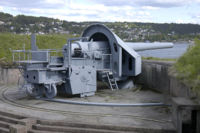
Your command is over a hundred years old, your weapons are older than the fathers of the raw recruits you have running around your battlements. Your main guns are 50 years old.

This is your Command though - your young sailors make up for their lack of experience by the bravery that comes from bravado and ignorance. That will be good enough.
 You have one trick though. One thing the enemy, whoever they are, do not know about. Thing is, your "secret weapon" is 40 years old. You feel old; but heck your secret weapons once belonged to an Empire that no longer exists - but that's OK - your people are known for keeping their equipment in good shape. You are worried. Even though the officer in charge of your secret weapon is out sick, you had a small boat pick up a retired Commander who, 31 years ago, once worked with them. He showed up last night. He will have to do - even though he looks like a museum ship in his old, ill-fitting uniform.

Sigh, you go to war with what you have - not what you wish you had.
You have no orders.

The approaching naval force already had forced their way past the outer forts and had received both warning shots and live rounds. As the vessels continue towards the capital, you make a decision; you consider them enemy warships and will engage them as such. Knowing your job, you turn to your men and state;

"Either we will become heroes or we will be court-martialled. Let's just do our duty for our country."
And so, it starts.
The total German naval attack comprised 1 heavy, 1 armoured and 1 light cruiser, 14 destroyers, 14 torpedo boats and miners and 41 freighters and tankers.

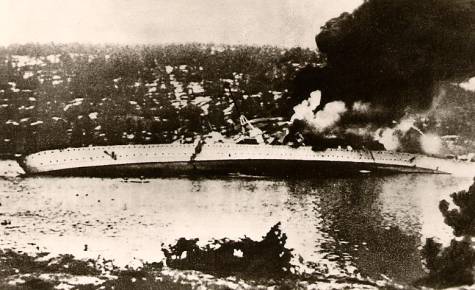
Hitler's planned to take the Norwegians by surprise and forcing them to surrender within hours (like he did in Denmark). But the first surprise he encountered was when the pride of his Navy, the brand new heavy cruiser "Blücher" - that was to spearhead the surprise attack on the nation's capital - at 4 AM, at full speed, no lights.
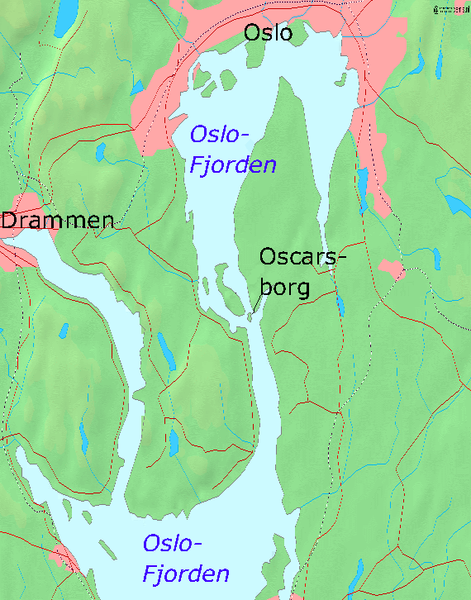
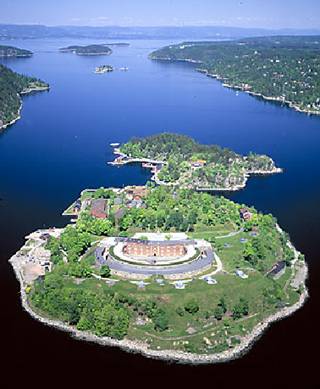
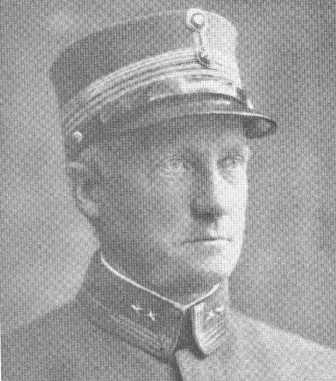
The heavy cruiser Blücher now moved slowly with darkened lanterns towards the old fortress built in 1847, obviously believing they could just sneak past. Erichsen stood at the main battery with his men to demonstrate that he as the boss was in the front line. As the German ships appeared from the darkness and morning fog, the loomed like giants ahead. A nervous, newly graduated lieutenant fiddled with the range finder and reported, "Distance 3,000 meter". "Nonsense!", Erichsen grumbled and shouted, "Distance 1,200 meter - Gun no. 1, Fire!" He never calculated to get off more than two shots with the museum-aged guns and his untrained men (some of them were the cooks!), so he had to get a hit!By sheer luck, the first 28-cm shell hit the Blücher's forward gunnery control station, effectively disabling the ship's forward guns. The second main battery round hit the aircraft hangar, destroying the ship's Arado Ar 196 reconnaissance seaplanes and igniting aviation fuel and infantry munitions stored on deck. There was only time for the main battery to fire these two rounds, due to their slow reload time. After losing its fire control system the Blücher was rendered unable to effectively respond to the fortress' bombardment. Blucher's main 20,3 cm guns never opened fire.

While fire was raging aboard the Blücher, the secondary Norwegian coastal batteries pelted her with guns ranging in calibre from the two small 57 millimetre pieces at Husvik, designed to protect the fortress' missing naval mine barrier, to the three 15-cm guns of the Kopås battery on the eastern side of the fjord. The larger guns wrought havoc on board the cruiser while the 57-mm guns were successful in suppressing the fire from her light artillery as the Blücher slowly slid past the fortress. All in all thirteen 15-cm rounds and about thirty 57-mm shells hit the German cruiser as it passed the guns of the fortress' secondary batteries.

After passing the line of fire of the fortress' gun batteries the cruiser was burning and severely damaged, but its captain still had hope of being able to save his ship. At this point, however, the Blücher entered the sights of Kommandørkaptein Anderssen and two of his three torpedo tubes at a range of only 500 meters. The torpedoes the retired officer was aiming at the pride of the Kriegsmarine were 40-year-old Whitehead weapons of Austro-Hungarian manufacture. These torpedoes had been practice-launched well over 200 times before being fired in anger, and no-one was certain if they would function or not. As Kommandørkaptein Anderssen pushed the firing mechanism the weapons showed themselves to work perfectly, first one and then another torpedo raced out of their tube at three meters below the surface towards the ghastly-looking burning warship. The first torpedo hit near the Blücher's forward (Anton) turret, and the second in the engine room, leaving her drifting out of control in the narrow fjord. The third torpedo tube was left loaded in case more ships were to follow close behind Blücher. After firing the two other tubes were reloaded and readied for the next target.

With all engines knocked out by the second torpedo hit, the cruiser anchored near the Askholmene islets to try and fight the ferocious fires raging throughout the vessel. The Blücher's torpedoes were also fired against land to avoid them being brought to explosion by the uncontrolled fires aboard. The crew's struggle would still prove hopeless when the fires reached the midship ammunition hold for the 15-cm guns and a huge gap appeared in the ship's side.
At 06:22 a.m. the Blücher sank bow first into the depths of the Oslofjord, taking hundreds with it below. After the ship had disappeared from the surface large quantities of oil floated up and covered the close to two thousand sailors and soldiers fighting for their lives in the freezing water. This oil rapidly caught fire, killing further hundreds of Germans.

All in all, some 800–1000 Germans died, going down with the ship or burning or freezing to death in the fjord.
That is it. You have done what you could. But there is still work to do.
While the Blücher had been sunk the remaining naval force destined for Oslo had long since turned around and retreated back down the fjord. Not knowing of the torpedo battery, the commander of the Lützow assumed the flagship had hit mines and at 04:40 decided to turn back and land the invasion forces out of range of Oscarsborg.

Before the force made its escape the fortress had managed to damage the Lützow,the 15-cm guns of the Kopås battery scoring three hits and knocking out the ship's forward ("Anton") 28-cm gun turret. After pulling out of range of the fortress guns the Lützow employed her remaining "Bruno" turret to bombard the defenders from a range of 9-10 kilometers down the fjord. The fortress was also subjected to heavy Luftwaffe bombing later on the same day, to which the fortress could only reply with two 40-mm AA guns, but again without Norwegian casualties. One of the anti-aircraft guns became unserviceable after only 22 rounds; the other gun kept up its fire until 1200 hrs, but to little effect. After a break in the attacks the Luftwaffe bombers returned at 1330 hrs and soon strafed the remaining Norwegian AA gun, forcing the crew to seek shelter in the nearby forrest at around 1400 hrs. In all, the fortress was subjected to around nine hours of air attack.
But you know that it is far from over. Your nation is small and weak - there is much more coming.
Although the naval attack on Oslo had been thwarted by the actions of Oscarsborg, the city was seized by forces that was airlifted in to Fornebu Airport. In light of the capture of the capital, and with news of German landings at the village of Son south of Drøbak, Colonel Eriksen decided that further fighting without adequate infantry support was in vain. The fortress was surrendered intact on the morning of April 10.
So old man; what did you and your old equipment buy for all your efforts? How will history judge you?
The effect of halting the German fleet was huge. On board Blücher were troops specially designated to capture the King, the Norwegian government, the Storting (Norwegian Parliament) and the national gold reserve. The delay made it possible for all these to escape from Oslo. If the King and government had been captured, it is most likely that Norway would have capitulated fairly soon to reach a deal with the German similar to that gained by the Danes. Instead, the Storting was able to convene at Elverum and give the government a wide authorization to continue until a Storting could again assemble. In fact, the Norwegian government was able to continue the defense of Norway until it had to go into exile in London.
Never assume the "old" can be dismissed. Do not discount old officers and inexperienced men who are fighting in their home waters. Do not assume away challenges with fairy dust and hopes.The Norwegians during the Battle of Drøbak sound.Fullbore.

UPDATE: From the 2016 movie, The King's Choice;


Friday, August 04, 2017

Fullbore Friday


What does it take to get a Navy Cross - in WWII? And what, my not so gentle readers, do you think when someone tells you, "We don't train for that because that will never happen. We have Sailors, not Marines. That isn't IAW the CONOPS anyway, and with technology - well, your scenario is just stilly."

Ahem. Tell that to the men of the USS BUCKLEY (DE-51) and U-66.
On 6 May 1944, USS Buckley DE 51 engaged U-66 in an Epic Battle that included hand-to-hand combat.

0322 - Range 500 yards. The gun flashes were blinding and deafening, an earsplitting roar. The blasts of the 3", 40mm and 20mm blended into something unreal, as though all the demons of hell had been released simultaneously. Above the roar, the shouts of gun captains exhorted their crews to load and reload ever faster and faster. Blood was drawn. The quarry was at bay. The hunter was out to kill and to keep from being killed. The U-66 was buried under a hail of withering point blank fire.

0328 - The u-boat was 20 yards to starboard, zigzagging violently at 19 knots. Skipper Abel had to make a decision, one that could cost him his ship, his crew, his life. The U-boat was badly hurt. Buckley might have stood off and pounded it to bits. But, supposing the sub did aim a torpedo into Buckley and get away to be repaired and fight again? Buckley was expendable; transatlantic shipping was not. A DE captain had to know what to do at a time of decision. He decided to ram the U-boat!

0329 - "Right full rudder!"
Hundreds of tons of steel clashed, twisted and ripped as Buckley rode up on the foc's'l of U-66!

Then there occurred one of the most remarkable incidents of the Atlantic War as attributable to an extraordinary courage on the part of the enemy as to the valor of the Buckley crew. Men began swarming out of the conning tower and forward hatch of the submarine and up onto the foc's'l of Buckley. Because the sub was now below the maximum depression of the DE's guns, a bitter fight had suddenly become man-to-man for the possession of Buckley!

The Buckley crew rallied quickly and found their enemy with objects, fists and guns. Still the enemy persisted in boarding. Captain Abel had to make another decision. Engines were reversed as Buckley backed away from the sub. "All engines ahead full!" Guns crews returned to their stations pouring a living hell of fire into U-66. Alongside the U-boat to starboard, range 25 yards, Captain Abel fully intended to ram again, but he didn't. The sub rammed the DE! U-66 veered sharply to port and struck under the after engine room of Buckley. The shaft and propeller were sheared clean off. The Buckley's deck crew could look right into the conning tower which as a flaming shambles.

With a twisting, scraping and groaning of steel plates, the sub drew aft and cleared under Buckley's stern. She popped up right under number three 3" guns which scored three hits on the conning tower.

U-66 rode under the sea to her end.

For the next three hours, Buckley steamed about the area and recovered thirty-six prisoners, including four officers.

Miraculously, there were no casualties on board the Buckley. With her starboard shaft gone, flooded compartments and widespread damage, Buckley proceeded to the New York Navy Shipyard, a trip which she made on her port screw without incident.
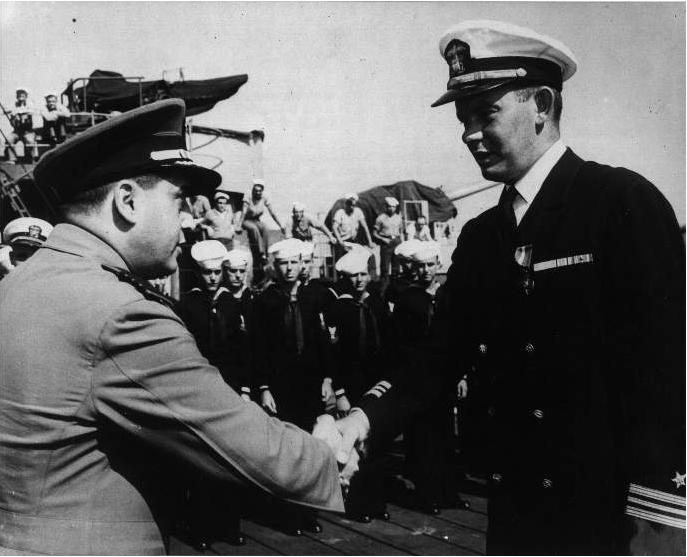
And the Navy Cross citation for their CO, LCDR BRENT MAXWELL ABEL, USNR.
Citation:
The President of the United States takes pleasure in presenting the Navy Cross to Brent Maxwell Abel, Lieutenant Commander, U.S. Navy, for extraordinary heroism and distinguished service in the line of his profession as Commanding Officer of the Destroyer Escort U.S.S. BUCKLEY (DE-51), in offensive action against a German submarine during while patrolling the Atlantic Coast on the early morning of 6 May 1944. Lieutenant Commander Abel expertly directed his command and made an undetected, high-speed approach in bright moonlight to a surfaced German U-boat. With skilled seamanship, he silenced its guns within four minutes after contact, despite a heavy barrage of enemy torpedo and automatic weapon fire. Narrowly escaping another torpedo, he then closed on the wildly maneuvering submarine, raked it with all available fire and rammed, with the enemy attempting to board the vessel in retaliation. Withstanding the desperate attacks of the enemy ship, which tried to ram after the combatants became disengaged, he persistently held to his target until the submarine, with its conning tower shattered and burning fiercely, all hatches open, abandoned by its crew and completely out of control, disappeared beneath the surface of the water and exploded. His conduct throughout was in keeping with the highest traditions of the Navy of the United States.
A good blow-by-blow account can be found here - one with a line that would make LT Black walk funny for a week.
"Hard right rudder!" he roared. "Pass the word to stand by for ram!"

Buckley heeled. Abel shot a glance at the exec.

"Okay, break out the small arms - let's go!"
In a day where the national "elite" hide from service like cockroaches from the light, you know what Buckley did before the war? He was a graduate of Harvard and Harvard Law and left his practice at the outbreak of WWII. Skipper Abel passed away the day before Christmas, 2006. Cheers Shipmate.

Hat tip Perry.

This FbF first posted JAN 2008.

Thursday, July 13, 2017

The Return of at Sea Reloads: The Big Importance of Small Things

On the list of "unsexy but important" are many items from icebreakers, to command ships, to hospital ships, that every POM cycle get left on the cutting room floor by the gaggle of cats chasing laser pointers we have in charge of building our fleet.

On occasion, someone on the inside manages to do the right thing. 

Today we have one of those things. In case you missed it, let's pull it above the ambient noise a bit;
The U.S. Navy is looking to restore its ability to reload its ships’ vertical launch systems at sea, which could be a dramatic logistical game changer in the planning and execution of high-intensity contingencies against peer competitors.
...
After discussing the means by which the Navy seeks to ensure its forward-deployed naval forces remain survivable and up-to-date with the latest tactical and technological innovation, Admiral Richardson said in reference to vertical launch system (VLS) underway replenishment, “we’re bringing that back.”

Since its operational debut in 1986 aboard the sixth Ticonderoga-class cruiser, USS Bunker Hill, the Mark 41 vertical launch system and its successor the Mark 57 have become the main battery of the preponderance of the Navy’s surface fleet, while the Mark 45 has become the principal means of deploying cruise missiles aboard submarines. Vertical launch systems are among the most adaptable weapon mounts that the Navy fields, allowing a ship to carry a variety of defensive and offensive missiles in the same shipboard infrastructure, and to fire them in rapid succession.

However, unlike other Navy striking arms like the carrier air wing, vertical launch systems cannot, at present, be practicably resupplied and reloaded while at sea. Once a VLS-equipped ship or submarine expends its missiles, it must withdraw to an equipped friendly port to replenish. This represents a significant operational liability, especially in high-intensity combat scenarios against peer adversaries.
Not just peer adversaries. As an old TLAM guy who managed to empty every operational TLAM out of one DDG and left a few DD & CG with only a handful of D1 & D2 warhead TLAM left - the inability to reload puts you in a pickle.

With our "peace dividend" carrier strike groups, you cannot afford to order a DDG or CG to steam a few days to some friendly port (if you have one) and then come back. Nope.

This is great news - and shows that now and then the right ideas can meet up with the right opportunity.

Now, let's talk about those armed icebreakers ....

Friday, March 18, 2016

Fullbore Friday


What does it take to get a Navy Cross - in WWII? And what, my not so gentle readers, do you think when someone tells you, "We don't train for that because that will never happen. We have Sailors, not Marines. That isn't IAW the CONOPS anyway, and with technology - well, your scenario is just stilly."

Ahem. Tell that to the men of the USS BUCKLEY (DE-51) and U-66.
On 6 May 1944, USS Buckley DE 51 engaged U-66 in an Epic Battle that included hand-to-hand combat.

0322 - Range 500 yards. The gun flashes were blinding and deafening, an earsplitting roar. The blasts of the 3", 40mm and 20mm blended into something unreal, as though all the demons of hell had been released simultaneously. Above the roar, the shouts of gun captains exhorted their crews to load and reload ever faster and faster. Blood was drawn. The quarry was at bay. The hunter was out to kill and to keep from being killed. The U-66 was buried under a hail of withering point blank fire.

0328 - The u-boat was 20 yards to starboard, zigzagging violently at 19 knots. Skipper Abel had to make a decision, one that could cost him his ship, his crew, his life. The U-boat was badly hurt. Buckley might have stood off and pounded it to bits. But, supposing the sub did aim a torpedo into Buckley and get away to be repaired and fight again? Buckley was expendable; transatlantic shipping was not. A DE captain had to know what to do at a time of decision. He decided to ram the U-boat!

0329 - "Right full rudder!"
Hundreds of tons of steel clashed, twisted and ripped as Buckley rode up on the foc's'l of U-66!

Then there occurred one of the most remarkable incidents of the Atlantic War as attributable to an extraordinary courage on the part of the enemy as to the valor of the Buckley crew. Men began swarming out of the conning tower and forward hatch of the submarine and up onto the foc's'l of Buckley. Because the sub was now below the maximum depression of the DE's guns, a bitter fight had suddenly become man-to-man for the possession of Buckley!

The Buckley crew rallied quickly and found their enemy with objects, fists and guns. Still the enemy persisted in boarding. Captain Abel had to make another decision. Engines were reversed as Buckley backed away from the sub. "All engines ahead full!" Guns crews returned to their stations pouring a living hell of fire into U-66. Alongside the U-boat to starboard, range 25 yards, Captain Abel fully intended to ram again, but he didn't. The sub rammed the DE! U-66 veered sharply to port and struck under the after engine room of Buckley. The shaft and propeller were sheared clean off. The Buckley's deck crew could look right into the conning tower which as a flaming shambles.

With a twisting, scraping and groaning of steel plates, the sub drew aft and cleared under Buckley's stern. She popped up right under number three 3" guns which scored three hits on the conning tower.

U-66 rode under the sea to her end.

For the next three hours, Buckley steamed about the area and recovered thirty-six prisoners, including four officers.

Miraculously, there were no casualties on board the Buckley. With her starboard shaft gone, flooded compartments and widespread damage, Buckley proceeded to the New York Navy Shipyard, a trip which she made on her port screw without incident.
And the Navy Cross citation for their CO, LCDR BRENT MAXWELL ABEL, USNR.
Citation:
The President of the United States takes pleasure in presenting the Navy Cross to Brent Maxwell Abel, Lieutenant Commander, U.S. Navy, for extraordinary heroism and distinguished service in the line of his profession as Commanding Officer of the Destroyer Escort U.S.S. BUCKLEY (DE-51), in offensive action against a German submarine during while patrolling the Atlantic Coast on the early morning of 6 May 1944. Lieutenant Commander Abel expertly directed his command and made an undetected, high-speed approach in bright moonlight to a surfaced German U-boat. With skilled seamanship, he silenced its guns within four minutes after contact, despite a heavy barrage of enemy torpedo and automatic weapon fire. Narrowly escaping another torpedo, he then closed on the wildly maneuvering submarine, raked it with all available fire and rammed, with the enemy attempting to board the vessel in retaliation. Withstanding the desperate attacks of the enemy ship, which tried to ram after the combatants became disengaged, he persistently held to his target until the submarine, with its conning tower shattered and burning fiercely, all hatches open, abandoned by its crew and completely out of control, disappeared beneath the surface of the water and exploded. His conduct throughout was in keeping with the highest traditions of the Navy of the United States.
A good blow-by-blow account can be found here - one with a line that would make LT Black walk funny for a week.
"Hard right rudder!" he roared. "Pass the word to stand by for ram!"

Buckley heeled. Abel shot a glance at the exec.

"Okay, break out the small arms - let's go!"
In a day where the national "elite" hide from service like cockroaches from the light, you know what Buckley did before the war? He was a graduate of Harvard and Harvard Law and left his practice at the outbreak of WWII. Skipper Abel passed away the day before Christmas, 2006. Cheers Shipmate.


Hat tip Perry.

This FbF was first run Jan 08.

Friday, November 16, 2012

Fullbore Friday


Via USAToday ... do I really need to write anything else?
In 2010, his unit headed to Afghanistan, the vanguard of a new strategy ordered by President Obama that bolstered forces in Taliban-controlled parts of the country. By then a corporal, Wooldridge was assigned to Weapons Company, 3rd Battalion, 7th Marines.

The Marines were sent to Helmand province, an insurgent stronghold and poppy-growing region in southern Afghanistan where coalition forces controlled only a few key towns. At the time, the Taliban moved freely through large swaths of the region.

Soon after arriving the unit was sent to Musa Qala, where the Marines were arrayed against Taliban fighters that wanted to hold the region at any cost. In June, Weapons Company was given the mission to clear a valley that held a large settlement in the Helmand River Valley.

They expected to confront the enemy but were taken aback by what they encountered.

"We ran into a hornet's nest," Calvin says.

The initial plan was to meet with villagers who lived in settlements strung along the valley, or wadi, to get a sense of the enemy situation.

"That all went out the window the moment we got into the wadi," Calvin says.

The Taliban tried to ambush the Marines at every turn. The roughly 125 Marines were facing between 150 and 250 hardened Taliban fighters who had established a sophisticated network of bunkers and trenches laced into hills in the high ground overlooking the wadi. The area had been seeded with roadside bombs.

Anticipating a clash, villagers fled the town. Families with all of their belongings, including sheep, cows and goats, streamed past the Marines. Insurgents from nearby towns flooded the area, determined to blunt the Marine offensive and hold on to the poppy-growing region that was critical to the Taliban. ... Within five minutes of leaving the secure perimeter, Wooldridge's vehicle struck a roadside bomb. No one was seriously injured, but the vehicle was wrecked. Wooldridge and his team got into another vehicle. They had barely moved before they hit another bomb and had to get into a third vehicle.

By this time in the offensive, the Marines had decided to alter tactics to get closer to an enemy that would typically fire at them from a distance and then melt away.

"Nobody had seen them," Madden says of the Taliban.

They would probe farther into the valley than ever before, drawing insurgents out and then sending teams on foot to cut off the Taliban fighters before they could melt away.

It wasn't long before the four-vehicle patrol was getting fired at from trees on the western side of the valley. (The account of his actions is based on interviews with Wooldridge and other Marines and the official citation.)

The turret gunners in the vehicles wheeled around and began firing in the direction of the gunshots. The Marines split up in an effort to cut off the Taliban militants. One team went south and another north.

Wooldridge bounded across a freshly harvested field toward the firing as a couple of his fellow Marines got down and fired at targets ahead of him. Wooldridge burst into the treeline and saw a militant emerge from a ditch and start to run.

"I shot and saw him fall," Wooldridge says.

Wooldridge's two teammates caught up with him. They moved quickly through the trees and stopped short when they came to the edge of a farming village with mud homes and walls. Looking down from a small hill, they saw 15 armed insurgents at the center of the village.

The startled insurgents saw the Marines and turned and raised their weapons. It was too late. The Americans opened fire. Most fell, but a handful escaped.

Marines watched as an insurgent carrying a rocket-propelled grenade emerged from a narrow alleyway in the village and stepped over the bodies of his fallen comrades. The Marines shot him.

This is what the Marines had been hoping for. They had flushed out the enemy and forced the Taliban into a close-quarters fight.

Wooldridge moved his team to another spot for a different view on the Taliban compound.

Just then he heard voices that sounded like men arguing behind a nearby wall. He peeked around the corner and was face to face with four insurgents armed with machine guns, assault rifles and rocket-propelled grenades.

Wooldridge shot two of them before they could react. He killed a third as the man was trying to escape. Out of ammunition, he tried to bluff the last insurgent by gesturing at him to drop his weapon.

The insurgent raised his gun and pointing it at Wooldridge, who was 10 feet away. Wooldridge ducked behind the mud wall to reload. Before he could put a fresh drum in his light machine gun, a barrel poked around the corner of the wall.

Wooldridge dropped his own weapon and grabbed the barrel of the machine gun. He slammed the insurgent against a wall and both men fell to the ground. Wooldridge rolled on top of the insurgent and began pummeling him.

The insurgent reached for a grenade attached to the Marine's protective vest. If he pulled the pin, both men would die.

Wooldridge broke away and got to his feet, grabbing the insurgent's machine gun at the same time. He aimed it at the insurgent and squeezed the trigger. It didn't work.

With the stock of the weapon, he beat the Taliban fighter to death.

Marines arrived to find Wooldridge covered in blood, leaning over the dead insurgent.
Of course, there's more. Read it all.

Friday, April 22, 2011

Fullbore Friday

One of my favorite FbF from the archive. Enjoy it again.
The war is about to begin. You are in command of your Navy's newest ship and are leading the attack on another nation's capital. Decades before others thought they had discovered such concepts as "Shock and Awe" and "Decaptitation Strikes" - you are on the tip of the spear of an attack that will seize the Head of State of the target nation before they even have a chance to resist.

Your opposition? A weak nation with a weak military - a nation you hold in contempt as the arrogance of their self-declared neutrality has lulled them into thinking they were beyond the reach of the most feared warriors the world has ever known.
They are so weak that you are sailing right into their nation's capitol. The only thing they oppose you with are obsolete, static defenses that even your Grandfather would dismiss. It is a great day for Victory.
Will your nation be able to stay out of this war? Which side will try to seize your capital? Will they keep to themselves? Your nation just wants to be left out of everyone else's wars. We have no claim on anyone's land or treasure. We insult no one. We just want to be left alone.

You are old - well past you life expectancy. When you started your service, most ships were just getting steel warships, there were no cars, trains were a rare treat - and the only things that flew flapped their wings.


Your command is over a hundred years old, your weapons are older than the fathers of the raw recruits you have running around your battlements. Your main guns are 50 years old.

This is your Command though - your young sailors make up for their lack of experience by the bravery that comes from bravado and ignorance. That will be good enough.
You have one trick though. One thing the enemy, whoever they are, do not know about. Thing is, your "secret weapon" is 40 years old. You feel old; but heck your secret weapons once belonged to an Empire that no longer exists - but that's OK - your people are known for keeping their equipment in good shape. You are worried. Even though the officer in charge of your secret weapon is out sick, you had a small boat pick up a retired Commander who, 31 years ago, once worked with them. He showed up last night. He will have to do - even though he looks like a museum ship in his old, ill-fitting uniform.

Sigh, you go to war with what you have - not what you wish you had.
You have no orders.

The approaching naval force already had forced their way past the outer forts and had received both warning shots and live rounds. As the vessels continue towards the capital, you make a decision; you consider them enemy warships and will engage them as such. Knowing your job, you turn to your men and state;
"Either we will become heroes or we will be court-martialled. Let's just do our duty for our country."
And so, it starts.
The total German naval attack comprised 1 heavy, 1 armoured and 1 light cruiser, 14 destroyers, 14 torpedo boats and miners and 41 freighters and tankers.

Hitler's planned to take the Norwegians by surprise and forcing them to surrender within hours (like he did in Denmark). But the first surprise he encountered was when the pride of his Navy, the brand new heavy cruiser "Blücher" - that was to spearhead the surprise attack on the nation's capital - at 4 AM, at full speed, no lights.

The heavy cruiser Blücher now moved slowly with darkened lanterns towards the old fortress built in 1847, obviously believing they could just sneak past. Erichsen stood at the main battery with his men to demonstrate that he as the boss was in the front line. As the German ships appeared from the darkness and morning fog, the loomed like giants ahead. A nervous, newly graduated lieutenant fiddled with the range finder and reported, "Distance 3,000 meter". "Nonsense!", Erichsen grumbled and shouted, "Distance 1,200 meter - Gun no. 1, Fire!" He never calculated to get off more than two shots with the museum-aged guns and his untrained men (some of them were the cooks!), so he had to get a hit!

By sheer luck, the first 28-cm shell hit the Blücher's forward gunnery control station, effectively disabling the ship's forward guns. The second main battery round hit the aircraft hangar, destroying the ship's Arado Ar 196 reconnaissance seaplanes and igniting aviation fuel and infantry munitions stored on deck. There was only time for the main battery to fire these two rounds, due to their slow reload time. After losing its fire control system the Blücher was rendered unable to effectively respond to the fortress' bombardment. Blucher's main 20,3 cm guns never opened fire.

While fire was raging aboard the Blücher, the secondary Norwegian coastal batteries pelted her with guns ranging in calibre from the two small 57 millimetre pieces at Husvik, designed to protect the fortress' missing naval mine barrier, to the three 15-cm guns of the Kopås battery on the eastern side of the fjord. The larger guns wrought havoc on board the cruiser while the 57-mm guns were successful in suppressing the fire from her light artillery as the Blücher slowly slid past the fortress. All in all thirteen 15-cm rounds and about thirty 57-mm shells hit the German cruiser as it passed the guns of the fortress' secondary batteries.

After passing the line of fire of the fortress' gun batteries the cruiser was burning and severely damaged, but its captain still had hope of being able to save his ship. At this point, however, the Blücher entered the sights of Kommandørkaptein Anderssen and two of his three torpedo tubes at a range of only 500 meters. The torpedoes the retired officer was aiming at the pride of the Kriegsmarine were 40-year-old Whitehead weapons of Austro-Hungarian manufacture. These torpedoes had been practice-launched well over 200 times before being fired in anger, and no-one was certain if they would function or not. As Kommandørkaptein Anderssen pushed the firing mechanism the weapons showed themselves to work perfectly, first one and then another torpedo raced out of their tube at three meters below the surface towards the ghastly-looking burning warship. The first torpedo hit near the Blücher's forward (Anton) turret, and the second in the engine room, leaving her drifting out of control in the narrow fjord. The third torpedo tube was left loaded in case more ships were to follow close behind Blücher. After firing the two other tubes were reloaded and readied for the next target.

With all engines knocked out by the second torpedo hit, the cruiser anchored near the Askholmene islets to try and fight the ferocious fires raging throughout the vessel. The Blücher's torpedoes were also fired against land to avoid them being brought to explosion by the uncontrolled fires aboard. The crew's struggle would still prove hopeless when the fires reached the midship ammunition hold for the 15-cm guns and a huge gap appeared in the ship's side.

At 06:22 a.m. the Blücher sank bow first into the depths of the Oslofjord, taking hundreds with it below. After the ship had disappeared from the surface large quantities of oil floated up and covered the close to two thousand sailors and soldiers fighting for their lives in the freezing water. This oil rapidly caught fire, killing further hundreds of Germans.

All in all, some 800–1000 Germans died, going down with the ship or burning or freezing to death in the fjord.
That is it. You have done what you could. But there is still work to do.
While the Blücher had been sunk the remaining naval force destined for Oslo had long since turned around and retreated back down the fjord. Not knowing of the torpedo battery, the commander of the Lützow assumed the flagship had hit mines and at 04:40 decided to turn back and land the invasion forces out of range of Oscarsborg.

Before the force made its escape the fortress had managed to damage the Lützow,the 15-cm guns of the Kopås battery scoring three hits and knocking out the ship's forward ("Anton") 28-cm gun turret. After pulling out of range of the fortress guns the Lützow employed her remaining "Bruno" turret to bombard the defenders from a range of 9-10 kilometers down the fjord. The fortress was also subjected to heavy Luftwaffe bombing later on the same day, to which the fortress could only reply with two 40-mm AA guns, but again without Norwegian casualties. One of the anti-aircraft guns became unserviceable after only 22 rounds; the other gun kept up its fire until 1200 hrs, but to little effect. After a break in the attacks the Luftwaffe bombers returned at 1330 hrs and soon strafed the remaining Norwegian AA gun, forcing the crew to seek shelter in the nearby forrest at around 1400 hrs. In all, the fortress was subjected to around nine hours of air attack.
But you know that it is far from over. Your nation is small and weak - there is much more coming.
Although the naval attack on Oslo had been thwarted by the actions of Oscarsborg, the city was seized by forces that was airlifted in to Fornebu Airport. In light of the capture of the capital, and with news of German landings at the village of Son south of Drøbak, Colonel Eriksen decided that further fighting without adequate infantry support was in vain. The fortress was surrendered intact on the morning of April 10.
So old man; what did you and your old equipment buy for all your efforts? How will history judge you?
The effect of halting the German fleet was huge. On board Blücher were troops specially designated to capture the King, the Norwegian government, the Storting (Norwegian Parliament) and the national gold reserve. The delay made it possible for all these to escape from Oslo. If the King and government had been captured, it is most likely that Norway would have capitulated fairly soon to reach a deal with the German similar to that gained by the Danes. Instead, the Storting was able to convene at Elverum and give the government a wide authorization to continue until a Storting could again assemble. In fact, the Norwegian government was able to continue the defense of Norway until it had to go into exile in London.
Never assume the "old" can be dismissed. Do not discount old officers and inexperienced men who are fighting in their home waters. Do not assume away challenges with fairy dust and hopes.

The Norwegians during the Battle of Drøbak sound.

Fullbore.

Wednesday, June 17, 2009

Sun Tzu of the Day

For those who have been to Bible study with me, you know that I cannot stand one-off Chapter and Verse quotations. I am a firm believer in the 10-up-and-10-down rule; you have to read the 10 Verses before and after the money quote in order to get a handle on the context. It is also helpful to have a copy of a parallel translations book as well ... but I digress.

So, there I am thumbing through Sun Tzu's The Art of War again, when I come across something we are all familiar with.
One who knows the enemy and knows himself will not be endangered in a hundred engagements.
... but that isn't the best part, this is;
One who does not know the enemy but knows himself will sometimes be victorious, sometimes meet with defear. One who knows neither the enemy nor himself will invariably be defeeated in every engagement.
Make sure you are reading this from the Chinese perspective you round-eyed devil - this helps.
If I know out troops can attack, but do not know the enemy cannot be attacked, it is only halfway to victory. If I know the enemy can be attacked, but do not realize our troops cannot attack, it is only halfway to victory.

Knowing that the enemy can be attacked, and knowing that our army can effect the attack, but not knowing the terrain is not suitable for combat, is only halfway to victory. Thus one who truly knows the army will never be deluded when he moves, never be impoverished when initiating an action.

Thus it is said if you know them and know yourself, your victory will not be imperiled. If you know them and know yourself, your victory will not be imperiled. If you know Heaven and you know Earth, your victory can be complete.
This has to do with being honest with yourself and gathering proper intel, good honest intel.

What is the main threat to the US from hostile intel services from the Clinton Administration on? China. They know their Sun Tzu better than we know our Clausewitz.

I want to pick on the last line from above.
If you know them and know yourself, your victory will not be imperiled. If you know Heaven and you know Earth, your victory can be complete.
One can argue how much we really know China I presume, but from the Korean War on I think the 51% of the argument is that we know a lot less than we think.

Now, from a USN perspective, how well do we know ourselves?
  • Do we know our deep strike capabilities? Review the lack of organic real tanking ability and lack of deep strike aircraft on our CVN. Don't even mention USAF quasi-peace time permissive tanking support. If you are going in harm's way from a ASW and AAW perspective, how many MK41 cells do you have left available for TLAM when you risk manage your ASW and AAW problem? SSGNs do look like a nice tool to have ... but for both surface and sub-surface units, how are our WESTPAC reload ability looking for sustained combat?
  • Do we know our ASW capability? ASW readiness for fixed and rotary wing - up to speed for both personnel and equipment? Just relying on SSN? How about your aircraft and ship light weight torpedoes - realistic warshot validation in the appropriate water and bottom profiles where we will fight? Numbers of warshots available allow for sustained combat with the expected number of attacks on false contacts?
  • Do we know our ship's capabilities? Enough LCS mission modules and ability to swap out forward deployed to match the changing MIW-ASW-ASUW-AAW threat as it appears? Oh, never mind ... none are and none are expected for a long time. OK then, DD ... FF (not-so-G)? Oops. Enough DDG-51's ready for ASW? Errr...P-3s?
  • Do we know our ability to escort CVN and Amphibs....
  • Do we know our AAW and ABM capabilities.....
Do we know?