Showing posts sorted by date for query long game. Sort by relevance Show all posts

Thursday, March 30, 2023

The Weapons Gap With the PRC the USA Created and Funded: it Goes Boom


If you don’t wake up every morning cursing those responsible for defense and China policy in the 1990s … the gobsmackingly short sighted arrogance of it all – then what use are you, actually?

With a few exceptions, from partially completed CV rusting in Ukraine to teaching the Communist Chinese how to MIRV ICBM warheads, to opening up our best research institutions to spies an assets, the USA was beset internally by unserious people with the attention span of a hamster and the historical perspective of a newborn in serious jobs requiring long-term thinking and decision making.

The harvest of this decade of frivolity continue to ripen, and via Jeremy Bogaisky, at Forbes – get ready to rage – we have just one more example; one that if we actually come to blows with the People’s Republic of China or those who buy their weapons – will result in more dead American men and women – more mutilated wounded. 

People and perspective matter. It appears the PRC has known this for decades;

In 1987, U.S. Navy researchers invented a new explosive with fearsome capabilities. Named China Lake Compound No. 20 after the Southern California base where it was developed, it boasted up to 40% greater penetrating power and propellant range than the U.S. military’s mainstay explosives, which were first produced during World War II.

With the collapse of the Soviet Union, however, the Pentagon’s urgency evaporated. So did the expensive task of perfecting CL-20 and designing weapons to use it.

…and how did they get CL-10? Where was the CIA, the FBI? Oh, that’s right – playing around in domestic politics. 

Meanwhile, the PRC was sending grad students; inserting citizens in the right companies. Doing just plain good old fashioned espionage. 

China, however, saw the potential. The country has invested heavily in developing long-range missiles with the aim of forcing U.S. warships and non-stealthy aircraft like refueling tankers to operate at a distance if Chinese forces invade Taiwan. Some of those weapons are believed to be propelled by a version of CL-20, which China first fielded in 2011 and now produces at scale.

“This is a case where we could potentially be beaten over the head with our own technology,” Bob Kavetsky, head of the Energetic Technology Center, a nonprofit research group that does work for the government, told Forbes.

Kavetsky and other experts in energetics, the niche field of developing things that go boom, have been warning for years that the U.S., long the world leader, has fallen dangerously behind China. The Pentagon last year outlined a plan to spend $16 billion over 15 years to upgrade and expand its aging network of munition plants, but Kavetsky warns that doesn’t include developing the advanced manufacturing capabilities needed to mass produce new explosives like CL-20.

Criminal malpractice. 

No, we are not being led by the best and brightest™ - we are not promoting our best - we do not have the right mix of incentives and disincentives.

…the U.S. depends on China as the single source for about half-dozen chemical ingredients in explosives and propellants, and other countries of concern for another dozen.

Yes, you read that correctly. I am sure Russia is in there too.

Like I said, criminal. You cannot commission new chemical plants overnight.

“We can’t build enough ships and airplanes to carry the number of missiles necessary to reverse the firepower imbalance we have inside the first island chain,” said retired Major General Bill Hix, who served as the Army’s director of strategy after commanding forces in Afghanistan and Iraq, and has consulted for the Energetic Technology Center.

“The only solution is new energetic materials,” he said. That would allow the U.S. to produce smaller missiles with the same power, so more could be carried by warplanes and ships, as well as to enable weapons that can shoot farther and pack more of a punch.

The PRC has over a decade head start building on R&D the USA paid for.

Wittman said he supports the idea of retrofitting existing missiles with CL-20 and creating a high-level office devoted to energetics under the secretary of defense. While decision makers at the Pentagon are aware of the issues, “I don’t think they see a sense of urgency with it,” Wittman said. “We’re going to instill a sense of urgency with them.”

Chinese scientists account for about three-quarters of the published research on energetics and in related fields over the last five years, nearly seven times as much as U.S. researchers, according to analyses from the Hudson Institute and Georgetown University. They’re working on materials that have improved performance over CL-20, Kavetsky said.

I would really like to see where those Chinese scientists got their degrees from, but you pretty much know.

As for the sense of urgency, what have we discussed here through the years about the 2nd and 3rd order effects of our accretion encumbered acquisition process? What does it cause? Just re-read the above.

Want another example of an existential threat to the Cult of Efficiency created? 

Nearly all U.S. explosives are produced at a single Army-owned plant in Holston, Tennessee, that dates back to World War II and is run by U.K.-based defense contractor BAE Systems (2022 revenue: $25.5 billion). The production processes generally are as old, Kavetsky said, with explosives prepared in 400-gallon vats that resemble cake mixers. Many advanced energetic materials can’t be made that way, including CL-20, which he said is synthesized in smaller amounts in chemical reactors.

All one needs is a pickup truck and a mortar team and game over. Single point of failure. As if you designed something to make you combat ineffective at D+1.

It would be possible to make 20,000 pounds of CL-20 a year with current amounts of precursor chemicals, Kavetsky said, but broad use would require 2 million pounds a year, which he believes could take three to five years to scale up to. “If DoD says we want large quantities,” he said, “industry will respond.”

“If DoD says we want large quantities, industry will respond.”

Not if we lose our one plant or run out of the chemicals – which I am sure are just in time delivered – that China is nice enough to export to us.

How long would it take for just then environmental impact statement to be completed?

Hix said he doubts those promising technologies will be ready for prime time this decade, but the U.S. could fairly rapidly boost its firepower with better explosives and propellants.

“A concerted effort on [explosives] is possible,” he said. “But we have to invest in it.”

Oh yes, our “decade of concern” … 

The Terrible 20s just keep giving.

Tuesday, March 21, 2023

60-Minutes Does our Navy - and the Nation - a Solid. I'll take the "W."


A regular topic of conversation here and on Midrats (it came up quite a bit on Sunday’s podcast with Jerry Hendrix), is the lack of discussion in the public space about the importance of a strong Navy to our republic’s economic and military security. Sure, inside our salons, slack channels, and email threads we talk to each other a lot, but we seem to have a hard time getting our message out to the general public.

Sunday night’s 60-Minutes was an exception to the rule. There is a lot of credit to go around here. First of all, you have to give credit to the 60-Minutes team fronted by Norah O’Donnell and lead producers Keith Sharman and Roxanne Feitel. This two-segment effort was not just on a topic we all are interested in, it was just plain good journalism.

Sure, I have a nit to pic here and there, but that is just my nature. Perfect? No … but it is one of the best bits of solid, down the middle journalism about our Navy and its challenges I have seen from a major network for a long time. 

If you missed it, CBS has published the video and transcript that I’m going to pull some bits from below for conversation.

The second segment was more meatier than the first, but the first is important. It isn’t just where Big Navy got a chance to make a run at media capture with the "C-2 to the Big Deck at sea" show that we all love, but it will introduce many people to someone who is very good at his job and representing the Navy, Admiral Samuel Paparo, USN.

He gets your attention early by, even though clearly well prepared and sticking to scripted talking points and marketing pitches here and there of questionable utility, he also spoke in blunt terms in a way we don't hear enough in venues such as this;

Admiral Samuel Paparo commands the U.S. Pacific Fleet, whose 200 ships and 150,000 sailors and civilians make up 60% of the entire U.S. Navy.  We met him last month on the aircraft carrier USS Nimitz deployed near the U.S. territory of Guam, southeast of Taiwan and the People's Republic of China, or PRC.

Norah O'Donnell: You've been operating as a naval officer for 40 years. How has operating in the Western Pacific changed?

Admiral Samuel Paparo: In the early 2000s the PRC Navy mustered about 37 vessels. Today, they're mustering 350 vessels.

...

60 Minutes has spent months talking to current and former naval officers, military strategists and politicians about the state of the U.S. Navy. One common thread in our reporting is unease, both about the size of the U.S. fleet and its readiness to fight. The Navy's ships are being retired faster than they're getting replaced, while the navy of the People's Republic of China or PRC, grows larger and more lethal by the year. We asked the commander of the U.S. Pacific Fleet, Admiral Samuel Paparo, about this on our visit to the USS Nimitz, the oldest aircraft carrier in the Navy.

Admiral Samuel Paparo: We call it the Decade of Concern. We've seen a tenfold increase in the size of the PRC Navy. 

Norah O'Donnell: Technically speaking, the Chinese now have the largest navy in the world, in terms of number of ships, correct?

Admiral Samuel Paparo: Yes. Yes.

Norah O'Donnell: Do the numbers matter?

Admiral Samuel Paparo: Yes. As the saying goes, "Quantity has a quality all its own." 

This is exactly how the answer needs to be delivered. No squish, no excessive spin - acknowledge the reality of where we are. 

More of this from more senior leaders.

There was some subtlety as well. When he first said this, about 10-seconds later I decided to rewind to listen to it again. 

Norah O'Donnell: And if China invades Taiwan, what will the U.S. Navy do?

Admiral Samuel Paparo: It's a decision of the president of the United States and a decision of the Congress. It's our duty to be ready for that. But the bulk of the United States Navy will be deployed rapidly to the Western Pacific to come to the aid of Taiwan if the order comes to aid Taiwan in thwarting that invasion.

Norah O'Donnell: Is the U.S. Navy ready?

Admiral Samuel Paparo: We're ready, yes. I'll never admit to being ready enough.  

Did you catch that? He can't say, "We're not ready." as if the call comes, we can and will execute what we are tasked ... and initially will be ready to do what we can with the reduced numbers we have ... but everyone knows there is a huge asterisk next to "ready." 

We don't have enough escort ships. We don't have enough VLS tubes. We don't have a large enough airwing with long enough legs. We don't have enough reliable and robust tanking. We don't have much of a bench ... so, we are "ready" - but not even close to being "ready enough." A subtle distinction with not so subtle implications.

We also need to give a nod to our Navy for not having only the 4-stars talk to CBS. LCDR David Ash, USN got some good face time with the camera, and his fellow LCDR Matthew Carlton, USN blessed us with his superb deployment stash.

60-Minute's graphics department also gets credit for the video that the pic at the top of this post is a screen capture of. 

One of the most important things someone can do who is interested in understanding the western Pacific from the PRC's POV is to see it from their shores in an east-up orientation. Where only a small group of PRC focused navalists have shared the image or have that projection on their wall were blessed with that perspective, now it is in the minds of at least hundreds of thousands more people.

This is how the Chinese Communist Party sees the Western Pacific, including the South and East China Seas from Beijing. Taiwan is the fulcrum in what China's leaders call "the first island chain," a constellation of U.S. allies that stretches across its entire coast.  Control of Taiwan is the strategic key to unlocking direct access to the Pacific and the sea lanes where about 50% of the world's commerce gets transported.

Norah O'Donnell: China has accused the United States of trying to contain them. What do you say to China?

Admiral Samuel Paparo: I would say, "Do you need to be contained? Are you expanding? Are you an expansionist power?" To a very great extent, the United States was the champion for China's rise. And in no way are we seeking to contain China. But we are seeking for them to play by the rules.

...and that is where the friction lies. The PRC holds the "rules" in contempt because they had no role in making them. As they don't like the rules, they are bit by bit changing them. From creating no-go zones in the South China Sea that once were open seas, to putting their flag down on the island nations of the southwest Pacific, to bending policies in Latin American nations, to being an observer at the Arctic Council to match their Arctic strategy.

Rules can, and are, being changed.

There was another point where Admiral Paparo put a marker down that someone can pick up and run with ... hey, I think I'll do that now;

Norah O'Donnell: How much do you worry about the PLA Rocket Force?

Admiral Samuel Paparo: I worry. You know, I-- I'd be a fool to not worry about it. Of course I worry about the PLA Rocket Force. And of course I work every single day to develop the tactics and the techniques and the procedures to counter it, and to continue to develop the systems that can also defend-- against them.

Norah O'Donnell: About how far are we from mainland China?

Admiral Samuel Paparo: Fifteen hundred nautical miles.

Norah O'Donnell: They can hit us.

Admiral Samuel Paparo: Yes they can. If they've got the targeting in place, they could hit this aircraft carrier. If I don't want to be hit, there's something I can do about it.

Ahhhhh, yes. Time to bring back one of my favorite graphics.


Draw a 1,500nm circle from the PLARF launch sites and look at what land based airfields, bases, depots and facilities of all sorts are located under that threat. They cannot move. A navy and sea based facilities can.

Undersold point, but Paparo is leaving it there for you to run with.

As a recidivist staff weenie, I swelled with pride at this moment. Nothing happens by accident;

Norah O'Donnell: I just noticed out of the corner of my eye. 

Admiral Samuel Paparo: This is a 688 class, a Los Angeles-class attack submarine. This is the most capable submarine on the planet. You know, with the exception of the Virginia class, our newer class of submarines.

Someone on that staff needs a NCM. Having that SSN heave in to view at that time and that place is simply 5.0 staff work. BZ to everyone, and like most of this visit, just all around well done. 

We've all seen such opportunities not work out all that well, but the time on NIMITZ was simply our Navy at its best. Paparo's staff, the crew of NIMITZ, the Strike Group, and Airwing all just did a superb job. Yes, there were a few PAOisms and talking points, but the visit and interviews were honest and praiseworthy. Paparo will get most of the credit, but everyone underway on that visit just did a superb job.

However, the following comment gave me pause, and it serves to make a point...I think.

Norah O'Donnell: How much more advanced is U.S. submarine technology than Chinese capability?

Admiral Samuel Paparo: A generation.

Norah O'Donnell: A generation.

Admiral Samuel Paparo: And-- by generation, think 10 or 20 years. But broadly, I don't really talk in depth about submarine capabilities. It's the silent service.

OK, I left active duty 13 yrs ago or so, but ... ummm ... I recall the PLAN submarine force then, and I also know roughly what the state of the US SSN were in 2013 and 2003, 10 and 20 years ago. If the PRC is pushing out new construction on par with what we were building even in 2003, much less 2013 ... ummm ... eek. 

To avoid me having a drop, flop, and foam panic attack, we'll call it an overstatement mulligan.

Also, that SSN is an LA Class SSN. I'm not sure which one, but the last one was commissioned in 1996. That was 27 years ago.

So. Let's just leave that there to simmer.

Norah O'Donnell: One recent-- nonclassified war game had the U.S. prevailing but losing 20 ships, including two carriers. Does that sound about right?

Admiral Samuel Paparo: That is a plausible outcome. I can imagine a more pessimistic outcome. And I can imagine a more optimistic outcome. We should be clear-eyed about the costs that we're potentially incurring 

There are about 5,000 Americans on board the Nimitz.  The ship is nearly half a century old. Given the Navy's current needs in the Pacific and because there's fuel left in its nuclear reactors, the carrier's life at sea is going to be extended.

Again, Paparo does a superior job here, but I want to take the last bit to remind everyone what war at sea looks like. Does everyone here fully understand what a loss of two CVN and 18 other ships would mean? 

Let's go back to March 10th's FbF about the loss in combat of the USS Laffey (DD-459),

Out of that crew of 208?  57 KIA/114 WIA. That is an 82% casualty rate.

We have 5,000 Sailors on each CVN. That is 10,000 Sailors. Let's uses a round number from a Flight II Arleigh Burke DDG manning of 300 as we don't know in that wargame what the other 18 ships were lost. That gives you another 5,400 Sailors for 15,400 total. 

With a 82% casualty rate, that is 12,628 Sailors; 4,158 killed and 8,470 wounded. That is almost as many killed in the last two decades fighting in Iraq (4,431). 

Killed not in 20 years, but a few weeks to months - maybe days.

That is what it is all about, which leads us to a great point brought up by two of the best people who served in the last Congress, Representative Mike Gallagher (R-WI) and Representative Elaine Luria (D-VA). 

Again, the right people to talk to.

Norah O'Donnell: What is it about the U.S. Navy that has allowed the two of you to find common cause?

Rep. Mike Gallagher: I think we-- share a sense of the urgency of the moment. We see increasing threats from China in particular in the Indo-Pacific. We feel like we're not moving fast enough to build a bigger Navy.

...

Norah O'Donnell: What would you say the state of the U.S. Navy is today?

Rep. Elaine Luria: I think the Navy has not received the attention and resources that it needs over two decades. I mean, I served on six different ships. Every single one of those ships was either built during or a product of the fleet that was built-- in the Cold War. 

Both Mike Gallagher and Elaine Luria have lobbied for government money for the shipyards in or near their districts, but they say this is less about jobs and more about national security. 

Rep. Elaine Luria: If we don't get this right, all of these other things we're doing in Congress ultimately-- might not matter.

She is exactly right - it might not matter. That is a deep comment we should all stop and ponder a bit.

There were a few Easter Eggs here for the Front Porch. You should all take a moment to savor. We've been at this together for almost two decades. Our arguments have soaked in. Enjoy:

Over the last two decades, the Navy spent $55 billion on two investments that did not pan out. The first was a class of Destroyers known as the Zumwalt. The futuristic fighting ships were supposed to revolutionize naval warfare. Thirty-two were ordered, but only three were ever launched. The cost of each ship, by one estimate, was upwards of $8 billion, making them the three most expensive Destroyers ever put to sea.

Another example is the Littoral Combat Ship or LCS, designed to be a fast all-purpose warship for shallow waters. Thirty billion dollars later the program ran aground after structural defects and engine trouble. Within the Navy, the LCS earned the unfortunate nickname, little crappy ship.

Norah O'Donnell: The Navy's last few decades have been described as a lost generation of shipbuilding. Is that overly dramatic? 

Don't get too full of yourselves folks, but take a bow. It wouldn't be there without you.

Next we had the CNO. He was a bit more off then on here. He looked if not unwell, at least very tired. Where Paparo gets an A- for his appearance - well prepared but not over scripted - I think the CNO got at best a B- as he was over-prepared and ready with talking point phrases that were just not appropriate for the moment. 

There were some things that just clunked;

Norah O'Donnell: Is the Navy in crisis?

Admiral Mike Gilday: No, the Navy's not in crisis. The Navy is out on point every single day.

Norah O'Donnell: Is it being outpaced by China? 

Admiral Mike Gilday: No. Our Navy's still in a position to prevail. But that's not blind confidence. We are concerned with the trajectory that China's on, with China's behavior. But we are in a good position right now-- if we did ever get into a fight against them. 

Ummm, CNO; no one thinks our Navy is doing great right now. This was not a rah-rah moment, this was an opportunity to ask for help to get our maintenance, stores, and fleet numbers aligned with requirements. A lost opportunity. His comments are simply not aligned with an objective review of the facts on the ground.

We should be less concerned with the trajectory the PRC is on - which we can't control - but with the trajectory we are on - that we can.

Another morale booster for the Front Porch, the CNO did repeat something he states on a regular basis and good for him that he does. Spot on.

Admiral Mike Gilday: I think one of the things that we learned-- was that we need to-- have a design well in place before we begin bending metal. And so we are going back-- to the past, to what we did in the '80s and the '90s, the Navy has the lead.

In the first and second decades of this century, how many people rolled in to comments here to tell us our critique represented "old think," that we didn't get the "new Navy" or were disconnected from "new methods?" 

Well, ha! He who laughs last laughs best. We were right, and in 2023, the CNO is with us circa 2004.

Especially for those who are subscribers to the Midrats podcast (going in to its 14th year) and readers here through the years, one of our regular and favorite guests made and appearance, Toshi Yoshihara; 

Toshi Yoshihara: China will have about 440 ships by 2030. And that's according to the Pentagon.

Norah O'Donnell: Why is China able to build more warships more quickly than the U.S.?

Toshi Yoshihara: China has clearly invested in this defense industrial infrastructure to produce these ships, which allows them to produce multiple ships simultaneously, essentially outbuilding many of the western navies combined.

They then went on to discuss issues with industry that in addition to what we linked to at the top of the post, we also discussed with Jerry Hendrix on last Sunday's Midrats.

If you want more Toshi, you can listen to his January visit to Midrats, or read his latest book we talked about; Mao's Army Goes to Sea: The Island Campaigns and the Founding of China's Navy.

Again, the CNO lost another opportunity by refusing to state hard truths.

Norah O'Donnell: What do you see when you see China's shipbuilding program?

Admiral Mike Gilday: It's very robust.

Norah O'Donnell: Do we have enough shipyards?

Admiral Mike Gilday: No. I wish that we had more commercial shipyards. And-- over my career, we've gone from more than 30 shipyards, down to about seven that we rely upon on a day-to-day basis to build ships. 

Going back to his "no crisis" comments earlier - I'm sorry, but the above is a crisis and needs to be spoken of and acted on as such. We have allies in Congress ... we can make this push ... but we need out senior uniformed leaders to ... well ... lead on this fight.

If, as Paparo says, we have a "decade of concern" then we need to focus on what we can get to displace water and make shadows on the ramp in the next decade that we know can project power at range. It is time to push the pie-in-the-sky, perpetually oversold, transformationalist, bullshit Tomorrowland stuff to the back burner both in the budget ... and unquestionably on the public stage.

Admiral Gilday says the U.S. Navy's main advantage over China is America's sailors.  His goal is to modernize the U.S. fleet and have those sailors serving alongside hundreds of unmanned vessels by 2045.

Admiral Mike Gilday: I think unmanned is the future. And so I think that-- some 40% of our fleet in the future, I believe, is gonna be unmanned. 

Own goal. Complete distraction and off topic to the challenge at hand. On top of that, he's poorly briefed and wrong.

2045 is to today what today is to 2001. Look at what we deployed with in 2001 and what we have today. That is your slope.

There will not be that big of a shift to unmanned due to legal, technological, and C2 challenges as well as and simple logic and experience. 

What an incredibly irresponsible stance to say such thing at this in this venue. It hobbles future leaders and managers who have to put credible platforms at sea that our Sailor will need to go to war in well before some vapor-ware 2045 fever dream.

40% my ass. Whoever briefed him that this was a good place to bring this up should be fired...or he tripped himself on one of his preplanned talking points. 

We did have a recovery at the end. The show, and the CNO, ended strong. It was a great close that sells well and gets attention. We needed more of this, and maybe there was on the cutting room floor. Usually there is what, 5-hrs of interviews for a 5-minute segment?

So, nice end.

Norah O'Donnell: The U.S. defense posture is viewed as aggressive by the Chinese. The foreign minister just said, "Look, stop the containment. This may lead to conflict." 

Admiral Mike Gilday: Perhaps the Chinese minister doesn't like the fact that the U.S. Navy is operating in collaboration with dozens of navies around the world to ensure that the mar-- maritime commons remains free and open for all nations. The Chinese wanna dictate those terms. And so they don't like our presence. But our presence is not intended to be provocative. It's intended to assure and to assure-- to reassure allies and partners around the world that those sea lanes do remain open. The global economy literally floats on seawater.


Tuesday, March 07, 2023

Keeping an Eye on the Long Game: Part XCVII


As important as it is to count the number and type of warships the People's Republic of China (PRC) is building for their navy is, how productive their shipyards are, and even the negative impact of their crashing demographics - there are other things that are arguably more important to track in order to see what the challenge will be before it comes over the horizon. 

That is what we have been doing for the last 18-years of the "Long Game" series on the PRC - looking further than the threat of the next few POM cycles. The PRC is playing a long game, we should do our best to understand it.

Where a warship has an effective life of 30-yrs or a bit more, there are assets that last much longer, continually modernize themselves, and when combined together, are much more powerful in aggregate than the sum of the individuals - that is human capital, specifically intellectual capital.

In 2023, the American taxpayer and their elected representatives would not stand by and accept if our defense contractors were building warships, aircraft, and armored vehicles for the PRC's military (one hopes). No arguments from industry about profits or the number of jobs these contracts would bring to communities in the USA would gain traction (one hopes). If anything, it would bring a popular revolt (one hopes).   

If that is true, then why would the American higher education system be any different? Specifically I am referencing the top research universities - which almost all American taxpayers pay for - STEM undergraduate, and especially the very few masters and PhD programs? 

I don't care if they are paying full price - why are we helping the PRC develop their future technology?

Anyone who, like your humble blogg'r, has kids and relatives of college age whose graduation ceremonies you attend can tell, PRC passport holders are taking up a HUGE portion of available slots. In a highly competitive environment, the difference between getting a spot or not in highly competitive programs at our top universities is a matter of small degrees. For each PRC national getting a PhD in chemical engineering at a top tier university, that is an American citizen - or the citizen of an allied nation - who is not.

This has been going on for decades. What is the result? 

Over at Breaking Defense there is a nice wakeup call to what we have helped create;

In a new report from the Australian Strategic Policy Institute (ASPI), the US comes second to China in the majority of critical technology research areas examined, like artificial intelligence, robotics, biotechnology and quantum technology and specifically in defense and space-related technologies. The report uses ASPI’s new Critical Technology Tracker, a tool that lets users track 44 technologies considered “foundational” for national security, economies and more areas.

...

China is outpacing the US and other democratic nations in 37 out of 44 technology research areas considered advanced and critical, setting the stage for potentially devastating immediate and long-term consequences if western nations don’t “wake up,” according to a think tank’s latest findings. 

In a large part building off the first generation of people educated in the USA and other Western nations' best universities, the PRC has some good universities ... but they cannot hold a candle to the culture of innovation and research at ours. In dual use technology areas ... we are not just helping them get a technological edge, we are helping them bring their military closer to a qualitive equality - eating away at our hedge against the quantity a nation 4x the size of ours will bring to any fight.

In many of these areas, the PRC is not a "pacing" or "rising" threat - they've already lapped us;

“To close, and surpass, the technological gap China is creating, the US not only needs to invest more, but also harness the power of commercial data to inform strategic investments to expel foreign influence and adversarial capital from our industrial base,” she added. “Only then can we begin to find America’s edge in the fight against China.”
People matter.

We cannot change the mistakes of the past. The PRC has what they have.

“In the long term, China’s leading research position means that it has set itself up to excel not just in current technological development in almost all sectors, but in future technologies that don’t yet exist…,” the report says.

What we can do is control our decisions for the future. If someone from the PRC wants to come to the USA to get a PhD in Gender Studies; knock yourself out. Comparative French Literature? Sure.

Other things ... naw ... 

ASPI made a total of 23 recommendations in its report, calling for increased investments in areas like research and development, talent development and the production of intelligence strategies, while also advocating for governments to come up with more creative policy ideas and more collaboration between partners and allies. 
This is the point of the article that I started to get frustrated. You can almost feel the author trying NOT to propose what is the most logical first step; stop training your adversaries.

Until we stop underwriting the development and ongoing modernization of the PRC's intellectual capital, their strength and dominance in existing and emerging strategic dual use technology will only grow.

Universities will not do it. At the State level, citizens need to tell their governors and state legislatures they don't want their universities sending citizens away in order to take PRC money. At the federal level, Congress must act where appropriate.

Graph credit Eric Rosenblum.


Thursday, February 23, 2023

Diversity Thursday


Yes, progress towards a color blind society where individuals are seen as - individuals - who should be judged by the content of their character and not the color of their skin (or other immutable characteristics) can be found here and there, but we have a long way to go.

It appears that things will have to get worse - much worse - before they get better.

Elections have consequences, and when one side conducts a full court press when they are in power, and then cow the other party to only stand still when they get their turn in power, you get what you get. 

Though it is happening on his watch and with his Executive Orders, this cannot be put squarely on the shoulders of President Biden. No, this is a bi-partisan problem. 

I saw the advance all the way back to the 1980s and all the (R) and (D) administrations since. The Boomer and older generations just have to fade from power before things can really be fixed. Too many of them and their followers are stuck in 1973.

For those not familiar with the Executive Order signed by President Biden on 16 FEB 2023, I encourage you to read it in full. It is a long one, and it is much worse than it looks.

No one tried to slow the regular growth of the nomenklatura populated by the otherwise unemployable cadre of the diversity industry in government. Everyone is afraid of being called names. 

This cadre managed to set the foundation for this month's actions almost two years ago with one of the first EOs of the Biden Presidency, and now they are going for the full effort.

Remember - regardless of how they try to define "equity" in the EO, we know how it is operationalized in light of the direction and guidance - and already established practice - in the EO.

Good news, this is only an Executive Order. It isn't law. It may not even be legal. The only remedy is either through legislative action or legal review. The former is unlikely and the later takes years.

No, to reverse this EO it will take a different Chief Executive who will repeal it. That takes winning elections. Such a person won't appear until the winter of 2025 at the earliest. As such, what is in the EO is what we will have to live with. 

While the goal is "equity" - a concept that has nothing to do with equality. The real driving force, as you will see, is the growth in number and more importantly - power - of the diversity bullies in the nomenklatura.

You have to admire the hustle.
Achieving racial equity and support for underserved communities is not a one-time project.  It must be a multi-generational commitment, and it must remain the responsibility of agencies across the Federal Government.  It therefore continues to be the policy of my Administration to advance an ambitious, whole-of-government approach to racial equity and support for underserved communities and to continuously embed equity into all aspects of Federal decision-making. ... advance equity in health ... equitable procurement practices ... educational equity ... equity in science ...

As most of you reading here are familiar with the Department of Defense - the most easily manipulated and quick to action in government - I want you to think about how DOD under the Biden Administration - and our Navy who is led by an admirer of Ibram X. Kendi - will execute the CINC's guidance. 

Everything will have to be tracked by self-identified (and the subsequent fraud that comes with it) immutable characteristics. 

... the Secretary of Defense ... shall, within 30 days of the date of this order, ensure that they have in place an Agency Equity Team within their respective agencies to coordinate the implementation of equity initiatives and ensure that their respective agencies are delivering equitable outcomes ... Each Agency Equity Team shall be led by a designated senior official (senior designee) charged with implementing my Administration’s equity initiatives, and shall include senior officials from the office of the agency head and the agency’s program, policy, civil rights, regulatory, science, technology, service delivery, financial assistance and grants, data, budget, procurement, public engagement, legal, and evaluation offices, as well as the agency’s Chief Diversity Officer, to the extent applicable. 

Administrative burden much? Just imagine the money it will not just take to pay for all these make work billets - but the opportunity cost of all the lost productivity, distraction, and bloat. 
 The senior designee at each agency shall be responsible for delivering equitable outcomes, ... Each Agency Equity Team shall support continued equity training and equity leadership development for staff across all levels of the agency’s workforce. 

    (iv)   Each agency’s senior designee shall ... ensure that the Agency Equity Team has sufficient resources, including staffing and data collection capacity, to advance the agency’s equity goals.  Agency heads shall ensure that their respective Agency Equity Teams serve in an advisory and coordination role on priority agency actions. 
Money and power. Power and money.
Each agency head shall support ongoing implementation of a comprehensive equity strategy that uses the agency’s policy, budgetary, programmatic, service-delivery, procurement, data-collection processes, grantmaking, public engagement, research and evaluation, and regulatory functions to enable the agency’s mission and service delivery to yield equitable outcomes ...  The Government-wide goal for Federal procurement dollars awarded to small business concerns owned and controlled by socially and economically disadvantaged individuals (SDBs) shall be 15 percent in Fiscal Year 2025.  
If you can't smell the fraud from here, you've never seen how these things work under today's rules ... this brings it the incentives to a whole other level.

Here's the empire building;
Agencies shall consider opportunities to: 
    (a)  further elevate their respective civil rights offices, including by directing that their most senior civil rights officer report to the agency head; 
    (b)  ensure that their respective civil rights offices are consulted on decisions regarding the design, development, acquisition, and use of artificial intelligence and automated systems; 
Woe be to the agency who does not. Also, when you get a chance, like in (b) above, search the document for its reference to "artificial intelligence" - it is mentioned a lot. There is something deep going on about controlling the code. As you'll soon see - the equity agenda seems to have an issue with math.
    (f)  prevent and remedy discrimination, including by protecting the public from algorithmic discrimination.    

What about differential equation discrimination? It sure hated me.

Let's discuss definitions, specifically "equity." We've discussed it often here for well over a decade. 

How does the National Association of Colleges and Employers define the word?

The term “equity” refers to fairness and justice and is distinguished from equality: Whereas equality means providing the same to all, equity means recognizing that we do not all start from the same place and must acknowledge and make adjustments to imbalances. The process is ongoing, requiring us to identify and overcome intentional and unintentional barriers arising from bias or systemic structures.

Of course, they also provide a nice link to visuals for the reading challenged that represent the most patronizing collection of the usual diagrams. 

Merriam-Webster tries to give the historical background of the word;

Equity usually appears in courts of law as a term related to justice or proportional fairness, or in financial offices to property or one's share of a company. The derivative root of the noun, which gained stability in the English language during the 1300s, is Latin aequus, meaning "even," "fair," or "equal"; however, to be fair, it was introduced to English by the French, whose adaptation of the Latin was equité. The French word has clear legal connotations; it means "justice" or "rightness," and those meanings, plus a splash of "fairness," carried over to the English word equity.

In the modern context, I think The United Way of the National Capital Area gives the best operational definition;

WHAT IS THE DEFINITION OF EQUITY?

Equity, in its simplest terms as it relates to racial and social justice, means meeting communities where they are and allocating resources and opportunities as needed to create equal outcomes for all community members.

WHAT IS THE DEFINITION OF EQUALITY?

Equality means each individual or group of people is given the same resources and opportunities, regardless of their circumstances. In social and racial justice movements, equality can actually increase inequities in communities as not every group of people needs the same resources or opportunities allocated to them in order to thrive.

Note how fair and balanced I am - all the above are leftist organizations. 

Speaking of which, how does the EO define the word?

The term “equity” means the consistent and systematic treatment of all individuals in a fair, just, and impartial manner, including individuals who belong to communities that often have been denied such treatment, such as Black, Latino, Indigenous and Native American, Asian American, Native Hawaiian, and Pacific Islander persons and other persons of color; members of religious minorities; women and girls; LGBTQI+ persons; persons with disabilities; persons who live in rural areas; persons who live in United States Territories; persons otherwise adversely affected by persistent poverty or inequality; and individuals who belong to multiple such communities.  

You can read the EO and know how the already existing diversity commissariat operates to understand that is not what will be operationalized in the zero-sum game that is job placement, promotion, and contract awarding.

Also, can you figure out who is left out? 

Yep'r. If you are a suburban or urban "white," male, Christian heterosexual then ... sucks to be you.

Back to math;

The term “algorithmic discrimination” refers to instances when automated systems contribute to unjustified different treatment or impacts disfavoring people based on their actual or perceived race, color, ethnicity, sex (including based on pregnancy, childbirth, and related conditions; gender identity; intersex status; and sexual orientation), religion, age, national origin, limited English proficiency, disability, veteran status, genetic information, or any other classification protected by law.

Perhaps we can blame Europe for this, but in summary what this means is - even if race etc is not a variable - if an algorithm/AI spits out results that don't - what do the cool kids say - "look like America" then clearly the math is racist ... or something.

Yes, this is begging for force-moding and "making the metrics fit."  Basically, inject bias so you can say there is no bias. Get the results you want, not what the results are. A fancy way of saying, "We're lying."

I'll let you ponder the second and third order effects of this EO. You may want to read a report from Fox and The Hill on this too. (see, more balance).

Never forget, there has never been a society who survived or prospered by establishing a spoils system of rewards and punishments based on race, creed, color, or other immutable characteristics. It created strife, discord and bloodshed. 

This EO gives the nomenklatura of the diversity industry the "Ref. A" they need to further their sectarianism and discrimination - and you'll pay for it.

Will Congress do anything? Can we get through the years it will take to get through the courts?

Will we have a new President in 2025 who will roll this back?

We'll see ... but rest assured, I think DivThu will have plenty of material going forward. 

Monday, February 13, 2023

Sticks, Lasers, and Balloons


While it can be frustrating when "our friends" can be a tad difficult, but in adult friendships when people have independence you have to expect friends to have disagreements with you now and then, have other priorities, or are just one of those "challenging friends" that is a pain in the tail but when important things come up that count, they are there more often than not.

Nations can be like people.

While some nations are easy friends, there are nations who no one really likes. Sure, nations will do business with them and do their best  to go along to get along. Even jerks have money and resources, so you do what you need to do, but as they seem more interested in taking your business than working with your business, you keep them at a respectful distance; keep one hand on your wallet while you shake hands with them using the other ... you know the type.

They are a lot like the insecure middle school bully. They have some people who hang out with them, but they are usually equally odious individuals or are just hoping that if they help the bully, the bully will leave them alone. They aren't real friends.

I've always looked at the People's Republic of China in that light, and I don't think they are mellowing with age.

It isn't that they seem to be spoiling for a fight - perhaps they are - but this just seems like they don't know any other way to interact with nations that don't immediately align themselves with Beijing - or worse, are seen as a competitor.

Yes, the USA and Canada had our Balloons of February, but in the last year or so, what has China been doing to seem like a pleasant alternative to the United States to the rest of the world?

Her largest neighbor? They get sticks:

The root cause is an ill-defined, 3,440km (2,100-mile)-long disputed border.

Rivers, lakes and snowcaps along the frontier mean the line can shift, bringing soldiers face to face at many points, sparking a confrontation.

The two nations are also competing to build infrastructure along the border, which is also known as the Line of Actual Control. India's construction of a new road to a high-altitude air base is seen as one of the main triggers for a deadly 2020 clash with Chinese troops.

How bad is the situation?

Despite military-level talks, tensions continue. In December 2022 troops clashed for the first time in more than a year.

It happened near the Tawang sector of Arunachal Pradesh state, the eastern tip of India. Some soldiers suffered minor injuries.

De-escalation work has taken place since a major clash in June 2020. The Galwan Valley battle - fought with sticks and clubs, not guns - was the first fatal confrontation between the two sides since 1975.

At least 20 Indian and four Chinese soldiers died.

Another face-off in January 2021 left troops on both sides injured. It took place near India's Sikkim state, between Bhutan and Nepal. 

The "I" and "C" in the B.R.I.C. are not going to be close friends, ever - one of the reasons I roll my eyes at those who propose the BRIC nations as some kind of power block - something only slightly sillier than the Cold War "Non Aligned Movement."

With the "B" being the basket case Brazil (always the nation of the future, and always will be), and the "R" being Russia, I mean, child please.

Another nation that if the PRC was just slightly more subtle and less arrogant they might have a chance to make things more difficult for the USA-Japan-Australia defense concerns is The Philippines. They had a window in the last couple of decades, but ... if they're doing this;

The PRC Wolf Warrior Lack of Charm Campaign perhaps may play well internally - and that may be all they care about - but there was a window not long ago that the PRC was playing smart on the world stage - making significant impact in Australia and having the USA happy to let them set up Confucius Institutes at our major universities, etc ... but the last decade or so they somehow decided to play a different game.

Bad move for them from my point of view if they wanted to leverage soft power - but a good move from the point of view of those who desire to keep the PRC contained until they age-out in the next decade.

So, PRC ... keep doing what you're doing.

Monday, February 06, 2023

The Old Ways are the Same as the "New Ways" - Except for One


I find it fun, and helpful, to read refreshed think pieces on carrier vulnerability like our friend and always pleasant read Robert Farley put out last week at 19fortyfive, The U.S. Navy’s Nightmare: 5 Ways To Kill An Aircraft Carrier.

From their very birth, carriers have been vulnerable. They are delicate but deadly creatures. Expensive to own and operate, but valuable beyond measure at war. Recall that one of the reason the Guadalcanal Campaign had so many surface actions was because there were just not that many carriers available to sustain casualties because ... well, they're vulnerable. 

Everyone wants to kill them not just because they are so vulnerable, but because they are so useful. As Farley puts at the end of his article,
Aircraft carriers are instruments of geopolitical influence. As long as they serve usefully in that role, nations will seek means to neutralize them. The aircraft-carrier form has proven remarkably flexibly, serving in one way or another for nearly a hundred years. From the USS Forrestal on, the U.S. Navy supercarrier has existed in basically the same form since the 1950s, and is expected to continue operating into the latter half of the twenty-first century. At some point, the game will be up; carriers will no longer pack the offensive punch necessary to justify their vulnerability. It’s not obvious when that day will come, however; we may only find out after the destruction of one of the Navy’s prize possessions.
As almost all threats to carriers are evolutionary in nature - and I tend to be a bit immune to transformationalist hype - I see many of the "new" threats a few excitable people talk about accompanied with the requisite heavy breathing, as simply advances on known threats that will require an appropriate response in defense. No crisis, really ... however, there is one exception.

Farley is sound in this regard, and I encourage you to read it all, but here are 4 of the 5 ways to kill a carrier, and what I consider their evolutionally development from.

1. Undersea Unmanned Vehicles : SSK and sea mines.

2. Cyberattacks : Electronic Warfare and sabotage

3. Unmanned Aerial Vehicles : Old school Kamikaze mass attacks as in the Battle of Leyte Gulf

4. Hypersonic Weapons : Late Cold War ASCM delivered by SSGN & heavy bombers

For every threat - serious as they are - there is a countermeasure. I do wish more people will join the discussion that we need to plan to take losses and continue the fight - which is why we need more than 11 CVN, but one bit of the apple at a time, I guess.

That is 1-4, #5 is something, in a fashion, quite different.
5. Orbital bombardment systems (nicknamed “Rods from God”) can solve that problem. Satellites equipped with tungsten rods, or really any other kind of kinetic weapon, can simultaneously identify aircraft carriers and attack them, without messy problems associated with networked communications. The Rods from God, using kinetic energy alone, could deliver a tremendous blow to a surface target, either sinking a carrier or rendering it useless.
Many moons ago I has a 100# head type explain the math to me, and as Farley outlines, there are not many countermeasures one can have to this once someone launches those puppies downrange. They do have one vulnerability - they are in space and as such fragile (weight is a tax to get in orbit), and should be considered a first strike weapon. You have to get them before they go.

Unlike big-ass-balloons launched from Central China - you can't hide the rockets that will be needed to launch such weapons in to orbit and I have better than average confidence that Space Force will keep a close eye on those should they ever appear. 

That weaponization of space would be a significant escalation globally. If done, that could be countered by "simple" anti-satellite weapons ... again, an escalation - but often you don't seek escalation; escalation seeks you.

Should #5 take place, the steps it would take to get us there informs me that we would have a lot more than just carrier security we would need to be focused on in the global security scene. No one is playing games when you weaponize near-Earth orbit.

The future would be interesting. 

NB: I know many here save yourself the nightmare of twitter, so I just wanted to give everyone a heads up that there is a reason my posting here has been a bit light the last week - and perhaps a bit scattered - I am working my way through COVID. The worse it behind me, but I dodged it for three years, and it finally got me. I managed to recover well at home with minimum side effects besides a lack of appetite and an almost irresistible fatigue and desire to sleep. I will say this about COVID, except for the bone pain, it is worse than my previous worse malady, Dengue Fever. So, enough attention seeking for me. I do appreciate your patience as I attempt to get back up on step.

Tuesday, January 31, 2023

Keeping an Eye on the Long Game: Part XCVI

Since August of last year, this picture keeps cropping up, and for good reason.

Images posted on the Chinese social media platform Weibo show five hulls of the Luyang III-class Type 052 destroyer under construction at the state-owned Dalian Shipyard in Liaoning province, northeast China

China is building at a wartime pace - more than just these five - for a reason. They have plans ... or at least want to be ready to execute a plan ... one long in the making.

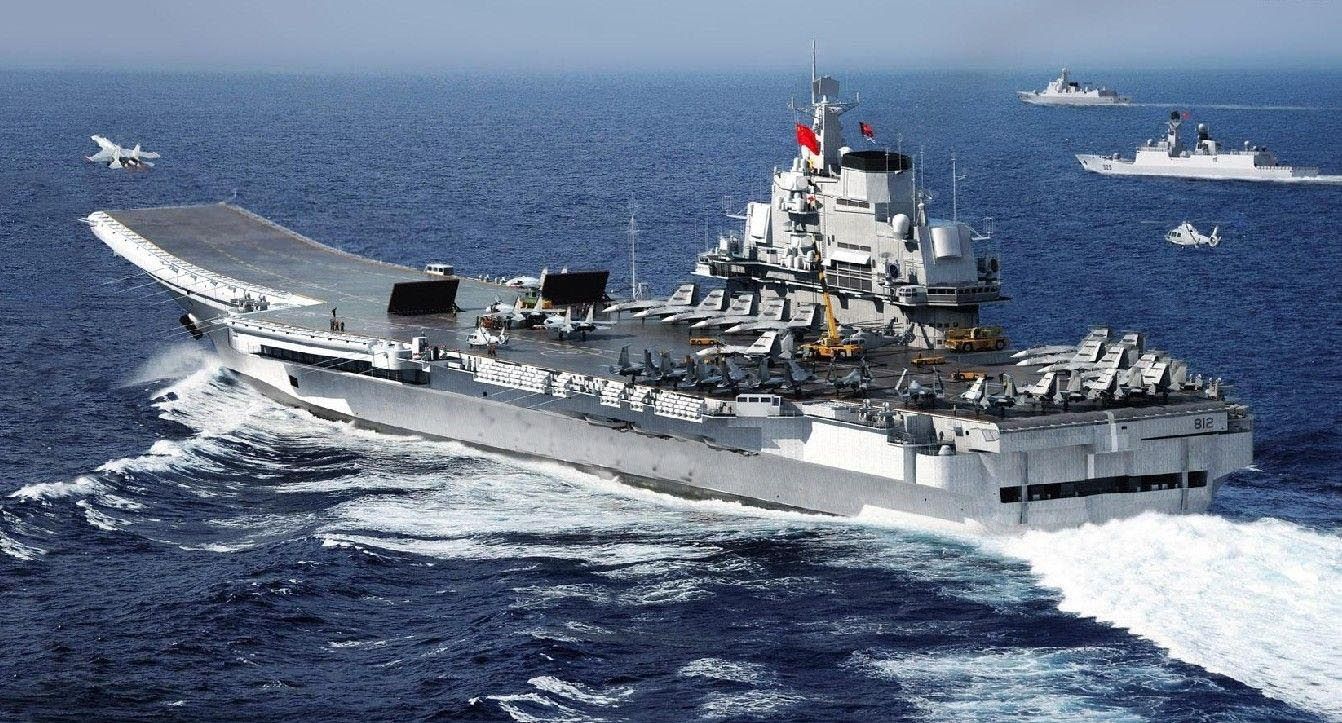
While we're at it, let's bring up a picture of the People's Liberation Army Navy's first aircraft carrier Liaoning - without which they would be at least one if not two decades behind in building their carrier fleet.


While it is encouraging that in the last few years "official Washington" has reached the pivot point in seeing the PRC's plans - it is almost criminal the lack imagination and vision on our part seeing it, especially in the 1990s when was the point everyone should have seen the game was afoot.

Just two datapoints, both related to these two pics.

"The Long Game" was an old story by the time we started it in 2004. It has its roots a lot further back. I think the first tickle of the idea came to Ensign Salamander back in 1990 when he caught a bit of info in the local paper about something that dominated the skyline for anyone coming in or out of Mayport.

Go to the pic at the top and look at those cranes and then return here. 

Know what the pic below is?


That's right - it was the original plan for "Goat Island" in the St. Johns River in northeast Florida. Today is is known as Blount Island.

There were big plans there in the 1960s and 70s;

...Offshore Power Systems (OPS) was formed on July 6, 1972 as a 50/50 joint venture between Tenneco Power Systems (who owned the Newport News shipyard) and Westinghouse Electric Corporation. It proposed to design, manufacture, and market complete nuclear power plants of a standardized design and integrated with specially designed floating platforms 5.

Each floating nuclear power station (FNPS) would contain two or more FNPPs within a protective breakwater. The individual plants were to be 1150 MWe Westinghouse four-loop PWRs with ice-condenser containments. They had once-through steam condenser cooling with no cooling towers. Electricity was to be transmitted at high-voltage (345 kV) through submerged cables beneath the sea bottom. A shore support facility would provide a staging area, a docking facility, office buildings, and parking.

At the time, the largest crane of its type in the world, just one, was at Blount Island - but the anti-nuclear movement in the 1970s killed OPS before any construction could be started.

That crane though...what was to be done with that? In 1990, in the heart of the Bush41 Presidency;

A REMNANT of a futuristic project that would have supplied cities with electricity from floating nuclear power plants is about to leave Florida. The world's largest crane, designed to build the nuclear systems, is being dismantled along the St. Johns River for shipment to China. The crane is being taken down by workers from the China State Shipbuilding Corp. at Blount Island. The Chinese reportedly paid $3 million for the 38-story crane, which cost $15 million when built for Offshore Power Systems.

Ensign Salamander - always suspecting the worse of all communist nations and enraged that we would do any business with them, was unpleased, but had a lot of PQS to do and was keeping a weather eye to that Iraq thing and hoped his betters knew what they were doing.

So began a bi-partisan decade of stupid acts.

Quick, go up to look at the PLAN carrier pic above again then come back.

Where did that start?


It was a mission like no other. In the aftermath of the Soviet Union's collapse, one businessman armed with cash and a casino cover story scooped the world to buy the unfinished hulk of a Ukrainian aircraft carrier that would become the centrepiece of the PLA Navy.

Speaking to the media for the first time, the Hong Kong-based businessman at the heart of the undertaking reveals in a two-part series the details of the little-known, behind-the-scenes odyssey to realise China's long-held dream of owning such a warship.

Xu Zengping disclosed that the militarily sensitive original engines of the carrier were intact when Ukraine sold the vessel in 1998. This is contrary to what Beijing told the world at the time.

Soon to be LCDR Salamander didn't like this either, but he was focused on that guy in Iraq who needed a good spanking for trying to kill Bush41, so he hoped  his betters knew what they were doing. He had his suspicions because we were also selling MIRV technology to the PRC, but what did I know?

His betters didn't.
Karginov told the media: “The unfinished aircraft carrier Varyag was handed over to Ukraine and then sold to China to convert it into a casino. After China received the ship, it completed its construction and renamed it the Liaoning ship. The ship was originally supposed to become one of the main ships of the USSR.”

I'm not really mad at the PRC. I'm actually quite impressed with their leadership's long term vision, drive, and follow through. 

Are we thinking as long-term? Is our defense nomenklatura focused on the Long Game ... or any game at all outside the Beltway?

Have we learned?

Tuesday, January 10, 2023

The Surface Force's Lost Generation


Over at Defense News, Megan Eckstein has your must read to start your week. I hope she does not mind, but I'm going to pull a lot from her article. Read it in full, but there is so much here that validates what we have spent the last two decades on the Front Porch and on Midrats discussing, we need to spend some time to take a deep dive.

Back in 2009 we warned everyone that the Navy's decision to classify INSURV was nothing more than a smokescreen to hide the results of bad decisions on maintaining the readiness of our Navy from the taxpayers and allowed senior leadership to play other games as opposed to their core responsibilities. To say that almost two decades after the Cold War all of a sudden INSURV was classified was just, in a word, insulting.

In 2009, the U.S. Navy faced a readiness crisis.

The cruiser Chosin and destroyer Stout were both deemed unfit for combat operations by the service’s Board of Inspection and Survey, which at the time checked ships’ material conditions every five years.

And they weren’t the only ones. From 2005 through 2009, nearly 14% of surface ships failed their inspections, up dramatically from 6.2% from 2000 to 2004 and 3.5% from 1995 to 1999.

The crisis came after the Navy discontinued several of its Cold War-era organizations focused on maintenance and training in an effort to save money during a time without a significant threat to U.S. security.

No, the "without a significant threat" line is simply BS, an excuse, and for many who knew better ... a lie. We all saw what the People's Republic of China was building. FFS, contemporarily we were a few years in to "The Long Game" series here and we were just riding the wave smarter people set in motion.

"Without?" No, that dog just won't hunt.

This excuse was designed only to cover people who were focused on little more than building personal clout in their present job, while shifting Navy problems in to someone else's PCS cycle to solve. Sure, there was myopia by an ill-informed or just wrong cohort, but for most it was simply, as we say in horse country, "shooting up the horse."

There were some who tried at the time to fix it inside the system, but ultimately came up short. 

There were good guys, a lot of them - they just didn't get to 50.1%; 

Adm. John Harvey, who led U.S. Fleet Forces Command at the time, helped charter a fleet review panel to determine how the Navy ended up in this position.

... 

In 2010, the fleet review panel’s report, dubbed the Balisle Report after lead author retired Vice Adm. Phil Balisle, shocked the surface fleet with its data on the poor state of ship readiness and crew training. It painted a dire picture of a surface navy that needed to be fixed; otherwise, there was a risk someone could get hurt or killed.

Let's freeze that for a moment. The summer of 2010. That is 12 and a half years ago. Here is what we wrote about this in June and July of 2010. What is that, between three and four WorldWars length of time?

The review, released in 2010, was condemnatory. “The panel is in full agreement that surface force material readiness is in decline. [T]he message is clear: the trend is in the wrong direction.”

Chief among the review’s recommendations was a call for the return of readiness squadrons, which oversaw surface ship maintenance and basic training. The review found that when these squadrons were eliminated in 1995, so too was the fleet’s focus on and accountability for making deployable ships and crews.

So many of the problems we have today can be traced back to the post-Cold War arrogance of the 1990s,  Perry's Last Supper, TQL, the triumph of the accountants, layered with the Transformationalist snake oil of the following decade.  

In 2010, Harvey pushed to reinstall the readiness squadrons, but he couldn’t rally enough support from the Navy’s manning, engineering and budgeting leaders, among others. The recommendation was never implemented.

But in summer 2017, two separate collisions by Navy ships in the Western Pacific killed 17 sailors. The service once again had to dig out of a ship readiness hole, and a key leader again called for the return of the readiness squadrons. Again, the idea went nowhere.

The lives of 17 Sailors and two WorldWars after 2010 later. "Nowhere" has one hell of a butcher's bill.

“The Balisle Report gave us this tremendous look at a history, really since 2000 or so, of these various decisions that were made in various different parts of the Navy,” Harvey told Defense News. “The collective impact was very, very negative in terms of our ability to keep our ships properly manned, trained and equipped.”

...

“Bringing back the readiness squadrons,” Harvey said, “if you talked to Adm. Balisle, it was his No. 1 recommendation to do. And I agreed with that.”

Still, Harvey added, the urgency to make this major change was “overcome by other events at that time.”

"Other events..." indeed; as we documented at the time linked to above.

The U.S. Navy has not made significant progress toward growing its fleet size above 300 ships. The FY23 National Defense Authorization Act allows the service to shed 12 of the 24 ships it proposed retiring. Even with a slower retirement rate and marginally higher shipbuilding and construction funding from Congress, it will prove difficult for the Navy to grow the fleet toward 355 ships. That was the last publicly stated force structure objective, back in 2016; since then, the Navy has not officially stated a revised target. (Source: Doug Berenson/Oliver Wyman)

It is a hard sell to beg for more ships when from a material condition to a maintenance support perspective we seem to have trouble taking care of what the taxpayers have already bought us by borrowing money in the name of children yet unborn.

Kitchener said there are two key differences this time around: an advanced adversary in China that’s forcing the Navy to think about its near-term readiness to fight; and data analytics and modeling that prove the surface groups will be worth the investment.

I'm sorry, but bullsh1t.

The threat from the PRC was as well known in 2016 as it is now. I will add to this that no one has confidence on the "analytics and modeling" coming from the Navy. 

The Age of Transformationalism, gutting of maintenance, and the vaporware that was "optimal manning" have blown all credibility in the Navy's "muh metrics" claims. Kitchener's numbers may very well be perfect, but no one has any reason to believe any of them from Main St. to Congress. Sorry, but institutionally we blew that credibility over the last two decades and it will take a long time to get it back.

We would make much better headway by simply saying, "For most of this century we blew it. We were wrong. We are trying to do better." 

Some, like Harvey, gave the Navy a window to save itself a dozen+ years ago and we didn't take advantage of it.

We have years of work to do ... but Step-1 here is to admit our mistakes. Until we do that, everyone can very reasonably assume we will do it again.

Data is central to Kitchener’s new effort. He told Defense News in an interview that various efforts have identified the ways to improve ship maintenance: building up a larger inventory of select spare parts, adding capacity in key shops and departments that are potential chokepoints, increasing training and growing expertise in certain technical areas, and more.

Ahh...the "Just in Time - -TQL" hangover. What takes one year to destroy, takes five years to rebuild. All that Kitchener is saying is not new. It is, just like readiness squadrons, returning to the last baseline that worked.

Are we in the process of a "baseline reset?" That would be a good thing.

Take Destroyer Squadron 9, for example, located in Everett, Washington. Its ships are scattered geographically: one located in Everett, five in San Diego and two in Pearl Harbor, Hawaii.

I'll let you do a distance and time zone review of that for yourself. Norfolk-Mayport was hard enough.

There are reasons this exists, but none of them are satisfactory when an overall net cost is considered.

Kitchener said he’s awaiting the final recommendations of his working group this summer, but expects each fleet concentration area to have a single surface group responsible for maintaining and training all surface ships, including cruisers, destroyers, littoral combat ships and amphibious warships, based in those cities. These home ports include San Diego; Norfolk, Virginia; Mayport, Florida; Everett; Pearl Harbor; Yokosuka, Japan; Manama, Bahrain; and Rota, Spain.

I am trying to hard not to just snark old-school...but really - we have reached the point that giving commanders a chance to "walk the pier" without getting on an aircraft is something "new."

Instead of gratuitous snark, have a meme.

I mean, this is how it should be ... and seems to be heading back in the correct direction. It should be applauded. 

Each surface group would devote itself entirely to readiness. ... in the case of a maintenance casualty, the surface group back home would work to find the quickest solution, allowing the destroyer or amphibious squadron staff to continue focusing on operations. 

“This is oversight and responsibility and accountability throughout the entire” readiness cycle, Kitchener said. “The idea is, this exists in the fleet concentration area, it’s got a cadre of people that are constantly on our ships assessing, understanding what the problems are; we’re pulling the trend analysis here at the headquarters, giving them focus areas. It’s a very active, not just some sort of bureaucratic, organization.”

For those who were JOSs in the 90s, I guess a bureaucratic system focused on maintenance excellence is new and radical, but it has a track record. This is simply good stuff. We tried everything else and failed, why not try what worked?

Also, can we also make progress in the "Syllabels Reduction Act of 2023?" Can we simply go back to calling things "bases" as opposed to "Fleet Concentration Areas?" 

2 syllables and one word > 8 syllabels and three words.

As there is a lot of ruin in a nation, there was a lot in institutional capital previous generations built up prior to the 1990s that could be drawn on to pay for bad decisions, but that account is pretty much drawn down to almost nothing. 

Talk to anyone on The Hill ... it's gone.

The Navy has observed improvements in maintenance performance, but is also facing new setbacks as labor and supply chain challenges across the manufacturing sector continue to take a toll on the ship repair industry.

Rear Adm. Bill Greene, the fleet maintenance officer for U.S. Fleet Forces Command, said in the fall that only 36% of surface ships are expected to complete maintenance availabilities on time in fiscal 2022, down from 44% in fiscal 2021.

... 

 This duality is also reflected in the most recent Board of Inspection and Survey report, which noted surface ships are seeing higher overall readiness scores than the six-year average, but have more functional areas deemed “degraded” than the six-year average, using a scoring method of satisfactory, degraded or unsatisfactory.

Time for a reminder ... we need to make INSURV publicly available again. Less accountability gave us less readiness, and as a result our nation and its Navy is less secure.

What vexes the Navy, Kitchener said, is variance in maintenance performance: ... Kitchener outlined a three-step process to address this. The first step was already done under Performance to Plan ... P2P has highlighted the need to prioritize people or materials for a certain ship availability, and then coordinate activities across multiple shops at a shipyard to get a specific repair done on time.

The second step is allowing surface groups to devote their full attention to implementing the actions identified through P2P in hopes of achieving better on-time maintenance rates.

The third step, on which Kitchener said he’d offer more details soon, is creating a surface response plan that prioritizes certain ships’ readiness over others.

If a contingency arose and a combatant commander needed three destroyers, the three ships at the top of the list would be called upon to deploy on short notice. Those ships higher up on the list would be expected to stay in a peak-readiness state, and the maintenance and supply communities would act accordingly. Ships lower on the list and less likely to be called upon for unexpected tasking may be in a lower readiness condition if the fleet is short on personnel or materials, for example.

For those outside the Minotaur maze that is the US Navy's decision making, you are allowed to ask, "Why didn't we do this already?"

I know. I know.

So, what will this look like?

Kitchener said the future SURFGRU Southeast, currently named Naval Surface Squadron 14, is the “most robust” organization and has served as a model for the working group, which determined how many supply specialists, logistics personnel, diesel engine (versus gas turbine) experts, and so on, were needed to keep ships properly ready.

Kitchener said the Mayport group has 105 billets for a squadron that tends to about 10 destroyers — compared to just 10 personnel tending to nine destroyers and cruisers in Everett. The exact number of billets in each group would depend on the number of ships at a particular port, but Kitchener said the groups would more closely resemble the Mayport squadron than the Everett unit.

Mayport ... the best Sea & Anchor Detail in the Navy. 

The Navy was skipping training and maintenance to achieve unsustainable levels of at-sea presence, and it was down about 12,000 sailors thanks to the individual augmentee program that sent personnel to support joint operations in Iraq and Afghanistan. Sequestration cuts to the federal budget in 2012 further diminished readiness, Harvey explained.

No one said, "No." No one defended our Sailors or our Navy. We let the COCOMs abuse the running room they made for themselves as a result of Goldwater-Nichols and the whole accretions encumbered COCOM structure and Cult of the Joint that came with it. 

Yes, I am beating that horse and will continue to beat it until we get something fit for the 21st Century. 

No senior leader was willing to put their "career" - whatever that is after you have 4-stars - on the line to defend their Navy. We needed "Admiral No" and instead got "Admiral Hinge."

It wasn't something that happened to our Navy. No, it was something we allowed to happen to our Navy. Heck, during some of the worst of it, the Chairman of the Joint Chiefs of Staff was a USN 4-star.

“It was going to take more billets, more people. … And there just was not a clean, widespread agreement among everybody who had to agree that this was the right way to go,” Harvey said. “In the greater scheme of things and what was going on, it just never rose to the level where it had a critical mass of leadership who all said: ‘Yes.’ ”

No, plenty of billets were found for other "priorities and distractions" - they were just more important than manning, training, maintaining, and equipping a fleet to fight and win. As I've offered for years, give me the top-cover and the manning documents ashore, and I'll find your billets. Just let me recode and reassign as needed. If I need more, I'll look at afloat and DC staff. They're there - you just have to be ready to upset a different group of people who don't add warfighting value anyway.

In the end, this is the cost of distraction and ill-focus;

Retired Vice Adm. Rich Brown, who investigated one of the two fatal ship collisions in 2017 and then took command of Naval Surface Forces in 2018, resurrected the push to bring back readiness squadrons. He said that, by 2017, virtually all Balisle’s recommendations were implemented — with the readiness squadrons being the major exception.

Brown told Defense News a robust readiness squadron likely would have prevented the fatal collisions involving the destroyers Fitzgerald and John S. McCain.

In summary, yep.

The existing structure asks destroyer squadrons to oversee the maintenance and certification of ships and serve as the sea combat commander for a carrier strike group. If the squadron needs a ship to fulfill a warfighting requirement, it creates a conflict of interest that can put maintenance and training needs at risk.

Brown said this construct “failed, and we recognized that it was failing, and so that’s why the Balisle Report said, and later I said, we’ve got to do this. And we just didn’t do it.”

He called the 1980s readiness squadrons “a proven model” that restored the Navy from having a hollow fleet in the 1970s to having a robust surface force by the 1980s.

There it is again; baseline reset.

A future “high-end fight requires so much dedicated concentration and focus that we need these additional commands. They’re going to come at a cost — it’s going to come at a huge manpower cost, and the Navy’s got to buy that manpower because it’s the right thing to do for our carrier strike groups,” Brown said.

Yes, buy manpower ... but also repurpose existing bloat ashore. Yes, recoding BA/NMP is a pain - but it can be done. Yes, rice bowls and rent seekers will be upset. All it needs to be is a senior leadership priority. And at the end of the day, shouldn't the ability to fight and win at sea be number 1?

We cannot change the past, but we must acknowledge, name, and recognize past errors so that they won't be repeated. 

There is some good stuff going on as outlined in Megan's reporting, and we should see more in this direction, but no more happy talk. No more multi-syllabic bullsh1t bingo lingo. No more petty distractions.

There are a lot of smart, good people in important positions who want to do great things. They just need the right higher direction and guidance to execute.