Showing posts with label Poland. Show all posts

Wednesday, February 01, 2023

Eastern Europe's Second Chance


Geography doesn't change. To a slightly lesser extent, neither do historic patterns.

Even if Ukraine wins the Russo-Ukrainian War, Russia will still be to the east from Central Europe. 

She will be back in one form or another.

After the fall of the Soviet Union, liberation, and joining NATO - helped with a lot of ahistorical thinking on both sides of the Atlantic - there was a bit of hedging that there was time to rebuild Central European economies and civil society before a threat from the east came back. For almost three decades the former Warsaw Pact members of NATO let their military capabilities and investments fall closer to 1% of GDP as opposed to the 2% minimum.

The events of the last decade have sobered up everyone from Estonia to Bulgaria, but for most of those nations, by free-riding on their richer nations to the west for national defense, they lost or allowed to almost die what domestic arms manufacturing they had remaining from communism.

Everyone - well those who are paying attention - now realize the existential requirement to have at least the most basic domestic production capabilities to defend yourself, regardless what accountants may say.

The last year is seeing once strong medium powers in Central Europe bring capacity back online. 

Good for them, good for all alliance members;

Still wary of Russia, their Soviet-era master, some former Warsaw Pact countries see helping Ukraine as a matter of regional security.

...

“Taking into account the realities of the ongoing war in Ukraine and the visible attitude of many countries aimed at increased spending in the field of defence budgets, there is a real chance to enter new markets and increase export revenues in the coming years,” said Sebastian Chwalek, CEO of Poland’s PGZ.

State-owned PGZ controls more than 50 companies making weapons and ammunition – from armoured transporters to unmanned air systems – and holds stakes in dozens more.

It now plans to invest up to 8 billion zlotys ($1.8 billion) over the next decade, more than double its pre-war target, Chwalek told Reuters. That includes new facilities located further from the border with Russia’s ally Belarus for security reasons, he said.

Other manufacturers too are increasing production capacity and racing to hire workers, companies and government officials from Poland, Slovakia and the Czech Republic said.

...

Chwalek said PGZ would now produce 1,000 portable Piorun manpad air-defence systems in 2023 – not all for Ukraine -compared to 600 in 2022 and 300 to 350 in previous years.

The company, which he said has also delivered artillery and mortar systems, howitzers, bulletproof vests, small arms and ammunition to Ukraine, is likely to surpass a pre-war 2022 revenue target of 6.74 billion zlotys.

...

Czech arms exports this year will be the highest since 1989, he said, with many companies in the sector adding jobs and capacity.

“For the Czech defence industry, the conflict in Ukraine, and the assistance it provides is clearly a boost that we have not seen in the last 30 years,” Kopecny said.

David Hac, chief executive of Czech STV Group, outlined to Reuters plans to add new production lines for small-calibre ammunition and said it is considering expanding its large-calibre capability. In a tight labour market, the company is trying to poach workers from a slowing car industry, he said.

Defence sales helped the Czechoslovak Group, which owns companies including Excalibur Army, Tatra Trucks and Tatra Defence, nearly double its first-half revenues from a year earlier, to 13.8 billion crowns.

The company is increasing production of both 155mm NATO and 152mm Eastern calibre rounds and refurbishing infantry fighting vehicles and Soviet-era T-72 tanks, spokesman Andrej Cirtek told Reuters.

He said supplying Ukraine was more than just good business.

“After the Russian aggression started, our deliveries for Ukrainian army multiplied,” Cirtek said.

“The majority of the Czech population still remember times of a Russian occupation of our country before 1990 and we don´t want to have Russian troops closer to our borders.”

The Poles and the Czechs, in addition to having the industry, have a martial tradition going back over 1,000 years. 

There is no downside to having them strong. They'll bring their neighbors along with them. 

Friday, January 13, 2023

Fullbore Friday

From 12–25 August 1920 there was one of the more important battles of modern history that is relatively unknown out of the country the battle took place in. It is a story of audacity in th eface of incredible odds by a nation only reborn less than two years earlier against an equally younger malignancy.

The Battle of Warsaw;
The Polish-born and much feared head of the Cheka (Bolshevik secret police), Feliks Dzierzinsky, was made head of a Polish Revolutionary Committee, which would follow the Red Army and form the new government. Lenin was absolutely confident of success. Initially all went well, and within six weeks the Red Army was at the gates of Warsaw. But as the Polish Communists had warned, all classes did indeed unite, and there was no rising in the city. Also the Polish commander, Józef Piłsudski, drew up a bold, if not foolhardy, plan of counterattack. The Polish army would stand on the defensive in front of the city, and when the Red Army was fully committed to the battle, Poland’s best units would launch a flanking attack from the south, cut the Bolshevik lines of communication, and encircle much of the Red Army. Some Polish generals were aghast at the risks involved, but in their desperation there seemed no alternative.
As often happens in war, things did not run as per the plan. The enemy has a vote, and they were advancing too fast. The Poles had to move a day early.
The Red Army fought its way to the village of Izabelin, only 8 miles (13 km) from the city, but the Polish attack succeeded beyond wildest expectations. Driving through a gap in Bolshevik lines, the Poles advanced rapidly against little opposition. In the Red Army, all was chaos; commanders lost control of their units, with some divisions continuing their advance on Warsaw, others fleeing. Three armies disintegrated, and thousands fled into East Prussia, where they were interned. In an encounter that saw Polish lancers charging and overwhelming Bolshevik cavalrymen, the First Cavalry Army, trapped in the "Zemość Ring," was all but annihilated.

The Fourth Army meekly surrendered after being encircled. Marshal Mikhail Tukhachevsky desperately tried to pull his troops back to a defendable line, but the situation was beyond redemption. A few more engagements followed, but the war was effectively won. Lenin was forced to agree to peace terms that surrendered a large tract of territory whose population was in no way Polish—the Red Army returned to reclaim it in 1939.

Losses: Soviet, possibly some 15,000–25,000 killed, 65,000 captured, and some 35,000 interned in Germany; Polish, up to 5,000 dead, 22,000 wounded, and 10,000 missing.
The seeds of one victory often hold the next defeat.


First posted AUG2018.

Tuesday, October 18, 2022

The Baltic Nations are Subject Matter Experts Here, we Should Listen


I always recommend that if people even have a remote opportunity, they should visit the Baltic Republics.

When there, take time to visit their museums. I especially recommend Vabamu Museum of Occupations and Freedom in Tallinn, Estonia.

These are small nations from Estonia's 1.3 million, Latvia's 1.8 million, to Lithuania's 2.8 million. These little ethnostates each have a unique language, culture, and have survived as a people since pre-history. They are survivors who have not had many years to be masters of their own fate.

The fall of the Soviet Union gave them their latest chance, and they've made a good run of it. They, more than most, know Russia - indeed, all three have significant Russian minorities in their nations who decided to throw their lot in with their Baltic neighbors after the fall of the Soviet Union.

Though they are small, when they speak about Russia, larger nations should listen. Their larger neighbor, Poland with 38 million souls, also has a long and brutal history with the Russians. All four nations will be the first to feel the results of making the wrong decisions towards their big neighbor to the east. A no kidding existential threat. They are also NATO allies, so their threat is in a very real way our threat.

They cannot afford vanity-filled feel-good theories.

Since February, the Baltics and Poland have repeatedly called for the provision of more and faster military assistance, including more powerful offensive weapons, only to be rebuffed by the United States and Western European allies who wanted to make clear that they were not in a direct conflict with Russia.

Slowly, that’s started to change, after Putin proved his wary neighbors right — repeatedly.

“Estonia knows the face of Russian occupation firsthand,” Kallas added. “We know that peace under occupation doesn’t mean the end of atrocities but more of them.”

Baltic leaders have long argued that Western sanctions adopted in 2014 after Putin illegally annexed Crimea showed the West’s lack of resolve in confronting the Russian president over his land grab. European leaders seemed to think the Baltics were so traumatized by Soviet occupation that they could not be objective.

“Jokingly, you know, we call this ‘West-splaining,’” Lithuanian Foreign Minister Gabrielius Landsbergis said. The West’s message, he said, was that “after 50 years of occupation, it’s understandable that you would have trust issues with a country that occupied you.”

“For us in the Baltics, it all boils down to this notion of appeasement: that basically we can appease Russia,” Landsbergis continued. “For us, it was always very clear, black and white. If a country is eager to cross another country’s border, they’re an aggressor and they will do that again, if they’re not stopped. And they have not been stopped.”

For free people to remain free - for liberal democratic systems to remain so - there must be military strength. Unfree and autocratic nations respect nothing more than power. You cannot maintain and built peace in their presence without it.

On a broader context specifically towards China, Rep. Mike Gallagher's (R-WI) speech this AM at Heritage drives this point home - hard power matters; overt hard power.

It may be cliché but it is true; the more you prepare for war, the less likely it will occur - but if it does - then you have the capability to win, vice being rolled over and your nation's future subject to the whims of another.

Friday, June 17, 2022

Fullbore Friday

When do you accept defeat? When do you allow your morale to be beaten down? Think you have an excuse to complain about things in your military career that are beyond your control? Really?


Years ago Pawel sent me a link to one of the many unsung (at least in the Anglosphere) heroes from Poland who fought on the Western front.

I've always had a soft spot for their story, but we've discussed them here mostly in their ground component support. Simply an amazing story of so many who fought for their nation only see it liberated from one occupier to be handed to another. Those who survived the war and fought in the West rarely had a chance to go home and had to find their way the best they could, mostly in post-war UK, Canada or the USA.

Not all made it, but their records remain. One such that Pawel rightly points out is worthy of mention is Captain Eugeniusz Horbaczewski, Polish Air Force contingent of the RAF.

Just the start is enough;
On September 17th, with a large group of Polish aviators, he crossed the Romanian border and via Yugoslavia, Greece and France, arrived in Britain. After completing fighter training in British aircraft he was assigned to fly "Spitfires" with the Polish 303rd Squadron. To his squadron mates, Horbaczewski was also known as "Dziubek".
By 1944, at age 27, he took command of 315 squadron and as all good commanders do, set the example;
On 16 February 1944 Horbaczewski took command of Polish 315 Fighter Squadron "City of Deblin," with squadron codes "PK". In March of1944, the Squadron was re-equipped, from "Spitfire" Mk Vs to "Mustang" Mk IIIs. On June 22, 1944 "Dziubek" had a performance of remarkable courage. During a ground attack on German units near Cherbourg, the aircraft piloted by Lt. Tadeusz Tamowicz was damaged and forced to land. Horbaczewski skillfully landed nearby on an airstrip just built by Americans. He found Tamowicz, who had injuries to both legs, and brought him back to "Dziubek's" P-51. Horbaczewski flew the two of them across the Channel to the home base of Coolham.
Read the whole thing - and Wiki has a good entry too.

First posted in AUG 2014.

Monday, August 09, 2021

Forget Your Peacetime Battle Networks


What the Spanish Civil War was to WWII armor and air tactics, the extended conflict in Ukraine and to a lesser extent Syria is to electronic warfare.

There isn't so much "new" that is being developed, but hard lessons forgotten since the fall of the Soviet Union.

The closer you get to Ukraine, the more clear it becomes. Poland gets it.
Polish firm WB Group harnesses low-power radios and quasi-satellites in a scalable and adaptive communication system.
A Polish company has developed a tactical communication system called Cicha Sieć (Silent Network) with a low electromagnetic signature that leverages lessons learned from the ongoing conflict in Ukraine.

WB Group launched Silent Network last month with battalion-level deployments in mind, although it claims the solution can be scaled up for larger formations.

Company VP Adam Bartosiewicz explained that Silent Network originated with two parallel developments in 2013: the Perad personal radio and the deployment of the FlyEye UAS in Ukraine.

What does Sal what to know? What does the USA have in this area?

Also a reminder; what happens in EW ashore also applies to at sea. How do we fight in a contested and hostile EW environment? Are we leaning too much on peacetime capabilities and habits that simply won't be there at war?

I hope we are asking and acting on such questions. 

Friday, May 15, 2020

Fullbore Friday

I have always found the various stories of the Polish military who fought with the Western forces interesting.

WWII in the West started when Germany invaded their nation - then the Soviet Union joined in eating up what was left. They had no chance. 

Those who escaped the Nazi and Communist death squads had epic stories how they managed to get to the West to keep on the fight. 

They fought, bled, and died for a nation and a cause that they could never return to. A hollow victory that traded fascism for communism for their beloved Poland. Many died before they could see a free Poland again.

One of those leaders was Commander Eugeniusz Pławski, Polish Navy.

He started life as an Imperial Russian Navy officer. Post WWI he joined the navy of the newly independent Poland. Fought through WWII, including going toe-to-toe with the Bismark as CO of the destroyer ORP Piorun (G65).

He and his crew had a great story. Sadly, at least for the English speaking world, Wikipedia is the best source - though a few others are good.

After the war, like most Poles who fought in the West, he could not return to Poland, so he emigrated to Canada, passing away in 1973 in Vancouver.

What would I do in the face of the challenges he faced in his life ... and that of his Sailors?

I don't know, but I would hope that it would be something good enough that Commander Plawski would give a polite nod to.

Fullbore.


Sunday, October 20, 2019

Baltic Security with Dr. Sebastian Bruns - on Midrats


From Finland to Denmark, Sweden to Poland - from small Latvia to the Continental power of Germany - the return of Russia has brought a renewed focus the last half decade to the Baltic.

Not just a SLOC, there are important economic and cultural ties that predate written history that continue to be important today.

Our guest for the full hour in a wide ranging discussion will be Dr. Sebastian Bruns.

Sebastian heads the Center for Maritime Strategy & Security (CMSS) at the Institute for Security Policy, University of Kiel (ISPK). He is the author/editor of six books, including "Routledge Handbook of Naval Strategy and Security" (edited with Joachim Krause, London 2016), and his latest, "US Naval Strategy and National Security. The Evolution of American Maritime Power" (London, 2018).

You can listen to the show at this link or below, but remember, if you don't already, subscribe to the podcast at Spreaker or any of the other podcast aggregators.

If you use iTunes, you can add Midrats to your podcast list simply by clicking the iTunes button at the main showpage - or you can just click here.

Thursday, July 11, 2019

NATO in Three Graphs

For those like me who deeply care about the NATO alliance, take some time to read last July's Pew Report if you have not already.

There are three graphs from their data that illustrate well some of the common points we've discussed here through the years.

If you want a good idea who would likely step if the call came, this is a good benchmark. 

This next graph is a good measure of entitlement and inherent free-ridership.

Poland and my people in The Netherlands are both outliers here. Good for them.

...and here is the "put your money where your mouth is" graph. Sadly, the Dutch are failing to do so - but look at Poland.

Poland deserves more of our support and encouragement. 

Much more.


Thursday, December 27, 2018

Poland Speaks its Truth

Over at Defense News, Poland's defense minister Mariusz Błaszczak outlines some immediate steps Poland is taking in response to the changes she sees as a front line nation.

Imagine if each NATO nation took a comparable move relative to their size. You want to strengthen the alliance? That is how you strengthen the alliance.
We have decided to form a fourth division east of the Vistula river. The whole process will take approximately three years with the perspective of the division’s full operational capability in spring 2021. We will continue to develop the Territorial Defence Forces as the fifth service of the Polish Armed Forces with its 17 brigades spread across each Polish province. We also continue designating significant financial resources for military
Hat tip SP.

Tuesday, November 27, 2018

Eastern European NATO vs. Russia - the Numbers

As we saw with the rapid fall of the Soviet Union and the end of the Cold War, history can change on a dime with little warning.

Russia's latest row with Ukraine is a good reason to tilt the prism we look at thing through and ponder a few items.

No one knows the Russians better than the Eastern Europeans who were once part of the Soviet Block.

When they rapidly moved away from Communism and joined NATO, they rightfully had a unique challenge in building sustainable economies and representative governments in line with the Western European standard +/-.

They all minimized what, under the protection of NATO and the supine wreckage of Russia to the east, was a lower priority - military spending.

The end of the 2nd decade of the 21st Century is not the 1990s and the last few years have seen a return to historical norms - the Russian bear looming to the east.

Of note, to a nation, all the former Warsaw Pact and Soviet Republics now in NATO have significantly increased military spending since 2014 when it was at its lowest. They skimped too much in the face of a growing Russia and are playing catch-up as best they can. Is it fast enough? TBD.

Hopefully, apart from internal realization of their shortcomings and pressure from the alliance partners, investment in defense in Eastern Europe will continue. Russians respect power more than anything, and a strong Eastern Front of NATO is best for all. 

I also hope there is something else driving this; a realization that NATO is not a guarantee. Many are now taking seriously what I have been warning my European friends for two decades; the USA is one election away from leaving Europe to its own devices (see the Norwegian series, Occupied - it ain't just me who sees this, and it pre-dates Trump).

What are those nations on the front lines against Russia doing for their own security? What alone, or in some collective, what can they put against the power of Russia?  

People and nations will show you what they think is important based on what they spend their money one. 

Last night I put a few numbers together.


There is so much potential here even without any help further west. Their population is not quite Russia, but it is their economic power that is the key.

Of course the weakest part of this is their lack of unified command - something they have in NATO - but with perhaps the Visegrad as the anchor - why not have some military structure in place like most of Western European NATO have with the EU military structure? Not a counter to NATO, but a backup - just like in hushed voices, some on the EU military staff will tell you. 

It would be a staff in being, waiting for a reason to scale up.

First things first though. The great advantage Eastern European NATO has against the Russians - especially Poland and the Czech Republic, is the strength of their GDP/person. They have strong economies. If they are smart, even small increases in military spending can buy quality kit and training - quickly closing the gap with Russia.

A strong Eastern Europe, economically, militarily and rule of law, would be the best guarantor of containing Russia. A promising side effect, by example and close ties, a rising Eastern Europe will help their neighbors, Ukraine and Moldova, start to improve as well. 

Eastern Europe does not have to think that Germany, France, Britain, or the USA are the only things keeping Russia away - if they invest and think - they can do most of it all themselves.

With strong backing to the west, even more. Remember, Eastern Europe has no threat from the west while Russia has much to concern her to her east. If Russia wanted to move west, she could not bring her full force to that effort.

Eastern Europe however can put their full force facing east.

Ponder 3-4 moves ahead of where we are at the close of 2018. 

Friday, October 12, 2018

Fullbore Friday


Time to revisit the Battle of Westerplatte - as a final chapter has closed.

For a heroes obit, I hope they don't mind if I steal 90% - it is too good to chop up.

At the end of August 1939, trouble entered the harbour in the form of the 14,000-ton German battleship the Schleswig-Holstein (a ship predating the First World War). Although sailing under the pretext of a courtesy visit, she contained a company of marines. In the early hours of September 1, Skowron was looking through his telescope and saw a flash emanating from the ship. Within seconds, a shell had landed on a gate near the railway, and a whole wall collapsed. What Skowron had witnessed was, in all possibility, the first shot fired during the Second World War.

After the salvo had ended, the peninsula was stormed by the German marines. Taking one of only two machineguns, Skowron ran down to a guardhouse and helped to repulse the first German assault on the main gate. The attackers were expecting an easy victory, but the Poles fought back ferociously, and managed to catch the Germans in a murderous crossfire. In addition, well-placed mortar rounds also fell on the attackers, and by around 10 o’clock that morning they retreated, having suffered 50 casualties to the eight of the Poles. The German losses would have been far higher had the Polish commander not wished to conserve mortar rounds.

On the following day, the Germans stepped up their attack. “There were three attacks in the morning,” Skowron recalled, “which got worse and worse. Aircraft, reportedly 50 of them, dropped nearly 200 bombs.” The air raid not only destroyed a guardhouse, but also the Polish mortars. Supplemented by a naval barrage, those aboard theSchleswig-Holstein reckoned — with good reason — that nobody could have survived the bombardment. Despite the intensity, the Poles sat firm. “Our men were calm,” said Skowron, “nearly indifferent, because the cycle was so repetitive — aircraft, bombs, missiles, again and again.” The entire peninsula soon resembled a First World War battlefield, with huge craters, bombed-out buildings and raging fires.

Nevertheless, the Poles would not be moved. Their morale was boosted by an announcement made by the Polish Commander-in-Chief, Edward Rydz-Smigly, that all the defenders of Westerplatte would be promoted to officer rank, and would be awarded the Virtuti Militari, Poland’s highest military decoration.

With the battle for the peninsula now becoming more symbolic than tactical, the Germans threw everything they had at the defenders. Burning trains were rammed into fortifications, and a torpedo boat even launched an attack. Although the Poles stood firm, the attacks certainly took their toll. “The worst part was the lack of sleep,” said Skowron, “because we couldn’t change troops, and we had to keep watch non-stop. The Germans could change their attackers, we could not.”

Eventually, on the morning of September 7, the Poles knew that any further resistance was fruitless. With a lack of food and medical supplies, the Polish commander decided to surrender. Skowron and his fellow survivors, of whom there were some 180, were ordered to cross the canal and throw down their tunics and caps. A German motorboat appeared, and the Poles were taken prisoner. The Germans were impressed by the Polish defence, not least because it had cost them an estimated 200 to 300 casualties, and had tied up more than 3,000 troops.

Skowron was imprisoned at Stalag IA near Königsberg, after which he was made to work on a German estate. “The Germans treated us decently,” Skowron recalled, “because they knew we were from Westerplatte. They said with admiration, ‘Polish soldiers good’.” The working conditions were nonetheless tough, and Skowron ended up in hospital, and was then discharged back home in February 1941.

He soon found work as a labourer on the railways, but he continued his own war against the occupiers. He joined the underground ZWZ — the Union of Armed Struggle — for whom he reported on German troop movements and shipments.

After the war Skowron worked on the railways until his retirement in 1975.

A modest man, he did not speak much of his participation at Westerplatte, but he soon found himself being lionised by a country that was keen to show the world that Poland had not rolled over for its aggressors. Skowron took part in many anniversary celebrations of Westerplatte, and was the recipient of numerous orders, medals and decorations, as well as being promoted to major.

Skowron was married to Anna Lisek in 1937. The couple had six children. Anna died in 2000. Skowron is survived by his children.

Major Ignacy Skowron, soldier and railway worker, was born on July 24, 1915. He died on August 5, 2012, aged 97
Hat tip AB.

First posted SEP2012.

Friday, August 17, 2018

Fullbore Friday

From 12–25 August 1920 there was one of the more important battles of modern history that is relatively unknown out of the country the battle took place in. It is a story of audacity in th eface of incredible odds by a nation only reborn less than two years earlier against an equally younger malignancy.

The Battle of Warsaw;
The Polish-born and much feared head of the Cheka (Bolshevik secret police), Feliks Dzierzinsky, was made head of a Polish Revolutionary Committee, which would follow the Red Army and form the new government. Lenin was absolutely confident of success. Initially all went well, and within six weeks the Red Army was at the gates of Warsaw. But as the Polish Communists had warned, all classes did indeed unite, and there was no rising in the city. Also the Polish commander, Józef Piłsudski, drew up a bold, if not foolhardy, plan of counterattack. The Polish army would stand on the defensive in front of the city, and when the Red Army was fully committed to the battle, Poland’s best units would launch a flanking attack from the south, cut the Bolshevik lines of communication, and encircle much of the Red Army. Some Polish generals were aghast at the risks involved, but in their desperation there seemed no alternative.
As often happens in war, things did not run as per the plan. The enemy has a vote, and they were advancing too fast. The Poles had to move a day early.
The Red Army fought its way to the village of Izabelin, only 8 miles (13 km) from the city, but the Polish attack succeeded beyond wildest expectations. Driving through a gap in Bolshevik lines, the Poles advanced rapidly against little opposition. In the Red Army, all was chaos; commanders lost control of their units, with some divisions continuing their advance on Warsaw, others fleeing. Three armies disintegrated, and thousands fled into East Prussia, where they were interned. In an encounter that saw Polish lancers charging and overwhelming Bolshevik cavalrymen, the First Cavalry Army, trapped in the "Zemość Ring," was all but annihilated.

The Fourth Army meekly surrendered after being encircled. Marshal Mikhail Tukhachevsky desperately tried to pull his troops back to a defendable line, but the situation was beyond redemption. A few more engagements followed, but the war was effectively won. Lenin was forced to agree to peace terms that surrendered a large tract of territory whose population was in no way Polish—the Red Army returned to reclaim it in 1939.

Losses: Soviet, possibly some 15,000–25,000 killed, 65,000 captured, and some 35,000 interned in Germany; Polish, up to 5,000 dead, 22,000 wounded, and 10,000 missing.
In the seeds of one victory often hold the next defeat.

Friday, May 11, 2018

Fullbore Friday


Your nation is in captivity, yet you fight - and you fight well.

I give you the Polish Grom-Class destroyer, ORP Błyskawica.
On 1 September, 1939, Germany invaded Poland. Consequently, following the the Polish-British Common Defense Pact, two days later Britain declared war on Germany. Before the war started it was realised that the Polish navy, in its infancy, was vastly outnumbered and no match for the Kriegsmarine. So on 30 August 1939, Operation Peking took place; the destroyers Grom, Błyskawica and Burza (Translated: 'Storm') were escorted out of the vulnerable Baltic to Britain to save them from destruction. Soon after, on 7 September, 1939 the Błyskawica attacked a U-Boat, the first recorded combat between an Allied and German ship in the war.

During the war the two Grom-class vessels fought with distinction, with the Błyskawica, under the command of Captain Wojciech Francki. The ship took part in Dunkirk, operations off Norway and would even later escort the Queen Mary to Britain carrying American troops through the dangerous Atlantic, the hunting-ground of U-Boats. The Błyskawica was one of the few ships capable of keeping up with the record-breaking Blue Riband winning liner.

Blysykawica was armed with four twin 120mm guns as her main offensive armament, triple torpedo tubes, four side depth charge throwers, two stern depth charge tracks and two mines, in addition to her impressive anti-aircraft battery consisting of one twin 40mm Bofors gun, 3 twin 37mm guns and two single 37mm anti-aircraft guns, ten anti-aircraft weapons in total.
-----
During the war, she logged 146,000 nautical miles (270,000 km) and escorted eighty-three convoys. In combat she damaged three U-boats and shot down at least four aircraft before the war's conclusion in May 1945.
Neat thing too - she is still afloat as a museum ship.


First posted JUN12.

Tuesday, August 29, 2017

What Poland Sees

John Schindler has a good read over at Observer.com focusing on Poland's efforts to increase here ability to defend herself - and as a byproduct, NATO and the West.
This spring, NATO finally came through, following years of pleading from Warsaw, and deployed 1,100 troops in northeast Poland. Some 900 of those troops are American, and this NATO battalion group, which is based 35 miles south of Kaliningrad, is merely a tripwire. They would be quickly flattened by Russian tanks if war breaks out, but they guarantee Poland will not be fighting alone.

That fear is widespread in Poland and is no surprise given the country’s painful history of abandonment by unreliable Western allies. No NATO country has taken the threat of a resurgent Russia more seriously.
...
Warsaw is one of the few NATO countries to spend the “required” minimum of two percent of GDP on defense (the others, aside from America, are Britain, Estonia and Greece).
This paragraph stands out - and should put Germans to shame;
Increased funding has been put to good use, and the Polish military is in the middle of an extensive defense modernization program that will run through 2022. For the army, the largest of Poland’s armed services, this means hundreds of new armored vehicles, including modernized Leopard II tanks and cutting-edge artillery systems. The army possesses three divisions and 13 maneuver brigades, making it one of the biggest land forces in NATO. To compare, the German army boasts two divisions with eight maneuver brigades (one of them half-French), even though Germany has more than twice Poland’s population and its GDP is four times as large.
The small Baltic republics, led by the always game and plucky Estonia, are coming online as well.

The key on the continent is Germany. She simply must stop picking her bellybutton and take her place as a bulwark against Russia. If she just spent her 2%, with or without the USA, Russia would be even more deterred than she is. When Germany moves, so will the other European nations.

Until then, BZ Poland.

Tuesday, January 17, 2017

Poland Needs Fords, not Ferraris

Jerry's classic from '09 came to mind when I read the following about plucky, brave Poland's drive to grow its defense budget and recapitalize their air arm;
The Polish Ministry of Defence is analysing a possible purchase of 50-100 aircraft to replace the Polish Air Force's aging Sukhoi Su-22 strike aircraft and Mikoyan MiG-29 fighter aircraft.
Yes, NATO still has SU-22.
"We consider various possibilities that would be beneficial, [including purchase of] F-16 aircraft; used or new or another solution. The optimal solution would be a purchase of 50-100 aircraft," Bartosz Kownacki, deputy defence minister responsible for defence procurement, told the government-owned Polish Press Agency (PAP).

"I think that during a month and a half we will have a clear idea if is worth buying used F-16s from the United States or new F-35s," he added. According to Kownacki, the aircraft Poland has been offered are older variants than the F-16C/D Block 52+ models currently used by the Polish Air Force. The F-16 option being considered would see Poland purchase 96 used F-16s (six squadrons) for PLN100 million (USD24 million) each to replace Poland's aging 32 MiG-29s and 32 Su-22s.
Poland needs additional firepower now, and every platform counts. They are not going to march on Moscow, so they need something - in numbers - to fight and hold the line at home.

A well trained pilot in a Block 52+ F-16 can handle anything the Russians can throw at them. They do not need now, nor can afford the F-35 in the appropriate numbers.

Something else besides the trusty F-16, I would also offer that the Swedes are about to have a fire-sale of some slightly used Gripens;
Last year the Swedish defense company SAAB made its final delivery of 96 Gripen planes ordered by the Swedish government. Now, despite having thousands of flying hours and many years left, the fighter jets are destined for the scrapheap. The Swedish government is buying even newer Gripen planes.

Gripen C/D is an advanced fighter jet with attack and surveillance capabilities, which unlike its Gripen predecessors is also compatible with NATO standards and thus more easily exportable. SAAB has sold or leased the plane not only to the Swedish government but to South Africa, Hungary, Thailand, the Czech Republic and even to the United Kingdom, which uses the plane for pilot training.

But in 2012, the Swedish parliament voted to place another order, this time for sixty new Gripen E aircraft, to be manufactured with immediate effect. “The government’s order was connected to likely sales to Brazil and Switzerland,” Swedish defense analyst Robert Dalsjö told me. “Because other governments were likely to buy it as well, the idea was that the Swedish government would get the planes more cheaply than it otherwise would.”
That is a nice bit of kit that the Swedes might make a good deal on. As the Poles already fly the F-16, there is some economy on just getting more of them - but there is something to be said for having two sources for your fighter aircraft and making nice with a neighbor who also does not like the Bear all that much.

Either way, the smart move for Poland would be to buy "good" in bulk, and wait for the "perfect" to mature a bit and be a bit more affordable.

Hey ... well look at that;
...Kownacki suggested that now would be the wrong time to purchase the F-35, should that be the route the country opts for. In his view, had Poland enterer the programme five years ago, then Polish industry could have been involved. However, given the current price of the initial aircraft remains high it is worth Poland waiting a few years until "F-35 availability rises and the prices drop".
Smart.

Anything we can do to help the Poles, we should. Last year, they crossed the 2% of GDP threshold and continues to grow in their investment in their defense. We should reward them as much as we can. 

You know the theory; reward behavior you approve of - punish that you don't. When you look at her former Warsaw Pact allies now in NATO to her south - an example of positive behavior is very much needed.

Friday, August 12, 2016

Fullbore Friday


Sometimes training and instinct make the hero. Sometimes though, the more difficult thing takes place. Against the grain, with great risk and for no material gain - someone makes the conscience decision to do what is often the more difficult choice - do the right thing.

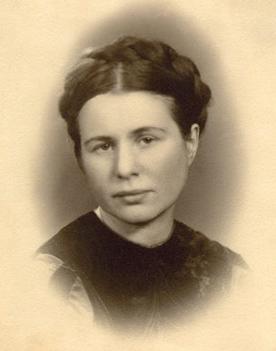
As brave as any Medal of Honor recipient- last month we lost a lion; Irena Sendler.
POLAND suffered more than any other European country during the second world war. And there was an extra twist: the history of that suffering was then systematically distorted by the Soviet-imposed Communist rulers, and widely misunderstood abroad. Auschwitz, for example, is still often referred to as a “Polish death camp”—rather than one run by the country's Nazi occupiers, in which huge numbers of Polish citizens perished. And gentile Poles are typically imagined to have rejoiced, collaborated or simply stood by as their Jewish compatriots were exterminated.

Poles, said the former Israeli leader Yitzhak Shamir, “imbibe anti-Semitism with their mother's milk.”

Certainly prejudice was prevalent in pre-war Poland; but many Poles defied it. One of the bravest was Irena Sendler. As a doctor's daughter, she had been brought up in a house that was open to anyone in pain or need, Jew or gentile. In the segregated lecture halls at Warsaw University, where she studied Polish literature, she and likeminded friends deliberately sat on the “Jewish” benches. When nationalist thugs beat up a Jewish friend, she defaced her grade card, crossing out the stamp that allowed her to sit on the “Aryan” seats. For that, the university suspended her for three years. All this was good preparation for the defiance she was to show after 1939, when the Germans invaded.

She was, a friend said, “born to selflessness, not called to it”. Certainly she had good genes. A rebellious great-grandfather was deported to Siberia. Her father died of typhus in 1917, after treating patients his colleagues shunned. Many were Jewish. Leaders of the Jewish community offered money to her hard-up mother for young Irena's education. Like many social workers in pre-war Poland, Mrs Sendler belonged to the Socialist party: not for its political ideology, she said, but because it combined compassion with dislike of money-worship. No religion motivated her: she acted z potrzeby serca, “from the need of my heart”.

Under Nazi occupation the Jews of Warsaw were herded into the city ghetto: four square kilometres for around 400,000 souls. Even before the deportations to the Treblinka death camp started, death could be arbitrary and instant. Yet a paradox created a sliver of hope. Squalor and near-starvation (the monthly bread ration was two kilos, or 4.5lb) created ideal conditions for typhus, which would have killed Germans too. So the Nazis allowed Mrs Sendler and her colleagues in and out of the tightly guarded ghetto to distribute medicines and vaccinations.

That bureaucratic loophole allowed her to save more Jews than the far better known Oscar Schindler. It was astonishingly risky. Some children could be smuggled out in lorries, or in trams supposedly returning empty to the depot. More often they went by secret passageways from buildings on the outskirts of the ghetto. To save one Jew, she reckoned, required 12 outsiders working in total secrecy: drivers for the vehicles; priests to issue false baptism certificates; bureaucrats to provide ration cards; and most of all, families or religious orders to care for them. The penalty for helping Jews was instant execution.
Names in glass jars

To make matters even riskier, Mrs Sendler insisted on recording the children's details to help them trace their families later. These were written on pieces of tissue paper bundled on her bedside table; the plan was to hurl them out of the window if the Gestapo called. The Nazis did catch her (thinking she was a small cog, not the linchpin of the rescue scheme) but did not find the files, secreted in a friend's armpit. Under torture she revealed nothing. Thanks to a well-placed bribe, she escaped execution; the children's files were buried in glass jars. Mrs Sendler spent the rest of the war under an assumed name.

The idea of a heroine's treatment appalled her. “I feel guilty to this day that I didn't do more,” she said. Besides, she felt she had been a bad daughter, risking her elderly mother's life with her wartime work, a bad wife to both her husbands, and a neglectful mother. Her daughter once asked to be admitted to the children's home where her mother worked after the war, in order to see more of her.

Mrs Sendler need not have worried. Far from being honoured, she narrowly avoided a death sentence from the Communist authorities. Her crime was that her work had been authorised and financed by the Polish government-in-exile in London; later, she helped soldiers of the Home Army, the wartime resistance. Both outfits were now reviled as imperialist stooges. In 1948 repeated interrogations by the secret police in late pregnancy cost the life of her second child, born prematurely. She was not allowed to travel, and her children could not study full-time at university. “What sins have you got on your conscience, Mama?” her daughter asked her.

It was not until 1983 that the Polish authorities allowed her to travel to Jerusalem, where a tree was planted in her honour at Yad Vashem. Many of the children she had saved sought her out: now elderly themselves, all grateful, but some still yearning for details of their forgotten parents. In 2003 she received Poland's highest honour, the order of the White Eagle. It came a little late.
No regrets needed. Thank you Irena - I hope to see you on the other side.

This FbF first published in June 2008.

Monday, July 11, 2016

Take a Moment to Savor the Victory

Let's start this week on an upbeat note. There is actually a lot to be proud of. There are actually some things on the national security front that make 2016 a safer and more predictable year than most in our recent history.

Through all my formative years, college, and my early JO years, the world was always 30 minutes away from global nuclear war. The soul crushing political cult of Communism was seen as inevitable and the fact it could implode with little blood and turmoil like it did in the early 90s was not even thought a possibility in "polite" society.

No one predicted what would happen would happen. From the fellow travelers and useful idiots on the Left like those who wrote for The Nation who were positioning and signaling so they would have a power role when the USA fell, to old Cold Warriors like George Bush the Elder who - even to the end with the "Chicken Kiev" speech - couldn't see what was going on; no one saw it.

What a glorious victory for The West and the fruits of The Enlightenment. Not a full victory, and we have different challenges now - as humans always will - but this was a great victory we should all remember and look at now and then. I'll take today's challenges on a global scale than those of my youth.

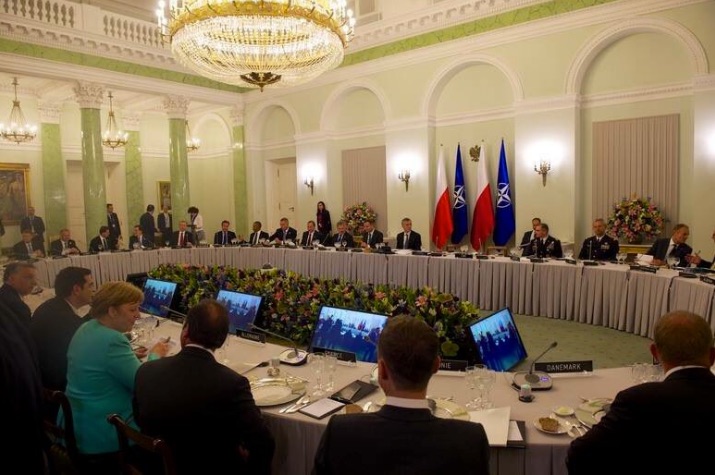
Enough words, let's just savor the picture. Two periods of time. One room in Warsaw, Poland.

The founding of the Warsaw Pact in 1955.


A 2016 meeting of NATO leaders.


Hat tip @englishrussia1.

Friday, December 11, 2015

Fullbore Friday

Tell me again how hard your job is?  A replay from 2010 ...

Most of us know about the Battle of Westerplatte because it started WWII and involved one of the most storied ships of any navy, the Pre-Dreadnought Schleswig-Holstein.

Before we go further though, I want you to look over this map.


Now ponder the real story of the Battle of Westerplatte and ask yourself - what determines victory? What makes the difference? Do you make the most out of every post you have? Do you underestimate your enemy?
On September 1, 1939, at 0448 local time, Germany began its invasion of Poland, starting World War II; the Schleswig-Holstein suddenly opened broadside salvo fire on the Polish garrison held by 182 soldiers and 27 civilian reservists. Major Sucharski radioed Hel Peninsula "SOS: I'm under fire". Three holes were made in the perimeter wall and oil warehouses were blazing in the southeastern sector. Eight minutes later, Lieutenant Wilhelm Henningsen's crack marines storm unit from the Schleswig-Holstein advanced in three platoons while the Wehrmacht's Pioneers blew up the railroad gate going on the land-bridge, expecting an easy victory over the surprised Poles. Wojciech Najsarek, a Polish soldier, was killed by machine-gun fire, the first victim of both the battle and war. However, soon after crossing the artillery-breached brick wall, the attackers suddenly came into a well-prepared ambush. German soldiers found themselves caught in a kill zone of Polish crossfire from concealed firing points (the Germans believed they were also fired on by snipers hidden in the trees, but in reality that was not the case), while barbed wire entanglements effectively blocked quick movements. The Poles knocked out a machine gun nest at the German Schupo and Lt. Leon Pajak opened intense howitzer fire on the advancing Germans who faltered and stopped their attack. The Field gun knocked out sniper machine-gun nests on top of the warehouses across the canal and almost knocked out the Schleswig-Holstein's command post but was destroyed by the ship's guns.
...
At 0622, the Marines frantically radioed the ship they had heavy losses and were withdrawing, Danzig Police had tried to seize control of the harbor on the other side of Westerplatte but were defeated. Casualties were 50 Germans and 8 Poles. The Germans tried again at 0855 but met mines, fallen trees, barbed wire and intense fire. By noon the SS men fled and Henningsen was mortally wounded. The initial assault was crushed and a second attack that morning (after an artillery barrage of 90 280 mm shells, 407 170 mm shells and 366 88 mm shells) was repelled as well, the Germans suffering unexpectedly high losses. The Poles eventually retreated from the Wał and Prom outposts (and for a time also from Fort), tightening the ring of defence around the New Barracks in the centre of the peninsula. On the first day of combat, the Polish side lost one man killed and seven wounded (three died later, including two of them who were captured and died in a German hospital). On the other side, the German naval infantry lost 16 killed in action and some 120 wounded (injuries of various gravity), the majority out of the 225 men deployed. The German losses would have been even greater if not for the order by the Polish commander, Major Henryk Sucharski, for the mortar crews to cease fire in order to conserve ammunition, issued after firing just a few salvos (because of this order only 104 out of their 860 shells were spent when the mortars were destroyed on the next day).

On the following days, the Germans bombarded the peninsula with naval and heavy field artillery, including a 210 mm howitzer, turning it into World War I-style moonscape. Eberhardt convinced General Fedor von Bock a ground attack was not possible. A devastating two-wave air raid by 60 Junkers Ju 87 Stuka dive-bombers on September 2 (the total of 26.5 tons of bombs) took out the Polish mortars, directly hit guardhouse 5 (destroying it completely with a 500 kg bomb) and killed at least eight Polish soldiers; the air raid covered the whole area of Westerplatte in enormous clouds of smoke and destroyed their only radio and all their food supplies; German observers believed that no one could possibly have survived such bombing. On the night of 3–4 September more German attacks were repelled. On September 4 a German torpedo boat (T-196) made a surprise attack from the seaside. The "Wal" post had been abandoned and now only "Fort" position prevented an attack from the north side. On September 5, a shell-shocked Sucharski held a war council who urged Westerplatte was to surrender; his deputy, Captain Franciszek Dąbrowski, briefly took over command. Several cautious probing attacks by the German naval infantry, Danzig SS and police and Wehrmacht were again repulsed by the Poles; at 0300, during one of these attacks, they sent a firetrain against the land bridge, but failed when the terrified driver decoupled too early. It failed to reach the oil cistern and set ablaze the forest, valuable for cover. The flaming wagons gave a perfect field of fire and the Germans suffered heavy losses. A second fire-train attack came in the afternoon but it failed too. Instead in the meantime, Polskie Radio continuously broadcast the message "Westerplatte still fights on" in each morning of the battle. A second war council was held and the Major was set to surrender. After all, the German Army was now outside Warsaw and gangrene had started to appear among the wounded. At 0430 September 7, Germans opened intense fire on Westerplatte which lasted to 0700. Flamethrowers destroyed Guardhouse 2 and damaged 1 and 4. The besieged garrison lacked sufficient water and medical supplies; Cpt. Mieczysław Słaby, the WST medical officer, was unable to maintain basic care of wounded soldiers.

At 0945 the white flag appeared; the Polish defense impressed the Germans so much that the German commander, General Friedrich-Georg Eberhardt (who later became the military governor of Kiev during the Soviet-German War), allowed Sucharski to retain his ceremonial szabla (Polish sabre) in captivity (it was apparently confiscated later). At the same time Polish wireless operator Kazimierz Rasiński was murdered by Germans after the capitulation; after brutal interrogation, he refused to hand over radio codes and was shot.

Sucharski surrendered the post to Kleikamp and the Germans paraded in full order when the Polish garrison marched out, still proud and erect. In all, approximately 3,400 Germans were tied up by being engaged in the week-long action against the small Polish garrison.
...
The exact figures of German losses remain unknown, but are now often estimated to be in range of 200 to 300 killed and wounded or sometimes more. Some of them might be actually hit by friendly fire, in particular from the battleship which was initially anchored too close to its target. About 30-50 German troops were reportedly killed. Polish casualties were much lower, including 15 to 20 killed and 53 wounded. There's a controversy regarding the burial site discovered in 1940, containing the bodies of five unidentified Polish soldiers who were possibly executed by their comrades for attempted desertion. Eight of the prisoners of war also said to have not survived German captivity.
Even the Germans saw it - Fullbore.

Friday, April 03, 2015

Fullbore Friday

For some strange reason - this man came to mind again this AM. Let's revisit.

There are some men whose true story should give all a pause to ask, "Am I as dedicated to my cause?" "What risk will I take?" "What is the level of my dedication?"

Simply an amazing man. You need to read it all.
Witold Pilecki, a 39-year old veteran of the Polish-Soviet War of 1919-1921 who fought against the initial Nazi invasion and a member of the Polish resistance, volunteered himself in 1940. Pilecki's mission was to allow himself to be arrested and, once inside Auschwitz, to collect intelligence for the Polish resistance in the country and the government-in-exile in London, and to organize a resistance from inside the camp. "I think he knew, he realized what he was getting himself into," said Jacek Pawlowicz, a historian at Poland's Institute of National Remembrance. "But even so, he was not prepared for the things he was actually able to witness."
During the next three years, Pilecki was involved in one of the most dangerous intelligence-gathering and resistance operations of the war. He authored three reports about life inside the camp for the Polish resistance. During his incarceration, Pilecki witnessed from the inside Auschwitz's transformation from a detention facility for political prisoners and Soviet soldiers into one of the Nazis' deadliest killing machines. An English translation of Pilecki's third and most comprehensive report -- a primary source for this article -- was recently published as a book titled The Auschwitz Volunteer: Beyond Bravery .
It is a fascinating first-hand account of virtually all aspects of life inside the camp. The original document is in the custody of the Polish Underground Movement Study Trust in London. ... By early 1943, Pilecki began considering his escape from the camp. He had gone in and accomplished his objective of organizing a resistance within the camp, at which point he thought the logical thing to do was wait for an attack on the camp by the Polish resistance from the outside so they could rise up from within. On top of this, the Gestapo was clamping down on security in the camp and many of Pilecki's recruits had been lost.
Pilecki ultimately made the decision to escape on April 13, 1943. The reason behind this was so he could make the argument for an armed assault on Auschwitz in person to the resistance leadership. He began handing over his network contacts and responsibilities to top deputies as a gradual transition process. After approximately 2,500 roll calls and 947 days inside the camp by his own calculations, Witold Pilecki and two other inmates escaped Auschwitz.
On the night of Monday, April 26 -- the day after Easter Sunday -- the three men were assigned to work in the bakery, which was located outside the camp grounds. They took advantage of a moment when the SS guard wasn't paying attention to cut a telephone wire, force open a door and made a run for it. Pilecki eventually made his way back to Warsaw and reported to the Home Army's headquarters on August 25, 1943

There is not a happy ending though. Just another card to put in the stack next time someone tries to excuse the evil of Communism.
Pilecki was arrested by communist authorities not long after, on May 5, 1947. According to Pawlowicz, "His fingernails were ripped off, ribs broken, nose broken. His interrogation was very difficult and he was tortured badly." He, and others, were given a show trial for activities against the state the following March.
On March 15, he was found guilty on several charges. The court declared, "As a paid agent of General Anders' Intelligence Service, he organized a spy network on Polish territory, collecting information and sending it abroad,' and in doing so 'betraying state secrets.' Pilecki was sentenced to death. A typical capital punishment sentence was carried out within 95 to 105 days of the sentence. The order for Pilecki's execution was given on May 22, two months after his trial.
The final account of anyone seeing Pilecki alive comes from father Jan Stepien, a Home Army chaplain whose own capital punishment was later changed to a 15-year prison sentence. His description of Pilecki as he was being led to his execution at the Mokotow prison in Warsaw: "He had his mouth tied with a white bandage. Two guards led him by his arms. He could hardly touch the ground with his feet. I don't know if he was conscious then. He seemed completely faint."
The exact location of where Pilecki was buried is unknown. His remains are believed to be either in a meadow next to the Sluzewiec cemetery, or in an area of the Powazki Military Cemetery in Warsaw, also called the meadow, in a mass grave with others who were executed by the post-war communist regime.
Hat tip xformed.

Friday, September 05, 2014

Fullbore Friday

Anniversaries are important, so it is time for a repeat FbF and a return to ...

Most of us know about the Battle of Westerplatte because it started WWII and involved one of the most storied ships of any navy, the Pre-Dreadnought Schleswig-Holstein.

Before we go further though, I want you to look over this map.


Now ponder the real story of the Battle of Westerplatte and ask yourself - what determines victory? What makes the difference? Do you make the most out of every post you have? Do you underestimate your enemy?
On September 1, 1939, at 0448 local time, Germany began its invasion of Poland, starting World War II; the Schleswig-Holstein suddenly opened broadside salvo fire on the Polish garrison held by 182 soldiers and 27 civilian reservists. Major Sucharski radioed Hel Peninsula "SOS: I'm under fire". Three holes were made in the perimeter wall and oil warehouses were blazing in the southeastern sector. Eight minutes later, Lieutenant Wilhelm Henningsen's crack marines storm unit from the Schleswig-Holstein advanced in three platoons while the Wehrmacht's Pioneers blew up the railroad gate going on the land-bridge, expecting an easy victory over the surprised Poles. Wojciech Najsarek, a Polish soldier, was killed by machine-gun fire, the first victim of both the battle and war. However, soon after crossing the artillery-breached brick wall, the attackers suddenly came into a well-prepared ambush. German soldiers found themselves caught in a kill zone of Polish crossfire from concealed firing points (the Germans believed they were also fired on by snipers hidden in the trees, but in reality that was not the case), while barbed wire entanglements effectively blocked quick movements. The Poles knocked out a machine gun nest at the German Schupo and Lt. Leon Pajak opened intense howitzer fire on the advancing Germans who faltered and stopped their attack. The Field gun knocked out sniper machine-gun nests on top of the warehouses across the canal and almost knocked out the Schleswig-Holstein's command post but was destroyed by the ship's guns.
...
At 0622, the Marines frantically radioed the ship they had heavy losses and were withdrawing, Danzig Police had tried to seize control of the harbor on the other side of Westerplatte but were defeated. Casualties were 50 Germans and 8 Poles. The Germans tried again at 0855 but met mines, fallen trees, barbed wire and intense fire. By noon the SS men fled and Henningsen was mortally wounded. The initial assault was crushed and a second attack that morning (after an artillery barrage of 90 280 mm shells, 407 170 mm shells and 366 88 mm shells) was repelled as well, the Germans suffering unexpectedly high losses. The Poles eventually retreated from the Wał and Prom outposts (and for a time also from Fort), tightening the ring of defence around the New Barracks in the centre of the peninsula. On the first day of combat, the Polish side lost one man killed and seven wounded (three died later, including two of them who were captured and died in a German hospital). On the other side, the German naval infantry lost 16 killed in action and some 120 wounded (injuries of various gravity), the majority out of the 225 men deployed. The German losses would have been even greater if not for the order by the Polish commander, Major Henryk Sucharski, for the mortar crews to cease fire in order to conserve ammunition, issued after firing just a few salvos (because of this order only 104 out of their 860 shells were spent when the mortars were destroyed on the next day).

On the following days, the Germans bombarded the peninsula with naval and heavy field artillery, including a 210 mm howitzer, turning it into World War I-style moonscape. Eberhardt convinced General Fedor von Bock a ground attack was not possible. A devastating two-wave air raid by 60 Junkers Ju 87 Stuka dive-bombers on September 2 (the total of 26.5 tons of bombs) took out the Polish mortars, directly hit guardhouse 5 (destroying it completely with a 500 kg bomb) and killed at least eight Polish soldiers; the air raid covered the whole area of Westerplatte in enormous clouds of smoke and destroyed their only radio and all their food supplies; German observers believed that no one could possibly have survived such bombing. On the night of 3–4 September more German attacks were repelled. On September 4 a German torpedo boat (T-196) made a surprise attack from the seaside. The "Wal" post had been abandoned and now only "Fort" position prevented an attack from the north side. On September 5, a shell-shocked Sucharski held a war council who urged Westerplatte was to surrender; his deputy, Captain Franciszek Dąbrowski, briefly took over command. Several cautious probing attacks by the German naval infantry, Danzig SS and police and Wehrmacht were again repulsed by the Poles; at 0300, during one of these attacks, they sent a firetrain against the land bridge, but failed when the terrified driver decoupled too early. It failed to reach the oil cistern and set ablaze the forest, valuable for cover. The flaming wagons gave a perfect field of fire and the Germans suffered heavy losses. A second fire-train attack came in the afternoon but it failed too. Instead in the meantime, Polskie Radio continuously broadcast the message "Westerplatte still fights on" in each morning of the battle. A second war council was held and the Major was set to surrender. After all, the German Army was now outside Warsaw and gangrene had started to appear among the wounded. At 0430 September 7, Germans opened intense fire on Westerplatte which lasted to 0700. Flamethrowers destroyed Guardhouse 2 and damaged 1 and 4. The besieged garrison lacked sufficient water and medical supplies; Cpt. Mieczysław Słaby, the WST medical officer, was unable to maintain basic care of wounded soldiers.

At 0945 the white flag appeared; the Polish defense impressed the Germans so much that the German commander, General Friedrich-Georg Eberhardt (who later became the military governor of Kiev during the Soviet-German War), allowed Sucharski to retain his ceremonial szabla (Polish sabre) in captivity (it was apparently confiscated later). At the same time Polish wireless operator Kazimierz Rasiński was murdered by Germans after the capitulation; after brutal interrogation, he refused to hand over radio codes and was shot.

Sucharski surrendered the post to Kleikamp and the Germans paraded in full order when the Polish garrison marched out, still proud and erect. In all, approximately 3,400 Germans were tied up by being engaged in the week-long action against the small Polish garrison.
...
The exact figures of German losses remain unknown, but are now often estimated to be in range of 200 to 300 killed and wounded or sometimes more. Some of them might be actually hit by friendly fire, in particular from the battleship which was initially anchored too close to its target. About 30-50 German troops were reportedly killed. Polish casualties were much lower, including 15 to 20 killed and 53 wounded. There's a controversy regarding the burial site discovered in 1940, containing the bodies of five unidentified Polish soldiers who were possibly executed by their comrades for attempted desertion. Eight of the prisoners of war also said to have not survived German captivity.
Even the Germans saw it - Fullbore.

More here.