Showing posts with label NATO. Show all posts

Saturday, March 25, 2023

NATO's Evolution in Response to the Russo-Ukrainian War with Jorge Benitez - on Midrats

The last 13-months has seen a scenario few in NATO’s uniformed or civilian leadership either predicted, or for that matter, though was possible.

How has the alliance reacted, grown, succeeded, or shown cracks under the pressure of the growing war in Ukraine as it moves it to its second year?

Returning to Midrats for the full hour this Sunday from 5-6pm Eastern will be Jorge Benitez, Associate Professor of International Relations at the Marine Command and Staff College in Quantico, Virginia.

He is also a non-resident Senior Fellow at the Atlantic Council. He specializes in NATO and transatlantic relations, European politics, and US national security. He previously served as assistant for Alliance issues to the Director of NATO Affairs in the Office of the Secretary of Defense.

He has also served as a specialist in international security for the Department of State and the Institute for Foreign Policy Analysis. Dr. Benitez received his BA from the University of Florida, his MPP from the Kennedy School of Government at Harvard University, and his PhD from the Fletcher School of Law and Diplomacy at Tufts University.

Join us live if you can
, but it not, you can get the show later by subscribing to the podcast. If you use iTunes, you can add Midrats to your podcast list simply by clicking the iTunes button at the main showpage - or you can just click here. You can find us on almost all your most popular podcast aggregators as well.

Wednesday, February 15, 2023

We Should be Brave Enough to Say Hard Things


For a proud people who make their living off their credentials, their "expertise," or their position in an hierarchy - one of the hardest things to do is to say, "I was wrong."

Almost as difficult are those who are friends, co-workers, or potential employees of those people who say to them, "You were wrong."

Sure, there are good reasons to be wrong. Smart, well-meaning people can simply be wrong. No one can see the future, and when weighing this variable or that, someone can just have the wrong theory of how things progress. You most often see this in the "optimism bias" where someone wants the future to be an easier, safer, more controllable place. They have so much confidence in their intelligence and "transformative" technology that they can find a way to get around the hard, messy, and expensive requirements that challenged previous - less blessed - generations.

The above, of course, is just me being nice - giving people the benefit of the doubt. There are some well meaning - but wrong - people that the above applies to. Those people we can pat on the shoulder and wish well when they repent...but there are others that must be dealt with.

The rest? No. I don't think we need to give them anything less than scorn. 

There are bad reasons to be wrong. The worst pushed theories simply because they were paid to push them - hired guns - followed by those who pushed false theories for needs best explained by a psychiatrists. There is a special circle of hell for those who were wrong because they wanted to keep people from the truth for reasons best explained by a team of counter intelligence experts.

I'd ask you to think back to at least the fall of the Soviet Union and think about all the theories - clever sounding theories - that claimed their adherents had some special vision at that place in time that no one else had - and that even if it went contrary to experience of previous generations, history's lessons - by their foundation in the past - were suspect. Suspect because The Now could never claim ownership of The Past. As such, one could not build a reputation or business on it. 

Both crass civilian leaders and careerist minded uniformed leaders who knew better either kept quiet or joined in the big lie because they decided to accept the future-risk with the hope that it would either give them money to spend elsewhere for votes and clout, or for flashier things that lead to book sales, cool gigs, political appointments, or just a shorter path to that lake house they always wanted. 

Sure, they may be directly responsible for creating a military of empty shells unable to fight more than a few weeks - but the numbers they put on the slide displaced water and made shadows on the ramp and made people happy who in a few years would make a job offer or place them on a board for good behavior. Should the future-risk run out of luck - well, that would be someone else's problem;

NATO recently completed a large survey of its ammunition stockpiles and found supplies have been considerably depleted by the war in Ukraine, according to a new report.

Many NATO countries were said to have already had weapons stockpiles that did not meet the bloc's targets prior to Russian President Vladimir Putin's invasion of Ukraine nearly a year ago

... the alliance found in a survey that those stockpile numbers have since dwindled even further as NATO continues to arm Ukraine at a rate that doesn't match weapons production.

Reuters also quoted an unnamed European diplomat who said: "If Europe were to fight Russia, some countries would run out of ammunition in days."

According to Reuters, many officials from NATO countries had "considered wars of attrition with large-scale artillery battles a thing of the past." Therefore, multiple NATO countries had let their stockpiles decrease even before Russia launched its prolonged conflict.

None of this is new. None of it. We pointed to it in 2018, 2014 and even earlier. Heck, NATO barely made it through the Libya operation in 2011. Hell, after Desert Fox we knew we had a precision weapons numbers problem.

Gates, Craddock, and others all tried - in polite ways - to warn the present what they were risking - but even they only did it out the door when it had the least impact. 

You see, there is recommended protocol. We can't upset people. They might call people who will write nasty articles about you that your neighbors will read. "Work inside the system" - that is they way...but really, it never is. It only perpetuates inadequacy.

Little was done. The future is now ... and it isn't some transformed tomorrow-land. The gods of the natsec copybook heading were right. They're right here - standing on our toes and breathing in our face.

What excuse for lack of action now?

The USA is in better shape than our allies ... and even some of our opponents as well - but you don't prevent, much less win wars, by just being marginally better. You must have overwhelming power.

If you desire a quick war, you must be armed and prepared for a long war. If you are not ready for a long war but only a quick war - then you will get the former and regret the day your predecessors bought off on the later.

Photo credit KCStar.

Wednesday, February 01, 2023

Eastern Europe's Second Chance


Geography doesn't change. To a slightly lesser extent, neither do historic patterns.

Even if Ukraine wins the Russo-Ukrainian War, Russia will still be to the east from Central Europe. 

She will be back in one form or another.

After the fall of the Soviet Union, liberation, and joining NATO - helped with a lot of ahistorical thinking on both sides of the Atlantic - there was a bit of hedging that there was time to rebuild Central European economies and civil society before a threat from the east came back. For almost three decades the former Warsaw Pact members of NATO let their military capabilities and investments fall closer to 1% of GDP as opposed to the 2% minimum.

The events of the last decade have sobered up everyone from Estonia to Bulgaria, but for most of those nations, by free-riding on their richer nations to the west for national defense, they lost or allowed to almost die what domestic arms manufacturing they had remaining from communism.

Everyone - well those who are paying attention - now realize the existential requirement to have at least the most basic domestic production capabilities to defend yourself, regardless what accountants may say.

The last year is seeing once strong medium powers in Central Europe bring capacity back online. 

Good for them, good for all alliance members;

Still wary of Russia, their Soviet-era master, some former Warsaw Pact countries see helping Ukraine as a matter of regional security.

...

“Taking into account the realities of the ongoing war in Ukraine and the visible attitude of many countries aimed at increased spending in the field of defence budgets, there is a real chance to enter new markets and increase export revenues in the coming years,” said Sebastian Chwalek, CEO of Poland’s PGZ.

State-owned PGZ controls more than 50 companies making weapons and ammunition – from armoured transporters to unmanned air systems – and holds stakes in dozens more.

It now plans to invest up to 8 billion zlotys ($1.8 billion) over the next decade, more than double its pre-war target, Chwalek told Reuters. That includes new facilities located further from the border with Russia’s ally Belarus for security reasons, he said.

Other manufacturers too are increasing production capacity and racing to hire workers, companies and government officials from Poland, Slovakia and the Czech Republic said.

...

Chwalek said PGZ would now produce 1,000 portable Piorun manpad air-defence systems in 2023 – not all for Ukraine -compared to 600 in 2022 and 300 to 350 in previous years.

The company, which he said has also delivered artillery and mortar systems, howitzers, bulletproof vests, small arms and ammunition to Ukraine, is likely to surpass a pre-war 2022 revenue target of 6.74 billion zlotys.

...

Czech arms exports this year will be the highest since 1989, he said, with many companies in the sector adding jobs and capacity.

“For the Czech defence industry, the conflict in Ukraine, and the assistance it provides is clearly a boost that we have not seen in the last 30 years,” Kopecny said.

David Hac, chief executive of Czech STV Group, outlined to Reuters plans to add new production lines for small-calibre ammunition and said it is considering expanding its large-calibre capability. In a tight labour market, the company is trying to poach workers from a slowing car industry, he said.

Defence sales helped the Czechoslovak Group, which owns companies including Excalibur Army, Tatra Trucks and Tatra Defence, nearly double its first-half revenues from a year earlier, to 13.8 billion crowns.

The company is increasing production of both 155mm NATO and 152mm Eastern calibre rounds and refurbishing infantry fighting vehicles and Soviet-era T-72 tanks, spokesman Andrej Cirtek told Reuters.

He said supplying Ukraine was more than just good business.

“After the Russian aggression started, our deliveries for Ukrainian army multiplied,” Cirtek said.

“The majority of the Czech population still remember times of a Russian occupation of our country before 1990 and we don´t want to have Russian troops closer to our borders.”

The Poles and the Czechs, in addition to having the industry, have a martial tradition going back over 1,000 years. 

There is no downside to having them strong. They'll bring their neighbors along with them. 

Tuesday, January 24, 2023

The German Problem ... is our Problem

Complacency, a self-serving bureaucracy, and a willful forgetfulness of the fundamentals of war is a common thread in most 21st Century defense establishments in the developed world, but these very human conditions are worse in some nations than others.

Germany stands out.

If you want a sobering view of the military situation of our German allies, Der Spiegel has a staggering report that provides a stark view of what small budgets, ill-fitting reforms, and just plain anti-military politicians can do to a nation who is - whether they want it or not - a keystone to NATO's continental defense.

Though it isn't quite fair to use the end of the cold war force levels - everyone's graphs would look nasty with that benchmark - but it is helpful to look at what was in living memory back when your host 'ole Sal was a JO;

Coming to 2023 and recent history, well, what the German political elite did makes what we've done to the American military look like art;

According to a forecast by the German Economic Institute, Germany will fall 10 billion euros short of the 2-percent target by 2026 – and by just short of 40 billion euros the following year.

And it’s not even certain that NATO’s defense spending target will remain at 2 percent. Given the Russian threat, some Eastern European member states are insisting that alliance members raise defense spending to 3 percent of their gross domestic product.

There are a number of indications that NATO is planning this year to turn the 2-percent mark from a target to a minimum. Germany, which sees itself as a leader on security policy, would find itself in a position of having to prove its intent by adequately funding its military.

A boost to the Defense Ministry budget would only be politically palatable, however, if it can be guaranteed that the extra billions for the Bundeswehr would not simply trickle away like water in the desert. And for that, the military would have to be fundamentally reformed, a project that Minister Christine Lambrecht has shown no interest in – even if she bears little responsibility for the predicament in which the Bundeswehr currently finds itself.

This should sound familiar;

The grain-size for sand in shooting ranges is specified, for example, while limits for the exposure to gunshot gas in the combat compartment of infantry fighting vehicles are bickered over so that the threat of "amniotic fluid damage to the female Puma crew" can be strictly ruled out.

Regulators require that gangways on new warships must be as wide as those on civilian ships. Now, you can walk past each other with "two walkers without any problems," as one naval officer scoffs. Meanwhile, though, the Bundeswehr is no more combat ready than it used to be. On the contrary.

The armed forces have lost their core competence over the years as they have become completely bureaucratized: combat. Within the administration, combat isn't even a relevant category – except, that is, when it comes to dealing with the next closest department.

The administration thinks in terms of processes, not results. The most important thing is that decisions be made in accordance with the rules. Every civil servant knows that mistakes can slow down a career and that a project well done doesn't necessarily guarantee further advancement. Instead, risks are eliminated to the degree possible. And time plays no role in the equation.

This combination of regulatory frenzy coupled with risk aversion is stifling the Bundeswehr. Systematically, responsibility has been shifted from the bottom up to anonymous large-scale authorities. In the past, it was up to a battalion to decide who would be promoted to lance corporal. Today it is the Personnel Office of the Bundeswehr that makes that decision.

Are any nations doing this well, or are we all just different degrees of bad?

The German military is in many ways is subject to a distilled version of the challenges the US military has. Large budgets can hide a lot of problems from bad leaderships and worse ideas. Shrink that budget down, and you get a concentrated soup of bad.

The present German government is led by the SDP, a party that simply is not institutionally capable in 2023 of being a serious leader of a serious military. 

Until there is fundamental change at the top where the desires of the German people align with the desires of their NATO allies, then we will have to continue to find work arounds. In the long run, the experience of the last year will set back Germany a few decades from her taking her position on the continent where she belongs. An opportunity for Poland and France, if they want it.

Tuesday, December 06, 2022

There Must be Consequences for Germany


I lived and worked with Germans for years. In their young years, my children's second language - mostly to help their father shop - was German. I have a great affection for Germany and Germans - but with great affection comes great expectations.

I know that my expectations for Germany is not that out of alignment with many Germans, however those Germans and their view of Germany are not presently holding power. As one does with things one values yet does not meet their potential, honest affection requires one to speak up and if needed take action.

The final part of the Merkle administration was problematic, but under the present SDP government led by Olaf Scholz - the Cold War socialist and Soviet apologist, Germany's irresponsible stance in the face of European and NATO security requirements cannot go without consequences. The present, "Just do enough in security to look like we're doing something, but not too much..." should be called out for exactly what it is.

Germany, even more than France, is the keystone to Europe. Too many nations look to her for leadership culturally, economically, and security. Poland is an emerging leader, but she does not have the population or GDP power to match Germany.

Though Germany's present dysfunction is multi-causal, the core of the problem is that the German people chose the wrong leader at the wrong time.

We're going to go to Foreign Policy and Politico to demonstrate. 

The German Chancellor Olaf Scholz has an essay in FP's Jan/Feb edition. It is a long and winding apologia, but look at this Salamanderesque quote from Scholz;

The world must not let Putin get his way; Russia’s revanchist imperialism must be stopped. The crucial role for Germany at this moment is to step up as one of the main providers of security in Europe by investing in our military, strengthening the European defense industry, beefing up our military presence on NATO’s eastern flank, and training and equipping Ukraine’s armed forces.

Germany’s new role will require a new strategic culture, and the national security strategy that my government will adopt a few months from now will reflect this fact. For the last three decades, decisions regarding Germany’s security and the equipment of the country’s armed forces were taken against the backdrop of a Europe at peace. Now, the guiding question will be which threats we and our allies must confront in Europe, most immediately from Russia. These include potential assaults on allied territory, cyberwarfare, and even the remote chance of a nuclear attack, which Putin has not so subtly threatened.

The transatlantic partnership is and remains vital to confronting these challenges. U.S. President Joe Biden and his administration deserve praise for building and investing in strong partnerships and alliances across the globe. But a balanced and resilient transatlantic partnership also requires that Germany and Europe play active roles. One of the first decisions that my government made in the aftermath of Russia’s attack on Ukraine was to designate a special fund of approximately $100 billion to better equip our armed forces, the Bundeswehr. We even changed our constitution to set up this fund. This decision marks the starkest change in German security policy since the establishment of the Bundeswehr in 1955. Our soldiers will receive the political support, materials, and capabilities they need to defend our country and our allies. The goal is a Bundeswehr that we and our allies can rely on. To achieve it, Germany will invest two percent of our gross domestic product in our defense.

Sounds good, but it is just cover.

Of course, serious nations know 2% is a floor, not a ceiling - but there it is.

Earlier this year there was all sorts of talk about boosting spending and getting that floor reached as soon as practical. His words above seem to signal that.

Really? From Politico on Monday,

Germany on Monday walked back its promise to swiftly raise defense spending to at least 2 percent of its economic output — breaching the key commitment made days after Russia’s invasion of Ukraine to become a more serious military force.

Berlin also sought to play down internal warnings about delays to a flagship procurement of new fighter jets.

During a government press conference, Chief Spokesperson Steffen Hebestreit scaled down expectations for Germany’s defense spending, telling journalists that the 2 percent target would be missed not only this year, but also likely next year: “It’s still open whether that [goal] will be achieved” in 2023, Hebestreit said, adding that his “cautious expectation” was that Germany would still meet the target within this legislative period, which ends in 2025.

...

The 2 percent pledge had been a key promise of Scholz’s Zeitenwende speech to the German Parliament in February, just days after Russia’s invasion of Ukraine, in which the chancellor said: “We will from now, year after year, invest more than 2 percent of gross domestic product invest in our defense.”

This commitment, which is in line with what all members of the NATO military alliance agreed to in 2014, was reiterated by Scholz in an op-ed in Foreign Affairs on Monday — although he no longer said the commitment would be upheld “from now on.”

Last month, it had already emerged that Germany will likely miss its 2 percent target in 2023 as the regular defense budget of about €50 billion will slightly shrink by about €300 million. Only a comparably small first tranche of a massive €100 billion special military upgrading fund is expected to be paid out.

Scholz is not an honest nor a reliable partner. Besides public shaming, what can be done? As outlined many times, there is Plan Salamander;

In NATO, General and Flag Officer billets are distributed amongst nations in a rather complicated way, but this formula is controlled by NATO – and as such – can be changed.

Entering argument: take the present formula for “fair distribution” and multiply by .75 any nation that spends 1.5% to 1.99% GDP on defense. Multiply by .5 any nation that spends between 1.25% to 1.499%. Multiply by .25 1.0% to 1.240%. If you fall below 1%, you get nothing and your OF5 (Col./Capt) billets are halved. 

1.25x for 2.01%-2.25%. 1.5X for 2.26%-2.75%; 1.75x for 2.76% -3.0%. 2x for +3.01%.

The NATO nations facing Russia directly are smaller and poorer than Germany and are all spending - or soon will spend - responsibly. 

All relationships that are successful and respectful have a common formula; reward positive behavior; punish negative behavior.

Going by to Scholz's article in FP, he reminds everyone what is really driving this. Something going back for decades with him and his cohorts; a thinly disguised dislike of NATO and the Anglo-Saxon influence that comes with it. Like their Western Frankish brothers out of Paris, for a thousand years there is a pull on the German people to control Europe. NATO, be design, will prevent that.

What won't? The EU;

More broadly, the EU must overcome old conflicts and find new solutions. European migration and fiscal policy are cases in point. People will continue to come to Europe, and Europe needs immigrants, so the EU must devise an immigration strategy that is pragmatic and aligns with its values. This means reducing irregular migration and at the same time strengthening legal paths to Europe, in particular for the skilled workers that our labor markets need. On fiscal policy, the union has established a recovery and resilience fund that will also help address the current challenges posed by high energy prices. The union must also do away with selfish blocking tactics in its decision-making processes by eliminating the ability of individual countries to veto certain measures. As the EU expands and becomes a geopolitical actor, quick decision-making will be the key to success. For that reason, Germany has proposed gradually extending the practice of making decisions by majority voting to areas that currently fall under the unanimity rule, such as EU foreign policy and taxation. 

Europe must also continue to assume greater responsibility for its own security and needs a coordinated and integrated approach to building its defense capabilities. For example, the militaries of EU member states operate too many different weapons systems, which creates practical and economic inefficiencies. To address these problems, the EU must change its internal bureaucratic procedures, which will require courageous political decisions; EU member states, including Germany, will have to alter their national policies and regulations on exporting jointly manufactured military systems. 

...

NATO is the ultimate guarantor of Euro-Atlantic security, and its strength will only grow with the addition of two prosperous democracies, Finland and Sweden, as members. But NATO is also made stronger when its European members independently take steps toward greater compatibility between their defense structures, within the framework of the EU.

Enough of coddling Germany and not rewarding responsible security partners. Time for NATO to at least start to make a point, and make it publicly. 


Wednesday, November 23, 2022

What Does a Real Military Buildup Look Like?

We need more and more clear and direct talk like this from senior uniformed leaders throughout NATO;

In a remarkable speech in Prague today, the Czech Republic’s most senior army leader demanded, as an “absolute necessity.” that the service embarks on its “biggest rearmament” ever.

Major General Karel Řehka, chief of the General Staff of the Czech Republic Army, told delegates at the Command Assembly convened to announce the army’s strategic and procurement plans for 2023 that “serious challenges await us,” as he reflected on the “crisis” in Ukraine.

“The biggest rearmament of the army in the country’s history is no longer just a wish, but an absolute necessity,” Řehka said.

Russia’s actions have left the Czech Army with many urgent tasks that can no longer be postponed, he said, before unveiling a five point plan covering long-term priorities.

The Czechs are an interesting bunch. In my travels in Central Europe earlier this year, I spent a few days in Prague and most of the other capitals of the nations of the former Austro-Hungarian Empire.

Nowhere were there more Ukrainian flags than in Prague. Since the start of the war they backed up this vibe with substantial and ongoing military support. 

As in most things, you have to look for steadfastness, follow through and ... follow the money.

With a population of only a little more than 10-million souls, less than Belgium, there is only so much the Czechs can do, but they can pull their fair share of the effort. Sadly, the last two decades of disinterest has left the once mighty Czech defense industry flat footed.

She has good company in the alliance, as we've discussed before.


She has a lot of work to do not just to support herself, much less have spare capacity to continue to support the Ukrainian defense against Russian aggression. 

Look at the quote above again and see the path the Czechs have to go just to get to the 2% floor.


All should applaud the effort, but also have an understanding of the limitations here and from other NATO members who coasted through the previous decade.


Tuesday, November 22, 2022

When Will the West Call for the Wooden Badger?


One of the more difficult things for me to work through is a certain intolerance at my core that is easily triggered, and I have to make a conscious effort to not be petty, mean, and flinty towards people an institutions who put it in my face. 

To be more specific, I have a very short fuse when people act shocked today when something happens that they have been warned about - and even suffered from - in the past that they could have avoided repeating in the future if they took basic and clear steps to learn their lesson.

Let's go back to 2011, almost a dozen years ago;

Less than a month into the Libyan conflict, NATO is running short of precision bombs, highlighting the limitations of Britain, France and other European countries in sustaining even a relatively small military action over an extended period of time, according to senior NATO and U.S. officials.

The shortage of European munitions, along with the limited number of aircraft available, has raised doubts among some officials about whether the United States can continue to avoid returning to the air campaign if Libyan leader Moammar Gaddafi hangs on to power for several more months.

...

The six countries conducting the air attacks, led by Britain and France, were unsuccessful at a meeting this week in Berlin in persuading more alliance members to join them.

NATO officials said that their operational tempo has not decreased since the United States relinquished command of the Libya operation and withdrew its strike aircraft at the beginning of April. More planes, they said, would not necessarily result immediately in more strike missions.

But, they said, the current bombing rate by the participating nations is not sustainable. “The reason we need more capability isn’t because we aren’t hitting what we see — it’s so that we can sustain the ability to do so. One problem is flight time, the other is munitions,” ...

Libya “has not been a very big war. If [the Europeans] would run out of these munitions this early in such a small operation, you have to wonder what kind of war they were planning on fighting,” said John Pike, director of GlobalSecurity.org, a defense think tank. “Maybe they were just planning on using their air force for air shows.”

Despite U.S. badgering, European allies have been slow in some cases to modify their planes and other weapons systems so they can accommodate U.S. bombs. Retooling these fighter jets so that they are compatible with U.S. systems requires money, and all European militaries have faced significant cuts in recent years.

And so here we are, at the end of 2022;

Top defense officials in Europe say arms shortages among Ukraine’s Western allies are forcing difficult conversations about how to balance support for Ukraine with concerns Russia may target them next.

NATO members that have sent billions of dollars worth of weapons and equipment are discussing what stockpile levels they need to meet their obligations under the mutual defense treaty. Decisions facing them now could have consequences for their their own security and for Ukraine, in its fight to repel Russia’s nine-month-old invasion.

The strain on stockpiles is “across the board,” and particularly sharp for ammunition, he said. In the years before some countries donated to Ukraine, they maintained stockpiles at half capacity or less because they saw little risk or couldn’t afford more, and took a “just-in-time, just-enough,” approach to the defense industry.

“So the urgency now is seen and understood, I think in most of the nations,” Bauer said.

Really? Now they'll get it?

It’s an acute challenge for some of NATO’s smallest members, like the Netherlands, which even before its donation of more than $800 million’s worth of aid to Ukraine, was straining to meet its NATO obligations. Gen. Onno Eichelsheim, chief of defense of the Netherlands, said Dutch stocks were “not that high” when the Netherlands opted to send Ukraine 155mm howitzer ammunition and air defense missiles.

“We started with stocks that were not completely filled, that were not completely ready, did not have all the materiel to support what we needed for NATO,” Eichelsheim said. “It means that I immediately have to get stocks filled up by getting contracts with industry, which we started, luckily, a year ago.”

The Dutch government and other European allies have been having discussions with industry about their long-term procurement plans to incentivize production increases ― and how to prioritize deliveries based on which country needs a weapon most. One aim is to build Europe’s defense industry and not depend too much on the U.S.

This isn't an industry problem, this is a people problem.


In Europe and North America we continue to promote people, priorities, and budgets for the wrong reasons. We have incentives and disincentives that reward myopic behavior and promote people who don't really understand what their job actually is. 

This is not a new problem. It has existed throughout human written history. In peace, we like people and policies that seem easy (and inexpensive) and really hope that we don't have to be prepared for the worse, because that is sad to think about. No, we need to be comfortable and look peaceful so people (we for some reason value) will say nice things about us and our priorities. 

Of course, reality always regresses to the mean. War is a constant in our species. Always has been. Always will be. The question, as always, is which society will gain when the next war comes? Will it be a society that a Westerner would call "progressive," "liberal," or based on "individual liberty," or will it be some autocratic force who will bring another period of darkness - the boot smashing the face etc.

Those who know their history, and what is needed to keep the global order from regression in to barbarity, need to speak up more. They need to support each other more. They need not be cowed. Care not what names you are called. Be not bothered the invitations you do not receive. They need to be open in their argument - clear in their purpose.

Once again, we have a small war (in 2011) warning us about a critical vulnerability. We now have a medium war (in 2022) yelling a little louder about this critical vulnerability.

History is trying to warn us, again, about what can undermine the Western project when the next big war comes.

There is no honorable or logical argument for shallow magazines, but the argument for deeper magazines will not win on its own. It needs advocates, it needs argument, it needs funding.

There also needs for a fair bit of "calling out" those who ignored warnings for so long. Fear and shame are great motivators - we should not be shy about using them.

Wednesday, November 16, 2022

Chaos is a Ladder: Opportunity in the High North


Before the Russo-Ukrainian War kicked off in February, on the Top-5 lists of any navalist worth their salt was the Arctic. If you are an Atlanticist/NATO type, it was in your Top-3.

Sea lanes/SLOC, resource access, resource protection, environmental protection and monitoring, and just good old sound military planning kept the Arctic on everyone’s mind. The fact that especially in the USA there was no small bit of “out of sight out of mind” neglect, specifically with our icebreaking capabilities, brought as much concern. The non-Arctic nation of China deciding she wanted to be a player only made it even more important that policy makers wake up.

When you look at the playing board in the Arctic, the nations who have square-footage in the game are the USA, Iceland, Denmark, Norway, Canada, and Russia. You can even throw in the island nation of the United Kingdom as she is the dominate North Atlantic power outside the USA and any problem north of her can get existential real fast.

Note the outlier in this list? Yes, Russia.

As we find ourselves in the fall of 2022, we have an opportunity here that may not come again for a long time. It is right in front of us. It won’t take much effort; we just need to step up and take advantage of it.

Yes, I said “advantage.” The NATO nations of USA/GBR/ICL/DNK/NOR/CAN have to tap into their opportunistic brain stem and make up for lost time. Russia is on her back foot in Ukraine. For the foreseeable future, her efforts, money and resources that may have been headed to the Arctic will be diverted towards the Black Sea instead.

We dropped the ball so far this century in the Arctic – now is the time, with just a little effort – to make up for that oversight

As Russia's invasion of Ukraine ends a post-Cold War era of low tension and cooperation, such events highlight how hard it is for states to monitor their own waters – particularly in the Arctic, an ocean one and a half times the size of the United States, where satellites are crucial to allow real-time detection and monitoring of activity.

Over recent years, NATO allies and Russia have scaled up military exercises in the region; Chinese and Russian warships conducted a joint exercise in the Bering Sea in September. Norway raised its military alert level in October.

But the West trails Russia in military presence.

Since 2005, Russia has reopened tens of Arctic Soviet-era military bases, modernised its navy, and developed new hypersonic missiles designed to evade U.S. sensors and defences.

Four Arctic experts say it would take the West at least 10 years to catch up with Russia's military in the region, if it chose to do so.

"The Arctic is currently a dark area on the map," said Ketil Olsen, formerly Norway's military representative in NATO and the European Union, who heads Andoeya Space, a Norwegian state-controlled company that tests new military and surveillance technologies and launches research rockets.

"It's so vast and with few civilian surveillance resources."

The chief of the U.S. Northern Command, General Glen VanHerck, told a Senate hearing in March the United States needed better Arctic "domain awareness" to detect and address Russian and Chinese capabilities to launch advanced missiles and destroy communications infrastructure. In a Pentagon strategy document released in October, the United States committed to improving early warning and surveillance systems in the Arctic, but the pace of the planned modernisation is unclear.

...

The waters between Greenland, Iceland and the UK - known as the GIUK Gap - are the only way Russia's northern-based ships can reach the Atlantic. The shortest path by air to North America for Russian missiles or bombers would be over the North Pole.

For the NATO allies, the GIUK Gap is crucial for links across the North Atlantic. There are oil and gas fields too: Norway is now Europe's largest gas supplier.

If Sweden and Finland join the Alliance, seven out of eight Arctic countries will be members.

Also at risk today are communications cables and satellite systems including the global positioning system (GPS) linking both civilian and military users, Andrew Lewis, former commander of NATO's Joint Task Force in Norfolk, Virginia, told Reuters.

In July, President Vladimir Putin launched a new naval strategy pledging to protect Arctic waters "by all means."

...

More answers may come in a stand-alone Arctic strategy document the Pentagon is expected to publish next March, a U.S. military official said, in what would be the first update since 2019. It would come as the Pentagon tries to better define what capabilities are needed for American warfighters at dangerously low temperatures.

"When it's dark all the time in the winter and it's 50- to 60-below-zero or even more, it is just brutal," the official told Reuters.

We need to act in our individual and collective interest. There is a rare opportunity here for our policy makers. Yes, they are busy, but they need to find the spare capacity to invest some effort that will accrue huge benefits. As mentioned in the article, with Sweden and Finland joining NATO, there will be even more reasons to get our act together in the high north.

We don't need to wait for a March 2023 document. Our NATO allies especially don't. No time is better than the present. 

Now. 


As usual, our friend Jerry Hendrix was ahead of the curve. If you need a modern perspective on the importance of the GIUK Gap mentioned in the pull quote, Jerry co-authored a report five years ago that remains one of the best resources on the topic out there. 

Monday, November 07, 2022

NATO's Next Leader: Serious Times Need Serious Leaders

Regardless of how seriously you take national and alliance security issues, never forget that both are worm-ridden with unserious people who only see defense structures as an exceptionally pliable organization with lots of money that can be used for other purposes.

Always remember this. If you forget, they will remind you. Case in point today.

After the Cold War, NATO remained in place for a couple of reasons. First was that the major nations of the West had over the decades developed a comfortable habit of 80/20 meshing our security concerns and capabilities together. Institutional inertia, yes - but more than that; in fits-and-starts we saw a stability almost unheard of in Europe for its history as there was more of a focus on working together with the powers on the other side of the Atlantic, than finding reasons to distrust or ignore each other.

Secondly, even with the Soviet Union gone - national memory did not forgot that it was just the Russian Empire under new leadership and though some of its captive nations managed to get free of Moscow's orbit - the Russians were still here. NATO was a good hedge.

So we find ourselves three decades after the fall of the Soviet Union where, as expected, the Russians are once again on the march of conquest they have been on after pushing the Mongols back east.

In a position not dissimilar to the USA from 1939-41 against the Axis powers, NATO nations today are bankrolling and arming the Ukrainians in the defensive war against a Russian imperial war of conquest in the mindset that it is best to fight the Russians with Ukrainians on the Dnieper than with Poles and Americans on the Vistula.

In spite of a couple of tight moments in the Cold War and even a spark or two at the end of the last century in the Balkans, 2022 finds NATO at its greatest moment of threat of stumbling in to war due to our support for Ukraine. Well meaning people can argue the wisdom of this, but we are we are - and it will continue.

The public lead of NATO is the Secretary General, presently my older and less good looking doppelgänger Jens Stoltenberg, the former Prime Minister of Norway. He's been in the job for 8-years and is looking to move on to a new position. He may extend for a year, but there is a move to replace him - even at this critical moment.

The position of Secretary General requires a deft combination of good coalition political experience, peer respect, personability, and a turn-key knowledge of alliance and European security issues. It is not a place for on the job training, figureheads, or personalities who don't understand the exceptional complexity of European politics. 

This is why the present Secretary General was a former Prime Minister. He predecessor was Anders Fogh Rasmussen, the former Prime Minister of Denmark who held the job for over five years. Before him, Jaap de Hoop Scheffer, former Dutch Minister of Foreign Affairs. Since the fall of the Soviet Union, in addition to the individuals mentioned above, we had a former British Defense Minister, Spanish Minister of Foreign Affairs, Belgian Minister of Foreign Affairs, and a German former Defense Minister.

Do you see a common thread there? Of course, a serious organization of such importance has to be led by serious people who are ready for the job on day-1. This is not a NGO or think tank - you screw this up and you can help start of world war.

So, via NYT, as a war wages in Eastern Europe and NATO is looking for a new Secretary General, what is the focus?

The behind-the-scenes jockeying for who should succeed Jens Stoltenberg has begun in earnest, with a focus on women.

Here's the CV:

While the officials cautioned that these are early days, and very often the names that surface first do not survive the bargaining among NATO’s 30 members, they said one prime candidate has surfaced in Washington: Chrystia Freeland, 54, the Canadian-Ukrainian deputy prime minister and finance minister of Canada.

Ms. Freeland, 54, a former journalist (who is married to a reporter for The New York Times), has also been Canada’s foreign minister. Her advantages are considerable: she speaks English, French, Italian, Ukrainian and Russian; she has run complicated ministries; she is good at news conferences and other public appearances; and she would be the first woman and first Canadian ever to run NATO. 

The fact that word is on the street that the primary filter here is if someone is XX vs XY would be laughable if not so destructive. There is absolutely nothing wrong with a woman being Secretary General, but that should have nothing to do with the decision. The fact is leading with that as the first criteria, any woman selected as Secretary General this round, would - rightly - always have a shadow over them for this simple fact that they did not get the position on merit - but simply an attempt to signal virtue to ... well ... fellow members of the woke left in the West, I guess. NATO's potential enemies will only be encouraged by such an act. 

This does nothing for NATO or women - and it degrades both by the process.

That being said, as her name is being floated, let's look at Freeland. Many US citizens may recognize her from her very undiplomatic interactions with the Trump Administration. It wasn't just Trump, but something worse that seeps out. Even during the Biden Administration, her not-so-subtle sniffs of standard issue leftist Canadian anti-Americanism. It crops up on a regular basis. It only gets worse when she deals with Americans to the right of Bernie Sanders.

In NATO, you need someone who is a subtle politician - again with experience working in a vigorous multi-party coalition with highly different views, priorities, and goals. That is why Europeans make such good Secretary Generals. While Canada also has a parliamentary system, it and its parties are VERY different than the European model. Freeland only gets partial credit here.

There is also the issue of temperament. Read the links above. Freeland likes to pick fights, often in public. Worse, she seems to enjoy - again as most standard-issue Canadian leftists do - in making snide comments about the government and people of the alliance's largest monetary and troop contributing nation - the United States of America.

The Secretary General of NATO has to be someone by temperament and habit seen as a non-partisan person toward the USA so that they can work with American administrations from all political parties. Freeland has significant issues with the American Republican Party in general and American conservatives in particular. That alone should be enough for serious alliance nations from Poland to Great Britain to be against her as a possible candidate. In summary; Freeland does not possess the skills or temperament for the position.

Now is not the time for such frivolity. 

The last reason - and the most important reason for me - that Freeland should not be the Secretary General will be recognizable to regular readers here. It has nothing to do with her as a person, but her nation, Canada. 

I love Canada and Canadians - but this is not personal, this is business. Serious alliance business. Simply by the numbers, Canada has not earned the position.

Review my post from September if needed, but Canada spends ~1.3% of her GDP on defense. This is WELL below NATO's 2% minimum. Only Slovenia, Belgium, Spain and Luxembourg spend less.


We are well past being polite to alliance members who refuse to pull their fair share of the burden. Canada simply has not put herself in the position to reward any of her political elite with the position of Secretary General, man or woman.

If anything, a public point should be made that the nationals of nations below the 2% threshold will not be taken in to consideration for this or any other high-level uniformed or civilian role in NATO.

If a security alliance wants to send a signal to the world about its serious understanding of place and time, then first we would want to pick a person from a nation who has earned a spot. Secondly, that nation should have a perspective useful in this time and place - pick an experienced Polish politician.
Monday, October 10, 2022

The Anglo-Saxon War in the Hetmanate

For centuries, since first in England and then in the United Kingdom, there was a habit/tradition in the English speaking world of getting involved in wars on the continent, directly or indirectly, for the simple reason of wanting to ensure a balance - or at least - a disaggregated power on Continental Europe. 

There is also a strong connection more than just language in the "Five Eyes" nations of Great Britain, the United States, Canada, Australia, and New Zealand. We all share a certain view of our place in the world we helped create. 

The rebellious child of the USA can be late to the game on occasion, but when the Mother Country goes to war, CAN, AUS, NZL go with her. In the modern world - just sticking to Europe here and keeping this very basic - GBR entered WWI on behalf of Belgium's neutrality, and CAN, AUS, and NZL went with her. In WWII, it was about Poland. Same pattern.

In both wars, the USA was a great supplier of military equipment before jumping in with both guns blazing. In recent history, all Five-Eyes fought together in IRQ and AFG and work hand in glove. From Suez to Malay to Vietnam to The Falklands, on occasion one or the other nation may demure, but on balance we align. 

We tend to see the world a certain way - at least with the global order that was crafted and enforced over the last two centuries by the Anglosphere.

Others nations and cultural groups? Spotty record, at best.

That strange family is again manifesting its world view in the Russo-Ukrainian War. Entire books will be written on this, but as data point, let's look at this little snapshot from GoodiesForUkraine.

Yes, this is just a snapshot. Yes, this is just one airhead. Yes, this does not represent aid coming by rail and road. All that being said, this does tell a story.

That is 29 flights. Of those 29, 24 came from the Anglosphere; 83%. One of those flights is "NATO." When you consider that the Anglosphere contributes well over half the fighting power of NATO, we'll take that too. That makes it 25/29 = 86%.

86%.

Where is the action from all the talk about "European Values" from other parts of Europe? It would be helpful to push back against Russia's smear of an "Anglo-Saxon War" if, oh I don't know, it didn't look like ... it was.

At some point there will be a real solid summary of the logistics of Western support for Ukraine in their war against Russian aggression. That will account for a lot more aid coming from Central Europe, especially the heavy stuff by rail/intermodal.

Still interesting snapshot.

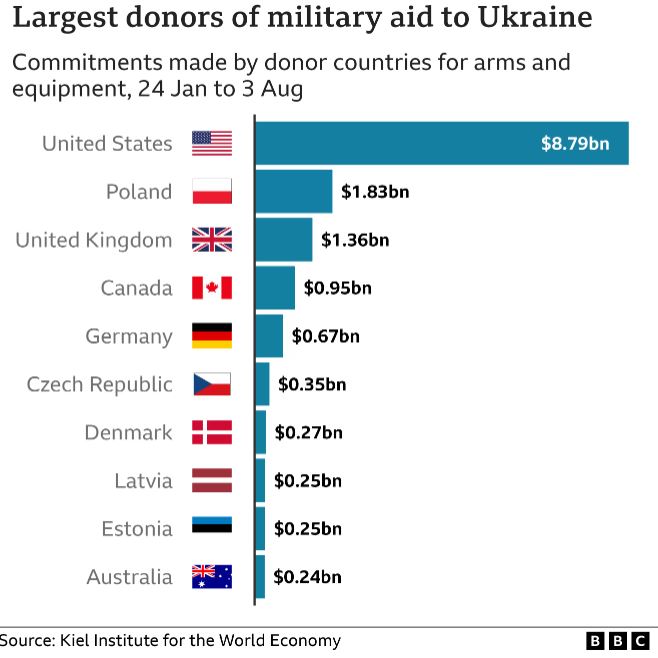
This August graph from the BBC gives a more rounded view;


That is 76% ($11.34/$14.96) from the Anglosphere - none of these nations are even physically connected to Continental Europe (sit down Gibraltar...).

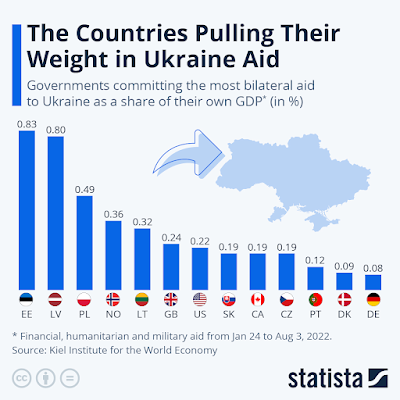
The % of GDP gives a measure of concern as well. The nations who know Russia best are speaking for themselves, but it is telling that of the Top-10, all the nation are either former Soviet Republics, Warsaw Pact members, share a border with RUS, or part of the Anglosphere.


I think about this a lot. You should too - and think about the most important word in the English language; "why."

Tuesday, September 27, 2022

Russia's Nuclear Option?


As winter arrives in Eastern Europe and the Russo-Ukrainian war approaches the end of its first year, a very serious war will become even more serious.

Both nations are increasingly fully invested in to seeing this to the end. Though on paper stronger, cracks in national resolve in Russia are showing much more than in Ukraine. Wars of choice for conquest – which is what Russia is engaged in – has a much different impact on a nation’s people than an existential war for national survival, which is the war Ukraine is in.

As Russia’s problems in trying to achieve something that looks like victory manifests itself in to the Russian people’s waning support for the war, the rulers of Russia will increasingly find their legitimacy and hold on power under threat. They know this war should have been over months ago. They clearly did not know their enemy well. 

Desperate times can force desperate measures. If the present Russian leadership’s hold on power is seen as weak, what measures might they take to try to hold on to power by forcing a quick end to the war on favorable terms?

Some are looking closer at the nuclear option that Russia has. I think they are looking too hard. A good example of this line of concern was in yesterday’s WaPo by Joseph Cirincione

NB: Before the pull quotes, a fair warning – Cirincione is selling a book titled, Nuclear Nightmares: Securing the World Before it is Too Late, so keep that in consideration;

Russian President Vladimir Putin is losing his war. If the Ukrainians continue to liberate areas of their country from his invading army, would he actually use nuclear weapons as he has threatened? If so, how? And what would the U.S. response be?

It is difficult to put percentages on risk. Nor does it really matter. Given the stakes, if the chances are 10 percent or 40 percent, the response would be the same: Minimize the possibility of nuclear use, and prepare responses in advance.

This is when I remind everyone that "we" are horrible at predicting the next war early enough to prevent them. The track record is simply not very good. However, Cirincione has invested a lot of time and effort in looking at this - so we should give his ideas some consideration;

The next quote reminded me of a little reminder a peer gave me back when I was a NATO staff weenie at the other end of the HQ p-way from him. As a JO, he was on the other side of the wire as an JO in the Warsaw Pact. "Americans may not follow their doctrine very well, but Russians do."
Russian military writings describe in detail how, if Russia is losing a conflict, it could use nuclear weapons to force its enemy to retreat. This “escalate to de-escalate” or “escalate to win” strategy is somewhat controversial, but it is not dissimilar to various U.S. plans for using nuclear weapons first.

Well, sometimes we follow our doctrine. Sometimes the Russians don't...but if you are playing odds... 

I still stand by my belief - and that is a weak thread, I know - that in the next war, nuclear weapons will be what chemical weapons were during WWII. Everyone had them; no one used them.

If nuclear weapons were to appear on the Ukrainian stage, Cirincione does not have this COA as his most likely ... but it is my most likely if one must choose from the "Nuke" basket;

Demonstration shot. One option is for Russia to fire a nuclear weapon over an uninhabited area — say, part of the Black Sea — as a demonstration of its seriousness in hopes that the West will back down. Some scientists involved in the Manhattan Project urged just such a demonstration shot as an alternative to bombing Japanese cities at the end of World War II. While no one would be killed and there would not be physical damage, the explosion would stop the world in its tracks. There has not been a nuclear weapon used in combat in 77 years. No one has even seen a nuclear explosion above ground since 1980.

This is their neighborhood and fallout will drift to their lands if nukes are used. Is anyone going to buy grain downwind? No. Next to underground explosions, explosions high over the water or in the atmosphere create the least secondary radiation effects. Don't underestimate the lingering memory of Chernobyl. I see "Demonstration Shot" of the most likely COA of the least likely Nuke COAs.

As shocking as this would be, Russia would likely reject this option for the same reason U.S. military leaders did in 1945: It is not shocking enough.

Don't agree. Russia believes their own FITREPs, so to speak. The arrogance of their initial OPLAN speaks to this. They hold most of Central and especially Western Europe in contempt. I am sure a nuke over the Black Sea would be shocking enough (and they're right).

This is the author's "Most Likely COA:"

Low-yield weapon. Russia could fire a “low-yield” nuclear weapon on a Ukrainian military target. The explosion would kill hundreds or thousands and cause significant damage. Russia could use one of the 10-kiloton warheads it deploys on some of its ground-launched cruise missiles, including the Iskander that has been used extensively in the war with conventional warheads. Although this would be a massive explosion — equal to 10,000 tons of TNT — it would be small by nuclear standards. The bomb that destroyed Hiroshima was 15 kilotons; most U.S. and Russian nuclear warheads range from 100 to 1,000 kilotons. Some believe that Russia has even smaller-yield warheads, in the one-kiloton range.

I'm sorry, a nuke is a nuke. Any use, however slight, breaks the seal. As mentioned earlier, why go right away with something that will blow fallout your direction and ruin a major cash crop for who knows how many years? No one would want hot-wheat. You'd win nothing but a poisoned challis.  

Once this seal is broken, beyond that line be dragons. I would see a hard split between Western and Central European NATO on a response. Lots of marches with large paper mache puppets, etc. I don't think the author is correct at all in his assumptions.

... it would not require a “response in kind” by the United States, though some would urge that. The likely response, in addition to those in scenario one, would be massive increases in military aid to Ukraine and possibly concerted NATO or U.S. strikes on the Russian units that launched the attack.

As per the split in NATO, there will be no NATO strikes anywhere after such a use. I do not see the USA using nukes either when two European NATO members, France and the UK, have nukes of their own. NATO will not do it, and especially the Biden Administration won't go alone in such a step unilaterally.

In his next two COAs, he treats them as individual events, I don't. Once "Low Yield" goes, unless there is an immediate capitulation to Russian actions, the next two steps will follow rather quickly. This isn't a ladder, this is a chute.

Large-yield weapon. Putin could dial up the explosive force of the attack to the 50- or 100-kiloton range, or about three to six times the Hiroshima bomb. Tens of thousands would die with massive damage and radiation plumes. If the target were Kyiv, it would decapitate Ukraine’s leadership. This would almost certainly trigger a direct U.S. or NATO response, though not likely nuclear. The United States and NATO have sufficient precise, powerful conventional weapons that they could use to devastate Russian forces in Ukraine and command headquarters, including those units responsible for the attack. This would likely be accompanied by large-scale cyber operations.

Nuclear attack on NATO. This is the least likely scenario. Russian first-use doctrine includes the option of striking NATO targets. The attack could be by long-range missiles or air-launched cruise missiles on Central European states. If the yield of the weapon was similar to the previous scenario, it would inflict a level of destruction on a NATO state not seen since World War II. This could trigger a nuclear response. Some would argue a limited nuclear counterstrike was necessary to preserve nuclear deterrence. More likely is an all-out conventional assault to try to eliminate either Putin himself or the weapons he commands before he strikes again.

There is a certain arrogance in thinking that you can control the nuclear genie once it is out of the bottle. I am firmly of the school that you can't ... unless one side buckles. That is why one must be firm. The weaker you are, the more attractive the chute of nuclear use seems.

There is also a Rumsfeldian Known-Known in play here; the US President Joe Biden. He has a history going back decades. As former SECDEF Gates noted, he has a tendency to pick the wrong action on the international stage. He also shows a desire to - at whatever cost to foreign nationals - get the USA out of foreign entanglements involving our forces.

Should the Russians in desperation pull the nuclear card, would the USA do nothing and let the Russians get her way? What precedent does that set? Does anyone think that will stop the Russians from pulling this card again?

Does anyone really think there is a way to control nuclear escalation, that the same people who on the USA side who never saw Kabul collapsing like it did or on the Russians side who didn't see Kyiv standing like it did - that these two groups - have the insight and nuance to steer around and control each step in the "nuclear escalation ladder?" 

If the Russians do an airburst high over the Black Sea, would NATO/USA do a similar airburst over the Arctic? I don't know. No one does. Do you think the Biden natsec team has run this game yet and has a pre-planned response approved and ready to go?

I don't. 

Even with the best of teams on both sides, these are the "B" and "C" teams, not the "A" teams. Neither side has that record. There is no ladder to escalate on, to pause on each step and ponder. No, once the seal is broken, we have a steep and well greased chute. 

Pray for cooler heads, humility, and well secured genies. 

Wednesday, September 21, 2022

What NATO Must Do 01JAN24

So, what did you wake up to
President Vladimir Putin on Wednesday ordered Russia's first mobilisation since World War Two and backed a plan to annex swathes of Ukraine, warning the West he was not bluffing when he said he'd be ready to use nuclear weapons to defend Russia.

In the biggest escalation of the Ukraine war since Moscow's Feb. 24 invasion, Putin explicitly raised the spectre of a nuclear conflict, approved a plan to annex a chunk of Ukraine the size of Hungary, and called up 300,000 reservists.
This should not be a shock to anyone. If it is, perhaps you should consider investing your time in cat-blogging. 

It should bring to the front that NATO can no longer allow unserious nations to play like they are anything but security free riders. They need to contribute their fair share or pay some consequence. Alliances have benefits and responsibilities. You should not have one without the other.

While percentage of GDP is an imperfect measure of contribution, it is better than all the other ones. It is as simple benchmark of national effort.

As these are the best numbers we have, let's look at 2021 and then forward.


It is amazing that after all Russia has shown Western Europe - both of its nature and the nature of modern warfare - that so many of our NATO allies continue to slow walk defense spending, doing the very minimum to be a full and fair partner in the alliance.

Russian victory - however they define it - or Russian defeat - however Ukraine defines it - will not change the geography or nature of Russia. She is not going anywhere.

This article back a couple of months ago is a nice summary of who is who in the alliance. Some nations get it more than others:

Ever since NATO defence ministers agreed to spend a 2% GDP quota on their military budgets annually, it’s been a stick with which the big spenders can beat their frugal partners.

When NATO members again agreed to meet the 2% of GDP target at the summit in 2014, only the UK and Greece were keeping up the European side of the bargain. 

... 

Across much of Central and Eastern Europe, politicians are now racing to make sure they meet the percentage target by at least next year.

... 

Poland’s parliament passed the Homeland Defence Act in March that will increase defence spending to three per cent of GDP, which would make Warsaw the second-biggest European spender in NATO, after Greece.

Of course the Poles get it. Others - especially the former Soviet and Warsaw Pact nations - get it too. Others with rare exception are playing catch-up to where before the Russo-Ukrainian War only Poland and the UK were 2%+.

According to NATO forecasts published last month, seven European members of NATO will hit the target this year — Croatia, Estonia, Greece, Latvia, Lithuania, Poland, Slovakia and the UK. Romania and France will be off by less than 0.1%. All but Greece and the UK are from the former “Eastern bloc”.
...
Just this month the governments of Slovakia, Slovenia and Latvia said they intended to reach the spending mark by at least 2023, if not this year. Romania has increased defence spending by 14% for 2022 and says it could meet the 2% target next year. 
… 
Finland, which recently agreed to join NATO, spent around 1.5% of GDP on defence in 2020. But its government announced an injection of €2 billion following Russia’s invasion of Ukraine, which could bring it above the 2% mark in 2022 or 2023.
Who should be on everyone's naughty list?
Sweden, which also recently agreed to join NATO, has vowed to reach the 2% mark by 2028. 

Now-former Prime Minister Mario Draghi said in April that Italy would meet the target the same year. Spain’s government says by 2029. Denmark thinks by 2033.

Last week, Belgium’s parliament agreed to spend an additional €10 billion by 2030, taking it up to around 1.5% of GDP. Alexander De Croo, the prime minister, reckons the 2% mark will be reached by 2035.
...
Germany has recently come under criticism after new financial plans released this month appear to indicate that defence spending will only be around 1.5% of GDP this year and 1.7% in 2023. Only by 2026 will it fulfil its 2% pledge, according to some media reports.
There is so much deferred spending from our free-riding European allies. 
Between 1999 and 2021, EU combined defence spending increased by 20%, according to reports by the European Defence Agency. That compares with a 66% increase by the US, and 292% by Russia and 592% by China, over the same period.
"Out years" are where dragons live, so anyone not on guide-slope to 2%+ by the end of 2023 - when one way or another the Russo-Ukrainian War should be over - will find someway to not get there in a wave of excuses and bluffing. 

We should call their bluff.

As such, and this is generous, we need to finally pursue PLAN SALAMANDER for NATO "Flags-to-Post" that I first proposed almost six years ago.
In NATO, General and Flag Officer billets are distributed amongst nations in a rather complicated way, but this formula is controlled by NATO – and as such – can be changed.

Entering argument: take the present formula for “fair distribution” and multiply by .75 any nation that spends 1.5% to 1.99% GDP on defense. Multiply by .5 any nation that spends between 1.25% to 1.499%. Multiply by .25 1.0% to 1.240%. If you fall below 1%, you get nothing and your OF5 (Col./Capt) billets are halved. 

1.25x for 2.01%-2.25%. 1.5X for 2.26%-2.75%; 1.75x for 2.76% -3.0%. 2x for +3.01%.

The math gets funky when a lot of people get over 2%, but we can refine it later. Doesn't cost a penny and will unquestionably get the attention of those nations. Trust me on this. By January 1st, 2024 no more excuses. A small and symbolic punishment, but a good start that may be all that is needed. This is not the second half of the 20th Century any more.

2% is something that the Russo-Ukrainian War should show as an artifact for a different world. Smart people know this.

But General Jens Stoltenberg, the NATO secretary general, said at a summit last month that he reckons 19 partners will exceed the target by 2024.

“Two per cent is increasingly considered a floor, not a ceiling,” he added.

Europeans should be the primary drivers of having everyone spend more. As I have been warning since before the turn of the century - the USA is one election or significant political/civil/economic/natural disaster away from shrugging carrying the load for European security. They need to be ready to stand on their own. 

If they think Americans love their freedom more than they do - they are wrong.

If they think a Russian defeat and Putin in the history books will keep their eastern front quiet - they are wrong.

Wednesday, June 29, 2022

1937, NATO, and the Need for Follow-Through


General Sir Patrick Sanders, GBR A, Chief of the General Staff (GBR), made a statement, in part, this week that at first I thought was a bit of an exaggeration

"This is our 1937 moment," the army chief said, referring to the crucial period leading up to World War Two.

"We are not at war - but must act rapidly so that we aren't drawn into one through a failure to contain territorial expansion… I will do everything in my power to ensure that the British Army plays its part in averting war."

The challenge means the army must modernise, embracing new technologies such as cyber warfare and long-range missiles, but also retain traditional soldiering skills.

General Sanders said if a battle came "standoff air, maritime or cyber fires are unlikely to dominate on their own - land will still be the decisive to domain", adding that "you can't cyber your way across a river".

Perhaps not. It tickled something that this former NATO staff officer and all around NATO fanboi tried to ignore as the Madrid Summit was going on.

NATO is always frustrating and not all our allies are as “good” as others. Some nations are just institutionally prone to freeriding … but still, there is nothing better than NATO for nations who are trying to keep the experiment of liberal democratic government going. Even the least democratic nation in our club, Turkey, is still a place you can – within reason – not feel like you are living in some dystopian hell hole – though there are limitations there as opposed to living in say Denmark.

It is clear that the Ukrainians’ brave stand in the face of Russian aggression finally opened the eyes of many in NATO that were previously closed that the post-Cold War fever dream has passed, that it is time to act as adults in an adult world. Not perfect, but an improved situation.

Yes, Russia is a poor and corrupt country … but she is also resource rich and has a distinctly expansionist vision of her place in the world. On paper in GDP and population she does not seem like a threat to prosperous Western Europe and North America, but you can be as rich and prosperous as possible, but if you are supine and distracted, the smaller and poorer who is aggressive will defeat you every time.

The events of the last year make the Madrid Summit one that must deliver more than group photographs. NATO must show her cards. This is one of those moments in time where you either turn in to the wind, or drift hopelessly.

So far, with a few quibbles, there is room for optimism. Let’s look at a few bits from the pre-summit press conference with Secretary General Jens Stoltenberg on Monday,

We will transform the NATO Response Force.

And increase the number of our high readiness forces.

To well over 300,000.

NRF from 40,000 to 300,000. Hey, I know that gig and I feel the need to get to the CJ5 shop in Mons to go over the Combined Joint Statement of Requirements (CJSOR). Which troop contributing nations are filling which serials? Are we going to use the existing JFC’s as higher HQ or a new structure? This is my staff officer happy place. What a great time to be in Brussels, Mons, Brunssum, or Naples. If you love staff work – which I did – this is the kind of thing you just live for. (NB: don’t expect anything soon. NATO pretty much shuts down from 15 JUL to 15 SEP).

Regulars here know my decades long hobby horse about NATO allies spending their fair share? Well … 

Nine Allies now reach – or exceed – the 2% target. 

Nineteen Allies have clear plans to reach it by 2024.

And an additional five have concrete commitments to meet it thereafter.

Two percent is increasingly considered a floor, not a ceiling.

"... Back in 2014, when we agreed the Defence Investment Pledge, only three Allies met the guideline of spending 2% of GDP on defence. And defence spending was also declining across Europe and Canada." 

Say what you want about Trump, but he is the one that dusted this off and made it a priority. He and his natsec team were correct in this regard and should be given the appropriate credit. 

There are nations that geographically don’t quite “fit” NATO but otherwise would be right at home. We are smartly pulling them in tighter.

I welcome that Australia, Japan, New Zealand, and the Republic of Korea will join us for the first time at our Summit.

Absolutely critical to global security…not just North Atlantic.

However … all is not perfect. I would not be doing my loyal readers proper justice if I did not point out one sad fact – there are still unserious people injecting their unserious neo-pagan religion in this very serious secular challenge;

And on climate change, we will agree to cut greenhouse gas emissions for NATO as an organisation.

NATO could disappear tomorrow – and the planet would not notice. What unserious Davosesque BS. Whoever insisted that be included should be publicly shamed. 

Having unserious FOD spot-welded on to serious occasions degrades everyone. It does not belong on the same page as this scene setter;

... remember that, for instance, in the current Strategic Concept, agreed at the Lisbon Summit in 2010 - and I attended that Summit as the Prime Minister of Norway - at that time, President Medvedev of Russia participated in the meeting and we agreed in the Strategic Concept, which is still the current Strategic Concept, and we will have a new one later this week, we said that Russia is a strategic partner. That will not be the case in the Strategic Concept we will agree in Madrid. I expect that Allies will state clearly that Russia poses a direct threat to our security, to our values, to the rules-based international order.

That really set the tone for the conference.

Today we got the official “Madrid Summit Declaration,” and it is good to note the significance of its location; 40-years after Spain joined NATO. 

What are the bold-faced items?

We reaffirm our commitment to NATO’s Open Door Policy.  Today, we have decided to invite Finland and Sweden to become members of NATO, and agreed to sign the Accession Protocols.  In any accession to the Alliance, it is of vital importance that the legitimate security concerns of all Allies are properly addressed.  We welcome the conclusion of the trilateral memorandum between Türkiye, Finland, and Sweden to that effect.  The accession of Finland and Sweden will make them safer, NATO stronger, and the Euro-Atlantic area more secure.  The security of Finland and Sweden is of direct importance to the Alliance, including during the accession process.

No questions the largest takeaway. Swedish and Finn officers have been a regular sight through Partnership for Peace at NATO HQs for decades and at least their military has been ready to finalize their integration in to NATO. They were just waiting for the people and their elected representatives to realize the utility of this fact. They are turnkey members and will more than carry their weight. Great to officially have them in NATO.

The second takeaway is something not spoken loudly in polite company but generally understood. Russia is the reason for NATO.

We condemn Russia’s war of aggression against Ukraine in the strongest possible terms.  It gravely undermines international security and stability.  It is a blatant violation of international law.  

...

The Russian Federation is the most significant and direct threat to Allies’ security and to peace and stability in the Euro-Atlantic area.

The invasion of Ukraine was simply the last straw. 

We warmly welcome President Zelenskyy’s participation in this Summit.  We stand in full solidarity with the government and the people of Ukraine in the heroic defence of their country.  We reiterate our unwavering support for Ukraine’s independence, sovereignty, and territorial integrity within its internationally recognised borders extending to its territorial waters.  We fully support Ukraine’s inherent right to self-defence and to choose its own security arrangements.  We welcome efforts of all Allies engaged in providing support to Ukraine.  We will assist them adequately, recognising their specific situation.

We are a long way from and many plays away from UKR joining NATO, but NATO is clearly as close to being a combatant in this war as one could be without having actual troops on the ground. The nearest parallel I can think of is the USA’s relationship to GBR from 39-41, and perhaps the Soviet Union to Vietnam during our war there.

We will continue and further step up political and practical support to our close partner Ukraine as it continues to defend its sovereignty and territorial integrity against Russian aggression.  Jointly with Ukraine, we have decided on a strengthened package of support. 

Every NATO meeting, like minded non-NATO nations should be invited and smart minds put to work to see how we can better integrate with these friends.

We have met here in Madrid with many of NATO’s partners.  We had valuable exchanges with the Heads of State and Government of Australia, Finland, Georgia, Japan, the Republic of Korea, New Zealand, Sweden, and Ukraine, as well as the President of the European Council and the President of the European Commission.  We welcomed the engagements with the Foreign Ministers of Jordan and Mauritania, as well as the Defence Minister of Bosnia and Herzegovina.

Sadly, once again – the unserious neo-pagan cohort had to jump in where they are not needed nor wanted, but Davos must have its bit of the spotlight;

Climate change is a defining challenge of our time with a profound impact on Allied security.  It is a threat multiplier.  We have decided on a goal to significantly cut greenhouse gas emissions by the NATO political and military structures and facilities, while maintaining operational, military and cost effectiveness.  We will integrate climate change considerations across all of NATO’s core tasks.

So, there you have it. Sweden and Finland are in, and Russia is on report.  Hopefully that means that I will have fewer opportunities to tap my sign over on twitter.


If we are lucky, by mid-decade the new floor will be 2.5% of GDP and punitive measures like we’ve recommended through the years will be placed on member states not carrying their fair share of the load.