Showing posts with label Information. Show all posts

Thursday, September 29, 2022

GLOC, SLOC, .... ILOC?


With what looks like sabotage of the Nordstream 1 & 2 pipelines under the Baltic Sea bringing a momentary focus on critical infrastructure on the seabed, now is the perfect time point everyone to Pierre Morcos and Colin Wall's 2021 CSIS commentary, Invisible and Vital: Undersea Cables and Transatlantic Security.

In the national security arena, when conflicts arise people will discuss Ground Lines of Communication (GLOC) and Sea Lines of Communication (SLOC) - concepts military professionals concerned with keeping beans, bullets, lawyers, guns, and money flowing have focused on for all of human written history. 

In our age, where so much of what goes over GLOC and SLOC relies on the flow of information - voice and data - with few offline backups, is the security of those pathways just as important - the Information Lines of Communication (ILOC)? 

I've been guilty as most have with the fragility of satellite communications ... but is that where the real threat is to the lifeblood of the information age?

...undersea cables carry over 95 percent of international data. In comparison with satellites, subsea cables provide high capacity, cost-effective, and reliable connections that are critical for our daily lives. There are approximately more than 400 active cables worldwide covering 1.3 million kilometers (half a million miles).

Forget obsessing about what additional bridging equipment we need in light of the lessons from the Russo-Ukrainian War (actually, do keep obsessing about it because we are woefully short) - but instead invest some of your intellectual effort about the challenge of bridging a cut in a cable 1,000nm at sea and 3,000 meters under the water;

The Euro-Atlantic ... carries traffic between the two biggest economic hubs with dozens of cables, the majority of which are between the United States, the United Kingdom, and France. Europe relies heavily on these cables as a majority of its data is stored in data centers located in the United States. 

...

he planning, production, deployment, and maintenance of subsea cables are almost entirely in the hands of the private sector. Currently, the four largest suppliers are Alcatel Submarine Networks (France), SubCom (United States), NEC (Japan), and newcomer Huawei Marine Networks (China)...

...In the financial sector alone, undersea cables carry some $10 trillion of financial transfers daily. 

There is more than just financial and economic exposure here;

Submarine cables are also critical for transatlantic security as governments rely heavily on this infrastructure for their own communications. Diplomatic cables and military orders largely pass through these privately owned cables as military operated, and classified cables remain marginal. Undersea cable breaks between Egypt and Italy in 2008 led U.S. drone flights in Iraq to decrease sharply from hundreds to tens a day. 

...in recent years, Russian attention to transatlantic undersea cables, particularly in the North Atlantic Ocean, has increased commensurately with NATO’s perception of undersea cables’ importance and vulnerability. Moscow has two primary means by which it could directly threaten the cables: submarines and surface vessels that can deploy autonomous or manned submersibles. 

On top of physical vulnerability;

More difficult and subtle than destroying the cables is tapping them to record, copy, and steal data, which would be later collected and analyzed for espionage.

Well, 'nuff said on that. Ahem.

This next bit should give you a flash of panic;

Allied governments should also step up their efforts to protect this critical infrastructure from malicious activity. Once allies agree on a shared assessment of vulnerabilities, NATO defense planners could consider setting capability targets to encourage allies to develop appropriate assets, such as surveillance ships or autonomous undersea drones. The United Kingdom has already announced the acquisition of a vessel specifically designed to protect underwater infrastructure. It will be equipped with advanced sensors and underwater drones and is expected to come into service by 2024. In addition to monitoring capabilities, allies could also consider policies to bolster the global fleet of cable repair vessels, which as of now is both overstretched and informally organized. The Fiscal Year 2020 U.S. National Defense Authorization Act (NDAA), for example, allocated a small stipend for a program to incorporate two privately owned vessels into a “fleet” the government can activate in a crisis.

Adopt contingency planning in case of major breaks: The United States and its European allies and partners should also develop, in close coordination with the private sector, contingency planning to prepare for the consequences of intended or unintended significant cuts. A focus should be on scenarios where many cables are severed in a short time period, overwhelming the redundancy features that the private sector builds into account for more common, isolated failures. 

We are naked, and you should be afraid.

Ask hard questions. Demand action.

Monday, August 01, 2022

The USA Thinks in Domains; the PRC Thinks in Dominances


China's military posturing is in the air this Monday, so we'll look west of Wake to start the week out.

Though rough translations can be a challenge to read, if you get a chance to read your main opponent's intellectual work that references how they think - you should make the effort.

Though it would be great to have a more recent copy, thanks to the USAF's Air University you can read the People's Republic of China Science of Military Strategy (2013).

They use a slightly different approach to think about the same issue all militaries do - how to look at the different areas of power and control. In the West, most of us think in "domains." The PRC's 2013 work uses the term "dominances."

As you know, I like words. Words mean things and should not be used carelessly or dismissed.

James Jay Carafano Jr.'s summary in 2018 of "domains" works, so let's start there;

The future focus of jointness will be on ensuring that U.S. armed forces retain the ability to operate effectively in all domains in a theater (land, sea, air, subsurface, cyberspace, and space) and to exploit the ability to use advantages in one domain to operate in another.

What is the definition of the word, "domain?"

domain, noun:​ an area of knowledge or activity; especially one that somebody is responsible for

- Financial matters are her domain.

- Physics used to be very much a male domain.

- things that happen outside the domain of the home

Looking over the PRC offering first linked above and quoted below in length, the Chinese have a more simplified construct in their "dominances" framework.

Let's define what a "dominance" is;

dominance, noun: ​ the fact of being more important, powerful or easy to notice than somebody/something else

- political/economic dominance

- America's rise to global dominance

- dominance over somebody/something to achieve/assert/establish dominance over somebody

That is a distinctively different tone and level of aggression.  

The PRC's emphasis on information operations as well is ... interesting.

Worthy of a read and a ponder.

..the initiative in war is centrally expressed as comprehensive battlefield dominance, with command of the sea, command of the air, [end of page 129] and information dominance as the core. Of these, information dominance is the foundation for seizing battlefield initiative; without information dominance it will be difficult to effectively organize the friendly forces to seize command of the air and command of the sea. 

Also, command of the air and command of the sea are the keys to and key points in the battlefield initiative; without command of the air and command of the sea, information dominance will lose a forceful means of seizure and control, and cannot maintain the battlefield initiative. 

The practice of high-tech local war such as in the Persian Gulf War and Kosovo War yet again demonstrates that war invariably begins with a contention for the “three dominances,” and that whether the “three dominances” can be seized and maintained will directly influence the progress and outcome of war. 

In local war under future informationized conditions, [we] will need to set out from the reality of the PLA’s fairly low quantities of high-tech equipment, and not only must attach importance to using superior equipment for seizing and controlling the “three dominances,” and regarding the “three dominances” as a prerequisite for unfolding the follow-up activities, but also must attach importance to using inferior equipment to contend with the powerful enemy for the “three dominances,” and bring into play the subjective dynamic quality, to ensure the ability to continue unfolding the operational activities when momentarily holding the “three dominances” or even in adverse circumstances without the “three dominances.” 

Seizing and controlling the “three dominances” requires laying stress on preempting the enemy; emphasizing in the preliminary operations phase the careful selection of first-attack targets, the concentration of elite troops and efficient weapons, and the launch of high-intensity strikes in a concealed and surprise fashion; and doing everything possible in the first strike to basically paralyze the enemy operational SoS, and in one stroke seize the “three dominances.” 

Along with the gradual advance of the war’s progress, [we] must exploit information operations [IO] forces for rigorous surveillance of the enemy’s naval and air force movements, and for uninterruptedly carrying out suppression and jamming of enemy information systems, and concentrate the application of Army, Navy, Air Force, and Second Artillery long-range strike forces, to continue strikes at enemy targets which have newly restored functioning after being attacked, as well as at newly detected targets, so as to continually maintain powerful pressure against the enemy, and firmly seize the “three dominances.”

Hat tip Shugart.

Monday, February 21, 2022

What Does a Decaying Empire Look Like?

There reaches a point where having a ship put to sea in peacetime, regardless of her mission short of directly saving human lives, is a net negative to its nation.

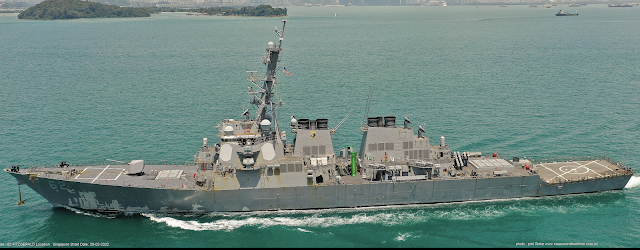
Of all places, yesterday in broad daylight, the USS Fitzgerald (DDG-62) passed through the Singapore Strait.

After our national humiliation in Afghanistan roughly half a year ago, and in the face of a serious challenge from China, in a part of the world where the powerful must maintain appearances less they lose face...behold what an organization that bills itself as the world's premier superpower has showing its flag.

Piet over at Maasmondmaritime.com has a whole series of high-res pics of her passage yesterday.

BEHOLD!


Our Admiralty continues to send such ships forward to show the flag, and they seem to be content to send the message of a poor, decrepit empire run by distracted and disengaged leaders who lack self-awareness of their decline.

I'll be blunt; this disgraces the Sailors, the ship, the Navy, and our nation.

There are no excuses.

Congress allocated to the Navy the money from the American taxpayer to buy this ship, and this is the level of stewardship we demonstrate.

Sure, the CNO stated we needed a 500 ship Navy, but I'm sorry Admiral - until we can prove we can properly take care of the ships we have, we have not earned a single additional hull.

Wednesday, December 22, 2021

What Kind of War Does Russia Want to Fight?


I guess to answer this post's title question, we could start by listing to what they are telling us.

It really could be that simple.

If things went sideways in Ukraine, what have the Russians been working on?

They've told us and in places, showed us.

Are we ready?

I'm pondering over at USNIBlog.

Come by and see what the General of the Army has to say.

Monday, May 11, 2020

The Chinese Will Tell You if You're Effective

Last Tuesday we linked to a message to the Chinese people from Deputy National Security Advisor Matt Pottinger given in Mandarin.

It is still great, but the question was, how effective was it?

Well, ... the Communists will tell you what they fear;
The following censorship instructions, issued to the media by government authorities, have been leaked and distributed online. The name of the issuing body has been omitted to protect the source.
Strictly delete any reposts, comments, and content related to U.S. Deputy National Security Advisor Matthew Pottinger’s Chinese speech from all platforms, websites, and interactive comment sections, leaving no dead corners. If any are found by the internet management office or reported by internet commentators, they will be dealt with seriously.
Simply superb.

Hat tip Jerry.

Wednesday, October 09, 2019

China is in an INFO war - if you know it or not

If you don't appreciate that the Chinese are lapping us in the Information domain, you're not paying attention.

More over at USNIBlog.

Come visit and tell me what you think.

Tuesday, August 13, 2019

3 COAs; Blue Most Likely; Blue Most Dangerous; Blue Most Unpossible

I don't know the politics of Maj. George Fust, USA, the author of an article over at RCD, but this just makes my head hurt.
Imagine a situation whereby the President accuses a U.S.-based news organization of being part of an adversaries' information operation. In accordance with MDO doctrine, the military can and should be leveraged to counter this threat. The Army's operating concept suggests "rapid and continuous integration of capabilities in all domains…to overmatch the enemy." Information operations include "social media, false narratives, [and] cyber attacks." Thus, the commander-in-chief can leverage his military to "defeat" the news organization or at least run counter information messaging. This is problematic. What prevents the President from abusing this control and offensive capability for his own political gain? The President could become a tyrant without a free press to serve as watchdog. The citizenry would subsequently view the military as a political arm to the administration. More than that, they may be viewed as a threat to liberty itself.

This is no random dude.
MAJ George Fust is a Military Intelligence Officer who currently teaches American Politics and Civil-Military Relations in the Department of Social Sciences at the U.S. Military Academy at West Point. He holds a master's degree in Political Science from Duke University.
This whole idea runs contrary not just to USA tradition and law - but to the nature of the US military as a whole.

I'm sorry - but maybe this is an Army thing - but I've worked closely with US Army types and no way they would wholesale be involved with this domestic activity.

I have less experience with the USAF, but the USN and USMC ... oh, hell no sister. We would not play. We would slow roll. We would launch every ready-JAG on alert ... just no. Our reservists in Congress would get read in ... no.

To really see this as a possibility, I would offer that George doesn't seem know his military well outside his bubble - I don't think he is all that well traveled in the nation he serves.

I'm not saying that George suffers from TDS ... but - dude. Maybe dry out from politics for awhile. 

Let's not personalize this too much - well meaning people are allowed to be highly wrong; even your humble blogger has on occasion - but instead let's focus on some professional shortfalls.

It seems the good Major lacks a good understanding of the lines between INFO OPS, PSYOPS, and Public Affairs - and how they are executed domestically vs. outside our borders. To get another view of this delicate area, I think he should do an exchange-semester with an institution I had the pleasure of giving a lecture to a decade ago; Führungsakademie der Bundeswehr in Hamburg.

Of the many great things I gained from my years with NATO was serving with Germans. As anyone with some time on staff with German Army officers will tell you, they will not put up with sloppy doctrinal understanding or conflating one concept with another. They not only had a good and well understood doctrine, they were fairly good at practical application (national caveats always held the Germans back in the field. Shame.).

I served with one German Army major who wore the lemon-yellow Signal Corp Waffenfarbe, and this was his speciality. You could see his eyes light up when someone - usually an American - got his INFO OPS, PSYOPS, and PA confused. I don't know if all their Signals guys were the experts on INFO OPS, PSYOPS and PA - but he was.

He would have made a mess of George's overwrought article. German law is a bit different than USA law, but the differences are manageable. 

I don't know if George is up for a NATO tour or the above exchange tour, but in the interim - in addition to understanding his own military's self-regulated firewalls against domestic use as he describes - he should take some time studying some NATO verbiage on the topic.

Trust me - this is mostly written by Germans. It's good.

Monday, March 11, 2019

No, the next war won't be livestreamed

Looks like the NYT discovered and wants everyone to know that "the cloud" and all the internet that binds our world together is not floating around us, but is under us and the great blue sea. 

The article is behind the paywall, so I won't make you go there, but let's touch on the topic.

Oceanic cables might seem like a 19th Century wonder, and they are, but that was just the first time our world was stitched together.

At war, it is not a new thing to consider data part of commerce and a nation's C2 infrastructure. Ever more so, the Information Age or Cognitive Age or whatever you want to call where we are now, it is all driven by fiber optic cables. Along those cables run everything from free pr0n to, as we discussed on Midrats yesterday, the command signals to our drones we use to fight our foreverwar.

Day to day lives in this age without access to internet? Look south;
Internet Collapses in Venezuela with 80% Offline; Twitter, YouTube, SoundCloud Blocked
That is just entertainment in a 3rd rate nation. Now consider what would happen to a global mercantile power engaged in military action. Not just a "soft kill" that has to do with electricity and software ... but a hard kill?

No, this isn't a new threat. It is old. Go back a bit over 120-years;
To isolate Cuba from Spain and other countries of the world was the problem which, upon the breaking out of war between the United States and Spain, immediately engaged the attention of our fleet at Key West. The blockade became virtually effective along the entire coast-line of Cuba, preventing the landing of food-supplies and munitions of war, as well as cutting off communication by mail between the island and the outside world. This, however, was not enough. General Blanco at Havana was still in direct communication by ocean telegraph-cables with many of the islands of the West Indies, and thence with the home government at Madrid. To cut these cables and thus destroy the Spanish telegraphic lines of communication, preventing the authorities at Madrid and at Havana, and the ships of Admiral Cervera's fleet, from sending or receiving information, was of the utmost strategic importance.

No ocean cables are landed on the north coast of Cuba except those leading directly from Havana to Key West. The United States, holding the terminal at Key West, controlled these lines. On the south coast the telegraph-cables are looped along the shore from Batabano, a port about thirty miles nearly due south of Havana and connected with that city by railroad and overland telegraph, to the eastward as far as Guantanamo Bay; the northern loops of the cables touching at San Luis, Cienfuegos, Trinidad, Santiago de Cuba, and a point on the shore of Guantanamo Bay.
...
The naval force operating on the south coast of Cuba in the early part of May, at the time of the cutting of the cables at Cienfuegos, was composed of the cruiser Marblehead, the gunboat Nashville, the converted yacht Eagle, the revenue cutter Windom, and the collier Saturn, at that time forming the fourth division of the fleet, under the immediate command of Commander B. H. McCalla, U. S. N., who flew the senior officer's pennant on board the Marblehead.

Cienfuegos is situated about six miles from the sea, and the bay or harbor is entered by a channel three miles in length. On the east of the entrance is Punta de la Colorados, where a lighthouse is situated. Overlooking this low strip of land and extending some miles to the eastward is a ridge or plateau, from two to three hundred feet in height, steeply sloping to the shoreline. Trees and the dense chaparral of Cuba cover the rocky and irregular surface of this hillside, the wild confusion of nature forming better rifle-pits here than the efforts of man could produce.
...
Shortly before sundown on May 10, signal was made directing the commanding officer of the Nashville and me to repair on board the Marblehead. On our arrival on board that vessel, we were informed by Commander McCalla that he intended to make an attempt at daylight the following morning to cut the ocean telegraph-cables; that an expedition of boats under my command would be sent in to endeavor to find and cut the cables landing near Colorados lighthouse, that the expedition would be opposed by a force of the enemy, and that the Marblehead and the Nashville would shell the country and attempt to dislodge the enemy or silence his fire. I was told that I could have the steam-cutter and the sailing-launch of the Marblehead and the steam-cutter and the sailing-launch of the Nashville, and that Lieutenant E. A. Anderson of the Marblehead would accompany the expedition as second in command. I had no further orders as regards the fitting out of the expedition, the details being left entirely to my own judgment.
...
The crew of each steam-cutter consisted of a cockswain, two seamen, a fireman, and a coal-passer. In addition to the crew, a sergeant of marines and half a dozen privates were to go as sharp-shooters. They were to be armed with rifles. In the Marblehead's steam-cutter a one-pounder Hotchkiss cannon was to be mounted on the forecastle. The Nashville's steam-cutter was to have two Colt machine-guns, one forward and the other aft. All boats were to be supplied with life-preservers. The tools for cutting the cables, to be carried in each sailing launch, consisted of cold-chisels, blacksmiths' hammers, a heavy maul, a block of hard wood with iron plate for its upper surface, an ax, wire-cutting pliers, and a hacksaw. Coils of stout rope and grapnels of different sizes were to be used in grappling the cables and bringing them to the surface.
...
My own individual orders were very brief. I was simply to cut the cables as directed above, and under no circumstances to land. The orders were quite sufficient, and I was glad to escape being hampered by more explicit instructions.
All should be nodding their heads here. Short clear orders.

Now days, things won't be so dramatic. Submarines and drones can do it ... but the impact will be the same and more dramatic as it will impact everywhere from teenagers' bedrooms to The Pentagon.

Silence. How the world would change in the blink of an eye.

So, what is the backup plan?

Head on over and read the whole thing by the guy who did the mission, LCDR Cameron Winslow, USN.

H/t Claude & Sid.

Tuesday, January 29, 2019

Dress for the Job That You Want

Especially at peace - a core to the "presence" mission - a navy ship represents her country and its people.

Sound seamanship and the material condition of ships sends a message about the nation whose flag it flies. Talk to any PAO, INFO OPS, or PSYOPS operator, they'll tell you.

What message are you seeing below?

First of all, let's look to the Chinese Navy.
A Chinese navy flotilla returned to Qingdao, east China's Shandong Province, on Sunday after completing its mission of escorting civilian vessels in the Gulf of Aden and waters off Somali.

The 30th escort squad of the Chinese Navy, comprised of missile frigates Wuhu and Handan and supply ship Dongpinghu, escorted 59 Chinese and foreign ships during the mission. The fleet set sail from Qingdao on August 6, 2018, the People's Liberation Army Navy said in a statement.

The fleet also participated in the naval parade marking the 60th anniversary of Tunisian Navy. And it visited Cambodia and the Philippines toward the end of its 175-day mission.

China sent its first convoy fleet to Somali waters in December 2008.
Five months later, what does a Chinese frigate look like to the world?


Next, what high profile ship broke in to the news cycle this month? Back on 19 Jan ...
Arleigh Burke class @USNavyEurope guided missile destroyer #USSDonaldCook transits Bosphorus & enters the BlackSea 17:30Z/12:30EST
What do we see 9 days later?


This is a regular habit. This is not sustainable. This is not the world's premier navy looking like one now, or in the future.

This is also not the fault of the CO or the ship's crew. This has everything to do with manning and maintenance support.

That goes straight to DC.

H/t Sid.

Tuesday, May 08, 2018

GLOCs, SLOCs .... ILOCs?

Taking or securing your status as a land power requires robust and well defended Ground Lines of Communication (GLOC). Only a strong and effective navy can secure the Sea Lines of Communication (SLOC) that enable food, fuel, and economic trade to flow unimpeded.

At war, if you want to undermine a land power, you threaten its GLOC. If you want to strangle a maritime nation, disrupt its SLOC.

In an age like so other where simple data, the rapid and reliable exchange of 1s and 0s, are so important for trade, communication, social, and warfighting prowess of advanced nations - what is the status of our Information Lines of Communications (ILOC)?

We all know the Tiffany China Doll fragility of our satellites, but what about the real backbone of the Information Age?

Over at BusinessInsider, a little something to ponder; in peace they are good to spy on ... in war - in a modern age where data bandwidth is as valuable for many economies as oil, coal, and iron were in other ages - are they are target?

Cables are nothing new, but the degree of reliance on them is - as is the ability of technology to find them. We know we fiddle with them at peace, but you don't have to be all that imagitive to see what a target they will be at war.

With everyone thinking about autonomous systems and AI, finding and disrupting cables would seem to be one of the easier things to do in this advance in technology. Even for non-state actors looking to go after the "E" in D.I.M.E., this is attractive.

With each year it will be easier to find and attack these ILOC.

How do you wargame this? Ponder as you watch the below.