Showing posts with label France. Show all posts

Friday, December 23, 2022

Fullbore Friday


Your commander matters. The best commanders know when to take the advice of their staff and when to brush it off. 

The worst commanders are those who lack the knowledge or personality to know when to do one of the other.

As told by Douglas Sterling;
“Great Army of the Sea”

On May 16, the English royal council met and pushed back the deadline for gathering the ships until June 12, which would mean a sailing date around the 20th. When Edward met with his council again on June 4, it was clear that earlier delays had not been resolved. The only way to even attempt to keep up with the timetable previously set, which was being relied upon by the allies, was to send at least a small force across the Channel to give support. Little did the English council know that the French had amassed a fleet, principally from the Norman ports, and had sailed from Harfleur on May 26. It was a large force, consisting of 202 vessels—seven royal sailing ships, six galleys, 22 oared barges, and 167 merchantmen— requisitioned by Philip’s agents. By the time the smaller English force sailed, the French had passed Calais.

The French fleet, called the “Great Army of the Sea,” appeared off Sluys on June 8. According to Jonathan Sumption, author of a multivolume history of the Hundred Years’ War, the French soon “swiftly and brutally occupied the island of Cadzand and anchored in the mouth of the River Zwin opposite the harbor of Sluys. The news passed rapidly through the Low Countries, spreading panic in coastal towns and drawing a great crowd of gapers to the foreshore to watch the denouement.”

Reaching the English government two days later, the news of the French attacks at Sluys caused a near panic, many of the king’s advisers claiming the odds were too great to force a confrontation with such an armada. Edward’s Chancellor, Archbishop Stratford, in particular argued strenuously that the risk was too great. He had never supported the King’s enterprise and now considered it folly to risk the government’s finances, its fleet, the security of the English coast, and, indeed, the King’s person on an unworkable scheme. Edward would have none of it, and accused his advisers of trying to frighten him. For him, there could be no question of abandoning the coalition he had helped create, nor could there be any question of running from a fight. “I shall cross the sea and those who are afraid may stay at home,” he announced.

Archbishop Stratford resigned and was succeeded by his brother Robert, Bishop of Chichester. Edward was, however, persuaded to delay his departure for a few days to requisition more ships and to convert a transport armada into a battle fleet. Horses were removed to make room for infantry, and strong messages were sent to every reachable port to provide all ships over 40 tons. No excuses were accepted; Edward himself confronted the mariners of Great Yarmouth who were yet delinquent.

By June 20, nearby harbors were empty and the ships previously assembled were brought into the Pool of Orwell to join the large ships of the western Admiralty. The exact size of the armada is unclear, but is thought to have been around 140 to 150 ships when added to the Northern Fleet under Lord Robert Morley. Edward himself went aboard the cog Thomas, and the fleet set sail just after midnight on June 22, 1340.

Kind Edward Longed for Revenge

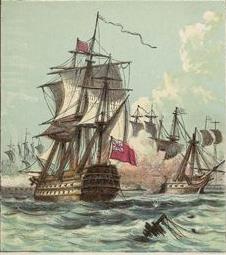
Catching a strong northwesterly breeze, the English fleet passed the point of Harwich at dawn and late on the following afternoon stood off the Flemish coast west of the Zwin estuary. Inside, the French fleet lay in wait, commanded by Admirals Hugh Quieret and Nicholas Behuchet. According to Jean Froissart, the famous chronicler of the early part of the war, “King Edward saw such a number of masts in front of him that it looked like a wood. When he asked his ship’s captain what it could be, he replied that it must be the Norman fleet that King Philip kept constantly at sea, which had done such great damage at Southampton, capturing the Christopher and killing her crew. King Edward declared that he had long wanted to fight them, and now, please God and Saint George, he would be able to, for they had done him such harm that he longed for revenge.”

The French saw the English fleet, too, and held a council of war. Barbavera, as the most experienced sailor among the commanders, counseled caution. He was concerned that the anchorage in which the French fleet lay was too confined for maneuvers if attacked and that the wind, blowing into the mouth of the river, would further hamper maneuverability. He suggested that Quieret and Behuchet take their fleets into the open ocean where they would have a better chance to maneuver and meet the English fleet on more favorable terms, but his colleagues balked. In their minds, the mass of their force was more than a match for the English. It certainly looked it, with the closeness of their ships and their great bulk, with bows, poops, and masts fortified with timber. Reinforcements from Flemish and Spanish allies brought their force to 213 vessels. Quieret and Behuchet were afraid that any move to the open ocean would provide an opening for the English force to sail in behind them and land in Flanders.

Instead of following Barbavera’s advice, the French admirals drew their ships into three lines across the mouth of the estuary, like an army on land setting up a strong defense. In the first line were 19 of their largest vessels, including the captured cog Christopher, which stood out larger than the others. Each line was chained together to form an impregnable barrier.
Who said SEALS are a recent invention?
The English sent a knight, Reginald Cobham, ashore with two others to gather intelligence on the French anchorage and their dispositions for the battle. Their report pointed out the major weakness of the French order of battle that Barbavera had warned of: the anchored, chained, and massed lines. According to N.A.M. Rodger, “This was a traditional galley or longship tactic, serving to make the naval battlefield as much like a battlefield ashore as possible, but of course it removed any possibility of manoeuvre and resigned the initiative to the enemy.” 
An English council of war decided to grasp the initiative and attack the next day when they would have the advantage of wind and tide behind them. 
Preparing for Battle
At the end of the 15th century, the Zwin estuary silted up, so that the site of the Battle of Sluys is now farm land and dunes. In 1340, according to Sumption, it was “a stretch of shallow water about 3 miles wide at the entrance and penetrating some 10 miles inland towards the city of Bruges. It was enclosed on the northeastern side by the low-lying island of Cadzand and on the west by a long dyke on which a huge crowd of armed Flemings stood watching. Along the west side lay the out-harbours of Bruges, Sluys, Termuiden and Damme.” 
In preparation for battle, the English also drew up their fleet in three battle lines. In the early afternoon of June 24, they began to press down from the north on the entrance to the Zwin. Although Froissart’s account of the battle is truncated in time— making it seem like the dispositions of the two fleets and the attack of the English followed quickly upon the two forces sighting one another—he nevertheless gives a stirring battle narrative. According to him, Edward deployed his fleet, maneuvering it “so that the wind was on their starboard quarter, in order to have the advantage of the sun, which had previously shown full in their faces. The Normans, unable to understand these maneuvers, thought that the English were trying to avoid giving battle; but they were delighted to see that King Edward’s standard was flown, for they were eager to fight him.” It was then that the English fleet “advanced to the sound of trumpets and other warlike instruments.” 
The English had the wind and the tide. Importantly, they sailed with the sun behind them, shining into the faces of the French. 
Within the French force, confusion was beginning to overshadow confidence. As Sumption relates, the French fleet “had been too long at their battle stations and the chained lines of vessels, which originally extended across the breadth of the bay, had drifted eastward piling the ships up against each other on the Cadzand shore and reducing their sea room still further. The chains were useless in these conditions.” The French admirals ordered the chains to be thrown off, and the fleet then attempted to recover the open flank to the west. 
Unfortunately, the Riche de Leure, a front line vessel of the French force, detached from their line and became entangled with a ship of the English van. While those ships grappled and struggled together, the English front line rammed into the French. 
The front lines of the two forces included their largest ships. Edward’s flagship, the cog Thomas, was among the large ships from the Cinque Ports and faced the Christopher, captured from the English in earlier action, and the St. Denis, a large vessel with 200 seamen aboard. 
Sea battle tactics in this period consisted of grappling with an enemy vessel to assault the enemy decks with showers of arrows in preparation for boarding, which was seen as a kind of infantry attack, like an assault on a fortress. The idea was to hold the enemy close to weaken them for a victorious assault. This is indeed how Froissart described the beginning of the battle, with “each side opening fire with crossbows and longbows, and hand-to-hand fighting began. The soldiers used grappling irons on chains in order to come to grips with the enemy boats.” Both sides had artillery of a sort, stone throwers and giant crossbows called “springalds,” but, according to Sumption, they were “more dramatic than useful.” 
Arrows Fell on French Crews “Like Hail in Winter” 
Because the French force was hemmed in by the weight of the English fleet and was soon snared with hooks and grappling irons, they were forced to fight with a serious disadvantage in firepower. For, as in the English land battles that were to come in the following years, the English crews were equipped with the longbow, which was greatly superior to the crossbow used by the French and their Italian allies. As Sumption says, the longbow “was more accurate. It had a longer range. Above all it could be fired at a very rapid rate.” He quotes a London observer as describing arrows falling on the French crews “like hail in winter,” while “crossbows had to be lowered and steadied at the stirrup while the wire was strenuously levered back between every firing.” 
By all accounts, the battle was ferocious and the slaughter terrible. According to Froissart, “The battle … was cruel and horrible. Sea-battles are always more terrible than those on land, for those engaged can neither retreat nor run away; they could only stand and fight to the bitter end, and show their courage and endurance.” Although the French had the advantage in numbers, the disposition of their forces and the weight at the point of attack favored the English. 
Still, the French and their allies fought hard. The English forces “were hard-pressed, for they were outnumbered four to one, and their enemies were all experienced sailors. But King Edward, who was in the flower of his youth, proved himself a gallant knight, and he was supported by … many … gallant knights [who] fought so valiantly, with the help of those from the neighborhood of Bruges, that they won the day.” 
The fighting proved to be fierce and lasted well into the afternoon when it became clear to the French in the rear lines that their comrades in the front were suffering grievously. Yet they were unable to join the fray because they were hemmed in between their own front line and the shore, and did not have room to maneuver round to the west. By evening, however, the English front line had broken through to the French ships in the rear and fell upon them. Now the English had a tremendous advantage in weight of ship as their cogs towered over the smaller French ships in their second line and they were able to rake the decks of the French from their greater height. 
With the English clearly winning, Flemings began to pour from Sluys and other harbors in the estuary to join the fight and share in the victory. They fell upon the French from the rear as the English continued to press from the front. As night fell, the third French line of Norman merchantmen and Philip’s barges attempted to escape the estuary. The English tried to block their path and the battle devolved into a series of skirmishes as more and more French ships made toward the open sea. By 10 pm the fighting was nearly over, except for two ships so entangled that they fought fiercely throughout the night. By the time the English were able to board the French ship at dawn the next day, they discovered 400 enemy dead aboard. 
Unlike war ashore, at sea here is not much room to retreat once fully engaged. Losses are rarely done in retail, deaths are wholesale. In modern times as it was for thousands of years.
Almost 18,000 Frenchmen Were Killed

In fact, only the dawn of the following day would reveal the extent of the French defeat and the tremendous loss of life and shipping. According to Sumption, the French “suffered a naval catastrophe on a scale unequalled until modern times.” The English had captured 190 of the 213 French ships that had been engaged, including their old cogs, Christopher and Edward . Although a certain number had escaped, including Barbavera’s six galleys, four of the six-oared galleys based at Dieppe, and 13 others, the death toll was almost indescribable. Again, as Sumption puts it, “The crews and troops on board the ships which did not escape were killed almost to a man. No quarter was given once a ship was boarded, and those who threw themselves into the sea, as many did, were picked up by the Flemings on the foreshore and clubbed to death.” Perhaps between 16,000 and 18,000 Frenchmen were killed. Edward himself would write to his son that each tide brought in more and more corpses.

As for the French admirals, Quieret was killed when his ship was boarded by the English. Behuchet, who was recognized by his captors, was held for ransom. Then, Edward III, in a pique of anger, waived the normal conventions of aristocratic warfare and had Behuchet hanged from the mast of his flagship.\
And now, befitting our era; the Battle of Sluys in Lego. Seriously; it's fairly good to excellent.


First posted December 2016.

Monday, October 03, 2022

We Need to Talk About France


On paper and in theory, one would think that a nation who love-hates NATO only slightly less than she love-hates the USA, and is always looking for an opportunity to - now that the UK yeet'd itself out of the EU - nudge Germany out of the way so she can be seen as THE leader of Europe, would take the lead in supporting Ukraine in the Russo-Ukrainian War.

Of course, I'm talking about France;

If France wants to lead Europe to a new era of military self-reliance, how come its contribution to the war effort in Ukraine is so small?

That is the awkward question being posed by some of the country's top strategic thinkers, who are pushing President Emmanuel Macron to make an urgent decision on more arms to Kyiv.

Recent analysis conducted on the ground in Poland and Ukraine shows that the French share of foreign arms deliveries is less than 2%, way behind the US on 49%, but also behind Poland (22%) and Germany (9%).

"I was concerned about the reliability of the statistics which showed France low on the list of contributing countries," says François Heisbourg, who is perhaps France's most influential defence analyst.

"So I went out to the main distribution hub in Poland to see how much in tonnage was actually being delivered, rather than just promised.

"Unfortunately the figures bore out my fears. France is way down the list - in ninth position."

We hear the same old excuses that we are used to hearing from other nations (FRA actually spends a bit over 2% GDP on defense), who free-ride in NATO;

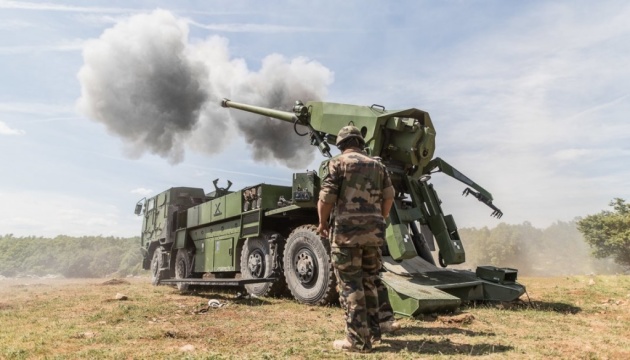
...defence officials say the true measure of military help is quality not quantity. Some countries are delivering masses of outdated equipment. France has given 18 Caesar self-propelled artillery units, which are now celebrated along the Ukrainian front-line.

France, they add, is like other Western countries in having run down military stocks as part of the post-Cold War peace dividend.

You know there's a "but" on the way ... and this is the point I raised to surprising response over the weekend on twitter;

Ukraine's Caesars are fully one quarter of France's entire mobile artillery. It cannot offer much more without making itself vulnerable in regions where it is already committed, like the Sahel and the Indo-Pacific.

18 = 25%. Yikes.

Yes, the nation that pretty much invented modern artillery on the battlefield is that short. Amazing, and she desires to be a major player on the stage? She's a continental power...but in theory only.

How to fix on the whole? That is a great question with a complicated answer I'm not sure we can do justice to here. 

How do you possibly fix her relative lack of support to Ukraine?

"When I was in Kyiv, everyone was very polite. I had no sense that the Ukrainians disapproved of us," he says. "In a way it was worse. I had the distinct feeling we were becoming irrelevant."

For Mr Heisbourg the equation is simple. Ukraine will talk to countries who it knows are likely to deliver the weapons it needs. France at the moment is not one of them.

The French have a very flinty ego. They don't like to be dismissed. They like to be important. They lust for a seat as a player.

Treat her like a 3rd-tier nation, and that might get her to up her game. 

Yes, France has long-standing interests in Russia ... but she, like many, seems to be missing her moment on history's stage. 

France has been and could be a strong and responsive ally ... but at this moment in time, cracks in her very real military capability are being brought in to focus, and larger cracks in her ability to understand place and time are even more pronounced. 

Tuesday, January 04, 2022

The Wisdom of Eisenhower


I remain firm in my stance that Ike Eisenhower is one of the most impressive leaders this nation every produced and deserves to be in any Top-5 lists of great Americans. 

Perfect? No. Great? Yes.

"To be well read..." - how often have you heard this phrase used? It is usually used as a way to make sure a curious mind does not - through conscious acts of commission or omission - put itself in a echo chamber. It has a secondary benefit; you find jewels you may not have found otherwise.

Classic case last night when I found myself digging around for news the new German government and a whole host of problematic decisions. There happened to be an intersection with yesterday's nod to diplomacy that out of the blue brought in two of the most important people in the West; Eisenhower and Churchill.  

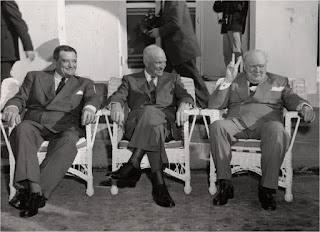
In the first year of Ike's Presidency there was regular correspondence between him and Churchill who two years earlier found himself back as Prime Minister after 6-years of Labour governance. Their correspondence eventually led up to the "Big-3" conference in Bermuda at the end of 1953 that included the French. I hope someone has compiled it in to one document or used it as a basis to get their PhD. If anyone knows, let me know. I has to represent a masterclass in personal diplomacy between allies.

Let me just pull one letter out of that year to demonstrate the remarkable political, personal, and diplomatic skill of Eisenhower. The letter is clear, efficient, and gloriously free of buzzwords, lingo, and posturing - but it is crafty.

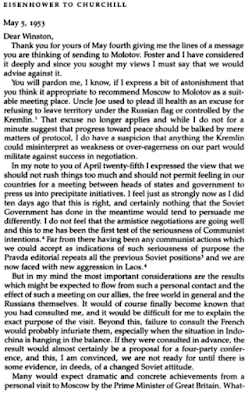
It is so good - and nutrient rich - that I am going to do a sentence by sentence fisking. I would encourage you to read it in full first at this link or as embedded below. Give it a read and come back. 

Now that you're back, let's go back to May 5, 1953 in a letter from Ike to Winston. Their relationship dated back to 1942 and was mostly businesslike. They both had complicated views of each other as persons and leaders with a history of disagreements - but the respect for the importance of their partnership is clear, even as the relative power positions changed after a decade.

There is something to learn in each sentence. Here's my take ... if I miss some nuance, please share in comments.
Thank you for yours of May fourth giving me the lines of a message you are thinking of sending to Molotov. 
Always reference the last correspondence and thank the author for it. First, it is simply good manners, second it establishes a reference point for your comments to follow. The  receiver may think your comments are based on a previous correspondence or something that followed. This is a critical detail. Never forget to include it early so as to avoid misunderstandings. With today's faster correspondence, I would include the time if by email, etc.
Foster and I have considered it deeply and since you sought my views l must say that we would advise against it. 
Note that "Molotov" in the previous sentence - an opponent - is referred to by his last name only. That is familiar to both, but "Foster" as in "John Foster Dulles" who even among friends was referred to as "Dulles" but here, is simply among friends "Foster."  Never underestimate the power of personal relationships between allies and friends. They should always be nurtured, even when the people in question may not be personally liked ... you should pretend to like them anyway. It isn't about "you" it is about the position you hold. Nations have friends, and their servants need to align as such.
You will pardon me, I know, if I express a bit of astonishment that you think it appropriate to recommend Moscow to Molotov as a suit-able meeting place. 
Get to the point, and be clear about it. There is no question that Ike is, politely, asking, "What the hell are you thinking?" It is OK for friends to directly confront each other when they think the other is in error, especially when it can affect mutual efforts. As a matter of fact, that is a sign of friendship. No reason to be squishy about it - also there is no reason to be rude. Friends can be blunt without being insulting. Insults just make people dig in. Done the way Ike has, no one loses face.

Once you tell your friend he is off, you owe them an explanation why;
Uncle Joe used to plead ill health as an excuse for refusing to leave territory under the Russian flag or controlled by the Kremlin.' That excuse no longer applies and while I do not for a minute suggest that progress toward peace should be balked by mere matters of protocol, I do have a suspicion that anything the Kremlin could misinterpret as weakness or over-eagerness on our part would militate against success in negotiation. 
"Uncle Joe" is of course Stalin who just died 8-months earlier. Note the use of "Russian" and "Kremlin." That is not a mistake. Ike was of the same generation as my grandparents and I recall being a pedant to my grandmother in middle school when she was telling a story about raising a family in WWII. She was discussing all the talk about "aid to Russia" when I mentioned, "They were the Soviet Union Mawmaw..." She just gave me that look, "Call them what you want, but we called them Russians, they are Russians, and they will always be Russians." Boy, was she right. Anyway, "Kremlin" is simply whoever is running the Russia/Soviet Union - not solidified in to a specific person at that time after Stalin's death, but the surviving Communist nomenklatura.

I think it is important to pull out something in this sentence again that applies as much today as it did then; 
...anything the Kremlin could misinterpret as weakness or over-eagerness on our part would militate against success in negotiation. 
I am not confident our present State Department or Executive Branch fully understand that centuries old constant in diplomacy in general, and dealing with the Russian mind in particular. 
In my note to you of April twenty-fifth I expressed the view that we should not rush things too much and should not permit feeling in our countries for a meeting between heads of states and government to press us into precipitate initiatives.
If your position has not changed, and indeed you are now even more firmly welded to it - then emphasize that fact if it appears no one really understood it. You can also see here Ike's natural caution and bias against recklessness. A serious man for a serious time. Churchill could be a bit overly aggressive - a nice feature as long as he has friends and confidents who can convince him to dial things back now and then. Ike could do that.
I feel just as strongly now as I did ten days ago that this is right, and certainly nothing that the Soviet Government has done in the meantime would tend to persuade me differently. 
If something is important enough to repeat, there is nothing wrong with saying it a third time a different way. Note the first use of "Soviet." Perhaps used interchangeably with "Kremlin" as it appears.
I do not feel that the armistice negotiations are going well and this to me has been the first test of the seriousness of Communist intentions.
If you are dealing with stubborn, but fair, personalities - which Churchill was - and you are concerned that they may bully through your concerns they may not fully appreciate, then don't be afraid to point out your top reasons. In this case the "armistice negotiations" involved the Korean War. I would also point out the first use of "Communist." Russia, China and their captive nations were on a global expansion that would continue for the next few decades. Though in conflict with each other in some places but coordinated in others, there was a trans-national "Communist" threat that was part of yet distinct from "Soviet" or "Russian." A complicated time demanded nimble thinkers.
Far from there having been any communist actions which we could accept as indications of such seriousness of purpose the Pravda editorial repeats all the previous Soviet positions3 and we are now faced with new aggression in Laos.
Continue to sell your opinion in the face of what appears to be thick-headed obstinance - even from friends. We forget how little insight we had in to the thinking of Soviet leaders at the time. Not shocking considering how thoroughly they had penetrated the US and UK's intelligence and foreign services agencies. "Kremlin watchers" and "Sovietologists" were a thing ... so yes, reading Pravda editorials was one of the few ways you could see what might be going on in the minds of Soviet leaders. Also note "Laos." The problems in Southeast Asia were starting.
But in my mind the most important considerations are the results which might be expected to flow from such a personal contact and the effect of such a meeting on our allies, the free world in general and the Russians themselves. It would of course finally become known that you had consulted me, and it would be difficult for me to explain the exact purpose of the visit. 
What is the diplomatic equivalent of "emotional intelligence?" Well, Ike sure had it. I'm not sure Churchill ever did. Ike was good at second and third order effects. Not perfect, but good and it shows here in spades.
Beyond this, failure to consult the French would probably infuriate them, especially when the situation in Indo-china is hanging in the balance. If they were consulted in advance, the result would almost certainly be a proposal for a four-party confer-ence, and this, I am convinced, we are not ready for until there is some evidence, in deeds, of a changed Soviet attitude. 
Oh yes, the French. Are you thinking of this years clown-show roll out of AUKUS? The French were, are, and will be looking for reasons to have their honor hurt. I'm a fan of the French, but you simply have to keep this national character in mind. Ike knew this, but I don't think Churchill cared.
Many would expect dramatic and concrete achievements from a personal visit to Moscow by the Prime Minister of Great Britain. What- ever you said publicly about the purposes of your solitary pilgrimage, I suspect that many in the Far East as well as the West would doubt you would go all the wav to Moscow merely for good will. 
Expectation management. This is Ike again helping Churchill understand second and third order effects. You can read the frustration Ike has with Churchill, but his understanding that frustration was to be overcome, not to dominate, their working relationship as there were simply too many important matters to attend to.
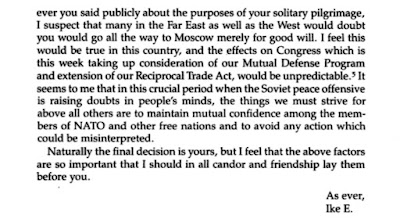
I feel this would be true in this country, and the effects on Congress which is this week taking up consideration of our Mutual Defense Program and extension of our Reciprocal Trade Act, would be unpredictable.
Is that a warning or a threat? I don't think it matters. Firm message, but not insulting.
It seems to me that in this crucial period when the Soviet peace offensive is raising doubts in people's minds, the things we must strive for above all others are to maintain mutual confidence among the members of NATO and other free nations and to avoid any action which could be misinterpreted. 
NATO was still a young organization and was important to the UK as it ensured that continental Europe did not build its own military arrangements that would leave the UK out. Remember, at this time a goal was to get American ground forces out of Europe once the Europeans were able to rebuild their militaries. Well, here we are, seven decades later ... 
Naturally the final decision is yours, but I feel that the above factors are so important that I should in all candor and friendship lay them before you. 
Respect for national sovereignty, yet clearly outlining what to expect if your concerns are ignored. 

Diplomacy is all about give and take with a goal of a net positive for your interests and those of your friends. You just can't focus on what you want, you have to consider the primary and secondary stake holders who support you, as well as those who oppose you. What leverage do you have vs. what leverage others have against you. 

In this dance, personal relationships and personalities matter. This isn't math, this is something much more human.

All I know is that I need to find a good book on the relationship between these two great men. If a page and a half letter such as this is as impactful as it is on its own, then the whole body must be something grand to behold.


UPDATE As some are having some trouble with the scribd, here's the screen shots:

Saturday, September 18, 2021

September Maritime Melee - on Midrats


Sal and EagleOne are tanned, rested, and ready to dive in a … well … where does one start for the last couple of weeks.

Australia pivots strong to China with here plans to move to SSN, France gets grumpy with the Anglosphere as a result but still kills a baddie for us, fleets of container ships are haunting out ports, and we’re all digesting what happened in Afghanistan. That’s just a start.

Join us for the full hour LIVE Sunday from 5-6pm Eastern

The chat room will be open and the studio line too.

Join us live if you can and roll in with your preferred topic in the chat room or call the switchboard number right here on the showpage.

If you use iTunes, you can add Midrats to your podcast list simply by clicking the iTunes button at the main showpage - or you can just click here.

Monday, July 19, 2021

France's Stand in the Pacific Contra China

Most people do not realize that one of the largest Pacific nation, if you measure by territorial seas, is France.

She has a lot to lose in a world where fleets of hundreds of Chinese fishing boats in fleet movements go from place to place, strip mining already stressed fishing resources.
French President Emmanuel Macron said on Monday France and South Pacific nations would launch a South Pacific coastguard network to counter "predatory" behaviour, which an adviser said was aimed at illegal fishing, as China expands its maritime reach.

The United States and allies including France, Japan, Australia and New Zealand, are actively expanding their activity in the Pacific to counter China's influence.

Though tiny in land mass, Pacific islands control vast swaths of resource-rich ocean called Exclusive Economic Zones, forming a formidable boundary between the Americas and Asia.

"To better cope with the predatory logic we are all victims of, I want to boost our maritime cooperation in the South Pacific," Macron said after a video conference with the leaders of Australia, the Marshall Islands, Papua New Guinea and representatives of New Zealand and other Pacific nations.
When France is good, she is very good.

This is a "growth area" in the maritime security arena. You can hear it in Macron's statement, and you can see it in the growing fleets of Offshore Patrol Vessels (OPV) that are a good compromise design for the mission at hand.

Those over 50 remember the last time a nation with a less than enlightened view of the rule of law and responsible stewardship of the world's oceans had the capability and will to do real damage, the Soviet Union.

For the better part of three decades, the world has become comfortable and secure - with isolated exceptions - of the fruits of Pax Americana on the high seas. Those days are over. With pressures and stress, more nations will need to turn their attentions to those things they thought they were naturally granted, responding to gaps in what I modestly call, "Salamander's Hierarchy of Maritime Power™" (apologies to Maslow).


All the higher requirements can only successfully be attained when the ones below it are properly secured, funded, and maintained. Where a power gets itself in to trouble is when it neglects "lower echelon" requirements - through ill-understanding or immature priorities - and instead get's top heavy.

Smart move by France in bolstering the base of its maritime power. With this secure, it will have better standing in higher echelon functions.

Tuesday, May 18, 2021

The French View of the Pacific


Many of our NATO allies have their own concerns in the Pacific independent of the USA's, with significant territorial possessions and economic interests from the African Indian Ocean coast to the Eastern Pacific. When they do good and responsible activities there, we get a nice secondary security benefit.

France always seems to want to have an outsized presence on the international scene, and they are making a new play for more influence in the Indo-Pacific theater. We should welcome that.

Via The Diplomat:

Largely by virtue of its considerable strategic real estate in the mega-region, in the Pacific as well as the Indian Ocean, Paris is increasingly becoming the partner of choice for many other regional powers who have sought to diversify their partnerships in that strategic theater in face of Chinese intransigence as well as U.S. policy uncertainty in the past.

Did you catch that? This is smart positioning. There are many nations that are "Western adjacent" who have no desire to be in the Chinese orbit but for a variety of reasons do not want to get all that close to the USA. France would be a good option, with a positive secondary effect on USA goals.

...and France intends to assume strongly its international responsibilities. In a strategic context focused on the growing competition between the U.S. and China, France could be a credible alternative for many countries in Southeast Asia thanks to its status as permanent member of the United-Nation Security Council (UNSC) and its forces of [military] presence and sovereign territory, permanently based in Indo-Pacific and reinforced by regular deployments of metropolitan [mainland] resources.

Knowing there are powerful friends who do not have a territorial claim, political schemes, or tricks for economic servitude as China does can be a way to strengthen the spine of Indo-Pacific nations. France is doing good work here for everyone.

To face those various threats together, France is fully engaged in cooperation about Maritime Domain Awareness. In order to achieve the best possible knowledge of activities at sea in Asia-Pacific, France’s ambition is to promote bilateral and multilateral partnerships such as Information Fusion Centers (IFC) in Singapore, India, or Madagascar, with French liaison officers present there since their respective creation. This knowledge is also reinforced by the French maritime and diplomatic community, as well as warships and aircraft operating in the area. France had, in particular, created in 2016 the MICA (Maritime Information Cooperation & Awareness) center, with aims to share permanently maritime information and analysis all over the world through an international maritime network.

We know the UK is making a renewed effort to see and be seen in the Indo-Pacific, and even Germany. More nations who share a desire for a stable international environment free of an authoritarian Chinese hegemon should too. 

It is true that [many other] European countries have recently showed a growing interest in the Indo-Pacific area. And from a French perspective it is very good news. The recent publication of German and Dutch strategies underlines the strategic interest of the Indo-Pacific for Europe. German and British deployment projects are, from my point of view, an excellent opportunity to promote a multilateral approach in the area.

There is good news and efforts out there if you look for them. I just hope that we have smart people in DON and DOS who are working to leverage and connect to these independent efforts ... and deconflict for the greater good.


UPDATE: Well, lookie here, right on topic:

Tuesday, March 02, 2021

Australian Submarine Program Stumbles


For a whole host of reasons, Australia needs a potent and numerous submarine force. Geography and potential opponents make the case pretty straight forward.

It looks like they are not on a smooth path;

As this is written, the head of the French naval construction company Naval Group, Pierre Eric Pommellet, is in Australia meeting federal ministers in an attempt to rescue the contract. Tragically for Australia – and for Monsieur Pommellet – not one of those ministers has the experience or competence to wrangle a successful result. Many informed commentators in France, Australia and elsewhere now expect the much-celebrated deal to be abandoned. If that happens, replacing the current ageing submarines would be delayed many years, depending on the timing of the change of government to a capable administration.
...
Several of Australia’s specifications were plain foolish, as Binoy Kampmark summarised for IA. A nuclear submarine with a diesel-electric engine is a fail. An American combat system won’t work in a French vessel because the Americans and the French do not talk. Lead-acid batteries will be obsolete well before the subs are delivered. 

France’s original tender documents put the cost of the project at between $20 billion and $25 billion. The cost in the initial agreement signed in late 2016 was $50 billion.

There were other options than what the French were offering, but here we are.

What Australians and her allies need to be careful about - and push back hard on - is thinking like this;

 Replacing the current six Collins-class vessels is certainly justifiable and possibly increasing that to seven or eight.

Comparisons with other countries suggest 12 is excessive.

Taiwan with a similar population to Australia’s and much greater defence vulnerability has four. Canada with a much higher population also has four. Argentina and Spain with roughly twice Australia’s population each have two. Germany which has a population more than three times Australia’s and is a major submarine manufacturer has six. Brazil with eight times the population has six. Mexico with five times the population has none. New Zealand with arguably the same defence vulnerability as Australia has none.

Twelve is thus excessive, especially as this Government has borrowed $73 billion on average each year for the past seven years – a total debt blow-out of $541 billion – while all well-managed economies have substantially reduced their debt.

I invite everyone to get a globe and look where those nations are, who their neighbors are, how big they are, how close their nearest allies are ... and then read the above again.

If you have a spare prayer, send one down under. They ... and we ... need this to work. 

Friday, November 27, 2020

Fullbore Friday


One of the highest forms of the military arts is to use your enemy's habits against them. Not forcing them, but simply opening a door for them they are simply too willing to enter out of habit.

Anyone who has lived in Europe - especially around or with Germans, French, Dutch, and Scandinavians, will enjoy this FbF.

This story is short, but it is important in a couple of ways. First, the French military was never really given a chance in WWII. Beset with spotty leaderships and in some cases just bad luck, the incredible martial example of WWI just two decades earlier was as if it never happened. They had a few bright spots against the Germans ... and this was one.

Secondly ... the naval battle in the Mediterranean was a near run thing. If the Royal Navy were not so good and the Italians such sub-performers, the entire course of the war would have changes. 

A big "what if" was the large and modern French Navy fleet in Toulon. Most here know it was scuttled ... but do you know the story about why the French Sailors had time to make it happen?

Well, let's set the board. Remember here, this is the German Wehrmacht and Waffen SS of the early war. Man to man ... the modern world has probably not seen a more effective fighting force.

...the 7th Panzer division arrived in Toulon. There were tanks, armored cars, armored personnel carriers and an SS motorcycle battalion. This fast-moving force entered the town and rapidly took control of the major port defenses to the west and east of the harbor. They entered the headquarters of the fleet on land and arrested the French officers, but not before a warning was radioed to Admiral Laborde on the great flagship Strasbourg. Laborde was shocked at the rapid and unexpected attack, but he swiftly took command of the situation. The orders went out to the fleet. They were to prepare to scuttle their ships and to fire on any German troops who approached. 

Have you worked in a shipyard? This will make complete sense. 

It took the German soldiers longer than they had planned to reach the harbor. It was surrounded by a great maze of naval infrastructure, sheds and warehouses, barracks and administrative buildings, turrets, watchtowers and high walls and fences topped with barbed wire. When they finally found their way to the main gates they found them closed and manned by French soldiers.

...but here is the trick; 

The German officers demanded the gates be opened. The French officer in charge smiled.

‘Of course,’ he replied in German, ‘Do you have your access paperwork?’ 

Yes ... right out of a bad Hollywood WWII movie; "Your papers please."

The German officer was perplexed, but his orders were to capture the port and the fleet without bloodshed, if possible, so he began to debate with the officer at the gate. The conversation went on for some time, and in the end, the German officer was obliged to produce documentation for the Frenchman, who nodded, smiled, thanked him, and then left him standing at the gate.

The French soldiers began to banter and chat with the Germans. The officer returned with more questions and requests for further paperwork. He delayed the German officer for as long as he could, but eventually the man’s patience was at an end, and the French soldiers were obliged to open the gate.

It was 5.25am when the German tanks finally rolled through the gates, by which time all was ready on board the doomed fleet. The order was given to scuttle the ships, and the French crews began to pour onto the harbor. Dull explosions reverberated through the air as the pale light of early dawn began to spread across the sky. The main force of the German tanks rumbled toward the flagship Strasbourg, which was already listing to one side in the water. Infantry dismounted from their motorcycles and ran toward the disembarking crews. Sporadic fighting broke out as thick greasy black smoke began to pour from the docked ships. 

Can we count this as a French victory? I think so ... but such a tragedy. If only the French Navy had made a run for it instead ... that would have been a story.

Total cost:

3 battleships (scuttled)

7 cruisers (scuttled)

15 destroyers (scuttled)

3 destroyers (seized by Germany)

13 torpedo boats (scuttled)

6 sloops (scuttled)

12 submarines (scuttled)

4 submarines (seized by Germany)

9 patrol boats (scuttled)

19 auxiliary ships (scuttled)

1 school ship (scuttled)

28 tugs (scuttled)

4 cranes (scuttled)

39 small ships (seized by Germany)

12 killed

26 wounded 


Tuesday, November 24, 2020

France's National Antibodies Wake - but too Late?


The story of Europe's growing struggle with its intentional own-goal of importing a critical mass of people who will not simply, "become European," will be an ongoing story this century.

Especially in France.

Outsiders also misunderstand the situation on the ground in France as it deals with radical Islamism. After the recent attacks, the government chose to close a mosque and an NGO suspected of ties with radical groups. But more consequential legislative action was initiated this fall, when the French government proposed a bill seeking to fight “separatism.” Building on months of dialogue with religious organizations like the French Council of the Muslim Faith, Macron suggested stemming foreign funding for mosques and the training of imams, aiming to instead privilege domestic training of religious scholars in accordance with democratic values.

The term “separatism” was chosen concertedly. Scholars such as Gilles Kepel, who has been influential in Macron’s thinking, have documented that France faces a struggle with Islamism that extends beyond terrorism. The deeper societal challenge involves the growing influence of radical groups in certain neighborhoods that exist outside the state’s purview, a countersociety that operates at the expense of women, LGBT people, Jews, and many others. Kepel’s book Terror in France recounts the trajectory of figures like Mohammed Merah, the terrorist who killed seven people, including three Jewish children, in Toulouse in 2012. At the time, Merah was seen as the ultimate “lone wolf,” a former petty criminal-turned-radical, acting on his own, without receiving orders from an organized terrorist network such as al Qaeda or the Islamic State. But years of investigations showed a different picture from the convenient lone-wolf narrative. Merah was socialized in a radical ideology that was the norm in his direct environment. From his family to his friends to his mosque (that Islamic State leaders Fabien and Jean-Michel Clain also attended), Merah’s ideological surroundings laid the groundwork for his radicalism. Rather than look at individual profiles and the psychological underpinnings of radicalism, the French government wants to tackle the ecosystems that have allowed them to prosper.

All this adds to many reports over the years of growing pressure on teachers trying to teach about the Holocaust, sex education, or even basic biology. In 2002, a book written by a collective of high school professors, The Lost Territories of the Republic, warned of alarming sexism and anti-Semitism in the French banlieues. A female professor interviewed by the Financial Times last month reported: “I don’t feel safe. If I have to show a film with a nude scene or a couple embracing, there’d be shouting, and not just the normal teenage stuff, real aggression, kids saying, ‘This is not OK. It’s not allowed.’” Male physicians have been put under pressure to avoid attending to female patients alone. Mayors have come under criticism for acceding to demands from religious groups for separate hours for women in public swimming pools. More recently, a group of Sorbonne scholars (a university not known for its far-right activism to say the least) led by Bernard Rougier published a series of empirical studies titled Territories Conquered by Islamism, warning that “Islamist networks have managed to build enclaves at the heart of popular neighborhoods.” Jews, who represent 1 percent of the French population but are disproportionally targeted by hate crimes (about 40 percent of attacks most years), have largely deserted these areas in the last decade.

This was, of course, avoidable ... but for decades politicians and cultural leaders - for reasons best explained by them - refused to clearly see the problem. They were more interested in being called nice things by all the right people. To accrue personal virtue today at the expense of the security and national unity of their children's future.

For their part, the French seem to be a victim of our garbage mainstream press and are misreading the USA; 

An op-ed in Le Monde denounced a “disconcerting American blindness when it comes to jihadism in France.” Macron’s measures have frequently been analyzed through the prism of domestic electoral politics as allegedly trying to co-opt the far-right. But this analysis represents a gross misunderstanding of the French political reality. A recent poll on the upcoming French presidential election in 2022 shows a situation eerily similar to the one that prevailed in 2017, when Macron roundly defeated Marine Le Pen in the second round. The vast majority of French citizens feel deep concern over the situation. According to a IFOP survey last month, 89 percent of respondents considered the terrorist threat to be “high,” 87 percent that “secularism is in danger,” and 79 percent that “Islamism has declared war on the nation and the Republic.” Are these all National Rally voters?

While pointing to a “crisis” within Islam, Macron was careful to distinguish the majority of French Muslims living and observing peacefully from the radical minority that poses a threat. The comparisons with far-right rhetoric, which precisely refuses to make such distinctions, thus completely miss the point. For many French liberals, this fight is not easily separable from the one against the far-right—both are a defense of liberal democratic values against illiberal ideologies. French Justice Minister Éric Dupond-Moretti thus dismissed calls for emergency measures coming from the National Rally, insisting that the rule of law was the only possible solution.

There is a large mass of Americans who fully understand the challenge that France faces, and support the French people's efforts to preserve their culture from a hostile import. 

The problem is that they won't hear it from the French language press that mostly copies what it reads from NYT and WaPo. They think that is the USA, and as we know - it isn't.

As I've mentioned over the years here, in the years I lived in Europe, this topic came up not infrequently over beers with my European military colleagues.

The most sobering was one long evening in Norway at a table full of Norwegians, Swedes, Danes, Finns, me and a Brit. At a dark moment, a Swedish Field Grade army officer coldly stated, "Our politicians will wait too long and things will get too bad and then they will call on us and the police to do what we have done before in Europe. It will not be pleasant."

I didn't ask for more - we all knew what he was saying.

I wish Macron success. If the political center will not take care of the security and cultural concerns of the people, the people will seek champions on the fringes. If they cannot find a responsible way to take care of this systemic problem - through incompetence or prolonged inaction - then Europe will force itself to become something it does not want to become, or accepts its transformation in to something their ancestors fought a thousand years to prevent. 

Read all of Benjamin Haddad's article over at FP. Very well done. 

Monday, October 19, 2020

A Beheading in France


Another chapter in Islam's slow war on France.

You need to take time today to read a critically important article by John Lichfield. Below I will pull extensively from it, but you need to read the whole thing.

On October 6, Mr Paty, 47, a much-liked history and geography teacher in a dull Paris suburb, produced for his middle school civics class a pair of the cartoons of the Prophet Mohammed which provoked the attack on Charlie Hebdo magazine five years ago.

Cartoons. History. A significance moment in their nation’s history. That is the job of a teacher. A secular teacher in a secular republic.

What happens when that republic allows, and indeed encourages, the growth of an imported culture that is contrary to those same values?

How can publishing such cartoons be justified, he asked the teenagers, if they offend people of the Islamic faith? Where does the freedom of expression end and respect for others’ feelings begin?

These questions are not easy, Mr Paty explained. That is why fundamental principles exist in democratic states such as France to help people of different faiths and opinions to get along without murdering one another (as they have in not-so-distant parts of French history). The complexities are the lesson. But this lesson cost Mr Paty his life. Ten days later he was dead – decapitated by a 19-year-old Chechen refugee to France as he walked home from school.

One of the pupils, a 13-year-old Muslim girl, had given her father a misleadingly lurid account of the lesson – from which she was absent. The father, with the help of a radical imam, started a campaign on the internet to have the teacher sacked. The lesson – or a false and inflammatory account of the lesson – became a cause celèbre on radical Islamic sites on Facebook, Instagram and Twitter. Parents at the school received as many as 10 messages day, some from Algeria and other Islamic countries, calling Mr Paty a “criminal”, a “thug” and a “paedophile” and demanding that he should be sacked.

The murderer, Abdullakh Anzorov, was a Chechen Muslim, born in Moscow 19 years ago. He did not know Mr Paty or the school. He lived in Evreux in Normandy, 60 miles away.  It is likely — but not certain — that he acted alone, enraged by the lies that he had read on the web.

Anzorov followed Mr Paty as he left the Collège du Bois d’Aulne in Conflans-Sainte-Honorine, north west of Paris last Friday evening. He attacked him with a 12-inch butcher’s knife, stabbing him in the arms and abdomen and then beheading him. Anzorov was shot dead by police a few minutes later.

Twelve people have been arrested, including his father, grandfather and brother and the parent and imam (apparently unknown to Anzorov) who started the hysterical hue and cry online.

France once again starts to protest … but besides talk, what does their ruling class do?

In the grim litany of islamist terror attacks in France in recent years, the killing of one teacher may seem relatively unimportant. It will soon be the five-year anniversary of the Bataclan and associated attacks in Paris on 13 November 2015 which killed 130 people. Nine months earlier, in February 2015, 17 people died in the attacks on Charlie Hebdo and the Hypercacher supermarket – for which 12 alleged associates of the terrorists are currently on trial.

But forget the numbers. Mr Paty’s lone murder has struck a raw and angry nerve in France – and not just because of the appalling manner of his death. Tens of thousands of people turned out to mourn and honour the teacher in demonstrations in Paris and other French cities on Sunday.

If this sounds familiar, it should. The French ruling class and its people spoke this after every attack … and yet, what happens?

Secularism is France’s state religion, the soil in which French democracy grows. The state guarantees a freedom to believe, and a freedom not to believe. It must otherwise be neutral on all religious questions. Teachers in state schools, though poorly paid and often criticised, are regarded as a front-line infantry, or secular priesthood, which passes on these Republican values of tolerance, freedom of expression and secularism to new generations.

The fact that Mr Paty was brutally murdered precisely for trying to explain these principles has made him into a kind of Republican martyr. There is talk of him being buried in the Panthéon, the secular cathedral on the Paris left bank which is the last resting place of great French men and women.

This is the challenge.

Mr Paty, though, was not the only target of last Friday’s attack. Anzorov also left a garbled message for the President, posted moments after the murder: “To Macron, leader of the infidels, I have executed one of your dogs of hell…Calm down others like him or we will inflict on you a severe punishment.”

Is freedom of speech worth it? That is the wrong question. To even ask it is to advertise you don’t understand the challenge. Freedom of speech is the fundamental liberty that allows all the others to freely exist. It is a concept not just worth civil war, but general war on a global scale. 

Embedded deep in the West, and not just France, are those who have other plans than enjoying the fruits of The Enlightenment.

They see the game in full.

Don’t forget, modern day Turkey, Lebanon, Syria, Jordan, Israel, much of Iraq, Egypt, Libya, Tunisia, Algeria and Morocco were once Christian areas. There is a history here. Know it as they do. Act on it as they do. Spain was once part of an Islamic empire and wars were fought to hold off further invasion deep in to France and modern Austria. 

As I am wont to say; history is sticky.

Back to today’s challenge. The policies of previous decades have not been successful, and things have gotten worse. To continue to do the same but expect a different result is just folly. Fixing the problem will be more challenging now than earlier, but the French Republic must stand up firm to the challenge of its own creation.

This was obviously influenced by the furious response in parts of the Islamic world to a speech Macron had given in Les Mureaux two weeks ago. Les Mureaux is a more troubled, multi-racial, outer suburb of Paris in the Seine valley 20 kilometres west of Conflans. In the speech, the President proposed new action to prevent French Muslims from becoming a separate community who give their allegiance wholly to the Koran rather than French laws or values.

He promised a law on “secularity and liberty” to combat extremist Islamist indoctrination by forbidding the teaching of children at home after the age of three and by ending the “importation” of foreign-financed imams. Mosques will be placed under greater surveillance. State funding will be available to mosques which sign a charter on secularism and democracy.

Does anyone here think this will fix anything? Does this point you down the narrow path, or simply delay the inevitable off ramp to a deeper and more dangerous abyss? 

Islam is not structured like Christianity and Judaism. To pretend it is only plays in to the ignorance that got you here. There are some Islamic sects that are not a threat to a free republic, but the sects that are driving the violence in France are on the rise and are not of that confession.

Sad it is here, but this is the natural result of decades of clearly self-destructive policies of mass immigration without assimilation from cultures that are now fully embedded and well pass the critical mass to be self-sustaining. 

Again, just look at what started this latest skirmish.

One of the pupils, a 13-year-old Muslim girl, had given her father a misleadingly lurid account of the lesson – from which she was absent. The father, with the help of a radical imam, started a campaign on the internet to have the teacher sacked. The lesson – or a false and inflammatory account of the lesson – became a cause celèbre on radical Islamic sites on Facebook, Instagram and Twitter. Parents at the school received as many as 10 messages day, some from Algeria and other Islamic countries, calling Mr Paty a “criminal”, a “thug” and a “paedophile” and demanding that he should be sacked.

That is home grown.

The present situation is not sustainable and yet, as the murderer of the teacher shows, the present policies are doing nothing to stop it from getting worse.

France has, proportionally, the largest Muslim population in Europe – between five and six million, or just under tenth of its people. Many – probably as many as a half – are non-practising. The great majority are law-abiding and accept the primacy of national laws. But there has been a shift in the last 20 years, even among moderate muslims, towards a more overt expression of their faith and sense of Islamic identity.

I’ll repeat myself to emphasize the critical points; this was all known for decades. The path to today was well marked out and visible, but the ruling class pretended they did not see it. I have been warning in this venue for a decade and a half – but it has been obvious since the last few decades of the 20th Century that this crisis was coming. 

As previous generations of the ruling class failed to do their job, it is up to the present-day leaders and citizenship to fix the problem. As we are well past critical mass, the best path is now a narrow one – surrounded on one side by a gapping maw of the destruction of their nations as founded, and on the other being forced to become something they don’t want to be to defend it.

If the ruling classes won’t fix it, then the people will rise up – that is stepping through a door in to a dark room no well meaning person would like to see, but that is where it is heading.

Macron’s speech, clumsily worded in places, offered no snap solution. It offered a long-term strategy to create a barrier between the majority of the French Muslim population and a minority of extremists. This approach has been attacked, in the wake of Paty’s murder, by the Right and Far Right in France as a feeble response to the Islamist threat. Marine Le Pen of Rassemblement National called for a “real war against the poison of radical Islam…a real war to eradicate it finally”. Bruno Retailleau of the centre right Les Républicains said that “Islamism” must be “thrown out of the country by force”.

These are largely meaningless words. What sort of force exactly? What kind of real war? Most of France’s muslims are French and French born. They are not going anywhere. Any violent attempt to isolate an extremist but often submerged minority could prove disastrous.

...

But simple-sounding responses and explanations, whether offered by French politicians or by radical Muslim intellectuals, are not the solution. They are part of the problem. We should heed Mr Paty’s lecture to the 13 and 14-year-olds of Collège du Bois d’Aulne at Conflans-Saint Honorine.We should cling to the principles of tolerance and freedom which western societies have evolved from their own dark centuries of intolerance and violence. The principles are often muddled and confusing. But that is the lesson. Complexity is the lesson.

Exactly. What the ruling class needs to do is, as we say in NASCARistan, turn in to the skid. 

- Macron should publicly display the cartoons the teacher died for.

- All schools should do the same and while they are at it, pick a few scenes from “Life of Brian” that equally poke fun at Christianity and Judaism.

- Every newspaper should publish the cartoons.

- Saturate the intellectual marketplace to make a point.

You will be called names – but isn’t Paris worth a few idiots calling you names? Muslims and Islam can live just fine in the West, but not the kind that is causing the trouble in France.

Cowardice in the face of name calling and extremism brought on this crisis. If the French Republic, and the West for that matter, is a culture worth defending – then defend it.

Do that or lose it and accept what replaces it. What are you afraid of - being called names? 

Knives and Kalashnikovs may kill you, but words will never hurt you.

Stand or submit. Those are your options, and because of the errors of previous generations, you/we are running out of time to do it the easy way. 

Friday, August 21, 2020

Fullbore Friday

First posted this over a decade ago ... but there is so much to learn from this little known (at least to Americans) battle, I wanted to post it again.

Before we start, I want you to consider the importance of agriculture. In a time of war, what if a nation cannot feed itself?

What if it does not have a merchant fleet?

What must it do to protect its merchants against a hostile power?

It's all here and ... any excuse for a Tallships FbF.
This battle is known more by the name than the place, as it was fought over 400 miles from Ushant, near Brest. [Some sources give the distance as 700 miles, which may be where the pursuit began.] There have been four battles by this name, with the last in 1944.

A British fleet under Admiral Lord Howe was escorting merchantmen to North America at about the same time as a French fleet under Rear Admiral Louis Villaret de Joyeuse was escorting 130 merchantmen loaded with grain from America to France. Admiral Howe had dropped off his charges when on May 28, 1794 the two fleets sighted each other. Because of fog, only light fighting took place between the British (24 ships) and the French (26 ships). During this time, the French managed to successfully feint and draw the British away from the merchantmen, which made it home intact.

Nonetheless, the battle cost the French 6 captured and one sunk, against no loss for the English. Eleven English and 12 French ships were dismasted. Ushant III is also famous for a savage duel between HMS Brunswick and the French Venger, which lasted four hours – a very long time for these actions. These were typically fought at point-blank range; each broadside that connected caused terrible havoc, particularly on the open decks. Captain Harvey Brunswick commanded HMS Brunswick. Wounded three times in a battle that saw 44 of his crew killed and 14 wounded, he did not survive the battle.

Overall casualties were 1500 French killed, 2000 wounded and 3000 POWs; 287 English killed and 811 wounded.

The British were too exhausted to pursue. The French claim Ushant III as their victory because the grain fleet made harbor safely.
I like this little hmmmmm as well.
.... this battle took place at the height of the Revolutionary Terror in France, with over 380 people a month executed. The French Government had a policy of executing failed commanders. Admiral Villaret-Joyeuse escaped the guillotine undoubtedly because the grain fleet came in safe. Wargamer.com feels that many French captains continued fighting after their situation became hopeless because of the “zero-tolerance-for-failure” policy.
The wiki page here has the full fleet line up.

Not a complete Navy story though, as The Queen’s (Second) Royal Regiment of Foot was involved and so was a wee Sailor.
The third battle of Ushant, where British Admiral Lord Howe fell upon the French fleet of Admiral Villaret-Joyeuse after several days of fierce fighting and won a tactical victory, though he did not intercept a food convoy from the new world.

Aboard the HMS Tremendous, one pregnant passenger gave birth to a boy. People thought this happy event was tremendous, so the kid got the nickname "Tremendous" and a Naval General Service medal in recognition of his presence at the action (with a rating of "baby").
... and you thought ours was the first fighting navy to push them out at war? Silly goose.

On a serious note - a tactical victory for the British; but a mission success for the French. The grain got there - call it a draw.


Hat tip ADB.

Thursday, August 13, 2020

France Returns Contra Ottoman Aggression ... I mean Turkish

As I've been saying a lot recently, history is sticky.

France has beean on an off - mostly on - power in the Levant for a thousand years when the Crusades first started the push-back against Islamic imperialism. The Ottomans and Persians even referred to the Crusaders not as Crusaders, but as "Franks," and the Christian West as "Land of the Franks" ... or Frangistan. 

That may help those new to the topic why the French President Macron was received so warmly in Beirut after the bombing. Many in the Levant - especially the Christian minority - look to the former modern colonial power France vs. The Ottomans as modern Estonians think of Sweden vs. Russia. Part of an empire, yes, but a stable and relatively humane empire.

As a cornerstone of this blog is that the USA should not be the primary power everywhere especially where issues are clearly in an ally's sphere of influence, we greatly welcome France pushing forward, and we should support her efforts.

I especially believe we should with the latest French presence operations in the Eastern Mediterranean - standing next to the Greeks/Cypriots vs. the Ottomans ... I mean Turks

France has deployed two Rafale fighter jets to Greek-Cyprus and a frigate to nearby waters. President Emmanuel Macron's intent is to deter Turkey from starting a conflict with Greece. It hasn't garnered much attention in the United States, but the risk of a Greece-Turkey conflict is growing rapidly.

The heart of the problem is President Recep Tayyip Erdogan's deployment of an energy survey vessel and naval escorts into Greece's exclusive economic zone. In response, Greece has deployed its own navy to the area. Tensions are high and rising quickly. Unconfirmed reports suggest that Turkey has started flying armed drones over the Greek island of Rhodes and that a Turkish naval vessel may have damaged a Greek vessel during a collision on Thursday. Apparently referencing that collision, Erdogan proclaimed, "We said that if you attack our [survey vessel], you will pay a high price, and [the Greeks] got their first answer today."

Endorsed. 

I hope other European nations should support the French play, and in a very background role, us as well.

I would like to end today's post with a repeat of my regular call; USA nukes out of Turkey; Turkey out of NATO.