Showing posts with label Dutch. Show all posts

Friday, December 23, 2022

Fullbore Friday


Your commander matters. The best commanders know when to take the advice of their staff and when to brush it off. 

The worst commanders are those who lack the knowledge or personality to know when to do one of the other.

As told by Douglas Sterling;
“Great Army of the Sea”

On May 16, the English royal council met and pushed back the deadline for gathering the ships until June 12, which would mean a sailing date around the 20th. When Edward met with his council again on June 4, it was clear that earlier delays had not been resolved. The only way to even attempt to keep up with the timetable previously set, which was being relied upon by the allies, was to send at least a small force across the Channel to give support. Little did the English council know that the French had amassed a fleet, principally from the Norman ports, and had sailed from Harfleur on May 26. It was a large force, consisting of 202 vessels—seven royal sailing ships, six galleys, 22 oared barges, and 167 merchantmen— requisitioned by Philip’s agents. By the time the smaller English force sailed, the French had passed Calais.

The French fleet, called the “Great Army of the Sea,” appeared off Sluys on June 8. According to Jonathan Sumption, author of a multivolume history of the Hundred Years’ War, the French soon “swiftly and brutally occupied the island of Cadzand and anchored in the mouth of the River Zwin opposite the harbor of Sluys. The news passed rapidly through the Low Countries, spreading panic in coastal towns and drawing a great crowd of gapers to the foreshore to watch the denouement.”

Reaching the English government two days later, the news of the French attacks at Sluys caused a near panic, many of the king’s advisers claiming the odds were too great to force a confrontation with such an armada. Edward’s Chancellor, Archbishop Stratford, in particular argued strenuously that the risk was too great. He had never supported the King’s enterprise and now considered it folly to risk the government’s finances, its fleet, the security of the English coast, and, indeed, the King’s person on an unworkable scheme. Edward would have none of it, and accused his advisers of trying to frighten him. For him, there could be no question of abandoning the coalition he had helped create, nor could there be any question of running from a fight. “I shall cross the sea and those who are afraid may stay at home,” he announced.

Archbishop Stratford resigned and was succeeded by his brother Robert, Bishop of Chichester. Edward was, however, persuaded to delay his departure for a few days to requisition more ships and to convert a transport armada into a battle fleet. Horses were removed to make room for infantry, and strong messages were sent to every reachable port to provide all ships over 40 tons. No excuses were accepted; Edward himself confronted the mariners of Great Yarmouth who were yet delinquent.

By June 20, nearby harbors were empty and the ships previously assembled were brought into the Pool of Orwell to join the large ships of the western Admiralty. The exact size of the armada is unclear, but is thought to have been around 140 to 150 ships when added to the Northern Fleet under Lord Robert Morley. Edward himself went aboard the cog Thomas, and the fleet set sail just after midnight on June 22, 1340.

Kind Edward Longed for Revenge

Catching a strong northwesterly breeze, the English fleet passed the point of Harwich at dawn and late on the following afternoon stood off the Flemish coast west of the Zwin estuary. Inside, the French fleet lay in wait, commanded by Admirals Hugh Quieret and Nicholas Behuchet. According to Jean Froissart, the famous chronicler of the early part of the war, “King Edward saw such a number of masts in front of him that it looked like a wood. When he asked his ship’s captain what it could be, he replied that it must be the Norman fleet that King Philip kept constantly at sea, which had done such great damage at Southampton, capturing the Christopher and killing her crew. King Edward declared that he had long wanted to fight them, and now, please God and Saint George, he would be able to, for they had done him such harm that he longed for revenge.”

The French saw the English fleet, too, and held a council of war. Barbavera, as the most experienced sailor among the commanders, counseled caution. He was concerned that the anchorage in which the French fleet lay was too confined for maneuvers if attacked and that the wind, blowing into the mouth of the river, would further hamper maneuverability. He suggested that Quieret and Behuchet take their fleets into the open ocean where they would have a better chance to maneuver and meet the English fleet on more favorable terms, but his colleagues balked. In their minds, the mass of their force was more than a match for the English. It certainly looked it, with the closeness of their ships and their great bulk, with bows, poops, and masts fortified with timber. Reinforcements from Flemish and Spanish allies brought their force to 213 vessels. Quieret and Behuchet were afraid that any move to the open ocean would provide an opening for the English force to sail in behind them and land in Flanders.

Instead of following Barbavera’s advice, the French admirals drew their ships into three lines across the mouth of the estuary, like an army on land setting up a strong defense. In the first line were 19 of their largest vessels, including the captured cog Christopher, which stood out larger than the others. Each line was chained together to form an impregnable barrier.
Who said SEALS are a recent invention?
The English sent a knight, Reginald Cobham, ashore with two others to gather intelligence on the French anchorage and their dispositions for the battle. Their report pointed out the major weakness of the French order of battle that Barbavera had warned of: the anchored, chained, and massed lines. According to N.A.M. Rodger, “This was a traditional galley or longship tactic, serving to make the naval battlefield as much like a battlefield ashore as possible, but of course it removed any possibility of manoeuvre and resigned the initiative to the enemy.” 
An English council of war decided to grasp the initiative and attack the next day when they would have the advantage of wind and tide behind them. 
Preparing for Battle
At the end of the 15th century, the Zwin estuary silted up, so that the site of the Battle of Sluys is now farm land and dunes. In 1340, according to Sumption, it was “a stretch of shallow water about 3 miles wide at the entrance and penetrating some 10 miles inland towards the city of Bruges. It was enclosed on the northeastern side by the low-lying island of Cadzand and on the west by a long dyke on which a huge crowd of armed Flemings stood watching. Along the west side lay the out-harbours of Bruges, Sluys, Termuiden and Damme.” 
In preparation for battle, the English also drew up their fleet in three battle lines. In the early afternoon of June 24, they began to press down from the north on the entrance to the Zwin. Although Froissart’s account of the battle is truncated in time— making it seem like the dispositions of the two fleets and the attack of the English followed quickly upon the two forces sighting one another—he nevertheless gives a stirring battle narrative. According to him, Edward deployed his fleet, maneuvering it “so that the wind was on their starboard quarter, in order to have the advantage of the sun, which had previously shown full in their faces. The Normans, unable to understand these maneuvers, thought that the English were trying to avoid giving battle; but they were delighted to see that King Edward’s standard was flown, for they were eager to fight him.” It was then that the English fleet “advanced to the sound of trumpets and other warlike instruments.” 
The English had the wind and the tide. Importantly, they sailed with the sun behind them, shining into the faces of the French. 
Within the French force, confusion was beginning to overshadow confidence. As Sumption relates, the French fleet “had been too long at their battle stations and the chained lines of vessels, which originally extended across the breadth of the bay, had drifted eastward piling the ships up against each other on the Cadzand shore and reducing their sea room still further. The chains were useless in these conditions.” The French admirals ordered the chains to be thrown off, and the fleet then attempted to recover the open flank to the west. 
Unfortunately, the Riche de Leure, a front line vessel of the French force, detached from their line and became entangled with a ship of the English van. While those ships grappled and struggled together, the English front line rammed into the French. 
The front lines of the two forces included their largest ships. Edward’s flagship, the cog Thomas, was among the large ships from the Cinque Ports and faced the Christopher, captured from the English in earlier action, and the St. Denis, a large vessel with 200 seamen aboard. 
Sea battle tactics in this period consisted of grappling with an enemy vessel to assault the enemy decks with showers of arrows in preparation for boarding, which was seen as a kind of infantry attack, like an assault on a fortress. The idea was to hold the enemy close to weaken them for a victorious assault. This is indeed how Froissart described the beginning of the battle, with “each side opening fire with crossbows and longbows, and hand-to-hand fighting began. The soldiers used grappling irons on chains in order to come to grips with the enemy boats.” Both sides had artillery of a sort, stone throwers and giant crossbows called “springalds,” but, according to Sumption, they were “more dramatic than useful.” 
Arrows Fell on French Crews “Like Hail in Winter” 
Because the French force was hemmed in by the weight of the English fleet and was soon snared with hooks and grappling irons, they were forced to fight with a serious disadvantage in firepower. For, as in the English land battles that were to come in the following years, the English crews were equipped with the longbow, which was greatly superior to the crossbow used by the French and their Italian allies. As Sumption says, the longbow “was more accurate. It had a longer range. Above all it could be fired at a very rapid rate.” He quotes a London observer as describing arrows falling on the French crews “like hail in winter,” while “crossbows had to be lowered and steadied at the stirrup while the wire was strenuously levered back between every firing.” 
By all accounts, the battle was ferocious and the slaughter terrible. According to Froissart, “The battle … was cruel and horrible. Sea-battles are always more terrible than those on land, for those engaged can neither retreat nor run away; they could only stand and fight to the bitter end, and show their courage and endurance.” Although the French had the advantage in numbers, the disposition of their forces and the weight at the point of attack favored the English. 
Still, the French and their allies fought hard. The English forces “were hard-pressed, for they were outnumbered four to one, and their enemies were all experienced sailors. But King Edward, who was in the flower of his youth, proved himself a gallant knight, and he was supported by … many … gallant knights [who] fought so valiantly, with the help of those from the neighborhood of Bruges, that they won the day.” 
The fighting proved to be fierce and lasted well into the afternoon when it became clear to the French in the rear lines that their comrades in the front were suffering grievously. Yet they were unable to join the fray because they were hemmed in between their own front line and the shore, and did not have room to maneuver round to the west. By evening, however, the English front line had broken through to the French ships in the rear and fell upon them. Now the English had a tremendous advantage in weight of ship as their cogs towered over the smaller French ships in their second line and they were able to rake the decks of the French from their greater height. 
With the English clearly winning, Flemings began to pour from Sluys and other harbors in the estuary to join the fight and share in the victory. They fell upon the French from the rear as the English continued to press from the front. As night fell, the third French line of Norman merchantmen and Philip’s barges attempted to escape the estuary. The English tried to block their path and the battle devolved into a series of skirmishes as more and more French ships made toward the open sea. By 10 pm the fighting was nearly over, except for two ships so entangled that they fought fiercely throughout the night. By the time the English were able to board the French ship at dawn the next day, they discovered 400 enemy dead aboard. 
Unlike war ashore, at sea here is not much room to retreat once fully engaged. Losses are rarely done in retail, deaths are wholesale. In modern times as it was for thousands of years.
Almost 18,000 Frenchmen Were Killed

In fact, only the dawn of the following day would reveal the extent of the French defeat and the tremendous loss of life and shipping. According to Sumption, the French “suffered a naval catastrophe on a scale unequalled until modern times.” The English had captured 190 of the 213 French ships that had been engaged, including their old cogs, Christopher and Edward . Although a certain number had escaped, including Barbavera’s six galleys, four of the six-oared galleys based at Dieppe, and 13 others, the death toll was almost indescribable. Again, as Sumption puts it, “The crews and troops on board the ships which did not escape were killed almost to a man. No quarter was given once a ship was boarded, and those who threw themselves into the sea, as many did, were picked up by the Flemings on the foreshore and clubbed to death.” Perhaps between 16,000 and 18,000 Frenchmen were killed. Edward himself would write to his son that each tide brought in more and more corpses.

As for the French admirals, Quieret was killed when his ship was boarded by the English. Behuchet, who was recognized by his captors, was held for ransom. Then, Edward III, in a pique of anger, waived the normal conventions of aristocratic warfare and had Behuchet hanged from the mast of his flagship.\
And now, befitting our era; the Battle of Sluys in Lego. Seriously; it's fairly good to excellent.


First posted December 2016.

Thursday, June 30, 2022

The Netherlands is Game for the Black Sea Grain Escort Mission


The next questions is, who will throw their hat in the ring with them?

From De Telegraph;

The Netherlands has offered mine hunters to clear the way for grain ships from Ukraine. "If we can play a role, we are happy to do so," Defense Minister Kajsa Ollongren said at the NATO summit in Madrid.

The Netherlands has offered Turkey, which mediates in the matter, help to clear the sea mines on the shipping routes. Then Russia and Ukraine will have to agree on a so-called maritime corridor, emphasizes Ollongren. Neighboring NATO member states such as Romania and Bulgaria are also in principle more eligible to supply minehunters, insiders say.

The Koninklijke Marine has a half-dozen Tripartite Class minehunters and are very good in this warfare area.

NATO operates combined mine hunting with member states on a regular basis. This could move fast if the diplomats can open the door.

Of course, there is another way to make this happen ... but that brings more risk than I think most of NATO will be willing to take.

Monday, August 02, 2021

East of Suez Gets Interesting Again


While the Royal Navy's new aircraft carrier and her battlegroup heading east of Suez for a bit of showing the flag, with her Dutch and American friends along for comic relief, the Arabian sea the last week seemed to wake up.

The chief of Israel’s armed forces spoke with his British counterpart on Sunday, the Israeli military said, after London accused Iran of carrying out an attack on an Israeli-managed ship off Oman last week that killed a Briton and a Romanian.

Lieutenant-General Aviv Kohavi and Britain’s Staff General Nick Carter “discussed recent events in the region and common challenges faced by both countries,” said an Israeli military statement...

In case you were not up to speed on the MV Mercer Street incident.

Iran's ambassador has been summoned to the Foreign Office following a drone attack on an Israeli-linked oil tanker in which two crew, including a British national, were killed.

The ambassador was summoned this morning for a meeting with Foreign Office minister James Cleverly after the UK and US blamed Iran for the strike.

...

The UK and US have blamed Iran for the attack on the Israeli-linked oil tanker, in which two crew members - a British national and a Romanian citizen - were killed.

The attack happened last Thursday when the tanker MV Mercer Street was off Oman's coast in the Arabian Sea.

Unrelated ... or simply byproducts of a same bubbling stew? Not sure, but what is clear is that the eternal laws of geography and maritime security may take a nap now and then, but they do not sleep.

Britain said on Tuesday it would permanently deploy two warships in Asian waters after its HMS Queen Elizabeth aircraft carrier and escort ships sail to Japan in September through seas where China is vying for influence with the United States and Japan.

Plans for the high-profile visit by the carrier strike group come as London deepens security ties with Tokyo, which has expressed growing alarm in recent months over China’s territorial ambitions in the region, including Taiwan.

“Following on from the strike group’s inaugural deployment, the United Kingdom will permanently assign two ships in the region from later this year,” Britain’s Defence Minister Ben Wallace said in a joint announcement in Tokyo with his Japanese counterpart, Nobuo Kishi.

It looks like they will base out of the already established logistics hub in Duqm, Oman - ~60 miles southwest of the unsinkable aircraft carrier that is Masirah Island. 

What will they do?

The UK will operate two Littoral Response Groups, one deploying to the Euro-Atlantic region and the other deploying to the Indo-Pacific.

This was outlined in the Defence command paper (essentially a defence review) published earlier this year.

“The Royal Navy will be a constant global presence, with more ships, submarines, sailors and marines deployed on an enduring basis, including to protect shipping lanes and uphold freedom of navigation. With support from partners in the Indo-Pacific, Offshore Patrol Vessels will be persistently deployed and a Littoral Response Group (LRG) in 2023 will complement the episodic deployment of our Carrier Strike Group; contributing to regional security and assurance. This will be enabled by the deployment of two Littoral Response Groups; the first in 2021 will be deployed to the Euro-Atlantic under a NATO and JEF construct, while a second will be deployed to the Indo-Pacific region in 2023. They will also be able to deliver training to our partners in regions of the world where maritime security is most challenging.”

Oman seems to be playing a tricky game. She is diplomatically very close to Iran, yet has a long standing security relationship with Britain and has been very helpful to the United States the last few decades. Where does this go? We'll have to watch.

Just an interesting sidenote: everyone is a student of history because you are living every day in its first draft.


Friday, April 30, 2021

Fullbore Friday

The rest of your fleet has left you behind.

The enemy is everywhere.

You have little defensive or offensive weapons - and you are painfully slow - but you have your ship and your Sailors and your mission, which at this point, is simply to survive.

What do you do?

Well ... never underestimate a Dutchman;
The ship was based at Surabaya in the Netherlands East Indies when Japan invaded in 1941. Following the Allied defeats at the Battles of the Java Sea and Sunda Strait in late March 1942, all Allied ships were ordered to withdraw to Australia. Abraham Crijnssen was meant to sail with three other warships, but found herself proceeding alone.

To escape detection by Japanese aircraft (which the minesweeper did not have the armament to defend effectively against), the ship was heavily camouflaged with jungle foliage, giving the impression of a small island. Personnel cut down trees and branches from nearby islands, and arranged the cuttings to form a jungle canopy covering as much of the ship as possible. Any hull still exposed was painted to resemble rocks and cliffs. To further the illusion, the ship would remain close to shore, anchored and immobile during daylight, and only sail at night. She headed for Fremantle, Western Australia, where she arrived on 20 March 1942; Abraham Crijnssen was the last vessel to successfully escape Java, and the only ship of her class in the region to survive.
She served her nation a long time, and you can still see her;
The ship was removed from the Navy List in 1960. After leaving service, Abraham Crijnssen was donated to the Sea Cadet Corps (Zeekadetkorps Nederland) for training purposes. She was docked at The Hague from 1962 to 1972, after which she was moved to Rotterdam. The ship was also used as a storage hulk during this time.

In 1995, Abraham Crijnssen was marked for preservation by the Dutch Navy Museum at Den Helder. She was retrofitted to her wartime configuration.
In war, for glory one does not necessarily have to earn a bridge wing full of battle stars or sink and shoot down scores of an enemy to be fullbore.

Sometimes you just need attitude.


Hat tip PS. First posted JUN17.

Thursday, October 31, 2019

When Allies Have Carriers, Everyone Wins

It would be great if France would build another carrier or two. Italy, Spain, and in a perfect world even Germany ... it would be good for them all to either add one or start one ... but the budgets aren't there.

If they did, we could see more of this in the future ... and the world would be a safer place.
HMS Queen Elizabeth is still on track to deploy to the Far East in 2021 – although whether it will actually sail through the South China Sea is yet to be explicitly confirmed – with escorting warships from the US and the Netherlands, according to reports.

The UK Defence Journal recently reported that Big Lizzie will rehearse for live deployments by practising with "two Type 45 destroyers, two Type 23 frigates, a nuclear submarine, a Tide-class tanker and RFA Fort Victoria".

On her maiden operational deployment, the carrier will take around 24 F-35B fighter jets plus helicopters.
...
The Dutch Navy will definitely join the deployment, most likely with a De Zeven Provinciën-class frigate – replacing one of the British Type 23 frigates in the mooted carrier battle group. Similarly, UKDJ reckons that an American destroyer will join the 2021 deployment (named Carrier Strike Group 21), freeing up a British Type 45 destroyer.
Good stuff.

Friday, October 25, 2019

Fullbore Friday

War wages all around you, and yet, you have your modest ship.
The motor vessel Ondina was a modern Dutch tanker of the Petroleum Company La Corona and had been delivered by the Dutch Dry Dock Company in Amsterdam [Amsterdamse Droogdok Maatschappij ADM]. The tanker had an overall length of 130 meters and a standard displacement of 6,341 ton and was equipped with a 6 cylinder Werkspoor diesel engine with a modest power supply of 2,800 shp. The maximum speed of the Ondina therefor was only 12 knots.
Each day brings harder news, yet you have a mission. 

The enemy is all around, and escorts are few. Who will protect you from the enemy?
...the new Bathurst-class corvette HMIS Bengal, which was destined for the British Indian Navy. During the Second World War 60 of these ships were constructed after an Australian design. Four of these corvettes, often called minesweepers as they were equipped with minesweeping equipment, had been built in the framework of the ’Commonwealth’s Shipbuilding Programme’ for the Indian Navy. British India at that time was still a British colony and therefore automatically a member of the Commonwealth. The four ships built for India were HMIS Madras, HMIS Punjab, HMIS Bombay and HMIS Bengal. This last ship was taken into service on 8 August, 1942, by Lieutenant Commander W.J. Wilson of the Royal Navy Reserve (RNR).

The corvettes of the Bathurst-class originally had a standard displacement of 650 ton but during the war the vessels were loaded with masses of extra equipment, ammunition and depth charges; so fully equipped they had a displacement of over 1,000 ton. The ships were provided with a triple expansion steam engine which supplied 2,000 shp. The max speed of the corvettes was designed to be 15 knots, but because of the larger displacement most of them did not go faster than 13 knots. On HMIS Bengal a 7.6cm gun (twelve pounder) had been installed as the foreseen 10.2cm guns were no longer in stock. The secondary armament of the ship consisted of a 40mm Bofors and two 20mm Oerlikon machine guns as anti-aircraft weapons. For the anti-submarine warfare the multi-purpose vessel was equipped with a type 38 Asdic (fore runner of the sonar) and 40 depth charges.

As the Bengal had only a capacity of 186 tons of heavy liquid fuel oil she could not reach India in one go from the Australian mainland. But sailing together, the ships would serve each other: the Ondina received an escort for part of the trip and HMIS Bengal could obtain fuel from the Dutch tank ship. It was scheduled that the Ondina and the Bengal would split up at Diego Garcia on the Chagos Archipellago south of the Maldives. On 5 November, 1942, the two allied ships departed from Fremantle. With an average speed of 10 knots it promised to be a long and dull crossing.
Dull? No. That was not to be.
In the morning of 11 November, 1942, HMIS Bengal and the Ondina sailed in line ahead, heading west-north-west. It was a nice and sunny day with a flat sea and excellent visibility. Around 11:30 a lookout of the Ondina saw two ships appear over the horizon at 90 degrees over port at a distance of approximately 12,000 meters. A little bit later the ships were also sighted from the Bengal. Because of the high deckhouses the strange ships for a moment were taken to be aircraft carriers. Because there had been no mentioning at all about allied ships being in the neighborhood, both Ondina and Bengal sounded the alarm and both ships turned 90 degrees to starboard, away from the suspected enemy ships. Around 11:50 Bengal signaled to Ondina to maintain her heading. The Bengal herself turned into the opposite direction in order to catch up head on with the enemy ships and to create time for Ondina to escape.


The enemy ships were recognized to be Japanese auxiliary cruisers and the Bengal steamed straight forward towards the one in front. First they thought that they were facing Hokoku Maru and the smaller Kunikawa Maru. Captain Horsman understood that he would never be able to pick up sufficient speed with his slow tanker to escape from the faster Japanese vessels and decided to face the battle and to support the Bengal with his 10.2cm gun. Just before 12:00 Hokoku Maru opened fire at HMIS Bengal and at 11:58 the corvette send an SOS signal to Fremantle with the message that they and the Ondina were under fire of two Japanese raiders in the position of 19.38 degrees southern latitude and 93.5 degrees eastern longitude, about half way Fremantle and the Chagos Archipellago. HMIS Bengal answered the fire of the Hokoku Maru with her twelve pounder. Second mate Bakker of the Ondina, who was the artillery commander of the tanker and was standing on the poop deck next to the gun, asked permission from captain Horsman to open fire. Steaming away from the approaching Japanese auxiliary cruisers, the captain of the Ondina granted permission. The artillery crew consisted of merchant seaman Visser, Able Seaman B.A. Hammond of the Royal Australian Navy and the Acting Able Bodied Seamen R.H. Bayliss, H.C. Boyce and H.A. Brooklyn of the Royal Navy. The Ondina opened fire when the Hokoku Maru had approached till about 8.000 meters, around 12:05. While the Dutch tanker received her first 14cm hit, which splintered the mast, the first 10.2cm shell of the Ondina went wide and the second hit just in front of the bow of the Japanese auxiliary cruiser. Therewith Second Mate Bakker could adjust his fire and the third grenade hit the deckhouse of the enemy ship. This was an extra ordinary achievement as the Ondina was not equipped with distance measuring equipment nor with fire-guidance. Bakker now diverted his fire to the stern of the Hokoku Maru. Whilst both HMIS Bengal as the Hokoku Maru continued to shoot at each other the fifth or sixth shot of the Ondina caused an enormous explosion on the Japanese auxiliary cruiser. A giant yellowish flame erupted and soon thereafter part of the stern broke off while the wrecked float planes shattered into the sea. The broken part of the rear of the ship sank and wild fires broke out in various places onboard the ship. Thereafter the ship listed heavily to starboard which caused ammunition to roll over and even more explosions erupted.

Aboard the Ondina they could not believe their ears and eyes The artillery crew danced for joy in spite of the fact that some enemy shells hit which damaged the radio antenna and one of the starboard life boats. The Chinese crew members who were not on duty, had sought a safe refuge below deck and AB Seaman Henry did his utmost to keep them composed. The Aikoku Maru now took aim on both ships and placed several hits on both ships that caused little damage though. When the Bengal ran out of ammunition the corvette put up a smoke screen and turned away from the battle around 12:40. One minute later the Bengal was hit again; this time in the rear which caused a fire to start. The crew of the corvette however succeeded to control the fire. The last they saw of the Ondina aboard the Bengal was that the tanker received a hit on the bridge at 13:08 and desperately tried to prevent further hits by changing course all the time a little bit. The corvette after having seen this, sent a coded message with the information that one of the auxiliary cruisers as well as the tanker had been sunk.

Aboard the Hokoku Maru the crew could not control the heavy fires and Commander Hiroshi could do nothing else but to issue the order to abandon ship. In the meantime on board all electrical power had failed and the engine rooms were ablaze. Because the Hokoku Maru was a converted merchant ship she did not have many watertight compartments; consequently the vessel made quickly a lot of water and after another heavy explosion the auxiliary cruiser foundered at 13:12. Of the 354 crew 76 lost their lives amongst whom Captain Hiroshi. 
 
In the meantime Ondina had fired her last 10.2cm shells whilst the Aikoku Maru had closed in on the tanker up to approximately 3.500 meters. Captain Horsman ordered white flags to be hoisted and ordered to abandon ship. The engines had stopped and the crew disembarked the ship in three life boats and two life rafts. The hit that struck the Ondina at 13:08 on her bridge, the last to be seen by the Bengal, killed captain Horsman. The remaining Japanese raider approached the Ondina up till 400 yards and launched two torpedoes towards the abandoned ship that both hit. Large holes were blasted in the starboard side of tanks number 1 and 2. This caused the Ondina to list to about thirty degrees, but remained floating on the other tanks. Thereafter the auxiliary cruiser maneuvered along the bow of the tanker, of which the Japanese thought that its fate had been sealed and started to machine gun the life boats and rafts. This war crime was probably committed out of frustration about the sinking of the Hokoku Maru and the escape of the Bengal. By this machine gunning three Chinese stokers were killed and the chief engineer J.J. Niekerk and ABS Henry were severely wounded. Chief engineer Niekerk died an hour afterwards from his wounds.

At 15:00 the Aikoku Maru had picked up the survivors of her sister ship and returned to the Dutch tanker. The Japanese fired another torpedo but missed. Convinced that the tanker had been lost, the Japanese auxiliary cruiser left the battle scene and sailed away in northerly direction without any further concern about the drowning crew of the Ondina.

Salvage of the Ondina
After the first mate Rehwinkel had provided a seaman’s grave to the chief engineer, he wanted to return to the Ondina. Of the crewmembers that were with him in the life boat only sailor Visser was prepared to accompany him. The others, Chinese crew members refused to come along as they feared that the Ondina would sink as yet. Second mate Bakker in the meantime, with the motor launch in which he was commander, had returned to the tanker. Together with third engineer Leys, the Australian gunner Hammond and the British artillerist Ryan he boarded the ship which was still on fire in several places. Bakker and the gunners started to pump water into several of the port tanks which slowly righted the Ondina. Leys inspected the engine room and established that the diesel engine was still in working condition. The motor launch was sent to collect the other life boats and rafts and Leys and Bakker went to the bridge where a fire was still burning. The fire was extinguished by both men after which they carried the body of the captain to his cabin. The tanker had in the meantime been righted and the outboard valves could be closed. Around 19:00 all life boats were alongside the tanker and the crews from the rafts had been taken aboard the life boats. The life boats were hoisted on board as good and as bad as this was possible and secured. The stokers and engineers went to work and a few hours later first officer Rehwinkel could give the order ”slow ahead”. And somewhat later even “full ahead”. The heavily damaged tanker set her heading for Fremantle while the crew extinguished the last fires in the forecastle.

The next day captain Horsman received a dignified seaman’s burial. The wounded were cause for serious worry. Especially ABS Henry was in serious condition. He had a crushed leg and had lost a lot of blood and was in urgent need of professional care. After two days the crew of the Ondina was of the opinion to be safe enough to send a radio message and to ask for medical assistance. This message was sent in clear language as, after the order to abandon ship, all secret documents and also the code book had been thrown overboard. The surprising and unexpected message was being received by the allied authorities in Colombo on Ceylon and in Fremantle with disbelieve and mistrust. As the Bengal had indeed reported the Ondina to be sunk and a trap, created by the Japanese in order to lure a ship towards them, was suspected. From Fremantle a signal was sent to inquire about her position. Rehwinkel did not dare to provide this because his clear language message could also be read by the enemy. Therefore medical assistance remained lacking for the time being.

It was not until 17 November before the damaged tanker was reconnoitered by an Australian Catalina flying boat, over 220 nm north-west of Fremantle. Onboard the Ondina shortly before, a ship had been spotted and with signal lamp the Catalina was asked to contact that ship and to ask for the presence of a doctor. The relevant ship turned out to be the Australian hospital ship HMAS Wanganella and it was directed quickly towards the Ondina. By quick handling of the doctors the life of ABS Henry could be saved. The next day the Dutch tanker entered the port of Fremantle after a trip that had not proceeded according to expectations and which had cost the lives of five crew. The day before HMIS Bengal had safely made the harbor of Diego Garcia. The last days the corvette had to sail at slow speed to safe fuel, but there had been no further problems.
Note, both ships ran out of ammo.

You never have enough ammo.

The accountants and supply people are always wrong. Take what they say you need, and add at least 30% more.

Always.

Also, when the next war comes, and it will - what are our plans to give our auxiliaries teeth? They will need it - regardless what the peacetime theorists say.

They always have during every war with a maritime component. From the dawn of time. It won't be different next time either.


Nice video here a year later of the Bengal.


H/t MR.

Friday, March 16, 2018

Fullbore Friday

Piracy.

No one likes piracy.

Like the pirates off Africa helped encourage the Chinese to flex their maritime muscles, throughout history this threat to trade has moved fleets ... and brought war;
In the early 1650s the damage caused by French and Barbary Coast pirates to Dutch Levant trade forced the Republic of Seven United Provinces to send an expedition commanded by Admiral Johan van Galen to the Mediterranean. With the start of the First Anglo-Dutch War the Dutch squadron had to face yet another enemy – the English ships under Captain Henry Appleton and Captain Richard Badiley.
...
A series of actions resulted in a capture of an English frigate Phoenix by the Dutch.
...
In March 1653 the Dutch have finally succeeded in trapping Captain Appleton and his 6 ships in the port of Livorno (Leghorn) in Italy. Livorno was a neutral territory under the Grand Duke of Tuscany. On one night the English undertook a successful sortie and recaptured the Phoenix.
...
This action meant a violation of the port’s neutrality by the English. Van Galen issued a demand for the English ships to leave. By this point an English squadron commanded by Richard Badiley has arrived to join forces with the trapped ships. The Dutch sailed out to face the new threat on a favorable wind. The blockaded squadron attempted to use the chance to escape and left the port. The Dutch however abandoned their previous target and instead attacked the escaping ships. All but one of Appleton's ships were either destroyed or captured and only Mary could outrun the Dutch and rejoin Badiley. The wind prevented the latter from coming to Appleton's rescue. At the end Badiley found himself outnumbered (8 + Mary vs. 16 Dutch) and was forced to retreat. Admiral Van Galen was mortally wounded in the action and died on March 23.
The Dutch are scrappy. They lost the First Anglo-Dutch war ... but at least here, they gave better than they got.

As a side note, the paintings of the battle in the Rijksmuseum in Amsterdam are awesome in person.


Friday, February 09, 2018

Fullbore Friday

No one will attack you. No one has a reason to. You are neutral. You have not armed yourself with anything aggressive that might provoke them.

Your unit is not finished training. You are nowhere near the front. You have plenty of time before you have to confront the enemy.

You are in a modern city full of civilians. There is no reason for anyone to attack you.

You are only 17 in 1940.

You have made it to 2018. You've had a full life - one whose experience is a witness to the false assumptions of others.

If you pardon the rough translation, I give you Corporal William 'Bill' Ramakers, Royal Netherlands Marines, the last veteran of the Battle for the Maasbruggen as the Dutch call it - or the 1940 Battle for Rotterdam in the Anglosphere.

Bill recently passed away after 95 years;
As a 17-year-old marine, Bill and his comrades fought for days against the German invasion force in Rotterdam during May of 1940. Because of their steadfast resistance, the marines, dressed in dark blue uniforms, were nicknamed by the Germans the "schwarzen Teufel": the Black Devils.
What an interesting path he took.
Ramakers became prisoner of war after the battle, but managed to escape a short time later. After the liberation of the south of the Netherlands in 1944, Ramakers left Scotland and Camp Lejeune in the United States for marine training.

After extensive training, with with the Marine Brigade he was supposed to participate in the invasion of Japan if that country did not surrender. With no invasion, Ramakers left for the former Dutch East Indies, and returned to the Netherlands in 1948. In 1951 with his young family, Ramakers emigrated to Canada.
Fullbore Corporal ... and congrats on a long and well lived life.

The pic is from his return to The Netherlands in 2014 with a visit by the King and Queen.

As for the Battle of Rotterdam, this is a great video overview of a brief part of WWII mostly unknown outside The Netherlands.

Friday, June 02, 2017

Fullbore Friday

The rest of your fleet has left you behind.

The enemy is everywhere.

You have little defensive or offensive weapons - and you are painfully slow - but you have your ship and your Sailors and your mission, which at this point, is simply to survive.

What do you do?

Well ... never underestimate a Dutchman;
The ship was based at Surabaya in the Netherlands East Indies when Japan invaded in 1941. Following the Allied defeats at the Battles of the Java Sea and Sunda Strait in late March 1942, all Allied ships were ordered to withdraw to Australia. Abraham Crijnssen was meant to sail with three other warships, but found herself proceeding alone.

To escape detection by Japanese aircraft (which the minesweeper did not have the armament to defend effectively against), the ship was heavily camouflaged with jungle foliage, giving the impression of a small island. Personnel cut down trees and branches from nearby islands, and arranged the cuttings to form a jungle canopy covering as much of the ship as possible. Any hull still exposed was painted to resemble rocks and cliffs. To further the illusion, the ship would remain close to shore, anchored and immobile during daylight, and only sail at night. She headed for Fremantle, Western Australia, where she arrived on 20 March 1942; Abraham Crijnssen was the last vessel to successfully escape Java, and the only ship of her class in the region to survive.
She served her nation a long time, and you can still see her;
The ship was removed from the Navy List in 1960. After leaving service, Abraham Crijnssen was donated to the Sea Cadet Corps (Zeekadetkorps Nederland) for training purposes. She was docked at The Hague from 1962 to 1972, after which she was moved to Rotterdam. The ship was also used as a storage hulk during this time.

In 1995, Abraham Crijnssen was marked for preservation by the Dutch Navy Museum at Den Helder. She was retrofitted to her wartime configuration.
In war, for glory one does not necessarily have to earn a bridge wing full of battle stars or sink and shoot down scores of an enemy to be fullbore.

Sometimes you just need attitude.


Hat tip PS

Friday, November 18, 2016

Fullbore Friday

This week I'm going to bring back again a classic FbF from a decade ago to honor the men of ABDA Force destroyed at the opening of the Pacific Theater of Operations in WWII.

I bring them back as news came out this week that should bring a pause to all Sailors - these men have been victimized by grave robbers.
Three Dutch warships sunk in the Battle of the Java Sea in 1942 have largely disappeared from the sea bed, defence minister Jeanine Hennis has told MPs in a written briefing. The wrecks of cruisers HNLMS De Ruyter and HMLMS Java and destroyer HMLMS Kortenaer were found by divers in the waters off Indonesia in 2002 and declared a war grave. However, the two cruisers have vanished, as has part of the destroyer, the minister told MPs on Tuesday. The discovery of the illegal salvage was made by divers during preparations for next year’s 75 year anniversary commemorations, Hennis said. The battle, involving Dutch, British, American and Australian ships, took place on February 27, 1942 and proved disastrous for the allies. Some 2,200 people died, including 900 Dutch nationals and 250 people of Indonesian Dutch origin.
It appears that it isn't just the Dutch who have this problem;
The Guardian says it has seen 3D images, showing large holes in the seabed where HMS Exeter, HMS Encounter, the destroyer HMS Electra, as well as a US submarine, used to be.

Experts say salvaging the wrecks would have been a huge operation.
There were reports a few years ago that the grave robbers have been to the USS HOUSTON (CA-30) as well.

I like to think that I am not a superstitious man, but all Sailors can be a bit superstitious and in that light I hope that those people who disturbed their graves in such a crass and thoughtless manner are brought to justice if not by man, but then by Mother Ocean.

So, in their honor, let's revisit The Battle of The Java Sea;

65 (now almost 75) years ago. At the bottom of the post you will find a video companion to my Battle of Sunda Straight post a couple of years ago.
The Battle of the Java Sea was a major naval battle of the Pacific campaign of World War II. Allied navies suffered a series of disastrous defeats at the hand of the Imperial Japanese Navy, in actions over several days in February-March 1942.
...
he ABDA force consisted of two heavy cruisers (HMS Exeter, USS Houston) and three light cruisers (HNLMS De RuyterHNLMS Java, HMAS Perth), and nine destroyers (HMS Electra, HMS Encounter, HMS Jupiter, HNLMS Kortenaer, HNLMS Witte de With, USS Alden, USS John D. Edwards, USS John D. Ford, USS Pope and USS Paul Jones. (Doorman's flagship),

The Japanese convoy was escorted by two heavy (Nachi, Haguro) and two light cruisers (Naka, Jintsu) and fourteen destroyers (Yudachi, Samidare, Murasame, Harusame, Minegumo, Asagumo, Yukikaze, Tokitsukaze, Amatsukaze, Hatsukaze, Yamakaze, Kawakaze, Sazanami, and Ushio) under the command of Rear Admiral Shoji Nishimura. The Japanese heavy cruisers were much more powerful, armed with ten 8-inch (203 mm) guns each and superb torpedoes. The Exeter & Houston were armed only with six of these guns. While the carried nine 8-inchers, only six remained operable as her aft turret had been knocked out in an earlier air attack.
...
The main ABDA naval force had been almost totally destroyed: 10 ships and approximately 2,173 sailors had been lost.
One thing I would like to see made into a movie by Clint Eastwood is the last 24 hours of the USS Houston and HMAS Perth.
HMAS Perth and USS Houston in Tandjong Priok


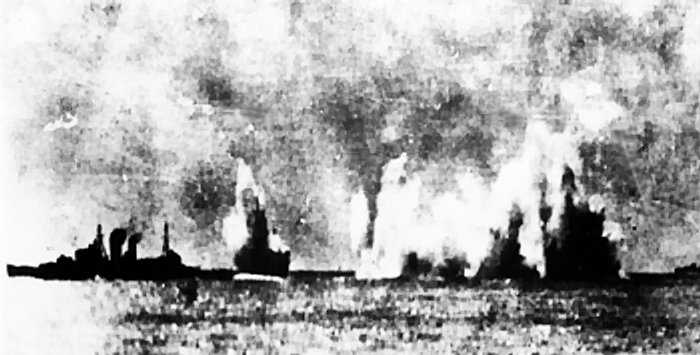
These ships were there as a result of Admiral Doorman's final order in the Battle of the Java Sea. They arrived in the morning of February 28th, and immediately tried to obtain oil and ammunition. The could get the first, although not without effort, but ammunition, that they so badly needed, was not available. At this time, the PerthHouston only 50 rounds. If they got into a fight, it was sure they wouldn't last long. They were battleready that night and left the harbor at about 1900 hours, and Captain Waller, the highest in rank, decided to sail directly to Sunda Strait, without making a curve around the invasion forces as Admiral Helfrich had ordered. This was the shortest way, but also the most dangerous. The Japanese had landed in the Bantam Bay on the north coast of Java, at Merak in Sunda Strait and at Eretan Ewan, east of Tandjong Priok. The two allied cruisers had to deal with the escorting squadron, which was devided into three groups: One was of the invasion force for Merak and consisted of the light cruiser Yura and four destroyers, the second was the invasion force at Bantam Bay and consisted of 1 cruiser and 11 destroyers and finally, the support group in the Java Sea, with the light carrier Ryujo, the heavy cruisers Mogami, Mikuma, Kumano and Suzuya. Mikuma and Mogami were cruising very close to the landingsite in Bantam Bay. There was also an invasion force at Eretan Ewan, but that one took no part in the final destruction of the Allied ships. The Perth and Houston, as said, sailed at top speed directly to Sunda Strait and encountered at about 22.30 the Japanese destroyer Fubuki, which guarded the Eastern approaches. She fired her 9 Long Lance torpedo's at about 3000 yards and retreated. The cruisers now saw the invasion force in the Bantam Bay and fired on the several dozen transports there. At that time, there were two destroyers in the bay and those immediately tried to make smoke screens to protect the transports. Nevertheless, the Allied cruisers scored hits on the transports, but no ship was sunk. At this time, stronger Japanese forces were closing in on the small squadron, but the only result was hits on Japanese warships and none on the Allied. This was soon to change. Japanese destroyers fired about 28 torpedoes, of which luckily none was a hit. The Perth and Houston replied which rapid gunfire and in the case of Perth, also torpedoes and managed to score several hits on the destroyers, but were themselves also slightly damaged by gunfire. But the heavy cruisers MogamiMikuma arrived at the battleground. Their 8 inch grenades surrounded the Perth and Houston and they also fired torpedoes. At about 23.20, the allied cruisers were out of ammo and now could only hope to reach safer waters by high speed. Japanese torpedoes were flying all over the battleground, and scored one hit on Perth, later followed by another two. This resulted in heavy loss of life, especially in engineering. Waller ordered to abandon ship, but the Perth received her fourth hit, which was too much for her. She sank and took half the crew with her. By this time, also the Houston had received several hits, including vital hits. A whole gun salvo hit the aft engine room where the high pressured steam killed almost everyone. The central fire control system was down along with one of the forward 8 inch-turrets. At about 00.20, the last operational turret was hit and Captain Rooks ordered to flood the forward magazines. Without the heavy batteries, she now fought a useless battle. But she still had her 5-inch guns and her machineguns and continued the fight. At about 00.30 three torpedoes hit the Houston on her starboard side. The water entered the ship from all sides and Rooks ordered to abandon ship. Captain Rooks died when he was hit by a part of a machinegun foundation. He died in the arms of his officers. Commander Roberts noticed that the Houston still had a lot of speed and decided to wait with abandoning the ship. The guns were still firing at this time, but the ship was lying dead in the water and the Japanese destroyers took the decks under fire with their machineguns. The Houston sank and took two thirds of it's crew with her. Only about 368 of a crew of over a 1000 were taken prisoner.
Gives me shivers to this day - thought I have read the account any number of times.

Besides going over the details again (you can do that some more at the links above), I would like this chance to personalize it. You need to see the very personal, one man's son's story from the HMS Exeter(you remember her). Click here to see it. Nicely done.

Friday, June 17, 2016

Fullbore Friday

A good life, well lived. Erik Hazelhoff RoelfzemaOutlaw Mike probably knows him - but for the rest of you think; in your early 20s, would you have met the standard?
Erik Hazelhoff Roelfzema, who won the Netherlands' highest military honor in World War II after leading 15 small-boat spying missions to the shores of his Nazi-occupied homeland in 1942, then flew 72 sorties in small plywood planes over Germany to point British bombers toward their targets, died Sept. 26 at his home in Ahualoa, Hawaii. He was 90.

The cause was heart failure, said his wife, Karin.

Acclaimed in the Netherlands as one of the nation's greatest World War II heroes, Mr. Hazelhoff Roelfzema gained international recognition after he wrote an autobiography, "Soldier of Orange" (Forum Boekerij, 1971; Hodder & Stoughton, 1972). The book offers gripping accounts of coastal landings on moonless nights near Nazi headquarters in the Netherlands, and then of dodging splays of tracers and anti-aircraft fire over Berlin. "Soldier of Orange," titled in deference to the Dutch royal dynasty, the House of Orange, has sold more than a million copies. In 1977, it was made into a movie by the director Paul Verhoeven, with Rutger Hauer portraying Mr. Hazelhoff Roelfzema as a 23-year-old.
"Tracers crisscrossed over our heads like monstrous party streamers," Mr. Hazelhoff Roelfzema wrote of the last of his 15 spy missions, on May 11, 1942, aboard a motorized dinghy that had been slipped over the side of a British gunboat, No. 320, near Noordwijk. "Machine guns and cannon chattered and barked."

The dinghy came under withering fire after delivering radio transmitters to Dutch resistance fighters who would use the devices to relay information about German installations and troop movements. Mr. Hazelhoff Roelfzema wrote of the gunboat: "Crewmen crouched on the foredeck and along the sides. Finally, they pulled us aboard without stopping, abandoning the dinghy. Then, rearing up under full power, the 320 roared out to sea."

Born April 3, 1917, in Indonesia, when it was under colonial rule as the Dutch East Indies, Mr. Hazelhoff Roelfzema was the son of a coffee plantation manager. The family later returned to the Netherlands.
Days after the Nazis invaded, Mr. Hazelhoff Roelfzema boarded a Swiss freighter bound for New York. When a British cruiser stopped the freighter, he persuaded the captain to take him to Britain. Once in London, Mr. Hazelhoff Roelfzema volunteered for the Dutch section of MI6, the British intelligence service, and was soon assigned to the dinghy missions to his homeland.

"He used to joke, 'Wait a minute, I just left,' " his wife said. Besides carrying transmitters to the resistance, Mr. Hazelhoff Roelfzema and his crew ferried spies to and from the Netherlands.

Despite the success of those missions, Mr. Hazelhoff Roelfzema ran afoul of Col. Mattheus de Bruyne, the newly appointed leader of the Dutch intelligence section, after he refused to provide information to another branch of the Dutch government in exile for fear it had been infiltrated by Nazi sympathizers. Court-martial proceedings were dismissed after the exiled Queen Wilhelmina recommended him for the Militaire Willemsorde.

The Militaire Willemsorde (the Military Order of William) was bestowed on Mr. Hazelhoff Roelfzema in the summer of 1942 by Queen Wilhelmina, who had fled to London and established the government in exile after the Germans occupied the Netherlands in May 1940.

Mr. Hazelhoff Roelfzema joined Britain's Royal Air Force. He learned to fly a De Havilland Mosquito, the twin-engine, spruce and balsa plane of the elite Pathfinder Force. The light, agile Mosquito was used for, among other things, firing flares at potential bombing targets. Mr. Hazelhoff Roelfzema's 72 flights into German airspace included 25 over Berlin.

Describing a night flight over Berlin, Mr. Hazelhoff Roelfzema wrote, "Hundreds of searchlights pierce the cloudless sky, rigid, motionless, like quills of the giant porcupine - Berlin." The RAF awarded him its Distinguished Flying Cross.

In April 1945, Mr. Hazelhoff Roelfzema was appointed aide-de-camp to Queen Wilhelmina and accompanied her as she returned from exile to the liberated Netherlands.

He moved to the United States in the early 1950s and became a citizen. He was a writer at NBC and for Radio Free Europe. Then, in 1971, he retired to Hawaii, where he was named to the board of Barnwell Industries, an oil and gas exploration company.

Besides his wife, Mr. Hazelhoff Roelfzema is survived by a son, Erik Jr., of Amsterdam; a daughter, Karna Hazelhoff-Castellon of San Francisco; a granddaughter; and a great-granddaughter.

Last July, in an interview with De Telegraaf, the Netherlands' largest daily newspaper, Mr. Hazelhoff Roelfzema said he had received too much recognition for his wartime exploits. "I became a war hero because I stuck out, because I wrote about my experiences," he said. "But behind every soldier decorated with military honors there are a hundred anonymous heroes, some of them greater."

This was first posted nine years ago. At the time, the movie had not made it to youtube yet. Most of it is there. Not a bad life if you can get Rutger Hauer to play you. Click here for most of the movie.

Wednesday, September 02, 2015

In Europe, Realty Sets In of the Europe That Is

The waves of migration will continue for years if nothing changes. Already numbering in the hundreds of thousands this year alone, more are coming.

There is a push and a pull. There is the push from the conflict in the Arab world that is just building on the pressures from nations whose economic growth cannot keep pace with their population growth.

Crowded Western Europe cannot take the develping world's surplus non-Western populations.

What was once just warnings from the fringe is becoming mainstream.

Hungary is building a fence. Austria, Denmark and others are calling for border controls. The old European hope as felt by Chancellor Merkel simply will not work.

Fences, controls ... those are just two ways to address the pull. Now, even The Netherlands is making a step just a decade or two would have been considered fringe;
The Netherlands is set to impose new rules that would see asylum seekers cut off from food and shelter after “a few weeks” if their application is rejected.

While Germany opened up its doors to make it easier for those arriving at its borders and France criticised Hungary over its new 110-mile razor wire fence, the Dutch government was going in a different direction.

From November, any migrant who refused refugee status or humanitarian protection will be given less than a month before they are deported or told to fend for themselves.

As part of the measures, the government wants to shut down 30 regional “bed, bath and bread” centres where asylum seekers can find shelter, regardless of the status of their application.
This is just a simple first step. More will follow.

Just yesterday, the President of the Czech Republic, Milos Zeman said.
“Of course I would wish for the EU to strengthen its borders, but I don’t see any real action,” Zeman told reporters in Prague castle on Monday. “Therefore I believe the Czech Republic should take of its borders alone and expel illegal immigrants from the borders, including with the use of the army.”

Friday, January 16, 2015

Fullbore Friday

I'm going to build off a theme from last week's FbF with el-Sisi - moral courage and forthright defense of natural law's first freedom from those who actually are putting their lives in danger by doing so.

The last week has seen a sickening parade of morale and physical cowardice in the defense of essential liberty. Afraid of what may happen if they stood with the French, politicians and much of the press instead hid behind "responsible speech" - which is their way of cowering in the face of threats against the very freedom they need to exist. That is the true Islamophobia - a twisted partonizing attitude that you cannot risk offending even in the slightest the tender feelings of a Muslim because, well, they just can't take it like everyone else and might become dangerous. A phobia of the followers of Islam: Islamophobia.

Heck, even last night I was reminded why I used think I was of the left. It used to be that there was a very libertarian streak on the left, but in the last 30 years they have been swamped by the Stalinists. One of the last of the traditional libertarian leftists I have found myself in rough alignment with is Bill Maher of all people.

Well, this week I am bringing in another man of the left who has it right. He gets extra points because he is Dutch. He speaks with the directness of a Dutchman, gets the enlightenment, and - more than most - he has stepped in to the field of fire to defend the flag.

The Salamander freedom fighter of the week is Ahmed Aboutaleb, member of the Labour Party, de Partij van de Arbeid (PvdA), and mayor of Rotterdam.

This is how you defend freedom as a political leader.


On a minor side-bar: I also had and continue to have a lot of "fun" with those of the left (or clueless) who have some kind of verbal tic that makes them want to want to call opposition to a radical religious sect a kind of "racism" and/or look at Arabs, Berbers, Turks, etc., as a "race" different than other whites/caucasians. As a result, if you have issues with them, it must be somehow based on "race."

More hogwash. Unless you want to take a pre-mid 20th century view of race more in line with the KKK and the Nazi party, no - they are not a race or races. I'll stick with the US govt directive if I must, they are white. Look at Mayor Aboutaleb again. Dude is as "white" as I am.

Of course, I know why they are throwing around race. Simply, that is the cultural bully's tool to shut people up. Well, to those people I say, "rot op."