Showing posts with label Economics. Show all posts

Wednesday, January 18, 2023

A Post-Davos World? Sign me up.


The whole World Economic Forum/Davos experience is one part Bond villain parody, one part clout seeking billionaires, one part megalomania, a heaping cup of greed, and a dash of rent seeking. 

In 2023 things have reached the point where any association with Davos should put an individual or organization under notice of suspicion. Amazing to see people who claim to be American conservatives or lovers of liberty attending in an non-ironic, non-protesting capacity.

This wannabee gaggle of quasi-oligarchs and autocrat throne sniffers represents everything that is wrong with the human desire for control, power, and to crush the individual for fun and profit.

They pretend to be the world government in waiting that no one asked for, no one wants, and trust me on this - no one wants to live under. Being unaccountable to the people is their ideal state.

If you don't know what I am referring to above, shame on you. Google it yourself, but I couldn't help but giggle when I read the title from this article by Gideon Rachman at The Financial TimesGeopolitics threatens to destroy the world Davos made.

Really? It is? Then by all means let's have MOAR!

...the 2023 WEF — the first to take place in its regular winter location since the pandemic began — could be seen as signalling a return to normalcy. However, China’s sudden abandonment of its zero-Covid policy has raised fears that a new wave of variants could emerge.

And, even if a fresh pandemic phase is avoided, Covid has left its mark on the way governments and businesses think about globalisation. The assumption that goods and commodities can always be shipped easily around the world has been shattered.

Except for the mentally fragile few and those who leverage power through them, the world is over COVID like it is over the flu. The last three years has been a clarifying event bringing in to stark relief those autocracy worshipers and hypocrites who hold individual rights in contempt. It also helped us see the existential danger a free people can face when they put themselves at the mercy of governments who see a crisis opening a door for an easy grasp at additional powers they will never want to give back.

The past the Davos set desired failed the future that is our present, but that doesn't give pause to any of them. The Davos view of the future where everyone (except for those at the top) lives in a pod, eats bugs, owns nothing but is "happy" is at best dystopian, at worst justifies at some point if they are not stopped, open global revolt against the ruling class with all the violence and blood that comes with it.

As an American, I have no problem saying that. America is a revolutionary nation that twice in its history drenched its soil with blood to ensure the rights of the individual over government and an unaccountable ruling class lording over those they considered lesser humans.

We are not at that point in most nations ... but when you see it happen like we saw in Sri Lanka ... understand where it is coming from.
Often prompted by governments, businesses are having to change their ways. It is not wise to rely on complex supply chains vulnerable to disease, war or other emergencies. Companies such as Apple — which boasted of products “designed in California, assembled in China” — are having to diversify production. Apple increasingly also produces in India and Vietnam.

Notice to complete focus on mercantilist concerns here? No mention or recognition, intentionally, of the maligned influence and moral repugnance of the People's Republic of China?  

Efforts by some western companies to lessen their dependence on China were prompted by the pandemic, but they have since accelerated because of a heightened awareness of geopolitical risk — otherwise known as war.

These are not dumb people. If it took them until the last couple of years to be concerned about war with the PRC ... are they fools or were they just trying to drain as much money out of offshoring to the PRC using slave labor until it was no longer easy to do? I vote the later. Either way, they are not using their intelligence for good. 

So, yes - bring us to a post-Davos world ... and let anyone who attended WEF before 2019 be giggled at ... and anyone who attends after 2023 - we'll give well meaning people a year to catch up because we're nice like that - on be an anathema to a free people.

Nuclear war is the most frightening potential development — and one that has concerned the White House since the outbreak of fighting last February. Even if the use of nuclear weapons is avoided, the danger of widening conflict remains as Nato sends advanced weaponry to Ukraine and Iran supplies Russia with military drones

The chance of nuclear war is less now than it was for the first 30 years of my life. The pearl clutching and paper bag huffing about this just encourages the use of nuclear blackmail. I'm sorry - but if you are "frightened" right now, then find another line of work besides national security. This profession requires rational thought, not emotional posturing.

Additionally, if we could keep the externalized masochism to a minimum it would be appreciated. The conflict is not expanding because we are helping a nation to defend itself from an imperial war of aggression. When the first Russian tanks crossed the Ukrainian border (again) that is your widened conflict. All else is the inalienable right to self defense.
Politicians and industrialists are scanning the horizon for the next big geopolitical threat. Many have focused on Taiwan, which produces 90 per cent of the world’s most advanced semiconductors. A Chinese invasion of Taiwan might shut down TSMC, the most important semiconductor producer, with devastating results for the world economy.

Even geopolitical tensions that stop well short of war have disrupted international commerce. The increasingly wary US attitude to China has led the Biden administration to sharply restrict exports of sensitive technology there. This affects not just US companies, but also foreign technology giants, such as South Korea’s Samsung, that use US tech.
Again...the Davos mindset. 180 degree lockoff. Taiwan and its semiconductors are not the threat, the PRC is. Note that it isn't the maligned presence of the PRC that is the problem, it is the US response to it.

Of course, in line with the mindset above, it isn't the WEF that is the problem, but ..
Political leaders, particularly in the west, must worry, too, about domestic pressure from populists. Many of the latter have made the WEF a symbol of inequality and rootless international capitalism.
Can anyone tell me where WEF is a supporter of equality and working towards domestic national resilience vice quarterly balance sheets, sketchy bank accounts on small Caribbean islands, or unaccountable power grabs?
In recent years, Davos has attracted the ire of anti-vaxxers, climate change sceptics, religious zealots and hardline nationalists. The forum features in a range of conspiracy theories. On the wilder internet fringes, the WEF has been accused of using the pandemic to seize control of the world economy.
Oh, nice ... no legitimate concerns, just swivel eyed loons. Don't dare oppose anything going on at Davos, your betters may just call you a name or throw you in the bin with the icky people.
Such theories aside, the idea that Davos is faintly toxic has gained ground. President Joe Biden, determined to present himself as fighting for ordinary working Americans, is unlikely to risk an appearance at Davos — unlike Donald Trump, who enjoyed rubbing shoulders with the assembled CEOs.

Even centrist and conservative leaders in Europe may be cautious about coming.

Good. They should be. Also, will someone put the American (R) there on notice that we see them?

President Emmanuel Macron of France, a defender of globalisation who has spoken at Davos in the past, has a sensitive domestic pension reform to push through, so may decide that now is not the right time to attend the WEF. As a new British prime minister, and one with a finance background, Rishi Sunak would normally be expected to seize the opportunity to woo the world’s most powerful chief executives. But the UK faces a wave of strikes, so he too will probably decide that it would be wise to miss Davos this year.

Simply unacceptable in democratic nations that the will of the people might promote change in political leadership. Next thing you know, they might want even more free speech and redress of grievances. 
Those world leaders who are present might do well to take the funicular up to the Schatzalp Hotel, which served as Mann’s model for the sanatorium in The Magic Mountain. The hotel’s view is the best in Davos — it may offer a chance for quiet reflection on how to prevent war and natural disaster from once again engulfing the global economy
Unspoofable.

Perhaps they should reflect on how they encouraged Russian aggression and European vulnerability to hydrocarbon blackmail? Should they take a moment to see how they look the other way as the PRC engages in wholesale oppression of their Muslim minority? Are they proud of their dividends derived from almost unimaginable levels of air and water pollution flowing out of PRC's slave labor run factories? 

Unlikely - they might miss out on the next party.

A post-Davos world? 

How do we bring it here faster? 

h/t Alessio.

Monday, November 28, 2022

The EU's Real Enemy - the United States?

If you are an American who lived on the European Continent, specifically Western Europe, you’re very familiar with an exceptionally sharp strain of anti-Americanism that resides in a significant percentage of their ruling elite – an adult version of the middle school mean girls. Though present in all nations to one degree to another, it is especially acute in Germany and France for slightly different reasons but are all working towards the same goal; degrade American influence in Europe.

The best way for this political and corporate anti-Americanism to find a lever of power is through the the trans-national and anti-democratic modern iteration of the European Union – made even more problematic with the departure of Great Britain who once played a balancing role between the Continental powers as she has for centuries.

Why primarily France and Germany? To start with, this is part of the sibling rivalry between the children of Charlemagne for primacy in Europe that has churned Europe over the last thousand years. The Anglo-Saxons on both sides of the Atlantic kept getting in the way of their return to the struggle.

Their armies under various blood-soaked leaders moved across Iberia to Moscow and back for centuries in order to be THE driver of power and influence on the continent. The European Union, once the “trade association” nose was in the tent, is now seen – fairly – as a mechanism to centralize power so The Smartest People in the Room™ no longer have pesky minor powers and – Buddha forgive – voters getting in their way. Without checks, power only seeks more power for itself. The morphing of the EU is just the latest example.

Not unlike their American counterparts who would like the USA to extract itself from foreign entanglements (NB: as I have written through the years, I am sympathetic/supportive of these efforts), many of the strongest proponents of the EU just want the USA to go home.

The Europeans, while benefiting from the WWII/Cold War leftover presence of the USA, want it to end and the influence that comes with it. If any opportunity to push back against the USA appears, they have their talking points ready to dirty up the reputation and standing of the USA. If that can be done while blaming Eurocrat failures on the USA as well, even better.

You know the Americans, citizens of that mongrel nation whose gene pool is full of religious zealots, failed revolutionaries, slaves, economic refugees, grasping second sons, criminals, and their descendants – spoiled with a continent overflowing with food, water, minerals, forests and open land they don’t even appreciate.

Loud. Fat. Pushy. Americans.

The usual snarled insults cobbled together by smug people who get much of their opinions of the USA by reading The Washington Post or The New York Times. “I know America, I read your newspapers.” That is right after, “I’ve been to America. I spent a week in DC/NYC/Boston/Chicago. I studied a semester at Brown.”

If you are used to countering America’s resident self-loathing Left, these are easy to deal with, and even entertaining. 

Don’t laugh too much though. Their externalized insecurity is a mortal danger to Western unity by constantly working to divide the West and undermine its cultural, economic, and military strength. When those snotty 20/30-somethings get in their 40s, 50s, and 60s in the Eurocracy, they start to get access to the levers of power and influence. That is when they can make trouble.

For my generation, we used to sneer and poke fun at the useful idiots of the 1980s anti-nuke/anti-war protest movements in Europe – clearly useful idiots for the Soviet Union – but we’re not laughing too much now, one of those fools is the Chancellor of Germany.

Knowing these people is as important as tracking what they say and do. With the East ablaze or rising to challenge the West, this is what the Eurocrats want to train their ire at – to the west across the Atlantic.

There is a lot to unpack in this ... whatever you would call it in Politico - but let's dive in;

Nine months after invading Ukraine, Vladimir Putin is beginning to fracture the West. 

Top European officials are furious with Joe Biden’s administration and now accuse the Americans of making a fortune from the war, while EU countries suffer. 

Funny opening, and telling. No, Putin is encouraging useful idiots in the West to do the fracturing for him.

As for the second part of the pull quote...just let that soak in. As if EU nations have nothing to benefit from keeping the Russians east of the Dnepr, and not threatening the Vistula. 

“We are really at a historic juncture,” the senior EU official said, arguing that the double hit of trade disruption from U.S. subsidies and high energy prices risks turning public opinion against both the war effort and the transatlantic alliance. “America needs to realize that public opinion is shifting in many EU countries.”

Almost comically lacking in self-awareness. Which nation tried to warn, pre-war, against reliance on Russian energy? What was the European reaction?

Another top official, the EU’s chief diplomat Josep Borrell, called on Washington to respond to European concerns. “Americans — our friends — take decisions which have an economic impact on us,” he said in an interview with POLITICO.

Why yes; the decision by the USA for over half a century to subsidize European defense with American taxpayer largess sure did have an impact on Europeans. It gave them the opportunity to spend not just on unsustainable welfare states, but in virtue signaling and corrupt green energy policies built on Russian gas, Chinese solar panels, and clear cut American forests

The U.S. rejected Europe's complaints. “The rise in gas prices in Europe is caused by Putin’s invasion of Ukraine and Putin's energy war against Europe, period," a spokesperson for Biden's National Security Council said. Exports of liquefied natural gas from the U.S. to Europe "increased dramatically and enabled Europe to diversify away from Russia," the NSC spokesperson said.

This is, of course, correct.

An American official stressed the price setting for European buyers of gas reflects private market decisions and is not the result of any U.S. government policy or action. "U.S. companies have been transparent and reliable suppliers of natural gas to Europe," the official said. Exporting capacity has also been limited by an accident in June that forced a key facility to shut down.

In most cases, the official added, the difference between the export and import prices doesn't go to U.S. LNG exporters, but to companies reselling the gas within the EU. The largest European holder of long-term U.S. gas contracts is France's TotalEnergies for example. 

I am shocked ... SHOCKED ... that the French would try to profit while shifting blame to the Anglo-Saxons. Next thing you know, the French might actually facilitate the migration of uninvited military aged males by the hundreds of thousands across the English channel to the Anglo-Saxon homeland. You never know ...

It’s not a new argument from the American side but it doesn’t seem to be convincing the Europeans. "The United States sells us its gas with a multiplier effect of four when it crosses the Atlantic," European Commissioner for the Internal Market Thierry Breton said on French TV on Wednesday. "Of course the Americans are our allies ... but when something goes wrong it is necessary also between allies to say it."

Amazing. Just read it again. It is almost high art.

Despite the energy disagreements, it wasn't until Washington announced a $369 billion industrial subsidy scheme to support green industries under the Inflation Reduction Act that Brussels went into full-blown panic mode.

“The Inflation Reduction Act has changed everything," one EU diplomat said. "Is Washington still our ally or not?”

Not content with meddling in the laws of their member states, the EU now wants to control the American legislative process? Hey, I didn't like the stupidly named Inflation Reduction Act either, but these are the people the Europeans like running America, so take it up at the next World Economic Forum discussion roundtable on ESG. 

...the EU sees that differently. An official from France’s foreign affairs ministry said the diagnosis is clear: These are "discriminatory subsidies that will distort competition.” French Economy Minister Bruno Le Maire this week even accused the U.S. of going down China's path of economic isolationism, urging Brussels to replicate such an approach. “Europe must not be the last of the Mohicans,” he said.

I'm not even sure what that means.


The EU is preparing its responses, such as a big subsidy push to prevent European industry from being wiped out by American rivals. "We are experiencing a creeping crisis of trust on trade issues in this relationship," said German MEP Reinhard Bütikofer. 

"At some point, you have to assert yourself," said French MEP Marie-Pierre Vedrenne. "We are in a world of power struggles. When you arm-wrestle, if you are not muscular, if you are not prepared both physically and mentally, you lose.”

If the Europeans had that much of an attitude towards Russia, there probably wouldn't be a war in Ukraine right now.

Behind the scenes, there is also growing irritation about the money flowing into the American defense sector.

Well, this is were I stop laughing and my blood goes cold.

The U.S. has by far been the largest provider of military aid to Ukraine, supplying more than $15.2 billion in weapons and equipment since the start of the war. The EU has so far provided about €8 billion of military equipment to Ukraine, according to Borrell.

According to one senior official from a European capital, restocking of some sophisticated weapons may take “years” because of problems in the supply chain and the production of chips. This has fueled fears that the U.S. defense industry can profit even more from the war. 

For decades, USA based voices have pleaded with Europe to spend more on defense, to take the threats to our collective civilizations seriously, to maintain their sovereign defense industries, but from the loss of Dutch submarine building capability to the disappearance of the once spunky Belgian military - here we are in 2022. 

The diplomat argued that a discount on gas prices could help us to "keep united our public opinions” and to negotiate with third countries on gas supplies. “It’s not good, in terms of optics, to give the impression that your best ally is actually making huge profits out of your troubles,” the diplomat said.

No one benefits from this except for the enemies of the West from Russia to China. These are the same useful idiots from the 1980s are with us today ... just with more power.


Perhaps we expect too much from France, Germany, and their auxiliaries. There are equally strong friends of the USA in these countries that we should do more to encourage and raise their profile. While doing that, there are other emerging power centers in Europe who could use more support from the USA and may actually appreciate it.

The smaller European nations don’t trust France and Germany all that much, for good historical reasons. Most of the Europeans in the “new territories” in the east like the USA. They see the Americans as a more reliable guarantee of safety from hostile powers in the East, having a few centuries of experience of the Western European Frankish tribes carving them up for fun and profit – irrespective of local desires. Collectively these nations are not that large in GDP or population - not much more than Italy (for now), but that’s OK. They have the correct geography.

If we shape this relationship correctly, we don’t have to permanently garrison this part of Europe. Poland is already establishing a new paradigm of proper levels of security investment. Once NATO’s eastern front calms down a bit, we can rotate through forces for exercises and training. Perhaps even create some combined training and logistics bases ready to scale up in case of trouble in Mordor. A template we should have put in place in Western Europe decades ago.

Reward positive behavior and let the French and Germans continue their millennium-length struggle – peaceful this time – in the west; keep them frothing in Brussels and Strasbourg while the forward-looking nations try to set up the next thousand years of Western progress in a positive direction.

Perhaps.

Monday, June 20, 2022

Bother Not the Oil and Wine - Bother First the Defense


As a mercantile republic - that is our natural state, don't forget that - our ultimate power is not our military. It is the byproduct of our system of government and the values we like to believe our nation was founded on. It is something that for too long was taken for granted.

Yes, there is much ruin in a nation, and the substance of that ruin is the hard work of generations that came before. Work to build a stable society, a vibrant economy where people who work hard are rewarded with the fruits of their labor. As secure society where people can plan their lives and that of their children in the knowledge that threats both foreign and domestic will be kept at bay.

Almost alone, no belay my last, unique to this planet, the United States of America was first blessed with its founding documents and the character of its founding fathers. They set the foundation for a great nation to be built on. We were second blessed with a fertile land, deep forests, water, minerals, and ultimately a large population of people who respected the first so they could best leverage the rest for their and their nation's benefit.

Our nation's blessings were then shared with the world by the example of its civil society, the inventions of its people and institutions, and then from Europe to East Asia - a security that allowed those societies to - in fits and starts as our nation had - prosper in similar ways.

As it is with all human institutions, the USA is imperfect. She has weaknesses. We have lasted so long because our founding fathers knew this and did their best to check ambition with ambition, power with power, interest with interest to stop humans from doing what they have a tendency to do from the Bronze Age collapse on - destroy themselves.

The problem came when petty, grasping, narrow minded people thought they were smarter, better people than the founders.

Though you can trace the drift to the Progressive Era two generations prior, the real decay came from when the WWII generation took power - their heads full of the arrogance of their victory. They then begat the largest generation who brought about the turmoil from 1965-80. Two generations who dominated our politics from 1960 on whose well meaning arrogance on one hand and entitled selfishness on the other consumed generations of hard work. Together, they begat the future we have.

And I heard a great voice out of the temple saying to the seven angels, Go your ways, and pour out the vials of the wrath of God upon the earth. - Revelation 16:1

Regulars here know The Terrible 20s that we warned of a dozen years ago. Recall, the warning was not so much geopolitical, but economic - specifically the budget.

Kevin Williamson outlines what is to come;

As it stands, interest on the debt already accounts for almost $1 out of every $10 the government spends. If interest rates go up sharply, so will federal debt-service payments. Under current conditions, the Government Accountability Office already estimates that interest payments will account for 15 percent of all federal spending by 2035 and 27 percent by 2050 — and those numbers could be much higher if there are big increases in interest rates, which is a real possibility. But I should emphasize here that the GAO already forecasts that interest payments will grow to 27 percent of federal spending in just a few years — which would mean that we’d be spending more on interest payments than we spend on Social Security, which currently accounts for a larger share of federal spending than any other program. Put another way, the thing we will be spending the most on in the future is previous spending.

It does not matter how big China gets. It does not matter how much those who understand the challenge west of Wake complain that we need to spend more. "More" simply will not be there. Heck, forget "will" - it isn't. 

An intellectually and economically isolated DC has to find a way to break the habits and institutions who brought us here and are invested in keeping things as they have been. The well is dry. The reserves of generations are depleted. The future is here. All is not lost, but it will take people of good will to move from passivity to action.

Do not ignore it. Do not despair. Think. Plan. We can do a lot with what we have - but do not plan for more. We have to get that right, because if we don't, that security we rely on will not be there. We will be at strategic risk to a degree not seen since the end of our civil war.

If you love our country and its promise, then be prepared to defend its stability. All else rides on economic prosperity. If not defended properly - specifically debt -  well, a brief review of history tells you what is in store.

Work harder. Make friends with those who understand. Accept that you will make enemies with those who don't. Build up the former, try to convert the later. What is coming will be no place for the squishy.

Tuesday, June 14, 2022

There Must be Consequences for European Security Freeriding

For a decade and a half here we have yelled, begged, pleaded for Continental European NATO - especially Germany - to rise to the challenge of the 21st Century and pull their fair share of the load to keep peace in Europe.

I have warned even longer IRL until it has become tiresome that they do not realize that the American public is just one election away from shrugging being Europe's security blanket. Everything regresses to the mean, and at our heart we are a mercantile republic, not an empire. WWII and the Cold War warped the nature of our relationship with Europe, and the force of regressing back to our natural state will bring us back across the Atlantic and looking to our West for the future unless the Europeans take concrete steps to encourage us not to.

Many in Europe, especially their natsec "elite" who think they know they USA because the read WaPo, NYT, and The Economist - have visited DC and lived a semester in Boston, etc, delude themselves to think Trump was an outlier. He was a warning, not a temporary PITA.

Few things will wear an American's patience thinner than a repeated refusal by someone to do their fair share of the work; to pay their fair share of the cost; to bear their fair share of the burden.

Especially when our efforts benefit others who refuse to make an honest effort themselves - our charity only lasts so long.

No other nation has benefited more from being under the American security umbrella for so long than Germany, and yes, I will focus on her. I focus on her because not only has she benefited the most, she is the strongest nation economically in Continental NATO (sorry France), and has the largest population. Culturally as well, she is highly influential to the other medium and small NATO powers in a way others are not. 

I am a great fan of Germany, her people, and her culture ... and that is why I expect more from her - to be the nation the West needs her to be in the 3rd decade of the 21st Century. Others will follow her lead either out of admiration, duty, or fear. I don't care - I want a stronger European NATO. It is the only way to keep the Americans in and the Russians out - with apologies to our friend Lord Ismay .

I am not sure if the Germans have thoroughly fooled themselves, or they take everyone else for a fool. Today, the German Embassy sent out a fact sheet dated 10 June that put out in part;

Germany is the third largest arms supplier for Ukraine

- Germany is at the forefront of providing Western military equipment to Ukraine, including advanced and heavy weapons. This includes the most modern anti-artillery radar and one of the most advanced air defense systems. Heavy weapons also include seven “Panzerhaubitze 2000” Howitzers, and 30 “Gepard” air defense tanks. We will also deliver armored multi-rocket launchers. From the beginning of the conflict Germany has provided e.g. thousands of anti-tank missiles, Stinger anti-aircraft missiles, Strela antiaircraft missiles, tens of millions of ammunition, bunker busters, machine guns, anti-tank mines, six-figure amounts of hand grenades and explosive charges as well as more than 170 armored vehicles.

- Germany is facilitating weapon transfers from NATO-partners to Ukraine by supplying partners with advanced weaponry in exchange (“backfilling”) and is greenlighting the supply of weapons that originate from German production or GDR stocks.

- Germany contributed USD 535 million through the European Peace Facility (EPF) that mobilized a total of USD 2.14 billion to support EU member states’ supplies of military equipment to the Ukrainian Armed Forces. 

Germany is one of Ukraine’s most important financial supporters

- Within 100 days since the start of Russia’s war of aggression, Germany has bilaterally committed over USD 4 billion to support Ukraine.

- Every fourth Euro in the EU support to Ukraine amounting to USD 4.5 billion so far comes from Germany, over one billion USD in total.

- Germany has also been providing support via the UN. For example, Germany was the largest donor to the UN Central Emergency Response Fund in 2021 and has already provided substantial support in 2022, of which funds are being provided to Ukraine.

- Germany provides political, financial and personnel support to reach accountability for crimes committed in Ukraine. Germany supports the ICC investigation into war crimes during the Russian invasion into Ukraine with over USD 1.1 million.

- Germany also supported Ukraine substantially before Russia´s war of aggression. From 2014 to January 2022 Germany supported Ukraine with over USD 3 billion in direct financial support, including humanitarian assistance and development cooperation. In addition, USD 3.8 billion was provided through the EU. For years, Germany has provided more in humanitarian aid to Ukraine than any other EU state.

Germany is hosting high numbers of Ukrainian refugees

- Every refugee from Ukraine is welcome in Germany. So far, more than 800.000 refugees from Ukraine have been registered in Germany.

OK, let's rack-and-stack this.

I'd like to point you to an information packed article over at FT, with two graphs based on metrics from our friends at the exceptional Kiel Institute;


NB: the EU is not a country ... but if it were it would have both a population greater than the USA (448 million vs 330 million) and GDP 86% of the USA's ($17.9 trillion vs $20.9 trillion). I'll ignore that stupidity on the graph and instead stick to the constituent nations on the graph.

GBR, POL, DEU, FRA, CAN, ITA, and NOR combined have 64.8% of the GDP of the USA ((2.71+.59+3.8+1.64+1.89+.36)=13.6 vs 20.9). If they spent the same to secure their borders as we did, that would be $27.2 billion vs $43 billion. Doing a little estimating based on the above graph, those nations actually spent $14.9 billion. That is 35.4%, not 64.8%.

Again, our allies are freeriding.

Oh, but you say, what about that refugee burden Germany wants you to have the feels about as much as they do? Funny you should mention that; FT has the graph for you.


Hell, even France is doing more than Germany by these metrics. Germany needs to stop lying to itself and its friends. As mentioned before, I am a great friend to Germany - but I will not lie to her when it is my nation's blood and treasure they are riding on - expecting to defend the West to the last Ukrainian, Europe to the last Pole, and Germany to the last American.

Germany is not a child. She should not be patronized. She is one of the most advanced, educated, rich, and financially stable nations on this planet. This is their backyard. They need to step up - other nations will follow...like they are right now in her sloth.

Keep this up and they should not be shocked when the next election across the Atlantic combines with the economic trials many of us see coming and brings the NATO alliance to a place they won't know what to do.

Pull your weight. Support the Ukrainians. Support the smaller Central European nations. You have to lead as you refuse to effectively follow and are too big to get out of the way.

There is a lot of work to do.

Help make the 21st Century be what it can be, or you may find the Americans letting you suffer to the east again as you did in the 20th Century as America focuses on the new center of power - Asia.


Monday, April 04, 2022

Russia's Last Gasp War?

It's been a couple of years since we visited Peter Zeihan, and two weeks ago he posted a video that just pulls it all together to make a solid point about the pivot point the Russo-Ukrainian war is ... at least for the Russians.

The Ukrainian economic and demographic numbers are a nightmare on their own, but let's put that struggling people to the side for a moment and look at the Russians. 

As interesting and informative are the tactical level efforts and changing "supply convoy" of the day pictures, the real interesting and informative to ponder are the larger movements in play; economics, geography, and demographics. 

The real frightening part is at the end as it covers a topic we discussed in part on yesterday's Midrats; fertilizer.

The full video below is worth your time, but I want you to focus on the second half. It is only around six minutes.

I would just like to make one little note; I put a "?" in the title as I do not fully buy in to the quasi-presentism of "Russia will disappear."

Russia has a history that goes back in to the mists of time. She has come back from the Mongol invasions of the Middle Ages and the depredations of the first half of the 20th Century on to be stronger.

While it takes a generation or two to recover from the demographic hole she is in, it can be done. It requires a national "great awakening" that may never come for Russia - but I am not of a mind to count the Russians out. I don't think the future would be that easy, or boring.

Sunday, April 03, 2022

War, Pestilence, and Famine - the World's Logistics Falters - with Ross Kennedy on Midrats


If it's April, it's time for a return visit by Ross Kennedy to Midrats!

A little under a year ago, we had Ross on to discuss the impact of COVID and related structural issues to the global supply chain. A year later, we find conditions have not just remained, but with war in Ukraine and a new COVID variant working its way through coastal China, in many ways the global trade in essential items has turned for the worst.

If you are worried about the cost and availability of fuel, food, and everyday items you've spent the last decade assuming were always going to be there at a price you're happy with, then you need to join us from 2-3pm Eastern this Sunday.

Ross is a U.S.-based logistics and supply chain expert with more than fifteen years in international transportation, procurement, and analysis. His unique blend of operations, sales, and strategic planning allows him to provide creative, agile solutions for his public- and private-sector clientele.

Join us live if you can
, but it not, you can get the show later by subscribing to the podcast. If you use iTunes, you can add Midrats to your podcast list simply by clicking the iTunes button at the main showpage - or you can just click 
here. You can find us on almost all your most popular podcast aggregators as well.

Monday, February 28, 2022

You want a Cyber World War? This is How You Get One


Events in the Second Russo-Ukrainian War (or whatever it is being called, this is what I call it with the 1st being in 2014), are moving fast. It seems anything you write will be OBE in a few hours, but write one must.

Case in point; going in to the weekend Germany was stuck in, "We are pausing NS2..." and we find our way to Monday where she is giving the nod for artillery, fighter jets, anti-aircraft, and anti-armor weapons to Ukraine as fast as they can get there and announcing an unprecedented increase in defense spending.

So, today let's focus on something that isn't quite as sexy as air superiority or logistics convoys, but may be the most important news of the day; financial sanctions. 

Let's go back to Chris Morris at the BBC five days ago;

Notably only about 16% of Russia's foreign exchange is now actually held in dollars, down from 40% five years ago. About 13% is now held in Chinese renminbi.

All of this is designed to protect Russia as much as possible from American-led sanctions.

Over time it has reduced its reliance on foreign loans and investments, and has been actively seeking new trade opportunities away from Western markets.

China is a big part of that strategy.

The government in Moscow has also taken initial steps to create its own system of international payments, in case it gets cut off from Swift - a global financial messaging service which is overseen by the major Western central banks.

And it has been cutting the size of its budget - prioritising stability over growth.

That has meant the Russian economy has grown at an average of less than 1% a year over the past decade. But it may have become more self-reliant in the process.

...

There's no question that sanctions can have an impact, but a package as broad as this has never been imposed on an economy as large as Russia.

And to make it effective, the West would have to be in it for the long haul.

This was all theory last week, now we come to a very different reality this last day of February...and Russia gets a vote. We can't assume she won't react. 

Also from the BBC, as of this AM US Eastern time;

Western nations are imposing increasingly severe sanctions on Russia following its invasion of Ukraine.

The measures are designed to cripple Russia's economy and punish its government for taking military action.

As you read the above and what is to follow, there is a word as old as war that should come to mind; blockade.

There are benchmarks about how nations can interpret blockades, and this is but one example in living memory;

A casus belli played a prominent role during the Six-Day War of 1967. The Israeli government had a short list of casūs bellorum, acts that it would consider provocations justifying armed retaliation. The most important was a blockade of the Straits of Tiran leading into Eilat, Israel's only port to the Red Sea, through which Israel received much of its oil. After several border incidents between Israel and Egypt's allies Syria and Jordan, Egypt expelled UNEF peacekeepers from the Sinai Peninsula, established a military presence at Sharm el-Sheikh, and announced a blockade of the straits, prompting Israel to cite its casus belli in opening hostilities against Egypt.

We can't forget this from the edge of living memory either;

In 1939 the United States terminated the 1911 commercial treaty with Japan. “On July 2, 1940, Roosevelt signed the Export Control Act, authorizing the President to license or prohibit the export of essential defense materials.” Under this authority, “[o]n July 31, exports of aviation motor fuels and lubricants and No. 1 heavy melting iron and steel scrap were restricted.” Next, in a move aimed at Japan, Roosevelt slapped an embargo, effective October 16, “on all exports of scrap iron and steel to destinations other than Britain and the nations of the Western Hemisphere.” Finally, on July 26, 1941, Roosevelt “froze Japanese assets in the United States, thus bringing commercial relations between the nations to an effective end. One week later Roosevelt embargoed the export of such grades of oil as still were in commercial flow to Japan.” The British and the Dutch followed suit, embargoing exports to Japan from their colonies in southeast Asia.

In today's global financial system that unlike the last world war where nations held physical assets like gold that could be loaded on cruisers as payment, much of nations' "wealth" is stuck in the cyber-world's 1s and 0s.

They are among the toughest measures nations can use, short of going to war.

As we go down this route - even with the Swiss of all people - we need to be clear-headed about how this can be seen by the Russians.

The action is aimed at cutting Russia off from the international financial system and to "harm their ability to operate globally".
A ban from Swift will delay the payments Russia gets for exports of oil and gas.

Cutting off a nation from its access to funds not just to fight but to feed, house, and employ its people - if we now consider "cyber" to be a domain like land, sea, and air - is keeping a nation from accessing resources in the cyber domain - AKA a blockade - any different than a ground, sea, or air blockade with the same goal?

Western leaders have agreed to freeze the assets of Russia's central bank, to limit its ability to access its $630bn international dollar reserves.

...

Targeting a central bank of a G20 nation is unprecedented and designed to "push the whole of Russia in to as deep a recession as possible, with the added chaos of bank runs", says BBC economics editor Faisal Islam.

...

The UK, EU, US and other countries have announced curbs on products that can be sent to Russia. These include dual-use goods, which are items that could have both a civilian and military use, like high-tech items, chemicals or lasers.

Are Russian "elite" motivated by the same things Western "elites" are? That seems to be the bet;

The EU, UK, US and Canada have launched a transatlantic task force to identify and freeze the assets of sanctioned individuals and companies, targeting more "officials and elites close to the Russian government, as well as their families".

Maybe...but maybe not. Either way, we have to expect some blowback - directly or indirectly;

Russia supplies 26% of the EU's crude oil and 38% of its gas. Even a brief cut in gas supply would raise energy prices.

...

Russia's foreign ministry has threatened sanctions of its own against the West. This may include reducing or shutting off gas supplies to Europe.

...

Hitting the Russian banking sector is likely to damage firms which do business in Russia, or have assets in its banks, and the export ban on high-tech goods will hit many Western manufacturers.

There is an important thread from Georgetown political scientist Professor Abraham Newman that you need to read in full on the topic. Here are a few consolidated pull quotes from his thread;

In a world of interdependent fiat currencies central banks have to live in a world where they depend on foreign buys and holders of their money. What does this mean and how does it relate to the sanctions regime? As the @FT explains, much of the reserves are held in securities i.e. assets that need to be sold to be used. To do that, Russian central bank needs intermediaries to conduct the transactions. Most international banks are now a no go so hard to sell. But the other problem is that the Russian Central Bank doesnt actually sit on the money it has. The money is in accounts in other central banks/international bodies. Russia has to access these ledgers to use its funds. Western sanctions black this. Aside from their gold reserves, the Russian self-insurance strategy is comprised of made up stuff which lives in a financial imaginary. Their ability to use and access is interdependent on the West. Russia, then, is confronting the reality of what @henryfarrell and I have termed Weaponized Interdependence. And the consequences for the Russian economy are going to be quite severe.

As I've stated before, I cannot think like a Russian - much less Putin - so I won't even try, but I can look at their capabilities, history, and what they could do.

Let me put on my red hat.

If I were RUS COMCYBERCOM, I would have three Courses of Action of increasing severity ready to present President Putin today to take down the entire Western financial system. It would be along the historically established, "If I can't use this, then I am damn sure going to guarantee that no one else can either."  You want a cyber world war? That is how you get one. Shut down the global online financial system. What do the Russians have to lose?

I hoped some smart people have wargamed this out. Again, if we are blockading, with the EU & Switzerland, Russian access to her money that they need to not just fight, but to feed and employ the people of Russia, is it beyond reason to consider that a belligerent act - especially when we are arming and giving aid to the Ukrainians?  We have invaded other nations for less.

Things are moving fast - and Putin has no off ramp outside complete victory.

Good luck everyone.

Wednesday, January 05, 2022

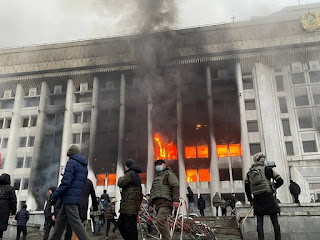
Understanding Kazakhstan: People Have to Eat. Winter is Cold. You need to Work.


If you recall, the "Arab Spring" started with increases in food prices going in to winter.

The Kazakh government seems to have collapses due to civil disorder resulting from increasing LPG prices gong in to winter.

Don't think inflation and supply chain issues are a national security issue? You're wrong.

I'm pondering over at USNBlog.

Come on by and bring a wheelbarrow of Papiermarks.


Sunday, November 14, 2021

Time for a Maritime Department? Next up, Jimmy Drennan on Midrats


All you need to do is look at a map to tell that we are a maritime nation. A strong Navy is only part of being a maritime power. As everyone is starting to appreciate as they look at empty shelves, rising prices, and fleets of merchant ships waiting for their turn off overburdened ports - the other side of a maritime power can impact everyone's quality of life overnight.

If most Americans knew the relative weakness - and in areas complete absence - of America in the maritime trade that keeps up employed, fed, and secure, they would probably have a mild panic attack.

Is part of the problem simply that we lack a national focus? Could a solution be to establish a cabinet-level Maritime Department with a mission of integrating applications of national power to ensure maritime security and prosperity?

Making a return to visit, our guest for the full hour this Sunday from 5-6pm Eastern will be Lieutenant Commander Jimmy Drennan, U.S. Navy, and we'll use his recent article, "Beyond Defense: America's Past and Future Interests at Sea" as a starting point for a broad ranging discussion.

Jimmy is a surface warfare officer and the soon to be outgoing president of the Center for International Maritime Security - a topic we may discuss as well.

Join us live if you can, but it not, you can get the show later by subscribing to the podcast. If you use iTunes, you can add Midrats to your podcast list simply by clicking the iTunes button at the main showpage - or you can just click here. You can find us on almost all your most popular podcast aggregators as well.

Wednesday, October 13, 2021

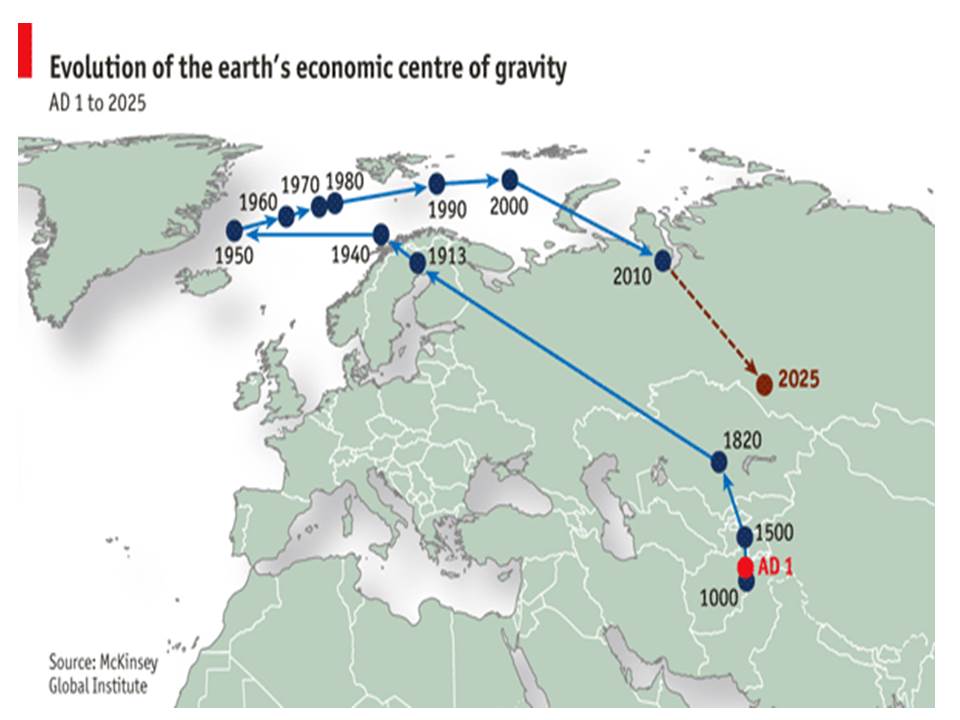
Economic Power is Global Power


Want to get a more wholistic view of what is and what is not worth the investment of strategic effort, sacrifice, and investment?

Follow the money.

Pondering a great graphic over at USNIBlog.

Come by and puzz'l your nogg'n with me for a bit.

Monday, September 20, 2021

Shippings Flock of Swans

Most readers here are aware of the fleets parked off major ports on both coasts
The number of container ships at anchor or drifting in San Pedro Bay off the ports of Los Angeles and Long Beach has now blown through all previous records and is rising by the day.

There were an all-time-high 65 container ships in the queue in San Pedro Bay on Thursday, according to the Marine Exchange of Southern California. Of those, a record 23 were forced to drift because anchorages were full.

Theoretically, the numbers — already surreally high — could go a lot higher than this. While designated anchorages are limited, the space for ships to safely drift offshore is not.

“There’s lots of ocean for drifting — there’s no limit,” Capt. Kip Loutit, executive director of the Marine Exchange of Southern California, told American Shipper.

“Our usual VTS [Vessel Traffic Service] area is a 25-mile radius from Point Fermin by the entrance to Los Angeles, which gives a 50-mile diameter to drift ships. We could easily expand to a 40-mile radius, because we track them within that radius for air-quality reasons. That would give us an 80-mile diameter to drift ships,” said Loutit.


Over at Splash247, they have a few interesting points to consider; 
“What you see today is not only a black swan event, but in fact an entire bevy of black swans, and one which grows larger by the day, as more and more weak strands in the supply web snap,” Jensen says.

The US is indeed the real origin of this fiasco, the Dane agrees. Yet, he has answers to why warehouses are so full.

According to Sea-Intelligence research, many industries in the US are actually dangerously low on inventory.

Another explanation is the very real shortage of drivers to take goods from those warehouses that are actually full, to the consumers.

A game of musical chairs

Steve Ferreira, CEO of New York-based Ocean Audit, describes today’s clumped box situation as like a game of musical chairs.

“You don’t want to be left standing without a seat, and it’s a self-perpetuating cycle,” Ferreira says, giving a couple of recent examples such as Walmart ordering 149 containers of garbage cans on one single vessel or a French tire manufacturer inking a new charter to Houston.

“How are Michelin’s tires going to supply cars you can’t buy due to a chip problem?” Ferreira muses.

Andy Lane from CTI Consultancy, a container advisory, cites both archaic US logistics infrastructure as well as the near impossibility for retailers to have prepared for such a see-saw in demand as Covid presented as the two largest factors in today’s snarled container situation.
For decades, technology helped generations of MBAs design exquisite global supply chains built on incredibly delicate assumptions. As long as the models worked, it gave you the ability to save micro-cents to hundreds of dollars per unit as opposed to more robust but inefficient domestic supply chains.
The sand-cascade failures that we are starting to see in isolation can, if they cannot be controlled, combine in to significant economic dislocation - and with it - any chance for a sustainable recovery.

I think this will be the story of the next year. After an orgy of money printing and once in a century pandemic responses - injecting huge inefficiencies in to economies not designed for them - how will this settle out?

As I mentioned on Sunday's Midrats - you can't shoot up the horse forever.

So far, not so good. 

Don't quit your day job.

 H/t Sal.

Saturday, August 07, 2021

Shipping in the time of COVID with Sal Mercogliano - on Midrats

Shipping rates, supply bottlenecks, and some nightmare abandonment stories for some mariners, like everything else on our water plant, COVID-19 impacted our shipping industry hard at sea and ashore. The impacts of which rippled in to everything.

As economies, nations, and corporations adjust to the new reality, what trends can the consumer and maritime professional expect?

It’s time to catch up with returning guest, Salvatore Mercogliano this Sunday from 5-6pm Eastern.

Sal sailed with MSC from 1989 to 1992, and worked MSC HQ as Operations Officer for the Afloat Prepositioning Force 1992-1996. He has a BS Marine Transportation from SUNY Maritime College, a MA Maritime History and Nautical Archaeology from East Carolina University, and received his Ph.D. in Military and Naval History from University of Alabama. He is the chair of the Department of History, Criminal Justice & Political Science at Campbell University. He was awarded 2nd place in the 2019 CNO History Essay Contest with his submission, "Suppose There Was a War and the Merchant Marine Didn't Come."

If you use iTunes, you can add Midrats to your podcast list simply by clicking the iTunes button at the main showpage - or you can just click here. You can find us on almost all your most popular podcast aggregators as well.

Monday, July 19, 2021

France's Stand in the Pacific Contra China

Most people do not realize that one of the largest Pacific nation, if you measure by territorial seas, is France.

She has a lot to lose in a world where fleets of hundreds of Chinese fishing boats in fleet movements go from place to place, strip mining already stressed fishing resources.
French President Emmanuel Macron said on Monday France and South Pacific nations would launch a South Pacific coastguard network to counter "predatory" behaviour, which an adviser said was aimed at illegal fishing, as China expands its maritime reach.

The United States and allies including France, Japan, Australia and New Zealand, are actively expanding their activity in the Pacific to counter China's influence.

Though tiny in land mass, Pacific islands control vast swaths of resource-rich ocean called Exclusive Economic Zones, forming a formidable boundary between the Americas and Asia.

"To better cope with the predatory logic we are all victims of, I want to boost our maritime cooperation in the South Pacific," Macron said after a video conference with the leaders of Australia, the Marshall Islands, Papua New Guinea and representatives of New Zealand and other Pacific nations.
When France is good, she is very good.

This is a "growth area" in the maritime security arena. You can hear it in Macron's statement, and you can see it in the growing fleets of Offshore Patrol Vessels (OPV) that are a good compromise design for the mission at hand.

Those over 50 remember the last time a nation with a less than enlightened view of the rule of law and responsible stewardship of the world's oceans had the capability and will to do real damage, the Soviet Union.

For the better part of three decades, the world has become comfortable and secure - with isolated exceptions - of the fruits of Pax Americana on the high seas. Those days are over. With pressures and stress, more nations will need to turn their attentions to those things they thought they were naturally granted, responding to gaps in what I modestly call, "Salamander's Hierarchy of Maritime Power™" (apologies to Maslow).


All the higher requirements can only successfully be attained when the ones below it are properly secured, funded, and maintained. Where a power gets itself in to trouble is when it neglects "lower echelon" requirements - through ill-understanding or immature priorities - and instead get's top heavy.

Smart move by France in bolstering the base of its maritime power. With this secure, it will have better standing in higher echelon functions.

Wednesday, April 21, 2021

Kiwis go Wobbly


Another sad week for those who wish New Zealand was a better partner for the West ... but she has a history here.

What is even more sad is that it appears this time it is for little more than money over human rights. Not much more.

Details over at USNIBlog.

Come on by and give it a ponder.

Sunday, April 11, 2021

The Supply Chains that Bind Us, with Ross Kennedy - on Midrats

Our comfortable, modern life exists on a delicate fabric of global transportation, laws, and lines of communication supported by assumptions of stability, peace, and professional competence. 

Over the last twelve months, from COVID-19 to EVER GIVEN in the Suez, the delicate nature off the global system of trade that allows affordable technology, food, and the full spectrum of consumer goods has broken in to the open for everyone to see. 
 
Is the global system of trade as delicate as it seems? Where are its weakest points, and how robust is it to various disruptions? 
 
Our guest this Sunday from 5-6pm Eastern for the full hour to discuss this and related topics will be Ross Kennedy Ross is a U.S.-based logistics and supply chain expert with more than fifteen years in international transportation, procurement, and analysis. His unique blend of operations, sales, and strategic planning allows him to provide creative, agile solutions for his public- and private-sector clientele.

If you use iTunes, you can add Midrats to your podcast list simply by clicking the iTunes button at the main showpage - or you can just click here. You can find us on almost all your most popular podcast aggregators as well.

Monday, March 29, 2021

On Suez: You Can't Buy Training Like This


At last, our great mercantilist nightmare has ended (almost, kind of). 

The mammoth cargo ship blocking one of the world’s most vital maritime arteries was wrenched from the shoreline and finally set free on Monday, raising hopes that traffic could soon resume in the Suez Canal and limit the economic fallout of the disruption.

Salvage teams, working on land and water for five days and nights, were ultimately assisted by forces more powerful than any machine rushed to the scene: the moon and the tides.

The ship was ultimately set free at around 3 p.m., according to shipping officials. Horns blared in celebration as images emerged on social media of the once stuck ship on the move.

When I refer to "training" in the title, I'm not talking about all the efforts afloat and ashore to get EVER GIVEN out of the way, but of the opportunity for navalists and mercantilists to review the good points of the Maritime Gods of the Copybook Headings when it comes to choke points.

The Suez Canal handles around 12% of global trade, making it an essential point of passage. Each day of blockage disrupts more than $9 billion worth of goods, according to Lloyd’s List, which translates to about $400 million per hour.

Some ship operators have already decided to re-route their vessels, anticipating that the Ever Given won’t be dislodged soon. Sending ships around the Cape of Good Hope adds more than a week of sailing, while also increasing costs.

Our planet if full of these choke points that by being open to all, keep houses warm and bellies full throughout the world. They do not stay open on their own. Manmade accidents like what happened with EVER GIVEN or even natural disasters will happen now and then ... but the real danger comes from a hostile power or entity blocking free passage. That is one of many reasons you have a navy.

Where are these places? A quick way to start looking at the globe's maritime choke points is to look at the British Empire at its height.

They knew. 


Monday, November 30, 2020

China Bully-boys Australia

Here is one hard fact; Australia has 1.7% of the population of Communist China. 

Additionally, Australia is 80% of the landmass of Communist China. Australia is also heavily reliant on China with regard to trade. 39% all goods exported in 2019-20 go to China, while 27% of all goods imported were from China.

This is top of mind to the Chinese Communist Party.

As they have in other parts of the world, once China gets comfortable with their economic leverage, they will begin to use it against you. 

They are not too good at it, and more often than not they come out as rather thuggish. They also lack cultural competence to see that what may work in some parts of the world, may not work elsewhere.

Case in point, Australia.

China has been pushing its influence in Australia for awhile, resulting in the occasional scandal and insult. 

Their latest play seems a bit much
Fraying relations between Australia and China have sparked a more than 25 per cent drop in coking coal prices even as iron ore — the other ingredient needed to make steel — has soared to six-year highs.

China last month placed what has been seen as an unofficial ban on imports of coal from Australia, following a sharp deterioration in diplomatic relations after Canberra called for an inquiry into the origins of the Covid-19 pandemic. On Friday, Beijing followed up with tariffs on Australian wine.

In a sign of China’s influence over commodity prices, since the coal ban came into effect the price of premium Australia low-volatility coking coal — the current industry benchmark — has dropped from $138.50 a tonne to $101.25.

Julien Hall, Asia metals pricing director at S&P Global Platts, said October was a “big tipping point” for the market as its recovery from the demand hit caused by the pandemic was put on hold by Beijing’s action.

“The need to find other destinations [for Australian cargoes] led to a rapid fall in the price,” said Mr Hall.
To top things off, this happened over the weekend


A Chinese Foreign Ministry spokesperson has hit back at the Australian government's demands for an apology over a doctored photo posted by a Communist Party official.

The photo, blasted as "repugnant" by Prime Minister Scott Morrison, has been altered to depict an Australian soldier holding a knife to the throat of a child atop the Australian and Afghanistan flags.
China's Foreign Ministry spokesperson Zhao Lijian today tweeted the faked image, sparking Mr Morrison's swift rebuke demanding an apology from China and for the image to be taken down.
...
"The Australian side is reacting so strongly to my colleague's Twitter," Ms Hua said, the Sydney Morning Herald reports.

"Does that mean that they think the coldblooded murder of Afghans is justified? The Australian government should feel ashamed of this; they owe an explanation to the world and they should solemnly pledge such crimes will not be repeated."

The Brereton report was actioned by the Australian government after allegations of improper conducted by SAS troops.

READ MORE: PM urges restraint over alleged war crimes exhibits at War Memorial
Mr Morrison earlier today said Australia was demanding an apology and immediate removal of the image, which he labelled as "false and a terrible slur".

"There are undoubtedly tensions that exist between China and Australia. But that's not how you deal with it," he said.

"It is deeply offensive to every Australian who has served in uniform.

"It is outrageous and can't be justified on any basis whatsoever."
The Australians don't need me to tell them this - but make no mistake, the Chinese don't just want to force Australia to submit to their will - they want to humiliate Australia. The Chinese do not see them as equals - and in the long run they have plans for Australia that they need to set the proper conditions for.

I'm not sure what we can do from here but be an even better friend and ally to Australia. Buy some Australian wine ... but more importantly, let both Australia and the Communist Chinese government know that we see exactly what they are trying to do, and call them on it.

The international community needs to get used to this. This is what dealing with a powerful China will look and feel like. 

Best thing nations can do is not to rely on Chinese money all that much. Their money comes with strings.