Showing posts with label Battleship. Show all posts

Friday, March 31, 2023

Fullbore Friday

Housekeeping Note: As I mentioned earlier this month, as our British friends might say, this "blogspot" hosted part of the blog is "going in ordinary." 

The archived posts here back to the beginning in 2004 will remain, but all new posts will be going over to CDR Salamander on Substack

The reasons are simply, really. Google owns blogspot and for some reason has decided to turn it in to a very creator-unfriendly environment. 

As noted in my earlier post, they are going through and marking all sorts of posts going back over a decade and new as "SPAM" or worse, "dangerous" or a variation of the usual etc. Most of it derives, I believe, from some automated system that looks for images of guns or discussions of violence. 

I don't know what they plan blogspot to be ... but since google bought it, they have neglected it in a variety of ways. 

Well, this is a milblog ... so ... if I can't discuss violence...

I will put out a simple note tomorrow as well - and no this is not an April Fool's joke - directing everyone not already subscribed to my substack to go there. 

A note about "subscribe." This just signs you up to receive email notifications of new posts. You do not have to subscribe to read substack. The link will let you in. All posts are, and will continue to be, free. There is an option for a pay subscription as well that I have not turned on yet. I'm rather humbled by the number of pledges I've received to throw a few shekels in the tip jar if I turn it on ... so for those who have, thanks. I may in the future, but if I do I feel I should offer paying subscribers a little extra content - maybe a "message board" like podcast discussion of those things I found interesting but didn't write about. I'm not sure right now - still pondering.

So, to mark a pivot point in the history of this blog, let's go back to 2006 and the first Fullbore Friday entry. The FbF aperture is a bit more open than when we started, but it is a popular regular feature.

Remember, switch to substack if you have not already - this is the last functional post I'll put here.


Something new and regular, I think. Kind of like Sunday Funnies except I will post more than one thing on Fridays.


Each Friday I will start with a view of something near and dear to my heart, and that of Marines. Big guns. When able, I will provide a link to the Navy Historical Center if you want to see and learn more about the boat in question.

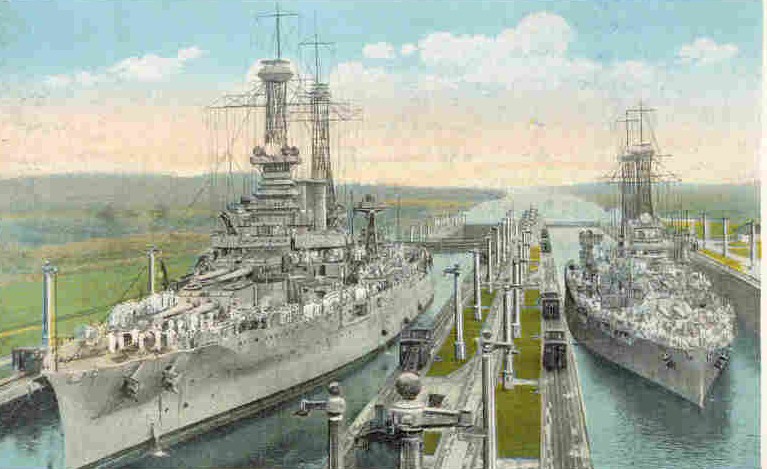
Of all the old battlewagons, none are closer to my heart than the one my Grandfather served on in WWI. The USS Arkansas.


Note the details. Always love the details. One more thing. Here is a cruise book from their 1913 Med Cruise.

Friday, December 09, 2022

Fullbore Friday

Last week was the story of the HMS JERVIS BAY and her crew during the Battle of Convoy HX84.


When we finished last week, HMS JERVIS BAY was out of the fight and the convoy was scattered - but she did her job.
By the time they realized that the Jervis Bay had been terribly alone, an hour had been lost. The convoy had been given time enough to break up and begin to flee.
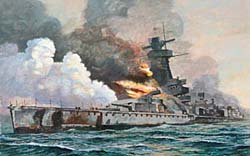
...and so the pocket battleship ADMIRAL SCHEER, unopposed now, closed in.

However, there was a Canadian ship, the SS BEAVERFORD, armed with one 4 inch & one 3 inch gun who turned towards the SHEER and her six 11 inch, eight 5.9 inch guns and eight 21 inch torpedo tubes. What was the BEAVERFORD?
Beaverford was the first of five Beaver class cargo liners in service with the Canadian Pacific Railway’s fleet. The 10,042 ton twin screw, steam turbine merchant ship had her maiden voyage in 1928 ... designed to carry 10,000 tons of cargo and twelve passengers at 15 knots.
...
Although a Canadian Pacific ship, the company chose to register her in the UK, as was the practice at the time. She carried a crew of seventy-seven sailors and ably mastered by 60-year-old Captain Hugh Pettigrew from Coatbridge, Glasgow. He had been sailing with CP since 1910. Most of her crew came from the UK, except for two Canadians.
...
She was one of 18 ships that sailed in HX-1, the first convoy of the war from Halifax to the UK on 16 September 1939; just six days after Canada declared war on Germany. In early 1940, Beaverford had a 4 inch gun installed on her stern and a three inch gun on her bow, for defense against surfaced U-boats.

By the time HX-84 left Halifax on 28 October 1940, Beaverford had already crossed the Atlantic sixteen times in convoy.
JERVIS BAY was lost, and here is where we pick up the story, wonderfully told by Roger Litwiller;
SCHEER then steamed past the sinking JERVIS BAY, now free to engage the merchant ships of the convoy. With only 22 minutes the convoy was still a smorgasbord of targets for the pocket battleships 11 inch guns with a range of over 19 miles; she could pick and choose her targets unimpeded.

In quick succession she sank the freighter Maiden carrying a mixed cargo and military vehicles, all ninety-one sailors killed, then damaged and set on fire the tanker San Demetrio, followed by sinking the freighters Trewellard, carrying steel and 12 aircraft, killing 16 sailors and Kenbane Head, general cargo, with 23 killed.

Captain Pettigrew had heeded the order to disperse, bringing Beaverford to full speed and turning away from the mighty German warship, as he and his crew watched JERVIS BAY engage ADMIRAL SCHEER. Beaverford’s radio operator sent out a continuous update of the action on the ships wireless.

They watched as the ship closest to them, Kenbane Head, suddenly exploded and sink as the massive German rounds found their mark. Pittigrew gave the order to turn Beaverford about and he raced his ship through the smoke towards the mighty ADMIRAL SHEER.

Beaverford’s radio operator sent one last message on the wireless, “It is our turn now. So long. The captain and crew of SS Beaverford.”

Pettigrew ordered the stokers, manning the boilers to make smoke, laying a dense smoke screen to hide the fleeing ships of the convoy.

At 15 knots the Canadian Pacific ship suddenly broke through the smoke close enough for her 4 and 3 inch guns to register a near miss on SCHEER. The pocket battleship checked her fire and concentrated on the new threat, turning her full might on Beaverford.

With the skill of a master mariner and the courage of his crew, Captain Pittigrew battled ADMIRAL SCHEER, playing a deadly game of “cat and mouse” as she ducked in and out of the smoke screen, harassing the enemy warship.

Beaverford’s superior steam turbines allowed the merchant ship to utilize a burst of speed and with Pettigrew’s skill and exceptional seamanship he would wait for SCHEER’s 11 inch guns to fire and then order an increase in speed and change of course, making his ship a difficult target to hit.

Beaverford’s delaying action allowed the Swedish freighter Stureholm to return and pick up the sixty-five survivors from HMS JERVIS BAY.

The battle between Beaverford and ADMIRAL SCHEER continued into the dead of night. The fleeing ships of HX-84 could see the star shells and illumination rockets lighting the night sky, as SCHEER attempted to find her antagonizer. The merchant ship had many opportunities to turn away and escape in the darkness and the smoke, but she continued on with the fight.

Whenever SCHEER would turn towards the direction of the fleeing merchant ships, Beaverford would break through the smoke and darkness and engage the pocket battleship, then disappear again. Beaverford suffered for her actions, SCHEER fired 83 rounds from her 11 inch guns and 71 rounds from her 5.9 inch guns at the Canadian Pacific ship.


The battle had now lasted over five incredible hours, Beaverford was in trouble, and fires were raging in the ship, making her an easier target for the German gunners. She had by now been struck with twelve 11 inch shells and sixteen 5.9 inch shells. We can only imagine the hardship, destruction and carnage faced by her sailors as they attempted to continue the fight.

With her speed slowing as the steam turbines were damaged, SCHEER fired a torpedo. It found its target in Beaverford’s bow at 2245. With a sudden, fierce explosion, Beaverford disappeared in a mass of flames as the ammunition stowed in her bow detonated.

We do not know how many of Beaverford’s brave crew died during the battle or if anyone survived that final devastating moment as their ship erupted into a massive ball of fire. By the time Beaverford was lost, there were no allied ships in the area to search for survivors. All seventy-seven sailors sacrificed their lives so convoy HX-84 could escape.
What can you say of such men? Such leaders? Such Sailors?

Fullbore.

First posted 16NOV2018.

Friday, December 02, 2022

Fullbore Friday


You go to war with what you have or what you can quickly patch together, the end result of the decision of others who will not have to fight, not have to command, not have to die.


There is no time to what-if. There is no time to complain. There is only time to get underway.

Duty. Mission. Training.
If confronted by the enemy, Fegen told his officers when he came aboard, “I shall take you in as close as I possibly can.”
You have what you have, but it is what you do with it that matters.

War is not fair. Your enemy will not wait for you to be ready. Time arrives when it want to.
November 1940.

America is over a year from joining the war. The Blitz is in its 2nd month. Liverpool has been bombed over 200 times already. German U-Boats rule the North Atlantic.

In Halifax, a convoy forms. 37 freighters heading to Britain across a hostile sea. They get one escort.
One.

A converted merchant ship armed with a few late-19th Century manually aimed 6" guns that could fire - with a well trained crew - about 8-rounds per minute with a range of 14,600 yards.

She was the HMS JERVIS BAY, and she had a mission.
In November 1940 the Jervis Bay was the sole escort for Convoy HX84 of thirty-seven freighters moving from Halifax to Britain
An extended quote from the HMS JERVIS BAY website
The position of the convoy was known to the Germans. In his book, Kapitän Theodore Krancke certainly makes no secret of expecting to find convoy HX84. ("That was the convoy all right").

As the Jervis Bay repeatedly signalled the challenge "A", the signals officer of the Scheer was commanded to attempt a bluff.

" ... 'She'll give her recognition signal in a moment,' said Krancke. 'Whatever it turns out to be repeat it at once as though we were calling her.'

Krancke was anxious to leave the enemy in doubt as to his real identity for as long as possible in order to get close up to the convoy before opening fire. At the moment the distance between the Scheer and the British auxiliary cruiser was still about fifteen miles.
That is 30,000 yards.

Who was Krancke? The Skipper of the pocket battleship ADMIRAL SCHEER. SHEER was armed with 11" guns with a range of 39,000 yards and a secondary armament of 5.9" guns with a range of 25,000 yards.

The Skipper of the HMS JERVIS BAY, Captain Edward Fegen, VC SGM, Royal Navy, knew this.
The auxiliary cruiser's 'A' was now followed by 'M' - 'A' - 'G' in quick succession. The Signals Officer of the Scheer immediately had the 'M.A.G' signal repeated, but the bluff failed. The Captain of the British auxiliary cruiser was not deceived. In any case, he probably knew quite definitely that no friendly warship could possibly be in that quarter, and now sheafs of red rockets began to hiss up from his decks - clearly the pre-arranged signal for the convoy to scatter. At the same time the auxiliary cruiser and most of the other ships in the convoy began to lay down a smoke screen.

The distance between the two ships was considerably less now and when it was about ten miles the Scheer, which up to then had been racing straight towards the convoy, turned to port to bring her broadside to bear. The guns were trained on their targets now - the big guns had been ordered to concentrate on the British auxiliary cruiser while the medium artillery was to take a tanker not far away from her as its target.

The British auxiliary cruiser, which was ahead of the second line of the convoy, had stopped signalling, and by this time the ships were close enough for the British Captain to have realised what he was faced with, for the outlines of the Scheer were now clearly visible against the evening sky and he could plainly see the guns of her triple turrets trained on him. As unlikely as it might seem, he had encountered a German pocket battleship in mid-Atlantic.
Let's pick up Chuck Lyons story over at WarfareHistoryNetwork;
Made aware of the Rangtiki’s sighting, at about 4:45 Captain Fegen sounded action stations and began accelerating his ship out of her convoy position and toward the Admiral Scheer.

Fegen immediately began firing his 6-inch guns even though he was well out of range of the Scheer. He also ordered smoke canisters deployed to hide the convoy, which made a quick turn away from the German ship and scattered. At a distance of about 10 miles, Captain Krancke swung the Scheer to port, bringing both his triple turrets to bear on the convoy and Jervis Bay. He began firing at the oncoming armed merchantman, the second salvo splashing 50 yards off Jervis Bay’s bow with 150-foot spouts of sea water, soaking the Bay’s forward gun crews.

Sam Patience, a quartermaster aboard Jervis Bay, heard what he later described as a “thunk” and turned to see a member of his gun crew slump to the deck, his head severed from his body. Admiral Scheer’s third salvo hit Jervis Bay’s bridge, knocking out her rangefinder, wireless, and fire-control equipment. Several officers and crewmen were killed by the blast, and Captain Fegen’s left arm was mangled.

As Scheer continued to fire, Jervis Bay was hit repeatedly on her superstructure, and her hull was holed in several places. The port bulkhead of the radio shack was gone and a radio operator and two coders were dead.

The remaining radioman climbed to the remnants of the bridge where he saw Captain Fegen“clutching his arm, blood spilling off his sleeve.”

Fires burned uncontrolled.

Wanting to neutralize the escort ship so he was free to attack the convoy, Scheer’s commander continued to train his big guns on Jervis Bay. Darkness was falling, and he knew he needed to sink Jervis Bay quickly so that he would have time to attack the convoy. Each salvo from the Scheer launched two and a half tons of ordnance at the stricken ship. The forward port side of Jervis caught the brunt of the fire and became a mass of twisted girders, bent and jagged plate, dead and wounded sailors, and flames. A shell somehow loosed Jervis’s anchor, and another knocked the white ensign of the Royal Navy off the top of the main mast. Midshipman Ronald Butler later recalled helping an unnamed seaman climb the mast to nail up a replacement ensign.

Jervis Bay continued steaming at Admiral Scheer and firing her guns until her steering gear was knocked out. The petty officer manning the wheel called into the voice tube that the ship’s steering gear was out of action and heard the captain’s pained voice come back ordering him to “man the aft steering position.”

With his ship aflame and sinking, Captain Fegen continued to maintain the unequal fight and stayed in command despite his shattered arm, consciously buying time for the ships of the convoy to escape.

Up to now, Captain Fegen had stayed on the collapsing bridge, which was under continuous hits from Admiral Scheer’s big guns. Shortly after giving the order to man the aft gear, however, he struggled down the starboard side of the bridge and, aided by a signalman, headed aft, stopping to encourage a gunner along the way and ordering more smoke deployed.

After a blast destroyed the after-control compartment just as he arrived there, the captain headed forward again, with “blood running over the four gold stripes on his sleeve,” Midshipman Butler later said.

Captain Fegen never made it. His body and the body of the signalman who was helping him were later seen on the deck. “[Jervis Bay] did not have a chance, and we all knew it,” said Captain Sven Olander, commander of the Swedish freighter Stureholm, one of the convoy ships. “But she rode like a hero and stayed to the last.”

Meanwhile, exploding cordite bags on Jervis Bay’s poop deck had convinced Captain Krancke that the smaller ship was still firing despite the severe damage she had suffered. He didn’t dare concentrate on the convoy until the threat posed by Jervis Bay was eliminated. Any damage to his ship from a lucky hit could seriously affect her ability to escape any hunt for her launched by the Royal Navy.

Krancke continued focusing his big guns on Jervis Bay, but turned some of his smaller ones against ships in the convoy that were still within his range.

After an hour of the unrelenting German fire and with Captain Fegen dead, Lt. Cmdr. George Roe, now in command, ordered the remaining crew of Jervis Bay to abandon ship. All of Jervis Bay’s life boats had been destroyed but rafts, some of which were damaged, and the ship’s 18-foot “jolly boat” had survived the bombardment and were launched. Most of Jervis Bay’s men simply jumped into the icy, sub-Arctic sea, some making it to the rafts and jolly boat. Others made do with what they could find floating in the water.

Shortly after the order was given to abandon ship, Jervis Bay went down. The white ensign Midshipman Butler had helped raise was the last thing to settle beneath the Atlantic waves.
Of the 254 crewmembers of JERVIS BAY, only 68 survived the battle.

The Skipper of JERVIS BAY, 49-yr old Captain Edward Fegen, was awarded a posthumous Victoria Cross as a result of this action.
"for valour in challenging hopeless odds and giving his life to save the many ships it was his duty to protect. On the 5th of November, 1940, in heavy seas, Captain Fegen, in His Majesty's Armed Merchant Cruiser Jervis Bay, was escorting thirty-eight Merchantmen. Sighting a powerful German warship he at once drew clear of the Convoy, made straight for the Enemy, and brought his ship between the Raider and her prey, so that they might scatter and escape. Crippled, in flames, unable to reply, for nearly an hour the Jervis Bay held the German's fire. So she went down: but of the Merchantmen all but four or five were saved."
The Battle of Convoy HX-84 was far from over even after the loss of JERVIS BAY.

For that, you'll have to wait for next Friday's FbF.

First posted 09NOV2018.

Friday, September 02, 2022

Fullbore Friday


I think that pic captures the soul of a battleship well, don't you think? 

108 years after her commissioning, she got underway again for a well needed dry docking.


I had a lot of people reach out to me about seeing her underway again, so for this week's FbF I'll reach back 8-yrs ago when we last mentioned thUSS TEXAS (BB-35).

We could spend hours on the ship that my paternal Grandfather (GM3 Salamander) saw from his ship, the USS ARKANSAS (BB-33), with the Brits in WWI - but let's just say "Happy Birthday" to the grand lady who completed 34 years of commissioned service and can still be visited today - and give a nod to a few bits in her highlight reel.
On 23 October 1942, Texas embarked upon her first major combat operation when she sortied with Task Group 34.8 (TG 34.8), the Northern Attack Group for Operation Torch, the invasion of North Africa. ... Texas transmitted Lieutenant General Dwight D. Eisenhower's first "Voice of Freedom" broadcast, asking the French not to oppose Allied landings on North Africa. When the troops went ashore, Texas did not come immediately into action to support them. At that point in the war, amphibious warfare doctrine was still embryonic; and many did not recognize the value of a pre-landing bombardment. ... Thus, unlike in later operations, she expended only 273 rounds of 14 in (360 mm) ammunition and six rounds of 5 in (130 mm) ammunition. ... At 03:00 on 6 June 1944, Texas and the British cruiser Glasgow entered the Omaha Western fire support lane and into her initial firing position 12,000 yd (11,000 m) offshore near Pointe du Hoc at 04:41, as part of a combined total US-British flotilla of 702 ships, including seven battleships and five heavy cruisers.[44][45][A 8] The initial bombardment commenced at 05:50, against the site of six 15 cm (5.9 in) guns, atop Pointe du Hoc.[2] When Texas ceased firing at the Pointe at 0624, 255 14 in (360 mm) shells had been fired in 34 minutes—an average rate of fire of 7.5 shells per minute, which was the longest sustained period of firing for Texas in World War II.[44] While shells from the main guns were hitting Pointe du Hoc, the 5 in (130 mm) guns were firing on the area leading up to Exit D-1, the route to get inland from western Omaha. At 06:26, Texas shifted her main battery gunfire to the western edge of Omaha Beach, around the town of Vierville. Meanwhile, her secondary battery went to work on another target on the western end of "Omaha" beach, a ravine laced with strong points to defend an exit road. Later, under control of airborne spotters, she moved her major-caliber fire inland to interdict enemy reinforcement activities and to destroy batteries and other strong points farther inland. ... By 15 June, the troops had advanced to the edge of Texas's gun range; her last fire support mission was so far inland that to get the needed range, the starboard torpedo blister was flooded with water to provide a list of two degrees which gave the guns enough elevation to complete the fire mission. With combat operations beyond the range of her guns on 16 June, Texas left Normandy for England on 18 June.
Hey - speaking of Pops's ship,
On the morning of 25 June Texas, in company with Arkansas, Nevada, four cruisers and eleven destroyers, closed in on the vital port of Cherbourg to suppress the fortifications and batteries surrounding the town while the US Army's VII Corps attacked the city from the rear. While enroute to Cherbourg, the bombardment plan was changed and Task Group 129.2 (TG 129.2), built around Arkansas and Texas, was ordered to move six miles (10 km) to the east of Cherbourg and engage the guns of Battery Hamburg, a large shore battery composed of four 240 mm (9.4 in).[50][51][52] At 12:08, Arkansas was the first to fire at the German positions, while the German gunners waited for Arkansas and Texas to be well in range to return fire. At 12:33, Texas was straddled by three German shells; five minutes later Texas returned fire with a continuous stream of two-gun salvos. The battleship continued her firing runs in spite of shell geysers blossoming about her and difficulty spotting the targets because of smoke; however, the enemy gunners were just as stubborn and skilled. At 13:16, a German 240 mm (9.4 in) shell skidded across the top of her Conning Tower, sheared the top of the fire control periscope off (the periscope remains fell back into the Conning Tower and wounded the gunnery officer and three others), hit the main support column of the Navigation Bridge and exploded.[50][53][54] The explosion caused the deck of the Pilot House above to be blown upwards approximately 4 ft (1.2 m), wrecked the interior of the Pilot House, and wounded seven. Of the eleven total casualties from the German shell hit, only one man succumbed to his wounds—the helmsman on duty, Christen Christensen.[55] Texas's commanding officer, Captain Baker, miraculously escaped unhurt and quickly had the bridge cleared. The warship herself continued to deliver her 14 in (360 mm) shells in two-gun salvos and, in spite of damage and casualties, scored a direct hit that penetrated one of the heavily reinforced gun emplacements to destroy the gun inside at 13:35.[51] At 14:47, an unexploded 240 mm (9.4 in) shell was reported.[56] The shell crashed through the port bow directly below the Wardroom and entered the stateroom of Warrant Officer M.A. Clark, but failed to explode. The unexploded shell was later disarmed by a Navy bomb disposal officer in Portsmouth and is currently displayed aboard the ship. Throughout the three-hour duel, the Germans straddled and near-missed Texas over sixty-five times, but she continued her mission firing 206 14 in (360 mm) shells at Battery Hamburg until 15:01 when, upon orders to that effect, she retired.
Oh, there's more. Head on over to Wikipedia for more.

Five battlestars and only one combat casualty. Wow.Oh, and one day we need to have a Salamanderpalooza with Sid leading a Hard Hat tour. 

Friday, November 12, 2021

Fullbore Friday


Allow me a little self indulgence (again) this Friday. USNI triggered me this AM:

It made me grin a bit because my paternal grandfather was a Sailor on the USS ARKANSAS (BB-33) with the 6th Battle Squadron that day.

The Germans never made their last thunder run in 1918 as that horrible and useless war ground to a halt, so they never saw action - which for my grandfather and much of his shipmates I am sure was quite fine.

I could only imagine him looking at his Royal Navy neighbors that day thinking things along the lines his grandson would think.

Anyway, to the Sailors in 1918 of what would become an old warhorse USS ARKANSAS (BB-33) - when she and you were young and the war done; fullbore.


Friday, October 22, 2021

Fullbore Friday


You graduated from the Naval Academy with the world at war. While it seemed your nation’s politicians were saying they would do all they could to stay out of this war – you probably knew better. It was a big war, and one side was being fed and armed from our side of the ocean. 

After graduation you get assigned to a battleship – and within a year, your nation goes to war. Your battleship was not just any ship, she was the USS Connecticut (BB-18), the flagship for The Great White Fleet a decade earlier, and now flagship of the Fifth Battleship Division.

Yet, your war never really came. You spent the war never leaving the east coast. You spent the entire war on what you realized soon, was an obsolete hulk of another age best used for what it was used for, training of others.


With the war over, you knew naval war was in a new age – an age where the submarine and the aircraft would change forever how power is brought from the sea.

You went to sub school and spent the next 12 years in the submarine service. A select group of select officers still trying to understand how to make these exciting new platforms work.

Big Navy was not through with you though, and back you went to battleships, the 15-yr old USS New York (BB-34). Your nation by now was in the grips of a nightmarish depression and the world was quiet.

You had a great tour and as a LCDR was given command of the USS Evans (DD-78). The 4-stack destroyer had been in the Navy as long as you had and was just a few years from being sent to mothballs, but she was your ship. 


You did well in command and post-command shore duty. As the world started to heat up again in 1937 you make Commander and your Navy sent you back to submarines with the honor of commanding Submarine Division Seven in Groton.

Again, the world headed to war yet you had aged out of operational units. Command is command though … and as an East Coast Sailor, your friends at BUPERS had something interesting – a 32-yr old former collier converted into a repair ship based out of Pearl Harbor, Hawaii. The USS Vestal (AR-4).

You’ve been in the Navy 25 years, almost 30 if you include your time at Annapolis. Maybe we’ll stay out of this war, maybe not … but command of a ship – any ship – in Hawaii, well, there are worse sunset tours for a Commander.

Then came one December Sunday halfway through your command tour; Commander Cassin Young, USN – history is finally calling, and you’re on her short list:

...Sunday in port was shattered shortly before 08:00 as Japanese carrier-based aircraft swept down upon Pearl Harbor. At 07:55, Vestal went to general quarters, manning every gun from the 5-inch (127 mm) broadside battery to the .30 cal. Lewis machine guns on the bridge wings. At about 08:05, her 3-inch (76 mm) gun commenced firing.

At about the same time, two bombs – intended for the more valuable battleship inboard on Battleship Row – hit the repair ship. One struck the port side, penetrated three decks, passed through a crew's space, and exploded in a stores hold, starting fires that necessitated flooding the forward magazines. The second hit the starboard side, passed through the carpenter shop and the shipfitter shop, and left an irregular hole about five feet in diameter in the bottom of the ship.

Maintaining anti-aircraft fire became secondary to the ship's fight for survival. The 3-inch (76 mm) gun jammed after three rounds, and the crew was working to clear the jam when an explosion blew Vestal's gunners overboard.

At about 08:10, a bomb penetrated Arizona's deck near the starboard side of number 2 turret and exploded in the powder magazine below. The resultant explosion touched off adjacent main battery magazines. Almost as if in a volcanic eruption, the forward part of the battleship exploded, and the concussion from the explosion literally cleared Vestal's deck.

Among the men blown off Vestal was her commanding officer, Commander Cassin Young. The captain swam back to the ship, however, and countermanded an abandon ship order that someone had given, coolly saying, "Lads, we're getting this ship underway." Fortunately, the engineer officer had anticipated just such an order and already had the "black gang" hard at work getting up steam.

The explosion touched off oil from the ruptured tanks of the Arizona which in turn caused fires on board Vestal, aft and amidships. At 08:45 men forward cut Vestal's mooring lines with axes, freeing her from Arizona, and she got underway, steering by engines alone. The naval tug Hoga, whose tugmaster had served aboard Vestal just a few months before the attack, pulled Vestal's bow away from the inferno engulfing Arizona and the repair ship, and the latter began to creep out of danger, although she was slowly assuming a list to starboard and settling by the stern. At 09:10, Vestal anchored in 35 feet (11 m) of water off McGrew's Point.


With the draft aft increasing to 27 feet (8 m) and the list to six and one-half degrees, Commander Young decided upon another course of action. "Because of the unstable condition of the ship", Young explained in his after-action report, "(the) ship being on fire in several places and the possibility of further attacks, it was decided to ground the ship." Underway at 09:50, less than an hour after the Japanese attack ended, Vestal grounded on 'Aiea Bay soon thereafter. Commander Young was awarded the Medal of Honor for his actions that day.

Many of you may recognize that name. He was promoted to Captain, given command of the USS San Francisco (CA-38) and was killed in action 13 NOV 42 during the Naval Battle of Guadalcanal leading his ship against the Imperial Japanese Navy’s Battleship Hiei.

Captain Young – fullbore.

Friday, February 05, 2021

Fullbore Friday


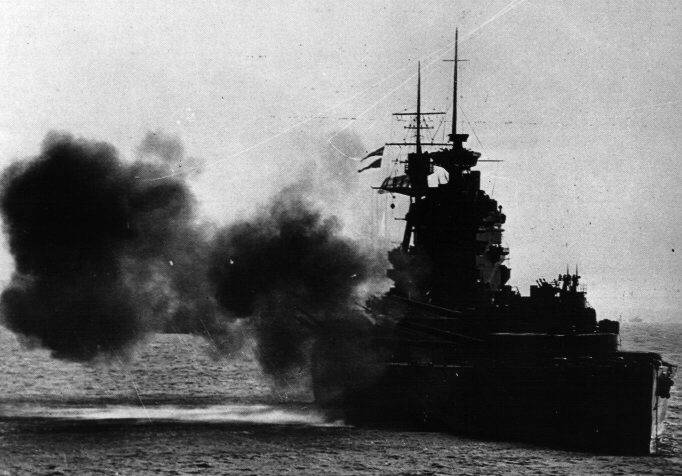
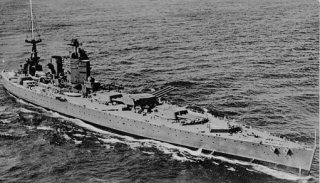
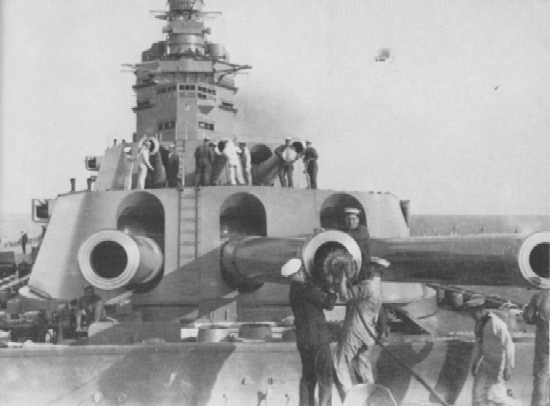
HMS Nelson. One of the more curious, no, the most curious Battleship classes (2) ever built. 

The first thing that comes to mind is "Shipmate, where is your stern?" If it looks like a ship built by committee, well that is because it is. 

A product of The Washington Treaty, "compromises" were made. Though it was the only RN ship with 16" guns, the ship herself was a tad slow, and once the war was done - like the rest of the RN Battleships - off to the breakers she went.


Best pictures here. Other sites here and here.


Orig. posted 16JUN06.

Friday, December 13, 2019

Fullbore Friday

We've posted on it before, but on its 80th Anniversary - we have to post again a great battle and a great story with many lessons on leadership, intelligence, and the realities and uncertainties of war..

Speed. Superior technology. Superior Sailors. Long-range, accurate weapons. Superior training.

From LCS to DDG-1000, we are all told that these are the key to victory at sea. They make up for inferior numbers. They are Transformational. War has changed. We own them.

All that came to mind when I thought of three ships, HMS Exeter, HMS Ajax, and HMNZS Achilles.

The Graf Spee was, well, the Graf Spee. With memories of the SMS Emden in mind, she was the terror of the seas.

To go after her you had three old, under armed, and relatively unarmored cruisers. On paper, there should be no contest. But the combined British and New Zealand Force had a plan. They had what you cannot put on paper or PowePoint - but that which wins almost all battles at sea; audacity.
13th. of December 1939.At 0520 ( 5.20 AM ) the squadron was in position 34 degrees 34 minutes South, 49 degrees 17 minutes West, on a course of 060 degrees, at a speed of 14 knots, cruising in line ahead Ajax, Achilles and Exeter. Smoke bearing 320 degrees, ie to the South West from the force, was sighted at 0610 ( 6.10 AM ) and Exeter was ordered to investigate, she soon replied:
"I think it is a pocket Battleship!"
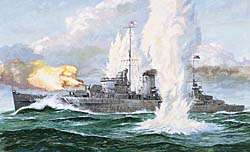
It did not take long for Graf Spee to act, in only two minutes she opened fire with her 11 inch turrets, one firing at Exeter, and one at Ajax.
The first division altered course to 340 degrees to close the range to the enemy, whilst Captain Bell hauled out of the line, altering course to the west, so he might attack Graf Spee from a widely different angle. All ships increased speed, now it should be noted that the enemy armament had almost twice the power of the British
cruisers, both Ajax and Achilles were light cruisers mounting 6 inch guns in their turrets, whilst Exeter was the lone ship of her class, mounting 6 by 8 inch guns in three twin turrets, A and B turrets forward, and a single Y turret mounted aft.

By 0623 ( 6.23 AM ) all ships had opened fire, and an enemy report was broadcast.Graf Spee straddled Exeter ( that means shells in a salvo fall both sides of the target ), one shell burst short, and killed the starboard torpedo tube crews, riddled the searchlights and the aircraft on the catapult, which was manhandled over the side, leaving the ship without any spotting capability from that source. The enemy ship seemed undecided about her gunnery policy, as she shifted targets several times before concentrating both turrets upon Exeter. The third salvo from
By 0624 ( 6.24 AM ) Exeter sent off 8 salvoes against the enemy, but on the incoming path, she received a direct hit from an 11 shell in the fore part of the B turret, putting it out of action, as splinters from this shell burst swept the bridge it killed or wounded all personnel there except for the Captain and two others. It also demolished the wheel house communications, leaving Captain Bell without any means of giving wheel orders to enable course changes, or orders to the engine room regarding speed changes. He decided to fight his ship from the after conning position, but the communication system here was also damaged from the shell burst earlier that effected the torpedo tube crews etc. A chain of messengers was set up to pass orders to the after steering position.
Now two further 11 inch shell hits registerd in the fore part of the cruiser, and Graf Spee shifted one 11 inch turret onto Ajax, who was straddled three times. The secondary armament of the German ship now took on Ajax and Achilles alternately, but to little effect.
During all of this intensive engagement, Ajax achieved a minor miracle by being able to catapult her aircraft for spotting purposes.
Exeter had fired off her torpedoes at 0632 ( 6.32 AM, ) but did not achieve any result, now at 0637 ( 6.37 AM ) Graf Spee altered course some 150 degrees, steering to the North West under cover of smoke.
0638 to 0650 ( 6.38 to 6.50 AM )At about 0638 ( 6.38 AM ) Exeter altered course to Straboard to allow the firing of her starboard torpedoes, then took off to the North East to close the First Division, at 0645 ( 6.45 AM ) she turned westerly to keep within range.
Two more 11 inch hits fell upon Exeter, one put A turret out of action, and another started a fierce fire in the Chief Petty Officer's flat amidships, the 4 inch magazine was flooded through a burst water main. All the compass repeaters were out of action, the Captain had to rely on a simple boat's compass to allow him to keep the ship pointed so that Y turret might keep up her firing at the enemy, locally controlled, with the Gunnery Officer taking control from the searchlight platform.
At 0640 ( 6.40. AM ) an 11 inch shell fell just short of Achilles in line with her bridge, it burst at the waterline, with splinters killing four sailors, stunning the Gunnery Officer, ( many unkind Officers might comment, But that is but the normal condition for most Gunnery Officers. ) and slightly wounding the Captain and his Chief Yeoman of Signals.
0650 to 0708. ( 6.50 to 7.08 AM )Achilles with her guns firing in local control could not find the right line with her gun fire, her salvoes falling short. The aircraft from Ajax, reporting that the salvoes were all falling short, but in Achilles, their gun control officer was unaware that Ajax was not still in concentrated firing, he therefore wrongly concluded it was his fall of shot being reported as short, and corrected accordingly, this had the effect of all his gunfire falling way over the enemy pocket battleship. A real mix up at a time when to achieve hits on the enemy was crucial. With all the smoke added to the general confusion, direct spotting was quite hard.
Graf Spee made frequent course alterations trying to throw off the British ship's gunfire, she also made skilful use of the smoke she generated.
Exeter valiently kept up firing her Y turret in local control, but she now had developed a 7 degree list to starboard, adding to the difficulties of keeping Y turret firing. She was still a target for fire from Graf Spee, but shots fell consistantly over.
0708 to 0728. ( 7.08 to 7.28 AM )Graf Spee was still 16,000 yards from theFirst Division, and they were ordered to close the enemy at speed, accepting they would lose the benefit of having their guns bear on the enemy whilst they steamed closer to the German ship.
At 0708 ( 7. 08 AM ) Graf Spee made a dramatic alteration of course to port under cover of her smoke, and at 0720 ( 7. 20 AM ) she turned back to the North West to bring her guns to bear, and Ajax was very quickly straddled three times from a range of 11,000 yards.
At the same time, the First Division turned to starboard to bring all their main armament bearing on Graf Spee, their fire appeared to most effective with Graf Spee on fire amidships. But at 0725 ( 7. 25 AM ) Ajax was hit by an 11 inch delayed action shell on the after superstructure, its passed through some cabins, wrecking them, then it went through X turret trunk, wrecking all the turret machinery below the gun house, a part of this shell base then struck Y turret barbette, close to the turret training rack, and jammed the turret. Thus one shell was responsible for putting both X and Y turrets out of action, for killing four, and wounding another six of X turret's crew.
It appeared that Graf Spee was neglecting Exeter, as she steered North West to close on the First Division, with Ajax assuming that the German ship would hold this course, she decided to fire off a broadside of her torpedoes. At 0724 ( 7. 24 A M ) she turned to starboard, and let go four torpedoes at a range of 9,000 yards, but without result.
Graf Spee must have seen them coming, and quickly took avoiding action by turning 130 degrees to port, and then returned to the North West after about three minutes.
Exeter was slowly dropping astern of the action, the forward damage taking it's toll. At 0740 ( 7. 40 A M ) Y turret still in local control stopped firing, this was due to a power failure caused by flooding. At 0740 ( 7. 40 A M ) Exeter was steering South East at a very slow speed, she needed to both make repairs and herself seaworthy again.
Now Ajax and Achilles altered course to 260 degrees so that the range to the enemy was reduced even more, then at 0721 ( 7.21 A M ) the spotting aircraft reported "Torpedoes approaching, they will pass ahead of you." The two cruisers decided to make sure they missed, and altered course to 180 degrees.
At 0732 ( 7.32 AM ) Graf Spee turned away to the West and started to zig zag, and Ajax seemed to be making good use of her three available guns, one of the hoists had failed in B turret, and both X and Y turrets were out of action.
Suddenly at 0736, ( 7.36 AM ) Graf Spee altered course to the South West to again bring all her armament to bear on the First Division, the range now down to 8,000 yards.
Ajax reported she had only 20% of her ammunition left.
The shooting by Graf Spee was accurate, and Commodore Harwood did not think she had suffered much damage from the salvoes from the British ships, so he decided to break off the action, at least till after dark. One of the last salvoes from the enemy had demolished Ajax's top mast, and with it all of her aerials, so jury aerials were rigged as quickly as possible. As the British ships turned away, Graf Spee did not follow them, but then altered course to 270 degrees, her speed 22 knots, this course would take her directly to the River Plate. The First Division, now turned to place themselves in shadowing positions on both quarters of the German ship, at a distance of about 15 miles.
British shipping in the area was alerted to Graf Spee's position, course and speed, this information was also sent off to the British Admiralty.
At 0912 ( 9.12 AM ) Ajax recovered her aircraft, then at 0916 ( 9.16 AM ) Harwood ordered Cumberland from the Falkland Islands to close the River Plate at full speed, he was in dire need of reinforcements to his force.
At 1104 ( 11.04 AM ) a merchant ship close to Graf Spee was stopped and blowing off clouds of steam, a signal from the pocket battleship read: "Please pick up lifeboats of English steamer." When coming up to the British ship, SS Shakespeare, all her boats were hoisted, and she reported that she was not in need of any assistance.
At 1105 ( 11.05 AM ) Exeter signalled that all her turrets were out of action, she was flooded up to No. 14 bulkhead, but could proceed at 18 knots, she was ordered to sail to the Falkland Islands at her best speed without placing strain on her bulkheads.
At 1342 ( 1.42 PM ) the British Naval Attache at Buenos Airies was informed that Graf Spee was making for the Plate. The shadowing of Graf Spee continued, and at 1915 ( 7.15 PM ) she suddenly fired off two salvoes at Ajax who turned away under smoke, the first salvo fell in line, the second in her wake as she turned, the range 26,000 yards.
It now seemed that Graf Spee intended to enter the Plate, and Achilles was told to follow her if she went West of Lobos, now Ajax was to proceed South of the English Bank, just in case the German doubled back that way.
Just after sunset, Graf Spee fired off three salvoes at Achilles, the third lobbed very close, in return, AchillesGraf Spee now proceeded North of the English Bank, and anchored in Montevideo roads at 0050. ( 00.50 AM ) fired 5 salvoes that seemed to straddle the enemy ship.
Harwood now reports that his main concern was how long Graf Spee intended to stay here.
At 2350 ( 11.50 PM ) Ajax and Achilles were ordered to withdraw from the Plate, Harwood did not want to risk them having to face Graf Spee silhouetted by the rising sun behind them. Achilles was to patrol the area from the Urugayan coast to a line 120 degrees from English Bank, whilst Ajax was to look after the Southern area. Both cruisers were to move back to the mouth of the Plate after the threat posed by the dawn had passed.
Fullbore.
UPDATE: Reader Oyster sends along the radio report. Cool.

UPDATE II, Electric Boogaloo: Since the first posting, even more is available.

Did you know that HMS Achilles flew the New Zealand flag ... the first time that flag flew in battle? You can also find the Y-turret from HMS Achilles on display at Devonport Naval Base in Auckland. 

To understand the battle more, click the 80th anniversary link at the top, and this video is helpful.


Friday, April 19, 2019

Fullbore Friday

An encore FbF from '07.

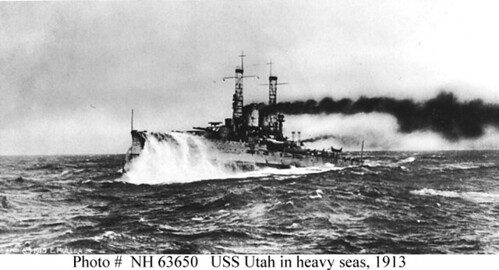
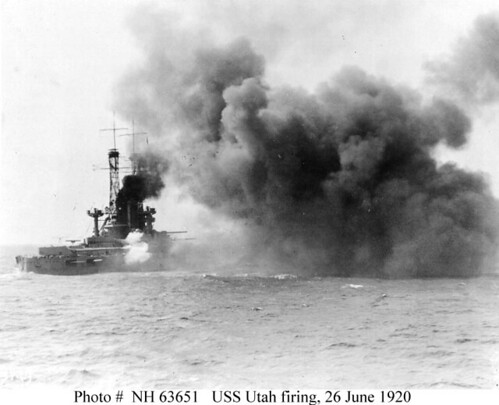
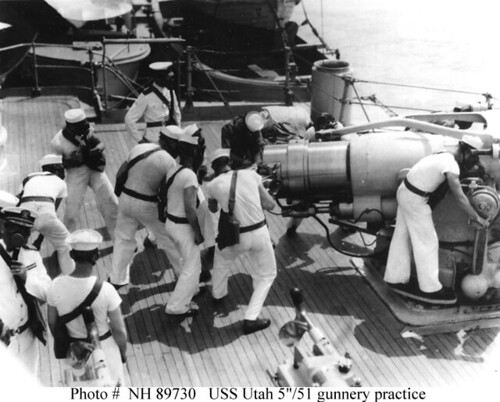
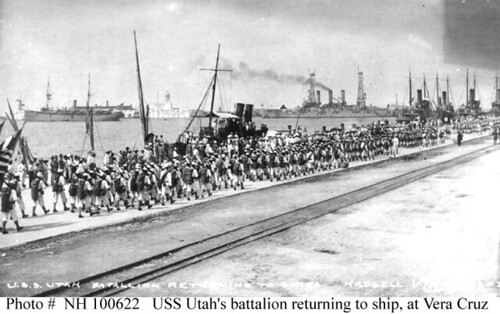
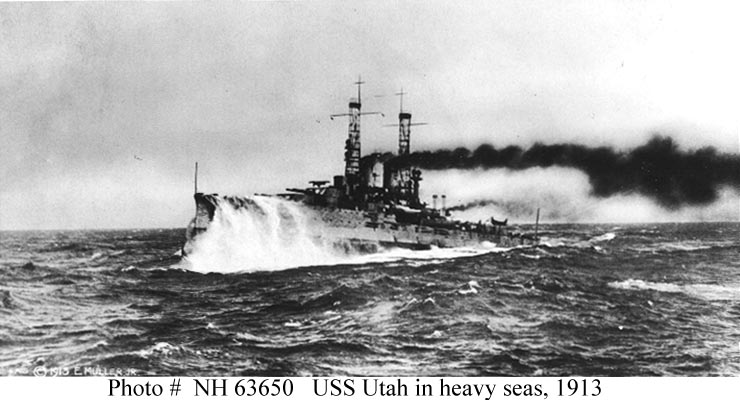
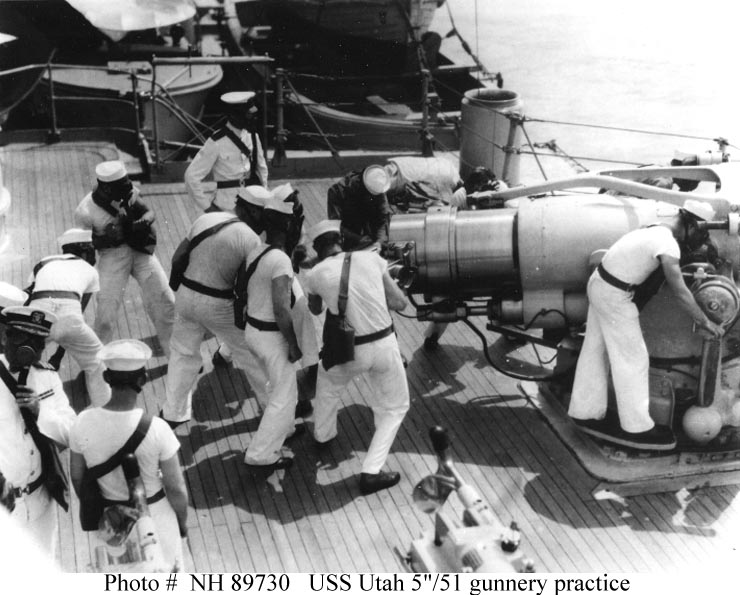
USS Utah (BB-31). Most people think of her from her days as a target for the Pacific Fleet, and then the Japanese. Well, like the Arizona, she lies in Pearl Harbor.....and has a great history of being one of the Big Boys. 

The girl in her prime.


And the mother of REAL Naval Infantry...


High res of the above pictures here, here, here, and here.

Friday, December 07, 2018

USS OKLAHOMA's Final Story


This is always a handy pic of the USS OKLAHOMA (BB-37) in '44 next to USS WISCONSIN (BB-64) just to see how much battleship construction changed in 30 years.

Friday, November 02, 2018

Fullbore Friday

I like to bring this back as an encore FbF now in then. I first posted it in 2006, and again in 2010.

I'll adjust the dates and try my best to update dead links to keep it up to date - but the message stays the same.

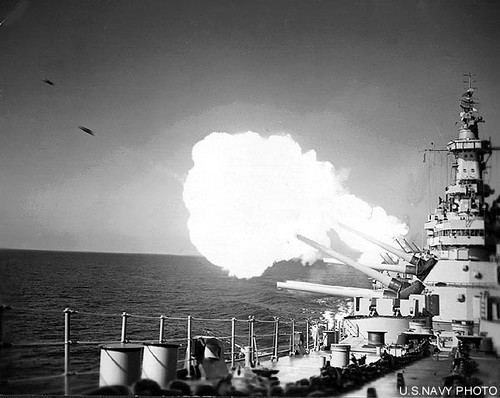
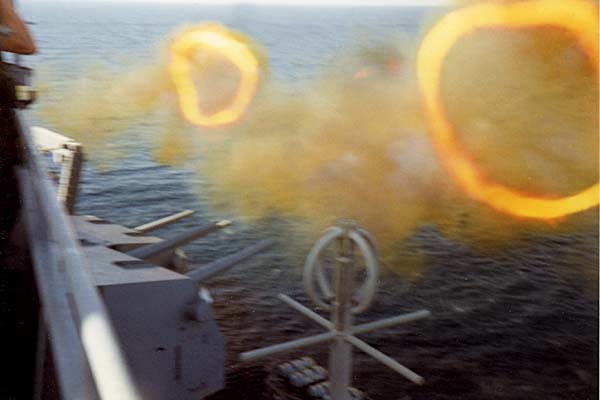
One of the last. Great history. USS WISCONSIN (BB-64). BTY, shipmates have a great website as well. Just don't like it too much.


Oh, and for some perspective about how far the Battleship came to peak of the Iowa class, here is a nice pic of her next to the uprighted USS OKLAHOMA (BB-37).

As a final commentary - the USS OKLAHOMA (BB-37) was commissioned in 1916. The USS WISCONSIN (BB-64) in 1944. 28 years. Click that link above and come back.

The first
TICONDEROGA class CG was commissioned 35 years ago. The next "ship of the line" to be commissioned will be the Flight IIA ARLEIGH BURKE Class Destroyer USS Thomas Hudner (DDG-116).

There are a couple of transformationalists that I have friendly exchanges with on-&-offline. Their constant refrain is that we are in a period of radical technological advancement.

That always bothers me - no, we are not. 1898-1918. 1916-1944. 1939-1962. Please. We are not even close to be in a period of quickening.

If we looked as technology as a tool and not an answer, we would save a lot of blood and treasure. Be humble.

Friday, September 21, 2018

Fullbore Friday


HMS Nelson. One of the more curious, no, the most curious Battleship classes (2) ever built. 

The first thing that comes to mind is "Shipmate, where is your stern?" If it looks like a ship built by committee, well that is because it is. 

A product of The Washington Treaty, "compromises" were made. Though it was the only RN ship with 16" guns, the ship herself was a tad slow, and once the war was done - like the rest of the RN Battleships - off to the breakers she went.


Best pictures here. Other sites here and here.


Orig. posted 16JUN06.

Friday, July 29, 2016

Fullbore Friday


HMS Nelson. One of the more curious, no, the most curious Battleship classes (2) ever built. The first thing that comes to mind is "Shipmate, where is your stern?" If it looks like a ship built by committee, well that is because it is. A product of The Washington Treaty, "compromises" were made. Though it was the only RN ship with 16" guns, the ship herself was a tad slow, and once the war was done - like the rest of the RN Battleships - off to the breakers she went. Best pictures here. Other sites here and here.


Orig. posted 16JUN06.

Sunday, May 22, 2016

The Battle of Jutland & the Time of the Battleship with Rob Farley - on Midrats


We are coming up on the 100-year anniversary of the Battle of Jutland. Stop for a moment, close your eyes, and then tell me what image comes to mind.

If your image is of a huge mass of steel coming at you out from the mist at 25-knots belching out sun-blocking clouds of coal-smoke and burned black powder and searing fingers of flame pushing tons of armor-piercing explosives, then this is the show for you.

For the full hour this Sunday from 5-6pm Eastern we will have as our guest a great friend of the show, Robert Farley. We will not only be discussing the Battle of Jutland, but battleships in general in the context of his most recent book titled for clarity, The Battleship Book.

Rob teaches defense and security courses at the Patterson School of Diplomacy at the University of Kentucky. He blogs at InformationDissemination and LawyersGunsAndMoney. In addition to The Battleship Book, he is also the author of, Grounded: The Case for Abolishing the United States Air Force.

Join us live if you can with the usual suspects in the chat room and offer up your questions for our guest, but if you miss the show you can always listen to the archive at blogtalkradio or Stitcher

If you use iTunes, you can add Midrats to your podcast list simply by clicking the iTunes button at the main showpage - or you can just click here.