Showing posts with label WWI. Show all posts

Friday, January 20, 2023

Fullbore Friday

 "Hey, we have this bizarre operation that has a shoestring budget, is in the middle of nowhere, and is asking for something to be done that has never been done before. Most likely, if the people sent are ever seen again, it will end in abject failure and humiliation for the officer leading it. Who should we send?"


"Hey, who is that weird 40-yr old LCDR down the hall with all the strange tattoos and whose uniform is all out of wack? I have no idea what he does at that desk, I won't miss him."

"Oh, you mean LCDR Geoffrey Basil Spicer-Simson?"

"Yes, that chap. He has an eclectic background fitting his personality. I think he just might be the fit."

And so starts a story that inspired books, radio programs and movies ... all for a wee spat in an important but relatively forgotten backwater.


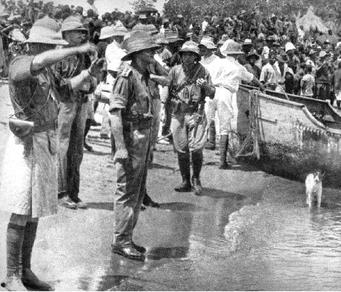
...and below is Spicer-Simpson, right after he captured the German ship Kingani. Yes, he went to war in a skirt.


If you find the naval campaign in Africa interesting, I did another post a few years ago I'd recommend.

Hat tip Campbell. First posted AUG2018.

Friday, November 11, 2022

Fullbore Friday

Yes, in America - for some reason I simply do not agree with - we took what was for the rest of the West, Remembrance Day, and turned it in to Veterans Day.

Yes, we have Memorial Day - which in the larger scheme of things is our "Remembrance Day" - but especially after living for years in Europe, I came to see the 11th of November as something else than what I grew up with.

WWI was such a stupid and unnecessary war. The two empires that dragged the rest of the West and its auxiliaries in to this meatgrinder, the Austro-Hungarian Empire and the Russian Empire, were destroyed by the end of the war. Their culture, empires, and dynasties disintegrated and disaggregated.

The German Empire - who joined simply because it had a treaty and could not stop the momentum to war - was also disintegrated and disaggregated in a way that set the conditions for what could subjectively be described as the world's most educated, cultured, and advanced nation to start the next world war a decade later.

The British Empire - who joined the scrap for reasons not unlike the German Empire - was bled white, and never really recovered.

The French Republic - who again joined in by a sense of duty and was unable to control their momentum to war - like the British were bled white and whose soul was even further weakened to the point she simply could not rise to the occasion when required a decade later.

That does not even begin to describe the horrors of the Italian or - apocalyptic like - the Serbian/Balkan experience. 

As Americans, I think we miss a lot by changing the meaning of the 11th of November: the end of the West's civil war that resolved little but did sow the seeds for a century of bloodletting and political nightmares at the throat of our species. Nightmares whose echoes still haunt us.

We don't think enough about The Great War. We should.

So, the American in me says to my fellow veterans ... I see you. The Westerner in me is, just, well, sad and humbled at the absolute sacrifice and bravery of millions, and the utter evil and incompetency of leaders in the early 20th Century who could not stop themselves from destroying almost everything.

So many lives spent to gain the world we have today. Is it better or worse than it would have been otherwise? Not known, but the price we paid is almost incalculable. 


Friday, October 28, 2022

Fullbore Friday

I like well hidden history, especially those with good shoes.

There are many stories out there that we are only now hearing about ... and this is one. From 
DailyMail,
In May 1919, with World War I recently over but with the Russian Revolution turning into a full-scale "Red Terror," the head of MI6, Sir Mansfield Cumming, known as "C," had a desperate problem.

A British agent - Paul Dukes - had infiltrated spies into the Bolshevik government and made copies of top secret documents, but he was cut off in Petrograd (present-day St Petersburg).

Dukes, a 30-year-old concert pianist from Bridgwater, Somerset, was a master of disguise, hence his admiring soubriquets such as "The New Scarlet Pimpernel" and "The Man with A Hundred Faces."

The only MI6 agent ever to be knighted for his services in the field, Dukes was, as Ferguson writes: "The sort of spy we all wanted to be."

The Government in London desperately needed a personal briefing from him about the situation in Russia, as well as the documents in his possession. But how to get him out?

Cumming asked a 29-year-old naval lieutenant, Augustus "Gus" Agar, to undertake a seemingly suicidal mission to rescue him.
 
An expert in skippering high-speed Coastal Motor Boats (CMBs), Agar was asked to come up with a plan to cross into Russian territorial waters in the Gulf of Finland and spirit Dukes out of the country, before the Russian secret police, the Cheka, were able to capture him.

The task was awesome. The borders had been sealed and a succession of couriers who had tried to cross them had been captured; six were betrayed, tortured and shot in one fortnight alone. So a high-speed boat landing at a pre-arranged rendezvous on the coastline near Petrograd was planned instead.

CMBs were 40ft long, had a crew of three, carried two Lewis machine guns and a single torpedo. They had hydroplane hulls, hence their nickname "skimmers," but were made of plywood so were almost defenceless against enemy fire.

The fastest naval vessels afloat, they were ideal for slipping past the huge array of defences in the Gulf of Finland - except for the deafening noise they made when they reached their top speed of 45mph.

Protecting the sea approach to Petrograd was the forbidding island fortress of Kronstadt and its 15 forts - nine to the north, six to the south - with enough guns to halt any enemy fleet.

Furthermore, the forts were connected by a hidden breakwater that MI6 told Agar was only three feet under the surface and which, since CMBs drew 2ft 9in of water, meant that his two vessels would have only three inches to spare at normal speed.
Although the Gulf of Finland is 250 miles long, it is only 30 miles wide, and with gunboat patrols, floating and fixed mines, searchlights, submarines and seaplanes, it seemed impassable to any but the most intrepid sailor.

Cumming explained the mission to Agar in his office in Whitehall, and ordered him to choose only unmarried men with no immediate dependents for his seven-man team; Agar himself had been orphaned at the age of 12, and although he had a sweetheart they were not then engaged.

Cumming also warned Agar that in the event of capture he could expect no help, or even official recognition, from the British Government.

His unit would be in plain clothes, although Royal Navy uniforms and caps would be donned in the event of capture, to protect them from being shot as spies.
If the story sounds interesting, click the link above for an extended summary, or you can get the details in Operation Kronstadt: The True Story of Honor, Espionage, and the Rescue of Britain's Greatest Spy The Man with a Hundred Faces by Harry Ferguson.

Wouldn't it make a great movie ... if Hollywood still made movies of this type?

Wrong heroes, I guess.


Originally posted JUL10.

If you want to hear more, and I know you do, historian Justin Reay has almost an hour for you on a man who two world wars later would rise to the rank of Commodore.

Friday, October 07, 2022

Fullbore Friday

Ordinary men often find themselves in extraordinary times, become extraordinary, and then return to ordinary.

That does not prevent us from remembering them.

On the eve of the Second World War if you found yourself in Birmingham, England you may have found yourself in the company of a middle aged optician Edward John Hicks and his wife Ethel. Perhaps their 19-yr old daughter Barbara or 15-yr old Pamela, born a few years after what they would call "The Great War," might make an appearance.


They lived in a simple duplex at 46 Brompton Road. That one on the right.

You wouldn't know that your neighborhood optometrist who makes your glasses was also this man.
Say hello to Lieutenant Edward John Hicks, MC, British Army, 2nd Hampshire Regiment. He was awarded the Military Cross for bravery at the Battle of Passchendaele in 1917. After fighting for the first two years of the war as an enlisted man, he was brought up from the ranks and completed officer training in 1916.

Clearly a good soldier and leader to be brought up, and he knew what that meant. Second Lieutenants only had a short lifespan on the Western Front. You needed luck...but more than that, you needed to be good. Better than good.

In WWI, the MC was the second highest award after the Victoria Cross. Roughly the equivalent to a Navy Cross in the USN.
The Battle of Passchendaele, sometimes called the Third Battle of Ypres, took place from June through October 2017. Yes, for the third time in as many years, there would be a major battle over the same bit of ground.

If you have seen this picture from WWI, it is from Passchendaele. This is where they fought.

When it was all said and done, the British Empire, French, and Belgians suffered over 300,000 casualties, and the Germans nearly that much. Both sides may have had more, no one really knows. Such was that war.

So, we have Edward. Halfway through the battle on September 2nd,1917 he joined the 2nd Hampshire Regiment.
Six weeks later, there he was, in the thick of it. 
The 2nd Hampshire, who left Parroy Camp at 9 .15 p.m. on October 8th, found moving up into the assembly positions more than usually difficult : the expanded Steenbeek had to be crossed, the German shelling was fairly heavy and caused both W and X Companies several casualties, while it rained hard all the time ; but if conditions could hardly have been worse,' somehow the positions were duly taken up, and at 7 a.m., 100 minutes after ` Zero ', the battalion started forward in ' artillery formation '. The fire was heavy, but it was some compensation for the mud that it partly smothered the shell-bursts, direction was well kept, thanks partly to having the railway line to go by, and before long the Hampshire were digging in on the Namur Crossing Line, which the Worcestershire had taken well up to time, subsequently going forward again. Advancing again at 8 .50 a.m., the Hampshire were heavily shelled but, admirably directed by Colonel Spring, established themselves just behind the second objective, which also the Worcestershire had duly secured despite stubborn opposition, taking 200 prisoners. On this line they dug in, 2/Lt. Hicks, though wounded and then buried by a shell-burst near him, set a splendid example, continuing at duty and holding on to his post. Then, about 4 p.m., counter-attacks from the NE. forced the Newfoundlands back from the third objective, which they had reached, their left being pushed back across the Poelcapelle—Cinq Chemins road. They rallied, however, and Colonel Spring was prompt to reinforce them and fill up any gaps in their line, while 2/Lt. Scutt formed a defensive flank on the left with his platoon, rallied officer less men who were retiring and restored the situation. After dark the Hampshire relieved the Newfoundlands in what was now the front line, running about NW. from near Tranquille Farm across the Poelcapelle—Cinq Chemins road,' the relief being smoothly effected. During the night, while patrols successfully located the enemy, taking several prisoners, the line was consolidated, with support and reserve lines behind it. Sergeant Sillence, acting as C.S.M., who had been conspicuous during the advance in assisting his officers and setting a fine example, was now much to the fore in directing the consolidation despite heavy shelling. The enemy's snipers were active, especially from Taube Farm to the right front, causing several casualties, and during the night several times fighting patrols approached our lines, two of about 30 each being dispersed by Private Bray, who was out with a Lewis-gun in front of our line, while Sergeant Martin beat off another and Lance-Corporal Jerram and Private Smith did useful work in scouting and detecting the enemy's efforts to advance. Except for barraging a line the battalion was not holding, the German artillery was inactive, and though such wet ground made the work difficult, real progress was made next day with the consolidation, very good work being done by the battalion runners in keeping up communications. Early in the afternoon the Brigade Major reached battalion head- quarters, now at Pascal Farm, East of Koekuit, with orders for the capture of a troublesome ` strong point ' to the left front near Cairo House. There was barely time to organize an attack before the barrage came down, but Lt. Colonel Spring went forward through a heavy barrage to W Company's head-quarters to arrange the attack, and W was just ready before our barrage began at 5 .30 p.m. Advancing with two platoons in a front wave and one supporting, the company, well led and skilfully directed by Captain Cuddon, who was well backed up by Sergeants Trethewy and Parker, mastered its objective, despite stubborn opposition. Many Germans were accounted for, a Lewis gunner, Private Gosling, dispersing one party of 30 single-handed, and a good line was established 50 yards NE. of the buildings and linked up to the rest of the line. That evening the 7th Lincolnshire (Seventeenth Division) arrived to relieve the Hampshire. A dark night made this difficult, but thanks to good arrangements for guides everything went off smoothly and by 8 a.m. next day (October 11th) the Hampshire were back at Elverdinghe . 2/Lt. Lloyd and 18 men had been killed and Captains C. T. Ball and Mudge, Lt. A. G. Smith, 2/Lts. Cutmore and Hicks and 74 men wounded. One noticeable feature of the action had been the increased expenditure of rifle ammunition; in bringing up reinforcements the enemy had given better targets than of late and, with more chances of using the rifle, battalions which had been careful to maintain their standards of musketry had reaped the benefit.

A Military Cross is not just mailed in. Six months later;
The King. King George V, grandfather of the recently passed Queen Elizabeth II, and great-grandfather to King Charles III.

Sadly, we don't know the details of Edward's wounds, but it would be 10 months until he could rejoin his regiment.

In the days before antibiotics and CASVAC, one can only imagine;
He was wounded a second time the first week of September 1918 a few kilometers north of Armentières, Belgium.

In two more months, the war was over. Then he went home as millions of other survivors of that horribly bloody war. The came home and helped make the world we live in today.

Edward fought as an infantryman - both enlisted and as an officer - for the entire length of the war from 1914 to 1918. The United Kingdom had almost 1-million men killed in the war, another 250,000 or so from her Empire. 

Wounded twice, Edward was one of them who made it home and had to do his best to make a future worthy of their sacrifice. He came home to industrial Birmingham to be an optometrist. He started a family, and there is how he found himself to The Front Porch.

Edward is the great-grandfather of friend to the blog and guest of Midrats, Emma Salisbury. I saw her note about her great-grandfather on twitter and she was kind enough to share with me the exceptional summary of Edward's records provided to her by The Royal Hampshire Regiment Museum where most of the above information was taken from.

Thank you Emma, and to your great-grandfather and all the men like him of his generation - fullbore. 


Friday, August 19, 2022

Fullbore Friday

The Russo-Ukrainian War of the last six months is reminding everyone - I hope - that war in a large measure does not change. Yes, some new technologies and ideas comes in that no one appreciates the value of until proven on the field of battle, some established technologies and ideas no longer work, and that process of integrating battlefield lessons often determines who gets better results over time.

At the end of the day, it is taking ground, keeping ground, and positioning yourself for more.

Thinking of that reminded me of a FbF from 4.5yrs ago that I thought I would bring back this week.


One of the enduring characteristics of WWI was the amount of blood that was shed over and over and over for such small bits of land.

So it was again in March of 2015;
French Commander-in-Chief General Joffre considered it vital that the Allied forces should take every advantage of their growing numbers and strength on the Western Front, both to relieve German pressure on Russia and if possible break through in France. British commander Sir John French agreed and pressed the BEF to adopt an offensive posture after the months of defence in sodden trenches. Joffre planned to reduce the great bulge into France punched by the German advance in 1914, by attacking at the extreme points in Artois and the Champagne. In particular, if the lateral railways in the plain of Douai could be recaptured, the Germans would be forced to evacuate large areas of the ground they had gained. This belief formed the plan that created most of the 1915 actions in the British sector. The attack at Neuve Chapelle was an entirely British affair – the French saying that until extra British divisions could relieve them at Ypres, they had insufficient troops in the area to either extend of support the action.
It is one thing to see the map of a battle as you see in the upper right hand part of the page - but here is a bird's eye view of the battlefield today. Driving through this now, it is an incredibly beautiful part of Europe - not the hellscape it was.


Neuve Chapelle village lies on the road between Bethune, Fleurbaix and Armentieres, near its junction with the Estaires – La Bassee road. The front lines ran parallel with the Bethune-Armentieres road, a little way to the east of the village. Behind the German line is the Bois de Biez. The ground here is flat and cut by many small drainage ditches. A mile ahead of the British was a long ridge – Aubers Ridge – barely 20 feet higher than the surrounding area but giving an observation advantage.
...
The attack was undertaken by Sir Douglas Haig’s First Army, with Rawlinson’s IV Corps on the left and Willcock’s Indian Corps on the right, squeezing out a German salient that included the village itself. The battle opened with a 35 minute bombardment of the front line, then 30 minutes on the village and reserve positions. The bombardment, for weight of shell fired per yard of enemy front, was the heaviest that would be fired until 1917.
...
Three infantry brigades were ordered to advance quickly as soon as the barrage lifted from the front line at 8.05am. The Gharwal Brigade of the Indian Corps advanced successfully, with the exception of the 1/39th Gharwal Rifles on the extreme right that went astray and plunged into defences untouched by the bombardment, suffering large losses. The 25th and 23rd Brigades of the 8th Division made good progress against the village. There were delays in sending further orders and reinforcements forward, but by nightfall the village had been captured, and the advanced units were in places as far forward as the Layes brook.
As was often the case in WWI - this 1915 battle was an experiment that hopefully informed future tactics. The price for this little wedge of land?
Casualties

The British losses in the four attacking Divisions were 544 officers and 11,108 other ranks killed, wounded and missing. German losses are estimated at a similar figure of 12,000, which included 1,687 prisoners.
...and the lessons?
It demonstrated that it was quite possible to break into the enemy positions – but also showed that this kind of success was not easily turned into breaking through them. The main lessons of Neuve Chapelle were that the artillery bombardment was too light to suppress the enemy defences; there were too few good artillery observation points; the reserves were too few to follow up success quickly; command communications took too long and the means of communicating were too vulnerable. One important lesson was perhaps not fully understood: the sheer weight of bombardment was a telling factor. Similar efforts in 1915 and 1916 would fall far short of its destructive power.

History tells us that we will again see larger-scale, heavy-casualty, nation-exhausting wars again. We are actually overdue for one. Like the decades of relative peace that followed Napoleon, so we too have enjoyed a long peace after the Cold War.

Human nature and habits are unchanged. This will come again, but when? Next week, next year, next decade? Where?

No one really knows, but what we can know is that it will most likely be a surprise. It will not be a short war. It will not be an easy war, and the world that comes after will be a foreign world than that existed before some nation's best and brightest thought they could control events.


Oh, and speaking of lessons, LongLongTrail forgot this one that History got. We'll see this again too;
The slowness and inaccuracy of communication between the front lines and the corps headquarters—the army had no wireless technology, and telephone lines at the front were usually cut or destroyed by enemy fire during battle—caused Lieutenant-General Sir Henry Rawlinson, the corps commander, to order a fresh advance when support troops were unprepared. In the confusion, some artillery even opened fire on friendly infantry. By the late afternoon, forward units were attacking without adequate artillery support or effective coordination, in failing light, against a hardening German defense.
...
... it (was) incredibly difficult for commanders on both sides to know where and when to effectively deploy their reserve troops. General John Charteris, director of military intelligence under British commander Alexander Haig, took another sobering lesson from the battle, writing that “England will have to accustom herself to far greater losses than those of Neuve Chapelle before we finally crush the German army.”

Friday, July 22, 2022

Fullbore Friday

If you look around in certain corners of the world, you can find little things that make you give a double-take. 

For instance, why is there a statue of an American General in a WWI uniform in the same park as a monument to the Soviet Red Army?


Have you ever heard of Major General Harry Hill Bandholtz, USA?

Probably not. What did he do that would warrant such a statue in such a location?

On August 11, 1919, General Bandholtz arrived in Budapest as one of four generals (English, French, Italian, American) to become the Inter-Allied Control Commission for Hungary, primarily to supervise the disengagement of Romanian troops from Hungary.

He became famous when, on the night of October 5, 1919, as President of the Day of the Commission, mainly through bluff, armed only with a riding crop, he prevented a group of Romanian soldiers from removing Transylvanian treasures from the National Museum.

The statue was erected in 1936, and stood throughout World War II with the inscription, in English,

“I simply carried out the instructions of my Government, as I understood them, as an officer and a gentleman of the United States Army.

In the late 1940s the statue was removed “for repair.” It lay in a statue boneyard until the 1980s, at which time it was placed in the garden of the U.S. Ambassador’s residence, at the request of then-Ambassador Salgo. It was re-placed in Szabadság tér at its original location in July 1989, just a few days before the visit of President Bush.

Is there any better quote for an officer to be remembered by?

For you history buffs of the labor troubles of the 1920s or pre-WWI counterinsurgency efforts in The Philippines, he had a noteworthy record with interesting peers...but for the Hungarians ... fullbore.


Friday, April 29, 2022

Fullbore Friday


In war, it often is not what you were designed to do. It is not what in theory what you were primarily trained, manned, and equipped to do. No. More often than not it is what you must do. What you are needed to do. What you may be the only unit in place to do.

There is also, like we saw in the below - what must be done now with what is at hand. With the right leadership, a lot is possible. The dogmatic, rigid, and blinkered - things that are often rewarded in peace - are not what gets the job done in war. One hopes that in peace we accept the above truth and only have our minds dogmatic, rigid, and blinkered. Hopefully we have enough intellectual and material flexibility to be able to do what is needed and must be done. To improvise, adapt and overcome.

A bit of a encore FbF, but as the original video links don't work from 2010, and I like to emphasize the important fundamentals, I would like to bring back the Battle of Beersheba; almost 105 years ago.
The Turkish defences of Beersheba were strongest towards the south and west. There they had a line of trenches, protected by barbed wire, supported by strong redoubts, all constructed along a ridge. To the north and east the defences were much weaker, and crucially lacked any wire. No serious attack was expected from the area of rocky hills east of the town. Beersheba had just been designated as the headquarters of a new Turkish Seventh Army, but on 31 October that army had not yet come into being. The town was defended by 3,500-4,000 infantry, 1,000 cavalry with four batteries of artillery and fifty machine guns.

Allenby allocated a very powerful force to the attack on Beersheba. Three infantry and two cavalry divisions would take part in the attack. Two of the infantry divisions were to attack against the main Turkish defences, to the south west of the town, to tie down the Turkish garrison. The third division was to protect against any Turkish reinforcements arriving from the north-west. Meanwhile, the two divisions of the Desert Mounted Corps (Anzac Division and Australian Division) were sent around the town to the east, with orders to sweep into the town through the weaker eastern defences.

The infantry attack proceeded entirely according to plan. The bombardment began at 5.55am, and lasted, with one gap, until 8.30. Over the course of the day the Turks were slowly forced out of their strong defensive positions, the last of which fell at around 7 p.m. The attacking infantry suffered 1,200 casualties during the battle.

At 9.00 am the Desert Mounted Corps was ready to attack the eastern defences of Beersheba. The New Zealand Brigade of the Anzac Division soon ran into a problem. The Turks had a strong defensive position at Tel es Saba, a steep sided flat topped hill three miles east of the town. The battle to capture the Tel took up all of the morning and much of the afternoon, and did not end until 3 p.m.

General Chauvel then decided to take something of a gamble. The delay at Tel es Saba threatened to prevent the capture of Beersheba before dark. Rather than continue with the methodical plan of attack, Chauvel ordered one of his reserve brigades, the 4th Australian Light Horse, to mount a direct assault on Beersheba. They had the ideal terrain for a cavalry charge – a long gentle slope running down into Beersheba. It was defended by two lines of trenches, but crucially not by barbed wire.

The attack soon developed into a classic cavalry charge. The 4th A.L.H. simply galloped over two lines of Turkish trenches. Part of the brigade then dismounted to attack the trenches, while the rest galloped on into Beersheba. There they found a Turkish column preparing to retreat. The sudden appearance of the Australian cavalry caused panic. Most of the 1,500 prisoners captured by the Desert Mounted Corps on 31 October were taken during the charge of the 4th A.L.H. The Australians suffered very light casualties during the charge of 32 killed and 32 wounded, most of them in the attack on the trenches east of Beersheba.
The whole movie The Lighthorsemen is available - but I would like you to go ahead to the 1:20 mark for the charge (the German officer's assumptions at 1:34 is critical). One of the best filmed scenes in the genre - if it doesn't raise your heart rate, pressure nothing will.

First posted OCT 2014.

Friday, January 14, 2022

Fullbore Friday

What is duty, duty to yourself, those who work for you, your mission, those who gave you your mission, and the purpose the mission was created?

How do you rack and stack these priorities?

Once again, my mind went to the story of T.E. Lawrence;

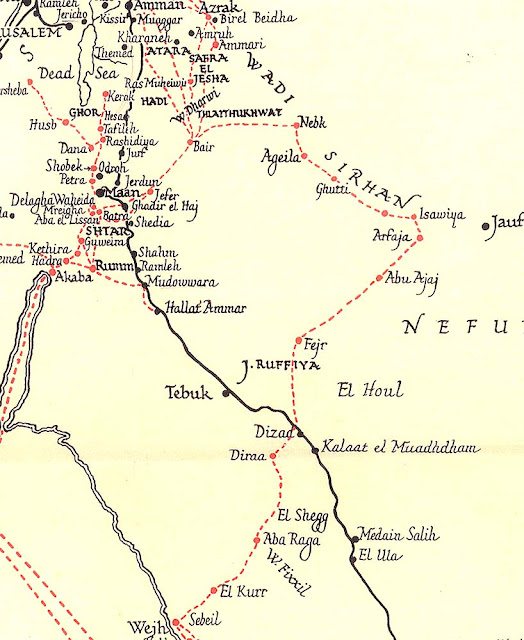
The next morning, 23 May, the party left Khabra` Abu Ajaj and rode northeast by north to a group of wells of `Arfajah, whereby they aimed at entering the lower Wadi Sirhan, passing over a vast, flat, empty, no-man’s land which was called Bisayt [Biseita] meaning a carpet. In the evening they came to the top of a sand ridge named Ja`ala [Jaala] and slept there peacefully. According to the maps to be mentioned later, this is exactly a midway point between Fajr and `Arfajah.

The next day, 24 May, was to become memorable for the rescue of Qasim [Gasim] by TEL when he was lost in the scorching Bisayt. He was one of TEL’s bodyguards though he was no Agayl but from Ma`an, ‹a fanged and yellow-faced outlaw, who fled into the desert and joined the Howeitat after killing a Turkish official in a dispute over cattle-tax. Crimes against tax-gatherers had a sympathetic side to all of us, and this gave Gasim a specious rumour of geniality which, we discovered later, was actually far from the truth (p.242).›

TEL, solely out of a sense of duty and not from humanity, had turned his unwilling camel round, and forced her back into the emptiness behind.

When TEL finally caught up the party with Qasim who had gone nearly insane from horror and heat and thirst sat on his camel’s rump, no one praised his deed. Auda said he would not have let TEL go back had he been present, and struck Qasim sharply. Nasib went so far as to blame TEL for such a whim to Nasir, saying it was clear to him that TEL must have reckoned they would come back.

That evening, they decided not to go farther and camped at Qusaym `Arfajah, contentedly even without a mouthful of water, because they were already at the south bank of Wadi Sirhan and `Arfajah was within their sight.

On 25 May, at 8 o’clock in the morning, TEL’s party reached the wells of `Arfajah. This ended the first leg of his journey for the `Aqaba raid.

Qasim. If you know the story ... you know the story. What makes you feel like you did the right thing in your context, may not be in the larger context ... and can end in ways you wouldn't expect.

Leadership is hard. Duty seems simple, but it is not. Many times there are no correct answers or actions, only the less imperfect - you hope. 

Time travel is not possible. Not all effects are known ... they just are.


Friday, November 12, 2021

Fullbore Friday


Allow me a little self indulgence (again) this Friday. USNI triggered me this AM:

It made me grin a bit because my paternal grandfather was a Sailor on the USS ARKANSAS (BB-33) with the 6th Battle Squadron that day.

The Germans never made their last thunder run in 1918 as that horrible and useless war ground to a halt, so they never saw action - which for my grandfather and much of his shipmates I am sure was quite fine.

I could only imagine him looking at his Royal Navy neighbors that day thinking things along the lines his grandson would think.

Anyway, to the Sailors in 1918 of what would become an old warhorse USS ARKANSAS (BB-33) - when she and you were young and the war done; fullbore.


Friday, October 08, 2021

Fullbore Friday

You were born to immigrant parents.

At home you spoke a different language than outside the home. A language that in your adulthood would – by simply speaking it – be a source of hate.

You were part of a small religious minority.

You were smart though, and resourceful.

You excelled in academics and were an accomplished engineer. You did dearly love your country and while in college decided to help serve it by joining what we would call the Army National Guard.

By the end of three decades, people – peers, subordinates, historians and Field Marshalls alike - would say things like this about you;

"a great bullock of a man... though his manners were pleasant and his behaviour far from rough, I have seen few men who gave me such a sensation of force... a fit leader for the wild men he commanded” …  "…the best general on the western front in Europe" … "the only general of creative originality produced by the First World War."

Most Americans and others outside the Commonwealth may not know of General Sir John Monash, Australian Army. He passed away 90-yrs ago today.  Take a moment to read up on him via the links above. More than worthy of a FbF.

Embedded in his story is a great example of responding to mindless prejudice through superior performance … and to the great credit of leaders and people who notice it – pushing petty bigots to the side.


H/t Gray Connolly


Friday, September 17, 2021

Fullbore Friday

Even though I posted this FbF again 6-months ago I wanted to bring it back just to add something quite special via twitter-friend Simon. 

From WWI we don't have must contemporary video of the people we read about, but in this case we do. 

Just 36.

Men his age saw the height of Edwardian Empire as young adults leading in to the extinction of their world in WWI, the nightmare of the depression and WWII in their middle-age and then - for those who survived - the poverty and decline of the post-WWII era for Britain. 


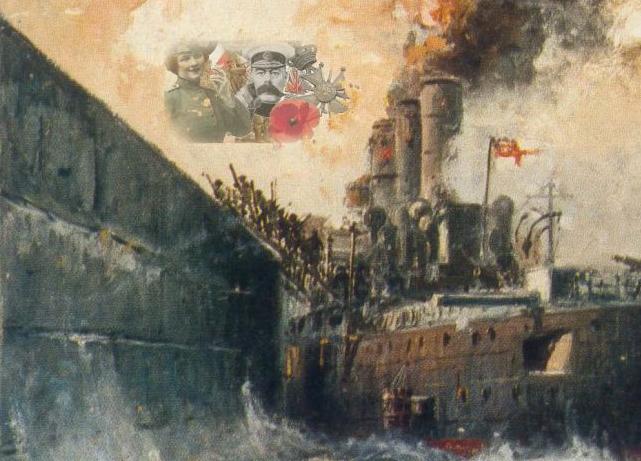
Zeebrugge. If you have been there or to its inner city Brugges you know what a beautiful and peaceful place it is - as most all of Belgium is today. 

In 1918 though, Belgium was a nightmarish slaughterhouse where the bodies of millions were blended into the beaten earth - where like Okinawa and Iwo Jima over a quarter century later - the living earth would move with a blanketed mass of maggots.

In one of history's subtle hints she will give you early if you wish to listen, Britain found herself on the edge of starvation due to a threat few understood or even knew of at the beginning of the war - the submarine. Something new, unexpected and decisive needed to be done.
By 1918, the Great War had entered a decisive phase. While Russia had been knocked out of the war, its place had been taken by the United States, which now provided a fresh pool of manpower and industrial capacity to the Allied cause. The transfer of these resources however was threatened by the continuing war at sea and the U-Boat menace that also threatened Britain's link with the continent. The early advance by the German Army in 1914 had meant that the Belgian ports of Ostend and Zeebrugge had been overrun and with the expansion of the port facilities, the Germans were in a position to threaten the very lifeline that supplied the Allied armies in France. The two ports were connected by a canal network with the city of Brugges that also gave access to the open sea. Brugges in turn, was connected to Germany by the railway network and partially completed U-Boats were shipped from Germany, to be finished at Brugges and then make their way to the open sea by means of the canal system. The canals formed a triangle and inside this, the Germans had built a series of airfields from which they conducted air raids on Britain and fortified the entire length of the coast with light and heavy artillery batteries. The Royal Navy did not attempt to bombard these ports until 12 May 1917 when it bombarded Zeebrugge in order to put the lock system out of action and used a smoke screen to hinder German observation. While the bombard failed in its task, the Germans stepped up defensive measures and as the war progressed, the front line drew ever closer to Ostend, bringing it within range of the Royal Marine heavy howitzer battery in France, forcing the Germans to transfer many of its facilities to Zeebrugge.

One of the objectives for the Third Battle of Ypres (Passchendaele) was the expulsion of the Germans from Flanders and to capture the ports of Zeebrugge and Ostend. The battle however failed to achieve the intended breakthrough and so any attempt to expel the Germans from these ports or to deny them the use of these facilities meant that any future attempt would have to made from the sea. The mounting losses in the war at sea caused the Royal Navy to look at the problem. A suggestion by Admiral Keyes that the ports might be blocked by sinking a ship in the entrance was initially rejected but as the war dragged on, the Royal Navy returned to the idea and it was decided that it might be done with the use of several ships, although the exact position would have to be chosen with care so that it would not be possible to get around the ships or to dredge around them to create additional channels and their bottoms would have to be blown to sink them as quickly as possible and prevent drifting.
So, as it is often done in this line of work, the word went out. Volunteer for a mission you have no idea about - odds are you won't come back. You will be trained quickly, sloppily with a pick-up team. You execute.
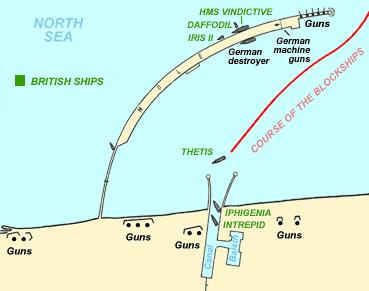
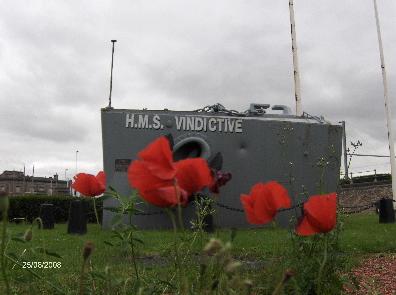
As the ships were approaching the entrance to the port, some protection would be afforded (in the case of Zeebrugge) by the Mole, which extended in an arc across the entrance to the channel. It was over a mile in length and some 100 yards wide, having extensive storage facilities and hangers for seaplanes. A railway connected the Mole to the shore and was used to transfer men, equipment and stores. As the planning for the operation got underway, a special Royal Marine battalion (mainly volunteer) was formed in February 1918 to eliminate the battery that was situated at the end of the Mole and would threaten the block ships as they approached the canal. Lt Col F E Chichester was appointed to command the battalion but was succeeded by Major B N Elliott. The battalion consisted of a headquarters, a machinegun section, a mortar section, three rifle companies and medical support staff. The troops were to be conveyed to Zeebrugge in HMS Vindictive, assisted by the Iris and the Daffodil, two Mersey ferry boats that had been provided for this operation. Once they had reached Zeebrugge, Daffodil was to push Vindictive against the Mole until she could be secured and disembark the troops. The ships were modified for this task. Special ramps were fitted to Vindictive so that the storming parties could reach the Mole, while Iris and Daffodil had been fitted with ladders to that their parties could climb up onto the Mole. Vindictive was strengthened and armoured against the storm of fire she would receive and additional armament fitted so she could support the troops as the moved onto the Mole.

By April 1918, the preparations for the raid had been completed, the men trained for their tasks and the shipping collected for the operation. Three block ships were to be sunk in the Zeebrugge canal entrance, HMS Thetis, HMS Intrepid and HMS Iphegenia. The first time the force sailed, 11 April 1918, the weather conditions changed as they neared Zeebrugge, which forced a postponement, but on the eve of St George's Day, 22 April 1918 the force sailed and during the passage, Admiral Keyes signalled "St George for England". Commander Carpenter on the Vindictive replied, "May we give the dragon's tail a damned good twist." By 23.20 on 22 April, the monitors had opened fire on Zeebrugge. Twenty minutes later, the motor launches that had accompanied the force began to make the smoke screen. One minute after midnight, St George's Day, Vindictive arrived alongside the Mole after which Daffodil arrived alongside her to push her against the Mole. By this point the smoke screen had begun to lift and the defensive fire was intense. In the approach to the Mole, many of the ramps fitted to Vindictive were damaged and only two could be used to allow the storming parties to disembark on the Mole. The ladders fitted to Iris were damaged as well and so the troops had to transfer to Vindictive to land. Once on top of the Mole, they had to endure intense German machinegun fire in order to get to the battery and while they failed to knock it out, they prevented it from firing on the blocking ships and so succeeded in their mission, something for which they suffered heavy casualties for.


The distraction caused by the motor launches and Royal Marines enabled the block ships to approach the canal entrance without too much difficulty. Thetis ran into problems when one of its propellers got caught in a net, forcing her to collide with the bank. She had to be sunk some distance from the entrance but performed admirable work in helping to direct the remaining two ships into the canal entrance itself. Both Intrepid and Iphigenia were able to be sunk in the correct positions, thus blocking the canal. Two submarines, C1 and C3 were packed with explosives and rammed into the viaduct, demolishing it, thus isolating the Mole from the shore. The crews from the submarines and the block ships were picked up by the motor launches despite heavy fire from the German batteries. By 00.50 on 23 April the recall had sounded and by 01.00 the survivors were all aboard. A quarter of an hour later, Vindictive had cleared the protection of the Mole and was undergoing intensive fire from the Germans but managed to come through it. The raid on Ostend at the same time proved to be a failure but another attempt was tried the next month and Vindictive was used as a block ship in that operation. The Royal Marines had been on the Mole for just an hour and the force had displayed such courage and devotion to duty that it gave great encouragement to the Allied forces at such a dark hour in the war. The 4th Royal Marine Battalion was awarded two Victoria Crosses with another six being awarded for the action at Zeebrugge and three being awarded for the actions at Ostend. At Deal, on 26 April 1918, a ballot was held as to who should receive the awards, with Captain Bamford and Sergeant Finch winning. In order that the gallantry of the battalion would be remembered, it was decided that no other marine battalion should be named the 4th.
In a day where entire nations ponder abandoning the battle against an existential threat to their very existence due to a number of casualties suffered at Zeebrugge in a matter of minutes, it can make you wonder if we can even try to understand what these men did and why. We can try. That is what the study of history is. That is why what we have done to the study of history from elementary school through college and as adults is a crime in itself and a shame on our culture.

And in the end;
Much was made of the raid. Keyes was knighted, and 11 Victoria Crosses were awarded. The Germans, however, made a new channel round the two ships, and within two days their submarines were able to transit Zeebrugge. Destroyers were able to do so by mid-May.
Did it make a difference? Of course it did. Did the pundits of the day nit-pic it to death? No, they understood that war from the Strategic to the Tactical is a dark room you step in to. No, it has only been nit-pic'd once the pundits were safely behind the wall of freedom that those who bled built.


First posted NOV08.

Friday, June 18, 2021

Fullbore Friday


Were there milbloggers, gadflies, and other agitators before their time? You bet there were.

Before “CDR Salamander” emerged from the head of Neptune, there were many examples that nudged “me” in to being. They are sprinkled throughout our history, some like Sims are well known – others have faded a bit in to the mists of time.

Today I want to bring someone out in to the light that is worth remembering. He saw well in to the future what realistic technological capabilities were emerging  that would more effectively and efficiently deliver what makes or breaks war at sea; delivering ordnance to target.

Let’s take a moment to appreciate a great naval officer, Admiral Sir Percy Moreton Scott, Royal Navy, 1st Baronet, KCB, KCVO.

To honor him I want to pull a few quotes from his 1919 book, Fifty Years in the Royal Navy. You can get a hard copy at the previous link, or via books.google, a free PDF is available.

Heck, I'll embed it below too.

Remember, this is right after World War One ended.

As I could not convince the Admiralty that the sub marine was anything more than a toy, I considered it my duty to communicate with the Press. On the 15th December, 1913, I wrote a letter but withheld it on representations by a member of Parliament that the Little Navyites, then very powerful in the country, might use it as a weapon to cut down the Navy Estimates, and that I should better serve the country by waiting until the estimates were passed, and Mr. Winston Churchill had got the money. He could then, if he agreed with me, easily strike off some battleships from the building programme, and spend the money voted for their construction on submarines, aircraft, and anti-submarine measures.

Their Lordships were so annoyed with me for venturing to put their heads straight as regards submarines that at the end of the year they took away the pay that I had been receiving for helping them with director firing. Their letter was remarkable for the statement that the installation was practically completed in several ships and that the manufacture of the gear was in a very advanced stage. As a matter of fact, it was only completed in two ships and was not even designed for the various classes of ships in which it was to be installed. In this letter, dated the 30th December, 1913, the Admiralty bade me farewell, expressing " their high appreciation " of my services in connection with “ this sighting gear ” and referring to its marked success."

…..

In due course the Navy Estimates for 1914-1915 were published, and as the substance of them revealed that the Admiralty had realised neither the menace that submarines were to this island country not the necessity of providing measures against them, I sent a letter to the Times on the 4th June, 1914, the gist of which was as follows : 

“ That as we had sufficient battleships, but not sufficient submarines and aircraft, we should stop building battleships and spend the money voted for their construction on the submarines and the aircraft that we urgently needed.

“ That submarines and aircraft had entirely revolutionised naval warfare.

“ That if we were at war with a country within striking distance of submarines, battleships on the high seas would be in great danger ; that even in harbour they would not be immune from attack unless the harbour was quite a safe one.

“ That probably if we went to war, we should at once lock our battleships up in a safe harbour, and that the enemy would do the same. “ That all naval strategy was upset, as no fleet could hide from the eye of the aeroplane.

“ That submarines could deliver a deadly attack in broad daylight.

“ That battleships could not bombard an enemy if his ports were adequately protected by submarines.

" That the enemy's submarines would come to our coasts and destroy everything they could see."

What is the future Navy to be ? Some officers say that the battleship is more alive than ever; others declare that the battleship is dead. I regarded the surface battleship as dead before the War, and I think her more dead now, if that is possible.

The battleship of today costs roughly £ 8,000,000; she carries about 1000 shells containing about 100,000 lbs. of high explosives ; her effective range is, say, 15 miles, she is vulnerable to aircraft with bombs and aerial torpedoes, and to submarines, the latter possibly carrying a 15-in. or 18-in. gun; and the ordinary automobile torpedo is still in process of development, and may, in the future, carry a ton of high explosives, which would probably sink any battleship.

For £8,000,000 we could build many aeroplane-carrying ships, equipped with aeroplanes carrying over 100, 000 lbs. of high explosives. If these aeroplanes carried fuel sufficient for five hours, their range would be about 150 miles out and 150 miles home.

In the battleship we put all our eggs into one basket.

In peace-time the aeroplane - carrying ships could be used as passenger ships, and the aeroplanes for carrying passengers instead of bombs.

As to relative cost of upkeep, the single battleship would require in peacetime about:

- 40 officers ... £8,000 

- 800 men ... £60,000

- Provisions and stores ... £30,000

- Coal ...  £10,000

- (total) ... £108,000

Say £120,000 a year. 

The aeroplane-carrying ships and the aeroplanes would cost nothing ; they would be earning money. The officers and men to form the crews of the ships would belong to the Merchant Navy. Aeroplane pilots will be as numerous as taxi drivers and get about the same pay. The battleship waddles along at twenty miles an hour, and cannot waddle very far, and in comparison with an aeroplane has a very low rate of speed.

The object in war is to introduce high explosive materials into your enemy's ships or country ; transmitting this high explosive by guns is expensive as the container of the high explosive has to be very strong, and consequently very heavy, to withstand the shock of discharge.

It takes a battleship weighing 30,000 tons to carry 100, 000 lbs. of this explosive. Ten aeroplanes weighing about three tons each would carry the same amount, so the relative weights of the carriers is as 30 tons to 30,000 tons.

When the battleship nears the end of her coal or am munition, she must waddle home at about the same speed as a South Eastern Railway train ( I am told that this is the slowest line on earth ), and it takes her several hours to fill up even if she uses oil fuel. The aeroplane does not waddle home, but comes back at 100 miles an hour, and it takes three minutes to fill her up with fuel and am munition. 

The future is with the aeroplane, which is going to develop rapidly in the next few years. Probably we shall also have submersible battleships of 10,000 tons. What chance will the surface battleship, presenting a huge target, have against such a vessel?

Be a gadfly. Take the slings and arrows. You serve your navy and your nation, not a bunch of imperfect people conflicted by personal ambition and the bias of the now. 

Always demand that those in charge of your navy are doing all they can and investing their money wisely so when your nation orders your Sailors in to harm's way, they have better and more capable tools to do their job than your nation’s opponents.

Admiral Scott, fullbore.

As a final note ... I'll just leave this here for the Front Porch;

Financial independence allowed Scott to indulge his intellectual arrogance and judgemental nature, which, when combined with his flair for self-publicity, formed the basis of his fractious relationship with Navy authorities. 
Saturday, August 08, 2020

Fullbore Friday

I was thinking of my grandfathers this week - so a little encore FbF in their memory. Enjoy again.

My Grandfather's Navy, thanks to the good people over at the National Film Preservation Foundation.


Take the time to click here for the whole video. Well worth your time. Here is the background.
U.S. Navy of 1915 (1915)
Production Company: Lyman H. Howe Company. Transfer Note: Digital file made from a 35mm negative. Running Time: 11 minutes (silent, no music).

We are indebted to independent scholar Charles “Buckey” Grimm for identifying this 11-minute piece of the celebrated “lost” three-reel documentary U.S. Navy of 1915, produced by the Lyman H. Howe Company. (The piece had formerly been known only as “U.S. Navy Fragment.”) The film was made with the full support of the Secretary of the Navy, Josephus Daniels, who believed in the power of motion pictures to convince isolationists of the importance of building a strong American navy. A former newspaperman who knew the value of publicity, Daniels allowed Howe’s camera crew remarkable shipboard access. The results show sailors as they go about their day—doing repairs, cleaning the deck, exercising, as well as demonstrating naval might. The film drew praise as capturing “the pulse-beat of the complex life that throbs through our dreadnoughts from reveille to ‘taps.’”

This was not first time the Navy had turned to film to tell its story. Early on, the Navy had collaborated with the Biograph Company on a now-lost series of 60 short films showing sailors and officers at work. The series screened at the 1904 St. Louis World’s Fair and 1905 Lewis and Clark Centennial Exposition in Portland before being put to use in a Midwest recruitment tour. Naval facilities and ships also figured prominently in early newsreels and narratives. The service took care to ensure that depictions presented it in a favorable light and reserved the right, for commercial films shot with official approval, to reuse them for the Navy’s own purposes.

Buckey identified the fragment through careful detective work involving the ships and ordnance on display in the fragment. For example, the “E-2” class submarine, pictured in the opening scene, was taken out of service in 1915, and the shells mentioned in a intertitle—“It costs the U.S. government $970.00 for each 14 inch projectile fired”—were added to the naval arsenal the year earlier. The clincher was matching a frame from the documentary with an image used in a newspaper piece to illustrate the Howe film. Buckey reported his research at the 2010 Orphan Film Symposium at New York University.

Born in Wilkes-Barre, Pennsylvania in 1856, Lyman Hakes Howe got his start as a traveling salesman. In the 1880s he switched to lecturing and demonstrated a miniature working coal mine on the road. When movies came along, he was among the first to make the transition. He devised his own projector, the Animotiscope, which upgraded the Edison machine by adding a second reel, and playing a phonograph to add sound. Soon he was making his own travelogues and newsreels. Little survives of his output other than this fragment.

About the Preservation
The National Film and Sound Archive of Australia generously lent the nitrate print to make the preservation copies. Edge codes on the source material date from 1917, suggesting this print of an earlier film may have been distributed to demonstrate American naval strength after the United States entered World War I. New prints are available at the Library of Congress and the NFSA.
My favorites? Swim call while taking on stores. PT - and the fact they worked in what we now call a dress uniform.

Hat tip Steve.

Friday, February 07, 2020

Fullbore Friday


Funny how things fold in to each other.

I was pondering one of the pivotal scenes of Hemingway's A Farewell To Arms, where in a general retreat, he is pulled to the side by the Carabinieri, as all officers were. They were being briefly interviewed - and then shot. Shot by the very Army that ordered them to retreat in the face of the advancing Germans and Austo-Hungarians.

I decided to dig a bit into the background of the real battle that was the backdrop, and came across this piece of work; Field Marshall Luigi Cadorna.

Historians describe Cadorna as a martinet, excessively ruthless with his troops and dismissive of his country's political authorities. During the course of war he fired 217 officers; during the Battle of Caporetto he would order the summary execution of officers whose units retreated. His harsh approach to discipline has been described as follows by one historian:
One in every seventeen Italian soldiers faced a disciplinary charge in the war, and 61 per cent were found guilty. About 750 were executed, the highest number of any army in the war, and Cadorna reintroduced the Roman practice of decimation - the killing of every tenth man - for units which failed to perform in battle.
Battle Caporetto. That rang a bell. Part of that campaign was the Battle of Longarone.

Why is that of significance? Well ... one of my favorite military minds is Field Marshall Rommel. I got along real well with a German Army 1-star who, much to my shock, had a portrait of him in his office. From him I learned that there are very few WWII officers who are acceptable to have pictures of in your office in the 21st Century German Army - in uniform nontheless. Rommel was one.

One thing that broke Rommel apart from many of his peers was that in WWI he won the "Pour le Merite" - the Blue Max. It is hard to find out how though. Such an award should not be an afterthought.

Well - let's give the good JO his moment. Above you have a horrible battlefield leader - and below let's review the moment that helped bring one of the best battlefield leaders, of any army.

Let's spend a moment to review Rommel at the Tactical level as a JO.

David Irving, in his paper The Trail of the Fox, gives the best account.

General von Below’s aim was to penetrate the main defense line south of the Isonzo River. The high points of the line were the towering Monte Mataiur, Monte Kuk, Kolovrat Ridge and Hill1114. Tens of thousands of Italian troops and well-constructed gun sites commanded each of these high points, and the German unit commanders scrambled to take them, knowing that honors would be the reward. The rivalry among these young officers leading proud units from the German provinces of Bavaria, Silesia and Rommel’s Swabia was ferocious.

Lieutenant Ferdinand Schoerner, a Bavarian commander, set the pace, driving his coughing, staggering volunteers so ruthlessly forward despite their heavy loads of machine guns and ammunition that one of his men dropped dead from exhaustion before the unit reached the objective: Hill 1114, key to the whole Kolovrat Ridge. For taking Hill 1114, Schoerner was awarded Prussia’s highest medal, the Pour le Mérite. That out- raged Rommel. He considered that the credit was due him.

Rommel’s part in breaching the Kolovrat position was in- deed great. As night fell on that first day of the offensive, Scho- erner’s promising position had seemed thwarted by Italian fortifi- cations. Rommel’s superior, Major Theodor Sproesser, commander of the Swabians, wrote a battle report, a faded copy of which still survives, which describes the emplacements. “Like fortresses,” he wrote, “the strongly built concrete gun positions . . . look out over us. They are manned by hard-bitten machine gunners, and bar our further advance to south and west.” During the night Rommel reconnoitered the enemy defenses and found a gap, and shortly after dawn his Abteilung penetrated the Italian lines. Three hours later he stormed Monte Kuk itself. Finding Rommel in their rear, the Italians panicked, their line began to crumble and German infantry poured through the breach.

But Schoerner, the Bavarian, got the Pour le Mérite! Rommel was stung by this injustice, and after the war he asked the official army historian to make petty corrections to the re- cord; he even arranged for future editions to read “Leutnant,” not “Oberleutnant,” in referring to Schoerner, and he persuaded the Reich government to print a fourteen-page supplement which in part set out his own role in more vivid detail describing how forty Italian officers and 1,500 men had surrendered to Oberleutnant Rommel, how he had pressed on ahead of his unit with only two officers and a few riflemen, how the Italians had surrounded and embraced him and chaired him on their shoulders and rejoiced that the war was over for them. This sort of prideful revisionism would become part of the Rommel style.

But Rommel still had a chance for a Pour le Mérite. General von Below had specifically promised one to the first officer to stand atop the loftiest Italian high point, the 5,400-foot Monte Mataiur. Rommel intended to be that officer. His own fourteen- page supplement to the official army history tells the story: “Before the prisoners from the Hill 1114 engagement were removed, some German-speaking Italians betrayed to Lieutenant Rommel that there was another regiment of the Salerno brigade on Monte Mataiur that definitely would put up a fight. . . . Heavy machine gun fire did indeed open up as the [Swabians] reached the western slopes.” By nightfall, after hours of hard fighting, Rommel was at the base of the last rise of Mataiur. He and his men were dog-tired, but he drove them on. The report of his superior, Major Sproesser, takes up the account: “There is an Italian with a machine gun sitting behind virtually every rock, and all the appearances are that the enemy has no intention of giving up Monte Mataiur so easily. Although their strength is almost at an end after fifty-three hours of continual full-pack march and battle, Rommel’s Abteilung crawls in to close quarters. After a hail of machine gun fire, which has a murderous splinter effect among the rocks, the enemy tries to escape into a ravine.”

Hesitantly, one Italian after another came out into the open and surrendered. At 11:30am. the last 120 men on the actual summit surrendered to Rommel. Ten minutes later he stood there himself. He ordered one white and three green flares fired to announce his triumph. Rommel had reached the top first and victory was his all the sweeter, too, for having cost the life of only one of his men.
The victory soon turned sour. Next day General Erich von Ludendorff, chief of the General Staff, announced the capture of Monte Mataiur by the gallant Lieutenant Walther Schnieber, a Silesian company commander. Schnieber accordingly carried off the prize promised by General von Below for the feat, the coveted Pour le Mérite.
It was obvious to Rommel that Schnieber had captured the wrong summit. Choking with anger, he complained to his battal- ion commander, Major Sproesser. Sproesser advised him to forget the matter, but Sproesser did mention in his dispatch of November that during the hour that Rommel’s Abteilung had rested on the Mataiur’s summit they never saw any signs of the Silesian regiment. Rommel was not satisfied, and according to his own account many years later he sent a formal complaint all the way up to the commander of the Alpine Corps, claiming that the medal belonged by rights to him. Silence was the only reply.

This disappointment did not affect Rommel’s fighting zeal. He stayed hard on the heels of the retreating Italians. His Abteilung was at the head of Sproesser’s battalion of Swabians, and that battalion was the spearhead of the whole Fourteenth Army. On November the river Tagliamento was reached. Now Rommel began a relentless pursuit of the demoralized Italians, using the same tactics of bluff, bravado, surprise attack and rapid pursuit that were to distinguish him later as a tank commander.
He had found his métier. He had learned how to exploit sudden situations even when it meant disobeying orders from superiors. He led his troops to the limits of human endurance so as to take the enemy by surprise climbing through fresh snowfalls that were murder to the heavily laden men, scaling sheer rock faces that would give pause even to skilled mountaineers, risking everything to work his handful of intrepid riflemen and machine gunners around behind the unsuspecting Italian defenders. He suddenly attacked the enemy however greatly he was himself outnumbered from the rear with devastating ma- chine gun fire on the assumption that this was bound to shatter the morale of even the finest troops.

His little force’s victories were remarkable. On November 7, Rommel’s companies stormed a 4,700-foot mountain and captured a pass. Two days later he launched a frontal attack on some seemingly invincible Italian defenses and captured another pass.

Then followed an action of the purest Wild West, one that wonderfully illustrates Rommel’s physical courage and endurance.
He was following an extremely narrow and deep ravine to- ward the town of Longarone the kingpin of the entire Italian mountain defensive system. What Rommel found ahead of him was a road blasted into the vertical rock face soaring 600 feet above. The road first clung to one side of the ravine, then crossed to the other side by a long bridge precariously suspended some 500 feet above the ravine floor.

“Relentlessly the pursuit goes on toward Longarone,” Major Sproesser wrote. “Now the big bridge spanning the Vajont ravine lies ahead. Not a moment to lose! . . . Lieutenant Rommel and his men dash across, tearing out every demolition fuse they can see.”
The Swabians took the next stretch of road at a trot. But when they emerged from the valley, they came under heavy rifle and machine gun fire from the direction of Longarone, about a half mile away. Between them and the town lay the river Piave. Almost at once a loud explosion signaled the demolition of the only bridge across the river. Through field glasses Rommel could see endless columns of Italians fleeing south on the far side of the river. The town itself was jam-packed with troops and war paraphernalia. He ordered one of his companies and a machine gun platoon to advance downstream. He himself went with them, then watched as eighteen of his men successfully braved the Piave’s fast-flowing waters under violent enemy machine gun fire. More men followed, and by 4:00 pm they had established a posi- tion on the other shore, a short distance south of Longarone. From there they could block the road and railway line leading out of town. Over the next two hours this small force disarmed 800 Italian soldiers who ran into their trap.

As dusk fell, Rommel himself forded the river, followed by five companies of troops. Taking a small party, he began to advance on Longarone. Stumbling into a street barricade manned by Italian machine gunners, Rommel ordered a temporary retreat, and now the Italians began running after him. It was a tricky situation: there were some 10,000 Italian troops in Longarone, so Rommel was vastly outnumbered. In fact, he had only twenty-five men with him at that moment, and when the Italian officers saw how puny Rommel’s force was, they confidently or- dered their men to open fire. All Rommel’s force here was wounded or captured, but he himself managed to slip away into the shadows.

He reassembled his Abteilung just south of Longarone in the darkness. Six more times the Italian mob tried to overrun him, but six times Rommel’s machine gunners sent them running for cover back into the town. To prevent the enemy from outflanking him in the darkness, Rommel set fire to the houses along the road, illuminating the battlefield. By midnight, reinforcements began arriving from Major Sproesser and from an Austrian division.

Rommel decided to renew the attack at dawn. His official account concludes: “There is, however, no more fighting to be done. South of Rivalta, Rommel’s Abteilung meets Lieutenant Schoeffel, who was taken prisoner during the night’s skirmish, coming toward them. Behind him follow hundreds of Italians, waving all manner of flags. Lieutenant Schoeffel brings the glad tidings of the surrender of all enemy forces around Longarone, written by the Italian commander. An entire enemy division has been captured! . . . Exhausted and soaking wet, the warriors . . . fall into well-earned beds in fine billets and sleep the sleep of dead men.”

In his later published account of the battle of Longarone, Rommel romanticized. There he described how he himself had swum the icy Piave at the head of his Abteilung. Yet there can be no doubt of his own physical courage in battle, even if these 1917 victories over the Italians were purchased relatively cheaply. In the ten-day battle ending in the Italians’ humiliating defeat at Longarone, Sproesser’s entire battalion lost only thirteen enlisted men and one officer (he fell off a mountain). At Longarone, Rommel captured 8,000 Italians in one day. Not for another quarter century would Rommel really meet his match.

One month later, the Kaiser gave him the tribute he ached for, the matchless Pour le Mérite. The citation said it was for breaching the Kolovrat line, storming Mataiur and capturing Longarone. Rommel preferred to attribute it to Mataiur alone unless he was in Italian company; then he took a certain sly pleas- ure in saying he won it at Longarone. Rommel was never diplomatic.
Fame never found anyone who was waiting to be found.

First posted September 2011.