Proactively “From the Sea”; an agent of change leveraging the littoral best practices for a paradigm breaking six-sigma best business case to synergize a consistent design in the global commons, rightsizing the core values supporting our mission statement via the 5-vector model through cultural diversity.

Even without the war, as with many long-term programs that start with a flash, AUKUS would have become a background issue anyway - which is a shame.
Most are left remembering the interesting bit - nuclear submarines for the Royal Australian Navy - but is that really the most important thing about AUKUS?
Our friend Alessio Patalano over at ASPI has a nice, brief primer to tap everyone on the shoulder that, yes, we are missing the big picture;
AUKUS is not a security alliance. It holds no provision to suggest such a notion, nor were any of the steps undertaken so far aimed at making it an alliance.
AUKUS is a technology accelerator agreement for the purpose of national defence, no more, no less. It is designed to allow three countries to work closely together to translate the promise of today’s maturing technologies, such as quantum computing and artificial intelligence, into tomorrow’s military edge.
So, Anglosphere tech-bros go to sea?
This is the second reason why AUKUS matters strategically. In a context in which advanced technology will matter increasingly more to maintain a military edge, only trusted partners will be able to achieve the most from defence collaborations.
...
This doesn’t mean that AUKUS won’t face challenges along the way before Australia deploys nuclear-powered submarines in 2040. Implementing the agreement will put national industrial capacity under pressure. Recent comments from senior American officials suggest that the idea of building the initial submarines for Australia in the US could be problematic.
...When considered against the impact of technology on future changes in systems and sensors, the division of labour is likely to remain a major changing variable.
What is certain is that one year on, AUKUS has started to chart a clear path as to what it is and why it matters. AUKUS is set on a path about a maritime-informed worldview in which accelerating advanced technology cooperation might very well make the difference in how strategic advantages can be secured and maritime stability can be maintained.
Especially if you buy in to the early-threat-theory of the People's Republic of China, 2040 is a LONG time from now - just a little under 18-years.
However, I've been blogging for 18-years and somewhere today in Australia is a 20 to 25 year old young Royal Australian Sub-Lieutenant who may wind up in 2040 being the first CO of a RAN SSN.
Time is faster than you think. Until then - if the fighting core of the Anglosphere (and in 2022 the AUKUS nations are that fighting core, sorry Canada and New Zealand) spends that time integrating their high technology developments, whatever appears as a threat in 2040 - the Anglosphere will be better positioned to face it.
As I like to do on Thanksgiving, I would like to thank one specific blessing; the US Navy's Culinary Specialists, Mess Cranks, and everyone who makes the extra effort to put together such an important feast for our Sailors on such an important national holiday.
We love you guys ... and maybe we don't say it enough - but even if we do, we'll say it again today.
I guess this is submarine week at CDR Salamander, because right after the Wednesday post, the Anglosphere decided to wake everyone up;
Joint Leaders Statement on AUKUS
SEPTEMBER 15, 2021
STATEMENTS AND RELEASES
As leaders of Australia, the United Kingdom, and the United States, guided by our enduring ideals and shared commitment to the international rules-based order, we resolve to deepen diplomatic, security, and defense cooperation in the Indo-Pacific region, including by working with partners, to meet the challenges of the twenty-first century. As part of this effort, we are announcing the creation of an enhanced trilateral security partnership called “AUKUS” — Australia, the United Kingdom, and the United States.
Through AUKUS, our governments will strengthen the ability of each to support our security and defense interests, building on our longstanding and ongoing bilateral ties. We will promote deeper information and technology sharing. We will foster deeper integration of security and defense-related science, technology, industrial bases, and supply chains. And in particular, we will significantly deepen cooperation on a range of security and defense capabilities.
As the first initiative under AUKUS, recognizing our common tradition as maritime democracies, we commit to a shared ambition to support Australia in acquiring nuclear-powered submarines for the Royal Australian Navy. Today, we embark on a trilateral effort of 18 months to seek an optimal pathway to deliver this capability. We will leverage expertise from the United States and the United Kingdom, building on the two countries’ submarine programs to bring an Australian capability into service at the earliest achievable date.
The development of Australia’s nuclear-powered submarines would be a joint endeavor between the three nations, with a focus on interoperability, commonality, and mutual benefit. Australia is committed to adhering to the highest standards for safeguards, transparency, verification, and accountancy measures to ensure the non-proliferation, safety, and security of nuclear material and technology. Australia remains committed to fulfilling all of its obligations as a non-nuclear weapons state, including with the International Atomic Energy Agency. Our three nations are deeply committed to upholding our leadership on global non-proliferation.
Recognizing our deep defense ties, built over decades, today we also embark on further trilateral collaboration under AUKUS to enhance our joint capabilities and interoperability. These initial efforts will focus on cyber capabilities, artificial intelligence, quantum technologies, and additional undersea capabilities.
The endeavor we launch today will help sustain peace and stability in the Indo-Pacific region. For more than 70 years, Australia, the United Kingdom, and the United States, have worked together, along with other important allies and partners, to protect our shared values and promote security and prosperity. Today, with the formation of AUKUS, we recommit ourselves to this vision.
I remain a fan of conventional submarines and are open to arguments that in our forward deployed empire, we could find a use for them, but just look at Australia’s place in the world;
That geographic imperative screams for the range and capability that only a SSN can bring to the table.
As for the French, one has to allow that they should be upset that their previous deal went south - they lost a good deal - but the world changed and they did not help themselves in a variety of ways once Australia decided to go SSN.
The response from Emmanuel Macron’s government was unequivocal. In the early hours of 16 September, the foreign minister Jean-Yves Le Drian and the army minister Florence Parly issued a blistering communiqué denouncing a “decision contrary to the letter and the spirit of Franco-Australian cooperation”. The statement criticised “the US’s choice … to sideline a European partner and ally”.
In a radio interview, Le Drian went further, denouncing “a stab in the back”. He added: “We need explanations.”
“The French seem to be in shock,” said Tara Varma, the head of the Paris office of the European Council on Foreign Relations.
The AUKUS pact just just a subset of the Five Eyes subset of the larger Anglophere, just leaving Canada and the spoiled traditionally anti-nuke posturing New Zealanders to the side. Sorry France, you are a friend, but when the going gets rough ... blood and history is stronger in the Anglosphere.
Once they decided to go nuclear, tying in to the already long standing military relationship with their fellow English speaking nations - and spot welding themselves on US-UK nuclear power relationship dating back to WWII - just makes too much sense.
One thing I hope so much for is that we make this as affordable as possible for Australia. I would hope we give it to them at cost. No reason to try to get any of the development cost whichever direction the build goes.
Helping build the infrastructure to support nuclear submarines will benefit everyone, and especially Australia - a nation that is a natural to go nuclear power for both green energy and other reasons - something this military effort could help kickstart.
How many? Let me do a back of the bar napkin guess. Australia has 7.5% of the US population and 6.5% of our GDP. Let’s mash that up as 7%.
The USN has 50 or so SSN depending on how you measure. Let’s add the 4 SSGN and round up to 55. If you round up and normalize for population/GDP that gives your 4 SSN for Australia.
Australia spends 2.1% of her GDP on defense, and rising. That $44.6 billion is roughly 6% of the USA’s $725 billion, so that doesn’t lead me to change any numbers there.
Let’s call it four boats … but wait.
How about this as an underline?
Australian Prime Minister Scott Morrison, U.S. President Joe Biden and U.K. Prime Minister Boris Johnson jointly announced the formation of a new tripartite alliance known as AUKUS on Thursday (local time), under which the first initiative will to build at least eight nuclear-powered submarines for the Royal Australian Navy.
Make that eight.
That, more than anything else should get your attention. There are serious things taking place as the West - and specifically the Anglosphere - is turning in to the wind coming from the Middle Kingdom.
Read the statement at the top of the post again.
Yeah … this is a big deal. Let’s hope we do it right.
He lived 102 years, and with him passed the last war chief of the Crow Tribe.
A great American, Joe Medicine Crow;
According to Crow tradition, a man must fulfill certain requirements to become chief of the tribe: command a war party successfully, enter an enemy camp at night and steal a horse, wrestle a weapon away from his enemy and touch the first enemy fallen, without killing him.
Joe Medicine Crow was the last person to meet that code, though far from the windswept plains where his ancestors conceived it. During World War II, when he was a scout for the 103rd Infantry in Europe, he strode into battle wearing war paint beneath his uniform and a yellow eagle feather inside his helmet. So armed, he led a mission through German lines to procure ammunition. He helped capture a German village and disarmed — but didn’t kill — an enemy soldier. And, in the minutes before a planned attack, he set off a stampede of 50 horses from a Nazi stable, singing a traditional Crow honor song as he rode away.
“I never got a scratch,” he recalled to the Billings Gazette decades later.
Sadly, that more well known event - a Union defeat - overshadows an event six weeks earlier - a Union victory - that, at the time, probably had a greater impact on the growing support in the very racist by modern standards Northern Army to arming large formations of African-Americans than anything else.
The attack on Ft. Wagner and the 54th Massachusetts were both in the Eastern theater of operations. As such, they naturally get more attention. There is so much more to learn in the often overlooked Western campaign, just you need to try harder to find it.
This FbF, I want to draw your attention to the Western theater and a battle on June 7th, 1863 known as the Battle of Milliken's Bend upriver from Vicksburg.
Let me set the scene.
You just immigrated from Switzerland to the USA seven years ago. Five years ago you were a private in this new army, and two years later you find yourself a Colonel.
You are commanding a supply depot as a side show of a side show of Grant's Vicksburg Campaign. You have a little over a 1,000 forces at your command. You are senior officer present, and with your command, the curiously named "African Brigade" by some, but to you are the 9th Louisiana Infantry (African Descent). They are almost all former slaves that you are told everyone knows will not make good soldiers.
The rest of your forces include the 23rd Iowa Infantry and 10th Illinois Cavalry.
Facing you, with 50% more forces than you have - a brigade in Walker's Texas Division.
On the morning of June 6, Union Colonel Hermann Lieb with the African Brigade and two companies of the 10th Illinois Cavalry made a reconnaissance toward Richmond. About three miles from Richmond, Lieb encountered enemy troops at the Tallulah railroad depot and drove them back but then retired, fearing that many more Confederates might be near. While retiring, a squad of Union cavalry appeared, fleeing from a force of Rebels. Lieb got his men into battle line and helped disperse the pursuing enemy. He retired to Milliken's Bend and informed his superior by courier of his actions. The 23rd Iowa Infantry and two gunboats came to his assistance.
Walker proceeded east from Richmond at 7 p.m. June 6. At midnight, he reached Oaklawn Plantation, which was situated about 7 miles from Milliken's Bend to the north and an equal distance from Young's Point to the south. Here, he split his command. Leaving one brigade in reserve at Oaklawn, he sent one brigade under the command of Brig. Gen. Henry E. McCulloch north to Milliken's Bend, and a second brigade under the command of Brig. Gen. James M. Hawes south to Young's Point.
Around 3:00 a.m. on June 7, Confederates appeared in force and drove in the pickets. They continued their movement towards the Union left flank. The Federal forces fired some volleys that caused the Rebel line to pause momentarily, but the Texans soon pushed on to the levee where they received orders to charge. In spite of receiving more volleys, the Rebels came on, and hand-to-hand combat ensued. In this intense fighting, the Confederates succeeded in flanking the Union force and caused tremendous casualties with enfilade fire. The Union force fell back to the river’s bank. About that time Union gunboats Choctaw and Lexington appeared and fired on the Rebels. The Confederates continued firing and began extending to their right to envelop the Federals but failed in their objective. Fighting continued until noon when the Confederates withdrew. The Union pursued, firing many volleys, and the gunboats pounded the Confederates as they retreated to Walnut Bayou.
A small battle, with huge implications. It got the attention of the right people;
Grant praised the performance of black U.S. soldiers at the battle, observing that "This was the first important engagement of the war in which colored troops were under fire," and despite their inexperience, the black troops had "behaved well."
Assistant Secretary of War Charles A. Dana wrote, "the sentiment of this army with regard to the employment of negro troops has been revolutionized by the bravery of the blacks in the recent battle of Milliken's Bend." Having seen how they could fight, many officers were won over to arming them for the Union. Even Confederate commander Henry McCulloch said the former slaves fought with "considerably obstinacy."U.S. Secretary of War Edwin M. Stanton also praised the performance of black U.S. soldiers in the battle. He stated that their competent performance in the battle proved wrong those who had opposed their service:
Many persons believed, or pretended to believe, and confidently asserted, that freed slaves would not make good soldiers; they would lack courage, and could not be subjected to military discipline. Facts have shown how groundless were these apprehensions. The slave has proved his manhood, and his capacity as an infantry soldier, at Milliken's Bend, at the assault upon Port Hudson, and the storming of Fort Wagner.
— Edwin M. Stanton, letter to Abraham Lincoln, (December 5, 1863)
While researching this I came across one story that bears mention.
One early recruit to join the regiment was named Jack Jackson. Jackson was said to be very large and strong-willed and quickly became a Sergeant in Company B. At some point Jackson joined the regimental recruiting parties; the officers were having trouble with convincing local field hands to join. Jackson's recruiting method was described as very forceful but ultimately successful.
At the Battle of Milliken's Bend one of Jackson's superior officers, Lieutenant David Cornwell, described the attack; saying that the 23rd Iowa was not behaving courageously but the three black infantry regiments offered great resistance. He said that Jackson, "Laid into a group of Texans... smashing in every head he could reach", and that, "Big Jack Jackson passed me like a rocket. With the fury of a tiger he sprang into that gang and crushed everything before him. There was nothing left of Jack's gun except the barrel and he was smashing everything he could reach. On the other side of the levee, they were yelling 'Shoot that big [_______]!' while Jack was daring the whole gang to come up and fight him. Then a bullet reached his head and he fell full on the levee."
It would be a great think if Jack and the rest of the forces that fought under Lieb could see the nation they brought in to the modern era.
It would be great to talk to them.
Fullbore.
This has been a difficult year, and many of us are not where we want to be this Christmas, or with who we want to be with.
This too will soon pass, but to my nation's enemies, in the Christmas spirit, I will offer you this reminder for this evening;
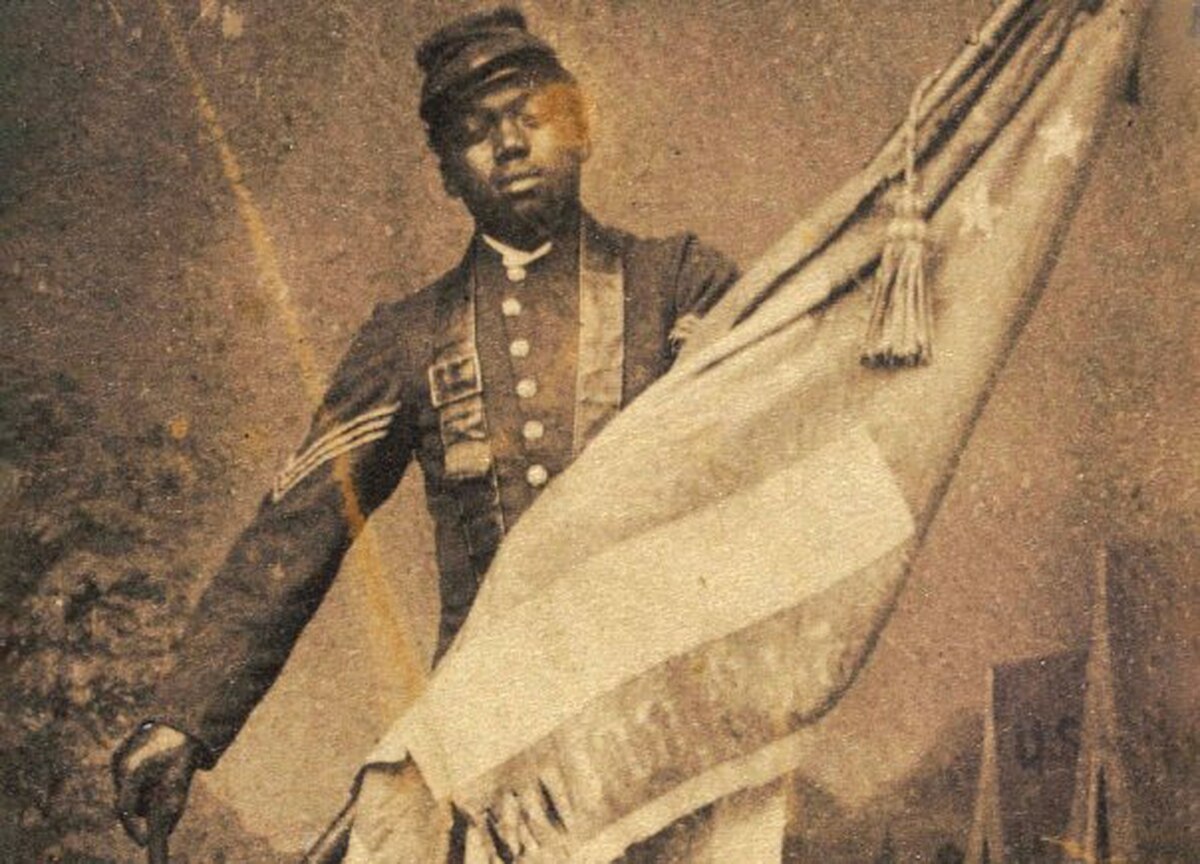
In March 1863, Carney joined the Union Army and was attached to Company C, 54th Massachusetts Colored Infantry Regiment, the first official black unit recruited for the Union in the north.
Forty other black men served with him, including two of famed abolitionist Frederick Douglass' sons. Within a few months, Carney's training would be put to the ultimate test during the unit's first major combat mission in Charleston, South Carolina.
On July 18, 1863, the soldiers of Carney's regiment led the charge on Fort Wagner. During the battle, the unit's color guard was shot. Carney, who was just a few feet away, saw the dying man stumble, and he scrambled to catch the falling flag.
Despite suffering several serious gunshot wounds himself, Carney kept the symbol of the Union held high as he crawled up the hill to the walls of Fort Wagner, urging his fellow troops to follow him. He planted the flag in the sand at the base of the fort and held it upright until his near-lifeless body was rescued. Even then, though, he didn't give it up.
Many witnesses said Carney refused to give the flag to his rescuers, holding onto it tighter until, with assistance, he made it to the Union's temporary barracks. Carney lost a lot of blood and nearly lost his life, but not once did he allow the flag to touch the ground.
His heroics inspired other soldiers that day and were crucial to the North securing victory at Fort Wagner. Carney was promoted to the rank of sergeant for his actions. For his bravery, Carney was awarded the Medal of Honor on May 23, 1900.
Carney was born into slavery in Norfolk, Virginia, in 1840. His family was eventually granted freedom and moved to Massachusetts
...Törni entered military service in 1938, joining the 4th Independent Jäger Infantry Battalion stationed at Kiviniemi; when the Winter War began in November 1939, his enlistment was extended and his unit confronted invading Soviet troops at Rautu.During the battles at Lake Ladoga, Törni took part in the destruction of the encircled Soviet divisions in Lemetti.His performance during these engagements was noticed by his commanders, and toward the end of the war, he was assigned to officer training where he was commissioned a Vänrikki (2nd lieutenant) in the reserves.[8] After the Winter War, in June 1941, Törni went to Vienna, Austria for seven weeks of training with the Waffen-SS, and returned to Finland in July; as a Finnish officer, the Germans recognized him as an Untersturmführer. Most of Törni's reputation was based on his successful actions in the Continuation War (1941–44) between the Soviet Union and Finland. In 1943 a unit informally named Detachment Törni was created under his command. This was an infantry unit that penetrated deep behind enemy lines and soon enjoyed a reputation on both sides of the front for its combat effectiveness. One of Törni's subordinates was future President of Finland Mauno Koivisto. Koivisto served in a reconnaissance company under Törni's command during the Battle of Ilomantsi, the final Finnish-Soviet engagement of the Continuation War, during July and August 1944. Törni's unit inflicted such heavy casualties on Soviet units that the Soviet Army placed a bounty of 3,000,000 Finnish marks on his head. He was decorated with the Mannerheim Cross on 9 July 1944.The September 1944 Moscow Armistice required the Finnish government to remove German troops from its territory, resulting in the Lapland War; during this period, much of the Finnish Army was demobilized, including Törni, leaving him unemployed in November 1944.
Well, there's chapter 1. What is a communist hating Finn supposed to do now? Well, like many men of his age ...
In January 1945, he was recruited by a pro-German resistance movement in Finland and left for saboteur training in Germany, with the intention of organizing resistance in case Finland was occupied by the Soviet Union. The training was prematurely ended in March, but as Törni could not secure transportation to Finland, he joined a German unit to fight Soviet troops near Schwerin, Germany. He surrendered to British troops in the last stages of World War II and eventually returned to Finland in June 1945 after escaping a British POW camp in Lübeck, Germany.
He was a slippery fella ... and so ends chapter 2. But, he's not done with the communists yet;
As his family had been evacuated from Karelia, Törni sought to rejoin them in Helsinki but was arrested by Valpo, the Finnish state police.[ After escaping, he was arrested a second time in April 1946, and tried for treason for having joined the German Army. After a trial from October to November, he received a six-year sentence in January 1947. Imprisoned at the Turku provincial prison, Törni escaped in June, but was recaptured and sent to the Riihimäki State Prison. President Juho Paasikivi granted him a pardon in December 1948.
At this point you'd think he'd come to peace with Finlandization ... but no, not his style. The anti-communist game was still afoot;
In 1949 Törni, accompanied by his wartime executive officer Holger Pitkänen, traveled to Sweden, crossing the border from Tornio to Haparanda (Haaparanta), where many inhabitants are ethnic Finns. From Haparanda, Törni traveled by railroad to Stockholm where he stayed with Baroness von Essen, who harbored many fugitive Finnish officers following the war. Pitkänen was arrested and repatriated to Finland. Remaining in Sweden, Törni fell in love with a Swedish Finn, Marja Kops, and was soon engaged to be married. Hoping to establish a career before the marriage, Törni traveled under an alias as a Swedish seaman aboard the SS Bolivia, destined for Caracas, Venezuela, where he met one of his Winter War commanders, Finnish colonel Matti Aarnio, who was in exile having settled in Venezuela after the war. From Caracas, Törni hired on to a Swedish cargo ship, the MS Skagen, destined for the United States in 1950.
While in the Gulf of Mexico, near Mobile, Alabama, Törni jumped overboard and swam to shore. Now a political refugee, Törni traveled to New York City where he was helped by the Finnish-American community living in Brooklyn's Sunset Park "Finntown". There he worked as a carpenter and cleaner. In 1953, Törni was granted a residence permit through an Act of Congress that was shepherded by the law firm of "Wild Bill" Donovan, former head of the Office of Strategic Services.
Like I said ... he was a slippery fella ... and I think you can see where this is headed;
Törni joined the US Army in 1954 under the provisions of the Lodge-Philbin Act and adopted the name Larry Thorne. In the US Army, he was befriended by a group of Finnish-American officers who came to be known as "Marttinen's Men" (Marttisen miehet).With their support, Thorne joined the US Army Special Forces. While in the Special Forces, he taught skiing, survival, mountaineering, and guerrilla tactics. In turn he attended airborne school, and advanced in rank; attending Officer Candidate School, he was commissioned as a first lieutenant in the Signal Corps in 1957. He later received a commission and a promotion to captain in 1960. From 1958–1962 he served in the 10th Special Forces Group in West Germany at Bad Tölz, from where he was second-in-command of a search and recovery mission high in the Zagros Mountains of Iran, which gained him a notable reputation. When he was in Germany, he briefly visited his relatives in Finland. In an episode of The Big Picture released in 1962 and composed of footage filmed in 1959, Thorne is shown as a lieutenant with the 10th Special Forces Group in the United States Army.
...
Deploying to South Vietnam in November 1963 to support Army of the Republic of Vietnam (ARVN) forces in the Vietnam War, Thorne and Special Forces Detachment A-734 were stationed in the Tịnh Biên District and assigned to operate Civilian Irregular Defense Group (CIDG) encampments at Châu Lăng and later Tịnh Biên.
During a fierce attack on the CIDG camp in Tịnh Biên, he received two Purple Hearts and a Bronze Star Medal for valor during the battle. This attack would later be described by author Robin Moore in his book The Green Berets.
Thorne's second tour in Vietnam began in February 1965 with 5th Special Forces Group; he then transferred to Military Assistance Command, Vietnam – Studies and Observations Group (MACV–SOG), a classified US special operations unit focusing on unconventional warfare in Vietnam, as a military advisor.
On 18 October 1965, as part of the operation Shining Brass, Thorne was supervising the first clandestine mission to locate Viet Cong turnaround points along the Ho Chi Minh trail and destroy them with airstrikes. Two Republic of Vietnam Air Force (RVNAF) CH-34 helicopters launched from Kham Duc Special Forces Camp and rendezvoused with a United States Air Force Cessna O-1 Bird Dog Forward Air Controller in inclement weather in a mountainous area of Phước Sơn District, Quảng Nam Province, Vietnam, 25 miles (40 km) from Da Nang. While one CH-34 descended through a gap in the weather to drop off the six-man team, the command CH-34 carrying Thorne and the O-1 loitered nearby. When the drop helicopter returned above the cloud cover, both the CH-34 and the O-1 had disappeared. Rescue teams were unable to locate the crash site. Shortly after his disappearance, Thorne was promoted to the rank of major and posthumously awarded the Legion of Merit and Distinguished Flying Cross.
After all that ... a helo midair. What a man.
We did not forget him ... and neither did his native Finland.
In 1999, Thorne's remains were found by a Finnish and Joint Task Force-Full Accounting team[nb 3] and repatriated to the United States following a Hanoi Noi Bai International Airport ceremony that included Secretary of State Madeleine Albright and Ambassador Pete Peterson.
Shared grave of Thorne and fellow Vietnam War casualties in Arlington National Cemetery
Formally identified in 2003, his remains were buried on 26 June 2003 at Arlington National Cemetery, section 60, tombstone 8136, along with the RVNAF casualties of the mission recovered at the crash site. He was memorialized on the Vietnam Veterans Memorial at Panel 02E, Line 126. He was survived only by his fiancée, Marja Kops, who later remarried.
He was 46.
"Excuse us, but would you please leave? Yes, I know you have orders and you are where you are right now, but I'll tell you what; if you don't leave your base, you'll be fine for 2-weeks. You need to leave inside 2-weeks. If any of your people go on any patrol, they will be considered hostile by militia forces - which by the Florida Constitution is,Some on the left seem gripped by new civil war fantasies. These people are not well. Do they even live a real life? Well, they think it is possible, so we will have to deal with their fevered foolishness.
The militia consists of all able-bodied citizens of this state and all other able-bodied persons who have declared their intention to become citizens.We want everyone to go home, so please move along. If you can't leave in two weeks, then you will have to surrender all your heavy weapons you cannot carry on the ship we will provide for your transport to The Bahamas. If you do not leave, we will have to kill everyone armed foreign national who does not surrender. Sorry, those are the rules. Governor DeSantis did not invite you & we don't recognize the UN authority inside our boundaries.
Thank you very much and have a nice day."
“How to stop a civil war” says the cover of the latest Atlantic magazine. I can suggest a fix: the international community should intervene in the US. Of course Americans have a right to self-determination but the priority now is saving democracy.Relax Simon, we know you're trying to be funny here (I think), but child please. We actually have less "ethnic, economic, and regional conflicts" in the USA than we have ever had in my short half-century+ on the planet.
...
...the first step is power sharing: a transitional government that includes all conflicting sides. ... Next comes an Afghan-style loya jirga, or grand assembly, to kick off a national dialogue. ...
Americans may also need to abandon the polarising impeachment of Donald Trump and let him seek exile in a friendly country: the model could be Ukraine’s kleptocratic pro-Kremlin former president Viktor Yanukovich, now based out of Russia.
The loya jirga writes a new constitution. This would be Britain’s first, and for the US, a much-needed update of its antiquated 1787 document. Japanese jurists could help draft it as a thank you to Americans for writing Japan’s excellent 1947 constitution.
The new text would dispense with vagaries such as “high crimes and misdemeanours”, define presidential corruption and end political control of the judiciary. If it’s undemocratic for the Polish or Hungarian governments to appoint judges, why can the US president do it?
... The US’s second republic will also need a new electoral system that favours coalitions instead of winner-takes-all rule. ...
At best, intervention will freeze the US’s overlapping ethnic, economic and regional conflicts. The question for the international community then becomes: how much blood and treasure is it willing to expend on a country that may not be ready for democracy?
Another thing that residents of the broad North American expanse between Canada and Mexico have noticed is that the programs and remedies that this class has promoted, both at home and abroad, have greatly enriched and empowered a small number of people, namely themselves—while the broader American population continues to decline in wealth, health, and education. Meanwhile, the American Empire that the ruling elite administers is collapsing. The popularity of such observations on both the left and the right is what accounts for the rise of Donald Trump, on one hand, and of Bernie Sanders and Elizabeth Warren on the other hand, among an electorate that has not been historically distinguished by its embrace of radicalism. Add those voter bases together, and perhaps 75% of Americans would seem to agree that their country, however you think of it, is in big trouble, and that the fault lies with the country’s self-infatuated and apparently not-so-brilliant elite.H/t Chap.
Every student of history has their own theory about how and why empires fall. My theory is this: The wealth of any empire flows disproportionately to the capital, where it nourishes the growth, wealth, and power of the ruling elite. As the elite grows richer and more powerful, the gulf between the rulers and the ruled widens, until the beliefs and manners of the elite bear little connection to those of their countrymen, whom they increasingly think of as their clients or subjects. That distance creates resentment and friction, in response to which the elite takes measures to protect itself. The more wealth and power the elite controls, the more insulation it must purchase. Disastrous mistakes are hailed as victories or are made to appear to have no consequences at all, in order to protect the aura of collective infallibility that protects ruling class power and privilege.
What happens next is pretty much inevitable in every time and place—Spain, France, Great Britain, Moghul India, you name it: Freed from the laws of gravity, the elite turns from the hard work of correct strategizing and wise policymaking to the much less time-consuming and much more pleasant work of perpetuating its own privileges forever, in the course of which endeavor the ruling elite is revealed to be a bunch of idiots and perverts who spend their time prancing around half naked while setting the territories they rule on fire. The few remaining decent and competent people flee this revolting spectacle, while the elite compounds its mistakes in an orgy of failure. The empire then collapses.