Showing posts with label Submarine. Show all posts

Friday, February 17, 2023

Fullbore Friday


"Lost at sea."

Sailors always get a little bit of the feels when they hear that phrase. The oceans are a large, beautiful, and terrifying place.

People and ships can, and do, just disappear without a trace, especially at war.

In time, some are found - and there is peace in that discovery.

They found the USS Albacore (SS-218)

NHHC’s Underwater Archaeology Branch (UAB) used information and imagery provided by Dr. Tamaki Ura, from the University of Tokyo, to confirm the identity of Albacore, which was lost at sea Nov. 7, 1944.

“As the final resting place for Sailors who gave their life in defense of our nation, we sincerely thank and congratulate Dr. Ura and his team for their efforts in locating the wreck of Albacore,” said NHHC Director Samuel J. Cox, U.S. Navy rear admiral (retired). “It is through their hard work and continued collaboration that we could confirm Albacore’s identity after being lost at sea for over 70 years.”

Japanese records originating from the Japan Center for Asian Historical Records (JACAR) covering the loss of an American submarine on Nov. 7, 1944, guided Dr. Ura’s missions. The location mentioned in the records matched a separate ongoing effort by UAB volunteers to establish the location of the shipwreck.

Dr. Ura’s team collected data using a Remotely Operated Vehicle to confirm the historical data. Strong currents, marine growth, and poor visibility on site made it challenging to fully document the wreck or obtain comprehensive images. However, several key features of a late 1944 Gato-class submarine were identified in the video.

Indications of documented modifications made to Albacore prior to her final patrol such as the presence of an SJ Radar dish and mast, a row of vent holes along the top of the superstructure, and the absence of steel plates along the upper edge of the fairwater allowed UAB to confirm the wreck site finding as Albacore.

The wreck of Albacore is a U.S. sunken military craft protected by U.S. law and under the jurisdiction of NHHC. While non-intrusive activities, such as remote sensing documentation, on U.S. Navy sunken military craft is allowed, any intrusive or potentially intrusive activities must be coordinated with NHHC and if appropriate, authorized through a relevant permitting program. Most importantly, the wreck represents the final resting place of Sailors that gave their life in defense of the nation and should be respected by all parties as a war grave.

Albacore was constructed by the Electric Boat Company in Groton, CT and commissioned on June 1, 1942. Before being lost in 1944, she conducted 11 war patrols and is credited with 10 confirmed enemy vessel sinkings, with possibly another three not yet confirmed. Albacore earned nine battle stars and four Presidential Unit Citations during her career. Six of the ten enemy sinkings were enemy combatant ships, ranking her as one of the most successful submarines against enemy combatants during World War II.

Less than two years of commissioned service, but what a record. Great summary of her war record at uboat.net.

Our now friends in Japan will respect her final resting place. Not true for many warships lost in WWII. Now the families of the lost will know the place.

h/t MR.

Tuesday, November 02, 2021

Nine Years is a Long Time

I think this is going to be tender week ... as my post tomorrow will be on the same topic.

I want you to think about 2012. Yes, it was nine years ago. Obama was running for re-election against Mitt Romney. 

The #1 song of that year was "Somebody That I Used to Know" by Gotye featuring Kimbra.

ISIS, in its present name, did not yet exist for another year.

It also was the last time...

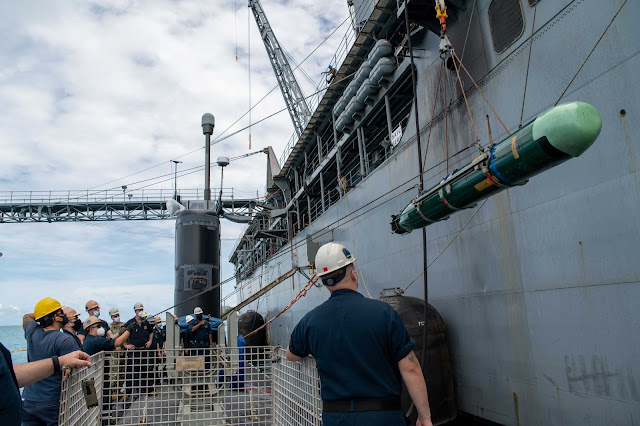
The submarine tender USS Frank Cable (AS 40) completed a weapons handling exercise involving the transfer of a MK-48 inert training shape to a submarine, Oct. 22. This was the first expeditionary reload Frank Cable has conducted outside of Guam since 2012.


OK. Here is a question I hope someone in Congress askes next time a 4-star comes in front of them.
“This exercise was instrumental to developing the expeditionary combat capabilities that our submarine tenders and submarines bring to the Pacific theater,” said Capt. Albert Alarcon, Frank Cable's commanding officer. “Every training opportunity helps assure our readiness for any contingency.”
So, all that talk about a Pacific pivot. All that talk about the, correct, primacy of our SSN fleet in any engagement west of Wake ... all that ... talk ... 

...and yet we did not conduct an evolution that will be essential for any sustained war effort in the Western Pacific.

Why?

I know there is message traffic on this. I know there is a reason ... but as a profession we need a serious conversation on why this was not done until ... 1QFY22.

Thursday, September 16, 2021

AUKUS and the Nuclear Roo

I guess this is submarine week at CDR Salamander, because right after the Wednesday post, the Anglosphere decided to wake everyone up;

Joint Leaders Statement on AUKUS

SEPTEMBER 15, 2021

STATEMENTS AND RELEASES

As leaders of Australia, the United Kingdom, and the United States, guided by our enduring ideals and shared commitment to the international rules-based order, we resolve to deepen diplomatic, security, and defense cooperation in the Indo-Pacific region, including by working with partners, to meet the challenges of the twenty-first century. As part of this effort, we are announcing the creation of an enhanced trilateral security partnership called “AUKUS” — Australia, the United Kingdom, and the United States.

Through AUKUS, our governments will strengthen the ability of each to support our security and defense interests, building on our longstanding and ongoing bilateral ties. We will promote deeper information and technology sharing. We will foster deeper integration of security and defense-related science, technology, industrial bases, and supply chains. And in particular, we will significantly deepen cooperation on a range of security and defense capabilities.

As the first initiative under AUKUS, recognizing our common tradition as maritime democracies, we commit to a shared ambition to support Australia in acquiring nuclear-powered submarines for the Royal Australian Navy. Today, we embark on a trilateral effort of 18 months to seek an optimal pathway to deliver this capability. We will leverage expertise from the United States and the United Kingdom, building on the two countries’ submarine programs to bring an Australian capability into service at the earliest achievable date.

The development of Australia’s nuclear-powered submarines would be a joint endeavor between the three nations, with a focus on interoperability, commonality, and mutual benefit. Australia is committed to adhering to the highest standards for safeguards, transparency, verification, and accountancy measures to ensure the non-proliferation, safety, and security of nuclear material and technology. Australia remains committed to fulfilling all of its obligations as a non-nuclear weapons state, including with the International Atomic Energy Agency. Our three nations are deeply committed to upholding our leadership on global non-proliferation.

Recognizing our deep defense ties, built over decades, today we also embark on further trilateral collaboration under AUKUS to enhance our joint capabilities and interoperability. These initial efforts will focus on cyber capabilities, artificial intelligence, quantum technologies, and additional undersea capabilities.

The endeavor we launch today will help sustain peace and stability in the Indo-Pacific region. For more than 70 years, Australia, the United Kingdom, and the United States, have worked together, along with other important allies and partners, to protect our shared values and promote security and prosperity. Today, with the formation of AUKUS, we recommit ourselves to this vision.

I remain a fan of conventional submarines and are open to arguments that in our forward deployed empire, we could find a use for them, but just look at Australia’s place in the world;


That geographic imperative screams for the range and capability that only a SSN can bring to the table.

As for the French, one has to allow that they should be upset that their previous deal went south - they lost a good deal - but the world changed and they did not help themselves in a variety of ways once Australia decided to go SSN. 

The response from Emmanuel Macron’s government was unequivocal. In the early hours of 16 September, the foreign minister Jean-Yves Le Drian and the army minister Florence Parly issued a blistering communiqué denouncing a “decision contrary to the letter and the spirit of Franco-Australian cooperation”. The statement criticised “the US’s choice … to sideline a European partner and ally”. 

In a radio interview, Le Drian went further, denouncing “a stab in the back”. He added: “We need explanations.”

“The French seem to be in shock,” said Tara Varma, the head of the Paris office of the European Council on Foreign Relations.

The AUKUS pact just just a subset of the Five Eyes subset of the larger Anglophere, just leaving Canada and the spoiled traditionally anti-nuke posturing New Zealanders to the side. Sorry France, you are a friend, but when the going gets rough ... blood and history is stronger in the Anglosphere.

Once they decided to go nuclear, tying in to the already long standing military relationship with their fellow English speaking nations - and spot welding themselves on US-UK nuclear power relationship dating back to WWII - just makes too much sense.

One thing I hope so much for is that we make this as affordable as possible for Australia. I would hope we give it to them at cost. No reason to try to get any of the development cost whichever direction the build goes. 

Helping build the infrastructure to support nuclear submarines will benefit everyone, and especially Australia - a nation that is a natural to go nuclear power for both green energy and other reasons - something this military effort could help kickstart.

How many? Let me do a back of the bar napkin guess. Australia has 7.5% of the US population and 6.5% of our GDP. Let’s mash that up as 7%.

The USN has 50 or so SSN depending on how you measure. Let’s add the 4 SSGN and round up to 55. If you round up and normalize for population/GDP that gives your 4 SSN for Australia.

Australia spends 2.1% of her GDP on defense, and rising. That $44.6 billion is roughly 6% of the USA’s $725 billion, so that doesn’t lead me to change any numbers there.

Let’s call it four boats … but wait.

How about this as an underline?

Australian Prime Minister Scott Morrison, U.S. President Joe Biden and U.K. Prime Minister Boris Johnson jointly announced the formation of a new tripartite alliance known as AUKUS on Thursday (local time), under which the first initiative will to build at least eight nuclear-powered submarines for the Royal Australian Navy.

Make that eight. 

That, more than anything else should get your attention. There are serious things taking place as the West - and specifically the Anglosphere - is turning in to the wind coming from the Middle Kingdom.

Read the statement at the top of the post again. 

Yeah … this is a big deal. Let’s hope we do it right.

Tuesday, June 29, 2021

PLAN Submarine RECCE Guide

Nice one stop shopping for the People's Liberation Army Navy submarine force.

We need cute little phrases to remember them, like, "Jin has a chin," "No tail Kilo," "Short-chin and shack on the Shang," "Ming has a thing," you can take it from there.


h/t HI Sutton.

Friday, September 18, 2020

Fullbore Friday


Slowly the sea gives up her secrets;

Divers have found what they believe is the wreck of a U.S. Navy submarine lost 77 years ago in Southeast Asia, providing a coda to a stirring but little-known tale from World War II.

The divers have sent photos and other evidence from six dives they made from October 2019 to March this year to the United States Naval History and Heritage Command for verification that they have found the USS Grenadier, one of 52 American submarines lost during the conflict. 

You can ignore the sub pic in the article linked to above - that is of a later USS Grenadier (SS-525) an not the one in question that we have pics of here, SS-210.


From the exceptional website OnEternalPatrol, here is the story of her loss; 

On the night of 20 April 1943, having had poor hunting for two or three days in Lem Voalan Strait, (northwest of Penang on the Malay Peninsula) GRENADIER ventured out ten miles west of that place to see what she could find. She found two ships, but before she could attack, they turned away. Figuring that they would come back to their original course in an hour and a half, Fitzgerald planned an attack to meet them on their course at that time. About 15 minutes before time to dive and prepare for the attack, a plane came in on GRENADIER, and she dived. As she was passing 120 feet, a violent explosion shook the ship, and all lights and power were lost. She was brought to rest on the bottom at about 270 feet. The hull and hatches were leaking badly aft, and a fire in the control cubicle kept the ship without propulsion. A bucket brigade kept the motors dry, and later a jury rig pump was called into service to perform the task, while the electricians worked all day to restore propulsion. Several men were prostrated by heat and exertion, but the work went on.

At dusk, GRENADIER surfaced and continued the work of trying to restore herself. Finally, they were able to turn over one shaft very slowly, but everything possible had been done, and no more speed could be expected.

Toward morning what appeared to be a destroyer, but was actually an 1800 ton merchantman, and an escort vessel were seen on the horizon, and a plane was driven away by gunfire. The skipper decided to scuttle the ship then, and it was done, with all hands being taken prisoner by the enemy merchant ship. 

That was not the end of their ordeal;

...an hour later were hauled aboard an armed merchant ship, which took them to Penang, a major port town on the Malayan Peninsula.

At a Catholic school requisitioned by the Japanese for use as a prison, events took an even darker turn.

“The rough treatment started the first afternoon, particularly with the (enlisted) men. They were forced to sit or stand in silence in an attention attitude,” wrote Fitzgerald. “Any divergence resulted in a gun butt, kick, slug in the face or a bayonet prick. In the questioning room, persuasive measures, such as clubs, about the size of indoor ball bats, pencils between the fingers and pushing of the blade of a pen knife under the finger nails, trying to get us to talk about our submarine and the location of other submarines.”

After a few months, all the crew were transferred to camps in Japan, where the abuse continued. Four died from a lack of medical attention.

You can see a full list of the crew and those who died in captivity here.

She had a solid, workmanlike war record prior to her loss; 

GRENADIER's record prior to her loss was six ships sunk, for 40,700 tons, and two ships damaged, for 12,000 tons. Her first patrol, beginning in February 1942, was conducted off the coast of Japan, and GRENADIER sank a freighter. Going to the Formosa shipping lanes for her second patrol, GRENADIER sank a large transport and a freighter. On her third patrol, she sank a large tanker. GRENADIER's fourth patrol was a mining mission in the South China Sea, and she damaged no enemy shipping. On her fifth patrol, this vessel patrolled the Java Sea area, and sank two small freighters and a sampan. In addition she damaged a freighter.

Fullbore.


 H/t Shu.

Friday, July 10, 2020

Fullbore Friday


How in one FbF can you do justice to a ship with 20 Battle Stars like the USS O'BANNON (DD-450)? 17 in WWII (second only to USS ENTERPRISE (CV-6) ), and three in Korea.

We aren't the only US Navy that has trouble getting its Sailors armed with the right weapons and enough weapons ... and we aren't the only US Navy with resourceful Sailors.

From the Destroyer History Foundation and Ernest A. Herr - BEHOLD!
On 5 April 1943, DesRon 21 was returning from a night of shelling Japanese shore installations deep in the New Georgia area of the Solomon Islands. Our destroyer, the O’Bannon, as part of this force, picked up a radar contact that turned out to be a large Japanese submarine cruising on the surface and apparently unaware of our presence. The Japanese lookouts undoubtedly were fast asleep.

We approached rapidly and were preparing to ram the sub. Our captain and other officers on the bridge were trying to identify the type of sub and decided, at the last minute, that it could be a mine layer. Not wanting to blow up ourselves along with the sub, the decision was made that ramming was not a wise move. At the last moment, the rudder was swung hard to avoid a collision and we found ourselves in a rather embarrassing situation as we sailed along side of the Japanese submarine.

On board the sub, Japanese sailors, wearing dark shorts and dinky blue hats, were sleeping out on deck. In what could be considered a rude awaking, they sat up to see an American destroyer sailing along side. Our ship however, was far too close to permit our guns lowered enough to fire and since no one on deck carried a gun, not a shot was heard. Ditto on the Japanese sub, no one there had a gun either. In this situation, no one seemed sure of the proper course of action and it probably would not have been covered in the manual anyway. Therefore everyone just stared more or less spellbound.

The submarine was equipped with a 3-inch deck gun and the sub’s captain finally decided that now was probably a good time to make use of it. As the Japanese sailors ran toward their gun, our deck parties reached into storage bins that were located nearby, picked out some potatoes and threw them at the sailors on the deck of the sub. A potato battle ensued. Apparently the Japanese sailors thought the potatoes were hand grenades. This kept them very busy as they try to get rid of them by throwing them back at the O’Bannon or over the side of the sub. Thus occupied, they were too busy to man their deck gun which gave us sufficient time to put a little distance between our ship and the sub.

Finally we were far enough away to bring our guns to bear and firing commenced. One of our shells managed to hit the sub’s conning tower but the sub managed to submerge anyway. At that time our ship was able to pass directly over the sub for a depth charge attack. Later information showed that the sub did sink. When the Association of Potato Growers of Maine heard of this strange episode, they sent a plaque to commemorate the event. The plaque was mounted in an appropriate place near the crews mess hall for the crew to see. Well, it was the crew’s battle.
BTW - as any WESTPAC guy will tell you, even today the Japanese have no idea what to do with a spud.


First posted in DEC 2011.

Friday, March 06, 2020

Fullbore Friday

With the trailer dropping yesterday for Greyhound, it is time to bring back this NOV 2011 Fullbore. Enjoy!

One Fullbore --- two ships. Lots of lessons here for today; importance of small arms, diversity of weapons systems, training, drills, cold weather survival, damage control .... and just plain battlemindedness; on both sides.
During her fourth patrol, Borie got a radar contact on U-256 shortly after 1943 hours, 31 October and closed in. The sub promptly crash dived. Two depth charge attacks forced her back to the surface, but she again submerged; after a third attack, a large oil slick was observed. Though U-256 made it home badly damaged, Hutchins believed the target to be sunk, and signalled the Card: "Scratch one pig boat; am searching for more."
Borie then got another radar contact about 26 miles (42 km) from the first, at 0153 hours on 1 November 1943, range 8000 yds. (7200 m) and charged in to engage. At 2800 yd (2500 m) radar contact was lost, but sonar picked up the enemy sub at about the same time. Borie engaged U-405 (a Type VIIC U-boat) hours before dawn, at 49°00' N., 31°14' W. There were 15-foot seas, with high winds and poor visibility.
The destroyer initially launched depth charges, after which the submarine came (or was probably forced) to the surface. Borie then came about for another attack, engaging with 4 inch (102 mm) and 20 mm gunfire at a range of 400 yd (360 m)

The sub's machine guns scored hits in the forward engine room and several scattered and harmless hits near the bridge, and her deck gun crew traversed their 88 mm (3.5 inch) gun and took aim for their first shot at Borie's waterline; but Borie's 20 mm gunfire wiped out every exposed member of the sub's crew topside, and a salvo of three 4 inch shells then blew off the sub's deck gun before it fired a round. Borie then closed in and rammed U-405, but at the last moment, the submarine turned hard left and a huge wave lifted the Borie's bow onto the foredeck of the U-boat.
After the ramming, Borie was high-centered on top of U-405, and until they separated, exchanges of small arms fire took place. This was a unique battle: unlike most other modern naval battles, it was decided by ramming and small arms fire at extremely close range. Borie's 24-inch spotlight kept the submarine illuminated throughout the following battle, except for brief periods when it was turned off for tactical reasons.
The two ships were initially almost perpendicular to one another; as the battle progressed, wave action and the efforts of both crews to dislodge from the enemy ship resulted in the two vessels becoming locked in a "V" for an extended fight, with the U-Boat along Borie's port side. The two ships were locked together only 25-30° from parallel. The action of the seas began to open seams in Borie's hull forward and flood her forward engine room. The submarine's hull, made of thicker steel and sturdier beams to withstand deep diving, was better able to handle the stress. Hutchins reported later, "We were impressed by the ruggedness and toughness of these boats."
Normally, in a surface engagement the superior armament, speed and reserve buoyancy of the destroyer would have been decisive. But in this unusual case, the destroyer was unable to depress her 4 inch (102 mm) and 3 inch (76 mm) deck guns enough to hit the sub, while all of the submarine's machine guns could be brought to bear. One or two 4 inch gun crews attempted to fire, but their shells passed harmlessly over the target. Borie's crew had a limited number of small arms, however, and the German deck mounts were completely open and had no protection. The executive officer had presented a virtually identical situation during drills on 27 October — a theoretical ramming by a U-boat on the port side — and as a result, after the ramming the Borie's crew took immediate action without orders.
In the extended and bitter fighting that ensued, dozens of German sailors were killed in desperate attempts to keep their machine guns manned. As each man emerged from the hatch and ran toward the guns, he was illuminated by Borie's spotlight and met by a hail of gunfire. Borie's resourceful crew engaged the enemy with whatever was at hand: Tommy guns, rifles, pistols, shotguns intended for riot control, and even a Very pistol. Borie's executive officer and a signalman fired effectively from the bridge with Tommy guns throughout the fight. One German sailor was hit in the chest with a Very flare. One of the Oerlikon 20 mm cannon was also able to continue firing, with devastating effect.
Borie's crewmen could clearly see a polar bear insignia painted on the conning tower of the sub, and three numerals that had been obliterated by 20 mm gunfire. The bow of the sub had been badly damaged by the depth charges and she was probably unable to submerge. U-405's deck armament was extensive: in addition to the 88 mm gun, she also had six MG 42 machine guns, in one quadruple and two single mounts. These weapons would have been devastating if the sub's crewmen had been able to keep them manned. Occasionally, one of them would reach one of the MG 42 mounts, and open fire briefly before he was killed. Other German sailors kept up a sporadic small arms fire of their own from open hatchways.
At a key moment in the fight, as Borie's port side crewmen were running out of 20 mm and small arms ammunition, two Germans broke from their protected position behind the bridge and approached the quad mount gun. A thrown sheath knife pierced a German crewman's abdomen and he fell overboard. Unable to bring his gun to bear, one of the 4 inch gun captains threw an empty 4 inch shell casing at the other German sailor, and successfully knocked him overboard as well.[4]Finally, U-405 and Borie separated and the two crews attempted to engage each other with torpedoes, to no effect.[4] At this point, about 35 of the German crew of 49 had been killed or lost overboard. Borie had been badly damaged and was moving at a reduced speed, while the sub was still capable of maneuvering at a similar speed.
The U-405's tighter turning radius effectively prevented the Borie from bringing her superior broadside firepower to bear, and her skipper, Korvettenkapitän Rolf-Heinrich Hopmann, did a masterful job of maneuvering his badly-damaged boat with his remaining crew.
Borie shut off her searchlight, with her crew hoping that U-405 would attempt to escape and provide a better target for gunfire. The submarine did attempt to speed away, and Borie switched her searchlight back on and turned to bring her broadside guns and a depth charge thrower to bear. The sub was bracketed by shallow-set depth charges and struck by a 4 inch shell, and came to a stop. Borie's crew observed about 14 sailors signalling their surrender and abandoning ship in yellow rubber rafts, and Hutchins gave the order to cease fire; several of them were apparently wounded, being loaded into the rafts in stretchers by their shipmates. The last to leave the stricken ship was wearing an officer's cap. U-405 sank slowly by the stern at 0257. She was seen to explode underwater, probably from scuttling charges set by the last officer to leave. Hutchins reported later,
When the submarine sank, there was a yell that went up from all hands — it probably could be heard in Berlin. The men were clasping each other and patting each other on the back, and all during the action, there were times when it was actually comical to observe the situation, particularly with the submarine pinned underneath ... heretofore their one dream had been to catch a submarine, depth charge him, bring him to the surface and then to sink him with gunfire, this particular action more than justified their hopes.
The survivors were observed firing Very star shells: Borie's crew believed this to be a distress signal, and maneuvered in an attempt to recover them from their rubber rafts, as they approached 50-60 yards off the port bow. But as it turned out, the Germans were signalling another surfaced U-boat, which answered with a star shell of her own. A Borie lookout reported a torpedo passing close by from that U-boat, and Borie had no choice but to protect herself by sailing away. The Borie was forced to sail through the U-405 survivors' rafts as she turned away from the other U-boat, but the men on the rafts were observed firing another Very flare as the Borie steamed away in a radical zigzag pattern. No German survivors were ever recovered by either side; all 49 crewmen were lost.
A jubilant radio report of the sinking of the U-405 was sent to Card after the engagement,
Time to celebrate? Well, notsofast.
Because of the loss of electric power, the crew had to wait until daylight to fully assess the damage to their ship. First light brought a thick fog. Borie was too badly damaged by the collision to reach the rendezvous in time, or even be towed to port by her sister ships. She had sustained severe underwater damage along her entire port side, including both engine rooms, as the two ships were pounded together by the sea before separating. The stress of the wave action from the 15-foot waves, as Borie was pinned against the U-boat's hull, had caused damage to key operating systems throughout the ship.
The forward engine room and generators were completely flooded, and only the starboard engine was operating in the partially flooded aft engine room. Auxiliary power had been lost and speed was reduced. The most critical damage was the compromised hull; but steam and water lines had separated, and most of the fresh water for the boilers had been lost, compounding the drive system problems. As a result, Hutchins was forced to use salt water in the boilers: the reduction in steam pressure forcing him to further reduce speed to 10 knots, making her an easy target for U-boats.
At about 1100, the communications officer restarted the Kohler emergency radio generator with a mixture of "Zippo" lighter fluid and alcohol from a torpedo; a distress call was sent, a homing beacon was set up and, after some delays due to poor visibility, Borie was spotted by a TBF Avenger from the Card.
Valiant efforts were made to save the ship. Kerosene battle lanterns had to be used for all work below decks. The crew formed a bucket brigade, and all available topweight was jettisoned, even the gun director. All remaining torpedoes were fired. The lifeboat, torpedo tubes, 20 mm guns and machine guns were removed and thrown over the side, along with the small arms used against the U-boat crew, tons of tools and equipment, and over 100 mattresses. Only enough 4 inch ammunition was kept for a final defensive action: 10 rounds per gun.
But the ship continued to slowly settle into the water with all pumps running; trailing fuel oil from all portside fuel tanks, and an approaching storm front had been reported. It would have been necessary to bring out a tugboat to tow her into port; due to the poor visibility prevalent in the North Atlantic, Hutchins believed the chances of a tugboat finding the Borie were slim. The nearest port, Horta, was about 690 miles away; Iceland, Ireland and Newfoundland were all about 900 miles away, and the task group was at the approximate center of five reported U-boat wolfpacks. By now there were 20-foot waves.
As nightfall approached at 1630, Hutchins reluctantly ordered his exhausted crew to abandon ship. The Card task force had taken a substantial risk by leaving the escort carrier unprotected in sub-infested waters. Card was 10 miles away, but Goff and Barry were close by as the crew abandoned Borie; on orders from the Task Group commander, the ship was not scuttled at that time. Despite the sporadic machine gun and small arms fire from U-405, none of Borie's crewmen had been killed during the engagement, although several were wounded. But due to 44° F. (6° C.) water, 20-foot waves, high winds and severe exhaustion, three officers and 24 enlisted men were lost during the rescue operation. Hutchins reported, "Many of the lost were just unable to get over the side" of the two rescuing destroyers.
Still, the ship remained afloat through the night; Goff and Barry attempted to sink the wreck at first light, but torpedoes went astray in the heavy seas. One 4 inch shell from the Barry struck the bridge and started a small fire, but she still refused to sink. The coup de grace was delivered on the morning of 2 November by a 500 lb (227 kg) bomb dropped by a TBF Avenger from the Card, piloted by Lt. (jg) Melvin H. Connley of VC-9. Borie finally sank at 0955 on 2 November. The survivors were transferred to the more spacious accommodations of the Card for the journey home.
The battle of the Atlantic in a nutshell. There is a reason you hear the trailer for The Cruel Sea on Midrats.


Hat tip S.

Friday, June 28, 2019

Fullbore Friday

You are flying an obsolete platform by this time of the war. Patrolling a relatively quiet sector of a body of water more than a bit out of the action.

You're not out of the fight by any means ... but the headlines, eyes, and best platforms are elsewhere. You have your aircraft, you have your crew, you have your mission - and that is more than enough.

It is the height of summer in the far North Atlantic. Almost nothing but day light all day. Hours and hours of grey ocean - like it had been for days, weeks, months and countless hours before ... and then;
Late in the day on 24 June 1944, Hornell’s Canso was at the end of a 12-hour patrol over the North Atlantic when the German submarine U-1225 was sighted on the surface approximately 120 miles north of the Shetland Islands. As the aircraft made its attack run, heavy and accurate anti-aircraft fire from the U-boat crippled the starboard engine and started a fire on the starboard wing. With great determination and skill, Hornell held the vibrating Canso on course and delivered his four depth charges on target, sinking the submarine. Shortly thereafter the starboard engine fell out of the wing, forcing Flight Lieutenant Hornell to ditch the aircraft, by now a flaming wreck, in the heavy seas. With only one dinghy serviceable, for several hours the eight members of the crew had to take turns holding on to the life-raft’s side while immersed in the icy water. Although the dinghy was spotted by a Consolidated Catalina flying boat from No. 333 (Norwegian) Squadron, RAF five hours after Hornell had ditched, for the next 16 hours rescue attempts were frustrated by high seas and malfunctioning equipment. Two of the crew eventually died of exposure. At one point, Flight Lieutenant Hornell had to be restrained by his comrades when, though at the end of his own strength and about to go blind, he proposed to swim to an airborne lifeboat that had been dropped. Finally, after 21 hours, a rescue launch arrived to pick up the survivors, but all attempts to revive Hornell failed, and he died of exposure.
His plane; his mission; his crew.
Flight Lieutenant Hornell was the first member of the RCAF to be awarded the Victoria Cross.

Citation
“Flight Lieutenant Hornell was captain and first pilot of a twin-engined amphibian aircraft engaged on an anti-submarine patrol in northern waters. The patrol had lasted for some hours when a fully-surfaced U-boat was sighted, travelling at high speed on the port beam. Flight Lieutenant Hornell at once turned to the attack.

The U-boat altered course. The aircraft had been seen and there could be no surprise. The U-boat opened up with anti-aircraft fire which became increasingly fierce and accurate.

At a range of 1,200 yards, the front guns of the aircraft replied; then its starboard guns jammed, leaving only one gun effective. Hits were obtained on and around the conning-tower of the U-boat, but the aircraft was itself hit, two large holes appearing in the starboard wing.

Ignoring the enemy’s fire, Flight Lieutenant Hornell carefully manoeuvred for the attack. Oil was pouring from his starboard engine, which was, by this time, on fire, as was the starboard wing; and the petrol tanks were endangered. Meanwhile, the aircraft was hit again and again by the U-boat’s guns. Holed in many places, it was vibrating violently and very difficult to control.

Nevertheless, the captain decided to press home his attack, knowing that with every moment the chances of escape for him and his gallant crew would grow more slender. He brought his aircraft down very low and released his depth charges in a perfect straddle. The bows of the U-boat were lifted out of the water; it sank and the crew were seen in the sea.

Flight Lieutenant Hornell contrived, by superhuman efforts at the controls, to gain a little height. The fire in the starboard wing had grown more intense and the vibration had increased. Then the burning engine fell off. The plight of aircraft and crew was now desperate. With the utmost coolness, the captain took his aircraft into wind and, despite the manifold dangers, brought it safely down on the heavy swell. Badly damaged and blazing furiously, the aircraft rapidly settled.

After ordeal by fire came ordeal by water. There was only one serviceable dinghy and this could not hold all the crew. So they took turns in the water, holding on to the sides. Once, the dinghy capsized in the rough seas and was righted only with great difficulty. Two of the crew succumbed from exposure.

An airborne lifeboat was dropped to them but fell some 500 yards down wind. The men struggled vainly to reach it and Flight Lieutenant Hornell, who throughout had encouraged them by his cheerfulness and inspiring leadership, proposed to swim to it, through he was nearly exhausted. He was with difficulty restrained. The survivors were finally rescued after they had been in the water for 21 hours. By this time Flight Lieutenant Hornell was blinded and completely exhausted. He died shortly after being picked up.

Flight Lieutenant Hornell had completed 60 operational missions, involving 600 hours’ flying. He well knew the danger and difficulties attending attacks on submarines. By pressing home a skilful and successful attack against fierce opposition, with his aircraft in a precarious condition, and by fortifying and encouraging his comrades in the subsequent ordeal, this officer displayed valour and devotion to duty of the highest order.”
What a man.

Fullbore.

A note on U-1225. She was a snorkel equipped Type IX/C40 U-boat. Her Skipper was 30-yr old Oberleutnant zur See Ernst Sauerberg. He took command on 12 June, eight days before deployment and 12 days before she was sunk. This was the boat's first war patrol. She was sunk on day 5.

Friday, June 21, 2019

Fullbore Friday


So, like WWII submarines?

This fits for a very good find from reader Steve - it's all so Fullbore, I can't pick just one.

All the submarine reports Historic Naval Ship Association from S-11 to USS Diablo.
At the end of each war patrol of WW II, submarine commanders created a report on the patrol. These reports were used as the raw material to inform intelligence, improve tactics, evaluate commanders, etc. During WW II, over 1,550 patrol reports containing approximately 63,000 pages were generated. During the 1970s these were photographed and reproduced on microfilm to make them more easly accessible and easily reproduced (approx. 250 rolls). During 2008 a copy of this microfilm was scanned into digital format (110 GB), and in 2009 it was made available online here (14 GB).

These war patrol reports were written during a deadly, bitterly fought war. Please note that there may be some references to enemy forces that may be offensive in today's context.
Treat yourself here. Oh, and if you find any of those terrible Politically Incorrect comments, please report them in comments. Sadly, I couldn't find any.

First posted March 2009.


Tuesday, April 09, 2019

SSBN Re-Capitalization Footsteps

We are planning for 12, but I will stick by to what I said almost exactly nine-years ago; we'll be lucky to get 10. (NB: that is in spite of the fact that Obama did not retreat and cut and the (R) unexpectedly took the House for the 8-following years - so the budget got larger. Hey, I'm not Nostradamus.)

The COLUMBIA Class is going to be the hungry-hungry hippo of defense money.

Can you hear it?
The Navy's $115 billion procurement cost estimate is not reliable partly because it is based on overly optimistic assumptions about the labor hours needed to construct the submarines. While the Navy analyzed cost risks, it did not include margin in its estimate for likely cost overruns. The Navy told us it will continue to update its lead submarine cost estimate, but an independent assessment of the estimate may not be complete in time to inform the Navy's 2021 budget request to Congress to purchase the lead submarine. Without these reviews, the cost estimate—and, consequently, the budget—may be unrealistic. A reliable cost estimate is especially important for a program of this size and complexity to help ensure that its budget is sufficient to execute the program as planned.

The Navy is using the congressionally-authorized National Sea-Based Deterrence Fund to construct the Columbia class. The Fund allows the Navy to purchase material and start construction early on multiple submarines prior to receiving congressional authorization and funding for submarine construction. The Navy anticipates achieving savings through use of the Fund, such as buying certain components early and in bulk, but did not include the savings in its cost estimate. The Navy may have overestimated its savings as higher than those historically achieved by other such programs. Without an updated cost estimate and cost risk analysis, including a realistic estimate of savings, the fiscal year 2021 budget request may not reflect funding needed to construct the submarine.
You can get links to the full report and the highlights here.

Part of me would rather see 8 SSBN and 2-4 SSGN from the design, but that is just me. Those SSGN bring a lot of punch forward when needed ... and flexibility.

The world in nine years further down the road will be different than we think it will be. Always keep that in mind.

Hat tip Phil.

Tuesday, February 12, 2019

Russian Akula SSN - Monster of My Youth, Still Out There

Yes, yes, yes; this is Russian propaganda - but just watch the glory of it all.

The Akula SSN was the monster at the end of the Cold War. In 2019, they are a little long in the tooth, but still all that. Here we have a few who are still active. The youngest active is about 27-yrs old.

We start part-1 of a 2-part series on was I assume is one of their SUBRONs ... the Beast Division, with in K-317, Pantera, Commissioned in 1990.

As you watch this, I have a recommendation; ignore the people speaking, look in the background. Look at details. Do you own visual zone inspection. That is where the good stuff is. (NB: the P-8A RECCE quiz prep-page framed at the 2:46 mark, and the big talk about our VIRGINIA Class at 3:20).

If shipyards and drydocks are your thing, 15:50 mark is your place.


You need to keep going to Part-2 because, be honest with yourself, you want to see Russian underwear (3:00).


Nice note, at the 5:22 point; alcohol makes your body more resistant to radiation. I'm not sure how much more Russian you can get.

More maintenance at 13:20, but a guy I'd love to have a few drinks with Yury Farafontov was chief designer from 1996-2016 for the AKULA Class. He tells a nice sea story at 21 minute mark.

Like I said a the start - propaganda. A bit clunky in places ... but worth the watch.

Friday, December 28, 2018

Fullbore Friday

While much has been written about the questionable operational and strategic use of the Imperial Japanese Navy's submarines in WWII, precious little has been written about some of the superb tactical leadership, performance, and effect some of their units had.

When re-reading portions of James Hornfischer's exceptional book, Neptune's Inferno, I was reminded of one of the most influential warships and commanders of the entire Pacific Campaign; then LCDR Kinashi Takakazu, IJN (later CDR and posthumously promoted to Rear Admiral).

It isn't just what he sunk or damaged (click here for his entire patrol record) - but the impact he and his crew had on the Naval Battle of Guadalcanal.

The first year of the war was not a good time to be an aircraft carrier, Japanese or American. USS YORKTOWN (CV 5) was sunk in June 1942 at the Battle of Midway. USS LEXINGTON (CV 2) was sunk a month before YORKTOWN at the Battle of the Coral Sea.

Then, one beautiful Pacific day,
15 September 1942:
At 0950, while running submerged, the soundman reports a contact with many heavy screws at 12-18S, 164-15E. LtCdr Kinashi orders I-19 to periscope depth. He makes a sweep with his 'scope but no ships are in sight.

250 miles SE of Guadalcanal. Captain (later Admiral) Forrest P. Sherman's USS WASP and Captain Charles P. Mason's (later Rear Admiral) HORNET (CV-8) are escorting a reinforcement convoy of six transports carrying the 7th Marine Regiment from Espiritu Santo to reinforce Guadalcanal. The carriers are steaming in sight of each other about 8 miles apart. Each carrier forms the nucleus of a task force. Captain George H. Fort's (later Rear Admiral) battleship USS NORTH CAROLINA (BB-55) is with the HORNET task force to the NE of the WASP force.

At 1050, Kinashi raises his periscope again. This time he sees a carrier, a heavy cruiser and several destroyers (Rear Admiral Leigh Noyes' Task Force 18) bearing 045T at 9 miles. Kinashi estimates the task force's course at 330 and begins a slow approach. The Americans, zigzagging at 16 knots, change course to WNW. Then at 1120, the target group again changes course -this time to SSE. WASP makes a slow left turn into the wind to launch and recover her aircraft - and heads toward the I-19.

LtCdr Kinashi estimates that his target is on course 130 degrees making 12 knots. At 1145, from 50 degrees starboard, he fires a spread of six Type 95 oxygen-propelled torpedoes at the enemy carrier from 985 yards. Two or possibly three hit the WASP and start an uncontrollable fire.

HORNET force continues a right turn to a 280 degree base course. Suddenly, an alarm is heard the tactical radio speakers from USS LANSDOWNE (DD-486) in the WASP's screen "... torpedo headed for formation, course 080!"

At 1152, a torpedo from I-19's salvo hits NORTH CAROLINA in her port bow abreast of her forward main battery turret. The blast holes the side protection below the armor belt and NORTH CAROLINA takes on a thousand tons of water. She takes on a five-degree list but counter flooding quickly levels her and she makes 25 knots.

At 1154, a torpedo hits destroyer O'BRIEN's (DD-415) port quarter and another just misses HORNET.

I-19 dives to 265 feet under the carrier's wake. The first depth charge explodes six minutes after the last torpedo hit. Soon the depth charges were exploding all around. American destroyers try to surround I-19 to attack together and finish her off. They rain down 30 depth charges.

At noon, WASP's avgas tanks explode. At 1515, two cruisers and destroyers abandon WASP and withdraw to the south. At 1520, Captain Sherman orders "Abandon Ship". The carrier is scuttled by five torpedoes from LANSDOWNE and sinks by the bow at about 2100. WASP suffers 193 killed and 367 wounded.
The USN was spooked by I-19 for weeks and months - seeing her everywhere and avoiding every hint of her.

Six weeks later, on 26 October 42, USS HORNET (CV 8) was sunk at the Battle of Santa Cruz Islands by aircraft. That left just one carrier USS ENTERPRISE (CV 6) - safely kept 200nm or so south of Guadalcanal - for the upcoming naval battles in November that saw close in surface actions that chewed up battleships, cruisers, destroyers, aircraft and men unlike anything either navy had seen in its modern history.

If you want that extended story, you need to get the book.

Friday, November 30, 2018

Fullbore Friday

When does a leader quit?

Never.

Make sure and read the full story from Nikola Budanovic, but I love this story;
In spring 1921, USS Conestoga, a tugboat assigned to the United States Submarine Force, went missing somewhere in the Pacific, while on its way to American Samoa. The tugboat steamed out from Mare Island, California, together with a coal-transporting barge on March 25th. It was to stop at Pearl Harbor, Hawaii, for refueling, but something happened along the way.

As it became clear that the had ship broken contact and that it must have encountered a problem during its voyage, a search party was dispatched from the Pearl Harbor military base in early May. Experts have estimated that Conestoga must have been somewhere around 100 nautical miles southeast of the coast of Hawaii.

A submarine designated USS R-14 (SS-91) under the command of Lieutenant Alexander Dean Douglas was sent out in order to conduct a surface search, in hopes of rescuing the tugboat and its crew.
They didn't find it ... but not for lack of trying;
Having incorrectly estimated the amount of fuel needed for the mission, when they arrived at the spot where Conestoga was presumed to be, the submarine had run out of usable fuel.

Since its electric motors lacked enough battery power to transport them back to base, they were stranded some 100 nautical miles from Hawaii, caught in a desperate situation.
Where's that OPREP binder again?
To make matters worse, their radio had malfunctioned and all communication went silent.
Oh, well ... nevermind.

What else could go wrong?
...the limited food supply wasn’t going to hold out for more than five days.
Sailors love being hungry.

But wait ...
The ship’s engineer came up with an idea to use the wind to power the submarine.

On. A. Submarine.

Well, you have to do something to keep the crew occupied;
All hands were soon employed in making a foresail out of the crew’s hammocks. Eight hammocks were stitched together, forming a sail, held by a frame made from dismantled bunks. The entire structure was then tied to the vertical kingpost of the torpedo loading crane, located forward of the submarine’s superstructure.

However, a submarine was much heavier and had a much lower silhouette than let’s say a 16th-century Spanish galleon. With the foresail, it achieved a speed of no more than one knot (1.2 mph; 1.9 km/h).
...
They built a mainsail out of six blankets and attached it to the radio mast, which added another half a knot to the total speed of the ship. In addition to this, another half a knot was achieved by stitching up another eight blankets and assembling yet another frame out of bunk beds.
...
After 69 hours of sailing, they finally reached the easternmost tip of the Hawaii islands and entered Hilo Harbor on the morning of May 15, 1921.
So, what do you do to a submarine CO who didn't bring enough fuel for the mission?
For the achievement and spirit of innovation, Lieutenant Douglas received a letter of commendation from his Submarine Division Commander, CDR Chester W. Nimitz.
How did things work out for the good LT who ran out of gas?

A different Navy. Via the superb U-boat.net;
Commanded two submarines in following years had assorted other duties, including the China Station and American Samoa, always with family. As a Comdr. 1941, was first C.O. of the USS Fulton, first ship built from the keel up as a submarine tender. 1942 Convoy Commodore of the second convoy of U.S. troops sent to Africa. Retired physically 1947,
As for the ship and crew they were looking for, the USS Conestoga? Not such good news;
The tugboat was officially declared missing on June 30, 1921, but it was not until 2009 that a shipwreck was discovered a few miles from Farallon Island, just off the coast of California.
Hat tip, USNI.

Friday, July 27, 2018

Fullbore Friday

Mike brought me to task in that in all these years - I have yet to give enough love to one of our greatest tactical leaders; Vice Admiral Lawson P. "Red" Ramage.

Attention to citation:
For conspicuous gallantry and intrepidity at the risk of his life above and beyond the call of duty as Commanding Officer of the U.S.S. Parche in a predawn attack on a Japanese convoy, 31 July 1944. Boldly penetrating the screen of a heavily escorted convoy, CDR Ramage launched a perilous surface attack by delivering a crippling stern shot into a freighter and quickly following up with a series of bow and stern torpedoes to sink the leading tanker and damage the second one. Exposed by the light of bursting flares and bravely defiant of terrific shellfire passing close overhead, he struck again, sinking a transport by two forward reloads. In the mounting fury of fire from the damaged and sinking tanker, he calmly ordered his men below, remaining on the bridge to fight it out with an enemy now disorganized and confused. Swift to act as a fast transport closed in to ram, CDR Ramage daringly swung the stern of the speeding Parche as she crossed the bow of the onrushing ship, clearing by less than 50 feet but placing his submarine in a deadly crossfire from escorts on all sides and with the transport dead ahead. Undaunted, he sent 3 smashing "down the throat" bow shots to stop the target, then scored a killing hit as a climax to 46 minutes of violent action with the Parche and her valiant fighting company retiring victorious and unscathed.
THAT is in the finest traditions of the naval service.

First posted JAN2014.

Friday, January 12, 2018

Fullbore Friday

There is an almost universal respect between navies and Sailors of all flags in both times of peace and war. The reason is that we all face the same enemies day in and day out - the sea and our equipment.

That is why you saw such a near universal rush to help the Argentinians in their search for their submarine, the ARA SAN JUAN.

Submariners - who I kid a fair bit about here - work in silence in exceptional circumstances; always one valve away from death. I spent a little more than a week underway on an SSN as a LT and that was enough for me.

This FbF, just a quick general note about the Fullbore Plan of the Day underway every submarine works under in general, and a nod to the crew of the SAN JUAN. Not much more I can say but to put up this brief summary of the recently released acoustic analysis.

Hat tip Chap and NavyLookout.

Monday, November 20, 2017

SUBLOST: All Hands to Argentina

There was a huge drama unfolding off Argentina over the weekend with the loss of Argentina's 32-yr old TR-1700 Class conventional submarine ARA SAN JUAN.

The immediate response you saw from other navies the world over is a reminder of a tradition almost universal in the common culture of all professional mariners; the past does not matter, the cause does not matter; friend, neighbor, stranger, or even actual or potential enemy does not matter - helping fellow mariners in distress are your #1 priority.

Argentina's friends, neighbors, and even the nation they recently fought a war against are all doing what they can, and sending what they have to help find the SAN JUAN, and hopefully bring her crew to safety.
A U.S. Navy rescue crew from San Diego has joined the international search effort for a Argentine submarine and its 44 crew members missing for several days beneath the stormy southern Atlantic Ocean.

Navy sailors with Undersea Rescue Command (URC) departed Miramar Saturday with a Submarine Rescue Chamber (SRC) and four aircraft, en route to where the ARA San Juan lost contact with the Argentine Navy Wednesday.
...
... highly trained American sailors will employ advanced technology on the Submarine Rescue Chamber, or SRC, which has already been in touch with the family members of the 44 on board, and will utilize an underwater system called Remotely Operated Vehicle, or ROV. It can climb down to depths of 850-feet and pull to safety "up to six persons at a time," the Pentagon officials said.

The sailors will also be relying on Pressurized Rescue Module, or PRM, which can rescue "up to 16 personnel at a time ... by sealing over the submarine's hatch allowing sailors to safely transfer to the recuse chamber," according to officials.

The American reinforcements will join the Navy's P-8A Poseidon multi-mission maritime aircraft and a NASA P-3 research aircraft that have been assisting the ongoing search for the ARA San Juan,
The weather in the South Atlantic is being what it is, horrible;
The best-case scenario, according to some experts, was that the submarine’s communications gear malfunctioned — perhaps as a result of a fire or flood — but that it did not lose the ability to navigate. Working against that theory is the fact that the submarine was due to arrive at its home port here on Sunday.

“It’s grim,” said Capt. Richard Bryant, a retired United States Navy submarine commander. “It implies that the ship is either on the surface without the ability to use its propulsion or that the ship is submerged.”

The first of those possibilities is deeply concerning, but not hopeless, according to experts. Given the stormy conditions, the crew is in significant peril if the vessel is being whiplashed.

The grimmest alternative is that the submarine sank as a result of a catastrophic event such as an explosion or fire. If the crew survived such an event, those onboard could conceivably have enough oxygen for several days after it went under, according to an Argentine Navy official who was not authorized to speak on the record.

If it is flailing on the surface, and the crew manages to weather the storm, the sailors would have enough fresh water and food to last for about 25 days, the official said.

The growing concern on Sunday was fueled by the fact that the crew had not activated emergency beacons that are standard in commercial and military vessels.

“The fact that we haven’t had communication for so long, that it didn’t show up at port as expected, and the fact that at least the initial search effort hasn’t found anything yet all point to the fact that the submarine may well unfortunately have been lost,” Captain Bryant said.
...
"We have 11 ships from the Argentine navy, from municipalities, and from countries that have collaborated with research ships such as Uruguay, Chile, Brazil, Peru, the United States, and (the UK).

"These ships are following the submarine's planned route, (and are) sweeping the whole area and we also have navy ships sweeping from north to south and from south to north."
...
Among those missing is Argentine Eliana Krawczyk - who became the first female South American submariner.
...
The Royal Navy is now flying in its elite Submarine Parachute Assistance Group (SPAG) to help locate the sub and the 44 people on board.

The team of medics, engineers and escape specialists will join the US in the search as offers of help also rolled in from Chile, Uruguay, Peru and Brazil.

Friday, September 15, 2017

Fullbore Friday

Like the subject matter of today's FbF, there won't be a lot of detail - and you don't want the detail.

You just need to know that there is a lot of general badassery being done in your name that if you did know the details, you would be both proud and humble at the same time.

The submarine service is well unknown for this little fact. The world's most deadly geeks.

Cmdr. Melvin Smith, commanding officer of the Seawolf-class fast-attack submarine USS Jimmy Carter, watches as the submarine travels through the Hood Canal. (Lt. Cmdr. Michael Smith/U.S. Navy)
We've covered a few times when British submarines have flown the Jolly Roger, and we highly approve. So many of the US Navy traditions come from the Mother Country, so I don't see why we can't keep stealing their best.

BZ to Skipper Smith and his crew. We'll read about it in a couple of decades, maybe.

Oh, and this; Salamander approved attitude as well. A CO is always on stage.