Showing posts sorted by relevance for query SSBN. Sort by date Show all posts

Wednesday, April 14, 2010

SSBN(X) - you'll be lucky to get 10


Ok, in line with the "drip-drip-drip" series of posts about something no-one wants to talk about (the trainwreck of shipbuilding that will be the Terrible '20s), let me make a little long range prediction for 'ya. First though, set the scene.

- The fiscal nightmare of the series of deficits we are building and the debt service they will bring - along with the budgetary realities of building a Social Democracy (only tremendous political changes in '10 and '12 elections will change this), will create budgetary pressures that will drive defense spending to below 3% of GDP by 2012 (it is 4% now).
- The largest shipbuilding pressure in the 2020's will be the re-capitalization of the SSBN force.
- Don't forget the new Nuclear Posture Review ...

From the
CBO, go to table 2. They are calling it going from 14 to 12 SSBN.

I'll call it now, we will be lucky if we get 10 SSBN(X). Make that a planning assumption.

Here is some more from the Bureau of the Hard Truth (BUTRU):
- Budgets will get smaller.
- Tiffany Navy shipbuilding costs will not get significantly smaller if we continue the attitude and practices from The Lost Decade.
- We will be at sub-250 ships at the end of the Terrible '20s unless something new happens in the next 5 years.
- This is not industry's fault; this is not Congress's fault. This is well in excess of 51% uniformed military's fault.

Way forward? We need radical change at the highest levels of leadership. Clark-Mullen-Roughead lineage got us here. Who am I looking for? Someone like this,

At the time of his appointment as Chief of Naval Operations, (he) was still a Rear Admiral, Upper Half (Two Star) and was promoted over the heads of many Flag Officers who were senior to him. (He) had never served as a Vice Admiral (Three Star), so he was promoted two grades at the time of his appointment as CNO.
That is a fresh start. And what did that give us?
Admiral Burke served an unprecedented three terms as CNO. He served at a critical time in world history, the depths of the Cold War. The facts that he was relatively young compared to other Flag Officers at the time, and was an excellent manager and organizer, were keys to his success. He supported the touchy Adm. Hyman Rickover in the development of a nuclear Navy. More directly, he promoted the Polaris missile program at a time when others in the Navy were very skeptical of the idea of a missile launched from a submarine.
Admiral Burke as CNO was intimately involved in the Eisenhower administration discussions of "how much is enough?", as to the number of US nuclear submarines needed for deterrence. Burke argued that a force of around 40 Polaris submarines (each with 16 missiles) was a reasonable answer. Burke further argued that land-based missiles and bombers were vulnerable to attack, which made the U.S.-Soviet nuclear balance dangerously unstable. By contrast, nuclear submarines were virtually undetectable and invulnerable. He was very critical of "hair trigger" or "launch on warning" nuclear strategies, and he warned that such strategies were "dangerous for any nation."

Earlier, Admiral Burke was involved in the "Revolt of the Admirals", a near mutiny by the leaders of the Navy in the late 1940s, and was saved from being fired by the intervention of President Harry S. Truman. His terms as CNO were times of growth and progress in the Navy. Upon completing his third term, he was transferred to the Retired List on August 1, 1961.
Time for 1955 thinking again or we will wind up having two Admirals for each ship.

Thursday, November 01, 2012

Smart SSBN Rethink

The need to re-capitalize our ballistic missile submarines has for the last few years been a heavy shadow over what is looking like a perfect budgetary storm at the end of this decade.

Budgetary pressures combined with the departure of the last of the Cold War fleet and then the very expensive SSBN(X) proposal would have left us with very little to keep Fleet numbers in acceptable ranges.

Though still a tough bill to pay - this is better.

Via news.usni;
The Ohio Replacement is scaled back from the initial Analysis of Alternatives (AoA) for the program, then dubbed SSBN(X), conducted by NAVSEA in 2009. The initial AoA called for a boat that would have cost $6 to 7 billion but with the reduction in capability the Ohio Replacement drove costs down to $5.6 billion a copy. The eventual goal of the reductions is to produce the boats at $4.9 billion a copy.
I also like the fact they are going to keep the class properly focused.
“The Ohio Replacement is not, is not, a multi-mission platform,” Capt. William Brougham, US Naval Sea Systems Command (NAVSEA) Ohio-class Replacement Program Manager, said at the 2012 Naval Submarine League Symposium in Falls Church, Va. on Oct. 18. “We don’t turn into a multi-mission platform that’s going to go off and do things that you see on television,” he said.
Good. Good.

A SSBN exists for one reason and one reason only - to be there is the need exists for this nation to find its inner-Roman.

No room for error. No need for distraction.

Wednesday, October 23, 2013

The Terrible 20s in a Picture

It is time to remind everyone about that light heading our way a bit down the tracks. Pretending it isn't there won't help anyone.

It is time again - and as usual the CBO helps best.


The most important line there is the average funding 1984 to 2013.  Look at it back and forth a few times.

Now, does anyone here REALLY think that given the huge debt load we have taken on in the last five years - building up more debt than then entire other years of the republic, that for the next 30 years we will consistently have that much of a higher average shipbuilding budget. Really?

We must capitalize our SSBN force. To do that, we have to either find a bunch of purple dollars in the colon of a Beltway unicorn, or we will have to squeeze the other programs.

As much as I don't care for LCS and would love for its death to be the answer, it wouldn't be; you could nuke the program and still only get 20% there.  SSN have been already squeezed, so what do you do? For planning purposes, what does the future look like if we kill LCS, cut the SSBN buy 20%? How much more do we have to cut? Our big stick are the CVN, so like the SSNs that are the premier sea denial platform in the Indo-Pacific; we can't touch that.  Our Amphibs are cut about as much as you can already.  What? Cut the large surface combatants by 50% during the Terrible 20s too?

Maybe - but you have to make a call somewhere. What would be helpful at this point is to pull out your essential Vince Lombardi.
“As a team last year we were horrible at the fundamentals of the game of football. Nobody here knows how to block and nobody knows how to tackle. All I saw last year was grab, grab, grab! “What we’re going to do now is go back to basics and we’re going to learn, drill and practice the fundamentals until we become better at them than anyone else in the game. If you do this with me, I will make you champions.” 
Let me paraphrase; "As a navy last decade and a half we were horrible at the fundamentals of the profession of building a fleet. Nobody here knows how to build a fleet and nobody knows how to respond to changing strategic requirements. All I saw in the last 15-yrs was spin, jargon, food-trough. What we're going to do now is go back to basics and we're going to learn, drill and practice the fundamentals until we become better at building a fleet for tomorrow than anyone else on the planet. If you do this with me, the nation will be secure, our industry strong, and our young men and women will have the best weapon systems possible if their nation sends them in to harm's way."

Something like that.

So, how does this start? First, we need some good Political guidance from the CINC. Then we we work on the best Strategic guidance inside a realistic understanding of our Diplomatic, Information, Military and Economic Constraints and Restraints - and how the Navy and Marine Corps fit in to it.

Thinking that we will receive in excess of 75% to 100% more than the historical average spending on shipbuilding in the face of an almost unprecidented budget crunch that will last decades is - well - in a fashion; professional malpractice and quasi-delusional. 

I'm sorry - but the 2014 plan is DOA. That is pretty much what the CBO report says ... but with nicer words and lots of math and hard facts.

We need to seriously look at how we would carry out what we believe we need to carry out given;
That alternative plan is not a recommendation by CBO but simply an illustration of the possible consequences of continuing funding for shipbuilding at its historical average amount rather than increasing it, as would be required under the Navy’s 2014 plan.

Purchases under that alternative plan would number 193 ships (versus 266 in the Navy’s plan), including 157 combat ships and 36 support ships.
...
Under that alternative plan, the battle force fleet in 2023 would be about the same size as in the Navy’s plan but by 2043 would number 243 ships, as opposed to the 306 ships in the Navy’s plan.
243. That is real close to what number front porch? Yes ... 240. That is a number that we have been using here since well before 2010.

So again - let's use that number; 240. What do we do, and how do we do it? What are the Assumptions? What are the Risks? What must be done, what can be done, what can be done with great risk, and what is simply outside a reasonable expectation?

To not have a "minority report" using a baseline fleet +/- 240 just makes it harder for the next generation to "make it happen."

Another note, look at the SSBN graph on page 10 of the report linked below. 3 1/2 years ago I warned that we would be lucky to stay at 10 SSBN ... well in the graph in 2028 we dip below the aspirational goal of 12 and hit 10 in 2032. Someone finds pixie dust and says we'll be up to 12 by 2042 - but those out years are just silly.

Unless something drastic happens soon, we should plan for 10 to be exactly what I predicted in 2010 - the ceiling. 

Math is hard; economics is harder.


Tuesday, December 02, 2014

The Terrible 20s meet the Tiffany Navy

As the regulars here and over at Midrats know - we've been hitting one constant note for the last decade - the music will stop. We've gone from 78 to 45 rpm and are about to find ourselves at 33.

After all the happy-talk, the hours of PPT, the endless iterations of taking the best case scenario - and even more often; shifting the truth telling and hard decisions to many PCS cycles down the road for others to fix - after all that: we have the macro-economic pressures of the national debt on one end, the sadly predictable results of an exquisitely designed Tiffany Navy in the middle, and the looming requirements for the recapitalization of the SSBN on the other end.

Over at DefenseOne, our friend Jerry Hendrix takes those to school who have not been paying attention, and reviews the fundamentals for those who have. He knows the topic well; priorities.
For almost a decade the Navy’s annual shipbuilding budget has hovered around $14 billion in adjusted dollars within an overall budget of $160 billion. But beginning in fiscal year 2020, the Navy will request an additional $5 billion dollars per year to pay for submarines to replace the 14 Ohio-class ballistic missile “Boomer” submarines that have been performing nuclear deterrence patrols since 1982 and are set to begin retiring in 2027.
You cannot have your cake and eat it too. There really are only three choices. All have their costs, but to pick the least painful you have to set your priorities.
In a fiscally constrained era there are three options. The first is to ask President Obama and members of Congress to increase the Navy’s budget to create a separate funding scheme for the Boomers.
...
The second approach would be for the defense secretary to redistribute funds within the defense budget.
...
The third approach would be for the Navy to pay for its new submarines out of its own resources.
Which is the right choice? Watch Congress.

From here - this is where I see the the three "Jerry Courses of Action."

Ideal is COA 1, but it is the most unlikely.

The best hope is COA 2, but that would take just the right combination of a strong SECDEF and House and Senate leaders who can make hard decisions with a long view. Ahem.

Sadly, it is COA 3 that the Navy must plan for. Hope for COA 2, but be ready for COA 3. If the stars align just right, you might get COA 1 after the 2016 elections - but to play for that is folly.
The need for a replacement for the Ohio-class ballistic missile submarines is undeniable. The strategic deterrence mission, although little understood or appreciated by the American people, is, as the CNO stated, the number one priority of the Navy in that it ensures the survival of the Republic. However, the challenge of finding the money to pay for these new boats is largely self-imposed. For 10 years the Navy planned to buy a fleet of sports cars like Arleigh Burke class destroyers, even where mission requirements called for pickups, all the while ignoring that there would be a mortgage payment coming due at the same time.

The Navy needs to move quickly to reorder its priorities. If strategic deterrence is our primary mission, then funding the next submarine for that mission is the first priority. We have to pay the mortgage. It’s common sense.
Yes it is.

If we happy-talk ourselves in to planning for COA 1 or 2, then we are repeating the mindset that got us to where we are today, and reality will hit our Navy up side the head.

Let's go back to the start of our Terrible 20s discussion here relative to SSBN back in FEB 2010. Almost half a decade ago, but it still applies - to quote myself;
If you continue to assume that CG(X) is dead, then you might get funding for the much needed DDG(X) follow-on for the DDG-51 class - might. That will be requested in light of the SSBN money sponge - and I don't see how with all the other needs in the 20's, we will be able to afford both a DDG(X) and a CG(X) - and there is a good chance that we will simply have to live with DDG-51 Flight III as our "new" platform through the beginning of the mid-21st Century.

I know that looking into the future is a fuzzy hobby. Heck, if you outlined in 2000 where we were in 2010 people would have said you were a nutty pessimist - so we can only see 2020 in very large, fuzzy pixels. The beginning of the mid-century (2030) is just a silly exercise in many ways - but one that needs to be done. There are known-knowns (DDG-1000 will be a rump, expensive class of ships, Ticos history, DDG-51 backbone, LCS decomm'n like flies), known-unknowns (will LCS even meet some of its promised ability and numbers, will DDG(X) be moving forward), and unknown-unknowns (Black Swan events), but still - 2020 is closer than we think, and there are economic facts that need to be looked at.

Huge challenge, one whose source is the lost decade we just came out of. You know, that "transformational" decade. The one that was to build the Fleet of the future. Well, it sure did, didn't it?

Look at what the Royal Navy is dealing with today, and it isn't a stretch to see similar challenges for ourselves. Look and learn - and perhaps we can mitigate the pain.

We'll be blogg'n about the 20's a lot down the road; let's call this an introduction to the Terrible 20's.
We are roughly halfway to 2020 from the time the above was blogg'd. So far, so pathetically on course.

I hope that very smart people in the right places with access to levers of power are listening to Jerry and others along the same lines. We have simply pissed away half a decade plus on vanity projects, bad theory, and worse program management - all in a vacuum missing updated, meaningfully effective, and actionable vision.

Miles to go, miles to go.

Wednesday, February 10, 2010

Looking towards the "Terrible 20's"


I would like you to join me in a little game of looking sideways (to the UK today) and looking forward (2020s) at what I see as not chickens coming home to roost, but vultures.

Just to have a sound foundation; for source documentation we are going to use the best magazine your money can buy,
The Economist, and some comments by VADM David Dorsett, USN, Deputy Chief of Naval Operations for Information Dominance (N2/N6) and Director of Naval Intelligence (DNI) from last week. We'll get to him later.

First let's look at the fundamental underpinnings of our defense budget - not not strategy - MONEY.

From the latest issue of
The Economist,
Mr Obama’s budget reveals a road-map to fiscal catastrophe. At no point over the coming decade will the deficit be below 3.6% of GDP; and after 2018, it starts rising again. The cuts the president has proposed are comically insufficient: a budget freeze on non-security discretionary spending, which amounts to only about 17% of the entire $3.8 trillion budget; and a toothless deficit commission (a better version has already been killed by obstructive Republicans in Congress) whose recommendations will doubtless be ignored.
Note the right side of that graph. 2020. Keep that in mind.

One thing that kept coming to mind last week in San Diego, was the goings-on in the mother country. Some of the challenges the United Kingdom is experiencing now are about a decade ahead of us, methinks - if not closer.

First is the fact that they have been under a left-of-center government for over a decade, their budget woes are roughly parallel to ours, they are starting the battle to find money to replace their SSBN fleet now, and their defense budget - starved for years as a % of GDP vs. OPTEMPO - is shredding. Hard choices, many already made in the Royal Navy, are being demanded more and more as past neglect needs to be repaired out of hide. Financially they just cannot get the money they need in competition with other programs their government has obligated itself to spend money on.

Let's look at what is happening in the United Kingdom. From The Economist;
This will cost about £1.2 billion ($1.9 billion) over the next three years. Some £280m of it will come from the Treasury, which has already provided £14 billion from its reserves to pay for the wars in Iraq and Afghanistan. The lion’s share, however, will be found by raiding other parts of the overstretched defence budget, with planned cuts that would realise around £1.5 billion over three years.
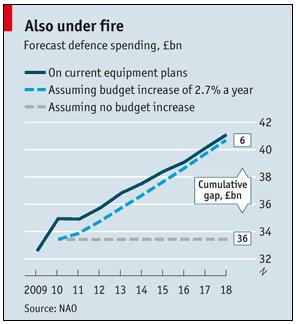
This amounts to more than trimming fat (by, for example, slashing the number of civil servants at the Ministry of Defence); solid muscle is to be sliced into as well. The Nimrod surveillance aircraft, one of which exploded over Afghanistan in 2006 because of a fuel leak, will be retired by March. The introduction of the new model, the Nimrod MRA4, will be delayed. This means that, at a time of greater Russian underwater activity, there will be a gap in anti-submarine surveillance to protect Britain’s own nuclear-armed subs. One of four Harrier squadrons is being lost and the rest are to be moved out of RAF Cottesmore, which will be closed. This could reduce still further training on Britain’s aircraft carriers. The loss of a minesweeper, at a time of rising tension in the Persian Gulf over Iran’s nuclear programme, was questioned by opposition MPs. Army training “not required for operations”, such as tank manoeuvres, will be reduced.

This is an unusually brave move by a defence secretary who was widely derided as second-rate when he was appointed in June, the fourth man in the job in four years. But whoever takes charge after next year’s general election will need to be braver still. Britain’s plans to buy new military equipment have long been unaffordable. Successive ministers have tried to balance the books by short-term savings (such as delaying or scaling back new equipment) that incur long-term costs. This has created a growing “bow-wave” of unfunded commitments that may finally break when an overdue Strategic Defence Review is held after the election.
Read that again. Look at those dollars you P-3/P-8 Bubbas .... because it parallels something said last week in San Diego about "..if you had to, where would you find a couple of $ billion."

VADM Dorsett responded to that question in an interesting way. As N2/N6/DNI - Intelligence, Surveillance, and Reconnaissance (ISR) is a critical capability for him. It is a growth industry, but he has to look at how he meets COCOM demands within a limited, and possibly stagnant-to-decreasing budget.

He started a couple of times and then backed off. He paused, thought about his words carefully, and then stated (paraphrase),
"Legacy ISR systems ..."
When you fold that into the previous discussions about unmanned ISR in the panel discussion - there can be only one area he is talking about in a USN context - P-3/EP-3 and the upcoming P-8/EP-8 program.

From a manpower and hardware requirements/budget POV, he is right, that is a large bucket of money.

That community's vulnerability to a money grab is largely their fault. As we have reviewed here over the years, the community leadership tried to hide the possibility - and then the fact - of their exceptional fatigue life problems. They created bad blood through defending a Cold War staff structure while the actual personnel and platforms at the pointy end shrunk by almost 50%.

In spite of the "transformational" press they got right after 9/11 with their overhead ISR - starting with pressure from CNO Clark to shut up about it - they avoided toot'n their horn in this area to stress ASW ---- while operationally they continued to provide overhead ISR as their major contribution. The public face vs. COCOM requirements delta was huge.

If you don't tell your story, no one will hear it. If you don't make yourself a lean operation while others are fighting and dying, you create distrust and envy among your peers. Neither buys you friends in budget fights.

In these two areas, the Maritime Patrol and Reconnaissance (MPR) community (as the P-3/EP-3-P-8/EP-8 folks are easier to describe) spent most of the decade setting the conditions for the same thing that happened to their British counterpart.

Is the "legacy" MPR fleet about to be decimated like the Nimrod? No, I don't think so. Is the P-8 buy going to shrink? Perhaps. Could P-3 squadrons be decommissioned early? Perhaps. Is that the right answer? Perhaps. Priorities - and in the 13XX world - the F-35 isn't getting any cheaper.

Let's look at 2020 again. What else is happening in the 20s? Well, for one, we will have to find money to re-capitalized the SSBN fleet. I offer to you that the 20 JAN HASC SEF Subcommittee meeting has an outstanding money discussion about that challenge. Deputy SECNAV Work has also discussed this challenge in other venues, and I think he has a very firm grasp of the problem, as do most in positions to know.

You have to look at it in the broader context of the budget as well. The hangover in the 20s from this decade's drunken frenzy of spending will couple with another cohort of Baby Boomers retiring and putting stress on the budget in ways we still do not have a firm grasp on.

In 2020 - that ship built in 1990 will be at 30 years. That LCS built in 2009 will only have 9 years or so of service life (LCS is expected to only last 20-25 years) - so by the end of the 2020s, LCS will be dropping like flies.

When you consider that we will be limited this decade to LCS and DDG-51 for our non-amphib surface ship program (don't throw JHSV at me, that is just a truck - full stop - all else is spin and hope) - you have about a perfect story for the 20s of limited shipbuilding funds and a stunted fleet.

Stunted? If you continue to assume that CG(X) is dead, then you might get funding for the much needed DDG(X) follow-on for the DDG-51 class - might. That will be requested in light of the SSBN money sponge - and I don't see how with all the other needs in the 20's, we will be able to afford both a DDG(X) and a CG(X) - and there is a good chance that we will simply have to live with DDG-51 Flight III as our "new" platform through the beginning of the mid-21st Century.

I know that looking into the future is a fuzzy hobby. Heck, if you outlined in 2000 where we were in 2010 people would have said you were a nutty pessimist - so we can only see 2020 in very large, fuzzy pixels. The beginning of the mid-century (2030) is just a silly exercise in many ways - but one that needs to be done. There are known-knowns (DDG-1000 will be a rump, expensive class of ships, Ticos history, DDG-51 backbone, LCS decomm'n like flies), known-unknowns (will LCS even meet some of its promised ability and numbers, will DDG(X) be moving forward), and unknown-unknowns (Black Swan events), but still - 2020 is closer than we think, and there are economic facts that need to be looked at.

Huge challenge, one whose source is the lost decade we just came out of. You know, that "transformational" decade. The one that was to build the Fleet of the future. Well, it sure did, didn't it?

Look at what the Royal Navy is dealing with today, and it isn't a stretch to see similar challenges for ourselves. Look and learn - and perhaps we can mitigate the pain.

We'll be blogg'n about the 20's a lot down the road; let's call this an introduction to the Terrible 20's.
Tuesday, March 17, 2020

Whither the Super Carrier

With apologies to Jo Moore, with COVID-19 spinning out of control, last week was a good week to bury bad news.

Did you catch it? The anti-CVN forces saw their moment, and it looks like they are making their move.

Though ordered, CVN-82 is as of yet, unnamed.

Could she be the last of her kind?
The Navy is launching a deep dive into the future of its aircraft carrier fleet, Breaking Defense has learned, even as the Secretary of Defense, dissatisfied with current Navy plans, conducts his own assessment. The two studies clearly show the deepening concern over how China’s growing might and the Pentagon’s eroding budgets could affect the iconic, expensive supercarriers.

The Future Carrier 2030 Task Force, which the service plans to announce next week, will take six months to study how carriers stack up against new generations of stealthy submarines and long-range precision weapons being fielded by China and Russia.
While always willing to give great and worthy people the benefit of the doubt, "Blue Ribbon Panels" have a spotty history of objectivity. I willing to be sold - but I'm not at the moment.

Add to that nugget, a little under two weeks' earlier, the confirmed SECDEF sent a frowny-face emoji to the acting SECNAV;
Defense Secretary Mark Esper has put a stop to the the expected release of the Navy’s long-term force structure plan, telling the service on Monday to hold off and take another look, several sources confirm.

The plan, announced last year and slated to be wrapped up by Jan. 15, has run into serious headwinds. The Navy insists it can grow the fleet to 355 ships as early as 2030 despite its shipbuilding budget being cut in the recently released 2021 budget, and as officials concede there’s little hope of significant growth in the near-term. Now Esper, who has been reviewing the plan for the past two weeks, is unwilling to sign off on it.
There you go. Unless there is significant intervention at the Congressional level - things look set up.

Even without the above, we knew this was coming.

Almost exactly 10-years and one month ago, I wrote the opening post announcing the upcoming Terrible 20s. This is what I wrote in February 2010;
Let's look at 2020 again. What else is happening in the 20s? Well, for one, we will have to find money to re-capitalized the SSBN fleet. I offer to you that the 20 JAN HASC SEF Subcommittee meeting has an outstanding money discussion about that challenge. Deputy SECNAV Work has also discussed this challenge in other venues, and I think he has a very firm grasp of the problem, as do most in positions to know.

You have to look at it in the broader context of the budget as well. The hangover in the 20s from this decade's drunken frenzy of spending will couple with another cohort of Baby Boomers retiring and putting stress on the budget in ways we still do not have a firm grasp on.

In 2020 - that ship built in 1990 will be at 30 years. That LCS built in 2009 will only have 9 years or so of service life (LCS is expected to only last 20-25 years) - so by the end of the 2020s, LCS will be dropping like flies.

When you consider that we will be limited this decade to LCS and DDG-51 for our non-amphib surface ship program (don't throw JHSV at me, that is just a truck - full stop - all else is spin and hope) - you have about a perfect story for the 20s of limited shipbuilding funds and a stunted fleet.

Stunted? If you continue to assume that CG(X) is dead, then you might get funding for the much needed DDG(X) follow-on for the DDG-51 class - might. That will be requested in light of the SSBN money sponge - and I don't see how with all the other needs in the 20's, we will be able to afford both a DDG(X) and a CG(X) - and there is a good chance that we will simply have to live with DDG-51 Flight III as our "new" platform through the beginning of the mid-21st Century.

I know that looking into the future is a fuzzy hobby. Heck, if you outlined in 2000 where we were in 2010 people would have said you were a nutty pessimist - so we can only see 2020 in very large, fuzzy pixels. The beginning of the mid-century (2030) is just a silly exercise in many ways - but one that needs to be done. There are known-knowns (DDG-1000 will be a rump, expensive class of ships, Ticos history, DDG-51 backbone, LCS decomm'n like flies), known-unknowns (will LCS even meet some of its promised ability and numbers, will DDG(X) be moving forward), and unknown-unknowns (Black Swan events), but still - 2020 is closer than we think, and there are economic facts that need to be looked at.

Huge challenge, one whose source is the lost decade we just came out of. You know, that "transformational" decade. The one that was to build the Fleet of the future. Well, it sure did, didn't it?
It holds up well, I think.

What I didn't see was the POLMIL stew our Navy would find itself in.

At this critical juncture, The Pentagon is led by the Esper/Milley West Point-West Point team while the Navy's Flag Officers try to recover from damage the previous generation of leaders inflicted on our institution over a decade spending their professional capital, like, well, drunken Sailors - mostly in WESTPAC - from Malaysian fat men to exhausted and untrained bridge watches driving Japan based destroyers. 

To top things off, those who should have spent every penny left getting ready for this decade spent what little professional capital they were able to scrape together from under the couch cushions on Ottomanesque bureaucratic protect-my-legacy games.

Almost two decades of sub-optimal performance at the highest levels has us where we are; a nice, solid-but-last-man-standing CNO and an Acting SECNAV fighting hard but wrestling two weight classes up in 4A. The previous SECNAV demonstrated what some of his problem was when he was last seen endorsing a Presidential primary candidate from the other party just a few weeks before he dropped out due to a complete lack of support among, well, almost anyone.

Of course.

Of course we are where we are.

The smart money is on a better than average chance the CVN will be killed by next POM (though perhaps not for good) and what little money is captured will be spent prosealing cracks from an overstressed and underfunded maintenance and readiness hole while trying to find some magic beans to build a useful fleet not reliant on a Cold War era destroyer as we stumble to 2030.

How will we project power from the sea in 2030? You can't do that from a submarine - a platform with limited followthrough and has its own growing vulnerability issues. You can't do that from land based aircraft. I win that wargame every time. There are not enough VLS cells in Christendom to do what a CVN can do ... with a proper airwing (which we don't have).

No, if we have to go to war in 2030, the question will be, "Where are the carriers?" ... and we will send thousands of Sailors in harm's way with an underfunded legacy system bereft of upgrades, carrying an airwing saddled with three decades of bad, short term decisions made by people trying to survive the next POM, not create a Navy ready to fight and win the next peer war.

I'm really not interested in discussing CVN vulnerability ... something known in detail since WWII. All capital ships are vulnerable ... that is why RN BB sortied so little during WWII, etc ... etc ... etc ... we've discussed that in volume here through the years. New folks can look it up, won't rehash it wholesale.

No, what are you going to replace them with? Vaporware? PPT thick programs? Unmanned systems whose performance and utility assumptions are based on AI that does not exist, robust reachback that is peace-time only, and ROE that won't survive a public university law school second-year law student?

I've seen that movie. It is stale and derivative. 

No, you can't. All you can do is, like The Thing in the dog kennel, flail around for anything that can justify taking food from Mom's plate so you can feed Dad so you can tell the rest of your family that you are taking care of the parents just fine.

With apologies to Jeremiah,
1:1 How doth TACAIR sit solitary, that was full of people!
She is become as a widow, that was great among the the services!
She that was a princess among Hollywood is become tributary to grunts!
1:2 She weepeth sore in the Unfunded Priorities List, and her tears are on her EMALS;
Among all her WBB contractors she hath none to comfort her:
All her fellow Service Chiefs have dealt treacherously with her; they are become her enemies.
1:3 NAVAIR is gone into captivity because of affliction, and because of great servitude;
She dwelleth among the Mine Warfare community, she findeth no rest:
All her budgetary enemies overtook her within the POM.
1:4 The ways of PEO Aircraft Carriers do mourn, because none come to the solemn assembly;
All her hangars are desolate, her Program Managers do sigh:
Her Flag Officers are afflicted, and she herself is in Executive TAP.
1:5 Her adversaries are become the head, her enemies prosper;
For SECDEF hath afflicted her for the multitude of her transgressions:
Her JOs are gone into career transition before the selection boards.
1:6 And from the Office of the Acting SECNAV all her majesty is departed:
Her Admirals are become like harts that find no pasture,
And they are gone without strength before the CBO.
So sayeth the Book of Salamander.

Monday, May 03, 2010

SECDEF ain't bluff'n

For years here and more recently over at Midrats, we have been warning that we have only seen the first dint of a the rolling trainwreck that is shipbuilding - the predictable result of happy-talk, low-balling, and just plain p155-poor management.

This will reach its peak during the "Terrible '20s" if we don't get the right uniformed and civilian leadership now. The catylist will be the re-capitalization of the SSBN force ..... and SECDEF knows it.

From
Politico,
Defense Secretary Robert Gates is planning to take aim next week at the Navy’s new multibillion-dollar ballistic missile submarine, a move some view as an implicit threat: Cut the sub, or I’ll do it myself.

Gates’s warning will come in a speech at the Navy League’s Sea-Air-Space Expo, and while he won’t announce any specific budget decisions, Pentagon spokesman Geoff Morrell says Gates will raise questions about changes in geopolitics, global naval resourcing, the global economy and how those changes may impact what programs the Navy builds in the future.

Any threat to cut the subs — which cost $7 billion apiece and would create plenty of jobs with defense contractors — is bound to stoke parochial tensions in Congress, especially with members who represent districts that build submarines. The new subs are planned to join the fleet starting in 2027, replacing existing Ohio-class missile subs.

Such strong words coming from Gates, who has cut Air Force fighter jets and helicopters, an Army combat system, missile defense programs and has fired two service secretaries and an Air Force chief of staff, are viewed in the defense community with great caution.
Who told you last month we would be lucky to get 10 SSBN's? Oh yea - that was me.

Monday, July 07, 2014

The Navy Goes Full Salamander on the Terrible 20s

Remember how we have been saying for most of the last decade that eventually, the Navy will run out of HappyTalk Juice? That as shadows do not appear on the deck and water is not displaced pierside ... that it would have to admit what it denied?

It really is heartbreaking to see, as we wasted so many years in happy talk, rosy scenarios, and best case projections. Those who made this bed have long retired to well paying gigs in boardrooms of companies and K-Street - to be dealt with by the leaders in place now.

Not a good thing to gloat about - but .... behold.
The U.S. Navy can’t meet its funding needs for surface warships and a new class of nuclear attack submarines from 2025 to 2034, according to the service’s latest 30-year shipbuilding plan.

The congressionally required blueprint, submitted late last week and obtained by Bloomberg News, says the Navy’s plan “requires funding at an unsustainable level” unless spending on shipbuilding is increased.

The document outlines challenges facing the plan to increase the Navy fleet to 306 vessels from the current 289 while building 12 new Ohio-class submarines, part of the nation’s nuclear triad of air, land and sea weapons.
Yea, it's that bad - and a tad more.
The average cost of the Navy plan during the period when the service will be spending the most on the new submarine is $19.7 billion a year, including more than $24 billion at the peak year of fiscal 2032, according to the report.

This budget “cannot be accommodated by the Navy from existing resources -- particularly if” the Pentagon remains under congressionally mandated automatic cuts known as sequestration, the report said.

The Navy’s historical shipbuilding budget has averaged about $13 billion a year, in fiscal 2014 dollars.

“Even if the Ohio-replacement program is removed” from the Navy plan, the average shipbuilding funding required beginning in fiscal 2020 is as much as $15 billion annually, the report found.
What the heck - no one paid me for my consult almost half a decade ago. From my Feb 2010 phrase-coining post, Looking towards the "Terrible 20's";
Let's look at 2020 again. What else is happening in the 20s? Well, for one, we will have to find money to re-capitalized the SSBN fleet. I offer to you that the 20 JAN HASC SEF Subcommittee meeting has an outstanding money discussion about that challenge. Deputy SECNAV Work has also discussed this challenge in other venues, and I think he has a very firm grasp of the problem, as do most in positions to know.

You have to look at it in the broader context of the budget as well. The hangover in the 20s from this decade's drunken frenzy of spending will couple with another cohort of Baby Boomers retiring and putting stress on the budget in ways we still do not have a firm grasp on.

In 2020 - that ship built in 1990 will be at 30 years. That LCS built in 2009 will only have 9 years or so of service life (LCS is expected to only last 20-25 years) - so by the end of the 2020s, LCS will be dropping like flies.

When you consider that we will be limited this decade to LCS and DDG-51 for our non-amphib surface ship program (don't throw JHSV at me, that is just a truck - full stop - all else is spin and hope) - you have about a perfect story for the 20s of limited shipbuilding funds and a stunted fleet.

Stunted? If you continue to assume that CG(X) is dead, then you might get funding for the much needed DDG(X) follow-on for the DDG-51 class - might. That will be requested in light of the SSBN money sponge - and I don't see how with all the other needs in the 20's, we will be able to afford both a DDG(X) and a CG(X) - and there is a good chance that we will simply have to live with DDG-51 Flight III as our "new" platform through the beginning of the mid-21st Century.

I know that looking into the future is a fuzzy hobby. Heck, if you outlined in 2000 where we were in 2010 people would have said you were a nutty pessimist - so we can only see 2020 in very large, fuzzy pixels. The beginning of the mid-century (2030) is just a silly exercise in many ways - but one that needs to be done. There are known-knowns (DDG-1000 will be a rump, expensive class of ships, Ticos history, DDG-51 backbone, LCS decomm'n like flies), known-unknowns (will LCS even meet some of its promised ability and numbers, will DDG(X) be moving forward), and unknown-unknowns (Black Swan events), but still - 2020 is closer than we think, and there are economic facts that need to be looked at.

Huge challenge, one whose source is the lost decade we just came out of. You know, that "transformational" decade. The one that was to build the Fleet of the future. Well, it sure did, didn't it?

Look at what the Royal Navy is dealing with today, and it isn't a stretch to see similar challenges for ourselves. Look and learn - and perhaps we can mitigate the pain.

We'll be blogg'n about the 20's a lot down the road; let's call this an introduction to the Terrible 20's.
We have very rough seas ahead. As you will see in my post tomorrow, we still have not set the proper condition, read the night orders, or adjusted the watch bill accordingly.

Solutions? Sure, there are some - but no one is talking about them as they require sharp elbows, flexible intellect, and the ability to not be invited to the right parties - or post retirement gigs of fortune.

Hat tip CGB.

Wednesday, October 19, 2011

There Goes Your Curve

To build off Monday's post - I think it is clear that we are planning on going to 240.

Don't ever doubt the Salamander: if you read it, you'll read it elsewhere a few years later.

From page 8 of the Congressional Research Service's Navy Force Structure and Shipbuilding Plans: Background and Issues for Congress by Ronald O'Rourke, Specialist in Naval Affairs, October 13, 2011. Someone in SEP got a peek ....
September 2011 Press Reports of Navy Options for 250- or 240-Ship Navy
On September 1, 2011, it was reported that the Navy, in response to anticipated reductions in planned levels of defense spending, is discussing options for maintaining a fleet with considerably fewer than 300 ships. The report stated that the Navy is considering the following options, among others:
• reducing the Navy to a 250-ship fleet that includes 10 aircraft carriers or a 240- ship fleet that includes 8 aircraft carriers (a fleet with 9 carriers is another option);
• retiring (rather than performing a nuclear-refueling overhaul on) the aircraft carrier George Washington (CVN-73), which would be one measure for reducing the size of the carrier force;
• delaying the procurement of the aircraft carrier John F. Kennedy (CVN-79) by two years, to FY2015 (an option that was first reported in July 2011);
• eliminating six aircraft squadrons;
• retiring at least some of the Navy’s 22 Ticonderoga (CG-47) class Aegis cruisers;
• reducing the planned number of next-generation Ohio replacement ballistic missile submarines (SSBN[X]s) by two boats, from 12 to 10, and consequently delaying the procurement of the first SSBN(X), perhaps by two years; and
• maintaining funding for procurement of two Virginia-class submarines per year,
and for Arleigh Burke (DDG-51) class Aegis destroyers and Littoral Combat
Ships (LCSs).
... and just because I am feeling full of myself today - see that second to last bullet? Where did you read that first ... say ... 18-months ago? Oh, that's right - at CDR Salamader.

Hat tip J.

Tuesday, April 09, 2019

SSBN Re-Capitalization Footsteps

We are planning for 12, but I will stick by to what I said almost exactly nine-years ago; we'll be lucky to get 10. (NB: that is in spite of the fact that Obama did not retreat and cut and the (R) unexpectedly took the House for the 8-following years - so the budget got larger. Hey, I'm not Nostradamus.)

The COLUMBIA Class is going to be the hungry-hungry hippo of defense money.

Can you hear it?
The Navy's $115 billion procurement cost estimate is not reliable partly because it is based on overly optimistic assumptions about the labor hours needed to construct the submarines. While the Navy analyzed cost risks, it did not include margin in its estimate for likely cost overruns. The Navy told us it will continue to update its lead submarine cost estimate, but an independent assessment of the estimate may not be complete in time to inform the Navy's 2021 budget request to Congress to purchase the lead submarine. Without these reviews, the cost estimate—and, consequently, the budget—may be unrealistic. A reliable cost estimate is especially important for a program of this size and complexity to help ensure that its budget is sufficient to execute the program as planned.

The Navy is using the congressionally-authorized National Sea-Based Deterrence Fund to construct the Columbia class. The Fund allows the Navy to purchase material and start construction early on multiple submarines prior to receiving congressional authorization and funding for submarine construction. The Navy anticipates achieving savings through use of the Fund, such as buying certain components early and in bulk, but did not include the savings in its cost estimate. The Navy may have overestimated its savings as higher than those historically achieved by other such programs. Without an updated cost estimate and cost risk analysis, including a realistic estimate of savings, the fiscal year 2021 budget request may not reflect funding needed to construct the submarine.
You can get links to the full report and the highlights here.

Part of me would rather see 8 SSBN and 2-4 SSGN from the design, but that is just me. Those SSGN bring a lot of punch forward when needed ... and flexibility.

The world in nine years further down the road will be different than we think it will be. Always keep that in mind.

Hat tip Phil.

Tuesday, June 21, 2005

Russian Delta III SSBN launches SLBM

A launch was detected about 80nm north of Severmorsk. The Russian, American, and Czech tracking stations confirm the launch from the Delta III Borisoglebsk (K-496) at 1946 UTC.

I’m just pulling your leg….kind of. All the above is true, it just happened. The same boat that hit the USS Grayling in 1993 launched a SLBM. This time though, it was just 1. Not 16. No MIRVs. It kept going with its payload. Up. Up. …. and into the age of sail.

Solar sail.
A solar sail is a spacecraft without an engine - it is pushed along directly by light particles from the Sun, reflecting off giant mirror-like sails. Because it carries no fuel and keeps accelerating over almost unlimited distances, it is the only technology now in existence that can one day take us to the stars.

Cosmos 1 has 8 triangular sails, each 15 meters (50 feet) in length, configured around the spacecraft's body at the center. The sails will be deployed by inflatable tubes once the spacecraft is in orbit.

The spacecraft will be launched from a submerged Russian submarine in the Barents Sea. It will be carried into orbit on board a Volna rocket - a converted ICBM left over from the old Soviet arsenal.
Read all about it. Cool.

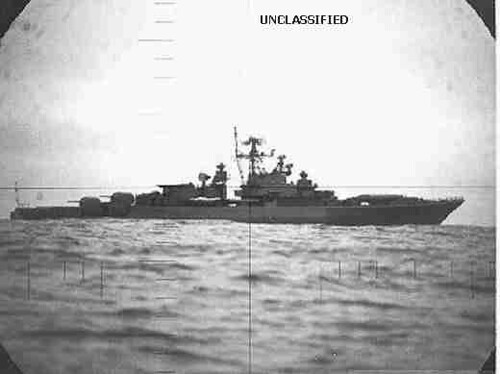
PS: Be honest: is some ways you miss the Cold War, don't you? RECCO Test #1: (see 'Viewgraph') Identify ship. "Knife in back; lip on stack; hotdog pack; it's a _____." First correct response gets a 72 hr liberty pass over any 3-day weekend.
UPDATE: In the finest traditions of the Soviet/Russian Naval service; things did not go off that well. Contact was lost shortly after lift-off. They think they found its signal in orbit but are not sure. Here is the "interesting" thing. The US Space Command states it can't find it. I hope that the thing never made orbit and the signal is a fluke, or that there is some OPSEC thing going on here; because if a clapped out Russian SSBN can launch a clapped out SLBM from a know location at a known time on a know trajectory and we cannot track it..... Well, you do the math.

Tuesday, September 21, 2021

The Terrible 20s Emerge from the Fog


Ah, yes, The Terrible 20s. What if you had the leadership and malaise of the Carter Administration mixed in with the budgetary pressures of the Clinton Administration ... with a little bit of Biden Administration special sauce mixed in?

We're not even a year in to the Biden Admin still at the start of the 20s...so you know this was coming.  

Via Joe Gould at DefenseNews;

House progressives will have a few chances to hold down the defense budget this week, but it’s going to be an uphill fight.

The House is set to vote this week on two Democratic amendments to cut the fiscal 2022 National Defense Authorization Act’s $740 billion top line. One would reduce it by roughly 10 percent, and another would undo a $24 billion a plus-up the House Armed Services Committee passed earlier this month.

...

“We face imminent threats from the COVID pandemic, climate change, growing economic inequality, and systemic racial and ethnic inequities [and] also, domestic terrorism,” Lee said. “It is time to shift our spending priorities to meet these priorities. I personally support much larger cuts to the Pentagon budget.”

There are a few amendments to be voted on too;

- A prohibition on funding for the Air Force’s nascent Ground Based Strategic Deterrent — a next-generation intercontinental ballistic missile and its warhead, the W87-1 — from Rep. John Garamendi, D-Calif.

- A prohibition on U.S. military forces in Syria without approval from Congress within one year, from Rep. Jamaal Bowman, D-N.Y.

- A prohibition on U.S. military logistical and intelligence support for Saudi air forces conducting strikes in the Yemen civil war, from Rep. Ro Khanna. (A separate amendment from House Foreign Affairs Committee Chairman Gregory Meeks, D-N.Y., would bar U.S. sustainment and maintenance support for those forces, with certain exemptions.)

- The top line-lowering amendments are a proposed 10 percent cut (excluding salaries and health care of military personnel), from Rep. Mark Pocan, D-Wis., and proposed reduction of the defense authorization top line to the level requested by the president, from Rep. Barbara Lee, D-Calif.

The (D) have a razor thin margin in the House and odds are the cuts won't run the board - but the anti-military (D) also know their window is about to close as '22 comes up ... they will do their best.

There are some macro patterns that are on their side - some masked by the flood of fiat money to cover the response to COVID - a classic black swan event.

Just a reminder from almost a dozen years ago, let's look at what we discussed in 2010 about where we might be today; from my Feb 2010 phrase-coining post, Looking towards the "Terrible 20's";

Let's look at 2020 again. What else is happening in the 20s? Well, for one, we will have to find money to re-capitalized the SSBN fleet. I offer to you that the 20 JAN HASC SEF Subcommittee meeting has an outstanding money discussion about that challenge. Deputy SECNAV Work has also discussed this challenge in other venues, and I think he has a very firm grasp of the problem, as do most in positions to know.

You have to look at it in the broader context of the budget as well. The hangover in the 20s from this decade's drunken frenzy of spending will couple with another cohort of Baby Boomers retiring and putting stress on the budget in ways we still do not have a firm grasp on.

In 2020 - that ship built in 1990 will be at 30 years. That LCS built in 2009 will only have 9 years or so of service life (LCS is expected to only last 20-25 years) - so by the end of the 2020s, LCS will be dropping like flies.

When you consider that we will be limited this decade to LCS and DDG-51 for our non-amphib surface ship program (don't throw JHSV at me, that is just a truck - full stop - all else is spin and hope) - you have about a perfect story for the 20s of limited shipbuilding funds and a stunted fleet.

Stunted? If you continue to assume that CG(X) is dead, then you might get funding for the much needed DDG(X) follow-on for the DDG-51 class - might. That will be requested in light of the SSBN money sponge - and I don't see how with all the other needs in the 20's, we will be able to afford both a DDG(X) and a CG(X) - and there is a good chance that we will simply have to live with DDG-51 Flight III as our "new" platform through the beginning of the mid-21st Century.

I know that looking into the future is a fuzzy hobby. Heck, if you outlined in 2000 where we were in 2010 people would have said you were a nutty pessimist - so we can only see 2020 in very large, fuzzy pixels. The beginning of the mid-century (2030) is just a silly exercise in many ways - but one that needs to be done. There are known-knowns (DDG-1000 will be a rump, expensive class of ships, Ticos history, DDG-51 backbone, LCS decomm'n like flies), known-unknowns (will LCS even meet some of its promised ability and numbers, will DDG(X) be moving forward), and unknown-unknowns (Black Swan events), but still - 2020 is closer than we think, and there are economic facts that need to be looked at.

It was so clear then ... why so many people refused to see it, I have no idea.

Navalists will need to fight every battle. Every ant hill is a hill worth dying on. Keep up the fight and don't take the bait. 

Monday, September 12, 2016

VADM Rowden Calls an End to the LCS Charades

The news on LCS just won't stop, and based on the comment count from last week's LCS posts - the Front Porch is still digesting it all.

A bombshell was dropped - wait, we're talking Surface stuff, so ... a broadside was fired on Friday as the previous day's letter from VADM Rowden, Commander Naval Surface Forces made the rounds.

The letter rakes the stern of the LCS establishment, and any lingering advocates need to strike their flag. While it is temping to gloat along with the rest of those who predicted much of this for over a decade - let's not do that (OK, maybe a little).

Rowden is doing is exactly what we need done and appears to be heading in the best direction; a smart person with a hard job trying to find a way to make the best of what the mistakes of others has foisted on to his Fleet. It is all I've asked for since throwing the towel in on LCS in 2010, and at last I think this is being done.

Then entire letter is below, but I want to comment on each paragraph, combining when needed - a friendly Fisking if you will.

OK, let's go.
A joint memo from the Chief of Naval Operations and Assistance Secretary of the Navy for Research, Development and Acquisition directed the establishment of a Littoral Combat Ship Review Team on Feb. 29, 2016. Our task was to review crewing, operations, training and maintenance of the ship class.

Our core focus was to maximize forward operational availability, while looking for ways to increase simplicity, stability and ownership. It became clear the LCS crewing construct is the variable that most impacts the other factors such as manning, training, maintenance, and – most importantly – operations forward. As such, one of the main changes to the program will be establishing a “Blue/Gold Plus” crewing concept. This change maximizes forward presence and improves stability, simplicity, and crew ownership. With this change, the crew will now focus on a single mission (Anti-Submarine, Anti-Surface, Mine Countermeasures) for the entirety of their tour.
"Simplicity" - the bane of transformationalists; excellent. Vince Lombardi leadership; superb."Stability and ownership." Lessons of centuries of manning ships and a slap across the face of the green-eye shade Navy; smart. Blue/Gold is a compromise and easy if fix if a failure. The big part of this paragraph - single mission. The fever dream of mission module swapping is dead. We told you that wouldn't work over a decade ago, but we welcome the party. Better now than later.
With Blue/Gold Plus crewing we will create three Divisions of four ships operating on each coast. The divisions will have a single mission (ASW, ASUW, MCM) and be commanded by a major commander identical in stature to officers commanding guided missile cruisers, amphibious transportation docks ships, destroyer squadrons, or amphibious assault ships. The 12 Freedom- variant ships will be homeported in Mayport, Florida. The 12 Independence-variant ships will be homeported in San Diego, California. One ship in each division will be designated as the “training ship,” manned by a single crew comprised of seasoned, experienced LCS Sailors. These training ships will be charged with knowing their mission, training to their mission and training/certifying the remaining six crews in their Division. The remaining ships of the squadron will be the ships that deploy and will be crewed with a “Blue-Gold” construct (similar to the crewing concept of our SSBN’s).
Single mission, focused Divisions run by a CAPT. Each Division will have one LCS in port to make sure all crews are kept trained and ready while their ship is deployed with the other crew. This absolutely works for me. A lot of non-deployable overhead, but you have to work with what you have. I shall not quibble.
The deploying crews will consist of 70 Sailors plus the Sailors manning the aviation detachment. These 70 Sailors are a combination of what was previously known as the “core” crew and the “mission module” crew – ONE CREW focused on ONE MISSION.
In case you missed it, he repeats it. Nod of the head to Rowden.
The Division Commander and staff will oversee all aspects of manning, training and equipping their assigned ships and crews, building expertise, ownership and stability within the crews.

To simplify and stabilize the ongoing testing and evaluation program, the first four ships in the in class will be shifted to dedicated, single-crewed testing ships whose main mission will be test and evaluation of the modular systems being installed on our LCS. Like the training crews, these ships will be manned with seasoned, experienced LCS Sailors. These ships will be available on an as needed basis for training and deployment; however, their main focus will be on system testing.
Back to what works for the Division, and notice Rowden repeats again - "simplify" "stabilize" - this is simply outstanding. Big takeaway here; LCS 1, 2, 3, and 4 are going to be training and evaluation units. This is a subtle admission that we still do not have any idea how to best use these ships with the weapons and systems they may or may not have. There is also a typo in the original, so I am not sure if it is the first four LCS, or first four of each class. If it is 1-8 as opposed to 1-4 ... then, yikes. Things are even worse in 2016 than I thought. Yes, worse than what I thought.
For all of our new ships, a single pre-commissioning crew will remain with the ship through the completion of post-shakedown availability and preparations for the first deployment.

To foster increased ownership by our sailors, we will establish Maintenance Execution Teams within the Division structure. These teams comprised of LCS Sailors will augment the ship crews within the Division in the execution of both preventative and corrective maintenance.
A kick to the groin for another sin of the concept - civilian contractor support. These are Sailors helping - and looks like good shore duty opportunities. Again, this is good stuff.
Finally, as we grow the number of forward operating stations to support our operations forward we will establish Forward Liaison Elements to ensure the support for our LCS where they are operating.

As we implement these changes, we will continue to make iterative adjustments and improvements based on evolving fleet requirements and technological developments. Implementing the approved recommendations from this review and continuing to examine other areas for improvement will better position the LCS program for success – both now and in the future.
This admits that we simply do not know what the future may require, so we'll adjust as needed going forward.

I don't know about you, but this works for me. Given the realities of what can realistically be done at the end of 4QFY16, I can only applaud VADM Rowden and his team on this first iteration of doing what can be done with this star-crossed program. May they squeeze every bit of utility out of it.

Statement from Vice Adm. Tom Rowden, Commander, Naval Surface Forces
Results from the Chief of Naval Operations Directed 60-Day Review of the
Littoral Combat Ship Program
Sept. 08, 2016

A joint memo from the Chief of Naval Operations and Assistance Secretary of the Navy for Research, Development and Acquisition directed the establishment of a Littoral Combat Ship Review Team on Feb. 29, 2016. Our task was to review crewing, operations, training and maintenance of the ship class.

Our core focus was to maximize forward operational availability, while looking for ways to increase simplicity, stability and ownership. It became clear the LCS crewing construct is the variable that most impacts the other factors such as manning, training, maintenance, and – most importantly – operations forward. As such, one of the main changes to the program will be establishing a “Blue/Gold Plus” crewing concept. This change maximizes forward presence and improves stability, simplicity, and crew ownership. With this change, the crew will now focus on a single mission (Anti-Submarine, Anti-Surface, Mine Countermeasures) for the entirety of their tour.

With Blue/Gold Plus crewing we will create three Divisions of four ships operating on each coast. The divisions will have a single mission (ASW, ASUW, MCM) and be commanded by a major commander identical in stature to officers commanding guided missile cruisers, amphibious transportation docks ships, destroyer squadrons, or amphibious assault ships. The 12 Freedom- variant ships will be homeported in Mayport, Florida. The 12 Independence-variant ships will be homeported in San Diego, California. One ship in each division will be designated as the “training ship,” manned by a single crew comprised of seasoned, experienced LCS Sailors. These training ships will be charged with knowing their mission, training to their mission and training/certifying the remaining six crews in their Division. The remaining ships of the squadron will be the ships that deploy and will be crewed with a “Blue-Gold” construct (similar to the crewing concept of our SSBN’s).

The deploying crews will consist of 70 Sailors plus the Sailors manning the aviation detachment. These 70 Sailors are a combination of what was previously known as the “core” crew and the “mission module” crew – ONE CREW focused on ONE MISSION.

The Division Commander and staff will oversee all aspects of manning, training and equipping their assigned ships and crews, building expertise, ownership and stability within the crews.

To simplify and stabilize the ongoing testing and evaluation program, the first four ships in the in class will be shifted to dedicated, single-crewed testing ships whose main mission will be test and evaluation of the modular systems being installed on our LCS. Like the training crews, these ships will be manned with seasoned, experienced LCS Sailors. These ships will be available on an as needed basis for training and deployment; however, their main focus will be on system testing.

For all of our new ships, a single pre-commissioning crew will remain with the ship through the completion of post-shakedown availability and preparations for the first deployment.

To foster increased ownership by our sailors, we will establish Maintenance Execution Teams within the Division structure. These teams comprised of LCS Sailors will augment the ship crews within the Division in the execution of both preventative and corrective maintenance.

Finally, as we grow the number of forward operating stations to support our operations forward we will establish Forward Liaison Elements to ensure the support for our LCS where they are operating.

As we implement these changes, we will continue to make iterative adjustments and improvements based on evolving fleet requirements and technological developments. Implementing the approved recommendations from this review and continuing to examine other areas for improvement will better position the LCS program for success – both now and in the future.