Showing posts with label Aircraft. Show all posts

Tuesday, October 25, 2022

Close Air Support Comes at You Fast ... From Both Perspectives

Ever wonder how fast things can come at you in combat ... and how fast you have to react to survive? 

Simply stunning video from the shootdown of a Russian S-25 in Ukraine:


No other aircraft has been so valuable - and no aircraft has been shot down more - than the SU-25 in this conflict.

Many regulars here are very familiar with "time compression" in such situations. Time slows down a lot. If you have not experienced that, you may wonder how he is able to eject so fast to survive a direct hit at 200-meters (about 600'). Well, training is one, but time compression is another.

This slow-motion video makes it a little closer to what it felt like to the pilot. 
Tough job. Tough aircraft.

h/t Tyler.

Tuesday, August 16, 2022

It isn’t the Platform: it’s the Engine

The “Out Years” is fantasy. It is a place where people wishcast the future they want. 

Let’s take a quick look at this gem from the Annual Long-Range Plan for Construction of Naval Vessels for FY 2007.

How'd that work out for us?

From that report looking forward nine years to 2016, it shows us having spent money on building in that time period … what exactly?

Seven (7) DD(X), aka DDG-1000, and six (6) CG(X).

Yeah … so be careful trusting these documents. That is why I simply refuse to listen to anyone’s pontifications on 2040 or 2045. Come on people. It’s insulting.

Let’s stick with that template of 9-years above, it's bad enough. From today that window would get us to 2031. Depending on who you talk to, that is either in the center or slightly right of center of the period expected to be the time of greatest danger with conflict over Taiwan with the People’s Republic of China. It also plays well with the issues we raised with the Hudson Institute’s Bryan Clark on Midrats last Sunday.

As men smarter than me have said, there are no magic beans. By the end of the decade there will be no “new” deployable program that will be able to change the fight west of Wake except on the margins in year-1 of any war. We will fight, +/-, at the end of the decade with what we have displacing water and making shadows on the ramp today. 

There are things that we have right now – at or near IOC – that may, if given the proper resources and focus, be significant additions to our combat power by the end of the decade.

I’d point you to Sunday’s Midrats for a series of platforms and capabilities that fit that bill, but today I want to focus on one that really got my attention – mostly because it is a historically proven force multiplier, engines.

Throughout aviation history marginal existing aircraft were made good, and good aircraft made great simply by updating engines.

In recent history, two example stand out.

First the USAF re-engined its KC-135s;

The re-engined tanker, designated either the KC-135R or KC-135T, can offload 50 percent more fuel, is 25 percent more fuel efficient, costs 25 percent less to operate and is 96 percent quieter than the KC-135A.

On the Navy side of the house, there was the re-engined F-14;

Navy Secretary John F. Lehman Jr. went on to say the TF30 engine “in the F-14 is probably the worst engine-airplane mismatch we have had in many years. The TF30 engine is just a terrible engine and has accounted for 28.2 percent of all F14 crashes.”

In 1987, F-14s began receiving new engines in the General Electric F110, which offered more thrust and eliminated many of the reliability problems associated with the TF30. These improved F-14Bs and the subsequent F-14Ds were very much the Tomcat of Top Gun fame, and as a result, you’ll often find Tomcat fans dismissing the TF30’s woes as a problem specific to the F-14A in the early days of operation.

See the pattern?

What does this have to do with any future conflict with China?

The self-inflicted vulnerability of our airwing and its well-known retreat from range with a deck full of short-legged strike fighters with no organic tanking (sorry, buddy tanking does not count) needs to be fixed at sea or balanced ashore.

While there is a chance to get a fair number of deployable unmanned tankers by the end of the decade, that is about the only thing we have on the horizon. Mindless dithering, entitlement, and sloth means our new carrier capable aircraft won’t be ready for the fight. 

What do we have that, possibly, might be able to help ashore for the USAF aircraft we will need beyond the finite number of heavy bombers and the delicate inventory of stand-off weapons they carry?

Though there are questions if it could be installed in the USN’s F-35C due to space constraints with the tailhook, and unquestionably can’t fit in the F-35B … for the land-based F-35A an engine replacement via the Adaptive Engine Transition Program (AETP) could provide a 25-30% increase in range. 

Pratt & Whitney is testing its new XA101 Adaptive Engine Transition Program powerplant and expects to conclude testing its two examples by the end of next year, company military engines division president Matthew Bromberg revealed in an interview. He expects that two-thirds of the technology developed from AETP could find its way into earlier engines now flying with the Air Force.

The company is “thrilled” to have two options available for the Air Force and F-35 partners to choose from for an upgrade to the fighter’s propulsion system, Bromberg said. GE Aviation has developed the XA100 AETP engine as a competitor to Pratt & Whitney’s version.

Testing of “our first new fighter engine in 30 years … was successful,” Bromberg said. The first XA101 and its twin will shuttle back and forth between Pratt & Whitney’s facilities and the Air Force’s Arnold Engineering Center in Tullahoma, Tenn., for the next year or so, generating more data. The Air Force and F-35 Joint Program Office will use the data to help decide whether the F-35 should get an all-new powerplant—one of the AETP engines—or take Pratt & Whitney up on its offer of an enhanced version of the F135 engine already in the F-35 fighter.

Pratt & Whitney succeeded in achieving the AETP’s goals, which were to obtain 10 percent improvement in thrust and 25 percent improvements in both fuel efficiency and thermal management, Bromberg said. “We know we can do that,” he said.

Range and endurance is a primary driver for any conflict in the Pacific. If we need more range inside 5-10 year window, AETP is one of the few ways I can see it happening.

I can think of fewer programs ready to go that seem more critical if the USAF is going to be able to join the fray in a manner we need them to. The timeline is tight, but take what you can get.

Time is short … and so is the range of our aircraft. 

All hail the F-35D.


Monday, July 18, 2022

On D+0 on the Opening of the Next Pacific War - we Will Regret not Having This

With the expected losses due to enemy action and mechanical failure, how do we plan to rescue aviators out of the water in the western Pacific?

What few subs we have will be fully employed elsewhere and really shouldn’t show themselves in a lot of those waters. We don’t have a lot of surface ships with helos either to spare.

As the USMC desires to make every island possible a fighting position, how do you supply them when their airfields – such that the are – are cratered by the PLARF conventional S//M/IRBM at D+1?

If your major airfields are unusable due to enemy military action or host nation political uncertainty ... how do you conduct long range ASW and reconnaissance as the Chinese fleet goes to sea and our satellites are blinded? What about tankers who use the same fields that our CVW are reliant on now that the same green-eyeshade pod-people got rid of organic tanking too (again, no - buddy tanking does not count).  

How limited is your ability to fully use your special forces if you cannot deliver and extract them in a theater dominated by shallow seas and countless islands, bays, coves, and rivers?

Why is your tool box limited to a flathead screwdriver and a hammer?

My entire adult life I have lamented the lack of seaplanes/flying boats in the toolkit of the US military. 

We had that capability in the past, but politics, green eye shade efficiency-cultists, and leaders of limited imagination but unlimited ambition stripped it away decades ago for the worst reasons possible. Some of our friends, like Japan, never did. Some opponents, like China, are rediscovering the logic of having such a versatile asset.

It is time again to discuss a huge gap in the US Navy’s toolbox; the seaplane.

Peter Ong at Naval News has a good update at a good – though not optimal – hope;

 “In terms of amphibious MC-130 demonstration, USSOCOM is actually going through some market research, currently, to see if we can identify any potential amphibious capacities to meet some of the SOF Requirements that are existing.  And currently AFSOC is also doing an experimental demonstration where they are planning on putting some float assemblies on a C-130 platform.  They use digital engineering as a major factor of reducing some of that risk and making some of those changes, and they have gone through some hydrotesting and some aero testing on a subscale factor.”

Good.

Better.


Best.


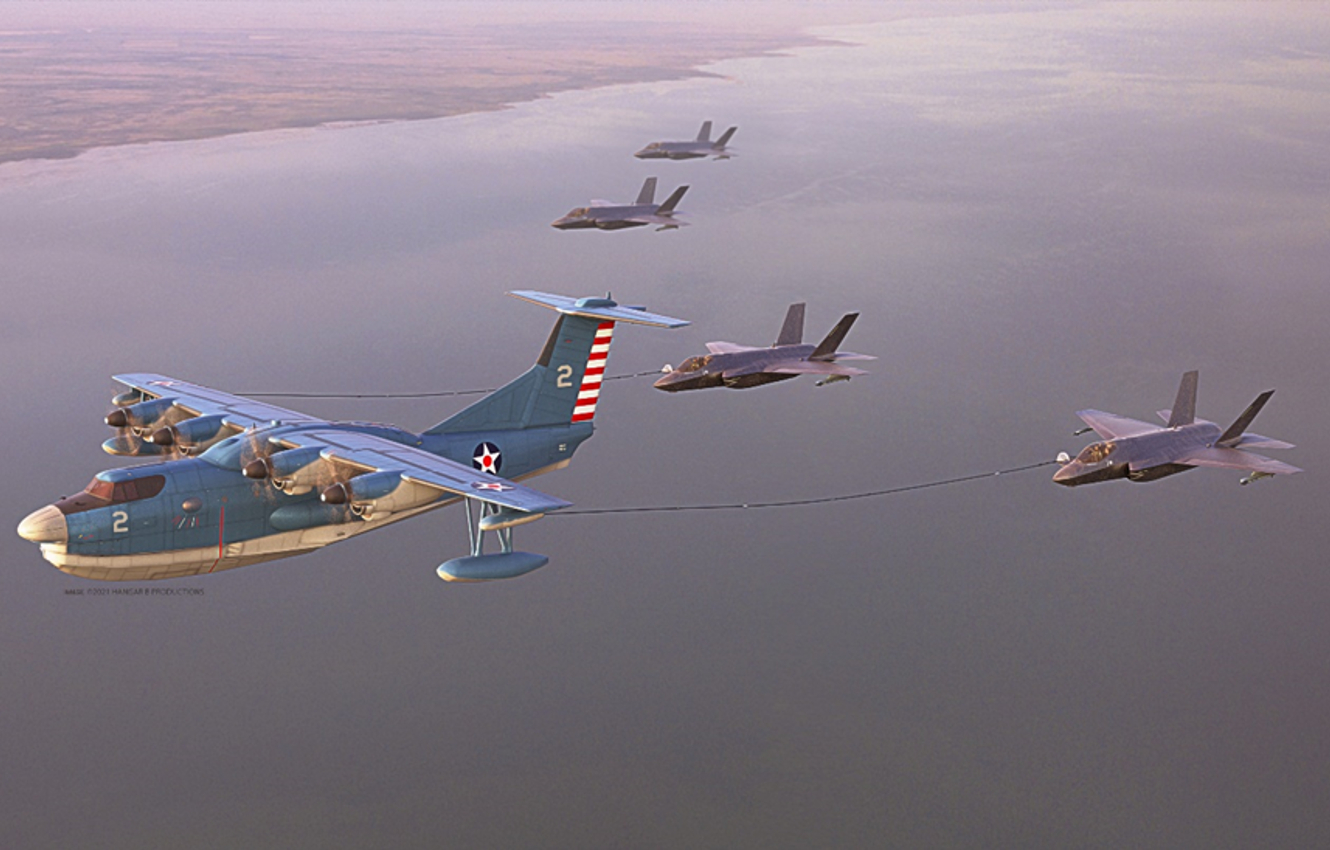
Yes, we should give a nod to the C-130 option, but should just buy what works NOW and works exceptionally well, the Japanese ShinMaywa US-2

If Japan can buy US built F-35s whole and in part, we can buy a few dozen US-2.

…and give them a great livery while we are at it.


Monday, June 21, 2021

Will the Franco-German Project Beat NGAD?


Well, at least they have a full scale static display;

The German defense ministry has forwarded a request to lawmakers seeking approval for almost 4,5 billion euros, or $5.3 billion, that would pay for the country’s contributions to the next stage of the Future Combat Air System.

Lawmakers on the Bundestag’s Budget and Defense committees are scheduled to consider the request next week. It covers a collection of research and technology-development activities, collectively dubbed phases 1B and 2, between 2021 and 2027. During that time, officials want to begin regular test flights with a demonstrator, constructed under the auspices of France’s Dassault Aviation.

I am a fan of the German thinking here;

German officials also want to offset nationally what they consider insufficient attention to the fields of electronic warfare, mission planning, weapons interfaces, and the secure distribution of sensor data, according to the document.

How fast could they move the timeline to the left if they had more money? Hard to say ... but 2027 is closer than it seems.

Monday, June 07, 2021

Three Card NGAD

When something you know is mundane, ordinary, and clearly unclassified is all of a sudden stamped with a classification, your first reaction should be, “What are they hiding?”, not, "What neat things are they doing!

Know your history.

I have spent a week waiting for someone to tell me the latest on NGAD isn’t exactly what I think it is, and no one even tries to explain it away.  They know.

Via Mallory Shelbourne at USNINews;

The Navy is keeping classified the amount of Fiscal Year 2022 money it wants to develop the next-generation fighter aircraft set to replace the fleet of F/A-18E/F Super Hornets, according to service budget documents.

The Navy’s FY 2022 budget justification documents withhold the amount of dollars the service is putting toward the Next Generation Air Dominance (NGAD) program. This is the second consecutive budget cycle in which the Navy has classified information about its investment into the service’s sixth-generation fighter.

It was over a dozen years ago that we saw what I consider the most egregious cover-up of our Navy’s fundamental failure to properly understand its responsibility for stewardship of the professional capital the taxpayers bought for them - the classification of INSURV. The previous link has my comments at the time.

An entire generation of leaders now have grown up - and been promoted - in this climate of cover-up in our Navy. That is what it is, no reason to sugar coat it.

After eight years of classified INSURV and the problems they hid, Rep. Whitman (R-VA) clearly identified what it was;

…he (Whittman) noted that Board of Inspection and Survey (INSURV) reports used to be unclassified and but have been classified for almost a decade. 

“During peacetime INSURVs should be declassified, and that makes sure there’s transparency there that we know what’s going on,” Wittman said. 

“That creates, again, that direction, that focus to make sure that maintenance is being done, maintenance availabilities aren’t being missed, material readiness is being maintained. All those things are critical.” 

“All of us have to look at this as an opportunity to really do some groundbreaking things in how the surface navy operates,” Wittman said. 

“It doesn’t hurt for us to get to points where we feel a little uncomfortable – in fact, I would argue we have to get to a point where we feel uncomfortable to make sure we are exploring all the different avenues that we have to explore.”

Yes, we commented on INSURV back in the day, but that was part of the process. Fear and shame are great motivators, and there is nothing classified about poor maintenance practices…unless you are doing such a horrible job that your warships are almost helpless … but that just tells we need more transparency, not less.

I remain convinced that you can draw a straight line from the horrible events of the summer of 2017 to not just the direct second and third order effects of hiding INSURV, but to the cultural mindset it enabled. 

Making uncomfortable facts classified is just a way to protect the powerful from being accountable - nothing more. We still have not addressed all the maintenance and material condition issues we “learned” from the summer of 2017's waste of 17 Sailors drowned in their racks, heck … we are still playing hide the ball on the manning issues.

We cannot afford to screw up NGAD, and I was hoping against experience that we would not. The fact we are on year two where we won’t even say what we’re spending on what is supposed to be a replacement for the Super Hornet only drags me in to further concern;

Look at this timeline;

The Navy finished its analysis of alternatives (AOA) for NGAD in July 2019 and as of August 2020, it had already started convening industry days for the program, USNI News reported last year.

The Navy has been seeking a replacement for the Super Hornet fleet for nearly a decade. The service put out its first request for information for the F/A-XX program in 2012

Nine years ago.

As we’ve stated over and over - next to reforming Goldwater-Nichols and the COCOM structure, we have to rip up root and branch our hide-bound and accretions hobbled acquisition system. 

It isn’t just inefficient and ineffective, it is a threat to national security. Just look at what it has done to our surface fleet the last quarter century. 

The aviation side of the house doesn’t have all that much better of a record. We’ve forgotten and thrown away range right when it became even more important. The light attack mafia won their tribalistic battles, but have left a flight deck that can't refuel a strike package, find and kill a submarine, or reach far enough without endangering mother. 

We’ve convinced ourselves that there was no way smaller aircraft carriers could park decks full of large footprint A-3, RA-5, F-14, EA-6B next to smaller aircraft - so we shrink our airwing in not just capability, but size, to the point of making its utility questionable. But hey ... the VFA guys got rid of all those VA & VF bubbas that teased them so much. They got rid of those goofy S-3s that kept taking up space ... so ... yea team.

Fewer aircraft with shorter legs is not how you win west of Wake.

With NGAD, it appears we have listened to industry oversell the promise of AI and unmanned systems, just assuming away very real issues such as bandwidth, reach back, ROE, engineering, and loss rates - all on the promise that technology risk is for losers and other people’s PCS cycle. 

This is what is driving what looks like a NGAD cock-up; the LCS of CG(X)s.

If you read the below and don’t get the sickening feeling that the same mindset and system that begat the clown show that was CG(X) isn’t slowly enveloping NGAD, then you’re not paying attention;

“As we look at it right now, the Next-Gen Air Dominance is a family of systems, which has as its centerpiece the F/A-XX – which may or may not be manned – platform. It’s the fixed-wing portion of the Next-Gen Air Dominance family of systems,” Harris said during a Navy League breakfast event at the end of March.

“But we truly see NGAD as more than just a single aircraft. We believe that as manned-unmanned teaming comes online, we will integrate those aspects of manned and unmanned teaming into that,” he added. “Whether that – we euphemistically refer to it as our little buddy – is an adjunct air-to-air platform, an adjunct [electronic warfare] platform, discussion of could it be an adjunct advanced early warning platform. We’ll have to replace the E-2D [Advanced Hawkeye] at some point in the future, so as we look to what replaces that.”

Harris at the time said the Navy divided its work on the NGAD program into two increments – increment one will evaluate a successor for the Super Hornet fleet and increment two will determine a replacement for the EA-18G Growler. The Navy has used F/A-XX to refer to the F/A-18 E/F replacement, while NGAD refers to the whole family of systems.

Someone get hold of NGAD while there is still time.

Not much time, but there is still time.

Have we learned nothing from the F-35 program? Did we not learn anything at all about “one stop shopping?”

They are over thinking NGAD. What we need now is an aircraft with legs that can deliver a tactically significant number of strike missiles that can hold an enemy's fleet, ports, and economic infrastructure at risk from distance. Design for 2-seats. Think of a 21st Century version of the SU-34. Go heavy now, that is the requirement.

If we feel we need an "air dominance" fighter for the fleet, then design one that does that with a lesser included secondary strike capability. We can have more than one aircraft under design and production at at time. If we are still trying to make the cult of efficiency happy by designing Swiss Army knives, then we are fools.

Are we compromising the good now for the future perfect that will never come?  If so, those in charge are steering us right in to a huge crisis at 2030 where the surface community finds itself today.

We don’t have time for that. Congress has no patience with the Navy for that. 

Remember, this is the team that brought us the FORD Class CVN that cannot even launch and recover the F-35C. A ship whose elevators and electrical systems seem designed to aviation tolerances and office park sensitivities that may not make it through shock trials, and if not, be able to deploy by mid-decade.

I, and others it seems, were giving them the benefit of the doubt. We were wrong. 

Congress needs to demand transparency. We cannot end up in 2030 with nothing to replace the Super Hornet. Its replacement should already be at IOC, but we playing three-card-monte with budget numbers.

If we screw this up - then why should the US Navy ever get more money in the budget? Any more responsibility? Any amount of respect and benefit of the doubt on Capitol Hill?

The Terrible 20s are fleshing out roughly as we saw a decade ago, and we appear to be compounding the problem through wholesale institutional incompetence.

Declassify now - not because it is in our self-interest (which it is) - but because we are a republic of a free people. The people and their representatives are not subjects.

Overclassification is a symptom of a larger problem. As outlined at CSIS’s Defense360 article from DEC09 by Patrick G. Eddington, Christopher A. Preble, and Seamus P. Daniels;

The overclassification of information poses a serious problem for national security. Restricting access to information prevents timely analysis and impedes decision-making by limiting debate on key policy issues to small groups of people within the government, and it inhibits public scrutiny of classified information and the decisions made from it. While it is critical to protect sensitive sources and methods, much of the information gleaned from these sources can still be made available in declassified formats. Still other information is already, and should properly be kept, in the public domain. Secrecy is inconsistent with the fundamental principles of transparency and democratic accountability, and the perception that government officials are using it to hide their own malfeasance contributes to widespread public disillusionment.

I am not sure what Congress is waiting for. 

Take the bad news and discomfort for a few retirement eligible Flag Officers now than the trainwreck to our Navy and the national security it underwrites that will come at the end of the decade if NGAD just becomes CG(X) with flight pay.

Tuesday, April 06, 2021

Egads on NGAD


I don't know who lead it will be or what crisis will cause it, but at some point we will realize that the golden calf idol of a procurement process we seem to think is a god is not only false, it is evil.

An entire generation going or two of acquisition professionals have grown up in a system that consistently fails the nation.

It doesn't have to be this inefficient or this ineffective, but it is. 

Latest datapoint is the overthinking and self-doubt is the replacement for the Super Hornet.

We have individuals who know what needs to be done - and if they had their way we would be a long way down the road to a modern fighter to replaced the butched-up 1970s runner-up that we have now ... but our self-imposed and voluntary system we work under won't let them. The amount of time this takes is simply gobsmacking - but we don't change.

Example. This sounds correct and sound.

The Navy is leaning toward replacing its fleet of Super Hornets with another manned fighter that will work with emerging unmanned aircraft concepts under the umbrella of the service’s Next Generation Air Dominance program.

Yes, that could have been said a decade ago and more - as a matter of fact it was, however ...

Rear Adm. Gregory Harris, who leads the chief of naval operation’s air warfare directorate (OPNAV N98), said Tuesday that the aircraft following the Super Hornets will “most likely be manned,” but that the Next Generation Air Dominance program will include a mix of both manned and unmanned platforms.

“As we look at it right now, the Next-Gen Air Dominance is a family of systems, which has as its centerpiece the F/A-XX – which may or may not be manned – platform. It’s the fixed-wing portion of the Next-Gen Air Dominance family of systems,” Harris told attendees at a Navy League breakfast. 

Is that clear? Sound confident?

Of course not. Harris knows what we need ... but ... 

“But we truly see NGAD as more than just a single aircraft. We believe that as manned-unmanned teaming comes online, we will integrate those aspects of manned and unmanned teaming into that,” he continued. “Whether that – we euphemistically refer to it as our little buddy – is an adjunct air-to-air platform, an adjunct [electronic warfare] platform, discussion of could it be an adjunct advanced early warning platform. We’ll have to replace the E-2D [Advanced Hawkeye] at some point in the future, so as we look to what replaces that.”

The Navy has been inching toward a family of systems approach for NGAD over the last several years. USNI News previously reported the service was leaning toward a manned fighter aircraft as part of the NGAD family of systems. The Navy last year quietly stood up its NGAD program office.

He can't see the future through a cloud of good idea fairies, snake oil salesmen, rent seekers, and people hanging on long enough to maximize their retirement. 

The system we have is so ossified and impeded by accretions, we can't just fiddle with it - it needs to be ripped up by the root and thrown in a chipper. 

DOD/DON won't do it either - Congress must act. 

Our acquisition systems isn't just not fit for purpose, it is an obstacle to producing the weapons our nation needs to win ... or even have a chance to win.

If you think this is a normal, efficient, and effective system - you are delusional.

Monday, June 22, 2020

With Carriers: Go Smaller to get Bigger?

In what will hopefully jumpstart another chapter in The Carrier Wars, our friend Jerry Hendrix has an article in National Review, “The Aircraft Carrier We Need” where he doesn’t argue that we don’t need carriers, just that we don’t need – or want – the one we’re building.

I’m in alignment with some his points, only slightly in others, and have a few points of my own that I think need to be part of the conversation.

As always, read it all, but here are a few pull quotes to get you interested.
… the Ford’s most glaring problems: It has the wrong design and is built around the wrong type and size of air wing, and it is not optimized for implementing the current National Defense Strategy, which focuses on great-power competition with Communist China and, to a lesser extent, a Putin-led Russia.
We really do not have a coherent National Defense Strategy and being that a CVN has a life of a half century, what it is “designed for” now will not exist in 20-50 years while it is still a capital ship.

This has always been the worst argument against specific platforms and it represents a line of thinking that can have bad results because you try too hard to specifically tailor a ship to your snapshot view of what is “optimized” for the challenge at hand in any specific POM cycle. That is how you get LCS and DDG-1000.

Instead, what we need are broadly flexible platforms built to be scalable if needed, fitted with a variety of known and unknown systems as the future tells us are needed at that time the need reveals itself. Flexibility and a design based on the ability to modify later are what is needed. That way, when the actual future – not the future we imagine – reveals itself, we’ll be able to adjust to it.
The Ford’s eventual design was predicated upon an assumption that the ship would operate in similar semi-permissive, low-threat environments, such as the Adriatic Sea or Arabian Gulf, staying close to enemy shores to optimize the efficacy of the carrier’s short-range (500 nautical miles) light-attack air wing, which was then dominated by the FA-18 Hornet. 

…the air wing should be designed to implement the nation’s defense strategy.
This is the real weakness. We have discussed here over the years the utter professional malpractice from short-sighted thinking that begat the 2020 airwing. People excused away the long range capability brought by organic tanking, heavy fighters, and strike aircraft. Instead, we think in terms of incredibly efficient decks of strike-fighters and their support aircraft. Much of the vulnerability of the carrier – and remember carriers have always been vulnerable because everyone is trying to kill them because they are so effective – derive from the pyrrhic victory of the Light Attack mafia against the Fighter and Attack mafia in the 1990s.

The next pull quote is a regular area of friction between Jerry and me. While we agree that unmanned aircraft will be part of the future airwing, we are at opposite ends of the UAS Overton Window. I believe we are about 1 decade away from knowing what we can actually “do” with unmanned systems so we can line up the next generation and will have a better idea of their use in 20, but Jerry thinks we know enough to make grander assumptions now. I think he is just too optimistic on the program risk, the technology risk, and the ability to do what he wants in a non-permissive EW environment.
As part of this shift, the core of the carrier’s new air wing would be 30 stealthy, heavily armed unmanned combat aerial vehicles (UCAVs), organized into three squadrons. Individual UCAVs should be capable of carrying 4,000 pounds of ordnance internally to a combat radius of at least 1,500 nautical miles without refueling. They should also feature broadband, all-aspect stealth design with a much-reduced radar cross-section (RCS). The design should also integrate an infrared-signature-reduction capability and an advanced passive sensor suite. These 30 aircraft — each armed with two 2,000-pound-class direct-attack weapons (GBU-31 JDAM) or stand-off weapons (e.g., JASSM or LRASM), four 1,000-pound-class direct-attack weapons (GBU-33 JDAMs), or up to 16 GBU-39 Small Diameter Bombs
More important than UCAV right now is the replacement for the F/A-18 series of aircraft. Not only does it need to be manned, it needs the option to have a 2-seat version for strike and electronic warfare. I know I jinx it by saying it needs to lean in the direction of a heavy strike-fighter, but it needs to lean in the direction of a heavy strike-fighter.

As for the size of Jerry’s carrier – it sounds familiar for a reason;
In addition, the carrier should have at least two long-stroke, heavy catapults in the bow and one in the waist (centered on the carrier’s angled deck) in order to maintain redundancy in battle, two arresting-gear wires, and three deck-edge heavy elevators to move aircraft to and from the hangar bay. The new carrier should have the storage capacity to accommodate 1,500 tons of aviation ordnance and 1.5 million gallons of aviation fuel. Lastly, to power all this, in terms of both speed through the water and electrical-power generation, the carrier will likely need two nuclear reactors (for combat redundancy) capable of generating 240,000 shaft horsepower. The United States no longer has the capacity to build large conventional maritime steam turbines, but if it ever does, this option should be considered. Such a carrier should cost no more than $5.5 billion, about a third of the cost of the current Ford-class carrier. This effort would take, at a minimum, ten years to design and build.

Before arguing that this proposed carrier is too small, its catapults and arresting gear are too few, and its aviation-ordnance and fuel capacities are too slight, critics should pause and consider that the carrier parameters described above, with the exception of the two nuclear reactors, lie directly between those of the Midway-class carriers built during World War II and the Forrestal-class carriers built during the 1950s. Both served in the Navy until the mid 1990s and operated heavy, long-range, penetrating-strike air wings.
This is a strong selling point to me for this reason alone; one of my greatest concerns about our present fleet design is that the cult of efficiency has led us to build a lot of very big platforms that cost a lot of money because the spreadsheet tells us that is the right thing to do. At war, what this does is make any loss unacceptable as it is one thing to lose 1 of 5 of your ships in an engagement, it is another thing to lose 1 of 3. One is a bad day at sea, the other means defeat; at tactical defeat that undermines your operational plans and puts your nation at strategic risk – all to make the peacetime spreadsheet optimized.

Can we trade 3 FORD’s for 5 HENDRIX’s? Would that be the right move … not on the spreadsheet, but for where it matters … at war?

An extended war? A war of attrition? The kind of war I’ll write about later this week?

Tuesday, March 17, 2020

Whither the Super Carrier

With apologies to Jo Moore, with COVID-19 spinning out of control, last week was a good week to bury bad news.

Did you catch it? The anti-CVN forces saw their moment, and it looks like they are making their move.

Though ordered, CVN-82 is as of yet, unnamed.

Could she be the last of her kind?
The Navy is launching a deep dive into the future of its aircraft carrier fleet, Breaking Defense has learned, even as the Secretary of Defense, dissatisfied with current Navy plans, conducts his own assessment. The two studies clearly show the deepening concern over how China’s growing might and the Pentagon’s eroding budgets could affect the iconic, expensive supercarriers.

The Future Carrier 2030 Task Force, which the service plans to announce next week, will take six months to study how carriers stack up against new generations of stealthy submarines and long-range precision weapons being fielded by China and Russia.
While always willing to give great and worthy people the benefit of the doubt, "Blue Ribbon Panels" have a spotty history of objectivity. I willing to be sold - but I'm not at the moment.

Add to that nugget, a little under two weeks' earlier, the confirmed SECDEF sent a frowny-face emoji to the acting SECNAV;
Defense Secretary Mark Esper has put a stop to the the expected release of the Navy’s long-term force structure plan, telling the service on Monday to hold off and take another look, several sources confirm.

The plan, announced last year and slated to be wrapped up by Jan. 15, has run into serious headwinds. The Navy insists it can grow the fleet to 355 ships as early as 2030 despite its shipbuilding budget being cut in the recently released 2021 budget, and as officials concede there’s little hope of significant growth in the near-term. Now Esper, who has been reviewing the plan for the past two weeks, is unwilling to sign off on it.
There you go. Unless there is significant intervention at the Congressional level - things look set up.

Even without the above, we knew this was coming.

Almost exactly 10-years and one month ago, I wrote the opening post announcing the upcoming Terrible 20s. This is what I wrote in February 2010;
Let's look at 2020 again. What else is happening in the 20s? Well, for one, we will have to find money to re-capitalized the SSBN fleet. I offer to you that the 20 JAN HASC SEF Subcommittee meeting has an outstanding money discussion about that challenge. Deputy SECNAV Work has also discussed this challenge in other venues, and I think he has a very firm grasp of the problem, as do most in positions to know.

You have to look at it in the broader context of the budget as well. The hangover in the 20s from this decade's drunken frenzy of spending will couple with another cohort of Baby Boomers retiring and putting stress on the budget in ways we still do not have a firm grasp on.

In 2020 - that ship built in 1990 will be at 30 years. That LCS built in 2009 will only have 9 years or so of service life (LCS is expected to only last 20-25 years) - so by the end of the 2020s, LCS will be dropping like flies.

When you consider that we will be limited this decade to LCS and DDG-51 for our non-amphib surface ship program (don't throw JHSV at me, that is just a truck - full stop - all else is spin and hope) - you have about a perfect story for the 20s of limited shipbuilding funds and a stunted fleet.

Stunted? If you continue to assume that CG(X) is dead, then you might get funding for the much needed DDG(X) follow-on for the DDG-51 class - might. That will be requested in light of the SSBN money sponge - and I don't see how with all the other needs in the 20's, we will be able to afford both a DDG(X) and a CG(X) - and there is a good chance that we will simply have to live with DDG-51 Flight III as our "new" platform through the beginning of the mid-21st Century.

I know that looking into the future is a fuzzy hobby. Heck, if you outlined in 2000 where we were in 2010 people would have said you were a nutty pessimist - so we can only see 2020 in very large, fuzzy pixels. The beginning of the mid-century (2030) is just a silly exercise in many ways - but one that needs to be done. There are known-knowns (DDG-1000 will be a rump, expensive class of ships, Ticos history, DDG-51 backbone, LCS decomm'n like flies), known-unknowns (will LCS even meet some of its promised ability and numbers, will DDG(X) be moving forward), and unknown-unknowns (Black Swan events), but still - 2020 is closer than we think, and there are economic facts that need to be looked at.

Huge challenge, one whose source is the lost decade we just came out of. You know, that "transformational" decade. The one that was to build the Fleet of the future. Well, it sure did, didn't it?
It holds up well, I think.

What I didn't see was the POLMIL stew our Navy would find itself in.

At this critical juncture, The Pentagon is led by the Esper/Milley West Point-West Point team while the Navy's Flag Officers try to recover from damage the previous generation of leaders inflicted on our institution over a decade spending their professional capital, like, well, drunken Sailors - mostly in WESTPAC - from Malaysian fat men to exhausted and untrained bridge watches driving Japan based destroyers. 

To top things off, those who should have spent every penny left getting ready for this decade spent what little professional capital they were able to scrape together from under the couch cushions on Ottomanesque bureaucratic protect-my-legacy games.

Almost two decades of sub-optimal performance at the highest levels has us where we are; a nice, solid-but-last-man-standing CNO and an Acting SECNAV fighting hard but wrestling two weight classes up in 4A. The previous SECNAV demonstrated what some of his problem was when he was last seen endorsing a Presidential primary candidate from the other party just a few weeks before he dropped out due to a complete lack of support among, well, almost anyone.

Of course.

Of course we are where we are.

The smart money is on a better than average chance the CVN will be killed by next POM (though perhaps not for good) and what little money is captured will be spent prosealing cracks from an overstressed and underfunded maintenance and readiness hole while trying to find some magic beans to build a useful fleet not reliant on a Cold War era destroyer as we stumble to 2030.

How will we project power from the sea in 2030? You can't do that from a submarine - a platform with limited followthrough and has its own growing vulnerability issues. You can't do that from land based aircraft. I win that wargame every time. There are not enough VLS cells in Christendom to do what a CVN can do ... with a proper airwing (which we don't have).

No, if we have to go to war in 2030, the question will be, "Where are the carriers?" ... and we will send thousands of Sailors in harm's way with an underfunded legacy system bereft of upgrades, carrying an airwing saddled with three decades of bad, short term decisions made by people trying to survive the next POM, not create a Navy ready to fight and win the next peer war.

I'm really not interested in discussing CVN vulnerability ... something known in detail since WWII. All capital ships are vulnerable ... that is why RN BB sortied so little during WWII, etc ... etc ... etc ... we've discussed that in volume here through the years. New folks can look it up, won't rehash it wholesale.

No, what are you going to replace them with? Vaporware? PPT thick programs? Unmanned systems whose performance and utility assumptions are based on AI that does not exist, robust reachback that is peace-time only, and ROE that won't survive a public university law school second-year law student?

I've seen that movie. It is stale and derivative. 

No, you can't. All you can do is, like The Thing in the dog kennel, flail around for anything that can justify taking food from Mom's plate so you can feed Dad so you can tell the rest of your family that you are taking care of the parents just fine.

With apologies to Jeremiah,
1:1 How doth TACAIR sit solitary, that was full of people!
She is become as a widow, that was great among the the services!
She that was a princess among Hollywood is become tributary to grunts!
1:2 She weepeth sore in the Unfunded Priorities List, and her tears are on her EMALS;
Among all her WBB contractors she hath none to comfort her:
All her fellow Service Chiefs have dealt treacherously with her; they are become her enemies.
1:3 NAVAIR is gone into captivity because of affliction, and because of great servitude;
She dwelleth among the Mine Warfare community, she findeth no rest:
All her budgetary enemies overtook her within the POM.
1:4 The ways of PEO Aircraft Carriers do mourn, because none come to the solemn assembly;
All her hangars are desolate, her Program Managers do sigh:
Her Flag Officers are afflicted, and she herself is in Executive TAP.
1:5 Her adversaries are become the head, her enemies prosper;
For SECDEF hath afflicted her for the multitude of her transgressions:
Her JOs are gone into career transition before the selection boards.
1:6 And from the Office of the Acting SECNAV all her majesty is departed:
Her Admirals are become like harts that find no pasture,
And they are gone without strength before the CBO.
So sayeth the Book of Salamander.

Monday, March 02, 2020

It's Always About More Than the Pilots

Pictures are important in telling our story.

We always see the sexy shot of the naval aviator doing their aviator things; the sexy jet with the right visuals, turning tax dollars in to the sound of freedom ... but there is a lot more there to make it happen.

As it was then, it is now. U.S. Naval Air Forces recreated a great picture from out past and updated it for today. 

I think when it comes to what kind of team it takes to get a plane in the air, this one pic does more than a thousand words.


BZ to all involved. Public Affairs messaging done right.

NB: I won't claim credit and all, but check out my tweet from 24 Jan of this year - I'll take the "W." ;)

Monday, December 23, 2019

Carrier Aviation: Personne n'est corrigé; personne n'a su ni rien oublier ni rien apprendre

Thoughts and emotions are all over the place while reading David Larter's weekend article, Amid a heated aircraft carrier debate, the US Navy sees funding slashed for a next-generation fighter.

Effective power projection is the key issue for our Navy. This is nothing new, this has been a standing requirement from its founding. 

You need a diverse tool box for power projection that includes subsurface, surface, and air platforms. The efficiency cult whose modern iteration can be traced back to what  William Perry begat a quarter century ago.  It gave us DDG and SSN without ASCM, a deck of short ranged strike fighters, no organic tanking, and an exquisite collection of Tiffany warships that will never deploy or a decade after Hull-1's commissioning, we still don't know what to do with.

We have an acquisition mindset with three decades of cascading failures - in no small part because of the need to feed the efficiency cult's Vaal on one end, and the nautical obsession with what next fancy buzzword is hiding behind the Bale-Bopp comet that will make all things new on the other.

The carrier debate has been one of the longest running and most frustrating kabuki-dance-meets-Groundhog-Day exercises we have. Their vulnerability is interlinked with their utility. Any student of the Guadalcanal Campaign can tell you how high-demand/low-density/high-utility/hi-vulnerability will drive decisions when it comes to carriers. 

At the dawn of 2020, many arguing this issue seem to have learned nothing of the last 30-years of efficiency and buzzword cults, and what they have done to our naval effectiveness. No one is being held accountable for actions everyone remembers, but no one wants to learn from.

If you assume, rightly, that in a peer conflict, any nearby airbase is just a nice static target, until you have something real and proven, if you want to project national will around the globe from the sea, the carrier is the way to do it. We seem to be hellbent to suboptimize and mitigate that ability, handing advantages to potential enemies without them having to fire a shot.

I think you would be hard pressed to degrade the American comparative advantage at sea any better than we are doing to ourselves through bot gross and petty mal-administration.

With the serial failures to replace deep strike VA capabilities, throwing away heavy fighters of the VF community, abandoning mid-range organic ASW/EW and tanking, we have an unnecessarily shrunk the  strike radius around our carriers. As such, we are long overdue for a new aircraft, and F/A-XX is supposed to be that platform.

It should be a mature design by now, but delay after delay is preventing it from making shadows on a ramp somewhere anytime soon.

At first glance in the article, it looks like Congress is trying to kill it in the cradle.
Congress has gutted funding for the U.S. Navy’s research effort into a next-generation fighter to replace the relatively limited range F/A-18 Super Hornet, an effort experts say could decide the continued relevance of the aircraft carrier in the 21st century.
That is, of course, until you read further.

Remember all the great advantages we would enjoy with delay and design all anchored to the advanced gun system for DDG-1000, the zippy-de-doo-da of LCS's engineering plant, or the all electronic systems on the Ford CGN?

How did that work out for us?

Does this smell familiar?
The Navy had planned to quadruple funding for research and development of the so-called F/A-XX, which was just $5 million in 2019, with most of the increase going toward research into a “Next Generation Advanced Engine effort,” according to the Navy’s budget submission.
OK, reading these tea leaves, I don't think Congress is the problem here. I think the problem is the Navy.

Could Congress be trying to force the Navy to abandon the pursuit of the perfect to embrace the good?

Again, we are fooling ourselves in to thinking if we just believe the industry promises enough and burn enough money a magical dragon will emerge from the stone eggs Santa put in our stocking?

Over and over again, we try to jump a generation but wind up falling on our face and then have to deal with upgrading the previous generation as best as we can.

Billions are spent without anything of tactical use displacing water or making shadows on ramps - putting our nation at strategic risk.

Are we talking big bucks? No.
The Navy’s budget request asked for $20.7 million but was ultimately appropriated just $7.1 million, a 66 percent cut. Congress sent the bill to the President on Thursday, who was expected to sign it.
Perhaps I'm wrong, but could Congress be right here. Are they saying, "No Navy. We don't believe you any more that we need to wait for your magical system to appear. Make something now that works now."

As paraphrased up-post,
Personne n'est corrigé; personne n'a su ni rien oublier ni rien apprendre. "Nobody has been corrected; no one has known to forget, nor yet to learn anything."
Does everyone need to be fired in order to get a change of mindset? Is there anyone not infected with the pathology of the fetid spawn of transformationalism coupling with the efficiency cult?
In May, Defense News reported that the effort to develop a system or “family of systems” to replace the shorter-range F/A-18 Super Hornet is a do-or-die effort that will determine if aircraft carriers remain relevant into the 21st century or will go the way of the chariot and battle elephant.
Ask the Army how their "family of systems" for Armored Systems Modernization program worked out. Hubris unalloyed by experience is a recipe for disaster.

Good people can be wrong here, and we have a lot of that. Case in point, Bob Work.

Correct diagnosis,
Bob Work, former Navy undersecretary and deputy Defense Secretary, told Defense News in May that the F/A-XX is the program the Navy needs to get range back onto the flight deck, which experts tend to agree is imperative. And if they’re going to do it right, they should look to unmanned, Work said.

“The focus should be on the F/A-XX. If you really want range, that has to be the platform you are shooting for,” Work said.
As we have been discussing for a decade and a half here, the Navy's retreat from range is an unforgivable case of self mutilation.

As steps were not made earlier then thing were only difficult, because we now find ourselves out of time, there is is a panic.

As is human nature, when panic steps in, you look for shortcuts, magic, or just blind luck.

A capability that has promise but is not even close to being ready for prime time, unmanned systems, are the latest thing we are grasping at.

For the problem at hand - what do we fight with in 2025 and 2030 - they are the wrong answer.
“Because with the Navy buying the F-35Cs, and the Marine [Corps] buying the F-35Bs, and the Navy buying the Block III Super Hornet, you are not going to be able to afford two or three programs. So, the F/A-XX is the one you need to focus on. And if the analysis shows you need range, that points to unmanned.”
Work is right about a lot of things - but like his stance on frigate's a decade ago, he is wrong here for what we need to do in 2020.

Bandwidth. Ability to takeoff, perform mission, and land in an non-EW or satellite access environment - these are just a few of the things that tell us that at this iteration, unmanned is not the basket we need to throw all our eggs in to. 

We need to take what we have and design from there. We are already a decade late in getting a replacement for the Super Hornet up and running.

We are letting the perfect be the enemy of the good. While we get what we need up and running, we can work on developing what we want - or think we want. We can and must do both ... but trusting on hope backed by hubris will not bring victory in the Sino-American conflict of 2027.

If we are not careful, we will wind up with the aviation version of the kind of perfection seen in DDG-1000. 

Like building DDG-51 until the crack of doom ... we will transform ourselves in to having an open production line of Super Hornets in to the 4th decade of the 21st Century.

We have a lot of people advocating for the wrong direction. We seem to not just be rudderless, but the bridge is empty as we head in to the shipping lanes.

Monday, December 02, 2019

First ASW Flap of FY20?

No, you can't buy training like this. Of course, this is all speculative. It could just be an amazing coincidence of events that is really just normal training exercises and pilots soaking up extra flight hours.

Or ... it could be ... something else.

Simply some amazing stuff since the end of October for those who follow @MIL_Radar on twitter.

Like what we've seen off Syria and other places, modern technology makes what was once known only to participants, something anyone can see just a percentage of. That is what we have here, so let's run with.

I couldn't take it anymore and decided I needed to put it all together for the Old Cold Warriors on the Front Porch. 

I could have just put you on to the twitter thread linked above, but I had trouble sleeping last night and thought I'd make a quick vid instead.

Now, MTH, you may want to be sitting ... because somewhere someone is just used up most of their FY20 allotment.

Now, off to Bear Island.

Enjoy!


Tuesday, November 05, 2019

The Mighty Hercules

If it seems that, like the B-52, the C-130 has been around forever ... well it pretty much has.

Via UKDJ;
Lockheed Martin delivered the 2,600th C-130 Hercules tactical airlifter last week, the customer was the U.S. Air Force Special Operations Command.

This milestone Hercules is an MC-130J Commando II Special Operations airlifter assigned to 9th Special Operations Squadron at Cannon Air Force Base, New Mexico

Just an incredibly successful platform that will easily see service in to the 22nd Century. What a great testament to her designers and those who build her.

I've lost count the different services' and nations' C-130s I've flown on. USN, USMC, USAF, ANG, GBR, FRA, POR, SWE, ESP, TUR.

Sunday, November 03, 2019

Naval Aviation with Kevin Miller - on Midrats


With the sequel to "Top Gun" coming up, if you ever wore the uniform of the US Navy, you're going to get asked a lot of questions.

This Sunday from 5-6pm Eastern, we are going to talk about today's Naval Aviation experience with author Kevin Miller, CAPT, USN (Ret.)

Kevin is a third generation naval officer. He graduated from the University of Mississippi and was designated a Naval Aviator in August 1983. In his career he flew the A-7E Corsair II and FA-18C Hornet, deploying overseas six times throughout the 1980’s and 90’s aboard the aircraft carriers Nimitz, Dwight D. Eisenhower, George Washington, Theodore Roosevelt and Enterprise. He finished his career in the Pentagon serving on the staff of the Secretary of the Navy, retiring in 2005.

After leaving the service Kevin was employed as an associate at two Washington DC defense consulting firms, and it was during this time he drafted his first novel Raven One. In 2010 he joined the Naval Aviation Museum Foundation as Executive Vice President and Chief Operating Officer. Today he is a self-employed defense consultant, Amazon Best-Selling author of the military action-adventure novels Raven One and Declared Hostile and serves as Vice President of Legislative Affairs for the Tailhook Association.

Kevin earned a Master of Science in Business Management from Florida State University and a Master of National Security Policy and Strategic Studies from the Naval War College.

You can listen to the show at this link or below, but remember, if you don't already, subscribe to the podcast at Spreaker or any of the other podcast aggregators.

If you use iTunes, you can add Midrats to your podcast list simply by clicking the iTunes button at the main showpage - or you can just click here.

Monday, September 23, 2019

The MQ-25A Imperative

As many of you noticed in a post earlier this month on the future airwing, the MQ-25A is almost here - and it is about time.

Via Ben Werner at USNINews;
Boeing conducted the first flight of its prototype unmanned aerial refueling aircraft on Thursday, testing its handling and the Navy’s ability to fast-track a long-stalled program.

The MQ-25A Stingray “T1” test airframe flew for two hours, flying in and out of MidAmerica Airport, located next to Scott Air Force Base outside of St. Louis. Boeing and Navy officials described the weather as perfect for flying as the T1 gathered performance data for Boeing and the Navy to review.
While a lot are itchy and a bit flustered that we are only going to use it for tanking (for now), it remains the correct move for two reasons; 1) It is a basic mission that will enable us to get used to operating and maintaining a CVN UAS so we can expand later in to other missions; 2) We have a gaping maw of a requirement for organic tanking.

It has been clear for a very long time how stupid it was to get rid of organic tanking. I've said from the start and maintain my position, that buddy-tanking does not count and is a false economy.

Facts, as usual, are on my side;

The Navy’s mission for carrier-based UAVs has evolved during the past decade. Initially, the UAVs were considered to augment a carrier-based strike capability and to provide surveillance missions. Instead, the Navy narrowed its focus to refueling as a way to free up more F/A-18E/F Super Hornets for strike missions.

“Stingrays can provide persistent aerial refueling that’s going to extend the range and operational capability of the carrier air wing and the CSG, and it’s going to improve the efficiency by increasing the number of F-18s available for the strike fighter mission,” Reed said.

Currently, between 20 and 30 percent of an air wing’s Super Hornet fleet is dedicated to aerial refueling operations. The introduction of the MQ-25A Stingray will free up those Super Hornets for strike missions. The MQ-25A will delivery up to 15,000 pounds of fuel at 500 nautical miles.
No one is bringing back the S-3Bs and we may get lucky that a real naval conflict does not come up in the next decade ... so let's get that tanking ability back ... and then get to work on the FA-XX.

Hat tip Blake.

Thursday, September 19, 2019

The Quandary of Aircraft Age vs. Mission Capability Rate

Just a quick graphic to ponder via DefenseNews's 05 AUG 19 edition.

This is USAF focused, and of course there are caveats; FMC vs PMC; maintenance hours per flight hour ... etc - but you would think that newer models would have a higher mission capable rate than models decades older.

Just a few to compare that caught my eye;

- B-52H: 69.3% vs B-2A: 60.7%

- F-16C: 70% vs F-35A: 49.6%

-UH-1N: 81.9% vs HH-60G: 70.7%

Huh.