Showing posts with label Japan. Show all posts

Wednesday, March 22, 2023

Japan Puts a Marker Down in Europe


The last few years have seen Japan take the very welcome steps out of the box her post-WWII constitution put her in and the habits of the post war generations.

With her size and wealth, even her 1% of GDP on defense created a significant military. As anyone who has operated can attest, it is a quality one in equipment, training, and material condition.

It's growing - and that is a good thing for the international order.

More than is apparent to the outside eye, her national security community – both uniformed and civilian – are very clear-eyed about the world in which they find themselves in 2023. They are taking steps to take her rightful and deserved place in the first tier of nations in national security, but they are small, direct, and cautious steps - but steps they are.

With all the above, the last few days brought a very significant moment for Japan and her friends. While most eyes were on the meeting between Russia’s Putin and the People’s Republic of China’s Xi, we had this;

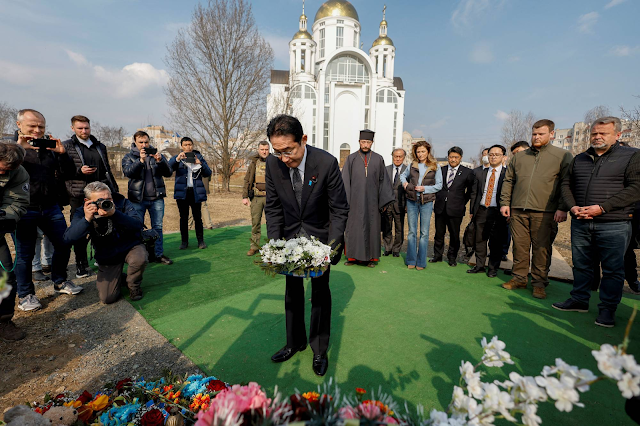
Prime Minister Fumio Kishida met Ukrainian President Volodymyr Zelenskyy on Tuesday in Kyiv, in a rare and unannounced visit that highlighted Japan's support for the war-torn country in the face of Russia's ongoing invasion.

The Japanese leader arrived in the Ukrainian capital on Tuesday afternoon local time by rail from neighboring Poland, becoming the final Group of Seven leader to visit the country since Russia's Feb. 24, 2022, invasion.

This is not just a photo op - this is a significant moment in Japan's ongoing evolution in to a proper 21st Century nation with responsibilities and the ability to help advance the cause of a more democratic planet.

Japan has not made such a statement with regards to events in Europe - I believe - since the presence of the 2nd Special Squadron in combat operations in the  Mediterranean WWI. 

That matters.

The next G7 Meeting is in Japan ... in a certain city of mention, Hiroshima;

"The world was astonished to see innocent civilians in Bucha killed one year ago. I really feel great anger at the atrocity upon visiting that very place here," Kishida said.

"I would like to give condolence to the all victims and the wounded on behalf of the Japanese nationals. Japan will keep aiding Ukraine with the greatest effort to regain peace," he added.

Earlier Tuesday, Japan's Foreign Ministry said Kishida would convey the “solidarity and unwavering support for Ukraine” of Japan and other G7 nations during the meeting while “firmly rejecting Russia's aggression and unilateral attempts to change of the status quo by force.”

...

"The situation in Ukraine and support for the country will be a major theme at the G7 Hiroshima summit,” NHK quoted LDP Secretary-General Toshimitsu Motegi as saying ahead of Kishida's arrival in Kyiv on Tuesday, saying it was "of great significance" that the prime minister "sees the situation on the ground firsthand.”

Not just Ukraine, the Japanese Prime Minister is sending a message by who he visits;

Kishida, who had been visiting India and was expected to return to Tokyo, entered Poland from India using a secretly chartered plane instead of the standard government aircraft, NHK reported.

Poland. India. Yes.

Japan continues to underline that she is part of the group of nations who will not allow Russia and China set a new global order.

Nothing in the diplomatic world is done by accident - especially when location and timing matter a lot for the unspoken messaging.

The decision to visit Ukraine came at an unusual — and perhaps fortuitous — time for Kishida, with Chinese leader Xi Jinping simultaneously in Moscow for talks with Russian President Vladimir Putin, ostensibly over Beijing’s proposal for a ceasefire between the neighbors.

Xi’s trip, his first abroad since winning an unprecedented third term as leader earlier this month, came just days after the International Criminal Court accused Putin of war crimes and issued a warrant for his arrest.

While Xi has sought to portray China as a potential peacemaker, even as he deepens relations with Putin, the two visits by the leaders of the world’s second— and third-largest economies served as a reminder of Tokyo’s robust support for Kyiv and Beijing’s ”no-limits” relationship with Moscow.

In Tokyo, U.S. Ambassador to Japan Rahm Emanuel said the day’s news told of “two very different European Pacific partnerships.”

“Prime Minister Kishida is making an historic visit to Ukraine to protect the Ukrainian people and promote the universal values enshrined in the U.N. Charter,” Emanuel tweeted. “Approximately 900 kilometers away, a different and more nefarious partnership is taking shape in Moscow.”

Meanwhile, Chinese Foreign Ministry spokesman Wang Weibin took aim at Kishida’s trip, saying that China “hopes Japan will push for an easing of the situation (in Ukraine), and not the other way around.”

Separately, Russia sent two strategic bombers over the Sea of Japan for about seven hours Tuesday, the country's Defense Ministry said. Moscow regularly sends the bombers, which are capable of carrying nuclear weapons, for missions in international airspace as a show of strength, but the timing was seen as more pointed with Kishida's trip.

A strong statement by Japan that is getting exactly the response you'd like. The response from the usual suspects means it matters.

Japanese defense planners and a number of senior lawmakers have been wary of the threat of conflict over Taiwan. Many have said a Taiwan emergency would also be an emergency for Japan.

These fears that Japan could be unprepared for a crisis in its own backyard have prompted Tokyo to pursue a dramatic hike in defense spending as well as closer ties with allies and partners.

The timing of the two visits could give more ammunition to claims that Tokyo and Washington sit firmly on one side of an increasingly divided world, while Beijing and Moscow find themselves on another.

“The coincidental timing of the trips does indeed create a stark contrast,” said Brown. “It presents the image of two blocs, with Japan and Ukraine on the side of democracy, and Russia and China representing an axis of authoritarianism.”

There are two blocks in the international world set in opposition, and the "realist" thing to do is accept that central fact.

We also need to accept that fact that "we" failed to win the post-Cold War peace.   

If you have not already, I highly encourage you to watch this 1992 interview with former President Nixon. If you have time, watch the whole thing - but this bit on Russia is spot on;
 

In the last decade of the 20th Century and the first decade of the 21st, Russia did not join the West. There was no "Peaceful Rise of China." The Smartest People in the Room™ failed us ... or it was a counter-historical fool's errand anyway. Pick whichever reason best fits your priors.

We have the 2023 that we have. We might as well crack-on with the slog.

Our friends are better than their friends anyway.

Wednesday, March 01, 2023

Building the WESTPAC Team we Need


There are good things, smart things, happening in The Philippines; 

"Meetings have already been set and probably we may have the Japanese and the Australians join in," Philippine Ambassador to the United States Jose Manuel Romualdez told Reuters.

"They would like to join in for joint patrols to make sure that there's the code of conduct and there's freedom of navigation," adding it was still "an idea under discussion".

If the plan materializes, it will be the first time the Philippines has joined multilateral maritime patrols in the South China Sea, a move that would likely anger Beijing, which claims most of the sea as its territory.

The United States - quietly and with a deft hand - needs to do whatever it takes to facilitate this taking place.

Just powerful.

The patrol talks and renewed engagement with the United States underscore how much Philippine President Ferdinand Marcos Jr. has realigned his country with its historic ally, moving away from predecessor Rodrigo Duterte's hostile approach to Washington while still pursuing close economic engagement with regional powerhouse China.

...

The United States, Japan and Australia have been conducting trilateral naval exercises, and joint patrols with those countries would be "good for the Philippines and for the entire area", Romualdez said, adding: "We want to have freedom of navigation."

'These are our allies'

The patrols "could be initially country-to-country" and expanded eventually "because these are our allies, like-minded countries", he said.

If we could find some way to have a PASSEX with the Vietnamese Navy while we were at it ... perfect ... but let's not get ahead of ourselves.

Early this month, Marcos granted the United States greater access to Philippine military bases by adding four more sites, on top of five existing locations, under the 2014 Enhanced Defense Cooperation Agreement, or EDCA, an agreement predecessor Duterte had threatened to scrap.

EDCA allows US access to Philippine bases for joint training, pre-positioning of equipment and building of facilities such as runways, fuel storage and military housing, but not a permanent presence.

Romualdez, who was also ambassador under Duterte, said recent developments showed "the relationship between the United States and the Philippines today is definitely at its best"

Step by step. Layer by layer. That is how you build strong, lasting, and mutually beneficial security partnerships. 

Good news. 

Tuesday, December 20, 2022

Japan Rising


As we started with Japan this week, let's stick with the topic - but this time on a more positive note.

Even more than the USA, Japan is a maritime and aerospace power. That is where her geography and technology give her the comparative advantage.

As the USA struggles to increase her forces to meet the challenge west of Wake, we rightfully look to our close ally in the region that has an impressive combo of GDP and population - Japan.

Even though she limited herself for decades to 1% of GDP on defense, with the size of her economy, she still has an impressive military. As those who have worked with her know, what she does have is quality in both personnel and material.

Keep all the above in mind as you read this;

Japan on Friday unveiled its biggest military build-up since World War Two with a $320 billion plan that will buy missiles capable of striking China and ready it for sustained conflict, as regional tensions and Russia's Ukraine invasion stoke war fears.

The sweeping, five-year plan, once unthinkable in pacifist Japan, will make the country the world's third-biggest military spender after the United States and China, based on current budgets.

...

"The Prime Minister is making a clear, unambiguous strategic statement about Japan’s role as a security provider in the Indo-Pacific," U.S. Ambassador to Japan Rahm Emanuel said in a statement. "He has put a capital “D” next to Japan’s deterrence," he added.

Meeting Japan-Taiwan Exchange Association Chairman Mitsuo Ohashi in Taipei on Friday, Taiwan President Tsai Ing-wen said she expected greater defence cooperation with Japan.

...

"The Ukraine war has shown us the necessity of being able to sustain a fight, and that is something Japan has not so far been prepared for," said Toshimichi Nagaiwa, a retired Air Self-Defense Force general. "Japan is making a late start, it is like we are 200 metres behind in a 400-metre sprint," he added.

China defence spending overtook Japan's at the turn of the century, and now has a military budget more than four times larger. Too few munitions and a lack of spare parts that ground planes and put other military equipment out of action are the most immediate problems for Japan to tackle, military sources have told Reuters.

Kishida's plan will double defence outlays to about 2% of gross domestic product over five years, blowing past a self-imposed 1% spending limit that has been in place since 1976.

"We look forward to Taiwan and Japan continuing to create new cooperation achievements in various fields such as national defence and security, the economy, trade, and industrial transformation,” the presidential office cited Tsai as saying.

It has been over a dozen years since we called for this, but 2% of GDP for Japan is great news for those who know what is needed in WESTPAC. 

Japan doubling defense spending? Huge.

The Japanese will be smart in this spending too. Most of it will go towards what they will need to secure the Northwest Pacific in any conflict - sea power and air power.

Excellent news.

Monday, December 19, 2022

"Support You and Your Family" - Really?


Are you familiar with the case of Lieutenant Ridge Alkonis, USN? 

Much to my shame, until this AM I was not. Let's get everyone up to speed. From Andrew Jeong at WaPo;

While stationed in Japan in May 2021, Alkonis was driving home with his family and their Australian labradoodle after a visit to Mount Fuji, near Tokyo. They had gone to an area about 8,000 feet high and accessible by car. After parking, the family hiked on a mostly flat trail for a few hours, Brittany Alkonis said. On their way home at 1 p.m., Ridge Alkonis was talking to his oldest daughter as he drove.

But mid-sentence, Alkonis suddenly fell unconscious, his family said. The vehicle, going about 25 mph, veered into a parking lot and crashed into several cars that were then pushed against two pedestrians: an 85-year-old woman and her 54-year-old son-in-law. They both died. A third person, a daughter of the elderly woman, was injured. Brittany Alkonis sustained an ankle injury.

When Ridge Alkonis awoke several minutes after the crash, witnesses said his face looked pale, his family said, citing police reports. His symptoms — paleness and a loss of consciousness — align with those of acute mountain sickness, which can affect people at altitudes above 8,000 feet, according to information published by the U.S. National Library of Medicine. In June 2021, a neurologist told Alkonis that he had suffered from the illness at the time of the crash, his family said.

A tragedy for everyone involved, especially those killed and injured - but also for Alkonis and his family. Unintentionally responsible for the death of others is something that will always be with a person - even if one is not at fault.

No one is at fault for an unexpected medical condition.

Accidents happen all the time due to medical emergencies with drivers. Many are familiar with drivers who are diabetic and run in to trouble while driving, not to mention heart attacks, strokes, and all manner of medical problems that come up with little notice. We are mortal beings. Both the background of the accident and the medical experts seem to agree that this is the case here - a tragic secondary effect of a medical emergency.

As those who have served overseas know, a service member's relationship with the host nation's legal system is bounded by the status of forces agreement with the host nation.

What did Japan decide in this case?

In October, Alkonis was sentenced to three years in jail for negligent driving. The judge overseeing the case said he had not traveled high enough to be afflicted with severe acute mountain sickness, according to local reports. Instead, she accepted prosecutors’ assertions that Alkonis had been drowsy that day. An appeal failed to overturn the verdict.

Alkonis’s family has accused Japanese investigators of misleading him into signing Japanese-language documents during his pretrial confinement that the family says inaccurately described Alkonis as having felt sleepy before driving that day. Alkonis was also denied access to an attorney during his initial four weeks of detention after the accident, according to his family.

That is what it is. How is he being treated relative to others?

Alkonis has repeatedly expressed sorrow over the deaths of the man and woman. His family, with help from friends, paid $1.65 million to the victims’ relatives as restitution, they said. “They are victims, 100 percent innocent. They are definitely victims,” Brittany Alkonis said in a phone interview this week.

But the family also says Ridge Alkonis received an unusually harsh punishment; 95 percent of Japanese citizens convicted of similar charges are granted suspended jail terms, according to Japanese Ministry of Justice data — meaning they aren’t sent to prison.

In 2019, of the 1,252 people charged with causing death through negligent driving, 4.6 percent — about 58 people — ended up serving prison time, according to a government white paper. The great majority — 95.4 percent — received a suspended sentence.

We cannot control the Japanese legal system, but there are things we can control. 

LT Alkonis is married with three children who are still in Japan where he was stationed.


What is his Navy and his Defense Department doing to support him and his family?

The Defense Department will deny a plea from Navy Lt. Ridge Alkonis to extend his pay and allowances while he serves a three-year prison sentence in Japan, according to U.S. Sen. Mike Lee of Utah on Thursday.

During a speech from the Senate floor, Lee said he spoke Nov. 29 with Defense Secretary Lloyd Austin after three weeks of requests for a phone call. Lee said he asked Austin for an update on the request for an exception to policy Alkonis made in June to keep his benefits flowing when his leave runs out at the end of this month.

Without Alkonis’ pay, his wife, Brittany Alkonis, and their children, still living in Japan, would be “kicked to the curb” at Christmastime, Lee, a Republican, said during his 23-minute speech on the Navy lieutenant’s plight.

“Secretary Austin callously informed me that day that the request for the exception to policy would not be granted,” Lee said. “I asked him why. He believed it wasn’t appropriate for the department to do that.”

Why is there a level of cynicism towards Navy leadership specifically and the military leadership in general by those who are serving? Why do you have some veterans discouraging family members from following their example and join the military - or if they do - tell stories like this as a warning that things are not what they may think?

We make a big deal out of family support. I'm thinking hard why we as an institution shouldn't stand up and support the Alkonis family right now.

Just look at this story and imagine this is your family, your friend, your Shipmate.

h/t Kurt.

Monday, September 19, 2022

If They Name Them “Yamato” and “Musashi” I will Probably Stroke Out


We talked about them a little bit on yesterday's Midrats, but I can't keep them out of mind - so, we'll start out the week looking at one hell of a fleet the Japanese seem to be building;

On the morning of September 1, the Japan Jiji News Agency suddenly reported news that the Japanese Ministry of Defense is preparing to build two new large warships. Its main features are: the standard displacement is about 20,000 tons, equipped with SPY-7 large radar originally used for land-based missile defense systems, equipped with American-made Standard-3 Block 2A anti-ballistic missiles, and Standard-6 long-range air defense missiles, made in Japan, Type 12 anti-ship missiles, and several other land-attack cruise missiles. This new ship, which can be fully classified as a heavy cruiser, is expected to enter service in 2027 and exist as a maritime mobile platform and a forward early warning and air defense base for Japan’s missile defense system.

Unless they are VERY far along in the process already, 2027 seem ambitious - but look again at what they are planning. 

An Arleigh Burke Flight III DDG displaces about 9,500 tons, just a little under a Ticonderoga Class CG. A Zumwalt Class DDG 15,600.

20,000 is a one big warship for a 21st Century navy to build. It makes sense though. If you consider that any static defense against ballistic missiles in Japan would not survive long due to their close proximity to the launch sites for ballistic missiles from China or North Korea - something underway is simply more survivable. Yes, they need more than two - but get started then see about getting more.

These aren't the only larger ships - modern Japanese technology ships - that Japan will have on hand.  The Izumo-class multi-purpose destroyers (AKA CVL) displace almost 20,000 tons empty 27,000 tons fully loaded. I am sure they have a follow-on carrier design somewhere. My guess is something between the Izumo and the Royal Navy's 65,000 ton Queen Elizabeth CV.

As we struggle to build a proper navy to meet the Chinese challenge, a militarily stronger Japan - if properly done - would be a tremendous asset in securing peace through deterrence in the Western Pacific, or in case of war, dominate the Northwest Pacific in a manner to free up the USN for other responsibilities.

I can see a few scenarios where the Japanese sit out a Pacific war, but I think they are unlikely to as it is in no way in their interest to have the Americans slink east of Wake.

Of course, as it is the the USN, funding is the key. There is new momentum to spend more on defense in Japan. As a maritime and aerospace power (as the USA is too, ahem), one would hope most of the increases would go to her navy.

We'll see, but until then ... I cannot wait to see the design for that 20,000 ton Japanese beauty.

Saturday, September 10, 2022

Looking West to the Taiwan Strait, with Dean Cheng - on Midrats

The People's Liberation Army Navy has her capital ships underway and under construction. The Japanese Navy continues her plans to grow in a way not seen in a century, and the lessons on the other side of the Eurasian landmass in Ukraine are shuffling long held assumptions concerning food, fuel, demographics, and economics.

We're going to cover this and more Sunday from noon to 1pm Eastern with returning guest Dean Cheng.

Dean is the Senior Research Fellow for Chinese political and security affairs at the Asia Studies Center of The Heritage Foundation. He specializes in Chinese military and foreign policy, and has written extensively on Chinese military doctrine, technological implications of its space program, and “dual use” issues associated with China’s industrial and scientific infrastructure. He is the author of “Cyber Dragon: Inside China's Information Warfare and Cyber Operations.”

Before joining The Heritage Foundation, he was a senior analyst with the Center for Naval Analyses, a federally funded research and development center, and a senior analyst with Science Applications International Corporation (SAIC, now Leidos), the Fortune 500 specialist in defense and homeland security. He has testified before Congress, spoken at the (American) National Defense University, US Air Force Academy, and the National Space Symposium, and been published in the Wall Street Journal and the Washington Post.

Join us live if you can
, but it not, you can get the show later by subscribing to the podcast. If you use iTunes, you can add Midrats to your podcast list simply by clicking the iTunes button at the main showpage - or you can just click 
here. You can find us on almost all your most popular podcast aggregators as well.

Thursday, January 06, 2022

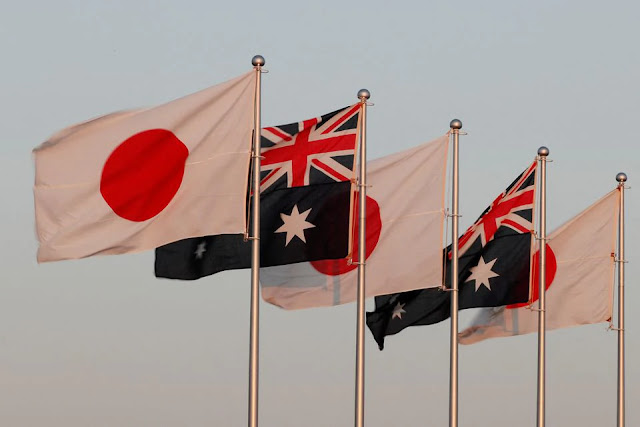
Australia and Japan: When Your Friends are Friends - Everyone is Stronger


This may get lost in the background noise, but if you are concerned about the rule of law, democratic governance and security in the Pacific, you would be hard pressed to find more important news than this;

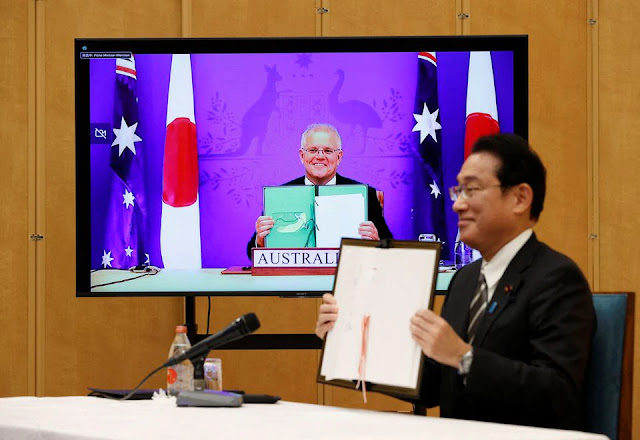
Australia and Japan are set to sign a treaty to beef up defence and security cooperation at a virtual summit on Thursday, in the latest move to strengthen ties amid China's rising military power and economic clout in the Indo-Pacific region.

Australian Prime Minister Scott Morrison said the two leaders will sign a Reciprocal Access Agreement, which will for the first time set out a framework for the two countries' defence forces to cooperate with each other.

What do they bring to the table? Primarily, this sends a message of solidarity, but like the USA, these are nations that are primarily maritime and aerospace powers due to geography. 

Looking just at their navies, if you combine their fleets they have (+/-) 28 submarines (6 AUS/22 JPN), 6 LHD/CVL/DDH (2 AUS/4 JPN), and 53 destroyers and frigates (11 AUS/42 JPN).

This is good. Good for them, good for the USA.

Everyone smile.


Tuesday, October 05, 2021

Japan Back in the Carrier Game ...

This really is an amazing video if you have a historically focused mind. 

Fresh from her modifications to fly F-35B, the Izumo is bringing the Japanese Navy back in the carrier business again … with some friends via United States Marine Corps F-35B.

The Japanese will be buying 42 F-35B and maybe more, so soon we will see the Izumo and her sister ships with the first Japanese fixed wing airwing at sea since the end of the Second World War.

I’d like more, faster – along with the South Koreans … and if we could get the Australians to play at some point that would be nice too … but this is all good news for navalists in the West.

Though not a “Western” nation, Japan is part of our network of allies and friends who stand for secure seas and the rule of law. The more of us who are strong and capable, the better we can contain other powers who see a darker future.

With USMC F-35B also underway for a full deployment with the HMS Queen Elizabeth – and even USAF CV-22B paying a visit – this is a good week for combined maritime operations that makes us all stronger and better.

Yes, this is a good week…but…more faster.


Wednesday, August 25, 2021

Remember WESTPAC?


No, not your liberty stories ... but the front line nations facing China that aren't all that concerned, directly, about the crisis in Kabul.

Taiwan and Japan ... tiny step by tiny step ... are getting closer.

A few updates over at USNIBlog.

Come by and give it a read.

Tuesday, December 29, 2020

Japan's Slow Entry in to the Arms Market Begins at Sea


Unlike Germany and Italy, Japan has been much slower to get back in to the military game outside its borders. Much of that derives from the constitutional restrictions we put in their new government after WWII. With that are the habits generations of Japanese leaders have developed when looking at this area and are comfortable with.

Slowly, that is changing. Especially as memories fade of Japanese occupation, and a sober appreciation of the very real threat from China, each year brings more details.

The government is considering exporting the Maritime Self-Defense Force’s destroyer to Indonesia, according to informed sources.

Negotiations on the export are underway with the Indonesian government, the sources said.

A successful destroyer deal, if struck, would provide momentum for Japan’s exports of defense equipment and help realize the country’s initiative to make the Indo-Pacific region free and open, the sources said.
More steps need to be taken in Japan to make this happen;
Japan’s three principles on defense equipment transfers, adopted by the Cabinet in 2014, allow exports of equipment that will be used for life-saving, transportation, vigilance and surveillance activities, or minesweeping.

“Exporting a destroyer will not be easy (in light of the principles) because the ship has not only warning and surveillance functions but attack capabilities,” a senior Defense Ministry official said.

But the export may be possible if it is made for the purpose of joint ship development with a foreign country, the official added.

In fiscal 2015, the ministry set up the Acquisition, Technology & Logistics Agency for uniform control of exports of defense equipment.

But the agency had failed to arrange equipment exports until it worked out in August this year a deal to ship four radars to the Philippines.

I support this for a variety of reasons, top most would be that it is in our interest for regional cooperation as a bulwark against China. The Japanese can play a significant role in this, and military ties would bring them closer.

Additionally would be the military effectiveness this will bring to nations that are no threat to us. The Japanese build quality kit, most of which the USA could help support if needed.  

Good. All good.

Crossposted to substack.

Wednesday, October 14, 2020

An Orion Comes to Vietnam?


Exciting news, well at least to me, of the growing presence of Japan in the security environment in the Western Pacific.

It looks like one area she might be selling aircraft and related services will be in Vietnam of all places.

I barely contain my joy over at USNIBlog.

Come on by for the details!

Monday, September 28, 2020

The Most Important BILAT Exercise You Haven't Heard of

This growing military relationship is probably one of the most important to watch as we approach the middle decades of the 21st Century.

Japan-India Maritime Exercise “JIMEX”


The Indo-Pacific Deployment (IPD) units, JS KAGA and JS IKAZUCHI, will conduct

bilateral exercise “JIMEX” with the Indian Navy (IN) as described below.

1. Objectives

(1) To improve JMSDF’s tactical capabilities

(2) To strengthen the relationship with the IN

2. Period

SEP 26 (SAT) – SEP 28 (MON), 2020

3. Exercise Area

 At sea and airspace in the west of India

4. Participating Units

(1) JMSDF

JS KAGA, JS IKAZUCHI

(2) IN

INS CHENNAI, INS TARKASH, INS DEEPAK and aircraft (P-8I and Mig-29K)

It appears both navies are bringing their varsity squad. All free nations should welcome this hopefully growing relationship.


Monday, September 14, 2020

Keeping an Eye on the Long Game: Part LXXXVI

 I don't think this is quite the graphic we should be using to make our point - whatever that point may be.


As reported by Brian Everstine, Pentagon editor at Air Force Magazine, General CQ Brown, Jr., USAF, the USAF Chief of Staff, shared the above slide with the following additional comment;

 ...USAF Airmen are the 'force multiplier' that make the difference, and a need for better sustainment. "Better to have a force of quality."

Well. 

I guess I need to go there, don't I?

1. First of all, the most expected flash point in WESTPAC involves Taiwan. As such, you can take all the South Korean units off that slide. They don't want any of that.  If 2025 is your point, you can take all of Japan off the slide as well. They unquestionably don't want any of that. Maybe later, but Japan needs another decade of seasoning before they are ready for that COA.

The Aussies? That is a hard best to make. Would they throw in for Taiwan? Impossible? Sure. Good chance, no.

2. I think we make a significant error to underestimate the "quality" of the Communist Chinese forces. Are they person-to-person-unit-by-unit as "good" as ours? No ... but the gap will be a lot closer in 2025 than it was in 2005 where most people's minds seem to be stuck.

We have a history going back to the Korean War in underestimating the Communist Chinese. We would be fools to do so now. You can say an American will kill 10 Chinese for every American loss, but if the Chinese are throwing 15 at you, you have a problem. 

We would also be fools to count as a given our allies forces. They are sovereign nations. They have agency ... and they may have other ideas about what is or is not worth poking the neighborhood dragon over. We have an entire Pacific Ocean to retreat over ... they don't.

H/t Blake.

Friday, July 10, 2020

Fullbore Friday


How in one FbF can you do justice to a ship with 20 Battle Stars like the USS O'BANNON (DD-450)? 17 in WWII (second only to USS ENTERPRISE (CV-6) ), and three in Korea.

We aren't the only US Navy that has trouble getting its Sailors armed with the right weapons and enough weapons ... and we aren't the only US Navy with resourceful Sailors.

From the Destroyer History Foundation and Ernest A. Herr - BEHOLD!
On 5 April 1943, DesRon 21 was returning from a night of shelling Japanese shore installations deep in the New Georgia area of the Solomon Islands. Our destroyer, the O’Bannon, as part of this force, picked up a radar contact that turned out to be a large Japanese submarine cruising on the surface and apparently unaware of our presence. The Japanese lookouts undoubtedly were fast asleep.

We approached rapidly and were preparing to ram the sub. Our captain and other officers on the bridge were trying to identify the type of sub and decided, at the last minute, that it could be a mine layer. Not wanting to blow up ourselves along with the sub, the decision was made that ramming was not a wise move. At the last moment, the rudder was swung hard to avoid a collision and we found ourselves in a rather embarrassing situation as we sailed along side of the Japanese submarine.

On board the sub, Japanese sailors, wearing dark shorts and dinky blue hats, were sleeping out on deck. In what could be considered a rude awaking, they sat up to see an American destroyer sailing along side. Our ship however, was far too close to permit our guns lowered enough to fire and since no one on deck carried a gun, not a shot was heard. Ditto on the Japanese sub, no one there had a gun either. In this situation, no one seemed sure of the proper course of action and it probably would not have been covered in the manual anyway. Therefore everyone just stared more or less spellbound.

The submarine was equipped with a 3-inch deck gun and the sub’s captain finally decided that now was probably a good time to make use of it. As the Japanese sailors ran toward their gun, our deck parties reached into storage bins that were located nearby, picked out some potatoes and threw them at the sailors on the deck of the sub. A potato battle ensued. Apparently the Japanese sailors thought the potatoes were hand grenades. This kept them very busy as they try to get rid of them by throwing them back at the O’Bannon or over the side of the sub. Thus occupied, they were too busy to man their deck gun which gave us sufficient time to put a little distance between our ship and the sub.

Finally we were far enough away to bring our guns to bear and firing commenced. One of our shells managed to hit the sub’s conning tower but the sub managed to submerge anyway. At that time our ship was able to pass directly over the sub for a depth charge attack. Later information showed that the sub did sink. When the Association of Potato Growers of Maine heard of this strange episode, they sent a plaque to commemorate the event. The plaque was mounted in an appropriate place near the crews mess hall for the crew to see. Well, it was the crew’s battle.
BTW - as any WESTPAC guy will tell you, even today the Japanese have no idea what to do with a spud.


First posted in DEC 2011.

Thursday, February 13, 2020

Japan Moves Out in Counter Air

I'm not really quite sure who is running the USAF, but this has been a hell of a year so far. 

Buy them a beer.

Because they decided to take a hit off the USN's transformationalist bong and overcomplicated tanking, they still don't have a tanker to replace Eisenhower era KC-135s.

In a world-class example of slow-rolling, they cancelled the light-attack platform we started asking for about 19-years ago.

...but that isn't all.

One thing we always counted on was being unquestioned in the air-superiority arena. We got so cocky, we stopped production of the F-22 for ... well ... stupid Beltway reasons.

History returned and we found ourselves relying on relic F-15 with nothing to follow. As such, the USAF announced that they will at last do what man of us knew they would have to do, buy new build F-15 to replace the F-15C.

Our friends cannot be looking at us with much confidence, and some are starting to hedge.

Japan is moving smartly with their own domestic modern air superiority fighter.
Japan’s Ministry of Defense has revealed that progress was gathering pace on the nation’s next-generation air dominance fighter program as Asia’s rising superpower, China, continues to enhance its own next-generation air dominance capabilities.
...
It is envisaged that Japan’s next-generation fighter, now named the F-X, will fill the role of the retiring F-15J air superiority fighter aircraft currently operated by the Japanese Air-Self Defense Force (JASDF), with the F-35A and B variants providing the low-end air-combat capabilities currently assigned to the F-16-based F-2 aircraft.
If you think that looks like the YF-23, you're on to something.
...recent changes within the US political establishment, notably the election of President Donald Trump, has triggered a major rethink in the policies that govern America’s arms exports, opening the door for Japan to engage with major US defence contractors like Lockheed Martin and Northrop Grumman.

Both companies have a history of developing highly capable fighter systems; Lockheed’s F-22 Raptor is the world’s premier air superiority and air dominance fighter aircraft, Northrop Grumman, largely famous for its UFO-like B-2 Spirit stealth bomber and the new B-21 Raider bomber, competed with the Raptor design during the competition to replace the F-15 Eagle in the early ’90s with the YF-23 Black Widow.

The Black Widow, although unsuccessful in the competition, presented the US Air Force and now Japan with an incredibly stealthy, fast and manoeuvrable air frame.

Tuesday, January 21, 2020

Japan on Tanker Patrol

It is always interesting to watch as Japan continues a growing habit of re-establishing her military on the world stage;
Japan will send a destroyer that can carry one or two patrol helicopters in early February, with hopes that the vessel can start operations by the end of the same month in the Gulf of Oman, the northern part of the Arabian Sea and the eastern side of the Bab el-Mande Strait.

The Defense Ministry is preparing to send Takanami, a 4,650-ton destroyer that can carry one anti-submarine patrol helicopter.

Tokyo also plans to mobilize two P-3C anti-submarine patrol airplanes that are currently engaging in anti-piracy patrol missions off Somalia for the planned intelligence activities.

About 200 crew members will be aboard the destroyer and about 60 staffers will be mobilized for the P-3C unit. The government plans to spend ¥4.68 billion on the dispatch in fiscal 2020, government officials said.
Exceptionally professional and capable ... but still hesitant for all the reasons we would expect, by habit.

We should encourage the Japanese as much as possible to keep stretching and gaining institutional experience. It is good for Japanese defense capabilities, American alliance heft, and the international effort to keep the seas safe for commerce.
Under the plan, the SDF unit won’t be authorized to use any weapons to defend other ships.

But in the event of an emergency, Tokyo could invoke an SDF law and put the unit on maritime policing operations, which would allow the destroyer and aircraft to use weapons to defend Japanese-flagged ships, officials said.

However, under international law, the SDF unit engaging in maritime policing activities would not be allowed to use weapons to defend foreign-flag ships. Most oil tankers operated by Japanese firms are registered in foreign countries due to low operating costs there.

During a news conference later the day, Defense Minister Taro Kono did not elaborate when asked whether and how the SDF unit could defend such a foreign-flagged ship operated by a Japanese firm.

Kono just said the SDF will “make a decision based on individual situations” and possible defense tactics would include giving a verbal warning to a party assaulting a foreign-flagged ship and deploying a destroyer close to the situation.
More of this. Much more.

Friday, October 25, 2019

Fullbore Friday

War wages all around you, and yet, you have your modest ship.
The motor vessel Ondina was a modern Dutch tanker of the Petroleum Company La Corona and had been delivered by the Dutch Dry Dock Company in Amsterdam [Amsterdamse Droogdok Maatschappij ADM]. The tanker had an overall length of 130 meters and a standard displacement of 6,341 ton and was equipped with a 6 cylinder Werkspoor diesel engine with a modest power supply of 2,800 shp. The maximum speed of the Ondina therefor was only 12 knots.
Each day brings harder news, yet you have a mission. 

The enemy is all around, and escorts are few. Who will protect you from the enemy?
...the new Bathurst-class corvette HMIS Bengal, which was destined for the British Indian Navy. During the Second World War 60 of these ships were constructed after an Australian design. Four of these corvettes, often called minesweepers as they were equipped with minesweeping equipment, had been built in the framework of the ’Commonwealth’s Shipbuilding Programme’ for the Indian Navy. British India at that time was still a British colony and therefore automatically a member of the Commonwealth. The four ships built for India were HMIS Madras, HMIS Punjab, HMIS Bombay and HMIS Bengal. This last ship was taken into service on 8 August, 1942, by Lieutenant Commander W.J. Wilson of the Royal Navy Reserve (RNR).

The corvettes of the Bathurst-class originally had a standard displacement of 650 ton but during the war the vessels were loaded with masses of extra equipment, ammunition and depth charges; so fully equipped they had a displacement of over 1,000 ton. The ships were provided with a triple expansion steam engine which supplied 2,000 shp. The max speed of the corvettes was designed to be 15 knots, but because of the larger displacement most of them did not go faster than 13 knots. On HMIS Bengal a 7.6cm gun (twelve pounder) had been installed as the foreseen 10.2cm guns were no longer in stock. The secondary armament of the ship consisted of a 40mm Bofors and two 20mm Oerlikon machine guns as anti-aircraft weapons. For the anti-submarine warfare the multi-purpose vessel was equipped with a type 38 Asdic (fore runner of the sonar) and 40 depth charges.

As the Bengal had only a capacity of 186 tons of heavy liquid fuel oil she could not reach India in one go from the Australian mainland. But sailing together, the ships would serve each other: the Ondina received an escort for part of the trip and HMIS Bengal could obtain fuel from the Dutch tank ship. It was scheduled that the Ondina and the Bengal would split up at Diego Garcia on the Chagos Archipellago south of the Maldives. On 5 November, 1942, the two allied ships departed from Fremantle. With an average speed of 10 knots it promised to be a long and dull crossing.
Dull? No. That was not to be.
In the morning of 11 November, 1942, HMIS Bengal and the Ondina sailed in line ahead, heading west-north-west. It was a nice and sunny day with a flat sea and excellent visibility. Around 11:30 a lookout of the Ondina saw two ships appear over the horizon at 90 degrees over port at a distance of approximately 12,000 meters. A little bit later the ships were also sighted from the Bengal. Because of the high deckhouses the strange ships for a moment were taken to be aircraft carriers. Because there had been no mentioning at all about allied ships being in the neighborhood, both Ondina and Bengal sounded the alarm and both ships turned 90 degrees to starboard, away from the suspected enemy ships. Around 11:50 Bengal signaled to Ondina to maintain her heading. The Bengal herself turned into the opposite direction in order to catch up head on with the enemy ships and to create time for Ondina to escape.


The enemy ships were recognized to be Japanese auxiliary cruisers and the Bengal steamed straight forward towards the one in front. First they thought that they were facing Hokoku Maru and the smaller Kunikawa Maru. Captain Horsman understood that he would never be able to pick up sufficient speed with his slow tanker to escape from the faster Japanese vessels and decided to face the battle and to support the Bengal with his 10.2cm gun. Just before 12:00 Hokoku Maru opened fire at HMIS Bengal and at 11:58 the corvette send an SOS signal to Fremantle with the message that they and the Ondina were under fire of two Japanese raiders in the position of 19.38 degrees southern latitude and 93.5 degrees eastern longitude, about half way Fremantle and the Chagos Archipellago. HMIS Bengal answered the fire of the Hokoku Maru with her twelve pounder. Second mate Bakker of the Ondina, who was the artillery commander of the tanker and was standing on the poop deck next to the gun, asked permission from captain Horsman to open fire. Steaming away from the approaching Japanese auxiliary cruisers, the captain of the Ondina granted permission. The artillery crew consisted of merchant seaman Visser, Able Seaman B.A. Hammond of the Royal Australian Navy and the Acting Able Bodied Seamen R.H. Bayliss, H.C. Boyce and H.A. Brooklyn of the Royal Navy. The Ondina opened fire when the Hokoku Maru had approached till about 8.000 meters, around 12:05. While the Dutch tanker received her first 14cm hit, which splintered the mast, the first 10.2cm shell of the Ondina went wide and the second hit just in front of the bow of the Japanese auxiliary cruiser. Therewith Second Mate Bakker could adjust his fire and the third grenade hit the deckhouse of the enemy ship. This was an extra ordinary achievement as the Ondina was not equipped with distance measuring equipment nor with fire-guidance. Bakker now diverted his fire to the stern of the Hokoku Maru. Whilst both HMIS Bengal as the Hokoku Maru continued to shoot at each other the fifth or sixth shot of the Ondina caused an enormous explosion on the Japanese auxiliary cruiser. A giant yellowish flame erupted and soon thereafter part of the stern broke off while the wrecked float planes shattered into the sea. The broken part of the rear of the ship sank and wild fires broke out in various places onboard the ship. Thereafter the ship listed heavily to starboard which caused ammunition to roll over and even more explosions erupted.

Aboard the Ondina they could not believe their ears and eyes The artillery crew danced for joy in spite of the fact that some enemy shells hit which damaged the radio antenna and one of the starboard life boats. The Chinese crew members who were not on duty, had sought a safe refuge below deck and AB Seaman Henry did his utmost to keep them composed. The Aikoku Maru now took aim on both ships and placed several hits on both ships that caused little damage though. When the Bengal ran out of ammunition the corvette put up a smoke screen and turned away from the battle around 12:40. One minute later the Bengal was hit again; this time in the rear which caused a fire to start. The crew of the corvette however succeeded to control the fire. The last they saw of the Ondina aboard the Bengal was that the tanker received a hit on the bridge at 13:08 and desperately tried to prevent further hits by changing course all the time a little bit. The corvette after having seen this, sent a coded message with the information that one of the auxiliary cruisers as well as the tanker had been sunk.

Aboard the Hokoku Maru the crew could not control the heavy fires and Commander Hiroshi could do nothing else but to issue the order to abandon ship. In the meantime on board all electrical power had failed and the engine rooms were ablaze. Because the Hokoku Maru was a converted merchant ship she did not have many watertight compartments; consequently the vessel made quickly a lot of water and after another heavy explosion the auxiliary cruiser foundered at 13:12. Of the 354 crew 76 lost their lives amongst whom Captain Hiroshi. 
 
In the meantime Ondina had fired her last 10.2cm shells whilst the Aikoku Maru had closed in on the tanker up to approximately 3.500 meters. Captain Horsman ordered white flags to be hoisted and ordered to abandon ship. The engines had stopped and the crew disembarked the ship in three life boats and two life rafts. The hit that struck the Ondina at 13:08 on her bridge, the last to be seen by the Bengal, killed captain Horsman. The remaining Japanese raider approached the Ondina up till 400 yards and launched two torpedoes towards the abandoned ship that both hit. Large holes were blasted in the starboard side of tanks number 1 and 2. This caused the Ondina to list to about thirty degrees, but remained floating on the other tanks. Thereafter the auxiliary cruiser maneuvered along the bow of the tanker, of which the Japanese thought that its fate had been sealed and started to machine gun the life boats and rafts. This war crime was probably committed out of frustration about the sinking of the Hokoku Maru and the escape of the Bengal. By this machine gunning three Chinese stokers were killed and the chief engineer J.J. Niekerk and ABS Henry were severely wounded. Chief engineer Niekerk died an hour afterwards from his wounds.

At 15:00 the Aikoku Maru had picked up the survivors of her sister ship and returned to the Dutch tanker. The Japanese fired another torpedo but missed. Convinced that the tanker had been lost, the Japanese auxiliary cruiser left the battle scene and sailed away in northerly direction without any further concern about the drowning crew of the Ondina.

Salvage of the Ondina
After the first mate Rehwinkel had provided a seaman’s grave to the chief engineer, he wanted to return to the Ondina. Of the crewmembers that were with him in the life boat only sailor Visser was prepared to accompany him. The others, Chinese crew members refused to come along as they feared that the Ondina would sink as yet. Second mate Bakker in the meantime, with the motor launch in which he was commander, had returned to the tanker. Together with third engineer Leys, the Australian gunner Hammond and the British artillerist Ryan he boarded the ship which was still on fire in several places. Bakker and the gunners started to pump water into several of the port tanks which slowly righted the Ondina. Leys inspected the engine room and established that the diesel engine was still in working condition. The motor launch was sent to collect the other life boats and rafts and Leys and Bakker went to the bridge where a fire was still burning. The fire was extinguished by both men after which they carried the body of the captain to his cabin. The tanker had in the meantime been righted and the outboard valves could be closed. Around 19:00 all life boats were alongside the tanker and the crews from the rafts had been taken aboard the life boats. The life boats were hoisted on board as good and as bad as this was possible and secured. The stokers and engineers went to work and a few hours later first officer Rehwinkel could give the order ”slow ahead”. And somewhat later even “full ahead”. The heavily damaged tanker set her heading for Fremantle while the crew extinguished the last fires in the forecastle.

The next day captain Horsman received a dignified seaman’s burial. The wounded were cause for serious worry. Especially ABS Henry was in serious condition. He had a crushed leg and had lost a lot of blood and was in urgent need of professional care. After two days the crew of the Ondina was of the opinion to be safe enough to send a radio message and to ask for medical assistance. This message was sent in clear language as, after the order to abandon ship, all secret documents and also the code book had been thrown overboard. The surprising and unexpected message was being received by the allied authorities in Colombo on Ceylon and in Fremantle with disbelieve and mistrust. As the Bengal had indeed reported the Ondina to be sunk and a trap, created by the Japanese in order to lure a ship towards them, was suspected. From Fremantle a signal was sent to inquire about her position. Rehwinkel did not dare to provide this because his clear language message could also be read by the enemy. Therefore medical assistance remained lacking for the time being.

It was not until 17 November before the damaged tanker was reconnoitered by an Australian Catalina flying boat, over 220 nm north-west of Fremantle. Onboard the Ondina shortly before, a ship had been spotted and with signal lamp the Catalina was asked to contact that ship and to ask for the presence of a doctor. The relevant ship turned out to be the Australian hospital ship HMAS Wanganella and it was directed quickly towards the Ondina. By quick handling of the doctors the life of ABS Henry could be saved. The next day the Dutch tanker entered the port of Fremantle after a trip that had not proceeded according to expectations and which had cost the lives of five crew. The day before HMIS Bengal had safely made the harbor of Diego Garcia. The last days the corvette had to sail at slow speed to safe fuel, but there had been no further problems.
Note, both ships ran out of ammo.

You never have enough ammo.

The accountants and supply people are always wrong. Take what they say you need, and add at least 30% more.

Always.

Also, when the next war comes, and it will - what are our plans to give our auxiliaries teeth? They will need it - regardless what the peacetime theorists say.

They always have during every war with a maritime component. From the dawn of time. It won't be different next time either.


Nice video here a year later of the Bengal.


H/t MR.

Saturday, May 04, 2019

Taiwan and the Challenge of Modern Strategic Defensive Posture with Grant Newsome, on Midrats


What is a good strategy and posture for Taiwan to take for her defense? Are there things she can learn from Japan?

What is Taiwan’s posture today towards mainland China, and where are trends taking her?

To discuss these and related questions this Sunday from 5-6pm Eastern will be our guest, Grant Newsham.

We will use his recent article in the Global Taiwan Institute, Rethinking Taiwan’s Defense: Looking at the Japanese Experience, as the starting point for our talk.

Grant Newsham is a retired US Marine Corps Officer and a Senior Fellow at the Japan Forum for Strategic Studies. He served as Marine Attaché in Tokyo and was later the first USMC liaison officer to the Japanese Self-Defense Force (JSDF), and was instrumental in developing Japan’s new amphibious force. For 2019, he will live in Taiwan as the Ministry of Foreign Affairs Taiwan Fellowship Scholar.

Join us live if you can, but if you miss the show you can always listen to the archive at Spreaker. 

If you use iTunes, you can add Midrats to your podcast list simply by clicking the iTunes button at the main showpage - or you can just click here.

Wednesday, April 17, 2019

The Anglosphere and Her Friends

In INDOPAC, it is better to have these friends getting to know each other.

Head on over to USNIBlog for the details.

Friday, January 04, 2019

Fullbore Friday

Every 4-5 yrs I run this FbF because it has so much to teach us about the demands of surface combat - even today. As you read, pay attention to the actions taken from bluff or misinterpretation of unfolding events. Pay attention to the amount of ordnance sent downrange by both sides and the incredible acts of damage control.


When I say Battle of the Komandorski, what comes to mind? If nothing, well that is sad ... but we can fix that.

Well, I think you would be hard pressed to find a more deserving Battle for FbF - if for no other reason than the very, well ... Shoe-y-ish-ness of it all.

A perfect day in the Northern Latitudes, you know the type of day.
The day was dawning with remarkable visibility under a light overcast, a glassy sea and gentle breezes from the southwest. Air and water temperatures were just at or above freezing. At 0830, apprized of his opposition, Hosogaya began to deploy his ships. Abukuma with Wakaba, Hatsushimo and Ikazuchi turned in column to starboard, followed two minutes later by Nachi, Maya and Tama. The two transports, accompanied by Inazuma, continued north, northwest as Hosogoya led his fleet southeastward in two parallel columns to engage the American fleet. At about this time Nachi launched an aircraft to assist in spotting the fall of shot.
How much do you rely on Intel? What do you do when you realize you are outnumbered almost two to one?
McMorris’ movements upon sizing up his opposition were reckless. Initially he believed he had found the expected convoy and that it would be lightly escorted. But as the masts of first one and then two heavy cruisers hove into sight over the horizon, he realized he was outnumbered and outgunned. Nonetheless, he continued to lead his fleet toward the enemy,
What was he looking at?

Forces Engaged - Battle of Komandorski Islands 
USN
TYPENAMEYEARDISP FLMAINSECTTSPD
CA 
CL 
DD 
DD 
DD 
DD
Salt Lake City 
Richmond 
Bailey 
Coughlan 
Dale 
Monaghan
1927 
1921 
1941 
1942 
1935 
1935
11,512 
9,508 
2,395 
2,395 
2,064 
2,064
10x8/55 
10x6/53 
5x5/38 
5x5/38 
5x5/38 
5x5/38
8x5/25 
2x3/50 

10x21" 
10x21" 
10x21" 
8x21" 
8x21"
32.5 
34 
35 
35 
36.5 
36.5


Total6193429,938


IJN
CA 
CA 
CL 
CL 
DD 
DD 
DD 
DD
Nachi 
Maya 
Tama 
Abukuma 
Wakaba 
Hatsushimo 
Ikazuchi 
Inazuma
1924 
1928 
1921 
1925 
1934 
1933 
1932 
1932
14,743 
14,604 
5,832 
5,570 
1,802 
1,802 
1,980 
1,980
10x8/50 
10x8/50 
7x5.5/50 
7x5.5/50 
5x5/50 
5x5/50 
6x5/50 
6x5/50
8x5/40 
8x5/40 
2x3.1/40 
2x3.1/40 

8x24" 
8x24" 
8x24" 
8x24" 
8x24" 
8x24" 
9x24" 
9x24"
35.5 
35.5 
36 
36 
36.5 
36.5 
38 
38


Total8192948,313


I also want you to ponder Damage Control. Follow this performance by the crew of the USS SALT LAKE CITY (CA-25) in particular.
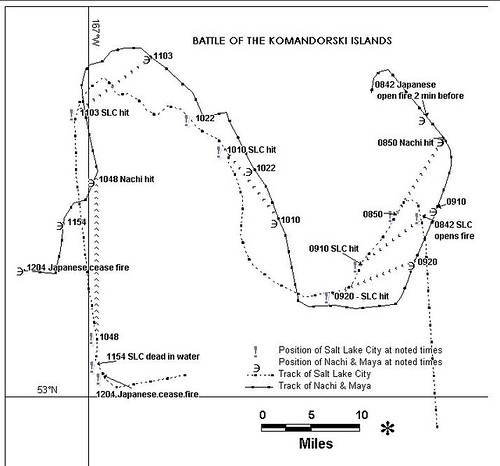
By 0840 the Americans were in battle formation: a single column still heading north led by Bailey followed by Coghlan, then Richmond, Salt Lake City, Dale and finally, Monaghan when Maya and then Nachi opened fire at a range of 20,000 yards. Maya obtained a straddle on Richmond with her second salvo, but then both cruisers switched fire to Salt Lake City. Salt Lake City began shooting back two minutes later. The Americans believed they scored a quick hit on Nachi with Salt Lake City’s third and fourth salvos, but they were apparently observing blast damage on Maya. Her action report stated that her opening salvos set her No. 1 floatplane ablaze. Damage control dumped the plane overboard and quickly controlled the fire. At 0844, as the range continued to rapidly close, Nachi launched eight torpedoes. Apparently these came close to doing serious harm: lookouts aboard Richmond saw a torpedo pass under her bow while one broke surface near Bailey’s starboard quarter. At the time these reports were discounted because the Americans still had no appreciation of the Japanese Long Lance torpedoes’ range.At 0845 McMorris finally changed course as the range was closing rapidly, turning to port, and increasing speed to 28 knots. As the Americans settled on a southwesterly course, Salt Lake City continued firing with her rear turrets and drew first blood hitting Nachi at 0850 with her sixteenth salvo from approximately 16,000 yards. One 8” shell struck the aft section of the compass bridge, killing eleven and wounding twenty-one and damaging the gunnery control electrical circuit. The second shell damaged one of the mainmast’s struts. Two minutes later a third 8” shell struck Nachi’s aft aircraft deck, killing two and wounding five in the torpedo room below. Damage control attempted to shift the affected generator to a boiler with low steam pressure. This error resulted in a complete failure in all power to Nachi’s main battery turrets, freezing her guns at full elevation and leaving them unable to train. She was effectively out of the battle for a half-hour while power was restored.

As Nachi struggled to correct her damage, Hosogaya turned his cruisers southwest to pursue the Americans. The light cruisers and destroyers had already peeled off to the southwest several minutes before. Strategically he was now between McMorris and his base, chasing the Americans from their aft port quarter while his light forces, positioned to protect the convoy, followed from the starboard quarter. Tactically, Hosogaya possessed the weather gage, but a stern chase is a long chase. His cruisers had to turn to fire their full broadsides (only four of their ten 8” guns could bear forward) and these maneuvers negated any advantage he might have gained with his superior speed.

As the Japanese settled on their new course, the range opened slightly. The Maya rightly concentrated her fire on Salt Lake City. Her aim was good, but Captain Rogers commanding the American heavy cruiser successfully chased salvos until 0910 when Maya finally landed an 8” shell on Salt Lake City’s starboard spotter plane on the midships catapult. The only two deaths the Americans were to suffer during the battle resulted, but damage control quickly extinguished the fire and dumped the plane over the side.

Another hit, once again from Maya followed at 0920. This struck Salt Lake City’s quarterdeck, but did little to immediately affect her fighting value. At this point the Americans gradually started bending their course west, then west by northwest. The Japanese suspended fire for nine minutes from 0921 to 0930 when Nachi re-opened fire. They were now sailing almost due west. By 0945 Tama had encroached to within 18,000 yards of Salt Lake City’s starboard quarter. Rogers sheered his ship out of line and with a few salvos forced the light cruiser to make a 360° turn. During this portion of the battle Abukuma with the three destroyers continued to follow off the American’s starboard quarter, out of range, but gradually closing.

Salt Lake City first experienced a serious problem at 0952 when the repeated concussions of her own salvos, as well as numerous near misses, threw her steering gear out of control. This problem was corrected, but only temporarily. By 0953 Abukuma had approached sufficiently close to merit attention from Richmond. The Japanese light cruiser exhibited a certain timidity, opening range when she came under fire by turning more to the north; perhaps her orders made protection of the convoy her primary responsibility.

At 1002 Salt Lake City’s steering gear failed again, this time permanently, restricting her course changes to only 10 degrees and thus limiting her ability to chase salvos. This handicap quickly told: at 1010 Salt Lake City was hit again from a range of nearly 22,000 yards; the shell, fortunately a dud, passed through her main deck and out her hull below the waterline, causing flooding in an engine room. At 1018, with Salt Lake City taking on water and having trouble steering, McMorris ordered his destroyers to make smoke to hide her from the pursuing Japanese. Conditions were perfect for this tactic and the white chemical and black funnel smoke hung thick in the still air behind the Americans.

At 1028 Salt Lake City changed course to 240?. Richmond followed about 3,000 yards astern while the destroyers remained on her engaged side, continuing to pour smoke from their funnels and generators. As the American column made its way west northwest at 30 knots, the Japanese cruisers followed. Up to this point, Hosogaya had fought an intelligent battle, exploiting McMorris’ initial aggressive movements to position his ships in the superior position. His long-range gunnery had damaged the principal American ship. With the advantages of speed, material and position, it was time to close range and force the issue. Instead the Japanese cruisers continued to zigzag, Hosogaya electing to fire full broadsides rather than close range. For three quarters of an hour the Japanese failed to score any hits as the smoke served to protect Salt Lake City, despite the presence of Nachi’s spotter plane. At 1100 McMorris turned his column due south. The Japanese cruisers were slow to respond to this course change and continued west for nearly a half-hour. Hosogaya was permitting McMorris to slip out of his trap. At 1103 Abukuma hit Salt Lake City, her fourth and final hit. This caused flooding in her after gyro and engine rooms. She took on a 5° list, but continued at full speed.

Shortly after the American course change the Japanese launched a torpedo attack with Maya firing four at 1105 followed by eight from Nachi at 1107 and four more from Abukuma at 1115. These sixteen torpedoes probably passed behind the Americans. The cruisers continued to swap ineffective salvos. Then, at 1125 Salt Lake City’s after fireroom went out of commission reducing her speed to 20 knots. McMorris initially ordered his destroyers to conduct a torpedo attack and they dropped back to get into position, but he canceled his order at 1138 as Salt Lake City was able to work her speed back up. Hosogaya was only able to close range about 3,000 yards during this time as he maneuvered to avoid the torpedo attack that never came.

At 1148 Nachi was hit again by a 5” shell on the starboard front side of #1 turret. This blocked her turret and killed one and wounded another crew. At 1149 the Japanese destroyers tried to enter the action when Wakaba fired five torpedoes at the American destroyers followed by six from Hatsushimo at 1154. As this attack was being conducted, the battle reached its moment of crises. At 1150, engineers counterflooding to correct Salt Lake City’s list, accidentally let water into the fuel oil and extinguished her burners. By 1154 she was dead in the water. The Japanese heavy cruisers were 19,000 yards north northwest, firing steadily and closing while the light cruisers were a little further to the northeast. Although Salt Lake City was partially obscured by smoke, there appeared to be little hope of saving her. McMorris immediately ordered his destroyers to form up for a torpedo attack. At 1159 Bailey, Coghlan and Monaghan reversed course to close the cruisers 17,000 yards to their northwest while Dale remained to refresh the smoke screen. Richmond closed Salt Lake City to evacuate her crew if need be. Rogers, however, was not ready to give up his ship. Frantic damage control efforts got her burners lit and by 1200 she was underway again making 8 knots.

As the American destroyers charged northwest Coghlan fired her 5” guns at Maya while the other two targeted Nachi. Hosogaya shifted fire to this threat and Bailey was quick to suffer. At 1200 an 8” shell struck her galley door on the starboard side, killing five. In the next two minutes she was hit again in her forward fireroom and her forward engineroom loosing boilers 1 and 2. Scrapnel from near misses wounded four on Coghlan and knocked both radars out of commission. Nachi suffered her fifth hit during this run in on a signal platform to starboard. Bailey launched five torpedoes at 1203 from 10,000 yards and turned away. The punishing fire prevented the other two destroyers from closing any further and they turned away as well, their torpedoes still in their tubes. Salt Lake City reopened fire just before Bailey’s fish hit the water. McMorris turned his cruisers east. Hosogaya made a turn to the west at 1203. The Japanese ceased fire at 1204 and the Americans at 1212. Both forces were now heading in opposite directions toward their respective bases.

Hosogaya’s turnabout seemed a miracle to the Americans. Apparently there were several factors behind his decision. His destroyers were low on fuel and his cruisers low on ammunition. He was not aware of the gravity of Salt Lake City’s problems. He was also concerned about air attacks. When Salt Lake City reopened fire, she was using HE ammunition, having expended all her AP. Apparently the white splashes from these shells were interpreted as explosions from aerial bombs dropped from above the overcast. Hosogaya’s decision to turn away was reportably not popular with his men. “They silently cursed the caution of their chief which depreived them of a victory already won.”

This battle was fought at long ranges, under perfect conditions, without intervention by aircraft (other than the one spotter) submarines shore batteries or mines. In this regard, Komandorski was unique, at least in the Pacific Theater. The expenditure of ammunition for all the American ships engaged was heavy. Salt Lake City fired 806 8” shells, 85% of her stock, and 95 5”. Richmond contributed 271 6” and 14 3” while Bailey, Coghlan, Dale and Monaghan fired 481, 750, 728 and 235 rounds of 5” respectively. On the Japanese side the totals for the heavy cruisers were impressive: Nachi and Maya fired 707 and 904 8” rounds respectively (up to 70% of their total) and 276 and 9 5”. The light forces fired considerably less: Tama 136 5.5” and Abukuma just 95 5.5”. Of the destroyers only Wakaba and Hatsushimo got into the action. Wakaba fired a few rounds of 5” and Hatsushimo only 5. The Americans launched 5 torpedoes, all from Bailey, while the Japanese launched 43, Nachi 16, Maya 8, Abukuma 4, Tama 4, Wakaba 6 and Hatsushimo 5. No torpedoes scored, but interestingly, the two American attacks, one aborted and one only partially carried out, had decisive results. The first prevented Hosogaya from closing range just before Salt Lake City lost power and the second encouraged him to break off his attack just when it was in his power to win the battle.
More details on the battle here. Things to ponder - how is your DC training? Are you ready to fight hurt? Are you ready to fight when your primary weapons are not hitting as you expect? Is you ship designed to fight hurt? Are you too reliant on technology? 
The sharp-eyed Japanese lookout once again got the jump on American radar. It wasn’t until a half hour later, at 0730, around an hour before dawn, when radar on McMorris’ flagship light cruiser Richmond and Coughlan independently detected ships north of the American picket line.
Are your leaders ready to fight hurt, or are they going to retreat without full victory? How is caution in war seen by history - or your peers and superiors?
McMorris maneuvered his fleet patiently and well. When the battle began he was outgunned and cut off from base. He managed to play to Hosogaya’s caution by conducting a slow, wide turn while maintaining range. The failure of the Japanese destroyers and light cruisers to play a larger part in this battle is a mystery. They never closed the range sufficiently to effectively attack although it was easily within in their power to do so. Apparently this caution was not of Hosogaya’s making as he was not happy with their performance. The Japanese inflicted more damage than they received, but strategically, they were defeated as their transports returned to base without delivering the supplies so badly needed by the isolated Aleutian garrisons. The final indicator of victory or defeat is how the commanding officer is judged by his superiors. Hosogaya was relived and sent into reserve. McMorris was decorated and became chief of staff to Admiral Nimitz.