Showing posts with label Maritime Patrol. Show all posts

Monday, June 06, 2022

D-Day at Sea

This D-day anniversary I want to bring out a FbF I've run a few times over the years as it points out one of the hidden parts of the campaign that I want new readers to have a chance to read about.

Most attention, rightfully, is paid to the beach and the move inland, but to enable that success, a lot of work was done at sea to keep the beach and seas open ... 

As the D-Day invasion was ongoing, the German Navy sortied what they could to try to drive the allies back across the channel. 

The most feared were the U-boats based in France.

Please read the whole thing, but here is a nice summary of one of the under-told stories of WWII, Coastal Command.

On night. One crew. Two U-boats.

Fullbore.

“G-George” droned on through the night. Men drank coffee from thermos flasks, kept the chatter to a minimum, scanned the endless sea and began to feel the numbing weariness set in that came with these long over-water patrols. But adrenalin shot through their bloodstreams like amphetamine just after 2 a.m. when Foster announced on the intercom that he had a solid return on his radar 12 miles dead ahead in the vicinity of Ushant Island (Ouessant). It was too early to tell whether it was a French fishing smack or the conning tower of a U-boat. Moore corrected his course slightly to port to put the target in the path of the moon reflecting on the water. Three miles out the conning tower of a submarine was made out in the moonlight.

Coastal Command anti-submarine crews were trained to attack the moment a U-boat was detected and without deliberation. An undamaged Type VIIC U-boat, with a well-trained crew could crash dive beneath the surface in 30 seconds. Time was of the essence, as was complete surprise.

Immediately, Moore instructed Foster to switch off the radar in case the submarine had detection equipment, and then began to drop lower and lower, adjusting his course to keep the enemy up-moon until he was at 50 feet above the calm surface. McDowall, the navigator, took his position at the bomb sight. Moore ordered the four big bomb doors opened and as they slid upwards and outboard on their rollers, he could hear the hydraulic pumps working and sense the difference in the airflow note down the sides of his warhorse. Approaching the U-boat, which they calculated was making 10–12 knots in a westerly direction, they selected 6 depth charges from their quiver, attacking due south and 90 degrees to the path of the U-boat on her starboard side. Moore chose to leave the powerful 22 million-candela Leigh Light off to further keep their whereabouts secret. As they screamed in for the attack, the spare navigator, Pilot Officer Alec Gibb, DFC sprayed the conning tower with heavy machine gun fire (some 150 rounds according to the after action report) from his position in the nose. Moore and Gibb later stated they could see as many as 8 submariners scrambling from the tower to get to the deck guns. There was some anti-aircraft return fire, but it was too little and too late. They had caught them completely by surprise.

As they roared over the submarine at 190 mph, six depth charges, set 55 feet apart, were falling from “G-George’s” bomb bay, having been released by McDowall whose accuracy this night would be perfect. Three fell on either side of the submarine in a textbook straddling attack just ahead of the conning tower. A flame-float, designed to ignite when it hit the water was also dropped to identify the position of the submarine at the moment of attack. The rear gunner Flight Sergeant I. Webb watched in fascination as the detonations exploded white in the moonlight and appeared to lift the 700-ton submarine out of the water.

By the time they had climbed, swung around and were homing on the beacon of the flame float at the position of the attack, there was nothing left of the U-boat save for some floating wreckage and the oily slick of diesel fuel. A Type VIIC U-boat had disappeared and ceased to exist in a matter of seconds, the depth charges having done their job breaching the pressure hull and sending one of Karl Dönitz’ hunters to the bottom with all hands. One can only imagine the last minutes of terror for the more than 50 men aboard.

Sadly, when this submarine sank, there was no one who could identify which U-boat it was. Postwar accounting pointed to U-629, commanded by Oberleutnant zur See Hans–Helmut Bugs on its 11th war patrol. She had just slipped out of her pen at Brest the day before. Still, other researchers disclaim the U-629 identification, pointing instead to U-441, commanded by Kapitänleutnant Klaus Hartmann on its ninth and final war patrol. It is not my goal to be definitive as to the identity of the fifty or so men killed that night, that best being left to experts in the field. Knowing would bring the story to a satisfying close, but it will not lessen the tragedy or the courage of the U-boat men who died that night.

Moore settled his crew down after the last pass over the wreckage, and ordered a course correction to take them back on their patrol. At 0231, just twenty minutes after the first radar contact was made, “G-George” sent a message to command that they had sunk a U-boat. The men were charged with electricity, but they had a job to do and hours before they could return home to St Eval.

Just a few minutes later at 0240 hrs, as they settled down at 700 feet ASL, Foster reported another radar contact 10 degrees off the starboard nose, this time just 6 miles ahead. Moore, with information from Foster, began to home in on the target, and at 2.5 miles range and 75 degrees to starboard, they sighted the conning tower of another U-boat on a northwesterly course running at an estimated eight knots on the surface. This time Moore needed to circle to port and come in on a course that would allow them to attack up the moon path.

Bringing the big Liberator down to 50 feet once again, Moore approached the U-boat at 110 degrees to its starboard side with plenty of time to set up another perfect attack at 190 mph. The remaining six Torpex depth charges were released at 55-foot intervals as well as a flame float. Again, Gibb, the spare navigator in the nose, was firing his machine gun at the conning tower, which answered this time with flak and tracer fire. As they roared overhead, the rear gunner Webb saw four depth charges strike the water to the starboard side of the U-boat and two on the her port side—another textbook straddling attack. Massive flumes of exploding water were seen rising on either side of the submarine, ten feet aft of the conning tower and totally obscuring the target.

Returning to the position of the flame float, Moore, Gibb and Ketcheson saw the U-boat in the bright moonlight, with a heavy list to starboard. As they approached, the bow rose steeply out of the water to an angle of about 80 degrees. The boat slid back into the sea “amid a large amount of confused water” according to the 224 Squadron ORB.

Moore circled in fascination and, coming around again, he turned on the powerful Leigh Light slung beneath his starboard wing outboard of engine No. 4. The blinding blue-white beam illuminated three yellow dinghies crowded with men floating on an oily surface strewn with bits of wreckage. One can imagine how exposed the survivors must have felt caught in the white light of the Leigh with a heavily armed Liberator thundering down its beam toward them. They passed overhead without further molesting the surviving crew, switched off the Leigh Light and left the German sailors floating in the moonlight.

The submarine was U-373, another Type VIIC boat commanded by Kapitänleutnant Detlef von Lehsten on its 11th war patrol. It had just slipped out of Brest after a six-month repair following a similar attack by a Coastal Command Wellington and Liberator in January. We know for certain that this was U-373 because all but four members of the crew survived to be picked up the next day by French fishing vessels and returned to Brest. Von Lehsten was one of the survivors.


Hat tip Al. First posted Sept. 2017.

Friday, November 26, 2021

Fullbore Friday


Not one of our Primary Mission Areas. We will never be asked to do that. If we did that, it would take away from the job that we think in most important. There are more important things we will have to do. That is a distraction. Our platform isn't optimized for that. We think other platforms can do that better. My boss won't let us talk about that.
You hear lots of that sometimes. Nonetheless, warfare asks a lot of people and machines. You often have to do the mission that is most needed, not the one that you like doing, the one your peacetime theorizing told you would be important - or the one that you are told you are supposed to push.

No, in the end - everything you do is, and should be, focused on the most important warfighter in any war. The man with his foot, sandal, or boot is on the ground with a weapons saying "this is ours."

Our friends in the VP Navy found themselves in this very spot in 1951 - and in every other war since - even though they don't like it.

Welcome to Lamp Lighter.
Patrol squadrons (VP) were among the first from the Naval Air Reserve to deploy overseas. Recalled to active duty on 20 July 1950, VP-892 reported to NAS San Diego the following month, and on 18 December logged its first mission, the first by a reserve squadron during the Korean War. Eventually, seven recalled patrol squadrons served during the conflict, flying PBM-5 Mariners, PB4Y/P4Y-2 Privateers and P2V-2/3 Neptunes. The crews flew a variety of missions, including long-range antisubmarine warfare and reconnaissance flights in the Sea of Japan and along the coasts of China and North Korea. This could get dangerous, as evidenced by the experiences of a VP-731 crew operating over the Yellow Sea off the west coast of Korea. On 31 July 1952, two Chinese MiG-15 jets attacked a squadron PBM-5S2, killing two crewmen and wounding two others. The plane's pilot, Lieutenant E. E. Bartlett, Jr., descended to low altitude, weaving in an effort to avoid further attack, and limped to Paengyong, South Korea, where he made an emergency landing. Two squadrons, VPs 772 and 871, harkened back to the days of the famous "Black Cat" patrol squadrons by operating at night over Korea, dropping flares to support night interdiction and close air support missions by Marine Corps aircraft. 
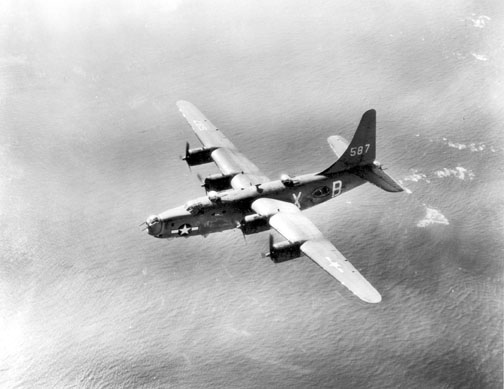
Privateers from VP-28, VP-772, and VP-871 flew flare missions in support of Marine Corps F7F Tigercat and F4U-5N Corsair night fighters. They carried up to 250 high-intensity parachute flares, enough to provide target illumination for several teams of attack aircraft during a single night sortie.
In 1951 VP squadrons were pressed into another role, this time over land, dropping illumination flares in support of air strikes. Known as Firefly missions, they helped deny the night to enemy supply movements. Admiral Arthur W. Radford suggested the use of P4Y-2 Privateers as flare ships to replace the more vulnerable R4D Skytrains in illuminating targets for Marine Corps F4U-5N Corsair and F7F-3N Tigercat night hecklers. One P4Y from VP-772 was modified For the mission and proved highly successful, and three more P4Ys from VP-772 and VP-28 were assigned as "Lamp Lighters" (later operated by successive squadrons). During a typical mission, the P4Y would rendezvous with four attack aircraft, search for truck convoys and illuminate the targets for the attack aircraft.
Although United Nations forces were successful in maintaining air superiority over most of the Korean peninsula, lumbering patrol aircraft had a few encounters with enemy aircraft. A VP-42 Mariner was damaged on 11 May 1952 by a MiG-15 fighter over the Yellow Sea, and on 31 July 1952 a VP-731 PBM was seriously damaged by gunfire from a MiG-15, which killed two crewmen and injured two others.
Low level. At night. Large, slow plane. Not trained for it. Do it anyway. 2/3 initially done by Reserve Squadrons. Great success. Almost forgotten. Enemy killed. Americans saved.

D@mn Reservists. Fullbore.


First posted in 2007 and every 5-yrs or so since.

Monday, October 25, 2021

I’ll Take Sub Killing for 500

SE=SL-RD-NL+DI-PL


If you want to bench test an old Cold Warrior, put something like this out;

The Navy has created a new task group on the East Coast to ensure it has ready destroyers that can deploy on short notice to counter the Russian submarine threat in the Atlantic Ocean.
The plan is to take destroyers that have recently completed deployments and are awaiting maintenance availabilities and make them ready for training and operations in the Atlantic. ... The creation of the new task group comes as the Navy has refocused assets and efforts on the Atlantic region due to Russia’s undersea capability. The service formally reestablished U.S. 2nd Fleet, which covers the North Atlantic and East Coast, in 2018 amid concerns over Russian submarines operating in the waters. ... The ships will be based out of Mayport and Norfolk, Va., and the task group is set for full operational capability by June 2022, according to McLane, who noted the ships will still have a post-deployment stand-down so sailors can see family after being out at sea. ... “These will allow us to work with the schedules of not only the surface ships, but the submarines, the P-8 community, and the HSM, [Commander, Helicopter Sea Combat Wing Atlantic] helicopter detachments so that we can align everybody up to take advantage of whatever training opportunities may exist, as well as tactical development exercises like in the past Black Widow, and then training opportunities like submarine command course operations. We can align those assets to go after these training environments that may exist,” Rear Adm. Brian Davies, the commander of Submarine Group 2, told reporters.
This is not a flip of the switch as there are a lot of “ifs” “buts” and “whens” … but the thinking is sound for reasons our friend Jerry Hendrix outlined in his 2017 report he co-authored on Forgotten Waters.

Jerry and I are about the same age. As East Coast JOs, we spent our ENS and LTjg sea duty saying bye to the last of the Soviet threat before that empire all fell apart. If you are under-50, you have no idea.

We experienced the Reagan build-up at flood tide. If you took a snapshot at the turn of the last decade of the 20th Century, the US Navy was well positioned for high end conflict in the Atlantic Coast. 

We had the entire great circle route from Miami to the GUIK gap covered. If you could keep the Soviet SSN/SSGN out of the open Atlantic, the convoy routes to the northern European ports would be relatively safe.

Surface ASW forces were well distributed and ready to conduct ASW or escort convoys. From south to north, we had Mayport, Charleston, Norfolk, and even a few in New York City (yes, for a brief shining moment, the sanity of strategic homeporting rules) and Newport. Land based active-duty air ASW were in Jacksonville, FL and Brunswick, ME with deployment sites all over the North Atlantic.

That was just on the US side. Canada, UK, France, The Netherlands, and Norway were all punching above their weight in the North Atlantic keeping that a very dangerous place for the submarines of the Red Banner Northern Fleet.

After 30-yrs break, we are not just a smaller force, we are a more scattered and vulnerable force. The incredibly myopic and greed based BRAC process divested the US Navy of the most effective access to the great circle routes to Europe. We evacuated the North. Brunswick gone. New York, and Newport are empty. Even Charleston in the Southeast is empty. Yes, the Russian submarine force is a shadow of what the Soviets were, but it takes a lot more effort to kill a sub than to be a sub.

If you consider the Greenland-Iceland-UK Gap the essential barrier, just look at the additional time to get on station. Of course, you won’t do surface ASW at 25 knots, but if you are just looking at nice round number transit speed – all caveats apply – then Newport is the closest to Iceland. A ship based out of New York will take 4.4-hrs more to get there. Norfolk 14.3-hrs more, Charleston 26.4-hrs more, and Mayport 33.4 hrs more.

Indeed, you don’t have to be a genius to see how easy it would be to place a few blocking ships in Mayport and Norfolk – not to mention some even more dramatic events – to effectively degrade the east coast Navy for weeks or even months.

If we desire to deny the Russian submarine force access to the North Atlantic, we need more than a couple of DDG between availabilities … thought I 100% support this solid concept. 

No, we are witness to decades of neglect in ASW in the Atlantic. We have left what capability we do have concentrated and incredibly vulnerable.

Task Group Greyhound is a nice opening for a long conversation.  

Friday, July 09, 2021

Fullbore Friday

 As the D-Day invasion was ongoing, the German Navy sortied what they could to try to drive the allies back across the channel. The most feared were the French based U-boats.

Please read the whole thing, but here is a nice summary of one of the under-told stories of WWII, Coastal Command.

On night. One crew. Two U-boats.

Fullbore.

“G-George” droned on through the night. Men drank coffee from thermos flasks, kept the chatter to a minimum, scanned the endless sea and began to feel the numbing weariness set in that came with these long over-water patrols. But adrenalin shot through their bloodstreams like amphetamine just after 2 a.m. when Foster announced on the intercom that he had a solid return on his radar 12 miles dead ahead in the vicinity of Ushant Island (Ouessant). It was too early to tell whether it was a French fishing smack or the conning tower of a U-boat. Moore corrected his course slightly to port to put the target in the path of the moon reflecting on the water. Three miles out the conning tower of a submarine was made out in the moonlight.

Coastal Command anti-submarine crews were trained to attack the moment a U-boat was detected and without deliberation. An undamaged Type VIIC U-boat, with a well-trained crew could crash dive beneath the surface in 30 seconds. Time was of the essence, as was complete surprise.

Immediately, Moore instructed Foster to switch off the radar in case the submarine had detection equipment, and then began to drop lower and lower, adjusting his course to keep the enemy up-moon until he was at 50 feet above the calm surface. McDowall, the navigator, took his position at the bomb sight. Moore ordered the four big bomb doors opened and as they slid upwards and outboard on their rollers, he could hear the hydraulic pumps working and sense the difference in the airflow note down the sides of his warhorse. Approaching the U-boat, which they calculated was making 10–12 knots in a westerly direction, they selected 6 depth charges from their quiver, attacking due south and 90 degrees to the path of the U-boat on her starboard side. Moore chose to leave the powerful 22 million-candela Leigh Light off to further keep their whereabouts secret. As they screamed in for the attack, the spare navigator, Pilot Officer Alec Gibb, DFC sprayed the conning tower with heavy machine gun fire (some 150 rounds according to the after action report) from his position in the nose. Moore and Gibb later stated they could see as many as 8 submariners scrambling from the tower to get to the deck guns. There was some anti-aircraft return fire, but it was too little and too late. They had caught them completely by surprise.

As they roared over the submarine at 190 mph, six depth charges, set 55 feet apart, were falling from “G-George’s” bomb bay, having been released by McDowall whose accuracy this night would be perfect. Three fell on either side of the submarine in a textbook straddling attack just ahead of the conning tower. A flame-float, designed to ignite when it hit the water was also dropped to identify the position of the submarine at the moment of attack. The rear gunner Flight Sergeant I. Webb watched in fascination as the detonations exploded white in the moonlight and appeared to lift the 700-ton submarine out of the water.

By the time they had climbed, swung around and were homing on the beacon of the flame float at the position of the attack, there was nothing left of the U-boat save for some floating wreckage and the oily slick of diesel fuel. A Type VIIC U-boat had disappeared and ceased to exist in a matter of seconds, the depth charges having done their job breaching the pressure hull and sending one of Karl Dönitz’ hunters to the bottom with all hands. One can only imagine the last minutes of terror for the more than 50 men aboard.

Sadly, when this submarine sank, there was no one who could identify which U-boat it was. Postwar accounting pointed to U-629, commanded by Oberleutnant zur See Hans–Helmut Bugs on its 11th war patrol. She had just slipped out of her pen at Brest the day before. Still, other researchers disclaim the U-629 identification, pointing instead to U-441, commanded by Kapitänleutnant Klaus Hartmann on its ninth and final war patrol. It is not my goal to be definitive as to the identity of the fifty or so men killed that night, that best being left to experts in the field. Knowing would bring the story to a satisfying close, but it will not lessen the tragedy or the courage of the U-boat men who died that night.

Moore settled his crew down after the last pass over the wreckage, and ordered a course correction to take them back on their patrol. At 0231, just twenty minutes after the first radar contact was made, “G-George” sent a message to command that they had sunk a U-boat. The men were charged with electricity, but they had a job to do and hours before they could return home to St Eval.

Just a few minutes later at 0240 hrs, as they settled down at 700 feet ASL, Foster reported another radar contact 10 degrees off the starboard nose, this time just 6 miles ahead. Moore, with information from Foster, began to home in on the target, and at 2.5 miles range and 75 degrees to starboard, they sighted the conning tower of another U-boat on a northwesterly course running at an estimated eight knots on the surface. This time Moore needed to circle to port and come in on a course that would allow them to attack up the moon path.

Bringing the big Liberator down to 50 feet once again, Moore approached the U-boat at 110 degrees to its starboard side with plenty of time to set up another perfect attack at 190 mph. The remaining six Torpex depth charges were released at 55-foot intervals as well as a flame float. Again, Gibb, the spare navigator in the nose, was firing his machine gun at the conning tower, which answered this time with flak and tracer fire. As they roared overhead, the rear gunner Webb saw four depth charges strike the water to the starboard side of the U-boat and two on the her port side—another textbook straddling attack. Massive flumes of exploding water were seen rising on either side of the submarine, ten feet aft of the conning tower and totally obscuring the target.

Returning to the position of the flame float, Moore, Gibb and Ketcheson saw the U-boat in the bright moonlight, with a heavy list to starboard. As they approached, the bow rose steeply out of the water to an angle of about 80 degrees. The boat slid back into the sea “amid a large amount of confused water” according to the 224 Squadron ORB.

Moore circled in fascination and, coming around again, he turned on the powerful Leigh Light slung beneath his starboard wing outboard of engine No. 4. The blinding blue-white beam illuminated three yellow dinghies crowded with men floating on an oily surface strewn with bits of wreckage. One can imagine how exposed the survivors must have felt caught in the white light of the Leigh with a heavily armed Liberator thundering down its beam toward them. They passed overhead without further molesting the surviving crew, switched off the Leigh Light and left the German sailors floating in the moonlight.

The submarine was U-373, another Type VIIC boat commanded by Kapitänleutnant Detlef von Lehsten on its 11th war patrol. It had just slipped out of Brest after a six-month repair following a similar attack by a Coastal Command Wellington and Liberator in January. We know for certain that this was U-373 because all but four members of the crew survived to be picked up the next day by French fishing vessels and returned to Brest. Von Lehsten was one of the survivors.


Hat tip Al. First posted Sept. 2017.

Wednesday, October 14, 2020

An Orion Comes to Vietnam?


Exciting news, well at least to me, of the growing presence of Japan in the security environment in the Western Pacific.

It looks like one area she might be selling aircraft and related services will be in Vietnam of all places.

I barely contain my joy over at USNIBlog.

Come on by for the details!