Showing posts with label Guns. Show all posts

Friday, January 17, 2020

Fullbore Friday

Do you know the story of Tony Stein? Just a young Ohio man, son of Austrian-Jewish immigrants. A great American ... and a giant who helped create what today we would call a Squad Automatic Weapon from spare parts.

First, attention to citation;
The President of the United States takes pride in presenting the MEDAL OF HONOR posthumously to

CORPORAL TONY STEIN
UNITED STATES MARINE CORPS RESERVE

for service as set forth in the following CITATION:

For conspicuous gallantry and intrepidity at the risk of his life above and beyond the call of duty while serving with Company A, 1st Battalion, 28th Marines, 5th Marine Division, in action against enemy Japanese forces on Iwo Jima, in the Volcano Islands, 19 February 1945. The first man of his unit to be on station after hitting the beach in the initial assault, Cpl. Stein, armed with a personally improvised aircraft-type weapon, provided rapid covering fire as the remainder of his platoon attempted to move into position. When his comrades were stalled by a concentrated machinegun and mortar barrage, he gallantly stood upright and exposed himself to the enemy's view, thereby drawing the hostile fire to his own person and enabling him to observe the location of the furiously blazing hostile guns. Determined to neutralize the strategically placed weapons, he boldly charged the enemy pillboxes 1 by 1 and succeeded in killing 20 of the enemy during the furious single-handed assault. Cool and courageous under the merciless hail of exploding shells and bullets which fell on all sides, he continued to deliver the fire of his skillfully improvised weapon at a tremendous rate of speed which rapidly exhausted his ammunition. Undaunted, he removed his helmet and shoes to expedite his movements and ran back to the beach for additional ammunition, making a total of 8 trips under intense fire and carrying or assisting a wounded man back each time. Despite the unrelenting savagery and confusion of battle, he rendered prompt assistance to his platoon whenever the unit was in position, directing the fire of a half-track against a stubborn pillbox until he had effected the ultimate destruction of the Japanese fortification. Later in the day, although his weapon was twice shot from his hands, he personally covered the withdrawal of his platoon to the company position. Stouthearted and indomitable, Cpl. Stein, by his aggressive initiative sound judgment, and unwavering devotion to duty in the face of terrific odds, contributed materially to the fulfillment of his mission, and his outstanding valor throughout the bitter hours of conflict sustains and enhances the highest traditions of the U.S. Naval Service.
Two videos that tell the story well.

First;


And second, his "stinger."


Tuesday, September 03, 2019

6.8mm on the Way: Eventually, Everyone Goes Salamander

Let's see, back in January 2006 I wrote;
Ground combat is not my specialty, my professional toolbox has big things that make big fireballs going out and going in, look cool on video, and require AC power - but please. There are more bad theories there than you can shake a stick at. I thought we stressed Aimed Fire? Spray and pray is what poorly trained targets do. Say what you want about the Soldier or Marine of 2006, but "..poorly trained and clueless 18 yr old" isn't very accurate. There was a move post OEF/OIF experience to go to a 6.5/6.8mm, but the bean counters, again, are trying to kill it. This sounds familiar.
I've been writing on and off the topic ever since.

I accepted defeat too early ... it appears that there were unknown Salamander types inside the Army lifelines working hard to make it happen ... and I smile with great satisfaction watching this progress.
The U.S. Army has selected three firms to advance to the next phase of testing to select the service's Next Generation Squad Weapon.

The Army chose General Dynamics-OTS Inc., AAI Corporation Textron Systems and Sig Sauer Inc. -- which makes the service's new Modular Handgun System -- to deliver prototypes of both the automatic rifle and rifle versions of the NGSW, as well as hundreds of thousands of rounds of special 6.8mm ammunition common to both weapons, according to an announcement posted Thursday night.
...
The Army's goal is to select a final design for both weapons from a single company in the first quarter of 2022 and begin replacing both M4s and M249s in an infantry brigade combat team in the first quarter of 2023, Brig. Gen. David Hodne, director of the Army's Soldier Lethality Cross Functional Team, told Military.com in July.
Why is this ultimately so important?

At the end of the day, everything a military has must support one thing; the infantryman. From time immortal, you do not achieve victory in war until you have someone in your uniform standing with their weapon - club, ax, sword, or gun - on any damn street corner they want to in a land that was until recently someone else's.

Infantry isn't sexy, but it is the One Thing.

They need the best. They deserve the best.

Green eye-shade types be damned.

Friday, January 04, 2019

Fullbore Friday

Every 4-5 yrs I run this FbF because it has so much to teach us about the demands of surface combat - even today. As you read, pay attention to the actions taken from bluff or misinterpretation of unfolding events. Pay attention to the amount of ordnance sent downrange by both sides and the incredible acts of damage control.


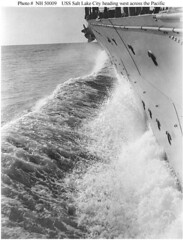
When I say Battle of the Komandorski, what comes to mind? If nothing, well that is sad ... but we can fix that.

Well, I think you would be hard pressed to find a more deserving Battle for FbF - if for no other reason than the very, well ... Shoe-y-ish-ness of it all.

A perfect day in the Northern Latitudes, you know the type of day.
The day was dawning with remarkable visibility under a light overcast, a glassy sea and gentle breezes from the southwest. Air and water temperatures were just at or above freezing. At 0830, apprized of his opposition, Hosogaya began to deploy his ships. Abukuma with Wakaba, Hatsushimo and Ikazuchi turned in column to starboard, followed two minutes later by Nachi, Maya and Tama. The two transports, accompanied by Inazuma, continued north, northwest as Hosogoya led his fleet southeastward in two parallel columns to engage the American fleet. At about this time Nachi launched an aircraft to assist in spotting the fall of shot.
How much do you rely on Intel? What do you do when you realize you are outnumbered almost two to one?
McMorris’ movements upon sizing up his opposition were reckless. Initially he believed he had found the expected convoy and that it would be lightly escorted. But as the masts of first one and then two heavy cruisers hove into sight over the horizon, he realized he was outnumbered and outgunned. Nonetheless, he continued to lead his fleet toward the enemy,
What was he looking at?

Forces Engaged - Battle of Komandorski Islands 
USN
TYPENAMEYEARDISP FLMAINSECTTSPD
CA 
CL 
DD 
DD 
DD 
DD
Salt Lake City 
Richmond 
Bailey 
Coughlan 
Dale 
Monaghan
1927 
1921 
1941 
1942 
1935 
1935
11,512 
9,508 
2,395 
2,395 
2,064 
2,064
10x8/55 
10x6/53 
5x5/38 
5x5/38 
5x5/38 
5x5/38
8x5/25 
2x3/50 

10x21" 
10x21" 
10x21" 
8x21" 
8x21"
32.5 
34 
35 
35 
36.5 
36.5


Total6193429,938


IJN
CA 
CA 
CL 
CL 
DD 
DD 
DD 
DD
Nachi 
Maya 
Tama 
Abukuma 
Wakaba 
Hatsushimo 
Ikazuchi 
Inazuma
1924 
1928 
1921 
1925 
1934 
1933 
1932 
1932
14,743 
14,604 
5,832 
5,570 
1,802 
1,802 
1,980 
1,980
10x8/50 
10x8/50 
7x5.5/50 
7x5.5/50 
5x5/50 
5x5/50 
6x5/50 
6x5/50
8x5/40 
8x5/40 
2x3.1/40 
2x3.1/40 

8x24" 
8x24" 
8x24" 
8x24" 
8x24" 
8x24" 
9x24" 
9x24"
35.5 
35.5 
36 
36 
36.5 
36.5 
38 
38


Total8192948,313


I also want you to ponder Damage Control. Follow this performance by the crew of the USS SALT LAKE CITY (CA-25) in particular.
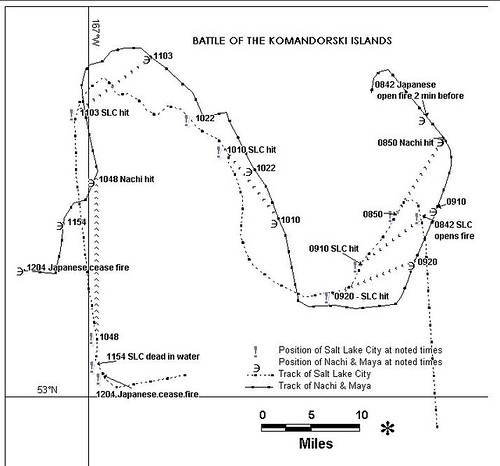
By 0840 the Americans were in battle formation: a single column still heading north led by Bailey followed by Coghlan, then Richmond, Salt Lake City, Dale and finally, Monaghan when Maya and then Nachi opened fire at a range of 20,000 yards. Maya obtained a straddle on Richmond with her second salvo, but then both cruisers switched fire to Salt Lake City. Salt Lake City began shooting back two minutes later. The Americans believed they scored a quick hit on Nachi with Salt Lake City’s third and fourth salvos, but they were apparently observing blast damage on Maya. Her action report stated that her opening salvos set her No. 1 floatplane ablaze. Damage control dumped the plane overboard and quickly controlled the fire. At 0844, as the range continued to rapidly close, Nachi launched eight torpedoes. Apparently these came close to doing serious harm: lookouts aboard Richmond saw a torpedo pass under her bow while one broke surface near Bailey’s starboard quarter. At the time these reports were discounted because the Americans still had no appreciation of the Japanese Long Lance torpedoes’ range.At 0845 McMorris finally changed course as the range was closing rapidly, turning to port, and increasing speed to 28 knots. As the Americans settled on a southwesterly course, Salt Lake City continued firing with her rear turrets and drew first blood hitting Nachi at 0850 with her sixteenth salvo from approximately 16,000 yards. One 8” shell struck the aft section of the compass bridge, killing eleven and wounding twenty-one and damaging the gunnery control electrical circuit. The second shell damaged one of the mainmast’s struts. Two minutes later a third 8” shell struck Nachi’s aft aircraft deck, killing two and wounding five in the torpedo room below. Damage control attempted to shift the affected generator to a boiler with low steam pressure. This error resulted in a complete failure in all power to Nachi’s main battery turrets, freezing her guns at full elevation and leaving them unable to train. She was effectively out of the battle for a half-hour while power was restored.

As Nachi struggled to correct her damage, Hosogaya turned his cruisers southwest to pursue the Americans. The light cruisers and destroyers had already peeled off to the southwest several minutes before. Strategically he was now between McMorris and his base, chasing the Americans from their aft port quarter while his light forces, positioned to protect the convoy, followed from the starboard quarter. Tactically, Hosogaya possessed the weather gage, but a stern chase is a long chase. His cruisers had to turn to fire their full broadsides (only four of their ten 8” guns could bear forward) and these maneuvers negated any advantage he might have gained with his superior speed.

As the Japanese settled on their new course, the range opened slightly. The Maya rightly concentrated her fire on Salt Lake City. Her aim was good, but Captain Rogers commanding the American heavy cruiser successfully chased salvos until 0910 when Maya finally landed an 8” shell on Salt Lake City’s starboard spotter plane on the midships catapult. The only two deaths the Americans were to suffer during the battle resulted, but damage control quickly extinguished the fire and dumped the plane over the side.

Another hit, once again from Maya followed at 0920. This struck Salt Lake City’s quarterdeck, but did little to immediately affect her fighting value. At this point the Americans gradually started bending their course west, then west by northwest. The Japanese suspended fire for nine minutes from 0921 to 0930 when Nachi re-opened fire. They were now sailing almost due west. By 0945 Tama had encroached to within 18,000 yards of Salt Lake City’s starboard quarter. Rogers sheered his ship out of line and with a few salvos forced the light cruiser to make a 360° turn. During this portion of the battle Abukuma with the three destroyers continued to follow off the American’s starboard quarter, out of range, but gradually closing.

Salt Lake City first experienced a serious problem at 0952 when the repeated concussions of her own salvos, as well as numerous near misses, threw her steering gear out of control. This problem was corrected, but only temporarily. By 0953 Abukuma had approached sufficiently close to merit attention from Richmond. The Japanese light cruiser exhibited a certain timidity, opening range when she came under fire by turning more to the north; perhaps her orders made protection of the convoy her primary responsibility.

At 1002 Salt Lake City’s steering gear failed again, this time permanently, restricting her course changes to only 10 degrees and thus limiting her ability to chase salvos. This handicap quickly told: at 1010 Salt Lake City was hit again from a range of nearly 22,000 yards; the shell, fortunately a dud, passed through her main deck and out her hull below the waterline, causing flooding in an engine room. At 1018, with Salt Lake City taking on water and having trouble steering, McMorris ordered his destroyers to make smoke to hide her from the pursuing Japanese. Conditions were perfect for this tactic and the white chemical and black funnel smoke hung thick in the still air behind the Americans.

At 1028 Salt Lake City changed course to 240?. Richmond followed about 3,000 yards astern while the destroyers remained on her engaged side, continuing to pour smoke from their funnels and generators. As the American column made its way west northwest at 30 knots, the Japanese cruisers followed. Up to this point, Hosogaya had fought an intelligent battle, exploiting McMorris’ initial aggressive movements to position his ships in the superior position. His long-range gunnery had damaged the principal American ship. With the advantages of speed, material and position, it was time to close range and force the issue. Instead the Japanese cruisers continued to zigzag, Hosogaya electing to fire full broadsides rather than close range. For three quarters of an hour the Japanese failed to score any hits as the smoke served to protect Salt Lake City, despite the presence of Nachi’s spotter plane. At 1100 McMorris turned his column due south. The Japanese cruisers were slow to respond to this course change and continued west for nearly a half-hour. Hosogaya was permitting McMorris to slip out of his trap. At 1103 Abukuma hit Salt Lake City, her fourth and final hit. This caused flooding in her after gyro and engine rooms. She took on a 5° list, but continued at full speed.

Shortly after the American course change the Japanese launched a torpedo attack with Maya firing four at 1105 followed by eight from Nachi at 1107 and four more from Abukuma at 1115. These sixteen torpedoes probably passed behind the Americans. The cruisers continued to swap ineffective salvos. Then, at 1125 Salt Lake City’s after fireroom went out of commission reducing her speed to 20 knots. McMorris initially ordered his destroyers to conduct a torpedo attack and they dropped back to get into position, but he canceled his order at 1138 as Salt Lake City was able to work her speed back up. Hosogaya was only able to close range about 3,000 yards during this time as he maneuvered to avoid the torpedo attack that never came.

At 1148 Nachi was hit again by a 5” shell on the starboard front side of #1 turret. This blocked her turret and killed one and wounded another crew. At 1149 the Japanese destroyers tried to enter the action when Wakaba fired five torpedoes at the American destroyers followed by six from Hatsushimo at 1154. As this attack was being conducted, the battle reached its moment of crises. At 1150, engineers counterflooding to correct Salt Lake City’s list, accidentally let water into the fuel oil and extinguished her burners. By 1154 she was dead in the water. The Japanese heavy cruisers were 19,000 yards north northwest, firing steadily and closing while the light cruisers were a little further to the northeast. Although Salt Lake City was partially obscured by smoke, there appeared to be little hope of saving her. McMorris immediately ordered his destroyers to form up for a torpedo attack. At 1159 Bailey, Coghlan and Monaghan reversed course to close the cruisers 17,000 yards to their northwest while Dale remained to refresh the smoke screen. Richmond closed Salt Lake City to evacuate her crew if need be. Rogers, however, was not ready to give up his ship. Frantic damage control efforts got her burners lit and by 1200 she was underway again making 8 knots.

As the American destroyers charged northwest Coghlan fired her 5” guns at Maya while the other two targeted Nachi. Hosogaya shifted fire to this threat and Bailey was quick to suffer. At 1200 an 8” shell struck her galley door on the starboard side, killing five. In the next two minutes she was hit again in her forward fireroom and her forward engineroom loosing boilers 1 and 2. Scrapnel from near misses wounded four on Coghlan and knocked both radars out of commission. Nachi suffered her fifth hit during this run in on a signal platform to starboard. Bailey launched five torpedoes at 1203 from 10,000 yards and turned away. The punishing fire prevented the other two destroyers from closing any further and they turned away as well, their torpedoes still in their tubes. Salt Lake City reopened fire just before Bailey’s fish hit the water. McMorris turned his cruisers east. Hosogaya made a turn to the west at 1203. The Japanese ceased fire at 1204 and the Americans at 1212. Both forces were now heading in opposite directions toward their respective bases.

Hosogaya’s turnabout seemed a miracle to the Americans. Apparently there were several factors behind his decision. His destroyers were low on fuel and his cruisers low on ammunition. He was not aware of the gravity of Salt Lake City’s problems. He was also concerned about air attacks. When Salt Lake City reopened fire, she was using HE ammunition, having expended all her AP. Apparently the white splashes from these shells were interpreted as explosions from aerial bombs dropped from above the overcast. Hosogaya’s decision to turn away was reportably not popular with his men. “They silently cursed the caution of their chief which depreived them of a victory already won.”

This battle was fought at long ranges, under perfect conditions, without intervention by aircraft (other than the one spotter) submarines shore batteries or mines. In this regard, Komandorski was unique, at least in the Pacific Theater. The expenditure of ammunition for all the American ships engaged was heavy. Salt Lake City fired 806 8” shells, 85% of her stock, and 95 5”. Richmond contributed 271 6” and 14 3” while Bailey, Coghlan, Dale and Monaghan fired 481, 750, 728 and 235 rounds of 5” respectively. On the Japanese side the totals for the heavy cruisers were impressive: Nachi and Maya fired 707 and 904 8” rounds respectively (up to 70% of their total) and 276 and 9 5”. The light forces fired considerably less: Tama 136 5.5” and Abukuma just 95 5.5”. Of the destroyers only Wakaba and Hatsushimo got into the action. Wakaba fired a few rounds of 5” and Hatsushimo only 5. The Americans launched 5 torpedoes, all from Bailey, while the Japanese launched 43, Nachi 16, Maya 8, Abukuma 4, Tama 4, Wakaba 6 and Hatsushimo 5. No torpedoes scored, but interestingly, the two American attacks, one aborted and one only partially carried out, had decisive results. The first prevented Hosogaya from closing range just before Salt Lake City lost power and the second encouraged him to break off his attack just when it was in his power to win the battle.
More details on the battle here. Things to ponder - how is your DC training? Are you ready to fight hurt? Are you ready to fight when your primary weapons are not hitting as you expect? Is you ship designed to fight hurt? Are you too reliant on technology? 
The sharp-eyed Japanese lookout once again got the jump on American radar. It wasn’t until a half hour later, at 0730, around an hour before dawn, when radar on McMorris’ flagship light cruiser Richmond and Coughlan independently detected ships north of the American picket line.
Are your leaders ready to fight hurt, or are they going to retreat without full victory? How is caution in war seen by history - or your peers and superiors?
McMorris maneuvered his fleet patiently and well. When the battle began he was outgunned and cut off from base. He managed to play to Hosogaya’s caution by conducting a slow, wide turn while maintaining range. The failure of the Japanese destroyers and light cruisers to play a larger part in this battle is a mystery. They never closed the range sufficiently to effectively attack although it was easily within in their power to do so. Apparently this caution was not of Hosogaya’s making as he was not happy with their performance. The Japanese inflicted more damage than they received, but strategically, they were defeated as their transports returned to base without delivering the supplies so badly needed by the isolated Aleutian garrisons. The final indicator of victory or defeat is how the commanding officer is judged by his superiors. Hosogaya was relived and sent into reserve. McMorris was decorated and became chief of staff to Admiral Nimitz.


Tuesday, May 15, 2018

Prepper Math

Don't worry, this isn't about to turn in to one of "those blogs" ... but this is too good to pass up as it folds together math, statistics, and an interesting take on a natsec issue that gets too little attention.

I'll let the author, BJ Campbell, set it up for you. For those who recall my still VERY valid "drums on the Rhine" post from a few years ago, you'll see why I like this.
I’m not a writer by trade. I’m a stormwater hydrologist, and in my opinion, a pretty good one. Hydrology is the science of tracking water as it moves through the water cycle, from ocean evaporation through cloud formation, precipitation, groundwater infiltration, runoff, evapotranspiration, riverine hydraulics, and the time series behavior of reservoirs. It is a deep and fascinating field, but one of its most relevant applications to our lives is delineating floodplain boundaries.

To determine a floodplain boundary, we first identify a “storm event” that concerns us. We use historical rainfall data and some statistical magic to calculate the worst storm event a place is likely to experience in a 100-year time span, probabilistically speaking, and we call that the “100-year storm.” There’s a push in the field to quit calling it that, because it confuses the muggles, so now we often say something like “the storm which has a 1% chance of happening in any given year.” Then we take that rainfall data, judiciously apply more math, and turn it into a flow rate in a river. Then we do hydraulics (more math) to determine how deep the river will have to be to carry that much water, and we draw a line on a map.

You should have seen this line, if you’ve ever bought a house near a floodplain. If you bought a house near a floodplain and were not shown this line, contact me professionally to ensure you didn’t make a terrible mistake.

We don’t buy houses in the floodplain if we can help it, because we are risk averse, even though the chance of it flooding in any given year is only 1%. Why? We will live in the house longer than one year. Over the 30-year life of a mortgage, the chance of the house flooding at least once vastly exceeds 1%, because every year is another roll of the dice. It’s not cumulative, though. The mathematics for back-calculating the odds is called a Bernoulli Process. Here’s what it looks like:
If you have trouble with the math, read the whole article and then come back, he covers it in words as well.

This is where it gets interesting.
Now let’s talk about a bigger, nastier disaster than a flood.
...
...we ... have good sources of data on when the group of people on the piece of dirt we currently call the USA attempt to overthrow the ruling government. It’s happened twice since colonization. The first one, the American Revolution, succeeded. The second one, the Civil War, failed. But they are both qualifying events. Now we can do math.
Have your attention?
Stepping through this, the average year for colony establishment is 1678, which is 340 years ago. Two qualifying events in 340 years is a 0.5882% annual chance of nationwide violent revolution against the ruling government. Do the same math as we did above with the floodplains, in precisely the same way, and we see a 37% chance that any American of average life expectancy will experience at least one nationwide violent revolution.

This is a bigger chance than your floodplain-bound home flooding during your mortgage.
But wait ... there's more;
Or we could look at a broader historical brush. Since the fall of Constantinople in 1453, there have been 465 sovereign nations which no longer exist, and that doesn’t even count colonies, secessionist states, or annexed countries. Even if we presume that half of these nation-state transitions were peaceful, which is probably a vast over-estimation, that’s still an average of one violent state transition every 2.43 years.

If we look at raw dialectic alone, we reach dismal conclusions. “Do you think the United States will exist forever and until the end of time?” Clearly any reasonable answer must be “no.” So at that point, we’re not talking “if,” but “when.” If you don’t believe my presumed probability, cook up your own, based on whatever givens and data pool you’d like, and plug it in. The equations are right up there. Steelman my argument in whatever way you like, and the answer will still probably scare you.
Thing is, in very recent memory we have an example of a relatively modern nation imploding.
In 2010, 8.5 million tourists visited Syria, accounting for 14% of their entire GDP. Eight years later, they have almost half a million dead citizens, and ten million more displaced into Europe. They didn’t see this coming, because if they did, they would have fled sooner. Nobody notices the signs of impending doom unless they’re looking carefully.
At least we don't have any warning signs, eh?
Pretend you’re someone with your eyes on the horizon. What would you be looking for, exactly? Increasing partisanship. Civil disorder. Coup rhetoric. A widening wealth gap. A further entrenching oligarchy. Dysfunctional governance. The rise of violent extremist ideologies such as Nazism and Communism. Violent street protests. People marching with masks and dressing like the Italian Blackshirts. Attempts at large scale political assassination. Any one of those might not necessarily be the canary in the coal mine, but all of them in aggregate might be alarming to someone with their eyes on the horizon. Someone with disproportionate faith in the state is naturally inclined to disregard these sorts of events as a cognitive bias, while someone with little faith in the state might take these signs to mean they should buy a few more boxes of ammunition.
I don't know about you, but I already have my bolt-hole ... I mean "hunting property" ... a couple of hours from the nearest big city and 30-min from the nearest interstate.

Sleep well!

Monday, May 14, 2018

The Simple, Right Thing is Often the Most Difficult Thing

It's a simple fundamental.

Everything a military does - every branch - is for one thing; to create conditions for a young person to stand on a street corner and state; this is ours. It is not yours.

So many billions of dollars are spent for the sexy and sparkly support equipment for others to enable that man there, and yet over and over again we nickle and dime the kit he is issued.

The fact we do this with his primary weapon is a crime.

As I may have mentioned here before, the real "1st appearance" of "CDR Salamander" was circa 1982 when in a high school ethics class (yes, I went to such a high school). I wrote my term paper about the horrible decisions that brought the M-16/5.56mm in to service roughly the year I was born.

Even though much has been done in the last half-century to correct some of the problems - its inadequacies are well known and still show up on the battlefield, unnecessarily resulting in the death of those who carry it.

The green-eyeshade argument has only become more callous with age and is another datapoint showing that - regardless of what their self-esteem workshops may tell them - those resisting change are blinkered and close-minded in understanding their jobs compared to those who came before.

Let's look at how other generations responded to better technology and calibers to give their soldiers. With the exception of the 30-06, each change in caliber corresponded with a new weapon.

1866 - 50-70 Sharps; 7-yrs
1873 - 45-70 Govt; 19-yrs
1892 - 30-40 Krag; 14-yrs
1906 - 30-06 Springfield; 48-yrs
1954 - 7.62x51mm NATO; 8-yrs (NB: still a "NATO caliber" and in use, but largely replaced by 5.56mm in front-line use).
1962 - 5.56×45mm NATO; 56-yrs and counting.

Don't listen to me on this, there are plenty of smarter people on my side;
Retired Army Maj. Gen. Bob Scales was a keynote speaker at the annual National Defense Industry Association Armament Systems forum here, and he didn’t waste any time launching into a takedown of key components that equip the close combat infantryman.

Scales recounted how he’d spoken at the conference three years ago, pushing industry and government procurement officials to create an intermediate caliber rifle with a piston action, polymer ammunition casing, a suppressor and digital fire controls.

“Now, in 2018, does any of that sound familiar?” he asked.
...
The rifle he described in his opening remarks is handled under the Next Generation Squad Weapon project, headed by the Army.

But there, too, are problems, he noted.

The NGSW program was aimed at making a rifle or carbine to replace the flawed M16/M4 system, which Scales has railed against since his own experience with early versions of the M16 in Vietnam.
You would think we would start there, but ...
But an incredulous Scales told the audience that developers on the NGSW are now prioritizing the light machine gun in a program called the Next Generation Squad Automatic Rifle to replace the Squad Automatic Weapon, with the rifle or carbine to come later.

“It’s the Next Generation rifle or carbine, damn it,” Scales said.
For those who have studied the history, government entities had been a problem and not a solution in getting modern weapons in the hands of those on the frontline for a long time. More often than not, it is an outside force that brings the infantryman what they need;
The change in focus means that under current schedules, the rifle/carbine won’t be ready until 2024.

That is not acceptable, Scales said. To either him or his boss.

“Let me tell you something, folks. It’s not working,” Scales said. “Make the rifle by 2020. My God, folks, it’s a nine-pound piece of steel. The cost isn’t as much as a lug nut on a B-1 bomber.”
He's right. This is already late;
Snipers with Special Operations Command will see a barrel swap on their 7.62 mm rifles as early as next year to a commercially available 6.5 mm caliber.

“The SecDef said before he leaves office in 2020, if [President Donald] Trump is not re-elected, he’s going out to a range somewhere to shoot that rifle,” Scales said. “If you don’t get something in the field by then, you’ve failed.”

He pointed to lives lost due to small arms and other infantry equipment holes from Vietnam to Afghanistan to last year’s deaths of special operations soldiers in Niger.

“If you’d listened to me three years ago, those soldiers in Niger would have had this rifle in their hands,” Scales said. “So, take that to bed tonight.”
Read it all. I'd gladly exchange a F-35C or two for all this to take place on an accelerated timeline.

A century ago, we almost went .270 (6.8mm), but the green-eyeshade of their day killed it. Maybe this century we'll get it right.

Thursday, February 01, 2018

Keeping an Eye on the Long Game: Part LXXII

Most everyone here has probably heard about the Chinese test installation of a "railgun."

I don't know what it is, but it is big.

Three standard sized containers are mounted on the ship’s open deck immediately aft of the turret, which are believed to be the generators and other associated equipment needed to power a railgun. Other modifications on the ship seen in the published photos also include a new additional observation gallery and an unknown sensor atop the original superstructure, which is believed to be a control room and observation platform related to the railgun.

The bow doors used for conducting amphibious operations has also been welded shut. It is not known where the modified ship was photographed, although the Haiyangshan was previously known to serve with the PLAN’s East Sea Fleet. The ship has made at least one voyage post-modification, suggesting underway trials to test the seaworthiness of the modifications has begun.
When I saw that barrel, I immediately thought of this picture of our shore mounted test vehicle we bolted on a JHSV a bit ago - just like the author of the article did.


Yes, that sure looks familiar.

A couple of things. First, we don't know if it is a railgun, or if it is - how far along their testing is. That being said, I don't think the PLAN would do that install if they didn't think it was a go. We'll see.

Second, if it is, don't be shocked. Have you looked at all the advanced positions in technology and engineering at our finest engineering schools we openly give to Chinese nationals? Are you are up to speed on the huge amount of espionage they are engaged in while our FBI invests much of its intellectual capital playing political games in DC?

It would be zero shock to me if the Chinese did not have all the plans and testing results from our railgun program. As a matter of fact, given the record, I would be shocked if they did not.

If it makes you angry that the Chinese keep stealing our stuff so they can use it against us later, then by all means, get angry - but don't be mad at the Chinese. Our counter-intel operations have been a disgrace for years. Get mad at the FBI and those who have oversight of them. Get mad at our universities who gladly give up limited advanced spots to fully paid Chinese students over native-born students that only pay in-state or need scholarship money.

Let not your heart be troubled, some good things are happening on our end too. The Japanese - whose submarines are exceptionally good - are leaning in strong;
An effort that was initiated by the Japan Maritime Self-Defense Force (JMSDF) to modernise its undersea warfare capabilities in 2012 is on track to deliver the planned fleet of 22 diesel-electric submarines required for the country’s defence needs by the early 2020s called for under the Japanese government’s 2013 National Defense Program Guidelines, according to a JMSDF official.

Speaking at the Undersea Defence Technology Asia seminar at the Asia Defence Expo & Conference Series (ADECS) 2018 in Singapore, Captain Takahiro Nishiyama, deputy director of the Plans and Programmes Division at the Ministry of Defence’s (MoD’s) Maritime Staff Office, revealed that seven of the service’s 82 m Oyashio-class submarines – which have a surface displacement of 2,800 tonnes – have already completed service-life extension work to date.

The seven boats have received extensive refits during their second and third maintenance cycles, which have been planned to bring the vessels to “almost the same level of that of the latest model [Souryu-class] submarine” while extending their service lives.
If the Japanese would double their build so that by 2030 there are more like 35-45 Japanese SS in commission - that would keep things sporty.

In other weapons development, we are moving hopefully in another area faster than the Chinese can steal it; lasers.
The US Navy (USN) has selected Lockheed Martin’s .. for the fast-track development of a high-energy laser weapon system for testing on a DDG 51 Arleigh Burke-class guided-missile destroyer.
...
HELIOS will leverage proven mature technology to field a 60-150 kW class high-energy laser weapon system
See the kW? Remember the low-end laser we installed on the PONCE a few years ago? It is 30kW.

Build a little; test a little; learn a lot.

China is playing the Long Game - I think as an institution we are too, at last.

We need to broaden our efforts. We need to up counter-intel, neck down training China's scientists, encourage our friends to carry a fair bit of the security load, and keep building bit by bit.

Oh, being that we are talking railguns ... I have to embed the video...


Wednesday, March 16, 2016

Your 2nd Amendment Moment of the Day

Just so you know why the founders of this nation put the 2nd Amendment where it was (regardless of the States decided during the Progressive Era to stop actively keeping militia districts, the people still have a right, for now).

Sure, because of the blood, sweat and tears of the generations that came before us has left us protected and soft - others know why. Oh, they know;
“Shortly after ISIS’s arrival,” she continued, “they rounded up all the Sunnis who had ever served in the army, police or worked with the government and beheaded them. Anyone who stands against them are executed. They didn’t even try to convince any of us their way was superior or that their way of Islam was better for us. They just treated us like animals.” She also told me that there is widespread hunger and starvation among the entire population in and around Mosul. In recent months she had gone from weighing 140 pounds to only one hundred—and she looked as thin and frail as you would expect.

When I asked why, with such barbaric treatment, the Sunnis had not risen against ISIS in revolt, she was very animated in her response. “When the ISF [Iraqi Security Forces] was in charge, they wouldn’t let civilians have guns. They took them all from us. When Daesh [an Arabic name for ISIS] came, they got all the heavy weapons and ammunition left behind by the Iraqi army. We had no means to fight them. We were powerless.” When I asked her if she’d rather have the Shia-dominated army in charge of the city instead of ISIS, she hesitated.

“I don’t like the Shia,” Mayam began. “Neither do I want ISIS. All we want is to live in peace. We don’t want any more war.” Indicating just how sick of war she and her family had become, she said, “right now we are all deeply traumatized by what ISIS has done to us. In the past when we had heard bombs or fighting, we would run from it to be safe. Now if we hear the sounds of battle, in hopes it is the Iraqi Army coming to liberate us we will run to it, even at the risk of being killed in crossfire. Right now,” she said in resignation, “I would support the [Shia-dominated] Iraqi Army against ISIS.”
A people unable to defend themselves become either dead or brutalized. The brutalized living become traumatized. The traumatized will sell themselves in to slavery to the strong for peace.

On all sides there is tyranny. For no one there is liberty.

Friday, February 13, 2015

VADM Rowden; not a fan of Mission Command it seems

Out of the box, my initial instinct to to nod my head in agreement. After all, who wouldn't want to have a required live fire exercise every day? But ... there is always a but ... there came to the front of mind my favorite word in the English language, "Why?"

Every day underway? Are we selecting personality types and have a culture at sea such that it requires such detail from a Vice Admiral in order to have your warships ready for action - not to mention the metric sponge feeding in para 3

What happened or has been happening that caused such a message to go out? Is it a bit high-and-right, or is something going on in the fleet that requires such an action?

I'm the first one who likes the idea of working the weapons system as much as possible - as that is the only way to know they will work when you need it - but is this how we have to do it?

A final note, the last copy I received of the message has two para 11's. Not sure why besides perhaps a Salamanderesque level of self-editing, but I won't correct it.
1. ALL COMNAVSURFOR SHIPS WILL ENSURE THE HIGHEST LEVEL OF COMBAT READINESS. YOUR MAIN BATTERY, ALL CREW SERVED WEAPONS, SHIP/AREA DEFENSE SYSTEMS, AND ATFP WATCH STANDER QUALIFICATIONS AND PROFICIENCY WILL BE CAPABLE OF ENGAGING THE ENEMY AND DEFENDING YOURSELF AS WELL AS THE HIGH VALUE UNIT AT ALL TIMES. THE NAVY PROVIDES SUBSTANTIAL NCEA TO ENSURE WEAPON SYSTEM OPERABILITY, CREW PROFICIENCY, AND COMMAND AND CONTROL PROWESS IN ACCORDANCE WITH REFERENCES A THRU G. SO SHOOT, ASK FOR MORE, AND CONTINUE TO SHOOT IAW REFERENCES A THRU D IN ORDER TO MEET VALID TRAINING REQUIREMENTS. YOU, YOUR CREWS, AND ALL YOUR WEAPON SYSTEMS MUST BE READY TO FIGHT!
2. ALL SURFOR SHIPS ARE REQUIRED TO CONDUCT LIVE FIRE EXERCISES DAILY WHILE UNDERWAY UNLESS FOR SAFETY, OPERATIONAL, OR ENVIRONMENTAL REASONS YOU ARE NOT ABLE TO FIRE. SHORT OF THE REASONS LISTED ABOVE, I WILL ASSUME IF YOU ARE NOT SHOOTING EVERY DAY WHILE UNDERWAY IT IS BECAUSE YOUR WEAPON SYSTEMS ARE BROKEN OR THERE ARE SPECIAL CIRCUMSTANCES ON WHICH YOU HAVE PRE-BRIEFED YOUR ISIC AND IN TURN YOUR ISIC HAS BRIEFED MY CHIEF OF STAFF AND FORCE GUNNER.
3. IF FOR ANY REASON YOU CANNOT CONDUCT LIVE FIRE EVENTS ON ANY UNDERWAY DAY, A REPORT VIA E-MAIL IS DUE TO YOUR ISIC BY THE END OF THE DAY ON WHICH YOU DID NOT SHOOT. ISICS WILL CONSOLIDATE REPORTS AND SEND MY CHIEF OF STAFF ([redacted](AT)NAVY.MIL) AND FORCE GUNNER ([redacted](AT)NAVY.MIL) A BRIEF SUMMARY OF WHY THE SHOOT DID NOT OCCUR THAT DAY. IF YOUR OPERATIONAL COMMANDER LIMITS LIVE FIRE EVENTS, WE WILL COORDINATE SEPARATELY AND ACCORDINGLY IN ORDER TO SUPPORT HIS/HER INTENTIONS. A SUMMARY OF ROUNDS FIRED BY WEAPON TYPE WILL BE INCLUDED IN YOUR WEEKLY REPORT.
4. PER CIWS PACFIRE MIP 7112 MRC R-2M, FOR EACH PACFIRE EVENT YOU ARE REQUIRED TO SHOOT AT BOTH HIGH AND LOW BURST (ONCE EACH). THE PARAMETER IS FOR THE PAC BIAS (CODE 68 AND 69) TO BE 0 +/- 1 FOLLOWING EACH RATE OF FIRE. IF YOU ARE NOT WITHIN THOSE PARAMETERS, YOU ARE TO RE-SHOOT AT THAT RATE OF FIRE, NOT TO EXCEED
3 TIMES AT ONE RATE OF FIRE. PREVIOUS PACFIRE OFFSET VALUES ARE REQUIRED TO BE ENTERED PRIOR TO START, AND WILL RESULT IN PAC BIAS BEING WITHIN 0 +/- 1.
5. PER REFERENCES E, F AND G, CNSF WILL SUPPORT 300 ROUNDS PER MONTH PER MOUNT IN AIR MODE. AN ADDITIONAL 100 ROUNDS PER MONTH PER MOUNT FOR SHIPS WITH SURFACE CAPABLE (BLK 1B) GUNS TO FIRE IN SURFACE MODE. 1500 ROUNDS PER MOUNT PER YEAR FOR CE-12 AND AW-21, WHICH WILL ALLOW FOR THE PROPER EXECUTION OF THE PACFIRE REQUIREMENTS EXPLAINED ABOVE. YOU MUST REQUEST THIS NCEA AUGMENT 45 DAYS IN ADVANCE.
6. SHIPS THAT ARE EQUIPPED WITH TOWED ARRAY SONARS WILL HAVE THE ARRAY RIGGED FOR TOW AT EVERY AVAILABLE OPPORTUNITY. YOUR SONAR SUITE WILL BE MANNED AND TRACKING SURFACE AND SUBSURFACE CONTACTS BOTH PASSIVELY AND ACTIVELY WHEN THE TACTICAL AND ENVIRONMENTAL SITUATIONS ALLOW. NIXIE WILL BE STREAMED WHEN REQUIRED AND ALL SETTINGS WILL BE IAW THE TACTICS, TECHNIQUES AND PROCEDURES PROMULGATED WITHIN NTTP 3-21.33.
7. AS SPECIFIED ABOVE, THE COMMITMENT TO CONDUCTING LIVE FIRE EXERCISES ADDRESSED HEREIN IS APPLICABLE TO YOUR MAIN BATTERY, ALL CREW SERVED WEAPONS, AND ALL SHIP/AREA DEFENSE SYSTEMS. AS SUCH, IN ADDITION TO ALL MAIN BATTERY AND CREW SERVED WEAPONS AMMUNITION AND ORDNANCE, I EXPECT INCORPORATION OF THE FOLLOWING MUNITIONS INTO YOUR LIVE FIRE AND NCEA AUGMENT PLANNING: MK 214 SEDUCTION, AND MK
46 REXTORP.
8. RANGE CLEARANCE AND OVERALL WEAPONS SAFETY IS PARAMOUNT AS YOU TUNE YOUR WARFIGHTING SKILLS.
9. NCEA AUGMENTATION AND REQUISITIONING GUIDANCE. REFERENCES E, F, AND G GOVERN NCEA MANAGEMENT. NCEA AUGMENT REQUESTS MUST BE SUBMITTED NO LATER THAN 45 DAYS PRIOR. ENSURE YOUR WEAPONS OFFICER, GUNNERY OFFICER, LEADING GM, AND AMMO ACCOUNTANT HAVE READ AND UNDERSTAND THE NCEA PROMULGATION MSGS AND ARE IN COMPLIANCE.
10. THIS ORDER IS DESIGNED TO ENHANCE THE ACCURACY, PRECISION, SAFETY, EFFICIENCY AND CONFIDENCE WITH WHICH YOU PLACE ALL TYPES OF ORDNANCE ON TARGET. YOUR ABILITY TO MASTER THE MATERIAL, TACTICAL, AND WATCH TEAM PROFICIENCY REQUIREMENTS ASSOCIATED WITH CONDITION ONE WEAPONS SYSTEMS OPERATION IS FULLY IN LINE WITH OUR WARFIGHTING FIRST PHILOSOPHY. THE TACTICAL PROFICIENCY DEVELOPED THROUGH REPEATED LIVE FIRE EXERCISES FAR OUTWEIGHS ANY POTENTIAL MATERIAL CHALLENGES ASSOCIATED WITH INCREASED USE OF YOUR MAIN BATTERY, CREW-SERVED WEAPONS, AND SHIP/AREA DEFENSE WEAPONS.
11. COMMODORES AND COMMANDING OFFICERS ARE WELCOME TO CONTACT MY STAFF AT ANY TIME REGARDING THIS, OR ANY OTHER ISSUE.
11. WARFIGHTING WILL REMAIN OUR #1 PRIORITY.
12. VICE ADMIRAL ROWDEN SENDS.//
If you are wondering what Mission Command is doctrinally, click here.

UPDATE: For those who are interested in Mission Command; from the US Army Combined Arms Center:

Tuesday, July 30, 2013

So, anyone consult an infantryman on this?

Someone please tell me there is more to this than what it looks like;
The Army’s Picatinny Arsenal is working on a “green” version of the M80A1 7.62 mm bullet, which troops are supposed to start being issued in 2014, according to an Army press release.

The Army has been looking to “green” small caliber ammo for some time now. In 2010, the Army switched to the greener 5.56 mm M855A1 Enhanced Performance Round.
...
“The EPR replaces the lead slug with a copper slug,” said Lt. Col. Phil Clark, product manager for small caliber ammunition in the Program Executive Officer Ammunition. “This makes the projectile environmentally-friendly, while still giving soldiers the performance capabilities they need on the battlefield. So far we have eliminated 1,994 metric tons of lead from 5.56 ammunition production.”

“Thirty-two grains of lead are eliminated per M855A1 projectile, and 114.5 grains of lead will be eliminated per M80A1 projectile,” according to the Army.
Oh no, no, no. We already know that the 5.56mm is iffy as an infantry round. It is already limited in what it can do, especially in the ranges we have been fighting as of late. There is a reason the M-14 was brought back. There is a reason - until the burocrats killed it - last decade a move was under foot to more to something between 6.5-6.8mm.

Could this be as bad as it seems? Could it make the Big Green Navy push seem sane?

In times of woe, as all good Sailors do, I turn to the USMC. Three years ago they decided that the Marines in the field were more important that the PPT on the Potomac, it seems;
Special Operations Command and now the Marine Corps are fielding a deadlier 5.56mm round, but the Army says soldiers can't have it. Instead, the service is holding on to its dream of environmentally friendly ammunition.

Army ammunition officials are on their third attempt at redesigning the Cold War-era M855 5.56mm round by adding a better-performing, lead-free bullet. The service had to halt the M855A1 Lead-Free Slug program in July when the new bullet failed to perform under high temperatures. The setback delayed fielding by nearly a year.

The newest version of the green round is in the live-fire test phase, and Army officials said they are confident it will be ready for combat use by June.

The Marine Corps, however, doesn't share this confidence. The Corps has dropped its plans to field the Army's M855A1 and approved the new SOST round for Marines to use in Afghanistan. SOST, short for Special Operations Science and Technology, is SOCom's enhanced 5.56mm round. It isn't green, but it is deadlier than the current M855 round and it's available now, Marine officials say.
I see nothing that shows me the Marines have changed their mind either.

A few more things come to mind - first of all cost. Copper is a lot more expensive than lead. For 29JUL the London cash price for copper is $6,860 a ton. Lead is $2,504 per ton. I'll let you do the rest of the math.

So, let us try to find a neutral party to look at the "green" bullet designed to make the battlefield friendly enough to turn humans in to pink mist.

Guns & Ammo, over to you;
... the reason it shoots flatter is because they’ve juiced the round up so that it will fly at 3,100 fps. This would be a great achievement except for the fact that they did it by increasing the chamber pressure from 55,000 psi to 63,000 psi. That’s a number closely approaching proof-load pressures. So are new M4s being constructed using stronger materials to handle this hot round? No, of course not. The M4 is being manufactured to the same Technical Data Package (TDP) that they have always been. This means that not only are parts going to wear out at a much higher rate (which is already is an issue with the M4), but if, God forbid, there is any bullet set-back, the number of M4s reportedly going “high order” (i.e., blowing up) should increase exponentially.

While on the subject of the effect of the M855A1 on service weapons, I would be remiss if I didn’t mention that the new round cuts barrel life by almost 50 percent (information sourced by Individual Carbine contenders recently supplied 10,080 rounds of the M855A1 EPR so that they could tune their submission for this new load).

But no amount of tuning is going to alter the fact that the EPR has a 5.5 MOA accuracy standard. 5.5 MOA? Seriously? The Mk 318 SOST round that the USMC has fielded in Afghanistan is held to a 2 MOA standard, but the latest and greatest round that it’s being replaced by is held to a 5.5 MOA standard? Additionally, the Mk 318 has better terminal ballistics against soft targets, holds together better through intermediate barriers and costs half what the M855A1 costs.
Read the whole thing if you must ... but do we need to do any more?

Someone, anyone, please tell me where this is a better solution for our infantry. Where does this better do the job of killing the enemy before he kills you?

Is this just another case of a desire to look "green" we are willing to sacrifice our young men and women and put our battlefield success at risk? 

Where is everyone from the USMC to G&A wrong? Why are the rank and file Army types silent?


I was having a little trouble thinking that this much stupid could stay for this long, so I bounced this off and Army type who gave me his six ohbytheways about this mess. The stupid is real. Only 1 of the 6 isn't a red mark. #6 is what will get us killed more than any other.
1. While both are in the inventory, you'll need two zeros. Because they'll fly different.
2. You get to die knowing the bullet that hit you won't pollute the environment.
3. Sure, it's better for ranges, until you look at the megatons of lead we've already shot there (not to mention the DU... An issue anywhere the davy crocket was fired, including the spotting round).
4. Copper is harder, meaning more penetration, at low velocity. At high velocity, if it hits hard stuff, it shatters.
5. Barrel/chamber/parts wear doesn't hunt, most rifles never live to see their wear-out date before being replaced.
6. Greater cost per round=less shooting or less $ for training.