Showing posts sorted by relevance for query long game. Sort by date Show all posts

Tuesday, January 31, 2023

Keeping an Eye on the Long Game: Part XCVI

Since August of last year, this picture keeps cropping up, and for good reason.

Images posted on the Chinese social media platform Weibo show five hulls of the Luyang III-class Type 052 destroyer under construction at the state-owned Dalian Shipyard in Liaoning province, northeast China

China is building at a wartime pace - more than just these five - for a reason. They have plans ... or at least want to be ready to execute a plan ... one long in the making.

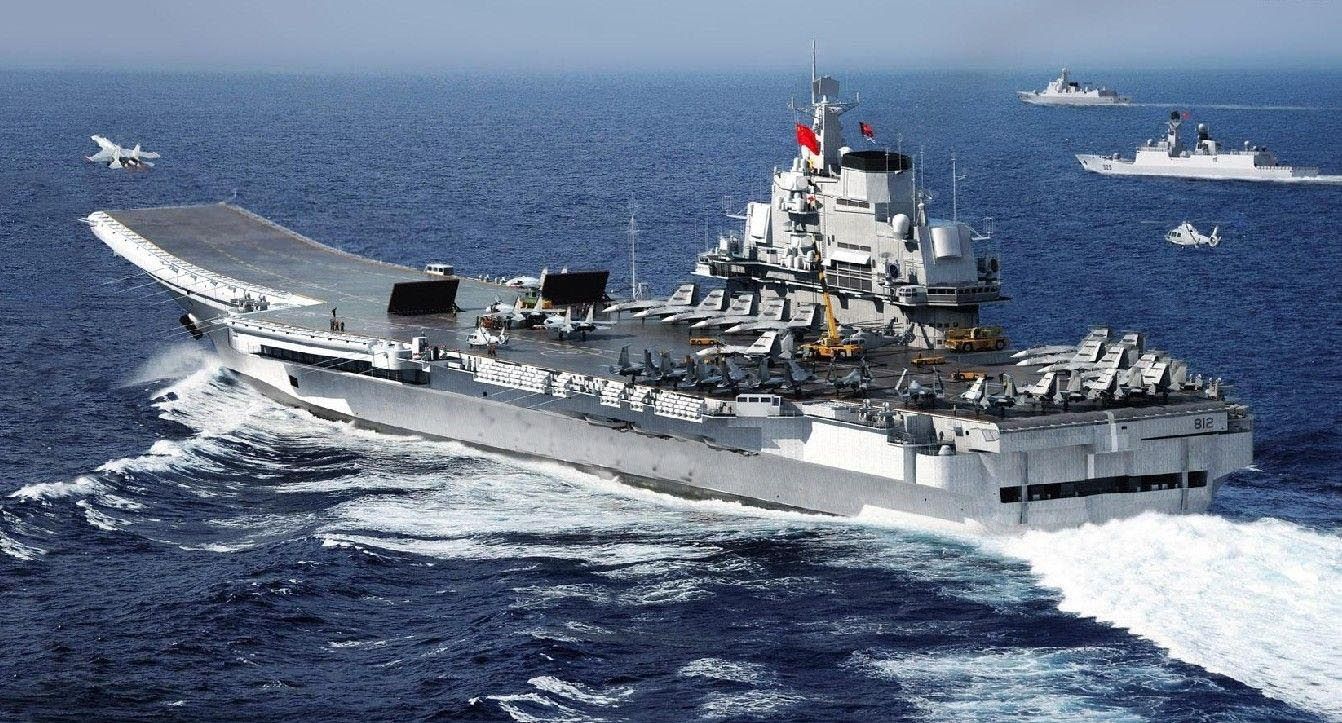
While we're at it, let's bring up a picture of the People's Liberation Army Navy's first aircraft carrier Liaoning - without which they would be at least one if not two decades behind in building their carrier fleet.


While it is encouraging that in the last few years "official Washington" has reached the pivot point in seeing the PRC's plans - it is almost criminal the lack imagination and vision on our part seeing it, especially in the 1990s when was the point everyone should have seen the game was afoot.

Just two datapoints, both related to these two pics.

"The Long Game" was an old story by the time we started it in 2004. It has its roots a lot further back. I think the first tickle of the idea came to Ensign Salamander back in 1990 when he caught a bit of info in the local paper about something that dominated the skyline for anyone coming in or out of Mayport.

Go to the pic at the top and look at those cranes and then return here. 

Know what the pic below is?


That's right - it was the original plan for "Goat Island" in the St. Johns River in northeast Florida. Today is is known as Blount Island.

There were big plans there in the 1960s and 70s;

...Offshore Power Systems (OPS) was formed on July 6, 1972 as a 50/50 joint venture between Tenneco Power Systems (who owned the Newport News shipyard) and Westinghouse Electric Corporation. It proposed to design, manufacture, and market complete nuclear power plants of a standardized design and integrated with specially designed floating platforms 5.

Each floating nuclear power station (FNPS) would contain two or more FNPPs within a protective breakwater. The individual plants were to be 1150 MWe Westinghouse four-loop PWRs with ice-condenser containments. They had once-through steam condenser cooling with no cooling towers. Electricity was to be transmitted at high-voltage (345 kV) through submerged cables beneath the sea bottom. A shore support facility would provide a staging area, a docking facility, office buildings, and parking.

At the time, the largest crane of its type in the world, just one, was at Blount Island - but the anti-nuclear movement in the 1970s killed OPS before any construction could be started.

That crane though...what was to be done with that? In 1990, in the heart of the Bush41 Presidency;

A REMNANT of a futuristic project that would have supplied cities with electricity from floating nuclear power plants is about to leave Florida. The world's largest crane, designed to build the nuclear systems, is being dismantled along the St. Johns River for shipment to China. The crane is being taken down by workers from the China State Shipbuilding Corp. at Blount Island. The Chinese reportedly paid $3 million for the 38-story crane, which cost $15 million when built for Offshore Power Systems.

Ensign Salamander - always suspecting the worse of all communist nations and enraged that we would do any business with them, was unpleased, but had a lot of PQS to do and was keeping a weather eye to that Iraq thing and hoped his betters knew what they were doing.

So began a bi-partisan decade of stupid acts.

Quick, go up to look at the PLAN carrier pic above again then come back.

Where did that start?


It was a mission like no other. In the aftermath of the Soviet Union's collapse, one businessman armed with cash and a casino cover story scooped the world to buy the unfinished hulk of a Ukrainian aircraft carrier that would become the centrepiece of the PLA Navy.

Speaking to the media for the first time, the Hong Kong-based businessman at the heart of the undertaking reveals in a two-part series the details of the little-known, behind-the-scenes odyssey to realise China's long-held dream of owning such a warship.

Xu Zengping disclosed that the militarily sensitive original engines of the carrier were intact when Ukraine sold the vessel in 1998. This is contrary to what Beijing told the world at the time.

Soon to be LCDR Salamander didn't like this either, but he was focused on that guy in Iraq who needed a good spanking for trying to kill Bush41, so he hoped  his betters knew what they were doing. He had his suspicions because we were also selling MIRV technology to the PRC, but what did I know?

His betters didn't.
Karginov told the media: “The unfinished aircraft carrier Varyag was handed over to Ukraine and then sold to China to convert it into a casino. After China received the ship, it completed its construction and renamed it the Liaoning ship. The ship was originally supposed to become one of the main ships of the USSR.”

I'm not really mad at the PRC. I'm actually quite impressed with their leadership's long term vision, drive, and follow through. 

Are we thinking as long-term? Is our defense nomenklatura focused on the Long Game ... or any game at all outside the Beltway?

Have we learned?

Tuesday, March 09, 2021

Do not act shocked ... do not avert your eyes ... look harder

We started the "Keeping and Eye on the Long Game" over a decade and a half ago. Many of you have been loyal members of the Front Porch since that time, so I know you are not surprised where 2021 finds us.

Look at it. Don't avert your eyes.


You ... yes you ... allowed this to happen because you elected the people you elected and promoted those you promoted. You allowed other priorities to creep in where maintaining the world's dominate navy should have been #1.

Sadly, many are either refusing to accept this fact or are acting as if it all of a sudden snuck up on them. Fire them all.

China was already in the midst of a shipbuilding spree like few the world has ever seen. In 2015, Xi undertook a sweeping project to turn the PLA into a world-class fighting force, the peer of the United States military. He had ordered investments in shipyards and technology that continue at pace today.

By at least one measurement, Xi's plan has worked. At some point between 2015 and today, China has assembled the world's largest naval force. And now it's working to make it formidable far from its shores.

In 2015, the People's Liberation Army Navy (PLAN) had 255 battle force ships in its fleet, according to the US Office of Naval Intelligence (ONI).

As of the end of 2020, it had 360, over 60 more than the US Navy, according to an ONI forecast.

Four years from now, the PLAN will have 400 battle force ships, the ONI predicts.

Go back to 2000, and the numbers are even more stark.

"China's navy battle force has more than tripled in size in only two decades," read a December report by the leaders of the US Navy, Marines and Coast Guard.

I didn't make this another in the Long Game series by post title for a reason. We are here. You have the Long Game intersecting with another long term project here, The Terrible 20s.  

We did not get here by accident. This was by design via the natsec leadership - uniformed, civilian, elected and appointed - by both political parties. 

Again, it is a matter of "when" not "if" the communist Chinese will challenge us. When they do, it will mostly be - if we are smart about it - a naval and air war. If the results are less than victory for the USA, it will be a hard break on a phase of history that has been with us for decades.

There is not much time. Demand answers. Demand proper priorities. Demand action.

If not, then prepare yourself for a nation and a globe neither you nor your children will recognize. 

You think the people of 1913 were shocked by where they found themselves in 1933, you don't even what to imagine with two decades after a shift to a Sino-centric world would be like.

Wednesday, November 30, 2022

Keeping an Eye on the Long Game: Part XCV

We started doing the "Long Game" series about the rise of the People's Republic of China to challenge American's place in the world. At the end of that first post in the series in July of 2004, I wrote;

Say what you want about the Chinese, they are very focused on their long term strategic needs. They will continue to study the way we do business at sea, and they will make sure they are ready when the call comes. Are we?

A lot of folks hear rustling in the woods behind us.

There were a lot of us, but few were listening. 18.4 years later, they are now.

That is part of the reason it has been since May of this year since I did a Long Game post. I've written a fair bit about the PRC since then, but did not use the "Long Game" tag. Why? Simple, we are here. Over 18 years is a "long time." All but the most compromised see the threat from the PRC and the game is afoot.

It is military, economic, and academic - and it is in our face.

I still think the tag is helpful in that while the PRC is now ready to call our bluff west of Wake, they are the nation with thousands of years of history, and they have a plan ... we just need to keep an open eye and mind to see it.

If you want to get the view from the official organs of the US government towards the PRC, a good place to look would be the recently published review of military and security development in the PRC by the USA's Department of Defense. 

There is one paragraph early on that I think is the most important;

Sensitive, dual-use, or military-grade equipment that the PRC have attempted to acquire include radiation hardened integrated circuits, monolithic microwave integrated circuits, accelerometers, gyroscopes, naval and marine technologies, syntactic foam trade secrets, space communications, military communication jamming equipment, dynamic random access memory, aviation technologies, and antisubmarine warfare (ASW) capabilities. 

How will they acquire all this dual use technology? If you are thinking it is Spy-vs-Spy old school espionage, you are only looking at a very small portion of what is going on.

You need to look at the very sober fact that they are getting that technology the most efficient way - they are convincing us to give it to them. It starts at our universities and pipelines right in to industry.

First of all, let's look at some charts from Statista. 

Even with the COVID effect, the numbers are staggering. Here's the number of college and university students from China in the United States from academic year 2010/11 to 2020/21 :


Note the decline to the USA is not the same as the decline globally. Here's the number of students from China going abroad for study from 2010 to 2020;


The numbers here are hard to come by and I would consider the above to be on the high side. SCMP puts the number at 290,086. A 2020 study from Georgetown University's Walsh School of Foreign Service have about half those numbers, but the commentary to the study is sound;

The results speak to ongoing policy conversations about the risks and benefits of Chinese students enrolled in science, technology, engineering, and mathematics (STEM) programs at U.S. universities. These conversations have been hampered by a lack of granular data on the number of enrolled Chinese students by field and degree level. For example, it is currently impossible to calculate the financial impact of Chinese students on the U.S. university system because we do not know how many Chinese graduate students are in master’s programs (and thus likely to pay full tuition) versus Ph.D. programs (for which they often receive university or federal funding). This paper seeks to provide such data and to identify remaining data gaps that should be filled.

Because there is no single database of domestic and international students in the United States that includes all the relevant information, analysts have had to produce estimates using several different data sources. These sources often count slightly different things over possibly different periods, complicating the analysis and increasing the risk of inadvertent errors. Our findings differ from widely-cited government estimates. Whereas those estimates suggested that 25 percent of U.S. STEM graduate students and 15 percent of STEM undergraduates are Chinese, we conclude with high confidence that the numbers are 16 percent and 2 percent, respectively.

That's right kiddies; one of the nation's top universities that happens to be in our nation's capital with incredible connections to our federal government finds, "..no single database of ...international students in the United States..."

In case you were wondering, the number of Americans studying in China in 2020 was 2,481. I can't find out how many are completing a full program of study or just doing a semester ... or what their majors are ... but just look at that delta.

From that study, it is clear that they are not in the USA to get Gender Studies degrees.

Look at how close the numbers of undergrads and graduate students are. Note that they're all STEM.

You cannot classify math. You cannot classify dual-use research. You cannot remove knowledge gained. Just look at those numbers. Look at those fields. Look up-post what areas the PRC wants to advance in.

We are making our #1 competitor better, and taking away opportunities for the children of American taxpayers who especially with land grant universities, paid for these universities to exist to serve them.

I don't blame the PRC's citizens for wanting to come here to study, for both personal and professional reasons. However, they never really leave their dystopian nation behind;

On the bucolic campus of Purdue University in Indiana, deep in America’s heartland and 7,000 miles from his home in China, Zhihao Kong thought he could finally express himself.

In a rush of adrenaline last year, the graduate student posted an open letter on a dissident website praising the heroism of the students killed in the Tiananmen Square massacre in 1989.

The blowback, he said, was fast and frightening. His parents called from China, crying. Officers of the Ministry of State Security, the feared civilian spy agency, had warned them about his activism in the United States.

“They told us to make you stop or we are all in trouble,” his parents said.

Then other Chinese students at Purdue began hounding him, calling him a CIA agent and threatening to report him to the embassy and the MSS.

Kong, who goes by the nickname Moody, had already accepted an invitation from an international group of dissidents to speak at a coming online commemoration of the Tiananmen massacre anniversary. Uncertain if he should go through with it, he joined in rehearsals for the event on Zoom.

Within days, MSS officers were at his family’s door again. His parents implored him: No public speaking. No rallies. 

That powerful hook back home isn't just used to keep people under control - but to get them to do further things for the PRC.

In August 2015, an electrical engineering student in Chicago sent an email to a Chinese national titled “Midterm test questions.”

More than two years later, the email would turn up in an FBI probe in the Southern District of Ohio involving a suspected Chinese intelligence officer who authorities believed was trying to acquire technical information from a defense contractor.

Investigators took note.

They identified the email’s writer as Ji Chaoqun, a Chinese student who would go on to enlist in the US Army Reserve. His email, they say, had nothing to do with exams.

Instead, at the direction of a high-level Chinese intelligence official, Ji allegedly attached background reports on eight US-based individuals who Beijing could target for potential recruitment as spies, according to a federal criminal complaint.

The eight – naturalized US citizens originally from Taiwan or China – had worked in science and technology. Seven had worked for or recently retired from US defense contractors. The complaint says all of them were perceived as rich targets for a new form of espionage that China has been aggressively pursuing to win a silent war against the US for information and global influence.

It would be one thing if we took an active roll here in the US and other Western nations (like The Netherlands in the link below), but we allow not just PRC police and intelligence services to run free, we allow other students (many the same people) to act as enforcers. 

26-year old UG student Meng avoids interacting with Chinese government supporters altogether, if she can. ‘These Pinkies are way too sensitive’, she says, using the nickname for young Chinese Communist Party supporters. ‘They are always very aggressive and feel they represent the side of justice.’

I’m always careful about choosing people to talk to

She is also careful when talking to people she doesn’t know well. And when she participated in a protest in Amsterdam this summer, remembering the 1989 massacre at Tiananmen Square that cost hundreds of lives and left thousands wounded when the Chinese government opened fire on protesters, she wore a mask and disguised herself in cheap clothes. ‘There were Chinese people there who kept taking pictures of us with their mobile phones’, she remembers. ‘When the protest was over, my companion and I walked to a place where no one was around. We changed our clothes and threw the outfit we had on in a trash bin.’

The FBI is, in theory, on the hunt - but read this from NPR and tell me if you think they are getting all the help they need from universities.

"The Chinese intelligence services strategically use every tool at their disposal — including state-owned businesses, students, researchers and ostensibly private companies — to systematically steal information and intellectual property," FBI Director Christopher Wray said at the Council on Foreign Relations in April.

Former FBI agents say the bureau's recent visits to universities are merely an extension of long-running efforts to collaborate with the private sector and academia on national security issues.

Speaking of dual use, not only are many of the finite number of PhD programs going to foreign nationals - and as this is a zero sum game - and not US citizens; so are the jobs.

Chinese and Indian students make up nearly half, and “most stay long after graduation”. “In February 2017, approximately 90% of Chinese nationals and 87% of Indian nationals who completed STEM PhD programmes in the US between 2000 and 2015 were still living in the country, compared to 66% of graduates from other countries,” the report states.

"Wait..." you say, "How can they help the PRC's military if they are working for American companies and universities?"

Well, its complicated - and made more so by the numbers being so large. It is hard for the FBI to keep track of what the threats are when the pool of candidates are so large and the connections so varied. Heck, the problem people don't even have to be from China;

The China Initiative’s most high-profile case has been that of Charles Lieber, the chair of the chemistry department at Harvard and a perennial Nobel Prize candidate, as well as the recipient of more than fifteen million dollars of federal funding, including from the Department of Defense. From 2012 to 2017, Lieber participated in China’s Thousand Talents, the most vaunted talent program; his contract paid him fifty thousand dollars per month, along with generous startup fees to establish a lab in Wuhan. He had, however, neglected to inform Harvard of his double-timing in China, and, when approached by federal investigators, he continued to conceal the arrangement—and the sacks of cash he had smuggled through customs. In December, he was convicted of lying to federal authorities, falsifying tax returns, and failing to report foreign earnings. Some felt that this was just another anti-Chinese expedition; a D.O.D. official testified that the investigation was prompted by the sheer number of Chinese students working in Lieber’s lab. But John Krige, the historian, has noted that Lieber’s contract stipulated that he work on the development of batteries for high-performance electric vehicles, an area of industrial competition. “The academic research community must ask itself if it is morally or politically acceptable to engage in international scientific collaboration with China in fields that can seriously harm the domestic economy,” he wrote.

This problem of our own creation is worthy of a few books and won't be solved here - but policy makers have to address:

- Too many of the finite numbers of US STEM graduate program seats are being taken up by citizens of the PRC.

- These STEM degrees feed the knowledge base for dual-use technology.

- PRC nationals working in cutting edge technology jobs received by having been given one of those limited positions make them the target for PRC exploitation.

- Even if PRC nationals take nothing material when they go home, they take their education and exposure with them.

- For a quarter century, us government and educational institutions have developed close and unequal relationships from entities controlled by the Chinese Communist Party.

This should be a non-partisan issue - but an American issue.

Tuesday, March 07, 2023

Keeping an Eye on the Long Game: Part XCVII


As important as it is to count the number and type of warships the People's Republic of China (PRC) is building for their navy is, how productive their shipyards are, and even the negative impact of their crashing demographics - there are other things that are arguably more important to track in order to see what the challenge will be before it comes over the horizon. 

That is what we have been doing for the last 18-years of the "Long Game" series on the PRC - looking further than the threat of the next few POM cycles. The PRC is playing a long game, we should do our best to understand it.

Where a warship has an effective life of 30-yrs or a bit more, there are assets that last much longer, continually modernize themselves, and when combined together, are much more powerful in aggregate than the sum of the individuals - that is human capital, specifically intellectual capital.

In 2023, the American taxpayer and their elected representatives would not stand by and accept if our defense contractors were building warships, aircraft, and armored vehicles for the PRC's military (one hopes). No arguments from industry about profits or the number of jobs these contracts would bring to communities in the USA would gain traction (one hopes). If anything, it would bring a popular revolt (one hopes).   

If that is true, then why would the American higher education system be any different? Specifically I am referencing the top research universities - which almost all American taxpayers pay for - STEM undergraduate, and especially the very few masters and PhD programs? 

I don't care if they are paying full price - why are we helping the PRC develop their future technology?

Anyone who, like your humble blogg'r, has kids and relatives of college age whose graduation ceremonies you attend can tell, PRC passport holders are taking up a HUGE portion of available slots. In a highly competitive environment, the difference between getting a spot or not in highly competitive programs at our top universities is a matter of small degrees. For each PRC national getting a PhD in chemical engineering at a top tier university, that is an American citizen - or the citizen of an allied nation - who is not.

This has been going on for decades. What is the result? 

Over at Breaking Defense there is a nice wakeup call to what we have helped create;

In a new report from the Australian Strategic Policy Institute (ASPI), the US comes second to China in the majority of critical technology research areas examined, like artificial intelligence, robotics, biotechnology and quantum technology and specifically in defense and space-related technologies. The report uses ASPI’s new Critical Technology Tracker, a tool that lets users track 44 technologies considered “foundational” for national security, economies and more areas.

...

China is outpacing the US and other democratic nations in 37 out of 44 technology research areas considered advanced and critical, setting the stage for potentially devastating immediate and long-term consequences if western nations don’t “wake up,” according to a think tank’s latest findings. 

In a large part building off the first generation of people educated in the USA and other Western nations' best universities, the PRC has some good universities ... but they cannot hold a candle to the culture of innovation and research at ours. In dual use technology areas ... we are not just helping them get a technological edge, we are helping them bring their military closer to a qualitive equality - eating away at our hedge against the quantity a nation 4x the size of ours will bring to any fight.

In many of these areas, the PRC is not a "pacing" or "rising" threat - they've already lapped us;

“To close, and surpass, the technological gap China is creating, the US not only needs to invest more, but also harness the power of commercial data to inform strategic investments to expel foreign influence and adversarial capital from our industrial base,” she added. “Only then can we begin to find America’s edge in the fight against China.”
People matter.

We cannot change the mistakes of the past. The PRC has what they have.

“In the long term, China’s leading research position means that it has set itself up to excel not just in current technological development in almost all sectors, but in future technologies that don’t yet exist…,” the report says.

What we can do is control our decisions for the future. If someone from the PRC wants to come to the USA to get a PhD in Gender Studies; knock yourself out. Comparative French Literature? Sure.

Other things ... naw ... 

ASPI made a total of 23 recommendations in its report, calling for increased investments in areas like research and development, talent development and the production of intelligence strategies, while also advocating for governments to come up with more creative policy ideas and more collaboration between partners and allies. 
This is the point of the article that I started to get frustrated. You can almost feel the author trying NOT to propose what is the most logical first step; stop training your adversaries.

Until we stop underwriting the development and ongoing modernization of the PRC's intellectual capital, their strength and dominance in existing and emerging strategic dual use technology will only grow.

Universities will not do it. At the State level, citizens need to tell their governors and state legislatures they don't want their universities sending citizens away in order to take PRC money. At the federal level, Congress must act where appropriate.

Graph credit Eric Rosenblum.


Friday, April 08, 2005

Keeping an eye on the long game: Part X

Good to see Eagle1 is keeping an eye on "The Long Game" as well.

Everyone go over to your handy handy map of the Taiwan Strait. Depending on where you are coming from and where you want to go, you have about 60-120nm to travel. (Lets face it, besides the Spratly Islands, is there anywhere the Chinese might want to take troops by sea? And the Spratly Islands are a haul.)

To get to where you want, read Taiwan, you have to get men and material there fast, in quantity, and in once piece. The longer you are at sea, the longer you are vulnerable. The PLAN has been working on their amphibious operations at a faster pace as of late.

And what are they doing? Well, making APD (fast troop transports) out of old destroyers and frigates.
China will soon have at least eight APDs.....The 1,800 ton Jianghu’s have a top speed of about 46 kilometers an hour. This enables APDs to move quickly, especially during darkness, to reach their destination. Shorter travel time makes the APDs less vulnerable to attack (and easier to defend, especially if you have to keep fighters overhead.) Taiwan is 300 kilometers from the Chinese coast. Each APD could carry several hundred troops, or a few hundred tons of cargo.
Wait, won't they need Marines to kick the door in?
China took the “armored regiment” of the 164th infantry division and converted it to the Second Marine Brigade. This brigade is organized using the new format, with one company of each infantry battalion having armored vehicles, in this case amphibious light tanks (Type 63A). The infantry companies have amphibious armored personnel carriers. The brigade artillery battalion has self-propelled 122mm howitzers. The First Brigade is larger, and has five combat battalions (two armored, with amphibious tanks, and three infantry.) The armor battalions have two tank and one infantry companies. In addition to the two brigades, there are two marine recon battalions and two frogman platoons (think “SEALs Lite”). These are usually attached to the First Marine Brigade. There may be a skeleton Marine Brigade in Shanghai, to be used to rebuild a Marine Brigade if one of the other two is destroyed in combat. The total size of the Chinese Marine Corps is over 10,000 troops.
That's not much, huh. Wait, don't they already have some amphibious capability?
...there is sufficient lift for 250 infantry and mechanized (tank and mechanized infantry) battalions. That’s about twenty divisions.
There's your occupying force. But you need to strike with fast, modern (well, not so modern - remember Narvik) concepts of speed and surprise? Right?
China appears to be building small amphibious ships in as many as five different shipyards (Lunshan, Huangpu, Jiangnan, Shanghai and Zhonghua). These are ships that could make the run across 300 kilometers of open water, at least in good weather, carrying a tank or two, some trucks, or a company of infantry. Larger amphibious ships, like their new LSD (landing ship dock) are building at a more leisurely pace. In any event, the LSD and LST type ships are also useful for longer range amphibious operations. But the smaller craft have only one target; Taiwan.
They also have a good plan to keep Taiwan busy as they slog across the strait.

In case you think APDs are too slow and to few to get the shock troops there, the Chinese are working on more capable units:
PLA Navy is now building two new types of LSM medium tank and troop landing ships, a total of about 12 since 2002, added to 20 or so ships of the same class. These ships can carry an average of about 10 tanks and 250 troops. The PLA may now be considering building new 15,000 to 20,000 ton LDH class amphibious ships that will use new hovercraft tank and troop conveyers similar to the U.S. LCAC, and large helicopters, allowing assaults from greater distance and against more difficult shore terrain.


That's why we call it "The Long Game." Not now, not in 5 years; but you're getting close.
On March 4th the Chinese government announced that its defense spending would increase by 12.6 percent in 2005. Save for 2003, all of the last 15 years has seen Chinese defense spending grow by double-digit percentages.....In 2004 the Pentagon noted that for 2003, overall Chinese military spending ranged between $50 and $70 billion.[1] If we take the Pentagon’s estimate as a baseline, then for 2004, which saw an "official" Chinese increase of 11.6 percent, spending might have risen from $55.8 to $78.1 billion, Similarly modifying the announced Chinese 2005 budget increase of by 12.6 percent yield actual expenditures between $62.8 and $87.9 billion. Other estimates have long held that Chinese military spending has reached or exceeded $100 billion. By comparison, Japan spends $45 billion on defense, and India about $19 billion.
Get out your Wizz Wheel and lets do some math. Let's say that we need to cover 100nm. If we are doing 30kts, that's 3hr 20min. Yikes, that could be hard to keep your Kung Pao Chicken MRE down. If you can cover half that distance in your hovercraft at 50kts avg, that is 2 hr 40 minutes to the beach. Go in a 150kt helo, and you're there before the bill and fortune cookie.

Remember, the Chinese have a long term view on things. They know with the way the economy is going, they will soon reach critical mass. Taiwan is, they will remind you, in their backyard, not ours. Mmmmm. Wonder what the Japanese think of this?

And what do you say comrade?

Monday, June 27, 2005

Keeping and eye on the long game: Part XII

In case you missed it, Bill Gertz is keeping a eye on The Long Game as well, in the Washington Times special on 26 JUL, Chinese Dragon Awakens.

China is building its military forces faster than U.S. intelligence and military analysts expected, prompting fears that Beijing will attack Taiwan in the next two years, according to Pentagon officials.

U.S. defense and intelligence officials say all the signs point in one troubling direction: Beijing then will be forced to go to war with the United States, which has vowed to defend Taiwan against a Chinese attack.
And where will those forces come from on short notice if we have the balance of our combat ready forces committed elsewhere?
China's economy has been growing at a rate of at least 10 percent for each of the past 10 years, providing the country's military with the needed funds for modernization.

The combination of a vibrant centralized economy, growing military and increasingly fervent nationalism has transformed China into what many defense officials view as a fascist state.

"We may be seeing in China the first true fascist society on the model of Nazi Germany, where you have this incredible resource base in a commercial economy with strong nationalism, which the military was able to reach into and ramp up incredible production," a senior defense official said.
Well, it isn't a democracy and it isn't Communist anymore. What else do you call it? Hard to argue.
The release of an official Chinese government report in December called the situation on the Taiwan Strait "grim" and said the country's military could "crush" Taiwan.

Earlier this year, Beijing passed an anti-secession law, a unilateral measure that upset the fragile political status quo across the Taiwan Strait. The law gives Chinese leaders a legal basis they previously did not have to conduct a military attack on Taiwan, U.S. officials said.

The war fears come despite the fact that China is hosting the Olympic Games in 2008 and, therefore, some officials say, would be reluctant to invoke the international condemnation that a military attack on Taiwan would cause.
Agreed. I have been saying for awhile that we are safe through 08/08/08. 2009 through 2012 is a key danger time for us. If we have a combo of a large percentage of our combat ready troops otherwise employed, and we have a weak government here after the 2008 elections; it will be a perfect storm that the Chinese will have trouble not taking advantage of. I would look at it.
In the past, some defense specialists insisted a Chinese attack on Taiwan would be a "million-man swim" across the Taiwan Strait because of the country's lack of troop-carrying ships.
"We left the million-man swim behind in about 1998, 1999," the senior Pentagon official said. "And in fact, what people are saying now, whether or not that construct was ever useful, is that it's a moot point, because in just amphibious lift alone, the Chinese are doubling or even quadrupling their capability on an annual basis."
If you have not been reading my "Long Game" series: shame on you.
China is building capabilities such as aerial refueling and airborne warning and control aircraft that can be used for regional defense and long-range power projection, ... It also is developing a maneuverable re-entry vehicle, or MARV, for its nuclear warheads. The weapon is designed to counter U.S. strategic-missile defenses, ... Work being done on China's weapons and reconnaissance systems will give its military the capability to reach 1,000 miles into the sea, ... Beijing also has built a new tank for its large armed forces. It is known as the Type 99 and appears similar in design to Germany's Leopard 2 main battle tank. ... The country's air power is growing through the purchase of new fighters from Russia, such as Su-30 fighter-bombers, as well as the development of its own fighter jets, such as the J-10.

Gen. Hester (Air Force Gen. Paul V. Hester, head of the Pacific Air Forces) compared Chinese warplanes with those of the former Soviet Union, which were less capable than their U.S. counterparts, but still very deadly.

"They have great equipment. The fighters are very technologically advanced, and what we know about them gives us pause for concern against ours," he said.
The Chinese have learned one thing that we have neglected in our ground war against terrorists. Missiles.
"It is their surface-to-air missiles, their [advanced] SAMs and their surface-to-surface missiles, and the precision, more importantly, of those surface-to-surface missiles that provide, obviously, the ability to pinpoint targets that we might have out in the region, or our friends and allies might have," Gen. Hester said.

The advances give the Chinese military "the ability ... to reach out and touch parts of the United States -- Guam, Hawaii and the mainland of the United States," he said.
There is a lot more in the report, especially concerning the Chinese oil situation and "other" former Chinese territory issues. Read it.
"Let's all wake up. The post-Cold War peace is over," Mr. Fisher (vice president of the International Assessment and Strategy Center) said. "We are now in an arms race with a new superpower whose goal is to contain and overtake the United States."
Next time you go to WalMart and buy all those Chinese goods, or read about China buying American corporations; think about that.

Monday, November 18, 2019

Welcome to the Long Game Folks

I used to quote from The Economist more here in the past than I have the last few years. Reasons are - and sad to say about a publication I have been reading for three decades - it just isn't as good as it used to be. It isn't even - at least from the American perspective - center-right anymore. It has drifted well in to the center-left. As such, what I read there doesn't supply much different opinion and perspective of the rest of my media diet.

One thing you could and still can rely on more often than not with The Economist for was it to reflect the Anglosphere "Foreign Policy Consensus." Yes, the gaggle that has, if we can be kind, a spotty record the last three to five decades.

So much of their performance and advice hasn't been malicious, just lazy and wrong. A lot of group-think and wishful thinking. Kind of like the WSJ and open boarder foolishness - they are scope locked on a pleasant theory, and not rigorous on the hard truth. As the phrase goes, they remember everything but learn nothing.

Since Nixon went to China, the blinkered view of China has been the primary example of this failure to adopt a hard-nosed vision. Before the fall of the Soviet Union, we needed a China strong - regardless of what she did to her own people - as a counter to their fellow Communists in the Soviet Union who all the smartest people in the room thought would last until the crack of doom. 

In the 1990s with the Soviet Union magically off the stage, we saw a shift when China pivoted to getting what they wanted by bribery. They soon found that a lot of business and politicians could be bought rather cheaply. Many people and nations talk a good game, but scratch the right place, and you can find those willing to be corrupt. The Chinese know how to play that game better than about anyone. Two greatest examples of that era are found with Loral and the Coffee Klatch money machine.

The last decade, while keeping bribery in their back pocket, we reached another economic power pivot point, the Chinese are moving on to economic extortion and leverage. 

While many on the outside - and a minority on the inside - have seen the Chinese for what they are (see Long Game tag here), too many leaders and influencers refuse to see it, either from lack of curiosity or habit, or simple greed. The German's 5G decision is one example.

The Chinese are getting bold. In their boldness, will they start to wake people up? The millions of Uighur in concentration camps combined with the crackdown in Hong Kong seem to be turning a few.

When The Economist is having second thoughts, perhaps we are seeing a turn;
There were moments during a recent gathering of Americans, Chinese and Europeans, invited to Stockholm to discuss China’s rise and the new world order, when Chaguan wondered whether anyone would say anything cheerful. At last, halfway through two days of doomy talk about trade wars and some scratchy exchanges about whether Westerners have a right to criticise China’s leaders, a Chinese participant sounded an optimistic note. Brexit is an opportunity for China, he enthused—once out of the European Union, Britain will need all the friends it can get.

That was as upbeat as discussions got at the Stockholm China Forum, a semi-annual meeting for politicians, officials, ambassadors, business bosses, scholars and journalists hosted by Sweden’s foreign ministry and the German Marshall Fund, a think-tank. The forum was founded to bridge transatlantic differences over China policy after a crisis in 2004, when France enraged America by proposing to lift an eu arms embargo on China imposed after the crushing of the Tiananmen Square protests in 1989. Chaguan has joined the meetings since 2008 and has seen them turn testy before, despite endless supplies of good coffee and Swedish cinnamon buns. At a forum in 2018 Americans and Europeans sparred over President Donald Trump’s foreign policy. This time was different. A shared fatalism marked panel discussions and offstage conversations. There was a common conviction that China is not about to change its model of authoritarian state capitalism.
You think?

I'm not sure what it will take - but each passing year, the FP and IC community continue to fail to think in line with our reality. How many bad calls do they get passes on? Fall of the Shah? Fall of the Berlin Wall? Fall of the Soviet Union? Iraq WMD? Overthrow of Qaddafi? Mass migration?

There have been a few successes, but not enough. Some more humility would be helpful here. "There was a common conviction..."

Better late than never.

No more, "We welcome China's rise..."

Monday, May 12, 2008

Keeping and Eye on the Long Game: Part XXVI

Bit by bit. Step by step. Here is a word for you old Cold Warriors - SOSUS.
Defense officials said China has deployed a new wide-area ocean surveillance system that includes an underwater sonar network of sensors, and ground- and sea-based long-range radar that will make it more difficult for U.S. submarines to protect the fleet and to track China's growing force of new attack and missile submarines.

A former U.S. government defense specialist on China said on the condition of anonymity that there are indications China is operating a rudimentary underwater Sound Surveillance System, or SOSUS. The sonar network includes fixed sensors that can pinpoint U.S. submarines operating in some areas of the western Pacific.

The U.S. Navy operates a similar system at strategic underwater choke points around the world.

The Chinese SOSUS has been detected underwater in the Bohai Sea, off the northern Chinese coast, north of the Yellow Sea, a major Chinese navy operating area. Additionally, China also has set up at least five long- and medium-range radar sites along its coast that have over-the-horizon capability, the former official said.

The sonar and radar are part of China's key strategic wartime goal of knocking out the five or more aircraft carrier strike groups that would be rushed to the region near Taiwan in any future conflict. Those carrier battle groups are defended by submarines.

"If they are after carriers, we protect carriers with subs and if they know where they are, they can find the carriers," said the former defense official, who confirmed that the Chinese are developing various ground, sea and space sensors designed to "target the American fleet."
But ... the folks at Inside the Ring (Bill Gertz's crew) need to get out their map more.

The center of the Bohai Sea is located 800NM as the crow flies from the northern tip of Taiwan (see right). Knowing, ahem, the oceanography of that part of WESTPAC - you could have a whistling shi'ite can of a
Type 1 Nuke near Taiwan and you are not going to hear it with a starter SOSUS in the Bohai Sea; if that is where their SOSUS is.

What is significant here is that they have put one in. The Chinese are nothing if not methodical. The Russians may not have taken cr@p without a plan - but the Chinese don't buy toilet tissue without a plan; hopefully a via a plan to steal tissue from someone else.

Once they figure it out, then they will deploy the next step. When you see one off Fuzhou or Hainan (next Long Game post), then you have something out there to keep you focused on your transients.

Now, where is my CZ Sliderule....

Tuesday, May 25, 2021

Keeping an Eye on the Long Game: Part XC


Are you numb when it comes to news of the maritime power growing on the other side of the Pacific?

I hope not, but if you are the numbers are such that it should burn through to what few nerves you have left.

We have been at this here for what; Long Game is this ... #90 (and that isn't even the number of China posts we've done over the years) a decade and a half or so?

Well, no rest folks. We are well inside the quickening.

Don't avert your eyes from the numbers. Let them soak in. Hoist them aboard. Ponder. Plan. Prepare.

I'll let our friend The Other Sal warm things up for you; 
China’s new shipbuilding orders up 182.1% in first four months

"China’s newly received shipbuilding order volume for the period of January-April was 27.87m dwt, a 182.1% surge year-on-year."

This is more tonnage than the US built in 1942 & 43, combined.

They are flooding the seas with numbers. Numbers matter. 

They are running all over the field while we sit in the coach's conference room watching best-of reels from last season's playoffs.

As at end of April, China’s shipbuilding output, newly received orders and orders on hand accounted for 41.1%, 53.3% and 46.8% respectively of the global shipbuilding market share.

The game is afoot people. 

Our passive, pampered, and entitled elites make their excuses, deposit their divided checks, reinforce their gated estates, and continue to lead the nation towards a reckoning with a serious power west of Wake. 

We need a new elite with different priorities, or the planet will have a new superpower.

Monday, July 09, 2018

Keeping an Eye on the Long Game: Part LXXV

We have been doing the "Long Game" series for what, a dozen years?

Well, we are pretty damn close to the event horizon where this is becoming a short game.

It is still gobsmacking that we have yet to design a surface combatant of any utility since the passage of Goldwater-Nichols at the height of the Cold War.

It is a clear case of systemic institutional failure that we blew up CG(X) because we had zero ability to control our worst tendencies, and that we seem happy to slug along with our glorious but crotchety stretch-SPRUANCE CG's as the guardians of our CVNs.

DDG(X) is still vapor ware. If FFG(X) winds up just being a stretched LCS, then we just need to fire everyone and nuke the accretion-saddled acquisition system from orbit. Just have the Australians design our fleet architecture for a decade until we can train up a new generation. They seem to get it.

Besides our friends Down Under, you want to see a serious surface force who is serious about building a fleet and getting ready to go to war at sea?


Three Type-52C (a very adequate 7,000 ton displacement DDG) and two Type-55 CG (it ain't a DDG at a displacement of 12,500 and 112 VLS on FLT-I). All right off the production line. I can smell the fresh paint from here.

Look at that picture in detail. The Chinese are dead serious about dominating their half of the Pacific and as much of the Indian Ocean as they can.

Meanwhile, we are still struggling to figure out how to train our officers in basic seamanship.

If this does not make you angry and motivated, then for the sake of our Navy and the nation is serves, go away. Retire. Go home. Find a hobby. Let others step in to the breach who actually give a damn.

H/t TS.

Monday, April 30, 2018

Keeping an Eye on the Long Game: Part LXXIII

Admiral Davidson has a view on the Long Game, and it should sober you up this Monday.

Via our friend Andrew Erickson, we have a nice summary of China-related comments from incoming PACOM Commander, Admiral Philip Davidson, USN.

This is ... aggressive;
The strategic and operational environment outlined in the NDS clearly identifies the importance of developing and fielding a force posture that is capable of countering Chinese malign influence in the region.With respect to their actions in the South China Sea and more broadly through the Belt and Road Initiative, the Chinese are clearly executing deliberate and thoughtful force posture initiatives. China claims that these reclaimed features and the Belt and Road Initiative will not be used for military means, but their words do not match their actions.Our defense strategy provides the necessary guidance that will drive our actions.

The Dynamic Force Employment and Global Operating Model concepts inform how the Joint Force is employed across the spectrum of military operations from deterrence operations to crisis response. Due to the distances involved in the Indo-Pacific, we cannot rely solely on surge forces from the Continental United States to deter Chinese aggression or prevent a fait accompli. PACOM must maintain a robust blunt layer that effectively deters Chinese aggression in the Indo-Pacific.
What exactly does that require and how does that mesh with the CINC's desire to have fewer American forces doing overseas what local forces should?

...and are we about to dust off the 'ole Pershing (III?) and GLCM, but this time with a conventional warhead ... maybe?
The Conventional Prompt Strike system will help meet military requirements in PACOM, but I think we need to also look at additional systems in order to balance against the large numbers of conventional missiles that China has already fielded. In the Indo-Pacific, the absence of the INF Treaty would provide additional options to counter China’s existing missile capabilities, complicate adversary decision making, and impose costsby forcing adversaries to spend money on expensive missile defense systems.
...
I believe the INF treaty today unfairly puts the United States at a disadvantage and places our forces at risk because China is not a signatory.
Going back to the first issue - if you get the CINC to OK more US forces in WESTPAC, where are you going to put them?
Current force structure and presence do not sufficiently counter the threats in the Indo-Pacific, particularly a resurgent China that leverages military modernization, influence operations, and predatory economics in pursuit of regional hegemony and displacement of the United States over the long term. Aligned with the concept of blunt forces in the NDS, the size of the Indo-Pacific region and the diversity of threats warrant a stable and sizable forward presence. Additional rotational forces allow for more engagements and help increase the readiness of the forward stationed forces.
Lots of good stuff there, read it all.

It ain't 2010 anymore, that's for sure.


Wednesday, November 15, 2006

The Stalking of the KITTY HAWK

Like Lex, I have held off putting anything down on the Chinese Sub that interrupted the USS KITTY HAWK's games. You see, there are some things you just don't talk about. Bubblehead has some interesting thoughts that I am mostly in line with, but TheSubReport has a percentage of the smart thinking as well. Being that, Admiral Fallon has spoken, I will dip my toe in the water some.
First let me say this; cocky arrogance based on your archaic POV of ASW is a recipe for getting your ship sunk and your Sailors killed. Period. A lot of the "bunch of primitive Chinamen" bravado crap has to stop. Now. That same kink of talk was made about the fighting ability of Iraqis and the cake walk we would have. Not so funny, or true, now - is it? Stowe it.

The Chinese know what they are doing. They are playing the Long Game - an ongoing story here that long time readers are aware of. They are smart, large, and growing stronger by the WalMart shopping day. They have a history and culture that makes our upstart post-colonial melting pot look like the long-legged, klutzy teenager that it is. Sure they have challenges, but I ask you - where is their trend line?

Enough of the Chinese. Let's talk about us. I am not going to talk about what did or did not happen with the Sh1tty Kitty. I am going to talk in more general terms.

1. Sitting in your chair in confidence of Foxtrot Mike technology making everything easy? Nice tools, but you are a fool.

2. How familiar are you with the waters around China?

3. Do you really understand the time-distance challenges of the Pacific? Seriously, get the map out with your circular slide rule.

4. Assume your subs are as perfect as you think. Fine. Can they be everywhere? Of course not. ASW is a numbers game in wartime. Look at the proficiency of our SH-60 series of helos in ASW. Ditto what little is left of our fixed wing ASW. S-3 is long gone, and what few P-3s we have left are trying to stay together long enough to preserve their community's Major Command billets till the P-8A shows up ~ half-way through the next decade. Ship ASW? Harumph. DD's - gone. FF(not so G)'s - might as well be gone. DDG-51s? Nice bit of kit - but those MK-41 cells have employment elsewhere outside ASW. As for the training and tactical sustainability of the above units? Don't BS a BS'r. I know where the money has gone over the last 15 years. ASW sensors and training has not been it.

5. Assume you have found your "Made in China" SS. Ready to kill it? Really? 'Nuff said there.

6. Ready for sustained ASW prosecution? Read what I have about the Falklands War? Magazine and lockers ready to go?

7. Like your LWT? What if they don't quite work like you want, or you run out after a few days attacking ghosts? What then? Have a back-up plan? Have a back-up weapon? Where are all your eggs? It isn't hard to figure out how things can twist in war. It really isn't. Arrogance and wishing your problems away will only get you killed.
It is hard to laugh at that non-nuke submarine that sank that USS ASHLAND 36 hours ago when you only have one SSTT MK-46 left and your helo is down until you can get another engine. To think that crew sailed all the way from Norfolk just to go like that. What was it, around 60 out of 800 or so Sailors and Marines the LASSEN and CARR managed to pluck out of the water?

You know she is out there. 8 hours ago the P-3 flying out of Guam thought she saw her and dropped two MK-54 on a POSSUB contact over a 45 minute timeframe with nothing to show for it; and that was 15NM away from where everyone else thinks the SS is. Well, where the LASSEN attacked her. Thinks she attacked her. At least she still has a helo and 6 LWT left. The nearest US SSN, the HOUSTON, is another 8 hrs or so away...you think... You can't sleep because every 90 minutes or so someone thinks they saw something or there is something interesting on the UYS-1 that they just have to tell you about. You don't know if it is the caffeine or the pain in your stomach that is keeping you awake...but you are bolt awake.

So, here you are. You, the REUBAN JAMES and the HOPPER are limping your way back to Guam at 5 knots with only one mission - get the NEW ORLEANS and her 1,000 plus Sailors and Marines back in one piece while the rest of the STRIKE GROUP keeps heading west. There she is. Still a 10 degree port list.

5 knots. You swear she is going backwards. Lucky ship though. They say that Yuan-class (they think) fired four torps at her. Only one hit. Lucky ship. How many dead? Don't know. Forgot. Missing? They don't know. We aren't looking. Something tells you we left someone behind. You'll worry about that later.

Why can't she go faster. Why? Two up helos that have even a prayer of doing ASW. 4 hours of P-3 time a day, the more reliable P-8s are all going west. Why didn't they give us more to fight with knowing we are on our own?

"Unlikely to follow... possibly sunk... mission kill... better water for ASW..." Is it because you are so tired that you laugh everytime you hear someone say that?

With the ESG running as fast as the slowest Gator Freighter to the waiting arms of the NORTH CAROLINA, and the BUSHSTRIKEGROUP; it is you and the Pacific. Cold, dark, quite Pacific. It doesn't look so peaceful anymore. A cigar on the helo deck no longer helps you relax. Every wave top looks like something it shouldn't be.

There is so much that needs to be done.

5 KTS. Days away. ASCM, even with less than a minute warning, you are comfortable with; but their torpedoes. The impotence. When you put your last MK-46 over the side and listen until its motor runs out of Otto fuel, what do you do then? Throw bug-juice at her? Have another P-3 chase a ghost in the middle of the night keeping your little ambulance service on edge? From what you are reading on message traffic, the odds are they will be out of sonobuoys tomorrow anyway at the rate they are throwing them out to the west. So, you will have that going for you. You'll take the radar though.

You are sick of contact reports that mean nothing. Intel that takes 3 pages to remind you that there are known unknowns out there. This morning you watched a 18-year AD1 break into tears because he couldn't fix your helo's broke-a55 engine and he was convinced that hundreds were going to die because he could make it happen. All he needs is sleep, but he won't. You won't. You can't.

5 KTS. If you could get another 100NM away from the flaming DATUM you would feel better. 20 hours. No way that Chinese Skipper is still stalking our poor wounded girl. You would know. You should know. You don't know, do you? Our active sonar is so good and our tails are the best in the world - buy why did we miss her after the attack a day and a half ago? It isn't supposed to happen this way. You are so tired.

5 KTS. 20 minutes of sleep, that is all you want. 20 minutes of blessed slumber.

No, we don't need to panic now. This Chinese SS thingy isn't a crisis...but it is an opportunity to think. Be humble. Do a little ORM. It is sleeping now while a potential challenger slowly reaches the tipping point that makes me worry.

Saturday, July 16, 2005

Keeping an Eye on the long game: Part XIII


Nice SKS. Much purty'r than mine. We should go to the range sometime, Comrade.

Anyway, back to The Long Game.
There are a lot of things out there about the CHICOMS latest threats. The dragon continues to stretch. Lets start with this wonderful article from the Financial Times.
“If the Americans draw their missiles and position-guided ammunition on to the target zone on China's territory, I think we will have to respond with nuclear weapons,” Zhu Chenghu, a major general in the People's Liberation Army, said at an official briefing.
Well General, that will get you the "subtle opinion" award for the day. Mmmm. What other goodies are here?
...China's definition of its territory included warships and aircraft
OK, my little Chinese version of Gen. 'Buck' Turgidson; what you are saying here is, "You sink my Lulu and I will nuke San Diego?" And you are still in uniform? In a senior position? Taking your medication?
Gen Zhu's comments come as the Pentagon prepares to brief Congress next Monday on its annual report on the Chinese military, which is expected to take a harder line than previous years. They are also likely to fuel the mounting anti-China sentiment on Capitol Hill.
Nice timing.

This is taking place in a larger context. China is not building up its military without reason. Unless India or Vietnam do something stupid (they won't) the only thing China wants land-wise is Taiwan. We are really the only thing that stands in their way. They also want to be treated with respect and control the choke points to their oil; but besides the desire for Taiwan, their is their wounded pride in wanting to be treated as a military equal with the US. A bluewater Navy will help do that, in addition to making the resupply and defence of Taiwan a tougher nut to crack.

Their buildup has been covered in a variety of ways in other "Long Game" posts. Besides the policy twisting narcotic of Nationalism, people wonder, "Why would China want to do this?" One of the head honchos at
STRATFOR has a VERY interesting idea; cover for economic problems.
China is not doing nearly as well economically as it appears. True, its exports are surging, but that doesn't mean the exports are profitable. Bad debts in China total an astounding $600 billion, according to Standard and Poor's — and I'd put the number higher. The Chinese economic miracle, which has been nothing to sneeze at, is running out of steam, as the rest of Asia did before it.

This poses a tremendous political challenge to the Chinese government. The Communist Party's claim to authority no longer rests on the ideological claims of Mao Tse-tung and Karl Marx; it rests on the fact that the Communist government of China delivered prosperity. It didn't deliver it throughout China's geographic expanse and it didn't deliver it equally, but it did deliver it more quickly and broadly than imaginable. Success in China, as in politics everywhere, is the root of popularity.
Nationalism as a cover for economic problems is nothing new. Unlike the author though, I don't think war with China, in the medium term (5-10 yrs), is unlikely. Not expected, but I won't be shocked if it takes place. Well, it will only take place if we honor our pledge to the Taiwanese. If we have a weak-sister President that China can intimidate, then all bets are off. Taiwan can be taken without US intervention. After 08/08/08, China can take Taiwan and after a year or two of international complaints, the dragon can burp and get on with business as usual. All the US will do is loose allies worldwide and China will be emboldened, and more dangerous. East Siberia will be next. If they "misunderestimate" the US leader though....
If China no longer can call on the revolutionary zeal of the workers and peasants, how does it maintain its popularity and legitimacy? The one thing that remains — and is a very powerful force indeed — is Chinese patriotism and nationalism. If the Communists can't rally the masses to Marx, they can rally them to China.
...
Over the past few weeks, observers have noted an odd hardening of China's foreign policy and a harsher edge to its tone. I would argue that China is in economic difficulty and a Chinese government in economic trouble is also in deep political trouble. Therefore, acting like a superpower is an antidote to economic problems, and legally committing itself to protect China's sovereignty makes a certain kind of sense.
The Chinese government knows its economic condition better than anyone. It is preparing the ground for a shift in its international behavior based on worsening economic conditions. This doesn't mean war, but it does mean a lot more discussion of war — and another headache for the United States at a time when Washington doesn't need any more foreign policy headaches.
Nationalistic saber-rattling only makes war more likely, not less

Here is the executive summary: this Chinese General job is to play "Bad Commie General," to kick the bushes and see what happens. Either that or he is seriously insane.

I hope the Chinese leadership isn't making the mistake others have made about the well hidden underside to the American character. Potential adversaries always think Americans are weaker than we are. Japan thought we were a pushover in '41 because if you looked at our pre-Pearl Harbor politics, we were. It is in our blood though, to be as violent as possible when threatened. Just look at our history.

If his scenario tool place,
“We . . . will prepare ourselves for the destruction of all of the cities east of Xian. Of course the Americans will have to be prepared that hundreds . . . of cities will be destroyed by the Chinese.”

I don't think he understands that no city west of Xian will be safe either. If one, 10, 100 American cities were nuked; no American President or his political party would do nothing less than ensure the obliteration from the face of the earth the country that did that. We are better at it than the Chinese when it comes to nukes. The only concern of the remaining 150 million Americans will be that we do not destroy the remaining Pandas as we move forward to killing as many of the remaining 500 million or so Chinese left after our initial attack.

Actually, under the first wave there would probably be fewer Chinese left and more Americans around. Lets make it 200 million Americans and 350 million Chinese left over. They are more concentrated; we have more nukes, better nukes, and a better military. Any American politician who did not have a non-stop nuking to the borders of Mongolia, India and Kyrgyzstan until China agreed to an unconditional surrender would be impeached or there would be "extra-Constitutional Action" in the US.....and then more nuking. Americans are a very nice people, but we get a solid blood-lust when provoked, and a war of national survival will push that instinct to the limits. People forget that most of our bloodlines came from European revolutionaries (loosing side, I will grant you), border skirmishers from the British Isles, slaves that survived the passage, rebels, kids called today ADD, criminals, adventurers, and religious zealots.

We are not stable when given weapons and a good reason to fight. Ask the Japanese, Sioux, and Saddam's kids. The best thing that China could expect from this conflict is retaining 1/3 of their prior population and their country broken up into Manchuria, Canton, East Turkistan, Tibet, and for good measure we will give some land back to our Mongolian friends, let the non-nuked Hong Kong become a Singapore, a bit to the now-united Korea, let Vietnam, Pakistan and India get their bits back, and Japan will have all oil rights outside 2NM from China's shores for 99 years. As for the US. We will take our remaining 150-200 million folks and get busy cleaning up our country while letting what is left of China's rump states descend into Warlordism for another 500 years. Will we be a superpower like we were? No, not even close. As a matter of fact, for generations we would be simply a regional power most likely. Too much rebuilding to work on. World will be on its own to deal with the expanding Islamic power and population. Will we be be a poor, sick, radioactive basket case? For a couple of decades, sure. India will rise and the major European powers will come on par with us. But, we will have won the war, and give us 100 years and we'll be back in form.

Oh, Taiwan? We'll let Japan have that too, being that odds are General Looney will probably nuke it to a moonscape. Anyway, Japan has as much of a right to it as China.

Phibian odds of a nuclear exchange with China? Methinks the odds are better that China will break into civil war .....but thats a post for another day.