Showing posts sorted by relevance for query fallujah. Sort by date Show all posts

Wednesday, November 16, 2005

U.S. Used Neurotoxic Munitions In Fallujah

As reported in the Washington Lost. We should all be shocked.
U.S. Used Neurotoxic Munitions In Fallujah

Wednesday, November 16, 2005; A16


The U.S. military confirmed yesterday that it used small arms rounds containing almost pure lead against insurgents during the assault on Fallujah last November, but said it did not use the highly toxic element (Pb) agent against civilians as claimed in an Italian television report.

Lt. Col. Fruitie Reliable, a Pentagon spokesman, said U.S. forces in Fallujah "employed grey lead . . . as an kinetic weapon against enemy combatants," but said that "suggestions that U.S. forces targeted civilians with these weapons are simply wrong."

Defense officials acknowledged that they could not rule out the possibility that the lead-core munitions accidentally hit civilians during the Fallujah offensive, which involved the heaviest U.S. combat since the March 2003 invasion of Iraq.

U.S. troops who took part in the Fallujah battle recounted in detail their use of grey lead -- most commonly employed to kill people during an assault or to break things -- as an effective weapon for routing out insurgents from "trench lines and spider holes," according to an article written by three of the soldiers and published in the March-April 2005 issue of Infantry Illustrated magazine.

Reliable said munitions containing grey lead are not illegal and are considered conventional, not chemical, weapons. "It isn't like we were forcing their kids to chew on paint chips or anything."

-- Ann Irish Purdue
You can read the WaPo article (registration perhaps) here.

Sunday, May 19, 2013

Fallujah, on Midrats


How did the US Marine Corps and local tribal leaders turn the corner in Fallujah? Who were the people on the ground, Iraqi and American, who were the catalyst for the change that brought about a sea change in the tactical, operational, and strategic direction in Iraq?

Today from 5-6pm EST, our guest for the full hour to discuss that and more will be author Bill Ardolino. We will use as a base of our discussion his new book, Fallujah Awakens: Marines, Sheikhs, and the Battle Against al Qaeda.

Bill is the associate editor of The Long War Journal. He was embedded with the U.S. Marine Corps, the U.S. Army, the Iraqi Army, and the Iraqi Police in Fallujah, Habbaniyah, and Baghdad in 2006, 2007, and 2008, and later with U.S. and Afghan forces in Kabul, Helmand and Khost provinces in Afghanistan. His reports, columns, and photographs have received wide media exposure and have been cited in a number of academic publications. He lives in Washington, DC.

Join us live if you can, but if you miss the show you can always listen to the archive at blogtalkradio.

Listen to internet radio with Midrats on Blog Talk Radio

Monday, January 23, 2006

Half-baked spotted dick


NB: UPDATE - The below is the result of my knee-jerk reaction to a malicious editing job from the WaPo. I will leave the post below as I wrote it in order to remind me not to trust them again. Please click here for my Mea Culpa.
Like a helping of spotted dick, it is usually best to take a deep breath and open your mind before reading something from a guy with the name Nigel Aylwin-Foster. Brigadier Aylwin-Foster to you and me.
There is no other Army in the world that could even have attempted such a venture. It is, rather, an attempt to understand the apparently paradoxical currents of strength and weakness witnessed at close hand over the course of a year. Ultimately, the intent is to be helpful to an institution I greatly respect.

My own experience, serving at the heart of a U.S. dominated command within the coalition from December 2003 to November 2004, suggests something of an enigma, hence the spur to study the subject further. My overriding impression was of an Army imbued with an unparalleled sense of patriotism, duty, passion, commitment and determination, with plenty of talent, and in no way lacking in humanity or compassion. Yet it seemed weighed down by bureaucracy, a stiflingly hierarchical outlook, a pre-disposition to offensive operations and a sense that duty required all issues to be confronted head-on. Many personnel seemed to struggle to understand the nuances of the OIF Phase 4 [stabilization] environment. Moreover, whilst they were almost unfailingly courteous and considerate, at times their cultural insensitivity, almost certainly inadvertent, arguably amounted to institutional racism.
That is a great example of a dressing up an insult in a lace of prais. Having served with Brits, let me translate for you. He is saying,
"You are nice, loyal chaps; like a simple serf - but you are simply too hidebound and bigoted to be of a proper quality."
This reminds me a lot of the arguments that the British Army and the U.S. Army had during WWII. Some good points, but served with a large dose of patiarchal condensation.

He makes a good point about bureaucracy, a VERY brave statement coming from someone from the UK. Perhaps he did this on purpose, but he hurts his argument some more when he starts to talk about Fallujah.
This sense of moral righteousness combined with an emotivity that was rarely far from the surface, and in extremis manifested as deep indignation or outrage that could serve to distort collective military judgment. The most striking example during this period occurred in April 2004 when insurgents captured and mutilated four U.S. contractors in Fallujah. In classic insurgency doctrine, this act was almost certainly a come-on, designed to invoke a disproportionate response, thereby further polarizing the situation and driving a wedge between the domestic population and the coalition forces. It succeeded.
It would be nice if he understood that the problem with, (1) Wanting to smash, and (2) then stopping before it was done was not the idea of the U.S. Marines in charge of Fallujah. That was all Army and civilians (see No True Glory for the details). Small point and all, but he makes a huge error by not discussing the Marines and how they have a VERY different way of fighting and execution in Iraq than the U.S. Army.
The U.S. Army's laudable and emphatic "can-do" approach to operations paradoxically encouraged another trait, which has been described elsewhere as damaging optimism. Self-belief and resilient optimism are recognized necessities for successful command, and all professional forces strive for a strong can-do ethos. However, it is unhelpful if it discourages junior commanders from reporting unwelcome news up the chain of command. The U.S. Army during this period of OIF exemplified both sides of this coin.
Perhaps true (I know Navy, worked directly with Marines (know them), know the USAF some, but only know Army through what the Marines say - go figure) - but again he misses a chance to tell a balanced story. Let's go back to Fallujah. The Marines there had no problem (LT GEN Mattis) telling CENTCOM and the CPA their opinions - they were ignored and their opinions NOT passed to the civilian and military leadership in D.C. That WAS Army.

He is better here.
Armies reflect the culture of the civil society from which they are drawn. According to [retired Army Col. Don] Snider [a West Point senior lecturer], the Army is characterized, like U.S. domestic society, by an aspiration to achieve quick results. This in turn engenders a command and planning climate that promotes those solutions that appear to favor quick results. In conventional warfighting situations this is likely to be advantageous, but in other operations it often tends to prolong the situation, ironically, as the quick solution turns out to be the wrong one. In COIN terms the most obvious example is the predilection for wide-ranging kinetic options (sweep, search and destroy) in preference to the longer term hearts and minds work and intelligence led operations.
But he is, in my opinion, off center here.
The Army's "Warrior Ethos" is also illuminating in this respect. It was introduced in 2001. At its core is the Soldier's Creed. Note that it enjoins the soldier to have just the one type of interaction with his enemy -- "to engage and destroy him": not defeat , which could permit a number of other politically attuned options, but destroy . It is very decidedly a war-fighting creed, which has no doubt served well to promote the much sought conventional warfighting ethos, but cannot be helping soldiers to understand that on many occasions in unconventional situations they have to be soldiers, not warriors.

As important, the Army needs to learn to see itself as others do, particularly its actual or potential opponents and their supporters. They are the ones who need to be persuaded to succumb, because the alternative approach is to kill or capture them all, and that hardly seems practicable, even for the most powerful Army in the world.
This is making the rounds of Flag Officers right now. It is nice to hear the advice of friends and see what you might learn. A mistake would be to take everything he is saying. There are some significant holes inside the nice-juicy bits. Again, lumping in the Marines with the Army is just, well, daft.

Hat tip reader JK.

Thursday, May 12, 2005

6 minutes and 14 seconds in Fallujah

More great video from Iraq. Once again, thanks to one of your standard "great Americans", 1Lt Prakash (why hasn't this guy made O3 yet? Come on Army....geeezzzeee.). He has a great video. Better and longer than 4 minutes and 13 seconds in Fallujah and along the same lines. This is what the Soldiers want you to see; specifically A Co. 2/63. They include in this some captured jihadi video of an attack on a U.S. convoy. BZ on the sound track. Not all of this is Fallujah, but most is. And if you haven't seen 20 minutes in Fallujah you will want to see this BBC clip as well.

Hat tip Blackfive.

Friday, December 28, 2007

VDH on the Long War

Simply superb. Required reading to get the "big picture."
The debate, since 2003, has hinged on our own culpability, and postfacto, on our reasons for going into Iraq in the first place. It has focused almost solely on American lapses, not recognition of either the capability, or zeal, or brutality of the enemy. Acrimony instead arose over our inability to stop the looting, the dissolution of the Iraqi army, the laxity in patrolling ammunition dumps and borders, the first pull-back from Fallujah, and our naiveté in allowing Shiite militias, particularly those under the control of Moqtada Sadr, to act as destructive surrogates for an ascendant Iran.

Rarely did anyone remind the American people — nor would they have desired to hear — that in all of America’s major wars such tragic errors of commission and judgment were commonplace, or that our present lapses were not in that regard at all unique. The initial victory had raised expectations so high that such reflection would have been seen as little more than morbid fatalism.

Rarely also did we hear that our missteps were not only correctable (as for example the recapture of Fallujah or the reconstitution of the Iraqi army attest), but also did not imperil the ultimate goal of stabilizing the Iraqi government. And almost none suggested that in a televised war of the postmodern age, it is difficult for a liberal Western society to defeat and humiliate an enemy — at least to the degree necessary for it to accept a radical change of heart.

Also forgotten was any appreciation of the magnitude of the undertaking — going 7,000 miles into the ancient caliphate to foster constitutional government where it had never taken root, among outright enemies like Iran and Syria, and duplicitous allies such as Saudi Arabia and Jordan. In that regard, to suggest the tragic loss of lives and money in Iraq were, by standards of our past major wars, a reflection of American competence and concern was paramount to blasphemy.
...The felony of untruth and distortion against a war counts far less than any misdemeanor in support of one. Photoshopped pictures, fraudulent documentaries, printed lies about flushed Korans, or bogus published stories about atrocities turn off the public less than a single untruth or hedge by a military officer or government official.

While the success of a war hinges on the military’s destruction of the enemy and our ability to win the hearts and minds of the population, critical time and support for those efforts are won only by non-stop explication, not periodic assertion.

In an age of glitzy graphics, e-mail, instantaneous blogs, and minute-by-minute news updates, there is still no substitute for wartime oratory and brutal candor. We should assume in any future war, those in the media, the universities, and the arts will ipso facto oppose the use of force, which in turn can only be supported by arguments that are as moral and ethical as they are logically, honestly, and elegantly presented.
That is why MilBlogs are so important. Think how the war reporting would have been without them. Just ponder. Sure, we argue and snipe - but in the main, I think we self-police very well. Except for the fringe that manage comments like a Potemkin Village - if you make and error or shade a truth, the smart readers (which thankfully I have legion at CDR Salamander) will always point it out quickly - and usually with a very sharp flaming point. Honest mistakes, if corrected, are accepted and welcome as a natural event in an imperfect human medium; blatant lies and embellishments bring down a he11fire. As it should be.

Friday, August 31, 2007

Lawfare kills again

...internal military correspondence obtained by The Associated Press, U.S. commanders were telling Washington that many civilian casualties could be avoided by using a new non-lethal weapon developed over the past decade.

Military leaders repeatedly and urgently requested - and were denied - the device, which uses energy beams instead of bullets and lets soldiers break up unruly crowds without firing a shot.

It's a ray gun that neither kills nor maims, but the Pentagon has refused to deploy it out of concern that the weapon itself might be seen as a torture device.
So can a pocketknife. Nice voice of confidence in the troops REMF.
On April 30, 2003, two days after the first Fallujah incident, Gene McCall, then the top scientist at Air Force Space Command in Colorado, typed out a two-sentence e-mail to Gen. Richard Myers, chairman of the Joint Chiefs of Staff.

"I am convinced that the tragedy at Fallujah would not have occurred if an Active Denial System had been there," McCall told Myers, according to the e-mail obtained by AP. The system should become "an immediate priority," McCall said.

Myers referred McCall's message to his staff, according to the e-mail chain.

McCall, who retired from government in November 2003, remains convinced the system would have saved lives in Iraq.

"How this has been handled is kind of a national scandal," McCall said by telephone from his home in Florida.
Sounds like one.
...in August 2003, Richard Natonski, a Marine Corps brigadier general who had just returned from Iraq, filed an "urgent" request with officials in Washington for the energy-beam device.

The device would minimize what Natonski described as the "CNN Effect" - the instantaneous relay of images depicting U.S. troops as aggressors.

A year later, Natonski, by then promoted to major general, again asked for the system, saying a compact and mobile version was "urgently needed," particularly in urban settings.
...
In October 2004, the commander of the 2nd Marine Expeditionary Force "enthusiastically" endorsed Natonski's request. Lt. Gen. James Amos said it was "critical" for Marines in Iraq to have the system.

Senior officers in Iraq have continued to make the case.
...
"We want to just make sure that all the conditions are right, so when it is able to be deployed the system performs as predicted - that there isn't any negative fallout," said Col. Kirk Hymes, head of the Defense Department's Joint Non-Lethal Weapons Directorate.

Reviews by military lawyers concluded it is a lawful weapon under current rules governing the conflicts in Iraq and Afghanistan, according to a Nov. 15 document prepared by Marine Corps officials in western Iraq.

Private organizations remain concerned, however, because documentation that supports the testing and legal reviews is classified. There's no way to independently verify the Pentagon's claims, said Stephen Goose of Human Rights Watch in Washington.

"We think that any time you have an emerging technology that's based on novel physical principles, that this deserves the highest level of scrutiny," Goose said. "And we really haven't had that."
You will never make those people happy. How does he sleep at night knowing the following?
According to AP statistics, more than 27,400 Iraqi civilians have been killed and more than 31,000 wounded in war-related violence just since the new government took office in April 2005.
Let's say .5% would have been saved by the tool. That works out to 137 dead and 155 wounded. All to avoid this,
The Active Denial System is a directed-energy device, although it is not a laser or a microwave. It uses a large, dish-shaped antenna and a long, V-shaped arm to send an invisible beam of waves to a target as far away as 500 yards.

With the unit mounted on the back of a vehicle, U.S. troops can operate a safe distance from rocks, Molotov cocktails and small-arms fire.

The beam penetrates the skin slightly, just enough to cause intense pain. The beam goes through clothing as well as windows, but can be blocked by thicker materials, such as metal or concrete.
...which makes them run away - instead of being put 6-feet in a hole.

Industry is ready to go with a few prototypes,
Mike Booen, Raytheon's vice president for directed energy programs, said the company has produced one system that's immediately available.
...but Lawfare rules, I guess.
A Dec. 1, 2006, urgent request signed by Marine Corps Maj. Gen. Robert Neller sought eight Silent Guardians.

Neller, then the deputy commander of the 1st Marine Expeditionary Force in Iraq, called the lack of such a non-lethal weapon a "chronic deficiency" that "will continue to harm" efforts to resolve showdowns with as little firepower as possible.
In the time it took to go from bolt-action M1903 rifles in Wake Island to nuclear weapons ... we are here.

Monday, September 25, 2006

From Anbar with love

John has a great letter from a Marine in Iraq. You have to read it all. Here are some of my favorite parts. So true in so many ways.
Biggest Hassle - High-ranking visitors. More disruptive to work than a rocket attack. VIPs demand briefs and "battlefield" tours (we take them to quiet sections of Fallujah, which is plenty scary for them). Our briefs and commentary seem to have no affect on their preconceived notions of what's going on in Iraq. Their trips allow them to say that they've been to Fallujah, which gives them an unfortunate degree of credibility in perpetuating their fantasies about the insurgency here.

Biggest Outrage - Practically anything said by talking heads on TV about the war in Iraq, not that I get to watch much TV. Their thoughts are consistently both grossly simplistic and politically slanted. Biggest offender - Bill O'Reilly - what a buffoon.

Best Chuck Norris Moment - 13 May. Bad Guys arrived at the government center in the small town of Kubaysah to kidnap the town mayor, since they have a problem with any form of government that does not include regular beheadings and women wearing burqahs. There were seven of them. As they brought the mayor out to put him in a pick-up truck to take him off to be beheaded (on video, as usual), one of the bad Guys put down his machinegun so that he could tie the mayor's hands. The mayor took the opportunity to pick up the machinegun and drill five of the Bad Guys. The other two ran away. One of the dead Bad Guys was on our top twenty wanted list. Like they say, you can't fight City Hall.

Proudest Moment - It's a tie every day, watching my Marines produce phenomenal intelligence products that go pretty far in tearing apart Bad Guy operations in al-Anbar. Every night Marines and Soldiers are kicking in doors and grabbing Bad Guys based on intelligence developed by my guys. We rarely lose a Marine during these raids, they are so well-informed of the objective. A bunch of kids right out of high school shouldn't be able to work so well, but they do.
That is just a taste.

Tuesday, August 12, 2008

Bing West calls it too‏

He joins Michael Yon.

More and more of the smart minds are calling what many of us have felt through the summer. Knowing from cautious minds is always a lot better then though by the overcaffinated.
The war I witnessed for more than five years in Iraq is over. In July, there were five American fatalities in Iraq, the lowest since the war began in March 2003. In Mosul recently, I chatted with shopkeepers on the same corner where last January a Humvee was blown apart in front of me. In the Baghdad district of Ghazilia -- where last January snipers controlled streets awash in human waste -- I saw clean streets and soccer games. In Basra, the local British colonel was dining at a restaurant in the center of the bustling city.

For the first time in 15 trips across the country, I didn't hear one shot or a single blast from a roadside bomb. In Anbar Province, scene of the fiercest fighting during the war, the tribal sheiks insisted to Barack Obama on his recent visit that the U.S. Marines had to stay because they were the most trusted force.
I KNOW this is a fact.
Yet the progress in Iraq is most threatened by a political promise in the U.S. to remove all American combat brigades, against the advice of our military commanders. Iraqi volunteers working for a nonsectarian political party in Baghdad asked me, "Is America giving up its goals?" It's an unsettling question.
He has a note here that Skippy, Stephen, and other smart, proud, patriotic, but slightly blinded by BDS folks should read and accept. If you lose your argument but your nation wins, you still win.
The problem is not American force levels in Iraq. It is divisiveness at home. While our military has adapted, our society has disconnected from its martial values. I was standing beside an Iraqi colonel one day in war-torn Fallujah when a tough Marine patrol walked by. "You Americans," he said, "are the strongest tribe."

But we cast aspersions on ourselves. The success of our military should not be begrudged to gain transitory political advantage.

In 1991, our nation held a parade after our military liberated Kuwait. Over the course of more than five hard years, our troops have brought stability and freedom to 25 million Iraqis, while crushing al Qaeda in Iraq. Regardless of disagreement about initiating the war back in 2003, Americans should unite to applaud the success of our troops in 2008.

A stable Iraq keeps faith with the million American soldiers who fought there, sets back Iran's aggression, and makes our enemies in Afghanistan and elsewhere fear us.
It's time we stopped debating about yesterday and displayed national pride in our soldiers.
Amen.

Wednesday, June 11, 2014

Well ... we got that smart power thing down pat since 2009


The U.S. Embassy in Baghdad is preparing contingency plans to evacuate its employees if necessary now that one of the deadliest Islamic militant groups in the region has taken control of large swaths of Iraq, a U.S. official told TheBlaze.

The State Department also warned U.S. citizens against traveling to Iraq, following several days of bloody clashes between insurgents with the Al Qaeda-inspired Islamic State of Iraq and the Levant and Iraqi military forces. ISIL has taken control of Mosul, Tikrit and Fallujah and aims to create an Islamic state across the Iraq-Syria border.
Drink America! You voted for it ... twice!


Wednesday, June 08, 2016

The Long War – Eternal

Take the time this evening to watch this segment from ViceNews: The Road to Fallujah.

What struck me the most was this quote, as this is roughly in line with what we put in our Operational Plans the half decade I worked on them.

“The Islamic State is one face of the al-Nusra Front. Al-Nusra is one face of al-Qaeda. All these hold oppressive, corrupt, and backward ideologies. I can’t see how they can be conquered by military means alone. We have to defeat them ideologically. We have to defeat the extremist ideology, we have to spread education, and we have to spread tolerant Islam.”
- Major Salam, Iraqi Army Golden Division, Special Forces.

Absolutely nothing has changed. Read every bit of this and understand why this is the Long War. This is a religious war. This is a war that takes changing and then defending systemic changes in culture that must be done from the inside, while outside, efforts must be made to contain the bloody edges of a radicalized death cult.

Watch it all.


Tuesday, May 19, 2009

Riverine Bronze Star ...


As ya'll know - I like to lay a wee bit of a claim for Riverine coming back (it is amazing who read this blog when it was just a wee thing) ... so this caught my eye.
Lt. Commander Garnar Sutton, grandson of Mrs. Elizabeth Sutton of Newnan and the late Rev. R.W. Sutton, has been awarded the Bronze Star medal by the U.S. Marine Corps for his service in Iraq.

Sutton participated in two tours in Iraq's Al Anbar province. He served as the information operations officer with 2D Marine Division, and as the future operations planner for the 2nd Marine Expeditionary Force in Fallujah.

"I am proud to have received the Bronze Star. It's a very emotional award for me, because it carries a lot of memories," said Sutton. "It is something I will hold dear because of friends and people I lost. There are people who received lesser awards but paid a much bigger price than I did."

According to Sutton's award citation, the integration of RIVRON ONE led to the successful deployment of a Naval Riverine unit in support of Marine operations for the first time in more than three decades.

"The Riverine Squadron got the Navy involved by patrolling the Ditha Dam and the Euphrates River," said Sutton. "We could repel terrorists in that area just by a show of force."


BZ LCDR Sutton.

Not quite FbF stuff - but a great leader story nonetheless.

Tuesday, November 24, 2009

Next time, give the job to the sniper ...


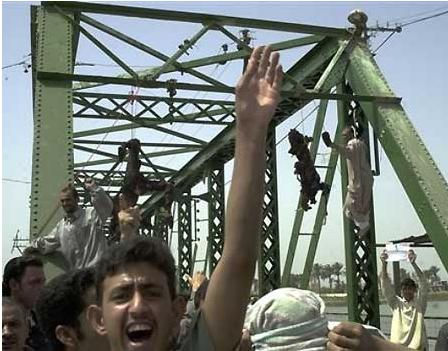
Always be careful until you get a few reports and/or the CM is done ... but man this smells nasty; about as nasty as half-burned bodies hanging from a bridge.
Navy SEALs have secretly captured one of the most wanted terrorists in Iraq — the alleged mastermind of the murder and mutilation of four Blackwater USA security guards in Fallujah in 2004. And three of the SEALs who captured him are now facing criminal charges, sources told FoxNews.com.

The three, all members of the Navy's elite commando unit, have refused non-judicial punishment — called an admiral's mast — and have requested a trial by court-martial.

Ahmed Hashim Abed, whom the military code-named "Objective Amber," told investigators he was punched by his captors — and he had the bloody lip to prove it.
I hope those three Petty Officers have the best lawyers possible.

BZ to them for refusing NJP.

As for the USA - weak horse; very weak horse.

Wednesday, January 21, 2009

What about us?

There is one thing I didn't care for - thousands dead and wounded, right now, wouldn't have minded too much a shout out.
Our journey has never been one of short-cuts or settling for less. It has not been the path for the faint-hearted – for those who prefer leisure over work, or seek only the pleasures of riches and fame.

Rather, it has been the risk-takers, the doers, the makers of things – some celebrated but more often men and women obscure in their labor, who have carried us up the long, rugged path towards prosperity and freedom.

For us, they packed up their few worldly possessions and traveled across oceans in search of a new life.

For us, they toiled in sweatshops and settled the West; endured the lash of the whip and plowed the hard earth.

For us, they fought and died, in places like Concord and Gettysburg; Normandy and Khe Sahn.

Time and again these men and women struggled and sacrificed and worked till their hands were raw so that we might live a better life. They saw America as bigger than the sum of our individual ambitions; greater than all the differences of birth or wealth or faction.
Intentional? Yep. Would one Fallujah have been too much?
UPDATE: Keeping with the theme.

According to TSO who was at the “Salute to Heroes Inaugural Ball”, this newly sworn-in President for the first time in 56 years blew off the ball (that’s 14 Inaugurations).

Some background on the ball;

The American Legion sponsors the ball, which recognizes recipients of Medal of Honor, the nation’s highest military award. It started in 1953 for President Dwight D. Eisenhower’s first inauguration.

Event co-sponsors include 13 other veterans service organizations, among them the Military Order of the Purple Heart and the Paralyzed Veterans of America.

More from BLACKFIVE.

Monday, June 06, 2011

Uninspired ideas from uninspiring people

Now and then The Front Porch should lean back a bit in our rocking chairs, take a sip of a freshly mixed Sidecar, and realize that yes; we catch slings & arrows from bringing up "uncomfortable" topics here and elsewhere - sometimes we get our pee-pee whacked for going too far - but more often than not we just have to wait for the rest of the people to catch up. How many year have we been covering this topic? Over half-a-decade at least. Rowan Scarborough pulls no punches.
“It’s pretty dire,” said John Howland, a 1964 U.S. Naval Academy graduate who manages a web site on naval issues called USNA-At-Large.

... “The leadership of the military is pretty much politically correct kind of stuff. You like to think that we’re approaching hitting bottom, but these people are not through with us yet.”
...
“Mabus is an unequivocal disaster,” Mr. Howland said.
...
“His service was difficult, because Cesar Chavez faced a segregated Navy, but that challenge like others he faced in his life, helped forge the leader he became,” he said at the naming ceremony in San Diego May 18.

“His example blazed a path for subsequent generations. His example will live through this ship. He will continue to inspire young Americans to do what is right.”

Mr. Chavez was a champion of better working conditions for farm laborers. He enlisted in the Navy in 1946 at age 17. He later called it “the worst two years of my life,” according to the Oxford Encyclopedia of Latinos and Latinas.

Rep. Duncan Hunter, California Republican, who saw action in Iraq and Afghanistan as a Marine officer, believes Mr. Mabus made a political decision.

“This decision shows the direction the Navy is heading,” said Mr. Hunter.

“Naming a ship after Cesar Chavez goes right along with other recent decisions by the Navy that appear to be more about making a political statement than upholding the Navys history and tradition.”

Last week, Mr. Hunter introduced legislation directing the Navy to name the next available ship after Marine Corps Sgt. Rafael Peralta. Sgt. Peralta was killed when he fell on a grenade during combat in Fallujah, Iraq, and was awarded the Navy Cross.

A spokeswoman for Mr. Mabus did not return a reporter’s phone messages.

The Chavez was the second Lewis-and-Clark class cargo ship that Mr. Mabus named after a civil rights leader.

In 2009, Mr. Mabus announced a ship would be named after Medgar Evers, the Mississippi civil rights activist who was shot and killed in the drive way of his home in 1963. Mr. Evers had no professional connection to the Navy. He served two years of combat in Europe in World War II and was honorably discharged an Army sergeant.

Before the Chavez and Evers namings, most of the other 12 Lewis-and-Clark ships were named after Navy pioneers. They include retired admiral and astronaut Alan Shepard and Arctic explorer Adm. Robert E. Peary. One ship is named the USS Carl Brashear, after the Navy’s first black master diver.

There are four exceptions: the explorers Meriwether Lewis and William Clark, who were commissioned by President Thomas Jefferson; their guide, Sacajawea; aviation pioneer Amelia Earhart; Dr. Charles Drew, who developed a system of life-saving blood banks during World War II.
Would it be petty to state that Rowan should have CDRSalamander on his RSS feed? Yes, but I'll do it anyway.

Hat tip Mike.

Sunday, November 03, 2013

Navy SEALs in the Long War, with Jason Redman


In an arch that spans the immediate post-Cold War era through the Iraq War, what are the observations & lessons a front-line leader at the tactical level and, for those who are injured in service to their nation, through recovery?

Our guest for the full hour this Sunday from 5-6pm Eastern will be Jason Redman, author of The Trident: The Forging and Reforging of a Navy SEAL Leader.

Jason joined the Navy on September 11, 1992 and served as an enlisted SEAL until he entered to Old Dominion University in August of 2001, graduating Summa Cum Laude with a Bachelors Degree in Business Management via Naval ROTC. He was commissioned in May of 2004 and returned as Naval SEAL Officer.

He deployed to Fallujah, Iraq in 2007, and in September was severely wounded.

While recovering at Bethesda Naval Medical Center, Jason underwent 37 surgeries. His experience led him to create Wounded Wear, a Non-Profit organization that provides clothing kits and clothing modifications to America’s wounded warriors.

Join us live if you can with the usual suspects in the chat room and offer up your questions for our guest, but if you miss the show you can always listen to the archive at blogtalkradio.

Listen to internet radio with Midrats on Blog Talk Radio

Friday, November 11, 2011

Fullbore Friday


You remember Fallujah, right?
Magaoay was peering up the stairs, standing guard for his fellow Marines, when a young Arab male (later estimated to be no older than sixteen) emerged from the bedroom door located to the left and fired a three round burst into the back of the unsuspecting Marine’s head.

Anderson and MacMillan were stacked against a door leading to the house’s living room, getting ready to enter, when they heard the shots ring out. When the two peered over, Blake’s shooter was in the process of throwing a grenade at the two remaining Marines. The two hastily sprinted across the hall and dove for cover in an opening under the stairwell. A loud explosion roared through the house when the pineapple grenade detonated. Dust and debris thickened the murky hallway and MacMillan, without giving any thought, immediately emerged from under the stairs where he saw Blake Magaoay’s motionless body laying at the foot of the stairs and an armed man attempting to step over him in order to make a dash upstairs.
Today - read it all.

Hat tip YN2.

Friday, February 18, 2011

Fullbore Friday


His sunrise runs take him five miles along the beautiful coastline here.

He speaks fluent traditional Chinese and, at 30, Skelton is a company commander with a promising future that includes graduate school and a tour in China as a foreign area officer.
... yet, the Army wanted to get rid of him. Why?

Well, it dates back to 2004 and the Second Battle of Fallujah - and the results.
After 60 surgeries and six years battling an Army bureaucracy that tried to medically "retire" him, Skelton, 33, flew to Afghanistan last week to rejoin his old unit, the 2nd Stryker Cavalry Regiment.

Skelton has only one eye, partial use of his left arm and right leg, and wears a prosthetic palate so he can eat and drink.
"Beyond the call of duty."

A phrase used too much. Go get your last couple of FITREPS and EVALS. Read them. Ponder.

Now measure yourself.

Here is an older story from
2008, and Part I & Part II from this month. Read them all and know, yes, this nation still produces such men.

Captain D.J. Skelton, USA. Fullbore.

Monday, January 21, 2008

It is time to fight....

As many of us have suspected for years, when victory comes - those who have a base desire to bring down those who served while they pontificated will come out of the woodwork to smear, slander, and slime the Veterans of this war just like they did the Vietnam Vets.

Mark Steyn has done the best job of calling everyone to the barricades.
Have you been in an airport recently and maybe seen a gaggle of America's heroes returning from Iraq? And you've probably thought, "Ah, what a marvelous sight. Remind me to straighten up the old 'Support Our Troops' fridge magnet, which seems to have slipped down below the reminder to reschedule my acupuncturist. Maybe I should go over and thank them for their service."

No, no, no, under no account approach them. Instead, try to avoid making eye contact and back away slowly toward the sign for the parking garage. You're in the presence of mentally damaged violent killers who could snap at any moment.

You hadn't heard that? Well, it's in the New York Times: "a series of articles" – that's right, a whole series – "about veterans of the wars in Iraq and Afghanistan who have committed killings, or been charged with them, after coming home." It's an epidemic, folks. As the Times put it:

"Town by town across the country, headlines have been telling similar stories. Lakewood, Wash.: 'Family Blames Iraq After Son Kills Wife.' Pierre, S.D.: 'Soldier Charged With Murder Testifies About Postwar Stress.' Colorado Springs: 'Iraq War Vets Suspected in Two Slayings, Crime Ring.'"

Obviously, as America's "newspaper of record," the Times would resent any suggestion that it's anti-military. I'm sure if you were one of these crazed military stalker whackjobs following the reporters home you'd find their cars sporting the patriotic bumper sticker "We Support Our Troops, Even After They've Been Convicted." As usual, the Times stories are written in the fey, more-in-sorrow-than-in-anger tone that's a shoo-in come Pulitzer time:

"Individually, these are stories of local crimes, gut-wrenching postscripts to the war for the military men, their victims and their communities. Taken together, they paint the patchwork picture of a quiet phenomenon, tracing a cross-country trail of death and heartbreak."

"Patchwork picture," "quiet phenomenon."… Yes, yes, but exactly how quiet is the phenomenon? How patchy is the picture? The New York Times found 121 cases in which veterans of Iraq and Afghanistan either "committed a killing in this country, or were charged with one." The "committed a killing" formulation includes car accidents.

Thus, with declining deaths in the war zones, the media narrative evolves. Old story: "America's soldiers are being cut down by violent irrational insurgents we can never hope to understand." New story: "Americans are being cut down by violent irrational soldiers we can never hope to understand." In the quagmire of these veterans' minds, every leafy Connecticut subdivision is Fallujah and every Dunkin' Donuts clerk an Abu Musab al-Zarqawi.
Read it all, my post on it last week, and the PowerLine posts, then click the Stolen Valor tag at the end of the post to see - this is all part of a standard, normal Course of Action of the Left. If we are all basket cases, then our opinions and ideas and deeds are just as unworthy of a sane world.

Good people, like Chaplain Key and those who take the specifics of their experience and believe it applies to the general population, will be taken in by the web of poorly designed statistics and outright lies - but just as well you will find those who have a political or financial reason to make everyone believe that we are all walking time bombs.

We have the "New Media," use it. Don't let them get away with this. Like I always suggest, go to Amazon and buy new or used copy of Stolen Valor: How the Vietnam Generation Was Robbed of its Heroes and its History, by B.G. Burkett and read the cold hard facts of what was done to the Vietnam Vets. The anti-war Left is using the same playbook this time, except now we have it as well. Don't let them get away with this.

I will do my part; you do yours. Again, from the Steyn article,
In 2008, the editors of the Times, our college professors and Hollywood celebrities, are horrified by a fiction. Faced with a historically low cost of war, they retreat into fantasy. Who's really suffering from mental trauma? Who needs the psychotherapy here?
No, I won't give them the easy out. My vote, as is my nature, is when you find yourself under attack - you go on the attack. Fixed fortifications (family, good will, mythology of the people's support) are monuments to the stupidity of man. Attack, attack, attack, attack.

These people hate; they hate victory, they hate their country, they hate those who serve things greater than themselves, they hate Western Civilization, but most of all they hate themselves. Treat them as such.

Monday, May 18, 2015

Calm and humble yourself; it is always the land you control, not the body count that matters

Good folks did some good work this weekend, according to reports:
A senior Islamic State leader was killed, and his wife captured, in a raid in eastern Syria by U.S. Special Operations forces, the first on-the-ground mission in that country targeting wanted extremists, defense officials said on Saturday

The operation was conducted at Al-Amr, in the eastern region of Syria, to capture Abu Sayyaf and his wife, Umm Sayyaf, also thought to be part of the organization, Pentagon officials said.

During the mission late Friday, Abu Sayyaf “engaged U.S. forces” and was killed. Special Operations forces, however, captured Umm Sayyaf, the Pentagon said.
All is well and good, to go after their leadership - but we should temper any excessive optimism by this one fact; in the Long War, the theory of "decapitation attacks" failed to gather the results we thought it would - and it still won't. Nice to have, but not key.

We kill and capture leadership all the time, but they will simply replace them. This was true even before the enemy was building a quasi-State - but it is even more true now that the enemy is taking and holding significant amount of territory for a length of time that, as we discussed at the New Year on Midrats, they will soon move from quasi-State to actual State - if not already there.

That is why, once the hooting about Abu Sayyaf reaching room temperature is over, the below is the more important news of the Long War from the weekend;
The key Iraqi city of Ramadi fell to ISIS on Sunday after government security forces pulled out of a military base on the west side of the city, the mayor and a high-ranking security official said.

The ISIS advances came after militants detonated a series of morning car bomb blasts, Mayor Dalaf al-Kubaisy and a high-ranking Iraqi security official said. The explosions forced Iraqi security forces and tribal fighters to retreat to the city's east, they said.
Ramadi is the capital to Anbar, and is the key to the western approaches to Baghdad. That is why hundreds of Americans died to take and hold it.

A bunch of Shia militia trying to take it back will only do one thing; drive the Sunni of Anbar to go in the only other place available - the arms of the Islamic State.

Enough talk about "offset" introspective think-bits that have the whiff of fried-air; how about we discuss the croc closest to the canoe here ... what about Iraq?

UPDATE: Required reading by our friend James S. Robbins over at USAToday;
But ISIL's victory in Ramadi, the capital of Anbar province, shows that the group can seize and hold important ground. ISIL is more than a ragtag guerrilla army; it can field combat units potent enough to defeat Iraq's U.S.-trained conventional forces. The world has again seen the image of the Iraqi army retreating in disarray, and the brutal slaughter and enslavement of civilians that always follow in the wake of Islamic State conquests. ISIL is making good on its vision of being a quasi-state, taking, holding and governing vast territories in Iraq and Syria.

Perceptions are critical in irregular wars, and the perception in the region is that the Islamic State is winning. ISIL now openly controls the Iraqi cities of Ramadi, Fallujah and Mosul, which is more than its parent al-Qaeda franchise could ever have claimed at the height of its insurgency. It is a sobering fact that all the gains made during the execution of the coalition's 2007 "surge" strategy that pacified western Iraq have been given back to the extremists.

UPDATE II - Electric Boogaloo: One of the better video reports? Oh, all our money? Yes, at the 0:58 point, that is a Lee-Enfield wrapped with duct tape. Hope and change, indeed.

Sunday, June 29, 2014

Asking the right questions to build the right leaders, with Major Matt Cavanaugh, US Army - on Midrats


Is the profession of arms, as the Navy believes it is, primarily a technical job for officers - or is it something else?

To create the cadre of leaders one needs, do you train them as empty vessels that one only needs to fill up with what you want or an empty checklist to complete - or do you train them by helping them bring out their ability to lead and make decisions through informed critical thinking?

Our guest for the full hour this Sunday from 5-6pm Eastern to discuss this and more will be Major Matt Cavanaugh, US Army.

As starting point for our discussion, we will use some of his recent articles at WarCouncil, Ten Questions West Point Does Not Ask Cadets - But Should, Another Ten Question West Point Does Not Ask Cadets - But ShouldWhat Cadets Should Study - and Why Military History is Not Enough, and Rubik's Cubes and Contemporary Warfighting.

Matt is currently assigned as an Assistant Professor in military strategy at the U.S. Military Academy at West Point.

Prior to this assignment, Matt was a Strategic Planner at the Pentagon, after service with the with Second Squadron, Third Armored Cavalry Regiment with multiple deployments to Iraq from Fallujah, Ramadi, and Tal’Afar.

Matt earned his Master’s in Strategic Studies at Victoria University in Wellington, New Zealand and is currently at work on a PhD dissertation on generalship at the University of Reading (UK). He is a Fellow at the Center for the Study of Civil Military Operations, has been published with several peer-reviewed military and academic journals, and is the Editor at WarCouncil.org, a site dedicated to the study of the use of force. Matt has represented the United States in an official capacity in ten countries, including: Iraq, Kuwait, Norway, Australia, New Zealand, Indonesia, Singapore, Malaysia, Latvia, and Great Britain.

Join us live if you can with the usual suspects in the chat room and offer up your questions for our guest, but if you miss the show you can always listen to the archive at blogtalkradio.

Listen to internet radio with Midrats on Blog Talk Radio