Showing posts sorted by relevance for query SSBN(X). Sort by date Show all posts

Wednesday, April 14, 2010

SSBN(X) - you'll be lucky to get 10


Ok, in line with the "drip-drip-drip" series of posts about something no-one wants to talk about (the trainwreck of shipbuilding that will be the Terrible '20s), let me make a little long range prediction for 'ya. First though, set the scene.

- The fiscal nightmare of the series of deficits we are building and the debt service they will bring - along with the budgetary realities of building a Social Democracy (only tremendous political changes in '10 and '12 elections will change this), will create budgetary pressures that will drive defense spending to below 3% of GDP by 2012 (it is 4% now).
- The largest shipbuilding pressure in the 2020's will be the re-capitalization of the SSBN force.
- Don't forget the new Nuclear Posture Review ...

From the
CBO, go to table 2. They are calling it going from 14 to 12 SSBN.

I'll call it now, we will be lucky if we get 10 SSBN(X). Make that a planning assumption.

Here is some more from the Bureau of the Hard Truth (BUTRU):
- Budgets will get smaller.
- Tiffany Navy shipbuilding costs will not get significantly smaller if we continue the attitude and practices from The Lost Decade.
- We will be at sub-250 ships at the end of the Terrible '20s unless something new happens in the next 5 years.
- This is not industry's fault; this is not Congress's fault. This is well in excess of 51% uniformed military's fault.

Way forward? We need radical change at the highest levels of leadership. Clark-Mullen-Roughead lineage got us here. Who am I looking for? Someone like this,

At the time of his appointment as Chief of Naval Operations, (he) was still a Rear Admiral, Upper Half (Two Star) and was promoted over the heads of many Flag Officers who were senior to him. (He) had never served as a Vice Admiral (Three Star), so he was promoted two grades at the time of his appointment as CNO.
That is a fresh start. And what did that give us?
Admiral Burke served an unprecedented three terms as CNO. He served at a critical time in world history, the depths of the Cold War. The facts that he was relatively young compared to other Flag Officers at the time, and was an excellent manager and organizer, were keys to his success. He supported the touchy Adm. Hyman Rickover in the development of a nuclear Navy. More directly, he promoted the Polaris missile program at a time when others in the Navy were very skeptical of the idea of a missile launched from a submarine.
Admiral Burke as CNO was intimately involved in the Eisenhower administration discussions of "how much is enough?", as to the number of US nuclear submarines needed for deterrence. Burke argued that a force of around 40 Polaris submarines (each with 16 missiles) was a reasonable answer. Burke further argued that land-based missiles and bombers were vulnerable to attack, which made the U.S.-Soviet nuclear balance dangerously unstable. By contrast, nuclear submarines were virtually undetectable and invulnerable. He was very critical of "hair trigger" or "launch on warning" nuclear strategies, and he warned that such strategies were "dangerous for any nation."

Earlier, Admiral Burke was involved in the "Revolt of the Admirals", a near mutiny by the leaders of the Navy in the late 1940s, and was saved from being fired by the intervention of President Harry S. Truman. His terms as CNO were times of growth and progress in the Navy. Upon completing his third term, he was transferred to the Retired List on August 1, 1961.
Time for 1955 thinking again or we will wind up having two Admirals for each ship.

Thursday, November 01, 2012

Smart SSBN Rethink

The need to re-capitalize our ballistic missile submarines has for the last few years been a heavy shadow over what is looking like a perfect budgetary storm at the end of this decade.

Budgetary pressures combined with the departure of the last of the Cold War fleet and then the very expensive SSBN(X) proposal would have left us with very little to keep Fleet numbers in acceptable ranges.

Though still a tough bill to pay - this is better.

Via news.usni;
The Ohio Replacement is scaled back from the initial Analysis of Alternatives (AoA) for the program, then dubbed SSBN(X), conducted by NAVSEA in 2009. The initial AoA called for a boat that would have cost $6 to 7 billion but with the reduction in capability the Ohio Replacement drove costs down to $5.6 billion a copy. The eventual goal of the reductions is to produce the boats at $4.9 billion a copy.
I also like the fact they are going to keep the class properly focused.
“The Ohio Replacement is not, is not, a multi-mission platform,” Capt. William Brougham, US Naval Sea Systems Command (NAVSEA) Ohio-class Replacement Program Manager, said at the 2012 Naval Submarine League Symposium in Falls Church, Va. on Oct. 18. “We don’t turn into a multi-mission platform that’s going to go off and do things that you see on television,” he said.
Good. Good.

A SSBN exists for one reason and one reason only - to be there is the need exists for this nation to find its inner-Roman.

No room for error. No need for distraction.

Wednesday, October 19, 2011

There Goes Your Curve

To build off Monday's post - I think it is clear that we are planning on going to 240.

Don't ever doubt the Salamander: if you read it, you'll read it elsewhere a few years later.

From page 8 of the Congressional Research Service's Navy Force Structure and Shipbuilding Plans: Background and Issues for Congress by Ronald O'Rourke, Specialist in Naval Affairs, October 13, 2011. Someone in SEP got a peek ....
September 2011 Press Reports of Navy Options for 250- or 240-Ship Navy
On September 1, 2011, it was reported that the Navy, in response to anticipated reductions in planned levels of defense spending, is discussing options for maintaining a fleet with considerably fewer than 300 ships. The report stated that the Navy is considering the following options, among others:
• reducing the Navy to a 250-ship fleet that includes 10 aircraft carriers or a 240- ship fleet that includes 8 aircraft carriers (a fleet with 9 carriers is another option);
• retiring (rather than performing a nuclear-refueling overhaul on) the aircraft carrier George Washington (CVN-73), which would be one measure for reducing the size of the carrier force;
• delaying the procurement of the aircraft carrier John F. Kennedy (CVN-79) by two years, to FY2015 (an option that was first reported in July 2011);
• eliminating six aircraft squadrons;
• retiring at least some of the Navy’s 22 Ticonderoga (CG-47) class Aegis cruisers;
• reducing the planned number of next-generation Ohio replacement ballistic missile submarines (SSBN[X]s) by two boats, from 12 to 10, and consequently delaying the procurement of the first SSBN(X), perhaps by two years; and
• maintaining funding for procurement of two Virginia-class submarines per year,
and for Arleigh Burke (DDG-51) class Aegis destroyers and Littoral Combat
Ships (LCSs).
... and just because I am feeling full of myself today - see that second to last bullet? Where did you read that first ... say ... 18-months ago? Oh, that's right - at CDR Salamader.

Hat tip J.

Tuesday, December 02, 2014

The Terrible 20s meet the Tiffany Navy

As the regulars here and over at Midrats know - we've been hitting one constant note for the last decade - the music will stop. We've gone from 78 to 45 rpm and are about to find ourselves at 33.

After all the happy-talk, the hours of PPT, the endless iterations of taking the best case scenario - and even more often; shifting the truth telling and hard decisions to many PCS cycles down the road for others to fix - after all that: we have the macro-economic pressures of the national debt on one end, the sadly predictable results of an exquisitely designed Tiffany Navy in the middle, and the looming requirements for the recapitalization of the SSBN on the other end.

Over at DefenseOne, our friend Jerry Hendrix takes those to school who have not been paying attention, and reviews the fundamentals for those who have. He knows the topic well; priorities.
For almost a decade the Navy’s annual shipbuilding budget has hovered around $14 billion in adjusted dollars within an overall budget of $160 billion. But beginning in fiscal year 2020, the Navy will request an additional $5 billion dollars per year to pay for submarines to replace the 14 Ohio-class ballistic missile “Boomer” submarines that have been performing nuclear deterrence patrols since 1982 and are set to begin retiring in 2027.
You cannot have your cake and eat it too. There really are only three choices. All have their costs, but to pick the least painful you have to set your priorities.
In a fiscally constrained era there are three options. The first is to ask President Obama and members of Congress to increase the Navy’s budget to create a separate funding scheme for the Boomers.
...
The second approach would be for the defense secretary to redistribute funds within the defense budget.
...
The third approach would be for the Navy to pay for its new submarines out of its own resources.
Which is the right choice? Watch Congress.

From here - this is where I see the the three "Jerry Courses of Action."

Ideal is COA 1, but it is the most unlikely.

The best hope is COA 2, but that would take just the right combination of a strong SECDEF and House and Senate leaders who can make hard decisions with a long view. Ahem.

Sadly, it is COA 3 that the Navy must plan for. Hope for COA 2, but be ready for COA 3. If the stars align just right, you might get COA 1 after the 2016 elections - but to play for that is folly.
The need for a replacement for the Ohio-class ballistic missile submarines is undeniable. The strategic deterrence mission, although little understood or appreciated by the American people, is, as the CNO stated, the number one priority of the Navy in that it ensures the survival of the Republic. However, the challenge of finding the money to pay for these new boats is largely self-imposed. For 10 years the Navy planned to buy a fleet of sports cars like Arleigh Burke class destroyers, even where mission requirements called for pickups, all the while ignoring that there would be a mortgage payment coming due at the same time.

The Navy needs to move quickly to reorder its priorities. If strategic deterrence is our primary mission, then funding the next submarine for that mission is the first priority. We have to pay the mortgage. It’s common sense.
Yes it is.

If we happy-talk ourselves in to planning for COA 1 or 2, then we are repeating the mindset that got us to where we are today, and reality will hit our Navy up side the head.

Let's go back to the start of our Terrible 20s discussion here relative to SSBN back in FEB 2010. Almost half a decade ago, but it still applies - to quote myself;
If you continue to assume that CG(X) is dead, then you might get funding for the much needed DDG(X) follow-on for the DDG-51 class - might. That will be requested in light of the SSBN money sponge - and I don't see how with all the other needs in the 20's, we will be able to afford both a DDG(X) and a CG(X) - and there is a good chance that we will simply have to live with DDG-51 Flight III as our "new" platform through the beginning of the mid-21st Century.

I know that looking into the future is a fuzzy hobby. Heck, if you outlined in 2000 where we were in 2010 people would have said you were a nutty pessimist - so we can only see 2020 in very large, fuzzy pixels. The beginning of the mid-century (2030) is just a silly exercise in many ways - but one that needs to be done. There are known-knowns (DDG-1000 will be a rump, expensive class of ships, Ticos history, DDG-51 backbone, LCS decomm'n like flies), known-unknowns (will LCS even meet some of its promised ability and numbers, will DDG(X) be moving forward), and unknown-unknowns (Black Swan events), but still - 2020 is closer than we think, and there are economic facts that need to be looked at.

Huge challenge, one whose source is the lost decade we just came out of. You know, that "transformational" decade. The one that was to build the Fleet of the future. Well, it sure did, didn't it?

Look at what the Royal Navy is dealing with today, and it isn't a stretch to see similar challenges for ourselves. Look and learn - and perhaps we can mitigate the pain.

We'll be blogg'n about the 20's a lot down the road; let's call this an introduction to the Terrible 20's.
We are roughly halfway to 2020 from the time the above was blogg'd. So far, so pathetically on course.

I hope that very smart people in the right places with access to levers of power are listening to Jerry and others along the same lines. We have simply pissed away half a decade plus on vanity projects, bad theory, and worse program management - all in a vacuum missing updated, meaningfully effective, and actionable vision.

Miles to go, miles to go.

Monday, July 07, 2014

The Navy Goes Full Salamander on the Terrible 20s

Remember how we have been saying for most of the last decade that eventually, the Navy will run out of HappyTalk Juice? That as shadows do not appear on the deck and water is not displaced pierside ... that it would have to admit what it denied?

It really is heartbreaking to see, as we wasted so many years in happy talk, rosy scenarios, and best case projections. Those who made this bed have long retired to well paying gigs in boardrooms of companies and K-Street - to be dealt with by the leaders in place now.

Not a good thing to gloat about - but .... behold.
The U.S. Navy can’t meet its funding needs for surface warships and a new class of nuclear attack submarines from 2025 to 2034, according to the service’s latest 30-year shipbuilding plan.

The congressionally required blueprint, submitted late last week and obtained by Bloomberg News, says the Navy’s plan “requires funding at an unsustainable level” unless spending on shipbuilding is increased.

The document outlines challenges facing the plan to increase the Navy fleet to 306 vessels from the current 289 while building 12 new Ohio-class submarines, part of the nation’s nuclear triad of air, land and sea weapons.
Yea, it's that bad - and a tad more.
The average cost of the Navy plan during the period when the service will be spending the most on the new submarine is $19.7 billion a year, including more than $24 billion at the peak year of fiscal 2032, according to the report.

This budget “cannot be accommodated by the Navy from existing resources -- particularly if” the Pentagon remains under congressionally mandated automatic cuts known as sequestration, the report said.

The Navy’s historical shipbuilding budget has averaged about $13 billion a year, in fiscal 2014 dollars.

“Even if the Ohio-replacement program is removed” from the Navy plan, the average shipbuilding funding required beginning in fiscal 2020 is as much as $15 billion annually, the report found.
What the heck - no one paid me for my consult almost half a decade ago. From my Feb 2010 phrase-coining post, Looking towards the "Terrible 20's";
Let's look at 2020 again. What else is happening in the 20s? Well, for one, we will have to find money to re-capitalized the SSBN fleet. I offer to you that the 20 JAN HASC SEF Subcommittee meeting has an outstanding money discussion about that challenge. Deputy SECNAV Work has also discussed this challenge in other venues, and I think he has a very firm grasp of the problem, as do most in positions to know.

You have to look at it in the broader context of the budget as well. The hangover in the 20s from this decade's drunken frenzy of spending will couple with another cohort of Baby Boomers retiring and putting stress on the budget in ways we still do not have a firm grasp on.

In 2020 - that ship built in 1990 will be at 30 years. That LCS built in 2009 will only have 9 years or so of service life (LCS is expected to only last 20-25 years) - so by the end of the 2020s, LCS will be dropping like flies.

When you consider that we will be limited this decade to LCS and DDG-51 for our non-amphib surface ship program (don't throw JHSV at me, that is just a truck - full stop - all else is spin and hope) - you have about a perfect story for the 20s of limited shipbuilding funds and a stunted fleet.

Stunted? If you continue to assume that CG(X) is dead, then you might get funding for the much needed DDG(X) follow-on for the DDG-51 class - might. That will be requested in light of the SSBN money sponge - and I don't see how with all the other needs in the 20's, we will be able to afford both a DDG(X) and a CG(X) - and there is a good chance that we will simply have to live with DDG-51 Flight III as our "new" platform through the beginning of the mid-21st Century.

I know that looking into the future is a fuzzy hobby. Heck, if you outlined in 2000 where we were in 2010 people would have said you were a nutty pessimist - so we can only see 2020 in very large, fuzzy pixels. The beginning of the mid-century (2030) is just a silly exercise in many ways - but one that needs to be done. There are known-knowns (DDG-1000 will be a rump, expensive class of ships, Ticos history, DDG-51 backbone, LCS decomm'n like flies), known-unknowns (will LCS even meet some of its promised ability and numbers, will DDG(X) be moving forward), and unknown-unknowns (Black Swan events), but still - 2020 is closer than we think, and there are economic facts that need to be looked at.

Huge challenge, one whose source is the lost decade we just came out of. You know, that "transformational" decade. The one that was to build the Fleet of the future. Well, it sure did, didn't it?

Look at what the Royal Navy is dealing with today, and it isn't a stretch to see similar challenges for ourselves. Look and learn - and perhaps we can mitigate the pain.

We'll be blogg'n about the 20's a lot down the road; let's call this an introduction to the Terrible 20's.
We have very rough seas ahead. As you will see in my post tomorrow, we still have not set the proper condition, read the night orders, or adjusted the watch bill accordingly.

Solutions? Sure, there are some - but no one is talking about them as they require sharp elbows, flexible intellect, and the ability to not be invited to the right parties - or post retirement gigs of fortune.

Hat tip CGB.

Tuesday, March 17, 2020

Whither the Super Carrier

With apologies to Jo Moore, with COVID-19 spinning out of control, last week was a good week to bury bad news.

Did you catch it? The anti-CVN forces saw their moment, and it looks like they are making their move.

Though ordered, CVN-82 is as of yet, unnamed.

Could she be the last of her kind?
The Navy is launching a deep dive into the future of its aircraft carrier fleet, Breaking Defense has learned, even as the Secretary of Defense, dissatisfied with current Navy plans, conducts his own assessment. The two studies clearly show the deepening concern over how China’s growing might and the Pentagon’s eroding budgets could affect the iconic, expensive supercarriers.

The Future Carrier 2030 Task Force, which the service plans to announce next week, will take six months to study how carriers stack up against new generations of stealthy submarines and long-range precision weapons being fielded by China and Russia.
While always willing to give great and worthy people the benefit of the doubt, "Blue Ribbon Panels" have a spotty history of objectivity. I willing to be sold - but I'm not at the moment.

Add to that nugget, a little under two weeks' earlier, the confirmed SECDEF sent a frowny-face emoji to the acting SECNAV;
Defense Secretary Mark Esper has put a stop to the the expected release of the Navy’s long-term force structure plan, telling the service on Monday to hold off and take another look, several sources confirm.

The plan, announced last year and slated to be wrapped up by Jan. 15, has run into serious headwinds. The Navy insists it can grow the fleet to 355 ships as early as 2030 despite its shipbuilding budget being cut in the recently released 2021 budget, and as officials concede there’s little hope of significant growth in the near-term. Now Esper, who has been reviewing the plan for the past two weeks, is unwilling to sign off on it.
There you go. Unless there is significant intervention at the Congressional level - things look set up.

Even without the above, we knew this was coming.

Almost exactly 10-years and one month ago, I wrote the opening post announcing the upcoming Terrible 20s. This is what I wrote in February 2010;
Let's look at 2020 again. What else is happening in the 20s? Well, for one, we will have to find money to re-capitalized the SSBN fleet. I offer to you that the 20 JAN HASC SEF Subcommittee meeting has an outstanding money discussion about that challenge. Deputy SECNAV Work has also discussed this challenge in other venues, and I think he has a very firm grasp of the problem, as do most in positions to know.

You have to look at it in the broader context of the budget as well. The hangover in the 20s from this decade's drunken frenzy of spending will couple with another cohort of Baby Boomers retiring and putting stress on the budget in ways we still do not have a firm grasp on.

In 2020 - that ship built in 1990 will be at 30 years. That LCS built in 2009 will only have 9 years or so of service life (LCS is expected to only last 20-25 years) - so by the end of the 2020s, LCS will be dropping like flies.

When you consider that we will be limited this decade to LCS and DDG-51 for our non-amphib surface ship program (don't throw JHSV at me, that is just a truck - full stop - all else is spin and hope) - you have about a perfect story for the 20s of limited shipbuilding funds and a stunted fleet.

Stunted? If you continue to assume that CG(X) is dead, then you might get funding for the much needed DDG(X) follow-on for the DDG-51 class - might. That will be requested in light of the SSBN money sponge - and I don't see how with all the other needs in the 20's, we will be able to afford both a DDG(X) and a CG(X) - and there is a good chance that we will simply have to live with DDG-51 Flight III as our "new" platform through the beginning of the mid-21st Century.

I know that looking into the future is a fuzzy hobby. Heck, if you outlined in 2000 where we were in 2010 people would have said you were a nutty pessimist - so we can only see 2020 in very large, fuzzy pixels. The beginning of the mid-century (2030) is just a silly exercise in many ways - but one that needs to be done. There are known-knowns (DDG-1000 will be a rump, expensive class of ships, Ticos history, DDG-51 backbone, LCS decomm'n like flies), known-unknowns (will LCS even meet some of its promised ability and numbers, will DDG(X) be moving forward), and unknown-unknowns (Black Swan events), but still - 2020 is closer than we think, and there are economic facts that need to be looked at.

Huge challenge, one whose source is the lost decade we just came out of. You know, that "transformational" decade. The one that was to build the Fleet of the future. Well, it sure did, didn't it?
It holds up well, I think.

What I didn't see was the POLMIL stew our Navy would find itself in.

At this critical juncture, The Pentagon is led by the Esper/Milley West Point-West Point team while the Navy's Flag Officers try to recover from damage the previous generation of leaders inflicted on our institution over a decade spending their professional capital, like, well, drunken Sailors - mostly in WESTPAC - from Malaysian fat men to exhausted and untrained bridge watches driving Japan based destroyers. 

To top things off, those who should have spent every penny left getting ready for this decade spent what little professional capital they were able to scrape together from under the couch cushions on Ottomanesque bureaucratic protect-my-legacy games.

Almost two decades of sub-optimal performance at the highest levels has us where we are; a nice, solid-but-last-man-standing CNO and an Acting SECNAV fighting hard but wrestling two weight classes up in 4A. The previous SECNAV demonstrated what some of his problem was when he was last seen endorsing a Presidential primary candidate from the other party just a few weeks before he dropped out due to a complete lack of support among, well, almost anyone.

Of course.

Of course we are where we are.

The smart money is on a better than average chance the CVN will be killed by next POM (though perhaps not for good) and what little money is captured will be spent prosealing cracks from an overstressed and underfunded maintenance and readiness hole while trying to find some magic beans to build a useful fleet not reliant on a Cold War era destroyer as we stumble to 2030.

How will we project power from the sea in 2030? You can't do that from a submarine - a platform with limited followthrough and has its own growing vulnerability issues. You can't do that from land based aircraft. I win that wargame every time. There are not enough VLS cells in Christendom to do what a CVN can do ... with a proper airwing (which we don't have).

No, if we have to go to war in 2030, the question will be, "Where are the carriers?" ... and we will send thousands of Sailors in harm's way with an underfunded legacy system bereft of upgrades, carrying an airwing saddled with three decades of bad, short term decisions made by people trying to survive the next POM, not create a Navy ready to fight and win the next peer war.

I'm really not interested in discussing CVN vulnerability ... something known in detail since WWII. All capital ships are vulnerable ... that is why RN BB sortied so little during WWII, etc ... etc ... etc ... we've discussed that in volume here through the years. New folks can look it up, won't rehash it wholesale.

No, what are you going to replace them with? Vaporware? PPT thick programs? Unmanned systems whose performance and utility assumptions are based on AI that does not exist, robust reachback that is peace-time only, and ROE that won't survive a public university law school second-year law student?

I've seen that movie. It is stale and derivative. 

No, you can't. All you can do is, like The Thing in the dog kennel, flail around for anything that can justify taking food from Mom's plate so you can feed Dad so you can tell the rest of your family that you are taking care of the parents just fine.

With apologies to Jeremiah,
1:1 How doth TACAIR sit solitary, that was full of people!
She is become as a widow, that was great among the the services!
She that was a princess among Hollywood is become tributary to grunts!
1:2 She weepeth sore in the Unfunded Priorities List, and her tears are on her EMALS;
Among all her WBB contractors she hath none to comfort her:
All her fellow Service Chiefs have dealt treacherously with her; they are become her enemies.
1:3 NAVAIR is gone into captivity because of affliction, and because of great servitude;
She dwelleth among the Mine Warfare community, she findeth no rest:
All her budgetary enemies overtook her within the POM.
1:4 The ways of PEO Aircraft Carriers do mourn, because none come to the solemn assembly;
All her hangars are desolate, her Program Managers do sigh:
Her Flag Officers are afflicted, and she herself is in Executive TAP.
1:5 Her adversaries are become the head, her enemies prosper;
For SECDEF hath afflicted her for the multitude of her transgressions:
Her JOs are gone into career transition before the selection boards.
1:6 And from the Office of the Acting SECNAV all her majesty is departed:
Her Admirals are become like harts that find no pasture,
And they are gone without strength before the CBO.
So sayeth the Book of Salamander.

Tuesday, September 21, 2021

The Terrible 20s Emerge from the Fog


Ah, yes, The Terrible 20s. What if you had the leadership and malaise of the Carter Administration mixed in with the budgetary pressures of the Clinton Administration ... with a little bit of Biden Administration special sauce mixed in?

We're not even a year in to the Biden Admin still at the start of the 20s...so you know this was coming.  

Via Joe Gould at DefenseNews;

House progressives will have a few chances to hold down the defense budget this week, but it’s going to be an uphill fight.

The House is set to vote this week on two Democratic amendments to cut the fiscal 2022 National Defense Authorization Act’s $740 billion top line. One would reduce it by roughly 10 percent, and another would undo a $24 billion a plus-up the House Armed Services Committee passed earlier this month.

...

“We face imminent threats from the COVID pandemic, climate change, growing economic inequality, and systemic racial and ethnic inequities [and] also, domestic terrorism,” Lee said. “It is time to shift our spending priorities to meet these priorities. I personally support much larger cuts to the Pentagon budget.”

There are a few amendments to be voted on too;

- A prohibition on funding for the Air Force’s nascent Ground Based Strategic Deterrent — a next-generation intercontinental ballistic missile and its warhead, the W87-1 — from Rep. John Garamendi, D-Calif.

- A prohibition on U.S. military forces in Syria without approval from Congress within one year, from Rep. Jamaal Bowman, D-N.Y.

- A prohibition on U.S. military logistical and intelligence support for Saudi air forces conducting strikes in the Yemen civil war, from Rep. Ro Khanna. (A separate amendment from House Foreign Affairs Committee Chairman Gregory Meeks, D-N.Y., would bar U.S. sustainment and maintenance support for those forces, with certain exemptions.)

- The top line-lowering amendments are a proposed 10 percent cut (excluding salaries and health care of military personnel), from Rep. Mark Pocan, D-Wis., and proposed reduction of the defense authorization top line to the level requested by the president, from Rep. Barbara Lee, D-Calif.

The (D) have a razor thin margin in the House and odds are the cuts won't run the board - but the anti-military (D) also know their window is about to close as '22 comes up ... they will do their best.

There are some macro patterns that are on their side - some masked by the flood of fiat money to cover the response to COVID - a classic black swan event.

Just a reminder from almost a dozen years ago, let's look at what we discussed in 2010 about where we might be today; from my Feb 2010 phrase-coining post, Looking towards the "Terrible 20's";

Let's look at 2020 again. What else is happening in the 20s? Well, for one, we will have to find money to re-capitalized the SSBN fleet. I offer to you that the 20 JAN HASC SEF Subcommittee meeting has an outstanding money discussion about that challenge. Deputy SECNAV Work has also discussed this challenge in other venues, and I think he has a very firm grasp of the problem, as do most in positions to know.

You have to look at it in the broader context of the budget as well. The hangover in the 20s from this decade's drunken frenzy of spending will couple with another cohort of Baby Boomers retiring and putting stress on the budget in ways we still do not have a firm grasp on.

In 2020 - that ship built in 1990 will be at 30 years. That LCS built in 2009 will only have 9 years or so of service life (LCS is expected to only last 20-25 years) - so by the end of the 2020s, LCS will be dropping like flies.

When you consider that we will be limited this decade to LCS and DDG-51 for our non-amphib surface ship program (don't throw JHSV at me, that is just a truck - full stop - all else is spin and hope) - you have about a perfect story for the 20s of limited shipbuilding funds and a stunted fleet.

Stunted? If you continue to assume that CG(X) is dead, then you might get funding for the much needed DDG(X) follow-on for the DDG-51 class - might. That will be requested in light of the SSBN money sponge - and I don't see how with all the other needs in the 20's, we will be able to afford both a DDG(X) and a CG(X) - and there is a good chance that we will simply have to live with DDG-51 Flight III as our "new" platform through the beginning of the mid-21st Century.

I know that looking into the future is a fuzzy hobby. Heck, if you outlined in 2000 where we were in 2010 people would have said you were a nutty pessimist - so we can only see 2020 in very large, fuzzy pixels. The beginning of the mid-century (2030) is just a silly exercise in many ways - but one that needs to be done. There are known-knowns (DDG-1000 will be a rump, expensive class of ships, Ticos history, DDG-51 backbone, LCS decomm'n like flies), known-unknowns (will LCS even meet some of its promised ability and numbers, will DDG(X) be moving forward), and unknown-unknowns (Black Swan events), but still - 2020 is closer than we think, and there are economic facts that need to be looked at.

It was so clear then ... why so many people refused to see it, I have no idea.

Navalists will need to fight every battle. Every ant hill is a hill worth dying on. Keep up the fight and don't take the bait. 

Wednesday, February 10, 2010

Looking towards the "Terrible 20's"


I would like you to join me in a little game of looking sideways (to the UK today) and looking forward (2020s) at what I see as not chickens coming home to roost, but vultures.

Just to have a sound foundation; for source documentation we are going to use the best magazine your money can buy,
The Economist, and some comments by VADM David Dorsett, USN, Deputy Chief of Naval Operations for Information Dominance (N2/N6) and Director of Naval Intelligence (DNI) from last week. We'll get to him later.

First let's look at the fundamental underpinnings of our defense budget - not not strategy - MONEY.

From the latest issue of
The Economist,
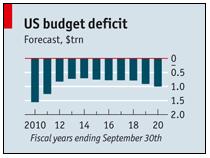
Mr Obama’s budget reveals a road-map to fiscal catastrophe. At no point over the coming decade will the deficit be below 3.6% of GDP; and after 2018, it starts rising again. The cuts the president has proposed are comically insufficient: a budget freeze on non-security discretionary spending, which amounts to only about 17% of the entire $3.8 trillion budget; and a toothless deficit commission (a better version has already been killed by obstructive Republicans in Congress) whose recommendations will doubtless be ignored.
Note the right side of that graph. 2020. Keep that in mind.

One thing that kept coming to mind last week in San Diego, was the goings-on in the mother country. Some of the challenges the United Kingdom is experiencing now are about a decade ahead of us, methinks - if not closer.
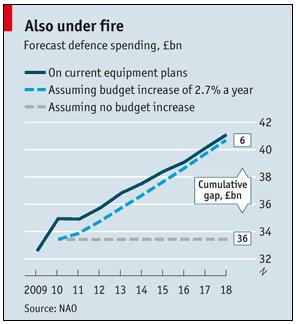
First is the fact that they have been under a left-of-center government for over a decade, their budget woes are roughly parallel to ours, they are starting the battle to find money to replace their SSBN fleet now, and their defense budget - starved for years as a % of GDP vs. OPTEMPO - is shredding. Hard choices, many already made in the Royal Navy, are being demanded more and more as past neglect needs to be repaired out of hide. Financially they just cannot get the money they need in competition with other programs their government has obligated itself to spend money on.

Let's look at what is happening in the United Kingdom. From The Economist;
This will cost about £1.2 billion ($1.9 billion) over the next three years. Some £280m of it will come from the Treasury, which has already provided £14 billion from its reserves to pay for the wars in Iraq and Afghanistan. The lion’s share, however, will be found by raiding other parts of the overstretched defence budget, with planned cuts that would realise around £1.5 billion over three years.

This amounts to more than trimming fat (by, for example, slashing the number of civil servants at the Ministry of Defence); solid muscle is to be sliced into as well. The Nimrod surveillance aircraft, one of which exploded over Afghanistan in 2006 because of a fuel leak, will be retired by March. The introduction of the new model, the Nimrod MRA4, will be delayed. This means that, at a time of greater Russian underwater activity, there will be a gap in anti-submarine surveillance to protect Britain’s own nuclear-armed subs. One of four Harrier squadrons is being lost and the rest are to be moved out of RAF Cottesmore, which will be closed. This could reduce still further training on Britain’s aircraft carriers. The loss of a minesweeper, at a time of rising tension in the Persian Gulf over Iran’s nuclear programme, was questioned by opposition MPs. Army training “not required for operations”, such as tank manoeuvres, will be reduced.

This is an unusually brave move by a defence secretary who was widely derided as second-rate when he was appointed in June, the fourth man in the job in four years. But whoever takes charge after next year’s general election will need to be braver still. Britain’s plans to buy new military equipment have long been unaffordable. Successive ministers have tried to balance the books by short-term savings (such as delaying or scaling back new equipment) that incur long-term costs. This has created a growing “bow-wave” of unfunded commitments that may finally break when an overdue Strategic Defence Review is held after the election.
Read that again. Look at those dollars you P-3/P-8 Bubbas .... because it parallels something said last week in San Diego about "..if you had to, where would you find a couple of $ billion."

VADM Dorsett responded to that question in an interesting way. As N2/N6/DNI - Intelligence, Surveillance, and Reconnaissance (ISR) is a critical capability for him. It is a growth industry, but he has to look at how he meets COCOM demands within a limited, and possibly stagnant-to-decreasing budget.

He started a couple of times and then backed off. He paused, thought about his words carefully, and then stated (paraphrase),
"Legacy ISR systems ..."
When you fold that into the previous discussions about unmanned ISR in the panel discussion - there can be only one area he is talking about in a USN context - P-3/EP-3 and the upcoming P-8/EP-8 program.

From a manpower and hardware requirements/budget POV, he is right, that is a large bucket of money.

That community's vulnerability to a money grab is largely their fault. As we have reviewed here over the years, the community leadership tried to hide the possibility - and then the fact - of their exceptional fatigue life problems. They created bad blood through defending a Cold War staff structure while the actual personnel and platforms at the pointy end shrunk by almost 50%.

In spite of the "transformational" press they got right after 9/11 with their overhead ISR - starting with pressure from CNO Clark to shut up about it - they avoided toot'n their horn in this area to stress ASW ---- while operationally they continued to provide overhead ISR as their major contribution. The public face vs. COCOM requirements delta was huge.

If you don't tell your story, no one will hear it. If you don't make yourself a lean operation while others are fighting and dying, you create distrust and envy among your peers. Neither buys you friends in budget fights.

In these two areas, the Maritime Patrol and Reconnaissance (MPR) community (as the P-3/EP-3-P-8/EP-8 folks are easier to describe) spent most of the decade setting the conditions for the same thing that happened to their British counterpart.

Is the "legacy" MPR fleet about to be decimated like the Nimrod? No, I don't think so. Is the P-8 buy going to shrink? Perhaps. Could P-3 squadrons be decommissioned early? Perhaps. Is that the right answer? Perhaps. Priorities - and in the 13XX world - the F-35 isn't getting any cheaper.

Let's look at 2020 again. What else is happening in the 20s? Well, for one, we will have to find money to re-capitalized the SSBN fleet. I offer to you that the 20 JAN HASC SEF Subcommittee meeting has an outstanding money discussion about that challenge. Deputy SECNAV Work has also discussed this challenge in other venues, and I think he has a very firm grasp of the problem, as do most in positions to know.

You have to look at it in the broader context of the budget as well. The hangover in the 20s from this decade's drunken frenzy of spending will couple with another cohort of Baby Boomers retiring and putting stress on the budget in ways we still do not have a firm grasp on.

In 2020 - that ship built in 1990 will be at 30 years. That LCS built in 2009 will only have 9 years or so of service life (LCS is expected to only last 20-25 years) - so by the end of the 2020s, LCS will be dropping like flies.

When you consider that we will be limited this decade to LCS and DDG-51 for our non-amphib surface ship program (don't throw JHSV at me, that is just a truck - full stop - all else is spin and hope) - you have about a perfect story for the 20s of limited shipbuilding funds and a stunted fleet.

Stunted? If you continue to assume that CG(X) is dead, then you might get funding for the much needed DDG(X) follow-on for the DDG-51 class - might. That will be requested in light of the SSBN money sponge - and I don't see how with all the other needs in the 20's, we will be able to afford both a DDG(X) and a CG(X) - and there is a good chance that we will simply have to live with DDG-51 Flight III as our "new" platform through the beginning of the mid-21st Century.

I know that looking into the future is a fuzzy hobby. Heck, if you outlined in 2000 where we were in 2010 people would have said you were a nutty pessimist - so we can only see 2020 in very large, fuzzy pixels. The beginning of the mid-century (2030) is just a silly exercise in many ways - but one that needs to be done. There are known-knowns (DDG-1000 will be a rump, expensive class of ships, Ticos history, DDG-51 backbone, LCS decomm'n like flies), known-unknowns (will LCS even meet some of its promised ability and numbers, will DDG(X) be moving forward), and unknown-unknowns (Black Swan events), but still - 2020 is closer than we think, and there are economic facts that need to be looked at.

Huge challenge, one whose source is the lost decade we just came out of. You know, that "transformational" decade. The one that was to build the Fleet of the future. Well, it sure did, didn't it?

Look at what the Royal Navy is dealing with today, and it isn't a stretch to see similar challenges for ourselves. Look and learn - and perhaps we can mitigate the pain.

We'll be blogg'n about the 20's a lot down the road; let's call this an introduction to the Terrible 20's.

Monday, April 02, 2012

Shipbuilding, Tiffany, & 2nd-3rd Order Effects


Sigh. Here we go again.

The answer has been there for this question for at least half a decade - but at least more and more people are now starting to ask the question many have been for years.

The Navy's new five-year shipbuilding plan provides adequate support for U.S. defense industry firms, even if it calls for a smaller number of vessels, according to Defense Secretary Leon Panetta.

The new plan, sent to Congress last Wednesday, is based on the goal of building a 300-ship fleet for the Navy.
...

"There'll be some ups and downs and there are some ships that obviously we'll draw down that are outdated. But overall, we are going to . . . not only maintain, but increase our ships in the Navy," Panetta told reporters Sunday after a speech aboard the USS Peleliu.

The ship strategy, he added, will generate enough work to keep U.S. shipbuilders afloat, according to Panetta.
Will someone please brief SECDEF better? Those Planning Assumptions in the 30-yr plan cannot survive even one pass of follow-on questions. He is being poorly briefed, unless he is delaying the truth for awhile longer ....
Aside from those deals, the Navy is still facing some tough decisions in balancing its new plan with industry and lawmaker concerns, acknowledged Vice Adm. Terry Blake, deputy chief of naval operations for integration of capabilities and resources.

Navy brass seriously considered "the second- and third-order ramifications to the industrial base" when cobbling together the new shipbuilding strategy, Blake explained at the same hearing.

The service's calculation was if any decision in the plan nixes a part of the fleet, but allows the Navy to bring that capability back at a later date, then the U.S. firms would be safe.

However, if a part of the fleet is cut permanently, "then we have to present to our leadership the fact that this may be an irreversible decision," Blake explained.

But while the Navy, along with the rest of the Pentagon, is under tremendous pressure to cut costs, sometimes that formula can't be applied as much as industry would like.

"The fact [is] that we may not be able to reconstitute that [capability] at some future date," Blake said. "Then the question takes on an even more serious tone."
"... cobbled together ..." - indeed.

VADM Blake - earlier more than later, you need to put out a revision to the 30-yr plan that addresses its most glaring happy-talk so Congress has a more accurate picture of where we are going.

We did this to ourselves.

It is simple. Look at LPD-17, DDG-1000, DDG-51 Flt-III, and LCS.

LPD-17 is simply too costly, too big, and as a result high per-unit cost; too few. DDG-1000 is actually a CL that is a 3-ship run that is but test-bed of floating technology risk with the expected price tag expected. Because we balked at DDG-1000 and aborted DDG(X) - all we have left is DDG 51 Flt-III with it "make it work" engineering costs to restart the line and meet the requirements - a good answer in a balance considering the poor options the Navy had due to distracted/poor leadership the first decade of the 21st Century. LCS is a speed-fetish's logical result of tradeoffs that resulted in a large Corvette with limited armament and a yet to be validated (or even developed) mission module CONOPS.

So, roll in a new CVN class and the need for a new SSBN class with an existing pipeline of Tiffany designs in an era of unprecedented peace-time budgetary challenges ... there you go.

Oh, and who has been accountable at the 4-star level for this dog's breakfast? That's right - they were promoted or retired in to the food trough. Of course.

Our solution? Simple - call the 30-yr plan just put out for what it is - the best-case scenario. We need two follow-on plans - the most likely and the worst case - and start discussing them in public now, not later - now. We need to under-promise and over-perform. We have a history of over-promising and under-performing. Classic path to no-credibility.

We have the ships we have now, nothing can be done about that. However - we can set things up so that we have a more affordable and functional option to start moving at the tail end of the Terrible 20s. LCS needs to be replaced with a multi-mission patrol frigate on the model of ABSALON/NANSEN classes. We need to re-open DDG-(X) as we cannot live forever in the hull of the BURKE - and hopefully some of the technology discovered to actually work in DDG-1000 can be re-purposed in to DDG-(X). Do LSD-(X) right.

Start to rebuild our credibility and confidence. We still are acting like the dog kennel from The Thing when it comes to explaining our shipbuilding plans. We are better than this.

The truth will set you free.

Wednesday, March 05, 2014

The Navy and the QDR

If you have not already from last night's post, click here for the QDR or just reference it below.

I don't get too wonky about QDRs as they are OBE fairly fast, but that doesn't mean they aren't important. They are very important because they are used as a reference point for decision makers and those tasked with deciding how to man, train, and equip our future Fleet.

In that light, here is a summary of the major maritime points as I see them:
The Navy will prioritize:
- Maintaining a credible, modern, and safe sea-based strategic deterrent, including required investments to start SSBN(X) submarine construction in FY2021; and
- Sustaining or affordably enhancing asymmetric advantages to remain ahead of or keep pace with adversary threats including offensive strike capabilities such as the Offensive Anti-Surface Warfare weapons, Next-Generation Land Attack Weapon, Virginia Payload Module, and F-35 programs.
There is your outline for the Terrible 20s with bullet #1, but #2 gives plenty of focus.
No new contract negotiations beyond 32 Littoral Combat Ships (LCS) will go forward. The Navy will closely examine whether the LCS has the protection and firepower to survive against a more advanced military adversary, especially in the Asia-Pacific region. The Navy will submit alternative proposals to procure a capable and lethal small surface combatant.
I know that is old news now, but I just wanted to put it out there again for the Front Porch to roll in.
... the Marine Corps will plan for an end strength of 182,000 active duty Marines, with additional cuts to 175,000 if sequestration-level cuts are imposed in FY2016 and beyond.
You can never have enough Marines - but in a global context that is an unmatched combat force pound-for-pound. Workable.
By 2020, 60 percent of U.S. Navy assets will be stationed in the Pacific, including enhancements to our critical naval presence in Japan.
No need to change that.

There is quite a bit in there about sequestration that requires your attention as well - but to be frank, it all bores me to death and I'll let the politicians work on it, and those who like to play in that sandbox. No offense to the authors (it actually reads well), it is just "it".

All in all, this just reinforces my general feeling about QDR: it means a lot to some very important people - but for me it still lies between meh and feh.


Saturday, August 08, 2015

The Force of the Future w/Acting Under SECDEF Brad R. Carson - on Midrats


If people are your most important asset, as the hardware people look to a future of F-35s, SSBN(X), and the FORD Class CVN, what are the steps being taken to set of the personnel structure to address future requirements?

Our guest this Sunday from 5-6pm Eastern to discuss this and more hour will be Brad R. Carson, Acting Under Secretary of Defense for Personnel and Readiness.

Mr. Carson was appointed by President Obama to serve as the Acting Under Secretary of Defense for Personnel and Readiness on April 2, 2015. He currently serves as the 31st Under Secretary of the United States Army and Chief Management Officer of the Army.

He has previously served as General Counsel of the Department of the Army Special Assistant to the Secretary of Defense, member of the U.S. Congress representing the 2nd Congressional District of Oklahoma, academia, and a lawyer in private practice.

His military service includes a deployment in support of Operation IRAQI FREEDOM December 2008 until December 2009, as a United States Navy intelligence officer.

Mr. Carson holds a bachelor’s degree in history from Baylor University, Phi Beta Kappa. He received a bachelor’s and master’s degree in Politics, Philosophy and Economics from the University of Oxford, where he was a Rhodes Scholar. Mr. Carson also holds a J.D. from the University of Oklahoma.

Join us live if you can with the usual suspects in the chat room and offer up your questions for our guest, but if you miss the show you can always listen to the archive at blogtalkradio

If you use iTunes, you can add Midrats to your podcast list simply by clicking the iTunes button at the main showpage - or you can just click here.


Listen to internet radio with Midrats on Blog Talk Radio

Tuesday, March 23, 2021

The Terrible 20s Get Crunchy


Thinking and planning are easy. Words can have flexible meaning and an artful planner can devise all sorts of trap doors, detours, and branches to allow their ideas a certain degree of flexibility.

Math, however, is hard. Budgets are even harder. They are math with personality.

We have reviewed the challenges of what we’ve come to call “The Terrible 20s” for over a decade. Now that we find ourselves here, what does this upcoming decade hold now that we no longer see the 20s dimly through the haze, but can see its details in sharp relief?

The first step in solving a problem is to admit it. That is easy for individuals as it only takes one entity to take the step – it is much more difficult for institutions. Sometimes it can be impossible for government institutions. 

We’ve chronicled the myriad of challenges faced by our Navy and others raised the alarm for years, getting traction now and then, seeming to simply scream in to the void the rest of the time. We may be getting some traction.

I offer to you a document that everyone here needs to take time to read sooner more than later, The 2020s Tri-Service Modernization Crunch by Mackenzie Eaglen and Hallie Coyne from the American Enterprise Institute.

At just 73 pages, it is easily digested, but let me get a few pull quotes for you to ponder ahead of time.

The opening two paragraphs of the Executive Summary take no prisoners and puts decision makers on report. Just solid.

President Joe Biden’s new administration and the 117th Congress must respond to a uniquely difficult political and fiscal environment; as part ofthis mandate, they will be charged with addressing the enduring mismatch of US defense strategy and resources, which contributes to ongoing supply and demand imbalances regarding requests for forces by combatant commanders. Since these challenges have been growing unchecked for years, the coming decade looms large as the US military is facing a massive spending spike to pay for modernization bills across the Navy, Marine Corps, Air Force, and Army that have been ignored, deferred, or inadequately considered. Although this was foreseen and forewarned, insufficient action has been taken. Resolution requires political courage, persistence, innovation, risk, and resources.

Fleets of ships, aircraft, vehicles, and other equipment are reaching the end of their service lives, hitting the edge of their upgrade limits, and losing combat relevance. As great-power competition accelerates, the United States is offering a free and open window of opportunity and advantage to its adversaries. Unless policymakers take concrete steps now, defense leaders will continue America’s sleepwalk into strategic insolvency and its consequences. The aptly named “Terrible 20s” have arrived.

…and yes, our “Terrible 20s” has officially broken in to the general lexicon.

...there is no easy way out of this fiscal bind for the US military. Rather, now is the time for effective mitigation strategies, urgent worst-case scenario planning, hard choices, and political leadership.

100% unalloyed truth. We have run out of time for more pet theories and CONOPS running on pixie dust and unicorn poop. 

The martial branch of the Gods of the Copybook Headings has joined the chat;

With the Hopes that our World is built on they were utterly out of touch,

They denied that the Moon was Stilton; they denied she was even Dutch;

They denied that Wishes were Horses; they denied that a Pig had Wings;

So we worshipped the Gods of the Market Who promised these beautiful things.

...

As it will be in the future, it was at the birth of Man

There are only four things certain since Social Progress began.

That the Dog returns to his Vomit and the Sow returns to her Mire,

And the burnt Fool's bandaged finger goes wabbling back to the Fire;


And that after this is accomplished, and the brave new world begins

When all men are paid for existing and no man must pay for his sins,

As surely as Water will wet us, as surely as Fire will burn,

The Gods of the Copybook Headings with terror and slaughter return!

It would be rude if I didn’t take a moment on behalf of the Front Porch (you regulars know that you are part of CDR Salamander as much as I am) to thank the authors for the hat tip;

In 2016, popular military blogger and Navy Cmdr. CDR Salamander (ret.) coined the phrase “Terrible 20s” to describe the modernization challenges before the US military this coming decade. He offered an ominous overview of the next 10 years as “that horrible mix of debt bombs, recapitalizing our SSBN [ballistic missile submarines] fleet, and the need to replace and modernize legacy aircraft, ships, and the concepts that designed them.”2 It is a bracing and accurate summary of the following analysis. In this case, the first step in addressing the problem is reminding the policymakers that it exists. The second step—incumbent on leaders in Congress, at the Pentagon, and in the White House—is being honest about the consequences. The third is generating the willpower and spending the political capital to pay for it. *

That last part cuts to the bone. Since the dawn of the Age of Transformationalism 20 years ago and through the socio-political posturing of the tenure of Mullen, Roughead, and others - how much political and institutional capital have we poured down rabbit holes for reasons of vanity or personal picayune projects? 

This is such a powerful report, but to avoid falling in to a long blog post, let’s fast forward on to the Navy section for a bit before I send you along to read the whole thing.

Of all the services, Navy leadership usually best articulates the severity of its approaching crunch. The sea services possess significant advantages in both an analytical and legislative context. Armed with long-range shipbuilding forecasting, a dedicated congressional naval caucus, and a 355-ship goal enshrined in executive and legislative policy, Navy leadership began sending up flares about the modernization crunch years ago. Annually, the CBO also sounds the alarm.

If the Navy received the same average annual amount of funding (in constant dollars) for ship construction in each of the next 30 years that it has received over the past three decades, the service would not be able to afford its 2020 shipbuilding plan. . . . CBO’s estimate of $31.0 billion per year for the full cost of the plan is almost double the $16.0 billion the Navy has received in annual appropriations, on average, over the past 30 years for all activities funded by its shipbuilding account.

This unified effort delivered results, or at least generated awareness, in the past.

True. With receptive ears, after a few FY, a new administration can move the needle in a positive direction if they so wish. One  example, see what happened when Trump took over from Obama;


What about the Biden Administration?

In the Navy’s case, its short-term 2020s procurement crunch centers on shipbuilding, partly because the Navy’s aviation modernization is largely wrapping up, relatively speaking. After dropping to only 271 battle-force ships in 2015,152 the smallest Navy since World War II, the service is challenged by the twofold task of replacing its aging submarine and destroyer fleet while procuring enough ships to work toward the 355-ship goal set in its 2016 Force Structure Assessment (FSA) and confirmed by the Trump administration’s National Defense Strategy and the FY18 NDAA.

This is a known unknown, hopefully they will ignore the petty, “Trump was for it, so we can’t be” reflex.

GAO and others have expressed concern about the poor state of the Navy’s four remaining shipyards. 161 After years of underinvestment, it is unclear if the shipbuilding industrial base, already struggling to maintain the Navy’s current force, could keep up with the demands of a larger fleet.162 These issues make the 355-ship goal appear largely unrealistic and put the Navy at risk of creating a hollow force of poorly maintained and undermanned ships. Meanwhile, the Chinese navy has been expanding both its size and its shipbuilding capacity, growing its navy by over 27 percent and its commercial shipbuilding by 60 percent from 2007 to 2017, now far surpassing American industrial capability with no signs of slowing.

This is what I worry about the most today. We have so many “must do” areas overdue at the same time. We are here because of 20-years of failure to have a proper understanding to stewardship that requires hard work now so others later will harvest the rewards later. Instead, we chased short term talking points and the petty praise of the moment. 

As we’ve discussed here and over on Midrats, this maintenance leg of our maritime power – it absolutely cannot be ignored any more. I would rather have money put to this than building more ships. Easily.

If we desire to be a serious power on a global scale, we have to retain our place as the premier maritime power. We cannot be a global power without one. This decade is starting with China on the brink of being able to push us off. If we don’t start to act with vigor and purpose, we will end the decade as the secondary power at sea.

We won’t like what the world looks like after that, and neither will the world.

Decline is a choice. It does not have to turn out that way. It is in our control.

* - NB: "The Terrible 20s" was actually coined in a post about SSBN(X) in 2010.