Showing posts sorted by relevance for query NLOS. Sort by date Show all posts

Wednesday, January 19, 2011

LCS ASUW: from tragedy to farce


Remember those wonderful days of NetFires and the joy of Joint? The promise the PPT Gods gave us of intellectually airbrushed exquisite systems that were so multi-functional that they could do everything? Why have three good and proven systems based on solid and affordable engineering systems technology when you can have one exquisite system that we know will transfer from PPT to field with no problems. We have pixie dust, don'tyanknow.

Textbook case of technology risk last week. NLOS - under the bus.
The U.S. Navy is moving towards selecting Raytheon’s Griffin missile as the replacement for the cancelled Non-Line of Sight missile on its Littoral Combat Ships, according to the director of the service’s surface warfare division.

After evaluating its options for replacing one of the key parts of the LCS’ surface warfare mission systems for six months, the surface warfare division settled on the Griffin due to the fact that it can hit targets at acceptable ranges for less money than the NLOS system, said Rear Adm. Frank Pandolfe today during a speech at a Surface Navy Association convention in Arlington, Va.

The Griffin — with its launchers pictured above mounted on a Humvee — will also be cheaper to install on the LCS than the larger NLOS system, according to Pandolfe.
We knew this was just a matter of time after the Army got rid of the program. It was also just a matter of time until someone had to find a replacement option. Griffin? Really?

First a little review of what NLOS was supposed to be:
At a May 6, 2010, hearing on Navy shipbuilding programs before the Seapower subcommittee of the Senate Armed Services Committee, Senator Jack Reed questioned Sean Stackley, the Navy’s acquisition executive (i.e., the Assistant Secretary of the Navy [Research, Development and Acquisition]), and Lieutenant General George Flynn, Deputy Commandant, Combat Development and Integration, and Commanding General, Marine Corps Combat Development Command, regarding the impact the cancellation of the NLOS-LS program. The following is text of the exchange.
...
SENATOR REED: Let me ask a question, then yield to Senator Wicker. And I might have one more question, but going back to the decision about the DDG- 51 versus the DDG-1000. The DDG-1000 was developed with the principal mission of close fire support for forcible entry, principally the Marine Corps. Then the Navy made the decision that they could do that by other means, and the more pressing need was missile defense, which the DDG- 51 seems more capable. Part of that decision, I understand, is the thought that essentially the Navy could adopt an Army system, the non- line of sight launch system, NLOS. But now it appears that the Army is getting ready to abandon the development of that system, forcing you to have no system or to adopt the cost of that system, rather than bootstrapping on the Army. So, I'm just, Admiral Blake, if NLOS is canceled, which it appears close to be, what’s your backup plan? But more importantly, I'd like everyone to comment on this general topic. What are we going to do to ensure close fire support for forcible entry of Marines?

BLAKE: Well, sir, first of all, for the NLOS program, the NLOS was looked at from the Navy perspective to go on the LCS. It was going to be a part of the surface package, the surface modular package [for the LCS]. It was going to go on there. And it was going to be used—one of the missions it was going to be used for was for the swarming boat issue. What we are doing right now is because of the Army’s announcement that they are potentially looking at terminating the program, we have been—we are going back and evaluating for that particular module. If, in fact that program is terminated and it is decided that the Navy would not go down that path, then what would we have to do in order to meet the key performance parameters for that particular module on the LCS.

REED: Thank you. That helps to clarify. Can I assume then, Secretary Stackley, to my comment, that the close fire support would be provided not by a destroyer, but by the LCS? Is that correct, the operational concept, Mr. Secretary?

STACKLEY: No, sir. There’s a naval surface first support capability. That requirement is met by what is called a triad. First, there’s organic artillery, there is air, then there’s naval surface fires. So that triad is intended to meet the overarching or capstone requirement. And we look at—you started with the DDG-1000 with the advanced con [sic: gun] system [the DDG-1000’s 155 mm Advanced Gun System] to [help meet] the overall requirement, and we look at other surface ships, basically [the] five-inch 54 [caliber gun], basically which is common to the DDG-51 and the [CG-47 class] cruiser. And with the NLOS, we looked at a capability that the LCS could further contribute to that [naval surface fire support] campaign problem.

REED: General Flynn, since your Marines are going to have to make the forceful entry, you have the last word on the whole topic and NLOS, too.

FLYNN: Sir, over a year ago we agreed that the solution, and this was at the same time we were examining the DDG-1000, we agreed to look for a joint analysis of alternatives [AOA] to determine the way ahead for naval surface fires. A key part of that had, as Secretary Stackley said, is our belief in the triad, that no single leg of the triad can meet all the demands of it. And we see naval surface fires as providing volume and accuracy as a key part of that triad. As part of the joint AOA, we looked at 71 alternatives, and we came down to the six most promising. One of them was the NLOS system. If it proved promising, it would have to have an extended range, but that was one of the alternatives. And that was one of the areas that we were also looking to capitalize on the Navy’s building of the LCS platform. If NLOS proves not to be effective, then the only other option that’s available right now is the development of the five-inch round, the extended range round for extended use off the DDG-81 and higher class [destroyer] hull forms. And that really needs to be upon 12-ish (ph) [sic: a POM-12 issue], because right now there is no [new] naval surface fire [capability], with the exception of the DDG-1000 in the program of record. The next promising or viable thing seems to be the extended five-inch range [shell]. And that would meet the requirement.
Executive summary. With DDG-1000 relegated to technology demonstration and NLOS proven the mirage its critics told you it was - we are stuck with the 5-in. Single mount 5-in at that. Ummmmmm, OK. More people owe me beer.

My solution remains what it has been for years - cancel the LCS program as soon as practical. Delay transfer of FF(not-so-G) to other navies. License build a run of 12-24 European designed frigates (NANSEN/SEVEN PROVINCES/etc) until we can design a solid, low-risk domestic frigate-sized platform. Transfer LCS to USCG.

Of course, that won't happen with the present leadership who have too much of their professional reputation tied up in LCS (oh, for the Burke option...)

So ... what do we do now?

Leaving the programmatics aside - think tactical application.

Griffin
is laser guided - therefore line-of-sight. It is targeting-platform limited with no back-up guidance, and little use in supporting operations ashore.

The usual answer to this point by a defender is "...launched by LCS, targeted by FireScout/Helo" - which of course brings in the whole maintenance, sortie rate, crew rest, weather/sea state to recover, access to the appropriate freq for guidance and control, EMCON, permissive air environment issues, etc that comes with that crutch. Really - doesn't anyone in the Surface shop have a RW friend to bounce ideas off?


Griffin is an adequate system, but for a Surface weapon system, exceptionally delicate. It is a single route to success, multiple point of failure weapons system. Tactically robust it is not.

If Rube Goldberg designed ship based weapons systems - it would look like this. It is however, a perfect system for LCS.

LCS as a warfighting platform for ASUW, ASW and even MIW would only work if everything from weight restrictions, crew fatigue, endurance, to mission module performance stayed withing strict metrics. Multiple technology risks left very little room for error. That doesn't even mention the lifetime per-unit cost and original sin(s) of this failed system of failed systems.

To argue that this program is anything but a failure at this point is just being pigheaded.

Let's get back to the Griffin. Let me paraphrase another professional's critique below.

The Griffin was designed to replace the Hellfire missile. It does not have the range of the canceled NLOS missile, so at best it is a weak replacement further requiring this delicate ship to close the enemy.

Another weakness of the Griffin for shipboard use is it was designed as an air-launched weapon. To extend the range of a surface launched version, either the solid rocket motor has to be increased in size or length or a solid rocket booster is required. Griffin uses a semi-active laser seeker head and that means the laser designator has to keep target lock on the target until impact. Anyone who has been at sea in a corvette sized ship can quickly see this challenge.

If we need to fill the VLS cells on LCS, then LCS should be getting the Mk 56 Evolved Sea Sparrow to give it more standoff range against air threats. The Griffin doesn't help unless it's being used as anti-boat defense - something it was not designed for and will require a lot of engineering and software work to make functional. Even then - unless you have multiple laser designators, you are limited to engaging one target at a time. Swarms come in parallel, not serial. You need a weapon systems that functions in the same manner.

The below is from a email that I will quote in part- further fleshing out what we are looking at in this compromise.
(When) speculation about the acquisition of a Griffin missile variant surfaced, my initial reaction was positive. Here was a cheap, reasonably MOTS solution to one of the LCS's problems. However, further research undermined this reaction.

The Griffin can project a 5.9kg warhead to a maximum range of 5500m (surface-to-surface, 12.5km air-to-surface) at somewhat less than $40,000 per shot (reading between the lines, perhaps as little as $5000, but I doubt that).

The M110 57mm, on the other hand, has an effective range of 8500m (care of wikipedia, max of 17,000m) with a shell that weighs 2.4kg (so most likely 1.5+kg HE) at a small fraction of the cost/rnd of a missile.

While I acknowledge that 1 6kg warhead is more powerful than 4 1.5kg warheads. Neither of these weapon systems are able effectively conduct fires ashore.

So, my question is: now that NLOS (ie a reasonably long-ranged system able to both be used in ASuW and against targets ashore) is dead in the water, what role does a LCS mounted Griffin missile have?

Apart from covering the rear arc of the LCS, ofc - noting the limits of LCS STFZs.

I absolutely acknowledge the role of a LCS deployed Griffin missile (ie fired from an LCS-launched UAV, supported and controlled from the LCS); but I struggle to find a role for so short-range a missile system that cannot be already completed by MOTS gunnery systems.

My conclusion then, is that the MOTS version of the Griffin adds nothing to the LCS that equipping LCS borne UAVs with Griffin does not already do. Therefore, money spent on integrating on-board Griffin into two separate combat systems would be better allocated to integrating UAV launched Griffin and to improving the LCS's gunnery systems.

Does this equation change if the surface-to-surface range of the Griffin is extended?
Possibly, but this option comes at with an R&D cost. (Presently) there is not really a 'weapon's-gap' that the LCS needs to close. Most threat systems available to small fast craft (ie ATGMs, RPGs, rockets etc) have a range less than 4nm. Those with a longer range are generally 'proper' ASMs and will out-perform a Griffin-ER (for example, even Griffin-ERs fired from LCSs are no response to Houbei class FAC(M)s).
LCS, again, is the gift that keeps on giving. Sad thing is - this was all avoidable. It has been known in professional circles for years that this program will never be able to justify its cost and will never meet its tactical requirements as there were simply too many wrong assumptions and pet theories from speed to manning that compromised the design and development.

Also - it is easy to blame the companies in question, but I will repeat - this is a failure of those in uniform. Full stop. Until we accept this blame, we will not be able to fix this gaping hole in our Navy's capability that grows larger with each LCS that joins the Fleet.

Monday, November 07, 2011

LCS ASUW: Farce Made Flesh


I still say that each month makes the Church of Latter Day LCS advocates look more and more like The Thing in the dog kennel.

In spite of the strategic risk this entire program will have on our Fleet by having such a large percentage of our warships having so little capability - we push on? Why do we push on? Simple, because yesterday we pushed on.

Ego, myopia, pigheadedness? Hard to say. Never before has so much been spent for so little capability.

Even in its original forms of 60 then 45 NLOS missiles, the ASUW package was lame and fraught with technology risk. So much non-mitigated technology risk, that when NLOS predictably could not make it off the PPT slide - we defaulted to the even more than suboptimal Griffin missile that we discussed back in JAN of this year.

Over at PEO LCS - or whatever they are calling themselves this FY - RDML James A. Murdoch and his band of merry folks are doing the best they can with the bucket of goo they inherited .. but this is just sad.
The program executive office for the Littoral Combat Ship has already identified capabilities that could replace the Griffin missile that will be utilized by the ship's surface warfare mission package, and a competition will begin this fiscal year, Rear Adm. James Murdoch, head of the PEO, said here recently.
This is good news, really. Griffin is unquestionably unsatisfactory, but it is all that we have.
Griffin-B’s surface-launched range is less than 1/6th of the Raytheon NLOS-LS PAM’s planned 25 mile range, so replacing NLOS-LS with Griffin comes at a cost. This severe cut in reach, coupled with the warhead’s small size, will sharply limit the Littoral Combat Ship’s already-restricted ranged engagement options. Griffins would be suitable for engaging enemy speedboats, but cannot function as naval fire support for ground forces, or do much damage to full-size enemy vessels – most of which will pack large anti-ship missiles with a 50+ mile reach.
Let me help you with the math with that 13-lb warhead.. 1/6th of 25nm is 4.17nm. Let that soak in. Target 2nm inland ... close shore ... some goober pulls a 57mm AZP S-60 out from behind the goat shed .. etc, etc, etc ... I guess we could just use that awesome speed to run away from a threat. That has such a wonderful pedigree in the Navy.

We have recognized the Griffin's shortcomings and are now working for something else. OK, fine. Something beats nothing for now. But, as a result - more money falling in to this money pit; money that could have been used to equip our fleet with something useful - a good general purpose light frigate or heavy corvette.

The best time to execute Plan B was four years ago - but alas the PPT was too strong. It can still be done, though less effectively at more cost - but is still better than the swampy and pestilence filled path we continue to go down. Blinkered stubbornness is not how one wins at war. It is how one finds yourself sunk or surrounded.

There was no competitive procurement for the Precision Attack Missile (nee PAM and/or NLOS) replacement, it looks like they just decided to stick with Raytheon - and now - here we go.

Would you really want one of your kids to go to war in one of these death traps any time soon? Marines or SOF ashore - like this as your cover and support? Ponder.

Monday, April 26, 2010

It is called "Technology Risk"

Once again LCS proves how NOT to run a program.
Following a review of its precision fires capabilities and requirements, the U.S. Army is recommending to cancel the XM-501 Non-Line of Sight Launch System (NLOS-LS) program. NLOS-LS was developed as a 'Platform independent Precision Weapon System', as a common system to be used by the U.S. Army and Navy. The program suffered significant setback in the recent Limited User Test, (LUT) scoring only two hits out of six launches. The system was jointly developed by Raytheon and Lockheed Martin under the Netfires industry team.
...
While the cancellation will relieve the Army of financial burden of a weapon system considered too costly and redundant, since combat brigades already have other precision guided weapons that can deliver firepower at the precision and timely response as the NLOS, the U.S. Navy, which counted on the weapon will have to support the continued development and fielding of the system by itself. The Navy is scheduled to begin at-sea testing of the NLOS-LS medium range surface to surface missile module by 2012.

According to the Navy's plans, NLOS-LS would become the principal weapon for the Littoral Combat Ships (LCS) 'Surface Warfare Module' enabling the vessel to dominate a large coastal and littoral area. Each LCS will carry three Command Launch Modules packed in two shipping containers, carrying a total of 45 missiles. The missile would be used as the 'long arm' of the vessel, enabling the LCS team to act upon information obtained by remote intelligence sensors and the vessel's own sensors – helicopters, UAVs, SIGINT and COMINT.

Launched at individual targets, or in salvos of multiple missiles, the Precision Attack Missiles would be used to defeat enemy over the horizon, inside the bases or at the shoreline, as well as defensively, eliminating attacks by swarms of fast boats. In escort missions, these missiles, supported by helicopters and UAVs, could be used to cover larger areas, protecting merchant ships from small boats attacks. The ability of the crew to control each of the missiles, and selectively aim at specific weak points enable the LCS to effectively engage and defeat larger targets, support friendly forces ashore and reducing the risk of collateral damage. Absent of such a weapon, the LCS will be toothless (the only other weapon on board is the single barrel 57mm gun).
This also exemplifies another example of "Joint Risk" that we saw with ACS.

Joint is a nice to have - not a requirement; though some think it is. Joint, like a marriage, only works when all partners follow through with their commitment.
Given the importance of the weapon to the Navy, it is likely that the program will not meet the fate of other FCS systems and continue through fielding, funded by the Navy. However, in this case, the missile would be tailored for the Navy's needs and will not necessarily have the operating modes the Army would eventually need. These modes are also likely to be more costly and complicated. Previous reports have indicated that Raytheon proposed to deliver the missiles at a unit cost below $200,000, given a multi-year production of about 9,900 units is secured. This cost is about a third of the cost of a typical naval attack missile currently available (like the Harpoon or Exocet) but it is about three times more expensive than the Javelin or Hellfire missiles, used extensively in Afghanistan. The current cost of a pre-production missile stands on $450,000 per unit.
Epic fail.

So, here is where we are. Best case, Navy spends a lot of money to get a marginal weapon in marginal numbers on a low-survivability, low-endurance, low flexibility, high cost platform. Then again - we told you that a half decade ago.

Can we see the future? No; we study the past.

Tuesday, November 28, 2017

So, what do you put in the NLOS void?

One of the many original sins of the LCS program was the assumption that there would actually be a NLOS missile. As such, there is on both classes a void forward where the never was has been NLOS was supposed to be.

As a stop gap - still using the two decades old thinking about what threat is what - ideas have come up to include Hellfire missiles or other short-legged anti-surface options.

Well, we are sneaking up on 2018, and do we really need to worry about the threat that NLOS was supposed to take care of?

What about area denial problems coming from the air? As presently configured, LCS can barely protect itself while doing its best to stay out of the way. RIM-116 RAM/SEA-RAM is a nice bit of kit, but is a last ditch defense.

Let's put to the side how you would support the radar and take a peek at what the Israeli Navy has come up with to take to sea their combat proven IRON DOME system. My guess would be to give some support to their new offshore gas fields.

A proved medium range anti-missile, anti-artillery, "if it flies it dies" capability. A bit more range than RIM-116.

I'd love to give the problem to some good naval architects and engineers and just ask them, "Tell me how you make this work on an LCS using the NLOS void."

Maybe the answer is, "you can't" - but if I were tasked to tool around WESTPAC in one of these Tiffany gunboats, I would not be worried about Boghammars from the Bill Clinton administration.


Wednesday, March 31, 2010

GAO on LCS


The GAO just provided a gift the other day to critics of LCS, but are often told something to the effect, "Don't quote me something you heard off some blog - that isn't reliable ... " - well, you know how that goes.

If you need to, send them the links to
DefenseTech and Rueters with this summary,
One of the primary missions of the LCS is to act as a screen for larger fleet ships, fending off small boat swarms in coastal waterways. The standard package for that mission is the Surface Warfare module (SUW), which includes a 30mm cannon and the NLOS-LS
...
GAO says the launcher was tested last summer, but failed due to a malfunctioning sensor and battery connector. The Navy expects delivery of another SUW package this year, this time with the launcher, but minus the missiles. As we noted in our previous write up, Army officials told us they think the missile’s targeting problems are pretty serious ones, considering how far along the NLOS-LS is in development. They’ve hinted they may look at a low cost alternative to the NLOS-LS.

Yet, the Navy is going ahead with delivery of the launcher. Why is the Navy taking delivery of a problematic launcher to fit in a mission module for an unproven missile? I’m guessing they’ve already sized the module for the NLOS-LS and at this stage it may be tool late to redesign it for another launcher without incurring serious costs. Absent a functioning SUW package, the LCS is not mission capable for its primary function as a small surface combatant.
...
GAO said the total cost of the LCS program so far, including research and development as well as procurement funding, was $5.1 billion, nearly 300 percent more than the $1.3 billion cost projected in 2004.

It said the unit cost per ship was $730 million, up from $331 million in 2004, but analysts said that included the first ship of each design, which generally cost more to produce.

GAO said the Navy was conducting dynamic load testing of Lockheed's LCS-1 ship, but integration with the Remote Multi-Mission Vehicle was not due to happen before the ship's so-called shakedown cruise, although it is a "physically stressing system to launch and recover."

For LCS 2, testing of the crane used to launch and recover smaller boats "revealed performance and reliability concerns that were not fully addressed prior to installation."

Lockheed spokeswoman Kim Martinez said the company's first LCS ship, the USS Freedom, had successfully completed its small boat launch and recovery tests, and had used the capability during Freedom's current deployment to catch drug traffickers.

GAO said the main propulsion diesel engines on the General Dynamics ship had not completed a required endurance test due to corrosion in the engines' intake valves, which had to be replaced so the ship could complete acceptance trials.

The General Dynamics ship had also experienced pitting and corrosion in its waterjet tunnels, an issue that the Navy has temporarily fixed, but which will require welding work during a future dry dock availability, GAO said.

Design changes were also made to the General Dynamics ship to address the corrosion and pitting in its waterjet tunnels by isolating the propulsion shafts from the waterjets, GAO said.

General Dynamics spokesman Rob Doolittle said issues sometimes arose during construction of the first ship of any class, but the company and the Navy had already addressed the concerns raised in the GAO report.
...
The GAO report also noted previously reported concerns about the stability of Lockheed's ship if critically damaged, but said the Navy had added external tanks to the rear of the ship to allow it to meet the damage stability requirement.

The design for Lockheed's second ship was also modified to lengthen its transom by four meters to improve stability.
Better yet, read the whole GAO report here - is has a lot about more than just LCS.

Do I need to add that you read it here first a few years ago? Naw ... that would be just rubb'n it in.

If you don't like reading clear, direct, fact-based discussion about LCS - you can always soak in stuff like
this instead.

Thursday, December 20, 2012

LCS, Griffin, and the Swarm

From almost day-one of the LCS saga, the turrets-like response to any criticism to the capabilities of this sub-optimal platform has been, “Swarm attack, swarm attack, swarm attack, boobies, pee pee” – or something like that.

When the never-was-has-been that was NLOS was deleted from the PPT, about the only reasonable thing that could fill the literal gaping holes was the Griffin missile. After all, we all know in hushed tones the limitations of sensor to shooter of the single … yes single .. 57-mm “main” gun and they had to get something. An OK something now is always better than a perfect thing that may never arrive. The key is to know you just have an OK and act accordingly.

Thank goodness that we have the 30-mm and .50-cal onboard, as that really is the best response against swarms as it stands going in to 2013. We also know that history tells us that when actually faced with such attacks, like the Royal Navy did in San Carlos Water (but from the air), you will have Sailors with small arms shooting as well – all the while cursing that you are on a ship that, simply, does not have enough easily added medium caliber general purpose guns.

Every war starts with ships getting additional small/medium caliber weapons added; so it will be with the next. But … let’s move on to the Griffin.

Something is better than nothing, but we need to be clear that Griffin is simply not the answer. It is useful, but as sub-optimal for its needed purpose as LCS is.

From a well known expert in weaponeering, I got the nod to share his thoughts and observations on Griffin. The balance of the below is a paraphrase with a few modifications and additions from his email.

Assuming that Griffin is the Navy's answer to swarming tactics, there's a drawback. Griffin uses semi-active laser homing. That means the target has to remain painted by the laser so that the Griffin's seeker can home on the reflected laser light (visible or invisible to the human eye). Meanwhile, what about multiple bogeys? Unless you have multiple laser designators for the other bogeys, a swarming attack can overwhelm this kind of system. That's what the Iranians and others are training to do.

Weather also affects laser targeting. Water droplets in the air (low cloud, rain, fog, mist) or smoke particles will scatter the laser beam to the point the missile cannot identify its target (unless it has some kind of "home on last good fix"). Those who have had to fly in the Arabian/Persian Gulf know what a nightmare the atmospherics can be in that place.  The problem with the "last good fix" is the target is moving so it will be gone when the missile gets there.

What is needed is a missile that has its own guidance system that's fire and forget once target lock is established. Once you get "tone", fire and switch to a new target. The Israeli Spike MR or ER is a fire and forget type of missile that's perfect for swarming attacks. Comparing Griffin to Spike, the better missile is the Israeli Spike MR or ER. The Spike guidance uses both imaging infrared and charge coupled device sensors for guidance. Countermeasures that work against lasers don't work against this kind of guidance.

The above is the Executive Summary of the sub-optimal missile we play on putting on our sub-optimal platform.

More work needed, and LCS are still in production ... and will be filled with Sailors who will be put in harm's way. We need to do the best we can with what we have.

Still ... in many ways the LCS drama kind of reminds me of  ....


UPDATE: Our weaponeer has a few more thoughts.
...as I re-read the article, one thing seemed to jump out at me and I thought it worth commenting upon.

The demise of Raytheon's NLOS-LS PAM with a range of 21 miles resulted in the Griffin-B with a 3.5 mile range and is semi-active laser guided.

I discussed the limitations of the SALG method of targeting on CDR Salamander's blog, but then I banged into this range issue. "3 Griffin missiles were fired from a sea-based launcher at 3 separate speeding-boat targets more than ... 1.2 miles away." This is TOO close! We are talking .50 caliber machine gun range here. What happened to the 3.5 miles?

Both Rafael's Spike MR and ER are fire and forget missiles with ranges of 1.5 miles and 5 miles respectively. Given my choice, I'd like to engage at 5 miles rather than 3.5 or 1.5 or 1.2 miles. Since the USN is already testing Spike MR, why don't we upgrade to the longer range bird? When engagements happen under real world scenarios, ranges typically get closer. I'd rather start out with a longer range missile to engage at a shorter range, rather than a shorter range missile with an even shorter range. If I could really have Santa give me my wish list, I'd opt for Spike NLOS with a range of 16 miles.

Why are we spending our hard earned money on these short range birds? Longer stand-off distances are our friend. Why not longer range?"

Tuesday, April 01, 2014

Must have been the tiddledeewinks of wargames

Once more unto the breach. 

Why does this bit from Michael Fabey over at AviationLeak give me flashbacks to breathless Russian commentary about the latest Soviet presidential election?

Awwww, heck; EagleOne took a swipe at it, so let's give it a swipe;
In the coming decade, enemy forces that focus on aircraft carriers, destroyers and other ships of a carrier strike group and ignore the little Littoral Combat Ship (LCS) will do so at their own peril.

Thus dismissed, the LCS will be able to sneak up on the opposition and deliver quite a punch with a surface-to-surface missile from more than 100 nautical miles out.

So much for questions about lethality.

That’s just a taste of what some of the U.S. Navy’s best and brightest wargamers are discovering in the last week of March during some sophisticated simulated action involving LCS models in production now.

Yes – now. The wargamers are not using some modified LCS or new small surface combatant as was ordered recently by the Pentagon.

“The ships we are playing are the ships we are building today,” says Rear Adm. Thomas Rowden, director of surface warfare.
Wait for it ... wait for it ...
The LCS, he says, could swing out from the group, nearly unobserved, and deliver a sneak attack with missiles that can hit a target 120 to 130 nautical miles away. There are missiles now, he says, available or in development, that the Navy is confident will work with the ships.
Bawahahahahah!


Good googly moogly, where does one start.


First of all, "nearly unobserved" is like being "nearly pregnant." LCS is not a small ship by any measure. "Smaller" yes, but small? No. Depending on which version you are talking about, that huge wake is visible from space. While being part of the glorious "Battle Network" and controlling its drones, it is leaking enough stuff in to the electromagnetic spectrum that a 1980s RadioShack fuzz-buster could detect it. 

You don't need LCS to do a multi-axis attack. That whole paragraph is straight from the "teenager thinks he's discovered s3x" category of innovation.

That isn't even the funny part.

The funny part is,
... attack with missiles that can hit a target 120 to 130 nautical miles away. There are missiles now, he says, available or in development, that the Navy is confident will work with the ships.
Notional missiles do not count. We aspire to have such a missile, but we don't have it, and won't for quite awhile in any appreciable number. We aspire to have any post-NLOS ASUW missile on LCS, but we don't even have one with a longer range than the, ahem, primary gun. "Fairy Dust" is not a program of record. Yes, a new ASCM is in the works, but let's let it make it to the Fleet before we declare victory in WestPac and come home.

"...confident will work." Weren't we confident NLOS would work on LCS? You know, in 1987 I was fairly confident that the University of Georgia cheerleader would stick with me as I went to get a pitcher refill, but that didn't quite work out for me either - though at least I had a fresh pitcher of beer for my troubles.
LCS could be tasked to do some destroyer-type missions to free up the DDGs for other jobs.
Ouch, that whiplash hurts! Didn't we spend almost a decade telling everyone that LCS was transformational and didn't need to do the work that frigates do, because, well, we don't need frigates? We knew that it couldn't function as a multi-mission frigate anyway ... now we're going to jump an entire class of ships and say it can perform as a DDG? You and what spare displacement?

Or ... could it be that it is going to do some of the frigate missions that we have DDG doing right now because we don't have frigates in the numbers we need? OK, I will buy that. LCS will do some of the frigate missions that DDG are doing because we don't have frigates because we don't need frigates because we have LCS; and that LCS will do the DDG's frigate missions so our DDG can do CG missions as we aren't building CG anymore. Did I get that right?
...they can take a punch and deliver one.

“Are they lethal and survivable? Absolutely.”
OK, I'll take the whiplash from the other direction. I thought the LCS speed was its greatest weapon so it could run away and let its wake do the killing for it? I thought it isn't designed to take a hit, it isn't manned to take a hit, as a matter of fact - the CNO has even discussed the need to keep it out of the fight because ... it can't take a hit? What happened?
Other thing that’s also supposed to be interchangeable are the mission module packages and he says the gaming proves that out as well. But now the Navy is looking at making even quicker changes by swapping out whole crew sets – that is to move one module crew onto another ship with that module already in place.

“Say you have a crack ASW crew,” he says. In that case, it may be better to swap out crews instead of modules.
Now we're moving in to unicorn poop'n skittles territory.

All those who have actually done ASW, non-permissive ASW, I want you to ponder that a bit. Take awhile longer. Feel free to ponder equipment, crew coordination, crew fatigue ... go ahead; take your time ...

This gets kind of embarrassing to read.
And, despite concerns to the contrary, he says the ships are up to the job. The naysayers, he says, are just being unrealistic.

But the naysaying has had an impact on the program. The Navy had planned for an LCS fleet of 52. Defense Secretary Chuck Hagel, though, has told the service to halt contract negotiations at 32 ships because of concerns over survivability and lethality and he directed the Navy to look at a more frigate-like vessel for future small surface combatant needs.

Even a Frigate can be vulnerable, though.

“You put a missile into any ship, that ship is going to have a bad day,” Rowden says. “In any open-ocean fight, any ship – alone and unafraid – is vulnerable.”

Given the right conops, LCS will be a force to be reckoned with, he says.

“I see no issue with the survivability of these ships. The idea is to reach out and touch someone before they reach out touch you. With a destroyer, the LCS becomes very lethal.”
Unrealistic? What is unrealistic is to be this far in to a program and still not have one that can do anything more than permissive surface search with the reach of a patrol gun boat. What is unrealistic is to ask the taxpayer to trust a program that from NLOS, to manning, to not-even-IOC mission modules are at, "trust us, they're great on PPT" stage. What is unrealistic to run best-case-enemy-doesn't-get-a-vote wargames using notional weapons and then declaring victory. Can we ask LtGen Van Riper to play OPFOR at least?

A level-1 ship, optimally manned, and as thin skinned as it is - and you have "no issue with the survivability." I'm sorry, that beggars belief.

Wait, what? That quote again, "With a destroyer, the LCS becomes very lethal."

That when the LCS will, "...swing out from the group, nearly unobserved, and deliver a sneak attack with missiles that can hit a target 120 to 130 nautical miles away."

Anyone can click the LCS tab below and go back almost a decade - we don't need to rehash it all. This spin is a textbook example of when the customer (Navy) starts to speak like an industry spokesman.

It not only hurts the credibility of the person saying it, it hurts the credibility of the Navy.

Anyone who has been through a few wargames knows how it works. We play "what if" with imaginary weapons with assumed capabilities all the time, but we don't pretend they reflect revealed truth. To use it in this way ... sad. Might as well use the magazine capacity of Harpoon 1.0 as your benchmark.

One more article, this one from the recent Senate Armed Services Committee gaggleex;
Greenert explained that LCS meets or exceeds the same standards of those elements of survivability and recoverability. He said the attributes of survivability in the LCS is comparable to frigates and better than the ships it is designed to replace such as mine countermeasures (MCM) and patrol craft (PC). 


"We can work on the susceptibility, and we do have a plan in place," said Greenert. "I want better survivability.

 The LCS is an important small surface combatant the Navy needs now and in the future," said Greenert. 
Although he supports the overall LCS design, he indicated he is open to modifications that would increase both survivability and flexibility of the platform. 


In responding to more questions about the need for a small surface combatant, Greenert described that the next ship after LCS could look quite different although maybe the same LCS hull. Greenert compared it to the evolution of Hornets and destroyers. He pointed out that the Navy is coming up on a fourth flight Arleigh Burke destroyer which the Navy is very, very, satisfied with.


At least the CNO is with those who DO have an issue with survivability.

... but,
Soon after the hearing the Director of Surface Warfare, Rear Adm. Thomas Rowden, confirmed this with interested media.

"There's no doubt we're continually learning more about how we can best employ the ship as part of the integrated force, but the bottom line is that it meets the mission it was intended to do," said Rowden. "We have to remember that the overarching question when looking at survivability is 'how are we going to operate these ships?' LCS has a validated set of requirements - and it meets them."

Sigh. We have no idea if it can meet the mission or not. If the mission is to create enough CDR-Commanders so you can mint more SWO-CAPT, then sure it meets that mission. 

We are commissioning these things left and right and yet don't even have one that has deployed and operated with a single fully mission capable mission module. It can't fight any surface ship half its size even. That one 57-mm; who are you going to seduce into range for that? MIW, ASW, etc. All PPT and still in development.


That last line about survivability and "how we are going to operate these ships" - that is a dodge. That is the "we'll run away," we'll be "stealthy"," "we'll be under the umbrella of a DDG." All spin and smoke.

For the last 18-months or so, I thought we were making clear-eyed progress in trying to find the best way to use the LCS we have to serve the Fleet and provide our Sailors a solid platform. Now, well, we seem to have wandered back in to fantasy land. This does no one any good, and is a set back on multiple fronts.

UPDATE: As he reminded us in comments, I would highly recommend that everyone take time to re-read Sid's LCS Seminar from August of 2008 here.

Friday, June 25, 2010

Fullbore Friday

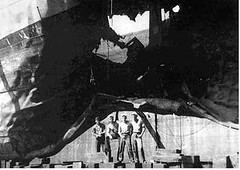
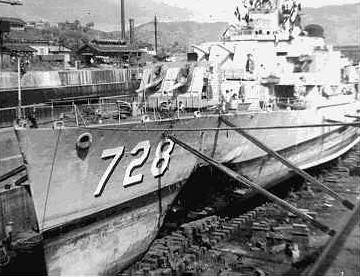
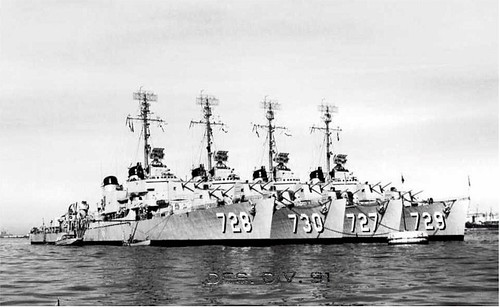
She was a Sumner Class DD. Eight Battle Stars over three wars ... but let's go back to the Korean War ... and remind ourselves of what is still out there ... waiting ... and what a well made ship, a well led crew, and a little luck can get you.
About 1230I on the 30th, an urgent dispatch directed the MANSFIELD and SWENSON to proceed at best speed possible to Lat 38°45'N, Long 128°15'E to assist a B-26 aircraft reported down at that point. The distance was about 60 miles north of the MANSFIELD. At 1445I the ship went to General Quarters and set Material Condition Able, executing this routine exercise with more thatn usual vigor upon hearing from the SAR plane on the scene that small arms fire had been received from the beach. At 1450I the ship reported on the scene and commenced searching. At 1500I, with the L.K. SWENSON lying to outside the 50 fathom curve, to cover our approach, the entry to Choson Ko begun. The approach was made at slow speed, heading so that the reported position of the plane wreckage would be on the starboard bow. A second plane was now on the scene, a B-178 with a rescue boat. The SAR plane, when requested to make another pass over the wreckage it had reported approximately 500 yards east of Toi To Island, again drew machine gun fire which could clearly be heard on the ship.

The ship had stopped engines at 1535I, and at 1536I both engines were backed to bring the way off, at a point 2,200 yards from the reported wreckage, in 12 fathoms of water. Some objects were now visible in the cove near the beach; a raft of logs about 3,000 yards to port, some net buoys about 3,000 yards ahead. At 1539I a sonar contact was identified as shoal, Chu Rai.

No sign of the suspected wreckage was seen by the many lookouts and officers on the bridge of the
MANSFIELD. Neither was anything seen in the water near the ship. The mine lookout, recently stationed in the eyes of the ship with rifle and binoculars, reporting nothing.

After backing clear to the vicinity of the L.K. SWENSON, a distance of four miles, engines were stopped and an account made of the casualties and damage. Radio reports were sent to cognizant commanders. Early analysis of the damage accurately established the water tight bulkhead forward at frame 48. This bulkhead was shored while wounded were carried to the battle dressing station in the wardroom. the Commanding Officer called repeatedly for an estimate of casualties particularly dead and missing. Finally an all hands muster on abandon ship parade confirmed the previous on-battle-station muster of NONE missing or dead. After this cheerful report was passed to all hands, the work of treating the twenty-eight wounded, of building shores, and of pumping tanks proceeded with greater expedition. Three weeks after the explosion the fact that not a man was lost of even crippled remains a miracle.
Please, read more at the links.

Check out this Fullbore timeline. Littoral warfare and fighting hurt; yea, we've got that.
CHRONOLOGICAL ORDER OF EVENTS
30 SEPTEMBER 1950

1227 Departed area of Point "Easy", Lat 37°56'N, Long 128°54'E, in company with USS LYMAN K. SWENSON DD729 proceeding at 25 knots to a point Lat 38°45'N, Long 128°15;E, to investigate a report of a downed American B-26 in accordance CTG 95.2 instructions.
1239 Established radio communications with SAR plane.
1445 Small arms fire reported on the beach. Manned General Quarters Stations.
1450 Commenced approach to Chosen Ko. USS SWENSON standing by to seaward.
MANSFIELD on course 286°T, speed 10 knots.
1500 Commenced entry, on course 205°T.
1504 Slowed to 5 knots.
1508 Increased to 10 knots.
1509 Plane reported possible wreckage 1/4 to 1/2 mile east of small island (Toi To).
1513 Slowed to 5 knots.
1533 SAR plane reported directly over wreckage.
1534 SAR plane reported objects at mouth of inner bay, appeared to be a life preserver and box.
1536 Objects, apparently logs, sighted on port beam 3000 yards.
1538 All engines stopped. Lying to.
1539 Sonar reported contact on port bow, 1200 to 1300 yards. Identified as 4 3/4 fathom shoal (Chu Rai).
1547 Explosion port side forward. All engines back full. Backed clear of minefield, lying to outside 50 fathom curve in vicinity L.K. SWENSON.
1737 All engines ahead 1/3 (3 knots).
1850 Changed speed to 8 knots.
2108 Stopped for transfer of wounded to USS HELENA.
2245 Underway at speed 8 knots as guide of formation.
2346 Changed speed to 10 knots.
Now let's talk about the ship for a bit.

Of course, she is a Bath Iron Works ship - that should tell you a lot - but let's look at the stats.
Class and type: Allen M. Sumner class destroyer
Displacement: 2,200 tons
Length: 376 ft 6 in
Beam: 40 ft
Draft: 15 ft 8 in
Propulsion: 60,000 shp (45 MW); 2 propellers
Speed: 34 knots
Range: 6500 nmi. @ 15 kt
Complement: 336
Armament: 6 × 5 in./38 guns (12 cm),
12 × 40mm AA guns,
11 × 20mm AA guns,
10 × 21 in. torpedo tubes,
6 × depth charge projectors,
2 × depth charge tracks
... and yes, I'm going there.

Now the
Little Crappy Ship.
Class and type: Littoral Combat Ship
Displacement: 3,000 metric tons
Length: 378 ft
Beam: 57.4 ft (17.5 m)
Draft: 12.8 ft (3.9 m)
Propulsion: 2 Rolls-Royce MT30 36 MW gas turbines, 2 Colt-Pielstick diesel engines, 4 Rolls-Royce waterjets
Speed: 47 knots
Range: 3,500 nm at 18 knots
Complement: 75-100

Armament:
1x BAE Systems Mk 110 57 mm gun,
2x .50-cal machine guns
21x RIM-116 Rolling Airframe Missile Surface-to-Air Missiles
45 NLOS missiles
Yes, LCS is larger than a WWII-Vietnam era destroyer. Of course, NLOS is vapor-ware. The Army has CANX it. Still not proven on land or at sea.

I am glad that the LCS is fast - because it better run away fast from the cutting edge of 1940-60s technology. That's ok though. It will run out of fuel fast enough that in our time-warp sea battle - the dash would find her and the DD could stand off at a respectful distance and plunk away with its six 5"/38s. It will only take a hit or two.

Oh, we'll even give the LCS a helo. Good luck getting close to MANSFIELD. Those 5"/38s have quite a track record against sub-200 knots targets. That one 57mm might break or jam after awhile - and it can't shoot aft ... that would be bad.

Here is a fun fact; the widdle LCS's 57mm has a
max range of 9 mn - about 1,000 yds more than the standard load for the 5"/38. At that range - it takes a round about a minute to reach the target. Both ships are very maneuverable. On top of that - LCS cannot fire from the stern and would have to turn and close the MANSFIELD. Optically guided, ahem, or even if it was fully online - you will not get hits at max range.

In a gun battle - numbers matter. The number of turrets you have gives you redundency in case of mechanical failure or battle damage. It also gives you some wiggle room on your fire control solution as two ships move a lot. It is easier to kill a rabbit with a shotgun than a rifle when it is running.

The closer you get, the more accurate your fire as the round spends less time in the air. You also need a large magazine and multiple magazines. Inaccurate fire means you need to put a lot down range in hope you get a hit. Magazines can have failures just like turrets can.

When you get closer - odds are you will get hit too - multiple times. You need to fight when hurt. You need enough crew for DC, and fighting the ship. How many hits could the MANSFIELD take? Yea ... I think we know that.

How many hits from a 5"/38 HE rounds could LCS take? I vote one.

OK shipmate - you can ride the 1971 version of the USS MANSFIELD or you can ride the 2010 version of the LCS. You are 20,000 yards apart and both of you want that nuclear weapon floating adrift on a tramp steamer off of San Diego. ,,,, Wait ... I am changing the rules here for a second. Don't get upset; just pray I don't change them again.

MANSFIELD has a DASH. LCS has a FIRESCOUT - after all - Firescout is so much more transformational than a silly manned helo with those pesky and expensive Sailors on them. I would give LCS something to fight with besides NLOS - but it doesn't exist. Sorry - you're stuck with your 57/30/12.7mm; but at least you're wearing NWU.

OK, pick your ship. Just give me a second to get my long sleeve wash khaki uniform from the attic. Heck ... liberty was better in 1971 anyway.


Wednesday, May 20, 2009

When monkeys fly out of my SVTT

Ummm ... General Conway ... please call your office.
A persistent capability gap in U.S. naval surface fire support (NSFS) could well be filled by the new Littoral Combat Ship (LCS), according to Marine Corps Commandant Gen. James Conway.

Conway said his Navy counterpart, Adm. Gary Roughead, has agreed to expand the concept of using the LCS as a firing platform for what Conway called a “box of rockets.”

The services are still examining storage and elevator capacity aboard LCS, and Conway said “we don’t have [the] box we need.”

NSFS is the ship-to-shore artillery element of the fires triad used to suppress and break apart enemy forces under an amphibious assault. Marine and the Navy leaders looked to reinvigorate the Corps’ classic, forcible beach-entry role after years of in-land counter-insurgency fighting in Iraq and Afghanistan. But as adversary defenses become more sophisticated, and reach farther from shore, the challenge for U.S. forces remains to outfit ships with systems offering enough firepower and range.

The truncation of the DDG-1000 and cancellation last year of Raytheon’s Extended Range Guided Munition (ERGM) put a dent in the Corps’ requirement for NSFS (Aerospace DAILY, Dec. 19, 2006). In the near-term, Conway said, the Marine Corps has not found a volume of firepower that can successfully fill the NSFS gap. Using the LCS “may fix the problem for the long-term,” he added.
Let's do a little back of the cocktail napkin planning here - shall we?

Let's give the LCS crowd 100% success in having the right LCS (or let's say 4) there at the right time with the right mission module there with the right opponent and the right sea state, OK? We have NetFires onboard. Each box has 15 missiles that have the hitting power of about a 155mm artillery round.

As I understand it, each SUW LCS Mission Module will give you four boxes. That is 60 rounds of 155mm equivalent (yes, yes, precision fires bla-bla-bla, we know). Four LCS together and you have 240 155mm equivalent ......

Wait, am I getting ahead of myself? Let's read that again,
The services are still examining storage and elevator capacity aboard LCS, and Conway said “we don’t have [the] box we need.”
A NSFS "box of rockets?"

This should work out like this if we needed it anytime soon from the sound of it,


You want a "box of rockets?" At about the 1:15 point, these guys had box of rockets. Mmmmmm, from concept to development, how long did the LCT(R) take?

This concept ain't done. Put it back in the oven.
UPDATE: Thanks to Scott B., we have an update ... snerk .... no shocker, but as of 04 MAR - as per Raytheon the punch just got smaller by 25%.
The LCS Mission Module can fire as many as 45 NLOS-LS PAM missiles from three container launch units. With a range greater than 25 miles, the PAM missile gives the LCS an increased surface warfare weapon capability.

"These tests prove the plug-and-play missile seeker ability to detect and track targets while filling the warfighter's capability gap for precision engagement of moving and stationary targets in open and complex terrain," said Scott Speet, executive vice president of NetFires LLC and Raytheon's NLOS-LS program director.

Set the watch: It is that time again. I am mostly dropping off the grid for the next six days or so. Through the weekend and all. I have some good stuff tee'd up through the 26th, so keep coming back. As Spock and I are on an away team, I need the right team on the bridge. C-14 you have the con, Byron Chief Engineer, LBG nav, MTH weapons, AM, Mr. Walthrop and GoH man the anti-troll quick response team, Maggie Comms. Kristin plays that nice Yeoman with the clipboard and the mini-skirt circa the second season who keeps Bones (Skippy) out of trouble.

Once again, I have some good stuff lined up - but if there is something breaking, I won't be able to get to it here ... where ever "here" is.

Wednesday, December 30, 2015

LCS Fitted With Decorative Dental Implants

Ok, everyone calm down;
The littoral combat ship is going to grow teeth in 2016 when ships Freedom and Coronado are armed with over-the-horizon anti-ship missiles.

Both ships will deploy next year with either the venerable Harpoon missile or the Naval Strike Missile, a Norwegian-developed missile with a greater range than 100 nautical miles.

The missiles will likely be strapped onto the decks of the ships in box launchers and not fully integrated into the ship's combat system, ...
Yes, I will accept more, "you were right" ticker-tape parades ... but please, no more stripper-grams, they make Mrs. Salamander grumpy.

The money is that even though the Naval Strike Missile was tested in a one-off earlier this year, in the end it will be the less capable Harpoon. We have them, we have the equipment, training and support. That would be good for Phase 1. If we really want NSM, then we can do that in the next spiral. Well ... that is what I would do. Good now, perfect later and all that jazz.

We need to be upfront with each other about what this represents:
- First, this is an admission that we have a surface warship that cannot fight a surface battle. As we have discussed for roughly a decade here, LCS will be asked to do missions the transformationalists wished would go away, but those with a respect for historical reality knew would not. Even if the short range NLOS was made flesh, the LCS would still ...
- Even with this bolt-on weapon, LCS is at best a "shoot and scoot" platform in a surface battle. Once its missiles are gone, it has nothing else to effectively fight anything from a light corvette up. That is OK, if you don't mind having a ship the size of a WWII destroyer with with a smaller gun, fewer ASCM and less speed than a 1970s Pegasus Class hydrofoil. 
- Low observability is gone. You can do a lot with an arc welder, bags of cash, and electrical cable duct-tapped to the deck, but when you do that, your RCS dramatically increases. You are also screaming beacons throughout the electromagnetic spectrum as you coordinate your non-integrated weapon in to a coordinated attack or at least getting a targeting solution locally or through your RC/manned helo.
- Irony is that Harpoon and NSM are not "littoral" weapons. They are designed for open ocean fighting for reasons your JAG can explain to you in detail. So, just CS not LCS.
- LCS was an exquisitely designed platform without much "white space" to make up for its many conceptual flaws. As such, no VLS, just bolt on and hope. This is something that will work, and in that note, we should be satisfied with.

On a positive note:
- As one of the worst kept secret in our Navy is that many of our DDG can only use a Harpoon if it is made of wood and steal and thrown by the BM1, having some additional ASCM shooters - shoot and scoot or not - is a great addition to any Strike Group Commander. It gives you more options, and makes the enemy's job more difficult.
- It give the crew of LCS something to actually fight with if called on to do it. As it stands right now, all they can do is order their helo det to commit suicide while they do a Banzai charge pop'n away with their 57mm saluting gun hoping it ricochets off of a wave and hits something. We don't do such things, so the crew can only go hide as everyone else fights. We don't do such things like that well either - hence the need to give Sailors something to fight with besides PPT slides.

James Holmes got it just about right a few days ago when it comes to the best that LCS/FF can ever hope to be;
Frigate-like combatants like the LCS, which fall into the cruiser or flotilla contingents under Corbett’s taxonomy, have their place in maritime strategy. In safe times they’re implements of choice. But these aren’t safe times. Low-end warships may not be enough to police important waterways in an age when great powers—not nonstate lawbreakers—pose the main threat to the maritime legal order. Rounding up Captain Jack Sparrow is one thing. Facing down the Chinese, Russian, or Iranian navy is quite another.

By all means, let’s station littoral combat ships or their ilk in, say, Singapore for constabulary and alliance-building duty. They’re fine for missions in permissive settings. But they do need a backstop in embattled settings, manifest in a vibrant, hard-hitting U.S. Navy battle force arrayed nearby. Without that backstop—without a fleet able to prevail in contested seas and skies—we’re trusting to China not to make trouble in places where it’s been doing precisely that. We’re assuming the United States, its allies, and its friends can enjoy the fruits of maritime command without defending it.

That’s a flimsy—and ahistorical, and counter-Corbettian—assumption.

Tuesday, November 17, 2009

LCS - truth trumps PPT

There was once a time when the core group of LCS critics were a small, lonely, bunch. Picked on by many - called nasty names - dismissed as not being transformational enough in our thinking.

Always derided as not understanding that historical norms, institutional knowledge, and a traditional understanding of a warship at sea no longer applied to today's 21st Century Navy. Didn't we see? We are even creating new naming protocals for our ships! Entire classes will begin their hull numbers with "21!" Better yet, "1,000!"

It wasn't so much the cost - it wasn't so much the etheral transformatinalist's language - it wasn't the wave-of-the-hand dismissal of damage control reality that bothered everyone at the core; no. What was most worrying was the focus on manning to a minimum in full knowledge that watchkeeping and ship's maintenance could not be radically reduced - as humans are human - they have to sleep, eat, and take care of those things mammals need to do.

Sailors have always been "hybrid." When a ship is engaged in combat operations - it has never been overmanned. Damage control, extended combat watchkeeping, and fighting hurt always required a properly manned and trained ship. These things the LCS critics took as self-evident. The "Optimal Manning" cult of the Green Eye Shade though did not. Hope is not a plan, but for some it sure was a manning concept.

Like we often warned - after a few PCS cycles, shadows appeared pier-side, deployments were planned, ships needed to be manned, and missions needed to be done - that changes would have to be made.

Behold.
The Navy’s first littoral combat ship, Freedom, will add 20 sailors to its crew when it makes its trial deployment next year, making for a total complement of about 95 people, as opposed to the crew of 75 the ship was originally designed to carry.
...Freedom’s 20 extra sailors would sleep in two 12-rack berthing modules, about the size of shipping containers, which will ride in the ship’s multiuse mission spaces. While the 75 core crew members will stay in the ship’s integral berthing spaces — which include double-tall racks, rooms of no more than eight sailors, and a head and shower to each berthing area — the VBSS sailors’ lodging will be more like those of sailors on a destroyer, he said.

“The racks are exactly the same — there’s a vent fan, a night light above it, there’s the same strap to hold you in. They’re that creamy beige color with the little step,” Good said.
Did you catch that? My first thought - how much extra space will there be in the multiuse mission spaces for mission modules?
In addition to the extra sailors, Freedom’s “tailored” surface warfare package will include two 33-foot rigid-hull inflatable boats for its VBSS sailors; its two Mk 46 30mm guns mounted on the multiuse boxes atop the superstructure; an armed MH-60S Seahawk; and “quite a collection of boarding team equipment,” Good said, including flak jackets, small-arms weapons, grappling hooks, and specialized gear for at-sea boardings.

Freedom will not take a Fire Scout unmanned helicopter or any of the maritime robots it’s designed to carry, nor will it carry the Non-Line-of-Sight missiles designed to be part of its surface mission package. That weapon, being developed with the Army, is still being tested.
Friends - in this case - "tailored" means incomplete.

So, what do we have here? From the sounds of it - there is no way you could fit a complete Surface Warfare Package in an LCS, as - moment arm concerns aside - I don't think you could fit the additional people and equipment to support NLOS, Firescout etc. I will give you partial credit though - assume a one for one swap for Seahawk and Firescout - just to make it simple as we go forward on this post. But still .... is this what we mean when we talk "Surface Warfare Mission Module?"

We should probably call this something else - as what they are putting onboard isn't going to be doing much Surface Warfare. Call this the Maritime Law Enforcement package .... which is a Coast Guard Mission ... which makes LCS ..... wait for it .... a very fast, very expensive Patrol Gun Boat with extra space.

Thank you - pay the bartender, I will pick up my beer on the way out.

Let's get back to the manning issue though.
Cmdr. Don Gabrielson, Freedom’s Blue Crew commissioning commander, who has since moved on to a position on the Joint Staff, anticipated criticism of the Freedom’s taking extra people. It might be seen as an early concession that the ship can’t operate in the real world with the small crew for which it was designed, but that’s not so, he said.

“People are going to say, ‘Hey, this is more people than they said they’d need. They’re lying to us!’ ” he said. But just as an LCS will take aboard custom equipment to hunt submarines or mines, so too does it need custom gear — in this case, sailors — for a visit, board, search and seizure team, he said.

“VBSS is a manpower-intensive evolution. I did one deployment to the [northern Persian Gulf] and boarded 400 ships in three months. Sometimes, when you board those ships, you keep them, lock them down for five months at a time, and you need sailors aboard all the time when they’re in that condition.”
An LCS can’t spare any of its 75 sailors — 40 multitasking core crew members and 35 sailors from a mission-module and an aviation detachment — so it needs the extra hands.
Shipmate - what I am missing? You have a partial, excuse me, "tailored" mission package, but you still have to bring and extra 20 personnel? I thought you said 35 were for the mission-module? So, let me do my NROTC BA math here; 35+20=55 to support just a partial, excuse me, "tailored" mission package?

Funny - I didn't see that vignette on a PPT anywhere. Oh, weren't we warned by the Antitransformationalists about the fact that operating at sea is by it very nature a "manpower-intensive evolution?" Weren't they told to sit down and shut up? Oh yea - thought so.
“One of the things we’re looking at is crew workload. We’re monitoring it, and it was deemed prudent that we should bring on a separate team for that [maritime security operations] boarding team capability,” said Capt. Mike Good, the program manager for LCS’s mission modules.
You bet it is. Thing is - there is no reason this needed to be said in 2009. "We" knew this over a half decade ago, but no one wanted to hear it.

Now that we have handled the manpower issue in macro - let's look at it in micro.
“The racks are exactly the same — there’s a vent fan, a night light above it, there’s the same strap to hold you in. They’re that creamy beige color with the little step,” Good said.

However, the berthing containers will not include showers or heads for the extra ship riders. For the trial deployment, sailors will use the core crew’s heads and showers, and Naval Sea Systems Command will look into developing a new stand-alone restroom container for future use with, but not part of, the extra-sailor berthing modules.

“As you might imagine, it’s a better strategy to separate them,” Good said.

Gabrielson said the VBSS team using the crew’s heads and showers “was a nonissue.”

“It’s not something where people are gonna go, ‘This is bad,’ ” he said — but it could be tricky given the geography of the ship.

Many of the ship’s heads and showers are inside the eight-person berthing spaces, meaning VBSS team members will have to enter crew members’ berthing rooms to use their facilities. Chiefs and officers also share heads and showers.
Nasty spin. Why do we teach our leaders to spin? In this day and age, you are not fooling anyone - you just degrade your credibility.

Don't call an issue a "non-issue." Don't say that is isn't something a Sailor is going to complain about as bad - when you know very well that the poor SOB's in the live nearest bearthing area with a head and shower to the two 12 man shipping containers are going to find a bad experience dealing with a parade of their fellow Sailors bust'n a55 in their head all night long as they try to sleep. It is one thing to share a head with 8 men eating poorly - it is altogether another thing to double that number or more.

How about we just acknowledge the challenge, say we will mitigate it and move on? Don't pi55 on Phil Ewing's head and tell him it's raining. That is just insulting.

So, there you go. So far, LCS is moving along just like we told you it would. Shame - this was avoidable. All we had to do was go with the VISBY option or even better - Patrol Frigate along the lines of the better European designs.

Sigh. And the people responsible are still not held to account.

Monday, May 14, 2012

LCS: An Unhelpful Stage in the Argument

From the start of my concerns about LCS, the argument has always been over cost/benefit, utility, bad theory, and the general symptom it represents of a larger acquisition process..

The argument has always been a healthy one which to this point has been one of professionals on a professional subject, for all the right reasons.

Good people can disagree on LCS as the core of the argument goes down to "are we being smart with our money; are we doing a good job managing our programs; are we basing our Fleet design on sound concepts. "

That is healthy and good. I think what has made this even more interesting is that for the most part, both sides of the argument have been on the "Sea Power Team." If a Sen. McCain or Rep. Forbes is busting your chops over LCS, you know they are doing so for the same reason you are trying to defend LCS - a desire for a sound, well formed Fleet.

As the argument has grown and the clear problems with all things LCS from delays, design, quality, cost, CONOPS, NLOS, down-select, .... do I need to keep going? .... have come to the front, I am afraid that the blood in the water has attracted other entities.

POGO & Rep. Speier (D-CA) laid down gauntlet on LCS ... and I'm not all that happy.
The Navy's close-to-shore combat ship just hit some rougher seas. An amendment requiring the Government Accountability Office (GAO) to conduct a review of the Littoral Combat Ship (LCS) program passed during the House Armed Services Committee (HASC) markup of the National Defense Authorization Act (NDAA) yesterday. The amendment, introduced by Representative Jackie Speier (D-CA), requires the GAO to investigate cracks, equipment failures, engine breakdowns, weld quality, and other matters related to the ships performance and cost.

If this sounds familiar, it’s because, as Rep. Speier indicated during the markup, the LCS letter we sent to Congress last month was Rep. Speier’s impetus for submitting the LCS amendment.
I smell politics. I smell a standard issue San Francisco Democrat's view of defense. I smell less of going after LCS for the reasons we have covered here for the better part of half a decade - and more of going after LCS for the pot of money it represents.

POGO sometimes seems a little CDI-esque ... but not too much. When they pair up with someone like Rep. Speier though ... I think we have reached a phase where we have moved in to the temple of the money grabbers.

Ungh. In this case Navy - we've made our own luck.