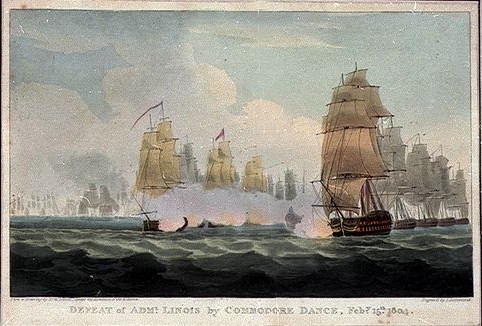
 About half of this is from an email Sid sent me back in 2009 when I first posted this. I added a little bit - but what a catch.
An elderly leader with decades of experience at sea. Merchants without enough military ships to make the passage. Hostile waters. A mission.
What do you do against a superior military force, when you basically have next to nothin'..?
You have been put in command of really nothing of a military ability - but everything of an economic necessity. Your nation is one that is at war, and relies on sea born commerce to survive and prosper. Between you and your nation are thousands of miles of open ocean, and an enemy that wants to destroy you.
You know you do not have what you need to fight and win ... at least on paper.
So, what do you do? Well - if you are Commodore Sir Nathaniel Dance, you get to work. You go to war with the Fleet you have - not the Fleet you wish you had.
Let's set the stage.
During the Napoleonic Wars, the British economy depended on its ability to trade with the British Empire, particularly the valuable colonies in British India. The intercontinental trade was conducted by the governors of India, the Honourable East India Company (HEIC), using their fleet of large, well armed merchant vessels known as East Indiamen. These ships weighed between 500 long tons (508 t) and 1,200 long tons (1,219 t) and could carry up to 36 guns for defence against pirates, privateers and small warships. They were not, however, capable under normal circumstances of fighting off an enemy frigate or ship of the line. Their guns were usually of inferior design, and their crew smaller and less well trained than those on a naval ship.
The East Indiamen sought to ensure the safety of their cargo and passengers, not defeat enemy warships in battle. Despite these disadvantages, the size of East Indiamen meant that from a distance they appeared quite similar to a small ship of the line, a deception usually augmented by paintwork and dummy cannon. The East Indiamen would gather at ports in India and the Far East and from there set out for Britain in large convoys, often carrying millions of pounds worth of trade goods.
The journey would usually take six months and the ships would subsequently return carrying troops and passengers to augment the British forces stationed in India. "Country ships", smaller merchant vessels chartered for local trade, sometimes independently from the HEIC, would often join the convoys. To protect their ships from the depredations of pirates, the HEIC also operated its own private navy of small armed vessels. In combination, these ships were an effective deterrent against smaller raiders, but were no match for a professional warship.
Understanding the importance of the Indian Ocean trade and seeking to threaten it from the start of the inevitable war, First Consul Napoleon Bonaparte ordered a squadron to sail for India in March 1803. This force was under the command of Contre-Admiral Charles-Alexandre Durand Linois and consisted of the ship of the line Marengo and three frigates.
What was Commodore Dance working with?
The China Fleet was a large annual British merchant convoy that gathered at Canton in the Pearl River during the winter before sailing for Britain, via India. As the convoy passed through the East Indies, it was joined by vessels sailing from other European ports in the region on the route to India, until it often numbered dozens of ships. The 1804 fleet departed in late January, and by the time it reached the approaches to the Strait of Malacca it had swelled to include 16 East Indiamen, 11 country ships, a Portuguese merchant ship from Macau and a vessel from Botany Bay in Australia.
Although the HEIC had provided the small, armed brig Ganges as an escort, this vessel could only dissuade pirates; it could not hope to compete with a French warship. There was no military escort: news of the outbreak of war had reached Canton before reinforcements had arrived from the squadron in India. Spies based in Canton had passed the composition and date of departure of the China Fleet to Linois in Batavia, and he set out to intercept it. However, Dutch informants at Canton had also passed on false reports that Royal Navy warships were accompanying the convoy, reports that may have been deliberately placed by British authorities.
The convoy was an immensely valuable prize, its cargo of tea, silk and porcelain valued at over £8 million in contemporary values (the equivalent of £541,000,000 as of 2009). Also on board were 80 Chinese plants ordered by Sir Joseph Banks for the royal gardens and carried in a specially designed plant room.
The HEIC Select Committee in Canton had been very concerned for the safety of the unescorted convoy, and had debated delaying its departure. The various captains had been consulted, including Henry Meriton, who in his ship Exeter had captured a frigate during the Action of 4 August 1800, a disastrous French attack on a convoy of East Indiamen off Brazil. Meriton advised that the convoy was powerful enough in both appearance and reality to dissuade any attack. He was opposed by John Farquharson of Alfred, who considered that the crews of East Indiamen were so badly trained that they would be unable to mutually defend one another if faced with a determined enemy.
Eventually the Committee decided that it could delay the convoy no longer and awarded command to the most experienced captain, Commodore Nathaniel Dance in the East Indiaman Earl Camden, an officer of over 45 years service at sea.
Not perfect - not even good; but what does a leader do? Improvise, adapt - overcome.
Lead.
Dance had been taken seriously ill at Bombay during the outward voyage, but had recovered in time to sail with the convoy. The fleet did not have any naval escorts, and though the East Indiamen were heavily armed for merchants, carrying nominal batteries of between 30 and 36 guns, they were no match for disciplined and professional naval forces. Not all of their listed armament was always carried, but to give the illusion of greater strength, fake gunports were often painted on the hulls, in the hope of distant observers mistaking them for 64-gun ships of the Royal Navy
...maneuver and deceive...
At dawn on 15 February, both the British and French forces raised their colours. Dance hoped to persuade Linois that his ships included some fully armed warships and he therefore ordered the brig Ganges and the four lead ships to hoist blue ensigns, while the rest of the convoy raised red ensigns. By the system of national flags then in use in British ships, this implied that the ships with blue ensigns were warships attached to the squadron of Admiral Rainier, while the others were merchant ships under their protection. Dance was unknowingly assisted by the information that had reached Linois at Batavia, which claimed that there were 23 merchant ships and the brig in the convoy. Dance had collected six additional ships during his journey, and the identity of these were unknown to the French, who assumed that at least some of the unidentified vessels must be warships, particularly as several vessels had been recently painted at Canton to resemble ships of the line.
At 09:00 Linois was still only observing the convoy, reluctant to attack until he could be sure of the nature of his opponents. Dance responded to the reprieve by reforming the line of battle into sailing formation to increase his convoy’s speed with the intention of reaching the Straits ahead of Linois.
With the convoy a less intimidating target, Linois began to slowly approach the British ships. By 13:00 it was clear that Linois's faster ships were in danger of isolating the rear of the convoy, and Dance ordered his lead ships to tack and come about, so that they would cross in front of the French squadron. The British successfully executed the manoeuvre, and at 13:15 Linois opened fire on the lead ship, Royal George, under the command of John Fam Timmins.
The Royal George and the next four ships in line, the Indiaman Ganges, Dance's Earl Camden, the Warley and the Alfred, all returned the fire, Ganges initially attacking the Royal George in error. Captain James Prendergrass in Hope, the next in line, was so eager to join the battle that he misjudged his speed and collided with Warley, the ships falling back as their crews worked to separate their rigging. Shots were then exchanged at long range for 43 minutes, neither side inflicting severe damage.
Royal George had one man killed: a sailor named Hugh Watt, another man wounded, and suffered some damage to her hull. None of the other British ships or any of the French reported anything worse than superficial damage in the engagement.
At 14:00, Linois abandoned the action and ordered his squadron to haul away with the wind and sail eastwards, away from the convoy, under all sail. Determined to maintain the pretence of the presence of warships, Dance ordered the ships flying naval ensigns, including his flagship Earl Camden, to chase the French. None of the merchant ships could match the French speed, but an attempt at a chase would hopefully dissuade the French from returning.
For two hours, Dance's squadron followed Linois, Hope coming close to catching Aventurier but ultimately unable to overtake the brig. At 16:00, Dance decided to gather his scattered ships and return to his former heading rather than risk attack from other raiders or lose sight of his convoy in the darkness. By 20:00, the entire British convoy had anchored at the entrance to the Straits of Malacca. On 28 February the British ships of the line HMS Sceptre and HMS Albion joined them in the Strait and convoyed them safely to Saint Helena in the South Atlantic, from where the convoy returned to Britain without further incident.
The attitude and conduct of the French Admiral is telling as an example of how not to fight war at sea.
The French admiral later attempted to explain his conduct during the engagement:
The ships which had tacked rejoined those which were engaging us, and three of the engaging ships manoeuvred to double our rear, while the remainder of the fleet, crowding sail and bearing up, evinced an intention to surround us. By this manoeuvre the enemy would have rendered my situation very dangerous. The superiority of his force was ascertained, and I had no longer to deliberate on the part I should take to avoid the consequence of an unequal engagement: profiting by the smoke, I hauled up to port, and steering east-north-east, I increased by distance from the enemy, who continued the pursuit of the squadron for three hours, discharging at it several broadsides.
—Linois, quoted in translation in William James' The Naval History of Great Britain during the French Revolutionary and Napoleonic Wars, Volume 3, 1827,
That is pathetic.
To end this FbF on a positive note - let's go back to Commodore Dance. Good leaders always are humble and thankful.
Placed, by the adventitious circumstances of seniority of service and absence of convoy, in the chief command of the fleet intrusted to my care, it has been my good fortune to have been enabled, by the firmness of those by whom I was supported, to perform my trust not only with fidelity, but without loss to my employers. Public opinion and public rewards have already far outrun my deserts; and I cannot but be sensible that the liberal spirit of my generous countrymen has measured what they are pleased to term their grateful sense of my conduct, rather by the particular utility of the exploit, than by any individual merit I can claim.
Class act.