Showing posts with label Airships. Show all posts

Tuesday, March 03, 2020

Airships: Now and Forever

At least once a year we need to throw a bone to our friend Campbell and allow me to bring one of my hobby horses out of storage.

Yes my friends, time to witness to you heathens the glory of airships!

This time, even FP is on the story;
The government of Quebec will be pitching 30 million Canadian dollars (23 million in U.S. dollars) to Flying Whales, a French company, to start building its massive zeppelins.
...
Flying Whales’ LCA60T model, according to the company, will be able to carry up to 60 metric tons of goods, travel up to 62 miles per hour, and serve remote areas with ease. If all goes according to plan, the company hopes to get the first airship off the ground in 2022.
Experimentation is good. With OPM, it is even better.

I hope they get this off the ground so we can learn what promise there is or is not there.

The maritime and logistics applications are well known.

Worth watching ... at least for Campbell and me.

Saturday, August 20, 2016

Airlander 10 - Underway

Yes, yes, yes - I know you blinkered troglodytes like to make fun of my and Campbell's faith in these aircraft - but I'm sorry; we should have at least two squadrons of these on order; one we give to the logistics guys, the other one to the Maritime Patrol and Reconnaissance guys and tell them; figure out what you can do with these.

From long-dwell ASW patrols to humanitarian assistance (not to mention a few SEAL missions I'll keep my mouth shut about), this platform has a lot of capabilities that have not been thought of yet. Perfect for the Reserves ... but that would require imagination and the willingness to take risks with proven technology. I know that isn't fun; but it sure has a good track record.

Well, we don't live in Salamander's world, so just watch her take off and ponder.


We believe in a new vision for air transport. That new vision is called Airlander. Hybrid Air Vehicles’ goal is to change the world of aviation through Airlander.
- We believe aircraft should be able to land and take-off anywhere.
- We believe aircraft should be able to fly for weeks at a time.
- We believe aircraft should be low cost and should pollute as little as possible.

Airlander takes the best of aeroplanes, helicopters and airships and combines them with the latest innovations in materials to create a truly revolutionary aircraft. The Airlander is a “hybrid” of an aeroplane and an airship – we get 40% of our lift from the aerodynamic wing shape of our aircraft, and 60% from the helium fill – it is therefore inherently more efficient than other forms of air transport. It uses the very latest fabrics to maintain its shape and is technologically years ahead of other aircraft. Airlander has flown before under a US Government programme, but is now being developed for commercial purposes, such as freight, remote access, aid distribution, advertising, surveillance, communications and luxury passenger transport.

Airlander aims to revolutionise transport and travel by:
- Being one of the lowest carbon emissions aircraft in the world, like for like.
- Having game-changing endurance (it can stay airborne for weeks rather than hours).
- Providing significantly lower delivery cost for airborne freight.
- Being able to land anywhere (water, land, desert, ice) thus opening up new point-to-point routes to previously inaccessible areas.

We will focus initially on Airlander 10, which has a 10 tonne payload, and ultimately could produce a range of hybrid aircraft capable of carrying up to 1000 tonnes.

Tuesday, March 08, 2016

Modularity? Here is a lot of that and whitespace to work with.

A few things I want you to consider not just for the 20-ton version, but especially the 50-ton version.

Think long dwell ASW. Think long dwell ISR at sea and ashore. Think disaster response. Think resupply in places that have lost shore facilities and have limited airports. There is even more to ponder.

USN or even USCG? I'd love to have one to give to Pax River (det Lakehurst, natch) and some JOs, a cadre of enlisted personnel, a funding line, and have them come up with some uses.
The longest aircraft in the world is preparing for its first test flight in a few weeks' time.

The Airlander 10 is a cross between an airship and an aeroplane.

It generates lift aerostatically through being filled with helium, and aerodynamically thanks to its unique-looking wing shape.

Because it's heavier than air, the 20-ton craft can land without tethers on most surfaces, including water.

Hybrid Air Vehicles, the makers of the Airlander 10 and based in Bedford, anticipate commercial uses such as leisure cruises, persistent, airbone research and for cargo to hard-to-reach places.

It can carry up to 10 tons and could be fitted to transport 48 passengers, flying for five days continuously, cruising at 80 knots (92mph).

The Airlander 10 was originally developed from 2009 for the US Army, which abandoned the project.

Hybrid Air Vehicles has plans for a 50-ton version of the Airlander.

Wednesday, July 17, 2013

Don't tell Campbell ....

... but here is a great website for pics airships past, present, and proposed.

Well worth your time.


Saturday, November 20, 2010

Tuesday, June 22, 2010

Airships for AFG!


At last - the Army goes Salamander!
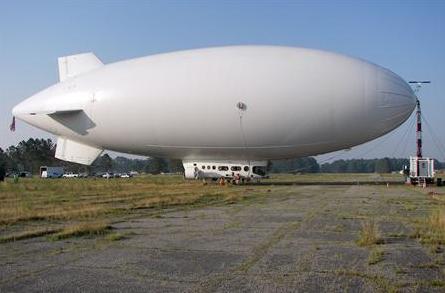
The US Army has asked Northrop Grumman to design three hybrid airships that are capable of providing American soldiers with persistent ISR (intelligence, surveillance and reconnaissance) capabilities in Afghanistan.

The airships - which have been dubbed Long Endurance Multi-Intelligence Vehicle (LEMV) systems - will be deployed in just 18 months.

"It is critical [for] our warfighters [to be] equipped with more enabling integrated ISR capability to tackle today's and tomorrow's conflicts," explained Northrop spokesperson Alan Metzger.

"[So], we have designed a system with plug-and-play capability to readily integrate into the Army's existing common ground station command centers and ground troops in forward operating bases."

According to Metzger, the LEMVs are expected to be capable of sustaining altitudes of 20,000 feet for a three-week period.
We've been asking for this for years. Hybrid airships are perfect for persistant ISR - better in many cases than Global Hawk/BAMS. I have a bias towards manned systems - but for ISR we could go UAS if we must.

Next step is to get some manned
cargo/transport versions that are ready to be built and can go places with more stuff than any C-17 to C-130 can.

As for this ISR one from LMT - a little more the Army's Solicitation.
The LEMV will be utilized to provide persistent Intelligence, Surveillance and Reconnaissance (ISR) support in multiple environments, including combat areas. Technical objectives for the LEMV include the following performance parameters: a. Unmanned air vehicle capable of being controlled through existing DOD ground station; b. 3 week flight endurance; c. 2500 pound sensor payload; d. 20,000 foot operating altitude; e. Multi-INT capable; f. 16Kw power for payload; g. capable of station keep; h. recoverable and reusable.
The advantages of a manned cargo variant - especially for an expeditionary force that may or may not (see Haiti) have access to airfields that can take large aircraft - are legion. One of the most lame excuses I hear against using modern hybrid airships is the old, "It will be too hard to build a proper career path and to get the right Flag sponsorship .... " etc.

Really? Really? We quit that soon for such a lazy reason? Sure, it is part of the environment ... but more often than not it is an excuse for the lazy mind.

Career path? Harumph. Then give them to the CWO/LDO professionals - they won't spend all their time tracking the career paths of others in their select group. Better yet, give it to the Reserves and Guard. Goodness knows that we have excess capacity in the USNR compared to the USAFR, USAR, and ANG.

What would I give up - you budget geeks ask (correctly). Simple. Four LCS. I like the bang for the buck of ~$3.5 billion in ISR and Transport hybrid airships any day. Make the cargo force 1/3 active duty with 50% CWO/LDO pilots (AWs need honest work now days anyway) and 2/3 USNR so we can recapture some of the money we spent on pilot training when the 1310s leave active duty. Another option - save more personnel costs by making the ISR hybrid airships part of the BAMS squadrons (large overlap in skill sets WRT mission systems).

In just 5 minutes, did I give you enough COAs to start with?

You're welcome.

Oh BTW - the Army is beating you; this time in something that actually matters - and come on, this is a no-brainer. It already comes in Navy Gray for goodness sakes.

Thursday, October 01, 2009

WESTPAC relief services

In an ongoing email thread about what we should do WRT nature gone wild (as she will do) in WESTPAC - and some ideas about INGRAHAM's lucky show in the neighborhood and what could be done in Indonesia (some good intentioned people, not me, proposing INGRAHAM could help there as well) - I had to play my role.

Skunk at the picnic.

It is a good chance to discuss a few items though. You WESTPAC Sailors know the math. Here is my skunk spray.
I would be first interested in the Navy's efforts ongoing in Somoa with the INGRAHAM. You know, American Samoa, the folks with the USA passports. They have 150 dead I believe as of today, more to come I am sure. Once we do what we can there - then perhaps we can shift fire West to Indonesia.

Samoa is 2,250nm from Hawaii. 2,100nm from Brisbane and about 1,600nm from Aukland. As the P-3 flies (in two days with a strong tailwind), the INGRAHAM is 5,400nm from the coast of Sumatra, Indonesia. I hope INGRAHAM has no plans to go there. Yokohama is "only" 3,100nm north of Sumartra. There are other options. The PACFLT AOR is huge - time distance is a bear.

INGRAHAM's story is American Samoa. I agree with SJS that we should leave the CO alone. He has a huge weight on his shoulders.

What this does show, if we wanted to pick around another aspect of this - is how our limited set of tools does not set us up well to do worldwide humanitarian missions.

When your only "heavy" capable airfield is out and you are days or weeks away from something such as a hospital ship (depending on where it is stationed) and are at the mercy of luck (INGRAHAM was just in the neighborhood) - you are in a lot of trouble when hit like this.

What tools would help? Well the only answers are what we don't have. Up through the Vietnam war, we still had large capacity cargo amphibians. The Japanese did until the last 90s doing SAR and patrol for their Coast Guard, I believe. The only ones left are in museums or fighting fires. All new construction is smaller amphibians.

Not just for this mission, but for other Strategic Lift answers for remote location are, of course, Lighter Than Air cargo airships. More flexible than an aircraft - faster than a ship. When you have over 2,500 miles to go somewhere with no airstrip; there you go. Even if you had a ship that could respond immediately, keep 25 kts SOA, and take the great circle route - that is still four days and change from 2,500.

Thursday, June 25, 2009

Blimp, airships --- bring 'em on

Via The Economist, lighter than air; now more than ever
SPYING is a sophisticated and expensive business—and gathering military intelligence using unmanned aircraft can be prohibitively so. Predator and Global Hawk, two types of American drone frequently flown in Afghanistan and Iraq, cost around $5,000 and $26,500 an hour respectively to operate. The aircraft themselves cost between $4.5m and $35m each, and the remote-sensing equipment they carry can more than double the price. Which is why less elegant but far cheaper balloons are now being used instead.

Such blimps can keep surveillance and ordnance-guiding equipment aloft for a few hundred dollars an hour. They cost hundreds of thousands, not millions, of dollars. And they can stay in the air for more than a week, whereas most drones fly for no more than 30 hours at a time. They are also easy to deploy, because no airfield is needed. A blimp can be stored in the back of a jeep, driven to a suitable location, launched in a couple of hours and winched down again even faster.
Makes you wonder if anyone ever thought about putting a "ISR Blimp Kit" next to the FireScout on the back end of a LCS?

Persistent ISR; you've got it.

Remember the SECDEF quote from yesterday?
At least 20 countries use blimps—both global military powers, such as America, Britain and France, and smaller regional ones, including Ireland, Pakistan, Poland and the United Arab Emirates. Many are employed in Iraq. In November 2008 Aerostar International of Sioux Falls, South Dakota, began filling a $1.8m order for 36 blimps to be deployed by the American armed forces in Iraq. But Afghanistan may prove a bigger market. That is because it is difficult to pick up satellite signals in the valleys of that mountainous country. As a result blimps, adjusted to hover at appropriate heights, are often used to relay data to and from satellites.

As politicians around the world seek to cut public spending, the attractions of blimps are growing. In January America’s defence secretary, Robert Gates, told the Senate’s armed-services committee that the Department of Defence would pursue greater quantities of “75% solutions” that could be realised in weeks or months instead of “99% exquisite systems” that take more than a decade to develop. Barry Watts, an analyst at the Centre for Strategic and Budgetary Assessments, a think-tank in Washington, DC, says America’s air force has been criticised for not providing enough aerial data to “insatiable” ground forces. Blimps, Mr Watts reckons, will help them sate that appetite.
Nice.

Wouldn't mind a larger version for BAMS either .... but AeroStar can't fight the lobby efforts of Northrop-Grumman I bet.

Wednesday, April 08, 2009

Can we call it the "SAURON?"

Can't think of a better name for this lovely.
The Pentagon said Thursday that it intends to spend $400 million to develop a giant dirigible that will float 65,000 feet above the Earth for 10 years, providing unblinking and intricate radar surveillance of the vehicles, planes and even people below.

"It is absolutely revolutionary," Werner J.A. Dahm, chief scientist for the Air Force, said of the proposed unmanned airship -- describing it as a cross between a satellite and a spy plane.
Actually, evolutionary - but I won't quibble.

Thursday, June 26, 2008

Return of the half-wing


Smart, smart, smart.
With oil prices rising sky-high, the U.S. Navy and Coast Guard will test a helium-filled blimp to see if it can supplement the fuel-hungry aircraft that search the Florida Straits for smugglers and boats in distress.

The Navy is leasing a Skyship 600, about the size of a Boeing 747, for the six-week test mission between Florida's southern coast and Cuba, Coast Guard Lt. Matthew Moorlag said on Tuesday.

The manned ship is held aloft by nonflammable helium and propelled by two Porsche 930 engines that consume 10 to 12 gallons of regular gasoline per hour.

"It's considered a very green machine," said George Spyrou, president of Airship Management Services Inc, which owns and operates the blimp. "A regular jet uses more fuel to travel from the gate to the taxiway than we would to fly for a whole week."

The airship has a bathroom and can stay aloft up to 52 hours without refueling but the surveillance flights off Florida will be limited to about eight hours to guard against crew fatigue, Spyrou said.

His company in Greenwich, Connecticut, has a contract for a little under $1 million for the test. It will supply two pilots to float the ship at an altitude of 1,500 to 3,000 feet while a crewman operates the radar and other scanning equipment.
I've always had a weak spot for lighter-than-air vehicles. Not sexy, but for surveillance in an air permissive environment, they are just plain smart. Brickmuppet and Galrahn are on it too.

In case you are wondering about the half-wing, click here and scroll to the bottom.

Tuesday, October 03, 2006

Airships - NOW!

One day you are talking about the USS Macon, and the next week this comes along.

Here is what it can do.
Lift 500 plus tons, cruises at 100 mph, travel 12000 miles in 7 days, and fly at altitudes up to 20,000 feet.
  • Does not require sea and air port infrastructures;
  • Can operate with vertical take off and landing in and out of third world countries;
  • Could provide tremendous positive impact to humanitarian efforts throughout the world.;
  • Will provide a lower cost option of transporting cargo world wide, point to point.
Now this is transformational. Just by reference, a C-17 can take 170,900 lbs. 500 tons is 1,000,000 pounds. This airship can take the load of almost 6 C-17s - and it can dump it anywhere on water or land.


Let's not even start to talk about the long-dwell ISR capabilities of this thing.