skip to main |
skip to sidebar
This just ties in some of the many glorious threads we have covered over the DivThu through the years, along with another.
We all know how much higher education costs have gone through the roof. Google it if you are not up to speed.
We know a lot of this has to do with the bloat of administrative staff.
That is one thread, now let's tie it in to a common thread of DivThu; the Diversity Industry.
It is a common joke, here at least; ok "doctor" - you have a PhD in Gender Studies ... what are you going to do with that?
As the Diversity Commissariat are the storm troopers of the totalitarian left, leftist administrators and those looking to have their diversity metrics look right to their friends, they love to find jobs for diversity experts. As you know, as young men and women naturally show up at college being tolerant and welcoming to everyone, we can't have that kind of atmosphere. How can we signal virtue if we don't have someone to explain how people are really being oppressed - even if they don't know it yet.
Who is going to help us pick the right pictures for our Potemkin brochures?
Everyone needs a job, right?
Well, let's take a look at a cute little private Catholic liberal arts college in Minnesota called the University of St. Thomas where mom and dad will send at least $43,000 a year to (it went up 4% last year, BTW).
Over to the excellent Rod Dreher;
JOB SUMMARY
In accordance with our University of St. Thomas mission of advancing the common good and convictions of dignity and diversity, the university seeks to create and sustain a diverse, equitable and inclusive community. Reporting directly to the President, the Associate Vice President for (AVP) for Inclusive Excellence will lead the development and implementation of a proactive diversity, equity and inclusion strategy, which will support St. Thomas’s mission and strategic priorities.
..
TYPICAL DUTIES AND RESPONSIBILITIES
Collaborating with university partners, lead the development and oversee implementation of a vision and related strategy and action plan that advances university priorities and champions the importance and value of a diverse, equitable and inclusive environment. Comprehensively assess university culture and make recommendations about campus climate, student diversity, equity and success; and employee outcomes related to diversity and equity.
That means creating PPT slides and inviting speakers no one wants to see, and making sure the "wrong" kind of speakers don't get a chance to speak.
Read the whole word salad.
You know what kind of cheese that is? $135,000 to $146,000 a year. They have almost 9,878 students as of 2017, undergrad and graduate. ~$14.78 per student per year.
Not a bad gig. Get your money's worth.
I'm serving up a dish or two over at USNIBlog that I'm hoping a few people might take a bite of.
...with kindness and goodwill, of course.
Come on over and take a look.
... good liberty?
A US warship has essentially been quarantined at sea for over two months and has been unable to make a port call due to an outbreak of a viral infection similar to mumps.
Twenty-five sailors and Marines aboard the USS Fort McHenry amphibious warship have been diagnosed with parotitis, which causes symptoms similar to mumps, according to US military officials.
Until CNN asked about the incident, the US military had not disclosed it. The illness first broke out in December, with the most recent case being reported on March 9.
...I guess there is enough time for preservation work now?
What, too soon?
H/t Bob.
I am sure I’m not alone in taking a pause to this announcement;
The United States announced late Monday that it is pulling the remaining staff from its embassy in Venezuela, citing the deteriorating situation in the South American nation.
Secretary of State Mike Pompeo announced the decision as Venezuela struggles to restore electricity following four days of blackouts around the country and a deepening political crisis.
The U.S. has led an international effort to oust socialist President Nicolas Maduro and replace him with opposition leader Juan Guaido, who vows to hold a new presidential election. Guaido is backed by some 50 countries, while Maduro maintains support from countries such as China, Russia and Cuba.
Most CDRSalamander readers know their history enough to remember that removing embassy staff can be a prelude to military action. It isn’t a sure thing, but has a track record.
Especially when there are a lot of people who should know better talking about why we should go in to Venezuela – it would be a crime of omission for those who make a habit of commenting in the natsec arena not to put their markers down, again.
I’ve stated this a few times on twitter, so I’ll do it here too; there is zero reason anyone should expect a net positive outcome from US military intervention in Venezuela. I don’t care about the Cubans. I don’t care about the Russians. I don’t care about the Chinese.
We have a history in the Caribbean, Central & South America with direct military intervention. It isn’t a track record of success, and it is not in the long term appreciated by the people who live there. We do have a better record of non-direct intervention and assistance and that is the model we should continue to use.
Yes, the condition of the 32 million citizens of Venezuela is a tragedy, but it is a tragedy of their own creation.
They once had the greatest per-capita GDP in Latin America. They once had many freedoms, but they threw it away for the promises of a leftist populist and his socialist snake oil. They voted for it over and over and over. They allowed themselves to be disarmed. They allowed their military to become a corrupt tool of the government. They taunted and threatened much of their citizens who had the education, capital, and connections to lead a resistance – so those people are now in the USA and other Latin American nations getting on with their lives.
32 million Venezuelans. That is roughly the same population of The Netherlands and Belgium combined. It is rife with crime and corruption. They have a history of anti-Americanism. Sure, some expats are calling for the USA to intervene militarily – but we’ve played that fool before. Not again.
We don’t need their oil. We don’t need their affection. We cannot afford the military adventure looking for another dragon to slay.
If a single military boot needs to go on the ground, then let it be Brazil (population 209 million) in conjunction with Colombia (population 49 million) to do the wet work.
The best solution is for the Venezuelans to solve this problem on Venezuelan terms. Peaceful as they are doing now, or if that is not tolerable, then by armed rebellion. Once they do that with some success, perhaps they will get some international help.
Of course, having disarmed their citizens a few years ago, by design, it will be difficult to extract cities and areas from the control of government forces - but it can be done.
What should not be done is to have US military forces have anything to do with overthrowing the government of Venezuela – regardless of how unpleasant it seems.
We are not a missionary nation. We are not a global empire. Every time we forget that, we fail.
The Venezuelans marched behind banners stating, “Socialismo o Muerte” – well, they are going to have both.
Let them be an example for others so tragedy such as this wont’ be repeated again soon.
If you think we should intervene militarily, then feel free to lead a MP company in one of the myriad slums run by drug lords.
Looks like the NYT discovered and wants everyone to know that "the cloud" and all the internet that binds our world together is not floating around us, but is under us and the great blue sea.
The article is behind the paywall, so I won't make you go there, but let's touch on the topic.
Oceanic cables might seem like a 19th Century wonder, and they are, but that was just the first time our world was stitched together.
At war, it is not a new thing to consider data part of commerce and a nation's C2 infrastructure. Ever more so, the Information Age or Cognitive Age or whatever you want to call where we are now, it is all driven by fiber optic cables. Along those cables run everything from free pr0n to, as we discussed on Midrats yesterday, the command signals to our drones we use to fight our foreverwar.
Day to day lives in this age without access to internet? Look south;
Internet Collapses in Venezuela with 80% Offline; Twitter, YouTube, SoundCloud Blocked
That is just entertainment in a 3rd rate nation. Now consider what would happen to a global mercantile power engaged in military action. Not just a "soft kill" that has to do with electricity and software ... but a hard kill?
No, this isn't a new threat. It is old. Go back a bit over 120-years;
To isolate Cuba from Spain and other countries of the world was the problem which, upon the breaking out of war between the United States and Spain, immediately engaged the attention of our fleet at Key West. The blockade became virtually effective along the entire coast-line of Cuba, preventing the landing of food-supplies and munitions of war, as well as cutting off communication by mail between the island and the outside world. This, however, was not enough. General Blanco at Havana was still in direct communication by ocean telegraph-cables with many of the islands of the West Indies, and thence with the home government at Madrid. To cut these cables and thus destroy the Spanish telegraphic lines of communication, preventing the authorities at Madrid and at Havana, and the ships of Admiral Cervera's fleet, from sending or receiving information, was of the utmost strategic importance.
No ocean cables are landed on the north coast of Cuba except those leading directly from Havana to Key West. The United States, holding the terminal at Key West, controlled these lines. On the south coast the telegraph-cables are looped along the shore from Batabano, a port about thirty miles nearly due south of Havana and connected with that city by railroad and overland telegraph, to the eastward as far as Guantanamo Bay; the northern loops of the cables touching at San Luis, Cienfuegos, Trinidad, Santiago de Cuba, and a point on the shore of Guantanamo Bay.
...
The naval force operating on the south coast of Cuba in the early part of May, at the time of the cutting of the cables at Cienfuegos, was composed of the cruiser Marblehead, the gunboat Nashville, the converted yacht Eagle, the revenue cutter Windom, and the collier Saturn, at that time forming the fourth division of the fleet, under the immediate command of Commander B. H. McCalla, U. S. N., who flew the senior officer's pennant on board the Marblehead.
Cienfuegos is situated about six miles from the sea, and the bay or harbor is entered by a channel three miles in length. On the east of the entrance is Punta de la Colorados, where a lighthouse is situated. Overlooking this low strip of land and extending some miles to the eastward is a ridge or plateau, from two to three hundred feet in height, steeply sloping to the shoreline. Trees and the dense chaparral of Cuba cover the rocky and irregular surface of this hillside, the wild confusion of nature forming better rifle-pits here than the efforts of man could produce.
...
Shortly before sundown on May 10, signal was made directing the commanding officer of the Nashville and me to repair on board the Marblehead. On our arrival on board that vessel, we were informed by Commander McCalla that he intended to make an attempt at daylight the following morning to cut the ocean telegraph-cables; that an expedition of boats under my command would be sent in to endeavor to find and cut the cables landing near Colorados lighthouse, that the expedition would be opposed by a force of the enemy, and that the Marblehead and the Nashville would shell the country and attempt to dislodge the enemy or silence his fire. I was told that I could have the steam-cutter and the sailing-launch of the Marblehead and the steam-cutter and the sailing-launch of the Nashville, and that Lieutenant E. A. Anderson of the Marblehead would accompany the expedition as second in command. I had no further orders as regards the fitting out of the expedition, the details being left entirely to my own judgment.
...
The crew of each steam-cutter consisted of a cockswain, two seamen, a fireman, and a coal-passer. In addition to the crew, a sergeant of marines and half a dozen privates were to go as sharp-shooters. They were to be armed with rifles. In the Marblehead's steam-cutter a one-pounder Hotchkiss cannon was to be mounted on the forecastle. The Nashville's steam-cutter was to have two Colt machine-guns, one forward and the other aft. All boats were to be supplied with life-preservers. The tools for cutting the cables, to be carried in each sailing launch, consisted of cold-chisels, blacksmiths' hammers, a heavy maul, a block of hard wood with iron plate for its upper surface, an ax, wire-cutting pliers, and a hacksaw. Coils of stout rope and grapnels of different sizes were to be used in grappling the cables and bringing them to the surface.
...
My own individual orders were very brief. I was simply to cut the cables as directed above, and under no circumstances to land. The orders were quite sufficient, and I was glad to escape being hampered by more explicit instructions.
All should be nodding their heads here. Short clear orders.
Now days, things won't be so dramatic. Submarines and drones can do it ... but the impact will be the same and more dramatic as it will impact everywhere from teenagers' bedrooms to The Pentagon.
Silence. How the world would change in the blink of an eye.
So, what is the backup plan?
Head on over and read the whole thing by the guy who did the mission, LCDR Cameron Winslow, USN.
H/t Claude & Sid.
 How are unmanned systems and the increasing use of robots from the kitchen to the battlefield impacting how our personal, professional, and national lives are being run?
What are the obvious and not so obvious places they are already a dominate presence today, and where are trends leading us?
Our guest for the full hour this Sunday from 5-6pm Eastern to discuss the issues he raises in his book, "One Nation Under Drones" will be John E. Jackson, CAPT, USN (Ret.).
Professor Jackson has served at the Naval War College for more than 20 years, teaching in the areas of national security decision-making, logistics, and unmanned and robotic systems. He holds the E.A. Sperry Chair of Unmanned and Robotic Systems and lectures frequently. His latest book “One Nation, Under Drones" was published by the U.S. Naval Institute in December 2018. He is the program manager for the Chief of Naval Operation's professional reading program. Additionally, he serves on the President's Action Group and as chairman of the 9-11 Memorial Committee. A retired Navy Captain, he served in supply and logistics assignments both afloat and ashore retiring in 1998 after 27 years of active service.
Join us live if you can, but if you miss the show you can always listen to the archive at Spreaker.
If you use iTunes, you can add Midrats to your podcast list simply by clicking the iTunes button at the main showpage - or you can just click here.
Every half-decade or so it is fun to go back to a 2007 FbF ... take us away!
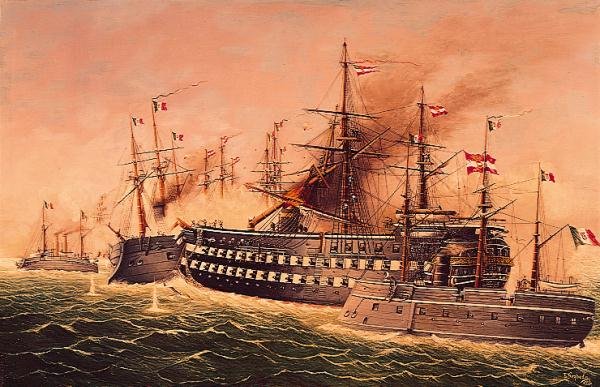
 The Imperial Austrian triple-decker wooden battleship Kaiser. Yes the AUSTRIAN Navy, again. Why her for Fullbore?
Well, the year was 1866 and this wooden warship held her own in the first major naval battle of ships of iron and steam against the Italian Navy at the Battle of Lissa.
Sure, she was outdated and the Fleet Admiral Wilhelm Freiherr von Tegetthoff was only 39, but was a glorious effort for a Navy that had only a little more than a half a century left.
The Imperial Austrian triple-decker wooden battleship Kaiser. Yes the AUSTRIAN Navy, again. Why her for Fullbore?
Well, the year was 1866 and this wooden warship held her own in the first major naval battle of ships of iron and steam against the Italian Navy at the Battle of Lissa.
Sure, she was outdated and the Fleet Admiral Wilhelm Freiherr von Tegetthoff was only 39, but was a glorious effort for a Navy that had only a little more than a half a century left.
Encountering the Italian fleet early on the morning of 19 July 1866, Tegetthoff sailed straight for the center of the Italian fleet, hoping to ram the ships to make up for his own fleet's lack of firepower. The smoke from the Italian ships made visibility very poor, however, and the Austrians missed the Italian fleet completely. Swinging around, Tegetthoff again charged, this time setting two Italian armored ships on fire and damaging several more.
After Tegetthoff's flagship, the Erzherzog Ferdinand Max, rammed and sank the armored Italian frigate Re d'Italia, the Italian fleet retreated the next day. Tegetthoff returned in triumph to his base at Pola (Pula). Nevertheless, his victory did not materially affect the outcome of the war, as Italy emerged victorious.
...
Seeing things going badly, Persano found the courage to throw himself into battle, deciding to ram the unarmoured screw battleship Kaiser rather than one of the armoured ships engaged with the Italian 2nd Division much nearer him. However, Kaiser managed to dodge Affondatore. Taking heart from his admiral, the captain of Re di Portogallo decided to hurl his ship at Kaiser, maintaining a heavy fire with her rifled guns as he did so. At the last moment, von Petz turned the tables on her and turned into the ram, in effect conducting a counter ram. The impact tore off Kaiser’s stem and bowsprit, leaving her figurehead embedded in Re di Portogallo. The Italian used the opportunity to rake Kaiser with fire, putting her mainmast and smokestack into the sea. The smoke was so great that as they backed off for another ram they lost sight of each other and ended the duel.
It's all here. Using 2,000 yr old tactics to win. Making the best of the Fleet you have. Aggressive action. Leaders who lead and win without waiting for specific direction to do so. More on the Kaiser, she survived the battle, here and here.